Showing posts with label Michael Matheson. Show all posts

Thursday, June 28, 2018

PROBE CONFLICT: £604K public cash inquiry magnate Ex Lord Advocate appointed to investigate Police complaints – linked to lawyers representing cops facing complaints

Ex Lord Advocate conflict of interest in inquiry role. A FORMER Lord Advocate who has links to lawyers and a suspended judge who represent the Scottish Police Federation (SPF) and cops facing complaints – has been appointed to review how complaints are handled against cops.

However, details released of the review fail to mention that Dame Elish Angiolini (nee McPhilomy) – hired Levy and Mcrae - who have been paid hundreds of thousands of pounds by Police Scotland & the Scottish Police Authority (SPA) – to get cops off the hook from complaints - including probes into deaths.

One of the lawyers linked to ex Lord Advocate Elish Angiolini – is suspended Sheriff Peter Watson.

Watson, who was suspended from the judicial bench by  Lord Brian Gill in 2015, after being named in a £28m writ linked to bust hedge fund Heather Capital - represents Police officers facing complaints and investigations by the Police Investigations and Review Commissioner.

Links between Angiolini and Watson are revealed in documents obtained from an investigation by Audit Scotland into payments of public cash by the Crown Office to Levy and McRae and Peter Watson.

Meanwhile Watson and his now former law firm Levy and Mcrae - also scoop up public cash for representing cops who are being investigated over complaints.

A recent report in the Scottish Sun found Police paid £187,000 to Peter Watson’s law firm PBW law for legal fees for representing cop clients facing complaints and other ‘issues’.

The newspaper also reported Police Scotland also paid £364,830 in charges over three years to Watson’s former law firm Levy & McRae – who are also linked to Angiolini.

Records also show Peter Watson represents Police Officers on behalf of the Scottish Police Federation – who assign Watson to officers facing difficult complaints investigations.

One of the high profile cases where Watson represents cops being investigated over complaints - includes  the three year investigation of Police Officers involved in the death of Sheku Bayoh.

Sheku, 31, died after being restrained by nine officers responding to reports of a man carrying the knife in the street in Kirkcaldy. Officers used CS spray, pepper spray and batons, after it was claimed Sheku struck Short. Dad-of-two Sheku lost consciousness and died in hospital shortly afterwards.

The Daily Record reported that Days after Sheku’s death in Police custody, the very same lawyer linked to Angiolini –  Peter Watson - who now has his own law firm PBW Law - issued a statement on behalf of the Scottish Police Federation and the officers involved.

He claimed Sheku “punched, kicked and stamped on” a female officer. However, none of this has been proved and a probe into the death is still underway.

The paper also reported Watson threatened the family of the deceased Mr Bayoh, in relation to a facebook posting, claiming the contents were a ‘breach of criminal law’.

A recent report in the Sunday Mail newspaper revealed PC Alan Paton, 44, has been paid about £75,000 to remain at home while the inquiry into the death of Mr Bayoh in Police custody, continues – three years after the events occurred.

A second officer involved in the investigation, PC Nicole Short, is also being paid similar amounts while off duty since Sheku’s death in 2015.
Now, an investigation by journalists into Elish Angiolini’s lucrative inquiry jobbing has revealed the former Lord Advocate has scooped well over half a million pounds of public cash - writing reports on policy areas which in reality have seen little change over the years, and are mainly used by ministers for PR purposes.

Details of large amounts of public cash payments to Elish Angiolini obtained by journalists using Freedom of Information legislation reveal Angiolini has received at least £603,985.41 for a handful of reports.

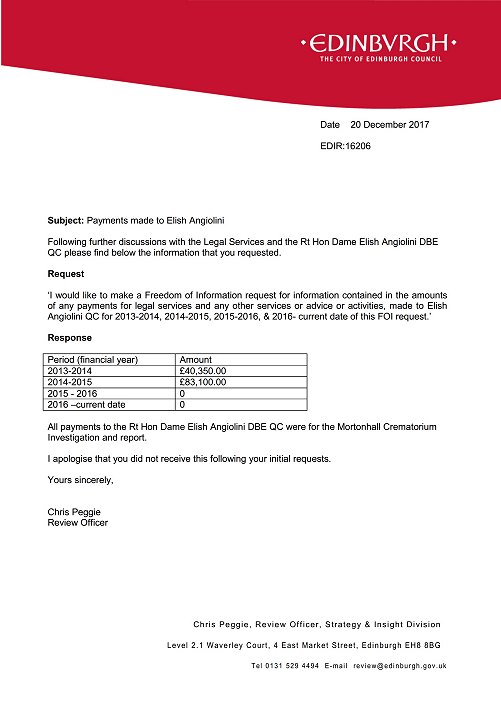
Payments of public cash from the City of Edinburgh Council to Elish Angiolini reveal the former Lord Advocate received large payments of public cash totalling £123,450 broken down to £40,350.00 in 2013-2014 and £83,100.00 in 2014-2015 - for the Mortonhall Crematorium Investigation and report.

However, the City of Edinburgh Council bitterly resisted releasing details of the payments, and the figures were only eventually disclosed after the intervention of the Scottish Information Commissioner.

Details obtained from the Scottish Government – who also resisted initial disclosure of what are listed as separate payments to Angiolini for a report into National Investigation into Infant Cremation Practices reveal Angiolini received even larger sums of public cash from the Scottish Government totalling at least £240,000 - broken down to £60,000 in 2014/15, £120,000 in 2015/16, and £60,000 in 2016/17

Expenses paid to Angiolini for the exact same report - which were claimed to involve meals for ‘other team members’ totalled £437.13 in 2014/2015, £621.18 in 2015/2016, and £292.05 2016/2017

A response from the UK Home Office disclosed the total amount paid to Dame Elish for work done on the review of Independent Review of Serious Incidents and Deaths in Police Custody was £116,667.

The Metropolitan Police, who paid Angiolini for a Report of the Independent Review into The Investigation and Prosecution of Rape in London – initially refused to release details of their huge payments to Angiolini,.

It then took over five months before the figures were released, and only after the matter had been reported to the Information Commissioner who began an investigation into the Metropolitan Police handling of the FOI request.

The response from the Metropolitan Police, received earlier this week stated: I can confirm the amount paid to Dame Elish Angiolini was £122,518.05 - £120,715.30 for the review and report; and £1802.75 for travel and hotel expenses.

Angiolini, who was Lord Advocate from 2006 to 2011, was appointed ten days ago by the now ousted Justice Secretary Michael Matheson - to look at how complaints are handled against the very same cops her own former lawyer now represents.

However, Angiolini had a chequered career as Lord Advocate, and was once accused of deliberately undermining the judiciary by Scotland’s top judge, the well respected Lord Hamilton.

In a letter released to the media, Lord Hamilton hit out at Elish Angiolini’s use of her Ministerial rank to tell a story of different sorts to the Scottish Parliament, for the collapse of the World’s End murder trial in 2007.

In her address to MSPs in 2007, Lord Advocate Angiolini attempted to blame the court for failures in the collapse of the high profile murder trial, failures which were clearly of her own Crown Office.

Taking issue with Angiolini’s statement in Holyrood’s main chamber, Lord Hamilton said in his letter to Angiolini at the time: I am of the clear opinion that the evidence that was made available to the court was sufficient to put before the jury to allow it the opportunity to decide on the case against Angus Sinclair. Let me set out the Crown case presented to the court."

You then set out, in a detailed and carefully crafted narrative, the evidence apparently adduced by the Crown and conclude at column 1769 -

"It was the Crown's position that the evidence in this case allowed ... an inference [of guilt] to be drawn."

It is clear that you were, as Lord Advocate, stating to the Parliament that in your "clear" opinion there was sufficient evidence to go to the jury. The plain implication from that statement was that you were publicly asserting that the decision of the trial judge was wrong.

Although I have read the whole of your statement to Parliament and the statement which the trial judge issued giving detailed reasons for his decision, I have formed no view as to whether or not that decision was sound in law. I am, however, concerned that you have thought it appropriate to challenge, in a public and political forum and in the way which you have, a final decision of the court (whether that decision be right or wrong).

Section 1(1) of the Judiciary (Scotland) Bill provides that certain office holders, including the Lord Advocate, must uphold the continued independence of the judiciary. That section, I believe, reflects an existing recognition that the Lord Advocate, among others, has such a duty. The independence of the judiciary depends, in my view, not only on freedom of individual judges from prior interference with decisions they have to take but a preparedness by the Lord Advocate and others to recognise, in all public pronouncements, that final decisions made by judges, whether on points of law or on applications of the law to particular facts or to particular evidence, reflect the law as it stands and must be respected as such. If such respect is not afforded, the independence of the judiciary as the final arbiter of legal issues is put at risk. An open challenge to the correctness of a final decision does not afford the requisite respect. Rather, it tends to undermine for the future the confidence which judges, faced with difficult decisions in controversial cases, can reasonably expect to have that their decisions will not be openly criticised by other organs of government.

The public prosecutor may of course entertain private views as to the soundness of legal decisions. In the light of experience steps may be taken to amend the law or in a legal forum to challenge the soundness of an earlier decision. But public criticism in a political forum of particular decisions, especially in controversial and sensitive areas, is in my view inappropriate.

My concern is not restricted to this case. The same situation might well arise in any case in which a trial judge sustained a submission under section 97. It might also arise where, on an appeal against conviction, the court held that there had been insufficient evidence in law to warrant it. While such events commonly occur without public interest, they may well occur in controversial cases. It would be most unfortunate were the Lord Advocate to adopt a practice of publicly criticising such decisions.

I can readily understand that, given the issue which had arisen as to whether the Advocate depute had properly exercised his discretion as to what evidence he should lead (or not lead), you would find it appropriate publicly to support him. But such support could have been afforded without public criticism of the judge. In particular, respect for what was treated as being a final decision of the High Court of Justiciary might have been expressly afforded.

I have discussed this letter with the Lord Justice Clerk. He agrees with its terms. He also agrees with my view that the letter should be made public.

The review of PIRC News comes after the PIRC Commissioner Kate Frame spoke out on the subject of who should investigate the Police in a recent Sunday Post article, here: So who should police the police? In her first interview in four years, Police Scotland watchdog breaks her silence

In the interview, Kate Frame called on MSPs to review who probes misconduct claims against officers and said whistleblowers should be able to turn to investigators outside the force.

Ms Frame said: “There is a discussion to be had about whether the police should investigate themselves.

“I think that from the public’s position, they would feel an independent investigation which has not been undertaken by the police would be preferable.”

In an earlier article it was revealed Police Complaints watchdog Kate Frame had accused Scottish Ministers of interfering in her functions as Scotland’s independent Police watchdog, reported by the Sunday Post here: Emails reveal police commissioner accused Scottish government of interfering after Justice Secretary’s aide asks her to delay scathing report

In the article,the Sunday post reported “the Police Investigations and Review Commissioner had to warn one of Justice Secretary Michael Matheson’s senior civil servants to back off after he attempted to persuade her to delay the publication of a damning report.”

“Ms Frame responded to the civil servant’s suggestion that her report might be delayed by writing: “My perception of your remarks is governmental interference with my independence.”

In the wake of the recently announced review to be conducted by the former Lord Advocate, legal insiders view the Scottish Government inquiry run by Angiolini move as an attempt to intimidate further outspoken views against Scottish Ministers interference in the Police Investigations and Review Commissioner and Police Scotland – which has been hit by multiple scandals used by senior officers & ministers in government to set their own agenda for Scotland’s single national Police force.

Angiolini’s glowing fanpage on Wikipedia records she was also working at the Crown Office as Solicitor General during the time in which prosecutors refused to look into 5 allegations of serious sexual assault against Scotland’s now current top cop, Deputy Chief Constable Iain Livingstone.

A report on the allegations of sexual assault against Iain Livingstone by a female Police Officer, allegations which were dismissed by a tribunal headed by male Police Officer colleagues of Livingstone was reported earlier by DOI here: TOP COP SECRETS: Transparency lacking at Police Scotland as spy scandal cops refuse to disclose files on complaints & historical sexual assault case details involving Deputy Chief Constable Iain Livingstone

Issues surrounding the allegations of sexual assault made by a female Police Officer against Iain Livingstone while he served at Lothian & Borders Police in 2003 resurfaced during recent scrutiny of Police Scotland over the past year.

Livingstone was however, cleared of the allegations by a hearing chaired by another senior Police officer - John McLean, Strathclyde assistant chief constable. The Police led hearing on allegations against Police Superintendent Livingstone established there had been no sexual impropriety or intent on Mr Livingstone's part.

However, interest in the 2003 case and details surrounding it has resurfaced – after the single Police service – created by the Scottish Government in 2013 - was hit by several scandals including numerous suspensions of senior officers, allegations of Ministerial meddling with ultimately led to the ousting of Chief Constable Phil Gormley, and the ongoing probe into senior officers use of a surveillance unit within Police Scotland to illegally spy on journalists & cops.

At the time of the sexual assault allegations in 2003, Iain Livingstone, 37, was working as an aide to Scotland's most senior police officer, Sir Roy Cameron, at Her Majesty's Inspectorate of Constabulary, when he was suspended in February 2003 over the claims - which arose from a drunken party at the Scottish Police College at Tulliallan.

It was reported at the time that Iain Livingstone - previously a solicitor and member of the Law Society of Scotland - had been suspended for 17 months after the WPC claimed she had been sexually assaulted during the party.

Five allegations of serious sexual assault made by the female Police officer against Livingstone were dismissed - but, at an internal misconduct hearing, Mr Livingstone admitted less serious allegations, including being in the woman's room overnight after falling asleep.

The Crown Office has refused to disclose any material in connection with their consideration of allegations of sexual assault again Iain Livingstone - and this would include material during the time which Elish Angiolini was Solicitor General.

Among the raft of appointments to write reports & reviews, including the position of Principal of St. Hugh's College of the University of Oxford - where she wrote a glowing appraisal of Aung San Suu Kyi, Angiolini is also listed as an Honorary Professor of  The Chinese University of Hong Kong.

Angiolini’s biography on the Honk Kong university site claims “As Lord Advocate she is seen as a moderniser, immediately announcing plans to speed-up justice and clear court congestion, including a scheme to quickly fine minor offenders and require them to pay compensation to victims.” - but makes no mention of significant failures during her time as Lord Advocate, including the episode where she was accused of undermining Scotland’s judiciary.

Michael Matheson’s announcement of Angiolini’s appointment by the Scottish Government was made in the Scottish Parliament:

Ministerial Statement on Police Complaints and Conduct Review

The written transcript of Michael Matheson’s statement:

Cabinet Secretary for Justice – Parliamentary Statement on review of complaints handling, investigations and misconduct issues in relation to Policing.

19 JUNE 2018

Thank you Presiding Officer.   

When I addressed the Chamber in November, on the leadership and performance of policing, I set out my intention to reflect on the operation of police complaints and conduct with key partners.   As I said then, I am open to considering whether there is scope for further improvement.

It is of the utmost importance to me and the public that parliamentary confidence in the police is high – and independently justifiably so – but equally that our systems provide suitable protection for the vast majority of police officers and staff who work hard to keep us safe.

Over recent months, I have listened to a range of different perspectives from those directly involved.  It is clear to me that complex issues have emerged in relation to the existing framework, operational responsibilities and procedures that need to be looked at afresh.

Five years on from the creation of Police Scotland, the Scottish Police Authority and the Police Investigations and Review Commissioner, the time is right to look at how the structures and processes are working.

To do that effectively will require an independent and authoritative assessment and that is why I, together with the Lord Advocate, have commissioned Dame Elish Angiolini QC to take this work forward.

I am delighted that Dame Elish has agreed to lead that Review.  As members will be aware, she is exceptionally well qualified to scrutinise these issues, as a former Procurator Fiscal, Solicitor General and Lord Advocate.

Her outstanding record of public service in Scotland is well known, having chaired the Commission on Women Offenders, as well as the Mortonhall Crematorium Investigation for the City of Edinburgh Council and National Cremations Investigation for the Scottish Government.

More recently, she led the independent Review into Serious Incidents and Deaths in Police Custody in England and Wales for the UK Government.

Under Dame Elish’s leadership, the Review of Complaints Handling, Investigations and Misconduct Issues in Relation to Policing will bring independent scrutiny to the framework and processes for handling complaints against the police and investigating serious incidents and alleged misconduct.

As well as assessing the current framework, the Review will report on the effectiveness of structures, operational responsibilities and processes. It will also make recommendations for improvements to ensure the system is fair, transparent, accountable and proportionate, in order to strengthen public confidence in policing in Scotland.

The Review will consist of two phases:

    The first phase will include a consideration of current procedures and guidance to identify areas for immediate improvement;
    The second phase will include a wider assessment of the frameworks and practice in relation to complaints handling, investigations and misconduct issues. It will cover the work of the Police and Investigations Review Commissioner, the Scottish Police Authority and Police Scotland.

The Review will take evidence from a broad range of stakeholders, including the Scottish Police Federation, the Association of Scottish Police Superintendents, the Scottish Chief Police Officers Staff Association, Unison, Unite, as well as the PIRC, SPA, Police Scotland and the Crown Office. Dame Elish may also wish to speak with those who have had experience of the current system to hear their views and understand where further improvement could be made.

Recommendations in the final report should take into account human rights considerations, as well as seeking to identify longer term improvements.

Presiding Officer, I am aware that the Justice Committee has invited evidence as part of its post-legislative scrutiny of the Police and Fire Reform (Scotland) Act 2012.  I welcome this scrutiny of the landmark legislation that enabled the creation of single police and fire services.

I am also aware that evidence has been submitted on the provisions within the Act that underpin our current system of police conduct, complaints and investigations. Those provisions were intended to strengthen the governance, accountability and scrutiny arrangements for policing and created a clear statutory framework for independent review and investigation.

It is only right that the Committee considers this evidence as part of its broader scrutiny of the Act and I look forward to seeing the outcomes of that process.

However, as the Cabinet Secretary with responsibility for the overall framework for dealing with police complaints and conduct issues in Scotland, which includes other primary and secondary legislation, I have a duty to ensure that the whole system is working well.  And the Lord Advocate has an independent interest, as head of the system for the investigation and prosecution of crime in Scotland.

The arrangements for complaints handling, investigations and misconduct issues in relation to policing, have seen a period of intense parliamentary, media and public scrutiny.

It is a framework that must ultimately build public confidence in policing and the events of recent months have raised questions about the way the system works and whether it could be improved.

It is only right that I listen to those questions and act decisively to address them, which is why the Lord Advocate and I have commissioned this Review.

The key outcomes of the Review will be to ensure that:

    roles and responsibilities at all levels are clear;
    there are agreed protocols that balance transparency with an appropriate level of confidentiality; and
    the framework and processes are fair, transparent, accountable and proportionate, upholding fundamental human rights.

Fairness. Transparency.  Accountability. Proportionality. These are the guiding principles of the Review and go to the very heart of what any system, which holds public services to account, should deliver.

The commitment to upholding fundamental human rights is embedded in police training, in the oath taken by officers and is central to Police Scotland’s Professional Ethics and Values. This is to ensure that policing operations respect the human rights of all people and officers, who in turn should have their rights respected.  This must also be central to the process for handling police complaints, conduct issues and investigations.

It is vital that the police are held to account when things go wrong.  Policing by consent depends upon that accountability.  And it is essential that lessons are learned and improvements made to prevent mistakes, bad practice - and criminality - recurring in the future.

In order to do that effectively, our systems must treat all parties fairly and justly if they are to earn the trust and respect of those involved and of the wider public.

Let me also be clear about what the Review will not do.  It will not consider the role of the Lord Advocate in investigating criminal complaints against the police.  Nor will it look at the role of HMICS in scrutinising the state, effectiveness and efficiency of Police Scotland and the Scottish Police Authority.

It is also important to emphasise that the Review will not re-examine specific cases or review specific decisions, although they may provide evidence for an overall assessment of the efficacy of current systems and processes. 

There are a number of high profile criminal investigations relating to serious incidents involving the police, currently underway. Those investigations are a matter for the Lord Advocate and it would be wrong to suggest that this Review should examine those cases – or pre-empt the investigation process.

Presiding Officer, I am confident that this Review, under the authoritative leadership of Dame Elish Angiolini will bring fresh scrutiny to the framework and structures we established 5 years ago, to ensure they are robust and true to the principles that I have outlined.

It is essential that our systems for complaints handling, investigations and misconduct issues in relation to policing are fair, transparent, and accountable, respecting the rights of all those involved.  Systems that police officers, staff and the public can have confidence in.

Let me finish, by putting on record my thanks and appreciation for the work of Police Scotland, the SPA, the PIRC, HMICS and the Crown Office, commending all those who work to keep our communities safe.

The Scottish Government’s announcement of Angiolini’s appointment makes no mention of her involvement with lawyers who also represent Police Officers facing complaints – including probes into deaths in custody: Police conduct review; Former Lord Advocate to consider investigation processes.

Former Lord Advocate Rt Hon Dame Elish Angiolini QC is to review the processes for handling complaints against the police and investigating serious incidents and alleged misconduct.

The independent review, jointly commissioned by Justice Secretary Michael Matheson and Lord Advocate James Wolffe QC, will assess the current framework and report on the effectiveness of structures, operational responsibilities and processes.

It will also make recommendations for improvements to ensure the system is fair, transparent, accountable and proportionate, in order to strengthen public confidence in policing in Scotland.

Mr Matheson said: “Most of us recognise and welcome the diligent, expert and often courageous work of the many thousands of police officers and staff who help keep Scotland’s communities safe.  That public confidence is also sustained by knowing that when things go wrong, the police are held to account, lessons are learned and improvements made.

“Given some of the questions raised in recent times about the processes for police complaints-handling, investigations and misconduct issues, and whether they could be improved, the time is right for this independent review, which will be ably led by Dame Elish.

“The review will seek to ensure that roles and responsibilities are clear, agreed protocols will balance transparency with appropriate levels of confidentiality, and that the processes are fair, transparent, accountable and proportionate, upholding fundamental human rights.”

Dame Elish said: “I am pleased to be invited to undertake this important independent review.  It is vital that systems for handling complaints, investigating serious incidents and alleged misconduct in relation to the police is both robust and fair, and trusted by all those involved.

“I look forward to engaging with those with direct involvement and experience of the current system – from all perspectives – to understand how it is working in practice and to identify areas for improvement.”

Background:

The independent review will formally begin in the autumn.

The Right Honourable Dame Elish Angiolini QC served as both Solicitor General for Scotland and, in 2006 was appointed Lord Advocate, the first to serve two different Scottish Government administrations.  She was appointed Dame Commander of the British Empire in 2011 for services to the administration of Justice.  In 2012, Dame Elish was elected Principal of St Hugh's College, Oxford, and is both visiting Professor at the University of Strathclyde and Chancellor of the University of the West of Scotland.

Dame Elish has chaired a number of ground-breaking reviews in the fields of law and criminal justice, as well as public health.  In June 2011 she was appointed as Chair of the Commission set up to examine the issue of how female offenders are dealt with in the Criminal Justice System in Scotland.  She led the Independent Review into the Investigation and Prosecution of Rape in London, which reported in 2015 and also chaired the Mortonhall Review for Edinburgh Council and the National Cremation Investigation for the Scottish Government, which reported in June 2016.  Dame Elish’s report into deaths in police custody in England and Wales, commissioned by the UK Home Secretary, was published in October 2017.

Previous article in relation to Police Scotland can be found here: Police Scotland - Previous articles

Previous articles in relation to the Crown Office & Lord Advocate can be found here: Crown Office - Previous articles & Lord Advocate - Previous articles

Friday, April 20, 2018

JUDICIAL REGISTER: Holyrood Petitions Committee calls for legislation to require Scotland’s judges to declare their interests in a register of judicial Interests

MSPs support creation of Judicial Register. A SIX YEAR Scottish Parliament investigation of a petition calling for the creation of a register of interests for judges has received the backing of a powerful Holyrood Committee - who have concluded the proposal to increase judicial transparency - should become law.

On Thursday, 22 March 2018, the Public Petitions Committee of the Scottish Parliament held it’s 25th hearing to discuss Petition PE1458: Register of Interests for members of Scotland's judiciary.

Members of the Committee concluded that such a register should be introduced into law – and cast aside arguments put forward by two top judges that such a register was “unworkable

Petitions Committee Convener Johann Lamont MSP (Scottish Labour) said: “In the course of our consideration of the petition, positive developments have occurred—most notably the introduction and further development of a register of judicial recusals. The register brings welcome transparency to instances where a judge may decide, or be requested, to decline to hear a particular case. “

“The committee particularly welcomes the recent agreement of the Lord President to expand the information that is captured in the register. However, the core action that was requested by the petition was the establishment of a register of financial interests.”

“We have given much thought to this request, hearing views both for and against such a register. Having taken those arguments into account, the committee has concluded that a register of financial interests is not unworkable, and it is the view of this committee that such a register should be introduced.”

Deputy Convener Angus MacDonald MSP (Scottish National Party) added: “This is another long-running petition, having been live since December 2012—for as long as I have been on the committee. It was originally based on a similar move in New Zealand, which was subsequently withdrawn.”

“Along with a wide range of back benchers from across the political spectrum, I spoke in favour of the introduction of a register of interests during a debate in the chamber in the previous session. It is clear to me that we need to ensure transparency and openness in public life as well as ensuring that people can have confidence in those holding public office. I believe that a register of interests along the lines of the system operating in Norway, which I have looked at, is the way to go. However, I am aware that the committee as a whole has not taken a view on that.”

“The petition has already secured a result, which you have referred to, with the introduction of a register of recusals, which was brought into effect in April 2014, directly as a result of this petition. You also referred to the fact that the current Lord President, Lord Carloway, has agreed to extend the scope of the register of recusals.”

“I would be keen for the Scottish Government and the Judicial Office for Scotland to do some further work on the introduction on the introduction of a register of financial interests. However, as you have suggested as possibly being the way forward, in the first instance we should refer the petition to the Justice Committee to allow it to move the issue forward.”

The Petitions Committee have since written to the Justice Secretary Michael Matheson, and Lord Carloway.

When responses are received, MSPs will consider further action.

Video footage and a transcript of the Public Petitions Committee hearing follows:

Petition PE 1458 Register of Judicial Interests Public Petitions Committee 22 March 2018

Judiciary (Register of Interests) (PE1458):

The Convener:  The next petition, PE1458, calls for the introduction of a register of interests for members of Scotland’s judiciary. As members will recall, we have previously agreed to write to the Lord President and the Cabinet Secretary for Justice, and have considered a draft letter at previous meetings. The petition has received much consideration since it was lodged in 2012. I express my gratitude to the petitioner for raising the issue and to all those who have engaged in discussions on the issues that are raised in the petition, including the Lord President, Lord Carloway, and his predecessor, Lord Gill.

In the course of our consideration of the petition, positive developments have occurred—most notably the introduction and further development of a register of judicial recusals. The register brings welcome transparency to instances where a judge may decide, or be requested, to decline to hear a particular case. The committee particularly welcomes the recent agreement of the Lord President to expand the information that is captured in the register. However, the core action that was requested by the petition was the establishment of a register of financial interests. We have given much thought to this request, hearing views both for and against such a register. Having taken those arguments into account, the committee has concluded that a register of financial interests is not unworkable, and it is the view of this committee that such a register should be introduced.

In reaching that view, the committee is very clear that it does not consider there to be a basis for any suggestion of corruption in respect of Scotland’s judiciary or of inappropriate influences on judicial decision making. Rather, it is the view that we have reached, based on the principles of transparency and openness in public life. While that is the view of this committee, we also understand that the Lord President and the Scottish Government have indicated they do not support the introduction of a register.

Would it be appropriate for us to invite the Justice Committee to consider the petition in light of our recommendation? Would members be content to write to the Lord President and the Scottish Government setting out our view and to refer the petition to the Justice Committee for its consideration? Do members have any comments?

Angus MacDonald (Falkirk East) (SNP): This is another long-running petition, having been live since December 2012—for as long as I have been on the committee. It was originally based on a similar move in New Zealand, which was subsequently withdrawn. Along with a wide range of back benchers from across the political spectrum, I spoke in favour of the introduction of a register of interests during a debate in the chamber in the previous session. It is clear to me that we need to ensure transparency and openness in public life as well as ensuring that people can have confidence in those holding public office. I believe that a register of interests along the lines of the system operating in Norway, which I have looked at, is the way to go. However, I am aware that the committee as a whole has not taken a view on that.

The petition has already secured a result, which you have referred to, with the introduction of a register of recusals, which was brought into effect in April 2014, directly as a result of this petition. You also referred to the fact that the current Lord President, Lord Carloway, has agreed to extend the scope of the register of recusals.

I would be keen for the Scottish Government and the Judicial Office for Scotland to do some further work on the introduction on the introduction of a register of financial interests. However, as you have suggested as possibly being the way forward, in the first instance we should refer the petition to the Justice Committee to allow it to move the issue forward.

Rona Mackay: I broadly agree with what my colleague has said. That is a natural way forward for the petition. I do not think that we can take it any further, given the history that we have just heard. I think that it is sensible to send it to the Justice Committee for its consideration.

The Convener:  Do we agree to write to the Lord President and the Scottish Government setting out our view and to refer the petition to the Justice Committee for its consideration?

Members indicated agreement.

Decision: PE1458 by Peter Cherbi on Register of Interests for members of Scotland's judiciary. The Committee agreed to write to the Lord President and the Scottish Government setting out its view that a register of interests should be introduced and to refer the petition to the Justice Committee, under Rule 15.6.2 of Standing Orders, for its consideration.

The judicial interests petition – filed at Holyrood in October 2012 and first debated at the Scottish Parliament’s Public Petitions Committee in January 2013 – calls for the creation of a publicly available register of judicial interests – containing information on judges’ backgrounds, figures relating to personal wealth, undeclared earnings, business & family connections inside & outside of the legal profession, membership of organisations, property and land, offshore investments, hospitality, details on recusals and other information routinely lodged in registers of interest across all walks of public life in the UK and around the world.

A full report containing video footage of every hearing, speech, and evidence sessions at the Scottish Parliament on Petition PE1458 can be found here: Scottish Parliament debates, speeches & evidence sessions on widely supported judicial transparency petition calling for a Register of Interests for Scotland's judiciary.

MSP at Holyrood have previously heard over sixty two submissions of evidence, during twenty one Committee hearings, and a private meeting between two MSPs and a top judge, and two private meetings since early December 2017 to decide a way forward on their six year investigation.

Cross party support for the Petition at the Scottish Parliament saw fifteen speeches by MSPs during a full Holyrood debate spanning from 2012 to 2018.

The move to create a register of judicial interests enjoys cross party support, is widely supported in the media and  in public debate as a result of media coverage.

The petition secured early support of Scotland’s Judicial Complaints Reviewer Moi Ali, and her successor - Gillian Thompson.

Moi Ali – who served as Scotland’s first Judicial Complaints Reviewer (JCR) - appeared before the Public Petitions Committee of the Scottish Parliament in a hard hitting evidence session during September of 2013, giving early backing to the proposals calling for the creation of a register of judicial interests.– reported here: Judicial Complaints Reviewer tells MSPs judges should register their interests like others in public life.

Scotland’s second Judicial Complaints Reviewer Gillian Thompson OBE also supported  the petition and the creation of a register of judicial interests during an evidence session at Holyrood in June 2015.

A full debate on the proposal to require judges to declare their interests was held at the Scottish Parliament on 9 October 2014 - ending in a motion calling on the Scottish Government to create a register of judicial interests. The motion was overwhelmingly supported by MSPs from all political parties.

Video footage and a full report on Lord Brian Gill giving evidence to the Scottish Parliament in November 2015 can be found here: JUDGE ANOTHER DAY: Sparks fly as top judge demands MSPs close investigation on judges’ secret wealth & interests - Petitions Committee Chief brands Lord Gill’s evidence as “passive aggression”

Video footage and a full report on Lord Carloway (Colin Sutherland) giving widely criticised evidence to the Scottish Parliament in July 2017 can be found here: REGISTER TO JUDGE: Lord Carloway criticised after he blasts Parliament probe on judicial transparency - Top judge says register of judges’ interests should only be created if judiciary discover scandal or corruption within their own ranks

The letters sent by the Public Petitions Committee to Lord President Lord Carloway, and Justice Secretary Michael Matheson recommend the creation of a register of judicial interests:

Dear Lord Carloway,

Petition PE1458: Register of Interests for members of Scotland’s judiciary

Calling on the Scottish Parliament to urge the Scottish Government to create a Register of Pecuniary Interests of Judges Bill (as is currently being considered in New Zealand’s Parliament) or amend present legislation to require all members of the Judiciary in Scotland to submit their interests & hospitality received to a publicly available Register of Interests.

As you may be aware, the above petition was lodged in December 2012 and has been considered by the current Public Petitions Committee and its Session 4 predecessor. Over this period MSPs have taken on board the arguments for and against a register of interests and the nature of the interests that might be covered in such a register. This letter sets out the conclusions that the Public Petitions Committee has reached on the petition.

In setting out these conclusions, I would emphasise that the Committee absolutely recognises that an independent and well-functioning judiciary is, and must be, an essential part of our system of government.

I also make clear that the Committee’s consideration of the petition, and the views set out in this letter, reflect our viewpoint that there is no basis for any suggestion of corruption in respect of Scotland’s judiciary or of inappropriate influences on judicial decision making.

The Committee has reached its views based on the wider contemporary picture of transparency and openness in public life wherein preventing the perception of any undue influence is important in ensuring confidence in those holding public office.

Register of recusals

One of the welcome developments in the course of this petition has been the introduction of a register of recusals. The Committee notes that this register was brought into effect in April 2014 directly as a result of the petition and a meeting between the then Lord President, Lord Gill, and representatives of the Session 4 Public Petitions Committee. In recent discussions with the Committee, and the petitioner, you agreed to extend the scope of the register of recusals. As a result, the register will now ensure transparency about recusal across courts and tribunals in Scotland. The Committee very much welcomes these measures.

In doing so, we note that this addresses one of the arguments made against a register of financial interests - that it would not capture those instances where consideration of any potential conflict in a case was based on a social or personal connection that may not be known about prior to a case coming to court.

The Committee agrees that the practicalities are such that it would not be possible or proportionate to require advance registration of personal connection with parties that may at some point be relevant within a particular case. However, we do consider that public transparency of such connections is vital and the register of recusals is the tool that strikes an appropriate balance in this regard.

We would also observe that the value of collating information about recusals is that it enables analysis to be undertaken of the way the recusal systems operates and for this analysis to inform ongoing thinking about the administration of justice through the Scottish courts.

Register of financial interests

Turning now to the core question of a register of interests, the Committee’s most recent consideration of the petition focussed on seeking to understand and explore some of the arguments put forward against the introduction of such a register.

These arguments have included—

• a risk of online fraud due to retribution from dissatisfied litigants (which, it was argued, may have an inhibitory effect on the administration of justice if judges start to decline roles on public bodies such as the board of the Scottish Courts and Tribunals Service) and,

• the possibility of the existence of a register of interests having a damaging effect on recruitment.

Members do, of course, have an understanding of the practical operation of a register of interests given the duties that apply to elected members. However, in considering the arguments put forward, we have not considered the role of judges as analogous to the role of elected members or had in mind any particular model for a register of interests that might be appropriate for judges.

Instead, our consideration has been based on an understanding of the expectations that apply to all holders of public office, whether elected or unelected, in relation to disclosure of financial interests. As we noted above, such disclosures not only allow for demonstration that decision-making is not influenced by personal interests but also prevent the perception of the influence of interests on decision-making.

Having considered these arguments and the thinking behind them, the Committee has not been convinced that a register of interests is an unworkable idea and it is the view of the Committee that such a register should be introduced.

Recognising that the Scottish Government and the Judicial Office for Scotland have indicated that they do not support the introduction of a register, the Committee today agreed to refer the petition to the Justice Committee, inviting that Committee to consider the petition further, in light of our recommendation.

Yours sincerely: Johann Lamont MSP Convener

The National reported on the success of the six year petition calling for a register of judicial interests, in the following articles:

Judges register backed by MSPs to become law

Martin Hannan Journalist 23 March 2018

IT’S taken nearly six years and 25 hearings but as The National predicted yesterday, a register of interests for all Scottish judges is set to become law.

The petition for a register by legal issues campaigner Peter Cherbi will now go the Justice Committee at Holyrood with a recommendation that the register becomes law.

The current and previous Lord Presidents, Lord Carloway and Lord Gill respectively, both strongly opposed the register which they feel will make it difficult for judges to be recruited.

Committee chair Johann Lamont said: “The committee has concluded that a register of financial interests is not unworkable and it is the view of the committee that such a register should be introduced.”

She said the committee’s view had been reached with regard to “the principles of openness and transparency in public life”.

Having achieved his success after years of work, Peter Cherbi told The National: “I am delighted to hear the Public Petitions Committee support the creation of a register of interests for judges, and applaud their work on this petition.

“From filing the petition in 2012, being a part of the process to submit evidence, report on hearings, and observing witness evidence, I am very impressed that Holyrood followed this through from committee, to a full debate in the main chamber in October 2014, where the petition gathered overwhelming cross party support, to now, with the decision to recommend the creation of a register of judicial interests.

“Key evidence from Judicial Complaints Reviewer Moi Ali in September 2013 was, I believe, the turning point and a key moment where the proposal for register of judicial interests gathered steam.

“MSPs were able to hear for themselves from someone within the justice framework how a register of interests for judges would not only benefit transparency, but also bring back much needed public trust and respect to the justice system and our courts.

“My sincere thanks to MSPs Angus MacDonald, David Torrance, current Convener Johann Lamont, ex-convener David Stewart, Jackson Carlaw, particularly Alex Neil who asked key questions several times in the process, former MSPs Chic Brodie and John Wilson and all members of the Public Petitions Committee past and present who have given their considerable time, effort and input into this petition, have taken the time to study the evidence, and arrive at the conclusion transparency in the judiciary is a good thing, and not as Lord Carloway and Lord Gill claimed ‘unworkable’.”

This is a good day for the Scottish Parliament and for transparency.

The Sunday Mail print edition reported on the Petitions Committee backing for legislation to require judges to declare their interest, and also featured a report on Alex Neil MSP – who supports the judicial transparency proposals and is prepared to bring in a Members Bill to create a register of judges’ interests:

BATTLE TO BRING IN JUDGES’ REGISTER

Sunday Mail 25 March 2018

Ex-minister Alex Neil will defy Nicola Sturgeon with a bill forcing Scotland's judges to declare their interests.

Holyrood's petitions committee have asked the Government to legislate for a register which may include details of financial, professional and personal connections of judges, sheriffs and justices of the peace.

Sturgeon is expected to reject the committee's recommendation. But Neil believes there is enough cross-party support to raise his own bill, in a rare act of SNP backbench rebellion.

He said: "If no bill is brought forward by the Government, I would intend to do so myself, as there is significant support from other MSPs."

Former health secretary Neil backs the register after representing constituent Donal Nolan, who took Advance Construction to court over a land dispute.

It later emerged that judge Lord Malcolm sat on the case despite his lawyer son Ewen Campell acting for the construction firm.

Neil said: "If the committee decide to recommend a bill, it is absolutely necessary as I have seen from cases such as Nolan v Advance Construction where there were undeclared interests."

The Scottish Sun print edition also reported on the Petition Committee’s backing for a register of judicial interests and Alex Neil MSP’s plan for a Member’s Bill:

JUDGE LIST IS BACKED

Scottish Sun 23 March 2018

MSPs defied Nicola Sturgeon yesterday by calling for judges to list their financial ties.

Holyrood's cross-party Public Petitions Committee backed a register of interests for the judiciary.

Its convener Johann Lamont said the move was based on "principles of transparency and openness in public life".

Top judge Lord Carloway claimed the register would hit recruitment and the Government has said it was "not needed".

Last night Nats MSP Alex Neil warned if plans for the list are not backed he is "prepared to do it as a Member's Bill".

A further report in The National newspaper:

MSPs to call for judges’ register in Scotland after years-long campaign

Martin Hannan Journalist 22 March 2018

AFTER nearly six years and 25 sittings of evidence and debate on the petition to create a register of judges’ interests, The National has learned that the Holyrood Petitions Committee is set to recommend legislation to the Scottish Government.

The petition lodged by legal issues campaigner Peter Cherbi in 2012 called for a Register of Pecuniary Interests Bill and when it meets later today, the Petitions Committee will have a draft letter before it suggesting the Scottish Government brings in such a register.

Cherbi’s petition has been strongly supported by MSPs such as Alex Neil and equally strongly opposed by members of the judiciary led by the current and former Lord Presidents, Lords Carloway and Gill respectively, who said it could be harmful to judges and their recruitment.

Cherbi said last night: “Everyone apart from the judiciary, and apparently those with a desire on becoming a judge, gets the idea that judges should declare their interests in a register, just like everyone else in public positions.

“For the judiciary to have stalled this transparency proposal on their reasoning that judges should be given a pass from transparency just because they are judges does not fit in with modern life or expectations by the public of openness in government and the justice system.

“Two top judges have given evidence. Both adopted overwhelmingly aggressive positions to the idea that the same transparency which exists across public life, and which they are charged with enforcing in our courts, should be applied to them.

“Yet amidst their inferences that justice would shut down, judges could not be hired, and the world would stop turning, neither Lord Carloway nor Lord Gill could make a convincing case against creating a register of judicial interests.

“Prosecutors, police, court staff, even the legal aid board – all key parts of the justice system have registers of interest. Therefore there can be no exclusion from transparency for the most powerful members of the justice system – the judiciary itself.

“Who would have thought judges would have been so fearful of transparency and disclosing their own interests, that it would have taken six years for the Scottish Parliament to reach this stage of recommending legislation? Time now to take openness forward for our judiciary, which will ultimately help regain a measure of public confidence in the courts.

“This is a win win for Scotland. We as a team, petitioners, the media, Judicial Complaints Reviewers, those in our courts and even the legal profession who back this move – changed the judiciary’s expectations of openness and requirements of transparency.”

Previous articles on the lack of transparency within Scotland’s judiciary, investigations by Diary of Injustice including reports from the media, and video footage of debates at the Scottish Parliament’s Public Petitions Committee can be found here : A Register of Interests for Scotland's Judiciary.

Tuesday, August 15, 2017

APPROVED BY M’LORD: Former Police Chief & Legal Complaints board member receives approval from Lord Carloway to fill ‘window dressing’ Judicial Complaints Reviewer post

Ex top cop & SLCC Board member is new Judicial Investigator. A FORMER Deputy Chief Constable of Tayside Police who served as Convener of the Standards Commission for Scotland and was a board member of a tainted legal complaints quango – has been approved by Scotland’s top judge to investigate judges and serve as Scotland’s third Judicial Complaints Reviewer (JCR).

Ian Gordon, who also formerly served as a board member of the pro-lawyer Scottish Legal Complaints Commission (SLCC) and is currently Acting Commissioner with the Northern Ireland Public Service Ombudsman Office – will now serve as Judicial Complaints Reviewer from 1 September 2017 to 31 August 2020.

Ian Gordon’s appointment as JCR, which is required to be approved by Scotland's top judge – currently Lord Carloway - was announced by Justice Secretary Michael Matheson yesterday, Monday 14 August.

However, MSPs from across the political spectrum have called for the judicial watchdog to be given new powers and a review of the role undertaken by the Scottish Government amid controversy over the lack of powers to the JCR.

Moi Ali - Scotland's first Judicial Complaints Reviewer branded the JCR role as “window dressing” in evidence to MSPs at Holyrood during September 2013 – featured in a report here: As Scotland’s top judge battles on against transparency, Judicial Complaints Reviewer tells MSPs judges should register their interests like others in public life

Moi Ali continually called for extra powers until she quit the role in 2014 amid lack of cooperation from the judiciary & Scottish Government.

Gordon’s appointment as Judicial Complaints Reviewer comes after both his predecessors complained the SNP Government starved the post of resources.

Last week, the Sunday Herald published a further report on the controversy around the office of Judicial Complaints Reviewer, revealing current Gillian Thompson has published further concerns on the relevance and efficacy of the job.

Gillian Thompson said her contracted hours of just three days a month “inevitably” led to delays, “inconvenience for complainants” and ultimately “a poor service”.

She said she doubted public expectations were being met, complained her access to investigation files was limited, and urged ministers to “review the relevance of the role”.

Gillian Thompson published two annual reports on her work as JCR, last week - which contain no case histories after the Scottish Government suggested such references be excluded in published reports.

Several weeks ago Thompson was caught in a controversy where documents released by the Scottish Government revealed she had accused her predecessor of being the source of media interest in the lack of published annual reports by the JCR.

The accusations turned out to be false, and the Scottish Government ordered journalists to destroy the initial release of documents, which was swapped for another version by Stuart Lewis, a Senior Media Manager for the Scottish Government’s Justice & Education hub. Lewis refused to identify who took the decision to order destruction of the FOI documents.

Further concerns have been raised after the Scottish Information Commissioner dodged calls to look into the case, after journalists called for a re-examination of how exemptions are used by the Scottish Government where Thompson’s written accusations were then censored under the guise of ‘protecting free and frank discussions between officials’.

A full report and publication of the FOI documents on the controversy around Thompson and the Scottish Government’s FOI release can be found here: Scottish Government request destruction of FOI papers - Files reveal Ministers silence on judicial complaints & civil servants attempts to exclude case histories from Judicial Investigator’s annual reports

Ms Thompson’s predecessor Moi Ali also complained a lack of funds and support had made the role of Judicial Complaints Reviewer “enormously frustrating and difficult”.

Today, it has been reported LibDem MSP Liam McArthur has urged Mr Matheson to review the post of JCR.

In a letter to the Justice Secretary, Mr McArthur said: “The only two holders of the post have both provided blistering accounts of their experiences. In appointing the third JCR the Scottish Government cannot ignore the criticisms of his predecessors and the serious questions that surround the credibility of this office. It is clear that the current system is not working.”

Tory MSP Liam Kerr said: “Given the criticism levelled at the Scottish Government by the former reviewer, it appears her successor has quite a job on his hands.

“If this role is to be a success, ministers have to provide the resources and support necessary. We can’t afford for this to be yet another wasted 12 months.”

Labour MSP Claire Baker added: “It is clear that the new JCR needs far greater support.

“For the SNP to simply announce a new JCR but fail to address any of the serious structural shortcomings in the role is simply unacceptable.

“The Scottish Government cannot hide from their responsibility. They must fully fund and resource the new JCR so that he can carry out his role in the best interests of the public.”

However the biography issued by the Scottish Government on Mr Gordon contains no references to his time as one of the first intake of Board members at the discredited Scottish Legal Complaints Commission.

The SLCC was recently branded as a “toothless waste of time” by former Cabinet Secretary Alex Neil MSP (SNP Airdrie and Shotts) after the legal services regulator failed to act in a high profile case involving a senior QC caught up in a cash payments scandal.

The team responsible for setting up the Scottish Legal Complaints Commission and it’s board members in 2008 was led by Angela McArthur, Chief Executive of the Parole Board since December 2009

During Mr Gordon’s time on the board of the Scottish Legal Complaints Commission, the pro-lawyer regulator lurched from controversy to scandal, where media reports revealed board members infighting over dealing with members of the public, campaign groups, and drunken exchanges between board members & senior SLCC staff.

Ministerial Announcement of new Judicial Complaints Reviewer: Judicial Complaints Reviewer appointed

Cabinet Secretary for Justice Michael Matheson has announced the appointment of the third Judicial Complaints Reviewer.

Ian Gordon is a retired Deputy Chief Constable of Tayside Police. He is currently an Acting Commissioner with the Northern Ireland Public Service Ombudsman Office.

He was seconded to HM Inspectorate of Constabulary and was the lead police officer on the annual statutory inspection of five UK police forces, and was a member of the UK Police Professional Standards Group. He has conducted criminal, conduct and complaints investigations in the UK and undertaken enquires abroad on behalf of the Foreign Office.

Mr Gordon was also a Convener for the Standards Commission between 2010 and 2017 and contributed to a focused improvement to awareness of the codes of Conduct by elected members and Boards of Public Bodies.

This appointment was established by the Judiciary and Courts (Scotland) Act 2008 to review, when asked, the handling of a complaints investigation into members of the judiciary, to ensure that it has been dealt with in accordance with The Complaints About the Judiciary (Scotland) Rules 2016. The Reviewer has no powers to consider the merits of any complaint or the disposal of the complaint.

The appointment will be for a period of three years from 1 September 2017 to 31 August 2020, and will be paid a daily fee of £217. The appointment has been made with the approval of the Lord President.

All appointments are made on merit and political activity plays no part in the selection process.

FROM EX-COP TO JUDGING JUDGES - BIOGRAPHY IAN GORDON:

Ian Gordon is listed as Chair on the website of the Ericht Trust and is an active director of the Ericht Trust which is also registered as a company limited by guarantee, managed by a Board of Trustees who are elected at an Annual General Meeting, and a Company Secretary.

The Ericht Trust has since reported in March 2017 to be in the process of changing it’s name to the Erich Trust.

The Ericht Trust describes itself as a 'not for profit' charitable organisation, which focuses on community development and regeneration in line with Scottish Government policies on community empowerment. It is a member of Development Trusts Association Scotland (DTAS). DTAS provides support to its members and a link into a network of the many comparable Trusts working for the benefit of their communities across Scotland. Being part of this bigger family gives strength to the organisation when voicing opinion or seeking support from Government and Local Authorities.

The object of the Trust is to stimulate a range of community projects which will benefit residents and businesses and draw visitors to this area.

A register of interests posted by the Scottish Legal Complaints Commission also listed Mr Gordon as a director of Quarere Ltd.

Quaere Limited was set up on 20 Dec 2006 has its registered office in Perthshire. Its current status is listed as "Dissolved". The company's first directors were Marion Therese Gordon, Ian Alexander Gordon. Quaere Limited has no subsidiaries.

The company was listed under the headings of SIC 2003:7414 — Business And Management Consultancy Activities & SIC 2007: 70229 — Management Consultancy Activities (Other Than Financial Management)

Last annual accounts of Quarere Ltd were filed in 2009.

Other interests listed in Mr Gordon’s register of interests from his time at the Scottish Legal Complaints Commission include:

• Associate Professor in Policing for Charles Sturt University (Australia).
• Formerly Chair of the Association of Chief Police Officers in Scotland (ACPOS) Professional Standards Business Area.
• Vice-Chair of ACPOS General Policing Business Area.

Previous articles on the Judicial Complaints Reviewer and complaints against Scotland’s judiciary can be found here: Judicial Complaints Reviewer - Reviewing complaints against Scotland's judiciary

Friday, June 16, 2017

GONE KREMLIN: Chair of Scottish Police Authority resigns, lingers in office ‘until replacement found’ for discredited Police watchdog – focus now moves to ‘collective amnesia’ board who failed to support transparency crusading colleague

Scottish police board chief Andrew Flanagan resigns. A SCANDAL involving poor governance and accusations of secrecy at the Scottish Police Authority (SPA) has finally led to the resignation of  the Police watchdog’s embattled Chairman - after a series of bruising encounters before two Scottish Parliament committees.

Andrew Flanagan, who was appointed Chair of the Scottish Police Authority in 2015 - announced his decision to resign from the role earlier this week on Wednesday, citing recent media and Parliamentary attention on his disagreement with a former board member and perceptions around SPA transparency.

The statement, issued by the SPA said Mr Flanagan has concluded that debate on these issues risks distracting policing from important work underway on strategy and finance and that it is in the best interests of policing in Scotland that he stand down.

In his resignation letter to the Cabinet Secretary for Justice, Mr Flanagan offered to continue in post until a successor is appointed by Scottish Ministers, and to ensure there is no delay in implementing the Policing 2026 strategy and underpinning financial deficit reduction plans.

Mr Flanagan said: “Recent events have focussed on my disagreement with a board member and perceptions of a wider lack of transparency in the SPA. I have apologised to the former board member and put in place changes to the governance processes of the SPA. There are many serious challenges faced by policing in Scotland, but the continued media and Parliamentary debate on these issues risks coming a prolonged distraction.

“With a strategic direction for the service well in train and the right mix of leadership in Police Scotland to deliver it, I do not wish the ongoing debate to get in the way as we move into the implementation phase. I have therefore taken the decision that it would be in the best interests of policing if I were to step down from my role as Chair of the SPA.

“The next few months will involve an intensive period of work to develop implementation plans and effective governance structures to manage and oversee the transformation programme. To avoid any hiatus or delay, I have indicated to the Cabinet Secretary that I would be willing to stay on until he appoints a successor and to ensure an orderly handover.

“I take pride in being a part of this chapter of policing history in Scotland, and for the personal successes I have had since taking up the role in 2015 – in particular shaping a long-term strategy for Police Scotland, recruiting a new Chief Constable and senior leadership team, and setting a clear direction for bringing financial sustainability.

“As a result, I am confident that the single police service in Scotland now has a solid platform from which to build an even better service for the people of Scotland. I hope that is a position on which we can build both consensus and momentum.”

The full text of Andrew Flanagan’s resignation letter to Justice Secretary Michael Matheson is as follows:

Since taking up my role as Chair of the Scottish Police Authority (SPA) in 2015, I have made significant progress on a number of fronts. These successes include creating a long-term strategy for Police Scotland, recruiting a new Chief Constable and re-shaping the senior team at Police Scotland, determining the financial position and setting a clear direction for bringing financial sustainability and significantly improving policing’s engagement at community and local level. I have also reshaped the SPA board ensuring we have a much-improved mix of skills to address the challenges policing has faced. The improvements to the governance of C3 and the full recovery of the monies spent on I6 are further examples of progress and I am pleased to say we have avoided similar controversies to those which arose in the early years of the SPA and Police Scotland.

Notwithstanding these successes, recent events have focussed on my disagreement with a board member and concerns that by discussing with the Board issues raised by HMICS rather than copying his letter this was indicative of a wider lack of transparency, which of course is not the case. To remedy these issues, I have apologised to the former board member and put in place changes to the governance processes of the SPA to ensure there can be no perception of a lack of openness. Despite the limited nature of these matters and at a time when serious challenges are faced by policing in Scotland, there has been prolonged and continued debate in the media and in Parliament. This is not helpful to the SPA or policing more generally and is proving a distraction to the important work we are undertaking.

Last week, I submitted to you the final version of our 10 year strategy, Policing 2026, for your consideration and agreement. We have also recently finalised the senior team at Police Scotland with the appointments of the Finance and HR Directors. With these two important elements in place I do not wish the ongoing debate to get in the way as we move into implementation of the strategy and take the necessary steps to reduce the deficit. In addition, the debate has become quite personalised and has impacted on me and my family. This is not something that I wish to endure further. I have therefore taken the decision that it would be in the best interests of policing if I were to step down from my role as Chair of the SPA.

The next few months will involve an intensive period of work to develop the implementation plans and associated investment and financing plans. Further, we need to build project management capability and the governance structures to manage and oversee the transformation programme. Delivery of the initial cost reductions to meet the deficit reduction targets is also required. To avoid a hiatus or delay I would be willing to continue as Chair until you find a successor and we can have an orderly hand-over.

I would like to place on record my thanks to my Board for their support over the last few weeks. I would also like to take the opportunity to thank you for your support during my time as Chair. I am confident that policing now has a solid platform from which to build an even better service and that the benefits of delivering on the aims of a single service are achievable.

In response to Mr Flanagan’s carefully arranged resignation letter, strikingly offered just over a week from a general election, Justice Secretary Michael Matheson issued a letter to the Scottish Parliament’s Public Audit and Post Legislative Scrutiny Committee, and the Justice Committee confirming the SPA Chair’s resignation.

The text of Justice Secretary Michael Matheson letter to both Scottish Parliament committees, in full:

Dear Acting Convener and Convener,

I am writing in response to letters regarding the Scottish Police Authority from the Public Audit and Post-Legislative Scrutiny Committee (12 May and 7 June 2017) and Justice Sub­committee on Policing (25 May 2017).

A key issue raised by both Committees is the position of the Chair of the SPA. I have been advised by the Chair that he is announcing today that he plans to step down from his role once a successor is appointed. I am grateful to Andrew for his contribution to policing and the significant progress that has been made in establishing the future direction of policing. However I understand and accept his reasons for stepping down and welcome his commitment to providing continuity until a successor is appointed. That process will start as soon as possible. Continuity will be important over the coming months as SPA is in the process of finalising the Policing 2026 strategy and putting implementation plans in place. It would not be in anyone’s interest for SPA to be without a Chair during this period.

As you are both aware, the SPA has already set out a number of planned changes relating to transparency and openness which I know the Committees will welcome. For example, the SPA Board has agreed to hold its Committees in public while recognising - in line with On Board - the need to hold some items in private; papers are now published on the SPA website in advance of meetings; and all formal correspondence from HMICS and Audit Scotland will now be circulated to all Board members as a matter of routine.

A number of the issues raised by the Committees will also be further explored as part of the inspection by HMICS to assess openness and transparency in the way that the SPA conducts its business. As you are aware, HMICS agreed to bring forward this part of their review at my request. It is due to report to Parliament on 22 June and I am sure we all await this report with interest.

In addition to this, I have also announced a review of the ways in which the SPA Board can be better supported to deliver its statutory functions - including:

• how the executive of SPA works with Police Scotland to collectively provide the information required to support the Board take informed, transparent decisions in the context of the guidance set out in "On Board: A guide for Members of Statutory Boards;

• how the arrangements for engaging stakeholders in the work of the Authority can be strengthened;

• the staffing and operating structure that fulfils the aim of providing the most effective support to the Board;

• areas where processes could be improved.

It will be jointly led by the SPA deputy chair Nicola Marchant and Comhairle nan Eilean Siar Chief Executive Malcolm Burr who will provide an independent perspective..

Your respective correspondences also highlighted some detailed points which I will now address.

Steps to ensure Board members understand the practical implications of the On Board guidance

As the PAPLS Committee heard in evidence from members of the SPA Board, those appointed to public bodies receive a copy of On Board as part of their induction. Since 2016, the Scottish Government has implemented a corporate induction for new Board members to support them as they step into their roles. This provides an opportunity for Board members - through networking and inputs from a range of speakers - to explore the practical implications of the On Board guidance. This is part of a rolling programme of networking and peer-learning activities for those involved in public body governance around topics related to On Board, including events for Chairs and development days for Board members. On Board is clear that part of the role of a Board member is to question and, as necessary, challenge proposals made by other Board members.

Information flows between Police Scotland and SPA

My reading of the evidence provided by Mr Graham to PAPLS was that he viewed these as much improved from the position he experienced in his early days on the Board. Again, my first-hand experience is that relationships are much improved and the challenge now will be to ensure that continues. Nevertheless, I am sure there is always scope for further improvement in this area.

The extent to which Scottish Government has prior knowledge of SPA meetings and papers As highlighted by officials in evidence to the PAPLS Committee, the Scottish Government is responsible for the policy and legislative framework for policing and Safer Communities Directorate is the sponsoring directorate, meaning that they have a proper and legitimate interest in SPA’s work. Issues discussed at the Board frequently result in the Scottish Government being asked to comment publically on the substance of the matter. Early sight of papers is therefore of value in the work that officials do in supporting Ministers. I would, however, refute any suggestion that the Scottish Government is using this information to control or dictate the agendas for SPA meetings. Indeed, my view is that the evidence presented to the PAPLS Committee on this point was noticeably lacking in detail and substance.

The number of days worked by Board members

In terms of effective scrutiny and best value, there is a balance to be struck between time and cost. Although the guidance is for a maximum of 5 days a month, there is flexibility at the discretion of the Chair to go beyond this upper limit if there is good reason to do so. I view this as a reasonable approach.

The need to improve diversity on Boards

I agree that there is a need to improve diversity on Boards and Scottish Government is taking positive action to ensure that public appointments are accessible and attractive to the broadest range of talent across Scotland. We have, for example, made notable success in redressing the gender imbalance in recent years with, overall, 45% of our Board positions now held by women. I wrote to the Chair of the SPA on 26 April asking him to consider taking forward activities that would support a diverse range of future potential Board members, including for example co-opting people onto Committees.

Information on the process for the appraisal of the SPA Chair

Guidance for the appraisal of Chairs and Board members is set out in the attached link: http://www.gov.scot/Publications/2017/02/6844. Given the significance of the SPA as a public body, the Chair’s assessment is carried out by DG Learning and Justice. The Chair’s high level objectives for the current year are:

• LEADERSHIP / GOVERNANCE: Drive forward the SPA to become an effective, high performing public body.

• STRATEGY / DELIVERY: Work in partnership with Police Scotland to maintain momentum on the 2026 strategy to develop - and then deliver against - the final strategy, implementation plan and financial plans.

• RELATIONSHIPS / REPUTATION: Establish good relationships which enhance the reputation of the Scottish Police Authority and improve outcomes for the people of Scotland.

• FINANCE / FINANCIAL RESILIENCE: Ensure that the Accountable Officer and Police Scotland are held effectively to account for enhancing the financial capability, capacity and leadership with a strong strategic approach to financial planning.

Within Leadership / Governance, progress I expect to see includes an effective review of the SPA corporate governance framework, taking account of the feedback received, and making demonstrable progress towards the commitment of 50:50 by 2020.

Information requests to SPA by Ms AH

Scottish Government officials have been encouraging (and continue to encourage) SPA to be as helpful as they can be in dealing with Ms Ali’s requests for information. Ultimately, SPA has the responsibility to respond in a way that is consistent with the appropriate legislation and agreed processes.

Conclusion

I believe I have addressed all of the issues raised by the committees and, as noted above, we await the conclusions of HMICS’ initial work on governance and transparency issues, scheduled for publication on 22 June.

Copies of this response have been sent to - Andrew Flanagan, SPA Chair; John Foley, SPA Chief Executive; Derek Penman FIMICS; Paul Johnstone, Scottish Government DG Learning and Justice; and Margaret Mitchell, convener of the Justice Committee.

The review – referred to by Andrew Flanagan and the JUstice Secretary, is to be jointly led by Nicola Marchant – appointed as deputy chairwoman by the current board which includes Andrew Flanagan, and Malcolm Burr, chief executive of Comhairle nan Eilean Siar.

It will report back to Mr Matheson in the autumn.

Speaking to the media Mary Fee, convener of the justice sub-committee which was the first to declare it had no confidence in Mr Flanagan's leadership, said "openness and transparency have decreased during his time as chair of the SPA".

She said: "We should view this as an opportunity to work proactively with the SPA to put in place a chair who will lead the board in an open, transparent manner and take the SPA forward."

Jackie Baillie, acting convener of the public audit committee which led much of the questioning, said there had been "serious concerns" about Mr Flangan's leadership.

She said: "With the announcement of his resignation today, we hope the SPA will now head in the right direction and put an end to its culture of secrecy. This is desperately needed in order to restore public confidence."

Mr Flanagan's resignation was welcomed by political parties, with Scottish Conservative leader Ruth Davidson saying the move was "needed to allow the correct focus on oversight and delivery".

Labour's justice spokeswoman Claire Baker said it "must only be the start of the complete overhaul that is needed at the top of the SPA".

Green MSP John Finnie said Mr Flanagan "should have resigned weeks ago", while Lib Dem Liam McArthur said "serious damage has already been done to the reputation of the organisation".

TRANSPARENCY FIRST: Former Board member Moi Ali spoke out on transparency concerns at Police Watchdog:

A glimpse into the world of the Scottish Police Authority’s board meetings features an excerpt from the SPA’s meeting of 15 December 2016, in which Board Member Moi Ali raised serious concerns about recommendations in relation to the publication on the day of board meetings and the holding of committees in private.

More on the discussion around the Governance Framework and input from Moi Ali who raised her concerns at the meeting can be viewed here:

Scottish Police Authority 15 December 2016 meeting Governance framework discussion

Ms Ali said she understood there were good reasons for those recommendations she had serious concerns about the lack of transparency around the two proposals, and that there were real drawbacks in relation to holding committee meetings in private.

Moi Ali said her concerns were two fold – the perception issue in relation to private meetings where it may be perceived that decisions may be taken behind closed doors, and that defacto decision may well be taken behind closed doors and that the process of decision making will be hidden and there is a danger in due course this will morph into a different kind of body in which effectively real decisions are taken albeit not in name but then come back to the SPA Board for rubber stamping rather than transparent debate.

UNFIT AUTHORITY: - Crisis continues at Scottish Police Authority after Board members criticise MSPs scrutiny of Cop Quango:

SPA Chair Andrew Flanagan’s decision to stay in the lead role at the now discredited Scottish Police Authority comes after one of it’s Board members – Graham Houston – launched a blistering attack on open hearings at the Scottish Parliament’s PAPLS Committee' – after it’s members quizzed the Chair & CEO of the SPA, along with Scottish Government Civil Servants at an earlier meeting of 20 April 2017.

Scottish Police Authority Board Member Graham Houston hits out at PAPLS scrutiny of Police Watchdog

Critisising MSPs scrutiny of the Scottish Police Authority, Board member Graham Houston said: “I also think as an example of good governance I think the treatment of my fellow board members by an audit and scrutiny committee was frankly appalling and I think if that is an example of what is expected of good scrutiny it leaves a lot to be desired. And I suggest that the members of that committee look to themselves about setting an example and also look to the guidance on board about how they conduct themselves in doing that.”

Mr Houston then attacked the media, accusing the press of abusing the ‘openness’ of the SPA and concludes by stating “I think that what will transpire is that probably we are one of the most open public authorities in Scotland.”

The SPA’s statement on the outcome of the meeting claimed it had strengthened the transparency and accessibility of its governance arrangements by making a number of revisions to Board and committee meetings and publication of papers.

The changes decided at the meeting, which will come in to effect from 1 June 2017 include:

SPA committee meetings held in public, with items taken in private only when necessary and with a clear articulation of the reason.

The publication of agendas for all public Board and committee meetings will be available on the SPA website 7 days in advance of meetings.

The publication of papers for all public Board and committee meetings will be published on the SPA website (under embargo) 3-working days in advance.

The publication of agendas for closed Board and committee meetings will be published on the SPA website (redacted if necessary) and a summary of the business conducted will be reported to the next public Board meeting.

The public will also have the opportunity to pose questions about policing matters to the SPA Board in advance of meetings.

In addition, the SPA Board has established a new Deputy Chair role. Nicola Marchant has been unanimously appointed to that position with immediate effect.

Full details of the changes and next steps agreed by the Board are outlined in the following paper: http://www.spa.police.uk/assets/126884/400419/governance

Houston’s criticism of the refers to the following hearing, in which evidence revealed to MSPs portrayed the Scottish Police Authority as a haven of secrecy, run in the style of  a “kremlin” operation – according to former Cabinet Secretary & PAPLS member Alex Neil MSP (SNP):

Scottish Police Authority - Public Audit and Post-Legislative Scrutiny Committee - Scottish Parliament: 20th April 2017

A full report on the PAPLS meeting of 20 April can be found here: POLICING SECRETS: Former Scottish Police Authority board member Moi Ali invited to give evidence at Holyrood, after MSPs accuse SPA bosses of running Police watchdog like Kremlin ‘secret society’

A further appearance of current and former board members of the Scottish Police Authority before Holyrood’s PAPLS Committee on the 11th May - established evidence in relation to a sequence of alarming events at the SPA - giving MSPs significant cause for concern of how the SPA Chair was in effect, personally running the Police watchdog as a “secret society”.

Public Audit and Post-Legislative Scrutiny Committee - Scottish Parliament: 11th May 2017

A full report on the PAPLS hearing of 11 May can be found here: UNFIT AUTHORITY: Chair of Scottish Police Authority “is not fit to continue on any public board” – says former SPA board member in evidence to Holyrood’s Public Audit Committee scrutiny of Police watchdog

The hearing also established not one board member of the now discredited Police Watchdog backed former board member Moi Ali – who was forced to resign from the SPA after she bravely raised issues of transparency and accountability during a meeting of the Scottish Police Authority in December 2016.

Then, at a hearing of the Scottish Parliament’s Justice sub-committee on Policing, Andrew Flanagan was asked by MSPs several times to consider his position as SPA Chair – yet Flanagan refused each call to stand down and allow the Scottish Police Authority to move on from the current crisis.

Justice Sub-Committee on Policing - Scottish Parliament: 18th May 2017

A more detailed report on the 18th May 2017 hearing of the Justice Sub-Committee on Policing can be found here: AUTHORITY LOST: Chair of Scottish Police Authority refuses to resign after facing challenge from Justice Committee MSPs to consider his position on discredited Police watchdog

SLOW SECRETARY: Justice Secretary Michael Matheson was criticised for lack of action in Police watchdog governance crisis

Justice Secretary Michael Matheson ducked out of taking immediate action on tackling the leadership & governance crisis at the Scottish Police Authority (SPA) – despite calls from across the political spectrum to act on restoring faith at the discredited regulator of Police Scotland.

During ‘Topical Questions’ at the Scottish Parliament on Tuesday 30 May 2017, MSPs from all parties called for a resolution to the crisis at the Police Regulator, and Andrew Flanagan’s refusal to step aside.

In response, Justice Secretary Michael Matheson said he was “conscious of the issues” and promised to consider the reports sent to him by the committees.

In Holyrood’s main chamber, Mary Fee MSP (Scottish Labour) told Michael Matheson that Andrew Flanagan had “lost the confidence of MSPs from all parties, including back benchers from the governing party.

“It is clear that his position is untenable. It seems that Mr Flanagan and the Justice Secretary are the last two people to see that.”

She called for a “drastic overhaul of how the SPA is run”.

Shying away from immediate action on the crisis at the Scottish Police Authority, Matheson replied: “I am sure that the member will recognise that it is important that ministers give thorough consideration to these issues in coming to a determination,”

The Justice Secretary added: “On the wider issue of the governance and structure of the SPA, there is no doubt that there are aspects of the way in which the SPA has operated over the past few years that have not worked as well as they should have and that there are areas in which I believe further improvements could be made.

“I have been clear about the need for the SPA to operate in an open and transparent manner as it undertakes its processes and considers matters, and I have repeatedly made that clear.”

Questions to Justice Secretary Michael Matheson on Scottish Police Authority & Andrew Flanagan 30 May 2017

A full report on MSPs questions to Justice Secretary Michael Matheson can be viewed here: Justice Secretary dodges call to fire Chair of discredited Scottish Police Authority - as cross party MSPs say Andrew Flanagan’s position is untenable, and crisis will impact on diversity, recruitment & transparency at public bodies

Previous articles on the Scottish Police Authority can be found here: Scottish Police Authority - Poor governance, private meetings & lack of accountability at Police regulator