Showing posts with label solicitors fees. Show all posts

Monday, February 04, 2013

SWINDLE SOCIETY : Profits dive at troubled Scots law firms while legal aid fraud, client rip-offs, solicitors negligence, dishonesty & complaints increase sharply

Law Society of ScotlandScots law firms feel the financial squeeze while clients feel the effects of rising fees, rip offs & legal aid swindles. TIMES ARE TOUGH as we all know, but many clients will feel it hard to shed a tear over recent news from the Law Society of Scotland announcing that Scottish solicitors are apparently earning less cash for their greedy partners as profits take another dive at Scots law firms. Should ordinary Scots feel sorry for a profession which writes its own rules, charges what it likes, has talked up and abused the housing market to the point of making homes unaffordable for many, has ruined families for their own financial benefit and even stolen from the dead ? Hardly.

The Law Society of Scotland reported in a recent Press Release : Drop in profits shows market still tough for Scots law firms that trading conditions remain tough for solicitors' firms, despite an increase shown in profits for sole practitioners and larger firms, according to a survey commissioned by the Law Society of Scotland. The Law Society's Cost of Time survey for 2012, based on the results of 244 participating firms, showed an overall drop in profits per partner levels which are now on a par with those of 2010, with cash flow issues proving to be a particular problem for solicitors.

However, while lawyers profits may be down, complaints made by clients, legal aid swindles, theft, dishonesty, embezzlement. negligence and client rip-offs are unsurprisingly all on the rise as Scottish solicitors follow tried & tested methods of extorting every penny from already impoverished clients and even taxpayers & the public purse, as increasing amounts of cash greedy law firms who previously refused to offer legal aid to clients now scramble to sponge off the Scottish Government’s £160 MILLION legal aid budget.

In December 2012, Diary of Injustice reported on the latest annual report from the hapless, anti-client Scottish Legal Complaints Commission (SLCC), who were themselves forced to admit that complaints against Scottish solicitors had risen significantly on the previous year at a figure of 16% here : From Bad to Worse : Complaints against lawyers up 16%, few cases upheld, Board members on £20K expenses, reports anti-client Scottish Legal Complaints Commission in 2012 annual report

The Law Society of Scotland’s survey claimed : Median profits for equity partners in Scotland have dropped to £64,000, the same level as two years ago, following an increase in 2011. Partners in medium sized firms have seen the biggest drop, with 2-4 partner firms dropping from £75,000 to £67,000 in 2012 and 5-9 partner firms seeing a £4,000 fall to £76,000 in 2012. However the survey showed an increase of £7,000 to £53,000 on average for sole practitioners and those in 10+ partner firms have seen a rise in their per partner profits from £144,000 to £163,000.

The results illustrate the extent of the difference between the profitability of larger firms with 10 or more equity sharing partners and smaller firms, with larger firms' average profit per equity partner exceeding those at smaller firms by £79,000. Equity partners in a law firm are not paid a salary, and the profits they earn are often used to fund working capital, so the figures have to be interpreted with care. The apparent paper profit is not the same as actual earnings.

The research has also shown a drop in law firms' bank balances in the past year from over £200,000 last year to just over £50,000 this year for 10+ partner firms. 2-4 partner firms have seen their median bank balance fall from £27,000 to £6,000, and 5-9 partner firms have also seen a major fall.

Clearly however, the reduction in law firms' bank balances and lack of cash for partners have made dishonesty, negligence and almost bare faced theft of client funds an even more tantalising way out of many law firms’ financial black holes as clients experience large fee demands for legal services which seem to have no effect on clients legal troubles.

In some cases brought to the attention of Diary of Injustice, some of Edinburgh’s ‘top’ law firms are regularly charging clients well over £150 plus VAT for letters & emails which comprise only a few lines of text and many of which appear to be repeated communications, or in other words, lawyers using both email & written correspondence to inflate fees demanded from clients.

In other cases, clients have been contacted by a solicitor years later, the solicitor claiming fees had not been accurately charged (in once recent case up to £30,000) and were now being demanded within seven days, otherwise the solicitor would apply to have clients sequestrated.

In several such cases currently being monitored by Diary of Injustice, not one of the solicitors or law firms have been able to substantiate work now being claimed for which in certain cases is claimed to date back to 2001. However, as Scotland’s Sheriff courts, the Court of Session and regulators such as the Law Society of Scotland & Scottish Legal Complaints Commission appear unwilling to the point of prejudice to hear out the clients side of the story, there appears to be little help for those who are now being trapped by greedy solicitors effectively demanding money with menaces which clearly are not due.

However, it is not just clients who are feeling ripped off, as figures reveal many law firms are going back to the legal aid register, apparently with intentions to plunder public coffers to make up for shortfalls in business …

The Scottish Legal Aid Board (SLAB) confirmed in a statement published along with in their latest annual report that the number of solicitors and firms registered to provide civil and criminal legal assistance has increased again and is at the highest level for five years. At the end of March 2012 there were 662 firms registered to provide civil legal assistance (36 more than 2009) and 591 firms and 1,431 solicitors registered to provide criminal legal assistance (25 more firms and 75 more solicitors than in 2009)

Sources within the Scottish Government have now told Diary of Injustice the Scottish Legal Aid Board have reason & increasing evidence to suspect that law firms re-entering the Legal Aid register and many currently on its books are submitting increased numbers of false claims for legal aid work on cases which are clearly going nowhere.

Lorna Jack, chief executive of the Law Society of Scotland, who is more used to issuing lavish claims about the size of Scotland’s legal industry, regularly putting out statements claiming a Scotland wide worth of over £1 billion pounds, told the media: "The cost of time survey is a good indicator of the general health of the profession on an annual basis and it's clear that the effects of the recession are not over.We're all well aware of tightening budgets right across the private and public sectors and we are encouraging our members to think very seriously about how they shape their business and look hard at their strengths and weaknesses to make the most of available opportunities.

Ms Jack continued : "The legal services sector is, and will remain, highly competitive. We anticipate the arrival of the first licensed legal services providers in Scotland in the first half of this year and we will undoubtedly see further consolidation. As the legal market continues to change it's vital that our members make sure that they are running a tight ship and take steps to ensure that they are effective business managers as well as excellent solicitors. Our professional practice team at the Society, headed by Coral Riddell, are more than happy to provide information and advice to solicitors who want to discuss best business practice."

While the Law Society of Scotland has plenty of advice for law firms on how to increase their profits, there is precious little advice or help available for clients who are caught in complicated swindles masterminded by their solicitors who operate safe in the knowledge that weak self-regulation will see them escape any punishment or need to pay compensation for their wrongdoing.

However, consumers can help themselves and avoid the rip offs by taking this simple advice : Let’s be honest folks, this recession is a tough one. Save your money. Don't feed the legal profession, feed yourself and your own family, and, if you do have problems with a solicitor, or have been forced to make a complaint about your solicitor, tell someone in the media about it.

Tuesday, September 18, 2012

The Great Fees Scandal : Scots legal consumers falling victim to RIP OFF bills from desperate law firms in ‘fabricated litigation racket’

Law Society of ScotlandLaw Society of Scotland, promoter of the profession, not honesty & high standards of service. IF YOU have recently received a bill from your lawyer, it may well be wise to cast a more than cautionary eye over amounts being demanded from you, as the chances are there is some expensive, yet non existent & fabricated work included in the sums demanded by the same solicitor who once told you the issue requiring the work of a qualified legal practitioner would not pose any difficulty or extreme cost to resolve.

An on going investigation by Diary of Injustice into fees demanded by Scottish law firms has so far revealed a significant number of solicitors bills brought to our attention which have been further looked into and queried both by clients and journalists, contain what can only be described as false charges for legal work which has never taken place.

Journalists have been able to establish that in all of the cases of disputed fee demands presented to Diary of Injustice regarding queries over the key area of "Counsel's Opinions", most of the solicitors failed (many refused) to produce any justification for obtaining a Counsels Opinion and all but one of the solicitors failed (again, many refused) to even produce an actual copy of the Counsel's Opinion to the client to justify claims for expenditures of up to £3,800 a time on alleged fees due to advocates.

In the sole case where, after six requests from the client to do so, the solicitor who was demanding £2,600 for a 'Counsel's Opinion', produced an incomplete, 'partial copy' of a Junior Counsel's opinion, along with an alleged copy of a cover note from the advocate named in the opinion, further enquiries revealed the advocate who supposedly wrote the opinion was, at the time, on extended leave after recovering from an alcohol related illness and had not been working for six months.

The advocate in the above case, has since admitted to journalists he was never contacted by the solicitor representing the client in a bitter boundary dispute so far lasting six years which has cost the client upwards of seventeen thousand pounds. The inescapable conclusion on this case is that clearly, the solicitor faked the advocate's opinion in order to fraudulently demand fees from his client.

As the antics of profit hungry, increasingly desperate Scots law firms to squeeze every penny out of their already impoverished clients shows, the imagination of solicitors to charge for non existent work is not limited to phantom 'Counsel's Opinions', with bills sent by both large city law firms and small High Street solicitors to clients on a variety of issues such as property transactions, divorce, wills & estates of deceased clients to complicated financial arrangements, commonly contain charges for items such as :

Non existent meetings between solicitors & clients,

Property & title searches, charged for, yet never carried out,

Letters to clients with 'important documents' supposedly "lost in the post",

Court appearances in Sheriff Courts and even Scotland's highest court, the Court of Session, none of which actually took place,

Exorbitant charges for storage of wills & other documents which clients were initially told was "a free service",

Shocking charges of up to £1,000 a time for the simple act of authorising payments, money transfers and other pay-outs to clients & beneficiaries.

In most of the 37 cases of disputed fees brought to the attention of Diary of Injustice, the clients involved have submitted complaints to the Scottish Legal Complaints Commission (SLCC), Law Society of Scotland & Faculty of Advocates. However, all three regulators have a poor track record in dealing with complaints over solicitors & advocates fees. Diary of Injustice recently reported on the reluctance of the SLCC to use its powers in complaints about fees, here : Regulator’s use of powers to reduce fees demanded by ‘crooked lawyers’ fails to keep pace with client complaints, dissatisfaction with Scots law firms

Some clients involved in disputes with their solicitors over clearly fraudulent fee demands have even approached their local Police Forces, asking for arrests & prosecutions, only to be shockingly told the issues "are civil matters", even though it is plain the criminal offence of fraud is at work in many of the cases.

A Police source speaking to Diary of Injustice pointed the finger of blame at Scotland's Crown Office. He alleged the Crown Office are reluctant to prosecute solicitors in Scotland for criminal offences involving acts committed against clients,  a fact backed up by several cases covered by Diary of Injustice and the media in the past where inexplicably, Scotland's Lord Advocate & Crown Office staff have refused to prosecute Scottish solicitors from everything from fraud against clients to the theft of millions of pounds of taxpayer funded legal aid.

Recently, Diary of Injustice has reported on how some clients have either been threatened with, or were actually made bankrupt by their law firm over disputes involving bills for legal work even though the law firm had actually significantly weakened or even ruined their client's legal affairs. Readers can view more on this here :

Since Diary of Injustice reported on a controversial case involving a Mr William Gordon and Perth Law firm Kippen Campbell, a number of clients have contacted Diary of Injustice telling of similar experiences of being threatened with sequestration or bankruptcy if bills for unsubstantiated legal work were not paid within seven days.

Cases like those already reported and others currently under investigation have led to a string of sequestrations across Scotland as a result of applications by law firms for the recovery of fees which commonly involve attempts to sell off client's properties on the cheap to recover a few thousand pounds for a greedy law firm which cannot provide evidence for its charges to clients.

Our advice - If you have a bill from your solicitor, the first thing you need to do is ensure it is itemised, and then if there is any work you are not sure took place, or was necessary in the first place, query the amounts asked for and if necessary, involve the regulators as soon as possible. If consumers want to alert Diary of Injustice to dodgy fee demands from solicitors, please email us via scottishlawreporters@gmail.com

Wednesday, November 30, 2011

Lawyers fees rip YOU off @ £137+ per hour : Save yourself some money & hurt by going elsewhere for your access to justice

The Law Society of Scotland Edinburgh HQ provides access to justice ? More like a license to steal from clients. DURING A BIG FREEZE, plumbers & repairmen are often demonised for charging what are branded ‘exorbitant fees’ by the press for coming out to fix your broken down gas boiler, frozen pipes or whatever the disaster is at home. Last winter for instance, we were treated to headlines such as “Big Freeze means big money for plumbers” who were alleged to be charging £150 an hour for repairing your frozen or broken pipes. However lawyers get away with this all the time, charging anything from £137 upwards an hour, yet newspapers, and most consumers pay no attention to these rip-off fees from the legal profession until its too late, that is, when the bill lands through your letterbox for yet another botched up job done by your soon-to-be unfriendly lawyer who has taken three years and several thousand pounds more to do a job you were told, or thought, could land you a tidy sum and be completed in a few months at most.

Now, as consumers you all like to think you are savvy, and wont be taken in by a cowboy builder who claims they can miraculously knock half your house down and rebuild it complete with a solid gold extension for £10.52 +VAT. In fact many [although not all] consumers do appear to be able to spot the cowboys in the building trade.

Not so with the legal profession, where it appears just about all of you, that is, everyone & anyone strolling through the doors of some lawyer’s office lose all their common sense and their supposed consumer savvy to the little-more-than-a-snake-charmer sitting behind the desk, promising you access to justice, a reasonable deal on a house or some resolution to some [let’s be honest, idiotic] dispute between you & your neighbours which is going to be blown out of all proportion by yours & their lawyers for years, at a cost of tens of thousands of pounds to both of you and your families.

Have you heard the one about the boundary dispute between two neighbours which started in 2006, where both parties have forked out over SEVEN THOUSAND POUNDS and are still nowhere near a court or a resolution to their squabble? There must be thousands of cases like this in Scotland & throughout the UK, and all that happens is your friendly lawyer who is billing you for several pints of blood by the hour, is making themselves & their law firm a lot richer while you get a lot poorer.

How about the one where the lawyer arm twists you into writing a will, appointing your lawyer as your executor and its witnessed by the secretaries of the law firm ? Again, thousands of times a year this happens throughout Scotland and the rest of the UK, and thousands of times a year there are complaints about the same lawyers ripping off the wills of their dead clients yet not one of these consumers who believe themselves to be savvy enough to spot a hot deal, or a cold crook, twig to the fact they are being ripped off in a scam which sees lawyers steal hundreds of millions of pounds from deceased’s estates every year throughout the UK.

Divorce, wills, boundary disputes, land & property transactions, damages claims, negligence, you name it, your lawyer provides it, all in the name of access to justice. Its actually business, and a very profitable one for them.

We could sit here talking about examples where lawyers have ripped off consumers all day, thousands of cases happening all over the country, to people who consider themselves able to spot a hot deal on the internet, yet when it comes to dealing with a lawyer, just about all consumers seem to turn into a soggy old bar of soap waiting to be scooped up and thrown in the bin.

So, the next time some lawyer tells you they exist to provide access to justice, and want to rip you off at £130 plus an hour, or when your solicitor hands you some surprisingly cheap estimate of what you legal troubles will cost you to resolve, walk out of your lawyers office before your life becomes a living hell and you join the thousands of people out there every year who have to deal with the same ‘surprisingly cheap estimate from their lawyer’ which then turns out to be anywhere up to 17 times the figure a few years on from when you first stupidly engaged your solicitor on some frivolous issue just because you were promised a megabucks settlement which turned out to be fantasy.

You made a mistake hiring your lawyer in the first place, you know that now. You realise your will is a bit of a scam, because the lawyer is going to help themselves to most of it, you realise your years long boundary dispute, or your years long trek to court to sue a hospital over a medical injury is going nowhere because the case is really more about your lawyer making their fees, rather than any final settlement for you obtaining the ‘justice’ you claim you deserve.

So, why don't you do something about it and stop throwing your money at lawyers you know nothing about who are in reality doing this on a regular basis to client after client ? We are in a recession, you know, and the last people you should be going anywhere near is the best pals of the bankers, the lawyers who are so worried about their dwindling business, they are beginning to place stories in newspapers in attempts to bring more clients through the doors of their chambers of horrors.

AND NOW THE GOOD NEWS : LAWYERS PROFITS IN STEEP DECLINE 

FIGURES put out by the Law Society of Scotland (which means we have to take these with a pinch of salt) claim the value of the legal sector to Scotland is around £2.2 billion pounds, perhaps one of the reasons that even the First Minister has been wired up to the Law Society’s lobby machine to promote Scottish lawyers in the middle east while stripping away consumer protection from crooked lawyers in Scotland.

Earnings of Scottish solicitors have taken a dive since the recession of 2008, however, to compensate for their loss of earnings, theft of client funds, fraudulent fee demands, embezzlement, negligence, and the numbers of cases being taken on by solicitors to scoop up fees and dropped later on without a result are swelling by the day.

Profits per partner have fallen from £104,000 in 2008 to £64,000 in 2010, while fees per partner are down from £125,000 to £104,000 over the same period. This reflects the fact that solicitors were able to charge £146 per hour on average in 2008 but were charging £137 per hour by 2010. To compensate for this, salaries have risen as a proportion of fees from 30% in 2008 to 34% almost in percentage terms, in line with the rising levels of fraud against clients.

The figures also report there are 10,380 too many solicitors in Scotland, plus about the same number of paralegals, who are also looked after by the Law Society of Scotland (escpecially the ones who like to steal from client' accounts to fund their spending, or even drug habits).

Of those 10,380 solicitors wrecking havoc throughout the country and dipping their fingers into your finances, 3659 work in private practices as principals, with a further 3416 as partners or juniors. Of the rest, 1734 work in the public sector either for the Scottish Government, councils or quangos, doing as much damage as they can to public services in Scotland and taking as much as they can from the public purse, and 761 work as in-house legal advisers for private companies, which is probably why a lot of private companies are suffering because they are being provided by bad & expensive legal advice. A higher proportion of solicitors are men, with the split currently standing at 54% to 46%.

Friday, October 22, 2010

Personal injury client dropped by Perth based solicitors Kippen Campbell ‘being hounded’ by court attempts to recover disputed fees

Perth Sheriff CourtPerth Sheriff court is the latest setting for Scots law firms pursuing clients over fees. PERTH SHERIFF COURT is again at the centre of questions over the progress of a year long case involving a local law firm Kippen Campbell and their attempts to recover fees from a client they were representing in a personal injury claim against Arriva Motor Retailing Ltd & Reg Vardy plc. Partners at Kippen Campbell allege the fees are due, even though the law firm dumped their client, Mr William Gordon, in a move which brought to a halt any progress on Mr Gordon’s personal injury claim as he has since been unable to secure legal representation.

Mr Gordon has now been put in the unenviable position in Scots Law of being an unrepresented party litigant trying to stave off demands from a law firm for disputed fees. Letters sent by Mr Gordon to Perth Sheriff Court in the case of Kippen Campbell v William Gordon A334/09 reveal Mr Gordon, the defender, has offered to settle the law firm’s claims, although it now appears the pursuing law firm Kippen Campbell prefers the case continue in the Sheriff Court.

Kippen Campbell Fee NoteFee note released during SLCC investigation detailed Kippen Campbell attempted to charge dropped client for dealing with Law Society complaints. As I reported in December 2009, the Scottish Legal Complaints Commission began an investigation into complaints made late last year against Messrs Kippen Campbell by their former client, Mr William Gordon over issues related to their representation of Mr Gordon in a personal injury claim. The SLCC’s investigation was ‘complicated’ according to legal insiders, although court documents seen by journalists revealed the law firm had, among its now disputed charges to Mr Gordon, charged a fee note to Mr Gordon for a phone call between the Law Society of Scotland and a partner from Kippen Campbell over a complaint Mr Gordon had made regarding service provided by his now former legal representatives.

Sources at the Law Society said such moves by law firms are severely frowned upon by the regulatory body as solicitors are ‘not allowed to charge clients for dealing with complaints’. Suggestions have since been made that a complete audit be carried out of the law firm involved, and a wider investigation be initiated by the Law Society & SLCC into practices of law firms charging clients for dealing with complaints – a secretive practice which may be contributing to similar cases across Scotland of law firms pursuing clients for fees they claim are due, where the coincidence exists the client has been dropped by a law firm who are themselves subject to complaints & investigations by solicitor’s regulators.

Jane IrvineSLCC Chair Jane Irvine may still have to appear as ‘expert witness’ in Perth Sheriff Court over disputed fees & law firm’s conduct. Progress on the case, now more than year on since I last reported on developments, where Jane Irvine, the Chair of the Scottish Legal Complaints Commission and at least one SLCC investigator faced being called as witnesses to be cross examined on the law firm’s conduct towards Mr Gordon and his personal injury claim, has been painfully slow, with almost no movement other than a succession of postponed hearings at Perth Sheriff Court on the law firm’s own pursuit of fees it claims it is owed.

The fee recovery case being pursued by Kippen Campbell against their former client, has, according to court documents seen by Diary of Injustice, not even been allocated to a Sheriff even after a year of being passed around the local Sheriff court system.

It has recently been revealed by legal insiders close to the case, the constant barrage of court hearings initiated by the law firm who dropped their own client and attempted to charge him for dealing with complaints, has taken its toll on the unrepresented Mr Gordon, whose well being has suffered so extensively his Doctor has been forced to write up to seven times to the court, stating his patient cannot attend proceedings due to failing health.

It has also been alleged that Mr Gordon has been treated with some disdain by local Sheriff court officials, who, appearing not to take Mr Gordon’s predicament as an unrepresented party litigant into account, have failed on numerous occasions to notify Mr Gordon of successive dates of court hearings. The court staff’s failures to notify Mr Gordon of events concerning the case against him have now become so numerous, some claim it is an attempt to ensure his former law firm who are pursuing him for fees they allege are due, obtain a decision in their favour during Mr Gordon’s absence from proceedings he is not being kept up to speed with and may not be aware of.

Details from an investigation carried out by Diary of Injustice into the case can now reveal Mr Gordon, even in his weakened medical state while signed off appearing in court by his Doctor, has been forced on each occasion to ask for access to court interlocutors, detailing motions & events concerning the law firm’s court pursuit of fees they allege are due.

On many occasions interlocutors have apparently been produced to Mr Gordon late, or in what some contend to be a questionable format with some papers provided by court officials appearing to have been adjusted photocopies of earlier postponements. It can also been revealed that curiously, the Sheriff Court wrote to Mr Gordon’s Doctor during his annual leave, and set a date for reply and the next hearing of the case on the same day the Doctor returned to work.

SLCC LAW SOCIETYLaw Society & SLCC failures over regulation of complaints against solicitors are impacting on clients health. The numerous Doctor’s letters required by Perth Sheriff Court in the Kippen Campbell v William Gordon A334/09 case are now causing concern in terms of their frequency & detail required by the court, to the point some are now questioning just how many times a Doctor should be harangued over the fitness of his client to attend proceedings in cases where the client has a long term medical condition, and when the likelihood is the stressful nature of such a case as it is continuing, against a background of serious allegations of complaints made against a law firm, and allegations of significant regulatory failures by the Law Society of Scotland & the Scottish Legal Complaints Commission, are only likely to make matters worse for Mr Gordon’s health.

The Scottish Court Service were asked for comment on what guidance exists to sheriffs & judges on how to handle "Soul & Conscience" style letters from doctors relating to parties in civil law cases.

A response from the Judicial Studies Committee, a division of the Scottish Court Service established for the purpose of supporting the judiciary in the carrying out of their non-judicial functions stated : “No specific guidance is issued to judges in relation to soul and conscience certificates. These tend to appear in support of an absence of a litigant or witness before or during court proceedings. They are tendered ex parte. If an issue arises about the authenticity or content of the certificate it is open to the judge to continue the case for clarification of the issue. The certificate is one factor to be taken into account in determining an application to adjourn or delay a case.”

“Medical certificates, according to Practice Note of 6 June 1968 (found in the Parliament House Book at p. C2002, which is available to all judges), no longer need to bear the words 'on soul and conscience' in relation to an action pending before the Court of Session. They are mainly used when a witness is unable to attend court and they will remove a witness from the court list for up to 30 days.”

“In an opinion of the Court delivered by the Lord Justice Clerk in The Scottish Ministers v Claire Rennison or Smith [2010] CSIH 44, it was observed that 'although certification on soul and conscience is no longer an indispensable requirement (cf Practice Note, 6 June 1968), the absence of it is a factor that we are entitled to take into account' when the second respondent failed to appear.”

“Consideration is being given by the judiciary to whether further procedural guidance on medical certificates would be desirable in light of the Rennison case.”

Taking into account cases such as the one reported on here today, there is clearly a need for further procedural guidance on medical certificates & doctor’s letters are now required for Scottish courts, and it seems, retraining for court staff in how to deal with party litigants. After all, just how many times can someone be asked if they are ill or liable to recover in time to pay off fees their solicitors claim are due, even when complaints against the solicitor’s service have been made and the fees themselves are in significant dispute …

Monday, August 16, 2010

R.I.P. OFF : Lack of independent regulation reveals solicitors, accountants & will writers should not be trusted on wills, final wishes & bequests

Will fraud bkWill fraud by solicitors, will-writers & accountants prove many professions cannot be trusted with consumers final wishes. A CONCERTED CAMPAIGN by solicitors & other financial professionals to retain market dominance in the multi billion pound will writing & will handling business in the UK has been brought back into focus in the past two weeks after allegations were made by solicitors against ‘cowboy’ will-writing private companies offering the same poor, often extortionately costing & woefully under regulated services for will-writing & will handling as many people have already experienced from the legal profession, who currently dominate the will writing & will handling market.

Put simply, solicitors, accountants, will-writers and all their colleagues who are in the will writing & will handling business, should not be trusted by members of the public to handle wills, final wishes & bequests. All are as bad as each other, and all are as poorly regulated as each other. Not one to mend another – trust one over the other, and you are sure to be ripped off, either by the solicitor, the accountant, the bank, or the will-writer.

Sure, there are many professional bodies who openly & publicly guarantee their so-called professional members will never rip off your will, will never rip off your remaining family, will never ruin your final wishes & take what you leave behind for themselves, but the sad truth is all these guarantees are hollow, as hollow as a rotted tree with no innards. I covered this issue in more detail in November 2009, here : Consumer warning on wills : Don't make your lawyer your executor as soaring cases of 'will fraud' show Law Society closes ranks on complaints

Scotsman coverage of some of the stories relating to Andrew PenmanRipping off the dead - Guarantees from the Law Society of Scotland of professionalism of their solicitors on handling wills are worthless as the media reports time & again. Trust a lawyer to handle your will, and you may well get one of the many Andrew Penmans running around, more of which you can read about here : Solicitors who rip off dead clients : How Borders solicitor Andrew Penman ruined an executry estate Trust an accountant as your executor, and you may well get one of the many Norman Howitts running around, more of which you can read about here : Accountants who rip off wills & abuse their positions as Executors : How Borders accountant Norman Howitt ruined a will and a family

Last week, the Society of Trust and Estate Practitioners - the international professional body for workers in the trust industry and the (often overlapping) field of estate administration whose members are mainly solicitors, barristers, attorneys, accountants, trust officers and trust administrators as well as banking and insurance professionals in the trust field, issued a press release claiming that a Survey Reveals Incompetence and Dishonesty of “Cowboy” Will Writers. The Press Release from STEP, bearing in mind their membership includes solicitors, accountants & bankers, reads as follows :

Interim results from a survey published today by the Society of Trust and Estate Practitioners (STEP), reveal the scale of the threat posed to the consumer from cowboys in the will writing market. The survey found that 75% of STEP members have encountered cases of “incompetence or dishonesty in the will writing market in the last 12 months”, and prompted STEP to again call for better consumer protection. Two thirds of respondents reported coming across hidden fees which were not outlined in the stated price for a will, and 63% had direct experience of cases where will writing companies had gone out of business and disappeared with their clients’ wills. Just over one third had encountered cases where incompetence had led to significant additional tax bills.

Chief Executive David Harvey said: “This research shows how widespread cowboy will writers have become and it is clear those who charge a fee for writing a will should now be regulated. They must have an appropriate qualification, and they must have proper indemnity insurance. Soon the consumer will be protected by new regulation in Scotland and this benefit needs to be extended to cover the rest of the UK."

Examples of malpractice included a company which approached young mothers in shopping malls, telling them their children would be taken into care after they died if they failed to make a will. One consumer was charged £12,000 up-front for executor services only for their family to find the firm involved had gone out of business not long after, disappearing with their wills and money. In June the Legal Services Board launched a review of the threat posed to consumers in England & Wales by unprofessional will writers and is currently seeking evidence of consumer harm. The Scottish Parliament is currently going through the process of regulating non-lawyer will writers through the Legal Services (Scotland) Bill.

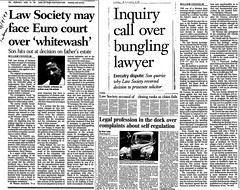
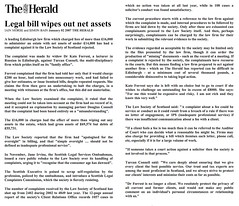
Certainly an interesting Press Release from STEP, but it hardly tells the real story of what is going on in the UK will industry, where solicitors dominate the market. Notably, STEP use an example where one consumer was charged £12,000 up-front for executor services yet the Scottish legal profession can beat that hands down, where, to quote one example, Edinburgh law firm Turcan Connell charged fees of more than £16,000 to administer an estate with net assets of under £14,000 – and the Law Society then rejected a complaint from the deceased client’s widow, Dr Kate Forrest.

Legal bill wipes out net assets - The Herald January 02 2007The Herald newspaper reported : “[Dr] Forrest complained that the firm had told her only that it would charge £200 an hour, had entered into unnecessary work, and had failed to give her estimates, or issue itemised bills, despite repeated requests. She claims the firm then gave an undertaking to halt the charges, in a meeting with witnesses at the firm's office, but this did not materialise. When the Law Society examined the complaint, it ruled that the meeting could not be taken into account as the firm had no record of it, and it accepted an explanation by managing partner Douglas Connell that the complaint had been based entirely on a "misunderstanding". The £16,000 in charges had the effect of more than wiping out any assets in the estate, which had gross assets of £69,574 but debts of £55,731.”

Hardly a glowing recommendation for regulation by the Law Society of Scotland of solicitors handling wills, rather it proves deceased clients will be ripped off by any professional, with no recourse for their remaining family while the solicitor gets away with it – the perfect, ultimate, R.I.P. OFF.

BBC Panorama investigation on wills - no longer existsBBC Panorama report into corruption in the will writing industry omitted problems of solicitors ripping off dead clients. Coincidentally, the BBC’s Panorama programme ran a report on the wills industry, highlighting various rip offs by will-writing companies. The programme bizarrely implied while will-writing companies were quite obviously ripping off consumers to the tune of thousands of pounds, the situation was very different if a solicitor handled a will – something many victims of solicitors mishandling wills all across the UK could easily dispute. Curiously the BBC Panorama programme on this issue is now no longer available, although readers can still view a summarised text version of the report carried out by Panorama journalist Vivian White, here : Call for tighter will-writing laws as consumers duped

The new regulation in Scotland which STEP are referring to in their Press Release, relates to amendments contained in the Legal Services (Scotland) Bill, which may well end up seeing the Law Society of Scotland regulate non-lawyer will writers. I reporter on the Scottish plans for regulation of non-lawyer will writers, here : Scottish Government plan to regulate non-lawyer 'will writers' may see Law Society regulate all complaints against mishandled wills, legal business

Consumers should be in no doubt the Legal Services (Scotland) Bill is turning into one of the biggest rip offs of consumer choice of legal services in Scotland, a far cry from the intentions of the Which? super complaint and the Office of Fair Trading’s report into lawyers dominance of Scotland’s legal services marketplace.

Since the Law Society of Scotland (dubbed by some as the 'World's worst regulator') cant even regulate their own member solicitors when it comes to defrauding deceased clients, wills, executry estates & beneficiaries, I doubt the Law Society is going to be very effective in regulating anyone else who is involved in the rip off will writing & handling industry, unless of course, the Law Society simply use their regulatory powers as an excuse to wipe out the competition, ensuring everyone has to use a lawyer to write or handle a will.

This advice may be hard to swallow, but take it from one who has witnessed, investigated and been a victim of solicitors ripping off the dead – trust no lawyer, accountant, will writer, or any other so-called professional when it comes to your will & final testament, and never appoint one as your executor … its the sure fire road to perdition ….

Tuesday, June 02, 2009

‘It’s all about money, not justice’ as lawyers greed on legal fees spills over at Law Society AGM

Law SocietyLaw Society of Scotland won vote delaying practising fees row for now. PROTESTS from lawyers at last week's annual general meeting of the Law Society of Scotland over the 'high cost' of an annual practising certificate which allows solicitors to work, were insufficient to sway enough of the votes for an immediate reduction in the current annual practising certificate levy on solicitors of £665, raising the threat that many solicitors will increase their already exorbitant fees for legal work carried out on behalf of clients.

Instead, the Law Society won a five month delay to consider how it will react to members unwillingness to pay £665 a year to fund the huge salaries of staff and officials at the Law Society of Scotland's Drumsheugh Garden headquarters in Edinburgh, where as we saw in an earlier report, the current Chief Executive, Lorna Jack's salary along with the costs of her office which now stand at £326,000 a year.

Eileen Masterman & Philip YellandLaw Society’s Philip Yelland & SLCC’s Eileen Masterman do similar jobs on £1,350 a week. With solicitors already having to fork out £400 or so a year to fund the Scottish Legal Complaints Commission, where Commission members are on up to £350 a day plus expenses, and officials such as the Law Society’s Director of Standards, Philip Yelland, and SLCC Chief Executive Eileen Masterman, are both doing the same job on salaries of £1,350 a week - all paid for out of solicitors pockets.

No doubt, the grumbles within the profession over these legal fat cat salaries will continue, but some legal firms are seemingly using their imagination to recover from clients, what they perceive to be the high costs of being a solicitor.

In several examples of accounts sent out to clients which have been brought to my attention, legal firms across Scotland are recouping their running costs and issues such as the cost of the practising fee, by issuing false fee demands to clients for legal work which has never been done.

I have reported on this subject earlier, here : Lawyers stealing from clients to earn 'double fees' while Law Society looks the other way in vast network of legal aid fraud & embezzlement & here : Lawyers fraudulent fee demands must be curbed by independent fee watchdog as culture of greed prohibits public access to justice

It is now becoming commonplace for legal firms to send out accounts to clients, falsely claiming they owe money on case work, some examples of which date back to over 10 years, where solicitors and their firms are regularly claiming to clients that “accounts have been overlooked and must now be settled”, with little or no explanation being provided for what work was actually done on the clients behalf.

Examples I have seen of some of these purely fake fee demands to clients have run into tens of thousands of pounds, the bills usually being accompanied with a seven day threat of legal action if payment is not made immediately, although when the legal firms are asked for specification & evidence as to exactly what work the solicitor did, the accounts are ‘reduced’ to in some cases, about a tenth of what was originally sought from the client, on threat of recovery.

A legal insider today admitted he was well aware many firms were sending out inflated bills. He said : “Many solicitors feeling the pinch have decided to look back through their work to see if they have missed sending out bills to clients.”

“Several of my colleagues are aware of a rising tide of complaints to the Law Society where clients are alleging they are in receipt of accounts from their solicitors for work which was never authorised or agreed to, and which there is no evidence even took place.”

He went on to claim that lawyers were being protected from criminal charges over the false fee demands, simply because of self regulation of the legal profession in Scotland : “If it were not for the fact the profession self regulates, I have no doubt the Police could be called in and fraud charges laid against several legal firms & individual solicitors.”

Of course, none of these issues were discussed at last week’s annual general meeting, although most or all of those legal firms attending are currently engaged in such practices, inspired by weak & corrupt self regulation, carefully maintained by the Law Society of Scotland, with any legislative reforms stifled by political allies to the legal profession.

Arguing about the cost of a practising certificate, while complaints, corruption, negligence, criminality and fraud spirals out of control among Scottish legal firms, will not repair the damage that lawyers have done to themselves, and their own business, and to public access to justice in Scotland.

The Scotsman reports :

No fireworks, but membership costs the burning issue

Friday, May 15, 2009

Lawyers fraudulent fee demands must be curbed by independent fee watchdog as culture of greed prohibits public access to justice

Law Society of ScotlandLaw Society of Scotland does little against fee fraud complaints.With the ongoing revelations from Westminster of a culture of greed revealed among politicians over their expenses claims, shamed into repayments only because of public naming & shaming by the media, calls are now growing for similar shaming of some of our notoriously if needlessly expensive legal firms, as the profession fails to deal with the issue of solicitors exorbitant & fraudulent fee demands to clients.

I reported on this issue in an earlier article here : Lawyers stealing from clients to earn 'double fees' while Law Society looks the other way in vast network of legal aid fraud & embezzlement

Basically, since competition in legal services has not existed in Scotland, ever, and the relevant legislation dating back to 1990 via Sections 25-29 of the Law Reform (Misc Provisions) (Scotland) Act 1990, which would have enabled wider rights of audience in Scottish Courts was withheld from implementation for 17 years to March 2007, solicitors and legal firms have charged clients what they wanted, in an orgy of spiralling greed, rather than allowing market conditions and market competition to set the price of legal services in Scotland.

If for instance, a solicitor wants a second or third home, or a new car, up the costs to clients go, unchecked, and must be paid on threat of legal action or repossession of clients assets .. and solicitors seem to have as easy a time ramping up their bills and claiming expenses for anything they want, just as much as MPs at Westminster loading their expenses claims for everything under the sun, soaking the taxpayer for all they could get – and getting away with it until now.

Just as at Westminster, where the 'Fees Office' set the rules for Parliamentary expenses claims, providing MPs with a justification for their claims for cleaning the swimming pool, moat, or paying everything (including their mortgage allowance) on their second home which of course they must have as one of life's necessities, the Law Society used to set its Table of Fees, by which solicitors could refer back to as justification for supporting their extortionate bills to clients, despite the poor quality of legal work, and high case failure rate.

After the Table of Fees were withdrawn in 2005, legal firms decided themselves how to ramp up the costs of litigation, and up to sky high levels they went as bonuses, cars, new offices, and all manner of perks were paid for out of clients soaring legal bills, while case success rates and quality of legal services remained poor, generating record levels of consumer complaints to the Law Society of Scotland.

Advice from the Law Society's own website currently offers the following : "With the withdrawal of the Society’s Table of Fees, it will not be appropriate to refer to fees recommended by the Society. If, for example in executries, the file is to be feed by an external fee charger such as an Auditor or Law Accountant, the basis on which the external fee charger will be asked to fee up the file needs to be stated to the client needs to be included. If hourly rates are reviewed during the course of the work, the clients will need to be told about any increase or there is a risk that firms will be unable to charge the higher rate."

I can only describe that as hopeless. Clients are hardly ever if ever informed about changes in rates, until the fee demand arrives on their doorstep.

The Law Society's advice continues : "As well as the hourly rate any commission which will be charged on capital transactions or on the sale of a house would need to be included. In any matter where the account is being rendered on a detailed basis, the charges for letters, drafting papers, etc will need to be expressed as well as the hourly rate. They can be in a separate schedule referred to in the basic letter."

Again, this is pure fantasy from the Law Society.

On matters of Executries & deceased estates, the Law Society offers the following : "In executries where the only executors are solicitors in the firm, the information should be provided to the residuary beneficiaries, as they will be meeting the fees out of their shares of the residue. In other executries the information should be provided to the non solicitor executors. "

I have never encountered this taking place in an executry yet, and since the handling of wills & executries by Scottish legal firms seems to produce the highest levels of fraud & embezzlement I have ever seen, the only advice I could give to anyone trying to write a will is keep lawyers and accounts well away from your belongings, because whatever your bequests are in your will, they will never reach their intended beneficiaries in their entirety if a lawyer has anything to do with it.

Even some of the legal profession’s senior members now admit soaring fraud is common among members, as Richard Keen, the Dean of the Faculty of Advocates, hinted in an earlier report I wrote here : Dean of faculty hints at rising fraud claims against solicitors as 'Penman Levy' bites hard into Scots law firms

In my experience of cases, clients who embarked on litigation often find their solicitors are content to write letter after letter to opposing legal teams, for no reason at all, other than to scoop up fees in some cases of £250+VAT for a single letter with four lines of text on it .. and several follow up letters which usually achieve nothing other than to inflate the solicitor's fee demand.

In one example of a case I heard of, there were 42 follow up letters at £150 each which totalled £6,300, with the case remaining unresolved after four years of letter writing and projected court costs of £10,000, all over a boundary fence misplaced by a galactic "5.2 inches" which the defenders in the action were at one stage willing to settle until their lawyer advised they should fight it out and continue sending costly replies to the pursuers costly enquiries.

Both legal firms in that case, in the Scottish Borders, have a good game of ping pong going - pursuers & defenders have paid over £10,000 each over a fence and a dispute, which might be settled quicker if wood worm eat the fence away, than if the two legal firms have their way.

Amazingly both those legal firms handle legal aid work too .. but I wonder, if they are so dishonest with their private clients, can they be trusted to receive public legal aid funds ?

We saw recently how the Law Society of Scotland protects legal aid fraudsters from criminal charges .. just to keep their members on the legal aid bandwagon, as I reported here : Law Society protects legal aid fraudster lawyers from criminal charges as SLAB nets £1.6 million ‘repayments’

The obvious conclusion from this is that solicitors who rip off their private clients, or are subject to complaints involving dodgy fee demands and other financial irregularities should not be allowed to claim legal aid fees.

In the past 12 months, many people have contacted me over their sudden receipt of huge fee demands from their solicitors, usually in the thousands of pounds, for as it usually turns out, non existent work allegedly undertaken two or more years ago, with little or no accounting of what that work actually entailed.

As an example, one demand sent to me by a worried client of an Edinburgh legal firm, who, among their case work, specialise in representing the Law Society of Scotland's Master Policy insurance, protecting crooked lawyers from negligence claims, threatened “legal action in seven days if an account of £23,000 was not paid immediately”. It was the first time the client had seen the bill, and notably there was no explanation of the work, no detailed breakdown, nothing at all to indicate what the solicitor had actually done, other than the words "working on a boundary dispute & drawing up letters".

The client contacted the legal firm, and pointed out they had ceased working on the boundary case in October 2006, due to settlement with the defenders, and that fees had been paid in full at the time, producing a receipt from the firm itself confirming that to be the case.

One of the senior partners of this legal firm then wrote back to the client, informing them "charges for work had been overlooked and not included in the fees at the time, and must now be paid or we will take legal action against you as intimated in our fee note."

The client returned to me, and I advised them to inform the legal firm they had passed on copies of the accounts to myself, and were going to call in the Police. Two days later, a letter arrived from the legal firm explaining "a clerical error had led to the fee note being issued, which has now been withdrawn."

However, not all cases of what can only be described as fraudulent fee demands, end up as easy to resolve as the above example, and, with the financial downturn affecting legal business significantly, I have noticed a huge upswing in legal firms bullying clients with demands for legal fees on work which simply never took place, and cannot be accounted for. When clients dare challenge these fee demands, the legal firm usually backs down, only after a threat of media exposure.

The legal services market, as it currently stands as a market monopoly controlled by the Law Society of Scotland and its members, cannot be trusted to set fees for legal services. These practices must end.

However, not only must it end, given the volume of complaints against fraudulent fee demands from the legal profession, there must be an independent fees commission to watch over the costs of legal services, ensuring access to justice is within the reach of everyone, not just the rich, or those the legal profession itself chooses to represent.

Given the high levels of fraud in solicitors fee demands, there must also be an independent inquiry into how far and how long this has been going on, with a view to the public being paid back money which has falsely been claimed by solicitors for work they never did, or legal services which were mishandled, either incompetently, or deliberately, just to inflate fee demands equating to a level of extortion over clients which cannot be allowed to go unchecked or unpunished.

Friday, August 01, 2008

Solicitors target clients with ‘sky high’ legal fees as Scotland's billion pound legal industry slows down

There is little doubt we are in a recession, and amid falling house prices, falling pay packets, rising energy bills and rising unemployment, the outlook is certainly not a rosy one for everybody and even Scotland's multi billion pound legal services market, controlled exclusively by the Law Society of Scotland is now experiencing problems, with the likelihood of job losses and hardship along with the rest of us.

However, while the Law Society of Scotland last week issued a Press Release on the subject of the current poor economic climate affecting lawyers, citing its concerns over redundancies and problems in the legal sector, there was a marked reluctance to talk about lawyers hiking up their fees for legal work which remains markedly poor in competence or honesty.

Of course, when industries feel the pinch, they put the bills up. British Gas just did that, upping the cost of your fuel bills by a whopping 35% ... and no doubt petrol will be going up again soon too .. putting the squeeze on your pockets along with the cost of everything else we all consume.

There should therefore be little surprise to you that lawyers have decided to hike their own legal fees by (in some cases) a whopping 40% on top of the £1.2billion they are already making from clients, so its now the turn of consumers to get hit with large legal bills too …

So, have you recently been charged £3,500 from a solicitor for a little work which might have only been £1,050 ?, because that is now happening to clients all over Scotland .

Time perhaps to challenge your solicitors fees just as many have challenged Bank fees and more unacceptable charges for less than adequate service …

Bill Aitken MSP : Scots Legal Services market worth £1.2billion … but that's not enough for some as lawyers fees now hit your roof !

As you can see from the above video, it was only a few months ago that Justice Secretary Kenny MacAskill and others so fond of solicitors at the expense of consumers, stood up in the Scottish Parliament and toasted the multi billion pound monopolistic legal services industry in Scotland controlled by the Law Society of Scotland, so why now should some in the legal world feel they have to hike up the cost of their work for clients, which is still mostly poor and lacking in standards.

Well, for one thing, property prices are down, quite a bit, as are house sales, which rake in lots of money for solicitors in legal fees, so clients must be hit, and hit hard on other kinds of legal work now to make up for the shortfall.After all, keeping up the family, the three houses, the five cars and other wee bits on the side must be passed onto unsuspecting clients, and if you can’t pay, your house and possessions will do nicely.

There are certainly a few unsuspecting clients by the looks of things as some fee notes I saw earlier this week showed solicitors charging clients for work done while they were actually receiving legal aid, and settlements in long drawn out cases being withheld by legal firms, while they fiddle up fee notes of extortionate proportions, for ultimately achieving nothing .. just to steal the settlements in their entirety for themselves, the client ultimately getting nothing … not a penny …

In one case brought to my attention, concerning a long running land dispute, a family who employed one of Edinburgh's top legal firms, have ultimately been hounded out by their landlord, yet they have received a large settlement to ensure their departure.

Unfortunately for that family in the case I refer to, their 'big name' Edinburgh lawyers have now taken the entire agreed settlement while they do some creative accounting for work done, which in reality wasn't much, if anything at all.

A small, but important detail to the case is the family concerned were on legal aid the whole time … but all the while, that ‘big name’ Edinburgh legal firm were demanding additional private cash payments … while apparently not disclosing such demands & payments to the Legal Aid Board, in what now seems to be a typical practice to make up for shortfalls in other areas of business.

But what will the Scottish Legal Aid Board think .. or do ? if they find out this 'big name' Edinburgh legal firm was demanding money from the clients while also taking from the legal aid purse .... as so many legal firms seem to be doing these days ...

Of course, you don't really get to find out much about lawyers fees, because the legal profession sets its own fees, and is accountable to no one in that respect.

Yes, lawyers set their own fees. There is no independent body to adjudicate on what lawyers can and cannot charge for their services. The Law Society of Scotland basically gives the go ahead for lawyers to charge what they want, and if you don't like it, when faced with a large account you cannot pay, your house will do nicely, if not your life.

Oh yes .. there is the not so often used "taxation of fees" where if you are unhappy with the fees charged by your solicitor in litigation which may have ended up in the Court of Session, you can apply to the "Auditor of the Court of Session" to have your account 'independently scrutinised', but here's a surprise for you - the Auditor of the Court of Session is a member of the Law Society of Scotland, so, in Scotland’s most important courtroom, there is no independent scrutiny of lawyers fees.

The present Auditor of the Court of Session is Mr Neil J Crichton, who was appointed to his position in December 1997, over 11 years ago and will be retiring on 28 September 2008. The following release from the then Scottish Executive lists Mr Crichton’s appointment :

Appointment of Auditor of the Court of Session

09/12/1997

ISSUED ON BEHALF OF SCOTTISH COURTS ADMINISTRATION

The Secretary of State has appointed Mr Neil J Crichton to be Auditor of the Court of Session on the retirement of Mr J Haldane Tait on March 31, 1998. Mr Crichton is currently senior partner in the Edinburgh firm of Aitken Nairn WS.

BACKGROUND

The Auditor of the Court of Session is a statutory appointment made by the Secretary of State on the nomination of the Lord Advocate. The main duty of the Auditor is, on remit from the Court, to tax accounts of expenses incurred in civil litigation and fix the remuneration of the receivers and liquidators. He also taxes accounts which the Scottish Legal Aid Board are unable to agree with the Solicitor and/or Counsel acting for a legally-assisted client in a Court of Session case.

News Release - 1975/97 Date December 9, 1997

It is important to note the "Auditor of the Court of Session" is not accountable to the Scottish Court Service in terms of if a complaint is filed against his decisions on fees.

The Auditor of the Court is in fact, a practicing solicitor, a member of the Law Society of Scotland.

It is a fact that all solicitors, and members of the Law Society of Scotland must also keep their indemnity insurance payments to the same Master Insurance Policy which itself has been brought into such disrepute concerning concocted fee notes over negligent legal service for many years, many of such cases surfacing in the media.

So, if you have a complaint about a huge bill from a solicitor which involves work in the Court of Session, and which is wholly unjustified, you can take it to taxation, which means giving it to the Auditor of the Court of Session.

However, if you remain unsatisfied with the Auditor of the Court of Session's findings, you cannot complain to the Scottish Courts Service, because the Auditor of the Court of Session does not fall within the remit of the SCS, the Auditor falls within the remit of the Law Society of Scotland to whom you must make a complaint if you remain dissatisfied with the Auditor’s decision in your case.

So, bearing in mind all of the above, is it safe now, in these times of required and expected reforms to Scotland's woefully poor legal services market, to allow another solicitor, and member of the Law Society of Scotland, the power of auditing solicitors legal fees in Scotland’s highest court, when there are disputes from clients ?

Surely it should now be the case that, with the measure of independent regulation brought in with the Scottish Legal Complaints Commission, there should be a new system of independent scrutiny of solicitors fees where clients feel they are unexplainably and unjustifiably high.

Perhaps now is the time to bring in an independent and accountable panel of auditors who are not linked to the legal profession, but are able to hear cases of client challenge to exorbitant legal fees and independently adjudicate on what are ever spiraling costs of legal services in the current solicitor monopolised Scottish legal services market.

You can read more about the procedures for challenging fees from your solicitor in the Sheriff Courts here : Act of Sederunt (Solicitor and Client Accounts in the Sheriff Court) 1992

It is important to note that while all Sheriff Courts have an auditor of the court, not all are solicitors. There are three solicitors who are “Auditors of the Court’, based at Scotland’s three key courts – Glasgow, Aberdeen, and of course, the Court of Session in Edinburgh. The remaining auditor’s of court in the Sheriff Courts, are employed directly by the Scottish Courts Service.

You can find out more about the fees of the Court of Session here : The Court of Session etc. Fees Amendment Order 2007

You can find out more about “Taxation” at the Court of Session on the Auditor of the Court of Session’s website here : Taxation at the Court of Session

The Law Society of Scotland also reports on how you can challenge fees from your solicitors on their own website here : How to query a lawyers fee and get nowhere

The Law Society’s explanation of how to query solicitors fees begins with an uninspiring account of what they cannot do …

“The Law Society of Scotland does not have the power to consider the amount of fees charged by a solicitor but has responsibility in relation to considering the quality of service provided by the solicitor.”

Interestingly, the Law Society of Scotland leave out the fact the auditors of Scotland’s main courts, are actually members of the Law Society of Scotland, and that in effect, you have a solicitor adjudicating the fees of another solicitor, which is certainly not a model of independent scrutiny by any measure of the word.

It cannot be said the Law Society’s information on challenging solicitor’s fees inspires any degree of trust whatsoever, after the Law Society of Scotland has acted with such contempt against clients for decades when complaints have been made against not only crooked & negligent solicitors, but also those who on a regular basis, fiddle their legal fees to you, sky high.

Time for a much needed change on how solicitors fees are set and scrutinised, to ensure full and proper consumer protection from a money making system which currently runs itself without accountability to anyone.

My advice to readers : Faced with a high legal bill from your solicitor ? Publish it online, name the lawyer and the legal firm, and challenge the authenticity & accountability of their fees.

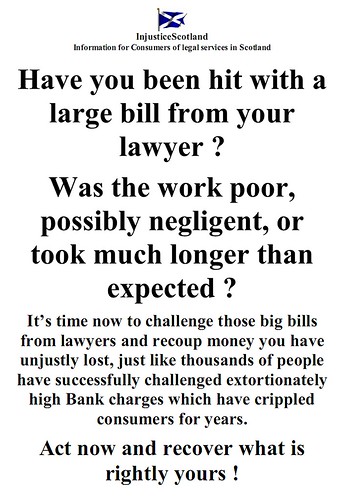
It’s now time to challenge those big legal bills from lawyers just as people have successfully challenged extortionate bank charges which have been taking place for years against consumers. Remember – it’s your money … and no one is unjustly entitled to it.

Injustice Scotland’s campaign to reclaim high legal charges :

Recover your money from lawyers extortionate charges campaign

Just for reference, here is the Law Society’s Press Release, which was passed onto me by a journalist who could hardly stop laughing at the prospect of a few lawyers losing their jobs …

There isn’t much thought about clients in the Law Society’s Press Release which focuses on the hardship of lawyers … but of course, hiking the fee notes to clients might help a few retain their jobs and luxuries at your expense …

SOCIETY COMMENTS ON CURRENT ECONOMIC CLIMATE

Henry Robson, deputy chief executive of the Law Society of Scotland, said: “Legal firms, like many other businesses in Scotland, are feeling the effects of the current economic climate.

“The Law Society is monitoring the situation and while at present relatively few solicitors have informed us of being made redundant, we have had reports of support staff from firms across the country having lost their jobs, which is a real concern.

“The professional practice department is giving help and advice to solicitors who may yet be faced with losing their job or equally to solicitor employers who have never before been in the position of having to make people redundant.

The Law Society is just one of many organizations to be affected by the uncertainty of the property market and we have decided to delay plans to relocate.

“The legal profession is not only being affected by the economic situation, but also by changes in legislation. For example, the slowdown has come at a time when summary justice reforms are having a negative impact on the volume of criminal legal aid work.”

The Law Society’s president, Richard Henderson, has written to Alistair Darling, Chancellor of the Exchequer, to raise concerns about the impact on the profession of the current economic downturn and there has also been a meeting with Kenny MacAskill, Cabinet Secretary for Justice, to make strong representations about the potential detrimental effects of the plans to introduce Home Reports in December.

The Law Society is working on a number of initiatives to support solicitors, including holding a conference to provide information and business advice specifically for high street firms. The charity LawCare can also offer advice and support to solicitors facing difficulties.

The Law Society’s education and training department is also offering support to those concerned about traineeships.

Mr Robson added: “As the representative body for solicitors, and working closely with paralegal colleagues, we share the profession's concerns and will continue to monitor the situation closely and provide support to our members."

ENDS

so … lawyers will get all the help they need from the Law Society .. but clients will have to pay for it through the nose … inspiration to avoid using a solicitor who is a member of the Law Society of Scotland and a good argument again, to open up Scotland’s legal services market much quicker than Mr MacAskill seems to be willing to do …