Showing posts with label Sir Fred Goodwin. Show all posts

Thursday, December 02, 2010

UK Banking Regulation ‘a joke’ : Financial Services Authority clears Royal Bank of Scotland & 'World’s Worst Banker' of wrongdoing over bank collapse

FSAFinancial Services Authority wont publish RBS review’s content but claims RBS collapse was down to bad decisions only. THE SPECTACULAR COLLAPSE of the Royal Bank of Scotland under the leadership of Sir Fred Goodwin, dubbed by the media as the ‘World’s Worst Banker’ was simply down to bad business decisions, rather than corruption or any lack of integrity, so says the UK’s financial regulator, the Financial Services Authority (FSA) in a timely release today while most of the county’s focus remains on winter storms, Russia winning the competition to host the 2018 World Cup (удача!), and yet more expected headlines from Wikileaks on international & domestic political double dealing.

After completing an investigation which began in May 2009, the Financial Services Authority released a statement today after completing its supervisory investigation which began in May 2009. The FSA said RBS had made "a series of bad decisions" and the bank’s failure which led to the massive multi billion pound UK taxpayer bailout, seeing the RBS 84% owned by the Government, was “not the result of any lack of integrity by any individual and we did not identify any instances of fraud or dishonest activity by senior individuals or a failure of governance on part of the board".

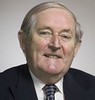
Fred GoodwinSir Fred Goodwin, off the hook, still working and still has a title, unlike many now being made redundant because of the UK banking collapse.The FSA said it would be taking no enforcement action as a result of the investigation, either against the firm or against individuals, so all those who were instrumental in the downfall of the UK’s largest financial institution, and are responsible for the biggest public service cuts ever in this country, along with throwing millions of people’s lives into financial turmoil, get away with it once again. Is this justice ? I think not. However it is consistent with regulation in the UK, that is, in the world of non-existent regulation.

The FSA’s statement in full :

FSA closes supervisory investigation of RBS

In May 2009 the Financial Services Authority (FSA) launched a supervisory investigation into Royal Bank of Scotland Group (RBS), as one of the UK banks that required partial taxpayer bailout support. This work considered if regulatory rules had been broken and what, if any, action was appropriate. The review was necessarily extensive and looked specifically at the conduct of senior individuals at the bank, the acquisition of ABN AMRO in 2007 and the 2008 capital raisings. The FSA conducted the review with assistance from PWC.

The FSA has now completed this supervisory investigation. The review confirmed that RBS made a series of bad decisions in the years immediately before the financial crisis, most significantly the acquisition of ABN AMRO and the decision to aggressively expand its investment banking business. However, the review concluded that these bad decisions were not the result of a lack of integrity by any individual and we did not identify any instances of fraud or dishonest activity by RBS senior individuals or a failure of governance on the part of the Board.

The issues we investigated do not warrant us taking any enforcement action, either against the firm or against individuals. However, the competence of RBS individuals can, and will, be taken into account in any future applications made by them to work at FSA regulated firms.

The FSA’s supervisory investigations into other banks that 'failed' during the crisis are ongoing. If they lead to enforcement action being taken then it would be usual for the FSA to make these outcomes public if such actions against individuals or institutions are successful.

The FSA cannot publish the content of the RBS review as information gathered from the bank during the course of the review remains confidential under the Financial Services and Markets Act 2000 (FSMA).

Rob MacGregor for the UNITE union released a statement condemning the FSA’s decision not to prosecute the RBS executives and condemned the FSA as being unable to hold the banking sector to account.

Rob MacGregor, Unite national officer, said: “Once again the Financial Services Authority has demonstrated its weakness and inability to hold the sector to account. The report’s conclusions are an outrage. It is unacceptable to suggest that the behaviour of the management in this iconic UK bank did not ‘lack integrity’ when they brought RBS to its knees, resulting in thousands of staff losing their livelihoods.

“By failing to bring any formal charges against the RBS executives the FSA has allowed some of the biggest villains of the financial crisis to go on enjoying their millionaire lifestyles whilst taxpayers experience cuts and staff face an insecure future.”

We can remind ourselves just what happened to the Royal Bank of Scotland at the hands of Sir Fred Goodwin, who still retains his knighthood and a job, unlike many victims of the public services cuts, including the UK’s armed forces and even the carrier HMS Ark Royal, now sunk twice it seems, the first time by a U-Boat of the Nazi German navy and now sunk again or scrapped as a result of the financial harm inflicted on the country by bankers who are off the hook once again.

Collapse of the Royal Bank of Scotland (Click images to watch video)

The Herald newspaper reported that during the Treasury Select Committee’s evidence sessions, “The four ex-chiefs of Royal Bank of Scotland (RBS) and HBOS admitted to having no formal banking qualifications between them in today's dramatic grilling by MPs.

“Members of the Treasury Select Committee heard how not one of the witnesses - who presided over two of Britain's biggest and worst hit banks - had technical banking training. The bosses - including former RBS chief executive Sir Fred Goodwin - were forced to defend themselves against tough questions over their suitability to lead the banks, which had to be bailed out with billions of pounds of taxpayers' cash.”

“Sir Fred denied he lacked experience, saying he had a degree in law and was a qualified chartered accountant, while also having worked as chief executive of the Clydesdale Bank and Yorkshire Bank before joining RBS. Sir Tom McKillop, previously chairman of now part-nationalised RBS, said he was "certainly numerate", although he conceded he had not studied banking specifically.”

Disgusting. These people have made fools of our country, our financial system, even our way of life. There are no words at all really to describe what they have done, and the suffering their actions are causing us – but its all ok because Sir Fred Goodwin had an LLB, and since the FSA said it was all just down to a few bad decisions, that's fine. Right ?

Monday, August 02, 2010

Insult to victims of Nazi holocaust as Scots Banker Grossart claims former RBS Chief Sir Fred Goodwin endured 'shades of Kristallnacht'

sir angus grossartScots Banker Sir Angus Grossart claimed his friend Sir Fred Goodwin has suffered over public attacks & broken windows. SCOTS LAWYER TURNED BANKER SIR ANGUS GROSSART has claimed former RBS Chief Executive Sir Fred Goodwin, the man dubbed as the “World’s Worst Banker” after his takeover of the Dutch banking giant ABN Amro, lead to the near collapse of RBS and subsequent multi billion pound bailout by UK taxpayers, has been treated as bad as the victims of Nazi Germany’s holocaust. where millions of Jews were rounded up and sent to Concentration Camps.

Fred GoodwinAn insult to victims of Nazi Germany : Sir Fred Goodwin’s suffering compared by Scots Banker to victims of holocaust. Sir Angus Grossart, speaking in an interview in the Scotsman group’s Scotland on Sunday newspaper, and widely quoted in today’s Telegraph newspaper claimed the attacks on his friend Sir Fred Goodwin, who Grossart maintains has been made a “scapegoat” for the banking crisis, believing Sir Fred has apparently suffered effects from the public attacks on his character and actions as former Chief of the Royal Bank of Scotland, as bad as the suffering of Jewish victims of the terrors of Nazi Germany.

Grossart shockingly compared the broken windows of Goodwin’s Edinburgh mansion to “Kristallnacht”, (the Night of Broken Glass), an anti-Jewish pogrom in Hitler’s Nazi Germany which took place in November 1938 where up to 30,000 Jews were arrested and placed in concentration camps while 91 victims were murdered, 267 synagogues were destroyed and thousands of Jewish homes and businesses ransacked.

An insult to victims of Nazi Germany’s Kristallnacht : World’s Worst Banker’s broken windows brought little sympathy after banking collapse (Click on image to watch video)

Sir Angus, who is in regular contact with Sir Fred, said: “I think he’s very sad at the way he was victimised. Shades of Kristallnacht. Clearly he made a mistake as did most people in the financial world, most people in government, most people in regulatory organisations. “There is no doubt he was going to be criticised, but I think there is a deliberate attempt to polarise the criticism, to some extent, as a distraction, a scapegoat kind of thing.”

Sir Angus added: “A lot of people, including those in government, were also involved in mistakes and they did not have bricks thrown through their windows.”

I have news for you, Sir Angus – a lot of people in regulatory organisations make a lot less mistakes than we are led to believe.

There are quite a few characters in those regulatory organisations who, rather than make mistakes, deliberately let those they regulate off the hook, even when some of them have caused deaths. In fact, some of those people in regulatory organisations have covered up deaths and benefitted financially from them, an issue I reported on earlier with regard to the Scottish legal profession, here : Suicides, illness, broken families and ruined clients reveal true cost of Law Society's Master Policy which 'allows solicitors to sleep at night'

This latest attempt to rehabilitate Sir Fred, who amazingly still retains his kighthood for services to banking yet those services led to the biggest banking collapse in the UK’s history, affecting millions of people across the globe in a financial crisis which has seen many lose their jobs, homes, livelihoods, is a mark of the determination of some around Goodwin to bring him back into public life.

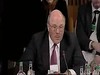
Douglas Mill 4Former Law Society of Scotland Chief Executive Douglas Mill defended Sir Fred Goodwin after RBS banking collapse. Others around Sir Fred such as Douglas Mill, the ex Law Society Chief Executive who was himself brought down after the now infamous "Granny’s Grave” Holyrood confrontation with the Scottish Government’s Finance Chief John Swinney over corruption at the Law Society of Scotland, have publicly defended Goodwin, preferring to blame the lack of regulation of banks for the failures which led to the public vilification and attacks on Goodwin’s character which Sir Angus Grossart referred to.

“It wasnae him” : Former Law Society of Scotland Chief Douglas Mill defended Sir Fred Goodwin, blamed lack of regulation rather than ‘World’s Worst Banker’ (Click on image to watch video)

There seems to be no depths some people will go to rehabilitate or defend those who have brought our banks, and the country to its knees.

Comparing the broken windows of Sir Fred Goodwin’s mansion to the suffering of German Jews in the holocaust is an insult unrivalled so far in anything I have seen written about Sir Fred Goodwin and the banking crisis.

We should all beware those who would use such unrivalled evil from world history to rehabilitate those whose actions have caused so much calamity in our modern times, actions which spring from greed, and deserve no sympathy.

Thursday, March 26, 2009

Truth & reconciliation must be applied to financial crisis, otherwise ‘better regulation’ plans will fail & public anger against bankers will remain

goodwinSir Fred Goodwin ‘shaken’ after hearing of attack on his home. Yesterday's attack on the home of former Royal Bank of Scotland Chief Executive Sir Fred Goodwin has generally been accepted by the media, politicians & public as being a result of Sir Fred’s part in the collapse of the RBS.There is of course, no justification for vigilante attacks against the man’s home & family, no matter how strongly people may feel over his actions at the RBS.

Reports of Sir Fred Goodwin’s home attacked by vandals :

While such attacks are fortunately few and far between, the fact is that the widely reported 'lack of public remorse' by Sir Fred, and many other bankers for their actions which have led to the global financial meltdown, has triggered a demand by many for 'heads to roll' over the banking failures.It may be said, such demands for people to be held to account for their actions, are, reasonable.

However, attacks against individual figures, can and often will be used to stymie the demands & needs of regulatory reform, as we have seen before in Scotland, as was demonstrated with the now slightly forgotten but much more serious attack on another financial professional, the Law Society of Scotland's Chief Accountant, Leslie Cumming, which occurred in Edinburgh in January 2006.

Accounting Chief Leslie Cumming was attacked in a mafia style hit arranged from within the legal profession.


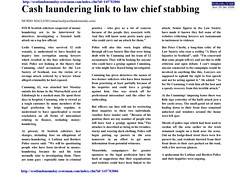
Cash Link to Law Chief StabbingMedia reports on Cumming attack were used by lawyers against reforms. Various theories are still being considered for the attack on Mr Cumming, ranging from a revenge attack organised by crooked lawyers over Mr Cumming's investigations of their accounts, to disgruntled clients who lost millions at the hands of crooked lawyers, to even a prospect the attack was carried out by other members of the Law Society intent on giving the profession a sympathetic image in the wake of serious legal reforms to its regulatory structure which the Law Society bitterly fought in Parliament during the latter half of 2006.

Leslie Cumming StoryLaw Society may have caused the attack itself. However it may well be that Mr Cumming, regrettably paid the price for his Law Society colleague's well known policy of bitter attrition towards people who dared make a complaint to the Society against their lawyer, and the general culture of a lack of accountability within the legal profession as a whole, which in turn led to feelings of bitterness on both sides.

Philip Yelland - Director of Regulation - Law Society of ScotlandPhilip Yelland, Law Society Director of Standards. In the case of the Law Society particularly, the glaringly obvious lack of ability by senior officials such as Douglas Mill, Philip Yelland and many others to even 'say sorry' or repair the financial damage their colleagues did to ordinary people, led to many cases of intense hardship, where even in one known case, a client committed suicide over the Law Society’s attempts to thwart consideration of the actions of a crooked lawyer.

Douglas Mill at the Scottish ParliamentLaw Chief Douglas Mill blamed campaigners for attack on colleague but it turned out to be lawyers. So bitter were the feelings by some at the Law Society of Scotland, the then Chief Executive, Douglas Mill, held private briefings with journalists and attempted to blame campaigners for the attack on his colleague, however it soon became clear to many in the following days the attack on Mr Cumming came from within the legal profession itself, and Douglas Mill had little more to offer on the subject, which even to this day has seen not one arrest in connection with the Cumming attack.

2006, the year of the attack on Mr Cumming, was a very bad year for the Law Society of Scotland, one could argue, as bad a year as 2008-9 has been & will be for the Royal Bank of Scotland, and indeed many other financial institutions.

The Law Society in 2006 was to be subject to the same outside scrutiny and independent investigations & public inquiries on the weakness & corruption of its regulation of crooked lawyers which will now have to be implemented on the RBS and the financial sector, where the same weak, closed ranks, soft touch regulation has ended up producing the spectacular financial failures on a global scale, that the same weak, closed ranks, soft touch regulation has produced in the legal sector on a client by client basis for decades.

Scottish Legal Complaints CommissionSLCC – now a rubber stamp for crooked lawyers. The Law Society fought the outside scrutiny and newly created legislation to bring independent regulation of complaints, and simply co-opted the new body with its own members to ensure that even after all the effort of campaigners, ruined victims, and the Scottish Parliament, the new Scottish Legal Complaints Commission simply ended up as another rubber stamp for crooked lawyers.

The banks, now faced with the same calls for more regulation, inquiries, investigations and the same campaigns by consumers against financial wrongdoings, will do the same as the Law Society did in 2006. We will end up with possibly, a new regulator to replace the Financial Services Authority after a year maybe, and then the regulator will end up being co-opted in the same way the FSA seems to have been so co-opted by the financial profession which led to its negligence in allowing the banks to do as they have done, and, collapse.

Michael Clancy - Director of Law Reform - Law Society of ScotlandLaw Society’s Michael Clancy killed off Holyrood attempt to heal ruined clients of crooked lawyers. It doesn't take much to say "sorry", and do the right thing .. however, saying "sorry" and doing the right thing, doesn't seem to be a basic capability of anyone in charge of a bank or a legal firm or indeed a regulator supposedly put in place to ensure that failure & corruption doesn't take place. Too much money. too much political influence, and soft touch, corrupt, regulation, has led to at attitude of omnipotence where these people and their organisations feel above accountability.

That culture of unaccountability must be ended for all professions, particularly those in the legal and banking worlds, if we are to repair the sins of the past and heal the wounds of ordinary people, and our economy, which have been caused by far too much unchecked greed & ambition by a few who control the many … Truth & Reconciliation is now a much needed medicine.

Friday, February 27, 2009

RBS collapse: Regulation of lawyers model cannot be used as example for safeguarding public against rule bending bankers who broke our banks

rbs_logoRBS – greatest UK corporate loss to-date. While our great banks such as the Royal Bank of Scotland, Lloyds, and the rest announce huge losses and effectively collapse around our ears on a global scale, the cries grow ever louder from the public and politicians alike, not only in the UK, but all over the world, for stronger, more effective regulation to prevent such disasters happening in the future.

Royal Bank of Scotland announces biggest loss ever :


While the hundreds of billions of pounds of public money flows into these institutions to prop them up, perhaps the public should be asking, will such regulation to prevent such a mess happening to our banks ever come to fruition ?

The short answer to that is "No", simply because what we have always seen is that when stronger regulation of a profession or industry is proposed, what sets out as a genuine attempt to introduce stronger measures to protect consumers, is stopped dead by many of those same politicians who are now bleating like sheep and blaming everyone other than themselves for the failures of our financial institutions.

Why do those attempts at introducing stronger, more independent regulation, fail at Parliamentary stage ?

Well they fail because the professions who are going to be affected by such regulation, co-opt the parliamentary process and ensure any parts of that planned regulation is either watered down to be so ineffective, or simply removed all together.

There is a prime example of this for everyone to take note of in these dire days of banking collapses - that being the introduction of increased regulation for the Scottish legal profession, during 2006, culminating in the Legal Profession & Legal Aid (Scotland) Act 2007

Despite the work of many campaigners & groups, and consumer bodies, the Law Society of Scotland co-opted the Parliamentary process at the Scottish Parliament, and watered down many parts of the LPLA (Scotland) Act which would have protected consumers of legal services in Scotland much more than what the act currently does.

You can read an earlier report on how the LPLA BIll passed Holyrood with amendments here : Legal Profession & Legal Aid Bill finally passed by Scottish Parliament, with amendments.

You can read more about the bitter battles to push through the LPLA Bill into law here : Scotland's LPLA Act - not doing well in regulating legal services

As a result of the LPLA (Scotland) Act 2007, we now have the Scottish Legal Complaints Commission, which originally under the previous Scottish Executive, was intended to effectively regulate the legal profession, with also consideration given to historical issues of complaints which had led to the creation of the legislation which created the commission in the first place.

However, with the intervention of the May 2007 election in Scotland, the SNP controlled Scottish Government, more precisely, the administrations of it's Justice Secretary, Kenny MacAskill, has allowed the legal profession itself to effectively castrate the regulator powers of rigid consumer protection, which were originally intended to put an end to all the 'crooked lawyer' problems of the past.

SLCC squareSLCC – as much use as no use at all to consumers. In actual fact, the Scottish Legal Complaints Commission has become such a besieged quango, bereft of public trust & confidence, it has become too afraid to publish pictures of its own members, for fear many consumers will realise that the Commission appointees, made by Kenny MacAskill personally, has become just another lawyers rubber stamp club for corruption and poor service in the legal profession which the Law Society of Scotland has managed to do so well for years.

Scottish Legal Complaints Commission – Would you trust them with complaints against lawyers ?

Scottish Legal Complaints Commission

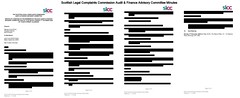
Audit & Finance Committee montageSLCC prefers secrecy to transparency as FOIs reveal. It turns out the SLCC are just too busy keeping themselves so secret,it looks like they have forgot they are supposed to be there to investigate complaints against crooked lawyers, but with most of the staff coming from the Law Society of Scotland, which created the problem in the first place, where crooked lawyers were being let off the hook in thousands of whitewash investigations, there seems little hope for the SLCC to do any different .. and as things stand it seems we are in for more of the same – a definite example to keep away from in improving regulation of financial services after the banking collapse.

MacAskill tight lippedKenny MacAskill gave £2million ‘gift’ to lawyers quango. Strangely enough, the Justice Secretary Kenny MacAskill has lavished millions of pounds of public money on his shiny new regulator while the quango was actually receiving millions of pounds from the legal profession itself. The SLCC, rather than get down to work as the campaigners including Cabinet Secretary John Swinney had originally hoped, then promptly spent it all on personal pension benefits, salaries, perks, medical benefits and just about anything other than actually helping consumers with complaints against legal services.

You can read more about Mr MacAskill's multi million pound gifts to the Scottish Legal Complaints Commission here : MacAskill silent on taxpayers £2million 'write off' to lawyers quango as Complaints boss reveals Law Society defaulted on levies

The legal profession in effect, re-wrote the rules of regulation and powers that the new legislation of the LPLA (Scotland) Act 2007, was supposed to give the 'independent' Scottish Legal Commission to help the public, and the SNP simply sat back and watched, even actually joined in the orgy of fiddling, and made sure it placed those who the legal profession wanted to be on the SLCC, at its helm.

As Mr MacAskill has always said - he will protect the legal profession at all costs. I wonder if John Swinney would be so bold to make such a sweeping statement for bankers and financial services ?

Kenny MacAskill - Claimed in Parliament he would protect lawyers against consumers, out of a great debt owed by the SNP Govt to the legal profession ...

So if you are looking for a new model of regulation for the banking sector, to prevent trillions of pounds of public money going on failed banks, while their ex Chief Executives walk away with 690,000 pension perks, then don't look to Kenny MacAskill or the SNP's ideas of regulating lawyers, because they simply don't work .. and don't look to leaders of the legal profession for much help, because as you can see, those same leading lights of Scotland's legal elite, couldn't wait to support the likes of Sir Fred Goodwin, and blame the Government for the failures, rather than the bankers themselves.

Ex Law Society Chief Douglas Mill speaks out in support of Sir Fred Goodwin and blames Govt for RBS failure.


You can read more about Douglas Mill’s support of Sir Fred Goodwin, and rush to blame everyone else for the RBS’s failure here : Royal Bank failure blamed on lack of regulation by ex Law Society Boss who campaigned against stronger regulation of solicitors

And finally ... we also learned yesterday that the possible legal case which may have caused the RBS a bit of pain financially, failed at a Sheriff Court in Oban yesterday, when Sheriff Pender ruled on Ian Hamilton QC’s small claims action against the RBS that the complexity of the case meant it could not be heard as a "small claims" action, which would have limited expenses to around £150.

Ian Hamilton QC's action against RBS is abandoned

Wednesday, January 21, 2009

Royal Bank failure blamed on lack of regulation by ex Law Society Boss who campaigned against stronger regulation of solicitors

The Royal Bank of Scotland's failure, which has led to the bank effectively being nationalised by the UK Government to save it, and save its customers, was nothing to do with either Sir Fred Goodwin or the Bank's 'takeover too far' of the Dutch Bank ABN Amro, so says Douglas Mill, former Law Society Chief Executive and school friend of Sir Fred Goodwin.

Douglas Mill - it wasn't the Bank or Sir Fred’s fault, it was the lack of governance & control !


Douglas Mill, said in a BBC Scotland interview, which highlighted the alleged failures of Sir Fred Goodwin, whom some newspapers have dubbed "The World's worst banker" :"Well scapegoating is the right expression.".

Douglas Mill would know all about scapegoating, and how to avoid it, as he did for around eleven years as Chief Executive of the Law Society of Scotland, who interfered & intervened in just about any case involving crooked lawyers which had the possibility to bring changes to the way solicitors were regulated by the Law Society.

Douglas Mill, staggeringly went on in the interview to blame the Royal Bank of Scotland's huge losses & failures on the financial markets on poor regulation of the Banking sector !

Douglas Mill went on in usual form : "The real failures here are failures of financial services regulation and that extends beyond the Royal Bank.

The real failures here are failures of lack of governance and lack of control in the whole banking sector not just the Royal Bank again its easy to be wise after the event but scapegoating Fred isn't going to address the problems here."

An amazing outburst indeed, from Mr Mill, who tirelessly campaigned against any strengthening of regulation against the legal sector in Scotland, and whose aims to prevent consumers being protected by increased safeguards & independent regulation of Scottish legal services are still being carried out today by the present Justice Secretary, Kenny MacAskill, who himself said on video in the past, he would also protect lawyers from anything or anyone …

You can read an earlier article on how Mr MacAskill carries on Douglas Mill's 'traditions' of protecting the worst elements of Scotland's legal profession here : Justice Secretary rejects independent regulation of lawyers and public right of choice in legal services market

Indeed, it was, as you will all recall, Douglas Mill who infamously once threatened the Scottish Parliament and the previous Scottish Government with legal action if legislation was passed in the Scottish Parliament to protect consumers and strengthen regulation against Scottish solicitors.

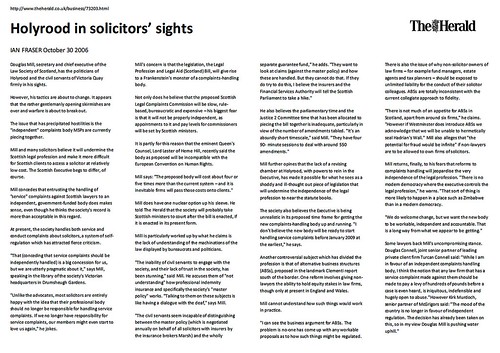
Douglas Mill threatens to sue Parliament & Govt : ‘Holyrood in Solicitors’ sights by Ian Fraser

Holyrood in Solicitor's Sights Octover 30 2006 The Herald

I wrote about Douglas Mill’s court challenge threat to Parliament here : Law Society of Scotland threatens Court challenge against Scottish Executive over LPLA legal reform Bill

We must also not forget this is the same Douglas Mill who famously scrapped with John Swinney, the Cabinet Secretary for Finance, in front of Holyrood's Justice 2 Committee, where Mr Swinney, then in opposition, exposed the secret memos of Mill himself which eventually led to the end of Mill's career at the Law Society after the video coverage of the event was posted to You Tube.

You can read more about the Holyrood confrontation between Douglas Mill & John Swinney here : Law Society boss Mill lied to Swinney, Parliament as secret memos reveal policy of intervention & obstruction on claims, complaints.

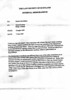
Douglas Mill Memo to Martin MacAllister 5 July 2001In the memos, it was revealed by John Swinney that Douglas Mill had been, and was still engaged in a bitter & protracted campaign against some of Mr Swinney's constituents to prevent them from obtaining access to legal services and financial settlements in long running claims against several of Scotland leading legal firms, which Mr Mill, and the Law Society's insurers Marsh UK, intended to delay and destroy at any cost.

It is worth noting that every single claim and complaint against 'crooked lawyers' which the now discredited ex-Law Society Chief Douglas Mill personally intervened in, ultimately failed to be resolved, and the particular case which Mr Swinney raised before the Justice 2 Committee along with Mill's own memos, also remains unresolved and without settlement.

Career ending video : Douglas Mill contradicts his own secret memos released by John Swinney during Justice Committee investigation


You may all be wondering why someone such as Douglas Mill may blame a lack of regulation of the banking sector as the cause of its catastrophic failure ?

Well, wonder no longer, as the banking sector, such as it used to be, went hand in hand with the legal sector, gaining billions of pounds of business & finance in Scotland from solicitors who themselves used clients funds and a myriad of other less than open financial deals with the banks, using clients money to gain personal finance deals and deals for their legal firms on spectacularly low interest rates which ordinary consumers had to prop up through exhorbitant costs of poor legal services and thousands of cases of lost clients funds each year which the Law Society under Douglas Mill did nothing about.

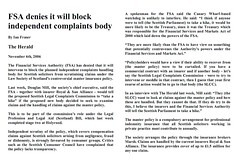
FSA denies it will block independent complaints bodyInterestingly, the same failures of regulation which Douglas Mill claims let down his friend, Sir Fred Goodwin, were the same kinds of regulation Mill actually fought against being implemented on the Law Society of Scotland, such as in the case where Douglas Mill claimed in an interview with Business Journalist Ian Fraser, that the Financial Services Authority would not allow any independent oversight of such things as the infamously corrupt Indemnity Insurance arrangements for Scottish solicitors known as the "Master Policy" which has led to some of the worst cases of corruption involving insurance in Scotland for decades.

It turned out the FSA were quite happy there would be independent regulation of the Master Policy, and I wrote some more about that issue here : Chief Executive of the Law Society of Scotland branded a liar after FSA denies claims of intervention to block complaints body.

You can read more about the Master Policy and how Douglas Mill as Chief Executive of the Law Society and his staff at ‘Client Relations’ implemented his 'policy for protection' of solicitors against claims & complaints here : The Corrupt Link Revealed - How the Law Society of Scotland manages client complaints & settlements.

More can be read about the Master Policy HERE

Perhaps what we learn from this story is that the banking world and legal world do tend to go hand in hand, when it comes to business, and scandals …. so both worlds need a fairly strong dose of independent regulation with effective policing of their activities, rather than the hands off approach which Mill and his kind have preferred over the years.

Mr MacAskill – adjust your policies accordingly, or step aside for someone who can protect the public, rather than simply protect the professions …