 Scotland's Human Rights Commission argue against Human rights of having a McKenzie Friend in Scotland. In a move condemned by some senior legal & consumer figures this evening, the Scottish Human Rights Commission have written to the Scottish Parliament Petitions Committee on the subject of Petition 1247 McKenzie Friends for Scotland, voicing argument & opposition to giving Scots court users the 'Human Right' of a McKenzie Friend, a right which has been respected as an Article 6 Human Right in England & Wales for several years, according to advice given out by the Lord President of the English courts, and backed by the UK's Ministry of Justice.
Curiously, the SHRC’s apparent opposition to McKenzie Friends as a ‘Human Right in Scotland’, seems to fit in with the negative views expressed so far by the Law Society of Scotland and the Faculty of Advocates, who both oppose the introduction of McKenzie Friends to Scotland’s courts, as I have reported earlier HERE and HERE.
In an unexpected twist to the argument for McKenzie Friends, the 'impartial' Scottish Human Rights Commission used an example of an EU ruling in the context of a case in which the applicant was assisted by a McKenzie Friend. In the case the SCCRC used as a reference, “The Court in this case made no comment on the role of the “McKenzie friend” which is neither prescribed nor proscribed by the ECHR. It clearly did not, however, consider this to be sufficient to provide the applicant with the required level of legal representation in the case given its complexity, the importance of what was at stake, and its highly emotive subject matter, finding ultimately that, in the instant case, “the principles of effective access to court and fairness required that [the applicant] receive the assistance of a lawyer.”
SHRC argued in their submission to Holyrood’s Petitions Committee that it would be better for litigants to pay a lawyer to represent them in court than have a McKenzie Friend !

The EU case reference used by the SHRC documents : “There is no automatic right under the Convention for legal aid or legal representation to be available for an applicant who is involved in proceedings which determine his or her civil rights. Nonetheless Article 6 may be engaged under two inter-related aspects. Firstly, Article 6 s1 of the Convention embodies the right of access to a court for the determination of civil rights and obligations. Failure to provide an applicant with the assistance of a lawyer may breach this provision, where such assistance is indispensable for effective access to court…by reason of the complexity of the procedure or the type of case. Factors identified as relevant in the Airey case (Airey v Ireland 9/10.1979) in determining whether the applicant would be able to present her case properly and satisfactorily without the assistance of a lawyer included the complexity of the procedure, the necessity to address complicated points of law or to establish facts, involving expert evidence and the examination of witnesses, and the fact that the subject-matter of the marital dispute entailed an emotional involvement that was scarcely compatible with the degree of objectivity required by advocacy in court. In such circumstances, the Court found it unrealistic to suppose that the applicant could effectively conduct her own case, despite the assistance afforded by the judge to parties acting in person.”
“It may be noted that the right of access to court is not absolute and may be subject to legitimate restrictions. Where an individual's access is limited either by operation of law or in fact, the restriction will not be incompatible with Article 6 where the limitation did not impair the very essence of the right and where it pursued a legitimate aim, and there was a reasonable relationship of proportionality between the means employed and the aim sought to be achieved. Thus, though the pursuit of proceedings as a litigant in person may on occasion not be an easy matter, the limited public funds available for civil actions renders a procedure of selection a necessary feature of the system of administration of justice, and the manner in which it functions in particular cases may be shown not to have been arbitrary or disproportionate, or to have impinged on the essence of the right of access to court. It may be the case that other factors concerning the administration of justice (e.g. the necessity for expedition or the rights of other individuals) could also play a limiting role as regards the provision of assistance in a particular case, though such restriction would also have to satisfy the tests set out above.”
“Secondly, the key principle governing the application of Article 6 is fairness. In cases where an applicant appears in court notwithstanding lack of assistance of a lawyer and manages to conduct his or her case in the teeth of all the difficulties, the question may nonetheless arise as to whether this procedure was fair. There is the importance of ensuring the appearance of the fair administration of justice and a party in civil proceedings must be able to participate effectively, inter alia, by being able to put forward the matters in support of his or her claims. Here, as in other aspects of Article 6, the seriousness of what is at stake for the applicant will be of relevance to assessing the adequacy and assessing the adequacy and fairness of the procedures (P, C and S v the United Kingdom, 11/12/2001)”
The English approach – McKenzie Friends are treated as a Human Rights issue on advice of the Lord President.
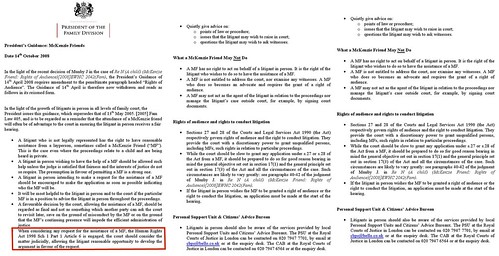
In stark contrast to the Scottish Human Rights Commission’s attitude on McKenzie Friends, the English approach, led by the Lord President of the Family Division, and backed by the Ministry of Justice advises that : “When considering any request for the assistance of a MF, the Human Rights Act 1998 Sch 1 Part 1 Article 6 is engaged; the court should consider the matter judicially, allowing the litigant reasonable opportunity to develop the argument in favour of the request.”
A senior figure in one of Scotland's consumer organisations attacked the SHRC's statement as profoundly shocking for party litigants in Scottish courts, claiming the commission's letter "sounded more like a pitch for business for lawyers than a defence of something already accepted as a right in England & Wales".
He said : "I am surprised by the negativity and tone of the SHRC's response to the Petitions Committee on the subject of McKenzie Friends."
"It is widely accepted in the English courts that litigants can request the presence of a McKenzie Friend, which the court usually looks on as an Article 6 Human Rights issue, as offered in advice from the Lord President of the Family Division, English Courts."
He continued : "While I respect the references used in the Human Rights Commission's reasoning, I feel their submission looks more like a pitch for forcing litigants to use lawyers, but they have not tackled the argument as to what happens if that litigant cannot obtain access to legal representation."
“I feel the SHRC has played a very dark hand making this submission on the day before the Petition is to be heard, after, I understand, having been asked to make a submission several months ago. One could be forgiven for thinking the SHRC are attempting to undermine the Petition itself with their rather poor showing."
A senior solicitor who was asked for comment on the SHRC's response to the McKenzie Friends Holyrood Petition said he was astonished the Commission had apparently went so far out of its way to argue that having a McKenzie Friend was not a Human Right.
He said : "I think people are going to look at the Commission’s letter to the Parliament and wonder why they actually exist if they are so set against issues which are handled as Human Rights entitlements in one part of the country, but not in Scotland."
He continued : "I don't see why the Scottish Border with England should be the crumbling point for individuals rights, where Scots clearly have less rights than people in England & Wales, and then we have this notion where those very organisations funded by the public in Scotland to protect & promote Human Rights, will go out of their way to argue against the very issues they are charged with protecting."
"Many solicitors in the legal profession I know, including myself, do not have a problem with McKenzie Friends appearing in Scotland's courts. However, there is clearly a movement within the legal profession who do not wish to see McKenzie Friends operating in the Scottish courts, and in these testy financial times, I would put that down to fear of the competition and lost business, not really anything to do with arguments of lawyers being able to give a litigant a better service, which I would be the first to admit, may not always be the case."
In an interview this evening, Mr Stewart MacKenzie, the Petitioner who raised the McKenzie Friends for Scotland Petition 1247, said he was disappointed with the Scottish Human Rights Commission's Parliamentary submission.
He said : "The SHRC seems to have focussed too heavily on the subject of representation, which has absolutely nothing to do with a McKenzie Friend, who is there simply to take notes, and quietly advise party litigants on what questions to ask or how to observe court procedures.”
Mr MacKenzie continued : "A McKenzie Friend should be a human right for all Scots as it is for the people of England & Wales, rather than some remote favour at the behest of the court. Why should a court have the discretionary power to say to someone you can have an assistant to help take notes, but refuse the same privilege to others ? That is not fair.”
"If I as a party litigant who cannot obtain legal representation through the services of a solicitor, want a note taker or assistant in court it should be my right to have that just as people in other parts of the country, and other parts of the world can have without all this opposition from the legal profession in Scotland. We are talking about helping people in court here, not representation or advocacy. McKenzie Friends should be a right for all and that is why I raised my petition at the Scottish Parliament."
I would certainly have to agree with Mr MacKenzie's point of view, and also, am left wondering why the Scottish Human Rights Commission have written a reluctant letter to the Scottish Parliament shying away from backing McKenzie Friends as a Human Right.
 Petitioner asks Holyrood to request Courts to implement McKenzie Friends. Late yesterday, the petitioner Mr MacKenzie wrote to the Scottish Parliament’s Petitions Committee, reminding them of Lord Gill’s recommendation that a McKenzie Friend facility now be introduced into Scottish Courts, and asked the Committee to write to the Sheriff Court Rules Council, requesting that they implement a McKenzie Friend facility without any further delay. Mr MacKenzie ended his request to the Petitions Committee by saying “There has been enough prejudice to the people of Scotland on this matter.” … yes, some forty years of prejudice, and one could almost say, organised resistance from the legal profession to the allowing of McKenzie Friends in Scotland …
The Scottish Human Rights Commission claim on their website : "The Scottish Human Rights Commission promotes and protects the human rights of everyone in Scotland. We are working to increase awareness, recognition and respect for human rights in Scotland by bringing human rights into everyday life. The Commission is dedicated to helping everyone understand their rights and the shared responsibilities we all have to each other and to our community. The Commission is independent of the UK and Scottish Parliaments and Governments."
One could easily conclude from the SHRC's response to the Scottish Parliament, the individual’s Human Rights may only go so far in Scotland ... perhaps to the point of a solicitor's fee note, and if you cannot get a solicitor to act for you, you don't have Human Rights …. which is most certainly an odd way of looking at things.
No one at the SHRC was available for comment this evening.
The Scottish Parliament’s Petitions Committee will hold its latest hearing on Petition 1247 (McKenzie Friends for Scotland) at Holyrood on Tuesday 5 October 2009.

