Showing posts with label Christine McLintock. Show all posts

Friday, April 22, 2016

One Law for Lawyers: Under the guise of ‘Consumer Protection’ Law Society of Scotland propose new pro-lawyer legislation to maintain control over self regulation of solicitors

Law Society - new powers to look after lawyers. VESTED INTERESTS tend not to remain silent in an election year, and as the May 2016 Holyrood elections approach, the Law Society of Scotland has proposed the Scottish Parliament give the legal profession even more powers to enable lawyers to look after their own.

The Law Society pledges the new legislation – written by the Law Society, amended by the Law Society, and finally, approved for whatever scant debate at Holyrood the Law Society deigns necessary, will enable the Law Society to protect consumers and clients even more so than is currently humanly possible.

The Prospectus for Power - which the Law Society has submitted to Scottish Ministers, sets out the legal profession’s take on a “need for change” including proposals for;

* better regulation of legal firms (‘entity regulation’) in addition to the regulation of individual solicitors to protect consumers,

* new powers to suspend solicitors suspected of serious wrongdoing,

* opening the Law Society’s membership in order to improve standards amongst other legal professionals,

* the ability for the Society to regulate legal work beyond the domestic Scottish jurisdiction in order to provide simpler regulation for cross-border firms,

* more flexible business models which allow legal firms to adapt to market changes.

Better regulation of legal firms - to protect consumers.

This coming just a few short months after Law Society staff were hurriedly arranging press conferences to combat questions over their seedy role in holding down a Crown Office investigation of certain activities carried out by solicitors involved in the Michelle Thomson property scandal – reported in further detail here: CRIME SOCIETY: Law Society of Scotland 'unfit for purpose' as calls grow for Scots solicitors to be stripped of self regulation powers used by lawyers to investigate themselves

Little more has been said of the Crown Office inept handling of the information allegedly passed to it by the Law Society - however, the silence may not be a total surprise, given Scotland’s Crown Office was recently revealed to hold a criminal tendency all of it’s own: CROWN CROOKED: Crown Office crime files reveal Scotland’s Prosecutors & staff charged with Drugs crimes, Police assault, threats & perverting the course of justice

However, we must remember the demands proposals from the Law Society of Scotland should not be taken lightly.

As any experienced Parliament watcher will admit - the Law Society of Scotland have a history of getting what the profession wants at the Scottish Parliament.

Take for instance, the Legal Profession and Legal Aid (Scotland) Act 2007, and the lengthy, at times bitter debate during 2006 - which saw John Swinney call out the Law Society of Scotland’s Master Policy Indemnity Insurance arrangements and the Society’s interference in client compensation claims as dishonest and then some.

The Law Society's then Chief Executive Douglas Mill did not take kindly to the cross examination, and proposals before MSPs to create an independent regulator – the Scottish Legal Complaints Commission (SLCC).

At one point, Mill went so far as to say Holyrood should take a hike – and threated the Parliament with legal action if lawyers were to be robbed of their self given Human Right to look after their own. In the end, it was Douglas Mill who took a hike.

However, in all things legal, nothing is as it seems.

The ‘independent’ Scottish Legal Complaints Commission - created as a result of the 2007 LPLA Act, became little more than a front for the Law Society of Scotland.

The regulator ended up costing clients around £3million a year – paid over and over again out of hikes to legal fees.

As independent regulators go, the SLCC is staffed by former Law Society employees, lawyers, lawyers families, friends, business associates, reported here: 'Independent' Scots legal watchdog consists of solicitors’ husbands, wives, sons, daughters, cousins, friends, & employers.

To crown it all, the Law Society took charge of the ‘independent’ SLCC by appointing one of their own former Directors - Neil Stevenson as the latest Chief Executive of the SLCC.

A truly malevolent definition of ‘independence’ – if ever there was one.

Since the LPLA Act took effect, countless law changes have taken place to allegedly improve the SLCC’s procedures on how it can better regulate the legal profession.

One such change landed Justice Secretary Kenny MacAskill before the Scottish Parliament's Justice Committee to provide Scots legal regulators with similar ‘new powers’ to protect consumers.

Read more on the 2014 legislative effort to create enhanced powers for legal regulators, here: TOXIC LAW: MacAskill gives lawyers ‘right to complain about complaints’

Guess what.The new rules changed nothing. The SLCC is as inept at regulating lawyers in 2016, as it was in 2014 counting backwards to 2008 when the ‘independent’ regulator came into being.

Previous media investigations, reports and coverage of issues relating to the SLCC can be found here: Scottish Legal Complaints Commission - A history of pro-lawyer regulation.
Prospectus for Power – Law Society of Scotland.

Now, in 2016, the Law Society of Scotland claims another round of new legislation is needed to better protect consumers and allow the Scottish legal services market to thrive

Publishing a detailed prospectus which it has presented to the Scottish Government on the need for change, the professional body for Scottish solicitors said the current legislative framework was increasingly out of date and unfit for purpose – about as unfit for purpose as self regulation can ever be.

Discussions have already taken place between the Law Society and the Scottish Government on the legal profession’s legislation wish list for new powers.

Christine McLintock – President of the Law Society of Scotland admitted: “We have had a number of very useful discussions with the Scottish Government and we are grateful to Ministers and officials for being so open to listening to our ideas. We have also worked hard to engage other bodies in the legal sector as well as consumer groups to ensure we work in partnership to deliver real change.

Ms McLintock added: “We obviously need to see the outcome of the Holyrood elections in May and the shape of the new Scottish Government.  Whatever the outcome, we will be pushing hard for reform to be an early priority in the new parliament.”

The Law Society’s campaign to give the legal profession new powers includes what the profession claims should be ‘Priorities for the Scottish Parliament’.

This campaign includes a call for Scotland’s political parties to commit to a modern, fit-for-purpose framework for legal services in Scotland which;

* Maintains the advantages of the current system, including the independence of the legal profession, a robust system of co-regulation involving strong professional bodies and an independent complaints handling organisation and discipline tribunal

* Provides a more agile system of consumer protection and addresses the rise of the unregulated legal services market

* Allows flexible regulation that reflects the rise of alternative business models, cross-border firms and internationalisation of the sector

* Enables the Law Society to respond to the changing needs of its members and to open up associate forms of membership to other legal professionals, including paralegals and legal executives

President of the Law Society, Christine McLintock added: “The legal services market is a great Scottish success story.  We contribute over £1 billion to the economy each year; account for over 20,000 highly skilled jobs and support many of the other sectors on which Scotland’s economy depends.  We have phenomenal legal talent, thanks to our world class universities and a rigorous programme of training and development to deliver high standards.

“Yet the legal services market is going through a dramatic period of change.  New expectations from clients, new business models, the growth of cross border legal firms and increased technology are all serving to reshape the market.

“Most of the legislation covering the operation and regulation of the legal market is over 35 years old. It is increasingly outdated for modern legal practice.  Whilst some reforms were brought in 2007 and 2010, the whole framework can be confusing and, in some cases, contradictory.

“There are important elements and principles which should be preserved.  The independence of the legal profession.  A single professional body for solicitors.  Independent complaints handling and discipline bodies.  These are important and should be protected.  However, there is a case for new, flexible and enabling legislation which helps the legal services market in Scotland to thrive, which continues to ensure standards remain high and which better protects consumers when things do go wrong.”

The Law Society of Scotland says it now plans to engage with political parties, consumer groups and others in the legal sector to build a consensus in favour of change with an aim of getting a new Bill introduced early in the new term of the Scottish Parliament.

However, in England & Wales, the public mood is for fully independent regulation of the legal profession, as was recently reported here: A QUESTION OF TRUST: Should solicitors be independently regulated? UK public say “Yes” - according to research conducted by the Solicitors Regulation Authority

Remember to add your own voice when any such proposals eventually reach the Scottish Parliament.

Friday, December 18, 2015

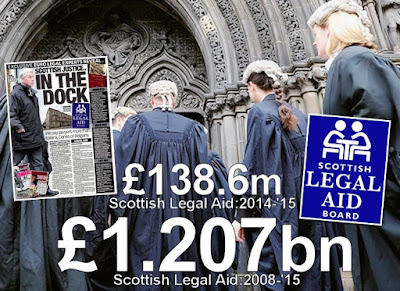
LEGAL BILLIONS: Law Society hits out at legal aid cuts as Scottish Legal Aid Board reveal lawyers received £138.6m public cash in 2014-15, making £1.2bn since 2008 financial crash

Billions in public cash keep ‘struggling’ lawyers afloat. SCOTLAND’S legal profession took home a staggering £138.6 million in public cash last year – for giving Scots access to justice – according to figures released by the Scottish Legal Aid Board (SLAB) today.

However, the latest round of payments of public subsidies to struggling solicitors, down from last year’s £150.5 million and marked for a further reduction by Finance Secretary John Swinney to £126.1m in 2016 budget - sparked ire at the Law Society of Scotland who yesterday attacked the Finance Secretary’s legal aid reductions as “unrealistic”.

Figures provided by the Scottish Legal Aid Board reveal Scotland’s legal profession have taken home over £1.2 billion in public cash since the great Financial crash of 2008: 2014-2015: £138.6m, 2013-14 £150.5m, 2012-13 £150.2m, 2011-12 £150.7m, 2010-11 £161.4m, 2009-10 £150.5m, 2008-09 £150.2m, 2007-08 £155.1m, TOTAL: £1.207 Billion.

Commenting on the figures, the Scottish Legal Aid Board said “Services funded through the Scottish Legal Aid Board (SLAB) provided help during 2014-15 to tens of thousands of often vulnerable people across Scotland. Legal aid funding allowed people to access the services of private practice solicitors, SLAB’s employed solicitors, law centres, and over 100 grant funded projects.”

Legal Aid Big Spenders: See which law firms, Advocates & Solicitor Advocates took home Legal Aid millions in 2014-2015. Glasgow based law firm Livingstone Browne Solicitors remain the top-earning law firm, taking home legal aid payments of £1.9 million. Brian McConnachie QC is Scotland's top legal aid earning advocate, receiving £303,000, Gordon Jackson QC earned £282,000 and third highest earner is Donald Findlay OQ on £258,600.The top legal aid earning solicitor advocate was Iain Paterson of Paterson Bell solicitors – who received £267,200 of public cash for legal services.

The total cost to the taxpayer of legal assistance in Scotland was £138.6 million in 2014-15, a decrease of 8% compared to the previous year. This £11.9m decrease is partly due to changes in the flow of criminal cases through the justice system in 2014-15. However, 2014-15 also saw falling applications and grants of summary criminal and civil legal assistance, offset partly by a slight increase in solemn criminal legal aid and continued growth in children’s legal assistance.

Colin Lancaster, Chief Executive of SLAB, said: “Over the last year, legal aid has again helped people across the country, many of them on low incomes and with caring responsibilities, defend themselves against criminal charges or deal with their problems on debt, housing, mental health or family breakdown.

“Publicly funded legal assistance helps people to resolve the problems they encounter in day to day life by pursuing or defending their rights and as such it makes a vital contribution to tackling inequalities in Scotland.

“The fall in expenditure in 2014-15 is not a signal that the financial challenges are over or that the legal aid system doesn’t need further reform and streamlining.

“The impact of the UK Spending Review means that significant further changes are needed to meet the Scottish Government’s budget allocation for legal aid. While the legal aid fund is demand led, and no-one who is eligible will be refused legal aid, expenditure savings will need to be found.

“Access to justice can only be maintained in the face of these financial challenges by working collaboratively with those interested in protecting the vulnerable through a legal aid system that is broad in scope and encourages a strategic approach to meeting needs. I look forward to doing so over the coming months.”

Iain A Robertson CBE, Chairman of SLAB, said: “Although we have seen the general demand for legal assistance fall again in 2014-15, the funds available to manage public finances are also falling. The need to reduce expenditure on legal aid has not gone away, and will increase.

“We will work collaboratively with others in the justice sector to deliver improvements that will enable further reductions in legal aid expenditure, including by streamlining the legal aid system where possible.

“It is imperative that discussions on reforms are approached strategically and in the context of the justice system as a whole, to protect the best interests of those in need of support from the legal aid system. Otherwise Scotland risks its proud record on maintaining access to justice.”

Key points of the Scottish Legal Aid Board 2014-15 annual report:

    Total expenditure on the Legal Aid Fund in 2014-15 fell by 8% to £138.6 million compared to the previous year. The 2013-14 figure was £150.5 million.
    SLAB assessed 212,000 applications for legal aid and paid 241,000 accounts of solicitors and counsel.
    SLAB managed three grant funding programmes, which enabled support for 108 projects around Scotland. The projects helped nearly 27,000 new clients. SLAB grant funding also contributed to a new Scottish Women’s Rights Centre which helps women experiencing gender based violence.
    SLAB processed all application and account types within its headline performance indicators.
    SLAB reduced the average number of working days it takes to process civil legal aid applications by six working days. It also reduced the average number of working days to making a payment on an account by six working days.
    Expenditure on criminal legal assistance fell by 10% compared to the previous year, from £94.0 million to £85.0 million.
    Net expenditure on civil legal assistance was £43.9 million, a fall of 8% compared to the previous year from £47.7m. There has been a fall in the take-up of advice and representation in civil matters.
    Children’s legal assistance (legal aid and ABWOR) cost £5.2 million, an increase of 7% compared to the previous year, from £4.9 million.
    Gross expenditure on grant funded projects was £6.3 million which increased from £5.5 million as a result of the Scottish Government and Money Advice Service providing extra funding for an extended programme.
    Payments to solicitors totalled £107.7 million, advocates £11.9 million and solicitor advocates £3.0 million.
    Payments on outlays (e.g. expert witnesses and court reports) fell by 8% compared to the previous year, from £19.5 million to £17.9 million.
    Grants of all types of criminal legal assistance have fallen compared to the previous year, apart from a small rise of 1.2% in grants of solemn criminal legal aid. This reflects a longer term trend of declining summary court business.
    Grants of civil legal assistance have fallen by 9.5% compared to the previous year. Demand has fallen due to the easing of pressures stemming from the economic situation. The largest volume year-on-year falls were in cases with subject matters of contact, separation and divorce. All these areas have been steadily declining for the past few years.
    Legal aid grants in relation to intervention orders and guardianship orders under Part 6 of the Adults with Incapacity (Scotland) Act 2000 now represent the largest category of legal aid certificates issued at 28% of all grants. Grants of this nature rose 19% in 2014-15 compared to the previous year.
    Grants of children's legal assistance continue to be affected by the changes that came into force on 24 June 2013 that extended the scope and availability of legal assistance for children's hearings. It is still too early to establish a proper comparison in volumes between years.

Responding to cuts in Legal Aid, and the Scottish Government’s Draft Budget for 2016-17, announced yesterday, Christine McLintock, President of the Law Society of Scotland, made the following statement to legal aid practitioners: “The 2016-17 budget allocation for the legal aid fund has been set at £126.1 million, the lowest it has been for well over a decade. This is a reduction from the 2015-16 budget of over 7% (from £136.1 million to £126.1 million).

“Legal aid spending is demand led and not limited by the budget and so we would expect the Scottish Government to continue to meet all its obligations in terms of demand for legal aid over the coming year. However, as you are aware, through its savings initiatives, the Government tries to reduce expenditure to meet the budget allocation.

“The Scottish Government has set the financial target for 2016-17 at a level that:

Is lower, in cash terms, than levels of legal aid expenditure from over 20 years ago (in 1994/95 the total expenditure on legal assistance was £132.1 million).

Is clearly unrealistic if you are trying to maintain an effective and sustainable legal aid system. Given existing figures, in order to reach its target, the Government would need to cut expenditure by at least £10 million by 2016-17. We do not see how this can possibly be achieved without seriously damaging both access to justice and the justice system.”

Investigation on Legal Aid in Scotland: SCOTTISH JUSTICE IN THE DOCK : Scotland's lawyers earn more from Legal Aid than whole of Italy, shock report reveals

The Euro study showed that Scotland disciplined a tiny number of lawyers compared to countries of similar size. Just three were struck off and 13 reprimanded in Scotland in 2010. Denmark, with a similar population, took action against 309 lawyers, with six struck off and 145 fined. And in Finland, also close in size, 99 rogue solicitors were sanctioned. Critics blame the Law Society of Scotland’s dual role of representing lawyers while also acting as regulator.

A large proportion of alleged criminals reported to prosecutors in Scotland are not being put in the dock. Of 265,830 cases sent to the Crown Office, only 41.7 per cent were brought to court. In England and Wales, 90.6 per cent of all cases resulted in court action.

The difference is thought to be partly due to Scotland’s recent introduction of spot fines and fiscal fines for what the authorities insist are more minor offences. Critics claim such fines lead to a secret justice system.

The report reveals that Scotland’s sheriffs top the European pay league.

Our sheriffs, with an average salary of 150,106 euros (£120,000), were number one, ahead of the Irish and Swiss. Next were sheriffs’ counterparts in England and Wales, who were paid 120,998 euros (£95,000). Not only were sheriffs the highest-paid, they also topped the table comparing their earnings to the national average. They earned 5.2 times the average Scot’s wage.