Showing posts with label Client Relations. Show all posts

Wednesday, February 25, 2015

OWNED POLL: Law Society ‘scripted’ survey criticised by Scottish Legal Complaints Commission - new data reveals few clients of dodgy lawyers ask legal regulators for help

Law Society poll did not reveal all – SLCC. THE FINDINGS of a Law Society of Scotland survey claiming hard-to-verify client-solicitor satisfaction rates have come in for criticism by the Scottish Legal Complaints Commission (SLCC) – the ‘independent’ regulator of solicitors & legal services in Scotland.

The Law Society poll – published in early January 2015 - claimed Scottish solicitors were highly regarded by the public.

However, the SLCC have now challenged the poll’s findings, claiming high levels of legal service in Scotland are “not a universal experience”. The ‘independent’ SLCC also cited higher compensation awards against rogue solicitors and ‘increasing redress’ provided by the SLCC to wronged clients.

And, in another swipe at the Law Society’s poll dodging, the SLCC has now revealed that only a third of clients polled who were dissatisfied with their solicitor did anything about it, and not one client involved in the poll knew they could refer their complaint to the SLCC.

However, carefully prepared statements avoided any explanation on why the SLCC’s involvement in the poll was kept secret until a media investigation published documents revealing the SLCC's role.

A spokesperson for the SLCC said: “Towards the end of last year, the Law Society of Scotland released the results of a poll of the public’s perceptions of the legal profession. This indicated that, overall, people expressed a high level of satisfaction with solicitors. While we agree that the vast majority of solicitors provide a high level of service, this is unfortunately not a universal experience. As our figures show, we are increasingly providing redress for those clients who receive a poor service from their solicitors – a picture also supported by the record level of compensation awards and refunds of legal fees we highlighted in our last Annual Report.”

The SLCC went on to explain it’s previously secret involvement in the poll, revealing it asked searching questions on how clients react to the provision of poor legal services.

“We were given the opportunity to include questions in the Law Society’s poll. We asked two related questions aimed to assess public awareness of the role of the SLCC. In particular, we wanted to know whether clients who were dissatisfied with the service they had received from their solicitor knew they could bring their concerns to us.

The answers to these questions were revealing. Of those who were dissatisfied with their solicitor: only a third did anything about it; and none knew they could refer their complaint to the SLCC.

Solicitors throughout Scotland have a duty to make their clients aware of the SLCC and how to make a complaint to us. We continue to see evidence that this is not happening – less than 5% of those who complain to us say that they found out about us from their solicitor. We are concerned that, as a result, the voices of many dissatisfied clients are just not being heard. As a priority, we are currently working with the Law Society to ensure that all solicitors provide clear and consistent sign-posting to our service.

Clearly there is also more work that we, as an organisation, need to do to increase public awareness of the SLCC. Our Consumer Panel, newly-established this year, will be looking at how we can make sure that, on the occasions where things do go wrong and fail to be resolved, the public knows to bring those concerns to us.  Our half year results show that when this does happen - we can help put things right.”

Complaints slightly down – SLCC statistics for first half of 2014/15. Alongside the SLCC’s attempt to clear the air on their involvement in what some legal insiders have referred to as a “vanity survey”, the SLCC released complaints statistics for the first half of the operational year, showing a slight drop in complaints.

The SLCC said: “The headline figures for the first half of the SLCC’s operational year show that, overall, the number of complaints we receive is declining, reflecting a continuing trend which we have highlighted in previous years.

More importantly, however, we note the proportion of those complaints which are either accepted as eligible complaints or resolved by us during our eligibility process. They represent almost 60% of all received complaints (up from just over 40% in the corresponding period in 2013).

It’s also clear from the figures that the number of accepted complaints which are then either resolved or upheld in favour of the complainer has also increased – 115 complaints compared to 97 in 2013.”

Responding to the SLCC’s criticisms, the Law Society’s Chief Executive – Lorna Jack – said: “In the vast majority of cases, solicitors’ clients are happy with the advice and the level of service they receive. However we know that things do go wrong from time to time and it is important that people have proper recourse to address any failings through a strong legal complaints system.”

“Dealing with complaints is and will always be difficult for everyone involved. What we want to ensure is that the process in place is robust and fair to both complainer and solicitor, and that we reach the right outcome.We will work with the SLCC to ensure that the legal complaints system in Scotland continues to improve.”

The Law Society did not comment on why the involvement of the SLCC was withheld from statements released by the Law Society along with articles written for newspapers during January by the Law Society’s own President – Alistair Morris.

The research carried out by IPSOS MORI for the Law Society of Scotland claimed that of clients who had used a solicitor in the past five years - more than 90% “of respondents” said their own lawyer was either very trustworthy (70%) or fairly trustworthy (27%), with 87% describing solicitors overall as very or fairly trustworthy.

However, no detailed material has been made available which could verify the claims, or identify which solicitors or law firms were involved. It has also emerged some solicitors and law firms were provided with scripted responses by the Law Society to answer questions from the pollsters.

Legal insiders also point out the SLCC’s admission of involvement in the ‘rigged’ poll only came about after the publication of heavily redacted communications between the SLCC & Law Society which revealed both regulators discussed how to frame questions for the survey. The now published documents also revealed the Law Society demanded all material handed to the SLCC regarding the poll was not to be released to the public or media.

Wednesday, February 11, 2015

LAW POLL FIDDLE: Law Society of Scotland survey on client satisfaction used scripted replies, question rigging & involvement of ‘independent’ legal regulator SLCC was kept secret

Law Society poll details to remain secret says regulator. A SURVEY conducted by the Law Society of Scotland claiming Scottish solicitors are highly regarded by the public was so dishonest, the involvement of the ‘independent’ Scottish Legal Complaints Commission (SLCC) and discussions about the poll and question rigging had to be censored out of documents released under Freedom of Information legislation.

AND, it emerged from an investigation into the poll the Law Society of Scotland demanded that all key documentation shared with the SLCC was provided to them on a confidential basis and on condition the material was safe from searching Freedom of Information enquiries by the media.

The research carried out by Ipsos MORI for the Law Society of Scotland claimed that of clients who had used a solicitor in the past five years - more than 90% “of respondents” said their own lawyer was either very trustworthy (70%) or fairly trustworthy (27%), with 87% describing solicitors overall as very or fairly trustworthy.

The survey went onto claim high numbers of clients felt their solicitor was an expert in their area of law and had provided good service enough to recommend to others. However, no independent material has been made available which could verify the claims, or identify which solicitors or law firms were involved.

Today, in documents released by the SLCC - blacked out to conceal discussions with the Law Society on how to ‘frame’ questions for the Ipsos-Mori survey, a murky trail of data manipulation emerges between the ‘independent’ SLCC & the Law Society – involved in a concerted attempt to manipulate the public into believing client-solicitor satisfaction rates are higher than the eventual publicity about the poll – published in late December 2014 & January 2015.

The documents released by the Scottish Legal Complaints Commission reveal a series of polls, carried out by the Law Society in order to boost its image and that of the legal profession.

In one email between the SLCC and Law Society representatives on the ‘poll’, a Law Society representative tells his SLCC colleague: At the recent LSS/SLCC strategy day, I agreed to provide you with our polling plans so we could discuss possible areas for some joint work. There are three pieces of polling work which we plan to carry out before the end of the calendar year, all carried out by Ipsos MORI.

• Public polling on attitudes towards solicitors (around 1,000 people) - polling carried out in September with results due in October.

• Political monitor (around 100 Members of the Scottish Parliament) - polling carried out Sep-Nov with results due in early December.

• Members polling (around 550 members) - polling carried out in December with results due by calendar year end.

Can I suggest that we find some time in the next few weeks for us to chat through the questions we have asked in the past and plan to ask this year? Perhaps Wednesday 13 or Thursday 14 August?

After a round of fixing questions and manipulation of data, an email from the Law Society of Scotland complains Ipsos cannot get to work on the survey because the pollster company was “busy with referendum stuff” in reference to the Scottish independence Referendum during September 2014.

“Please find attached the public research with your proposed changes. I will send it on to Ipsos and let them advise on the best way to frame the questions. This research will now not happen before October-they're quite busy with referendum stuff at the moment! If you can get back to me next week with any comments, I would appreciate it.”

During attempts to publicise Ipsos-Mori survey, the Law Society had so much difficulty obtaining publicity it’s own President – Alistair Morris put his name to articles spinning out the poll – which now appears more of a spin session than an accurate accounting of what the public really feel about high charging Scots lawyers who are costing their own legal profession over £1000 a day in compensation awards to ripped off clients.

Outgoing SLCC Chief Executive Matthew Vickers backed the decision to keep much of the details of the SLCC’s involvement with the survey a secret. He also supported the Law Society’s condition of providing documentation to the SLCC on the sly.

Matthew Vickers said: “The information which has been withheld relates to the survey carried out on behalf of the Law Society of Scotland ("the Society") by IPSOS MORI. The SLCC was given the opportunity by the Society to contribute some questions to the survey and following the survey the results of the poll were shared with the SLCC by the Society. The Society provided the material to the SLCC on a confidential basis and this was agreed and reaffirmed with the society at the time.

Vickers – who is standing down from the SLCC to take up a role in mediation at Ombudsman Services, added he strongly rejected any calls for the Law Society documents to be released in the public interest. Vickers said there was a greater interest in withholding the information from the public than releasing it.

Law Society President Alistair Morris said: “Overall, the results from the Ipsos MORI research are very positive and we are delighted that our members are so well thought of. However we can never become complacent and we have to recognise that things do go wrong from time to time. In addition to ensuring that we have a strong regulatory system in place, it’s important that we can understand the reasons behind clients dissatisfaction and what we at the Law Society can do to provide the right support and training to ensure that solicitors offer the advice and services that their clients need, whether they are buying a house, completing a business deal or appearing in court.”

However, it now transpires a number of solicitors did not want anything to do with the survey, some even questioning it’s cost and worth.

Earlier today, a law firm contacted in the survey talked about the discredited poll, admitting they were provided with a scripted response on how to respond to the pollsters.

Speaking to DOI a solicitor claimed he disagreed with the Law Society intruding into solicitor client relationships purely to seek publicity for it’s own ends.

He said: “The Law Society’s desire for publicity is more often than not counter productive and creates an unnecessary air of potential disagreement or conflict if clients refuse to become involved”.

The solicitor indicated colleagues in the profession had also received similar prompts from the Law Society to respond to the “vanity survey”.

Wednesday, April 04, 2012

Clients of Scots solicitors miss out on ‘right to know’ as UK Legal Ombudsman moves to name & shame ‘crooked lawyers’ in England & Wales

Legal OmbudsmanLegal Ombudsman for England & Wales now operating naming & shaming policy. CROOKED LAWYERS operating in England & Wales who are being investigated over complaints from clients and law firms who are considered ‘serial offenders’ in their poor treatment of clients & consumers could now be publicly identified by the Legal Ombudsman (LeO), even if the complaint is yet to be decided, according to an announcement made earlier this week by the independent regulator of complaints against the legal profession south of the border.

The policy, popularly known as ‘naming & shaming’ has taken well over a year for the LeO to implement after several consultations took place amid bitter arguments and veiled threats from the legal profession, who are worried consumers may end up seeing a different ‘warts, complaints, swindling, corruption & all’ view of lawyers other than the carefully manicured image projected by the Law Society and the UK’s legal services industry.

The LeO originally announced in November 2011 they would be going ahead with ‘naming & shaming’ in early 2012, reported by Diary of Injustice here : Scots to be ‘kept in dark’ on details of crooked lawyers while Legal Ombudsman’s ‘naming & shaming’ policy ‘will protect’ consumers in England & Wales

Earlier this week, Legal Ombudsman issued a statement & media release on its website confirming the naming & shaming policy is now operational : “As of 1 April 2012 we are collating names of lawyers and law firms subject to complaints resolved by an ombudsman's decision. Any data collected will be made publicly available at the end of July 2012 and then subsequently every quarter.”

The statement (pdf) went on to say : “In November last year, the Office for Legal Complaints (OLC), which is the board of the Legal Ombudsman, announced its decision that it is right to publish the names of lawyers in some specific circumstances, in line with the powers given to the Board under the Legal Services Act 2007.”

“The policy – which starts from 1 April 2012 – is to identify lawyers or law firms that are the subject of complaints in two different ways. The first of these is to publish, once a quarter, a table that summarises the number of ombudsman decisions each legal entity has been the subject of, what the outcome was (so remedy or no remedy), and the area of law in each case. The first quarterly information will be available on the Legal Ombudsman website in late July.”

The second is where there is a pattern of complaints, or circumstances where it is in the public interest to publish the details of a lawyer or law firm, then, pending approval from the Board, the Legal Ombudsman will publish this information immediately. This is regardless of whether there has been an ombudsman decision on the case.”

Liz France, Chair of the Legal Ombudsman’s board, said: “After careful reflection, based on the consultations we undertook, I am confident that the approach we are taking strikes the right balance. It meets our aim to be open in all we do while not providing information which is excessive to the purposes of publication – protecting consumers of legal services from detriment and helping to improving standards of service.”

Further information is available on the Legal Ombudsman’s consultations page HERE. Diary of Injustice reproted on the Legal Ombudsman’s consultation over naming & shaming here : Legal Ombudsman moving to name & shame crooked lawyers in England & Wales, crooked Scottish solicitors records to remain protected by secrecy for now

Which logoConsumer group Which? have previously given their backing to the Legal Ombudsman’s plans to identify crooked lawyers in England & Wales. A spokesperson for Which? told Diary of Injustice last year : “Which? strongly supports the principle of the LeO publishing complaints data under a strict and published policy , including in some circumstances the name of the law firm concerned. We set out our position in our response to the LeO consultation (page 51: opening up regulatory data)) pointing out that it is the expectation of Government that complaints handling bodies are as transparent as possible.”

Legal Services Consumer PanelSpeaking on the LeO’s plans to publish complaints data & the identities of law firms who perform poorly for clients, Elisabeth Davies, Chair of the Legal Services Consumer Panel (LSCP), said last year : “Research shows that UK consumers are now leaving well over 100 million comments online every year about their experience with businesses across the economy. Lawyers cannot escape this welcome emergence of consumer power, but instead should seek and then use such feedback to improve the service they offer.

She continued : “The courts will decide the fate of the Solicitors From Hell website. However, such websites fill a vacuum that exists because official complaints data about lawyers is not publically available to help consumers identify good quality lawyers. The Panel will continue to push the Legal Ombudsman to name those law firms who regularly provide poor service.”

oftThe Office of Fair Trading (OFT) also supports the Legal Ombudsman’s naming & shaming policy. The OFT stated in its submission (pdf) to the LeO’s consultation : “We appreciate that you need to balance the interests of consumers with the reputational impact on firms and individual lawyers. However, the OFT remains firmly of the view that the publication of named complaints data could incentivise legal service providers, due to reputational considerations, to maintain and/or improve the quality of service they provide to consumers.We believe that essential data would include:

* The number of complaints made against individual firms and lawyers;
* The nature of those complaints and placing them into categories to help see if a pattern develops;
* The ratio of complaints upheld against an individual firm or lawyer;
* Areas of law where complaints tend to focus;
* Which aspects of service the complaints tend to focus; and
* Whether the complaints tend to come from private or publically funded cases.

Diary of Injustice has been following the Name and Shame debate in England & Wales and it should not be forgotten the Law Society of England & Wales has, at rumoured costs of up to half a million pounds, used the courts to silence private individuals efforts to set up websites naming & shaming ‘crooked lawyers’, the most famous of which was Rick Kordowski’s Solicitors from Hell website.

While consumers of legal services in England & Wales are expected to benefit from the tough stance on naming & shaming taken by Adam Sampson, the Legal Ombudsman, there are no equivalent statutory moves being made in Scotland by the Scottish Legal Complaints Commission (SLCC) to name & shame many of Scotland’s ‘serial rogues’ from the legal profession who regularly get away with a slap on the wrist or secret shady deals done between the SLCC, Law Society of Scotland & the Legal Defence Union.

Even though the SLCC, Law Society of Scotland or the Faculty of Advocates currently refuse to name & shame their serial offenders who fail their clients, there are other routes, as Diary of Injustice reported earlier this year, here : NAME & SHAME YOUR CROOKED LAWYER : Have you been treated roughly by your solicitor ? It’s time to talk, rate, review, name & shame YOUR crooked lawyer

No one from the Scottish Legal Complaints Commission or the Scottish Government was available to comment on the lack of public information available about Scottish solicitors’ regulatory history, however a former Law Society Council member speaking to Diary of Injustice indicated any moves to name & shame ‘crooked lawyers’ in Scotland “will be fiercely resisted by the Law Society of Scotland”.

The insider also suggested any moves made in petitions to the Scottish Parliament or pleas to the Scottish Government to amend legislation to enable the SLCC to identify solicitors who are the subject of complaints “will be lobbied against by the Law Society of Scotland”.

THOSE WHO KEEP COMPLAINTS AGAINST SCOTS SOLICITORS HIDDEN FROM PUBLIC VIEW :

Philip YellandMisplaced trust with complaints : Philip Yelland. Philip Yelland, the Law Society of Scotland’s director of standards, previously director of regulation and before that head of the Law Society’s “Client Relations Office” has been in charge of regulating crooked lawyers in Scotland for over TWENTY YEARS yet from Penman to the present and beyond, most crooked Scottish lawyers have either received a slap on the wrist or no punishment at all while the client ends up financially ruined and excluded from the courts to make sure justice can never be done. Would you trust anyone like this with your complaint ? Make sure you use the media first before trusting the Law Society or SLCC with your lawyer problems.

Lawyer sued for 1 million Sunday Mail June 3 2007Law complaints regulators like the Scottish Legal Complaints Commission & Law Society of Scotland turn out to be client-haters rather than consumer protectors. Consumers, clients & readers may get a lot further in their complaints and obtain a lot more satisfaction from a media investigation of their crooked lawyers long before the Law Society of Scotland or blundering Scottish Legal Complaints Commission get round to putting pen to paper. Put simply, its more difficult for so-called regulators like the Law Society of Scotland or SLCC to let a crooked lawyer off the hook if they have already been in the newspapers a few times. Its also more difficult to let a crooked lawyer off the hook if, as usually turns out to be the case, the media reveal they have been ripping off many of their clients, not just you, or someone you know

If you have a story about a crooked lawyer, contact Diary of Injustice via scottishlawreporters@gmail.com with full details of what happened, how you were treated and what you have done about it so far.

Monday, September 05, 2011

Prevention is better than Penman : Law Society of Scotland's ‘One Profession’, ‘One Big Rip Off’ conference is just another ‘Client Relations Killer’

law-in-scotlandSponsored by Master Policy Insurers Marsh & HSBC Bank, Law Society of Scotland’s annual conference debates way forward for lawyers. THE LAW SOCIETY OF SCOTLAND, the infamous anti-consumer regulator of complaints against crooked Scottish solicitors, holds its 'one profession' conference tomorrow, Tuesday 6 September at the ‘plush’ Glasgow Hilton. The event is sponsored by well known UK Based bank HSBC and the Law Society’s own Master Policy insurers, MARSH, the convicted of bid rigging in the US insurance broker firm linked in an independent report to the suicides of clients who dared approach the courts & Master Policy to recover funds stolen by crooked Scottish lawyers.

'Law in Scotland - One Profession', which, according to those in the know may be better described as One Profession, One Big Client Rip Off, is being held on Tuesday 6 September at the Glasgow Hilton. Attendees expected, mostly solicitors and those from the legal establishment will be those who have rather large financial interests in making the legal profession as profitable as possible, stepping on as many clients along the way as is humanly possible.

marshMarsh, the Master Policy insurers co sponsor this year’s conference, along with HSBC Bank. This year's event at the Glasgow Hilton, itself the scene of various cosy lunches between law firms, universities & the Scottish Government which appear to have influenced the awarding of multi million pound publicly funded contracts to Scots law firms, is, according to the Law Society’s website, structured around 6 streams each focusing on highly topical issues for Sole Practitioners, High Street firms, In House, Big Firms, Legal Aid practitioners and New Lawyers.

Topics for tomorrow’s conference, (with the reality check in bold for consumers), include:

1. Winning more business from existing clients and new clients (and ripping them off through a variety of well tried & tested fraudulent methods, safe in the knowledge you are going to get away with it)

2. Tenders & Procurement: What Corporates look for in a law firm (Bribes, blackmail, backhanders, hospitality, access to crooked politicians, sympathetic or crooked members of the judiciary etc)

3. Ensuring your income from Legal Aid (and ensuring the Crown Office doesn't prosecute you for stealing millions in legal aid by calling in the Legal Defence Union & favours from the Law Society)

4. Dealing with Difficult Clients (How to harass clients into withdrawing their complaint, sending someone round to threaten to burn their house down if they don't, threatening client’s children (in one case, rape), use of corrupt Police Officers to threaten arrest, having a client’s home repossessed, breaking up their family, provoking a client into suicide (becoming increasingly popular)

5. Building your Professional Network (Meeting up with crooked colleagues from all walks of life & professions including the criminal underworld who may be of use in the future)

6. Your clients want WHAT? (none of the above, just a honest job on their case rather than it being strung out for a few years just to generate huge fees and a few rip offs including thefts from wills & property.

Despite the Law Society of Scotland claiming to represent both the legal profession and the public interest in legal issues & regulation of the profession, clients are not welcome at the event, however, the two faces of what the Law Society preaches as “Client Relations” versus what “Client Relations” actually is, will most certainly be discussed.

The Law Society of Scotland will have the public believe “Client Relations” is about dealing with client complaints effectively and ensuring clients are well protected from mishaps in their relationship with their solicitor or the legal profession as a whole. As many readers & consumers now know, through the power of the alternative & online media to that of the legal profession, the reverse is true.

Fact. In reality, experiences of real clients, rather than third party script writers show ”Client Relations” is in truth, about sending a client round so many twists & turns in the legal world, ending up with a law firm that represents & defends crooked lawyers, and is acknowledged to have intervened to prevent criminal charges against corrupt solicitors in legal aid fraud cases, that the client, a married family man was provoked into suicide after well over three years of torture at the hands of the Scottish legal profession and its many tentacles.

Prior to tomorrow’s conference, some sections of the media have been helping the Scottish legal profession over the past few weeks to promote itself as an honest bunch, albeit with ‘imperfections’ which can be easily put right. The usual, now incredibly worn script is followed – a lawyer can only achieve what is possible, not always what the client wants, and of course, the lawyer should put right mistakes immediately, something which invariably does not happen.

However, the same tired arguments & ostensibly the same articles written by solicitors and some of the most senior officials from the Law Society in newspapers since the early 1990’s, have done nothing to stem rising client fraud committed by members of the legal profession over the past two decades, and noticeably have spoke nothing about the rising numbers of client deaths, home repossessions & sheer outright harassment which clients have experienced at the hands of vindictive solicitors & law firms who have in recent times started to use the courts to recover alleged fee notes for work which never took place.

So worrying is the silence on the consumer’s point of view and actual experiences of genuine clients with genuine grievances, it is as if there is a media blackout of clients woes in some sections of the press, and when someone dares to point it out, or write about the issue on their own, a national newspaper tags along with the profession to in a concerted attempt to silence criticism. Clearly, no accident, according to how one journalist told it.

Law Society of ScotlandLaw Society of Scotland “Client Relations” ensures solicitors interests come first before consumer protection. Clearly, enough time has passed where more & more experiences of clients ruined by their solicitors have hit the internet based media, showing without a doubt, clients usually receive the sharp end of the stick from their solicitors and the legal profession once a fraud has taken place, and upon receipt of an actual complaint by a client, the Law Society of Scotland will despatch the likes of the Legal Defence Union and a charity called “Law Care” to help the solicitor out of their ‘difficulties’ by any means possible, while the client is left with no support, no help, no one to speak for them, and certainly no return of what is now typically tens of thousands of pounds stolen from their funds.

While the Law Society gives lectures to its masses, and consumers about “how to deal with difficult clients”, the truth of how the Scottish legal profession perceives & deals with complaints is reflected in what one well known solicitor in an interview about how to deal with difficult clients once said.

Referring to an example where a client had considerable cause to complain to the Law Society of Scotland about the loss of hundreds of thousands of pounds, the solicitor said : “He should have a shotgun stuck in his mouth and the trigger pulled.”

This, is the attitude, and indeed the practice of the legal profession and the Law Society of Scotland when dealing with complaints against their colleagues.

Scotsman coverage of some of the stories relating to Andrew PenmanPrevention is better than Penman : Want to prevent this happening to you ? Avoid going through the doors of a lawyer’s office if you can help it. If you want to avoid what happens next, ask yourself do you really want to put yourself and your family through a living hell dealing with the legal nightmare which comes after dealing with a solicitor. Take it from someone who has already been through the system, if you want to prevent Penman happening to you, think again about how you use your money in these troubled financial times, and don't go wasting it on the fantasy services provided by many Scottish law firms, services which quickly degenerate into dishonesty and just another escapade in taking as much money from you as possible, without being able to achieve the desired result in law, where you will invariably end up as the victim.

MURDER ON THE LAW SOCIETY EXPRESS : How the Master Policy’s killer streak protects Scots solicitors :

SLCC report headerAfter the release of the Scottish Legal Complaints Commission's investigation into the claims process against solicitors, harsh evidence emerged of the human cost to clients, where suicides, illness (some resulting in death), family break ups and huge financial losses are the horrific consequences sustained by members of the public who have tried to make claims against the Law Society of Scotland's 'Master Policy' insurance scheme, touted by the legal profession as protecting lawyers and clients but which the ground breaking report released by Manchester University School of Law on Monday reveals “is simply designed to allow lawyers to sleep at night.”

Page 8 - Consumer Focus Scotland refused cooperation from Law SocietySuicides, illness, family breakdown, loss of homes, loss of livelihood were all identified by interviewees as being directly associated with members of the public’s dealings with the Law Society & Master Policy. During the research team's investigation of claims against the Master Policy, team members were told of suicides which had occurred due to the way in which clients of crooked lawyers had been treated by the Law Society of Scotland and the insurers who operate the Master Policy protection scheme for solicitors against negligence claims. Quoting the report : "Several claimants said that they had been diagnosed with depression; that they had high blood pressure; and several had their marriages fail due to their claim. Some had lost a lot of money, their homes, and we were told that one party litigant had committed suicide."

Further excerpts from the Manchester University report into the Law Society's Master Policy & Guarantee Fund show the intolerable strain clients who attempt to claim against their 'crooked' solicitor have to endure : Claimants "described being intimidated, being forced to settle rather than try to run a hearing without legal support, and all felt that their claims’ outcomes were not fair. Some claimants felt that they should have received more support, and that this lack was further evidence of actors within the legal system being “against” Master Policy claimants. Judges were described as being “former solicitors”, members of the Law Society – and thus, against claimants. Some described judges and other judicial officers as being very hostile to party litigants."

One direct quote from the report, depicts a claimant, who was forced to become a party litigant : "I keep fighting cases, and they keep coming at me, and now I have become ill. But they still keep coming at me. They threw me out onto the street, I couldn’t get my medication, I’ve got nothing, I was homeless, ill, sleeping in the car. Now I am appealing. But I can’t get a solicitor. They are just shutting me down…. My health has been damaged, they kill you off. It's a proven fact. All of us have stress related problems after years and years of stress."

The full story of the University of Manchester’s report on the Master Policy and its effects on clients, can be read here : Suicides, illness, broken families and ruined clients reveal true cost of Law Society's Master Policy which 'allows solicitors to sleep at night'

Some of the ways in which clients have been targeted by the Law Society of Scotland were revealed in an earlier article, documenting how Private Investigators & corrupt Police Officers have been used to intrude into client’s lives, featured here : HERE & HERE

Thursday, February 05, 2009

Dean of faculty hints at rising fraud claims against solicitors as 'Penman Levy' bites hard into Scots law firms

richard keen qcRichard Keen QC. Richard Keen QC, the Dean of the Faculty of Advocates, has admitted there will be a sharp rise in claims against solicitors, with both the Master Policy & Guarantee Fund being heavily affected as many of the dubious buy-to-let schemes, involving solicitors apparently faking up securities for clients, begin to be discovered.

Richard Keen QC said in “The Firm” article which you can read here : Reasons to be cheerful : “Are there any prospects for growth in the present environment? I would predict that over the next 12 months we are almost certainly going to see a substantial increase in the identification of loan fraud related to buy to let projects. I would not be at all surprised if this came to dominate claims on the Master Policy and the Guarantee Fund.”

Law Society of ScotlandLaw Society will face many claims against crooked lawyers. Prospects for growth, as the Dean himself indicates, seem to be a huge jump in fraud claims against the legal profession, with the Master Policy & Guarantee Fund both being put to the test as many banks and financial instructions discover that many ‘buy-to-let’ schemes have frankly, been nothing short of bare faced fraud, on the part of many clients and solicitors, hungry for fat profits on highly dubious deals, backed by faked up securities many of the Banks failed to accurately confirm supported the transactions taking place.

You can read more about the buy to let fraud here : Buy-to-let fraud hits thousands

Buy-to-let fraud has hit the property market and the legal profession many times before, and many will remember how some clients of the defunct law firm Scott Moncrieff & Dove Lockhart (known for their jailed solicitor partner John McCabe where £4 million disappeared), were apparently also engaged with some of the solicitors in ‘buy-to-let’ fraud schemes, in which several Scottish banks lost a great deal of money.
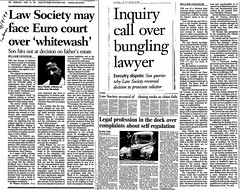
Scotsman coverage of some of the stories relating to Andrew PenmanLessons to be learned – The ‘Penman Levy’ ends up costing Scots lawyers & legal firms dear. The growth in ‘buy to let fraud’ & claims against crooked lawyers is not the only growth area in the legal system these days .. as solicitors in Scotland must also now fork out a huge annual complaints levy, dubbed by some senior lawyers as the "Penman Levy", in reference to the multitude of 'crooked lawyer' scandals reported in the media after my own personal battle with the legal profession, which involved the Law Society's determination to defy prosecution in the case of crooked Borders lawyer Andrew Penman.

You can read more about the Scotsman’s reporting of the Andrew Penman case, here : Andrew Penman of Stormonth Darling Solicitors, Kelso -The Scotsman stories

However, while each Scottish solicitor was forced this year to pay an average of £400 each to fund the “Penman Levy" to run the Scottish Legal Complaints Commission, amounting to a whopping £2.4 million, it seems some solicitors have decided to recoup their ‘Penman Levy’ costs by fiddling their fee demands to clients, as many Scots are about to find out, if they are expecting a bill from their lawyer.

In a recent survey of 20 contacts throughout Scotland who have received demands from their solicitors for payment of fees, every single bill was found to be well far of the 'cost estimate' originally provided by the solicitor to the particular client, and it is also worth noting that in each case, where timescales for a resolution to the client's problem had been given, not one single case out of the 20 clients concerned, had progressed to a solution.

In one case, involving a boundary dispute with a neighbour, the client, of a famous Edinburgh legal firm, was told in 2005, it would cost in the region of £2,000 to study the papers, seek Counsel's opinion, and bring the case to court.

However, last week the client received a demand for an additional second Counsel's opinion, which came to £2,105.55 pounds alone, which the client was not informed had even been given in 2008. When the client asked to see the actual opinion, his request was refused, with a letter arriving two days later demanding full payment of the £2,105.55 otherwise immediate steps would be taken to recover the funds.

After a little checking by the client, directly with the Advocate, it has been discovered the QC who was supposed to have given Counsel's opinion on the boundary dispute, had never actually undertaken the work, nor even given the first Counsel's opinion the solicitor had charged his client £1520, during 2007.

Obviously in this case, a significant fraud has taken place against the client, by one of Edinburgh's 'most respected legal firms', and this particular case will no doubt generate another complaint against a 'crooked lawyer' to add to the thousands of complaints filed each year by clients against their solicitors in Scotland.

SLCC squareSLCC wont investigate cases before late 2008. However the ‘do-nothing’ Scottish Legal Complaints Commission will not even investigate this complaint or any matter arising from the case, as the SLCC conveniently decided it would not examine any complaints connected with legal work instructed prior to 1st October 2008, when the Commission began operation.

Studying the raft of solicitors bills recently sent out to clients, there does appear to be an increasing trend by Scots legal firms, desperate for any income they can get, to provide false accounts to clients, for cases which partners have taken on but have never seriously pursued as per agreements reached with clients to represent their legal interests.

The only advice I can offer for now is : If you have currently engaged a solicitor in any way whatsoever, you must carefully scrutinise your solicitors fee demands and bills, because the likelihood is, their fee demands are inaccurate and unjustified.

In another case, a family who were due to receive property as part of their deceased father's estate in the Scottish Borders, were forced to wait three years, before being told there was no assets left in the estate and they must put in money to pay a whopping £5,300 bill for legal services, undertaken by a notorious firm of solicitors based in the Scottish Borders.

In yet another instance, a client was recently sent a bill for £3,520 by a Glasgow law firm, despite the fact he actually settled the case with his neighbour over a land dispute in 2007. The recent fee demand was accompanied by a 7 day threat of court action if no payment was received, apparently being sent on the basis "the account had been misfiled and never sent out" - this despite the fact the client retained his fee payments and took his client file from his solicitor's office in 2007 after settling the case, and settling all fees due which totalled £1,477 at the time.

Many of the other cases brought to my attention of inflated accounts & demands from solicitors involve case work such as, land purchases or sales gone wrong, divorces, custody cases, boundary disputes, failures in executry work, false QC's opinions, backdated or allegedly misfiled accounts, fictitious work undertaken on cases which have no hope of reaching a settlement.

A paralegal I know who recently was sacked along with several other staff from her struggling legal firm, described the client billing situation in the Scots legal profession as "fraudulent at best", and went on to claim "at the moment its pandemonium in many legal firms I know of, where friends and paralegals I know personally have been asked to type up bills for clients which they know themselves are fictitious as the work has never been done".

"I remember a few weeks ago there was a client telephoned to speak to the senior partner over the size of his bill and the fact it was nearly £6,000 over the estimate initially provided. The senior partner told me he didn't want to speak to the client under any circumstances, and I was to call the Police if the client made any hint he would not pay or insulted any members of staff on the telephone".

"I know for a fact that client's case is a mess and twice the solicitor took the matter into court just to have the case adjourned so he could get more fees out of the client for doing nothing”

“The case, which involved a neighbour who had built on their land, has left the client with a property they cant sell. Probably the mess will be left for someone else to clean up if they can get another solicitor to look at it which I honestly don't think will happen after the mess my former employers made of their case."

So the lesson for anyone of you who has received or is about to receive a bill from their solicitor, is to check it out thoroughly, because the chances are, there is a lot of false work added to that account, which you either never authorised, or were never told would be required.

I suppose the other lesson, perhaps this time for solicitors is – speak out against the bad apples in the profession, because in the long run it will be a lot cheaper for you, generate much more respect, and probably bring in business & clients who for now, doubt your honesty and ability as a profession to regulate yourselves.

Oh, by the way, (I have to ask) how do solicitors really feel about having to pay out £400 a year to fund the SLCC, simply because the Law Society decided to fiddle the case against Andrew Penman, the Scotsman’s reporting of which brought about many hundreds more scandals involving crooked lawyers reported in the Scottish media to this day ?

Read on for some more examples of sleazy solicitors from Scotland’s legal profession (from the Scotsman) :

Sleazy side of legal profession

""We must ensure those with the highest standards are protected from the dishonest few" - leslie cumming

By GINA DAVIDSON

AS Leslie Cumming lay bleeding outside his Murrayfield home, the victim of a frenzied stabbing, his cool legal brain was probably already clicking into gear.

While his body fought to stem the flow of blood from a dozen wounds, his mind was whirring through the possibilities of who would have wanted to attack him. It wasn't long before the top law official was able, from his hospital bed, to give Lothian and Borders Police a rundown of lawyers he is and has investigated for suspected money laundering.

Now, two lawyers are to be interviewed by detectives in connection with the attack on the 62-year-old, while police also sift through all the Law Society files that are the work of months of painstaking investigation by chief accountant Cumming and his 12-strong team.

Yet while the attack on Cumming saw the reality of violent crime intrude into his highly regulated world of balance sheets and law books, it has also focused the public interest on corrupt lawyers. Ever since he was appointed chief accountant of the Law Society of Scotland back in 1984, Cumming has taken it upon himself to weed out rogue or "bent" lawyers throughout the country.

Back in the early 1990s, he ensured the Law Society took a hard-line stance against crooked lawyers who embezzled clients' money, changing the five-year inspection of firms' books to two years. The move came after lawyer John McCabe, who had worked for Edinburgh firm Scott Moncrieff & Dove Lockhart, was jailed for ten years for defrauding his clients out of more than £4 million.

More than two years ago the Law Society - which represents more than 8000 lawyers - along with the National Criminal Intelligence Service held a series of seminars aimed at raising awareness about the ways criminals might try to exchange stolen for clean money.

That was when the Proceeds of Crime Act became law, making it illegal for professionals to handle criminals' money without asking questions. As a further safety measure, he also oversaw the introduction of regulations which mean every firm must submit a financial certificate every six months to the Law Society, providing financial information about the firm and confirming compliance with accountancy rules.

Such scrutiny was bound to make him some enemies. Yet Cumming has always maintained that solicitors in Scotland are in the majority honest, with just a few spoiling the reputation of the profession. He has said: "Our system relies on the near 100 per cent honesty of the profession which is what we find time after time.

"It is our duty to the profession and their clients to ensure that those who maintain the highest standards and their clients are protected from the actions of the few who act dishonestly."

Sources in the legal profession claim there are currently 19 lawyers on petition charges - which means they've committed an offence which could mean a minimum sentence of more than five years in jail - although a spokesman for the Crown Office says they have no way of confirming the number as they don't list occupations.

Legal sources also suggest that, despite the Proceeds of Crime Act which could see lawyers face up to 14 years in prison for turning a blind eye to money laundering, there are still those who believe the rewards are worth the risk.

"It all depends on how well your practice is doing, that seems to be the excuse when people are struck off," says one Edinburgh lawyer. "That if business isn't going so well, and they have clients who have money to 'invest' in property, then it becomes an option. But lawyers know the risks. If a client comes in with £100,000 in cash and says he wants to buy something, be it property or shares, bells should be ringing.

"If a lawyer doesn't do the necessary checks, ask the necessary questions and then gets found out to be dealing with dirty money, then they go to jail, it's as simple as that. Most would think it isn't worth the risk, but there will always be those who are blinded by the cash."

Another adds: "The change in the law has been onerous for solicitors. It means that when a new client comes through the door we have to ask for passports, driving licences, utility bills . . . it's a bureaucratic nightmare.

"If there's any reason to suspect the client of trying to pass off stolen money you have to report them to NCIS in England. The solicitors are being asked to police clients rather than the police, and if we get it wrong we go to jail."

Another city solicitor says: "Embezzling has been seen as a way out of trouble for some lawyers in the past, but these days firms' books are gone through with a fine-tooth comb every two years. The accountants at the Law Society know exactly what to look for, so there's no hiding any dodgy practices."

However, despite all the checks and balances, one case which slipped Cumming's net for a decade, until just two years ago, was that of former solicitor John Kennedy Forster. A partner at Stranraer-based solicitors Ferguson & Forster, MacFie & Alexander, he admitted 35 charges of embezzling £667,000 from his clients to pay for school fees, his large home with outdoor swimming pool and foreign holidays.

His sentencing was deferred several times at the High Court in Edinburgh, to allow for compensation proceedings to be resolved and for a report to be submitted by forensic accountants. Finally though on March 18, 2004, he was jailed for six and a half years.

According to Cumming, the case took so long because it "involved a uniquely complex system with the evidence well hidden".

He added: "But as with all cases, once the cracks appeared layer after layer of the fraud was exposed and produced the evidence which we needed and which the Crown then used.

"Most successful frauds involve several strands and depend on a position of particular power or influence. The hardest to uncover are those where there's an element of complicity. It's a constant challenge and each time we find a scheme we ensure that all our inspection teams know about the mechanisms and how it worked so that they can recognise the signs in the future."

Police sources here in Edinburgh believe there are few, if any, corrupt lawyers working in the Capital, and that the Law Society's checks are currently adequate for preventing illegal financial activities, although they admit there will be those who don't get caught quickly enough.

One says: "I've seen a few dodgy lawyers in my time, but not on the financial front.

"There's more organised crime in Glasgow than Edinburgh but then the property market here is much more expensive and so that maybe proves the attraction. But I do think that there's only a few corrupt lawyers in Scotland - although they can be damaging to the whole of the profession."

But perhaps the most telling thing about crime among Scotland's lawyers is that claims on the Law Society's Guarantee Fund - a fund which compensates clients who have suffered loss as a result of a solicitor's dishonesty, and which is paid into by partners in law firms - have steadily fallen under Cumming's tenure.

Each partner pays around £200 a year into the fund, which is in excess of £1 million. For the year 2003-2004, the last year for which figures are available, the total paid out was £187,000, whereas when the fund was first established in the early 1990s, the compensation payouts were as high as £1.35m.

LOWERING THE BAR: CROOKS WHO MAKE UP LAW'S LIST OF SHAME

1991: Edinburgh lawyer John McCabe was jailed for ten years after admitting 34 charges of fraud totalling more than £4 million. He conned banks and building societies into handing over loans of up to £500,000 and ploughed the money into disastrous business ventures. He fled to South America, leaving a taped confession, but returned within a few days and was arrested at Heathrow Airport.

1996: A five-year sentence was handed to David Hoey, a lawyer from Leven, after he was found guilty at the High Court in Edinburgh of stealing more than £500,000 from elderly clients. He had already been struck off when the offence came to light.

1996: After a probe into his firm's financial affairs, Donald Pirie was struck off. A police investigation found that the Cowdenbeath-based lawyer, who lived in East Linton, had embezzled £63,000 from clients, including £40,000 from his parents. He was jailed for five and a half years.

1997: Stephen Crilley pocketed £45,000 in fees due to his firm because he believed he was underpaid. He was a partner with Grant & Wyllie until resigning in 1996 and was struck off the following year. He avoided going to prison by repaying the money.

1997: Pat Elliot was jailed for 18 months after she was found guilty of stealing £60,000 that was destined for two charities from a client's will. Elliot, of Crown Terrace, Glasgow, was also struck off.

1998: Alexandra MacRae, a lawyer who underwent a sex-change operation and was previously known as Steven Raw, admitted to embezzling more than £16,000 from a client's account in order to pay her Dundee firm's debts. She was struck off before later being sentenced to 15 months. However, she appeared in court again in 2001 and was sentenced to three years for embezzling almost £100,000 from an elderly client while she had worked as a lawyer.

2000: William Stevens of Saughtonhall Drive was jailed for four years at the High Court in Edinburgh for embezzling cash from elderly clients to pay for school fees. He was also struck off, although had resigned as a partner with firm Bennett and Robertson in 1997.

2001: Alistair Liddle prompted a police hunt in 1997 after vanishing, leaving his family in Forres, just as the Law Society was to investigate his firm. He was struck off in 1999 and traced to Cornwall in 2001, where he admitted embezzling £17,875 from a client's account. He was jailed for a year.

2001: Solictor Bruce Gordon of Piersfield Terrace in Edinburgh was struck off after being found guilty of professional misconduct for embezzling £55,000 from a dead man's estate. He was jailed for a year.

2003: Alastair Hall, a former partner of A&R Robertson and Black in Blairgowrie, was jailed for 11 years after stealing £500,000 from clients. He admitted five charges of embezzlement, two of fraud and a bankruptcy offence.

2004:Edinburgh lawyer Ricky McAnulty was jailed after admitting embezzling almost £20,000 from the accounts of five clients. He was struck off and sentenced to 18 months in Saughton.

2004: Douglas Criggie, who owned Cumberland Street firm Criggie & Co, was charged with embezzling £50,000 from clients. But his firm was sequestrated after it was discovered he had unpaid loans and bills totalling £300,000 and he went bankrupt. He was struck off by the Law Society in May 2004 and the Crown Office is still considering prosecution.

2005: Glasgow lawyer Calum Blyth was jailed for two years after being found guilty of embezzling £108,000 from his clients and obtaining a further £27,000 by fraud while working for Blyth Solicitors between 1996 and 1999

Sunday, August 03, 2008

Law Society conference on client care falls short as lawyers told to 'dump & ruin clients’ to save themselves

Despite the promise of 'a new era' in dealing with complaints against crooked lawyers and attempts to improve the appallingly poor quality of Scotland's overpriced legal services market, the Law Society of Scotland are still choosing to undermine the very foundations of client care, with more of the usual policies, sanctioning lawyers disgraceful treatment of clients to the point of ruin.

One of a number of comments on my earlier article on legal fees here : Solicitors target clients with ‘sky high’ legal fees as Scotland's billion pound legal industry slows down went onto show how poor client care is regarded in the Scots legal profession :

“When confronted by a large legal bill of approximately £10,000 from the defenders in a personal injury case I instructed the solicitors then representing me to lodge a motion to the Court of Session on basis you outline, that is, the clear potential for a serious conflict of interest arising given the Auditor of the Court of Session would be ruling on matters relating to a fellow professional's expenses.

My solicitors refused to submit the motion, claiming it was incompetent. When I suggested it was for the Court to decide this and I should at least be allowed the opportunity to present the motion and receive the Court's decision my solicitors threatened to withdraw if I insisted on submitting the motion.”

Not much in the way of client care there … is there ? Could there be some kind of accounting fiddle going on too while one lawyer is tasked to investigate another colleague’s expenses ? Maybe you too are getting a fiddled bill in from your lawyer in a now common fraud by solicitors against unsuspecting clients …

So, while preaching an emphasis on caring for the client, and attending to good service with one hand, the Law Society’s ‘other hand’ is being used again to undermine what it publicly preaches, in favour of a more sinister policy of protecting its members once again from negligence claims and complaints against poor work …

Recently there has been an upswing in 'profession orders' from the Law Society to solicitors to dump clients who are either complaining against another solicitor, or are trying to lodge court cases for negligence or financial recovery of damages from lawyers who have ruined clients.

A very recent example letter follows below, from the Law Society of Scotland to a solicitor, which was 'inadvertently' sent to the client by a member of that solicitor's staff, and then forwarded to me, goes to show there is no let up even now in how low the Law Society feels it can treat members of the public and get away with it :

Dear ****

I am writing to you with reference to your client Mr ****'s negligence claim against Messrs **** & **** . I would emphasise this is private correspondence between us which is under no circumstances to be disclosed to your client.

I note your client is seeking to have the various papers he is in possession of relating to the investigation of the complaint against Mr **** submitted in evidence for his negligence claim.

I also note from the terms of your letter your client apparently is insisting on calling witnesses from the Law Society of Scotland who took part in the investigation of the complaint made against Mr ****.

In consideration of the above information you have furnished us, I recommend you withdraw from acting from your client immediately and make it as difficult as possible for any potentially dangerous material to be returned to your client in the file.

Yours sincerely,

Mr ****

* I have been asked to remove names & identities of those concerned for now, on the instructions of the client who sent me the letter.

I, of course, am not surprised in the slightest at the above letter, as this is a well trodden path for the legal profession when dealing with clients who have been ruined by one of their colleagues. It just goes to reinforce what has already been reported by myself and attested to by others over the years, the Law Society of Scotland is, a corrupt institution, and must be denied any future regulatory role in complaints or client claims made against solicitors.

I am not surprised ... why ? Well, just look at a few similar letters I have reported on in the past .. together with input from Cabinet Secretary for Finance Mr John Swinney (SNP) who bravely exposed another such letter in the Scottish Parliament itself.

John Swinney MSP exposes Law Society Chiefs who ordered lawyers to dump clients who were ruined by crooked lawyers

On my own case too, I received similar treatment from none other than Law Society Chief Executive Douglas Mill and Director of Client Relations Philip Yelland, who personally intervened in both my legal aid claims, and ordered my solicitor not to take instructions from me which like the above letter quoted, sought to prevent my inclusion of evidence gathered by the Law Society against well known crooked Borders lawyer Andrew Penman of Stormonth Darling Solicitors, Kelso, whom you can read more about from the Scotsman stories on that case here :

Andrew Penman of Stormonth Darling Solicitors, Kelso -The Scotsman reports on Scotland's most crooked lawyer

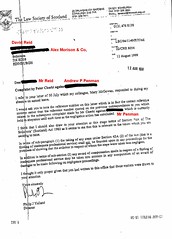
Here are copies of the actual letters from Philip Yelland ordering my solicitor not to take my instructions on the claim against Andrew Penman, and Law Society Chief Executive Douglas Mill ordering my legal aid be refused here :

Philip Yelland - Director of Regulation - Law Society of ScotlandClient Relations Director Philip Yelland :

'I order you not to help your client Mr Cherbi or take his instructions on submitting evidence in his negligence claim against Andrew Penman'


Philip Yelland letter to David Reid ordering him not to take my instructionsDear Mr Reid

Complaint by Peter Cherbi against Andrew Penman

I refer to your letter of 30 July which my colleague Mary McGowan responded to during my absence on annual leave.

I would ask you to note the reference number on this letter which is in fact the correct reference number rather than the reference number quoted on the previous correspondence to you which relates to the subsequent complaint made by Mr Cherbi against Andrew Penman which is currently held in abeyance until such time as the negligence action has concluded.

I think that I should also draw to your attention at this stage terms of Section 56A of The Solicitors (Scotland) Act 1980 as it seems to me that this is relevant to the issues which you are seeking to raise.

In terms of sub-paragraph (1) the taking of any steps under Section 42A (2) of the Act (that is a finding of inadequate professional service) shall not be founded upon in any proceedings for the purposes of showing that the solicitor in respect of whom the steps were taken was negligent.

In addition in terms of sub-section (2) any award of compensation made in respect of a finding of inadequate professional service may be taken into account in any computation of an award of damages to be made following on negligence proceedings.

I thought it only proper given that you had written to this office that these matters were drawn to your attention.

Yours sincerely

Philip J Yelland
Director

So, what was Mr Yelland doing writing to my lawyer telling him not to take my instructions on submitting the evidence of the complaints investigation against Andrew Penman which I wanted heard out in the Court of Session ?

Were the Law Society so desperate they didn’t want all the dirty details of what happened at the Complaints Committee coming out in public, where Senior Law Society member James Ness had inserted false evidence and personal attacks to save Mr Penman in a routine which until then had been kept secret from most clients who lodged complaints against their solicitors …

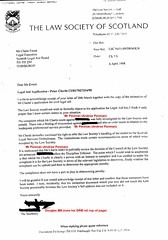
Now the turn of Douglas Mill, who was determined to prevent my access to the court at any cost, even ensuring I wasn’t able to ask for a Judicial Review against how the Law Society Complaints Committee and a few of its top staff saved crooked lawyer Andrew Penman. Telling a few lies and half truths was certainly not beneath a rather desperate Douglas Mill as his letter to the Legal Aid Board demonstrates :

Douglas Mill - Law Society of Scotland Chief ExecutiveLaw Society Chief Executive Douglas Mill :

Cancel Peter Cherbi's legal aid claim and any access to justice on my orders or else …


Douglas Mill letter to Scottish Legal Aid Board demanding my legal aid be refusedDear Ms Ewart

Legal Aid Application - Peter Cherbi

I write to acknowledge receipt of your letter of 20 March together with the copy of the intimation of Mr Cherbi's application for civil legal aid.

The Law Society would not wish to formally object to his application for Legal Aid but, I think it is only proper that I draw certain issues to your attention.

The complaint which Mr Cherbi made against Mr Penman was fully investigated by the Law Society and upheld. there was a finding of misconduct made against Mr Penman and also an order made in relation to the inadequate professional service provided.

Mr Cherbi thereafter exercised his right to refer the Law Society's handling of the matter ot the Scottish Legal Services Ombudsman. the Ombudsman made certain recommendations some of which were accepted by the Law Society.

It is understood that Mr Cherbi seeks to judicially review the decision of the Council of the Law Society not prosecute Mr Penman before the Discipline Tribunal. the point which I would wish to emphasises is that whilst Mr Cherbi is clearly a person with an interest to complain and was entitled to make his complaint, it is for the Law Society in terms of the relevant legislation to determine, firstly whether the complaint can be upheld and then to determine the appropriate penalty.

The complainer does not have a part to play in determining penalty.

I will be grateful if you would acknowledge receipt of this letter and confirm that these commends have been noted. I note, incidentally, that the intimation document which you sent did not reach the Law Society presumably because the Law Society's full address was not included on it.

Yours sincerely,

Douglas Mill
The Secretary

These letters on my own case are quite a common occurrence when clients of crooked lawyers find they can no longer gain access to justice or legal representation, the reasons for that being clear in the 'professional orders' handed down to solicitors from the Law Society, however, it is very difficult for a client to get hold of such material, believe me.

In one now famous case where there was a 'leak' from the Law Society of Scotland on the personal memos of Douglas Mill & others, did the true extent of the Law Society's ability and determination to prevent members of the public from obtaining access to justice in claims against crooked lawyers.

You can read more about that case involving a client who was able to testify before the Scottish Parliament in the following articles :

Law Society boss Mill lied to Swinney, Parliament as secret memos reveal policy of intervention & obstruction on claims, complaints.

The Corrupt Link Revealed - How the Law Society of Scotland manages client complaints & settlements.

Law Society boss Mill lied to Swinney, Parliament as secret memos reveal policy of intervention & obstruction on claims, complaints.

The determination of the Law Society to keep such a deniable policy afloat even led to it's Chief Executive and senior staff appearing before the Scottish Parliament and simply telling lies to deny what has become obvious to all - a policy to protect crooked lawyers at any cost whatsoever.

Law Society Chief Exec Douglas Mill – despite what my own memos say, I never fiddled complaints against crooked lawyers !

So, there we have it folks, for "Client Care", read "Client Control", and for "access to justice" read "control of access to justice".

What right if any does the Law Society of Scotland have to preach "Client Relations" when all it does is ensure that clients have no access to justice or legal services if it turns out like an increasing number of people, they have been defrauded by their solicitors ...

However, the Law Society with its seemingly vast army of paid political allies (some of whom seem to be in receipt of free legal services), continues on in its unchecked ways, reminding everyone, who is actually in control of the legal services and to this end, an impending, if imaginatively titled conference "Client Care and avoiding client dissatisfaction" hosted by the Law Society of Scotland, is listed as having the following aims :

(1) Identify areas which can give rise to client concerns and complaints
(2) Suggest ways of avoiding these issues
(3) Put forward ways of how they can be dealt with if and when they arise

Well, identifying areas which give rise to client concerns and complaints shouldn’t be too difficult … lying to clients, cheating clients, embezzling clients finds, ripping off the estates & wills of dead clients, stealing clients land & property … all areas which could give rise to client concerns & complaints, yes ?

Suggesting ways of avoiding the above … well .. that would be teaching and ensuring much higher standards of legal service, by keeping a watchful eye on the profession (which the Law Society has obviously not been doing) and ensuring that lawyers don’t continue with their present attitude of ‘lets rip off clients because we know we can get away with it’.

Putting forward ways of dealing with the above … well well well … I have a few things to say about that, as I’m sure many of you do too ! but put simply, an effective, independent regulatory body, fully accountable and transparent, with strong powers of enforcement, would just about do the trick, and of course, not forgetting opening up the legal services market fully to competition, to ensure that when lawyers feel they have to boycott an individual’s right of access to justice, that individual can still go somewhere else.

After reading all of the above, have a look here at the Law Society’s idea of a Client Care conference :

Client Care and avoiding client dissatisfaction

CPD: 2 hours (Other)

26 November 2008, The Law Society of Scotland

Client Care and avoiding client dissatisfaction has always been important in trying to avoid complaints. The creation of the Scottish Legal Complaints Commission dealing with service complaints alone will see a change in the regulatory structure in 2008.

The aim of this event is to:
Identify areas which can give rise to client concerns and complaints;
Suggest ways of avoiding these issues; and
Put forward ways of how they can be dealt with if and when they arise

The aim of the event is to try to ensure that practitioners are aware of these issues and to give an indication in general terms about how the Commission is at this stage developing.

Convener:
Philip Yelland from The Law Society

Speakers:
Philip Yelland from The Law Society
Russell Lang from Marsh
Jane Irvine, Chair of the Scottish Legal Complaints Commission

Registration: 5.30pm Seminar: 6pm - 8pm

£55.00 + £9.62 VAT = £64.62

If the legal profession want to hear from clients themselves (which they obviously don't), why not let in clients for free ?

Could it be that Philip Yelland would rather order solicitors to drop their clients, not take their instructions or see to it they never get access to legal services again, rather than teach how clients should be respected and not ripped off or have their access to justice limited ?

Perhaps a good idea now would be for Jane Irvine, the Chairman of the 'new' and supposedly independent Scottish Legal Complaints Commission to hold some client care conferences at the SLCC and get the public perspective on how client care should develop, not the wishes orders from the legal profession itself.