Showing posts with label Scottish Police Authority. Show all posts

Thursday, January 11, 2024

NEW COP ON THE BLOCK: Complaints, infighting & resentment inside Police Scotland as files reveal new Chief Constable Jo Farrell was judged “Best candidate to meet the challenge of stability & operation excellence” at Scotland’s single national Police service

Candidate for change: Jo Farrell FOLLOWING a series of reports raising questions of judgement of the new Chief Constable of Police Scotland, it has emerged the Scottish Police Authority were of no doubt the ex Durham Constabulary Chief Jo Farrell - was the best candidate to lead ‘rapid cultural change” at Scotland’s national Law enforcement agency.

Documents obtained via Freedom of Information on the recruitment process for a new Chief Constable to replace ex Chief Iain Livingstone – reveal Lynn Brown, Chief Executive of the Scottish Police Authority (SPA) - informed Don McGillivray Director of Safer Communities at the Scottish Government of the SPA’s intention to appoint Ms Farrell as  the new Chief Constable of Police Scotland

Lynn Brown wrote: “Ms Farrell performed and scored consistently strongly across all elements of the assessment process, including the final interview, and against all the core Competencies and Values Framework for a senior officer in Scotland. It was the unanimous view of the panel that she should be appointed to the role.”

“Overall the panel's view is that Ms Farrell is the best candidate to meet the challenge of stability of operational excellence and the requirement for rapid cultural change against a back drop of financial constraints.”

“The Board met on the afternoon of Monday 12 June 2023 and agreed unanimously to approve the panels recommendation.”

“The Board approved that a 4-year contract (legislation allows for a contract of between 2 and 5 years) should be offered, although at this point this remains to be discussed and agreed with the recommended candidate. In addition, an appropriate start date will need to be agreed with the candidate.”

“The Authority will contact all the candidates and move to announce this appointment as soon as practicable if Ministers approve this appointment.”

Writing to Craig Naylor, the current HM Inspector of Constabulary - Martyn Evans, Chair of the Scottish Police Authority stated: “Jo Farrell is an outstanding and highly experienced senior police leader who has made an exceptional contribution to policing over her extensive career. Her appointment will bring exceptional professionalism, building on the high level of policing operational stability and effectiveness achieved in recent years and further accelerate the culture change programmes in Police Scotland”

It has since emerged the only other candidate for the Chief Constable role was Deputy Chief Constable Malcolm Graham.

Earlier this week, Deputy Chief Constable Graham announced his retirement from Police Scotland, leaving the force on 8 April 2024.

The full Freedom of Information disclosure on the recruitment round for a new Chief Constable of Police Scotland can be read or downloaded at the following link: LET 20231208 FOI Response - 2023-24-052 incl appendices collective

In additional reporting this week, it has been revealed a complaint has been made against Chief Constable Jo Farrell - by the civilian Deputy Chief Officer of Police Scotland - David Page - who is responsible for finance, procurement, and estates at the cash strapped force.

This complaint comes after an incident in November 2023, where Chief Constable Farrell was forced to apologise for an "error of judgement" after it emerged in news reports that a police officer drove the Chief Constable and Gary Ridley - chief finance officer for Durham Constabulary - home to England after her train was cancelled during Storm Babet in October.

There are suggestions from sources within Police Scotland that complaints now circulating against the Chief Constable are a result of anger that the new Chief brought in ‘outside help’ to look at how the force has been financially run into the ground by the Scottish Government and senior Police officers.

It is of note that while Police Scotland now faces severe financial constraints in spending cuts – the final months of Iain Livingstone’s lead of Police Scotland saw the force dubbed “Institutionally racist” by the now former Chief Constable - who has now moved on to another Police job in Northern Ireland.

Livingstone has been given a position as Officer in Overall Command of the ‘independent’ Kenova probe in Northern Ireland – which is tasked with examining Troubles-era offences, including more than 200 murders as well as kidnaps and torture.

There has been an extensive PR war by allies of the former Chief Constable to PR Police Scotland’s flaws and faults as other people’s responsibility.

However the reality in which Scotland’s single Police service now finds itself has became increasingly apparent with the crumbling of Scottish Government PR tactics to spin any issue as far from reality.

A previous report on on the reality of Police Scotland and the five years of Iain Livingstone’s leadership and SNP Government meddling in policing can be found here: POLICE SCOTLAND: Non Disclosure Agreements, whistle-blower witch-hunts, £Ms paid to silence victims, institutionally discriminatory & corrupt – The Scottish Govt Policing PR machine & lawyer-led Scottish National Police service that simply ran out of lies

More questions on Iain Livingstone’s leadership at Police Scotland can be found here: TOP COP SECRETS: Transparency lacking at Police Scotland as spy scandal cops refuse to disclose files on complaints & historical sexual assault case details involving Deputy Chief Constable Iain Livingstone

Any information sources wish to share with blog journalists on matters in relation to Police Scotland and policing matters, please contact via usual and known routes.

Wednesday, November 20, 2019

COURT OF SENATORS: Top judge hires FIVE new judges - after claiming register of judges interests creates difficulty in recruitment – papers reveal new judge gave legal advice to Scottish Police Authority secrecy block against ex Board member's files request for Holyrood Police oversight probe

Five new judges - after Lord Carloway claimed difficulty in recruitment. ONE DAY after Holyrood's Justice Committee considered claims by Scotland's top judge that judicial recruitment would be hampered by bringing in a register of judges' interests - the Judiciary of Scotland have announced five new 'senators' for Scotland's top court - the Court of Session.

The five new judges – Douglas Fairley QC, Anna Poole QC, Sean Smith QC, Robert Weir QC and Sheriff Peter Braid – can expect salaries of up to £215K a year, will gain the terms “Senators of the College of Justice” and will sit in the Court of Session & High Court of Justiciary.

The latest round of judicial appointments – announced one day after Holyrood MSPs discussed claims by Lord Carloway - that raising issues of judicial transaprency may cause him difficulty in recruting judges for the Court of Session and the High Court – come after a raft of judicial appointments in the past few months.

In September, the Judicial Office announced the appointment of seven Summary Sheriffs who can expect a salary of £110,335 per annum - Patricia Prycem Charles Lugton, Roderick Flinn, Sukhwinder Gill, Michael Higgins, Hugh McGinty and Colm Dempsey - to various courts around Scotland.

And in August – the Judicial Office announced the appointment of eight full time Sheriffs who can expect £140,289 a year - Paul Reid, Tony Kelly, Sara Matheson, Joseph Hughes, Fergus Thomson, Colin Dunipace, Mhari Mactaggart and Jillian Martin-Brown - on the recommendation of the First Minister.

Lord Carloway (real name Colin John Maclean Sutherland) – who earns £234K a year - also refused to give evidence at the Justice Committe, and demanded to know of questions in advance should he have to address further queries from MSPs who have been investigating a cross party backed petition calling for a register of judicial interests – Petition PE1458: Register of Interests for members of Scotland's judiciary - originally filed at Holyrood’s Public Petitions Committee in October 2012.

Lord Carloway's letter to Margaret Mitchell MSP states “I would be grateful if you could write to me setting out any new issues that have been identified. We will then be well placed to determine how best to progress this matter which, unfortunately, has been aired at a time when I am attempting to encourage our most senior lawyers to apply for office of judge of the Court of Session and High Court.”

Among the new appointments to the Court of Session after a closed shop Judicial Appointments Process - is Anna Poole QC – who sat part time as a UK First-tier Tribunal judge (Social Entitlement Chamber) from 2014 and recently took up a judicial position as a salaried judge of the Upper Tribunal of the Administrative Appeals Chamber on 30 April, 2018.

However, a biography published by the Judicial Office for Anna QC  as part of the judiciary’s announcement of the new judicial appointments – omits key details of Ms Poole’s representation of the Scottish Government, Crown Office & Procurator Fiscal Service (COPFS), the Scottish Police Authority (SPA) and others, in cases and issues which have been of significant public interest and concerns – and would be expected to be entered in a register of judges’ interests – if one existed.

Details of Ms Poole’s previous legal representation of one controversial public authority were revealed in papers obtained from the Scottish Police Authority (SPA) via Freedom of Information reques.

The information disclosed by the Scottish Police Authority reveals the same Anna Poole QC was engaged by the SPA to provide 'supplementary legal advice' for the controversial Police Regulator's successful attempt to block a request from former board member Moi Ali for access to information.

The Scottish Police Authority initially did not disclose the identity of the QC in response to the FOI request - and only did so after a review was requested of their decision to keep Ms Poole’s identity a secret.

The Scottish Police Authority eventually revealed it had also shared parts of the legal advice with the Scottish Government - who were also criticised by MSPs for their role in poor management at the Scottish Police Authority.

Information released under Freedom of Information by the SPA's Information Management team disclosed: The SPA can confirm that legal advice was sought from DLA Piper, Solicitors, in relation to the SPA holding Committee meetings in private. The cost of this legal advice came to a total of £1,408.68 (inc VAT).

The SPA can also confirm that legal advice was sought from DLA Piper, Solicitors, in relation to a request for information from Ms Ali.

The cost of this legal advice came to a total of £5,875.08 (inc VAT). Parts of this legal advice procured by the SPA was shared with the Scottish Government.

In addition, the SPA obtained supplementary legal advice in relation to this issue. The cost of this supplementary legal advice came to a total of £4,800.00 (inc VAT).

The information contained in the legal advice procured by the SPA as aforesaid is information in respect of which a claim to confidentiality of communications could be maintained in legal proceedings and is, therefore, exempt from disclosure in terms of Section 36(1) of the Freedom of Information (Scotland) Act 2002.

Sections 36(1) of the Freedom of Information (Scotland) Act 2002 is not absolute exemption and as such, the public interest in disclosing the information must be weighed up against the public interest in maintaining the exemption.

Section 36(1) Public interest considerations favouring disclosure:

Disclosure would provide an understanding around the decision making in relation to the above matters.

Section 36(1) Public interest considerations favouring non-disclosure:

Disclosure of the information requested could prejudice the effective operations of SPA. SPA staff have to be able to discuss certain matters behind closed doors, with an expectation of privacy in those discussions. If that expectation were to be eroded it may affect the free and frank exchange of views and as such inhibit decision making.

In response to the request for review of the decision to keep the QC’s identity a secret, the Scottish Police Authority disclsoed the identity of Anna Poole QC as a provider of ‘further legal advice’.

The SPA’s Information Management Team stated: Having carried out a review of the initial response I am satisfied that the information contained in the legal advice procured by the SPA is information in respect of which a claim to confidentiality of communications could be maintained in legal proceedings and is, therefore, exempt from disclosure in terms of Section 36(1) of the Freedom of Information (Scotland) Act 2002, we therefore uphold this part of the response.

I can advise that Miss Anna Poole QC was instructed to provide further legal advice.

In response to a second FOI request, the Scottish Police Authority disclosed further information revealing they had shared the legal advice with the Scottish Government.

The Scottish Police Authority disclosed the following: The SPA can also confirm that legal advice was sought from DLA Piper, Solicitors, in relation to a request for information from Ms Ali.

Parts of this legal advice procured by the SPA was shared with the Scottish Government.

In addition, the SPA obtained supplementary legal advice in relation to this issue.

The information contained in the legal advice procured by the SPA as aforesaid is information in respect of which a claim to confidentiality of communications could be maintained in legal proceedings and is, therefore, exempt from disclosure in terms of Section 36(1) of the Freedom of Information (Scotland) Act 2002.

Sections 36(1) of the Freedom of Information (Scotland) Act 2002 is not absolute exemption and as such, the public interest in disclosing the information must be weighed up against the public interest in maintaining the exemption.

Section 36(1) Public interest considerations favouring disclosure:

Disclosure would provide an understanding around the decision making in relation to the above matters.

Section 36(1) Public interest considerations favouring non-disclosure:

Disclosure of the information requested could prejudice the effective operations of SPA. SPA staff have to be able to discuss certain matters behind closed doors, with an expectation of privacy in those discussions. If that expectation were to be eroded it may affect the free and frank exchange of views and as such inhibit decision making.

And your further response of 13th November:

I can advise that Miss Anna Poole QC was instructed to provide further legal advice.

The SPA are the owner of the legal advice shared with the Scottish Government, and therefore we are not required to seek permission should we wish to disclose to a third party.

The Scottish Government did not advise of any further disclosure.

The information access request by former SPA Board member Moi Ali - who resigned from the Scottish Police Authority after raising concerns regarding the SPA's lack of transparency - came prior to hearings hearing of the Scottish Parliament's Public Audit & Post Legislative Scrutiny Committee (PAPLS)

Video footage of Ms Ali raising concerns during an SPA Board meeting - concerns which ultimately led to the Scottish Parliament's investigation of the Police Authority which provides oversight of Police Scotland, can be found here: Scottish Police Authority 15 December 2016 meeting Governance framework discussion

Issues raised by Moi Ali in relation to the Scottish Police Authority were taken on by the Scottish Parliament’s Public Audit and Post Legislative Scrutiny Committee, leading to hearings and ultimately, the resignation of the SPA's Chairman Andrew Flannagan, and the exit of Chief Executive John Foley which is covered in more detail here: GONE EXEC’IN: Scottish Police Authority Chief Executive takes early retirement with pay-off, following resignation of ‘Kremlin’ Chair Andrew Flanagan - discredited board & Vice Chair who backed secretive top duo remain in posts.

A full report on the resignation of Andrew Flanagan, Chair of the Scottish Police Authority, can be found here: GONE KREMLIN: Chair of Scottish Police Authority resigns, lingers in office ‘until replacement found’ for discredited Police watchdog – focus now moves to ‘collective amnesia’ board who failed to support transparency crusading colleague

Video footage of a key hearing by the Public & Post Legislative Scrutiny Committee held on 20 April 2017 can be found here: Scottish Police Authority - Public Audit and Post-Legislative Scrutiny Committee - Scottish Parliament: 20th April 2017

A full report on the PAPLS meeting of 20 April 2017 can be found here: POLICING SECRETS: Former Scottish Police Authority board member Moi Ali invited to give evidence at Holyrood, after MSPs accuse SPA bosses of running Police watchdog like Kremlin ‘secret society’

A further appearance of current and former board members of the Scottish Police Authority before Holyrood’s PAPLS Committee on the 11th May2017  - established evidence in relation to a sequence of alarming events at the SPA - giving MSPs significant cause for concern of how the SPA Chair was in effect, personally running the Police watchdog as a “secret society”. Video footage of this hearing is available here: Public Audit and Post-Legislative Scrutiny Committee - Scottish Parliament: 11th May 2017

A full report on the PAPLS hearing of 11 May 2017 can be found here: UNFIT AUTHORITY: Chair of Scottish Police Authority “is not fit to continue on any public board” – says former SPA board member in evidence to Holyrood’s Public Audit Committee scrutiny of Police watchdog

Writing to the Convener of the Justice Committee – Scotland’s top judge Lord Carloway - claimed that raising the issue of a register of judges’ interests would create difficulties in recruiting judges, yet the day after Holyrood MSPs discussed Carloway’s letter, the Judicial Office announced five new judges for the Court of Session.

Lord Carloway’s  letter in full: Lord Carloway's letter to Margaret Mitchell MSP

I refer to your invitation of 25 June to give evidence to the Committee in relation to the proposal for a judicial register of interests. This is a matter that has been the subject of parliamentary consideration for number of years, with the petition being lodged in 2012. Since then there have been a number of exchanges between the Petitions Committee and both my predecessor, Lord Gill, and myself. Both Lord Gill and I have given oral evidence to the Petitions Committee on this matter. For your convenience, I attach copies of the letters that Lord Gill and I have sent to the Petitions Committee, and also the transcripts of our oral evidence.

I appreciate that your Committee is constituted differently from the Petitions Committee, and that the topic may therefore be comparatively new to its members. There would, however, appear to be little that could be said in any further session that does not simply go over ground that has already been covered extensively. It would not, I suggest, be the most fruitful use of the Committee's valuable time.

If, however, after consideration of everything that has gone before, it emerges that there are new substantive issues, I would be happy to address them. I would be grateful if you could write to me setting out any new issues that have been identified. We will then be well placed to determine how best to progress this matter which, unfortunately, has been aired at a time when I am attempting to encourage our most senior lawyers to apply for office of judge of the Court of Session and High Court.

FIVE NEW COURT OF SESSION & HIGH COURT OF JUSTICIARY SENATORS FOR LORD CARLOWAY:

New judges appointed

Five new Scottish judges have been appointed and will take up position next year.

Her Majesty the Queen, on the recommendation of First Minister, has appointed Douglas Fairley QC, Anna Poole QC, Sean Smith QC, Sheriff Robert Weir QC, and Sheriff Peter Braid as Senators of the College of Justice.

Douglas Fairley QC and Anna Poole QC will take up appointment on 13 January 2020; Sean Smith QC will take up appointment on 17 February 2020; Sheriff Robert Weir QC will take up appoint on 6 April 2020; and Sheriff Peter Braid will take up appointment on 22 June 2020.

Douglas Fairley QC

Douglas Fairley was educated at Hutchesons' Grammar School and Glasgow University. He graduated in 1989 with a First Class Honours LL.B. After combining a legal traineeship with part-time work as a professional orchestral clarinettist, he then worked as a solicitor for six years between 1992 and 1998. He called to the Bar in 1999, specialising in commercial and employment litigation. He has served as an employment judge in both Scotland and England (2009-2011), and as an advocate depute (2011-2015). He took silk in 2012 and, since 2015, has continued to work on a wide range of high-profile civil cases.

Anna Poole QC

Anna Poole was educated at Madras College, St Andrews and Oxford University. In 1996 she qualified as a solicitor (England and Wales) at Linklaters in the City of London, then as solicitor (Scotland) at Brodies. She called to the Scots bar in 1998. She became a QC in 2012, after serving as First Standing Junior Counsel to the Scottish Government. She sat part time as UK First-tier Tribunal judge (Social Entitlement Chamber) from 2014, and as arbitrator for MIB cases. In 2018, she was appointed UK upper tribunal judge (Administrative Appeals Chamber), sitting in Edinburgh and London. She is Chancellor of the Dioceses of Edinburgh and Argyll and the Isles.

Sean Smith QC

Sean Smith was educated at Flora Stevenson’s and at Broughton High School, Edinburgh. A graduate of Glasgow University, he was a fellow and lecturer in law at Emmanuel College, Cambridge between 1991 and 1996. He was admitted to the Faculty of Advocates in 1999, and took silk in 2012. He has been Standing Junior Counsel, variously, to the Scottish Government, to HMRC, and to the Office of the Advocate General. Between 2017 and 2019 he served as advocate depute.

Robert Weir QC

A graduate in both history and law, Sheriff Weir served his traineeship with Maclay Murray and Spens, Solicitors, before being admitted to the Faculty of Advocates in July 1995. He served as an advocate depute between 2005 and 2008, took silk in 2010, and was appointed a floating sheriff of South Strathclyde Dumfries and Galloway, based at Hamilton Sheriff Court, in April 2015. He has served as a temporary judge of the Court of Session since March 2017, and took up a position as a resident sheriff at Edinburgh Sheriff Court in April 2018, sitting as one of the specialist sheriffs in the All Scotland Sheriff Personal Injury Court.

Peter Braid

Educated at George Watson’s College, Sheriff Braid graduated from Edinburgh University in 1980 with first class honours, winning the Lord President Cooper prize for best student. He entered the solicitor branch of the profession, becoming a partner in Morton Fraser in 1985 and a solicitor-advocate in 1995, dealing predominantly with commercial litigation. He was appointed as a sheriff in 2005 and currently sits in Edinburgh. In 2015, he was appointed as one of the first appeal sheriffs in the Sheriff Appeal Court, and as a designated Personal Injury sheriff.

NEW SHERIFFS IN COURT

Paul Reid is a law graduate of the University of Strathclyde. In 1985 he started as trainee then assistant and latterly associate with Jno. Shaughnessy Quigley and McColl, Glasgow. He is a founding partner of Fleming and Reid, Solicitors Glasgow. He enjoys Rights of Audience before the High Court of Justiciary, the Court of Session and the Supreme Court. In 2009 he was appointed a part time Sheriff. He has previously held membership of the Scottish Civil Justice Council. He is presently a member of the Scottish Legal Aid Board.

Tony Kelly was appointed Summary Sheriff of Glasgow and Strathkelvin in 2016. A law graduate of the University of Strathclyde, he started his traineeship in 1990 with Messrs. Hannay, Fraser & Co, Solicitors, before becoming associate and then partner. Between 1997 and 2016 he worked with Taylor & Kelly, Court Solicitors in Coatbridge. He was granted Rights of Audience as a Solicitor Advocate in both the Court of Session and High Court of Justiciary in 2012. He was a First-Tier tribunal judge in the Social Entitlement and Immigration and Asylum Chambers. Mr Kelly is a visiting Professor in Human Rights in the University of Strathclyde and a Legal Member of the Parole Board for Scotland.

Sara Matheson graduated in law from Aberdeen University and qualified as a solicitor in 1992. She became accredited as a specialist in child law in 2005 and in family law in 2008.  Ms Matheson was appointed as a Convenor of the Additional Support Needs Tribunal in 2008 and was a founding partner of MTM Family Law in 2012. She was President of the Glasgow Bar Association in 2008 and was appointed as a Summary Sheriff at Airdrie in 2016.

Joseph Hughes is a law graduate of Edinburgh, Glasgow and Strathclyde Universities. Since 1986 he has been Managing Partner of J C Hughes Solicitors Glasgow. From 2004 he was appointed to the Mental Health Tribunal for Scotland, Health and Education Chamber, Pension Appeals Tribunals for Scotland, Scottish Solicitors Discipline Tribunal, NHS Tribunal for Scotland, Police Appeals Tribunal, Housing and Property Chamber, General Regulatory Chamber (Charity), Institute and Faculty of Actuaries Disciplinary Panel, Scottish Housing Regulator Appeals and SFA Disciplinary Judicial Panel. Mr Hughes has also held a number of non-executive, public and charitable positions.

Colin Dunipace is an Honours graduate of the University of Strathclyde. He began his career in 1988 with Barrowmans in Cumbernauld before establishing Dunipace Brown, Solicitors in 1993, where he remains a partner. He was granted extended Rights of Audience as a Solicitor-Advocate in the High Court in 2002. Mr Dunipace was a Council and Board member of the Law Society, and became a part-time Stipendiary-Magistrate in 2010 before appointment as a part-time Summary Sheriff in 2016. Since 2013 he has sat on various Tribunals, including as a fee-paid Judge of the Immigration and Asylum Chamber and being a Board Member of the SCCRC.

Fergus Thomson is a law graduate of the University of Edinburgh. He trained with Bell & Scott WS and qualified as a solicitor in 1996. He worked initially as a banking solicitor, with Dundas & Wilson and Maclay, Murray & Spens, and subsequently in litigation with DLA Piper. He also worked in structured finance with Bank of Scotland.  He was called to the Bar in 2004. A Writer to the Signet and Fellow of the Chartered Institute of Arbitrators, Mr Thomson is currently an Advocate in primarily civil practice.

Mhari Mactaggart is a law graduate of the University of Glasgow. She started as a trainee and became a partner with Robert Carty & Co in 1985. Ms Mactaggart then joined Milligan Mactaggart & Perkins Solicitors as a partner before becoming a senior partner with Mhari S Mactaggart Family Law Practice in 1996. Ms Mactaggart was appointed Part-time Sheriff in 2005. She went on to join Hamilton Burns WS in 2008 as a Consultant and Head of Family Law Team and in 2016 was appointed a Summary Sheriff in Ayr.

Jillian Martin-Brown was appointed as a summary sheriff in Tayside, Central and Fife in 2016. She has particular responsibility for the Problem Solving Court in Forfar. Prior to her appointment, she was a solicitor in private practice, representing the Scottish Prison Service at fatal accident inquiries throughout Scotland. She later worked as an advocate, developing particular expertise in the fields of personal injury and medical negligence. She was appointed as Standing Junior Counsel to the Scottish Government and served as an ad-hoc Advocate Depute for the prosecution service.

The Judicial Appointments Board for Scotland is an independent advisory public body with the role of recommending individuals for appointment to judicial offices within the Board’s remit including judge of the Court of Session, chair of the Scottish Land Court, sheriff principal, sheriff, and summary sheriff.

The First Minister has statutory responsibility for making recommendations to Her Majesty the Queen and is required by statute to consult the Lord President of the Court of Session before making her recommendation.

Previous articles on the lack of transparency within Scotland’s judiciary, investigations by Diary of Injustice including reports from the media, and video footage of debates at the Scottish Parliament’s Public Petitions Committee can be found here : A Register of Interests for Scotland's Judiciary.

Saturday, June 22, 2019

POLICE STORY: Ex-Lord Advocate linked to Police union complaints lawyers - says Police should continue to investigate themselves, complaints against top cops should be heard by ‘quango style’ panel - headed & appointed by Scotland’s top judge

Police should investigate Police – report. A FORMER Lord Advocate once accused of undermining the judiciary by Scotland’s top judge – has delivered a preliminary report as part of a review on handling of complaints and investigations against officers of Police Scotland.

However, the report from Dame Elish Angiolini on “Independent review of complaints handling, investigations and misconduct issues in relation to policing” - continues to advocate Police should continue to investigate themselves - on the vast majority of complaints.

Angiolini also goes on to outline an eerily familiar procedure where – in the case of complaints against the most senior cops –  a ‘quango’ style panel will be convened and headed by Scotland’s top judge - along with selected ‘independent’ persons from other quangos or organisations - appointed to the panel by - Scotland’s top judge.

The report from Elish Anglioni – who herself is linked to lawyers & law firms which represent Police Officers against complaints - states “The vast bulk of complaints should properly be investigated by the police service itself” and “it is critical that those processes are clear, transparent and trusted”.

As far as the Police Investigations and Review Commissioner is concerned, Angiolini states that “Independent supervision and audit is also critical. In those cases rightly requiring independent investigation the police must also provide the fullest co-operation and assistance to allow timely and effective action.”

In a recommendation linked to deaths in custody, and with relevance to the death of Sheku Bayoh who died in 2015 after being restrained by police in Kirkcaldy.

Angiolini’s report states that Police officers involved in a death in custody should be separated to prevent them conferring and contaminating evidence.

This recommendation comes after what happened following the death of Mr Bayoh, where up to nine officers involved were together in the same room for more than eight hours - which led to allegations the cops conferred with each other in compiling their reports of what happened during their involvement in the incident which ultimately lead to Mr Bayoh’s death.

Angiolini’s report states “Police officers involved in a death in custody or serious incident, whether as principal officers or witnesses to the incident should not confer or speak to each other following that incident.

“Early separation of officers, other than in pressing operational circumstances, is the best way to ensure non-conferral in practice, give transparency to the process and preserve the integrity of each individual’s evidence.

“This is in the interests of both the individual police officers themselves and the public interest in order to safeguard public confidence in the integrity of their evidence.”

“In any group of people there is a danger of group-think that could contaminate or colour evidence inadvertently or otherwise.”

However, what is not revealed anywher in the report is that Elish Angiolini – has frequently used the legal services of the same lawyer – Peter Black Watson - who also represented Police Officers involved in the same incident which led to the death of Mr Bayoh.

In a BBC Disclosure investigation, it was reported : Days after his death, the Scottish Police Federation (SPF) lawyer Peter Watson told the media that "a petite female police officer was subjected to a violent and unprovoked attack by a very large man who punched, kicked and stamped on her."

The new evidence obtained by BBC Disclosure casts doubt on this account.

More on the BBC investigation can be read here: Sheku Bayoh: Fresh questions over death in police custody

It was also reported Peter Watson – who represented Angiolini in some high profile cases – had hit out against the family of Mr Bayoh over criticisms relating to the death in custody.

BBC News reported: Peter Watson of PBW Law said: "Comments made by those representing the family of the deceased promote a completely inaccurate and misleading account."

He added: "The officer injured remains off work, has had several hospital visits and is now in rehabilitation.

"An examination by a leading consultant confirms her injuries were significant. The injuries have been documented and photographed.

"The officers involved have never refused to provide statements. It was agreed at the outset with the Police Investigations and Review Commissioner (PIRC) that they would revert to us when they wanted statements and when they were clear on the basis that statements were to be given.

"PIRC emailed me this morning at 10:46 asking for our assistance to organise interviews and we answered at 11:29 confirming we would be pleased to assist. Those are the facts."

Peter Watson, and also his former law firm of Levy & Mcrae, both remain as legal service providers to the Scottish Police Federation – and have represented Police Officers facing complaints, and criminal charges – yet neither are identified in Angiolini’s report nor is her use of both Watson and Levy & Mcrae flagged up as a conflict of interest issue.

The report on scrutiny of complaints against the Police comes in a tough year for Police Scotland - after the appointment of Iain Livingstone to the top post of Chief Constable even after questions surfaced over Livingstone’s suitability for the role after he once faced five allegations of serious sexual assault against a female officer.

The allegations against Livingstone - who was demoted over the sexual assault allegations and then reinstated upon appeal after the case was heard by a male-led Police tribunal – resurfaced in the print media earlier in 2019 – and in a BBC Scotland investigation into cover ups and scandals at Police Scotland.

Previous articles reporting the sexual assault allegations against Iain Livingstone are available here: Scotland's Chief Constable & what happened to five allegations of serious sexual assault against a female officer

Full report available here: Independent review of complaints handling, investigations and misconduct issues in relation to policing

On complaints against top cops - Angiolini’s report on misconduct investigations against senior officers is critical of current procedures, and recommends responsibilities be transferred away from the Scottish Police Authority (SPA) – due to fears of familiarity between top cops and SPA figures, and a perceived lack of impartiality.

The report states: Police Scotland’s senior officers form a small group of 12 officers above the rank of Chief Superintendent. The members of this group are in regular contact with members and officials of the SPA at meetings of the Board of the Authority and its committees. The SPA, by its nature, also consists of a small group of members and executives. Regular engagement is right and proper and an essential part of the current accountability arrangements whereby it is the statutory function of SPA to hold the Chief Constable to account for the policing of Scotland. However, the regularity of that contact and the familiarity of senior police officers with board members and senior officials could lead to actual or perceived partiality, or antipathy, when it comes to disciplinary matters in which any of those same officers might be involved as the officer under complaint, a supporter to a subject, or a witness.

However, Angiolini’s solution to probes involving top cops - is to create a quango style panel of selected individuals - chaired by a very senior member of the judiciary or Scotland’s top judge – the Lord President – who will also appoint every one of the ‘independent’ persons to the quango style panel hearing complaints against senior cops.

From the report: The key stages of the senior officer misconduct proceedings (both misconduct and gross misconduct) should in future be removed from the responsibility of the SPA and made subject to consideration by an independent legally chaired panel appointed by a very senior member of the judiciary such as the Lord President. The Lord President should be consulted on this matter. The other members of the Panel should consist of an expert in senior policing and a lay person.

The process should follow the steps specified: 1) receipt of the complaint/allegations by SPA; 2) meaningful preliminary assessment and scrutiny of the complaint (within a strict deadline) by a senior Director; 3) prompt referral to the PIRC, or in the case of a criminal allegation to COPFS; 4) an independent investigation by the PIRC of the allegations which should remain confidential unless or until a prima facie case is established; 5) referral by the PIRC to an independent legally chaired panel and determination by the panel as to whether, in the light of the PIRC’s report, there is a case to answer of misconduct or gross misconduct; 6) a preliminary independent hearing by an independent, legally chaired panel to identify any evidence that is not in dispute and can be agreed, and any other matter which can be resolved prior to the formal hearing of the misconduct; 7) a hearing by the panel to consider the evidence, to determine the matter and if proven to decide the appropriate disciplinary action; 8) a right of appeal to a further and different legally chaired independent panel; and finally; 9) the implementation of the disciplinary action by the SPA as the “employer” of the senior officer. (Any constable may further appeal to a Police Appeals Tribunal against any decision to dismiss or demote him or her, and that should remain the case.)

The Panel should consist of independent people from other organisations or jurisdictions, and the Lord President should be consulted by the Scottish Government about the proposal that he should appoint suitable individuals. It is suggested that stages 5, 6 and 7 described in the preceding paragraph could be carried out by an independent 3-person panel comprising a legally qualified chair, one member with a senior UK policing background and one lay member; while the role of the SPA would be limited to stages 1, 2, 3 and 9. The appeal stage could also be conducted by a different independent panel appointed by the Lord President. 184. I believe that the principle of having an independent legally qualified chair for a misconduct hearing should also be extended to gross misconduct hearings for non-senior officers, that is, the rank of Chief Superintendents and below.

The Scottish Governemnt’s announcement of Elish Angiolini’s initial report mentions main points, does not allude to any relationships between the report’s author and law firms who have made millions of pounds from defending Police Officers from complaints and associated issues.

Independent review of complaints handling, investigations and misconduct issues in relation to policing: preliminary report Published: 21 Jun 2019

Dame Elish Angiolini's independent review addresses complaints handling, investigations and misconduct issues in relation to policing in Scotland, in the wake of the Police and Fire Reform (Scotland) Act 2012.

Foreword

In June 2018 Michael Matheson MSP, the then Cabinet Secretary for Justice, and the Lord Advocate, James Wolffe QC, invited me to conduct an independent review on complaints against the police in Scotland. The Review commenced in September 2018. Six years have passed since the creation of radical, new policing structures for Scotland. This is an appropriate juncture to review the effectiveness of the new systems for dealing with complaints against the police in Scotland, how well such complaints are investigated and the processes reviewed. This review also provides a significant opportunity to contribute to work on matters of profound public interest in a key area of human rights.

My mandate from the Ministers is to make recommendations that will help to strengthen public confidence in policing in Scotland. This first report makes recommendations that are preliminary. It will be followed next year by a wide‑ranging report seeking to ensure that the future legislation, regulations, guidance and practice are fit for purpose. It will also examine in detail the structures of the individual organisations charged with dealing with complaints against the police. Despite the very different responsibilities and natural tensions between the four separate organisations involved in the process, it is crucial that relationships are professional, respectful, and focused on continuous improvement of policing in Scotland and securing the rights of those they serve.

In 2017 I was asked by the then Home Secretary to carry out a review of deaths in police custody in England and Wales. In my report of that Review[1] I observed that we ask a lot of those who police us in the 21st century. The need to interact and sometimes intervene in the lives and freedom of members of the public is a daily occurrence for the police. Such duties involve the power to arrest or intervene where criminal conduct is suspected or where the welfare or life of that individual or others is at serious risk, as well as in many other emergency settings. The powers that flow from those duties are immense in their potential impact on citizens and are regulated by a complex framework of laws and regulations to prevent abuse or negligence in the exercise of those powers.

How those powers are exercised is also governed by the competence and integrity of the individual police officer as well as the wider police force within which he or she serves. In addition to law, training and guidance on how officers should approach encounters that may lead to detention, the community relies on the professionalism, wisdom, ethics and courage of police officers to approach incidents which may result in harm to the officers or others. These are often situations from which most in the community would wish to remove themselves immediately for their own personal safety. Where death or serious injury occurs for those detained by the police and, in other cases, where it is alleged the detention is unlawful, human rights considerations come into play and the state is obliged to carry out effective, timeous and independent investigations into those allegations. In those that result in death, the investigation must also be held in public and allow effective participation in the process by the next of kin of the deceased.

There is however a much wider set of complaints against the police which may involve other types of allegations of criminality. Serious complaints should also be the subject of independent investigation and consideration by a prosecution service independent of the police, others should be drawn to the attention of the prosecutor as soon as possible to allow the prosecutor to determine who should carry out the investigation. Further, members of the public who interact with the police may have complaints about the conduct or efficiency of officers or the quality of service they have received from the police service as an organisation. These matters represent the vast bulk of complaints and are principally directed at the quality of the service provided including rudeness, delay or ineffectiveness. These complaints are identified for a process which aims to be user friendly and capable of as swift and proportionate a response as possible by the police organisation itself, subject to independent supervision, audit and checks.

It can be seen therefore that the notion of a complaint against the police covers a very wide range of events, behaviours and conduct that can be very distinct from each other in character. There may also be occasions however where a combination of different categories of complaint can arise from any given situation. Similarly, the character of the complaint is not always apparent to those first to receive the intimation and further information needs to be sought or investigation undertaken before decisions are made about the route the complaint should take.

This variation in the nature of, and appropriate response to complaints, presents significant challenges for the police and appropriate agencies charged with supervising or investigating such matters; more so for any member of the public wishing to make a complaint. Any understanding of the operation of the different types of complaint and the complex routes for response flowing from the complaint has been described in another, similar context as displaying "the complexity of a wiring system from the star ship Enterprise"[2] This is certainly also the case in Scotland and it was put to this Review in evidence that "the current arrangements for handling complaints about the police are overly complex, lack clarity and can be open to a range of different interpretations".

The vast bulk of complaints should properly be investigated by the police service itself but it is critical that those processes are clear, transparent and trusted. Independent supervision and audit is also critical. In those cases rightly requiring independent investigation the police must also provide the fullest co‑operation and assistance to allow timely and effective action. The effectiveness of the relations among and between each of the four organisations charged with these responsibilities in Scotland is also critical to success of the process. While the interaction of these organisations requires a degree of autonomy, and in respect of the COPFS and PIRC, independence from the police, independence does not equate to isolation, which undermines the independence of an organisation. In order for the independence of organisations to be maintained and enhanced, and for checks and balances to be effective, there must be regular and meaningful interaction at all levels of these agencies. There must also be mutual respect and an atmosphere of genuine co‑operation.

This preliminary report identifies and discusses a number of issues about these central matters for immediate consideration and others about which further comment is invited before the full report next year. Elish Angiolini 21 June 2019

Independent Report or Political Interference by Scottish Ministers

After an earlier attempt by Scottish Ministers to interfere in complaints reports from the Police Investigations and Review Commissioner, some see the Angiolini report as a new attempt by Scottish Ministers to control how investigations are handled against Police officers and particularly officers who have shown political support for Scottish Government policies.

The review of Policing complaints handling came after the Police Investigations and Review Commissioner Kate Frame spoke out on the subject of who should investigate the Police in a Sunday Post article, here: So who should police the police? In her first interview in four years, Police Scotland watchdog breaks her silence

In the interview, Kate Frame called on MSPs to review who probes misconduct claims against officers and said whistleblowers should be able to turn to investigators outside the force.

Ms Frame said: “There is a discussion to be had about whether the police should investigate themselves.

“I think that from the public’s position, they would feel an independent investigation which has not been undertaken by the police would be preferable.”

In an earlier article it was revealed Police Complaints watchdog Kate Frame had accused Scottish Ministers of interfering in her functions as Scotland’s independent Police watchdog, reported by the Sunday Post here: Emails reveal police commissioner accused Scottish government of interfering after Justice Secretary’s aide asks her to delay scathing report

In an article featuring Scottish Government interference with PIRC, the Sunday post reported “the Police Investigations and Review Commissioner had to warn one of Justice Secretary Michael Matheson’s senior civil servants to back off after he attempted to persuade her to delay the publication of a damning report.”

”Ms Frame responded to the civil servant’s suggestion that her report might be delayed by writing: “My perception of your remarks is governmental interference with my independence.”

PROBE CONFLICT: Ex Lord Advocate used same lawyers who are paid to defeat complaints by Police Union

A FORMER Lord Advocate who has links to lawyers and a suspended judge who represent the Scottish Police Federation (SPF) and cops facing complaints – has been appointed to review how complaints are handled against cops.

However, details released of the review fail to mention that Dame Elish Angiolini (nee McPhilomy) – hired Levy and Mcrae - who have been paid hundreds of thousands of pounds by Police Scotland & the Scottish Police Authority (SPA) – to get cops off the hook from complaints - including probes into deaths.

One of the lawyers linked to ex Lord Advocate Elish Angiolini – is Sheriff Peter Watson –  who was suspended from the judicial bench by  Lord Brian Gill in 2015, after being named in a £28m writ linked to bust hedge fund Heather Capital.

Watson represents Police officers facing complaints and investigations by the Police Investigations and Review Commissioner.

More on Elish Angiolini’s connections to law firms representing Police Officers facing complaints, and an investigation revealing she earned over £600K on inquiry appointments can be found here: PROBE CONFLICT: £604K public cash inquiry magnate Ex Lord Advocate appointed to investigate Police complaints – linked to lawyers representing cops facing complaints

The Scottish Parliament’s Justice Committee is due to hear evidence on Monday 24 June 2019 from Elish Angiolini on the Independent review of complaints handling, investigations and misconduct issues in relation to policing.

Monday, September 17, 2018

TOP OF THE COPS: Police Scotland media team in row over “wrong” word in transcript of top cop explaining away suspension, demotion & reinstatement after male-led cop tribunal cleared him from FIVE allegations of serious sexual assault

Scotland’s new Top Cop once faced serious sexual assault probe. THE “WRONG” word in a transcribed version of an interview with the officer who is now Scotland’s new Chief Constable – Iain Livingstone – became the subject of bitter exchanges between media officers of Police Scotland and a national newspaper.

Reports from inside the media have revealed the matter became the subject of protracted requests to the Daily Mail newspaper from Police Scotland’s media unit – which includes a Communications officer identified as Chris Starr.

The dispute arose after a mistake was identified in the paper’s published transcript of a television interview asking Iain Livingstone about how he dealt with five allegations of serious sexual assault from a female colleague.

The mistake amounted to one word – “all” .. which should have read from interview as “wrong”.

However, questions have arisen as to why Police Scotland’s media unit hare being used to target the media over the wording of a transcript – a task which should have been allocated to a law firm.

And, while cops have taken issue with reporting of the sexual assault allegations against Scotland’s new Chief Constable, Police Scotland and the Scottish Police Authority continue to resist full disclosure and publication of the full details of the FIVE allegations of sexual assault made against Iain Livingstone by a female officer who has since left the force.

Livingstone was recently confirmed as Scotland’s new Chief Constable after a gruesome sequence of suspensions of colleagues, a damning report on how Scots Police spied on journalists and whistle-blowers, and the Ministerial backed ousting of former Chief Constable Phil Gormley.

During the BBC Scotland Investigates documentary “A Force In Crisis” - investigative journalist Sam Poling asked Mr Livingstone about the 'allegations of sexual assault' and about him being 'bumped down from superintendent to constable and suspended'.

Mr Livingstone said: “There was a set of circumstances in 2000 whereby at a social event at Tulliallan, at a training event I had too much to drink.

I fell asleep in the wrong place and that was “wrong” and I shouldn't have done that, and clearly I accept that.

I was suspended, I spent time off work. There was a hearing convened where I did accept I fell asleep.

I was cleared of any sexual impropriety.

I was cleared of any level of sexual intent and at that hearing, initially, I was then demoted from superintendent to constable.

I immediately appealed against that and I was reinstated.

I came back to work, I accepted that I made a mistake, I accepted I had learned from it and since that time I have continued to conduct my duties with absolute rigour and professionalism.”

Asked whether he could be the 'strong professional leader with integrity' that the public want as chief constable, Iain Livingstone said: “I think I could discharge the responsibilities of the job. 'One of my main strengths, I think, is the ability to work collectively and to work in a collegiate manner.”

“I do think I could do the job, I just need to be quite clear in my own mind that that's what I want to do for the next three to five years.”

Mr Livingstone was suspended in 2003 after a female officer said she was sexually assaulted at Tulliallan, Scotland's police training college.

At the time he was 36, a father of three, and held a post in Her Majesty's Inspectorate of Constabulary, which used to oversee regional police forces.

There were no legal proceedings - although Mr Livingstone was demoted from superintendent to constable in 2004 following a disciplinary hearing.

Five allegations of serious sexual assault were dismissed but, at an internal misconduct hearing, he admitted being in the woman's room overnight after falling asleep.

The hearing, chaired by the then assistant chief constable of Strathclyde Police, found there had been no sexual impropriety or intent.

The woman, who had been on the accelerated promotion scheme for graduates, was reported to have left the scheme, which guarantees fast-track promotion.

A statement to the Press issued by a Police Scotland media representative in May on the subject of the BBC Scotland interview stated: “This matter was subject to due process by Lothian and Borders Police and was formally concluded under police regulations 14 years ago.”

“A hearing concluded that there was no sexual impropriety or intent on Mr Livingstone's part and he has nothing further to add.”

TIMELINE OF SEXUAL ASSAULT ALLEGATIONS AGAINST TOP COP:

FEBRUARY 2003: Iain Livingstone, then 36, is suspended amid sexual assault claims and admits he is 'shattered'.

AUGUST 2003: Prosecutors drop proceedings against Mr Livingstone - but he faces internal disciplinary proceedings.

JUNE 2004: Mr Livingstone is demoted from the rank of superintendent to constable, which means a loss of more than £1million in salary and pension payments.

AUGUST 2004: Tayside's Chief Constable John Vine upholds Mr Livingstone's appeal and reinstates him, agreeing that the original decision was 'harsh'.

OCTOBER 2015: Now Deputy Chief Constable of Police Scotland, Mr Livingstone emerges as a candidate for the top job after Sir Stephen House quits.

DECEMBER 2015: Former Norfolk Constabulary Chief Constable Phil Gormley is named as the new boss of Police Scotland.

JULY 2017: Mr Livingstone announces his retirement, saying it was a 'privilege to serve the people of Scotland'.

SEPTEMBER 2017: Amid the bullying row engulfing Mr Gormley, Mr Livingstone cancels his retirement plan and takes charge of the single force.

APRIL 2018: Front runner to become the new full time chief, Mr Livingstone is confronted about his conduct in a BBC Scotland TV documentary.

Journalist Sam Poling questioned Iain Livingstone during the BBC Scotland documentary, A Force in Crisis, which aired on Monday 30 April 2018.

The transcript of the interview between Sam Poling & then Deputy Chief Constable Iain Livingstone (now promoted to Chief Constable) reads as follows:

SAM POLING: What about your background?

DCC IAIN LIVINGSTONE: My background as a police officer?

SAM POLING: The allegations of sexual assault. You ended up admitting misconduct, staying in the room of a junior officer.

You were bumped down from superintendent to constable and suspended. Am I right?

DCC IAIN LIVINGSTONE: No, not on that, no you're not right.

SAM POLING: You weren't taken down from superintendent to constable?

DCC IAIN LIVINGSTONE: No, I wasn't taken down from superintendent to constable and then suspended.

There was a set of circumstances in 2000 whereby at a social event at Tulliallan, at a training event, I had too much to drink.

I fell asleep in the wrong place and that was wrong and I shouldn't have done that, and clearly I accept that.

I was suspended, I spent time off work. There was a hearing convened, where I did accept I fell asleep.

I was cleared of any sexual impropriety. I was cleared of any level of sexual intent and at that hearing, initially, I was then demoted from superintendent to constable.

I immediately appealed against that and I was reinstated.

I came back to work, I accepted that I made a mistake, I accepted I had learned from it and since that time I have continued to conduct my duties with absolute rigour and professionalism.

SAM POLING: The public want a strong professional leader with integrity in their chief constable. Is that you?

DCC IAIN LIVINGSTONE: I think I could discharge the responsibilities of the job. One of my main strengths, I think, is the ability to work collectively and to work in a collegiate manner.

I do think I could do the job, I just need to be quite clear in my own mind that that's what I want to do for the next three to five years.

SEXUAL ASSAULT ALLEGATIONS AGAINST TOP COP TO REMAIN SECRET:

A statement from Police Scotland in response to the Freedom of Information request refused any form of disclosure or acknowledgement of the status of any files held by Scotland’s single national Police service read as follows:

“Police Scotland endeavors to provide information whenever possible. However, under section 18(1) of the Act, a public authority may refuse a request where:

• if the information existed and was held by the authority, it would be exempt from release under any of Sections 28 to 35, 38, 39(1) or 41 of the Act; and

• the authority considers that to reveal whether the information exists, or is held by it, would be contrary to the public interest.

In this instance, it is considered that to reveal whether the information you have requested exists, or is held by Police Scotland, would be both exempt from release under the Act and contrary to the public interest. There is a strong public interest in protecting individuals' privacy, and personal information is exempt from release into the public domain under section 38 of the Act if it would be unfair, unlawful or otherwise breach the Data Protection Act.

For these reasons, Police Scotland must refuse your request under section 18(1) of the Act.

This notice should not be taken as conclusive evidence that the information you have requested exists or is held.”

Material in relation to new complaints made against DCC Iain Livingstone was sought from the Scottish Police Authority in February of this year, after information was received with regards to further serious complaints made against Police Scotland’s current ‘interim’ Chief Constable.

However, the Scottish Police Authority under Susan Deacon deliberately delayed releasing their response to the Freedom of Information request – by a number of months, as members of the Scottish Police Federation and Scottish Government ministers bolstered DCC Livingstone’s position as front runner for the top job – despite the grim details of a case involving 5 allegations of serious sexual assault which were dismissed by a tribunal composed of Livingstone’s male cop colleagues.

The Scottish Police Authority were asked to provide details of :

  • The numbers of complaints, subject of complaints, and identities (not name, but by rank, status as Police Officer, civilian employee, member of the public or other)

  • Who have made complaints (and the numbers of complaints) against current DCC Iain Livingstone from 1 April 2013 to the date of this FOI request

  • The status, and outcomes of these complaints.

However, and some time after discussions over the Freedom of Information request had taken place, inside & outside the SPA - the Scottish Police Authority responded to the FOI request four months late, in early June - denying access to all of the information sought in relation to DCC Livingstone.
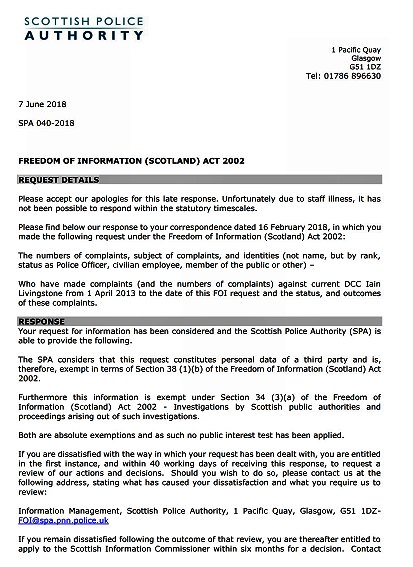
In their response, issued months late and outwith Freedom of Information timescales, the Scottish Police Authority wrongly claimed the material sought was “personal data of a third party” in a concerted attempt to conceal further details of complaints against DCC Livingstone from the public.

The Scottish Police Authority stated in it’s letter of response, dated 8 June 201: 

The SPA considers that this request constitutes personal data of a third party and is, therefore, exempt in terms of Section 38 (1)(b) of the Freedom of Information (Scotland) Act 2002.

Furthermore this information is exempt under Section 34 (3)(a) of the Freedom of Information (Scotland) Act 2002 - Investigations by Scottish public authorities and proceedings arising out of such investigations.

Both are absolute exemptions and as such no public interest test has been applied.

A request for review has been lodged, and material also sent to the Scottish Information Commissioner with regards to the SPA’s refusal to disclose the information.

The Scottish Police Authority’s eagerness to conceal information in relation to a senior Police Officer - who has been previously accused of 5 allegations of serious sexual assault, and has faced further complaints including an ‘interaction’ with another officer - raises questions about the impartiality of the recruitment round to appoint a new Chief Constable to Scotland’s crisis hit single Police service.

With reference to the five allegations of serious sexual assault, Iain Livingstone was cleared of sexual impropriety or intent – by a tribunal headed by a male top cop colleagueAssistant Chief Constable John McLean of Strathclyde Police.

The former lawyer and Raith Rovers footballer had been suspended for 17 months after the WPC claimed she had been sexually assaulted during the party.

A qualified lawyer and member of the Law society of Scotland, Mr Livingstone switched careers in 1992, joining Lothian and Borders Police.

In just 10 years, Livingstone – who had also once played for Raith Rovers - had clearly been fast tracked, reaching the rank of superintendent.

At the time of the allegations and ‘internal’ investigation by his Police colleagues, Livingstone was not prosecuted by the Crown Office over the claims.

Instead, Livingstone admitted a less serious allegation about being in the woman's room overnight and falling asleep.

It should be noted that during the time of the investigation & tribunal, handled by Police, the Lord Advocate was Colin Boyd, Baron Boyd of Duncansby – now a judge in the Court of Session, and the Solicitor General was Elish Angiolini – recently appointed by Nicola Sturgeon a Scottish Minister to investigate how complaints are handled against Police in Scotland – reported here: PROBE CONFLICT: £604K public cash inquiry magnate Ex Lord Advocate appointed to investigate Police complaints – linked to lawyers representing cops facing complaints

A full report on Police Scotland’s refusal to release the details of allegations against Iain Livingstone can be found in an earlier article here: TOP COP SECRETS: Transparency lacking at Police Scotland as spy scandal cops refuse to disclose files on complaints & historical sexual assault case details involving Deputy Chief Constable Iain Livingstone

A report on the Scottish Police Authority’s refusal to release information in connection with the allegations of sexual assault against Iain Livingstone can be found here: THE COP FACTOR: Scottish Police Authority refuse to release documents on sex assault case top cop who wants to be Chief Constable - now, new info said to contain more complaints & references to ‘interaction with another officer’

Friday, July 06, 2018

THE COP FACTOR: Scottish Police Authority refuse to release documents on sex assault case top cop who wants to be Chief Constable - now, new info said to contain more complaints & references to ‘interaction with another officer’

SPA block files release on sex case cop who wants top job. DOCUMENTS detailing new, and serious complaints against a senior cop previously linked to a case involving five allegations of sexual assault, and now, fresh details of an additional ‘interaction with another officer’, are being kept secret by the Scottish Police Authority (SPA).

The secrecy move by the Scottish Police Authority, under their new chair of ex MSP & former Health Minister Susan Deacon – comes as three senior Police officers - including current Deputy Chief Constable Iain Livingstone – submitted their applications to be considered for the £216,549 a year role as Chief Constable of Police Scotland.

Material in relation to new complaints made against DCC Iain Livingstone was sought from the Scottish Police Authority in February of this year, after information was received with regards to further serious complaints made against Police Scotland’s current ‘interim’ Chief Constable.

However, the SPA under Susan Deacon deliberately delayed releasing their response to the Freedom of Information request – by a number of months, as members of the Scottish Police Federation and Scottish Government ministers bolstered DCC Livingstone’s position as front runner for the top job – despite the grim details of a case involving 5 allegations of serious sexual assault which were dismissed by a tribunal composed of Livingstone’s male cop colleagues.

The Scottish Police Authority were asked to provide details of :

  • The numbers of complaints, subject of complaints, and identities (not name, but by rank, status as Police Officer, civilian employee, member of the public or other)
  • Who have made complaints (and the numbers of complaints) against current DCC Iain Livingstone from 1 April 2013 to the date of this FOI request
  • The status, and outcomes of these complaints.

It should be noted Information in relation to a number of these complaints, has recently been shared with MSPs, and the media.

However, and some time after discussions over the Freedom of Information request had taken place, inside & outside the SPA - the Scottish Police Authority responded to the FOI request four months late, in early June - denying access to all of the information sought in relation to DCC Livingstone.

In their response, issued months late and outwith Freedom of Information timescales, the Scottish Police Authority wrongly claimed the material sought was “personal data of a third party” in a concerted attempt to conceal further details of complaints against DCC Livingstone from the public.

The Scottish Police Authority stated in it’s letter of response, dated 8 June 201: 

The SPA considers that this request constitutes personal data of a third party and is, therefore, exempt in terms of Section 38 (1)(b) of the Freedom of Information (Scotland) Act 2002.

Furthermore this information is exempt under Section 34 (3)(a) of the Freedom of Information (Scotland) Act 2002 - Investigations by Scottish public authorities and proceedings arising out of such investigations.

Both are absolute exemptions and as such no public interest test has been applied.

A request for review has been lodged, and material also sent to the Scottish Information Commissioner with regards to the SPA’s refusal to disclose the information.

The Scottish Police Authority’s eagerness to conceal information in relation to a senior Police Officer - who has been previously accused of 5 allegations of serious sexual assault, and has faced further complaints including an ‘interaction’ with another officer - raises questions about the impartiality of the recruitment round to appoint a new Chief Constable to Scotland’s crisis hit single Police service.

With reference to the five allegations of serious sexual assault, Iain Livingstone was cleared of sexual impropriety or intent – by a tribunal headed by a male top cop colleague – Assistant Chief Constable John McLean.

The former lawyer and Raith Rovers footballer had been suspended for 17 months after the WPC claimed she had been sexually assaulted during the party.

A qualified lawyer and member of the Law society of Scotland, Mr Livingstone switched careers in 1992, joining Lothian and Borders Police.

In just 10 years, Livingstone – who had also once played for Raith Rovers - had clearly been fast tracked, reaching the rank of superintendent.

At the time of the allegations and ‘internal’ investigation by his Police colleagues, Livingstone was not prosecuted by the Crown Office over the claims.

Instead, Livingstone admitted a less serious allegation about being in the woman's room overnight and falling asleep.

It should be noted that during the time of the investigation & tribunal, handled by Police, the Lord Advocate was Colin Boyd, Baron Boyd of Duncansby – now a judge in the Court of Session, and the Solicitor General was Elish Angiolini – recently appointed by Nicola Sturgeon a Scottish Minister to investigate how complaints are handled against Police in Scotland.

Asked about the sexual assault allegations during a recent BBC Scotland documentary, DCC Iain Livingstone said he “fell asleep in the wrong place and that was wrong”.

Although he admitted that he 'shouldn't have done that', he insisted that he still has the right attributes for the job.

During the BBC Scotland documentary - PoliceScotland A Force In Crisis, investigative journalist Sam Poling asked Mr Livingstone about the 'allegations of sexual assault' and about him being 'bumped down from superintendent to constable and suspended'.

Quotes from DCC Livingstone’s responses when questioned about the allegations of sexual assault reveal the following remarks by the Police Officer:

Mr Livingstone said: “There was a set of circumstances in 2000 whereby at a social event at Tulliallan, at a training event I had too much to drink.”

“I fell asleep in the wrong place and that was wrong and I shouldn't have done that, and clearly I accept that.”

'I was suspended, I spent time off work. There was a hearing convened where I did accept I fell asleep.I was cleared of any sexual impropriety.”

'I was cleared of any level of sexual intent and at that hearing, initially, I was then demoted from superintendent to constable. I immediately appealed against that and I was reinstated.”

MSPs at the Scottish Parliament also questioned his suitability for the job after his response to the claims in a BBC documentary this week - saying only that he 'fell asleep in the wrong place and that was all'.

However, Livingstone’s application for the top job – which appears to be backed by Scottish Ministers, and the Scottish Police Federation has been called into question after a former Assistant Chief Constable said Livingstone should not get the top job.

COPS TURN ON THEIR OWN: Scottish Police Federation boss launches twitter attack on ex colleague:

Following criticisms by former Assistant Chief Constable Angela Wilson - of Iain Livingstone’s bid to become Chief Constable, Calum Steele – General Secretary of the Scottish Police Federation (SPF) launched a highly personalised attack on his female former colleague - on the twitter social media platform.

The Sunday Mail reported that Calum Steele – a Police Constable with an honorary rank as Chief Inspector due to his Police Federation duties -  also branded ex ACC Wilson “useless” and a “buffoon” and wrongly claimed in tweets that a corruption inquiry in her former force Tayside “extended” to her.

Steele is general secretary of the Scottish Police Federation (SPF) who have 18,500 members and represent 98 per cent of police officers.

Steele posted a string of six tweets last week after Wilson spoke out on the prospect of DCC Iain Livingstone gaining the top job as Chief Constable of Police Scotland.

The first of Calum Steele’s tweets said she was “one of the most incompetent imbeciles ever to have held rank in the police service”.

It claimed she was continuing “a smear on one of the very best”, adding: “You really need to ask – who is driving this?”

He went on to say that Wilson had served in Thames Valley Police as did Claire Gormley, the wife of Phil Gormley who quit as head of Police Scotland in February following bullying allegations against him.

Steele added: “AW [Angela Wilson] and the Gormleys have an axe to grind. It’s frankly pathetic.”

He also described Livingstone as “one of the most talented, able, skilled and resilient police officers”.

Scottish Tories justice spokesman Liam Kerr said: “Mr Steele has a position of responsibility and should probably have thought more carefully before embarking on this chain of tweets.

“The result of this is now a potential legal case which will drag the force and its associated bodies through the mud at a time it never needed it less.”

Angela Wilson subsequently lodged a formal complaint with Police Scotland and the SPF.

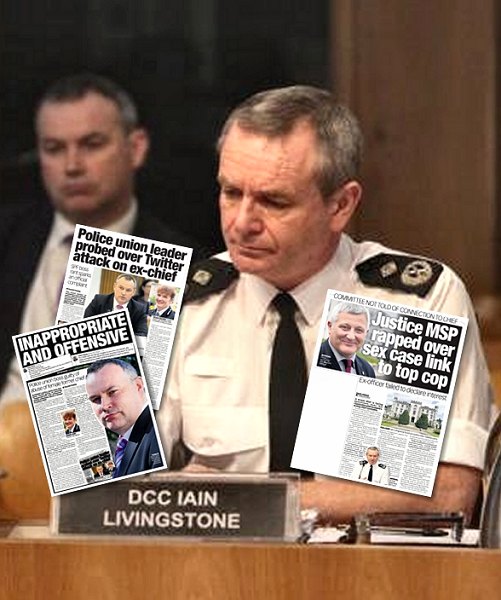
It was then reported in the Sunday Mail newspaper that - as a result of the complaint raised by ex ACC Wilson, Constable Calum Steele was found guilty of posting “inappropriate and offensive” online comments about a female ex-police chief.

Upholding the complaint, Chief Inspector Jacqui Campbell, of the Professional Standards Department (PSD), ruled the comments were “inappropriate and offensive” and that Wilson was “never investigated for corruption”.

Steele claimed to be off duty when he launched the Twitter tirade on May 3 but the Professional Standards Department probe discovered that he was working.

Campbell said: “The record revealed Constable Steele’s duty for that date was 0900 to 1700 hours, therefore, at the time the tweets were posted he was on duty.”

Campbell has issued Wilson a “sincere apology for the undoubted upset Constable Steele’s actions have caused”.

But Steele – who heads the federation representing 98 per cent of Police Scotland officers – “makes no apology” and refuses to delete the messages.

Campbell said: “We have asked Constable Steele to remove the relevant tweets from his Twitter account. Unfortunately, it is his own personal Twitter account and, as such, we are unable to order him to remove or delete them.”

Despite Steele’s messages being from a personal account, Campbell found “they are directly related to his role as a police officer and particularly his role as general secretary” of the SPF.

Mr Livingstone has been regarded as the favourite to replace Phil Gormley, who quit in February after being accused of bullying by colleagues.

Following Gormley’s leave of absence last year, a campaign of suspensions, bitter infighting dubbed ‘backstabbing cops’ in the media, and now scrapped criminal investigations into colleagues of the ousted Chief Constable then took place over a number of months – setting the stage for DCC Livingstone to conveniently scrap his retirement plans, and campaign, along with vested interests in the Scottish Police Federation to replace the ousted Chief Constable.

Steele, who spoke to PSD officers through a lawyer, now faces a further hearing which may result in disciplinary action. His lawyer quoted a dictionary definition of “imbeciles” as meaning “a fool” and that it was “a fair and honest comment that represents Constable Steele’s honestly-held belief”.

Scottish Conservative justice spokesman Liam Kerr said: “Calum Steele should really back down, apologise and delete the offending tweets. Otherwise this row will rumble on.”

Chief Superintendent Mark Hargreaves, head of the Professional Standards Department, said: “The investigation into this complaint has concluded and as this is an internal matter it would be inappropriate to comment further.”

THE MSP & SEX CASE TOP COP: Ex cop MSP failed to declare link to sex case cop Livingstone:

In an earlier report in the Sunday Mail newspaper, it was also revealed that while DCC Iain Livingstone was giving evidence to the Scottish Parliament's Justice Committee in January, Justice Committee member & former police officer John Finnie had failed to tell fellow MSPs he had represented Iain Livingstone when he was cleared of sexual misconduct.

At Holyrood’s justice committee in January, John Finnie quizzed Livingstone about staffing levels and said losing chief officers was one of the benefits of creating a single police force.

Scottish Labour justice spokesman Daniel Johnson said: “John is a valued colleague on the justice committee but I am alarmed that he did not see fit to declare this link with the acting chief constable.

“Police Scotland are in desperate need of scrutiny – and the public will expect such scrutiny to be conducted professionally.

“I would urge him to correct the record and to ensure he declares interests fully and promptly in future.”

A spokesman for the Scottish Conservatives added: “He also owes parliament an explanation as to why he neglected to mention this very important link.”

Finnie spent 14 years as an official for the Scottish Police Federation (SPF) – the organisation who represent police officers up to the rank of chief inspector.

And, it emerged in February of this year that during evidence given by Deputy Chief Constable Iain Livingstone to the Scottish Parliament’s Justice Committee, neither Livingstone or the Justice Sub Committee Convener John Finnie declared any previous links to each other while Livingstone testified before MSPs.

A report in the Sunday Mail newspaper in February revealed Mr Finnie – previously a serving Police Officer and representative for the Scottish Police Federation (SPF) - had represented Mr Livingstone when he was cleared of the sexual misconduct claims in 2003.

The issue was reported by the Sunday Mail newspaper here:

Green MSP under fire after failing to reveal sex case link to top cop Iain Livingstone

John Finnie failed to tell MSPs he represented the acting chief constable when he was cleared of sexual misconduct.

By Mark Aitken 18 FEB 2018

John Finnie failed to tell MSPs he represented Iain Livingstone

A Green MSP is facing questions over his connection with Scotland’s acting chief constable.

Former police officer John Finnie failed to tell fellow MSPs he had represented Iain Livingstone when he was cleared of sexual misconduct.

He failed to declare the link at a meeting of Holyrood’s justice committee when Livingstone was being questioned.

Finnie spent 14 years as an official for the Scottish Police Federation (SPF) – the organisation who represent police officers up to the rank of chief inspector.

Livingstone, the frontrunner to replace Phil Gormley as Scotland’s chief constable, was acccused in 2004 of sexually assaulting a female police officer.

Livingstone admitted falling asleep in the woman’s room at the Scottish Police College in Tulliallan, Fife, after a drunken party in 2000.

Iain Livingstone was accused of sexually assaulting a female police officer in 2004

At an internal hearing, more serious allegations were dropped.

Livingstone, who was then a superintendent, was demoted to constable but won his job back on appeal. Livingstone’s appeal was backed by the SPF.

Finnie said at the time that the case had highlighted “the ease with which the system can be abused and the punitive consequences which affect not only the officer but their family”.

At Holyrood’s justice committee in January, Finnie quizzed Livingstone about staffing levels and said losing chief officers was one of the benefits of creating a single police force.

Scottish Labour justice spokesman Daniel Johnson said: “John is a valued colleague on the justice committee but I am alarmed that he did not see fit to declare this link with the acting chief constable.

“Police Scotland are in desperate need of scrutiny – and the public will expect such scrutiny to be conducted professionally.

“I would urge him to correct the record and to ensure he declares interests fully and promptly in future.”

A spokesman for the Scottish Conservatives added: “He also owes parliament an explanation as to why he neglected to mention this very important link.”

Finnie began his career with Lothian and Borders Police in 1976 and moved to Northern Constabulary three years later.

He served as a full-time officer with the SPF from 1992 to 2006.

Finnie was elected as an SNP MSP in 2011 but quit the party the following year in protest at the decision to end their long-standing opposition to Nato membership.

Finnie and the Greens failed to respond to the Sunday Mail’s calls.

SCOTLAND’S NEXT TOP COP:

There are three shortlisted candidates for the Chief Constable role at Police Scotland.

Deputy Chief Constable Iain Livingstone, whose past & current complaints records are being kept secret by the Scottish Police Authority, and Police Scotland.

A second candidate - Police Scotland Deputy Chief Constable Johnny Gwynne - a former head of the National Crime Agency's (NCA) Child Exploitation and Online Protection command - has also applied for the job.

Gwynne, a former Royal Ulster Constabulary (RUC) officer also previously held the post of former deputy director-general of the Scottish Crime and Drug Enforcement Agency – which was absorbed into Police Scotland in 2014.

The third candidate is Lincolnshire Police Chief Constable Bill Skelly, who joined Devon and Cornwall Police from Police Scotland as Deputy Chief Constable in 2013 and was appointed as chief Constable of the force last year.

The shortlisted candidates will undergo a selection process including two panel interviews, chaired by the Scottish Police Authority’s own boss Susan Deacon.

And the selection panel will also include SPA board member Mary Pitcaithly, NHS Scotland chief executive Paul Gray, Professor Lorne Crerar, - chairman of legal firm Harper MacLeod; and National Crime Agency Director General Lynne Owens.

Gill Imery – the current Her Majesty's Chief Inspector of Constabulary in Scotland will also act as an ‘advisor’ to the team.

According to the job information pack: "Shortlisted candidates will be invited to participate in a psychometric and personality profile exercise, an Assessment Centre, and an interview with the Selection Panel."The assessment centre will include a scenario exercise and a mock media interview.

Final interviews of the three candidates are expected to take place on 13 and 14 August.

A report on the allegations of sexual assault against Iain Livingstone by a female Police Officer, allegations which were dismissed by a tribunal headed by male Police Officer colleagues of Livingstone was reported earlier by DOI here: TOP COP SECRETS: Transparency lacking at Police Scotland as spy scandal cops refuse to disclose files on complaints & historical sexual assault case details involving Deputy Chief Constable Iain Livingstone