Showing posts with label negligence. Show all posts

Friday, June 15, 2012

Vested interests ‘run Scotland’s courts’ as judges rule £90K & £120K civil jury awards over accident deaths ‘were excessive’

Lord_Hamilton_03Decision to ‘guide’ juries on civil awards shows vested interests have free run of our courts. A RULING in Scotland’s Court of Session by a five judge bench under the retiring Lord President, Lord Hamilton that damages awards made by civil juries to relatives of two people killed in separate accidents ‘were excessive and the claims should be heard again’ will prove to many that vested interests of professions, big business & insurance firms have the ability to skew justice in their favour in Scotland’s courts. The ruling, made earlier this week is seen by some as the thin end of the wedge to ending civil juries in damages awards in Scotland’s courts are over ‘paltry’ sums which not even a Banker would accept as a bonus or a judge would accept as an annual salary or retirement pension..

Previously, civil juries at the court of Session had found negligence on the part of the defenders had caused the deaths, where in the first case, KIRSTY MAY HAMILTON Pursuer and Respondent; against FERGUSON TRANSPORT (SPEAN BRIDGE) LTD Applicant and Defender: jurors awarded Kirsty Hamilton £120,000 after her mother, Caroline (aged 50) died in a road traffic accident when her car was crushed by a lorry near Fort William. Ms Hamilton was 17 at the time of her mother’s death. In the second case, GILBERT DENNIS THOMSON Pursuer and Respondent; against DENNIS THOMSON BUILDERS LTD Applicant and Defender, Dennis Thomson, was awarded £90,000 by a civil jury for the death of his son James, then aged 26, who died in an accident on a building site. Mr Thomson senior was 57 at the time of his son’s death.

However, the five judge bench - Lord Eassie, Lord Clarke, Lord Emslie, Lord Brodie and Lord Hamilton who heard the appeals of the companies previously found to be liable for the cause of the two fatalities, have now decided the compensation claims of the relatives should be heard again, and this time, the jurors should be given “guidance” from the presiding judge in assessing damages, with the judge suggesting a spectrum in which the award might lie.

The implication of the judges decision is that any further awards made in the cases should be much less than originally made by the earlier jury, leading many to conclude that vested interests are controlling the Scottish courts and the public’s access to justice.

In a telling excerpt from the opinion of the court, Lord Hamilton, sounding more like he was more concerned with curtailing publicity & growing enquiries over the disparity of justice where the amount of financial awards made by judges in damages actions without juries are falling well short of awards made in cases where a civil jury has made it’s decision, said : "If greater regard than hitherto is not had by judges to jury awards then the disparity between the judicial and jury awards is likely to remain.” Lord Hamilton went onto claim such a “state of affairs which lacks the consistency which is one of the hallmarks of a mature system"

The now retired Lord President commented that the absence of directions about sums awarded in similar cases by a civil jury, as opposed to that awarded by a judge was a "less than satisfactory aspect of civil jury trials". Lord Hamilton went onto say it was time "to set a framework for civil juries against which they can address levels of damages"which may easily be interpreted as an attempt to deprive a civil jury from making any kind of award which does not sit easily with a judge, or the vested interests of insurers & big business.

Lord Hamilton suggested several ways to address the disparities between awards made by judges & civil juries in Scotland’s Courts, saying : “The objective must now be to seek to narrow that disparity and to eliminate, in so far as practical, that lack of consistency. That can be done by three measures: first, by judges, sitting alone or in the Inner House, having significantly more regard to available jury awards (particularly where they demonstrate a pattern); secondly, by juries being given by the presiding judge fuller guidance than hitherto as to the level of damages which, consistently with other cases, might reasonably be awarded by them; and, thirdly, by appellate courts continuing to intervene, where necessary, on comparative justice grounds as envisaged under statute since 1815. This is a process which will take time and experience to mature.”

In what some may interpret as comments intended to stave off any intervention by the Scottish Parliament (similar to the asbestos damages bill) to remedy what many will perceive as a huge injustice in the cases of the deaths of the two persons, Lord Hamilton wrote in his opinion : “There is no reason to suppose that Parliament intended that awards by juries should have priority over awards by judges - or vice versa. Judicial and jury awards give different but complementary guidance for what is a just award of damages. In an age when life may be thought to be more precious than it may have been thought to be by earlier generations, and where consequentially the loss of the life of a close relative may seem a greater loss than it might have seemed earlier, the input of jury awards, reflective of the views of the community, may, in death cases, be particularly important.”

Lord Hamilton continued : “While awards made by juries without the benefit of judicial guidance may be at greater risk of being arbitrary or of having been influenced by illegitimate factors, those made with that (non-prescriptive) benefit are likely to be a valuable source for assessment in future cases. As to the second element, some suggestions are made below (para [76]) as to what procedural arrangements might be put in hand. The objective should be to eliminate, or at least reduce, the disparity between judicial and jury awards while at the same time securing that "awards ... in comparable cases ... bear a coherent relationship with each other" (Girvan, per Lord Clyde at page 25). If that objective is achieved, then parties whose disputes over damages are litigated can be better satisfied that they have had a fair trial - whether the adjudicating body is a judge or a jury.”

The size of the awards made by the civil juries in Scottish courts may surprise international readers, particularly those from the United States where awards in similar cases would normally run into the hundreds of thousands of dollars, or even millions of dollars. However, Scotland’s justice system has yet to catch up, if ever, with other jurisdictions who allow greater access to justice to victims of injustice, rather than what is seen as the regular influence of vested interests in Scotland’s courts which limits justice, and punishment over the loss of loved ones, to what amounts to little more than a few pennies after legal fees are paid.

As as happened in so many cases before in Scotland’s courts, bankers, politicians and judges can expect bigger bonuses & retirement pensions than any relative can expect via a future award made by a judge or civil jury in a case in a Scottish court.

The full details of the opinion can be read here : CSIH 52 PD2039/09 and PD1444/09 OPINION OF THE LORD PRESIDENT in motions for new trials in causis (1) KIRSTY MAY HAMILTON Pursuer and Respondent; against FERGUSON TRANSPORT (SPEAN BRIDGE) LTD Applicant and Defender and (2) GILBERT DENNIS THOMSON Pursuer and Respondent; against DENNIS THOMSON BUILDERS LTD Applicant and Defender

Of note is the inclusion in the hearing of counsel from the Scottish Government Legal Directorate appearing for Scottish Ministers.

BBC News reported on the case here : Awards in Highland and Shetland accidents 'excessive' judges rule

Tuesday, May 12, 2009

Scots public urged to take part in Commission's survey on claims made against lawyers with Law Society's Master Policy & Guarantee Fund

SLCC squareScottish Legal Complaints Commission has began research into compensation claims against rogue solicitors. Clients of Scottish solicitors who have tried to pursue claims for poor work, fraud, embezzlement, theft and other failures of legal service by their legal representatives are being asked to take part in an investigation into how such claims are handled by the Law Society of Scotland's client compensation schemes, known as Master Policy and Guarantee Fund.

Researchers from Manchester University, Professor Frank Stephens and Dr Angela Melville have been engaged by the Scottish Legal Services Commission to conduct research into aims and function of the Law Society of Scotland’s Master Policy and Guarantee Fund. Professor Stephens and Dr Melville are particularly interested in people’s experiences of bringing a negligence claim against a solicitor or advocate or making a claim against the Guarantee Fund, as well as views on the operation of the policies more generally

The SLCC has been forced to investigate the alarming failures of the Scots legal profession to pay out damages claims made by potentially thousands of clients against an ever increasing tide of rogue lawyers, due to the fact it has an official monitoring role, which some within the Commission are apparently reluctant to pursue to the fullest extent possible for fear of damaging revelations to the Law Society.

EXCLUSIVE Lawyer sued for 1millionSome lawyers such as John G O’Donnell have 21 negligence claims made against them and still continue practising. Most solicitors who face client claims to the Master Policy & Guarantee Fund, have in many cases financially ruined their clients but still remained in practice due to closed shop investigations by the Law Society of Scotland which have protected thousands of solicitors from client clains & complaints, many of a serious nature involving missing funds, thefts from wills & deceased family members estates, costly case failures, and overcharging on legal fees, which due to the financial downturn, has recently seen many legal firms issue 'fake' bills to clients alleging money owed on non existent work.

Dr Angela Melville, speaking to "Diary of Injustice" said of her ongoing research into the Master Policy & Guarantee Fund claims, "We want to know about their personal experiences of making a claim against either the Master Policy or the Guarantee Fund, and their views more generally on the aims and operation of the Master Policy and the Guarantee Fund".

Anyone wishing to take part in the survey can contact Dr Melville at Angela.L.Melville@manchester.ac.uk or if anyone wishes to be interviewed on their experiences, they can telephone Dr Angela Melville on 0161 275 3580, or leave a message on 0161 306 1262.

Dr Melville suggested some questions for those who wish to contact her with their experiences of the claims process to both the Master Policy & Guarantee Fund :

1. When did you initiate the claim, and was it against the Master Policy or the Guarantee Fund ?
2. What happened that raised a claim ?
3. Did you represent yourself, or did you obtain (or try to obtain) legal representation ?
4. Did you run into any problems trying to bring the claim ?
5. What was the claim’s outcome ?
6. Do you think that you have been dealt with fairly ?
7. How satisfied are you with both the process of resolving the claim and the claim outcome ?
8. What do you feel should be the aim of the Master Policy /Guarantee Fund ?
9. Do you feel that the Master Policy /Guarantee Fund is achieving this aim?
10. Do you feel that there is anything about the Master Policy /Guarantee Fund that needs to be addressed?

Which 2Which? are to be contacted over claims against crooked lawyers research. Dr Melville added the research team would be contacting Consumer Focus Scotland and Which?, who have recently been instrumental through their 'supercomplaint' to the Office of Fair Trading, in pursuing reforms of the Scots legal profession's monopolistic business model which has for years, effectively placed a stranglehold on public access to justice & legal services in Scotland.

Which? and Consumer Focus Scotland also recently supported the McKenzie Friend petition at the Scottish Parliament, calling for the 39 year exclusion of McKenzie Friends from the Scottish Courts to be lifted, allowing party litigants to call on a service engaging a legal adviser to assist them during their representation of their own legal affairs in court.

Law Society of ScotlandLaw Society of Scotland’s client compensation schemes condemned as corrupt. Both the Master Policy and Guarantee Fund compensation schemes run by the Law Society of Scotland have been regularly criticised from all quarters, including Government Ministers, as being prejudiced in their operation against clients, self serving, self protective of dangerous solicitors who ramp up significant but secret claims records, slow to pay out, deliberately difficult in their claims handling philosophy and of course, corrupt.

The Master Policy, exists to handle client claims of negligence against Scottish solicitors, with the Law Society regularly arguing it plays no part in claims processing to the fund, rather cases are handled by the insurers, Royal Sun Alliance, and the infamously corrupt Marsh, who were themselves caught up & pled guilty to corruption charges in the US several years ago.

Clients have had such difficulty in making negligence claims to the Master Policy against their solicitors negligence, officials from Royal Sun Alliance were forced to admit in staggering revelations to the Justice 2 Committee during their LPLA Bill investigations that less than 1% of claims to the Master Policy reached court.

Claims to the Law Society of Scotland’s Guarantee Fund, which supposedly exists to compensate clients for a solicitor’s theft of their funds, have faired little better, as I reported earlier here : Law Society's 'Guarantee Fund' for clients of crooked lawyers revealed as multi million pound masterpiece of claims dodging corruption.

John SwinneyJohn Swinney revealed Law Society regularly interfered in claims against crooked lawyers. However, it was left to the now Cabinet Secretary for Finance, John Swinney MSP, to tackle Douglas Mill, the ex Chief Executive of the Law Society over startling revelations from Mill's own memos that the Law Society of Scotland were actively involved on a regular basis in delaying and effectively killing off client's negligence claims against crooked lawyers.

Douglas Mill 4Douglas Mill was forced out of Law Society top job by John Swinney’s revelations of a claims fixing policy. The video of this confrontation between Mr Swinney and Douglas Mill eventually led to Mill's resignation as Law Society Chief in early 2008, his position becoming untenable over the raft of revelations of corruption at both the Law Society itself and in the claims handling procedures of the Master Policy and its insurers, RSA, and brokers Marsh UK.

John Swinney's confrontation with Law Society Chief Douglas Mill led to revelations of a policy of protection for crooked lawyers against client claims & complaints.

You can read an earlier report I wrote on the outcome of the confrontation between John Swinney & Douglas Mill here : Law Society boss Mill lied to Swinney, Parliament as secret memos reveal policy of intervention & obstruction on claims, complaints. and of Mr Mill's eventual downfall here : Breaking News : Law Society Chief Executive Douglas Mill who lied to Parliament, pursued 'personal vendetta' against critics - to resign

So, my advice to all readers is if you have tried to make a claim against your solicitor for a failure of service which impacted on you financially, please take the time to take part in this survey, as the more respondents give their views, the larger and clearer the picture of how the claims process against the legal profession actually works.

Friday, July 25, 2008

Rebranding fails to raise client trust in lawyers as poor standards & negligence dominate Scots legal sector

Imagine you needed a heart operation and you were just about to 'go under the knife' when you found out the surgeon had killed every single former patient in the same operation you were to undergo. Would you still proceed or would you ask for another surgeon ?

Chances are you would ask for another surgeon if you were told such a thing .. and thankfully in the medical world, there are plenty capable & qualified people who are not all a bunch of killers as some may put it so you might be in with a chance of finding the surgeon to your liking.

However, what happens if you come to sell your house and the lawyer you are using makes a complete mess of the deal to the point you only get half the value or less of your property .. or even worse, you find out the lawyer himself or one of his business partners bought your house on the cheap through a fiddled deal ? What would you do if that happened ? Would you try to find another lawyer to sort out the lawyer who ruined you ... or even try to take legal action against your former lawyer for fiddling your legal & financial affairs ?

Chances are you wont get another lawyer to do any of that .. because in the legal world, hardly any lawyer likes to 'sort out' another lawyer .. it just isn't on chaps, not only because lawyers don't usually sue other lawyers, but also because the Law Society of Scotland basically forbids such cases going to court in most instances or it might just have to start paying out huge sums of money from the profession’s Master Insurance Policy for professional negligence which you can read more about here : How to sue a lawyer in Scotland and get nowhere

So the lesson is .. any other profession, or industry (minus perhaps accountants) where a professional mucks up the task you set them .. you can normally find another to put it right .. not with a lawyer though .. no .. not a chance.

Try and complain against a lawyer after they have done you wrong, fleeced your finds, ruined your life .. you will find the legal profession itself will turn on you with a vengeance and ensure it is you who are the ruined one ... and oh my, there are just so many examples of that, it would take weeks to go through them all.

Suffice to say, lawyers don't sue other lawyers, and lawyers wont see their colleagues put out of their jobs, simply because they are crooks .. and with no way to find out how crooked your lawyer might be .. you are taking as big a chance going to a lawyer these days as you are attempting to walk blindfold across water.

So, which of Scotland’s legal firms have client complaints ?

Well the answer to that is of course, all of them. All legal firms and most or all lawyers have complaints made against them, in varying severity of course.

So, which legal firms or lawyers will tell you how bad they have been to clients ?

Obviously the answer to that one is : None of them ! Not one ! Ever !

You can’t find out any of the above information because of course, Freedom of Information isn’t allowed when it comes to lawyers, as the legal profession currently have an immunity from FOI as I reported in my earlier article of this week : Consumer protection weakened by lawyers FOI exemption while new Legal Complaints Commission must comply to information laws

With the eventual opening of Scotland's legal services market, after Justice Secretary Kenny MacAskill's go slow approach lifts, there would of course be no need for the public to be forced to use any of Scotland's current framework of legal firms, because new entrants to the legal services sector could take a more honest approach, disclosing their full & up-to-date client service histories to all consumers .. something you will never find a Scots legal firm doing .. and I will tell you why.

Earlier this week, in a conversation with a senior lawyer, the extent of negligence claims against solicitors in Scotland was brought home to me where I was shown details of cases showing in twenty 'big name' legal firms from one city alone, at least one of the partners had no less than five negligence claims made against them.

Unsurprisingly most of those negligence cases remain unresolved, some stuck in court after eight years, due to 'intervention' from the Law Society of Scotland which of course, the outgoing Law Society Chief Executive claimed did not occur.

Here’s a couple of links to show what the Law Society do when it comes to stopping negligence cases going to court :

The Corrupt Link Revealed - How the Law Society of Scotland manages client complaints & settlements.

Law Society intervention in claims 'commonplace' as ex Chief admits Master Policy protects solicitors against clients

Not to be outdone by the written word, you can also see Douglas Mill claiming the Law Society of Scotland never intervened in complaints or claims against lawyers in video form here

Douglas Mill – It wisnae me who fiddled cases against my fellow lawyers even though my memos say so !

Yes .. before you say it, I do use that clip quite a lot .. but it is rather unique footage .. a Law Society Chief Executive lying to a Justice Committee over the content of his own memos and how he intervened in cases to stop people obtaining a measure of justice … even my own !

Now to get back to what I was saying, twenty lawyers from twenty legal firms with 100 negligence claims against them is quite a lot .. despite what the legal profession may have you believe. If you think of how many lawyers and legal firms there are in Scotland and how that statistic may repeat itself .. it must mean the Scots legal profession has a problem, to say the least.

The detail and severity of cases which were disclosed in that conversation showed to me we are talking serious figures here on serious complaints ranging from poor or fraudulent management of litigation for both private & corporate clients, to theft from deceased's estates to just about anything you could imagine ...

How indeed could anyone trust a 'big name' or perhaps 'brand name' legal firm again after that ? ... because really you don't know what you are getting when you go to them, despite the 'aura' of their 'name' and reputed proficiency .. which in reality does not exist.

Here's an example of how one solicitor can build up a history of negligence claims ... in this case we are talking about over twenty negligence claims against one solicitor but it seems that five or ten negligence claims against just about any lawyer you could name are not unusual these days in Scotland - thanks to the way the Law Society of Scotland has poorly regulated the legal profession over the past few decades.

A solicitor with 21 negligence claims against him – normal enough in today’s Scots legal services sector : Law Society of Scotland covers up history of crooked lawyer as new President indicates little change on pro lawyer anti client policies

There are it seems, many lawyers almost equalling the above reported case walking around with the full support of the Law Society of Scotland, still offering their poor legal services to unsuspecting members of the public who don’t know one thing about the person they are about to commit the most important legal aspects of their life to.

Would you use a lawyer who told you they had 21 negligence claims made against them for poor legal work ? Probably not !

What can you do to avoid these kinds of lawyers ?

Well at the moment, not much .. because the Law Society certainly wont be disclosing any regulatory records to enquiring members of the public .. should they do, I doubt anyone in the country would use a Scots lawyer after that.

Here’s an article I wrote a couple of years ago on disclosure of a lawyer’s regulatory history, which would benefit consumers and add to that level of consumer protection we all must surely expect from our legal representatives : Disclosing the regulatory history of lawyers in Scotland to help give choice to the consumer

You can, as clients, start insisting on seeing a lawyers regulatory record before you do business with them .. and really that isn't such a bad thing to ask or expect to receive, given the tasks you give a lawyer probably include or affect the most important details of your life.

Put it this way .. plenty of you look at the ingredients on your packaged food before you buy it ... so why not look at the ingredients of your lawyer before you hand over the keys to your life .... and just because you might be buying into a 'brand name' legal firm, doesn't always mean you are getting good quality or the promise of a successful outcome.

Here follows an article from this weeks Scotsman on 'brand awareness' in the Scots legal sector .. which perhaps you might want to question much harder before you take the plunge into legal bills and the inevitable poor legal service which seems to dog just about all litigation in Scotland these days.

Of course, it could just be this rebranding exercise is all about firms positioning themselves to be sold off to banks & financial companies who may enter the Scots legal services sector once the market is opened up to competition … but such would-be buyers of what appear to be ‘famous legal names’ should beware of buying into what might just be a case of ‘bad rubbish’, better maybe to start their own legal services firms with more customer friendly clean slates …

Brand awareness begins to make inroads in a very traditional sector

Change in markets is leading firms into new territory and altering the way they communicate, says Jennifer Veitch

IT IS bright pink, it is bold, and it is unashamedly trying to generate new business from female clients. Pagan Osborne's recent Beauty Secrets marketing campaign – which offers to "smooth out frown lines" and "reduce dark circles" by easing the stress of life's big decisions – is something of a departure for a law firm with 250 years of tradition.

But, according to Tania Hemming, Pagan Osborne's marketing and business development director, the campaign is just a taste of how law firms might look to promote themselves in an increasingly competitive marketplace.

As the UK economy slows and the regulations governing legal services look set to be relaxed, Hemming says that firms will have to look at their branding.

"Our market is changing and because of alternative business structures, we are going to have to change the way we communicate," she says. "People buy very differently these days, and I think the profession has, sometimes, a quite stuffy image.

"Our campaign was such a shock when it came out – it's bright pink, it's a very strong female image, and it's not what you would expect. But you have to talk to clients in the way they want to be talked to."

Hemming had the idea for the recent marketing campaign – which invites women to meet the firm over coffee at Edinburgh style bar Tigerlily – after recent reports suggested women were often the financial decision makers in the household.

She says Beauty Secrets is already bringing in new business and has inspired plans for future campaigns.

According to Nathan Fulwood, the business development manager of web design agency Realise, whose clients include Pagan Osborne, Drummond Miller, Dickson Minto and the Law Society, more firms in the sector are recognising the need to create a stronger brand, particularly online.

"We're seeing that there is a willingness from solicitors to think differently about their presence on the web," he says. "For instance, there is an openness to borrowing experiences from other sectors, particularly in terms of embracing concepts of customer journey and life scenarios to engage clients on a more emotive level, not just on a 'need' basis."

He continues: "The use of the web has changed from purely brand promotion. Some (firms] have successfully used websites to disseminate information and knowledge and so establish a leadership position which drives people to them.

"Others increasingly recognise that the website is more about the person visiting the website and less about the firm itself.

"The web is now the place where the customer searches for services, including legal services. Therefore any solicitor has to have a distinctive presence online if it is going to have a competitive edge."

Donald Shaw, managing partner of Dundas & Wilson, agrees that the changing legal market will require firms to reconsider how they communicate to prospective clients, rather than relying on tradition or quality.

"In a large, diverse market like legal services, a favourable perception of your reputation or brand leads to more opportunity," he says. "It's important to us that we build on our reputation as a market leader and so we're very careful to ensure the DNA of the great things our business stands for is reflected in everything we do.

"A changing legal services landscape means that law firms need to adapt to compete. Quality of service will continue to speak for itself, but it's more important than ever to ensure the market knows who you are and what you can offer.

"Smaller firms in particular may have to face up to the prospect of focused consolidation, especially if highly effective companies such as Tesco seriously enter their market."

But Shaw cautions that branding can only go so far: "Having a brand is a safeguard, but only if you can be seen as having a strong consistent and different proposition – the trade-off being that smaller independent practitioners, used to autonomy, will need to work in a much more consistently branded and organised way to maintain any kind of market presence."

Dianne Paterson, a partner with Edinburgh-based Russel + Aitken, says her firm has recently launched a new marketing campaign – "Bringing the Law to Life" – that focuses on the legal services clients will need throughout their lifetime.

"The campaign, through innovative products and events, simply enforces the message to our clients and the public that we are not only one of the market leaders in this field but that we are also delivering these services to our clients in an energetic and engaging way," she says.

"Not only are people coming in to our offices for such advice but we are going out to the people and are currently involved in a series of road shows to promote our services.

"However, we are strongly of the view that you cannot simply invent a brand. It must be built up over the years from a good solid foundation and have good products at the heart of it."

Traditionally, legal firms were restricted in how they advertised themselves, with practice rules preventing firms from comparing themselves with others on fees or services. The rules were relaxed by the Law Society in 2006, allowing firms to compare themselves with rivals for the first time.

The society itself has recently recognised the importance of marketing, and unveiled its own re-branding earlier this year. A spokeswoman for the Society says the new brand has created consistency and a "stronger and clearer image".

She adds: "A brand is a representation of an organisation and as the Society is currently going through a period of change and modernisation, creating a new brand helped reflect that."

But not everyone in the profession sees the need to change direction in relation to branding and marketing. Louise Kean, the head of communications at Turcan Connell, says the firm will be sticking to its existing marketing plans.

"Looking from the perspective of our clients, both existing and prospective, we need them to know that we are here for them, continuing to provide a service that they need in these uncertain times," she says.

"Now more than ever, they need professional advice which gives them a sense of confidence that their affairs are in good order. So it's the consistency of our message that is crucial at this time.

Friday, June 06, 2008

Insurance monopoly over Scots professions & public services prevents public's access to justice

Why is it so difficult to sue a lawyer in Scotland many people ask ?

Well it is difficult to sue a lawyer because all lawyers are insured by the same insurance cartel – Marsh UK.

So if you can actually get a lawyer to take on your case against a lawyer who has say ... lost you a court case you had a good chance of winning .. or failed to give you good legal service which led to a substantial financial loss, even perhaps, the loss of your home ... the lawyer you hire to sue the lawyer who caused you the loss, will of course be insured by the same insurance cartel as the crooked lawyer.

Now, the fact that all lawyers are insured by the same insurance cartel might be argued by some as having nothing to do with the difficulty of getting a lawyer to sue a lawyer ... but we of course know different from the reality of things.

Actually, just say, your lawyer gives you poor legal service which leads to a substantial financial loss, and you hire another lawyer to sue them for negligence, which would entail obtaining the services of an Advocate, obtaining QC's opinion there was negligence present in your former legal agent's poor service to you, and eventually making it to the Court of Session .. you will find that your new lawyer, your Advocate, and the crooked lawyer who caused you the loss in the first place, will all benefit financially if your damages claim fails, or suffers a severe reduction in the settlement, if one is even agreed to.

In most cases involving client legal action against 'crooked' or negligent lawyers, your own legal agents and the lawyer who was negligent in handling your legal affairs, all receive financial bonuses if your claim for damages is either reduced, or thrown out.

On top of that, even your legal agents have a vested interest in your claim either being reduced or failing completely, because your success will increase their own annual payments into the insurance cartel which will be forced to pay out to you if you succeed. Good business, isn't it .. but not for you ... and of course, you are told nothing about this.

Whether you succeed or fail in your court action against a lawyer, you will then find your access to legal services blocked by the Law Society of Scotland, as you are put on a 'legal services blacklist' maintained by the legal profession naming people who have either complained against, or have taken legal action against lawyers.

Indeed, the Law Society of Scotland itself, has intervened many times directly in legal action against its own members, ensuring such cases fail at every turn. That interference from the profession's governing body has come from it's highest levels in many cases, where Chief Executives, past & present, have intervened to save crooked lawyers and the Law Society's insurance policy otherwise known as the Master Insurance Policy, from payout's to ruined clients.

Here are just a few examples of the Law Society of Scotland intervening in court actions against lawyers - to save their beloved, if corrupt, insurance cartel from paying out & admitting negligence ...

Douglas Mill steps into my own case against crooked lawyer Andrew Penman & the Law Society of Scotland’s complaint fiddling …

Scotsman 5 June 1998 Law Society accused of closing ranks as claimi fails

Former Law Society boss Kenneth Pritchard intervenes to halt a client’s legal representation in a case against crooked lawyers …

Policy is to protect both says Law Society - Kenneth Pritchard

Douglas Mill again intervenes in client claims & complaints against solicitors, tells a few lies about it at Parliament too …

The Herald 5 June 2006 - Would granny swear by the law society

Insidious isn't it ... the legal profession in Scotland have been doing this for years - making sure that anyone who tries to sue a lawyer gets nowhere ... and anyone who dares complain against a lawyer gets no access to justice after that .. and politicians, from all parties who have been aware of this for years, have sat back and generally done nothing.

Why have politicians done nothing ? Well, its usually because the Law Society of Scotland will 'call them in' for questioning, or 'a good talking to' as some politicians who helped me over the years had to face ... and with the occasional threat banded about by the Law Society to those who may dare help someone denied access to justice, even the politicians slide into anonymity - happily it seems in some instances ...

The problem is, as you can see in all of this, there is an insurance cartel controlling the situation, backed up by the legal profession's governing body itself - who claim not to intervene in cases of complaint or financial claims against solicitors .. but they do, and one such incident was famously exposed by our very own Cabinet Secretary for Finance, John Swinney, where the outgoing Law Society Chief Executive Douglas Mill just sat before the Justice 2 Committee and bizzarely lied through his teeth, attempting to deny the obvious content of his own memos, revealing a catalogue of intervention & interference in claims & complaints against solicitors in Scotland.

Law Society Chief Douglas Mill tells a few lies to John Swinney …

This problem however, is not limited to the legal profession.

Want to sue a Hospital or medial professional for negligence ? You will find the very same insurance cartel insure those same medical professionals you are trying to sue .. so your lawyers (if you can get someone to take on the case) will be insured by the same insurers who insure the medical professionals.

Want to sue an accountant or financial professional or financial institution ? You will find the very same insurance cartel insure those same accountants & financial professionals or institutions you are trying to sue .. so your lawyers (if you can get someone to take on the case) will be insured by the same insurers who insure accountants, financial professionals & financial institutions ...

Have a dispute with a local Government department, or even a department of the Scottish Government which has caused you financial loss through negligence, or breached your human rights or caused you a reason to sue them ? You will find the very same insurance cartel again, insure many of those workers and departments of local & national Government.

Have a dispute over a miscarriage of justice where the Crown Office failed to disclose material to your defence agents which would have seen you go free from court instead of being falsely convicted ? Well ... parts of the Crown Office, the Scottish Criminal Cases Review Commission and the Government Legal Service for Scotland (GLSS) are all dependent in some way on the same insurance cartel run by Marsh UK so .. a bit difficult to change a miscarriage of justice then …

Even a vet ? ... Taken your dog to the local vets to get a jag and came back with half a dog ? Well .. the odds are your vet is insured by the same insurance cartel for professional indemnity ... so if you want to recover the rest of your dog .. yes, its probably Marsh UK or one of the same insurance companies who will decide what happens to the other bits of your dog ...

Before you ask .. yes, many departments of the Scottish Government are still insured by Marsh UK, the same insurers of the Law Society of Scotland and many other professionals ... and you can find more about that in article I wrote about that earlier, where funnily enough, John Swinney, before he became Cabinet Secretary for Finance, asked questions on the previous Scottish Executive's dealings with Marsh UK.

My earlier report on the links between Marsh UK and the Scottish Executive, which have been sadly continued to this day : Corrupt Insurers of the Scottish legal profession linked to Scottish Executive

A very interesting monopoly don't you think ? Where one big insurance cartel, represented by among others, Marsh UK, control most of the professional indemnity insurance cover throughout public services, and the most popular or most required services from the private sector - in effect control the public's access to legal services & access to justice when the actions of those concerned may merit legal action from a member of the public.

Why haven't the OFT investigated this monopoly ?

Well, vested interests perhaps don't want this monopoly interested, particularly since departments of the OFT may just also be insured by a Marsh brokered deal too !

So ... trying to sue a lawyer or some other professional is next to impossible when dealing with one big insurance monopoly that even ex lawyers still pay into at a subsistence level ... to keep access to some of those nice fringe benefits of the likes of the Master Insurance Policy which they don't readily declare to the public if say for instance, they happen to be an ex lawyer politician ...

A solution to this ? Easy ....

Well, opening up the legal services market as well as opening up the indemnity insurance coverage market for the legal profession would just about do it .. but strong independent regulation of the legal profession would have to follow, and strict rules implemented on how solicitors deal with cases against other solicitors & legal representatives, such as negligence or other damages actions .. no more of the Marsh/Law Society claims fixing policies of the likes of Douglas Mill ... and believe me, we are talking about claims fixing here – where either the public have been prevented from getting access to legal services or their actual litigation has been purposely crippled against professionals insured by the same insurance cartels, involving the likes of Marsh UK.

Since the Cabinet Secretary for Finance John Swinney knows all about the woes of dealing with insurance cartels such as Marsh UK .. and since the Justice Secretary Kenny MacAskill has paid quite a bit of money into that very same insurance cartel via his required subscriptions as a member of the Law Society of Scotland .. there should be no difficulty in the Government realising the extent of their mistake in allowing this to continue in Scotland ...

Monday, January 07, 2008

Lawyers negligence insurance branded corrupt, anti-consumer as evidence reveals only one per cent of clients get chance of payout

Imagine your house has just been storm damaged. You have insurance so you call the insurers, inform them you need to make a claim, and the process begins of an assessor showing up at your house, estimates being made of the financial cost of the damage, and usually, work is then authorised to repair your home.

Sounds simple enough ? and while there may be some bumps along the way, generally, your home will be repaired under the insurance policy, if it covers the damage.

You would expect nothing less ... paying into an insurance scheme for years, meticulously making sure the policy covered such instances, and making sure you were satisfied with your insurance company and that your policy would be there for you when you needed to depend on it.

Translate this to making a claim for damages against a lawyer though, and the whole claims process turns into a nightmare of corruption, deceit & anti consumerism. In fact, trying to make a claim for damages against a crooked lawyer turns so bad that figures reveal only 1% of financial claims for damages against lawyers even get access to a courtroom, never mind the chance of an actual payout from the much vaunted but usually absent "Master Policy Insurance" for Scotland's legal profession.

Trevor Goddard of Royal Sun Alliance & Law Society Chief Exec. Douglas Mill - 'Only 1% of claims against crooked lawyers ever get a chance'

The "Master Policy", sometimes known as the "Master Fund" has been touted by the Law Society of Scotland as giving "unrivalled consumer protection" for Scotland's enormous solicitor's client base, but in reality, payouts are very few & far between, particularly when it comes to the question of 'negligence' - which is so prevalent in Scotland's vast army of 10,000 solicitors, it almost equates to that 'storm damage' on your home insurance ...

If you thought there was only a 1% chance of you getting 'storm damage' to your home paid for by your insurance policy, or indeed, any other type of damage covered by your insurance policy, would you remain with that Insurer and keep paying for such an insurance policy which would never pay out ? ... Probably not. I know I wouldn't ...

You would rightly go somewhere else and find another insurer, as there would probably be such a high level of bad publicity against your current insurers who never pay out, you would know that blindly handing over money each year for an insurance policy which has a 1% chance of payout, would be a total waste of your money so, why would you use a solicitor whose insurance policy only has a 1% chance of paying you out when you find out your solicitor has ripped you off, or acted negligently, or worse, made off with your family's assets, even your home ?

Well, currently of course, the Scots public has no choice at all in this. Basically, if you want access to legal services, access to the courts, or access to a solicitor, you have to use a solicitor who is insured by the "Master Policy Insurance" of the Law Society of Scotland and if you have any problems with your solicitor which requires you to make a claim for damages against their insurance, you need to hire another solicitor who is also a member of that same insurance scheme.

Alistair Sim, Director Marsh UK (Brokers to the Master Insurance Policy) - You need a lawyer to sue a lawyer

Marsh inquiry page 1Marsh inquiry page 2

A party asserting a claim cannot pursue his or her claim directly with the insurers of the Master Policy. It is for the solicitor concerned to intimate any claim to the Master Policy insurers and to request the benefit of the cover. In simple terms, the Master Policy insurers cannot become involved until the matter is intimated by the practice.

In any claim for alleged negligence, the party asserting the claim [the client] will require to establish :

- Whether a duty of care was owed

- Whether the duty has been breached, and how

- What loss has arisen as a direct result of the breach

For that reason, those pursuing claims against solicitors are advised to seek legal representation in pursuing claims.

As you can see from Marsh's own statement, supported by the Law Society of Scotland, an individual cannot pursue a claim directly with the insurers of Scotland's legal profession. You have to go through a lawyer, spend some more money, and hope against reality, that your new lawyer - if you are even able to get another lawyer to sue a lawyer, will actually do the job properly, and without any outside interference.

Sadly, outside interference, particularly from Law Society officials, is indeed the order of the day, as previous articles I have reported on the lawyers insurance scheme show quite clearly ...

Law Society boss Douglas Mill lied to Swinney, Parliament as secret memos reveal policy of intervention & obstruction on claims, complaints.

Law Society intervention in claims 'commonplace' as ex Chief admits Master Policy protects solicitors against clients

Even worse for you, as the poor client who may have been financially ruined by your solicitors actions, you cannot even being the claims process until the lawyer who ruined you actually tells the insurers he suspects you may make a claim against their actions, and even after that, all the steps you have to go through in the "Master Policy" insurance must be conducted, at significant financial cost, by another firm of solicitors you have to find willing to take on the case.

Using the Master Policy of the Law Society of Scotland to sue a negligent lawyer is impossible

Does any of this so far qualify for "unrivalled consumer protection" ? Probably not.

There is no doubt, the "Master Policy" insurance scheme for the Scottish legal profession is good at what it does best, which is - protecting crooked lawyers, keeping them in practice, and keeping payouts to wronged & ruined clients - you, to a minimum.

This is the sole aim of the "Master Policy" insurance - not to pay out when you need it, rather to ensure you don't get paid anything whatsoever - and there is a trail of thousands of ruined clients of crooked solicitors who have received not a penny from the "Master Policy" insurance, while their crooked lawyers have went on to remain in practice, even ripping off more clients.

Solicitor John O Donnell faces 21 separate negligence claims involving the same insurance scheme and he is still in practice - it could so easily be YOUR solicitor and you know nothing about it ...

Alistair Sim once said, there isn't a lawyer in Scotland who hasn't had a complaint & claim made against their insurance - and he would be correct.

You as the client don't get to know anything about that though .. . indeed, as the above link to an earlier story I covered shows, you could well find that your lawyer has as bad a record as Mr O'Donnell and is facing or has faced multiple claims by ruined clients made against his insurance, and no one has ever been paid out .. and there is no way you can truthfully find out whether that is the case or not ...

The way the "Master Policy" insurance scheme for Scotland's legal profession is sold to the public is under the guise of "unrivalled consumer protection" so let's take a brief look at what Marsh, the Brokers, and the Law Society of Scotland claim you get for your trust in your lawyer ...

Master Policy details - a crooked lawyer's charter, written by crooked lawyers, for the protection of crooked lawyers.

Master Policy for Professional Indemnity Insurance 1

"The Master Policy provides cover for all practice units for the mandatory limit of indemnity - £1.5m. All claims attributable to the same act, error or omission or series of acts, errors or omissions consequently upon or attributable to the same original cause or source will be regarded as one claim., In the event of cover being required in excess of the mandatory limit of indemnity, additional Excess layer ("top-up") cover requires to be arranged which may be taken under the facility provided by the Society's Brokers.

The cover is wide and provides indemnity in respect of claims or alleged claims in respect of "any civil liability (including liability for claimant's costs and expenses) incurred in connection with the Practice ..." The definition of "the Practice" refers to "all manner of business ... which is customarily (but not necessarily exclusively) carried on or transacted by Solicitors in Scotland"."

An amazing claim by the insurers and the legal profession, but one hardly consistent with reality given the fact that a paltry 1% of claims only ever make it to payout ...

The Brokers information then amazingly goes on to claim that "The Master Policy also provides cover for dishonest, fraudulent, criminal or malicious acts or omissions involving clients funds on the part of a partner or member of the firm's staff. This cover in respect of clients funds does not apply if the act or omission was committed or condoned by a sole practitioner or by all principles of a partnership."

An equally further amazing claim by the Brokers, completely inconsistent with reality. Just try making a claim against the "Master Policy" for such things as dishonestly, fraud, criminal or malicious acts, and see if you get any further than the thousands of clients who have tried & failed over the years to make similar claims - only to be denied access to the very legal representation required to make such a claim - and thus denied access to justice.

Notification of Claims and Circumstances - or how to kill off a client's claim ...

Master Policy for Professional Indemnity Insurance 2

Now we come to the real dirty tricks of the claims process ...

Notification of Claims and Circumstances

The Master Policy requires (General Condition 1 of the Certificate of Insurance) practice units to :-

"give written notice to the Brokers (regardless of any Self-Insured Amount) as soon as reasonably practicable after becoming aware of circumstances which might reasonable be expected to produce a claim irrespective of the [practice unit's] views as to the validity of the claim or on receiving information of a claim for which there may be a liability under [the] Certificate."

There is no claim form which requires to be completed in order to intimate a claim or circumstance. All that is required initially is a letter to the Brokers, explaining the factual background. Copies of relevant correspondence should be submitted along with any Legal Aid Application, Writ, or Summons.

If the preparation of a detailed summary of the facts or a statement by those involved is likely to delay matters, the practice should simply write to the Brokers in the first instance with brief particulars of the available information rather than delaying their intimation until more detailed information is available.

Where a Writ, Summons, or notice of a Legal Aid Application has been received, clearly the matter should be intimated immediately, with these items, in order that the insurers may take whatever action is required within the appropriate time limits.

No claim form .. imagine that ... nothing like your house or car insurance now, is it .. preferring to keep everything as convoluted & complicated as possible, ensuring a bare minimum of input from the financially ruined client but obtaining the solicitor's point of view, who obviously will be pleading 'not guilty' to their financial crimes against clients ...

I particularly liked the part about "Where a Writ, Summons, or notice of a Legal Aid Application has been received, clearly the matter should be intimated immediately ... in order that the insurers may take whatever action is required within the appropriate time limits."

Yes, we all know what "the insurers may take whatever action is required" means, and it's not just the insurers who do that - the Law Society of Scotland joins in too, to make sure that anything, even a client's claim for legal aid to begin such an insurance claim against a crooked lawyer is stopped

Douglas Mill [regularly] intervenes with the Legal Aid Board to stop client negligence claims against crooked lawyers

Scotsman 5 June 1998 Law Society accused of closing ranks as claimi fails

oh .. but Douglas Mill testified before the Justice 2 Committee of the Scottish Parliament he never intervened in a legal aid claim against both the Law Society of Scotland and a crooked lawyer, which makes Mr Mill a liar in that case - and a liar which the Scottish Conservatives support in the Parliament via Bill Aitken, Convener of the Parliaments's only Justice Committee ...

Douglas Mill - 'I swear on my granny's grave I'm a liar'

So, not just having to be made do with the Law Society of Scotland's monopoly on the legal services market in Scotland, the Scots public are also forced to make do with a corrupt insurance compensation scheme which the lawyers claim is there to protect the public but which only protects lawyers from the public.

Surely such things are yet good arguments to open up the Scottish legal services market and come away from the hallmarks of monopoly, corruption, lack of accountability and anti client prejudice which have ruled the day for all these years ?

Wait a minute though ... the current Justice Secretary, Kenny MacAskill is a lawyer.

Mr MacAskill has paid for many years into the same "Master Policy" to protect himself from clients and ensure that if he did wrong, no one would get a penny so it's hardly surprising that Kenny MacAskill wants to preserve a large part of the Law Society's monopoly on legal services in Scotland and also the monopoly of the "Master Policy" insurance scheme which mandates that anyone who wants to practice legal services must pay into it ...

Kenny MacAskill - public can made do with second class rights - better to protect crooked lawyers monopoly on legal services & self regulation

Indeed, Mr MacAskill and the Lord President - another financial contributor to the same "Master Policy" insurance scheme, have been happily dismissing any & all applications for rights of legal representation, made by persons & organisations other than members of the Law Society of Scotland, under the 2006 implementation of Sections 25-29 of the Law Reform (Miscellaneous Provisions) (Scotland) Act 1990, which was designed eighteen years ago to open up the Scottish legal services market and break the Law Society of Scotland monopoly on the public's access to justice.

Mr MacAskill and the Lord President have cited among their reasons for their dismissal of all applications for rights of legal representation to-date the applicants are not members of the same "Master Policy" insurance scheme which only sees a 1% chance of the public ever getting financial redress for the negligent or crooked actions of their legal representatives. Isn't that a bit strange ?

Kenny MacAskill - If you don't pay into the "Master Policy" and aren't a member of the Law Society, we won't let you practice legal services.

Justice Secretary Kenny MacAskill to Cabinet Secretary for Finance John Swinney 26 July 2007

It doesn't stop there though ... the same "Master Policy" insurance for crooked lawyers is also costing the Scottish public a pretty penny as each of you have to food the bill for all of the Scottish Government's GLSS lawyers, who have their "Master Policy" annual subscriptions paid as an 'expense freebie' ... and indeed, many Government departments within the Scottish Government also contract the services of Marsh and similar corrupt insurance schemes which do everything to ensure protection of their departments at any cost while any member of the public who has been wronged or financially affected by negligent decisions, never gets a chance of financial compensation.

Some articles I filed earlier on the Scottish Government's affiliation with Marsh UK and the insurers of the legal profession's anti consumer "Master Policy"

Corrupt Insurers of the Scottish legal profession linked to Scottish Executive

Scottish Executive budget on lawyers salaries revealed at over £5 million pounds while public face restrictions on legal representation

Government Legal Service for Scotland - 'no help to victims of injustice'

A good example of some of the public sector's insurers & lawyers dirty tricks may well be the Hepatitis C infected blood products victims, many of whom have died over the years, and are still battling the Government and these kinds of corrupt insurance schemes for compensation and in that case, where patients Health records were allegedly destroyed, it turns out that many think the order those Health records were destroyed, came from the lawyers and insurers of those Health Boards who infected their patients with the tainted blood products ...

What a coincidence that destroying solicitor & client records and faking up files is also one of the policies of the "Master Policy" insurance for crooked lawyers ... which has permeated Government to the highest level with even Ministerial backing from the Justice Secretary ... and a seemingly happy support from the rest of the SNP Government so far ...

Justice or injustice ? The rights and expectations of the public are certainly being trampled by such corrupt 'consumer protection' practices which in reality are 'consumer attack' practices we can all do without ...

Should it not be that our SNP Scottish Government will end such 'consumer attack' practices immediately and give Scots first class legal services instead of second class rights against Scotland's crooked lawyers ?

Wednesday, June 06, 2007

Law Society of Scotland covers up history of crooked lawyer as new President indicates little change on pro lawyer anti client policies

Last week, the Law Society of Scotland gained a new President in the annual appointment of what is mostly an honorary position. This year sees John MacKinnon, a partner in Brown & McRae in Fraserburgh become the latest President of the Law Society.

So, all change then ? Not much of a chance of that it seems, from reading Mr MacKinnon's soft interview in the Scotsman earlier this week .. so soft, and so glowing, I wondered if Douglas Mill, the real power behind the Law Society of Scotland was lurking in the background, dictating terms on how the article should be worded ...

When reading Mr MacKinnon's interview, one should spare a moment to read the excellent Sunday Mail's exposure of corruption in the legal profession which has seen the Law Society cover up the details of a solicitor who the Sunday Mail exposed as being the subject of 21 complaints ! .. and there's probably more clients dissatisfied with solicitor John O'Donnell, based in Cathcart, Glasgow - who blames his behaviour on a "mental illness" between 2000 and 2002.

So the Law Society are allowing solicitors with mental illnesses to practice ? or is it just another of the good excuses generated to get crooked lawyers off the hook from complaints ? You can read the Sunday Mail exposure on solicitor John O'Donnell here :

EXCLUSIVE : LAWYER SUED FOR £1MILLION and I covered last year's Sunday Mail coverage of Mr O'Donnell here : Peter Cherbi comments on top Scottish Lawyer revealed by the Sunday Mail newspaper to be at centre of 12 Negligence Claims by clients

There are many O'Donnells in the Scottish legal profession though, helped on by the policy of the Law Society of Scotland as self regulator all these years to ensure complaints against lawyers are covered up and the consumer doesn't know the record of who & what their lawyer really is ... time to fix that one then Mr MacKinnon ? and bring in full regulatory disclosure on lawyers so that clients know who they are dealing with before they employ their services ?

If you don't do it, Mr MacKinnon, perhaps the new Justice Minister Kenny MacAskill should force the issue of regulatory disclosure ? in the public interest perhaps ?

Mr MacKinnon does come clean over two important issues in the largely sympathetic-to-lawyers article, those being the Law Society's attitude towards the new Scottish Legal Complaints Commission, which comes into action next year as a result of the Legal Profession & Legal Aid (Scotland) Act 2007 .. and also, the Law Society's concern over the long needed break up of the legal profession's monopoly of the legal services market - which lawyers have used for years to arbitrarily decide who gets access to justice & who does not.

To quote the article directly :

"One of my main priorities is to ensure that, when the commission opens its doors in October 2008 or earlier, the profession is well-informed and educated about its workings and expectations, and are ready and able to deal with it," he says.

"My priority is that we set up standards. The standards already exist in the form of guidelines, so I think it's a question of defining those standards, so that not only the profession knows the standards that are expected of them but also the public."

That will be a change of resistance, threat & blackmail then, previously heard as policy statements from Douglas Mill, the Law Society Chief Executive, who even went so far to threaten the Parliament & Executive over the passage of the LPLA Bill ? How contradictory indeed !

I covered Douglas Mill's threat of legal action against the LPLA Bill here :

Law Society of Scotland threatens Court challenge against Scottish Executive over LPLA legal reform Bill

I would of course, have to take issue with Mr MacKinnon's comment on 'standards'.

What on earth makes anyone think or believe the Law Society of Scotland can set up standards now, when it hasn't been able to do so for the existence of it's lifetime to date ?

Haven't we seen rampant corruption in the legal profession for years ? complaints at all time high levels of up to 5000 complaints a year against less than 10,000 solicitors .. and that going on for nearly a decade ?

Indeed, the Law Society of Scotland has been performing it's self regulatory function admirably in terms of letting armies of crooked lawyers off the hook while the numbers of their financially ruined clients mount up over negligence, embezzlement, theft, mis-sold mortgages, bad investment deals, fiddled property transactions ... so Mr MacKinnon has a great task ahead of him indeed, if he thinks he will be able to "set up standards" in the legal profession now, after all those decades of lawyers being used to covering up for lawyers and avoiding to pay out any compensation to clients they ripped off to feather their own nests, buy big houses, a few extra cars and the rest of their family perks - all on the backs of poor unsuspecting clients who have been robbed blind by Scotland's legal profession over the years.

However, in another part of the rather soft interview, rather embarrassing to read in a newspaper one must admit as a 'news item' ... John MacKinnon reveals one of the main fears of the Law Society currently .. the fact that if the monopoly on legal services currently held by lawyers & advocates is broken up, they won't be able to regulate those people who are able to step into the shoes of lawyers, and perhaps offer the consumer a much greater choice in legal services, cheaper services (no more of the £100+VAT for 3 lines of text on a lawyers letter perhaps) - and more importantly, access to justice which has more often than not usually been access denied by lawyers & their legal profession who didn't want particular cases or people proceeding to court on particular issues .. such as of course, pursuing a crooked lawyer or even perhaps establishing a ruling in law on an issue which the legal profession did not want.

To quote Mr MacKinnon again from the article :

"What is being suggested is solicitors should be able to go into business with non-solicitors, and solicitors' firms could be owned and funded by non-solicitors," says MacKinnon. "My problem with this is I have still to see a method of regulation of that scenario. We can regulate solicitors, but who is going to regulate the non-solicitors?"

Indeed, Mr MacKinnon - who will regulate the non solicitors ? Not you or your colleagues I hope - or for sure, we will end up with another crooked self regulatory framework which will cause thousands of problems a year for the public just as your current self regulation of the legal profession has caused for decades.

What we really need, is a new fully independent regulatory system, to regulate the opened up legal services market in Scotland, and solicitors are not the best placed people to be doing that, as after all, they will be in direct competition to those new faces & companies allowed to represent people in the courts and handle legal work which has been the fiefdom of lawyers & advocates for so long ...

Lastly today, I manage a laugh at Donald Reid's rant in the Scotsman earlier this week, on his visit to Iona and that he came across a small museum there which happily stated there were "no lawyers" around in 1791. It must have been bliss then for the Iona Community ! - not to be troubled by legal sharks out to raid people for every penny.

Mr Reid, your understanding of how clients perceive or blame their lawyers for wrongdoing is completely out of touch with reality.

While as a member of the Scottish legal profession, you may hate my guts as one of the 'malcontent' clients, who successfully campaigned for changes in the law to help the public against crooked lawyers & self regulation, you should take off your LLB and walk among us to see & understand the financial ruin, lost property, hurt, pain, violence, even, abuse, your legal colleagues have inflicted on their victims, rather than spout the Law Society's professional doctrine, which has been consistently anti client, anti consumer, anti reform, and certainly lacking honesty, transparency & accountability for all these years.

To answer your "wee sermon" Mr Reid, quoting your "lighten up on lawyers and we'll listen more sympathetically. Right now, we are so used to being castigated for what we didn't do that we are tempted to fight back even when we ought to apologise and face our critics honestly. "

Mr Reid - lighten up on the public, and take a dose of honesty, transparency & accountability as a profession. Tackle your own problems as a profession, your own contradictions & claims of representing the public interest when you do anything but, and tackle the 17 year old regime at the Law Society of Scotland which has seen complaints figures explode, as well as the numbers of crooked lawyers getting away with their crimes, as the oh so common actions of Mr O'Donnell illustrates.

You want us to lighten up on you, after our colleagues, have hounded us, hunted us down, vilified us, intimidated us, obstructed, interdicted & ruined our lives ... how dare you ask that before confronting your own demons & actions which have led to our suffering as victims of the very people who claim to serve the law, but use it as nothing more than a business model for making money at the expense of honesty and life itself.

Look inside your own house before preaching to us, the victims of your crooked corrupt colleagues and the many more out there whose cases go buried by the Law Society of Scotland.

Articles from the Sunday Mail and Scotsman to follow :

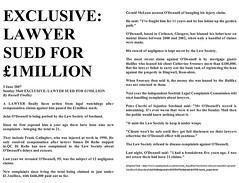
EXCLUSIVE: LAWYER SUED FOR £1MILLION

3 June 2007
EXCLUSIVE: LAWYER SUED FOR £1MILLION
By Russell Findlay

A LAWYER finally faces action from legal watchdogs after compensation claims against him passed the £1million mark.

John O'Donnell is being probed by the Law Society of Scotland.

Since we first exposed him a year ago there have been nine new complaints - bringing the total to 21.

They include Frank Gallagher, who was injured at work in 1990. He only received compensation after lawyer Simon Di Rollo stepped in.QC Di Rollo has now complained to the Law Society about O'Donnell's delays and excuses.

Last year we revealed O'Donnell, 55, was the subject of 12 negligence claims.

New complaints since bring the total being claimed to just under £1.1million, with £446,000 paid out so far.

Gerald McLean accuses O'Donnell of bungling his injury claim.

He said: "I've fought him for 11 years and he has ledme up the garden path."

O'Donnell, based in Cathcart, Glasgow, has blamed his behaviour on mental illness between 2000 and 2002, when only a handful of claims were made.

His record of negligence is kept secret by the Law Society.

The most recent claim against O'Donnell is by mortgage giants Halifax who loaned his client Catherine Sweeney more than £100,000. But the lawyer failed to carry out the basic task of registering the loan against the property in Dingwall, Ross-shire.

When Sweeney then sold it, the money she was loaned by the Halifax was not returned to them.

Next year the independent Scottish Legal Complaints Commission will start handling complaints about lawyers.

Peter Cherbi of Injustice Scotland said: "Mr O'Donnell's record is astonishing. It's even worse that were it not for the Sunday Mail then the public would know nothing about it.

"It suits the Law Society to keep it under wraps.

"Clients won't be safe until they get full disclosure on their lawyers otherwise the O'Donnell effect will continue."

The Law Society refused to discuss complaints against O'Donnell.

Last night, O'Donnell said: "I had a breakdown five years ago. I was not aware there had been 21 claims."

and now the new Law Society of Scotland's President interview in the Scotsman ...

http://thescotsman.scotsman.com/index.cfm?id=869812007

Standard-bearer voices concerns over key issues

JENNIFER VEITCH

IT IS beginning to seem that each new president of the Law Society of Scotland is faced with new and more intricate challenges than the last. While the dust may have settled on the recent battles fought by Caroline Flanagan and Ruthven Gemmell over regulation and complaints, it will be up to the new incumbent, John MacKinnon, to get to grips with the new order, and a new Scottish Executive.

Over the next 12 months, this quietly-spoken Skye-born solicitor will have to steer the society through profound changes in the way complaints about legal services are handled. The Scottish Legal Complaints Commission may be operational as the new gateway as early as next spring, and the society has already been challenged by the commission's interim chief executive to set standards for the profession - or face having them imposed by the new commissioners.

The society is also keeping a watchful eye on developments at the Office for Fair Trading (OFT), which recently received a "super-complaint" from the consumer watchdog Which?, which has called for deregulation of the Scottish legal services market and an independent Scottish Legal Services Board to take regulation out of the hands of the society and the Faculty of Advocates.

MacKinnon is also taking over at a time when the biggest changes in legal education for a generation are likely to take place. At the same time, the society is reviewing its own structure, including the council and committees, to ensure it is providing members with a service that reflects the modern profession. Even the current location of the society is up for review.

Meanwhile however, its headquarters remains at Drumsheugh Gardens in Edinburgh, which MacKinnon will no doubt come to regard as his second home during frequent trips south from Fraserburgh over the next 12 months. Sitting in the society's library, he reflects on the challenges ahead, and cites the birth of the new commission as being at the top of his agenda.

"One of my main priorities is to ensure that, when the commission opens its doors in October 2008 or earlier, the profession is well-informed and educated about its workings and expectations, and are ready and able to deal with it," he says.

"My priority is that we set up standards. The standards already exist in the form of guidelines, so I think it's a question of defining those standards, so that not only the profession knows the standards that are expected of them but also the public."

When the commission may open as early as next April, MacKinnon knows there is limited time for the society to get up to speed. A working group is set to make recommendations at the next AGM in March.

This timescale may be tight if the commission does open early. MacKinnon hopes the commissioners, who are set to be appointed in the autumn, will recognise the importance of ensuring the profession and the public are up to speed before introducing the new gateway for service complaints.

"The commission is very important, and it is very important they get it right, and everything is in place," he says carefully. "On the other hand, I suppose there is uncertainty for the profession, and there is the uncertainty for the society's employees. If everything is in place earlier than October 2008, then I'd have no difficulty with that."

The society was vocal in its concerns about the proposals for the new commission, unveiled early last year. But now the Legal Profession and Legal Aid (Scotland) Act 2007 has been passed, MacKinnon says the focus is to work with partners on the steering group tasked with setting up the new commission to ensure any concerns are addressed.

MacKinnon says the focus on the commission may have overshadowed the work done by the Research Working Group on the Legal Services Market in Scotland, which reported to the Executive last year.

The working group, which included the OFT, concluded that the "evidence probably pointed to a case for non-intervention, assuming that market forces would keep supply and demand in alignment".

Despite post-Clementi moves to open up the market in England, MacKinnon remains confident the group will conclude that the existing business structures for law firms are still the best option, despite the call for deregulation by Which? on the grounds that the current system is failing consumers.

"What is being suggested is solicitors should be able to go into business with non-solicitors, and solicitors' firms could be owned and funded by non-solicitors," says MacKinnon. "My problem with this is I have still to see a method of regulation of that scenario. We can regulate solicitors, but who is going to regulate the non-solicitors?"

But he adds he can appreciate why some firms may also want to see the market opened up. "Our difficulty is that, on the one hand, I can appreciate the concerns of the big firms who want to have a level playing field with their counterparts down in England. On the other hand, I have concern about the effect on the core values of independence and confidentiality.

"I have particular concerns for high-street practices. I have concern that the multinational providers of legal services will cherry-pick the most profitable areas of work and leave the rest to high street practices. That will not be to the benefit of the public."

As a partner with Brown & McRae in Fraserburgh, the future of small high-street firms and access to justice are issues that are understandably close to MacKinnon's heart.

While it is not unprecedented, it is still unusual for a solicitor from a rural firm to become president of the Law Society and, after 37 years in the North-East, MacKinnon's grassroots perspective of problems with rates of legal aid and recruitment and retention of lawyers will bring a fresh perspective to the helm.

"I am acutely aware of the difficulties of recruiting young solicitors and the situation certainly hasn't improved," he says. "Some firms in rural areas do have trainees and are able to keep them but quite a lot of them will say, we train them and then they leave.

"On the question of access to justice, I am very concerned about it, and I think the Scottish Executive should be as well.

"It's to do with legal aid, but also simply there being enough solicitors to provide legal services."

and finally - Donald Reid's opinion on why lawyers are hated so much - because they promote hatred themselves, Donald .. that's why ..

http://thescotsman.scotsman.com/index.cfm?id=869732007

Weavers, millers,a wheelwright - 'but no lawyers'

DONALD REID

I PAID a weekend visit to Iona last week, an annual pleasure for me. Each time I go there I wonder why I ever come back to the mainland.

But, at morning worship in the fine old Abbey church, we were exhorted by the preacher, on behalf of the Iona Community, to resist the wish to retreat into peace and tranquillity, but rather to "go back out" with the message of the Gospel.

This piece today is my response. A missionary lawyer - whatever next?

Close to the Abbey is a little museum of the island's history. I learned there that in 1791 an astonishing 3,002 people were living and working on Iona and the nearby Ross of Mull.

The exhibit stated that these included brogue makers, shoemakers, boat carpenters, a wheelwright, smiths, millers, merchants, weavers, tailors, houses for retailing spirits, two surgeons... "but no lawyers", it triumphantly concluded.

What, I wondered, caused the historian to conclude his narration of positive facts with that apparently gratuitous negative one?

Clearly, back in the 18th century lawyers were already getting a bad press (Shakespeare having a character wanting to "kill all the lawyers" much earlier).

Didn't they have estate agents, accountants or politicians back then, to share the hatred, as these lesser professions do today?

I accept we may bask in this a little as the princes of opprobrium, but not surely as the sole offenders.

I suspect the legal profession back then was associated closely, in the minds of ordinary folks, with privilege and oppression. Lawyers were the lackeys of lairds and landowners, who alone needed their services or could afford their fees.

Lawyers frequently served as estate factors and had the job of putting up rents and evicting defaulters. Indeed the same Iona museum contains an account of just such events in the 19th century.

Ordinary people did not own property and, when they died, their estates were too humble and non-contentious to be worth winding up in any formal way. Divorce was unheard of, and litigation entirely the preserve of the urban rich. For a community to be free of lawyers altogether was therefore indeed a cause for pride and boasting, or so it would seem.

What of today? The dislike of lawyers is still with us but the social reasons have changed completely. Prosperity is no longer the preserve of a small minority. Lawyers do serve ordinary folks, in their house transactions, wills and finances, family breakdowns and litigious confrontations.

So why is the anger still out there? Why are lawyer jokes the best and funniest of the genre?

My guess is that much of it has to do with shooting the messenger. When things go well, people tend to give credit to themselves.

When they go wrong, they look for someone else to blame: "You lost me that house"; "Why did you let my husband off the hook?" And so on...

There is a well-known legal case that I quote frequently when giving seminars. One day by chance I met the pursuer in that case and asked him about it. He vividly described the stress, uncertainty and expense and then summed up, eyes ablaze, in two words: "See lawyers..." I beat a retreat.

So here's my wee sermon: lighten up on lawyers and we'll listen more sympathetically. Right now, we are so used to being castigated for what we didn't do that we are tempted to fight back even when we ought to apologise and face our critics honestly.

More decency from clients. More humility from lawyers. The community spirit.