Showing posts with label Petition PE1033. Show all posts

Wednesday, August 11, 2010

Vested interests take priority as Calman Implementation Group ‘contaminated’ by Law Society of Scotland’s ‘reform blocker’ appointment

Michael ClancyMichael Clancy, the Law Society of Scotland's Director of Law Reform. MICHAEL CLANCY, the Law Society of Scotland’s Director of ‘Law Reform’, famed for frequenting both the Scottish & Westminster Parliaments & liaising with politicians on issues the Law Society of Scotland wants to influence, or block, has been invited to sit on the Calman Implementation Group, which has been formed to look at implementing proposals contained in the Calman Commission review of devolution, which produced its final report (pdf) on the ‘experience’ of Scottish devolution in June 2009.

The Calman Implementation Group, co-chaired by Scottish Secretary Michael Moore and Exchequer Secretary to the UK Treasury, David Gauke, met on Monday, 26 July in Edinburgh, to discuss how the proposals would be taken forward. The BBC News report of that meeting can be viewed here : Calman plans 'empower' Holyrood . You can read more about what the Calman Commission actually recommended, in terms of its review of Scottish devolution, here : Digesting the Calman report

While Mr Clancy’s membership of the Calman Implementation Group was welcomed by the Law Society of Scotland, many in Scots political life know Mr Clancy as being more of a ‘reform blocker’ than a reform promoter, particularly when it comes to bringing the legal profession itself to heel in legislative changes affecting the way it regulates Scotland’s 10,000 plus solicitors. Several MSPs who, over the years have asked pointed questions on subjects relating to the justice system, and in particular, regulation of the legal profession have found themselves ‘called in’ by Mr Clancy to explain the Law Society’s point of view, which coincidentally led to those same MSPs closing off their inquiries into the Law Society of Scotland & the legal profession’s inability to represent client’s best interests …

Petition PE1033 Law Society closure released by Scottish ParliamentMichael Clancy ordered reforms to the SLCC blocked at Holyrood. Among Mr Clancy’s noted interventions against consumer orientated reforms was his action against attempts to reform the ‘independent’ Scottish Legal Complaints Commission, with a Holyrood petition to allow it to re-investigate cases of historical complaints where the Law Society of Scotland had covered up for ‘crooked lawyers’ theft of client funds, in some cases numbering in the millions of pounds. Mr Clancy on that occasion ordered suggested to Holyrood’s Petitions Committee it should cease its study into any ideas of widening the scope of the SLCC’s remit, which you can read more about in a previous report, here : Truth & reconciliation fails as MacAskill follows Law Society orders to Parliament on attempt to heal public confidence in legal profession

After Mr Clancy and the Scottish Parliament’s Petitions Committee killed off Petition PE1033 in September 2007, the Scottish Legal Complaints Commission voted to refuse investigation of historical complaints.

To ensure any further attempts to present the ideas of Petition PE1033 to the Scottish Parliament were blocked, a legislative amendment to the LPLA Act, the Legal Services Act 2007 (Transitional, Savings and Consequential Provisions) (Scotland) Order 2008 including a section on the SLCC’s investigation of historical complaints, was presented by the Scottish Government to the Justice Committee in September 2008, quietly supported by the SLCC & the Law Society of Scotland and passed by the Scottish Parliament, which ensured no one could ever ask the SLCC again to investigate historical complaints against ‘crooked lawyers’ which the Law Society had deliberately mishandled.

The Law Society of Scotland’s self-congratulatory media release media release on Mr Clancy’s ‘invitation’ to join the Calman Implementation Group, states : “The Law Society of Scotland is delighted that their Director of Law Reform, Michael Clancy, has been invited to sit on the Calman Implementation Group, which will look at implementing proposals contained in the Calman Commission review of devolution.”

James Aitken, member of the Society's tax law and constitutional law sub committees, deputising for Mr Clancy at today's meeting said: "The meeting was very positive and I was particularly pleased to see that a large number of the proposals put forward by the Society have already been taken on board and will be implemented. Smaller technical groups will now be created, and we look forward to a number of our members being involved in more detailed discussions on areas that will be devolved."

“The Society has provided detailed written and oral evidence to the Calman Commission over the last few years, and was pleased to hear commitment from the Government to introducing the proposals in a Scotland Bill this autumn, with full implementation by 2015. The Society was in favour of the Calman review and had substantive comments on a number of areas including the Scotland Act 1998, Schedule 5 changes, especially in insolvency (where this should be reserved) and charity law, tax law provisions and changes to Scottish Parliament procedures.”

The Law Society's written evidence, submitted in October 2008 can be found HERE, all of which you can be rest assured, benefits the legal profession over the rest of us.

If the Calman Commission is supposed to be so reforming, and good for Scotland, then why invite those to its ranks whose mission it seems, is to destroy reforms for the good of ordinary Scots, and protect the vested interests of big business & the professions …

Thursday, March 26, 2009

Truth & reconciliation must be applied to financial crisis, otherwise ‘better regulation’ plans will fail & public anger against bankers will remain

goodwinSir Fred Goodwin ‘shaken’ after hearing of attack on his home. Yesterday's attack on the home of former Royal Bank of Scotland Chief Executive Sir Fred Goodwin has generally been accepted by the media, politicians & public as being a result of Sir Fred’s part in the collapse of the RBS.There is of course, no justification for vigilante attacks against the man’s home & family, no matter how strongly people may feel over his actions at the RBS.

Reports of Sir Fred Goodwin’s home attacked by vandals :

While such attacks are fortunately few and far between, the fact is that the widely reported 'lack of public remorse' by Sir Fred, and many other bankers for their actions which have led to the global financial meltdown, has triggered a demand by many for 'heads to roll' over the banking failures.It may be said, such demands for people to be held to account for their actions, are, reasonable.

However, attacks against individual figures, can and often will be used to stymie the demands & needs of regulatory reform, as we have seen before in Scotland, as was demonstrated with the now slightly forgotten but much more serious attack on another financial professional, the Law Society of Scotland's Chief Accountant, Leslie Cumming, which occurred in Edinburgh in January 2006.

Accounting Chief Leslie Cumming was attacked in a mafia style hit arranged from within the legal profession.


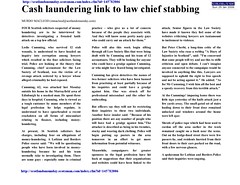
Cash Link to Law Chief StabbingMedia reports on Cumming attack were used by lawyers against reforms. Various theories are still being considered for the attack on Mr Cumming, ranging from a revenge attack organised by crooked lawyers over Mr Cumming's investigations of their accounts, to disgruntled clients who lost millions at the hands of crooked lawyers, to even a prospect the attack was carried out by other members of the Law Society intent on giving the profession a sympathetic image in the wake of serious legal reforms to its regulatory structure which the Law Society bitterly fought in Parliament during the latter half of 2006.

Leslie Cumming StoryLaw Society may have caused the attack itself. However it may well be that Mr Cumming, regrettably paid the price for his Law Society colleague's well known policy of bitter attrition towards people who dared make a complaint to the Society against their lawyer, and the general culture of a lack of accountability within the legal profession as a whole, which in turn led to feelings of bitterness on both sides.

Philip Yelland - Director of Regulation - Law Society of ScotlandPhilip Yelland, Law Society Director of Standards. In the case of the Law Society particularly, the glaringly obvious lack of ability by senior officials such as Douglas Mill, Philip Yelland and many others to even 'say sorry' or repair the financial damage their colleagues did to ordinary people, led to many cases of intense hardship, where even in one known case, a client committed suicide over the Law Society’s attempts to thwart consideration of the actions of a crooked lawyer.

Douglas Mill at the Scottish ParliamentLaw Chief Douglas Mill blamed campaigners for attack on colleague but it turned out to be lawyers. So bitter were the feelings by some at the Law Society of Scotland, the then Chief Executive, Douglas Mill, held private briefings with journalists and attempted to blame campaigners for the attack on his colleague, however it soon became clear to many in the following days the attack on Mr Cumming came from within the legal profession itself, and Douglas Mill had little more to offer on the subject, which even to this day has seen not one arrest in connection with the Cumming attack.

2006, the year of the attack on Mr Cumming, was a very bad year for the Law Society of Scotland, one could argue, as bad a year as 2008-9 has been & will be for the Royal Bank of Scotland, and indeed many other financial institutions.

The Law Society in 2006 was to be subject to the same outside scrutiny and independent investigations & public inquiries on the weakness & corruption of its regulation of crooked lawyers which will now have to be implemented on the RBS and the financial sector, where the same weak, closed ranks, soft touch regulation has ended up producing the spectacular financial failures on a global scale, that the same weak, closed ranks, soft touch regulation has produced in the legal sector on a client by client basis for decades.

Scottish Legal Complaints CommissionSLCC – now a rubber stamp for crooked lawyers. The Law Society fought the outside scrutiny and newly created legislation to bring independent regulation of complaints, and simply co-opted the new body with its own members to ensure that even after all the effort of campaigners, ruined victims, and the Scottish Parliament, the new Scottish Legal Complaints Commission simply ended up as another rubber stamp for crooked lawyers.

The banks, now faced with the same calls for more regulation, inquiries, investigations and the same campaigns by consumers against financial wrongdoings, will do the same as the Law Society did in 2006. We will end up with possibly, a new regulator to replace the Financial Services Authority after a year maybe, and then the regulator will end up being co-opted in the same way the FSA seems to have been so co-opted by the financial profession which led to its negligence in allowing the banks to do as they have done, and, collapse.

Michael Clancy - Director of Law Reform - Law Society of ScotlandLaw Society’s Michael Clancy killed off Holyrood attempt to heal ruined clients of crooked lawyers. It doesn't take much to say "sorry", and do the right thing .. however, saying "sorry" and doing the right thing, doesn't seem to be a basic capability of anyone in charge of a bank or a legal firm or indeed a regulator supposedly put in place to ensure that failure & corruption doesn't take place. Too much money. too much political influence, and soft touch, corrupt, regulation, has led to at attitude of omnipotence where these people and their organisations feel above accountability.

That culture of unaccountability must be ended for all professions, particularly those in the legal and banking worlds, if we are to repair the sins of the past and heal the wounds of ordinary people, and our economy, which have been caused by far too much unchecked greed & ambition by a few who control the many … Truth & Reconciliation is now a much needed medicine.

Thursday, October 09, 2008

Cabinet Secretary Swinney admits Law Society is 'vigorously resisting' reforms to regulation of legal profession as client protection fails once more

Constituents of John Swinney, as well as thousands more in a stunning admission by the Cabinet Secretary himself, the Scottish legal profession has vigorously resisted reforms to regulation of complaints against lawyers but these changes still do not address the 'sins of the past' including some of the largest scandals in Scots legal history, which the Law Society and even the new Scottish Legal Complaints Commission are demanding should be buried without atonement.

John Swinney's admission on regulation of legal professionJohn Swinney : 'New legislation is no aid to most victims of crooked lawyers' "Finally I would reiterate my view that you have achieved a great deal in this case, not last more stringent legislation in the field of complaints about the legal profession. I know that does not address your own circumstances, but you should be aware of the significant impact of your intervention has had on delivering change that was vigorously resisted by the legal profession but was long overdue."

SLCC squareMr Swinney is indeed correct in that the Legal Profession & Legal Aid (Scotland) Bill 2007, which created the 'independent' but now co-opted Scottish Legal Complaints Commission, will be of no help to thousands of Scottish victims of crooked lawyers, which the SLCC has abandoned by ruling it will not investigate or handle cases of complaints against 'crooked lawyers' before 1st October 2008.

There have been attempts to change the stubborn resistance of the SLCC to address the Law Society's sins of the past, where for my own part, I raised Petition PE1033, as a gesture to employ a procedure of "Truth & Reconciliation" where either the SLCC or a new Commission formed comprising individuals independent of the legal profession would consider the past and many cases where members of the public have been ruined by Scottish solicitors, with the Law Society rather letting the crooked lawyer off the hook than doing something for the client.

You can read more about Petition PE1033 here :

Petition PE 1033 - A call for action, review & settlement for victims of the Scottish legal profession's injustice against client complaints.

Michael Clancy - Director of Law Reform - Law Society of ScotlandMichael Clancy ‘killed off law reform proposals’ … However, Petition PE1033 was one step too far for the Law Society of Scotland, who, via their Director of Law Reform Michael Clancy, ordered the Scottish Parliament to terminate PE1033 just in case the idea caught on. You can read more about the Law Society's "vigorous resistance" to the Truth & Reconciliation idea here :

Law Society kills Petition PE1033 amid calls for review of injustice & regulatory sins of the past

and not content with allowing the Law society to kill off the idea to heal the legal profession’s sins of the past, the Justice Secretary Kenny MacAskill joined in and made sure there would be no further help to the many victims of crooked lawyers :

Truth & reconciliation fails as MacAskill follows Law Society orders to Parliament on attempt to heal public confidence in legal profession

Given what has happened recently to the Scottish Legal Complaints Commission, which is now staffed mostly by former Law Society staff .. I doubt the Commission as it currently stands could ever find a place in a truth & reconciliation role.

The fact the SLCC is now staffed by ex-Police officers, ex-Law Society Committee members, and is operating under an unwilling attitude to acknowledge the failings of the past are not a good recipe for engaging in the idea of truth & reconciliation ... in fact, I would call it a very backward step coming from the legal profession’s policy of “vigorous resistance” as Mr Swinney admits himself, which has served the Law Society of Scotland very well in avoiding having to deal with reforms to regulation and the way it operates in general.

However, it is still a fact that if the legal profession’s ‘sins of the past’ were to be tackled, and admitted as Mr Swinney seems to be doing himself, there would be great benefits to all in Scotland, as I wrote in an earlier article here :

The polluter pays - Why cleaning up lawyers sins of the past would be good for the public & legal profession alike

John SwinneyJohn Swinney fought against crooked lawyers as an MSP but its time to come off the fence now he’s in Government and help the victims he acknowledges the legal profession has mistreated …

While Mr Swinney in his Cabinet Secretary role obviously feels comfortable to admit the legal profession is dishonest when it comes to regulation, it is surely unacceptable for the Government to continue to allow thousands of victims of crooked lawyers to go without help .. simply because of alleged taunts from the Law Society they will challenge the Government if any effort to remedy the sins of the past is made ...

Tuesday, June 24, 2008

Rough Justice for clients as new complaints commission refuses to investigate cases mishandled by Law Society

Amazingly or not, the work of watering down the intentions of the Legal Profession & Legal Aid Act (2007) goes on.

The latest salvo fired by the legal profession against clients takes the form of rigid conditions imposed by the new Scottish Legal Complaints Commission, itself now mostly staffed by employees of the Law Society of Scotland who have transferred over to the new 'independent' regulator .. which has now definitely lost the tag of 'independence' by any measure of the word.

As reporter in last week’s article but now confirmed, the Scottish Legal Complaints Commission has now categorically stated that it will refuse to handle any complaints regarding any legal work instructed prior to 1st October 2008, the date the new Scottish Legal Complaints Commission begins its work as regulator of 'service' complaints against Scotland's 10,500 solicitors.

This may spell disaster for clients whose complaints are now caught in this tricky period, where it is rumoured, the Law Society are binning complaints against lawyers at an alarming rate before the new Commission takes effect, dishing out infinite measures of 'rough justice' to clients who have fell victim to crooked members of the legal profession.

The SLCC has also decided, after apparently receiving 'counsel's opinion' on complaints handling, that it will refuse to examine historical cases of complaint mishandled by the Law Society of Scotland. A small reminder to readers that ‘Counsel’ would of course, be a member of the Law Society of Scotland ! – so it’s hardly surprising the Law Society would want its old mishandled cases re-examined by the new complaints body.

Being unable to examine cases of the past, may not be such a bad thing though, as the SLCC itself is staffed by many members of the Law Society of Scotland who have performed questionably on complaints against solicitors in the past - and I doubt they would be so willing to reexamine their own work and find against how poorly they had treated clients beforehand while working at the Law Society.

The Law Society of Scotland are of course, very happy about these two policy decisions. It was the Law Society who asked for it, and they have got it. That shouldn't surprise anyone, it was always the goal of the Law Society to ensure the new Commission was 'brought to heal' like an errant puppy, and it has certainly achieved that by populating the new Commission with its staff and lay committee members.

After all, the legal profession is to pay for the new Complaints Commission, so they will definitely want a say in how that money is spent, while ensuring continued control of the regulatory process via former staff from the Law Society who will no doubt continue in the vein they have become accustomed to.

Jane Irvine, the new Chairman of the SLCC confirmed in a statement the Scottish Legal Complaints Commission won't be looking into complaints prior to work instructed before the first of October 2008.

Jane Irvine : "The simple fact is the SLCC's powers to award redress, particularly compensation, would be as limited as those of the Law Society if we re-opened old cases. We wished therefore to avoid re-opening old cases where we could have little effect and instead would probably simply inconvenience parties by taking them through our investigation system. The SLCC will therefore focus on work instructed after 1-10-08"

I have to say, on the whole, I agree with Jane Irvine that the SLCC is not a safe venue to reexamine old cases where the Law Society of Scotland deliberately or incompetently mishandled complaints against solicitors.

We can't have the same people who worked for the Law Society and may have worked on many of these mishandled complaints, re examine their own work now they are based at the new Scottish Legal Complaints Commission. It simply is not on at all. How on earth could they be trusted to come up with an impartial view of their own work or that of their colleagues ? Simply not possible in the real world ... and it would only malign the name of the SLCC further.

There is no doubt that old cases must be reopened - there are many to consider, where the Law Society has let crooked lawyers off the hook but a new body must be created to do that, if only for that task, as I pointed out in my Petition PE1033.

You can read about my ideas for re examining historical cases of injustice caused by the legal profession & the Law Society of Scotland in the following articles :

The polluter pays - Why cleaning up lawyers sins of the past would be good for the public & legal profession alike

Law chiefs & politicians who left Scots denied access to justice should move to heal legal system's sins of the past

There .. not too difficult is it now - and it doesn’t involved rocket science .. only needing the will to clean up the sins of the past and do some good, for maligned clients, the legal profession, the justice system, and the general public interest. Has to be a good idea, surely !

Truth & reconciliation is the way ahead, but putting together the legal profession, maligned clients, politicians who must lead the process or at least encourage it, and consumer organisations is not the easiest of tasks but it is definitely the way to proceed on this difficult and thorny issue, itself which has led to the changes in legislation and the creation of the new complaints commission.

It seems apparent there will have to be an independent Commission created for the purpose of re examining injustice caused by past mishandled cases of complaint against solicitors.

To achieve this, I hope the Scottish Government can see their way to bringing political leadership to this issue, by way of a fully independent Truth & Reconciliation Commission, ensuring a fair hearing for many people who have most certainly been denied such a right by the legal profession in the past - and are now seeing their rights abused again by what was to be a new broom in the legal world, now sadly losing its bristles before it even begins its work.

Hoping to repair the situation somewhat, the Scottish Consumer Council has also been campaigning for historical cases of poorly handled complaints against solicitors to be re examined by the new Commission, and has replied to the SLCC's rules consultation, pointing out inadequacies in the way the SLCC's remit and complaints handling is to be implemented.

In fact, looking at the SLCC’s remit, one could be forgiven of thinking it was … written by the Law Society of Scotland ?

The Scottish Consumer Council's response to the SLCC's consultation can be viewed here : Rules of the Scottish Legal Complaints Commission 2008 Consultation Draft (in pdf format), and is reprinted below.. You can read more about the SLCC consultation HERE

10 June 2008

Dear Jane

Rules of the Scottish Legal Complaints Commission 2008 - consultation draft

Thank you for consulting the Scottish Consumer Council (SCC) on the draft rules of the Scottish Legal Complaints Commission. We welcome the opportunity to comment on the consultation draft.

General comments

While we understand the need for the rules to be formal and precise, it is important that complainers are able to understand how they operate.

We hope, therefore, that the rules will be supplemented by clear, easily understood guidance for complainers on the Commission’s rules and procedures.We understand that the Commission is also to set up a ‘gateway team’ to advise and assist complainers, and we welcome this.

We are concerned that the Commission does not intend to consider re-opening historic complaints, particularly in relation to complaints about endowments sold by solicitors. We consider these to be a class of complaints which may merit being re-considered, for the reasons which we have previously outlined to the Commission.

Specific comments Rule 3 – making a complaint etc.

We are concerned about the implications of draft rule 3(6), which go beyond the issue of historic cases. As the draft rule stands, where the conduct or service complained about relates to a matter in which the practitioner was instructed by the complainer before 1 October 2008, the Commission will not accept the complaint.

This means that such cases will continue to be dealt with by the relevant professional bodies. This could mean that those bodies will have to continue to deal with such cases for many years after the work was carried out – where, for example, there has been a mistake in a conveying a property or in drafting a will, the problem may only be discovered many years after the event.

We presume that this also means that anyone who has a complaint falling into this category will only be entitled to the level of compensation which the professional body was able to award at the time the work was carried out, rather than the maximum £20,000 which the Commission will be able to award.

While it is understandable that the Commission wishes to start with a clean sheet, it seems unlikely that this situation is what the Scottish parliament intended. It also seems unfair on the professional bodies who could continue to receive such complaints for many years.

We would suggest that an appropriate compromise might be to apply rule 3(7) to cases falling within rule 3(6) (a), which would allow the Commission to deal with genuine long-term cases, without opening the floodgates. This would also mean that the professional bodies would know that there was a clear cut-off point for them beyond which they would not have to deal with service complaints. We would expect this date to be 1 October2009, on the basis that they will only accept complaints for up to one year after 1 October, which we understand is the intention of the Law Society of Scotland.

Rules 13-14: hearings

We are concerned that the terms of these rules – which refer to ‘hearings’, ‘evidence’ etc.- suggest an adversarial procedure, although the Commission has made clear it intends to operate in a more inquisitorial fashion.

Rule 21: quorum

We would suggest that draft rule 21(2) should provide that a quorum of any committee should include at least one non-lawyer member and one lawyer member.

Rule 22: reasons for determination

We would suggest that the Commission should give written reasons for its determinations, decisions etc.

Draft application form

It is not clear whether this is intended to be a paper form or if it can be completed electronically. Presumably the need for a signature means that even if it can be filled in electronically, it will need to be printed off and signed.

Again, we assume that the form will be accompanied by guidance explaining the meaning of terms such as ‘instructed’, ‘practitioner’ and ‘professional body’.

Question 1 – it may be helpful to make clear that an approximate date will be sufficient, where the complainer is unsure as to the exact date when they instructed the practitioner.

Question 2- it would be helpful to clarify from whom the details might be kept confidential – presumably the practitioner complained about. It could also be made clearer that not all of the possible types of contact details are required - only a name and postal address are needed in terms of the rules. Clearly, however, other forms of contact may be helpful to the Commission and would also be more convenient for the complainer.

Question 3 – is there a need to state here, as in relation to Question 6, that if the complainer refuses to allow the form to be copied to the practitioner, the Commission cannot investigate the complaint?

Question 4 – it is not clear what happens if the person filling in the form is not the client. Presumably if the Commission is to make a determination under draft rule 3(4) as to whether it is appropriate for that person to make the complaint on the client’s behalf, it will need further information about the substance of the complaint, as set out in the rest of the form.

It is not clear whether this question is also intended to cover the situation where the complainer wishes to complain about a practitioner’s service, but is neither the client nor acting on behalf of the client. This might be someone else who has suffered as a result of the practitioner’s alleged poor service/negligence, such as a beneficiary of a will or the client of a solicitor on the other side of a transaction, for example.

Question 9 - we are not convinced that complainers should be asked about why they want a particular resolution. This could be seen to be intrusive and is not necessarily relevant to the complaint. We would suggest that instead, question 8 could be opened up a bit more – to ask the complainer what ‘other action’ they would like to see, for example.

Finally we would have expected to see a question in the form about whether the complainer has already complained to the practitioner / firm / been through the firm’s complaints procedure. While the new process requires people to go through this stage before going to the Commission, not everyone will be aware of this.

I hope that these comments are helpful.

Martyn Evans Director

Sunday, April 20, 2008

Law chiefs & politicians who left Scots denied access to justice should move to heal legal system's sins of the past

The ability to revisit a story these days is helped greatly by the use of technology, and as clips of politicians praising, even shielding those who have caused Scotland's public and legal system a great deal of harm filter through to the web, I thought I would take an opportunity to show people what reformers and campaigners are up against when it comes to promoting reforms and reconciliation to Scotland's much ruined legal system.

As many of you are aware from previous articles I have written on the prospect of opening the Scots legal services market, I am very much for such a move, where for once, you, the individual will be in control of who you want to represent your legal interests.

I have covered many articles on opening the Scots legal services market here : Previous articles on access to legal services

As things currently stand, and have stood for decades, the Scots public have never had such a choice, always having to use a member of the Law Society of Scotland to gain access to legal services and the Scottish courts ... and if you have a controversial issue requiring the services of a Scots lawyer, perhaps one which may not be in the interests of the Scots legal profession to pursue, you will have found yourselves cast out along with thousands of others, denied access to a lawyer and access to justice, by the very same legal profession which claims to serve Scotland so well.

Over the past couple of years since the successful campaign to bring the Legal Profession & Legal Aid (Scotland) Act 2007 into being, many issues have come to light revealing just how focused the Scots legal profession has been on denying individuals access to justice, with even the very highest levels of staff at the Law Society of Scotland being shown to have interdicted ordinary Scots access to justice, preferring to follow their own policy of protecting colleagues within the legal system, many of whom are now widely known to have performed so poorly for multiple clients, they would be better filling a jail cell than earning hundreds of thousands of pounds a year from clients who get nowhere in their cases ...

One such individual widely known to have interdicted many Scots access to justice is the current [but resigning] Law Society Chief Executive, Douglas Mill .... who felt so assured of his position of being able to halt peoples lives when it came to access to legal services, he sat before the Scottish Parliament's Justice 2 Committee and simply lied through a questioning by Cabinet Secretary for Finance John Swinney, of events revealed in Mill's own secret memos, which indicated a well practiced policy by Douglas Mill, other members of the Law Society of Scotland, and the insurers of intervention in claims & complaints against fellow solicitors, ensuring the lawyer got off the hook, while the client got nothing.

Law Society Chief Executive Douglas Mill before the Justice 2 Committee - I swear I prevented people getting access to justice ...

Not too long after the above video was posted on You Tube, Douglas Mill announced his resignation, which you can read more about here : Breaking News : Law Society Chief Executive Douglas Mill who lied to Parliament, pursued 'personal vendetta' against critics - to resign

However, such people as Douglas Mill who have ruined the lives of many ordinary Scots seeking justice, or even just a simple closure to their case of complaint or legal claim, have their fans, supporters, and those who will shield them from scrutiny or attempts to put matters right.

Here is a recent clip of one of Douglas Mill's fans, none other than the Scottish Conservative Justice spokesman, Bill Aitken MSP, who unwisely praised Douglas Mill, even holding him up as an undeserved 'example of excellence'.

Bill Aitken MSP praises Douglas Mill as an example of excellence but in reality Mill lied to the Scottish Parliament and threatened court action against legislative reforms ...

What on earth could make politicians praise such an individual as Douglas Mill, who in reality has presided over the worst period of history for Scotland's legal profession, where client complaints have reached nearly eight thousand in some years, and solicitors generally are viewed as untrustworthy, even endemically corrupt ?

You can read previous articles I wrote about the legal services debate involving these matters here : Scotland fights political interests for wider access, choice of legal services over protectionism of lawyers monopoly

Well, perhaps what we are seeing in Mr Aitken's words of praise of Douglas Mill, are an example of the underlying support the legal profession and people such as Mill have enjoyed from politicians over the years in Scotland, the very same politicians who have mostly stood back while the Law Society of Scotland merrily ruined the lives of anyone who challenged its authority .. clients and solicitors alike.

Surely time for that one to end then, and those politicians who are fans of those who cause injustice to be replaced ? Well, I thought so myself last May when we had an election in Scotland, but just look at the next movie of the current Justice Secretary, Kenny MacAskill, who seems to be such a fan of his colleagues in the legal profession he has made his case and position very clear on any proposed reforms to the way the Scots legal profession manipulates the legal services market and ordinary Scots access to justice ...

Kenny MacAskill sees it as his mission to protect lawyers from anything ... hardly a justifiable SNP goal ?

Mr MacAskill, not content with his startling outburst against the legal profession's critics & reformers, then went on to justify his actions by claiming Scotland owes a great debt to lawyers and the legal profession ....

Kenny MacAskill : Scotland owes a great debt to lawyers ... but should this so-called 'debt' prejudice the need for change and public interest reforms ?

Well, I have no doubt that Scotland has indeed owed debts to the legal profession, and of course, I very much support elements of the Scots legal profession who have, over the years, come forward and challenged inept or unjust laws, have ensured that clients legal cases and the public in general are heard on legal matters, and particularly those solicitors who have worked hard for and represented their clients honestly, with vigor and succeeded in bringing a measure of justice and access to it to those who need it

In general however, I find from talking to many people, public and solicitor alike, that Scotland and the legal profession are about quits on things these days .. so time to rid ourselves of these claimed 'debts' (which generally turn into political favours or such) and move on to bring reforms in which are both in the interests of the public and the legal profession alike.

One further area which the Justice Secretary should also be looking at, if Mr MacAskill can get past his seemingly distinct prejudice of dealing with anything which criticises the legal profession, is that of bringing truth & reconciliation to the many cases of injustice which the Law Society of Scotland have themselves caused over the years.

What a great thing it would be if someone could heal the deep divisions between the public and the Scots legal profession, bringing closure & justice to the many who have been denied it over the years .. and surely the time to do that is now ...

You can see my idea of bringing truth & reconciliation to clients and the Scots legal profession here : Law Society kills Petition PE1033 amid calls for review of injustice & regulatory sins of the past

As you can see, the Law Society of Scotland were too afraid of my idea to let it live, but surely taking the time now to bring dialogue, reconciliation & settlement to people by cleaning up the mistakes & ruined lives left by the failed regulatory policies of Douglas Mill's Law Society of Scotland is worth the effort, to heal the rifts caused by the policies of a few which should not be allowed to continue to ruin the public's trust in both the legal profession and the justice system ?

Sunday, March 30, 2008

Swinney expenses circulated by aggrieved lawyers over parliamentary confrontation with resigning Law Society Chief

The 'hero' of several campaigners for legal reform, John Swinney, who challenged the Law Society of Scotland's Chief Executive Douglas Mill in front of the Justice 2 Committee of the Scottish Parliament over corruption in the way complaints and claims against lawyers have been dealt with by the Law Society itself, has seemingly 'gone into silence' on the issue, after, it has been alleged, the legal establishment have given him a warning over his conduct, with the waiving of certain documents to preferred sections of the media ...

John Swinney v Douglas Mill at the Justice Committee - serious corruption revealed in Chief Executive's own attempts to thwart claims, which led to Mill's resignation.

You can read a lot more about the events leading up to Douglas Mill's resignation, which began with the confrontation between Mill & Swinney at the Parliament here : Breaking News : Law Society Chief Executive Douglas Mill who lied to Parliament, pursued 'personal vendetta' against critics - to resign

Now that you have watched the above video, and read my earlier report on Mr Mill's resignation, you should not be surprised to learn that earlier last week, documents were apparently being circulated by some aggrieved members of the Law Society, showing Mr Swinney's mortgage claims on his Parliamentary expenses account. The documents currently doing the rounds show among other things, Mr Swinney receiving regular payments for mortgage interest at around £900, with, curiously enough, even a 19pence stamp making the claims book.

John Swinney mortgage allowance claims

John Swinney on mortgage payments

even a stamp ...

John Swinney on stamps

The documents, apparently released by members of the legal profession, who clearly support Douglas Mill and the Law Society's policy of beating down complaints against solicitors with a stick or anything higher, don't particularly show anything we don't already know, but I am slightly amazed myself at the size of the claims and seemingly attention to detail, while Mr Swinney's constituent, and others mentioned by him not only in that confrontation with Douglas Mill, but also within the Parliamentary debate on the LPLA Bill, have not yet seen their cases achieve a measure of settlement.

I was in two minds whether to cover the story at all, but in the interests of fairness, and the expectation of Mr Swinney's constituents and those he has helped over the issue of problems with regulation in the legal profession, the story does deserve coverage, also hopefully to limit the damage that certain forces may be trying to do to Mr Swinney's reputation, as was seen in the early part of 2007 when several Labour & Lib Dem MSPS were caught in mortgage allowance expenses, apparently after leaks of documents from a few lawyers who were ticked off after the passage of the LPLA Bill in the Scottish Parliament in mid December 2006 ...

John Swinney speaks in the Scottish Parliament on corruption within the Law Society of Scotland and interference with innocent people's access to justice.

As you know, I am a supporter of Mr Swinney, particularly over his courage to take on Douglas Mill in front of the Justice 2 Committee in 2006, and really get to the heart of the issues which have been burning up the public over their poor treatment by the Law Society of Scotland when it came to making complaints and financial claims against either negligent or crooked lawyers. I simply don't think that anyone else, with the exception of Phil Gallie, would have had the courage to ask those questions and take issue with Mr Mill, as John Swinney clearly did.

Surely Mr Swinney has been in government long enough now to ensure these cases attain a measure of settlement and closure, for the good of his constituents, the others he mentioned, and the interests of justice and the Scottish justice system as a whole.

It's not too much to ask or expect I think, for people to be given closure and peace of mind over wrongs which were perpetrated against them by the legal profession itself, and if the Cabinet Secretary for Finance, Mr Swinney, cant put this issue on the table now and get it fixed for all concerned, we are living in a very sorry state of affairs in Scotland.

How about it John ? Lets give the innocent some justice and allow everyone to get on with their lives again ? It's time, and surely after you raised the subject, it's time to live up to the duty of seeing it through, which you have the power to do, and give some help to innocent Scots who are caught in this never ending injustice ...

Tuesday, March 04, 2008

Truth & reconciliation fails as MacAskill follows Law Society orders to Parliament on attempt to heal public confidence in legal profession

There will be no 'truth & reconciliation" between the public and the legal profession under Justice Secretary Kenny MacAskill, according to replies received from the Scottish Government on this issue.

While some within the SNP are floating the idea of 'truth & reconciliation' as a way of resolving long standing cases of injustice, it is just one step too far for the public to be allowed any accountability against injustice caused not only by the legal system, but also by the very legal profession which has caused so much trouble & pain in Scotland.

Kenny MacAskill : lawyers money making will take priority over the public interest no matter what ...

Justice Directorate PE1033 final

I am not too surprised that Mr MacAskill, a lawyer himself who has publicly stated it will be his mission to defend his lawyer colleagues from any criticism or 'misrepresentation', over it seems, anything to do with the public interest, has ruled out a move to resolve the legal profession's sins of the past against clients, where poor or corrupt regulation of crooked lawyers has allowed so many solicitors to remain in practice while many clients have been financially ruined.

I am surprised however, the Justice Secretary so blatantly protects the legal profession from any possible reforms which would damage its monopolistic business model, as well as impugning its controlled regulatory model, the latter of which Mr MacAskill has felt so strongly to protect that he selected a group of lawyers and ex Law Society Committee members to ensure the new Scottish Legal Complaints Commission continues the Law Society's valuable work of letting crooked lawyers off the hook.

You can read some of those reports on the demise of the SLCC before it has even begun its work here :

Call for MacAskill appointments 'sleaze investigation' as revelations show Legal Complaints Commission member was subject of Police inquiry

Law Society staff secretly migrating into 'independent' complaints commission will ensure continuing problems of regulating Scottish lawyers

Calls for full disclosure on legal complaints commission members as Justice Department 'covers up' conflicts of interest in appointments scandal

So, who thinks the Scottish Legal Complaints Commission will do any different from the Law Society of Scotland after those revelations ?

The proposals for 'truth & reconciliation' were made in Petition PE1033, which called for the Scottish Parliament to form an independent commission to resolve the legal profession's long list of poorly handled cases of complaints against crooked lawyers, which have caused so much harm to clients over the years.

Petition PE1033 : a call to resolve lawyers 'sins of the past' against clients, and a chance to do something for Scots before lawyers ...

PE1033 Page 1PE1033 Page 2PE1033 Page 3

The Law Society of Scotland however, had other ideas, and ordered the Petitions Committee to close consideration of the petition, implying the SLCC may be able to deal with such issues, when we now see from how the SLCC will be staffed, it certainly won't be dealing with any cases of the past, with the revelation the same Law Society staff who have caused such terrible injustice against the public, are transferring to the SLCC themselves ...

Michael Clancy, Director of Law Reform - Law Society of Scotland demands no truth & reconciliation for ruined clients of crooked lawyers

Law Society of Scotland PE1033 Page 1Law Society of Scotland PE1033 Page 2

Michael Clancy, who is the Director of Law Reform at the Law Society of Scotland, but doesn't want the law reformed against lawyers themselves, certainly gives the orders as you can see from the above letter, and the Parliament are only too willing, save the odd note of dissent, to comply and ensure that any call to bring solicitors to account for their injustice against clients does not get heard.

Not only do we have justice denied by the legal profession in Scotland, we also have democracy & accountability denied when it comes to politicians being asked to do something extra to heal injustice, which they should have done a long time ago, and so obviously left out of the Legal Profession & Legal Aid (Scotland) Act 2007, which was brought in to heal some of the problems of biased complaints regulation by lawyers against lawyers.

It appears that Mr MacAskill shares the same chip on his shoulder against me which a few at the Law Society have, therefore I doubt I will revisit this issue with them again for now, as cutting through Mr MacAskill's 'I will support lawyers over people" bias is just impossible and I can't & wont offer the kind of incentives that the other Justice Secretary Michael Clancy along with his colleagues at the Law Society can offer the Scottish Government to keep such 'truth & reconciliation' proposals off the table.

Helping Scots victims of injustice is what being a Scot is all about ...

To Kenny MacAskill PE1033 final

Of course, it is open to others to raise the same issue ... and perhaps you may be more successful than me, so give it a try please - it's an effort to help all Scots who use lawyers and legal services.

So, little wonder that Justice Secretary Kenny MacAskill supports his colleagues in the legal profession, when they are capable of ripping off earning so much from the taxpayer, as the following story on how much money lawyers took from the taxpayer for themselves in the miners compensation deal demonstrates.

Before anyone says, 'oh the miners compensation rip off happened mostly in England & Wales, and it couldn't happen in Scotland', well, the Law Society of Scotland and it's member legal firms have been doing the very same to Scots for decades, on a wide range of cases, and so far have got away with it because the politicians have sat back for so long and done nothing ...

The Herald reports :

10-year wait for ex-miners as lawyers earn £1.3bn

DANIEL BENTLEY

Former miners have been forced to wait more than 10 years for government compensation for pit-related illnesses, a powerful committee of MPs said yesterday.

Some even died while their claims were being processed because ministers underestimated the size and complexity of the project, the Public Accounts Committee found.

Solicitors have earned more than £1.3bn in fees for handling the claims, with one firm alone collecting nearly £124m.

Average administration costs amounted to more than the claim itself in more than two-thirds of the cases.

In a highly-critical report the committee said the government had expected about 218,000 claims for lung disease and vibration white finger, with payouts totalling £614m.

There have now been about 762,000 claims which it is thought will cost about £4.1bn once they are all settled, as well as another £2.3bn in administration.

But tens of thousands of ex-miners are still waiting for an offer. Last September there were about 128,500 claims still awaiting settlement.

Some miners had waited more than 11 years between their medical assessment and receiving an offer.

Edward Leigh, the Conservative MP who chairs the committee, accused the Department of Business and Enterprise of having "seriously mismanaged" the schemes in their early stages.

Far too much money went into the solicitors’ pockets

"Its attempt to implement the schemes swiftly, combined with its underestimation of how many claims would be made and how complex some would be, resulted in many claimants having to wait a very long time for the compensation they were owed," Mr Leigh said.

"Some of these were elderly and ill and in no position to wait for years for compensation - in some cases 10 years or more. Some claimants even died while waiting. The taxpayer has also taken a big hit, with the cost of just administering the schemes expected to total nearly £2.3bn."

The restitution packages were arranged after British Coal was found to have been negligent in the cases of ex-workers who had developed chronic obstructive pulmonary disease (COPD) from dust and vibration white finger from equipment in the pits.

But the government failed to get its own actuarial assessment of the likely number of claims and liabilities under the Coal Health Compensation Scheme, instead relying on British Coal's forecasts.

Ministers did not initially realise that deceased miners' claims would be payable to their widows and families.

The cross-party committee also criticised the government's dealings with solicitors, accusing it of "weak" negotiations on their fees which led to higher administration costs.

Of the £2.3bn administration expenses, solicitors' bills accounted for £1.3bn.

The average cost of processing each claim was £3100, more than what two-thirds of miners received in compensation.

Just 10 law firms collected between them £635.8m in fees. The highest earner was Thompsons, which received £123.6m.

The government is chasing up to £100m in repayments from solicitors after a court ruling that certain cases should have incurred a smaller fee.

Some solicitors also effectively double-charged for their services by taking a cut from their clients' compensation packages on top of their government-paid fees.

The Legal Complaints Service believes lawyers owe millions of pounds to tens of thousands of miners.

It is currently contacting every miner covered by the scheme urging them to check whether they had money wrongly deducted.

Mr Leigh said: "There are lessons aplenty here for other parts of government planning and implementing new compensation schemes.

"Far too much money went into the solicitors' pockets."

Monday, October 01, 2007

Law Society kills Petition PE1033 amid calls for review of injustice & regulatory sins of the past

We constantly read in the media of those who commit crimes never showing any repentance for their actions, usually doing their utmost to deny their wrongdoing, even when the evidence is all too plain to see.

And so, it is with the Law Society of Scotland, who never apologise for abusing clients rights when an innocent individual discovers they have been wronged grievously by a solicitor.The Law Society never apologizes of course, because they can get away with abusing clients, and don't see anything wrong with it.They see it as their right, and they have political friends who support it. As long as that is the case, nothing can stop it.

Imagine,if you will, an abuser, facing a law change which would send them to jail for longer, and force them to pay compensation of their victims, called up their political friends to prevent that law being changed, and the politicians said "Oh yes, we will allow you to go on abusing, we support you".

How would the public react to that ? Would those same politicians who shielded the abuser's view of their right to go on abusing & get away with it, last long in political office ? Well, yes, it does happen in a few instances, but for anyone who has fallen victim to the sins of the Law Society of Scotland and crooked lawyers, it has happened all too often.

This is, technically what happened at the Scottish Parliament Petitions Committee on 18 September 2007, where, sadly, but not unexpectedly, my Petition PE1033, to call for a review of cases of injustice, caused by the Law Society of Scotland in it's role as regulator of complaints against solicitors, a complaints process which has caused such damage to innocent members of the public, was, for now, closed...

The letter from the Petitions Committee :

Feedback Letter PE1033

I knew it would happen of course, the Law Society, as determined as it is, and as full of hate as it is for anyone who criticises it's position as regulator of complaints against solicitors, would succeed in either delaying or ending what is, an obvious call for the sins of the past to put right.

Here is the Law Society of Scotland's letter to the Scottish Parliament Petitions Committee members, arriving at the Parliament, by usual means of dirty tricks, the very same day the Petition was being considered. The Law Society had since December 2006 to make the spurious claims they laid before the Committee ....

The letter from the Law Society of Scotland to the Petitions Committee :

Law Society of Scotland PE1033 Page 1Law Society of Scotland PE1033 Page 2

Item 1 of the Law Society's letter, gives a summary of how the Legal Profession & Legal Aid (Scotland) Act 2007 came into being, which barely passed into law last year, after constant meddling, arm twisting, even threats to take the Parliament to Court if parts of the then LPLA Bill were not amended to the Law Society's interests ... None of that is mentioned in Mr Clancy's summary of how the LPLA Bill progressed through the Parliament and into law because Mr Clancy puts forward the Law Society's view of itself and demands that no one can take issue with it.

Item 2 of the Law Society's letter, the shorter part, and in the usual style of the Law Society when answering it's critics, attempts to sideline the reforms & additional powers I asked for in Petition PE1033, which were to either give extended powers to the new Scottish Legal Complaints Commission to review & resolve past cases of complaint mishandled by the Law Society of Scotland, or, form an independent review commission with a similar remit.

There is of course, nothing at all, no mention whatsoever in the Legal Profession & Legal Aid (Scotland) Act 2007, of any such reforms or extended powers to which I called for in Petition PE1033, as is plain to see.

The Law Society claim further, in the letter, that

"The Parliament passed the Legal Profession and Legal Aid (Scotland) Act 2007 on 14 December 2006. Mr Cherbi submitted his petition on 15 December 2006.

Mr Cherbi’s wish to make changes to the jurisdiction of the Scottish Legal Complaints Commission could have been considered by the Parliament on 14 December had he promoted amendments to the Parliament.

The Act received the Royal Assent on 19 January 2007 and is in the process of implementation. In the Society’s view, the Act should be given the opportunity to be fully implemented and to be put into operation before its amendment should be contemplated. "

Really ? I think you jest Mr Clancy, and you know it full well.

So Mr Clancy wants to give the LPLA Act an opportunity to be "fully implemented and put into operation before this amendment should be contemplated."

The same LPLA Act which his colleague, Law Society Chief Executive Douglas Mill threatened to bring down with legal action against both the Scottish Executive & Scottish Parliament unless it was amended to suit the needs of the legal profession.

Does perhaps, Mr Clancy have plans for the progress of implementation of the LPLA Act to which we are not privy yet ? ..

Perhaps, as one of the rumours circulating from the Justice Department being that somewhere along the line, the Law Society will support a challenge by one of it's solicitors against the LPLA Act and the SLCC on the grounds that particular legislation or operation of the SLCC has ... breached that particular solicitors Human Rights ? ..... just the same as what happened with Temporary Sheriffs, then we see the SLCC suspended in it's function while the Law Society of Scotland come back to self regulate the legal profession for its own interests as it has always done ?

This is one of the scenarios which has been under consideration by politicians in the event that Douglas Mill and the Law Society decide yet again to threaten to kill off the LPLA Act & the function of the SLCC .... so, better now to look at either implementing the aims of Petition PE1033 as an 'amendment' or more simply, have the Justice Secretary convene a review commission to carry out the terms of Petition PE1033 .. sooner rather than later.

If I had put forward amendments to the LPLA Bill, the Parliament would have considered them and thrown them out quicker than the speed of light, on orders from the Law Society because such amendments would effectively call into question many many cases of poorly & deliberately mishandled complaints by the Law Society of Scotland over many years.

I have been asking since 1999, since the Justice & Home Affairs Committee of the Scottish Parliament first examined whether to investigate regulation of the legal profession, that the sins of the past be put right.

To clearly show the long history of this matter, you can read the submissions of myself, and many others to the Justice 1 Committee 'regulation of the legal profession' hearings in 2003 and again, submissions from myself and many others to the Justice 2 Committee consideration of the LPLA Bill during 2006.

Clearly, at least one MSP out of them all, should have proposed the issue of dealing with injustice caused by the Law Society to clients whose complaints were poorly or deliberately mishandled by the law Society of Scotland - there was ample evidence, after all .. but not one MSP was brave enough to raise it as an issue, despite every MSP in the Parliament receiving letters from constituents on problems with 'crooked lawyers'.

Why on earth would I, and many others, have been campaigning over the years, since 1994 actually, for an end to self regulation of the legal profession, the creation of an independent regulatory body to deal with complaints against solicitors, and as obvious to all, a clean up of the injustice of the past by the Law Society who either poorly or deliberately in many cases, mishandled complaints against solicitors ?

Petition PE1033 - Reviewing mishandled complaints against lawyers :

PE1033 Page 1PE1033 Page 2PE1033 Page 3

Here are the details from the Committee Official Report on how my Petition PE1033 was considered :

Legal Profession (Complaints) (PE1033)

The Convener: I thank committee members and the public for their patience. We have heard from two petitioners and we must now give appropriate consideration to a series of petitions.

PE1033, which was lodged by Peter Cherbi—I hope that I have pronounced that right—calls on the Scottish Parliament to seek an effective, transparent and wholly independent means of reviewing cases of alleged injustice, caused by actions and decisions of the Law Society of Scotland and the Faculty of Advocates that relate to the regulation of complaints made by members of the public against the legal profession, either by giving powers to the new Scottish legal complaints commission or by setting up an independent review commission. Before being formally lodged, the petition was hosted on the Parliament's e-petition system, where between 9 February and 2 June it gathered 46 signatures and three comments.

Do members have views on how to deal with the petition? We have received a letter from the Law Society of Scotland, which is one of the organisations that we might contact as part of our consideration. I will not pre-empt the discussion by talking about what the letter says. That would be

Col 120

unfair to members, who have not seen the letter, because it arrived this afternoon.

Nanette Milne: I have seen the letter from the Law Society of Scotland. I think I am right when I say that significant legislation has been passed; the Legal Profession and Legal Aid (Scotland) Act 2007 has not yet been fully enacted, but it will establish the Scottish legal complaints commission. I confess that I do not know the detail around that, but I know that the Justice 2 Committee in the previous session of the Parliament took detailed evidence on the issues.

Given that the new arrangements are not yet fully up and running, would it be a little premature to consider the petition at this stage? Might it be better to deal with it as part of post-legislative scrutiny? I am interested in what members think about that.

15:30

Rhoda Grant: I was about to say much the same thing. It is important to let legislation bed in and, when significant changes have been made, to ascertain whether the new system is working. After that, the new system can be reviewed by the appropriate committee of the Parliament.

The Convener: Do members agree?

Tricia Marwick: Despite the raft of legislation that has been passed, it seems that dissatisfaction remains about the legal profession, which might or might not be lessened when all legislative provisions are in place. It might be worth while to write to the Law Society of Scotland or the Scottish Government about the petition, to ask whether it is anticipated that all the petitioner's concerns will be addressed when all provisions are in force. I suspect that all the petitioner's concerns will not be addressed. We might ask what further provisions could be considered.

Robin Harper: We must acknowledge that there is a group of people in Scotland—a relatively small number, I hope—who, for personal reasons, are deeply disturbed by the treatment that they have had from lawyers. The depth of their feelings should not influence committee members as much as the sensible approach that Nanette Milne suggested, which is to wait until the legislation that has been passed is in force, before considering what can be done in the context of post-legislative scrutiny.

The Convener: Two distinct approaches have been suggested: to seek further views on the appropriateness of the petition in the context of existing legislation and to ask whether existing legislation will address the petitioner's concerns; or to wait until post-legislative scrutiny takes place.

Col 121

Nanette Milne: Are the two approaches mutually exclusive?

Robin Harper: I do not think so. We can do both.

The Convener: I hope that the approaches are not mutually exclusive. I am trying to find healing words.

Nanette Milne: We can do both, ideally.

The Convener: Are we not closing the petition?

Fergus Cochrane (Clerk): If the committee decides that existing provisions are sufficient to deal with the concerns that are raised in the petition, it can close the petition on that basis.

John Farquhar Munro: Can we take advice from the Scottish legal complaints commission?

The Convener: The issue is whether we can close the petition at this stage on the basis that we can revisit it if issues emerge from post-legislative scrutiny or comments made by the Government, the law officers or anyone else.

Fergus Cochrane: If you close the petition, you close it.

The Convener: That is what I was trying to get at. What do members want to do?

Tricia Marwick: I would not want to go to the wall on this. A few members think that the legislation needs to bed down and I would not divide the committee on that. We might say to the petitioner that we will close the petition at this stage, but if he wants to come back to us after the provisions have been enacted and have bedded in we will consider more specific points at that stage.

The Convener: That seems a sensible way to resolve a difficult issue, given the journey that has been taken. We might recommend closing the petition on the basis that we expect to hear something about post-legislative scrutiny. We can remind the petitioner that if his concerns have not been appropriately dealt with in the new legislative framework, the opportunity remains for him to lodge another petition. I thank members for their helpful contributions.

Sadly, I think only Tricia Marwick MSP actually understood what Petition PE1033 was all about, and what I was asking for in it, rather than accepting the Law Society explanation in their letter, ideally timed to keep scrutiny of the issue to a minimum.

I do thank all of you who signed the Petition on the Parliament's website. I am sorry of course, for letting you down but the battle goes on, to bring redress to those who suffer & have suffered injustice at the hands of the legal profession in Scotland.

Well, I can only but try again of course, and to assist that somewhat, and given I heard a whisper the Petition was to be closed (amazing, isn't it), I wrote to the Justice Secretary Kenny MacAskill several days before the Petitions Committee met, asking that he consider the aims of Petition PE1033, with a view to his office implementing the calls for review & resolution of past injustice caused by the mishandling, deliberate or otherwise, of complaints against solicitors by the Law Society of Scotland.

Mr MacAskill could do that. He does have the power to either call for a review & resolution of past injustice caused by the legal profession against members of the public, by way of putting together a Commission, or himself, putting forward extended powers to be passed by the Parliament, just as the Law Society have occasionally done in the past, using Solicitor MSPs to put forward & promote legislation when it suited them to do so

My letter to Justice Secretary Kenny MacAskill :

MacAskill PE1033 Page 1MacAskill PE1033 Page 2

The Law Society of Scotland know of, and apparently have, a copy of my letter to Mr MacAskill, so I can imagine they will try and flummox him with the same deadly poison they laid before the Petitions Committee.

However, I hope that Mr MacAskill, a member of the legal profession himself, will see sense and give, what are 'healing powers' to the new Scottish Legal Complaints Commission to clean up the Law Society of Scotland's sins of the past. After all, cleaning up the sins of the past, isn't such a bad thing to do now, is it ?

Tuesday, May 08, 2007

Consumers call for OFT Inquiry to investigate restriction of legal services in Scotland

Reflecting the views of many victims of the monopolistic legal profession in Scotland, Which ? - a UK Consumer organisation, have made a "super complaint" to the OFT to ask for an inquiry into access to legal services in Scotland , which is currently the exclusive domain of solicitors & advocates.

Download a copy of the Which" "Super Complaint" here : Which? super-complaint on Scottish legal services (PDF: 220Kb)

As we all know, if you need to use legal services, you have to use a solicitor. If you need access to the courts, you invariably need to use a solicitor and an advocate too, depending on the nature of the case. If you don't use either, you don't get access to legal services, and you don't get access to court - as simple as that.

This is the grand monopoly the Law Society of Scotland & the Faculty of Advocates have maintained for their members for decades. A great money spinner for all, making sure that no one else can enter their business markets, but more importantly, also making sure that they decide exactly who has access to justice, and who has not.

The solicitors & advocates monopoly on legal services, was supposed to have ended during the 1990s, with the implementation of Sections 25-29 of the Law Reform (Misc Provisions) Act 1990, which was passed by the last Conservative Government.

However, looking back on the obvious lack of implementation of Sections 25-29, it now looks like those parts of the Law Reform Act (Misc Provisions) were only put in to appease criticism of how easy the legal profession enjoyed their unrestricted business model.

During the 1990s, lobbying from the legal profession and resistance from the likes of former Lord Advocate Lord hardie (who actually asked for delays to the implementation of those relevant parts of the Act, and even wanted Sections 25-29 repealed) kept the monopoly on legal services firmly in the money making hands of the legal profession - and no one did anything about it after that until someone made an FOI request to the Scottish Executive which saw some sticky revelations yet to be generally published.

I reported on these matters here : Former Lord Advocate Andrew Hardie revealed as major obstacle in removing lawyer-advocate monopoly on legal representation and here : Scottish Executive drops FOI disclosure battle over restrictive access to Courts while thousands go without representation

Access to justice & legal representation is not just conveyancing services, wills & probate and other general duties of lawyers getting the benefit of wider access to legal representation, there is also the question on how to handle other legal matters, such as lawsuits, damages claims, and yes, negligence cases against professionals who give poor service to their clients, one of the best examples of that being the legal profession themselves, where lawyers are famed for protecting their own, or stringing out negligence cases against other professional bodies & their members who invariably are insured by the very same insurance firms which insure the legal profession .... and offer backdoor bonuses to kill off such actions.

From my own experience and campaign on the issue, time and again, people have been denied access to justice at the whim of the legal profession when someone has fallen victim to the growing band of crooked lawyers in Scotland who seem to get off every complaint thrown at them no matter how serious it is. I have documented my own case quite well on that in the past, and reported on others too .. all bearing the same similar plight of being denied access to justice, to protect the crooked within the legal profession.

The SNP's Justice spokesman, Kenny MacAskill, who may well be the next Justice Minister, doesn't favour these reforms, as he already said last week in the Herald newspaper
SNP says ‘Tesco Law’ is not suited to Scottish society
and Mr MacAskill, himself a solicitor and member of the Law Society of Scotland, has already gone on record as being hostile towards those who have suffered at the hands of his legal colleagues too : View from Holyrood

It seems therefore, the SNP certainly need a view change on this issue, as I reported here : It's time for Injustice to end, but will the SNP end Injustice in Scotland ?

Who indeed, could support a corrupt legal profession, which even brought in English LibDem peers to threaten our Scottish Parliament & Executive with an ECHR court action simply over the loss of their self given right to regulate their own colleagues and continue to let crooked lawyers off the hook from client complaints ?

Who indeed could support the leaders of a legal profession who author memos on interdicting & delaying negligence claims against solicitors, then lie about it in front of TV cameras & a Justice Committee, or send malicious letters to the Legal Aid Board, interdicting a financially ruined client's legal aid claim to start a case against a crooked lawyer ?

Who indeed could support a legal profession which uses an assault on one of their senior staff members as a public relations stunt to brief certain parts of the press, asking directly for named campaigners to be implicated and even name drop their critics to the Police, when actions reflect more on their own colleagues than anyone else ?

Only those who would benefit from such a racket, would support such ideals ... which are certainly not in the public interest.

We are all Scots after all, and we should all have access to justice without prejudice .. so, let us end the injustice and open out our legal services so everyone has access to justice, rather than letting the legal profession decide.

We must also look at the victims of the sins of the past of the legal profession too, where the Law Society of Scotland have got away with corrupt practice in prejudicing the handling, investigation & outcome of client complaints on an exponential level.

Petition PE1033 at the Scottish Parliament calls for a review of how people have for so long been denied justice at the hands of the legal profession in the field of complaints against solicitors & advocates.

You can also sign Petition PE1033

Article from the Herald to follow :

http://www.theherald.co.uk/news/news/display.var.1381429.0.0.php

Calls for OFT investigation over access to justice for Scots
Exclusive by LUCY ADAMS, Chief Reporter May 08 2007

A powerful consumer charity has asked for a formal investigation into concerns that Scots are not getting enough access to affordable justice and legal representation.

Which? has sent the Office of Fair Trading (OFT) a "super complaint" to recommend it addresses fears that the current regulation of legal firms is hindering the market, restricting choice and pushing up the price.

The move comes ahead of reforms being introduced south of the border which will allow banks and supermarkets to join forces with law firms and provide legal services.

Following a review by Sir David Clementi, organisations such as Tesco and the RAC should, from 2008, be able to offer legal services alongside sandwiches or roadside assistance. The changes, supported by the OFT, are intended to make the legal profession more responsive to consumer needs.

However, Which? believes the Law Society of Scotland, the Faculty of Advocates and the Scottish Executive have all demonstrated no appetite for exploring, let alone implementing, alternative structures.

Areas such as conveyancing, litigation in court and obtaining confirmation in executries must be undertaken by solicitors in Scotland. Other services such as will-writing can be done by non-solicitors, but that is usually not the case.

Which?, at the vanguard of revolutionising provision of legal services in England, is turning its attention to Scotland, which it believes is pushing up prices and limiting access for customers.

The OFT has 30 days to consider the super complaint and decide whether to investigate.

A Which? spokeswoman said: "People cannot instruct advocates directly and have to employ a solicitor to do so. We would want to see an independent body created to protect consumers in Scotland in relation to legal services."

Following moves to liberalise the regulations on legal firms south of the border, HBOS, which has two million customers, launched a new service offering "everyday legal products" to customers at what it claims will be considerably lower fees than those offered by high-street solicitors.

The service is being rolled out through the bank's Halifax arm in England and Wales. However, Joel Ripley, head of Halifax Legal Solutions, said last year there are plans to extend it to Scotland.

The Halifax service, which will include discounted conveyancing, will preparation and a 24-hour legal helpline, is also set to provide access to a website where customers can prepare their own documents, including tenancy agreements and letters of complaints about faulty goods. These will be reviewed by qualified lawyers.

Conveyancing in England and Wales will be done by HammondsDirect. In Scotland, it would be undertaken by a firm north of the border. Customers will pay an annual membership fee of £89 which will give them free access to the helpline.

John Campbell, QC, of the Oracle Chambers, said: "The Which? super complaint poses important questions for the way law is practised in Scotland, and opens up the potential for a much more open market in the provision of legal services. It should be welcomed by lawyers as a whole, and by the executive.

"Since these ideas appear to have been embraced south of the border, it is to be hoped the new administration will realise the twin goals of increased competitiveness among lawyers.

"This complaint takes a long, hard look at professional business structures, and finds that simple changes would generally introduce efficiencies, lower costs, and benefit consumer choice.

"Lawyers should look on these ideas as a challenge and an opportunity, not as an attack on their institutions."

Scotland's lawyers have been split on the Clementi review. Some have threatened to move their "brass plaques" south to help them find outside sources of capital and hire non-lawyers for simple jobs.

Others are far from enthusiastic about the prospect of English-style reforms north of the border. The Law Society of Scotland has stressed what it sees as the risks of allowing other businesses to own law firms. What, it asked, if crime organisations take over all the lawyers in a town?

and the story from Which? itself .... link in the headline :

Scottish legal services super-complaint

Which? has asked the Office of Fair Trading to investigate how legal rules in Scotland are working against consumer interests.

In Scotland there are restrictions on the ways that lawyers can work together and with non-lawyers, and consumers are not allowed to deal directly with advocates, (who have a similar role to barristers in England and Wales). We’re using our power as a designated ‘super-complainer’ to ask the Office of Fair Trading to look at how these restrictions are preventing consumers from getting the legal services they need. (More on Which?’s powers as a super-complainer’.)

Restrictions

Consumers in Scotland are, in the main, provided with legal services by members of two professional bodies – the Law Society of Scotland and the Faculty of Advocates - who regulate the legal profession in Scotland.

The Law Society of Scotland does not allow non-lawyers to own a legal firm and prevents solicitors forming a legal relationship with non-lawyers with a view to offering professional services, for example setting up a joint practice with an accountant.

The Faculty of Advocates compels its members to practice as sole traders and prevents them from working with other advocates, solicitors or others to provide legal services. Faculty rules also mean that people cannot instruct an advocate without first instructing a solicitor.

Consumer harm

These restrictions work against consumers as they prevent lawyers from innovating to meet the needs of their customers. Moreover, service providers are unable to use new business structures to become more efficient, which could lead to lower prices for consumers. The fact that people cannot instruct advocates directly can lead to unnecessary legal work and ultimately higher prices.
What changes are needed?

We believe that most existing restrictions can be removed without new legislation, but we recognise that allowing non-lawyers to get involved in the Scottish legal services market will require regulation to protect consumer interests.

A new Scottish Legal Services Board should be established, independent of the legal profession, and of government, ultimately responsible for regulation of the Scottish legal services market. It would either directly regulate solicitors, advocates and the third party entrants to that market, or it would oversee regulation by the Society and the Faculty to ensure that their rules facilitate alternative business structures, enable direct access of consumers to advocates or allow third party participation in the market.

Super-complaint

The Office of Fair Trading has 90 days to respond to our super-complaint and decide whether to recommend removal of the restrictions on the legal services market in Scotland.