Showing posts with label UK Supreme Court. Show all posts

Monday, January 27, 2020

CONFLICT OF JUSTICE: Deputy President of UK Supreme Court Lord Hodge blocked appeal to UKSC on damages case he previously heard 16 times – where fellow judge Lord Malcolm failed to declare his own son represented defenders in same court

Lord Hodge heard case 16 times, then blocked appeal. PAPERS from a UKSC case file - reveal top judge Lord Hodge – who has today been appointed as Deputy President of the UK Supreme Court (UKSC) – blocked an appeal to the Supreme Court on a case he failed to declare he heard up to SIXTEEN TIMES when he sat as a judge in the Court of Session.

BUT, the case was not just any ordinary case – it was an appeal linked to a multi million pound damages claim involving defenders represented by a then serving member of the judiciary – (now former Sheriff) Peter Watson - who was later suspended for a record three years plus over his links to a £28M writ involving the £400M Heather Capital Hedge Fund collapse - and then resigned in 2019.

AND – in the SAME case representing the SAME defenders – was solicitor Ewen Campbell – the son of another Court of Session judge - Lord Malcolm (real name Colin Campbell QC) – who, like Lord Hodge – is also a Privy Councillor.

However, as DOJ has previously investigated and reported – Lord Malcolm ruled on the same case up to EIGHT TIMES - while failing to declare his own son – Ewen Campbell – acted for the defenders in the same court before his own father – Lord Malcolm.

The information revealing Lord Hodge blocked the appeal to the UK Supreme Court - came to light in a letter from UKSC Registrar - Louise Di Mambro.

The brief letter from the Registrar of the Supreme Court reveals no court procedure for any UKSC appeal was followed, and that simply – the Registrar had shown the papers to Lord Hodge who had claimed the UKSC had no jurisdiction over the case.

In fact – so confident was Loise Di Mambro and Lord Hodge of blocking the appeal – they sent a copy of their letter to solicitor Richard Cullen at the respondent’s law firm – Levy and McRae - where Ewen Campbell & Peter Watson had represented the defenders – Advance Construction Ltd.

When enquiries were made of UKSC media after the papers were discovered in case files some time ago - a long and protracted debate took place over the validity of an appeal, and counter claims were received in response to media queries on the case and how Lord Hodge came to a conclusion the Supreme Court had no jurisdiction.

However when the existence of the Registrar’s letter and it was pointed out – Lord Hodge had failed to declare he had heard the case up to sixteen times in the Court of Session – a different tone was struck from UKSC media chiefs in emails now being studied for further publication.

It should be noted the pursuer and his legal backers contended at the time - the UK Supreme Court did have jurisdiction over how badly the case had been manipulated in the Court of Session – however a noticeable and deliberate effort by the judiciary to put the case to one side, and even reopen hearings to channel funds to the defenders – struck a bad chord in Scotland’s courts – particularly with the background of what many connected to the case was a judge deliberately concealing his links to family members in court.

AND - there are significant grounds for a re-examination of the case – and other cases heard by Lord Malcolm – given the inescapable conclusion the judge could not have forgotten over eight hearings – that his own son was a legal representative of the pursuers in the exact same courtroom.

Bio: Justice of The Supreme Court, The Right Hon Lord Hodge

Patrick Stewart Hodge, Lord Hodge became a Justice of The Supreme Court in October 2013.

Lord Hodge was admitted to the Faculty of Advocates in 1983 and appointed a Queen's Counsel in 1996. From 1997 - 2003, he was a part time Law Commissioner at the Scottish Law Commission.

Prior to his appointment to the Supreme Court in April 2013, Lord Hodge was the Scottish Judge in Exchequer Causes and one of the Scottish Intellectual Property Judges. He was also a Judge in the Lands Valuation Appeal Court and a Commercial Judge.

Lord Hodge is one of the two Scottish Justices of The Supreme Court.

Bio: Louise di Mambro Registrar

Louise has been Registrar of The Supreme Court since 1 October 2009 and Registrar of the Privy Council since 1 April 2011.

As Registrar, she exercises judicial and administrative functions under the two sets of Rules and Practice Directions which provide the procedure for these Courts.

From June 2008 until September 2009, Louise was Deputy Head of the Judicial Office of the House of Lords, supporting the Law Lords in their judicial functions. Before that, Louise was a deputy master in the Court of Appeal, Civil Division, working in the Royal Courts of Justice from December 1997 to May 2008.

From September 1977 to December 1997, Louise held various posts as a member of the Government Legal Service in the Treasury Solicitor’s Department and the Lord Chancellor’s Department. Louise was called to the Bar in July 1976.

It should be noted this is the second case of a top UK Supreme Court judge failing to declare their interests in previous cases and hearings.

Last month, Lord Reed – another Scottish judge – assumed the presidency of the UK Supreme Court after his appointment in the last days of Theresa May’s Government.

DOJ reported more on Lord Reed’s undeclared interests in further detail here: SUPREME COURT INTERESTS : Prorogation case judge Lord Reed who failed to declare role in appointment of Scotland’s Prorogation Judicial Review ruling top judge Lord Carloway - takes over as new President of UK Supreme Court

The investigation into the Lord Malcolm case of serious failures to declare conflicts of interest,  is reprinted here: CONFLICT OF INTEREST: Papers lodged at Holyrood judicial interests register probe reveal Court of Session judge heard case eight times - where his son acted as solicitor for the defenders

Judicial Interests probe - Lord Malcolm heard case involving his own son. AN INVESTIGATION by MSPs into proposals to create a register of judges’ interests has received evidence which contradicts claims by top judges - that members of the judiciary recuse themselves when they have conflicts of interest in court.

Papers lodged with the Scottish Parliament’s Public Petitions Committee in relation to Petition PE1458: Register of Interests for members of Scotland's judiciary - reveal Court of Session judge - Lord Malcolm – real name Colin Malcolm Campbell QC – took part in multiple hearings on a case which began with his son – Ewen Campbell - providing legal representation to building firm Advance Construction Ltd.

However, Lord Malcolm did not recuse himself from any of the hearings, and no one in the court made the pursuers aware of any relationship between Lord Malcolm and Ewen Campbell until years into the court case.

The high value civil damages claim, initially heard in Hamilton Sheriff Court and then transferred to the Court of Session for a ‘speedy’ resolution – involved the dumping of 16,500 tons of contaminated waste by the defenders from a North Lanarkshire Council PPI project on the land of Donal Nolan - the well known & respected former National Hunt jockey & trainer.

At the time, the defenders solicitor - Ewen Campbell - worked for Glasgow based Levy & Mcrae – a  law firm linked to Scotland’s judiciary and more recently named in a writ in relation to the £400million collapse of a Gibraltar based hedge fund - Heather Capital.

Papers now lodged at Holyrood reveal Ewen Campbell reported back to former Levy & Mcrae senior partner and suspended Sheriff Peter Watson on the day to day running of the case for Advance Construction Ltd.

Crucially, answers lodged by the defenders in relation to an appeal by the pursuer in 2016 – finally confirmed the relationship between the judge hearing the case and the defenders solicitor, admitting Ewen Campbell was Malcolm’s son, and had been acting for the defenders in court in earlier hearings.

However, the admission of the relationship between the judge and the defenders solicitor came years into the case, and questions are now being asked as to why the judge, and no one else in court informed the pursuers of this potential conflict of interest at a much earlier stage in the action.

A quote from a motion raised by the defenders in 2016 stated: “Lord Malcolm's son, namely Ewen Campbell, was formerly an assistant solicitor at Messrs Levy & Mcrae, Solicitors, Glasgow. That firm is the principal agent instructed by the Defender and Respondent. Ewen Campbell was formerly involved in the present cause as an assistant to the partner handling the case.”

Pleadings to the court reveal Lord Malcolm heard the case on eight separate occasions, listed as 3 May 2012, 11 May 2012, 24 July 2012, 4 October 2012, 13 March 2013, 11 April 2013, 20 May 2013 and  on 16 March 2016.

However, there is no record of any recusal by Lord Malcolm in the case.

During the 11 April 2013 hearing, a note of the decision written by clerk Kate Todd reveals Lord Malcolm appointed Lord Woolman to hear the proof.

The move to appoint another judge is now subject to debate and questions from the pursuers and legal observers, given the fact Lord Malcolm had already taken part in no less than five hearings in Mr Nolan’s case without any recusal with regard to his son’s interest as legal agent for the defenders.

According to normal procedure, the appointment of Lord Woolman to the proof should instead have been undertaken by the Office of the Keeper of the Rolls of the Court, and not by another judge.

Lord Woolman has since come in for criticism after key parts of his 2014 opinion have been subject to concerns in relation to a lack of evidence and ‘unauthorised’ actions attributable to a senior QC.

However the saga of Lord Malcolm’s appearances in the case did not end with the proof being handed over to Lord Woolman in 2013.

Lord Malcolm returned to the same case during 2016 for another hearing - in order to hear and grant a motion handing money to the defenders - which had been lodged for an appeal by a friend of Mr Nolan.

The return of a judge to a case in which MSPs have been told he should have stood aside due to a conflict of interest - has now prompted concerns over the integrity of information currently supplied by the Judicial Office since 2014 relating to judicial recusals - and previous claims by judicial figures to politicians that judges had recused themselves when required to do so prior to the creation of the recusals register in 2014.

And, it has been pointed out - Lord Malcolm’s position on such an obvious conflict of interest contrasts starkly with action taken by former Lord President Brian Gill – who avoided the same situation when forced to step down from a case in June 2014 when Lord Gill’s son - Advocate Brian Gill – appeared in the same court acting for a party in a hearing.

With increasing calls for transparency on judges’ declarations and interests, questions are also being asked why a judge was allowed to sit unchecked so many times on a case in which his own son provided legal representation for the defenders.

The case involving Lord Malcolm - has now been brought to the attention of members of the Scottish Parliament’s Public Petitions Committee – who are involved in a five year probe on the judiciary and proposals put forward to require judges to register their interests.

Writing in a submission to MSPs, Mr Nolan’s partner - Melanie Collins - said had a register of interests for judges existed in Scotland, the existence of such a register would have resulted in Lord Malcolm recusing himself from hearing the case.

Ms Collins also highlighted links between the same judge – Lord Malcolm – and a ruling affecting hundreds of solicitors and members of the public which toppled over 700 investigations by the Scottish Legal Complaints Commission against solicitors and law firms accused of wrongdoing.

Ms Collins informed MSPs the SLCC were at the time investigating a complaint in relation to issues surrounding Mr Nolan’s case.

However, the ruling by Lord Malcolm ‘coincidentally’ closed down the legal regulator’s investigation into solicitors involved in the case, and hundreds of other cases after the judge struck down a 30 year policy where the Law Society of Scotland and SLCC investigated “hybrid complaints’ comprising of conduct and service issues against solicitors since before 1980.

Now, Ms Collins and her partner Mr Nolan both have the support of their constituency MSP Alex Neil and backing to bring their experiences to the Scottish Parliament.

The full submission from Melanie Collins: PE1458/CCC: SUBMISSION FROM MELANIE COLLINS

I would like to make the following submission in relation to the current system of judicial recusals.

In my view the system is not transparent about the circumstances in which judges should recuse themselves, such as circumstances in which a judge could be perceived as having a potential bias, or the instances in which a judge may be asked to consider recusing themselves but decide not to do so. My experience demonstrates that the recusal register is not working and that a register of interests being put in place is both necessary and correct to allow the public to have faith in the judiciary and transparency of the judicial system.

My views arise from a case raised on my partner's behalf and in which a senior judge did not recuse himself, in circumstances in which the existence of a register of interests may have resulted in him having done so.

The matter, which I note has already been mentioned in a submission by the petitioner and has been aired by Committee members, has relevance to a recent ruling in the Court of Session a recent ruling in the Court of Session carried out by the Scottish Legal Complaints Commission .

In a civil case raised in the Court of Session, on behalf of my partner, Mr Donal Nolan, Lord Malcolm (Colin Campbell QC) heard and ruled on evidence in the case.

His son, Ewen Campbell, who at the time was with Levy & McRae, was an assistant solicitor involved in the day-to-day running of the case, providing the defenders with advice and representation in court. Ewen Campbell reported back to Peter Watson, formerly a senior partner of Levy & Mcrae, and (at the date of this submission) currently suspended as a temporary sheriff.

In the case raised on behalf of my partner Mr Nolan, had a register of interests for members of the judiciary existed prior to the case coming to court, this may in my view have resulted in Lord Malcolm having recused himself.

In relation to the impact of this on the ruling in the case involving the Scottish Legal Complaints Commission, the SLCC were investigating matters in relation to this case which the ruling by Lord Malcolm had the effect of changing the hybrid complaints process which resulted in numerous cases not being concluded.

There are examples in the judicial recusals register of judges recusing themselves, particularly the instance where former Lord President, Lord Brian Gill, recused himself on 26 June 2014, after his son appeared in the same court acting for a respondent.

It is not clear to me how this instance differed from my case where Lord Malcolm did not recuse himself and on which Lord Brodie’s opinion concluded that the circumstances did not satisfy the test for apparent bias or that there was a question of interest on the part of Lord Malcolm. This lack of clarity about when recusal is appropriate does not help in assuring public faith in the judiciary and transparency of the judicial system .

Members may also wish to note I have written to the current Lord President Lord

Carloway, to make him aware of concerns in relation to my own experience before the Court of Session.

No action has been taken by Lord Carloway to address the matter, which in my view is of significant concern where there is a potential conflict of interest, and where the transparency of the judicial system could be improved. In a response from the Lord President’s Office, information about the complaints mechanism for judges was not provided.

As members of the Committee have previously been made aware of certain details of this case, I would very much welcome the opportunity to give evidence in a public session, and also that my MSP, Alex Neil whose assistance has been invaluable in advancing matters, be invited to give evidence before the Committee.

------------------------------

THE UNRECUSED: The judge, his son, conflicts of interest and failure to recuse - undermines public confidence in Court of Session:

An ongoing investigation into a case in which a judge did not recuse himself from seven hearings on a case where his own son represented the defenders, and returned for a eighth hearing in 2016 to hand over sums lodged as cation for an appeal – is eroding confidence in Scotland’s top court -  the Court of Session.

Journalists examining papers relating to Lord Malcolm’s eighth appearance to the case of Nolan v Advance Construction Ltd - have revealed a motion lodged by pursuer Mr Nolan for permission to appeal the decision by Lord Malcolm to hand over the £5,000 lodged as caution for expenses was blocked by Lord Brodie – but only after the judge appeared to be talked out of considering the pleadings by the defender’s QC.

The appeal raised by Mr Nolan against Lord Malcolm’s decision to hand over the cation - raised a conflict of interest and human rights, stating “grounds of justice and all persons who have an interest in the case should have been declared”.

This appeal was lodged during 2016 - only after the pursuer had been alerted to the fact a solicitor – Ewen Campbell – who acted for the defenders was actually the son of the judge - Lord Malcolm – who had presided over the case on seven previous hearings.

During hearings in relation to the initial lodging of the £5K cation by a friend of Mr Nolan – the QC, Roddy Dunlop acting for defenders Advance Construction Lrd asked Lord Menzies to increase the amount of the cation to around £35K.

However, Lord Menzies denied the defenders their motion to increase, and thought £5K was sufficient for to advance the appeal.

Then, in a later hearing, Lord Brodie said the money for the appeal should have been left in situ after the pursuer entered pleadings - requesting the cation be returned to the third party.

However Balfour & Manson - acting on behalf of Levy & Mcrae - for Advance Construction Ltd – presented a motion requesting the money be handed over to the defenders.

It was at this hearing, Lord Malcolm returned for the eighth occasion after earlier recusing himself from the case – to hand over the cash to the defenders.

The pursuer - Mr Nolan – then sought a written opinion from Lord Malcolm for his decision on 16 March 2016 to hand over the cation – however none was forthcoming from the judge or his clerks.

An opinion by Lord Brodie from the Court of Session – dated 20 May 2016 which the Scottish Courts Service has refused to publish – reveals Lord Brodie - who previously ruled on parts of the case, returned to hear Mr Nolan’s motion requesting for leave to appeal Lord Malcolm’s decision to the UK Supreme Court.

In the difficult to obtain opinion, Lord Brodie appeared to be going for the pursuer’s pleadings in that the test was met for a fair minded observer to conclude a conflict of interest existed on the part of Lord Malcolm.

However, as Lord Brodie’s opinion continues, the judge is then persuaded against granting the pursuer’s request for leave to appeal by the defender’s QC – Roddy Dunlop.

Commenting on the developments at the Scottish Parliament, the petitioner suggested the rules around judicial recusals should be improved to ensure a judge who has already recused themselves from a case should not be allowed to return to the same case at any later date.

The petitioner further stated: ”It appears Mr Nolan had no chance of obtaining justice at the Court of Session in a situation where the father of the defender’s legal agent was the presiding judge, the law firm acting for the defenders had senior partners who were judicial office holders and therefore colleagues of the presiding judge, and a QC who was representing the defenders has family links to the judiciary.”

“Had a register of judicial interests already existed, most or all of these relationships should have been caught and properly dealt with if public scrutiny and the test of fair mindedness of external observers were able to be applied to events in this case.”

As investigations into the case continue, papers currently being studied by journalists are set to reveal further issues:

* a senior QC sent emails to the pursuer and his partner demanding cash payments outside of the process where Advocate’s fees are normally paid through solicitors to Faculty Services. At the time of these demands for cash payments, the current Lord Advocate – James Wolffe QC – was the Dean of the Faculty of Advocates and fully aware of the QC’s irregular requests for cash.

* a set of desperate emails from a senior QC demanding possession of a recorded consultation during which, among other issues the pursuer’s legal team seem aloof of developments in major contamination & planning related cases.

* Evidence of Advocates’ demands for cash payments and falsified documents handed to James Wolffe QC – the then Dean of the Faculty of Advocates and now Scotland's top prosecutor – the Lord Advocate – were not acted upon or properly investigated.

* North Lanarkshire Council paid out £2 million pounds of public cash which ended up with the defenders after they were paid in a subcontract agreement – yet the contaminated material dumped by the defenders on Mr Nolan’s land is still there and no action has been taken to remove it while the Scottish Environmental Protection Agency (SEPA) ‘looked the other way’.

* Mr Nolan had obtained a Soul & Conscience letter from his doctor due to ill health, lodged as document 148 of the process. The existence of the Soul and Conscience letter meant Mr Nolan should never have been put a position to address a court under the circumstances but was forced to do so.

* the blocking of an appeal to the UK Supreme Court by Lord Hodge – who failed to declare he previously sat on the Nolan v Advance Construction Ltd case at least eighteen times while he served as a judge in the Court of Session.

Previous articles on the lack of transparency within Scotland’s judiciary, investigations by Diary of Injustice including reports from the Sunday Herald and Sunday Mail newspapers, and video footage of debates at the Scottish Parliament’s Public Petitions Committee can be found here : A Register of Interests for Scotland's Judiciary


Friday, January 17, 2020

SUPREME COURT INTERESTS : Prorogation case judge Lord Reed who failed to declare role in appointment of Scotland’s Prorogation Judicial Review ruling top judge Lord Carloway - takes over as new President of UK Supreme Court

President of UK Supreme Court Lord Reed. A TOP JUDGE who failed to declare a potential conflict of interest in relation to last year’s Supreme Court ruling on the unlawful suspension of Parliament – has taken over the role of President of the UK Supreme Court (UKSC) from Lady Brenda Hale.

Amid media plaudits from Lord Hope – who currently serves with other Scottish judges in courts in the United Arab Emirates & Gulf States - where Human Rights abuses, domestic abuse & trafficking in migrant workers lead the order of business -  Lord Reed - Robert John Reed (Baron Reed of Allermuir) – who has previously sat at the European Court of Human Rights and on a string of other appointments – now presides over the UK’s most powerful court.

Prior to his appointment to the Supreme Court in February 2012 - after the death of Lord Rodger, Lord Reed sat in the Outer House of the Court of Session, and became principal commercial judge in 2006.

Lord Reed was then appointed a Privy Councillor – a position enjoyed by other Court of Session judges such as Lord Malcolm (real name Colin Campbell QC) and joined the Inner House of the Court of Session where he sat from 2008 to 2012.

However, in September 2019 - when the UK Supreme Court upheld the prorogation case brought by MSP Joanna Cherry (and others) – documents obtained from the Scottish Government revealed Lord Reed sat on the same appointments panel which recommended Lord Carloway for the position of Lord President – Carloway (real name Colin Sutherland).

Lord Carloway is the same judge who upheld the Judicial Review case brought by the same MSP – Joanna Cherry (and others) in Scotland, against the prorogation of Parliament.

In the findings of three Scottish appeal court judges – headed by Lord Carloway himself, – Lord Carloway upheld the respondents contention that the Prime Minister’s advice to HM the Queen that the United Kingdom Parliament should be prorogued from a day between 9 and 12 September until 14 October was unlawful because it had the purpose of stymying Parliament.

In that ruling, Lord President, Lord Carloway, decided that although advice to HM the Queen on the exercise of the royal prerogative of prorogation Parliament was not reviewable on the normal grounds of judicial review, it would nevertheless be unlawful if its purpose was to stymie parliamentary scrutiny of the executive, which was a central pillar of the good governance principle enshrined in the constitution; this followed from the principles of democracy and the rule of law. The circumstances in which the advice was proffered and the content of the documents produced by the respondent demonstrated that this was the true reason for the prorogation.

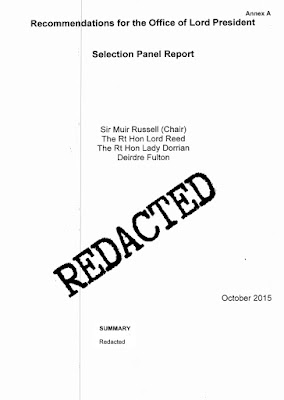
Scrutiny of Papers obtained via Freedom of Information legislation and published in 2016 from the Scottish Government – revealed the same UKSC judge Lord Reed – also sat on the selection panel which recommended the appointment of Lord Carloway (Colin Sutherland) as Lord President in 2015.

The failure of Lord Reed to declare he sat on the appointments panel which recommended Lord Carloway for the top judicial job in Scotland – is one of two potential conflicts of interest for the Supreme Court judge which should have been aired and debated for recusal - prior to the UKSC hearing on the suspension of the Westminster Parliament.

How judges select Scotland’s judges - in secret Documents obtained from the Scottish Government revealed Lord Reed sat on the selection panel for the office of Lord President - along with Sir Muir Russell, Judge Lady Dorrian, and Deirdre Fulton – considered five candidates for the position of Scotland’s top judge.

This same panel – which included Lord Reed – went on to recommend Lord Carloway for the position as Lord President & Lord Justice General of the Court of Session.

Written exchanges between civil servants and the selection panel which are included in the released papers - reveal a short listing meeting was held on 1 September 2015.

The panel considered that two applicants Lord Carloway [Redacted] merited an interview on the basis of the quality of their applications.

Two emails from Lord Reed, dated 14th ^ 15 October 2015 – released by the Scottish Government in the FOI documents - give a minimal, and heavily redacted description of Lord Reed’s role in the panel’s work, which ultimately recommended Lord Carloway for the position of Scotland’s top judge.

In one email, Lord Reed states: “This strikes me as an excellent report. I have made a few minor suggestions as shown on the attached version. Most of the suggestions are trivial, [redacted]”

In a second email Lord Reed writes “I am content with the amended report. I agree, in particular, with the points which were made by Leeona. The amended version beems to me to present an accurate account, and a fair and balanced assessment [redacted]”

A further potential interest not declared, brought ot the attention of journalists by a legal source, identifies Lord Reed’s work together with Lord Carloway – on a ‘compatibility issues review’ to consider if the High Court of Justiciary in Scotland would still have to give permission for appeals in criminal cases to go forward to the UK Supreme Court.

The review group was itself established by Lord Carloway, with others appointed to the group being Lord Reed (Deputy President of the UKSC), and others - Lady Dorrian (Lord Justice Clerk); David Harvie (Crown Agent); Roddy Dunlop QC (Treasurer of the Faculty of Advocates); and John Scott QC (President of the Society of Solicitor Advocates).

The review concluded - "Appeals to the Supreme Court of the United Kingdom (UKSC) should not require certification by the High Court of Justiciary that the issue raises a point of law of general public importance, a review chaired by the Lord Justice General has concluded."

Although – it should be pointed out – coincidentally, the review on appeals to the UKSC – limited to appeals in criminal cases - came too late to help in several serious cases of judicial conflicts of interest in Scotland – particularly on a well known case where Court of Session judge & Privy Councillor - Lord Malcolm (Colin Campell QC) heard a case up to eight times - while failing to declare his own son represented the defenders in multi million pound damages action.

A report on the Lord Malcolm conflict of interest case can be found here: CONFLICT OF INTEREST: Papers lodged at Holyrood judicial interests register probe reveal Court of Session judge heard case eight times - where his son acted as solicitor for the defenders.

The two potential conflicts of interest, not declared by Lord Reed in relation to what was a law changing UKSC ruling of significant impact – again highlight the need for a publicly available Register of judges’ interests - to ensure members of the judiciary do not forget to disclose interests which may have a bearing on cases before them.

The issue also brings into question again, the self imposed secrecy on judicial interests by the judges of the UK Supreme Court and wider UK Judiciary – who have resisted calls to become more transparent and declare their interests in the same way all public servants and elected politicians are required to declare in publicly available registers of interest.

The current stance of UK Supreme Court judges on transparency in relation to declarations of interest, is a point blank refusal by the judiciary to comply with the public expectation of transparency.

The UK Supreme Court’s website states the following in relation to judicial expenses and interests:

Justices' interests and expenses

Background

Prior to the creation of the Supreme Court of the United Kingdom, the highest court in the UK was the Appellate Committee of the House of Lords. The members of the Committee were Lords of Appeal in Ordinary appointed under the Appellate Jurisdiction Act 1876. Although those appointments gave them full voting and other rights in the House of Lords, the Law Lords had for some years voluntarily excluded themselves from participating in the legislative work of the House. Notwithstanding that, they were bound by the rules of the House and provided entries for the House of Lords Register of Interests.

On the creation of the Supreme Court the Lords of Appeal in Ordinary became Justices of the Supreme Court. They retain their titles as Peers of the Realm, but are excluded by statute from sitting or voting in the House, for so long as they remain in office as Justices of the Supreme Court. As such, they are treated as Peers on leave of absence; and do not have entries in the House of Lords Register of Interests. Historical information remains accessible via the House of Lords website.

Other judges in the UK, such as the judges of the Court of Appeal and the High Court in England and Wales, and in Northern Ireland, and the Court of Session in Scotland, do not have a Register of Interests. Instead they are under a duty to declare any interest where a case comes before them where this is or might be thought to be the case.

Current position

Against this background the Justices have decided that it would not be appropriate or indeed feasible for them to have a comprehensive Register of Interests, as it would be impossible for them to identify all the interests, which might conceivably arise, in any future case that came before them. To draw up a Register of Interests, which people believed to be complete, could potentially be misleading. Instead the Justices of the Supreme Court have agreed a formal Code of Conduct by which they will all be bound, and which is now publicly available on the UKSC website.

In addition all the Justices have taken the Judicial Oath - and they all took it again on 1 October 2009 - which obliges them to "do right to all manner of people after the law and usages of this Realm without fear or favour, affection or ill will"; and, as is already the practice with all other members of the judiciary, they will continue to declare any interest which arises in the context of a particular case and, if necessary, recuse themselves from sitting in that case - whether a substantive hearing, or an application for permission to appeal.

In relation to the UK Supreme Court’s stance on declarations of interests, and declarations of conflicts of interest, Diary of Injustice reported on the issue in detail during 2017, here: SUPREME SECRETS: UK Supreme Court refuses to publish recusal data - Court rejects release of info on UKSC justices' conflicts of interest in response to Freedom of Information recusals probe on top UK court

During the probe of UKSC recusals and failure to declare interests, a common thread of dishonesty was noted in court staff’s handling of a Freedom of Information request from Scotland – which was only answered after coverage of the issue in The National newspaper, which prompted the Information Commissioner’s Office to order the court to respond to the request.

Lord Reed’s limited biography on the UK Supreme Court website (reprinted below) does not feature either of the issues identified linking the judge to Lord Carloway’s appointment as Lord President nor any mention of review & other work undertaken with Lord Carloway – including the UK Supreme Court sitting in Edinburgh, which included Lord Carloway as a sitting judge on the UKSC panel.

The announcement by 10 Downing Street of Lord Reed’s appointment as President of the UK Supreme Court in July 2019 read as follows:

The Rt Hon Lord Reed will succeed Baroness Hale of Richmond as President of the Supreme Court of the United Kingdom, alongside three additional appointments as Justices.

The Queen has been pleased to confer a peerage of the United Kingdom for Life on Lord Reed upon his appointment as the President of the Supreme Court in recognition of the contribution that he has made to law and justice reform.

Lord Reed will take up the position of President on 11 January 2020. Lord Justice Hamblen, Lord Justice Leggatt and Professor Andrew Burrows will join the Supreme Court as justices on 13 January, 21 April and 2 June 2020 respectively.Her Majesty The Queen made the appointments on the advice of the Prime Minister and Lord Chancellor, following the recommendations of independent selection commissions.

Lord Reed will replace Lady Hale who retires on 10 January 2020 after serving as President of the Supreme Court since September 2017.

LORD REED UKSC BIOGRAPHY:

Lord Reed was appointed as a Justice of the Supreme Court in February 2012 and has served as Deputy President since June 2018. Prior to his appointment to the Supreme Court he served as a judge in Scotland, sitting from 1998 to 2008 in the Outer House of the Court of Session, where he was the Principal Commercial and Companies Judge, and from 2008 to 2012 in the Inner House.

He was educated at the Universities of Edinburgh and Oxford, and qualified as an advocate in Scotland and as a barrister in England and Wales. He practised at the Scottish Bar in a wide range of civil cases and also prosecuted serious crime.

As well as sitting on the Supreme Court and the Judicial Committee of the Privy Council, he is a member of the panel of ad hoc judges of the European Court of Human Rights, and a Non-Permanent Judge of the Hong Kong Court of Final Appeal. He is also the High Steward of Oxford University.

IMPORTANT NOTE: Readers should note this article does not take sides in the brexit debate. This article is a reporting of a failure by a UK Supreme Court judge to declare or discuss relevant interests and a potential failure to recuse - by a senior judge who is the new President of the UK Supreme Court.

Sunday, September 29, 2019

SUPREME INTERESTS: UK Supreme Court Judge Lord Reed's undeclared links to Lord Carloway selection panel & appeal review work - will not alter UKSC "unlawful" Parliament suspension ruling - but should feature in register of judges' interests

UKSC judge Lord Reed linked to Lord Carloway job panel. A POTENTIAL undeclared conflict of interest of the next President of the UK Supreme Court (UKSC) – in relation to a recent ruling on the unlawful suspension of Parliament - has been discovered from documents obtained from the Scottish Government.

Papers obtained via Freedom of Information legislation and published in 2016 reveal that Scottish judge Lord Reed – who has sat on the Supreme Court since 2012 – also sat on the selection panel which recommended the appointment of Lord Carloway (Colin Sutherland) as Lord President in 2015.

The potential conflict of Lord Reed - identified during discussions with legal sources – has a bearing (but no overall effect) on the ruling by eleven Supreme Court justices in relation to the findings of three Scottish appeal court judges – headed by Lord Carloway – who declared Prime Minister Boris Johnson’s decision to suspend parliament in the run-up to the October Brexit deadline as unlawful.

In that ruling, Lord President, Lord Carloway, decided that although advice to HM the Queen on the exercise of the royal prerogative of prorogating Parliament was not reviewable on the normal grounds of judicial review, it would nevertheless be unlawful if its purpose was to stymie parliamentary scrutiny of the executive, which was a central pillar of the good governance principle enshrined in the constitution; this followed from the principles of democracy and the rule of law. The circumstances in which the advice was proffered and the content of the documents produced by the respondent demonstrated that this was the true reason for the prorogation.

However, the failure of Lord Reed to declare he sat on the appointments panel which recommended Lord Carloway for the top judicial job in Scotland – is one of two potential conflicts of interest for the Supreme Court judge which may have required to have – at the very uleast - been aired and debated for recusal - prior to the UKSC hearing on the suspension of the Westminster Parliament.

How judges select Scotland’s judges - in secret Scottish Government documents previously obtained by the media revealed the selection panel for the office of Lord President - of which Lord Reed was a member, along with Sir Muir Russell, Judge Lady Dorrian, and Deirdre Fulton – considered five candidates for the position of Scotland’s top judge.

Written exchanges between civil servants and the selection panel which are included in the released papers - reveal a short listing meeting was held on 1 September 2015.

The panel considered that two applicants Lord Carloway [Redacted] merited an interview on the basis of the quality of their applications.

Two emails from Lord Reed, dated 14th ^ 15 October 2015 – released by the Scottish Government in the FOI documents - give a minimal, and heavily redacted description of Lord Reed’s role in the panel’s work, which ultimately recommended Lord Carloway for the position of Scotland’s top judge.

In one email, Lord Reed states: “This strikes me as an excellent report. I have made a few minor suggestions as shown on the attached version. Most of the suggestions are trivial, [redacted]”

In a second email Lord Reed writes “I am content with the amended report. I agree, in particular, with the points which were made by Leeona. The amended version beems to me to present an accurate account, and a fair and balanced assessment [redacted]”

A further potential interest not declared, brought ot the attention of journalists by a legal source, identifies Lord Reed’s work together with Lord Carloway – on a ‘compatibility issues review’ to consider if the High Court of Justiciary in Scotland would still have to give permission for appeals in criminal cases to go forward to the UK Supreme Court.

The review group was itself established by Lord Carloway, with others appointmed to the group being Lord Reed (Deputy President of the UKSC), and others - Lady Dorrian (Lord Justice Clerk); David Harvie (Crown Agent); Roddy Dunlop QC (Treasurer of the Faculty of Advocates); and John Scott QC (President of the Society of Solicitor Advocates).

The review concluded - "Appeals to the Supreme Court of the United Kingdom (UKSC) should not require certification by the High Court of Justiciary that the issue raises a point of law of general public importance, a review chaired by the Lord Justice General has concluded."

Although – it should be pointed out – coincidentally, the review on appeals to the UKSC – limited to appeals in criminal cases - came too late to help in several serious cases of judicial conflicts of interest in Scotland – particularly on a well known case where Court of Session judge & Privy Councillor - Lord Malcolm (Colin Campell QC) heard a case up to eight times - while failing to declare his own son represented the defenders in multi million pound damages action.

A report on the Lord Malcolm conflict of interest case can be found here: CONFLICT OF INTEREST: Papers lodged at Holyrood judicial interests register probe reveal Court of Session judge heard case eight times - where his son acted as solicitor for the defenders.

The two potential conflicts of interest, not declared by Lord Reed in relation to what is a law changing UKSC ruling of significant impact – again highlight the need for a publicly available Register of judges’ interests - to ensure members of the judiciary do not forget to disclose interests which may have a bearing on cases before them.

The issue also brings into question again, the self imposed secrecy on judicial interests by the judges of the UK Supreme Court and wider UK Judiciary – who have resisted calls to become more transparent and declare their interests in the same way all public servants and elected politicians are required to declare in publicly available registers of interest.

The current stance of UK Supreme Court judges on transparency in relation to declarations of interest, is a point blank refusal by the judiciary to comply with the public expectation of transparency.

The UK Supreme Court’s website states the following in relation to judicial expenses and interests:

Justices' interests and expenses

Background

Prior to the creation of the Supreme Court of the United Kingdom, the highest court in the UK was the Appellate Committee of the House of Lords. The members of the Committee were Lords of Appeal in Ordinary appointed under the Appellate Jurisdiction Act 1876. Although those appointments gave them full voting and other rights in the House of Lords, the Law Lords had for some years voluntarily excluded themselves from participating in the legislative work of the House. Notwithstanding that, they were bound by the rules of the House and provided entries for the House of Lords Register of Interests.

On the creation of the Supreme Court the Lords of Appeal in Ordinary became Justices of the Supreme Court. They retain their titles as Peers of the Realm, but are excluded by statute from sitting or voting in the House, for so long as they remain in office as Justices of the Supreme Court. As such, they are treated as Peers on leave of absence; and do not have entries in the House of Lords Register of Interests. Historical information remains accessible via the House of Lords website.

Other judges in the UK, such as the judges of the Court of Appeal and the High Court in England and Wales, and in Northern Ireland, and the Court of Session in Scotland, do not have a Register of Interests. Instead they are under a duty to declare any interest where a case comes before them where this is or might be thought to be the case.

Current position

Against this background the Justices have decided that it would not be appropriate or indeed feasible for them to have a comprehensive Register of Interests, as it would be impossible for them to identify all the interests, which might conceivably arise, in any future case that came before them. To draw up a Register of Interests, which people believed to be complete, could potentially be misleading. Instead the Justices of the Supreme Court have agreed a formal Code of Conduct by which they will all be bound, and which is now publicly available on the UKSC website.

In addition all the Justices have taken the Judicial Oath - and they all took it again on 1 October 2009 - which obliges them to "do right to all manner of people after the law and usages of this Realm without fear or favour, affection or ill will"; and, as is already the practice with all other members of the judiciary, they will continue to declare any interest which arises in the context of a particular case and, if necessary, recuse themselves from sitting in that case - whether a substantive hearing, or an application for permission to appeal.

In relation to the UK Supreme Court’s stance on declarations of interests, and declarations of conflicts of interest, Diary of Injustice reported on the issue in detail during 2017, here: SUPREME SECRETS: UK Supreme Court refuses to publish recusal data - Court rejects release of info on UKSC justices' conflicts of interest in response to Freedom of Information recusals probe on top UK court

During the probe of UKSC recusals and failure to declare interests, a common thread of dishonesty was noted in court staff’s handling of a Freedom of Information request from Scotland – which was only answered after coverage of the issue in The National newspaper, which prompted the Information Commissioner’s Office to order the court to respond to the request.

Lord Reed’s limited biography on the UK Supreme Court website (reprinted below) does not feature either of the issues identified linking the judge to Lord Carloway’s appointment as Lord President nor any mention of review & other work undertaken with Lord Carloway – including the UK Supreme Court sitting in Edinburgh, which included Lord Carloway as a sitting judge on the UKSC panel.

LORD REED BIOGRAPHY:

Robert John Reed, Lord Reed became Deputy President of The Supreme Court on 7 June 2018. He was appointed as a Justice of The Supreme Court in February 2012.

He studied law at Edinburgh University and undertook doctoral research in law at the University of Oxford. He qualified as an advocate in Scotland and as a barrister in England. He practised at the Scottish Bar in a wide range of civil cases, and also prosecuted serious crime.

He served as a senior judge in Scotland for 13 years. From 2008 to 2012 a member of the Inner House of the Court of Session, and from 1998 to 2008 a member of the Outer House of the Court of Session, where he was the Principal Commercial Judge.

As well as sitting on the Supreme Court and the Judicial Committee of the Privy Council, he is also a member of the panel of ad hoc judges of the European Court of Human Rights, and is a Non-Permanent Judge of the Court of Final Appeal in Hong Kong. He is also the Visitor of Balliol College, Oxford.

Lord Reed is one of the two Scottish Justices of The Supreme Court.

To update readers – on 24 July 2019, the last working day of Prime Minister Theresa May, HM the Queen appointed Lord Reed to serve as the President of the Supreme Court of the United Kingdom and declared her intention to raise him to the peerage. 

Lord Reed will take over as President of the United Kingdom Supreme Court from Baroness Hale of Richmond on 11 January 2020.

IMPORTANT NOTE: Readers should note this article does not take sides in the brexit debate. Rather this article is a reporting of a failure to declare or discuss relevant interests and a potential failure to recuse - by a senior judge who has been appointed as the new President of the UK Supreme Court.

Thursday, December 07, 2017

JUDICIAL REGISTER: Calls to invite Supreme Court President Lady Hale to Holyrood for evidence on judicial interests register - as Judicial Office concede on addition of 500 Justices of the Peace to recusals register & publication of tribunal recusals

MSPs hear calls to invite UKSC President Lady Hale to Holyrood. A FIVE YEAR Scottish Parliament investigation of Petition PE1458: Register of Interests for members of Scotland's judiciary has received further submissions - calling for MSPs to invite Baroness Hale to give evidence at Holyrood.

Calls for Lady Hale - President of the UK Supreme Court (UKSC) - to be invited to appear before the Scottish Parliament - come on the back of evidence presented to MSPs on the lack of transparency relating to recusals in UK’s top court – which also serves Scotland as the court of last resort.

While courts in Scotland now publish details of judicial recusals – where judges stand down from cases due to a conflict of interest – the UK Supreme Court has refused to take on this extra transparency measure.

Transparency campaigners cite the Supreme Court’s refusal to publish recusals as creating an imbalance in transparency with a court based in London which Scots based litigants & accused persons must still rely on for a right of appeal.

Submissions filed with the Scottish Parliaments Public Petitions Committee also urge MSPs to quiz Lady Hale on the current stance of the UK’s top court on declarations of judicial interests in a publicly available register – a move currently opposed by the Supreme Court according to policy currently posted on the UKSC’s website.

A supplementary submission lodged earlier this week also reveals major concessions from the Judicial Office for Scotland after discussions between the petitioner and the Head of Strategy and Governance at the Judicial Office.

MSPs have been made aware an agreement has been reached where up to five hundred Justices of the Peace are now to be included in the Register of Judicial Recusals – created by ex Lord President Brian Gill in February 2014 – in response to meetings with MSPs on Petition PE1458.

However, the submission asks MSPs to seek answers on why Justices of the Peace – who comprise the bulk of Scotland’s judiciary – were excluded from the recusals register when it was set up in April 2014.

An additional concession from the Judicial Office passed to MSPs also reveals that recusals which take place on the many tribunals under the wing of the Scottish Courts and Tribunals Service (SCTS). will be published at a date yet to be decided.

MSPs have also been asked to consider calling Ian Gordon – the new Judicial Complaints Reviewer (JCR), who took over from Gillian Thompson and hear his views on declarations of judicial interests.

Both previous Judicial Complaints Reviewers – including well known transparency campaigner Moi Ali – fully support the petition calling for the creation of a register of judicial interests in Scotland.

A full report on Moi Ali’s evidence to MSPs and support for proposals calling for the creation of a register of judicial interests is reported here: Judicial Complaints Reviewer tells MSPs judges should register their interests like others in public life.

Meanwhile it can be revealed written evidence of failures to declare interests at the UK’s top court has been passed to journalists and MSPs for study.

The material, identifies a judge who took part in a case in the Court of Session on multiple occasions who then took a seat on the Supreme Court – and knocked back an appeal from the same case he had ruled on, without declaring any former interest in the case after blocking the route of appeal.

Later today, members of the Scottish Parliaments Public Petitions Committee will consider the request to call Lady Hale and obtain more answers on judicial recusals.

UK SUPREME COURT: MOST POWERFUL, NOW LEAST TRANSPARENT:

The current stance of the UK Supreme Court has previously been used by judges in Scotland to avoid creating a register of judicial interests in response to the cross party supported petition still under investigation at the Scottish Parliament.

UK Supreme Court on declarations of judicial interests statement:

Background: Prior to the creation of the Supreme Court of the United Kingdom, the highest court in the UK was the Appellate Committee of the House of Lords. The members of the Committee were Lords of Appeal in Ordinary appointed under the Appellate Jurisdiction Act 1876. Although those appointments gave them full voting and other rights in the House of Lords, the Law Lords had for some years voluntarily excluded themselves from participating in the legislative work of the House. Notwithstanding that, they were bound by the rules of the House and provided entries for the House of Lords Register of Interests.

On the creation of the Supreme Court the Lords of Appeal in Ordinary became Justices of the Supreme Court. They retain their titles as Peers of the Realm, but are excluded by statute from sitting or voting in the House, for so long as they remain in office as Justices of the Supreme Court. As such, they are treated as Peers on leave of absence; and do not have entries in the House of Lords Register of Interests. Historical information remains accessible via the House of Lords website.

Other judges in the UK, such as the judges of the Court of Appeal and the High Court in England and Wales, and in Northern Ireland, and the Court of Session in Scotland, do not have a Register of Interests. Instead they are under a duty to declare any interest where a case comes before them where this is or might be thought to be the case.

Current position:  Against this background the Justices have decided that it would not be appropriate or indeed feasible for them to have a comprehensive Register of Interests, as it would be impossible for them to identify all the interests, which might conceivably arise, in any future case that came before them. To draw up a Register of Interests, which people believed to be complete, could potentially be misleading. Instead the Justices of the Supreme Court have agreed a formal Code of Conduct by which they will all be bound, and which is now publicly available on the UKSC website.

In addition all the Justices have taken the Judicial Oath - and they all took it again on 1 October 2009 - which obliges them to "do right to all manner of people after the law and usages of this Realm without fear or favour, affection or ill will"; and, as is already the practice with all other members of the judiciary, they will continue to declare any interest which arises in the context of a particular case and, if necessary, recuse themselves from sitting in that case - whether a substantive hearing, or an application for permission to appeal.

The latest submissions filed with the Scottish Parliament’s Public Petitions Committee in relation to Petition PE1458: Register of Interests for members of Scotland's judiciary are reprinted below:

PE1458/IIII: Petitioner submission of 4 September 2017

I would like to draw to the attention of members the appointment of Baroness Hale as President of the UK Supreme Court, which also serves as the most senior court in the UK for appeals from Scotland.

Noting Baroness Hale’s recent comments in relation to the appointment of judges (Let ministers pick judges, says Supreme Court chief Baroness Hale, The Times, 23 August 2017) and other matters, I request Baroness Hale be invited to give evidence before the Petitions Committee.

As the President of the UK Supreme Court, Baroness Hale will be able to give a substantive account of why UKSC Judges no longer consider they require to adhere to the expectation of completing a register of interests as they did pre-UKSC days as Law Lords in the House of Lords.

Members may also wish to raise questions to Baroness Hale on the disparity of judicial transparency between Scotland and UKSC on judicial recusals, where as members are aware, the Judiciary of Scotland now list details of recusals, compared to the UKSC in London - where this information has not yet been made available to all UK users of the Supreme Court.

The position of the UKSC on the current lack of a register of judicial interests has entered Committee discussions on numerous occasions, and in evidence. Lady Hale’s appointment as President would be a significant opportunity for this Committee to hear from the top UKSC judge on a court which also serves the interests of Scotland.

Lord Carloway evidence to Petitions Committee 29 June 2017: In response to evidence given by Lord Carloway to members I note Lord Carloway claims the creation of a register of interests would deter recruitment of candidates to become judges.

In no other walk of life including politics - does the existence of a register of interests deter recruitment of individuals to a profession or industry. A register of interests is designed to promote accountability and transparency. If someone were to be deterred from a job due to the existence of a register of interests there would quite properly be questions on why transparency would hinder someone from applying for a position of such authority, power - and - responsibility to serve the community.

Lord Carloway stated the critical distinction for judges in this case is that the judiciary require to be independent of any form of government - a point no one or this petition is questioning.

However, and to quote Scotland’s first JCR Moi Ali in a letter to the Petitions Committee of 23 April 2014 “The position of the judiciary is incredibly powerful. They have the power to take away people’s assets, to separate families, to lock people away for years. Some of these people will not have committed a crime.”

To add to Ms Ali’s comments, members will be aware a decision by the judiciary can effectively revoke an item of legislation created by the Scottish Parliament, or the House of Commons if a legal challenge in court to a law is successful. Examples of such cases - including HMA V Cadder - have occurred over recent years, requiring emergency legislation to address issues of successful judicial challenges.

One branch of the Executive which can overturn legislation from another branch, or our elected Parliaments, clearly requires the same implementation of transparency as the other.

In light of the judiciary’s position as the most powerful branch of the Executive - and their considerable effect on public life, policy and legislation, an equivalent, or even greater level of transparency is required to be applied to the judiciary by way of creating a register of judicial interests.

In his evidence, Lord Carloway goes on to claim a register of judicial interests should only be created if the judiciary detect corruption within it’s own ranks.

This is not a credible position in terms of public expectation of transparency in 2017.

Registers of interest exist to ensure transparency and accountability in public life and there is now clearly a requirement for members of the judiciary to declare their interests as practiced by all others in public life.

In conclusion of Lord Carloway’s evidence, I note the Lord President was unable to provide a single legitimate example of harm caused to the judiciary by the creation of a register of interests, nor one single reason why the judiciary should be exempt from the same levels of public transparency which rightly apply to everyone else.

There is cross party backing for the creation of a register of judicial interests, as has already been demonstrated at Holyrood during the motion debate of October 2014, and widespread support in the media and public, and from both Judicial Complaints Reviewers for judges to be required to declare their interests.

Creating a register of interests for members of Scotland’s judiciary is the right thing to do.

Members will also be aware of the appointment of a new Judicial Complaints Reviewer - Mr Ian Gordon, formerly the Convener of the Standards Commission for Scotland.

Mr Gordon’s appointment, along with concerns from the outgoing JCR Gillian Thompson, and calls for a review of the role and powers of the JCR - were reported in the Sunday Herald (Calls for more funding as new judicial watchdog appointed, Sunday Herald, 15 August 2017).

As Mr Gordon is well versed in standards, and public expectation of transparency, I ask the Committee call Mr Gordon to give evidence on his experience in relation to standards in public life, and any thoughts he may have as the new Judicial Complaints Reviewer - with regards to the creation of a register of judicial interests.

Members may also wish to note the retiring JCR - Gillian Thompson who gave evidence to the Committee in July 2015 has published information in her 2014/15 annual report in relation to her continued support for this petition, which available on the JCR’s website here: Judicial Complaints Reviewer Annual Report 2014-2015

All annual reports from the Judicial Complaints Reviewer including those from Moi Ali, are available here: Judicial Complaints Reviewer - Annual Reports

In light of the progress on this petition, public interest, and public debate, I would like to encourage this Committee to begin discussions with other Committees to determine which is the best way to advance this petition forward.

There is now five years of work, from MSPs, Public Petitions Committee members past & present, PPC clerks, two Judicial Complaints Reviewers, Parliamentarians from other iurisdictions, legal academics, submissions from members of the public, wide support in the media and across the spectrum of politics & public for the implementation of a register of judicial interests.

This team effort should rightly culminate in what will be a significant gain for the justice system, judiciary and courts - in terms of transparency and accountability, and a gain for this Parliament in creating the legislation to bring about such judicial transparency, and increase public confidence in our courts.

Finally, as Lord Carloway raised the subject of problems in judicial recruitment if a register is created, I urge the Committee write to the Sheriff’s Association, the Scottish Justices Association, the Law Society of Scotland and the Faculty of Advocates on this particular subject, seeking their views in writing, so these issues can become a matter of public record in this debate.

PE1458/JJJ: Submission from the Petitioner, 29 November 2017

A further development of interest to members with regards to the Register of Judicial Recusals - created by former Lord President Lord Brian Gill as a result of this petition in April 2014.

During the creation of the Register of Judicial Recusals in 2014, some 400 plus members of the judiciary - Justices of the Peace - were excluded from the register for no apparent reason.

Recent communications with the Judicial Office and further media interest in the petition[has prompted the Judicial Office to finally include Justices of the Peace in the Register of Judicial Recusals - with a start date of January 2018.

This follows an earlier development after Lord Carloway gave his evidence to the Committee, where the Judicial Office agreed to publish a wider range of details regarding judicial recusals, A copy of the revised recusal form for members of the Judiciary has been provided by the Judicial Office and is submitted for members interest.

Additional enquiries with the Judicial Office and further media interest on the issue of Tribunals which come under the Scottish Courts & Tribunals Service (SCTS) and Judicial Office jurisdiction has produced a further result in the Judicial Office agreeing to publish a register of Tribunal recusals.

I urge members to seek clarification from the Judicial Office and Lord President on why Justices of the Peace, who now comprise around 500 members of the judiciary in Scotland, were excluded from the recusals register until now - as their omission from the recusals register has left a distorted picture of judicial recusals in Scotland.

Since my earlier submission of 4 September, the Scottish Courts & Tribunals Service has published their Annual Report, which contains a Register of Interests for SCTS Board members, including several members of the judiciary, available here: Scottish Courts & Tribunals Service Annual Report 2016-2017

While the register exists for a handful of judges who sit on the SCTS Board - including Lord Carloway, and does include further detail on some financial holdings of the judiciary, as provided by the Judicial Office SCTS Board shareholdings register - there is clearly a format by which this same register, with enhanced requirements of disclosure as appear in other jurisdictions, could be applied to all members of Scotland’s judiciary.

Finally, I wish to draw attention to members of the status of the Norwegian Register of Judicial Interests, which is a very comprehensive register, and could well be used as a template for a similar register of judicial interests in Scotland.

The Norwegian register of judicial interests is available here: Norway - Register of Judicial Interests. I urge members to contact Norway’s judiciary to seek comments on their register of judicial interests, and if necessary invite evidence on Norway’s implementation of such a register and how it impacts on judicial transparency.

Previous articles on the lack of transparency within Scotland’s judiciary, investigations by Diary of Injustice including reports from the media, and video footage of debates at the Scottish Parliament’s Public Petitions Committee can be found here : A Register of Interests for Scotland's Judiciary.

Friday, September 15, 2017

SUPREME SECRETS: UK Supreme Court refuses to publish recusal data - Court rejects release of info on UKSC justices' conflicts of interest in response to Freedom of Information recusals probe on top UK court

Top UK court obstructed Scots media judicial recusals probe. THE UK Supreme Court (UKSC) has refused to disclose how many of it’s justices have recused themselves from court hearings over conflicts of interest or requests to step aside from cases.

And, the top court’s refusal to disclose the information only came about after the Information Commissioner (ICO) decided to issue a decision notice forcing the Supreme Court to respond to Freedom of Information requests submitted in May 2017.

Unlike in Scotland, where the Judiciary of Scotland publish a Register of Judicial Recusals– listing judges who have stood aside in cases for certain conflicts of interest (not including financial, wealth or other status related interests), the United Kingdom’s Supreme Court in London does not publish any recusal information.

However, Freedom of Information requests seeking disclosure of the UK Supreme Court’s recusal data encountered obstacles after UKSC officials took a decision to refuse to respond to Scottish journalists FOI requests.

And, it can also be revealed the Ministry of Justice – the body in charge of all courts in England & Wales followed the Supreme Court’s anti-transparency position – refusing to respond to a similar FOI request again sent from Scotland in May 2017.

Four months after the original Freedom of Information request was made to the UK Supreme Court, and amid numerous reminders to UKSC officials, the Information Commissioner’s office was contacted in July for assistance.

After discussions with ICO staff, the Information Commissioner gave the top court an extra month to reply.

However, the Supreme Court again refused to respond to any Freedom of Information requests from Scotland on the subject of recusals.

A legal insider claimed the refusal to reply to the requests originated over fears the material was to be referred to at the Scottish Parliament in connection with a five year probe on judges’ interests and a call to create a register of judicial interests - Petition PE1458: Register of Interests for members of Scotland's judiciary.

However, after the Information Commissioner again contacted Scottish journalists making the requests, the ICO confirmed it would issue a determination to order the UK Supreme Court to respond to the requests.

In an email of 25 August 2017, Matthew Cresswell of the Information Commissioner’s office informed journalists seeking the recusal information: “As the Supreme Court have failed to respond to your information request within the statutory time limit set out in section 10(1) of the FOIA, the Commissioner can now start the process of ordering a decision notice on this case. A decision notice is a legally binding document that will require the public authority to provide a response.”

Coverage of the case then appeared in The National newspaper on 30 August – which prompted the Supreme Court to finally issue a response to the Freedom of Information requests.

However, the UKSC refused to divulge any details of UKSC justices’ recusals, citing cost grounds of gathering the information.

Paul Brigland, for the UK Supreme Court claimed logging errors where the real reasons for a lack of reply to the FOI requests, rather than a determined policy by the UK Supreme Court not to respond to a Scottish Freedom of Information request.

Paul Brigland, the Head of Office and Building Services & Departmental Records Officer said: “Firstly, I would like to apologise for the mishandling of your request and the failure to reply. This is entirely due to an error in our logging process in which this request was incorrectly marked as dealt with, but had in fact been mistaken for a separate request you made under the FOLA at the same time which we responded to within the correct time limit. I hope you will accept our apologies for this error. I should also explain that since you made your request we have changed the way in which we log and handle FOI requests, so this situation should not arise in the future.”

Paul Brigland then confirmed the UKSC held information relevant to the request.

Mr Brigland said: “I can confirm that we do hold some information relevant to your request.”

However, Paul Brigland claimed the work involved and cost would prohibit the information being disclosed.

Brigland added: “In order to provide you with the information on the scale that you have requested would require a search of individual paper case records. We do not maintain a central record of any such requests as there is no business need to do so.”

“Section 12 of the FOLA makes provision for public authorities to refuse requests for information where the cost of dealing with them would exceed the appropriate limit, which for central government is set at £600. This represents the estimated cost of one person spending 3.5 working days in determining whether the Department holds the information, locating, retrieving and extracting the information.”

“As your request is widely framed, I estimate that it will take us more than 3.5 working days to determine appropriate material within the scope of your request, and locate, retrieve and extract that information.”

“I am sorry that on this occasion I cannot suggest ways in which you could narrow the scope of your request to bring it within the cost limit. This is because any information sought under a revised request, for example requesting information for a shorter time period, would still be exempt under section 32 (court records).”

“However, outside the terms of the Act, and to be helpful, I can explain the following.”

“Where there are reasons that a Justice considers there might be an issue of recusal, that information is sent to the Justice chairing the panel (normally the President or Deputy President) and then a letter is sent to the parties. I can confirm that there have been no instances where we have written to parties that has subsequently led to a request from the parties for a Justice to stand down.”

“Similarly, I can confirm that there have been no instances where a Justice has recused themselves following a request initiated by a party to a case.”

However, the explanation offered by the UKSC does not actually confirm if any justices have refused to recuse themselves following any request from litigants or parties to do so.

And, as no register of recusals currently exists at the UK Supreme Court, legal insiders have suggested the explanations from the UKSC on recusal data should be taken with a pinch of salt.

A legal insider has suggested legal teams operating in the UK Supreme Court are dissuaded from – or not minded to ask for recusals.

The source said “ justices do not take well to their position being questioned to recuse from a hearing”.

A solicitor from England who has now come forward on the issue said he was aware of certain cases at the Supreme Court which may have necessitated a recusal.

The solicitor, who has studied the details contained in Scotland’s register of judicial recusals said it was clear in some cases before the UKSC, comparable examples of justices links to issues do exist, and therefore should be acknowledged in a similar register of recusals at the Supreme Court.

However, the solicitor cited the Supreme Court’s determination to avoid declaring justice’s interests in a register of interests as one reason which the UKSC is avoiding publishing any data on it’s justices’ recusals.

Amid the Supreme Court’s refusal to release information on recusals, Scottish journalists asked for a review of the decision, which was handled by William Arnold, the Head of Corporate Services.

Mr Arnold did not provide a review response on material with the UK Supreme Court logo, instead responding by email in the following terms.

Willian Arnold said: “As Mr Brigland explained, the UK Supreme Court does not maintain any formal central register of requests  to Justices to recuse themselves  from particular cases, since there has never been any operational need to do so.”

“Identifying the record of any such requests would therefore entail reviewing all the case papers in every case heard since January 2014 to the present date. I am satisfied that Mr Brigland was correct in assessing that carrying out this review would require staff resource input, which would exceed the cost limit for answering FOI requests of £600.”

“As Mr Brigland went on to say, this would be a pointless exercise in any event, because any such recusal request, if one was found, would form part of the records of the individual court case; and in Section 32 of the FOI Act Parliament has enacted an exemption of court records from the FOI regime. This exemption is not subject to any kind of public interest test, so the UKSC would not in any case be able to release any such recusal request, if one was found, to you under the FOI regime. I agree with this analysis.”

“In order to try to be helpful, Mr Brigland, however, went on to tell you, outside the provisions of the Act, since this is not recorded information which the UKSC holds, that the practice is that where a Justice considers he might have interests which might generate a request for recusal, a letter is sent to the parties outlining those interests.”

“Nobody here of those staff who have been at the UKSC since its inception in 2009 can remember any instance where such a letter has resulted in a request from a party to a case for a Justice to recuse themselves. Equally nobody here can recall any instance where a party has ever initiated a request for a Justice to recuse themselves, so the question of acceding to or rejecting such a request has never arisen.”

Mr Arnold went on to contradict Paul Brigland’s initial explanation where he stated the UKSC did hold material in relation to recusal information.

William Arnold stated: “The only sentence in Mr Brigland’s letter which I do repudiate is on page one  where he says “I can confirm that we do hold some information relevant to your request.”

“He may have been thinking of the letters we send to parties, where a Justice believes they have interests they should disclose, as set out above, but it is not clear to me that these are strictly relevant to your request; and I cannot find any other evidence which leads to the conclusion that the UKSC ‘holds some information relevant to your request’.”

“Indeed I have reached the opposite conclusion – that we likely do not hold any such information, although we could not be formally sure of that without carrying out the review of all our cases, which on cost grounds, as set out above, we have declined to do.”

A barrister who studied the correspondence from the UK Supreme Court, including the initial FOI response and the UKSC’s review – said the responses were evasive.

He also noted the UKSC’s position on holding no recusal data revolved around process where a letter is sent out to parties in relation to a justices’ conflict of interest - rather than an interest being raised by a party or legal representative.

The barrister said: “The UK Supreme Court has existed for eight years. I think it highly unlikely not one single request for a recusal at the Supreme Court has been made during such a considerable length of time.”

While the UK Supreme Court remains determined to refuse any further disclosure of information on judicial recusals, the Information Commissioner has been contacted again over the Ministry of Justice’s refusal to answer similar requests for disclosure of recusal information from the English courts.

A decision from the Information Commissioner on this matter is awaited.

However, the position Scottish users of the UK Supreme Court now face is that judges in Scotland are required to publish their recusal data, while the UKSC has decided against any such transparency – leaving Scottish court users at a considerable disadvantage.

The National reported on the battle to obtain recusal information from the UK Supreme Court and the Ministry of Justice in two articles, published below:

Victory for Scottish information campaigner in battle with Supreme Court

Martin Hannan Journalist 30th August

THE UK Supreme Court will be ordered by the Information Commissioner to reply to question from a Scottish legal rights campaigner, after it refused to say whether it had a register of recusals by court justices.

Recusal is the term used when a judge has to step aside from a case because of a possible conflict of interest. It is thought that various Supreme Court justices have recused themselves from numerous cases, but no such information is made public.

The National can reveal the Information Commissioner has decided to act after the Supreme Court and the Ministry of Justice for England and Wales failed to reply to blogger and campaigner Peter Cherbi’s request for information.

A register of recusals has been in existence for several years in Scotland – it can be viewed online – and Cherbi wants to see the system extended to all the judiciary in the UK.

The Information Commissioner told Cherbi, above: “As the Supreme Court has failed to respond to your information request within the statutory time limit set out in section 10 (1) of the Freedom of Information Act, the Commissioner can now start the process of ordering a decision notice on this case.

“A decision notice is a legally binding document that will require the public authority to provide a response.”

Sources at the Supreme Court have indicated that the decision notice has not been received by the court, but that it will be acted upon.

Cherbi’s long-term aim is to see the creation of a register of judicial interests similar to that which MPs, MSPs and police officers must complete. His petition calling for that register has been debated by MSPs for nearly six years, and a decision is due next year. He feels the delay is an attempt to stop the register of interests. The National can reveal that lawyers in London support Cherbi’s case, but think judges will oppose it.

One legal source said: “They fear recusals up here in Scotland are inevitably leading to a register of judicial interests and it will lead to the same thing happening in England and Wales.”

The Supreme Court has already decided against a register of interests, stating: “The justices have decided it would not be appropriate, or indeed feasible, for them to have a comprehensive register of interests, as it would be impossible for them to identify all the interests, which might conceivably arise, in any future case that came before them.

“To draw up a register of interests, which people believed to be complete, could potentially be misleading. Instead the justices of the Supreme Court have agreed a formal code of conduct by which they will all be bound, and which is now publicly available on the court’s website.

“In addition, all the justices have taken the judicial oath … which obliges them to ‘do right to all manner of people after the law and usages of this realm without fear or favour, affection or ill will.

“And, as is already the practice with other members of the judiciary, they will continue to declare any interest which arises in the context of a particular case and, if necessary, recuse themselves, whether it is a substantive hearing, or an application for permission to appeal.”

Cherbi said: “Refusing access to information is not accidental. We are looking here at a coordinated attempt to thwart the introduction of Scottish judicial transparency to the rest of the UK.”

The Ministry of Justice referred The National to the Supreme Court where a spokesman confirmed that they were awaiting the Commissioner’s formal decision.

Supreme Court finally responds to Scottish FoI request about recusals ... and rejects it

Martin Hannan Journalist 06 September 2017

THE UK Supreme Court has refused to issue information on how many of its justices have stood aside from cases because of a conflict of interest.

The National revealed last week that the Information Commissioner in England had ordered the Supreme Court to deal with Scottish law campaigner Peter Cherbi’s freedom of information request after it failed to reply to him in time.

Now the Supreme Court has written to Cherbi apologising for failing to deal with his request timeously but saying it will not give him the information as it would cost too much to provide it.

“That’s just ludicrous,” Cherbi said yesterday, “and it just makes people all the more suspicious that the Supreme Court is covering up something that the public should have the right to know.”

In another development, Cherbi is to ask the Scottish Parliament’s Petitions Committee to invite the new President of the Supreme Court to give evidence as to why she and her fellow justices oppose a register of interests for the judiciary similar to that for MPs and police officers.

The committee has been discussing Cherbi’s call for a register of judicial interests in Scotland for almost five years.

Cherbi said: “I would like Lady Hale to come to Holyrood and explain why the UK Supreme Court’s members are so set against a register of interests.

“We have already seen Scotland’s top judges opposing it, and it would be good to know why the UK Supreme Court opposes it – after all, the Supreme Court sits in judgement on Scottish cases all the time, so why should the public not be able to see what interests, financial and otherwise, that judges have?

“As the President of the UK Supreme Court, Baroness Hale will be able to give a substantive account of why Supreme Court justices no longer consider they require to adhere to the expectation of completing a register of interests as they did pre-UK Supreme Court days as Law Lords in the House of Lords.

“After all, we ask our MPs and MSPs and police officers to register their interests so that everything is seen to be above board, so why not the judges in the highest court in the land?”

Cherbi also wants Lady Hale to tell the committee why the Supreme Court does not keep a register of recusals (when judges step aside from a case) as happens in the Scottish courts.

In its delayed response to Cherbi, the Supreme Court said: “To provide you with the information on the scale that you have requested would require a search of individual paper case records. We do not maintain a central record of any such requests as there is no business need to do so. Section 12 of the Freedom Of Information Act makes provision for public authorities to refuse requests for information where the cost of dealing with them would exceed the appropriate limit, which for central government is set at £600.

“This represents the estimated cost of one person spending 3.5 working days in determining whether the department holds the information, locating, retrieving and extracting the information.

“As your request is widely framed, I estimate that it will take us more than 3.5 working days to determine appropriate material within the scope of your request, and locate, retrieve and extract that information.”

A legal expert told The National: “The information on recusals certainly exists, so all that needs to be done is to send an email to the justices and their assistants and the information could be gathered in a day.”

Cherbi said: “We have a register of recusals in Scotland. It’s time they had one for the Supreme Court and all English and Welsh courts.”

Previous reports on moves to publish judicial recusals in Scotland and a media investigation which prompted further reforms of the Scottish Register of Judicial Recusals can be found here: Judicial Recusals in Scotland - Cases where judges have stood down over conflicts of interest

Recent reforms to the way in which judicial recusals are recorded and entered in Scotland’s register of judicial recusals were reported here: RECUSALS JUST GOT REAL: Judicial Office concedes to reforms for Judicial Recusals Register, full case details where judges stand down from court hearings to be entered after media & FOI probe success