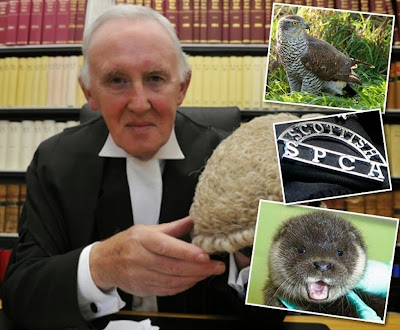
 Sheriff Drummond opposes increased powers for animal welfare charity. A RETIRED judge who once reportedly told a former police officer concerned about soft sentences given to those convicted of wildlife crime to “get a life” - has launched a blistering attack on proposals currently being considered by the Scottish Government to give more wildlife crime detection powers to the Scottish Society for the Prevention of Cruelty to Animals (SSPCA).
In a written submission to the Scottish Government’s consultation, Sheriff Kevin Drummond describes the SSPCA as “a private campaigning organisation with a provable conflict of interest” and urges the status quo, with the Police as the principal investigating authority be preserved.
Currently, SSPCA inspectors can only investigate where an animal is “in distress”, however, proposals to increase the animal welfare charity’s powers would enable their inspectors to more fully investigate reports of animal cruelty, allowing search and seizure of evidence where an animal has been killed or where it has “not been illegally killed, but is likely to be”.
The move by the Scottish Government to extend animal protection powers comes after questions raised by wildlife campaign groups and charities over the low number of wildlife crime prosecutions by Scotland’s Crown Office & Procurator Fiscal Service (COPFS), leading to some evidence the courts system in Scotland is “soft” on wildlife crime.
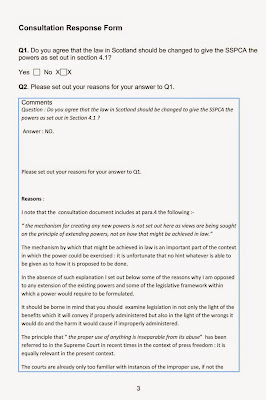 In his submission to the consultation on giving more powers to the SSPCA, Sheriff Drummond said: It should be borne in mind that you should examine legislation in not only the light of the benefits which it will convey if properly administered but also in the light of the wrongs it would do and the harm it would cause if improperly administered.
The principle that " the proper use of anything is inseparable from its abuse" has been referred to in the Supreme Court in recent times in the context of press freedom : it is equally relevant in the present context.
The courts are already only too familiar with instances of the improper use, if not the abuse, of existing powers by campaigning organisations in connection with the prosecution of crime. Indeed, a number of relatively high profile prosecutions have failed by reasons of such abuses.
I have had it said to me in a public forum by a senior representative of a sister organisation to the SSPCA words to the effect that "our Royal Charter empowers us to investigate (wildlife) crime and we will do that regardless of what the courts say."
Efforts over many years to encourage such organisations to operate within the existing authorised framework of, in particular, the exercise of powers of search have met with opposition.
It must be borne in mind that what is in contemplation is the granting of powers of search and seizure to a private campaigning organisation which is not answerable to any public authority for the application of its policy . Snaring and badger culls are current examples of such policy conflicts where activity which is authorised by law is opposed by the organisation to which Parliament proposes to give power of seizure of materials in the investigation of wildlife crime.
Every employee exercising such powers as are contemplated has a patent conflict of interest which could impact on any objection taken to the legality of seizures or searches carried out under such powers. How a grant of such powers to a private organisation could be made responsibly is a matter which would require extraordinary justification : how it could be granted to such an organisation in the face of patent conflict of interest is inconceivable.
Judicial examples exist of e.g. RSPCA seeking to expel from it organisation members who are opposed to any particular policy position which the organisation happens to adopt from time to time.
This proposal is also being contemplated within the framework of an existing legislative structure which already enables the appropriate investigating public authority, namely the police, to call on the assistance of organisations such as the SSPCA to assist in the investigation of crime where the police consider it necessary. Such assistance is authorised by warrant.
Whilst the consultation document does not address "the mechanisms" for achieving such an extension of powers it is inconceivable that such a mechanism as is mentioned at 4.1 and which authorised the "seizing" of evidence should not also regulate what should be done with such evidence after it has been "seized."
Is an item seized, for example, to be available to SSPCA officers for handing over to their own in-house or favoured "experts" for examination and reporting ? Is it to be handed over to the police and/or PF ? If so when ?
Section 18 (3) of the Criminal Procedure (Scotland) Act provides that any article seized by police or procurator fiscal will be presumed to be in the same condition on examination as at seizure : is such a presumption to be contemplated ?
The existing chain of transmission of evidence is a vital step in preserving that presumption.
Contamination of evidence, in the widest sense of that expression, is a familiar and routine problem for investigating police officers who are required to take well recognised and regulated steps for the proper preservation of evidence : where stands the evidential value when a member of a campaigning organisation with a proveable conflict of interest simply removes a vital piece of evidence from a crime scene and hands it over to a favoured "expert" for examination and reporting ?
Such situations are not hypothetical and examples of abuses within the existing structures are well known.
As I have already observed above, what is in contemplation is the extending of powers of search to a campaigning organisation which is not accountable to any public authority. That is to say, that a private organisation is to be given powers to invade the privacy of another private individual where the potential consequences can include imprisonment.
It is often a matter of fine judgement as to whether a particular incident of the exercise of existing powers of search is in fact a search to investigate a crime which has been committed or is a "fishing exercise" to identify whether or not a crime has actually been committed. It is a distinction with which the courts are familiar and in respect of which a significant corpus of law already exists.
Within that corpus of law are other examples of non-police organisations being given powers, sometimes extensive, of search. Such organisations will, in general if not exclusively, be arms of Government e.g. HM Revenue and Customs and the Health and Safety Executive.
Sheriff Kevin Drummond was previously the chair of the Scottish Government’s Partnership for Action Against Wildlife Crime Scotland (PAW Scotland) legislation subgroup. Additional consultation responses can be read here : Consultation Responses - Wildlife Crime Investigative Powers for Inspectors in the Scottish Society for the Prevention of Cruelty to Animals
In the face of opposition from vested interests, and support from others, it may well be a positive move to grant extended powers to the SSPCA, as it has become clear over time some wildlife crime cases have been complicated – and even compromised by the fact those alleged to have committed offences against wildlife were in the employment of hunting & fishing estates where members of the Police and other individuals in the justice system – including judges and lawyers are regular visitors.
As there is currently no register of interests for Scotland’s judiciary – although MSPs at the Scottish Parliament are currently considering proposals to create a register in Petition PE1458: Register of Interests for members of Scotland's judiciary, the public currently cannot find out which members of the judiciary are members of pro-hunting lobby groups, or those judges who own or financially benefit from businesses involved in hunting, fishing or shooting. Neither can the public currently find out which judges may be members of animal welfare charities.
However, the interests of members of the judiciary in wildlife crime cases recently surfaced in a case at Aberdeen Sheriff Court. Hearing the case, Sheriff Annella Cowan revealed at a pre trial hearing she was a member of the Royal Society for the Protection of Birds (RSPB) - who were involved in the prosecution. Sheriff Cowan then recused herself from further hearings after being asked to step down by the accused’s defending legal agents.
Sheriff Cowan’s recusal was published by the Judiciary of Scotland in the following terms: 22 October 2014 Aberdeen Sheriff Court Sheriff Cowan (Criminal) Evidence and witnesses from RSPB, of which Sheriff is a member.
Diary of Injustice published a report on the case here: RAPTOR RECUSAL: Sheriff with RSPB bird charity link steps down in Bird of Prey poisoning Wildlife Crime case - marks first published ‘detailed’ recusal of Scottish judge.