Independent Law journalists report on legal news for consumers, litigants & Scotland's legal community including features on justice, access to justice, law reform, the judiciary, politics & in-depth investigations, analysis and commentaries on legal related issues.
Judges & Prosecutors at centre of Post Office IT scandal.AMID the almost daily headlines of dishonest, manipulated practices and flawed evidence used by the UK’s Post Office and Prosecutors to convict over nine hundred postmasters and postmistresses - there is one key group which has so-far escaped the slightest calling before the Inquiry – The judiciary.
And on the sheer scale of injustice contained in the prosecutions, and convictions of over nine hundred postmasters – there can be no doubt the UK and Scotland’s judiciary have many questions to answer.
The Law Gazette recently reported Post Office lawyers held secret meeting with judge to stop disclosure : “Lawyers for the Post Office arranged a secret meeting with a judge to prevent disclosure to defence solicitors in a criminal trial, the Post Office Inquiry heard yesterday. Solicitor Martin Smith and his barrister colleague Simon Clarke met the judge at Birmingham Crown Court in 2013 on the eve of a trial of a sub-postmaster accused of theft.
“The prosecuting lawyers applied for public interest immunity on the report, successfully persuading the judge that the defence solicitors should not be made aware of it.”
Clearly, the judiciary are much more involved in the Post Office Horizon scandal than the Judicial Office Media relations teams across the UK would like us journalists, and the public to believe.
Yet to date in the Post Office inquiry, not one member of the judiciary who convicted and sentenced the postmasters has appeared to face questions and give evidence on how they and the judiciary as an institution did not appear to even question the hundreds of prosecutions brought against Postmasters.
The figures are grim - Around 736 people were prosecuted between 1999 and 2015 based on information from the faulty Horizon computer accounting system – ‘evidence’ from which was then used by Prosecutors, the courts and the judiciary to secure over 900 convictions.
A further 283 cases were brought against postmasters, using information from the same faulty Horizon accounting system - by other bodies, including the Crown Office and Procurator Fiscal Service (COPFS) in Scotland.
In total, 236 postmaster and postmistresses have been sent to prison.
However, in not one hearing of the Post Office inquiry to date of publication - have the public heard from members of the judiciary – the same judges who convicted over 900 postmasters, and then sent 236 postmasters to jail.
As readers, and all court reporters will be well aware - more often than not when a conviction is secured by the prosecution, and particularly so when that conviction will result in a prison sentence – the judge often reads out a sentencing statement or comments to those who are found guilty in court.
The content of these sentencing statements and comments from trial judges - upon the court finding an accused guilty – often result in diatribes of piercing detail, grim listening and reading.
Many times, journalists & others in court rooms have listened to sentencing comments from the bench - while Prosecutors smirk at their side of the court, the Trial judge will often cast up details of what was previously heard in the trial, rounding on the convicted person’s past, their character, background, perhaps even their family and other issues as perceived by Prosecutors to justify the guilty verdict.
The strength of sentencing statements & comments from the presiding judge, are often designed to ensure no one, not even the media – can take issue with what occurred in that court room or question the evidence used to convict – what we now understand to be wrongful prosecutions based on a faulty computer system.
And when a trial concludes, and the accused who are found guilty deserve such comments for their crimes, there are few who would not agree such statements are very much well deserved, and in the public interest.
However, and for all to see in the Post Office Inquiry so-far, whatever the judges said in court to the hundreds of postmasters wrongly - perhaps even maliciously convicted - and the hundreds of postmasters sent by judges to prison – there is an absolute public interest case for all such comments and statements from the judiciary to be published, and accounted for.
Over Nine Hundred convictions – and - Two hundred and Thirty Six persons sent to jail – all sent there by a judge – is an alarming scale of wrongful, perhaps even malicious prosecutions.
The justice system has been used, and willingly so – to target and convict, then jail UK Postmasters on an industrial scale – in an effort which very likely was motivated to protect the Post Office and the Horizon IT accounting system it used, from the scrutiny and accountability which we now see coming to the fore in the questioning of witnesses in the Post Office inquiry.
If the Post Office Horizon inquiry is to reveal the true extent of the complicity of the justice system in the scale of the determined and malicious application of justice against the Postmasters – every single sentencing judge should be called to appear before the Post Office inquiry, read out their sentencing comments or statements and face questions on every single conviction and prison sentence handed down by a judge.
When do we get to hear from the judges who sentenced and sent all the Postmasters to jail?
Convicting over Nine Hundred people and sending Two Hundred and Thirty Six to jail – is not the act of any honest institution, honest courts, honest Prosecutors, honest justice system or an honest judiciary.
This cannot be explained away, no matter how many at-times- Media Relations Spokespersons for the judiciary & demanding members of the UK’s legal professions call up journalists to steer us away from questioning why the judges did their bit for the Post Office and Government.
POSTMSTER PROSECUTIONS IN SCOTLAND
In Scotland, over 100 Postmasters were prosecuted by the Crown Office and convicted, sentenced by Scottish judges on the basis of information provided by the faulty Post Office Horizon accounting system.
The Crown Office first became aware of issues linked to the Horizon system in 2013 but only stopped pursuing new cases in 2015.
According to a Law Society of Scotland 2022 Press release, - In Scotland postmasters were convicted of embezzlement or fraud – prosecutions taking place between 2004 and 2013. Postmasters in Scotland who were convicted in court were sentenced to a range of penalties, which also included being sent to prison. Some of these cases are under consideration by the Scottish Criminal Cases Review Commission (SCCRC).
The Lord Advocates who were responsible for the Crown Office during prosecutions of Postmasters during this period - from 2004 to 2013 were: Colin Boyd (2000-2006); Elish Angiolini (2006 – 2011); and Frank Mulholland (2011- 2016)
Both Colin Boyd (Right Hon Lord Boyd of Duncansby), and Frank Mulholland (Rt Hon Lord Mulholland) are now judges in the Court of Session - Scotland’s highest court.
Lord Boyd if Duncansby’s biography on the Judiciary of Scotland website states the following:
Lord Boyd was appointed as a judge of the Supreme Courts in June 2012.
He qualified as a solicitor in 1978; became an advocate in 1983; and was appointed as a Queen's Counsel in 1995.
He practised at Caesar & Howie from 1978 to 1982 and as an advocate from 1983 to 1997, building up a practice in civil and particularly planning law.
He acted as an advocate depute from 1993 to 1995 and was appointed Solicitor General for Scotland (for the UK Government) in 1997 and for the Scottish Executive in 1999.
He was Lord Advocate from 2000 to 2006. His time in office saw the devolution of legislative responsibility to the new Scottish Parliament and the introduction of the European Convention on Human Rights into domestic law. He brought in significant reforms to the Crown Office and Procurator Fiscal Service. He was also responsible for the prosecution of the Lockerbie trial.
He returned to practice as a solicitor advocate in 2007 joining Dundas & Wilson Solicitors as a Consultant and Head of Public Law. He was appointed a privy councillor in 2000 and became a life peer in 2006.
In 2019, he was appointed Vice-President of the Investigatory Powers Tribunal.
Lord Frank Mulholland’s biography on the Judiciary of Scotland website states:
Lord Mulholland was appointed as a judge of the Supreme Courts in May 2016.
He graduated in law at Aberdeen University (1981) and also graduated with a masters degree in business administration at Edinburgh University (1997).
He was appointed as the Solicitor General for Scotland in 2007 and the Lord Advocate in 2011.
He has wide experience including having been Procurator Fiscal in Edinburgh, Area Procurator Fiscal for Lothian and Borders, Crown Counsel and Senior Crown Counsel.
He has dealt with the most challenging and high profile cases as a prosecutor and has appeared in the appellate courts, including a full bench of the Appeal Court and in the UK Supreme Court.
Ex Lord Advocate Elish Angiolini (nee McPhilomy) - the only recent Lord Advocate (outwith James Wolffe KC) not to be given a judicial seat in the Court of Session - has a number of other credits listed in various online biographies as the following:
Since September 2012, Angiolini has been the Principal of St Hugh's College, Oxford. Angiolini has been a pro-vice-chancellor of the University of Oxford since 2017 and is an Honorary Professor of the Chinese University of Hong Kong. Angioolini also served as Chancellor of the University of the West of Scotland from 2013 to 2021.
In June 2022, Angiolini was appointed a Lady of the Order of the Thistle by Queen Elizabeth II. Angiolini took part in the Coronation of Charles III, representing the Order of the Thistle.
In June 2023, Angiolini was appointed to the office of Lord Clerk Register by King Charles III, the first woman to hold the role since its creation in the 13th century.
However, despite all the decorations of judicial office or and Royal orders of the Lord Advocates who were responsible for the Crown Office, and COPFS prosecutions in Scotland - including the wrongful prosecutions of the Postmasters, and a few other cases known to journalists - so far, not one of Scotland’s Lord Advocates have appeared at the Post Office Inquiry to face questions or answer why their Prosecutors went after Postmasters using information provided by the Post Office which is now clearly in dispute.
So grim was the determination of Prosecutors, Police and the Judiciary itself to see this malicious prosecution through to a result - at one point in November 2017 – the Lord Advocate’s own judge wife – Lady Sarah Wolffe QC – was neatly arranged – by the judiciary – to hear the civil damages claims against her own husband in his role as the Lord Advocate, and similar damages claims against Scotland’s Chief Constable.
Back in February of this year, Scotland’s top law officer – Lord Advocate James Wolffe QC gave a statement at the Scottish Parliament on 9 February 2021 in which Mr Wolffe conceded - the prosecution of Rangers Administrators – by the Crown Office & Police Scotland – was a malicious prosecution.
James Wolffe publicly apologised to the two Administrators who were wrongly prosecuted during a fraud investigation carried out by the Crown Office and Police Scotland, in relation to the sale of Rangers Football Club.
David Whitehouse and Paul Clark acted as administrators during the sale of the football club, settled out of court with the Crown Office in December and were both awarded £10.5 million in damages while legal costs are thought to total more than £3 million – all of which will be paid from public cash.
Lord Advocate James Wolffe publicly apologised for the malicious prosecution, however – Wolffe denied anyone had acted with malice but was accused of “brushing this appalling state of affairs under the carpet” if public confidence isn’t restored through an independent inquiry.
Mr Whitehouse and Mr Clark were arrested in 2014 but the Crown Office has admitted the prosecution that followed was “malicious”.
Mr Wolffe said in his statement to Holyrood that decisions made in the Crown Office probe were “indefensible in law”.
Missing from the statement to MSPs was a key fact in the order of events, in which Lord Advocate James Wolffe had earlier said nothing during court hearings in late 2017 where his judge wife – Lady Sarah Wolffe was scheduled by fellow judges to hear financial claims for damages in this case case against her own husband – Lord Advocate James Wolffe.
The NINE million pound damages claim against Scotland’s top cop and top prosecutor has been lodged by David Whitehouse – a former administrator at Rangers FC – who is seeking financial damages from Police Scotland's Philip Gormley and Lord Advocate James Wolffe QC.
A copy of the Court Rolls handed to the media at the time reveal Lady Sarah Wolffe QC – an outer house senator of the Court of Session – was scheduled to hear the case involving the claim involving the Lord Advocate - her own husband - A295/16 David Whitehouse (represented by Urquharts) v Liam Murphy &c (represented by Ledingham Chambers for SGLD - Scottish Government Legal Directorate) - on November 15 2017.
Liam Murphy was at the time - listed as a Crown Office Procurator Fiscal on “Specialist Casework”.
Claims have since been made Lady Wolffe was suddenly dropped from the hearing when it ‘emerged at the last minute’ her husband – Lord Advocate James Wolffe - was involved in the case.
A report from a source claims a second Court of Session Judge - Lady WiseQC - was then scheduled to hear the case.
However, the silent replacement of Lady Wolffe with Lady Wise - has now raised serious questions as to why there are no references to any note of recusal made by Lady Wolffe – who clearly had a conflict of interest in the case given one of the core participants in the action is her own husband – the Lord Advocate.
The case then took another turn after media reports of the hearing on Wednesday 15 November reveal a third judge – Lord ArthursonQC – eventually heard the case, and has since arranged for a four day hearing for legal arguments.
Questions then arose as to why the Judicial Office avoided publishing any official recusal by Lady Sarah Wolffe QC – the wife of Lord Advocate James Wolffe - in relation to the scheduling of the case to be heard by the Lord Advocate’s.
These events and others, illustrate very well why all members of Scotland’s judiciary should be required to declare and publish their interests in a Register of Judges’ Interests – which is now part of the Scottish Government’s work programme for 2021 –2022.
A Register of Judges’ Interests should contain information on all judges’ backgrounds, figures relating to personal wealth, undeclared earnings, business & family connections inside & outside of the legal profession, membership of organisations, property and land, offshore investments, hospitality, details on recusals and other information routinely lodged in registers of interest across all walks of public life in the UK and around the world.
Readers can watch the full statement in relation to the malicious prosecutions of the Rangers Administrators - from the Lord Advocate James Wolffe to MSPs on 9 February 2021 here:
Malicious Prosecutions of Rangers FC Administrators by the Crown Office, Lord Advocate & Police Scotland – Scottish Parliament 9 February 2021
The Deputy Presiding Officer (Lewis Macdonald)
The next item of business is a statement by the Lord Advocate, on malicious prosecutions. The Lord Advocate will take questions at the end of his statement, so there should be no interventions or interruptions.
The Lord Advocate (James Wolffe) Thank you, Presiding Officer. I am grateful for the opportunity—[Inaudible.] I am sorry about that sound issue, Presiding Officer.
I am grateful for the opportunity to make a statement following the disposal last week of the actions that David Whitehouse and Paul Clark brought against me. Those actions concerned events that predated my appointment as Lord Advocate, but it was and is my responsibility, as the current incumbent, to account for them. The on-going proceedings that relate to the matter constrain what I can say today, but I welcome the fact that I am now free to begin the process of public and parliamentary accountability and to reiterate the commitment that the Crown has given to that process.
The prosecutions that gave rise to the cases arose from police investigations into the purchase of Rangers Football Club by Craig Whyte in 2011 and into the administration of the club and its sale to Charles Green in 2012. The investigations were large and complex. Ultimately, seven individuals were prosecuted. This statement concerns only the position of Mr Clark and Mr Whitehouse.
On 14 November 2014, Mr Clark and Mr Whitehouse were detained and brought to Glasgow. They were held in custody before appearing in court on 17 November on a petition that contained charges that related to Mr Whyte’s purchase of Rangers. That started the clock for a statutory time bar that, unless extended, required the Crown to serve an indictment in respect of the charges by 16 September 2015.
In High Court cases, after an accused has appeared on petition, the Crown undertakes a process of investigation and analysis that is called precognition. When it is completed, the precognition contains a detailed narrative of the evidence and an analysis of whether the evidence is sufficient to support criminal charges.
The precognition is submitted to Crown counsel for a decision on whether to issue an indictment. Precognition is not a statutory requirement, but it is a long-standing, routine and essential feature of Crown practice in relation to High Court cases. It provides assurance that there is a proper evidential basis for the indictment and, along with Crown counsel’s instruction, it provides a record of the basis for the decision.
This case was exceptional in its scale and complexity. By early September 2015, with the expiry of the time bar approaching, the precognition process was incomplete and essential investigations were still on-going. On 3 September, the Crown applied to the court for a nine-month extension of the time bar; the sheriff granted a three-month extension. An appeal by Mr Clark and Mr Whitehouse against that extension was refused. In the meantime, on 2 and 3 September, Mr Clark and Mr Whitehouse appeared in court again on a second petition that contained new and separate charges that related to the second matter that the police had been investigating—the administration of Rangers and its sale to Charles Green in 2012.
On 16 September 2015, Mr Clark and Mr Whitehouse, with five other accused, were indicted. The charges against them derived from the November 2014 and September 2015 petitions. At that time, the precognition process in relation to the November 2014 petition was still incomplete and there was, demonstrably, no precognition in relation to the September 2015 petition, which had only just been initiated. Essential investigations were still on-going in respect of the charges that derived from the November 2014 petition, and there was evidence available that was—objectively—obviously inconsistent with the charges against these two accused that derived from the September 2015 petition.
On 2 December 2015, a second indictment was served that superseded the first. At a preliminary hearing in February 2016, following legal argument, Crown counsel withdrew certain of the charges. On 22 February, the judge dismissed the remaining charges against Mr Clark and Mr Whitehouse. Crown counsel advised the court that consideration would be given to a further indictment against them. A Crown Office press statement that was issued that day indicated that a fresh indictment would be brought, but that was corrected by a further statement the following day.
On 25 May 2016, the Crown advised Mr Clark and Mr Whitehouse that there would be no further proceedings against them. On 3 June 2016, Crown counsel formally advised the court of that position.
In August 2016, Mr Clark and Mr Whitehouse initiated civil actions against me—I had been appointed on 2 June 2016—to seek damages on the grounds of malicious prosecution and breaches of articles 5 and 8 of the European convention on human rights. They also advanced claims against the chief constable of Police Scotland.
I advanced a defence that relied on established legal authority that the Lord Advocate is immune from common-law liability. That defence was upheld at first instance, but, in October 2019, the inner house of the Court of Session overturned the previous legal authority and allowed the claims to proceed.
On 20 August 2020, I admitted liability to Mr Clark and Mr Whitehouse. Those admissions followed the conclusion of a very substantial and lengthy investigation that was undertaken by the legal team, including external counsel, instructed on my behalf. As a result of that investigation, I concluded that the decisions to place Mr Clark and Mr Whitehouse on petition in September 2015 and to indict them were indefensible in law.
I concluded that those decisions proceeded without probable cause—that is, without a proper evidential basis—in circumstances that met the legal test for malicious prosecution. That legal test can, in certain circumstances, be met even though no individual had malice, in the popular sense of a spiteful motive. My acceptance of liability in this case did not depend on any individual being malicious in that popular sense.
I cannot, at this time, disclose in detail the basis upon which liability was admitted, but, when it is free to do so, the Crown will disclose the basis for those admissions in full—including to this Parliament. What I can say is that there were, in this case, profound departures from the normal practices, including precognition, that are designed to ensure—and routinely do ensure—that any prosecution in the High Court has a proper basis.
I also admitted breaches of article 5 in respect of the detention of Mr Clark and Mr Whitehouse in November 2014 and September 2015, and of article 8 in respect of the incorrect press release of February 2016.
After the admissions of liability, mediations took place with both pursuers, and agreement was reached to settle their claims. Each of them has been paid £10.5 million in damages, and, to date, more than £3 million has been paid to them in aggregate by way of expenses. Those two pursuers were very high-earning professional people and the damages paid reflect a reasonable estimate of the loss that they sustained as a result of being prosecuted. I have written to the Justice Committee about the financial implications.
On 24 December 2020, I issued written apologies to each of Mr Clark and Mr Whitehouse. They should not have been prosecuted, and, as the current Lord Advocate and head of the system of criminal prosecution, I apologised unreservedly for the fact that they had been. I reiterate that unreserved apology publicly to Mr Clark and Mr Whitehouse today.
Although the case involved significant departures from standard practice, lessons have been learned and will continue to be learned. The precognition process has been reinforced, and, in 2018, I established new arrangements for the management and oversight of large and complex cases. Those arrangements are now well established and provide a substantial safeguard against anything like this happening again.
In my JUSTICE human rights day lecture in December 2016, I said this:
“a fair and independent prosecution service, taking decisions rigorously, independently and robustly in accordance with the evidence, is, I believe, essential to the freedom under the law which we enjoy as citizens of this country.”
Scottish prosecutors and the Crown Office and Procurator Fiscal Service have a justified reputation for fairness, integrity and independence. The seriousness of what happened in this case should not obscure the truth that, day in and day out, Scotland’s public prosecutors and the staff who support them fulfil their responsibilities with professionalism and skill. They take hard decisions rigorously, robustly and in accordance with the evidence, and they secure the public interest in the fair, effective and robust administration of criminal justice in Scotland.
In this case, there was a serious failure in the system of prosecution. It did not live up to the standards that I expect, that the public and this Parliament are entitled to expect and that the Crown Office and Procurator Fiscal Service expects of itself.
What happened in this case should not have happened. As the Lord Advocate and head of the system of prosecution in Scotland, I tender my apology to this Parliament and to the public for the fact that it did happen and for the consequent cost to the public purse. I confirm my commitment and that of the Crown to supporting a process of inquiry into what happened in this case once related matters have concluded, and I express my determination that nothing like it should ever happen again.
The Deputy Presiding Officer The Lord Advocate will now take questions on the issues that were raised in his statement. I intend to allow about 20 minutes for questions, after which we will move on to the next item of business.
Liam Kerr (North East Scotland) (Con) I remind members that I am a practising solicitor, and I thank the Lord Advocate for advance sight of his statement.
There has been an extraordinary catalogue of unexplained and profound departures from normal practices. What is “indefensible”, to use the Lord Advocate’s word, is that, given that the
“decisions proceeded without probable cause—that is, without a proper evidential basis”,
the prosecution was malicious.
Let us be absolutely clear: this was not simple human error or an obscure legal mistake. Rather, our system of prosecution has admitted that it acted with malice in its move to throw innocent men behind bars and destroy their reputations. That begs an obvious question: how many times in Scottish legal history has there been a malicious prosecution?
In any event, I note that the Crown is, crucially, committed to a process of inquiry. Can the Lord Advocate confirm that there will be a fully independent, judge-led public inquiry that demands to know why malicious prosecutions were pursued in defiance of evidence? Will it investigate the actions of the Lord Advocate, his predecessor and all agents who were involved? If not, how on earth can the Crown expect the people of Scotland to conclude anything other than that it is brushing this appalling state of affairs under the carpet?
The Lord Advocate (James Wolffe) Given that I have come to Parliament at the first opportunity when I have been free to do so, I hope that nobody would suggest that I could properly be accused of “brushing” anything “under the carpet”. I have committed myself and the Crown to supporting a process of inquiry once related matters have been concluded. Those matters need to be resolved before the process of inquiry can proceed.
On Mr Kerr’s first point, as I observed in my statement, the legal test for malicious prosecution can be met in circumstances even when no individual has malice in the popular sense of their having a spiteful motive. I should make it clear that my acceptance of liability in this case did not depend on any individual being malicious in the popular sense. That is not for a moment to minimise the seriousness of what happened. Quite the reverse is the case; as I observed in my statement, what happened represents a very serious failure in the system of prosecution in Scotland.
I have been asked how many times there has been a malicious prosecution in Scotland. As I emphasised in my statement, a process that is known as precognition is undertaken routinely in High Court cases. That process necessarily involves careful collection, investigation and analysis of evidence. It involves a system of cross-checking and should provide significant reassurance to the public that, in our system of prosecution, cases are routinely brought on a proper basis.
As I explained in my statement, in this case, that process was incomplete when the case was indicted; essential investigations had not been completed. The normal processes that are routinely followed in every High Court case were not followed, but the public should take reassurance from what I have said that the prosecution system in Scotland is robust, fair and independent, and is one on which they can rely.
Rhoda Grant (Highlands and Islands) (Lab) I, too, thank the Lord Advocate for advance sight of his statement.
This case raises serious concerns. That it was thought that the Lord Advocate was immune from common-law liability would suggest that he should also have been beyond reproach. We imagine that there are, in the system, checks and balances between the police and the Crown Office and Procurator Fiscal Service, with both of them challenging and questioning the activities and evidence in a case. That appears either not to have happened or to have gone seriously wrong in this case, with both being sued by David Whitehouse and Paul Clark.
How could that have happened? Were concerns raised, internally or externally, about the actions of both organisations at the time, especially when it came to light that there was inconsistent evidence?
The Lord Advocate said that the system has been improved, but there cannot be proper scrutiny until we know exactly what went wrong in the first place. Until that happens, how can we expect to restore confidence in the system?
The Lord Advocate (James Wolffe) The first thing that I should say is that, at this time, there are continuing live proceedings relating to the matter, which regrettably—I do regret it—constrains what I can say.
I have committed the Crown to engaging fully with public accountability in the matter, and the Crown has committed to making more information available when it is free to do that. That includes the basis upon which liability was admitted in this case and supporting the process of inquiry when it is possible to do that. I hope that that gives some assurance to Rhoda Grant that lessons will be learned and that there will be public understanding of what happened.
Perhaps it is worth noting—I do not say this to minimise, in any sense, what happened in this case—that the court fulfilled its functions in dealing with certain charges and the Crown fulfilled its responsibilities in withdrawing charges and ultimately confirming that no prosecution would proceed. I do not say that to minimise the significance of a prosecution having been brought without proper basis. However, on those issues the checks and balances in the system fulfilled their functions.
As I explained, there is, in the Crown Office, routinely preparation of High Court cases, which involves cross-checking of cases by staff of the Crown Office and Procurator Fiscal Service initially, and ultimately by Crown counsel, on the basis of there being a full narrative of the evidence and analysis of that evidence. Those processes are designed to ensure that we can be confident—I am confident—that, across the system in Scotland, prosecutions are brought properly and that this case was wholly exceptional.
Rona Mackay (Strathkelvin and Bearsden) (SNP) Can the Lord Advocate reiterate what lessons have been learned and what improvements are being made to ensure that this will never happen again?
The Lord Advocate (James Wolffe) The key lesson relates to the management of large and complex cases. As I said in my statement, I have instituted new procedures for internal management and oversight of the particular category of case. The arrangements involve early agreement of the investigation and prosecution strategy; early and continuous engagement with the police; a project management approach to case preparation; a system of case management panels to scrutinise case strategy and to keep under review the progress of the case, with reference to the strategy; and any issues that might emerge being addressed.
All of that aligns with a protocol that the High Court issued in 2018, with my support, in relation to the management of such cases once they are in court. That protocol, again, encourages a proactive approach to the management of such cases.
Murdo Fraser (Mid Scotland and Fife) (Con) The Lord Advocate referred to the payment of £24 million that was made to Whitehouse and Clark, but that sum might well be just the tip of the iceberg, because the report suggests that the total cost of the case could top £100 million, given that there are outstanding cases.
Will the Lord Advocate tell us whether it is correct that, in addition to those payments, Whitehouse and Clark were also given tax indemnities so that, should HM Revenue and Customs pursue them for payment of tax, that demand would be met by the Scottish Crown Office, and that the cost to the Scottish taxpayer will therefore be far higher than the £24 million that has been paid out already?
The Lord Advocate (James Wolffe) I acknowledge the significance of the sum involved. Murdo Fraser is correct in observing that, with other cases pending, the cost to the public purse will increase and the ultimate cost is yet to be seen.
The approach that has been taken in settling cases was to make a reasonable estimate of the actual loss that individuals could demonstrate. An arrangement was entered into such that if—it is “if”—they can properly show that they have sustained additional loss of the type that Mr Fraser described, that loss will be borne.
If that happens, the Crown will account to the Justice Committee, as it did last week, for the costs in the cases.
John Mason (Glasgow Shettleston) (SNP) Now that it has been established that the Lord Advocate does not have absolute immunity from civil liability, will the Crown be more cautious in pursuing prosecutions, and will that mean that criminals are less likely to be convicted?
The Lord Advocate (James Wolffe) I am determined that any change in the law regarding the immunity of the Lord Advocate should not have that effect. That is one reason why I have put in place measures to strengthen the management of large and complex cases.
It is essential that there is a proper basis for prosecutorial decisions in all cases. As I explained in my statement, the process of precognition that is routinely undertaken in all High Court cases provides confidence and assurance both to prosecutors and to the public.
I have confidence in the robustness of Scotland’s prosecutors. They make difficult decisions every day, in exercising their judgment. I am determined to have in place systems that enable prosecutors to continue to take robust decisions in effective prosecution of crime.
James Kelly (Glasgow) (Lab) The decisions that were made in this case might predate the current Lord Advocate, but they raise serious questions about decision making and accountability within the Crown Office. Serious errors were made. The system failed, and we have been told that the cost to the public purse will be at least £24 million. What other area of the Scottish budget has had to be to be raided to fund the incompetence of the Crown Office and Procurator Fiscal Service?
The Lord Advocate (James Wolffe) As the Cabinet Secretary for Finance told Parliament last week, arrangements have been made so that the cases will not affect the Crown Office’s resource budget or its operational effectiveness. The member’s question would be better directed to the finance secretary.
Liam McArthur (Orkney Islands) (LD) This is a true scandal. In monetary terms, it is on a scale with BiFab and the Ferguson Marine shipyard. The colossal waste of taxpayers’ money runs to tens of millions of pounds. That money could have been spent on supporting businesses during the pandemic, on educational catch-up or on investment in mental health. There might be worse news to come, given that we do not yet know the extent of Police Scotland’s exposure or of the additional cases to which the Lord Advocate referred.
Given that the overturning of the Hester v MacDonald decision means that the Lord Advocate can now be held liable for serious errors from the past, what assurance can he offer that there are no other skeletons lurking in the Crown Office closet?
The Lord Advocate (James Wolffe) The principal assurance that I can give is the description that I have already given of the routine precognition processes that are carried out in every High Court case.
It is fair to say that this case was wholly exceptional in all sorts of ways—that is the principal answer to Liam McArthur’s question. We have a system of prosecution that has demonstrated robustness, fairness, effectiveness and integrity. This case was a serious falling below the standards that all of us expect of that system, but the very fact that those expectations are so high and that this case has occasioned the justified reaction that it has is a reflection of the high standards that our prosecutors routinely meet, day in and day out, in courts across the country.
John Finnie (Highlands and Islands) (Green) I, too, thank the Lord Advocate for early sight of his statement. This was a serious failure of the system of prosecution, and public confidence in our justice system is vital. Can the Lord Advocate outline what further steps will be taken to reassure a public that might reasonably think, “Wow! If this can happen in such a high-profile case, with all that publicity, what chance do I have against the system?”
The Lord Advocate (James Wolffe) The first reason why the public should have reassurance is the point that I made a moment ago to Liam McArthur, that routinely—day in and day out—our prosecution system operates effectively, robustly and fairly, and it is understood and seen by the public to do so. Prosecutors take decisions that, if taken to court, are tested in the independent court and by the examination and cross-examination skill of those who represent accused persons. So, not only are there protections and reassurances to be taken from the well-justified recognition of the integrity and skill of our public prosecutors, but the public can also have confidence because of the reputation, integrity and skill of the defence bar in testing prosecutions that are brought—and, ultimately, because of our court system, in which any case that is brought to court is tried fairly and independently.
James Dornan (Glasgow Cathcart) (SNP) Having previously been a precognition officer, I am surprised to see that the lack of precognition appears to have been a major failing in this case. Further to your statement, Lord Advocate, can you give some detail to help provide reassurance that the Crown is, indeed, equipped to deal with complex financial crime going forward?
The Lord Advocate (James Wolffe) Yes, indeed. The Crown successfully prosecutes thousands of cases every year, including complex financial crime cases. For example, an accused was prosecuted last year in respect of a £12 million Ponzi scheme fraud involving 140 complainers and laundering the proceeds of the crime. He was convicted and imprisoned for 14 years. Serious financial crime cases are dealt with in accordance with the arrangements that I have described for large and complex cases. Those new arrangements, which were put in place in 2018, should give reassurance that such cases will be effectively and properly investigated and prosecuted. In the course of this Parliament, the budget allocation to the Crown Office and Procurator Fiscal service has increased by some 42 per cent. Although that was to deal with a range of pressures on the system, part of that additional budgetary resource has gone to ensure that the new system for the management of large and complex cases can be operated as it is intended to be.
Adam Tomkins (Glasgow) (Con) What happened was completely indefensible, Lord Advocate. I therefore have a simple question, to which I want an answer: was it incompetence or was it corruption?
The Lord Advocate (James Wolffe) I have said what I can say about the circumstances. There were significant departures from the normal practices that routinely provide safeguards against what happened in this case. I have made it clear that the admission of liability in this case was not predicated on any individual having subjective malice.
I should also say that the investigation that was carried out into the prosecutorial work on the case did not report any criminal conduct to me. Had it done so, I would have taken action. However, should criminal allegations come forward, that does not preclude their being considered and, if appropriate, investigated. I am putting in place arrangements, including the instruction of external senior counsel, so that such a process can happen if that is required.
Alex Neil (Airdrie and Shotts) (SNP) Do the former Lord Advocate, Frank Mulholland, Police Scotland and the team of prosecutors who worked on the case agree with the current Lord Advocate’s decision to pay out millions of pounds of public money on the basis that the prosecution was malicious? Is the Lord Advocate’s decision making in this case up to scratch and robust?
The Lord Advocate (James Wolffe) I have had to take the decision on the civil action that was brought against me. I took that decision following the conclusion of a substantial, lengthy and carefully considered investigation that was undertaken by the legal team, including a team of external counsel instructed on my behalf. That decision fell to me to take, and it is one for which I stand here and account to the Parliament.
Bill Kidd (Glasgow Anniesland) (SNP) Can the Lord Advocate provide reassurance to victims and witnesses that arrangements have been made so that the settlements that are made will not affect the service that the Crown Office provides?
The Lord Advocate (James Wolffe) Yes. A moment ago, I reminded members that the Cabinet Secretary for Finance told Parliament last week that arrangements had been made so that the meeting of the settlements would not have an impact on the resource budget of the Crown Office. Indeed, the budget allocation to the Crown Office this year is significantly larger than it was last year. As ever, that, in part, reflects the commitment of the service to supporting victims and witnesses.
Neil Findlay (Lothian) (Lab) The Lord Advocate admits to a malicious prosecution but says that no one showed malice. That takes political doublespeak to a whole new level. Can the Lord Advocate answer these clear questions? Who is responsible for this expensive fiasco? Who is accountable? Where is the money coming from to pay for it? Those are clear questions. Can I have clear answers, please?
The Lord Advocate (James Wolffe) Yes. I proceeded in addressing the case on the basis of the relevant legal tests. As I explained in my statement, the legal test for malicious prosecution—I appreciate that the wrong has that description—can, in certain circumstances, be met even though no individual had malice in the popular sense of the word. That is the basis on which I accepted liability in this case.
In terms of our responsibility, ultimately, in our constitutional arrangements, it is for the Lord Advocate, as head of the systems of criminal prosecution and the investigation of deaths, to answer for the conduct of criminal prosecutions, whether in court—as I do every day in relation to the prosecutions that are brought in my name—or here, in Parliament, as I am doing today. As the current Lord Advocate, it is my constitutional responsibility to answer to the Parliament for what happened at that time.
I have said what I can say today about the circumstances, given other pending processes. When it is free to do so, the Crown Office will disclose further information.
Gillian Martin (Aberdeenshire East) (SNP) The Lord Advocate has already given quite a lot of detail, but I ask him to outline what additional steps he will take to support public accountability for and understanding of such cases.
The Lord Advocate (James Wolffe) As I have said, as and when the Crown is free to do so, it will disclose further information about what happened in this case. In particular, it will disclose the basis for the admission of liability. I and the Crown will support a process of inquiry once all related matters have been dealt with.
The Deputy Presiding Officer We have a very brief final question from Graham Simpson.
Graham Simpson (Central Scotland) (Con) Will there be a fully independent, judge-led public inquiry?
The Lord Advocate (James Wolffe) We will debate a motion in the name of Murdo Fraser on that subject tomorrow. In my statement, I have made it very clear that I and the Crown will support a process of inquiry when all other related matters have been concluded. The ultimate form of such an inquiry will be a matter for determination at the appropriate time.
Events have since moved on from the now former Lord Advocate’s statement to the Scottish Parliament in February 2021.
Later in March it was confirmed both the Lord Advocate – James Wolffe – and his deputy – Solicitor General Alison Di Rollo (maiden name Lafferty) were to resign from their respective roles at the Crown Office – due to events conceded in relation to the malicious prosecution of the Rangers Administrators.
After James Wolffe and Alison Di Rollo resigned their office, a ‘short’ recruitment process took place, which saw former Advocate Depute Dorothy Bain QC appointed as Lord Advocate to replace James Wolffe, and Ruth Charteris QC replacing Alison Di Rollo as Solicitor General.
However, material passed to journalists revealed Bain was not the first choice to replace James Wolffe.
As the recruitment round took place, a list of several well known legal figures who turned down offers of accepting the Lord Advocate role was passed to journalists.
One legal figure involved in the process - who does not wish to be identified – said he felt the Lord Advocate role was poisoned by the Rangers debacle.
The legal figure added “The Crown Office is badly damaged as an institution”.
After Dorothy Bain’s appointment to the Lord Advocate role, issues of Ms Bain’s involvement in the Rangers case were reported by the media - resulting in claims Ms Bain held a conflict of interest in any involvement in further proceedings relating to the malicious prosecution of the Rangers Admins.
The new conflict of interest which emerged - was that Dorothy Bain had previously acted for a firm of solicitors who represented the Rangers Administrators company - Duff and Phelps.
As a result of increased media scrutiny of the new Lord Advocate’s conflicts of interest in the Rangers case – Dorothy Bain has since recused herself from further involvement in related matters – with the new Solicitor General, Ruth Charteris QC, assigned to issue instructions to the ‘independent’ legal team and senior counsel advising on the remaining Rangers claims cases.
Noting James Wolffe made no mention of matters which arose in court in relation to the judiciary’s scheduling of Lady Wolffe to hear and rule on the financial claims against her husband – Lord Advocate James Wolffe, and damages claims lodged against the Chief Constable of Police Scotland - a report on Lady Sarah Wolffe’s role in the sequence of events and her initial appointment to decide on the claim against her own husband, featured in a Sunday Mail newspaper investigation, here:
Lady Sarah Wolffe was originally scheduled to oversee a hearing in David Whitehouse's £9m lawsuit against Lord Advocate James Wolffe.
By Craig McDonald 24 DEC 2017
A former Rangers administrator’s £9million lawsuit against Lord Advocate James Wolffe was given an emergency judge swap – after it emerged the case was originally handed to his wife.
David Whitehouse, 51, is suing Wolffe, Police Scotland chief Phil Gormley and prosecutor Liam Murphy amid claims he was “unlawfully detained” during an investigation into Craig Whyte’s doomed 2011 club takeover.
Court officials had to draft in a replacement judge when they realised Wolffe’s wife Lady Sarah Wolffe was scheduled to sit on the bench for a procedural hearing at the Court of Session in Edinburgh last month.
The late switch from Lady Wolffe was ordered after the conflict was discovered.
Lady Morag Wise was asked to take her place, although the hearing eventually went ahead in front of Lord Paul Arthurson.
Yet another judge, Lord Neil Brailsford, was on the bench when the case was called again earlier this month. It is scheduled to go ahead next year.
The removal of Lady Wolffe is not noted in the official list of judicial recusals – where a judge declines jurisdiction – as it was reallocated before it was called in court.
A Scottish courts spokesman said: “Lady Wolffe was assigned to hear procedural matters in a number of cases on November 15.
“One of those cases was listed on the court rolls as David Whitehouse v Liam Murphy and others.
“Subsequently, when the papers were checked by the Keeper’s office, it became apparent the Lord Advocate was the third defender and, accordingly, the case was reallocated to a different judge.
“The case was initially reallocated to Lady Wise but, having regard to the level of business and in order to avoid unnecessary delay to the parties, was ultimately dealt with by Lord Arthurson.”
Whitehouse and colleague Paul Clark were arrested during the Rangers probe but charges against the pair were later dropped.
They worked for Duff & Phelps, who were appointed as administrators of the club in February 2012. The business and assets of The Rangers Football Club plc, who entered liquidation later that year, were sold to a consortium led by Charles Green for £5.5million.
Police launched an investigation into the circumstances surrounding the takeover. Whyte was cleared of fraud by a jury at the High Court in Glasgow in June.
Lawyers acting for Whitehouse claimed their client was “unlawfully detained” by detectives in November 2014. They also said that, throughout the period of detention, there were no reasonable grounds to suspect he had broken the law.
Whitehouse claims police and prosecutors didn’t follow correct legal procedure and his arrest damaged his reputation and caused him significant loss of income.
The defenders in the action, including the chief constable and Lord Advocate, claim correct legal procedure was followed and want his case to be dismissed.
Previous articles on the lack of transparency within Scotland’s judiciary, investigations by Diary of Injustice including reports from the media, and video footage of debates at the Scottish Parliament’s Public Petitions Committee can be found here :A Register of Interests for Scotland's Judiciary
Legal regulator reveals sexual offence cases.SCOTLAND’S ‘independent’ legal services regulator – the Scottish Legal Complaints Commission (SLCC) - has revealed it received at least five cases containing allegations of a sexual nature against members of the legal profession since 2017.
In response to a media investigation of allegations of serious sexual assault and related offences alleged to be committed by solicitors & advocates – the Scottish Legal Complaints Commission disclosed the information in response to a series of Freedom of Information requests for relevant data from 2017 to 2021.
In one of three FOI responses, the legal regulator revealed: “Five cases containing an allegation of a sexual nature have been made to the SLCC within the time period specified”
However, the Scottish Legal Complaints Commission went on to state their response came with a caveat - in that the regulator’s search may not have captured all allegations of a sexual offence nature made against solicitors & advocates
The SLCC’s Information Officer stated: “I would reiterate that the SLCC cannot determine what criminal behaviour is and therefore this figure relates to allegations of a sexual nature and we make no comment on whether they would amount to a crime. These figures are subject to a caveat that the SLCC does not record if a crime has been committed or alleged in a recordable format, therefore the above represents a search within the summary of complaint and may not capture all allegations made.”
The SLCC further confirmed four cases were referred to the relevant professional bodies for investigation by the SLCC.
However – the Scottish Legal Complaints Commission went on to admit the regulator does not hold a record of reporting any matters directly to Police Scotland or the Crown Office.
The SLCC stated: “The SLCC does not consistently record if a complaint has also been made to Police Scotland or the Crown Office, however it may be referred to by the complainer at any point. It is entirely for the complainer if they decide to inform the SLCC that they have reported the matter to any other agencies. In respect of the cases identified above, the SlCc was made aware that two of the cases were reported to another agency.”
The SLCC were asked for information in the following questions using Freedom of Information legislation to obtain responses:
1. allegations of, complaints of - and evidence provided to the SLCC of; sexual offences including alleged rape, abuse and assault - committed by solicitors and Advocates/QCs
and information contained in;
2. How many such cases have been reported to the SLCC since January 2017 to the date of this FOI request
3. How many such cases have included evidence material handed to the SLCC since January 2017 to the date of this FOI request
4. How many of these cases resulted in the SLCC reporting matters to - Police Scotland and Crown Office and Faculty of Advocates & Law Society of Scotland
How many of these cases were the SLCC aware or had been made aware these cases had also been reported to - Police Scotland and/or Crown Office, and the Faculty of Advocates and the Law Society of Scotland
The SLCC Response:
I confirm that the SLCC holds some of the information that you have requested and I have responded to each point in turn below. The SLCC endeavours to release as much information as possible. However, it has decided that some of the information you have requested is exempt from disclosure under the exemption(s) found in section(s) 25 (1) of FOISA. I have explained below the reasons for the application of the exemption(s).
1. The SLCC procedure for dealing with allegations of a criminal nature are contained within the Policy and Procedure for the SLCC Complaints Process, s 3. 4. 28. I have included a link here. The SLCC and RPOs are unable to consider an allegation of crime as such as outlined in the Manual, however we can consider if specific actions have breached the professional standards. If a member of the public is of the opinion that a criminal act has occurred, SLCC staff will advise them to contact the Police in the first instance.
2. Five cases containing an allegation of a sexual nature have been made to the SLCC within the time period specified. I would reiterate that the SLCC cannot determine what criminal behaviour is and therefore this figure relates to allegations of a sexual nature and we make no comment on whether they would amount to a crime. These figures are subject to a caveat that the SLCC does not record if a crime has been committed or alleged in a recordable format, therefore the above represents a search within the summary of complaint and may not capture all allegations made.
3. The SLCC is not able to state what would constitute evidence of a crime as it is not a criminal reporting agency. All complaints to the SLCC to be properly made must be submitted on a complaint form outlining what the complaint is and a complainer may provide whatever supporting evidence they feel appropriate. The SLCC is unable to answer this point for the above reason as we do not hold this information. As the SLCC holds no information in relation to the scope of your request, and in line with the Freedom of Information (Scotland) Act 2002, I am issuing you with a Section 17 (1) (b) Notice stating that the information is not held.
4. Four cases were referred to the relevant professional bodies for investigation by the SLCC. Please note the SLCC does not hold a record of reporting any matters directly to Police Scotland or the Crown Office.
5. The SLCC is the gateway for all legal complaints. The SLCC does not consistently record if a complaint has also been made to Police Scotland or the Crown Office, however it may be referred to by the complainer at any point. It is entirely for the complainer if they decide to inform the SLCC that they have reported the matter to any other agencies. In respect of the cases identified above, the SlCc was made aware that two of the cases were reported to another agency.
A second FOI request to the Scottish Legal Complaints Commission sought information in response to the following questions:
1. I would like to make a Freedom of Information request for information contained in; the SLCC's procedures for how to deal with allegations of, complaints of - and evidence provided to the SLCC of; acts of a criminal nature which can be prosecuted under criminal law - committed by solicitors and Advocates/QCs and information contained in;
2. How many such cases have been reported to the SLCC since January 2017 to the date of this FOI request
3. How many such cases have included evidence material handed to the SLCC since January 2017 to the date of this FOI request
4. How many of these cases resulted in the SLCC reporting matters to - Police Scotland and Crown Office and Faculty of Advocates & Law Society of Scotland
5. How many of these cases were the SLCC aware or had been made aware these cases had also been reported to - Police Scotland and/or Crown Office, and the Faculty of Advocates and the Law Society of Scotland
The SLCC Response
I confirm that the SLCC holds some of the information that you have requested. The SLCC endeavours to release as much information as possible. However, it has decided that some of the information you have requested is exempt from disclosure under the exemption(s) found in section 25 (1) of FOISA. I have explained below the reasons for the application of the exemption(s).
1. The SLCC procedure for dealing with allegations of a criminal nature are contained within the Policy and Procedure for the SLCC Complaints Process, s 3. 4. 28. I have included a link here. The SLCC and RPOs are unable to consider an allegation of crime as such as outlined in the Manual, however we can consider if specific actions have breached the professional standards. If a member of the public is of the opinion that a criminal act has occurred, SLCC staff will advise them to contact the Police in the first instance.
2. The SLCC cannot determine what criminal acts are, however I have identified 12 cases where the complainer has made reference to crimes allegedly being committed by practitioners. The SLCC can only look at complaints in terms of the Rules and Standards applicable to solicitors and advocates in Scotland and we do not consistently record where a crime has occurred or been alleged in a searchable manner. These figures are subject to a caveat that the SLCC does not record if a crime has been committed or alleged in a recordable format, therefore the above represents a search within the summary of complaint and may not capture all allegations made.
3. The SLCC is not able to state what would constitute evidence of a crime as it is not a criminal reporting agency. All complaints to the SLCC to be properly made must be submitted on a complaint form outlining what the complaint is. The SLCC is unable answer this point for the above reason as we do not hold this information. As the SLCC holds no information in relation to the scope of your request, and in line with the Freedom of Information (Scotland) Act 2002, I am issuing you with a Section 17 (1) (b) Notice stating that the information is not held.
4. With the caveat of point 2, 5 of the 12 cases were referred to the relevant professional bodies for investigation by the SLCC. Please note the SLCC does not hold a record of reporting any matters directly to Police Scotland or the Crown Office. As the SLCC holds no information in relation to the scope of your request, and in line with the Freedom of Information (Scotland) Act 2002, I am issuing you with a Section 17 (1) (b) Notice stating that the information is not held.
5. The SLCC is the gateway for all legal complaints and therefore it is not possible to make a complaint directly to the Law Society of Scotland to the Faculty of Advocates.The SLCC does not consistently record if a complaint has also been made to Police Scotland or the Crown Office, however it may be referred to by the complainer at any point. It is entirely for the complainer if they decide to inform the SLCC that they have reported the matter to any other agencies.
Given the nature of several cases where serious allegations of sexuual offences committed by members of the legal profession have been reported to the Scottish Legal Complaints Commission, and material has been provided to regulators to support such allegations – clients, and members of the public may have cause for concern - given the SLCC appears to operate a deliberate policy of failing to record such incidents or notify Police Scotland and the Crown Office.
Information which has been provided to regulators in relation to allegations of sexual offences committed by lawyers and advocates - is currently being investigated by journalists as part of a wide ranging probe of how the legal profession in Scotland deal with offences of a sexual nature committed by solicitors and advocates.
From documents and material handed to the media - which currently cannot be published for legal reasons – there are strong indications both solicitors and advocates have remained in practice, and continued to represent clients in civil hearings, and criminal trials and criminal appeals – while their clients, and accused persons - remained oblivious and uninformed as to to the nature of serious criminal allegations made against their legal representatives.
And, it appears from scrutiny of the material – which is also in the possession of MSPs – the Law Society of Scotland, the Scottish Legal Complaints Commission, and the Faculty of Advocates – have all sat on cases where allegations of a specific nature of rape, and other serious sexual assault – alleged to have been committed by named individuals within the Scottish legal profession – have been reported by clients, and victims.
In some cases currently being investigated, it can be revealed allegations reported to legal regulators – alleging serious sexual offences committed by named legal practitioners, and potential sexual misconduct committed over lengthy periods of time relating to lawyers working in the courts, and also those working for the prosecution service - have provided credible testimony where legal representatives have broken legal professional privilege in discussing cases related to clients, and accused – and have in writing – actively sought to undermine criminal trials and appeals by breaking confidentiality rules on multiple occasions.
The Judicial Office for Scotland were asked for comment on how the courts and judges should deal with legal representatives facing criminal allegations and investigations while the accused legal representative continues to represent clients, and appear in cases in court.
The media enquiry to the Judicial Office, submitted on 6 April 2021 is as follows:
Can the Judicial Office, Lord President, and Scottish Courts & Tribunals Service provide detail on what your procedures are for dealing with cases where you have been informed or become aware of: criminal complaints (including allegations of serious sexual offences) have been made against QCs, Advocates & solicitors who are representing clients in current court cases, criminal trials and appeals.
and can the Judicial Office, Lord President, and Scottish Courts & Tribunals Service comment on what steps you take to inform & notify:
current cases, criminal trials, appeals, presiding judges, clients & their legal representatives:
that allegations of criminal complaints (including allegations of serious sexual offences) against QCs, Advocates & solicitors have been notified to the Judicial Office, Lord President, and Scottish Courts & Tribunals Service
Additionally When allegations of criminal complaints (including allegations of serious sexual offences) are made to, or notified to the Judicial Office, and Scottish Courts & Tribunals Service by any or all of the following -
legal regulators such as the Faculty of Advocates, SLCC & Law Society of Scotland,PoliceScotland,Crown Office & Procurator Fiscal Service, a victim who has reported such allegations against QCs, Advocates, solicitors or law firms
What steps are then taken by the Judicial Office, Lord President and Scottish Courts & Tribunals service to ensure;
the allegations, Police investigations and any potential criminal charges do not impact on, or impede:
current cases, criminal trials & appeals currently represented by or involving the QC, Advocate or solicitor who is/are subject of criminal complaints (including allegations of serious sexual offences) ?
Does the Judicial Office, Lord President, and Scottish Courts & Tribunals Service require an Advocate or QC or solicitor who is subject to criminal complaints (including allegations of serious sexual offences) to notify:
current clients, the Scottish Courts & Tribunal Service,Crown Office,Advocate's chambers, law firm, the Judicial Office, and Lord President,The Faculty of Advocates,Scottish Legal Complaints Commission,Law Society of Scotland,and any presiding judges in current cases or criminal trials - that they are subject to a report of allegations of a criminal nature (including allegations of serious sexual offences) ?
As of date of publication, no response has been received from the Judicial Office in relation to the above media enquiry.
A Freedom of Information request to Police Scotland for information in relation to allegations of sexual offences committed by members of Scotland’s legal profession - resulted in a blanket refusal to disclose any information – on the grounds of cost of recovery of such information.
Police Scotland were asked for information in relation to:
allegations of, complaints of - and evidence provided to Police Scotland of;
sexual offences including alleged rape, abuse and assault - committed by solicitors and Advocates/QCs
and information contained in the following (from January 2017 to the date of this FOI request);
How many such cases have been reported since January 2017 to the date of this FOI request
How many such cases have included evidence material handed to Police Scotland since January 2017 to the date of this FOI request
How many of these cases resulted in Police Scotland reporting matters to - Crown Office and legal regulators Faculty of Advocates & Law Society of Scotland
How many of these cases were Police Scotland aware or had been made aware - cases reported to Police Scotland had also been reported to - the Crown Office directly, and reported by complainants to the Faculty of Advocates and the Law Society of Scotland
Police Scotland response:
Having considered your request in terms of the Act, I regret to inform you that I am unable to provide you with the information you have requested, as it would prove too costly to do so within the context of the fee regulations.
As you may be aware the current cost threshold is £600 and I estimate that it would cost well in excess of this amount to process your request.
As such, and in terms of Section 16(4) of the Freedom of Information (Scotland) Act 2002 where Section 12(1) of the Act (Excessive Cost of Compliance) has been applied, this represents a refusal notice for the information sought.
By way of explanation, it is not mandatory to record an individual’s occupation. I can further advise you that even when an occupation is recorded the only way to access this information is via each crime report. There are no relevant markers which allow the automatic retrieval of this level of information. As such this is an exercise which I estimate would far exceed the cost limit set out in the Fees Regulations.
However, Andrew Coyle, Communications Manger for the Crown Office replied, stating “As per previous discussions with the Media Relations team, I'm passing your enquiry on to our Freedom of Information team for a response.”
COPFS intentionally converted the media enquiry into Freedom of Information request – with the goal of delaying a response for as long as possible.
The media enquiry to the Crown Office read as follows:
1. Can the Crown Office provide detail on your procedures for dealing with criminal complaints involving allegations of serious sexual offences against members of Scotland's legal profession
2. And, what procedures exist (including procedures for averting conflict of interest) for investigating allegations of, or criminal complaints of serious sexual offences against members of Scotland's legal profession (including Advocates & solicitors) who have previously worked at the Crown Office & Procurator Fiscal Service in any role including Advocate Depute
3. and can the Crown Office offer comment on how COPFS handle cases of, & allegations of criminal complaints (including allegations of serious sexual offences) against Advocates and QCs who have previously worked for COPFS and represented COPFS in court.
4. If the Lord Advocate and Crown Office become aware an Advocate or QC (and also an Advocate or QC who currently works for, or has previously worked for the Crown Office in any capacity) has become the subject of criminal complaints (including allegations of serious sexual offences)
Is the Crown Office & Lord Advocate obliged, or required to notify: the Scottish Courts & Tribunal Service, the Judicial Office, and Lord President,The Faculty of Advocates, Scottish Legal Complaints Commission
H Hart of the Crown Office Information and Response Unit replied on query 1 only – stating the following:
There is a general requirement that where an accused or potential accused is a member of the Crown Office & Procurator Fiscal Service (COPFS) staff the case must be reported to the office of the Deputy Crown Agent for Serious Casework (DCA SC). The case will be referred to Crown Counsel for instructions. If an allegation relates to a serving Advocate Depute, then external counsel can be appointed to oversee the investigation.
Where police report a case in which a Justice, Sheriff or other officer of the court is involved as an accused or is implicated in unlawful activities, then a report is required to be made to the DCA SC. Decisions around case marking do not require to be referred to Crown Counsel, although there are occasions where Crown Counsel’s Instructions (CCIs) are sought if the case is deemed to merit it. Factors that would be considered would include the seriousness of the alleged offending.
When a solicitor or trainee solicitor is reported to the Procurator Fiscal for criminal conduct, the DCA SCG will report the case to the Secretary of the Law Society of Scotland. Decisions around case marking do not need to be referred to Crown Counsel, although, again, there are occasions where CCIs are sought if the case is deemed to merit it. Factors that would be considered would include the seriousness of the alleged offending.
If COPFS receives a case in which an Advocate is an accused, following receipt of CCIs, the DCA SCG would write to the Dean of Faculty to make them aware. Similarly, information could be shared with the Judicial Office and/or Lord President if the accused under investigation is a serving member of the judiciary.
Media enquiries to the Faculty of Advocates on the specific nature of how the Faculty handle complaints and allegations relating to serious sexual offences involving advocates and QCs, resulted in the Faculty providing a link to their own procedures.
Can the Faculty of Advocates provide detail on what your procedures are for dealing with criminal complaints (including allegations of serious sexual offences) against your members and can the Faculty of Advocates comment on how you handle cases of, & allegations of criminal complaints (including allegations of serious sexual offences) against your members
Additionally When allegations of a criminal complaints (including allegations of serious sexual offences) are made to, or notified to the Faculty of Advocates by - legal regulators such as the SLCC & Law Society of Scotland,Police Scotland,Crown Office & Procurator Fiscal Service, or a victim who has reported such allegations against your members
Does the Faculty notify the Advocate or QC who is the subject of the allegations?, and what steps are then taken by the Faculty?
Also, if there are allegations of serious sexual offences made against members of the Faculty of Advocates -
Is the Advocate or QC who is subject to the allegations allowed to continue practising in cases related to sexual offences, and/or any other criminal cases?
Is the Advocate or QC who is subject to the allegations obliged to notify their clients that they are subject to a report of allegations of a criminal nature (including allegations of serious sexual offences) ?
Is the Advocate or QC who is subject to allegations of a criminal nature (including allegations of serious sexual offences) obliged, or required to notify: the Scottish Courts & Tribunal Service, Crown Office, the Judicial Office, and Lord President, Scottish Legal Complaints Commission, Law Society of Scotland - that they are subject to a report of allegations of a criminal nature (including allegations of serious sexual offences)?
Fay McIsaac, Communications Officer for the Faculty of Advocates responded by email with the following short statement:
Efforts to investigate the blanket silence by legal regulators, Police Scotland, Crown Office and the Judicial Office on cases involving allegations of a serious sexual nature and other allegations of serious criminal conduct committed by members of Scotland’s legal profession - has not hampered the ongoing media probe, which continues to review new material related to allegations of criminal offences against solicitors, advocates and QCs.
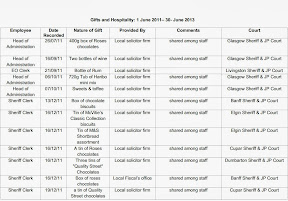
Hospitality Register identifies gifts to courts.A REGISTER which now requires the identification of anyone offering hospitality to Scotland’s Courts and judiciary – has seen a drop in high value gifts now recorded in more detail by the Scottish Courts and Tribunals Service (SCTS)
However, the latest declarations of hospitality to court staff in Scotland - reveals a slight decrease in gifts & hospitality from law firms raking in millions in publicly funded legal aid, while ‘anonymous’ gifts from unidentified “Member of the public” appear to be on the rise.
Among the providers of ‘hospitality’ to court staff are multiple law firms, technology companies, in-house legal teams of Scottish Local Authorities, and even Police Scotland, who provided a “Crystal engraved Police Scotland Armed Policing Specialist Firearms Unit ornament” to the Supreme Courts.
And now - thanks to media scrutiny, records of hospitality which is offered but refused - is also now part of the register.
Examples of refused hospitality include a burns supper dinner, offered by Microsoft to the Information Technology Unit in January 2019, and questionable offers of hospitality by Procuratir Fiscals to court staff – which included a faculty dinner offered to court staff at Kilmarnock Sheriff Court.
The rate of hospitality in terms of high value gifts has declined, at least if the disclosed records are to be believed.
And, law firms which are known to have received up to half a million pounds of legal aid every year – who were previously showering staff in local courts with gifts & hospitality – are no longer flooding the courts with perks & freebies after Diary of Justice began publishing disclosures on courtroom hospitality and it’s connections to legal aid & lawyers touting for business in local criminal courts.
The recently disclosed Register of Hospitality for Scotland’s Courts & Tribunals Service running from 2017-2019 – as provided by the SCTS in relation to a Freedom of Information request - can be viewed here: Scottish Courts & Tribunals Service Register of Hospitality 2017-2019
Among the extensive list of hospitality providing law firms are the following names, provided by a reader – which also highlight some gifts & hospitality from foreign Governments to Scotland’s courts. The location of hospitality offered/accepted is listed next to the provider: The Society of Solicitors of Hamilton (Hamilton Sheriff Court), Burnett & Co (Aberdeen Sheriff Court, Digby Brown Solicitors (Aberdeen Sheriff Court), McKinnon Hewitt Solicitors (Kilmarnock Sheriff Court), Belmonte & Co Solicitors (SCTS Lothian & Borders mgmt team), Leonards Solicitors (Hamilton Sheriff Court), Norwegian Civil Law Division (OPG & AOC), Innes Johnson LLP Kirkcaldy (Dunfermline Sheriff Court), Netherlands Judiciary, Lamont's Solicitors Ayr (Ayr Sheriff Court), Aberdeen Bar Association (Aberdeen Sheriff Court), George Mathers & Co solicitors (Aberdeen Sheriff Court), West Lothian College, Bar Association (Aberdeen Sheriff Court), Nigel Beaumont Solicitor (Edinburgh Sheriff Court), Unidentified Solicitor 3x Hospitality (Livingston Sheriff Court), Adams Whyte Defence Lawyers (Livingston Sheriff Court), Bar Association (Livingston Sheriff Court), Allcourt Solicitors (Livingston Sheriff Court), Balfour & Manson (Supreme Courts), Ministry of Justice - Korea (OPG & AOC) , Ministry of Justice republic of Korea (OPG & AOC), Chinese Delegation (Supreme Courts), School Mock Court Case Project (Supreme Courts), Marsh Insurance (OPG & AOC), University of Glasgow (Glasgow Sheriff Court), Solicitors for the Elderly (Supreme Courts), Inverness Legal Services (Inverness Sheriff Court), Malcolm Boyd Sheriff Officers (Airdrie Sheriff Court), BTO Solicitors (Supreme Courts & Edinburgh Sheriff Courts), Stewart and Watson property & Legal services (Elgin Sheriff Court), T Duncan & Co (Forfar Sheriff Court), Caesar & Howie Solicitors Alloa (Alloa Sheriff Court) , PoliceScotland (Supreme Courts), Cockburn McGrane Solicitors (Kirkcaldy Sheriff Court), G4S (Dundee Sheriff Court), MacDonald Law, Thurso (Kirkwall Sheriff Court), Caird Vaughan Solicitors (Dundee Sheriff Court), Lefevre Litigation (Supreme Courts), Alistair Young Solicitor (Dumbarton Sheriff Court), McKenna Law Practice (Kirkcaldy Sheriff Court), President of the Law Society of Scotland (SCTS Chief Executive Office), Court Police Officers (Kirkcaldy Sheriff Court), Hunter & Robertson solicitors (Paisley Sheriff Court), Procurator Fiscals Office Hamilton, Summary Unit (Hamilton Sheriff Court), Bonnar Accident Law (Airdrie Sheriff Court), JK Cameron solicitors (Dumbarton, Airdrie Sheriff Court), Kenneth M Greener solicitors (Hamilton Sheriff Court), Wink and MacKenzie solicitors (Elgin Sheriff Court), Aberdein Considine solicitors (Aberdeen Sheriff Court), Mackie Thomson & Co Ltd solicitors (Hamilton Sheriff Court), North Lanarkshire Council Legal (Hamilton Sheriff Court), Procurator Fiscal (Dundee Sheriff Court), Stirling Dunlop solicitors (Hamilton Sheriff Court), the MacKenzie Law Practice (Inverness Sheriff Court), AC O'Neill solicitors (Dumbarton Sheriff Court), Adairs solicitors (Dumbarton Sheriff Court).
A full listing of solicitors & law firms, companies and others who offered hospitality to court staff and the judiciary - can be viewed by searching the Register of Hospitality document which runs in detail to twenty eight pages, providing details of all disclosed hospitality from law firms, and others to the Scottish Courts & Tribunals Service.
Prior to Freedom of Information requests from DOJ journalists, the SCTS register of hospitality did not identify law firms – and was later found to be incomplete in recording hospitality, after an investigation was launched due to media coverage of gifts by law firms – some of which have received many millions of pounds of legal aid over the last decade.
Extract of Register of Hospitality 2013 Scottish Courts Service. Disclosures from the Scottish Court Service in documents reveal that in the last five years, over 500 instances of gifts and hospitality received by publicly funded SCS were declared under the rules.
Gifts such as expensive champagne, wines, chocolates and dinner invitations were given by lawyers and others to Sheriff Clerks and SCS staff, along with invitations to the Royal Garden Party, paid-for trips in planes, tickets to football matches and a host of other goods, services & gifts many court users may well come to question in terms of how much this gift giving by lawyers dents the supposed impartiality of court staff.
During reporting of the issue back in 2013, it emerged in the media that in some cases, lawyers had paid for criminal fines accrued by court staff, leading some to question their reasons for doing so and what secret benefits this brought to the legal profession and court staff involved.
At the time, legal sources acknowledged to Diary of Justice that significant numbers of gifts have not been declared by court staff, and that much of the gift giving may well be seen as thanks for favours done in court for law firms, particularly those who are pursuing clients for unpaid fees.
Ms Thompson was asked by the Scottish Court Service to investigate reports of irregularities in hospitality given to court staff.
The request for the investigation came after the Scottish Court Service received Freedom of Information requests regarding hospitality in the courts, prompting concerns some staff may have accepted gifts or hospitality but failed to register.
Report said SCS Registers insufficient, Court staff involved in private gains failed to declare.Gillian Thompson’s Report on Hospitality & Gifts in the SCS stated: “The information currently captured on the registers is insufficient to provide assurance that staff are using their common sense and considering issues such as conflict of interest.
Ms Thompson went on to recommend the “SCS should revise the Policy on Acceptance of Gifts, Rewards and Hospitality to ensure that it is fit for purpose for all staff, taking account of the various roles performed within SCS. It may also be time to revisit the levels of value for gifts and hospitality.”
The former AIB’s report also revealed court staff were using their positions to earn money privately from their links with lawyers and law firms operating in courts, stating “Several staff raised the issue of sheriff clerks who carry out extrajudicial taxations and private assessments and who personally benefit financially from these activities.”
Ms Thompson’s report roundly condemned this practice, stating: “Not only is it inappropriate in terms of the civil service code requirements for staff who are public servants to be able to receive private gain from their employment it is also highly divisive when other staff see such benefits being derived from simply being in the right post of Auditor of Court within the Sheriff Courts.”
Ms Thompson recommended in her reportthe “SCS should bring the practice of sheriff clerks profiting privately from their employment by SCS to an end as quickly as possible”.
HOW COURT CHIEFS LOST HOSPITALITY INFORMATION BATTLE
When DOI launched an initial investigation into hospitality and graft among court staff, the Scottish Court Service refused to release information relating to the gift register, claiming “the names of the gift or hospitality provider would be deemed as personal information” and “as the provider of the gift or hospitality was not made aware at the time that their name may be released, we consider disclosure of such is likely to bring the Scottish Court Service into conflict with the data protection principles.”
However, the Freedom of Information request – from DOJ – triggered a review of hospitality policy at the Scottish Court Service, leading to names of ‘'hospitality’ providers being added to the register.
Richard Warner of the SCS said: “I can advise you that due to your request for this information, the Scottish Court Service has changed the policy covering hospitality and gifts to ensure that the provider of any hospitality or gift are made aware that their name shall be entered on to our register and may be disclosed if requested in any future information request. This policy change shall take effect as from 1 January 2014 so the release of names may be considered in any future request for gifts or hospitality offered from this date. The policy also states that if the provider does not consent to their name being considered for release then the gift or hospitality cannot be accepted by a member of staff.”
After a request for review of refusal to disclose the information, the SCS again refused - this time around, claiming it would cost them too much to contact each law firm to ask permission to disclose their ‘hospitality’ to court employees. The SCS claimed they would have to contact every lawyer who gave a gift and this would cost too much to provide the information.
DOJ journalists took the matter up with Rosemary Agnew - the Scottish Information Commissioner – who requested Courts Chief Eric McQueen provide an explanation as to why the courts were blocking release of information on hospitality relationships between the legal profession and court staff.
John Kelly, Freedom of Information Officer at the SIC said: “Having written to and discussed the matter with the SCS, without being required to do so by way of a formal Decision Notice, the SCS has agreed to provide you with the information requested, subject to redactions in terms of section 38(1)(b) of FOISA on the basis that to disclose some of the names of individuals would breach the first data protection principle of the Data Protection Act 1998 (the DPA).I understand that the names of Solicitor and Law Firms will be provided.”
After the intervention of the Scottish Information Commissioner, the SCS subsequently released the hospitality list to journalists.
Richard Warner for the SCS said: “Having reconsidered your request, and the SCS response, I now attach a list which indicates law firms where this information has been recorded. For the reasons stated in our earlier response this does not include the names of any individuals concerned as there could have been no expectation on their part that this information would be circulated or published widely. As indicated previously, steps are being taken to ensure that individual persons are made aware at the relevant time that their details made be released as a result of an information request.”
Previous articles on hospitality and gifts to the Scottish Courts and Tribunals Service, reports on gift giving to court employees and investigations by Diary of Injustice on the relationship between law firms and SCTS staff can be found here Hospitality and Gifts to the Scottish Courts.