Showing posts with label strategic change. Show all posts

Friday, May 02, 2008

Scots public get raw deal in legal services as paralegals fall under Law Society of Scotland's dishonest regulatory regime

The Law Society has made a big song & dance this week about it's registration scheme for Paralegals, which is the result of 'agreements' reached between the Law Society and the Scottish Paralegals Association, inferring the scheme, which will effectively see the Law Society control and regulate paralegals, will be good for both the client and the legal profession at large.

While some may see the legal profession under the current rule of the Law Society may benefit from grabbing control of paralegals, if anything, the reverse is actually the case, where, as the Law Society has proved particularly through its recent history , it cannot effective manage any part of the profession, and adding the burden of administering, registering & regulating paralegals will do nothing to enhance either the Society's reputation or that of the profession at large.

Ostensibly, what is happening to paralegals, means that when clients have a problem with a paralegal, they will of course, have to take the matter up with the Law Society of Scotland, and as the new Scottish Legal Complaints Commission doesn't seem to be equipped to deal with paralegals, the buck will stop with the troublesome Law Society of Scotland who historically have ensured client complaints go nowhere.

So, in short, Law Society of Scotland control over paralegals is a bad thing for clients .... as we all know from how the Law Society has mismanaged complaints against solicitors for the past thirty years plus.

Want an example of what could happen to a client complaint to the Law Society of Scotland against a paralegal ? Well, there are plenty examples on this blog and in the media of how the Law Society of Scotland treat complaints against lawyers .....

Neil Stevenson - who was appointed by the infamous Douglas Mill to head up 'strategic change' at the Law Society of Scotland, wrote this week in the Scotsman law page on the subject of Law Society control over paralegals :

"There is no doubt that paralegals already provide a valuable service within the legal market, but at the moment anyone can call themselves a paralegal. Introducing a registered status will mean that employers can be sure of the standards met by employees. It will also give paralegals the professional recognition they deserve. And clients will benefit from knowing that the paralegal, who they may have more direct contact with than a solicitor, has been assessed properly.

This development also represents continuing change at the Law Society of Scotland. An innovative regulatory approach has been developed to tackle the issue, and state-of-the-art IT will underpin compliance"

I would remind readers that Douglas Mill, the outgoing Chief Executive of the Law Society of Scotland, is probably the one individual who has done the most damage to the Scots legal profession over the years, with policy failure after policy failure, leaving the profession with the highest levels of complaints, the highest levels of negligence cases, and the poorest level of public trust & respect for solicitors for decades ..... hardly a man who should have any lasting influence on things if the damage he and his kind have done, is to be repaired ?

"An innovative regulatory approach" from the Law Society of Scotland .. I wonder what on earth that could mean in the light of how they have handled regulation for all these years ?

Perhaps the Law Society of Scotland will simply lose the pretence of any honesty whatsoever and bin all complaints against paralegals as they are apparently doing at Drumsheugh Gardens in the run up to October 2008 when the Scottish Legal Complaints Commission takes over regulating service complaints and other issues relating to client complaints against Scottish solicitors.

What we are seeing in these moves by the Law Society over paralegals is simply a move to ensure it will control the legal profession from top to bottom, at every level, ensuring it will have influence & control over everything from the admissions process to control over rights of audience & representation, and of course, retain as much influence and control over access to justice itself.

As things stand, the Law Society will still be able to dictate and restrict the Scots public's choice of legal representatives in a continuing highly restrictive legal services market as indicated by last week's Law Society Alternative Business Structure proposals, and now the public are faced with an even greater danger in the quality & accountability of the present level of legal services on offer with the Law Society's annexing of the paralegals profession.

Unless the SNP Government or other political parties in the Scottish Parliament move forward with proposals to ensure the Scots legal services market is fully opened up to competition and freedom of choice, as recommended by the OFT and many consumer organisations, we will not see any increased quality, accountability or safety of legal services in Scotland.

So, over to less public choice and ever more regulatory failures as clients get a weaker, less safe legal service than ever in Scotland - where regulation of paralegals by the Law Society is definitely not good news for anyone except the Law Society control freaks and those who wish to further control the public's access to justice ..

The Scotsman article written by the Law Society Director of 'Strategic Change" :

Paralegal registration scheme is good news for the profession and for clients

By Neil Stevenson

WHAT will becoming a Law Society of Scotland registered paralegal actually mean?

The status is a badge of quality, indicating that the holder has met certain academic standards, has a certain amount of work experience and can carry out work to a prescribed standard.

We must emphasise that the exact arrangements are still under discussion, but having spoken to most of the concerned parties we have a clear idea of how the final proposal may look.

The Law Society is proud that this is a true partnership project, with the society and the Scottish Paralegal Association working closely to ensure that this new scheme brings benefits to everyone involved.

Paralegals who have attained a formal recognition under the scheme will be eligible to apply for entry to the register. A wide range of qualifications are likely to be considered relevant, from HNC/HNDs provided by Scotland’s colleges to provision from respected commercial providers such Central Law Training and Rewards Training.

We are also delighted to have worked with the Scottish Qualifications Authority (SQA) to redevelop an HNC/HND in legal services, and are now moving to develop professional development awards in a variety of key areas of law. For the first time this will provide a qualifications framework for paralegals.

Paralegals will then need to undertake an assessed year in practice, supervised by a solicitor. Those already with office experience may be able to follow an accelerated route, with the emphasis on ensuring all those becoming registered meet the required standard.

Those achieving registration will be required to complete annual ongoing training and will have to uphold standards laid out in a code of conduct. A complaints process will be put in place, but the emphasis will be on upholding standards through a variety of regulatory approaches.

There is no doubt that paralegals already provide a valuable service within the legal market, but at the moment anyone can call themselves a paralegal. Introducing a registered status will mean that employers can be sure of the standards met by employees. It will also give paralegals the professional recognition they deserve. And clients will benefit from knowing that the paralegal, who they may have more direct contact with than a solicitor, has been assessed properly.

This development also represents continuing change at the Law Society of Scotland. An innovative regulatory approach has been developed to tackle the issue, and state-of-the-art IT will underpin compliance.

This is also a year when the Society’s own governance arrangements are being reviewed and are likely to significantly alter following the move to bring in more experience from outside the profession and streamline our management.

• Neil Stevenson is from the Law Society of Scotland.

Monday, February 11, 2008

Law Society's 'strategic change' fizzles out as protection of monopoly on access to legal services takes priority

Law Society Chief Douglas Mill's latest creation of 'strategic change', along with costly posts funded [but not voted on] by the membership, has not lasted long in the pretence of bringing change to the Scots legal profession in the face of looming changes to the way the public can access the legal services market.

As the new 'head' of 'strategic change' at the Law Society reveals in media articles today, the policy of the Law Society to maintain the closed shop of legal services, is to bring paralegals to the fore, ensuring they are fully 'Law Society registered' as the latest excuse to obstruct progress towards the opening of the legal services market to anyone suitably qualified and reaching suitable standards which the Law Society itself have never been able to attain or maintain.

I have covered this issue before here :

Open access to legal services & poorly regulated paralegals wont resolve public's lack of trust in lawyers

We don't need lawyers, we need non lawyers says Law Society of Scotland as Client Relations remain in the gutter

The Paralegals profession has existed for a long time - and enjoy almost the same high levels of complaints against poor service & conduct, as do solicitors.

A few recent examples of complaints against paralegals, which have seen everything from families cheated from inheritances to collapsed house sales and embezzled client funds, prove the paralegals profession is as badly regulated & maintained as solicitors ... who occasionally, or more often than not, transfer the blame of some of their actions back & forth to paralegals to get off the hook, and occasionally drafting in paralegals to back up lies, even fake up a bit of paperwork to avoid a serious complaint as some complaints investigations have revealed ...

Since paralegals are for the most, unregulated, pursuing complaints against their work has been problematic at best.

The Law Society, in their 'cunning plan' to maintain a closed shop of legal services, can see that paralegals themselves can be a key tool in the fight to maintain that monopoly of access to justice which the legal profession dominates .. so to this end, there is to be a scheme established to register paralegals .. and take them 'under the wing' of the Law Society itself.

This move will certainly not give any client a better chance of having a fair hearing of a complaint against a paralegal's poor service, probably as complaints figures against solicitors over the years have demonstrated, it will make matters much worse and ensure the Law Society's habit of whitewashing the legal profession for even the most serious scandals will continue long into the future.

So, what do we really need to bring change to the legal profession ?

Well, for a start, we need a fully independent legal services regulator, much like the Legal Services Board in England & Wales - something which Justice Secretary Kenny MacAskill angrily denies Scotland needs - because he feels, as a lawyer himself, that the legal profession should be independent from the rest of us and be able to get away with what they please.

My earlier coverage of Justice Secretary MacAskill's rather hostile response to independent regulation of the legal profession :

Justice Secretary MacAskill insists on second class legal system for Scotland as England names & shames crooked lawyers

Such an independent legal services regulator, free from any influence or ex staff & hangers on from the Law Society of Scotland and it's various affiliates, could get on with the task of ensuring standards within an opened legal services market, and tackle regulation & disciplinary matters of all kinds, leaving the Law Society as little more than a union for lawyers as it always should have been - not the sole regulator of the legal profession as it has proved it cannot be.

Next up, we need, of course, the full & unrestricted opening up of the legal services market, from the current set up where only a Law Society of Scotland member can provide you with legal services or access to the courts, to that of a well policed open business structure where anyone who reaches a suitable standard of qualification and indemnity insurance coverage, can enter the legal services market and provide the legal services to the public which the Law Society feels it cannot, and no doubt at a much cheaper price than the Law Society feels it can provide ...

Gone should be the days of £159+VAT for three lines of text on an A4 page ... and legal work which might cost £200 spun out to end up as something like £4000 .. if only the legal services market could be opened up, but as you can see, the legal profession don't want to lose their cash cow, and control over how you, the public, have access to legal services and the courts - and that control extends far up the political ladder, as recent actions from the Justice Secretary on these issues, which can only be viewed pro-lawyer and anti-public.

Of course, to get the legal services market fully opened up, we need to have someone other than the Justice Secretary and the Lord President clearing individuals or companies applications to enter the legal services market, as both the Lord President and the Justice Secretary Kenny MacAskill are members of the Law Society of Scotland.

We all know the Law Society of Scotland wants to maintain the closed shop of legal services .. so it's no surprise that Mr MacAskill and the Lord President have been sitting down happily striking out all applications to enter the legal services market to-date.

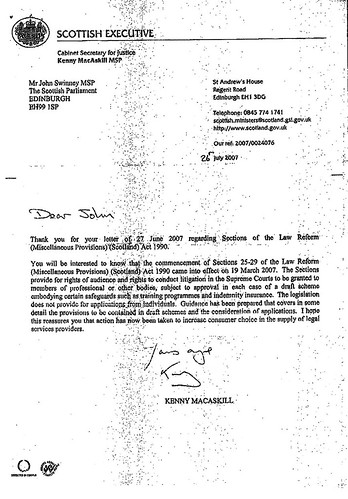
As readers will recall, Mr MacAskill mislead both the Cabinet Secretary for Finance John Swinney. and the Parliament itself on this matter where he claimed in a leaked letter that people could indeed apply for rights of representation - but all have failed so far under the pen of Mr MacAskill and the Lord President.

Kenny MacAskill writes to John Swinney - 'individuals can apply for rights of legal representation, but secretly we are killing off their applications in favour of lawyers ...'

Justice Secretary Kenny MacAskill to Cabinet Secretary for Finance John Swinney 26 July 2007

So in short, no change from the Law Society in it's 'strategic change' policy, but that is not unexpected because let's face it - who would want to lose control over the biggest money making monopoly in Scotland today - control over access to justice, access to legal services, and the right to charge and fleece the public for exorbitant costs of using those legal services.

Something about a leopard never changing its spots ?

The Scotsman reports :

An exciting time as this ‘new profession’ matures

By NEIL STEVENSON

CONFUSED? You are not alone… paralegals have long been a vital part of the legal market in Scotland. You’ll find them working with individual clients looking to buy a home or take a civil case, and you’ll find them working for Scotland’s largest commercial firms and financial institutions.

The Scottish Government and local councils employ them, and they work within Scotland’s charities and not-for-profit organisations. But you’ll notice I still haven’t defined exactly what a paralegal is.

So what happens when you ask paralegals to define their title themselves? Surely they know what a paralegal is? “A non-solicitor fee-earner” comes close to a definition, but seems to lack aspiration. From my previous work in the NHS it is extremely hard to imagine a highly qualified and experienced nurse-manager describing themselves as a “non-doctor care-giver”.

“Professional legal support staff” at least avoids a definition that rests on not being something, but then “support” doesn’t capture the workload of the hundreds of paralegals who are actually providing valuable front-line services to clients.

Perhaps more concerning is the fact that anyone can currently use the title. While law firms tend to have rigorous recruitment and supervision arrangements, especially since the solicitors supervising the paralegals remain personally responsible for the quality of their work, this is not always the case with non-law firms.

The Law Society of Scotland has received complaints in the past from members of the public who have thought they were getting legal advice from a qualified and knowledgeable source, only to find that anyone can use the title paralegal, that there are no set standards of practice or required qualifications, and as a group paralegals are not formally regulated.

This lack of clarity is confusing for the public and those working in the sector alike. However, the Law Society of Scotland, the professional body for solicitors, is now set to establish a registration scheme for paralegals. The Society is working closely with the Scottish Paralegal Association (SPA), the independent professional association whose experienced members are calling for clear standards and more formal regulation of the sector.

Work is underway that will define the learning outcomes and workplace experience someone must have before they can use the term “Law Society of Scotland Registered Paralegal”. There will be an online database allowing professionals and members of the public to quickly confirm whether someone is registered. Once registered, paralegals will be required to stay up-to-date in the law and best practice in client care.

Paralegals will also be able to access Society services, including our highly respected professional practice helpline, our award-winning monthly Journal, and Update – our continuing professional development courses and online learning. There will be a clear progression path to more senior levels of registration.

Rigorous standards will be set and maintained that will be transparent and flexible. We hope to work with organisations providing paralegal training to learn from their experience about what is appropriate and relevant in education and assessment.

The views of the public and clients will also inform the work. The recent review of how to qualify as a solicitor provides valuable data on what non-solicitors think key skills for those working in the sector should be. And, of course, we’ll also consult with employers and paralegals themselves to make sure both education and work-based learning are at an appropriate level.

The outcome of this work should lead to paralegals working to clear standards that the public can refer to, a defined career development route for paralegals, and clear grades to help recruitment, development and retention of paralegals for employers.

With so much change in the profession and legal services market at the moment, I’m sometimes asked why I am regularly citing this project as one of the most exciting the Society has underway at the moment.

I believe it’s because we are seeing essentially a new profession, with all that enthusiasm and experience, start to emerge and be formally recognised.

And it’s because we are starting to see the “legal profession” as not just solicitors and advocates, but as a vibrant and thriving part of the Scottish economy to which a whole range of professionals contribute – something that will be a guiding theme for the Society in the future.

The Society hopes to announce more details in the spring but, if you want to sign-up to receive further information as soon as it’s available, then please e-mail your name to

• Neil Stevenson is the head of strategic change at the Law Society of Scotland.