Showing posts with label John Campbell QC. Show all posts

Wednesday, August 26, 2020

COURT ON AUDIO, M’LORD: Clients should be given SAME DAY access to Court of Session audio recordings - as ongoing probe reveals QC’s admissions in case linked to Lord Malcolm, Lord Carloway & concealed judicial conflicts of interest

Court recordings should be available same day to clients. AN ONGOING media investigation into hearings in Scotland’s top court – the Court of Session – has received evidence which casts doubt on the integrity of witnesses and  counsel’s actions – which could be remedied if unedited digital audio recordings were required to be provided to clients involved in cases – upon the conclusion of a hearing.

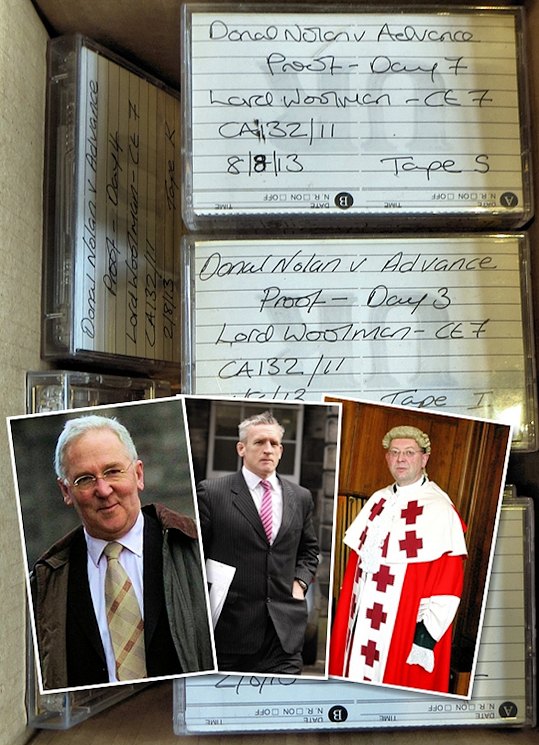
Audio recordings of hearings in a £6million land case Nolan v Advance Construction (Scotland) Ltd provided by a court source – and a study of their content have led to calls for clients who already pay tens of thousands of pounds for their claims to be hard by the Court of Session - to be given unrestricted access to audio records of proceedings in court – without obstruction or prohibitive cost being used to block access to proceedings in their case.

In the case which features in the released audio -  extraordinary exchanges between counsel, witnesses and the judge – Lord Woolman - can be clearly heard and further exchanges were counsel take an unrealistic, if combative approach with local planning officials in attempts to conceal or contradict legislation relating to the dumping of toxic, hazardous waste from the court.

In the cassette tapes of the Court of Session hearings – obtained by journalists from court sources – the audio recordings of interactions between witnesses, John Campbell QC, and the current Dean of the Faculty of Advocates – Roddy Dunlop QC – has since led to a separate investigation which has discovered one of the chief witnesses in Nolan v Advance held compromising interests linked to the defenders – which were concealed from the court and the judge – Lord Woolman.

In one exchange, Dunlop questions a North Lanarkshire Council planning officer – Mr Fraser Miller – on the conditions and legislation which are required for the removal of hazardous material including asbestos. From the recordings and what happened in court, it becomes clear the planning officer says planning permission would be required to remove the asbestos from the site, and the same permission would be required fo the asbestos to be dumped on the site.

As the case proceeds over a number of days in August 2013 before Lord Woolman - Dunlop’s client – Advance Construction (Scotland) Ltd – are ultimately forced to admit to Lord Woolman they were responsible for illegally dumping the toxic material on Mr Nolan’s property.

The audio tapes of the Nolan v Advance hearings go on to reveal many discrepancies between the accounts of what John Campbell QC said to his own client, and what actually transpired in court – including the as yet unexplained reasons why Campbell QC removed much of his own client’s financial claims – and critically the claim for legal expenses – without receiving any instruction to do so.

While it is important to note this case was initially won by Mr Nolan - the pursuer –  the failure of counsel to return to court for legal expenses against the defender led to financial loss & disaster after counsel for the pursuer turned on his own client by inexplicably stripping out much of the financial claim – an act which Lord Woolman said he had never seen in such a case.

A full report on how John Campbell QC reduced his own client’s financial claim almost to zero and without any instruction or consultation - can be found here: CASHBACK QC: Legal regulator’s files reveal senior QC reduced claim without instructions, withheld key evidence & witnesses including Cabinet Secretary from Court of Session case

Readers may be familiar with Nolan v Advance - one of the most extraordinary cases in recent times - which has since led to the discovery of carefully concealed interests of Court of Session judge Lord Malcolm (Colin Campbell QC) and Scotland’s current top judge – Lord Carloway (Colin Sutherland).

During a consultation between journalists currently engaged in the probe and court sources, further issues in the Nolan v Advance case have now come to light including a source which identified a comment between counsel to the effect of an unreferenced instruction with some degree of motivation - which states “you have got to four o’clock to get this sorted”.

And now – further audio recordings have been provided to journalists which lay down in crystal clear terms an extraordinary attitude on payment of fees on the part of the pursuer’s legal team – which included John Campbell QC, advocate Craig Murray and solicitor Gregor McPhail.

The legal team for Mr Nolan had previously signed up to a no win no fee agreement – which Campbell admits to in the recordings.

However, and without hesitation Campbell then appears to turn against the fee deal and demands his team all be paid – this coming after further material and already published emails revealed John Campbell demanded, and insisted on collecting  in person – cash sums of up to five thousand pounds at a time from his client Mr Nolan.

In one exchange – Campbell QC says “As fond as I am of you, none of us are doing this for love and neither is Craig [Murray]”

Campbell is then challenged over his already agreed position of working on the case via a no win no fee deal

John Campbell agrees he was working on a no win no fee deal but then replies: “That is correct, hmmm but we just have to see whether that actually holds up because hmm you know…”

A number of further recordings are now being studied where it is acknowledged by counsel Lord Woolman states he is  concerned about counsel’s lack of provision to the judge of evidence given by certain witnesses for the pursuer, Mr Nolan.

In an additional audio provided to journalists, John Campbell QC - who now heads the Edinburgh based Quaich Project – clearly admits responsibility for key failures in his presentation of evidence to the court.

Journalists and technical experts are now considering the content of the court recordings for futher publication and potential inclusion in reports to the Scottish Parliament’s Justice Committee of events in the Nolan v Advance case which identify a pattern of deliberate and concealed conflicts of interest by judges in the Court of Session.

And - in another court case where recordings have also come to light, it is also very clear what happens in court is very loosely transcribed to parties when there are requests by court participants for transcripts – some costing clients tens of thousands of pounds over hearing after hearing.

In a further case presented to the media team looking into Court of Session audio recordings - a court source has come forward with claims that a transcribing firm who were given court recordings as part of an order for transcripts - were told in a phone call to go easy on certain dates across hearings in one major case - and pay less emphasis to one side’s counsel in their provision of a final transcript ordered by the other side’s legal team.

A legal insider who has been given access to some of the audio material handed over to journalists now believes clients should be given unfettered access to recordings of their cases in court.

He said: “Clients pay a lot of money for their legal representatives to take a case through to the Court of Session and should be provided with audio recordings of each day’s proceedings at the end of that day”

He added: “The equipment to record court hearings has been installed for some time, and this should be properly used to ensure clients on both sides of the court have access to these recordings, without any attempt by court staff or the sitting judge to use unsatisfactory excuses or prohibitive costs as a reason for withholding audio access to those who are paying for the hearings.”

Currently, clients can request a copy of recordings from the Court of Session to be transcribed by an external private company, however – seldom if ever do the actual audio recordings pass into the hands of clients or either side’s legal team.

Clients must pay for the transcribing of the court recordings in what can run into bills of tens of thousands of pounds, however – there are notes of many cases where court staff, and the judge have blocked a client’s request to obtain transcripts of proceedings – and even when the court has agreed to transcription in some cases – clients and legal teams have identified multiple omissions in transcripts which suggest a motivated approach was taken to omit particular evidence from print.

For the media, a different approach to recording and broadcasting from the Court of Session & High Court of Justiciary currently exists in the following format:

Protocol on Recording and Broadcasting of Proceedings in the High Court of Justiciary and the Court of Session, and the Use of Live Text Based Communications from Court

Broadcast: Except where the context otherwise requires, for the purposes of the Protocol, "broadcast" means the transmission to members of the public of a video and/or audio recording; or live streaming. For the purposes of the Protocol, a recording refers to a video and/or audio recording. Broadcast may be for live streaming, news broadcast or documentary production. Individual sections within the Protocol identify the extent to which broadcasting may be permitted for a particular type of case.

Guiding Principle: The guiding principle is that broadcast of court proceedings is in the interests of open justice and for the information and education of the public.

Judicial Control: Subject to the guiding principle, whether a hearing should be recorded must remain under judicial control. The court may rule that, in any given case, recording a hearing would not be in the interests of justice.

Fair and Accurate Reporting: A report or presentation of proceedings that includes a broadcast of a hearing must be fair and accurate, having regard to the overall content of the report or presentation and the context in which the broadcast is presented. It must not be used for: the purposes of a party political broadcast; advertisement or promotion (except where such advertisement or promotion relates to a report or presentation that includes the broadcast); light entertainment; comedy or satirical purposes.

For the purposes of the Protocol, a media party means a journalist registered with the Scottish Courts and Tribunals Service (SCTS), or a party who can provide sufficient, appropriate evidence of relevant journalistic or documentary work. Any media party wishing to record a hearing is required to submit an application using one of the prescribed forms

Applications must be submitted to Judicial Communications for consideration by the Broadcast Working Group well in advance of the date of commencement of proceedings. On receipt of an application, the Broadcast Working Group must notify the presiding/chairing judge and ask him, or her, to provide to the Broadcast Working Group any comment or response which he, or she, may have on the application within an agreed time. Once the Broadcast Working Group has considered any such comment or response, it must make a recommendation to the Lord Justice General (or Lord Justice Clerk) as to whether the application ought to be approved. The final decision lies with the Lord Justice General or, in the absence of the Lord Justice General, with the Lord Justice Clerk. Approval may permit recording to take place in accordance with sections 2 to 5, or in accordance with any additional conditions as may be specified.

A decision on the application must be intimated to the media party within an agreed time. In the event of an application being refused, in whole or part, written reasons must be provided by the Broadcast Working Group.

In the event of an application being refused, in whole or part, the media party may submit an amended application taking into account the reasons for refusal.

If permission to record is granted, the Broadcast Working Group must appoint an SCTS staff member as a liaison officer. That officer is the point of contact between the media party and the court for all purposes connected with the recording.

If permission to record proceedings is granted, the presiding/chairing judge retains responsibility for ensuring that: the grant of permission remains appropriate; the recording is carried out on the terms approved by the Broadcast Working Group; and the recording is carried out in a way which does not disrupt court business. If, at any stage in the proceedings, the judge forms the view that to proceed with the recording would constitute a threat to the administration of justice, or that such a risk is present, or that the media party has breached the Protocol or any condition imposed, the presiding/chairing judge may withdraw the permission. If the presiding/chairing judge is considering withdrawing permission, an opportunity should be afforded to the media party to make representations to the judge before a final decision is reached.

Despite the progress of technology in the world outside of Scotland’s creaky Victorian courts and justice system, recording and broadcasting of what goes on in Scotland’s courts has not yet had the full impact on increasing transparency and accountability in the justice system which the same application of audio and video technology have had in courts in other jurisdictions.

Currently, the media must rely on a ‘judge-led’ review chaired by Lady Dorrian – who was appointed to chair it by Lord Brian Gill, Scotland’s former Lord President and Lord Justice General who famously liked to go after the media and block access to courts and documents during his short three year term as Lord President in which he continually held the media, and transparency in disdain.

Report of the Review of Policy on Recording and Broadcasting of Proceedings in Court, and Use of Live Text-Based Communications

A judge-led group which was appointed by the Lord President to review the current policy on the recording and broadcasting of proceedings and the use of live text-based communications from Scottish courts has published its report.

The review group, chaired by Lady Dorrian, has made a series of recommendations following a public consultation exercise, to which 17 individuals and organisations responded.

The review, which examined the existing practice in Scotland and other jurisdictions, was carried out in the context of a complete acceptance of the importance of the principle of open justice, recognising however that any steps taken in support of this principle must not pose any risk to the administration of justice.

In summary, the report recommends the following:

  • Filming of civil and criminal appeals, and legal debates in civil first instance proceedings, such as judicial review or procedure roll hearings, should be allowed for live transmission. Subsequent news broadcasting and documentary film-making should be allowed subject to clear and comprehensive guidelines.
  • The court should allow criminal trials to be filmed for documentary purposes in certain circumstances, subject to the safeguards referred to in the report. Cases involving children, sexual offences and vulnerable witnesses should not be filmed.  
  • No live transmission or filming for subsequent news broadcast should be allowed for criminal first instance business or for civil proceedings involving witnesses.  
  • For subsequent news broadcasts, the delivery of sentencing remarks of the judge should be permissible, with filming focused only on the sentencing judge. 
  • Filming of criminal trials for live transmission should not be allowed. 
  • In civil cases at first instance, filming for documentary purposes only should be allowed, but should exclude certain groups such as family cases and those involving asylum seekers.   
  • A structured approach to considering applications to film. 
  • All filming should be subject to robust, clear and comprehensive guidelines.   
  • Journalists who register in advance with the Scottish Court Service should be permitted the use of live text-based communications such as Twitter from court, subject to guidelines which will be issued in due course.  

The Lord President, Lord Gill said: “I am grateful to Lady Dorrian and her group for having carried out this exercise so thoroughly. These well-considered recommendations have the support of the judges. I accept all of the recommendations. They are entirely appropriate in the contemporary world. My office will now prepare guidance on the implementation of Lady Dorrian’s report.”

On 18 October 2012, the Lord President, Lord Gill, appointed a judicially led media review group, whose remit was to review policy on the recording and broadcasting of proceedings in court. This was later extended to include consideration of the use of live, text-based communications (LTBC) from court.

Guidance on the conditions under which cameras could be allowed in court was previously contained in a practice note issued by Lord President Hope in 1992. These conditions were revised by Lord President Hamilton in 2012. The revised conditions allowed filming to take place without the consent of all parties involved. The production company and broadcaster had to provide an undertaking to the presiding judge that the final broadcast would not identify those who had not consented to the filming.

The passage of time since guidance was issued, together with the development of social media, the use of instant text-based communication and the broadcasting of proceedings before the UK Supreme Court have all contributed towards a need to review this matter. When filming for documentary purposes has taken place in Scotland, the guidelines have had to be complemented by detailed negotiations as to the precise terms in each case. In appointing this review group, the Lord President considered that a more structured approach was desirable, not least in the interests of consistency.

The review was chaired by Lady Dorrian. The other members were: Lord Bracadale, Lord Woolman, Sheriff Principal Stephen, and Sheriff Drummond. The group was supported by: Christopher Nicholson, Deputy Legal Secretary to the Lord President; Elizabeth Cutting, Head of Judicial Communications; Steven D’Arcy, Head of Strategy and Governance, Judicial Office for Scotland.

Friday, July 17, 2020

ADVANCE, QC: From Big Invoice to Cash Register – New Dean of Faculty of Advocates stood silent in court while Lord Malcolm concealed his son was on same legal team representing asbestos dumping construction company who lost case - then used law firm linked to top judge to hunt down couple for legal fees

Lord Carloway & Lord Malcolm welcome new Dean R.Dunlop TO WATCH and listen to members of the Faculty of Advocates who strut around Scotland’s courts as if they have a starring role in a grand pantomime or musical overseen by a figure dressed in fiery red and white robes – you may be forgiven for thinking you just entered the world of fantasy and cosplay.

However - what you are actually witnessing is Scotland’s ‘Victorian’ justice system – where lies spoken in court by a figure in a black gown & wig can become an accepted ‘truth’, prosecutors can intimidate defence counsel by adding the dead to witness lists, deals can be done in-chambers to avoid the press & public in open court, and evidence can be lost down the back of a filing cabinet.

And, if you are looking for shameless, outright dishonesty - try the time where Scotland’s top prosecutor James Wolffe QC – himself a former Dean of the Faculty of Advocates -  was being sued in the Rangers admin case of wrongful arrest.

The stakes in that case were so high that Scotland’s ‘world leading’ courts system then neatly engineered a scenario so that Sarah Wolffe QC – the wife of that same top prosecutor James Wolffe QC – could hear and rule on the £9 million claim against her husband and Scotland’s Chief Constable.

You all know the story – A real howler: WOLFFE COURT: Lord Advocate James Wolffe and his judge wife at centre of £9million damages claim - Questions remain why Lady Wolffe avoided recusal during emergency judge swap on court case against her own husband

It gets better: ‘World famous’ (really, not) Scots QCs taking millions in publicly funded legal aid - can literally dream up an entirely false line of defence (commonly known as a lie) - for their child murdering clients and get away with trolling it out to a sceptical judge, jury and entire court room - and then bill the Scottish Legal Aid Board (Taxpayer) for their time spent doing so.

Going further up the tree - Scotland’s top prosecutor - the Lord Advocate – on an instruction to cover up for top cops with shady pasts – can ram-raid a Tribunal hearing and intimidate Tribunal judges into blocking claims of corruption and evidence tampering in the most senior ranks of Police Scotland - from becoming public.

Want to see examples of what most in the real world call corruption and money laundering? – try case after case where Advocates and QCs quietly demand with menaces – sums of cash in envelopes from their criminal or civil case clients. The ‘whisper’ goes like this - Pay up – or the desired court outcome will not be achieved.

And, don’t forget the ranks of slick, overcharging QCs who represent newspapers and the media – you know the type – all smooth talking on telly in between demanding appearance fees for doing so, hair gel to deflect from the botox injections, slick suits, a brown envelope on the way to the court, and a seat on a local rugby club along with a property grabbing, grubby, dishonest local high street solicitor who happens to sit on several Tribunals where he and his brethren live out their squalid existence extorting millions more from taxpayers.

Yet, for those in the know - behind the backs of their very own fee paying media clients, the same QCs with media scorecards find a quiet corner in the Court of Session to contact a colleague to get a message to opposing counsel on what and what not to say – to prolong the case for fees, or do the dirty on the case before them, for a favour on another.

You do for us today, we do for you tomorrow. And, tell you what mate – there is an opening in the Faculty for the son of that judge -  even though he only worked as a trainee lawyer for a few weeks.

But of course, these same legal legends in their own minds jealously guard their profession and self-created reputations – even on social media – where a critical article - or realistic tweet on the legal world can draw the ire of a grubby QC who actually lives on defending the worst filth in society and makes the taxpayer pay him staggering amounts of legal aid millions for doing so.

If anyone dares to question these weird legal people with double lives and multiple personas who market themselves as more valuable to society than doctors and nurses – in their legalistic, legal aid funded view of the world - that critic, person, politician or even a journalist - is not fit to live.

It’s all good though – as they say – because when such public exchanges take place – inevitably someone in an office comes forward with a bundle of papers to show the same high and mighty advocate or QC was actually knocked back by the Legal Aid Board for submitting false claims for public cash – so let’s call that attempted fraud, for the purposes of reality.

To complete the picture of what is in actuality - the Faculty of Fantasy – remember those envelopes full of cash - collected in person by a ‘leading light’ or ‘top’ Advocate or QC - of the same Faculty of Advocates whose members are money laundering and tax dodging all the way to the bank.

Take it from people who write of reality in the justice system - when you enter the eerie world of Scotland’s legal mafia and fall prey to that business known as the Scottish Courts and Tribunals Service – you are witnessing a cash grabbing, case fiddling, double dealing world of avarice and greed, rather than the work of robbed figures who would have you believe they are the saviours of humanity, or anyone’s Human Rights.

Clients - mean nothing. Cash collecting and Big Invoice are king. Take them to task and they will see you suffer. And, they do exactly that.

The last Dean of the Faculty of Advocates – Gordon Jackson QC – stood down on 30 June after being filmed talking about the Alex Salmond trial in a train.

The video footage published by the Sunday Times revealed remarks Mr Jackson made about his client Alex Salmond - and his accusers.

In a statement published by the Faculty of Advocates on their Twitter feed, Mr Jackson said in April: “I have intimated my decision to resign as dean of the Faculty of Advocates, with effect from 30 June, at the latest.”

“It would not, however, be appropriate for me to remain as Dean at a time when the Faculty was considering disciplinary proceedings regarding my conduct.”

“Accordingly, if, before that date, the Scottish Legal Complaints Commission remits the recent complaint for consideration by the Faculty’s Complaints Committee, I will stand down as Dean immediately. I do not intend to make any further comment.”

Since that announcement in April, Gordon Jackson has been less conspicuous on twitter - with much of the Faculty’s usual posturing on all things, law, legal and ‘other’ taken up by Roddy Dunlop QC – who was handed Jackson’s job in a lower than usual fanfare of the Court of waffling Session earlier this week.

Albeit  Dunlop only gained the position by default – he was the only candidate to put forward his name for the role - after Gordon Jackson ended his own run as dean in a blaze of careless comments in a train, filmed for posterity.

Dunlop – who - earlier this year gained the position of Vice Dean after Angela Grahame resigned her role – was welcomed in as Dean of the Faculty by Lord Carloway (Colin Sutherland), Lord Malcolm (Colin Campbell QC) and Lord Woolman.

However - the three judges who welcomed Mr Dunlop into the poisoned position of dean – have their own story to tell.

Two of those judges – Carloway & Malcolm - concealed conflicts of interest to a case which Dunlop lost, but was then used to go after the people who won it for the legal fees generated by Dunlop and his colleagues – including Lord Malcolm’s son. This case is currently at the heart of an ongoing media investigation and ticks all the right boxes for dishonesty, greed and conflict of interest.

The probe has so far linked Dunlop’s client (Advance Construction Scotland Ltd) to an ex-sheriff Peter Watson who resigned from the judiciary after he was suspended to protect public confidence in the judiciary

Then, there was the law firm – Levy and MCrae - who escaped a £28m writ over a £400m collapsed hedge fund.

The judge – Lord Malcolm - who concealed the fact his own son was linked to the same case he heard eight times

And, Scotland’s top judge himself – Lord Carloway – who concealed from MSPs that the law firm where his son worked was employed by Dunlop’s client to go after, and seize the properties of the party who actually won the case which Dunlop lost – courtesy of a ruling by the third judge – Lord Woolman.

Only in Scotland’s justice system will you ever find such a gang loaded with conflict of interests who use their seemingly unquestionable status in society to welcome another to their safe-house.

The investigation which reported on Lord Malcolm’s failure to declare serious conflicts of interest, is reported in further detail here: CONFLICT OF INTEREST: Papers lodged at Holyrood judicial interests register probe reveal Court of Session judge heard case eight times - where his son acted as solicitor for the defenders.

When Lord Malcolm’s son bailed out of the court case – but only after the secret his own father was hearing the same case in the same court - came to light – Ewen Campbell ended up in the same Advocate stables as the new Dean of Faculty - Roderick William Dunlop QC of Axiom Advocates.

Nicely done - as some may say.

A recent development in the ongoing media probe of this case saw publication of a witness statement from Advocate Ewen Campbell – Lord Malcolm’s son –  which directly contradicts evidence given by  Lord Carloway - to the Public Petitions Committee and MSP Alex Neil in a hearing on 29 June 2017.

A further development saw a court-sourced witness statement of solicitor and ex-Sheriff Peter Black Watson to the Court of Session – which confirmed Watson employed the son of Lord Malcolm in the case to represent the client – Advance Construction Scotland Ltd – which ended up being heard by Lord Malcolm - who concealed his link to his son during multiple court hearings.

Lord Carloway’s son - Alexander Sutherland - then bailed out of a law firm linked to the same case heard by Lord Malcolm – after the Judicial Office were asked for comment on why his father – Scotland’s current top judge concealed this conflict of interest from evidence in the Scottish Parliament.

Carloway’s son – Alexander Sutherland then spectacularly ended up in the Faculty of Advocates - after only a few months working as a trainee solicitor.

Everything happens for a reason, right?

An earlier investigation revealed Lord Carloway failed to declare his son was linked to the same case: JUDGE OF CONFLICT: Top judge who attacked MSPs over judicial interests probe – failed to declare relative’s role at law firm targeting MSP’s constituents’ home & farm in £6M court case linked to Lord Malcolm conflict of interest scandal

A full report on the publication of evidence contradicting Lord Carloway’s testimony at the Scottish Parliament can be found here: DISHONESTY, LORD: Files reveal Lord Carloway misled Holyrood Committee on involvement of judges’ relative in Court of Session claim – witness statement exposes direct role of Ewen Campbell in £6M land case heard by his father - judge & privy councillor Lord Malcolm

Another turn of luck in the ongoing investigation of the Nolan v Advance case – was the discovery of methods employed by QCs and Advocates to get round signed up fee agreements – by demanding substantial sums in cash payments – which the QC or Advocate then insists on collecting in person from their clients.

But – trawling the court files and fee notes took on an even darker tone when evidence emerged that the Faculty of Advocates itself were attempting to issue fee note credits to cover undeclared payments of cash collected by QCs – when the Faculty feared discovery, and the worrying prospect of an investigation by UK tax authorities.

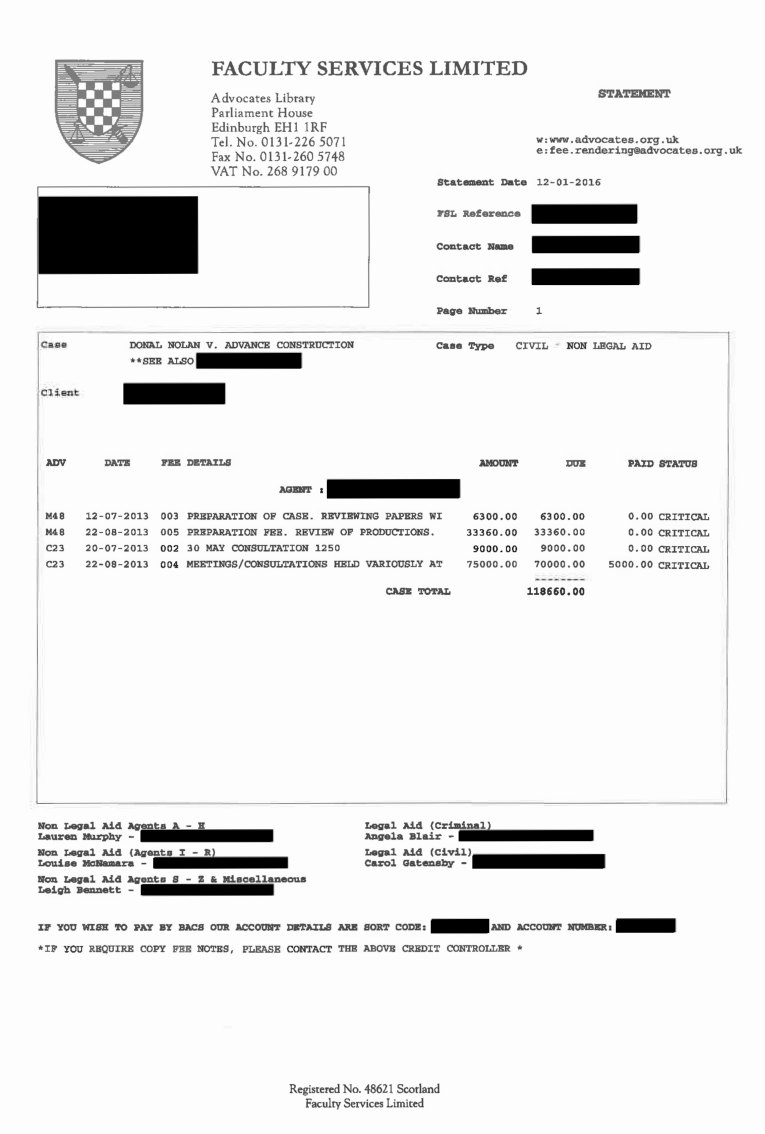
In one such document - a study of a statement from Faculty Services Ltd in the Nolan v Advance  – noted references to ‘undated’ sums, and credit notes for payments which were in fact – never made.

In one credit note from Faculty Services Ltd - the sum of £5000 - without any date reference is stated as paid.

However, a solicitor dealing directly with the case DENIED the undated £5,000 amount had been paid to Faculty Services Ltd - and a review of the accounts confirm NO such payment was ever made.

The undated £5K credit note listed in the documents – and other unexplained entries - appear to have been created by Faculty Services Ltd with a deliberate intention to conceal tens of thousands of pounds in undeclared cash payments Campbell demanded from his clients.

The fee statements & accounts from Faculty Services Ltd now raise serious questions of how far up the involvement of figures in the Faculty of Advocates in this case stretches - after an earlier investigation established Campbell was pocketing large payments he personally insisted on collecting in cash filled envelopes from his clients in £5,000 bundles.

Written evidence recovered from files held by legal regulators revealed Campbell himself sent emails to his clients - demanding large payments in cash to pay himself and junior counsel Craig Murray.

A full report on Craig Murray’s involvement in the case, and his role in writing two versions of evidence to legal regulators can be found here: ADVOCATE PROBE: How legal regulators covered up for top QC - Files show Scots Advocate now working as Barrister in London – authored two versions of SAME letter for Faculty probe of cash scandal QC who failed clients in £6M Court of Session case

An email from John Campbell to his clients revealed Campbell demanded £5,000 in cash - while he was on the way to a meeting at Airdrie Sheriff Court followed by a dinner with the Law Society of Scotland.

The email from Campbell states: “A little better information about timing. I am due in Airdrie at 4.30. The meeting is in the Sheriff Court, which closes at 6.30. The Law Society is taking me and a colleague for dinner, but I have no idea where. There isn't a huge number of restaurants in Airdrie, but we'll find somewhere. This means I won't be at Bonkle Road until about 8. Is that OK?”

“I have asked JC [John Carruthers] for a breakdown of the £5000. I will explain to you how a spec case works. I have checked; both John and I are willing to take on a spec case for Donal, but only if he signs up to it. There will be two conditions; one is that you keep the Edinburgh agent fed and watered, and the second is the size of the uplift at the end of the day, as I explained to you.”

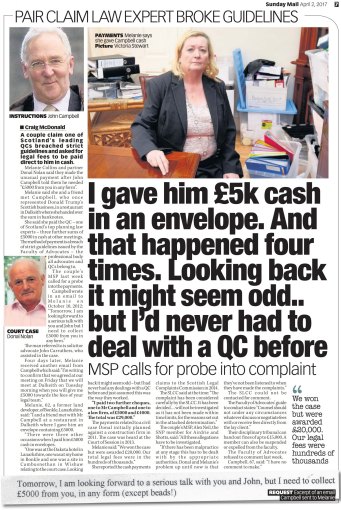
A Sunday Mail investigation into the case established John Campbell sent multiple emails to clients – in some cases, demanding cash “in any form except beads” to pay for legal services.

An additional email from John Campbell QC to his client stated: “I'm writing to confirm that we agreed at our meeting on Friday that we will meet in Dalkeith on TUESDAY morning, when you will give me £5000 towards the fees of your legal team” … “Please let me know if it's OK to meet at the Mulsanne Garage, which is at 137 High Street, and what time would suit you?”

If you were wondering why Mr Dunlop’s name keeps cropping up in Nolan v Advance – well – it was Roddy Dunlop’s legal fees – and others - which prompted Levy and Mcrae & Begbies Traynor to use Lord Carloway’s son’s law firm to evict the pursuer out of his house to pay for it all.

You can read all about what happened next, here: FIRE SALE: AIB face sequestration probe as files reveal Trustee was paid £20K by vulture fund to sell home & firebombed farm five days after targeted attack on couple at centre of land case linked to top Scots judges, an ex-Sheriff, an asbestos dumping building company & law firm Levy and Mcrae

If you want to know why Lord Carloway decided to keep quiet about his own link to this case, read more here: JUDGE OF CONFLICT: Top judge who attacked MSPs over judicial interests probe – failed to declare relative’s role at law firm targeting MSP’s constituents’ home & farm in £6M court case linked to Lord Malcolm conflict of interest scandal

THE GANG’S ALL HERE: New Dean welcomed by judges who concealed conflicts of interest in same case

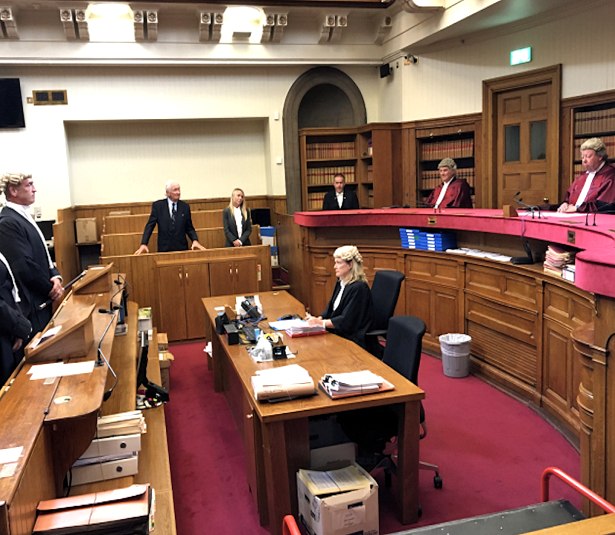
THE newly-elected Dean of Faculty, Roddy Dunlop, QC, has been introduced formally to the Court of Session in a short ceremony.

Mr Dunlop was presented to the Lord President, Lord Carloway, sitting with Lords Malcolm and Woolman, in the First Division courtroom.

Lord Carloway said it was not only his duty but his particular pleasure to congratulate Mr Dunlop on the high honour conferred on him by the Faculty.

Lord Carloway said: “It is an honour which is amply justified by your professional attainments and your personal character,” added the Lord President.

“It is a mark of my own age that I can not only say ‘kent his faither’ – whom I am pleased to see is present today – but even ‘kent his grandfaither’, whom I remember as an agent practising in Glasgow High Court.

“These are difficult times for the Court, the Bar, the wider profession and the public. We have learned a lot in the past four months, and will learn even more over the next four. There are many issues which need to be resolved if the courts are to continue to deliver justice for the people of Scotland. They will require discussion and careful consideration, but at the end of the day difficult decisions about the future will have to be made.

“The Court is confident that you will maintain the high traditions of the office of Dean. I can assure you that any representations which you make to the Court on behalf of the Faculty will always receive our closest attention.”

Mr Dunlop was the sole nomination to succeed Gordon Jackson, QC, who stepped down after four years in office.

Mr Dunlop said: “It is a huge honour to have been appointed Dean of Faculty. This high office extends back to the very origins of the College of Justice in the 16th Century. It has been held by many of the foremost legal minds in Scottish history, and I am humbled, and a little awed, to find myself in their company.

“I take office at an extremely challenging time for Faculty, and for the legal profession as a whole. I will endeavour to meet these challenges in a way that respects the efforts of those who have gone before me.”

Admitted to Faculty in 1998, Mr Dunlop took Silk in 2010. He has a broad-based, mainly civil practice, but with a keen interest in media law, he has been regularly instructed in the criminal courts in contempt matters.

Mr Dunlop served as Treasurer of Faculty from April 2017 until February this year when he was elected as Vice-Dean of Faculty. An election for a new Vice-Dean will follow.

Further material sourced from the Court of Session, including digital evidence & recordings from Neal transcribing machines in relation to proceedings in court where Dunlop and his opposite number John Campbell QC ‘sparred’ during hearings of Nolan v Advance - will be published in further articles.

Wednesday, May 06, 2020

JUDGE OF CONFLICT: Top judge who attacked MSPs over judicial interests probe – failed to declare relative’s role at law firm targeting MSP’s constituents’ home & farm in £6M court case linked to Lord Malcolm conflict of interest scandal

Lord Carloway failed to declare link to judicial conflict case. A REPORT being compiled for an investigation of judges’ conflicts of interest by Holyrood’s Justice Committee – will reveal Scotland’s top judge – Lord Carloway -  concealed a critical conflict of interest while giving evidence to the Scottish Parliament on a proposal to create a register of judges’ interests.

Lord Carloway’s failure to declare his own link to a case he initially claimed to know little of - while answering questions from MSP Alex Neil - was made all the more serious after the top judge himself openly attacked Mr Neil and other members of a Holyrood committee -  for daring to suggest judges should declare their relatives interests in a planned register of judges’ interests.

The report on Lord Carloway’s testimony to Holryood’s Public Petitions Committee will reveal that Lord Carloway (real name Colin Sutherland) did NOT declare to MSPs that his own son – Alexander Colin Maclean Sutherland – also worked for the merged law firm of Addleshaw Goddard-HBJ Gateley - which was trying to evict a couple at the centre of the case raised by Mr Alex Neil during the Committee hearing in 2017.

Mr Neil was invited to attend Committee hearing to quiz Lord Carloway on what legal experts say is one of the most serious cases of judicial conflict of interest in Scotland’s courts – Nolan v Advance Construction Scotland Ltd [2014] CSOH 4 CA132/11.

In the outburst from the top judge, Lord Carloway said to Mr Neil: “The suggestion is that we should start registering what our relatives are doing, where they are working and matters of that sort, which I suspect would go way beyond even what is expected of politicians.”

Alex Neil replied to Lord Carloway, stating: “No—we have to register what close relatives do.”

Lord Carloway - clearly rattled by questions from Alex Neil and fellow MSPs about another top judge who concealed he heard a case involving his own son - hit out at Mr Neil and members of the Public Petitions Committee in video footage which can be viewed here:

Lord Carloway -  Judges should not declare relatives interests   Scottish Parliament 29 June 2017

The terse exchange – one of many in the evidence session - led to material obtained during a probe by journalists which revealed Lord Carloway’s son – Colin Alexander Maclean Sutherland – worked at the time for the merged law firm Addleshaw Goddard & HBJ Gateley - who became key players in the aftermath of Nolan v Advance Construction (Scotland) Ltd.

However – Lord Carloway did not declare this conflict of interest during the Holyrood hearing.

Instead; the top judge went on to attack other Committee members and Mr Neil - over their backing for a cross party supported petition to require judges to declare and register all their interests.

Minutes before the exchange, Carloway had even denied even receiving any communications from the couple at the centre of the case - however records show Carloway’s legal secretary - Roddy Flinn – now himself a Sheriff – sent acknowledgements to the couple on 24 May 2016.

Papers show Addleshaw Goddard & HBJ Gateley were acting on behalf of Kenneth Pattullo of insolvancy practitioners Begbies Traynor – who were appointed by Advance Construction’s lawyers – Levy and Mcrae – to seize the home, land, a farm, and all assets of Ms Melanie Collins & retired National Hunt jockey Donal Nolan.

The couple took on Advance Construction (Scotland) Ltd - over a land contamination incident on their land in Wishaw.

The construction company - owned by businessman Seamus Shields was ultimately forced to admit illegal dumping of material in the Court of Session case before judge Lord Woolman.

However - the couple’s £6million damages claim - led by John Campbell QC - ended badly after a series of undeclared conflicts of interest by some of Scotland’s most senior judicial figures, instances where judges were switched from hearing to hearing, a series of refusals of legal costs claims, and denied requests to appeal in Edinburgh, and at the UK Supreme Court in London.

In a sequence of discussions and a meeting between Campbell and defenders counsel Roddy Dunlop QC which took place after Lord Woolman stated in court that Mr Nolan had a valid claim – John Campbell QC embarked on a series of unauthorised actions - and destroyed his own client’s case - by removing most of the financial claim - without consultation or obtaining permission to do so.

A recent probe established John Campbell – who agreed to act on a no-win-no-fee basis in the case - then went on to scam his client Mr Nolan for hundreds of thousands of pounds in unexpected legal fees, while also demanding thousands of pounds at a time – in cash – which the senior QC and now Edinburgh Quaich Project Charity Boss insisted on collecting in person

A full investigation of Campbell’s fee scam and the Faculty of Advocates role in concealing undeclared cash payments to Campbell is reported in further detail here: CASH ADVOCATE: £9K consultations & £75K meetings - Edinburgh Quaich Project Charity QC Boss scammed clients on no-win-no-fee deal - Faculty of Advocates files reveal extent of Advocates cash-for-fees HMRC tax dodge scam

Mr Nolan and his partner remain constituents of MSP Alex Neil - who has followed and supports their efforts to have the case re-opened, as well as an investigation into events.

Since the sequestration of Mr Nolan and his partner took place, after the conclusion of their court case, the couple have been the victim - of what some view as revenge for daring to take on a company with public contracts who illegally dumped hazardous waste on their land, where this same company was and is represented by law firms directly linked to senior figures in Scotland’s judiciary.

Mr Nolan and his partner have been evicted from their own home, lost their farm and land.

And - a deliberate, targeted fire attack on Mr Nolan's stables at a farm in 2019 which resulted in the death of several horses –  is still under investigation by Police Scotland.

Sources believe the deliberate arson attack on the couple’s Morningside Farm which featured in news reports of the tragic discovery of burned bodies of dead horses – is linked to the couple’s sequestration and setbacks in court.

And, recently, evidence has come to light of burned out vehicles possibly connected to the incident which were photographed located at a premises linked to potential suspects.

Now, there are calls for an independent, public inquiry into events which occurred during the case, the role of Advance Construction, and events in the Court of Session including involvement of certain law firms and members of the judiciary who – according to court files - deliberately concealed conflicts of interest across multiple court hearings in the case.

The case - Nolan v Advance Construction (Scotland) Ltd has attracted significant publicity in the press and is part ongoing probe into judicial conflicts of interest – resulting in the naming of several judges who failed to declare documented conflicts of interest in the case

Holyrood’s Public Petitions Committee, and recently, the Justice Committee have received and considered evidence in relation to the actions of Lord Malcolm (Colin Campbell QC) who himself failed to declare he heard the case up to eight times while his own son – Ewen Campbell – was in the same court, representing the defenders – Advance Construction (Scotland) Ltd.

The investigation into the Lord Malcolm case of serious failures to declare conflicts of interest, is reported in further detail here: CONFLICT OF INTEREST: Papers lodged at Holyrood judicial interests register probe reveal Court of Session judge heard case eight times - where his son acted as solicitor for the defenders.

Minutes before Lord Carloway hit out at Alex Neil over suggestions judges declare links to their relatives interests, the top judge snapped at the MSP stating: “I am satisfied that Lord Malcolm’s actions were entirely honourable and that he acted in accordance with the code of judicial ethics.”

However, the court record does show Lord Malcolm heard the case on multiple occasions while his son was in court – and new evidence has emerged from witness statements indicating Lord Malcolm’s son had also visited the site of the land contamination incident – which contradicts claims from the top judge & judicial office that Ewen Campbell had nothing to do with the case.

The original papers from Hamilton Sheriff Court in 2011 indicate that when a Sheriff Millar transferred the case to the Court of Session to be heard by Lord Malcolm – Ewen Campbell – Lord Malcolm’s son - was also present at that same hearing on 30 September 2011, along with Gavin Walker – who is a QC at Axiom Advocates.

An ongoing investigation into the case has now revealed Levy and Mcrae, representing Advance Construction in their pursuit of Mr Nolan & his partner – then sought a hearing on 14 April 2015 - to swap the original appointment of the Accountant in Bankruptcy in the sequestration of the elderly couple - to Begbies Traynor and Mr Pattullo.

That hearing took place at Hamilton Sheriff Court before the SAME Sheriff Millar - who heard the couple’s initial claim against Advance Construction in 2011 and then transferred it to be heard by Lord Malcolm in the Court of Session.

However, records show that by the time of this hearing in 2015 – accountants KPMG had already been appointed by the Accountant in Bankruptcy to handle the sequestration of Mr Nolan and his partner Ms Collins – and it can not be easily explained away by the Accountant in Bankruptcy as to why KPMG were swapped out of the sequestration for Levy and Mcrae’s choice of Begbies Traynor and Kenneth Pattullo.

Events around Levy & Mcrae’s motivated appointment of Begbies Traynor and Mr Pattullo – are now the subject of calls for an investigation by the couple’s MSP and legal experts - after it emerged assets owned by the couple which were held by the Clydesdale Bank, were transferred without notification to an offshore vulture fund known as Promantoria Ltd.

And – information has now come to light that land and assets formerly owned by the couple which were seized by Mr Pattullo & Begbies Traynor on behalf of Advance Construction (Scotland) Ltd - are now in the ownership of several persons of interest in relation to ongoing investigations of events which have occurred around Mr Nolan and his partner as a result of the collapse of their valid Court of Session claim.

The Judicial Office for Scotland were asked for comment on the following media enquiry:

“In relation to claims made by Lord Carloway to MSP Alex Neil at yesterday’s Public Petitions Committee in relation to declaring the interests of close relatives, and Lord Carloway’s mention of a son in the legal profession, can the Judicial Office confirm if Lord Carloway’s son currently works at Addleshaw Goddard LLP which has merged with HBJ Gateley.”

“On being provided with information HBJ Gateley is a pursuer in relation to obtaining decree with a view to evicting a Ms Melanie Collins & a Mr Donal Nolan from properties in Wishaw, does the Judicial Office or Lord President wish to comment on Lord Carloway’s testimony yesterday that entering the details of close relatives work in a register is going way beyond what is being proposed in terms of a register of interests for members of Scotland’s Judiciary.”

“And, in view of the claims made in relation to above, does the Judicial Office or Lord President see this as a matter which should be made clearer to the Petitions Committee after yesterday’s mention of the case during open session and Lord Carloway’s comments?”

“Finally, does the Judicial Office or Lord President have any further comment on Lord Carloway’s evidence to the Petitions Committee, and any further comment on the Petition itself?

Baktosch Gillan, who was the Acting Head of Judicial Communications at the time, gave the following reply: “In relation to your first question, the Judicial Office does not hold that information.”

Mr Gillan added: “We have nothing further to add to the Lord President’s evidence to the committee.”

To confirm Mr Sutherland’s position at Addleshaw Goddard during the time Lord Carloway gave his evidence to Holyrood in 2017, a search of the Law Society of Scotland’s online database of solicitors was made.

Days before the query to the Judicial Office in relation to Lord Carloway’s son - the name of Alexander Sutherland appeared in the Law Society of Scotland’s online search results.

However, some time after the Judicial Office issued the statement denying they held any information on the Lord President’s son’s involvement with HBJ Gateley & Addleshaw Goddard, and a potential conflict of interest - a new search of the Law Society of Scotland’s database revealed they had removed the name of Alexander Sutherland and references to his service at Addleshaw Goddard from their online database search results – which are now published as part of this report here:

The full exchange between Carloway (real name Colin Sutherland) and Alex Neil MSP at the Public Petitions Committee can be viewed, with transcript, below:

Alex Neil questions to Lord Carloway Register of Judges interests Scottish Parliament 29 June 2017

Alex Neil (Airdrie and Shotts) (SNP): I apologise for being slightly late. I had to go to the Public Audit and Post-legislative Scrutiny Committee. I apologise in advance if I cover ground that has already been covered.

Lord Carloway, as an issue of principle, do you think that it should be left only to a judge to decide whether they are going to recuse themselves, or should you or the keeper of the rolls be able to insist on recusal if you believe that there is a potential conflict of interest?

Lord Carloway: The short answer is that I do not believe that there is any problem with the current system, which is that the judge, who knows what his connection is to the case or the parties to it, should make the initial decision. That decision is made in open court, when the parties are present, and it is subject to review on appeal. In other words, if somebody is dissatisfied with that decision and if the litigant eventually loses the case, the decision will come before three judges who will review whether it was correct. If it was incorrect, the decision on the case would fall.

Alex Neil: The person bringing the case to court may not be aware of any conflict of interest that the judge may have and may never find out that there was one, but the judge may well have been influenced by a particular interest. Surely that is not right. If there is any potential conflict of interest, surely there should be a declaration or commitment by the judge, making an explicit statement that there is no conflict of interest. People may not have the resources to appeal, for example. Is the system not balanced against people who come to court for justice?

Lord Carloway: No, it is not. I go back to something that I mentioned earlier, which is very important. Scotland does not have a corrupt judiciary. The matter has been examined by independent persons, notably the GRECO anti-corruption body that operates under the auspices of the Council of Europe, which examined the UK judiciary, including the Scottish judiciary. It was clear that, fortunately, we, as distinct from many other countries, do not suffer from corruption in the judiciary. For that reason, it did not consider that a register of interests was necessary. If one introduces such a measure, one has to be satisfied that it is necessary and also that it is proportionate. If one analyses its proportionality, one has to look at what exactly we are guarding against. If the situation were to be that there was corruption in the Scottish judiciary—which we would discover at some point or another—of course we would have to consider measures to prevent that, one of which might be a register of certain interests. Until such time as it is demonstrated that there is corruption in the Scottish judiciary, I am entirely satisfied that there is no requirement for a register of interests and that it would be positively detrimental to the administration of justice, particularly in relation to the recruitment of judges and especially at the higher level of the judiciary.

Alex Neil: I want to draw a parallel with the register of interests that members of the Scottish Parliament have to sign and regularly update. That came about not because of any allegations or belief that the system was corrupt or that members of the Scottish Parliament are corrupt. In the 18 years that we have been here, I have not heard one allegation of corruption. The register is there not because of allegations of corruption but to ensure that there is no prejudice. If I participate in a debate and I have an interest that I have not declared, I will be open to an allegation not of corruption but of prejudice. Because there is a register of interests and because I have to declare interests in a debate or in a committee meeting such as this one, there is a transparency to ensure that I do not act in a prejudicial fashion.

To go back to the case that Mr MacDonald cited as I came in—the case of Advance Construction and Donal Nolan, in which Lord Malcolm’s son was involved as a lawyer for one of the parties—the issue there was not an allegation of corruption but one of possible prejudice or perception of prejudice. That is a very good example of why either a register of interests or a more robust system of recusal—or perhaps both—might serve the judiciary very well.

Lord Carloway: I am satisfied that Lord Malcolm’s actions were entirely honourable and that he acted in accordance with the code of judicial ethics. I am not sure what is—

Alex Neil: Have you investigated it?

Lord Carloway: I am aware of the background to it.

Alex Neil: No, but have you investigated it?

Lord Carloway: I have read the papers that it involves.

Alex Neil: With all due respect, Melanie Collins and Donal Nolan have written to you on numerous occasions, and at no time have you replied to them, let alone met them, so you have not heard the other side of the case.

Lord Carloway: I am sorry, but I am not aware of letters to me by those particular persons.

Alex Neil: Your office—

The Convener: Alex, let us be careful that we do not get into anything specific on that.

Alex Neil: Yes—absolutely. My point is about how Lord Carloway can reach that conclusion if he has not heard the other side.

Lord Carloway: I have read documents emanating from the persons that you have mentioned. As far as I am aware, they were not addressed to me, but I could be wrong about that. The position is that I am aware of the circumstances of the case. I am satisfied that Lord Malcolm’s conduct was entirely correct in the circumstances. That is part of the problem that you have perhaps highlighted. That case has nothing to do with a register of pecuniary interests. The suggestion is that we should start registering what our relatives are doing, where they are working and matters of that sort, which I suspect would go way beyond even what is expected of politicians.

Alex Neil: No—we have to register what close relatives do.

Lord Carloway: Can I deal with the difference between MSPs and the judiciary, which I think I dealt with earlier this morning? It is quite a different function. A politician is by nature someone who is not independent in the sense that the public expect the judiciary to be. That is not a criticism; it is a reality. As a generality, judges do not deal with the type of issues that politicians deal with. Politicians have executive power. They are dealing with major economic interests of one sort or another. As a generality, judges are not dealing with that type of thing. They are dealing with issues that are usually between private individuals but can be between private individuals and Government or others. Judges are not dealing with the type of issues that politicians are dealing with such as planning inquiries and so on at a local level or major economic development in society as a whole.

The need for independence in the judiciary is different from the kind of independence that a politician requires, because with a politician it is primarily, as Alex Neil has pointed out, about issues of a pecuniary nature. Those are not the issues that arise in most of the recusal cases with which we are concerned. What we are concerned with as judges is that we appear to be independent of all connection with the case. It is not a question of having a pecuniary interest.

If one looks at the register of recusals in the past year, I do not think that any of them were to do with pecuniary interest at all. They were to do with social connections with people—whether someone is a friend; whether a party to the litigation is a friend of a friend; and matters of that sort. Those are the types of situations that are raised by people in the practical reality of litigation and those are the issues that are being dealt with. Unless you are suggesting a register of one’s friends—and presumably, therefore, one’s enemies—the real issue with recusal in the judicial system would not be addressed.

The Convener: Last question, please, Mr Neil.

Alex Neil: If I can just finally draw the parallel between our register and what has been talked about in terms of either recusal or financial interest, MSPs—as individuals and collectively—do not have executive power per se unless they are ministers, but what is very important is the perception of fairness and the perception that justice is being carried out.

If, in any case—without referring to a specific case—a close relative of a judge is participating in the case, rightly or wrongly, the perception is that there may be a degree of prejudice. It might be very unfair, but the point is to try to ensure that the excellent reputation of the judiciary down the years in Scotland is retained. That reputation is not just for not being corrupt, which we all accept—we are not accusing anybody of corruption. The perception of fairness and the perception of not being prejudiced are also extremely important. I would argue that, certainly in at least one case recently, which we have referred to briefly, the perception is that there may have been unfairness and prejudice in the way in which the matter was conducted, particularly as the judge concerned was involved in the case not once but on a number of occasions.

Lord Carloway: I disagree entirely with your analysis of that particular case and I repeat what I said earlier. The case that you refer to did not involve the judge’s son having any active involvement with the case whatsoever. We have very clear rules in our statement of principles of judicial ethics on how to deal with such matters and it is made very clear in that statement that if a relative is the advocate in the case before one, the modern approach is that the judge should not hear the case, or one could put it another way round—the relative should not be presenting the case. Whichever way it happens to be put, the situation that we had 20 or 30 years ago, when it was commonplace for the relatives of judges of one sort or another to be advocating the case, no longer exists.

That practice no longer exists not because it was thought that there was any actual problem with the decision making but, as you say, because of a perception of unfairness. There is a clear judicial rule about that and I am not aware of any case in which it has been breached. I myself have been in a situation in which my son was involved in a firm that was litigating before me. In such a case, the judge would be expected to declare it and the parties would then decide whether to take the point. However, if they took the point and the relative just happened to be a member of the same firm operating in a different department, I would not encourage the judge to recuse himself.

The Convener: There are no final questions, so I thank you very much for your evidence. It has been helpful to clarify many of the issues that you presented to us in written evidence and to have an opportunity to explore some of the issues around prejudice, for instance.

A recent perusal of Mr Sutherland’s online legal biography at Ampersand Advocates and the Faculty of Advocates - does not mention his time at the merged firm of Addleshaw Goddard-HBJ Gateley in his online legal career:

Alexander Colin MacLean Sutherland BIO:

Year of Call: 2018; Since calling to the Bar in June 2018, Alex has developed a general practice centred on commercial law and public law, including judicial review and planning. He has appeared in the Court of Session, sheriff court and Scottish Solicitors’ Discipline Tribunal. He has also provided Opinions on a wide range of matters, including contractual disputes, insolvency and property.

Before calling to the Bar, Alex trained with a commercial firm in Edinburgh. He completed his LLB at Glasgow University in 2014 and the Diploma in Professional Legal Practice at Edinburgh University in 2015. Before then, he studied German and English Language at Edinburgh University, during which time he spent a year studying in Vienna.

He speaks fluent French and German and is well placed to undertake work involving consideration of documents in those languages.

Selected recent cases: Community Windpower Ltd v Scottish Ministers (ongoing): Inner House, Court of Session; For the appellants. Appeal against a Reporter’s decision. With Ailsa Wilson QC.

Tasmina Ahmed-Sheikh v (1) Scottish Solicitors’ Discipline Tribunal and (2) Council of the Law Society of Scotland [2019] CSOH 104; 2020 SLT 1: Outer House, Court of Session; For the petitioner. Judicial review of the first respondent’s decision on expenses.

Saadi v Whiterock Investments Ltd: Outer House, Court of Session; For the defenders. Pursuer seeking reduction of the decree awarding his sequestration.

Ford v The Firm of W&AS Bruce [2020] SC KIR 9: Kirkcaldy Sheriff Court; For the pursuer. Action of damages against a firm of solicitors for failing to advise the pursuer to include a survivorship destination when disponing half of his property to his partner. Debate on prescription.

NCS Office Services (Scotland) Ltd v Emtelle UK Ltd: Glasgow Sheriff Court (Commercial Action); For the defenders. Proof before answer on whether one of the defenders’ employees had authority to enter into a contract with the pursuers on behalf of the defenders.

Law Society of Scotland v WM: Scottish Solicitors’ Discipline Tribunal; For the respondent. Preliminary hearing on whether the complaint should be dismissed due to excessive delay.

However, when Ampersand Advocates welcomed Alexander Sutherland to their stable in 2018 – Mr Sutherlands spell at Addleshaw Goddard did gain a mention, without reference to his father being Scotland’s top judge - here: Ampersand welcomes Alexander Sutherland 

Ampersand is delighted to welcome Alexander Sutherland to the stable who called at the Bar today.

Before calling to the Bar, Alex trained with Addleshaw Goddard LLP, formerly HBJ Gateley. During his seat in the firm’s dispute resolution department, he gained experience of a wide range of litigation in both the Court of Session and the sheriff court, including real estate and insolvency litigation. He also had seats in the real estate and corporate recovery departments.

Alex completed his LLB at Glasgow University in 2014 and the Diploma in Professional Legal Practice at Edinburgh University in 2015. Before then, he studied German and English Language at Edinburgh University, during which time he spent a year studying in Vienna.

Alex’s interests lie primarily in the fields of commercial and public law. As a devil he also gained experience of planning. His principal devilmaster was Ampersand’s Laura-Anne van der Westhuizen.

He speaks fluent French and German and is well placed to undertake work involving consideration of documents in those languages.

On Alex’s arrival, Head Clerk Alan Moffat said “I am delighted that Alex has joined us. He comes with a great reputation from his time at a top firm and has been highly praised during his time on the devils course. I am very sure he will continue to impress at the Bar and expect him to be a great addition to the stable.”

In the first part of the time-honoured two-stage admission ceremony, the Dean of Faculty, Gordon Jackson, QC, said the public office of advocate carried real privileges and corresponding responsibilities.

“You have become part of a great national institution which has played, throughout its existence, a very significant role in the legal and cultural life of this nation. As a member of Faculty you will play your own particular part in the future of that institution,” he added.

In the second part of the ceremony, before Lord Clark in the Court of Session, Alex along with 6 other new calls made the declaration of allegiance.

Lord Clark said: “It is a genuine pleasure and a privilege to welcome you as members of the Faculty of Advocates and to congratulate you on this great achievement. The Faculty has long been an important and distinguished organisation. It has commonly attracted some of the ablest minds of each generation, and it continues to thrive.

“It is truly one of the great features of our society that the general public, businesses and other organisations have at their disposal people like you – independently-minded advocates who will take on and fight their causes.

“I very much hope that you thoroughly enjoy your work at the Bar and the camaraderie of your colleagues.”

Alex is a welcome addition to the depth of counsel on offer at Ampersand.

HOLYROOD QUEST FOR A REGISTER OF JUDGES’ INTERESTS

Petition PE1458: Register of Interests for members of Scotland's judiciary – originally lodged at the Scottish Parliament in 2012 – calls for the creation of a publicly available register of judicial interests – containing information on all judges’ backgrounds, figures relating to personal wealth, undeclared earnings, business & family connections inside & outside of the legal profession, membership of organisations, property and land, offshore investments, hospitality, details on recusals and other information routinely lodged in registers of interest across all walks of public life in the UK and around the world.

Previous articles on the lack of transparency within Scotland’s judiciary, investigations by Diary of Injustice including reports from the media, and video footage of debates at the Scottish Parliament’s Public Petitions Committee can be found here : A Register of Interests for Scotland's Judiciary.

Monday, April 27, 2020

CASH ADVOCATE: £9K consultations & £75K meetings - Edinburgh Quaich Project Charity QC Boss scammed clients on no-win-no-fee deal - Faculty of Advocates files reveal extent of Advocates cash-for-fees HMRC tax dodge scam

John Campbell no fee no win court deal was turned against client. A TOP QC recently appointed to head an Edinburgh Charity £25million scheme redeveloping Princes St Gardens – is at the centre of calls for a tax probe - after newly released files reveal he used the Faculty of Advocates to demand huge fees - on a case he originally agreed to work on a no-win-no-fee basis.

Documents recovered from Faculty Services Ltd reveal John Campbell QC – of Themis Advocates - demanded payments of well over £100,000 - for a land contamination claim – contrary to an earlier agreement Campbell made with his clients where the fee would ONLY be taken from any settlement upon success in the Court of Session case.

However - the £6million claim led by John Campbell QC - ended badly after a series of undeclared conflicts of interest by some of Scotland’s most senior judicial figures, instances where judges were switched from hearing to hearing, denial of legal costs claims & denied appeals.

Campbell then effectively destroyed his own client’s case - by removing most of the financial claims without consultation or permission to do so.

Now - there are now calls for a full investigation by tax authorities of all transactions involving Scottish Advocates - after new evidence indicates fee documents from the Faculty of Advocates were altered - to cover up a series of undeclared cash payments Campbell demanded from his clients.

In one of a series of Faculty Services statements - files reveal John Campbell demanded £75,000 for ‘unspecified’ meetings on the case he had already agreed to work on the no-win-no-fee arrangement in Nolan v Advance Construction Scotland Ltd [2014] CSOH 4 CA132/11.

In another entry on the same statement - the senior Campbell QC - sometimes described as a ‘leading Scots legal figure’ - demands a staggering £9,000 for ONE single consultation.

Campbell also inserts a demand for £33,360 for ‘reviewing productions’ and preparing his fee – even though he had already agreed there would be NO fee if he didn’t win the case.

Another £6,300 is then charged up by Campbell for a further review of papers and ‘preparation of case’.

Given the outcome of the case, and what has since happened to Campbell’s clients as a result of his role as their legal representative - the fee statements appear to contravene the no-win-no-fee deal agreement between John Campbell and his clients.

And - in digital evidence now held by journalists, Campbell states the payments he pocketed from clients despite the no win no fee deal - include work undertaken by his Junior Counsel Craig Murray.

Craig Murray now works as a barrister in London at 12 King's Bench Walk Chambers - and maintains a seat at Compass Chambers in Edinburgh.

A full report on Craig Murray’s involvement in the case, and his role in writing two versions of evidence to legal regulators can be found here: ADVOCATE PROBE: How legal regulators covered up for top QC - Files show Scots Advocate now working as Barrister in London – authored two versions of SAME letter for Faculty probe of cash scandal QC who failed clients in £6M Court of Session case

It should be noted - despite accounts from Campbell and the Faculty of Advocates demanding hundreds of thousands of pounds from Mr Campbell’s clients - on a case Campbell himself destroyed in court – both John Campbell QC and Craig Murray have now DELETED all references to the Nolan v Advance Construction (Scotland) Ltd case from their online biographies documenting their respective legal careers.

A study of additional statements from Faculty Services Ltd currently being undertaken by a law accountant – highlights references in the newly released files to ‘undated’ sums, and credit notes for payments which were in fact – never made.

In one credit note from Faculty Services Ltd - the sum of £5000 - without any date reference is stated as paid.

However, a solicitor dealing directly with the case DENIED the undated £5,000 amount had been paid to Faculty Services Ltd - and a review of the accounts confirm NO such payment was ever made.

The undated £5K credit note listed in the documents – and other unexplained entries - appear to have been created by Faculty Services Ltd with a deliberate intention to conceal tens of thousands of pounds in undeclared cash payments Campbell demanded from his clients.

The fee statements & accounts from Faculty Services Ltd now raise serious questions of how far up the involvement of figures in the Faculty of Advocates in this case stretches - after an earlier investigation established Campbell was pocketing large payments he personally insisted on collecting in cash filled envelopes from his clients in £5,000 bundles.

Written evidence recovered from files held by legal regulators revealed Campbell himself sent emails to his clients - demanding large payments in cash to pay himself and junior counsel Craig Murray.

An email from John Campbell to his clients revealed Campbell demanded £5,000 in cash - while he was on the way to a meeting at Airdrie Sheriff Court followed by a dinner with the Law Society of Scotland.

The email from Campbell states: “A little better information about timing. I am due in Airdrie at 4.30. The meeting is in the Sheriff Court, which closes at 6.30. The Law Society is taking me and a colleague for dinner, but I have no idera where. There isn't a huge number of restaurants in Airdrie, but we'll find somewhere. This means I won't be at Bonkle Road until about 8. Is that OK?”

“I have asked JC [John Carruthers] for a breakdown of the £5000. I will explain to you how a spec case works. I have checked; both John and I are willing to take on a spec case for Donal, but only if he signs up to it. There will be two conditions; one is that you keep the Edinburgh agent fed and watered, and the second is the size of the uplift at the end of the day, as I explained to you.”

A Sunday Mail investigation into the case established John Campbell sent multiple emails to clients – in some cases, demanding cash “in any form except beads” to pay for legal services.

An additional email from John Campbell QC to his client stated: “I'm writing to confirm that we agreed at our meeting on Friday that we will meet in Dalkeith on TUESDAY morning, when you will give me £5000 towards the fees of your legal team” … “Please let me know if it's OK to meet at the Mulsanne Garage, which is at 137 High Street, and what time would suit you?”

Campbell then collected the cash in envelopes - in locations such as restaurants, a garage specialising in servicing Bentley cars, and on land at Branchal in Wishaw.

John Campbell has refused to make any statement to the media on the written evidence published in the media of his demands for undeclared cash payments from clients.

Commenting on Campbell’s emails and some of the Faculty Services fee statements, a Criminal Defence solicitor who did not wish to be named – claimed the practice of QCs and Advocates demanding fee top ups in cash is widespread and needs to be looked at.

In one case quoted by a legal source, a senior member of the Faculty of Advocates who recently appeared in the news - is alleged to have demanded a six figure sum in cash from an accused person to ensure a non-custodial sentence in a criminal prosecution.

The legal source who provided the information said “Given the seniority of the accused’s legal representation it is difficult to believe others in court were not involved in the cash for freedom deal.”

In another case of a similar nature, an accused person refused to pay a similar sum of cash demanded by a high profile QC who also guaranteed a non-custodial sentence. The accused person went on to receive a custodial sentence after being found guilty at a criminal trial.

The rules on how payments to Advocates and Queens Counsel are collected from clients by Faculty Services Ltd –  the fees collection arm of the Faculty of Advocates which is currently chaired by Geoff Clarke QC - are very clear.

Section 9.9 of the Faculty of Advocates Code of Conduct states: “Counsel should not under any circumstances whatever discuss or negotiate fees with or receive fees directly from the lay client.”

Further rules from the Code of Conduct state clearly that fees to QCs and Advocates acting as counsel can only be collected by solicitors, and then paid over to clerks and Faculty Services.

“Normally Counsel’s fees are negotiated between the clerk and the solicitor. All fees should be paid to Counsel’s clerk.”

Additional guidance designed to cover over any direct payments ‘collected’ by Advocates states: “If any fee happens to be paid direct to Counsel, Counsel must account for it forthwith to his or her clerk.”

CASE BROKE ALL JUDICIAL CONFLICT OF INTEREST RULES:

Nolan v Advance Construction Scotland Ltd [2014] CSOH 4 CA132/11 is the same case which exposed serious conflicts of interest in Scotland’s judiciary – notably where Lord Malcolm (Colin Campbell QC) failed to disclose on multiple occasions - the fact Lord Malcolm’s son – Ewen Campell - represented the defenders in the same court.

The investigation into the Lord Malcolm case of serious failures to declare conflicts of interest, is reported in further detail here: CONFLICT OF INTEREST: Papers lodged at Holyrood judicial interests register probe reveal Court of Session judge heard case eight times - where his son acted as solicitor for the defenders.

It is also worth noting the Nolan v Advance (Scotland) Ltd case drew in a series of sheriffs and judges – from not easily explained hearings at Hamilton Sheriff Court involving Sheriff Millar, Peter Watson & Levy & Mcrae – and Lord Malcolm’s son – Ewen Campbell – to Court of Session judges including Lord Brodie, Lord Menzies, Lord Woolman, Lord Bracadale (and a concealed recusal) and Lord Hodge – who later prevented the case being appealed to the UK Supreme Court without declaring he had already ruled on the case while in Edinburgh on multiple occasions.

A full report on Lord Hodge, his undeclared conflicts of interest and his role in denying an appeal to the UK Supreme Court can be found here: CONFLICT OF JUSTICE: Deputy President of UK Supreme Court Lord Hodge blocked appeal to UKSC on damages case he previously heard 16 times – where fellow judge Lord Malcolm failed to declare his own son represented defenders in same court

An earlier investigation of this case revealed that when Lord Woolman stated in court papers that Mr Nolan had a case, John Campbell QC removed – without instruction – most of his client’s own case including over £4million and a claim for legal costs – after he had discussions with the current vice dean of the Faculty of Advocates – Roddy Dunlop QC.

A full report on how John Campbell QC reduced his own client’s financial claim almost to zero and without any instruction or consultation - can be found here: CASHBACK QC: Legal regulator’s files reveal senior QC reduced claim without instructions, withheld key evidence & witnesses including Cabinet Secretary from Court of Session case

Roderick William Dunlop QC of Axiom Advocates along with Lord Malcolm’s son who is now at the same Advocates Stables as Dunlop – Ewen Campbell of Axiom Advocates - and Peter Watson – now formerly of Glasgow based Levy & Mcrae - represented Advance Construction (Scotland) Ltd.

At the time – Peter Watson was a member of Scotland’s judiciary – and held various positions and directorships in relation to a hedge fund run by Greg King.

However – Peter Watson’s involvement in the collapsed £400million Heather Capital Hedge fund was beginning to trickle out into the media - and in 2015 after questions were put to Scotland’s top judge by the Scottish Sun newspaper - Lord Brian Gill suspended Peter Watson from sitting as a judge “to maintain public confidence in the judiciary”.

A full report on Watson’s suspension from the judicial bench can be found here: CAPITAL JUDGE: As top judge suspends sheriff over £28m law firm writ alleging links to £400m Heather Capital collapse, what now for Lord Gill’s battle against a register of interests & transparency for Scotland’s judiciary

Watson’s suspension as a judge lasted for over three years – a record term of suspension of a member of Scotland’s judiciary and ended with Watson’s resignation in 2019, reported in further detail here: SHERIFF WALKS: Scottish Courts confirm lawyer & part-time Sheriff Peter Watson - who was named in £28M Heather Capital writ linked to collapsed £400M hedge fund – resigned from the judiciary in 2018

JOHN CAMPBELL QC & THE EDINBURGH CHARITY PROJECT:

Recently, and in a blaze of public relations, John Campbell QC was appointed as Chairman of The Ross Development Trust - a charity created to lead a redesign of West Princes Street Gardens in Edinburgh.

However, Campbell’s appointment as Chairman of the project comes amid a scandal where big businesses, vested interests and wealthy donors were promised access to high-profile celebrities, international publicity at VIP events tickets for high-profile concerts, exclusive drinks parties and dinners under a secret fundraising drive by the Quaich Project – which Campbell now chairs.

Leaked details published last month by the media suggest corporate backers will be able to advertise their brands all across the redeveloped Princes Street gardens and the new amphitheatre which will replace the current Ross Bandstand.

Campbell’s reaction to the publication was an aggressive response, attacking critics of the public-private partnership project for “scaremongering” over “completely untrue” claims that it would lead to over-commercialisation and privatisation of the gardens.

It was reported in the media that John Campbell insisted there was “absolutely no evidence” to support claims that Princes Street gardens would be turned into a “private playground” reserved for wealthy donors and for commercial companies – yet the documents detailing the funding drive & secret promise of sponsorship to big business and vested interests - are now widely circulating in the public domain after being leaked to the press.

Eerily - the plan to redevelop Princes Street Gardens – dubbed the ‘Quaich project’- is developing a similar theme to how parts of the Court of Session ended up in the ownership of the Faculty of Advocates, after legal figures targeted the Laigh Hall complex, claiming ownership of the hall via a series of dubious titles and a lobbying campaign to take possession of the court buildings.

The Laigh Hall scandal resulted in a secretive deal after a bitter campaign by the Faculty of Advocates to usurp possession of parts of the Court of Session building for their ownership, adding it to their asset portfolio under a trust chaired by Court of Session judge Lord Brailsford.

The Scottish Government eventually caved in and  ‘gifted’ parts of the Court of Session to the Faculty of Advocates – even though the building belonged to the City of Edinburgh Council.

A full report on what happened to the Laigh Hall – which now hosts many exclusive events for lawyers & their businesses, and the transfer of ownership to the Faculty of Advocates can be found here: WOLFFE HALL: Edinburgh Council racks up £53K legal bill in failed bid to recover ownership of Parliament House - as papers reveal Faculty of Advocates “occupied” Laigh Hall for 150 years without recorded title deeds

Campbell is also a Trustee of the Scottish Historic Buildings Trust, and of Planning Aid Scotland, and an Honorary Fellow of the Royal Incorporation of Architects in Scotland (RIAS)

Former Cabinet Minister Alex Neil MSP (SNP Airdrie and Shotts) – who is backing his constituents in their quest to obtain justice, has now called for a full probe into the allegations against Campbell.

The Sunday Mail reported on the development & political backing in an investigation, here: MSP brands legal watchdog a 'toothless waste of time' after top QC avoids censure over cash payments

The Sunday Mail’s original Investigation and report on John Campbell QC and his cash demands from clients can be found here:

'We gave top QC £5000 cash in an envelope four times' Couple claim law expert broke guidelines as MSP calls for probe

By Craig McDonald Sunday Mail 2 APR 2017

A couple claim one of Scotland’s leading QCs breached strict guidelines and asked for legal fees to be paid direct to him in cash.

Melanie Collins and partner Donal Nolan said they made the unusual payment after John Campbell told them he needed “£5000 from you in any form”.

Melanie said she and a friend met Campbell, who once represented Donald Trump’s Scottish business, in a restaurant in Dalkeith where she handed over the sum in banknotes.

She said she paid the QC – one of Scotland’s top planning law experts – three further sums of £5000 in cash at other meetings.

The method of payment is a breach of strict guidelines issued by the Faculty of Advocates – the ­professional body all advocates and QCs belong to.

The couple’s MSP last week called for a probe into the payments.

Campbell wrote in an email to Melanie on October 10, 2012: “Tomorrow, I am looking forward to a serious talk with you and John but I need to collect £5000 from you in any form.”

The man referred to is solicitor advocate John Carruthers, who assisted in the case.

Four days later, Melanie received another email from Campbell which said: “I’m writing to confirm that we agreed at our meeting on Friday that we will meet at Dalkeith on Tuesday morning when you will give me £5000 towards the fees of your legal team.”

Melanie, 62, a former land developer, of Bonkle, Lanarkshire, said: “I and a friend met with Mr Campbell at a restaurant in Dalkeith where I gave him an envelope containing £5000.

“There were three other ­occasions when I paid him £5000 cash in envelopes.

“One was at the Dakota hotel in Lanarkshire, one was at my home in Bonkle and one was a site in Cambusnethan in Wishaw relating to the court case. Looking back it might seem odd – but I had never had any dealings with a QC before and just assumed this was the way they worked.

“I paid two further cheques, one to Mr Campbell and one to a law firm, of £5000 and £4000. The total was £29,000.”

The payments related to a civil case Donal initially planned against a construction firm in 2011. The case was heard at the Court of Session in 2013.

Melanie said: “We won the case but were awarded £20,000. Our total legal fees were in the hundreds of thousands.”

She reported the cash payments claims to the Scottish Legal Complaints Commission in 2014.

The SLCC said at the time: “The complaint has been considered carefully by the SLCC. It has been decided … will not be investigated as it has not been made within time limits, for the reasons set out in the attached determination.”

The couple’s MSP, Alex Neil, the SNP member for Airdrie and Shotts, said: “All these allegations have to be investigated.

“If there has been malpractice at any stage this has to be dealt with by the appropriate ­authorities. Donal and Melanie’s problem up until now is that they’ve not been listened to when they have made the complaints.”

The SLCC could not be contacted for comment.

The Faculty of Advocates’ guide to conduct states: “Counsel should not under any circumstances whatever discuss or negotiate fees with or receive fees directly from the lay client.”

Their disciplinary tribunal can hand out fines of up to £15,000. A member can also be suspended or expelled from the faculty.

The Faculty of Advocates refused to comment last week.

Campbell, 67, said: “I have no comment to make.”

JOHN CAMPBELL QC BIOGRAPHY:

During the span of his legal representation provided in Nolan v Advance Construction (Scotland) Ltd, John Campell was based at the former Hasties Stables of Advocates, which rebranded themselves earlier this year as Themis Advocates.

The rebrand of Hasties Stables after Advocates in the former Hastie Stable announced they were to re-emerge under the new brand of Themis Advocates – on the appointment of new senior clerk Kiera Johnston who will work alongside depute clerks Sara Mauriello and Liz Archibald.

Sitting alongside John D. Campbell QC in Themis Advocates are members of Scotland’s judiciary – including Mungo Bovey QC – who has sat as a part time Sheriff since 2009.

Themis Advocates describe themselves in the following terms: “Themis Advocates is a generalist stable, of which our advocates cover all areas of the law well. Within the stable, solicitors can find counsel able to handle a very broad range of inquiries, both in the range of subject matter and in the nature of the task requiring to be undertaken. We can provide competent advocates at all levels for any item of work. For ease of use we have arranged the Areas of Practice under the headings listed on the left. Click on any one of these headings for a breakdown of specialist topics within that heading.”

Alongside John Campbell QC at Themis Advocates are the following QCs: Mungo Bovey QC ;Andrew Brown QC ; Laura Dunlop QC ; Bruce Erroch QC ; Leo Hofford QC, FCIArb ; Kirsty Hood QC Gavin MacColl QC ; Alan McLean QC, FCIArb ; Brian Napier QC ; Steven Walker QC ; Andrew Webster QC

Juniors at Themis called for over seven years include the following: David F Ballantyne ; Mike Bell Joe Bryce  Alan Caskie  Maria Clarke  Gerry Coll  Donald Davidson  Andrew Devlin  Kenneth Forrest  Robert Frazer  Kenny Gibson  Alasdair Hardman  Ewan Hawthorn  Graeme Henderson  Jeya Irvine  David Leighton  Catherine MacColl  David McLean  Fintan McShane  John Moir  Ross Pilkington  Chris Pirie  Michael Upton

Juniors at Themis called for under seven years include the following: Tracey Brown  Andrew Crawford  Michael Dempsey  Tim Haddow  Chris Jones  Ann MacNeill  Julie McKinlay  Graham Middleton  Safeena Rashid  Katerina Stein

John Campbell also maintains a role at Trinity Chambers in England, alongside: Toby Hedworth Q.C.   John Campbell Q.C.  Andrew Stafford Q.C.  Francis FitzGibbon Q.C.   Nicholas Stonor Q.C.   Caroline Goodwin Q.C.

Barristers at Trinity Chambers can be found here: Trinity Chambers - Barristers a-z

The Trinity Chambers website describes their practice in the following terms: Trinity Chambers is proud of its reputation as being one of the leading sets of barristers’ chambers in the North of England, endorsed by the Chambers and Partners and Legal 500 Directories - "Trinity Chambers' ‘expertise, professionalism and empathy are second to none’", the "extremely efficient" clerks are "always keen to assist" Legal 500 2019, ‘One of the most renowned sets in the North East for good reason’ Legal 500 2020.

This is a reputation we have won by investing in staff, services and facilities, by implementing a robust administration and clerking structure, and, crucially, by supplying high quality legal advice and advocacy.

Trinity were the first chambers north of London, and only the fourth in the country, to be awarded the General Council of the Bar’s BarMark which is an annual review of all aspects of practice management, client care and regulatory compliance as assessed and reported upon by the British Standards Institution.

We were the first BarMark chambers in the country to be awarded Investors in People. Trinity were among the first six chambers to be awarded the Legal Services Commission’s Quality Mark. Since our establishment in 1954, we have consistently grown so that we now offer a broad spectrum of specialisation, expertise and experience, with consistently high quality across the board.

John Campbell QC Trinity Chambers Biography

John Campbell Q.C. CASES – with no reference to his role in Nolan v Advance Constuction (Scotland) Ltd:

About 200 windfarm and other planning cases at Committee, in writing, on appeal to Inspectors and Reporters, and on Appeal and Judicial Review in Scotland, Cumbria, Northumberland, East Yorkshire, North Wales, West Wales, and Norfolk; Avich & Kilchrenan Community Council – appearance before UN Economic Committee for Europe’s Ã…arhus Convention Compliance Committee, Geneva, Switzerland; Beauly to Denny OHL Inquiry – major power line inquiry from Beauly (Inverness-shire) to Denny (Stirlingshire); Bilfinger Berger Siemens CAF Joint Venture - training for Edinburgh Trams Mediation; Coastal Regeneration Alliance – Community Right to Buy under Land reform (S) Act 2003 – wrongful refusal to register lawful interest by Scottish Ministers; David Bines v CNES – [2010] Otter control at a fish farm; Gloag v Perth and Kinross Council and The Ramblers Association – right to roam – right to erect a fence with out planning permission; Gordon & Macphail v The Moray Council – Land Tribunal Valuation dispute for loss of use of a spring feeding a malt whisky distillery; Gordons Trustees – landlord’s resistance to an informally created agricultural tenancy; Grantown on Spey Caravan Park – Certificate of Lawful Use and Development against Planning Authority; success and costs awarded; HMA: v Hyslop – farmer carrying shotgun and allegedly threatening ‘lampers’ on his own ground – unanimous acquittal; HMA v Reid – shaken baby death; ICE v Addison – professional body wrongfully expelling Chartered Engineer; Laird v Scottish Borders Council – Planning consent invalidated for ambiguity; Lidl Stores – Nine public inquiries for new stores; Macaskill Stornoway [2009] Lorry noise nuisance case; Mearns Residents Association – flooding – correct interpretation of Council’s obligations to regulate housing permissions; Nairn v Fife Council [2008] Listed Buildings and ransom strip at large Country House; Newton Mearns Residents Association [2014] CSOH – flooding issues, Protective Expenses Order; Packard v Scottish Ministers [2012] – judicial review of windfarm Planning decision – bias and pre-determination by Scottish Ministers alleged; Parry v Highland Council – Contested certificate of lawful use for a fish farm; Pentland-Clark v Maclehose and Others – [2013] 10 year long Will dispute; Pirie and another v NEC – unlawful contract termination of TV distributor’s agreements; Q-Park – Access through designated bridge Airspace valuation; RIAS v Mays – unlawful expulsion of architect from membership of professional body – compensation; S and others – prolonged family dispute among four brothers following sale of a waste recovery business; Scott v McTear – auction house denying liability for compensation after burglary; TMSL v Rannoch Club – unlawful contract termination – compensation; Scottish Parliament Inquiry – 2004 – Inquiry into overspend on the Scottish Parliament Building; Trump International v Scottish Ministers UKSC [2015] judicial review of decision about the correct interpretation of a term in Electricity Act 1989;William Grant & Sons, Distillers [2013] – judicial review of Planning Decision; Wilson v Morton Fraser – Solicitors negligence claim, contested valuation of loss of profit

APPOINTMENTS: Member of the Scottish Bar since 1981, QC Scotland since 1998 ;Member, Dispute Review Board, Mersey Gateway Crossing 2015-

LECTURES & SEMINARS: Regularly gives talks on Planning law and Arbitration to solicitors, local authority staff, students, clients and others and has written a number of articles on Listed Buildings and Built and Natural Heritage issues

EDUCATION: LLB Edinburgh 1972

ADDITIONAL INFORMATION: John Campbell is a Scottish Queen’s Counsel, qualified to practice throughout the UK.

He graduated from Edinburgh University in 1972, and worked as a solicitor in Scotland until 1978. He was appointed as an Assistant Director of Legal Aid in Hong Kong where he worked in a range of public service legal jobs until appointed a Magistrate in 1980. He returned to Scotland in 1981.He passed Advocate that year, was called to Lincolns Inn in 1990, and took silk in 1998. He was a member of 40 King Street Chambers in Manchester throughout the 1990s.

He has worked in Family Law, both claimant and defendant Personal Injury and industrial disease work, and much earlier, in Crime. He has acquired a lot of agricultural experience, particularly for estates, farms and tenants and in landlord and tenant issues, and has worked widely in promoting arbitration and mediation for farmers, and in rent reviews both in Scotland and around the world. He has been a registered Construction Adjudicator and is currently a Member of a DRB.

He has worked in Town and Country Planning since the mid 1990s and has developed that speciality to include Environmental Law and some Construction Law. He is particularly active in Renewable Energy work on behalf of communities, NGOs, third parties, developers and councils.

His practice today is mainly in Planning and Environmental Law, property and land law, and agriculture and energy work, and he has a specialised practice in all kinds of ADR work and its promotion. He has carried out about 200 public inquiries and a number of related judicial reviews. Outside the law, he is Chairman of Scotland’s largest Building Preservation Trust, and of a University Research Advisory Board.

DO you have a complaint or case where a QC or Advocate has not provided fair legal services? What are your experiences of dealing with the Faculty of Advocates?

Has your solicitor, advocate or QC demanded cash payments from you at any stage of a civil or criminal case? Tell us more about it in confidence, by email to scottishlawreporters@gmail.com