Showing posts with label Lord Reed. Show all posts

Friday, January 17, 2020

SUPREME COURT INTERESTS : Prorogation case judge Lord Reed who failed to declare role in appointment of Scotland’s Prorogation Judicial Review ruling top judge Lord Carloway - takes over as new President of UK Supreme Court

President of UK Supreme Court Lord Reed. A TOP JUDGE who failed to declare a potential conflict of interest in relation to last year’s Supreme Court ruling on the unlawful suspension of Parliament – has taken over the role of President of the UK Supreme Court (UKSC) from Lady Brenda Hale.

Amid media plaudits from Lord Hope – who currently serves with other Scottish judges in courts in the United Arab Emirates & Gulf States - where Human Rights abuses, domestic abuse & trafficking in migrant workers lead the order of business -  Lord Reed - Robert John Reed (Baron Reed of Allermuir) – who has previously sat at the European Court of Human Rights and on a string of other appointments – now presides over the UK’s most powerful court.

Prior to his appointment to the Supreme Court in February 2012 - after the death of Lord Rodger, Lord Reed sat in the Outer House of the Court of Session, and became principal commercial judge in 2006.

Lord Reed was then appointed a Privy Councillor – a position enjoyed by other Court of Session judges such as Lord Malcolm (real name Colin Campbell QC) and joined the Inner House of the Court of Session where he sat from 2008 to 2012.

However, in September 2019 - when the UK Supreme Court upheld the prorogation case brought by MSP Joanna Cherry (and others) – documents obtained from the Scottish Government revealed Lord Reed sat on the same appointments panel which recommended Lord Carloway for the position of Lord President – Carloway (real name Colin Sutherland).

Lord Carloway is the same judge who upheld the Judicial Review case brought by the same MSP – Joanna Cherry (and others) in Scotland, against the prorogation of Parliament.

In the findings of three Scottish appeal court judges – headed by Lord Carloway himself, – Lord Carloway upheld the respondents contention that the Prime Minister’s advice to HM the Queen that the United Kingdom Parliament should be prorogued from a day between 9 and 12 September until 14 October was unlawful because it had the purpose of stymying Parliament.

In that ruling, Lord President, Lord Carloway, decided that although advice to HM the Queen on the exercise of the royal prerogative of prorogation Parliament was not reviewable on the normal grounds of judicial review, it would nevertheless be unlawful if its purpose was to stymie parliamentary scrutiny of the executive, which was a central pillar of the good governance principle enshrined in the constitution; this followed from the principles of democracy and the rule of law. The circumstances in which the advice was proffered and the content of the documents produced by the respondent demonstrated that this was the true reason for the prorogation.

Scrutiny of Papers obtained via Freedom of Information legislation and published in 2016 from the Scottish Government – revealed the same UKSC judge Lord Reed – also sat on the selection panel which recommended the appointment of Lord Carloway (Colin Sutherland) as Lord President in 2015.

The failure of Lord Reed to declare he sat on the appointments panel which recommended Lord Carloway for the top judicial job in Scotland – is one of two potential conflicts of interest for the Supreme Court judge which should have been aired and debated for recusal - prior to the UKSC hearing on the suspension of the Westminster Parliament.

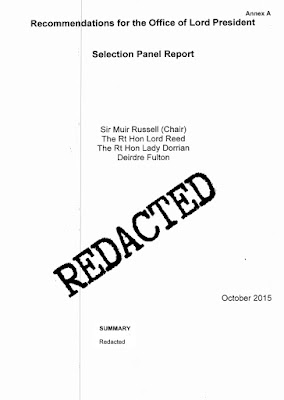
How judges select Scotland’s judges - in secret Documents obtained from the Scottish Government revealed Lord Reed sat on the selection panel for the office of Lord President - along with Sir Muir Russell, Judge Lady Dorrian, and Deirdre Fulton – considered five candidates for the position of Scotland’s top judge.

This same panel – which included Lord Reed – went on to recommend Lord Carloway for the position as Lord President & Lord Justice General of the Court of Session.

Written exchanges between civil servants and the selection panel which are included in the released papers - reveal a short listing meeting was held on 1 September 2015.

The panel considered that two applicants Lord Carloway [Redacted] merited an interview on the basis of the quality of their applications.

Two emails from Lord Reed, dated 14th ^ 15 October 2015 – released by the Scottish Government in the FOI documents - give a minimal, and heavily redacted description of Lord Reed’s role in the panel’s work, which ultimately recommended Lord Carloway for the position of Scotland’s top judge.

In one email, Lord Reed states: “This strikes me as an excellent report. I have made a few minor suggestions as shown on the attached version. Most of the suggestions are trivial, [redacted]”

In a second email Lord Reed writes “I am content with the amended report. I agree, in particular, with the points which were made by Leeona. The amended version beems to me to present an accurate account, and a fair and balanced assessment [redacted]”

A further potential interest not declared, brought ot the attention of journalists by a legal source, identifies Lord Reed’s work together with Lord Carloway – on a ‘compatibility issues review’ to consider if the High Court of Justiciary in Scotland would still have to give permission for appeals in criminal cases to go forward to the UK Supreme Court.

The review group was itself established by Lord Carloway, with others appointed to the group being Lord Reed (Deputy President of the UKSC), and others - Lady Dorrian (Lord Justice Clerk); David Harvie (Crown Agent); Roddy Dunlop QC (Treasurer of the Faculty of Advocates); and John Scott QC (President of the Society of Solicitor Advocates).

The review concluded - "Appeals to the Supreme Court of the United Kingdom (UKSC) should not require certification by the High Court of Justiciary that the issue raises a point of law of general public importance, a review chaired by the Lord Justice General has concluded."

Although – it should be pointed out – coincidentally, the review on appeals to the UKSC – limited to appeals in criminal cases - came too late to help in several serious cases of judicial conflicts of interest in Scotland – particularly on a well known case where Court of Session judge & Privy Councillor - Lord Malcolm (Colin Campell QC) heard a case up to eight times - while failing to declare his own son represented the defenders in multi million pound damages action.

A report on the Lord Malcolm conflict of interest case can be found here: CONFLICT OF INTEREST: Papers lodged at Holyrood judicial interests register probe reveal Court of Session judge heard case eight times - where his son acted as solicitor for the defenders.

The two potential conflicts of interest, not declared by Lord Reed in relation to what was a law changing UKSC ruling of significant impact – again highlight the need for a publicly available Register of judges’ interests - to ensure members of the judiciary do not forget to disclose interests which may have a bearing on cases before them.

The issue also brings into question again, the self imposed secrecy on judicial interests by the judges of the UK Supreme Court and wider UK Judiciary – who have resisted calls to become more transparent and declare their interests in the same way all public servants and elected politicians are required to declare in publicly available registers of interest.

The current stance of UK Supreme Court judges on transparency in relation to declarations of interest, is a point blank refusal by the judiciary to comply with the public expectation of transparency.

The UK Supreme Court’s website states the following in relation to judicial expenses and interests:

Justices' interests and expenses

Background

Prior to the creation of the Supreme Court of the United Kingdom, the highest court in the UK was the Appellate Committee of the House of Lords. The members of the Committee were Lords of Appeal in Ordinary appointed under the Appellate Jurisdiction Act 1876. Although those appointments gave them full voting and other rights in the House of Lords, the Law Lords had for some years voluntarily excluded themselves from participating in the legislative work of the House. Notwithstanding that, they were bound by the rules of the House and provided entries for the House of Lords Register of Interests.

On the creation of the Supreme Court the Lords of Appeal in Ordinary became Justices of the Supreme Court. They retain their titles as Peers of the Realm, but are excluded by statute from sitting or voting in the House, for so long as they remain in office as Justices of the Supreme Court. As such, they are treated as Peers on leave of absence; and do not have entries in the House of Lords Register of Interests. Historical information remains accessible via the House of Lords website.

Other judges in the UK, such as the judges of the Court of Appeal and the High Court in England and Wales, and in Northern Ireland, and the Court of Session in Scotland, do not have a Register of Interests. Instead they are under a duty to declare any interest where a case comes before them where this is or might be thought to be the case.

Current position

Against this background the Justices have decided that it would not be appropriate or indeed feasible for them to have a comprehensive Register of Interests, as it would be impossible for them to identify all the interests, which might conceivably arise, in any future case that came before them. To draw up a Register of Interests, which people believed to be complete, could potentially be misleading. Instead the Justices of the Supreme Court have agreed a formal Code of Conduct by which they will all be bound, and which is now publicly available on the UKSC website.

In addition all the Justices have taken the Judicial Oath - and they all took it again on 1 October 2009 - which obliges them to "do right to all manner of people after the law and usages of this Realm without fear or favour, affection or ill will"; and, as is already the practice with all other members of the judiciary, they will continue to declare any interest which arises in the context of a particular case and, if necessary, recuse themselves from sitting in that case - whether a substantive hearing, or an application for permission to appeal.

In relation to the UK Supreme Court’s stance on declarations of interests, and declarations of conflicts of interest, Diary of Injustice reported on the issue in detail during 2017, here: SUPREME SECRETS: UK Supreme Court refuses to publish recusal data - Court rejects release of info on UKSC justices' conflicts of interest in response to Freedom of Information recusals probe on top UK court

During the probe of UKSC recusals and failure to declare interests, a common thread of dishonesty was noted in court staff’s handling of a Freedom of Information request from Scotland – which was only answered after coverage of the issue in The National newspaper, which prompted the Information Commissioner’s Office to order the court to respond to the request.

Lord Reed’s limited biography on the UK Supreme Court website (reprinted below) does not feature either of the issues identified linking the judge to Lord Carloway’s appointment as Lord President nor any mention of review & other work undertaken with Lord Carloway – including the UK Supreme Court sitting in Edinburgh, which included Lord Carloway as a sitting judge on the UKSC panel.

The announcement by 10 Downing Street of Lord Reed’s appointment as President of the UK Supreme Court in July 2019 read as follows:

The Rt Hon Lord Reed will succeed Baroness Hale of Richmond as President of the Supreme Court of the United Kingdom, alongside three additional appointments as Justices.

The Queen has been pleased to confer a peerage of the United Kingdom for Life on Lord Reed upon his appointment as the President of the Supreme Court in recognition of the contribution that he has made to law and justice reform.

Lord Reed will take up the position of President on 11 January 2020. Lord Justice Hamblen, Lord Justice Leggatt and Professor Andrew Burrows will join the Supreme Court as justices on 13 January, 21 April and 2 June 2020 respectively.Her Majesty The Queen made the appointments on the advice of the Prime Minister and Lord Chancellor, following the recommendations of independent selection commissions.

Lord Reed will replace Lady Hale who retires on 10 January 2020 after serving as President of the Supreme Court since September 2017.

LORD REED UKSC BIOGRAPHY:

Lord Reed was appointed as a Justice of the Supreme Court in February 2012 and has served as Deputy President since June 2018. Prior to his appointment to the Supreme Court he served as a judge in Scotland, sitting from 1998 to 2008 in the Outer House of the Court of Session, where he was the Principal Commercial and Companies Judge, and from 2008 to 2012 in the Inner House.

He was educated at the Universities of Edinburgh and Oxford, and qualified as an advocate in Scotland and as a barrister in England and Wales. He practised at the Scottish Bar in a wide range of civil cases and also prosecuted serious crime.

As well as sitting on the Supreme Court and the Judicial Committee of the Privy Council, he is a member of the panel of ad hoc judges of the European Court of Human Rights, and a Non-Permanent Judge of the Hong Kong Court of Final Appeal. He is also the High Steward of Oxford University.

IMPORTANT NOTE: Readers should note this article does not take sides in the brexit debate. This article is a reporting of a failure by a UK Supreme Court judge to declare or discuss relevant interests and a potential failure to recuse - by a senior judge who is the new President of the UK Supreme Court.

Sunday, September 29, 2019

SUPREME INTERESTS: UK Supreme Court Judge Lord Reed's undeclared links to Lord Carloway selection panel & appeal review work - will not alter UKSC "unlawful" Parliament suspension ruling - but should feature in register of judges' interests

UKSC judge Lord Reed linked to Lord Carloway job panel. A POTENTIAL undeclared conflict of interest of the next President of the UK Supreme Court (UKSC) – in relation to a recent ruling on the unlawful suspension of Parliament - has been discovered from documents obtained from the Scottish Government.

Papers obtained via Freedom of Information legislation and published in 2016 reveal that Scottish judge Lord Reed – who has sat on the Supreme Court since 2012 – also sat on the selection panel which recommended the appointment of Lord Carloway (Colin Sutherland) as Lord President in 2015.

The potential conflict of Lord Reed - identified during discussions with legal sources – has a bearing (but no overall effect) on the ruling by eleven Supreme Court justices in relation to the findings of three Scottish appeal court judges – headed by Lord Carloway – who declared Prime Minister Boris Johnson’s decision to suspend parliament in the run-up to the October Brexit deadline as unlawful.

In that ruling, Lord President, Lord Carloway, decided that although advice to HM the Queen on the exercise of the royal prerogative of prorogating Parliament was not reviewable on the normal grounds of judicial review, it would nevertheless be unlawful if its purpose was to stymie parliamentary scrutiny of the executive, which was a central pillar of the good governance principle enshrined in the constitution; this followed from the principles of democracy and the rule of law. The circumstances in which the advice was proffered and the content of the documents produced by the respondent demonstrated that this was the true reason for the prorogation.

However, the failure of Lord Reed to declare he sat on the appointments panel which recommended Lord Carloway for the top judicial job in Scotland – is one of two potential conflicts of interest for the Supreme Court judge which may have required to have – at the very uleast - been aired and debated for recusal - prior to the UKSC hearing on the suspension of the Westminster Parliament.

How judges select Scotland’s judges - in secret Scottish Government documents previously obtained by the media revealed the selection panel for the office of Lord President - of which Lord Reed was a member, along with Sir Muir Russell, Judge Lady Dorrian, and Deirdre Fulton – considered five candidates for the position of Scotland’s top judge.

Written exchanges between civil servants and the selection panel which are included in the released papers - reveal a short listing meeting was held on 1 September 2015.

The panel considered that two applicants Lord Carloway [Redacted] merited an interview on the basis of the quality of their applications.

Two emails from Lord Reed, dated 14th ^ 15 October 2015 – released by the Scottish Government in the FOI documents - give a minimal, and heavily redacted description of Lord Reed’s role in the panel’s work, which ultimately recommended Lord Carloway for the position of Scotland’s top judge.

In one email, Lord Reed states: “This strikes me as an excellent report. I have made a few minor suggestions as shown on the attached version. Most of the suggestions are trivial, [redacted]”

In a second email Lord Reed writes “I am content with the amended report. I agree, in particular, with the points which were made by Leeona. The amended version beems to me to present an accurate account, and a fair and balanced assessment [redacted]”

A further potential interest not declared, brought ot the attention of journalists by a legal source, identifies Lord Reed’s work together with Lord Carloway – on a ‘compatibility issues review’ to consider if the High Court of Justiciary in Scotland would still have to give permission for appeals in criminal cases to go forward to the UK Supreme Court.

The review group was itself established by Lord Carloway, with others appointmed to the group being Lord Reed (Deputy President of the UKSC), and others - Lady Dorrian (Lord Justice Clerk); David Harvie (Crown Agent); Roddy Dunlop QC (Treasurer of the Faculty of Advocates); and John Scott QC (President of the Society of Solicitor Advocates).

The review concluded - "Appeals to the Supreme Court of the United Kingdom (UKSC) should not require certification by the High Court of Justiciary that the issue raises a point of law of general public importance, a review chaired by the Lord Justice General has concluded."

Although – it should be pointed out – coincidentally, the review on appeals to the UKSC – limited to appeals in criminal cases - came too late to help in several serious cases of judicial conflicts of interest in Scotland – particularly on a well known case where Court of Session judge & Privy Councillor - Lord Malcolm (Colin Campell QC) heard a case up to eight times - while failing to declare his own son represented the defenders in multi million pound damages action.

A report on the Lord Malcolm conflict of interest case can be found here: CONFLICT OF INTEREST: Papers lodged at Holyrood judicial interests register probe reveal Court of Session judge heard case eight times - where his son acted as solicitor for the defenders.

The two potential conflicts of interest, not declared by Lord Reed in relation to what is a law changing UKSC ruling of significant impact – again highlight the need for a publicly available Register of judges’ interests - to ensure members of the judiciary do not forget to disclose interests which may have a bearing on cases before them.

The issue also brings into question again, the self imposed secrecy on judicial interests by the judges of the UK Supreme Court and wider UK Judiciary – who have resisted calls to become more transparent and declare their interests in the same way all public servants and elected politicians are required to declare in publicly available registers of interest.

The current stance of UK Supreme Court judges on transparency in relation to declarations of interest, is a point blank refusal by the judiciary to comply with the public expectation of transparency.

The UK Supreme Court’s website states the following in relation to judicial expenses and interests:

Justices' interests and expenses

Background

Prior to the creation of the Supreme Court of the United Kingdom, the highest court in the UK was the Appellate Committee of the House of Lords. The members of the Committee were Lords of Appeal in Ordinary appointed under the Appellate Jurisdiction Act 1876. Although those appointments gave them full voting and other rights in the House of Lords, the Law Lords had for some years voluntarily excluded themselves from participating in the legislative work of the House. Notwithstanding that, they were bound by the rules of the House and provided entries for the House of Lords Register of Interests.

On the creation of the Supreme Court the Lords of Appeal in Ordinary became Justices of the Supreme Court. They retain their titles as Peers of the Realm, but are excluded by statute from sitting or voting in the House, for so long as they remain in office as Justices of the Supreme Court. As such, they are treated as Peers on leave of absence; and do not have entries in the House of Lords Register of Interests. Historical information remains accessible via the House of Lords website.

Other judges in the UK, such as the judges of the Court of Appeal and the High Court in England and Wales, and in Northern Ireland, and the Court of Session in Scotland, do not have a Register of Interests. Instead they are under a duty to declare any interest where a case comes before them where this is or might be thought to be the case.

Current position

Against this background the Justices have decided that it would not be appropriate or indeed feasible for them to have a comprehensive Register of Interests, as it would be impossible for them to identify all the interests, which might conceivably arise, in any future case that came before them. To draw up a Register of Interests, which people believed to be complete, could potentially be misleading. Instead the Justices of the Supreme Court have agreed a formal Code of Conduct by which they will all be bound, and which is now publicly available on the UKSC website.

In addition all the Justices have taken the Judicial Oath - and they all took it again on 1 October 2009 - which obliges them to "do right to all manner of people after the law and usages of this Realm without fear or favour, affection or ill will"; and, as is already the practice with all other members of the judiciary, they will continue to declare any interest which arises in the context of a particular case and, if necessary, recuse themselves from sitting in that case - whether a substantive hearing, or an application for permission to appeal.

In relation to the UK Supreme Court’s stance on declarations of interests, and declarations of conflicts of interest, Diary of Injustice reported on the issue in detail during 2017, here: SUPREME SECRETS: UK Supreme Court refuses to publish recusal data - Court rejects release of info on UKSC justices' conflicts of interest in response to Freedom of Information recusals probe on top UK court

During the probe of UKSC recusals and failure to declare interests, a common thread of dishonesty was noted in court staff’s handling of a Freedom of Information request from Scotland – which was only answered after coverage of the issue in The National newspaper, which prompted the Information Commissioner’s Office to order the court to respond to the request.

Lord Reed’s limited biography on the UK Supreme Court website (reprinted below) does not feature either of the issues identified linking the judge to Lord Carloway’s appointment as Lord President nor any mention of review & other work undertaken with Lord Carloway – including the UK Supreme Court sitting in Edinburgh, which included Lord Carloway as a sitting judge on the UKSC panel.

LORD REED BIOGRAPHY:

Robert John Reed, Lord Reed became Deputy President of The Supreme Court on 7 June 2018. He was appointed as a Justice of The Supreme Court in February 2012.

He studied law at Edinburgh University and undertook doctoral research in law at the University of Oxford. He qualified as an advocate in Scotland and as a barrister in England. He practised at the Scottish Bar in a wide range of civil cases, and also prosecuted serious crime.

He served as a senior judge in Scotland for 13 years. From 2008 to 2012 a member of the Inner House of the Court of Session, and from 1998 to 2008 a member of the Outer House of the Court of Session, where he was the Principal Commercial Judge.

As well as sitting on the Supreme Court and the Judicial Committee of the Privy Council, he is also a member of the panel of ad hoc judges of the European Court of Human Rights, and is a Non-Permanent Judge of the Court of Final Appeal in Hong Kong. He is also the Visitor of Balliol College, Oxford.

Lord Reed is one of the two Scottish Justices of The Supreme Court.

To update readers – on 24 July 2019, the last working day of Prime Minister Theresa May, HM the Queen appointed Lord Reed to serve as the President of the Supreme Court of the United Kingdom and declared her intention to raise him to the peerage. 

Lord Reed will take over as President of the United Kingdom Supreme Court from Baroness Hale of Richmond on 11 January 2020.

IMPORTANT NOTE: Readers should note this article does not take sides in the brexit debate. Rather this article is a reporting of a failure to declare or discuss relevant interests and a potential failure to recuse - by a senior judge who has been appointed as the new President of the UK Supreme Court.

Saturday, October 02, 2010

Independent regulation 'only solution' to feuding solicitors' regulators as court rules against Scottish Legal Complaints Commission

SLCC LAW SOCIETYLaw Society of Scotland wins court victory against 'independent' SLCC. THE DANGER of having two regulators of complaints against solicitors in Scotland has been brought into sharp focus with a recent Court of Session ruling over a decision by the Scottish Legal Complaints Commission to send a complaint from a third party against a solicitor to the Law Society of Scotland. The judges ruled by a majority verdict in favour of the Law Society, stating the SLCC should have rejected the complaint as totally without merit.

I initially reported on the Law Society’s court appeals against the SLCC in an earlier article during April of this year, here : Bitter feud between regulators as Law Society of Scotland take Scottish Legal Complaints Commission to Court of Session over complaints role

The complaint made by Mr Glenn McIntosh and Mrs Janet McIntosh to the Scottish Legal Complaints Commission, stated they had received “an overly aggressive, intimidating and threatening letter” from a firm of solicitors, Mr Alistair Dean, solicitor, of the Alistair Dean Law Practice Ltd, Edinburgh, alleging trespass and threatening interdict proceedings over the McIntoshs’ alleged access through land owned by Mr Dean’s client, Mr Allan Pryde of Pryde Homes Ltd. The letter accused the McIntoshs’ of damage to a septic tank and drainage, which was denied in the McIntoshs’ complaint to the SLCC.

The McIntoshs’ told the SLCC : "We have received an overly aggressive, intimidating and threatening letter dated 6 July 2009 from adlp which was delivered while we were on holiday. In this letter we are accused of a continuing transgression through land allegedly owned by an Allan Pryde, Pryde Homes Limited. … We admit to accessing the field to the north which is owned by a local farmer Mr Miller, via the boundaries of our neighbour's property, in this letter you will see we are accused of causing damage to the septic tank and drainage and that access is prohibited, you will see our response to this in the letter we sent to adlp dated 28 July 2009 to which we have not yet had a reply. We also enclose a copy plan showing exactly where the equipment referred to is situated.”

“The majority of this letter is based on inaccurate facts and untruths and we think it is an absolute outrage that solicitors are sending this type of correspondence to people. My wife has shown the letter to Trading Standards who were equally shocked by the content and this has prompted our communication with you".

The Scottish Legal Complaints Commission considered matters, and determined the complaint should be remitted to the Law Society of Scotland for investigation and determination as a conduct complaint in accordance with section 6 of the LPLA (Scotland) Act 2007. The Law Society challenged the SLCC’s decision, and filed the resulting appeal at the Court of Session.

While Lord Kingarth & Lord Reed both sided with the Law Society of Scotland, finding the complaint to be totally without merit, and the SLCC’s decision to send it onto the Law Society wrong, Lord Malcolm gave a differing view, supporting the SLCC’s actions, detecting no error of law in the Commission’s approach to the complaint.

Lord Malcolm’s opinion in full : The appellants' (Law Society) concern is that in general the respondents (SLCC) are too reluctant to consider the merits (or demerits) of a complaint when assessing whether it is or is not "totally without merit" for the purpose of deciding whether to refer it to the professional body for investigation and determination. On the other hand the respondents stress that the public interest in the proper regulation of the profession demands that it should be alerted to any circumstances where there might be professional misconduct or unsatisfactory professional conduct. The present case has been selected from a number of appeals which raise similar issues.

His Lordship continued : [48] Parliament has decided that, notwithstanding the creation of the Scottish Legal Complaints Commission ("the Commission"), the relevant professional body (in this case the Law Society of Scotland) should remain responsible for the investigation and determination of a conduct complaint. This suggests that when considering whether or not a complaint is "frivolous, vexatious or totally without merit" in terms of section 2(4) of the 2007 Act, any inquires carried out by the Commission should be no more than is required to allow it to answer that question. Were it otherwise, there would be a risk of duplication of effort, unnecessary delay, complexity and confusion. The Commission might be drawn into an investigation and consideration of the merits of a complaint, something which is specifically the responsibility of the Society. It was plain from the discussion at the hearing on the appeal that the Commission is anxious to avoid usurping the exclusive jurisdiction of the professional body to police conduct issues.

[49] A flavour of the correct approach to the phrase "totally without merit" can be gained from the link with "frivolous" and "vexatious" complaints. In my view, the test of "totally without merit" is different from a test of "without merit". The latter would require consideration of the substance of the matter, allied to any necessary investigation. The statutory formula does not require this. It allows the sifting of complaints which, on their face, are obviously unworthy of any consideration or investigation by the professional body. It covers hopeless complaints where it is clear that further inquiries could make no difference. A conclusion that a complaint is unlikely to succeed would not meet the test for dismissal by the Commission at the preliminary stage. ("Succeed" may not be the correct word since it connotes a dispute or adversarial process akin to litigation, whereas for a professional body the fundamental purpose of a complaints system is to facilitate its duty to protect the public and to promote proper professional standards). The hurdle set by the phrase "totally without merit" is very low. While not exact, the nearest equivalent which occurs to me is the "clearly unfounded" test for certification of an asylum claim under section 94 of the Nationality, Immigration and Asylum Act 2002, around which there is a developed jurisprudence. It stresses that certification should be granted only if it is absolutely clear that, if put before an immigration judge, the claim would be bound to fail. Anything more than a fanciful prospect of success, perhaps after and depending upon the outcome of appropriate investigations, would prohibit certification: see A K (Sri Lanka) [2009]

EWCA [Civ] 447.

[50] Contrary to a submission made by counsel for the Commission, for rejection of a complaint as totally without merit under section 2(4) it is not necessary that it be identified as an abuse of process. That submission is based on an unwarranted gloss on the statutory wording. A complaint may be totally without merit, yet not an abuse of the process. An example is given later in this opinion.

[51] The creation of the Commission and its "single gateway" role was, at least in part, prompted by a concern that the previous regime was "run by lawyers for the benefit of lawyers". Such perceptions were damaging to the standing of the profession. The policy was "to build public confidence in the system for handling complaints against lawyers" by instituting procedures which "put the users of legal services at the heart of regulatory arrangements" (paragraphs 6 and 26 of the Policy Memorandum relating to the Legal Profession and Legal Aid (Scotland) Act Bill). Thus the Act set up a body independent of the profession which, amongst other things, would decide whether the relevant professional body should be required to investigate a complaint. Previously the Justice 1 Committee of the Scottish Parliament had offered the view that such a system "could reassure the public that complaints could not be unfairly rejected as invalid by the professional bodies", there having been expressions of concern that they were too quick to find reasons for declaring a complaint to be ineligible (paragraph 5.8 of the Report "Reforming Complaint Handling, Building Consumer Confidence" May 2005).

[52] This background suggests that, when dealing with complaints, the Commission (and the relevant professional body) should try to keep in mind how things might appear to a lay person. Whatever the outcome, it should try to resolve complaints in a manner which avoids a feeling on the part of complainers that their concerns have been swept under the carpet. This indicates that a complaint should be rejected by the Commission as being "totally without merit" only in a clear and unambiguous case. One approach would be to ask whether a sensible person could think that there may be something to be gained from a referral to the professional body.

[53] There may be cases which, though not focused by the complainer, raise topics of general concern or interest, which the professional body might consider to be of value or significance from the point of view of reviewing and perhaps improving standards and general practice. Proper professional conduct is not set in stone. The present case might prompt the Society to reflect on what is to be expected of a solicitor who is instructed to write a letter directly to lay people threatening court action on the basis of alleged wrongdoing. For example, guidance might be given that solicitors should make it clear that they cannot and do not associate themselves with the allegations, but are simply acting on the instructions of and on the basis of information provided by their client. While lawyers may understand all this, lay people may not. If the allegations are unwarranted, the recipients may consider that they are being bullied and intimidated by a professional person. For many people, a letter in such terms from a solicitor will be an unusual and worrying thing. In most people's eyes it will have a special status. Furthermore, language which appears normal and measured to a lawyer may well come across quite differently to a lay person. The court was informed that throughout the whole process the solicitor made no response to either the complainers or the Commission. In these circumstances the Society may wish to consider whether it is satisfactory for the solicitor to ignore rebuttal letters, especially if in the meantime he neither raises the threatened court proceedings nor says anything further on the subject, thereby leaving the people concerned in a state of uninformed limbo.

[54] In summary, if a complaint raises issues which may be of general interest to the professional body with responsibility for reviewing conduct and standards, I would not expect it to be rejected by the Commission under section 2(4). The contrary approach would involve an overly restrictive concept of the term "merit". All of this follows if it is understood that such a complaint is not analogous to an adversarial dispute, nor to a summons in a litigation. A summons necessarily imports notions of onus, specification and relevancy, but in my view it would be wrong to translate similar concepts to the present context.

[55] During the hearing there was some discussion as to whether, for the purposes of section 2(4), "the complaint" should be restricted to the specific concerns focused by the complainer. Given the wider public interest issues involved, I would not expect the professional body to consider itself so constrained if it identified other matters deserving of its attention. I would not expect a complaint to be dismissed as being wholly without merit simply because, for whatever reason, the complainer had not articulated a matter which deserves investigation. Typically complainers will not be lawyers. I see no reason to adopt a different interpretation of the provisions of the Act, including section 2(4). Thus, in my view, the Commission should not adopt a narrow view restricted to the specific concern or concerns as expressed by the complainer. Rather it should decide the preliminary issue on the basis of the whole circumstances arising from and relating to the complaint. The same will apply if the court is considering whether to exercise its powers under section 22 of the Act to substitute its decision for that of the Commission.

[56] The 2007 Act expressly allows for complaints of "unsatisfactory professional conduct", a much broader, easier to establish concept than the more serious matter of professional misconduct. When considering its task under section 2(4), the Commission should ask itself whether there is any possibility that the relevant professional body would consider that the complaint merits consideration, with or without further inquiries. In other words, and putting the matter colloquially, "might there be something in it?". If the answer is "possibly yes", the hurdle is cleared and the Commission must refer the complaint to the professional body. An example discussed at the hearing where the answer to this question would be "clearly no", concerned a complainer criticising his advocate for referring the judge to a recent Supreme Court authority adverse to his client's interests, which had been overlooked by his opponent's counsel. It is wholly understandable that this might irritate the client, and leave him feeling aggrieved. Such a complaint could not be described as frivolous, vexatious or an abuse of process. However, it is beyond doubt that counsel was simply fulfilling his duty to the court and no amount of further investigation could alter that fact. This would be an example of a complaint which was totally without merit within the meaning of section 2(4).

[57] Where the Commission is of the view that further investigation is needed, it does not follow that the Commission must carry out that investigation before it can determine the section 2(4) issues. On the contrary, a need for investigation is likely to demonstrate that the complaint is not totally without merit. This remains so even if the likelihood is that further investigation will exonerate the solicitor. In my view, the phrase "whether or not" in section 2(4) does not compel the Commission to resolve any uncertainties. In a case where further investigation might be relevant, it is the professional body, not the Commission, that should undertake that investigation.

Contrary to what might be deduced from certain submissions made on behalf of the Society, it is important that when considering its task under section 2(4) the Commission does not reach conclusions as to what the outcome of such investigations might be, for example because of assumptions that the solicitor will not have acted improperly. The dangers of such an approach are obvious. Equally, neither the professional body nor the practitioner should be offended or disturbed by a decision by the Commission to refer, since this involves no judgment on the merits of the complaint.

[58] In the grounds of appeal the Society emphasises the stress and other difficulties which a complaint can cause for a solicitor. No doubt an investigation by one's professional body can be stressful and unwelcome, but there are powerful public interest considerations lying behind Parliament's decision that conduct complaints should be fully and properly considered by other members of the profession. The emphasis should be on protection of the public and safeguarding the reputation of the profession: see Graham v Nursing and Midwifery Council 2008 SC 659 (Extra Division) at paragraph 13.

[59] Notwithstanding all of the above, I am of the view that counsel for the Commission was wrong when he appeared to suggest that once a complaint is lodged the Commission can ask no further questions of the complainer. That submission is contradicted by the terms of section 17 of the Act. Even without that provision, I would have concluded that the Commission has an implied power to seek clarification of the complaint or the factual basis for it, though, as indicated earlier, any such inquiries ("investigation" is perhaps the wrong word) should be no more than is necessary to allow the Commission to decide the preliminary issue under section 2(4). With regard to the hypothetical example proffered by counsel for the Society during the hearing, if a complainer says only that X is a thief, there is nothing to stop the Commission from asking "why do you say that?". If the answer is because X is a red head and all red heads are thieves, then clearly the complaint should be dismissed as frivolous, vexatious or totally without merit, or perhaps all three.

The Present Appeal
[60] Turning now to the circumstances of the present appeal, when considering whether the complaint is or is not totally without merit, I would expect the Commission to have in mind two matters. Firstly, that it is possible that the allegations in the letter sent to Mr and Mrs McIntosh are wholly inaccurate, and that it might be understood by them as the solicitor asserting that the allegations are true, particularly having regard to the terms of the first, second, sixth and penultimate paragraphs. Secondly, that it is at least possible that the Society would take the view that a solicitor should appreciate that the recipients might be alarmed and distressed on receiving such a letter from a solicitor. I have in mind the statement that "if there is a repeat of your accessing the land in question, our client has instructed us to raise court proceedings, in the form of an interdict action, without further notice", allied to the reference on the next page to a report of malicious damage to the police. Given the terms of the reply from Mr and Mrs McIntosh to the solicitor, the view may be taken that he should have appreciated that if he failed to reply to that letter, then they may be left in a state of worry and uncertainty. Further, and especially should the true facts be as asserted by them, absent any response to their letters, and with no court proceedings being raised, they may be left with the overall impression that there was never any real intention to bring the matter to court, and that a solicitor's letter was simply being used to bully and intimidate them. It was common ground at the hearing that it would be at least unsatisfactory conduct for a solicitor knowingly to participate in such an exercise. In these circumstances the complainers might expect the Society to at least check that the solicitor was not privy to or party to any such objective. In my view the issue is not whether the solicitor had instructions, but what those instructions were. An outright rejection of their concerns by the Commission without any consideration by the professional body may well leave the complainers with the impression that their concerns had not been addressed.

[61] None of this involves any assertion on my part that there has been unsatisfactory or improper conduct on the part of the solicitors. However, in the overall circumstances, I agree with the Commission's decision that the complaint should not be dismissed at this stage. Such a decision is wholly neutral as to the proper disposal of the complaint. If the matter was referred to the Society, it would remain open to it to conclude that on no view of the facts has the solicitor transgressed any rule or fallen below a satisfactory standard of conduct. Further, a referral does not oblige the professional body to any course of action other than to apply its mind to the complaint, carry out such inquiries, if any, as it thinks fit, and reach a reasoned decision on the complaint. I do not interpret section 47 of the Act as imposing an elaborate procedure where none is required. However, at a minimum, one result of a referral might be some consideration as to whether a solicitor should make it clear in letters such as that sent to Mr and Mrs McIntosh that he is simply acting on the basis of information provided to him, and, when a detailed response is received, that the threat of interdict proceedings should not be left hanging in the air. At the hearing, counsel for the Society indicated that a solicitor would be expected to respond to a letter from another solicitor. Without some explanation from the Society, members of the public are unlikely to understand why a lay person is not entitled to the same courtesy.

[62] The Society's grounds of appeal suggest that a solicitor can never be expected to do more than proceed on the basis of a state of facts presented to him by his client when writing a letter alleging wrongdoing. (A contrast is drawn with the obligations on a solicitor when drafting court pleadings). I am reluctant to endorse that as an absolute rule in all circumstances, and it can be noted that the letter did threaten interdict proceedings without further notice. I do not interpret the complaint as an allegation that the solicitor should have, in effect, warranted that the stated facts were true before writing the letter. Plainly that would be impracticable and beyond any reasonable requirements on a solicitor asked to write such a letter. Also, I am not suggesting that after receipt of the letter from Mr and Mrs McIntosh the solicitor was then obliged to adjudicate on the dispute. However, I would disagree with any proposition that, whatever the circumstances, a solicitor's obligations begin and end with his duties to his client, fellow professionals and the court. There is no such limitation in the phrase "unsatisfactory professional conduct" which, in broad terms, is defined in section 46 of the Act as covering sub‑standard professional conduct. Obviously from time to time lawyers cannot avoid writing letters which will cause upset, but equally I do not agree with counsel for the Society's submission that, when considering a complaint of this nature, the likely effect of the letter on its recipients must always be treated as wholly irrelevant.

[63] At least some of the above considerations were in the mind of the author of the Commission's document headed "Determination under section 2(4)". Writing in November 2009 he observed that there had been "no response of any kind received by Mr and Mrs McIntosh to their letter of 28 June 2009". He also noted that the solicitors had made no response to a second letter of 14 August, which was sent on the advice of the Commission. From the terms of paragraph 3.4 of that document it is plain that there was a concern that the terms of the solicitor's letter were too assertive as to the accuracy of the information being supplied to the solicitors, and "gave no opportunity to Mr and Mrs McIntosh to explain their version of events". For myself I see no defect in the reasoning contained in the determination when, as the author clearly stated, the only question was whether the complaint was or was not totally without merit. For the reasons explained above I also have no difficulty in following the potential relevance of the solicitor's failure to respond in any shape or form to the letters of 28 June and 14 August.

[64] I detect no error of law in the Commission's approach. Even if, as indicated in the opinion of your Lordship in the chair, there was an element of misunderstanding in the author's mind as to the proper role and duty of a solicitor in these circumstances, nonetheless, for the reasons given earlier, it would not cause me to regard the decision itself as vitiated, nor to substitute a different one. In the whole circumstances, I regret that I find myself unable to agree with your Lordships. I would refuse the appeal.

Despite winning the appeal, the Law Society of Scotland strangely did not issue the usual media release promoting itself as the world’s worst best regulator of solicitors, it’s 20 year reigning Director of Regulation Philip Yelland choosing rather to make a brief comment in the Journal Online.

Rosemary Agnew, the interim Chief Executive of the Scottish Legal Complaints Commission issued a brief statement : “Although the Lords found for the Law Society of Scotland by majority, and so the Commission lost the appeal, we recognise the opinions expressed in the decision are of vital importance to our future operations and are giving the matter measured consideration.”

However, a source close to the SLCC said the blame for origins of this case, and others of a similar nature currently going through the Court of Session lay firmly with the Scottish Parliament’s Justice 2 Committee’s consideration of the Legal Profession & Legal Aid Bill during 2006.

She said “As the Justice 2 Committee considered the LPLA Bill during 2006, MSPs & the Scottish Executive must have realised from testimony the Committee heard the Scottish Legal Complaints Commission should have been put in charge of all complaints against solicitors, rather than the Law Society being allowed to retain conduct complaints & discipline. These failures are now causing significant problems for the SLCC’s complaints handling remit.”

I reported on the progress of the LPLA Bill during 2006 on many occasions, reporting on the bill’s final passage through a Scottish Parliament vote, here : Legal Profession & Legal Aid Bill finally passed by Scottish Parliament, with amendments. Make no mistake, the LPLA Bill was as butchered by the Law Society of Scotland then, as the current Legal Services Bill is being butchered by the same vested interests bent on retaining their power over what is little more than a money making ‘business’ to the legal profession, which the Scots public must rely on for access to justice.

A legal insider commenting on the Court of Session’s ruling said it set a dangerous precedent for the treatment of third party complaints raised by non-clients.

He said : “Firstly I would like to make clear I believe there must be an effective mechanism for dealing with third party complaints against the legal profession. However, one has to wonder at the motives of the SLCC for sending this particular complaint to the Law Society in the first place, when one of its own staff had already judged the complaint to be without merit.”

He continued : “It is a matter of record there are now two recent favourable rulings to the legal profession in terms of how the Law Society & the SLCC handle complaints. Both these rulings do not in my view benefit the public, rather they show a pattern of both regulators apparently trying to gain court backing for their handling of complaints, necessitated by the ludicrous situation of having two regulators handling complaints against the legal profession, both vying for the spot of top dog, while doing little to instil any public confidence in their operation.”

A solicitor speaking this morning to Diary of Injustice said : "Questions must now be asked regarding the SLCC & the Law Society’s conduct in this case and the other appeals, which are ultimately being funded by the profession in a rather odd situation where solicitors are effectively paying a complaints levy to see two regulators run up huge court costs over questionable decisions. I for one am not happy with this state of affairs.”

Clearly independent regulation of the legal profession in Scotland would resolve these problems where the SLCC finds itself having to send off conduct complaints to the Law Society of Scotland, for what we all know amounts to a complaint’s certain death, however, as we have witnessed over the past two years, the Scottish Legal Complaints Commission has underperformed on an almost unimaginable scale in terms of its public expectation of cleaning up complaints against solicitors.

If fully independent regulation of the legal profession is to come in Scotland, the SLCC is not in my view the body to be trusted to do it, and the Scottish Parliament appears too weak to create an effective truly independent body which could live up to the task. After all, one really has to ask oneself what kind of people, after hearing the kinds of testimony which came out during Holyrood’s consideration of the LPLA Bill would be stupid enough to leave a discredited regulator such as the Law Society of Scotland in charge of even a duck house …?

Tuesday, February 02, 2010

Guidance on Freedom of Information requests issued after case involving legal services provider ‘damages’ FOI legislation on documents disclosure

Kevin Dunion Information Commissioner ScotlandScotland’s Information Commissioner, Kevin Dunion. GUIDANCE on the validity of FREEDOM OF INFORMATION REQUESTS has been issued by Scotland’s Information Commissioner, Kevin Dunion, after the Scottish Government began using a recent judgement in Scotland’s Court of Session involving a challenge by two Scottish Councils to the Information Commissioner’s powers, to label FOI requests received by Government departments as “invalid”, thus denying access to information. The judgement, handed down by Lord Reed in Scotland’s Court of Session last year, effectively narrowed the meaning of the term “information” and defined who or what exactly is an “applicant” under Scotland’s Freedom of Information legislation.

The case in question, which has to some extent lessened the power of FOI legislation in Scotland, concerned the well known Glasgow Law firm, MacRoberts (the law firm who were involved in the censoring of Scotland Against Crooked Lawyers website on behalf of the Scottish Court Service) sent in multiple FOI requests on behalf of their [at the time] undisclosed clients Millar & Bryce to Glasgow City Council and Dundee City Council, seeking copies of statutory notices served under various building and planning legislation since 17 February 2005.

Glasgow City Council failed to reply to MacRoberts within 20 days concerning their original FOI requests, then failed to respond to MacRoberts request for a review. In the case of Dundee City Council, they refused MacRoberts FOI requests under section 33(1) of FOISA on the basis that it would substantially prejudice its commercial interests.

Lord ReedLord Reed – Ruled against FOI Commissioner. In both cases, MacRoberts appealed to Scotland’s Information Commissioner, Kevin Dunion, who ruled the information should be disclosed in both cases, however, both Councils appealed Mr Dunion’s decision, which was duly overturned by Lord Reed in the Court of Session on 30 September 2009. Lord Reed’s opinion, which is highly critical of Mr Dunion’s decisions in connection with MacRoberts requests, stating the Commissioner errd in law (several times) can be viewed here : Dundee City Council & Glasgow City Council v Scottish Information Commissioner

It should be noted that MacRoberts clients, Millar & Bryce are a service provider to the legal profession, and describe themselves on their website as being “the largest of the private search firms in Scotland, supplying legal services to over 1000 firms of Lawyers, Accountants, Banks and other organisations, providing the legal profession with a modern and user-friendly web engine, storing data to minimise administration and keep track of your search requests.”

Scottish GovernmentScottish Government were eager to deploy court obstacles against FOI requests. A typical Scottish Government FOI response example of recent weeks reads : “As you may be aware, the recent Court of Session judgment - Glasgow City Council and Dundee City Council v Scottish Information Commissioner [2009] CSIH 73 (issued on 30 September 2009) - clarified that the Freedom of Information (Scotland) Act 2002 (FOISA) gives a right to information, not documents, and that information requests must identify precisely the information sought. A request is not valid if it does not, in accordance with section 8(1)(c) of FOISA, describe the information requested. As your request is a general request for copies of minutes or meeting notes and does not clearly identify the particular information you are looking for, in line with the Court of Session decision, we do not consider it to be a valid request. Accordingly, we are not obliged to respond to it. However, if you wish to rephrase your request to clearly describe the specific information, rather than documents, you are looking for we would be able to consider your request and respond in accordance with FOISA. If you need any further advice and assistance to rephrase your request, please contact **.”

To deal with such responses handed out by the Scottish Government to FOI requests here follows the Information Commissioner’s Guidance, which should be read by anyone intending to make Freedom of Information requests from now on, in Scotland.

Requests for documents, or copies of documents

* The Freedom of Information (Scotland) Act 2002 (FOISA) provides a right of access to information and not a right of access to copies of specific documents.

* Authorities should not automatically refuse requests for copies of documents, as long as it is reasonably clear from the request that it is the information recorded in the document that the applicant wants.

* Requesting a document (e.g. a report, a minute or a contract) is a commonplace way to describe information. Where it is reasonably clear that a request is for the information contained in a document, the authority should respond to the request as one properly made under FOISA.

* If a request is for a document, but it is not reasonably clear what information is being requested, the authority should contact the applicant to seek clarification.

Requests on behalf of other people

* There is nothing to stop someone making a request on behalf of another person.

* An information request must contain the name of the applicant. Requests on behalf of someone else must name the third party (the 'true applicant').

* Authorities must advise and assist applicants to make requests. If a request is made on behalf of an unnamed person, the authority should provide reasonable advice and assistance to the applicant to explain what needs to be done in order for a valid request to be made.

If an authority rejects a request as being 'invalid', it is important that the authority advises the applicant of the right to request a review and, if still dissatisfied, to make an application to the Commissioner for a decision.

Authorities are urged to read the Commissioner's detailed guidance, which can be downloaded below, and review their procedures in the light of it. In the event that an authority has determined any requests invalid on either ground following the Court of Session Opinion, the Commissioner advises the authority to review those requests and satisfy itself that it has complied with its responsibilities under the legislation, including advice about the right to request a review.

Contact the Information Commissioner’s Office you have any enquiries on this guidance, or any other aspect of freedom of information law, by email on enquiries@itspublicknowledge.info or call 01334 464610.

Download the full Guidance on validity of requests following Court of Session Opinion (Pdf - 119Kb)

An important excerpt from the full guidance document states :

If you want to see information which is held in the form of documents, you should try to make your information request as clear and precise as possible so that the public authority can identify and locate the information you want.

You are not entitled to be given copies of specific documents under FOISA but this does not mean that any requests you make for documents or copies of documents are automatically invalid. Indeed, you may need to refer to documents in describing the information you want. However, to reduce the possibility of any doubt, your request may be dealt with more quickly if you ask for the information contained in the documents rather than for the documents or records themselves.

So, instead of writing: “Please let me have copies of correspondence between the Council and Company A …” you could write: “Please let me have the information contained in the correspondence between the Council and Company A …” & Instead of writing: “I would like the contract between the Health Board and Company X…” you could write: “I would like the information contained in the contract between the Health Board and Company X …”

Happy FOI’ing, everyone … and remember, keep maintaining the pressure for organisations currently exempt from Freedom of Information legislation, such as the Law Society of Scotland, to be made FOI compliant, even if they have to be dragged, kicking & screaming into the compliance with the public interest, and the public’s right to know.

You can read more about the campaign to make the Law Society of Scotland FOI compliant HERE, paying particular attention to the Scottish Government’s apparent wish to fight any idea of making Scotland’s self regulator of solicitors more transparent & accountable under FOI legislation, here : Scottish Ministers 'will fight' disclosure of secret legal advice ordering Law Society immunity from Freedom of Information laws

Tuesday, June 16, 2009

Scottish Courts criticised over 'vexatious' rulings as cases show public denied access to justice in challenges against law firms

scslogoScotland's courts have been criticised for protecting legal firms against challenges by barring clients from courts. A recent addition to the list of vexatious litigants in Scotland, now numbering six people, has drawn attention to the fact that most of the cases on the list appear at some stage, to involve issues relating to the legal profession, with even allegations of interference in the judicial process itself, leading to criticisms today that the Scottish courts are protecting lawyers from challenges by clients who cannot obtain legal representation due to the fact that most lawyers will not take on legal actions against their colleagues.

As the Scotsman reported yesterday, the latest addition to the list of vexatious litigants follows a judgement from Lord Reed in the case of the Lord Advocate v Andrew McNamara, relating to cases raised by the pursuer dating back to 1996.

Among those mentioned, as the Scotsman reports, in the cases brought by Mr McNamara, were Edinburgh legal firm Tods Murray who were suing McNamara for fees, and Glasgow legal firm Levy & McRae, who formerly themselves represented McNamara in his own actions against Tods Murray. The Scotsman goes on to report that the cases grew to involve the former First Minister Henry McLeish - himself forced to resign over secretly renting out his offices to law firm Digby Brown, another Glasgow legal firm - Alexander Stone & Co, and Sheriff Peebles.

The glaring consistency in all those named in the various legal actions, is of course, they are all members of, or have some connection with the legal profession.

Law Society of ScotlandLaw Society of Scotland ‘strangely silent’ on public being barred from courts when cases involve challenges to lawyers. A legal insider today alleged that ‘vexatious rulings’, quietly taking place without protest, are damaging public access to justice in Scotland, and appear to be being used by the legal establishment as a last line of defence against people who find themselves unrepresented by counsel solely because their cases, which are often complicated, involve challenges to the legal profession’s way of doing things.

He said "What is glaringly obvious in the list of vexatious litigants on the Scottish Courts website is that most of the cases, the details of which are peculiarly not listed in full to give readers any leads on why such rulings have been applied, seem to have some involvement with the legal profession in some way, such as challenges to fees, poor work, misrepresentation, interference in the judicial process itself, and even involvement with the Law Society of Scotland."

He went on : "One could easily conclude the courts are closing the door on access to justice for anyone who is challenging a legal firm, and who also find themselves coincidentally lacking legal representation because of an organised boycott against their case by solicitors and the Law Society of Scotland."

John SwinneyCabinet Chief John Swinney revealed Law Society chiefs ordered solicitors to drop clients. The lack of legal representation of individuals who find themselves the target of 'vexatious litigant' rulings appears to be no accident, as Cabinet Secretary John Swinney revealed during a debate in the Scottish Parliament that Law Society chiefs have written to solicitors advising them "to drop clients", in cases which usually involve solicitors initially representing clients against other legal firms in complicated legal actions, where complaints of negligence, poor service, or falsified fee demands, and corruption against clients have been detected.

The usual pattern of obstruction then develops in that clients find themselves suddenly unrepresented nearing their proof hearings in Court after orders to cease representation are handed out by the Law Society, or as reported in some cases, secret deals are worked out between the legal firms to drop the pursuer a few days before the court case is due to start.

Cabinet Secretary John Swinney reveals Law Society Chief Kenneth Pritchard ordered legal firms to drop clients, leaving them unrepresented in court, like McNamara.

Kenny MacAskillJustice Secretary Kenny MacAskill 'should make guidelines’ to Judges on barring people from access to court. An official from a consumer organisation today said that while Scotland has so far escaped using the ruling to bar so many people from the courts, she believed it was time for the Justice Secretary to step in and ensure that members of the public are not being barred from access to the courts simply because their cases involve challenges against 'crooked lawyers' or involved claims against other professionals.

He said : "Given the recent ideas of a sentencing council put forward by the Scottish Government in the Criminal Justice and Licensing Bill, I believe it is now appropriate for the Justice Secretary to make strict guidelines to the courts on cases which may be considered vexatious litigation and that it may be time for a review of the Vexatious Actions Act and how it is applied in cases where it appears people are being denied access to justice especially when their case seems to involve problems with the legal profession.”

“It does appear to me that many of the cases so far which have been denied a hearing in the Scottish courts seem to involve problems with the legal profession, and a determination on the part of some that no issue of an unrepresented pursuer's case receives a fair hearing, for fear of upsetting the balance of power in the Scots legal world which most people now accept is heavily tilted against the consumer by vested interests."

As the evidence clearly shows, the court has become no place for challenging a crooked legal firm – because everyone in the court, except the client, is a member of the Law Society of Scotland .. even the judge.

A new independent venue must be developed for such cases, as the court has clearly demonstrated time & again it cannot be trusted and cannot be impartial enough in such instances where a client has been maligned by one of their colleagues, to deliver a just verdict while determining exactly the course of events which led to the litigation in the first place.