Showing posts with label Court of Session. Show all posts

Tuesday, October 31, 2023

RULE BY JUDGE: Top judge Lord Carloway declares Lord President’s office & unelected judiciary - should remain final regulators of Scotland’s lawyer-regulates-lawyer legal profession & legal services market

Top judge says judiciary must regulate lawyers. SCOTLAND’S top judge – Lord Carloway (real name Colin Sutherland) has declared his role as Lord President, and Scotland's unelected judiciary - should remain as the final regulator of Scotland’s legal services market - currently composed of around 11,000 self-regulating solicitors, advocates & Kings Counsel.

The statement by Scotland’s top judge came in Lord Carloway’s address to lawyers, judges and other legal vested interests in his recent Opening of the Legal Year 2023-2024 speech – where Carloway attacked plans to reform how lawyers regulate themselves in the Regulation of Legal Services (Scotland) Bill which is currently at Stage 1 consideration a the Scottish Parliament.

In a jibe at the Scottish Government’s admittedly feeble plans to reform regulation of the Legal profession in Scotland, Lord Carloway claimed the reforms to lawyers looking after themselves in complaints regulation – “gives rise to serious constitutional concerns about the rule of law …”

Lord Carloway said: “The first is the Regulation of Legal Services. The senior judiciary recently responded to Parliament's call for views on the Bill. They were unanimous in the view that the Bill, as currently drafted, gives rise to serious constitutional concerns about the rule of law and the separation of powers. It is a threat to the independence of the legal profession and the judiciary. If the Bill is passed in its current form, Scotland will be viewed internationally as a country whose legal system is open to political interference. This will have serious adverse consequences.”

Scotland’s top judge went on to declare his unelected office of Lord President and his judiciary, should instead remain the ultimate regulator of rogue lawyers facing any complaint or question about their provision of legal services to clients.

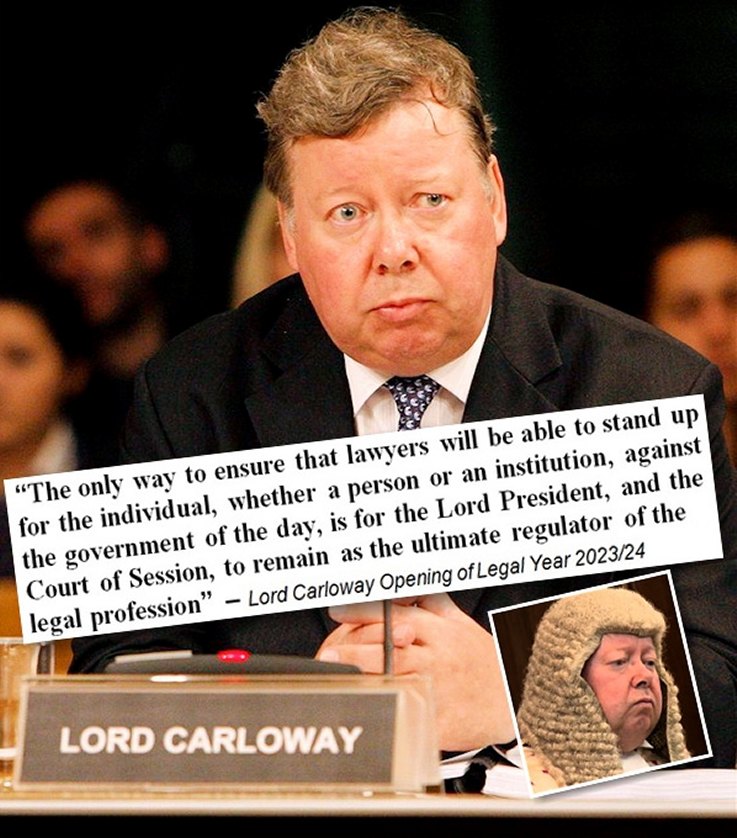
Lord Carloway stated: “The rights of clients, who are the ultimate consumers of legal services, to obtain legal advice, must be protected from interference by the government. The only way to ensure that lawyers will be able to stand up for the individual, whether a person or an institution, against the government of the day, is for the Lord President, and the Court of Session, to remain as the ultimate regulator of the legal profession.”

Regulation of lawyers in Scotland is currently controlled by the Law Society of Scotland, Faculty of Advocates and a lawyer dominated Scottish Legal Complaints Commission (SLCC)

The Scottish Legal Complaints Commission is funded by client fees to solicitors and Advocates who then pay the complaints levy to the Scottish Legal Complaints Commission.

In Scotland, a decades old, repressive and at times highly vindictive regime of lawyers looking after themselves – has seen thousands of clients & consumers of legal services each year – ripped-off by their own solicitors with little or no recompense for the millions of pounds lost to legal services overcharging, theft, embezzlement & outright solicitor client fraud each year in Scotland’s legal services market.

In some of the most appalling cases of Scots lawyers found to have looted their clients assets - legal regulators have reacted to unwanted media coverage by using private briefings and turning newspapers and journalists against each other. In some well known cases, legal regulators encouraged articles against legal reforms, blocked publication of newspaper reports on identified lawyers & law firms, and personally went after ;law reform campaigners who seek nothing more than removing the self regulation element from regulation of legal services and legal representatives in Scotland.

However – despite the public protests of Lord Carloway and other ‘leaders’ of Scotland’s legal profession – including the Dean of the Faculty of Advocates who has also attacked the proposed legal reforms, the reality is the Scottish Government’s Regulation of Legal Services Bill falls far short of what is needed to quell Scots lawyers appetite for ripping off consumers and clients.

And unsurprisingly, according to legal and political sources - there are allegations much of the Scottish Government’s claimed solicitor regulation reform proposals are ‘deliberately deceptive’ and have already been negotiated away with legal interests and political partners in deals to water down what is currently in the bill.

Speaking on condition of anonymity, an MSP who along with others is said to be facing de-selection by their own embittered party – informed journalists of private briefings and meetings between MSPs of all parties - and lawyers and legal regulators who are anxious to ensure much of the already watered down proposals in the reform of legal regulation bill are eliminated or that the entire bill is stalled or axed completely.

No references to any of these meetings appear to exist in entries of the Holyrood lobbying register but it has been established meetings did take place and lawyers who met MSPs appear to believe they succeeded in their lobbying aims, stating so in private lawyer-only social media chat groups.

You can read more about the Scottish Government’s Reform of Legal Services Bill here: Reform of Legal Services Bill - Scottish Parliament

This latest attempt by a Scottish Government and the pro-lawyer Scottish Parliament to reform regulation of lawyers is the third attempt since 2000 – where in 2001 – and amid bitter evidence sessions - Holyrood’s Justice Committee led by Christine Grahame threw out calls for reform of how lawyers cover up complaints for their own colleagues.

A second attempt by another of Holyrood’s Justice Committees in 2006 saw arm twisting from legal regulators to shelve much of the proposals in the Legal Profession & Legal Aid Bill, which became law in 2007 after multiple amendments lodged by MSPs, including Scottish Conservative MSPs on behalf of legal vested interests.

What became the LPLA Act 2007, which led to the formation of the Scottish Legal Complaints Commission in 2008 – which in turn has led to some fifteen years and counting of disastrous complaints regulation by an overly false legal regulator which is in fact staffed and run by the same lawyers and vested legal interests who ran complaints at the Law Society of Scotland.

To make matters worse, the Scottish Legal Complaints Commission later set into policy a system which intimidated clients who had already been ripped off by their solicitors – into signing Non Disclosure Agreements to conceal thousands of complaints against Scots multiple law firms over the last decade – with many law firms appearing week after week at the Scottish Legal Complaints Commission to demand complainants sign more NDAs to conceal some of the worst and repetitive acts against clients which even the old Law Society of Scotland regime failed to keep away from public gaze.

And, it should be noted the Scottish Legal Complaints Commission has cost clients of Scottish solicitors around £40million pounds in complaints levies – paid for by law firms hiking client fees to meet their annual complaints levy.

Lord President Lord Carloway’s Legal Year address to lawyers, which takes the usual Judicial Office tone of launching threats against one piece of reform legislation, then absorbing another piece of legislation – the Victims, Witnesses and Justice Reform Bill as a form of pro-justice system judicial PR and follow-the-money-supply-to-law-firms – is well worth a read.

It should be glaringly obvious to all the Victims, Witnesses and Justice Reform Bill – more of which can be read here Victims, Witnesses and Justice Reform Bill - Scottish Parliament has only come about because Scotland’s judges, courts & lawyers have been mistreating and preying on victims of crime, abuse & countless other crimes for decades to the point the public and victims themselves demanded action – rather than the action coming willingly from the judiciary or legal profession who seem to believe they own the law.

Lord Carloway’s Opening of the Legal Year 2023-2024 speech can be downloaded here Lord Carloway - Opening of Legal Year Scotland 2023-24 with relevant content below:

Welcome to the opening of the legal year. I thank you all for coming. Since the abolition of formal court terms, today is primarily a ceremonial occasion, but it remains a useful opportunity to reflect on the progress we have made in the past year, and on what will, or at least might, happen next.

I extend a special welcome to Lord Burnett of Maldon, the Lord Chief Justice of England and Wales and thank him particularly for his work during his years in office in ensuring that Scotland's voice was heard on legal matters in the Halls of Westminster and elsewhere.

Law Reform: Regulation of Legal Services and Criminal Justice

Looking to what it is that might happen next, there are two Bills on which views are currently being sought. Each proposes a series of notable reforms to the justice system.

The first is the Regulation of Legal Services. The senior judiciary recently responded to Parliament's call for views on the Bill. They were unanimous in the view that the Bill, as currently drafted, gives rise to serious constitutional concerns about the rule of law and the separation of powers. It is a threat to the independence of the legal profession and the judiciary. If the Bill is passed in its current form, Scotland will be viewed internationally as a country whose legal system is open to political interference. This will have serious adverse consequences.

The rights of clients, who are the ultimate consumers of legal services, to obtain legal advice, must be protected from interference by the government. The only way to ensure that lawyers will be able to stand up for the individual, whether a person or an institution, against the government of the day, is for the Lord President, and the Court of Session, to remain as the ultimate regulator of the legal profession.

On a more encouraging note, the Victims, Witnesses and Justice Reform Bill contains proposals for significant reform of the criminal justice system, many of which are based on the Lord Justice Clerk's Review. The judiciary welcome the reforms insofar as they aim to make giving evidence a less traumatic experience for witnesses, including the creation of a right to anonymity and to independent legal representation for complainers in relation to applications under the rape shield legislation, the establishment of a specialist sexual offences court and the abolition of the not proven verdict.

Overall, the judiciary believe the Bill proposes a number of measures which, in principle, represent improvements to the existing system.

The Criminal Courts: Recover, Renew, Transform

Following the build-up of criminal cases which have waited for a considerable period of time to go to trial as a result of lockdown, the court service began the Recover, Renew and Transform programme in September 2021.

The recovery aspect aimed to restore the courts to their pre-pandemic capacity. It involved recruiting more sheriffs and court staff and the setting up of more High Court and sheriff trial courts. Good progress has been made. The challenge now is an ever-increasing volume of indictments and complaints which libel sexual offences. In the face of this new volume of criminal business, we no longer expect to restore matters to the pre-pandemic position. We need to adjust our expectations and set a new reasonable baseline for the number of cases waiting to go to trial at any one time.

Our modelling predicts that the number of High Court cases waiting for trial will recover to a new reasonable baseline level by March 2025, and sheriff solemn trials by March 2026.

Prisoner escort services are causing those in custody to arrive at court late. This has an impact on the smooth operation of the criminal courts. We are looking to accelerate plans to move to virtual custodies. Pilots have already taken place. As I have said many times before, the need to bring those arrested before a court as soon as practicable, must remain a priority.

The purpose of renewal is to establish better ways of working which promote the resolution of cases at the earliest opportunity. The Summary Case Management pilot continues in Dundee, Hamilton and Paisley Sheriff Courts. It aims to reduce the number of hearings to those which are necessary, by encouraging early resolution through early disclosure. Early disclosure has allowed the Crown to take a more targeted approach to the citation of witnesses. There has been earlier resolution of proceedings brought in the pilot courts and a reduction in the number of witness citations being issued in those proceedings. Work is underway to roll the pilot out to Glasgow Sheriff Court.

Specialist online courts are being set up to deal with domestic abuse cases. The idea is to ensure that the complainer and the accused do not require to meet each other. This reduces potential trauma for complainers.

Juries continue to be balloted remotely, thus sparing the public the inconvenience of coming to court. Over the course of the past year, over 450 police and expert witnesses have given their evidence remotely in High Court trials.

A key component of transformation lies in the implementation of the recommendations of Lady Dorrian's Review. The court service has been making substantial progress in relation to those recommendations which do not require legislation. The creation of facilities to pre-record the evidence of children and vulnerable witnesses and the giving of evidence remotely is being accelerated. We now have designated facilities for commissions in Edinburgh, Glasgow, Inverness and Aberdeen.

Earlier this month, I visited the Bairns' Hoose. The Hoose is designed to feel like a family home. It is based on an international model first developed in Iceland, called the Barnahus, which brings together justice, health, social work and recovery support for children in one location. The Hoose is, in essence, a comfortable and safe space in which children can give evidence, receive medical care, take part in decisions about their protection and obtain support to recover from trauma.

The Hoose is the first of its kind in Scotland. The Barnahus model was first advocated for in early 2016, as part of SCTS's Evidence and Procedure Review. I am very pleased to see it implemented into the system, and I hope that we will see more of them developed in due course.

The Civil Courts: Technology and Transparency

On the civil side, there have been a number of notable technological improvements this year.

The importance of making the people's courts as accessible as possible cannot be understated. The advent of new technology means that we can implement new, more efficient and convenient ways to do this. In June, we officially launched Court of Session Live, a new streaming service for Inner House proceedings. I thank Lord Pentland, and his cross-departmental task force, for their hard work in getting this up and running.

Alongside Court of Session Live, we are publishing information about, and summaries of, upcoming appeals much earlier than we have ever done before. We hope that this will enable those who are interested in viewing proceedings, whether online or in person, to make plans to do so.

We launched the new and improved Civil Online portal in May and have significantly expanded the level of service which the portal offers. In Simple Procedure cases, court users can now raise and respond to actions through the portal.

We secured funding from the Scottish Government to start developing a new case management system for the Office of the Public Guardian. The new interface will provide a more accessible and broader range of online services to the public.

Many of our Tribunals are experiencing growth in the volume of business. The work of the Social Security Chamber is expected to increase significantly. The new Local Taxation Chamber has inherited over 40,000 cases from its predecessor, the Valuation Appeals Committee. We are working closely with the Government to ensure that sufficient resources are made available to support this. Reform of the Tribunal system generally also continues, with the further expansion of the General Regulatory Chamber's jurisdiction, and the potential transfer of the MHT into the First-tier Tribunal during 2024.

The court service are in discussions with the Faculty about the re-establishment of the practice of making justiciary and session papers available to the Advocates Library. This will enable advocates and, via the National Library, members of the public, to view them.

We are working hard to deliver these improvements, but, as ever, we can only do as much as resources allow. We will continue to do what we can within budgetary constraints. I ask only that the government continues to support us by providing us with sufficient funding to continue to deliver core services, as well as these improvements to the system.

Ends.

Earlier relevant coverage from this blog - of how the Legal Profession & Legal Aid Act (2007) was deliberately mangled by the Scottish Government, and Scottish Parliament – which allowed lawyers to continue to regulate themselves to the current date, can be found here: The Legal Profession & Legal Aid (Scotland) Act 2007

Wednesday, August 26, 2020

COURT ON AUDIO, M’LORD: Clients should be given SAME DAY access to Court of Session audio recordings - as ongoing probe reveals QC’s admissions in case linked to Lord Malcolm, Lord Carloway & concealed judicial conflicts of interest

Court recordings should be available same day to clients. AN ONGOING media investigation into hearings in Scotland’s top court – the Court of Session – has received evidence which casts doubt on the integrity of witnesses and  counsel’s actions – which could be remedied if unedited digital audio recordings were required to be provided to clients involved in cases – upon the conclusion of a hearing.

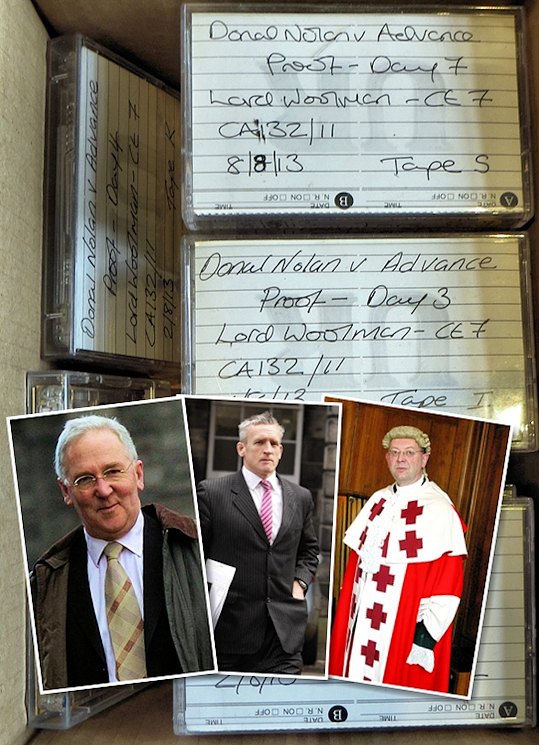
Audio recordings of hearings in a £6million land case Nolan v Advance Construction (Scotland) Ltd provided by a court source – and a study of their content have led to calls for clients who already pay tens of thousands of pounds for their claims to be hard by the Court of Session - to be given unrestricted access to audio records of proceedings in court – without obstruction or prohibitive cost being used to block access to proceedings in their case.

In the case which features in the released audio -  extraordinary exchanges between counsel, witnesses and the judge – Lord Woolman - can be clearly heard and further exchanges were counsel take an unrealistic, if combative approach with local planning officials in attempts to conceal or contradict legislation relating to the dumping of toxic, hazardous waste from the court.

In the cassette tapes of the Court of Session hearings – obtained by journalists from court sources – the audio recordings of interactions between witnesses, John Campbell QC, and the current Dean of the Faculty of Advocates – Roddy Dunlop QC – has since led to a separate investigation which has discovered one of the chief witnesses in Nolan v Advance held compromising interests linked to the defenders – which were concealed from the court and the judge – Lord Woolman.

In one exchange, Dunlop questions a North Lanarkshire Council planning officer – Mr Fraser Miller – on the conditions and legislation which are required for the removal of hazardous material including asbestos. From the recordings and what happened in court, it becomes clear the planning officer says planning permission would be required to remove the asbestos from the site, and the same permission would be required fo the asbestos to be dumped on the site.

As the case proceeds over a number of days in August 2013 before Lord Woolman - Dunlop’s client – Advance Construction (Scotland) Ltd – are ultimately forced to admit to Lord Woolman they were responsible for illegally dumping the toxic material on Mr Nolan’s property.

The audio tapes of the Nolan v Advance hearings go on to reveal many discrepancies between the accounts of what John Campbell QC said to his own client, and what actually transpired in court – including the as yet unexplained reasons why Campbell QC removed much of his own client’s financial claims – and critically the claim for legal expenses – without receiving any instruction to do so.

While it is important to note this case was initially won by Mr Nolan - the pursuer –  the failure of counsel to return to court for legal expenses against the defender led to financial loss & disaster after counsel for the pursuer turned on his own client by inexplicably stripping out much of the financial claim – an act which Lord Woolman said he had never seen in such a case.

A full report on how John Campbell QC reduced his own client’s financial claim almost to zero and without any instruction or consultation - can be found here: CASHBACK QC: Legal regulator’s files reveal senior QC reduced claim without instructions, withheld key evidence & witnesses including Cabinet Secretary from Court of Session case

Readers may be familiar with Nolan v Advance - one of the most extraordinary cases in recent times - which has since led to the discovery of carefully concealed interests of Court of Session judge Lord Malcolm (Colin Campbell QC) and Scotland’s current top judge – Lord Carloway (Colin Sutherland).

During a consultation between journalists currently engaged in the probe and court sources, further issues in the Nolan v Advance case have now come to light including a source which identified a comment between counsel to the effect of an unreferenced instruction with some degree of motivation - which states “you have got to four o’clock to get this sorted”.

And now – further audio recordings have been provided to journalists which lay down in crystal clear terms an extraordinary attitude on payment of fees on the part of the pursuer’s legal team – which included John Campbell QC, advocate Craig Murray and solicitor Gregor McPhail.

The legal team for Mr Nolan had previously signed up to a no win no fee agreement – which Campbell admits to in the recordings.

However, and without hesitation Campbell then appears to turn against the fee deal and demands his team all be paid – this coming after further material and already published emails revealed John Campbell demanded, and insisted on collecting  in person – cash sums of up to five thousand pounds at a time from his client Mr Nolan.

In one exchange – Campbell QC says “As fond as I am of you, none of us are doing this for love and neither is Craig [Murray]”

Campbell is then challenged over his already agreed position of working on the case via a no win no fee deal

John Campbell agrees he was working on a no win no fee deal but then replies: “That is correct, hmmm but we just have to see whether that actually holds up because hmm you know…”

A number of further recordings are now being studied where it is acknowledged by counsel Lord Woolman states he is  concerned about counsel’s lack of provision to the judge of evidence given by certain witnesses for the pursuer, Mr Nolan.

In an additional audio provided to journalists, John Campbell QC - who now heads the Edinburgh based Quaich Project – clearly admits responsibility for key failures in his presentation of evidence to the court.

Journalists and technical experts are now considering the content of the court recordings for futher publication and potential inclusion in reports to the Scottish Parliament’s Justice Committee of events in the Nolan v Advance case which identify a pattern of deliberate and concealed conflicts of interest by judges in the Court of Session.

And - in another court case where recordings have also come to light, it is also very clear what happens in court is very loosely transcribed to parties when there are requests by court participants for transcripts – some costing clients tens of thousands of pounds over hearing after hearing.

In a further case presented to the media team looking into Court of Session audio recordings - a court source has come forward with claims that a transcribing firm who were given court recordings as part of an order for transcripts - were told in a phone call to go easy on certain dates across hearings in one major case - and pay less emphasis to one side’s counsel in their provision of a final transcript ordered by the other side’s legal team.

A legal insider who has been given access to some of the audio material handed over to journalists now believes clients should be given unfettered access to recordings of their cases in court.

He said: “Clients pay a lot of money for their legal representatives to take a case through to the Court of Session and should be provided with audio recordings of each day’s proceedings at the end of that day”

He added: “The equipment to record court hearings has been installed for some time, and this should be properly used to ensure clients on both sides of the court have access to these recordings, without any attempt by court staff or the sitting judge to use unsatisfactory excuses or prohibitive costs as a reason for withholding audio access to those who are paying for the hearings.”

Currently, clients can request a copy of recordings from the Court of Session to be transcribed by an external private company, however – seldom if ever do the actual audio recordings pass into the hands of clients or either side’s legal team.

Clients must pay for the transcribing of the court recordings in what can run into bills of tens of thousands of pounds, however – there are notes of many cases where court staff, and the judge have blocked a client’s request to obtain transcripts of proceedings – and even when the court has agreed to transcription in some cases – clients and legal teams have identified multiple omissions in transcripts which suggest a motivated approach was taken to omit particular evidence from print.

For the media, a different approach to recording and broadcasting from the Court of Session & High Court of Justiciary currently exists in the following format:

Protocol on Recording and Broadcasting of Proceedings in the High Court of Justiciary and the Court of Session, and the Use of Live Text Based Communications from Court

Broadcast: Except where the context otherwise requires, for the purposes of the Protocol, "broadcast" means the transmission to members of the public of a video and/or audio recording; or live streaming. For the purposes of the Protocol, a recording refers to a video and/or audio recording. Broadcast may be for live streaming, news broadcast or documentary production. Individual sections within the Protocol identify the extent to which broadcasting may be permitted for a particular type of case.

Guiding Principle: The guiding principle is that broadcast of court proceedings is in the interests of open justice and for the information and education of the public.

Judicial Control: Subject to the guiding principle, whether a hearing should be recorded must remain under judicial control. The court may rule that, in any given case, recording a hearing would not be in the interests of justice.

Fair and Accurate Reporting: A report or presentation of proceedings that includes a broadcast of a hearing must be fair and accurate, having regard to the overall content of the report or presentation and the context in which the broadcast is presented. It must not be used for: the purposes of a party political broadcast; advertisement or promotion (except where such advertisement or promotion relates to a report or presentation that includes the broadcast); light entertainment; comedy or satirical purposes.

For the purposes of the Protocol, a media party means a journalist registered with the Scottish Courts and Tribunals Service (SCTS), or a party who can provide sufficient, appropriate evidence of relevant journalistic or documentary work. Any media party wishing to record a hearing is required to submit an application using one of the prescribed forms

Applications must be submitted to Judicial Communications for consideration by the Broadcast Working Group well in advance of the date of commencement of proceedings. On receipt of an application, the Broadcast Working Group must notify the presiding/chairing judge and ask him, or her, to provide to the Broadcast Working Group any comment or response which he, or she, may have on the application within an agreed time. Once the Broadcast Working Group has considered any such comment or response, it must make a recommendation to the Lord Justice General (or Lord Justice Clerk) as to whether the application ought to be approved. The final decision lies with the Lord Justice General or, in the absence of the Lord Justice General, with the Lord Justice Clerk. Approval may permit recording to take place in accordance with sections 2 to 5, or in accordance with any additional conditions as may be specified.

A decision on the application must be intimated to the media party within an agreed time. In the event of an application being refused, in whole or part, written reasons must be provided by the Broadcast Working Group.

In the event of an application being refused, in whole or part, the media party may submit an amended application taking into account the reasons for refusal.

If permission to record is granted, the Broadcast Working Group must appoint an SCTS staff member as a liaison officer. That officer is the point of contact between the media party and the court for all purposes connected with the recording.

If permission to record proceedings is granted, the presiding/chairing judge retains responsibility for ensuring that: the grant of permission remains appropriate; the recording is carried out on the terms approved by the Broadcast Working Group; and the recording is carried out in a way which does not disrupt court business. If, at any stage in the proceedings, the judge forms the view that to proceed with the recording would constitute a threat to the administration of justice, or that such a risk is present, or that the media party has breached the Protocol or any condition imposed, the presiding/chairing judge may withdraw the permission. If the presiding/chairing judge is considering withdrawing permission, an opportunity should be afforded to the media party to make representations to the judge before a final decision is reached.

Despite the progress of technology in the world outside of Scotland’s creaky Victorian courts and justice system, recording and broadcasting of what goes on in Scotland’s courts has not yet had the full impact on increasing transparency and accountability in the justice system which the same application of audio and video technology have had in courts in other jurisdictions.

Currently, the media must rely on a ‘judge-led’ review chaired by Lady Dorrian – who was appointed to chair it by Lord Brian Gill, Scotland’s former Lord President and Lord Justice General who famously liked to go after the media and block access to courts and documents during his short three year term as Lord President in which he continually held the media, and transparency in disdain.

Report of the Review of Policy on Recording and Broadcasting of Proceedings in Court, and Use of Live Text-Based Communications

A judge-led group which was appointed by the Lord President to review the current policy on the recording and broadcasting of proceedings and the use of live text-based communications from Scottish courts has published its report.

The review group, chaired by Lady Dorrian, has made a series of recommendations following a public consultation exercise, to which 17 individuals and organisations responded.

The review, which examined the existing practice in Scotland and other jurisdictions, was carried out in the context of a complete acceptance of the importance of the principle of open justice, recognising however that any steps taken in support of this principle must not pose any risk to the administration of justice.

In summary, the report recommends the following:

  • Filming of civil and criminal appeals, and legal debates in civil first instance proceedings, such as judicial review or procedure roll hearings, should be allowed for live transmission. Subsequent news broadcasting and documentary film-making should be allowed subject to clear and comprehensive guidelines.
  • The court should allow criminal trials to be filmed for documentary purposes in certain circumstances, subject to the safeguards referred to in the report. Cases involving children, sexual offences and vulnerable witnesses should not be filmed.  
  • No live transmission or filming for subsequent news broadcast should be allowed for criminal first instance business or for civil proceedings involving witnesses.  
  • For subsequent news broadcasts, the delivery of sentencing remarks of the judge should be permissible, with filming focused only on the sentencing judge. 
  • Filming of criminal trials for live transmission should not be allowed. 
  • In civil cases at first instance, filming for documentary purposes only should be allowed, but should exclude certain groups such as family cases and those involving asylum seekers.   
  • A structured approach to considering applications to film. 
  • All filming should be subject to robust, clear and comprehensive guidelines.   
  • Journalists who register in advance with the Scottish Court Service should be permitted the use of live text-based communications such as Twitter from court, subject to guidelines which will be issued in due course.  

The Lord President, Lord Gill said: “I am grateful to Lady Dorrian and her group for having carried out this exercise so thoroughly. These well-considered recommendations have the support of the judges. I accept all of the recommendations. They are entirely appropriate in the contemporary world. My office will now prepare guidance on the implementation of Lady Dorrian’s report.”

On 18 October 2012, the Lord President, Lord Gill, appointed a judicially led media review group, whose remit was to review policy on the recording and broadcasting of proceedings in court. This was later extended to include consideration of the use of live, text-based communications (LTBC) from court.

Guidance on the conditions under which cameras could be allowed in court was previously contained in a practice note issued by Lord President Hope in 1992. These conditions were revised by Lord President Hamilton in 2012. The revised conditions allowed filming to take place without the consent of all parties involved. The production company and broadcaster had to provide an undertaking to the presiding judge that the final broadcast would not identify those who had not consented to the filming.

The passage of time since guidance was issued, together with the development of social media, the use of instant text-based communication and the broadcasting of proceedings before the UK Supreme Court have all contributed towards a need to review this matter. When filming for documentary purposes has taken place in Scotland, the guidelines have had to be complemented by detailed negotiations as to the precise terms in each case. In appointing this review group, the Lord President considered that a more structured approach was desirable, not least in the interests of consistency.

The review was chaired by Lady Dorrian. The other members were: Lord Bracadale, Lord Woolman, Sheriff Principal Stephen, and Sheriff Drummond. The group was supported by: Christopher Nicholson, Deputy Legal Secretary to the Lord President; Elizabeth Cutting, Head of Judicial Communications; Steven D’Arcy, Head of Strategy and Governance, Judicial Office for Scotland.

Friday, January 17, 2020

SUPREME COURT INTERESTS : Prorogation case judge Lord Reed who failed to declare role in appointment of Scotland’s Prorogation Judicial Review ruling top judge Lord Carloway - takes over as new President of UK Supreme Court

President of UK Supreme Court Lord Reed. A TOP JUDGE who failed to declare a potential conflict of interest in relation to last year’s Supreme Court ruling on the unlawful suspension of Parliament – has taken over the role of President of the UK Supreme Court (UKSC) from Lady Brenda Hale.

Amid media plaudits from Lord Hope – who currently serves with other Scottish judges in courts in the United Arab Emirates & Gulf States - where Human Rights abuses, domestic abuse & trafficking in migrant workers lead the order of business -  Lord Reed - Robert John Reed (Baron Reed of Allermuir) – who has previously sat at the European Court of Human Rights and on a string of other appointments – now presides over the UK’s most powerful court.

Prior to his appointment to the Supreme Court in February 2012 - after the death of Lord Rodger, Lord Reed sat in the Outer House of the Court of Session, and became principal commercial judge in 2006.

Lord Reed was then appointed a Privy Councillor – a position enjoyed by other Court of Session judges such as Lord Malcolm (real name Colin Campbell QC) and joined the Inner House of the Court of Session where he sat from 2008 to 2012.

However, in September 2019 - when the UK Supreme Court upheld the prorogation case brought by MSP Joanna Cherry (and others) – documents obtained from the Scottish Government revealed Lord Reed sat on the same appointments panel which recommended Lord Carloway for the position of Lord President – Carloway (real name Colin Sutherland).

Lord Carloway is the same judge who upheld the Judicial Review case brought by the same MSP – Joanna Cherry (and others) in Scotland, against the prorogation of Parliament.

In the findings of three Scottish appeal court judges – headed by Lord Carloway himself, – Lord Carloway upheld the respondents contention that the Prime Minister’s advice to HM the Queen that the United Kingdom Parliament should be prorogued from a day between 9 and 12 September until 14 October was unlawful because it had the purpose of stymying Parliament.

In that ruling, Lord President, Lord Carloway, decided that although advice to HM the Queen on the exercise of the royal prerogative of prorogation Parliament was not reviewable on the normal grounds of judicial review, it would nevertheless be unlawful if its purpose was to stymie parliamentary scrutiny of the executive, which was a central pillar of the good governance principle enshrined in the constitution; this followed from the principles of democracy and the rule of law. The circumstances in which the advice was proffered and the content of the documents produced by the respondent demonstrated that this was the true reason for the prorogation.

Scrutiny of Papers obtained via Freedom of Information legislation and published in 2016 from the Scottish Government – revealed the same UKSC judge Lord Reed – also sat on the selection panel which recommended the appointment of Lord Carloway (Colin Sutherland) as Lord President in 2015.

The failure of Lord Reed to declare he sat on the appointments panel which recommended Lord Carloway for the top judicial job in Scotland – is one of two potential conflicts of interest for the Supreme Court judge which should have been aired and debated for recusal - prior to the UKSC hearing on the suspension of the Westminster Parliament.

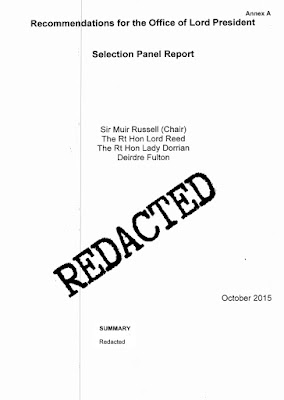
How judges select Scotland’s judges - in secret Documents obtained from the Scottish Government revealed Lord Reed sat on the selection panel for the office of Lord President - along with Sir Muir Russell, Judge Lady Dorrian, and Deirdre Fulton – considered five candidates for the position of Scotland’s top judge.

This same panel – which included Lord Reed – went on to recommend Lord Carloway for the position as Lord President & Lord Justice General of the Court of Session.

Written exchanges between civil servants and the selection panel which are included in the released papers - reveal a short listing meeting was held on 1 September 2015.

The panel considered that two applicants Lord Carloway [Redacted] merited an interview on the basis of the quality of their applications.

Two emails from Lord Reed, dated 14th ^ 15 October 2015 – released by the Scottish Government in the FOI documents - give a minimal, and heavily redacted description of Lord Reed’s role in the panel’s work, which ultimately recommended Lord Carloway for the position of Scotland’s top judge.

In one email, Lord Reed states: “This strikes me as an excellent report. I have made a few minor suggestions as shown on the attached version. Most of the suggestions are trivial, [redacted]”

In a second email Lord Reed writes “I am content with the amended report. I agree, in particular, with the points which were made by Leeona. The amended version beems to me to present an accurate account, and a fair and balanced assessment [redacted]”

A further potential interest not declared, brought ot the attention of journalists by a legal source, identifies Lord Reed’s work together with Lord Carloway – on a ‘compatibility issues review’ to consider if the High Court of Justiciary in Scotland would still have to give permission for appeals in criminal cases to go forward to the UK Supreme Court.

The review group was itself established by Lord Carloway, with others appointed to the group being Lord Reed (Deputy President of the UKSC), and others - Lady Dorrian (Lord Justice Clerk); David Harvie (Crown Agent); Roddy Dunlop QC (Treasurer of the Faculty of Advocates); and John Scott QC (President of the Society of Solicitor Advocates).

The review concluded - "Appeals to the Supreme Court of the United Kingdom (UKSC) should not require certification by the High Court of Justiciary that the issue raises a point of law of general public importance, a review chaired by the Lord Justice General has concluded."

Although – it should be pointed out – coincidentally, the review on appeals to the UKSC – limited to appeals in criminal cases - came too late to help in several serious cases of judicial conflicts of interest in Scotland – particularly on a well known case where Court of Session judge & Privy Councillor - Lord Malcolm (Colin Campell QC) heard a case up to eight times - while failing to declare his own son represented the defenders in multi million pound damages action.

A report on the Lord Malcolm conflict of interest case can be found here: CONFLICT OF INTEREST: Papers lodged at Holyrood judicial interests register probe reveal Court of Session judge heard case eight times - where his son acted as solicitor for the defenders.

The two potential conflicts of interest, not declared by Lord Reed in relation to what was a law changing UKSC ruling of significant impact – again highlight the need for a publicly available Register of judges’ interests - to ensure members of the judiciary do not forget to disclose interests which may have a bearing on cases before them.

The issue also brings into question again, the self imposed secrecy on judicial interests by the judges of the UK Supreme Court and wider UK Judiciary – who have resisted calls to become more transparent and declare their interests in the same way all public servants and elected politicians are required to declare in publicly available registers of interest.

The current stance of UK Supreme Court judges on transparency in relation to declarations of interest, is a point blank refusal by the judiciary to comply with the public expectation of transparency.

The UK Supreme Court’s website states the following in relation to judicial expenses and interests:

Justices' interests and expenses

Background

Prior to the creation of the Supreme Court of the United Kingdom, the highest court in the UK was the Appellate Committee of the House of Lords. The members of the Committee were Lords of Appeal in Ordinary appointed under the Appellate Jurisdiction Act 1876. Although those appointments gave them full voting and other rights in the House of Lords, the Law Lords had for some years voluntarily excluded themselves from participating in the legislative work of the House. Notwithstanding that, they were bound by the rules of the House and provided entries for the House of Lords Register of Interests.

On the creation of the Supreme Court the Lords of Appeal in Ordinary became Justices of the Supreme Court. They retain their titles as Peers of the Realm, but are excluded by statute from sitting or voting in the House, for so long as they remain in office as Justices of the Supreme Court. As such, they are treated as Peers on leave of absence; and do not have entries in the House of Lords Register of Interests. Historical information remains accessible via the House of Lords website.

Other judges in the UK, such as the judges of the Court of Appeal and the High Court in England and Wales, and in Northern Ireland, and the Court of Session in Scotland, do not have a Register of Interests. Instead they are under a duty to declare any interest where a case comes before them where this is or might be thought to be the case.

Current position

Against this background the Justices have decided that it would not be appropriate or indeed feasible for them to have a comprehensive Register of Interests, as it would be impossible for them to identify all the interests, which might conceivably arise, in any future case that came before them. To draw up a Register of Interests, which people believed to be complete, could potentially be misleading. Instead the Justices of the Supreme Court have agreed a formal Code of Conduct by which they will all be bound, and which is now publicly available on the UKSC website.

In addition all the Justices have taken the Judicial Oath - and they all took it again on 1 October 2009 - which obliges them to "do right to all manner of people after the law and usages of this Realm without fear or favour, affection or ill will"; and, as is already the practice with all other members of the judiciary, they will continue to declare any interest which arises in the context of a particular case and, if necessary, recuse themselves from sitting in that case - whether a substantive hearing, or an application for permission to appeal.

In relation to the UK Supreme Court’s stance on declarations of interests, and declarations of conflicts of interest, Diary of Injustice reported on the issue in detail during 2017, here: SUPREME SECRETS: UK Supreme Court refuses to publish recusal data - Court rejects release of info on UKSC justices' conflicts of interest in response to Freedom of Information recusals probe on top UK court

During the probe of UKSC recusals and failure to declare interests, a common thread of dishonesty was noted in court staff’s handling of a Freedom of Information request from Scotland – which was only answered after coverage of the issue in The National newspaper, which prompted the Information Commissioner’s Office to order the court to respond to the request.

Lord Reed’s limited biography on the UK Supreme Court website (reprinted below) does not feature either of the issues identified linking the judge to Lord Carloway’s appointment as Lord President nor any mention of review & other work undertaken with Lord Carloway – including the UK Supreme Court sitting in Edinburgh, which included Lord Carloway as a sitting judge on the UKSC panel.

The announcement by 10 Downing Street of Lord Reed’s appointment as President of the UK Supreme Court in July 2019 read as follows:

The Rt Hon Lord Reed will succeed Baroness Hale of Richmond as President of the Supreme Court of the United Kingdom, alongside three additional appointments as Justices.

The Queen has been pleased to confer a peerage of the United Kingdom for Life on Lord Reed upon his appointment as the President of the Supreme Court in recognition of the contribution that he has made to law and justice reform.

Lord Reed will take up the position of President on 11 January 2020. Lord Justice Hamblen, Lord Justice Leggatt and Professor Andrew Burrows will join the Supreme Court as justices on 13 January, 21 April and 2 June 2020 respectively.Her Majesty The Queen made the appointments on the advice of the Prime Minister and Lord Chancellor, following the recommendations of independent selection commissions.

Lord Reed will replace Lady Hale who retires on 10 January 2020 after serving as President of the Supreme Court since September 2017.

LORD REED UKSC BIOGRAPHY:

Lord Reed was appointed as a Justice of the Supreme Court in February 2012 and has served as Deputy President since June 2018. Prior to his appointment to the Supreme Court he served as a judge in Scotland, sitting from 1998 to 2008 in the Outer House of the Court of Session, where he was the Principal Commercial and Companies Judge, and from 2008 to 2012 in the Inner House.

He was educated at the Universities of Edinburgh and Oxford, and qualified as an advocate in Scotland and as a barrister in England and Wales. He practised at the Scottish Bar in a wide range of civil cases and also prosecuted serious crime.

As well as sitting on the Supreme Court and the Judicial Committee of the Privy Council, he is a member of the panel of ad hoc judges of the European Court of Human Rights, and a Non-Permanent Judge of the Hong Kong Court of Final Appeal. He is also the High Steward of Oxford University.

IMPORTANT NOTE: Readers should note this article does not take sides in the brexit debate. This article is a reporting of a failure by a UK Supreme Court judge to declare or discuss relevant interests and a potential failure to recuse - by a senior judge who is the new President of the UK Supreme Court.

Sunday, September 29, 2019

SUPREME INTERESTS: UK Supreme Court Judge Lord Reed's undeclared links to Lord Carloway selection panel & appeal review work - will not alter UKSC "unlawful" Parliament suspension ruling - but should feature in register of judges' interests

UKSC judge Lord Reed linked to Lord Carloway job panel. A POTENTIAL undeclared conflict of interest of the next President of the UK Supreme Court (UKSC) – in relation to a recent ruling on the unlawful suspension of Parliament - has been discovered from documents obtained from the Scottish Government.

Papers obtained via Freedom of Information legislation and published in 2016 reveal that Scottish judge Lord Reed – who has sat on the Supreme Court since 2012 – also sat on the selection panel which recommended the appointment of Lord Carloway (Colin Sutherland) as Lord President in 2015.

The potential conflict of Lord Reed - identified during discussions with legal sources – has a bearing (but no overall effect) on the ruling by eleven Supreme Court justices in relation to the findings of three Scottish appeal court judges – headed by Lord Carloway – who declared Prime Minister Boris Johnson’s decision to suspend parliament in the run-up to the October Brexit deadline as unlawful.

In that ruling, Lord President, Lord Carloway, decided that although advice to HM the Queen on the exercise of the royal prerogative of prorogating Parliament was not reviewable on the normal grounds of judicial review, it would nevertheless be unlawful if its purpose was to stymie parliamentary scrutiny of the executive, which was a central pillar of the good governance principle enshrined in the constitution; this followed from the principles of democracy and the rule of law. The circumstances in which the advice was proffered and the content of the documents produced by the respondent demonstrated that this was the true reason for the prorogation.

However, the failure of Lord Reed to declare he sat on the appointments panel which recommended Lord Carloway for the top judicial job in Scotland – is one of two potential conflicts of interest for the Supreme Court judge which may have required to have – at the very uleast - been aired and debated for recusal - prior to the UKSC hearing on the suspension of the Westminster Parliament.

How judges select Scotland’s judges - in secret Scottish Government documents previously obtained by the media revealed the selection panel for the office of Lord President - of which Lord Reed was a member, along with Sir Muir Russell, Judge Lady Dorrian, and Deirdre Fulton – considered five candidates for the position of Scotland’s top judge.

Written exchanges between civil servants and the selection panel which are included in the released papers - reveal a short listing meeting was held on 1 September 2015.

The panel considered that two applicants Lord Carloway [Redacted] merited an interview on the basis of the quality of their applications.

Two emails from Lord Reed, dated 14th ^ 15 October 2015 – released by the Scottish Government in the FOI documents - give a minimal, and heavily redacted description of Lord Reed’s role in the panel’s work, which ultimately recommended Lord Carloway for the position of Scotland’s top judge.

In one email, Lord Reed states: “This strikes me as an excellent report. I have made a few minor suggestions as shown on the attached version. Most of the suggestions are trivial, [redacted]”

In a second email Lord Reed writes “I am content with the amended report. I agree, in particular, with the points which were made by Leeona. The amended version beems to me to present an accurate account, and a fair and balanced assessment [redacted]”

A further potential interest not declared, brought ot the attention of journalists by a legal source, identifies Lord Reed’s work together with Lord Carloway – on a ‘compatibility issues review’ to consider if the High Court of Justiciary in Scotland would still have to give permission for appeals in criminal cases to go forward to the UK Supreme Court.

The review group was itself established by Lord Carloway, with others appointmed to the group being Lord Reed (Deputy President of the UKSC), and others - Lady Dorrian (Lord Justice Clerk); David Harvie (Crown Agent); Roddy Dunlop QC (Treasurer of the Faculty of Advocates); and John Scott QC (President of the Society of Solicitor Advocates).

The review concluded - "Appeals to the Supreme Court of the United Kingdom (UKSC) should not require certification by the High Court of Justiciary that the issue raises a point of law of general public importance, a review chaired by the Lord Justice General has concluded."

Although – it should be pointed out – coincidentally, the review on appeals to the UKSC – limited to appeals in criminal cases - came too late to help in several serious cases of judicial conflicts of interest in Scotland – particularly on a well known case where Court of Session judge & Privy Councillor - Lord Malcolm (Colin Campell QC) heard a case up to eight times - while failing to declare his own son represented the defenders in multi million pound damages action.

A report on the Lord Malcolm conflict of interest case can be found here: CONFLICT OF INTEREST: Papers lodged at Holyrood judicial interests register probe reveal Court of Session judge heard case eight times - where his son acted as solicitor for the defenders.

The two potential conflicts of interest, not declared by Lord Reed in relation to what is a law changing UKSC ruling of significant impact – again highlight the need for a publicly available Register of judges’ interests - to ensure members of the judiciary do not forget to disclose interests which may have a bearing on cases before them.

The issue also brings into question again, the self imposed secrecy on judicial interests by the judges of the UK Supreme Court and wider UK Judiciary – who have resisted calls to become more transparent and declare their interests in the same way all public servants and elected politicians are required to declare in publicly available registers of interest.

The current stance of UK Supreme Court judges on transparency in relation to declarations of interest, is a point blank refusal by the judiciary to comply with the public expectation of transparency.

The UK Supreme Court’s website states the following in relation to judicial expenses and interests:

Justices' interests and expenses

Background

Prior to the creation of the Supreme Court of the United Kingdom, the highest court in the UK was the Appellate Committee of the House of Lords. The members of the Committee were Lords of Appeal in Ordinary appointed under the Appellate Jurisdiction Act 1876. Although those appointments gave them full voting and other rights in the House of Lords, the Law Lords had for some years voluntarily excluded themselves from participating in the legislative work of the House. Notwithstanding that, they were bound by the rules of the House and provided entries for the House of Lords Register of Interests.

On the creation of the Supreme Court the Lords of Appeal in Ordinary became Justices of the Supreme Court. They retain their titles as Peers of the Realm, but are excluded by statute from sitting or voting in the House, for so long as they remain in office as Justices of the Supreme Court. As such, they are treated as Peers on leave of absence; and do not have entries in the House of Lords Register of Interests. Historical information remains accessible via the House of Lords website.

Other judges in the UK, such as the judges of the Court of Appeal and the High Court in England and Wales, and in Northern Ireland, and the Court of Session in Scotland, do not have a Register of Interests. Instead they are under a duty to declare any interest where a case comes before them where this is or might be thought to be the case.

Current position

Against this background the Justices have decided that it would not be appropriate or indeed feasible for them to have a comprehensive Register of Interests, as it would be impossible for them to identify all the interests, which might conceivably arise, in any future case that came before them. To draw up a Register of Interests, which people believed to be complete, could potentially be misleading. Instead the Justices of the Supreme Court have agreed a formal Code of Conduct by which they will all be bound, and which is now publicly available on the UKSC website.

In addition all the Justices have taken the Judicial Oath - and they all took it again on 1 October 2009 - which obliges them to "do right to all manner of people after the law and usages of this Realm without fear or favour, affection or ill will"; and, as is already the practice with all other members of the judiciary, they will continue to declare any interest which arises in the context of a particular case and, if necessary, recuse themselves from sitting in that case - whether a substantive hearing, or an application for permission to appeal.

In relation to the UK Supreme Court’s stance on declarations of interests, and declarations of conflicts of interest, Diary of Injustice reported on the issue in detail during 2017, here: SUPREME SECRETS: UK Supreme Court refuses to publish recusal data - Court rejects release of info on UKSC justices' conflicts of interest in response to Freedom of Information recusals probe on top UK court

During the probe of UKSC recusals and failure to declare interests, a common thread of dishonesty was noted in court staff’s handling of a Freedom of Information request from Scotland – which was only answered after coverage of the issue in The National newspaper, which prompted the Information Commissioner’s Office to order the court to respond to the request.

Lord Reed’s limited biography on the UK Supreme Court website (reprinted below) does not feature either of the issues identified linking the judge to Lord Carloway’s appointment as Lord President nor any mention of review & other work undertaken with Lord Carloway – including the UK Supreme Court sitting in Edinburgh, which included Lord Carloway as a sitting judge on the UKSC panel.

LORD REED BIOGRAPHY:

Robert John Reed, Lord Reed became Deputy President of The Supreme Court on 7 June 2018. He was appointed as a Justice of The Supreme Court in February 2012.

He studied law at Edinburgh University and undertook doctoral research in law at the University of Oxford. He qualified as an advocate in Scotland and as a barrister in England. He practised at the Scottish Bar in a wide range of civil cases, and also prosecuted serious crime.

He served as a senior judge in Scotland for 13 years. From 2008 to 2012 a member of the Inner House of the Court of Session, and from 1998 to 2008 a member of the Outer House of the Court of Session, where he was the Principal Commercial Judge.

As well as sitting on the Supreme Court and the Judicial Committee of the Privy Council, he is also a member of the panel of ad hoc judges of the European Court of Human Rights, and is a Non-Permanent Judge of the Court of Final Appeal in Hong Kong. He is also the Visitor of Balliol College, Oxford.

Lord Reed is one of the two Scottish Justices of The Supreme Court.

To update readers – on 24 July 2019, the last working day of Prime Minister Theresa May, HM the Queen appointed Lord Reed to serve as the President of the Supreme Court of the United Kingdom and declared her intention to raise him to the peerage. 

Lord Reed will take over as President of the United Kingdom Supreme Court from Baroness Hale of Richmond on 11 January 2020.

IMPORTANT NOTE: Readers should note this article does not take sides in the brexit debate. Rather this article is a reporting of a failure to declare or discuss relevant interests and a potential failure to recuse - by a senior judge who has been appointed as the new President of the UK Supreme Court.

Wednesday, November 29, 2017

GOOD FOR LAWYERS: Challenging year for 'toothless, waste of time' Scottish Legal Complaints Commission as complaints against lawyers rise again amid claims regulator has little impact on rogues of the legal world

Lawyers regulator proves no deterrent to poor legal services. SCOTLAND’S ‘independent’ regulator of legal services has admitted complaints against rogue solicitors & law firms have again risen in the past “challenging year” according to the latest Annual Report 2016-17 of the Scottish Legal Complaints Commission (SLCC).

The SLCC’s past year was marked by the Anderson Strathern appeal, in which Court of Session judge Lord Malcolm – real name Colin Campbell QC - ruled unlawful the SLCC's previous practice of classifying certain single issue complaints as hybrid (raising issues of both service and conduct).

However, an investigation of the ruling by Lord Malcolm – who is also a Privy Councillor – revealed a top QC who was identified in complaints relating to the acceptance of £5,000 a time cash payments  and accusations of misrepresenting clients in a case directly involving Lord Malcolm - escaped investigation as a result of the same Court of Session ruling on 31 August 2016.

Earlier this year, the SLCC was branded a “toothless waste of time” by Alex Neil MSP (SNP Airdrie and Shotts) – who called for major reform of the Scottish Legal Complaints Commission after a Sunday Mail investigation revealed the SLCC refused to investigate serious complaints & cash payments involving ‘top’ planning law QC John Campbell (67) of Hastie Stable & Trinity Chambers.

Speaking to the Sunday Mail, Alex Neil said: “These technicalities show the SLCC as it stands is a waste of time. It’s not up to the job and we need major change.”

Mr Neil continued: “Parliament’s justice committee should have an urgent and comprehensive look at this and rewrite the legislation so people have a reasonable time to register legitimate complaints.”

“People need assurance that the legal profession isn’t just looking after itself all the time. People have no confidence in the system.”

A full report on the John Campbell case impacted on by Lord Malcolm’s ruling can be found here: CASH ADVANCE: QC says ‘Can I have £5k cash on the way to the Law Society?’ - MSP calls for reform of ‘toothless’ Scottish Legal Complaints Commission as regulator turns blind eye on Advocates cash payments scandal.

Further litigation occurred with the Law Society of Scotland over the SLCC's power to then reclassify cases, in which the court eventually found for the Legal Complaints Commission but resulted in a large number of complaints being suspended, with no progress made until the ruling in June.

Over the year, complaints received rose from 1,132 to 1,155, up 2% on top of the previous year’s 12% rise.

However, an analysis of the complaints statistics, and contact with persons raising complaints with the pro-lawyer Scottish Legal Complaints Commission reveal the SLCC is more often than not – too eager to knock back complaints against solicitors – in a similar manner once practiced by the Law Society of Scotland.

In the past year, a total of 414 cases were accepted for conduct or service investigation, or a combination of the two (previous year 408), and 171 (compared with 226) were deemed ineligible as time barred or being "frivolous, vexatious or totally without merit".

A further 251 cases (previous year 188) were resolved, withdrawn or discontinued without a formal investigation.

Solicitors accounted for 410 of the complaints accepted while 4 of the cases related to members of the Faculty of Advocates.

However, this year, the success rate of mediation was much lower – indicating perhaps complainants have become wise to a process dubbed as “rigged” by some, after it was discovered some ‘independent’ mediators have connections to some of the law firms facing complaints investigations.

In the past year, mediated resolutions were achieved in only 27 complaints (44 the previous year), a lower success rate than previously at 58%.

Sixty three cases were resolved during or at the conclusion of the investigation stage (down from 128), and the number receiving a final determination by a committee of commissioners fell from 102 to 95, of which 44 (down from 58) were upheld in whole or part.

The number of investigations in hand at the year end rose from 664 to 807, having jumped from 473 at the start of the previous year.

Residential conveyancing was again the most frequent area of complaint, at 22% of those received, closely followed by litigation (21%), then executries, wills and trusts (14%), family law (10%) and crime (7%). Commercial property and leasing accounted for 4%, as did "personal conduct". Other categories of work, each comprising fewer than 3% of complaints, accounted for the remaining 18%.

Regarding the nature of the complaint, however, failure to communicate effectively was a clear leader at 26% (but down from 43%), followed by failure to advise adequately (20%, up from 14%), failure to provide information (14%, down from 15%), failure to prepare adequately (11%, up from 6%), failure to follow instructions (10%, up from 6%), and delay (unchanged at 8%). Other categories made up 6% of cases.

The accounts for the year, also published today, disclose a net operating loss up from £114,000 to £194,000, though income rose from £2.714m to £2.763m. Net assets fell from £675,000 to £421,000.

This year the current Chair, Bill Brackenridge, comments on coming to the end of his statutory term after five years as well as this year’s performance: “the SLCC has sought to drive efficiency within the current statutory process whilst making bold calls for reform.  This year we were pleased to see the Scottish Government announce an Independent Review of the Regulation of Legal Services, and we will continue to contribute to work to improve the regulatory and complaints system for consumers and lawyers”

“This year complaints against lawyers continued to rise, a further 2% on top of 12% last year.  We recognise that complaints form a tiny proportion of overall transactions in which lawyers support clients, but increasing case load continues to be a key factor in performance and costs.  This year we have also seen a continuing trend towards more complaints entering the later stages of our process.  To tackle this we’ve worked to support consumers and the sector with guides to reduce the common causes of complaints.”

SLCC Chief Executive Neil Stevenson added “this has been a challenging year, with significant litigation that has driven delays and costs and which was outwith our control.  We are delighted the court upheld our position, and hope we can now move beyond some of these challenges to work with others in the sector to improve confidence in regulation.

On a personal level one of the organisational achievements we all contributed to, and which I am most proud of, is a significant improvement on our staff engagement survey results. I’m also delighted that we are in the rare position of gender pay parity.”

The SLCC’s Annual Report and Annual Accounts are laid before the Scottish Parliament by the Minister for Community Safety and Legal Affairs.

In the past NINE years since the Scottish Legal Complaints Commission was created in 2008, the Law Society backed ‘independent’ regulator of complaints against legal practitioners in Scotland – including solicitors and advocates – has more often than not seen year on year rises in complaints while becoming involved in protracted orchestrated arguments with lawyers over funding for the legal quango.

In reality, funding for the SLCC – running at around £3million a year - is secured from a client sourced complaints levy – where hikes in solicitors legal fees to clients & consumers are used to pay for the upkeep and operation of the Scottish Legal Complaints Commission.

Since 2008, the SLCC has received nearly £30 million of client sourced funds - yet it is now clear the pro-lawyer quango has had little impact on the generally poor standards of expensive legal services available in Scotland.

Currently the Scottish Legal Complaints Commission is involved in lobbying against a Scottish Parliament investigation into self regulation of the legal profession, a full report on this can be found here: LOOKING OUT FOR LAWYERS: Scottish Ministers unite with lawyer dominated review panel & pro-lawyer legal regulator – to urge Holyrood MSPs delay probe on proposals for independent regulation of legal services.

The SLCC, along with the Law Society of Scotland and other legal interests have made submissions to the Scottish Parliament’s Public Petitions Committee calling for MSPs to hold off on hearing petitions calling for independent regulation – until a Scottish Government review on regulation of legal services reports back at the end of 2018. The ‘independent’ review, is in actuality being run by lawyers.

ANOTHER DAY IN COURT – Unidentified Law firm accused in client complaints fails in bid to overturn investigation

The Court of Session recently ruled in favour of the SLCC in refusing an application by a firm of solicitors for leave to appeal one of the Commission’s decisions. The application came from a firm seeking leave to appeal a decision that a number of issues of complaint were accepted as eligible services complaints and were not frivolous, vexatious or totally without merit. It was unusual in that only some issues of complaint accepted were being appealed.

The full findings – by Lord Glennie are available here: NOTE OF REASONS delivered by LORD GLENNIE in the application for leave to appeal by X LLP AND OTHERS (Appellant) against SCOTTISH LEGAL COMPLAINTS COMMISSION (Respondent).

However, it should be noted the Court ruling does not identify the law firm involved.

The SLCC’s eligibility determination that some issues of complaint should be accepted for investigation represents what is essentially a sifting function to establish whether issues of complaint require investigation. The Court endorsed the already established view that at this stage there is a low bar for accepting issues of complaint, Lord Glennie’s Notes of Reasons stating “the Commission has to decide in respect of each complaint whether it is frivolous, vexatious or totally without merit; and if it decides the complaint is any or all of these things, it must reject the complaint and notify the relevant parties.  That is a high test to be applied or, to put it another way, is a low threshold to be crossed.”  

Mark Paxton, one of the SLCC’s Case Investigation Managers, explained “there can be misconceptions about the eligibility test, one of the most complex stages within the process prescribed in statute.  We have seen comments in the past that ‘too many complaints’ are let in, but the courts are once again making clear there is a high test to be met if complaints are dismissed at this stage.  We know others can think the eligibility decision is an early indication of eventual substantive outcome, which is not the case - it is simply a decision that matters need formally investigated to have sufficient information to make a decision. We are also aware that, for practitioners, the fact that this is a formal “decision”, appealable to the Court of Session, suggests that it is somehow already a stain on the practitioner’s record – which again is just not the case.”

Lord Glennie went on to reiterate that “the nature and extent of the investigation to be carried out by the Commission, and how they go about it, is pre-eminently a matter for the Commission itself.”  Having considered that there was no basis for establishing that the SLCC had erred in law or acted irrationally the Court refused leave to appeal the decision.

What was also highlighted in this case was the time and resource expended by the SLCC in carrying out this sifting function. The Court also made reference to the detail in which the SLCC had dealt with this determination, stating “The Commission’s decision in the present case is very fully reasoned… The decision deals with each complaint individually and over a number of paragraphs”.

The resources expended by the SLCC in relation to appeals bears a significant financial cost to the organisation. In this particular case, costs will be recovered following the decision of the Court to award expenses. However such an award is unlikely to recompense the full cost of all work done in relation to the appeal, and the process of contesting appeals continues to be a significant factor which the SLCC has to contend with in managing its budget.

Neil Stevenson, CEO added: “The expense of appeals has been a key driver of increasing cost in the last two years. Looking at other complaints bodies and ombuds it is very unusual for a right of appeal, especially to such a senior court, to be provided for in a complaints process on a decision simply that something needs investigated.  Our current proposals for statutory reform recommend that a more proportionate approach should be considered.”

The SLCC itself was created at a cost of over £2 million pounds of public cash in 2008 – by a Scottish Government team led by Angela McArthur - who was since appointed as Chief Executive of the Parole Board of Scotland from 2009 to present day.

Previous media investigations, reports and coverage of issues relating to the SLCC can be found here: Scottish Legal Complaints Commission - A history of pro-lawyer regulation.

Thursday, May 04, 2017

CASHBACK QC: Legal regulator’s files reveal senior QC reduced claim without instructions, withheld key evidence & witnesses including Cabinet Secretary from Court of Session case

John Campbell QC - evidence to legal regulator contradicts judge. DOCUMENTS obtained by the media from a legal complaints investigation - reveal a senior QC was unable to produce substantive evidence against allegations he stripped out a £4m head of claim & legal and professional expenses without consulting his client.

The overall tone of responses from John Campbell QC to the Scottish Legal Complaints Commission (SLCC) give a series of contradictory accounts to legal regulators of services he provided in a case now linked to serious failings of the judiciary.

In one lengthy explanation Campbell claims he did not act without instruction, however, the senior QC refuses to produce any evidence of said instructions.

In another exchange, the long time QC dismisses the appearance and evidence from a star witness Cabinet Secretary – Alex Neil MSP (SNP Airdrie and Shotts).

Campbell personally took the top politician’s precognition and had him set to appear on the first day of the proof, then failed to call the Cabinet Secretary in a move now raising serious concerns over the performance of the once ‘top’ rated Planning Law QC.

And, in a bizarre twist to the case the senior QC – now the subject of media coverage - claimed he had no professional relationship with Mr Nolan’s partner – even though evidence has since been published in the press Campbell demanded and obtained cash sums of £5,000 from his client’s partner.

The cash payments sought by John Campbell QC are in breach of rules of the Faculty of Advocates - who stipulate fees can only be paid via solicitors to Faculty Services. A full report on Campbell’s cash demands can be read here: Investigation reveals Scotland’s 'top' Planning QC demanded cash payments & cheques from clients in Court of Session case

In an attempt to answer allegations he removed a £4m head of claim & legal expenses from the high value damages action in the Court of Session on the last day of proof - the senior Planning Law QC gave the SLCC a laboured account of events without being able to back up his position.

Complaints against Campbell’s reduction of the claim relate to sweeping statements made by Court of Session judge Lord Woolman in his 2014 opinion of Nolan v Advance Construction (Scotland) Ltd.

An evidence review of court documents, including transcripts from the case, and now John Campbell’s response to the SLCC indicate Lord Woolman’s statement – that Nr Nolan “vastly” reduced the claim on his own – is incorrect.

Woolman’s opinion, of 17 January 2014 stated “In the course of the proceedings, Mr Nolan has greatly narrowed his claim. In June 2012, he deleted his conclusion for specific implement. At the close of the proof, he abandoned his claim for lost development value, which he had originally valued at £4 million. He also accepted that some elements of the claim for investigative costs are properly classified as litigation expenses.”

However, and in a move which now discredits key parts of the Woolman opinion – John Campbell failed to produce to legal regulators - any evidence of a consultation with his client or evidence that he obtained proper authorisation to strip out key parts of a £6m damages claim – rendering the judge’s now unfounded statements  worthless.

A study of material from the SLCC complaint file handed to investigators at the Scottish Legal Complaints Commission reveals a set of exchanges and written testimony handed to the regulator which show John Campbell QC acted on his own, and without instruction when he removed the £4m head of claim along with legal and professional expenses on the last day of a proof hearing.

The sudden, and unauthorised move by the QC stunned the court and even the judge – who had acknowledged on the preceding day Mr Nolan had a valid claim.

However, Mr Campbell’s own client – the well respected former National Hunt jockey & trainer Donal Nolan was kept in the dark by the senior QC and his assistant – Advocate Craig Murray of Compass Chambers.

Responding to allegations Campbell acted on his own, the QC claimed: ”I did not act without instructions. The Court adjourned while I took instructions on this very matter. Mr Nolan was not in attendance.”

“I asked that he be brought to Court. The Court's Minute of Proceedings discloses that i sought and obtained an adjournment for that purpose. The same day, I wrote a Note for Mr Nolan.”

However, an email presented to the SLCC as part of the complaints file reveals a much different version of events where John Campbell writes in an email to Mr Nolan’s solicitor saying he does not want to see his client.

Campbell’s email to his client’s solicitor reads: “Melanie has given instructions to do without Steven Brown. I am content with those instructions. Craig is getting them in writing and l will write a Note of Advice. You DO NOT need to bring Donal through here this afternoon”

In reality, the ‘instructions’ Mr Campbell referred to in his email – never existed.

Advocate Craig Murray – mentioned in the email and who was serving as Junior Counsel – later denied he ever received any written instructions from Mr Nolan’s partner with regard to dealings with the witness referred to by Campbell.

And despite repeated requests by the pursuer for Mr Campbell and other members of the legal team to produce such written instructions to the SLCC investigation, none were forthcoming.

Campbell’s explanation goes on to say: “I also have a verbatim note of proceedings on that day, taken by junior counsel, which demonstrates quite clearly that I sought and obtained an adjournment to take instructions on this matter, and to have the pursuer himself attend. I can make that verbatim note available if the SLCC wishes to see it …”

However, the additional “verbatim note” referred to by John Campbell – was never produced despite repeated requests.

Campbell further attempted to justify his removal of the £4.1m head of claim.

John Campbell wrote: “Further, the decision to proceed without this part of the claim was fully explained, first to Mrs Collins, and then subsequently to Mr Nolan. It was endorsed by junior counsel, and understood by the solicitors. I am in no doubt at all that it was fully understood by all.”

However, a media investigation and study of the case file has concluded there is NO discoverable trail of consultation or any subsequent written or verbal authorisation for removal of the £4.1m head of claim between the QC, the Edinburgh Agents Drummond Miller, the solicitor in charge of the case or the client – Mr Nolan.

In the same letter to the SLCC, John Campbell attempted to blame the client’s solicitor for a failure to include the words “without prejudice” in a letter to Levy & Mcrae - the defender’s legal agents – even though it was Campbell himself who drafted the letter and had omitted to put in the words now under dispute.

Mr Campbell then claimed he discussed with his client - the possibility of capping the site at Branchal in Wishaw – the same site the defenders had accepted their dumping of the contaminated material had been unlawful.

Capping – a technical term of dealing with dumped material refers to layers of soil placed over the dumped material. However, if the material is contaminated, this method of dealing with hazardous waste renders a site unusable.

An interview with the client – Mr Nolan, has established no such discussion with Mr Campbell on the subject of ‘capping’ ever took place.

And expert testimony seen by reporters has revealed any ‘capping’ of the Branchal site would have rendered it worthless for future development.

In the same response to the SLCC, John Campbell claimed bombshell evidence from a North Lanarkshire Councillor - who alleged bribes or inducements had been offered for him not to give evidence in court - “was in the end irrelevant to the issues which the judge had to determine”.

The Councillor gave a precognition to Campbell’s Junior – Craig Murray of Compass Chambers. Murray is now an ad-hoc Advocate Depute for the Crown Office in the High Court. Also present during the Councillor’s precognition was Fiona Moore – head of litigation for Edinburgh law firm Drummond Miller.

Both Craig Murray and Fiona Moore have been asked questions by the press over their involvement in the case, however both refused to comment.

A full report on Craig Murray’s involvement in the case features here: Second version of Advocate Depute’s letter to legal regulator 'removed bribe offer’ in evidence considered by Faculty under ex-dean, now Lord Advocate James Wolffe QC

In respect of the evidence relating to bribery, legal insiders speculate if the court had heard the evidence of an attempt to bribe an elected councillor - it is most likely hearings would have been halted while a criminal investigation by Police Scotland took place, along with attendant media interest.

And, a recent press interview with the councillor has since established the offer of an inducement did in fact, take place, naming two individuals connected to companies involved in the court action.

Serious questions remain as to why this evidence relating to bribery was not introduced during the court case, and the motives of Mr Campbell in omitting such headline grabbing material from the court.

One witness who has since spoken to journalists said he felt Mr Campbell had an “alternate agenda” in the lines of questioning he had previously indicated would be asked compared to what questions Campbell eventually asked of witnesses in court..

On the point of calling a star witness in the case – Cabinet Minister Alex Neil MSP – John Campbell writes “The evidence of Mr Neil MSP was not required. I accept responsibility for not calling him”

However, it is likely the headlines generated by a Scottish Minister with the rank of Alex Neil – who was Cabinet Secretary for Health at the time – would have generated headline attention to his evidence which in turn may have led to developments in the case.

Papers obtained by journalists including a witness list from the case - have now established the Cabinet Secretary for Health & Wellbeing was to be called as a witness on the first day of the proof in Nolan v Advance Construction (Scotland) Ltd.

The move to call Mr Neil on the first day gave a clear indication of the importance placed on Mr Neil’s evidence.

However, the Cabinet Minister was kept waiting in the witness room for around four hours by senior counsel John Campbell - to a point where it became clear Mr Neil was not destined to appear that day.

Mr Neil then had to leave the court for a meeting, and was not called again by Campbell QC.

A study of evidence from Mr Campbell’s written explanation to the SLCC clearly indicates the senior QC never had any intention of calling Mr Neil despite all the plans made to do so and the expectation of his client.

Despite Campbell’s claim to the SLCC the evidence of Alex Neil was unimportant and not relevant to the case, it has now emerged John Campbell personally took Alex Neil’s precognition statement – an unusual move but one indicating the emphasis placed on testimony of such a high ranking politician.

Ultimately, the episode involving Mr Neil not being called as a witness could be viewed as symptomatic of John Campbell’s treatment of the case and his client.

Speaking to Diary of Injustice, Mr Nolan’s partner has indicated a clear and consistent line of dishonesty ran throughout their dealings with the Senior counsel.

Further material now handed to journalists on the case includes a copy of an audio interview with John Campbell QC, Advocate Craig Murray, Gregpr McPhail, the pursuer’s solicitor and the pursuer’s partner.

The explosive audio recording – in which Campbell admits taking instructions from Ms Collins – even though he claimed to the SLCC he had no professional relationship with her, is set to be submitted to the Scottish Legal Complaints Commission and the Faculty of Advocates in a revamped complaint against the senior QC.

And now, additional material passed to journalists which covers work done by Edinburgh law firm Drummond Miller on behalf of Mr Nolan – raises serious concerns as to their conduct and work carried out on behalf of their client.

In a letter dated 9 October 2014 from Fiona Miller – Head of Litigation for Drummond Miller - to Simpson & Marwick (now Clyde & Co) who were now defending John Campbell QC against the complaints raised in relation to his provision of legal services, Fiona Moore confirms “Many consultations and meetings took place between Mrs Collins and counsel which we [Drummond Miller] were not party to.” – blowing apart claims by Campbell to the SLCC he had no relationship with Ms Collins.

However, Fiona Moore then goes on to state to Simpson & Marwick “I trust this assists and that the complaint is successfully defended. If you require anything further, please do not hesitate to contact me.”

The tone of Fiona Moore’s letter raises serious questions over Drummond Miller’s relationship with their own client, Mr Nolan and the law firm’s apparent willingness to engage in a concerted attempt to thwart investigation of the complaints against the QC.

The firm’s willingness to side with their legal colleague came even though all parties had been aware Campbell was regularly breaking Faculty rules and ostensibly wanted to control the case on his own rather than use proper channels of solicitor, Edinburgh agents to speak to his client.

It has also been pointed out Drummond Miller frequently appear in the Court of Session for clients - and would easily have been aware of the identify of Lord Malcolm, who is reported to have heard the Nolan v Advance Construction (Scotland) Ltd case no less than eight times, while failing to declare a conflict of interest.

Yet when asked questions as to why Drummond Miller did not alert their client - Mr Nolan - to any potential conflict of interest between Lord Malcolm and the solicitor who represented the defenders - his son – Ewen Campbell, Drummond Miller partner Fiona Moore refused to comment.

With the complaints file now being available for study and full publication – there is a possibility of further complaints against Craig Murray and other legal agents involved in the case who sought huge fees and legal aid for their work being made to legal regulators.

A recent attempt to illicit comment from John Campbell QC failed, marking a consistent line of silence from the senior QC in response to questions from the press.

Asked for a comment, the Scottish Legal Complaints Commission said it would give no further statement to the press on this case.

The Faculty of Advocates have also refused to speak to the press on Mr Campbell’s actions and their previous investigation which it has since been confirmed relied on a second, highly edited version of written evidence given by fellow Advocate Craig Murray - which Murray now contests ever existed.

Journalists are now studying a series of damning environmental reports from Court of Session papers - which accuse North Lanarkshire Council, and two construction companies – Advance Construction (Scotland) Ltd and Graham Construction Ltd of being responsible for the dumping of contaminated material at Branchal.

The investigation has so far revealed John Campbell QC had sight of the material but failed to make proper use of the damning reports – raising concerns he was not presenting the full facts of the case as instructed by his client.

The reports – due to be published by the press in full - also raise serious questions about the conduct of Scotland’s environmental regulator – the Scottish Environment Protection Agency (SEPA) – whose failures in this case could not be categorised as ‘accidental’.

“The National” newspaper carried an exclusive investigation into the Nolan V Advance Construction Ltd case, here: Couple's human rights breach claim raises questions about how judicial conflicts of interest are policed. The newspaper’s investigation revealed there are moves to take an appeal to the UK Supreme Court at a date to be decided.

BURNING QUESTIONS: QC fails to answer queries from Media

The QC at the centre of the cash for services scandal – John Campbell QC has consistently refused to talk to any media.

Campbell’s silence comes after publication of his own communications revealed the senior QC demanded sums of £5,000 at a time be paid to him in cash or cheque form – a breach of the rules as laid down by the Faculty of Advocates.

Journalists put the following questions to the senior QC, however John Campbell failed to reply to all requests for comment.

1. In a letter dated 5th of June 2014 sent to the SLCC you state to the SLCC that you had no professional relationship with Mrs Collins who is Mr Nolan’s partner. Any comment on this?

2. In a letter sent to Simpson Marwick dated 9th of October 2014 from Fiona Moore she states clearly that as you are no doubt aware , the case was in any event being run by Melanie Collins, Mr Nolan’s partner and that it was she who gave all the instructions in the case. This is clearly at odds with what you state to the SLCC. Any comments on this?

3. Returning to your letter to the SLCC you state you did not act without instructions    Who gave you these instructions? Any comment on this?

4. Copy correspondence also received from the instructing solicitor to Ms Collins clearly states no instructions were ever given by him to remove this part of the claim. Drummond Miller also state they gave no instruction to drop any part of this claim. Any comment on this?

5.It is clearly evidenced by court transcripts that Mr Woods of DMHall was only in court to speak to productions D5 and D 10 which were valuations he prepared for the Heritable Creditor the Clydesdale Bank and nothing else. Any comment on this?

6. Again in your letter to the SLCC page 2 you state the decision to proceed without the blight claim was fully explained to Mrs Collins, Mr Nolan and Mr Falls when in fact I have now been passed an audio tape recording where you clearly state you removed this claim yourself without any instructions. Any comment on this?

7. Lastly, the emails you sent to Ms Collins asking for collections of £5k in fees at a time, again you stated you had no professional relationship with Ms Collins yet frequently broke Faculty rules by demanding collection of fees in cash to be provided by her. How can it be you claim no professional relationship with Ms Collins yet seek to engather fees? Any comment?

DO you have a complaint with the Scottish Legal Complaints Commission or Faculty of Advocates?

What is your experiences of dealing with the SLCC or the Faculty? Has your solicitor, advocate or QC demanded cash payments from you at any stage of a civil or criminal case? Tell us more about it in confidence, by email to scottishlawreporters@gmail.com