Showing posts with label Tesco Law. Show all posts

Monday, May 03, 2010

Scots consumers 'to miss out' on access to justice reforms as Legal Services Bill debate reveals Law Society calls the shots on ‘Tesco Law’

Debating chamberScottish Parliament debated Legal Services Bill. THE LEGAL SERVICES BILL for Scotland, proposed by the Scottish Government to improve Scots consumers access to justice “is turning into little more than a legislative time wasting exercise controlled by the legal profession” according to consumer sources today, after the developments of the past week which saw the bill debated at the Scottish Parliament last Wednesday 28 April where the Bill was passed by 98 votes to 2, amid many retractions by Scottish Ministers on key parts of the bill after intervention by the Law Society of Scotland.

Last Wednesday’s tedious & winding debate, which left spectators in little doubt this piece of access to justice legislation was developing into ‘little more than a protection racket for the current legal services monopoly held by solicitors in Scotland’, saw many retractions of the proposals aimed at allowing Scots consumers to make their own choice on where they could purchase legal services, such as from independent non-lawyer owned legal providers, as opposed to the current Law Society controlled monopoly on legal advice. The Holyrood debate was then followed by a remarkably staged piece of theatre two days later on Friday, where the Law Society of Scotland’s Council, who purported to be previously in favour of alternative business structures voted to oppose abs allowing non-lawyers majority ownership of existing law firms.

Legal Services Bill Stage 1 Debate – The only people not consulted appear to be consumers & fee paying clients ! (click on the links to watch video of the debate)

Fergus Ewing Opening Speech Legal Services Bill Scottish Parliament  28 April 2010 Part 1Fergus Ewing Opening Speech Legal Services Bill Scottish Parliament 28 April 2010 Part 1

Fergus Ewing Opening Speech Legal Services Bill Scottish Parliament  28 April 2010 Part 2Fergus Ewing Opening Speech Legal Services Bill Scottish Parliament 28 April 2010 Part 2
Bill Aitken Opening Speech Legal Services Bill Scottish Parliament  28 April 2010 Part 1Bill Aitken Opening Speech Legal Services Bill Scottish Parliament 28 April 2010 Part 1
Bill Aitken Opening Speech Legal Services Bill Scottish Parliament  28 April 2010 Part 2Bill Aitken Opening Speech Legal Services Bill Scottish Parliament 28 April 2010 Part 2
Richard Baker Legal Services Bill Scottish Parliament 28 April  2010Richard Baker Legal Services Bill Scottish Parliament 28 April 2010

David McLetchie Legal Services Bill Scottish Parliament 28 April  2010David McLetchie Legal Services Bill Scottish Parliament 28 April 2010

Robert Brown Legal Services Bill Scottish Parliament 28 April 2010Robert Brown Legal Services Bill Scottish Parliament 28 April 2010

Nigel Don Legal Services Bill Scottish Parliament 28 April 2010Nigel Don Legal Services Bill Scottish Parliament 28 April 2010

Bill Butler Legal Services Bill Scottish Parliament 28 April 2010Bill Butler Legal Services Bill Scottish Parliament 28 April 2010

James Kelly Legal Services Bill Scottish Parliament 28 April 2010James Kelly Legal Services Bill Scottish Parliament 28 April 2010

Fergus Ewing Closing Speech Legal Services Bill  Scottish Parliament 28 April 2010Fergus Ewing Closing Speech Legal Services Bill Scottish Parliament 28 April 2010

Two days after the Holyrood debate took place, an already planned policy change was voted through by the Law Society of Scotland’s ‘Council’, which changed its policy on alternative business structures (ABSs) to support majority ownership (51%) of law firms remaining with solicitors or solicitors with other ‘regulated’ (preferably self regulated, of course) professionals. More changes are planned, on the Law Society’s stance on the Legal Services Bill itself, as well as a slew of amendments the Society has persuaded (forced) the Scottish Government to undertake to the bill during it’s next hearings at the Scottish Parliament’s Justice Committee.
Ian SmartLaw Society President Ian Smart. Commenting on the Law Society’s vote change, and making reference to further, if unspecified amendments the Law Society are seeking to what was once a consumer choice bill, now little more than a lawyer’s own market protection bill, the Law Society’s President, Ian Smart in a media release said : “We have listened to the profession and there are strong differences of opinion about the way forward, with large and small firms on both sides of the debate. There does, however, seem to be an acceptance that ABSs are inevitable, as reflected in the parliamentary vote, and that a compromise must be found. ”With that in mind, the Society’s Council – which includes solicitors from every sector of the profession – has adopted what it believes to be fair and reasonable compromise position, which would prevent outright external ownership, for instance by supermarkets, but allow firms to compete in a changing marketplace.”

Mr Smart ended by saying : “The next stage of the parliamentary process, which involves making detailed amendments, is almost upon us so the need to present a clear Council policy without further delay was uppermost in the minds of Council members. “We remain committed to ensuring that the proposed legislation is effective, workable and in the interests of the profession and the public. To achieve that, we will remain in discussions with all interested parties and continue to welcome feedback from solicitors.The revised policy will be put to the Society’s membership at its annual general meeting on 27 May. We hope that others will recognise the benefits of supporting a compromise position.”

“Making detailed amendments” …. that will of course relate to ensuring solicitors control the legal services market in Scotland, and ensure any ‘consumer choice’ is killed off at birth .. and with the Scottish Parliament & Scottish Government apparently so willing to bend to the Law Society at every stage, consumers shouldn’t expect much from this fatally damaged piece of legislation. There is little doubt now the Legal Services Bill will end up as badly damaged as the Legal Profession & Legal Aid (Scotland) Act 2007, and will do nothing for Scots consumers, in terms of widening choice of legal services & access to justice.

Background : The Legal Services Bill (Scotland) came into being after the consumer organisation Which? issued a “super complaint” to the Office of Fair Trading under section 11 of the Enterprise Act 2002, stating that the consumer interest was being harmed the restrictions on advocates' business structures, solicitors and advocates providing services jointly, third party entry into the market, and direct consumer access to advocates.

The OFT’s response to the Which? super complaint can be viewed here : OFT response to super-complaint (pdf) along with their comments from July 2007 which stated : “Which? argued that the current restrictions against such practices prevent legal services providers in Scotland from adapting their business to best fit the needs of Scottish consumers. The OFT concluded that the restrictions are unnecessary and believes that there would be benefits to consumers if they were lifted – such as efficiency gains and higher levels of innovation in the provision of legal services.”

The Scottish Consumer Council, now renamed Consumer Focus Scotland, issued its response to the OFT’s consideration of the Which? super complaint, broadly supporting the moves to open up Scotland’s legal services market. The SCC’s reply to the OFT can be viewed HERE (pdf)

You can read the full official report of the debate here : Legal Services Bill Stage 1 Debate Wednesday 28 April 2010 and you can find out more about the Legal Services Bill here : Legal Services Bill (Scottish Parliament)

You can read my own coverage of the Legal Services Bill here : Legal Services Bill for Scotland - The story so far

Thursday, April 08, 2010

‘Anti-consumer theatre’ goes on as lawyers narrowly vote through Law Society support for ‘Tesco Law’ Legal Services Bill proposals

Law Society of ScotlandLaw Society of Scotland saw close vote. The Law Society of Scotland has managed to survive to fight another day (for now) after 2,245 of its solicitor members voted to support the Society’s ‘current policy’ of supporting the Scottish Government’s Legal Services (Scotland) Bill, which aims to bring wider consumer access to justice in Scotland by introducing non-lawyers into the legal services market, while also allowing the current crop of law firms to seek outside capital & investors for their businesses.

Ian SmartLaw Society President Ian Smart. Ian Smart, President of the Law Society of Scotland, said in a Press Release : “The narrowness of the result clearly illustrates just how the issue has brought out widely divergent views across the profession. While there have been a few heated remarks on the wider fringes of the debate, I believe that the vast majority of solicitors still wish to try and find a united way forward. These results will therefore inform the ongoing policy debate which will also continue both in private and reconvened special general meeting later this month.

He continued : “There are, I believe, already areas of consensus on some models of ABS but more work still requires to be done to find an overall solution to what is, undoubtedly, one of the most important issues faced by the Society in my more than 30 years of professional life. Trying to find an agreement will continue to be the number one priority of all of us within the leadership of the Society."

This is how the vote actually turned out on the referendum on Alternative Business Structures :

Question 1 : “Do you support in principle the introduction of Alternative Business Structures ("ABSs") to Scotland as long as there are appropriate safeguards to protect the core values of the legal profession and there is an equivalence of regulation between ABSs and traditional firms ?”

In response to the first referendum question 2,245 solicitors voted in favour of the introduction of alternative business structures, as long as there are appropriate safeguards, while 2,221 voted against.

Scottish GovernmentVote by lawyers is seen as attempt to gain more concessions against consumer choice of legal services from Scottish Government. While the Law Society narrowly secured the vote, it did so on the basis there will be more concessions from the Scottish Government on the Legal Services Bill, more concessions which will effectively translate into a watering down of the proposals not only on the ‘safeguards over who owns law firms’ issue, which according to one senior Government insider “is really a bit of a smoke screen by solicitors who actually want the issue of non-lawyer entrants into the Scottish legal services market scaled back”, thus restricting wider consumer choice before it is even enabled.

Question 2 : “In the event that the Legal Services (Scotland) Bill enabling ABSs to operate as Licensed Providers is passed into law, should the Law Society of Scotland apply to be a Regulator of such Licensed Providers?

On the second question, according to the Law Society, a decisive 81% of votes were in favour of the Society applying to be a regulator of ABSs if they are introduced.

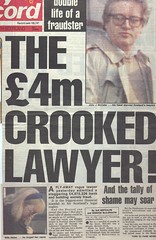
The 4m Crooked Lawyer - Daily Record 1991Allowing Law Society to continue regulating legal services would leave clients facing ‘same old crooked regulator of same old crooked lawyers’. Unsurprisingly, while the vote on the first question of safeguards over non-lawyers owning legal firms was narrow, the second vote on ensuring the Law Society of Scotland will be ‘apply’ to be the Scottish Government’s ‘approved regulator’ of new non-lawyer entrants into the legal services market passed by a significant margin, leaving the prospect for Scottish consumers the Law Society of Scotland, that failed, notoriously corrupt self regulator of solicitors who have whitewashed tens of thousands of complaints against ‘crooked lawyers’ over the years, will again be the first stop for any poor client who finds themselves in difficulty at the hands of one of the new style non-lawyer legal firms to emerge if the Legal Services Bill passes the Scottish Parliament.

If only consumers & clients could have a referendum, without any interference from the legal profession itself, what would we say about the situation of having to use the same anti-client Law Society of Scotland to investigate complaints against non-lawyer legal firms ?

An official from one of Scotland’s consumer organisations condemned the whole affair as “nothing more than a piece of anti consumer theatre staged by the legal profession to blackmail the Scottish Government into watering down the plans for wider consumer access to justice”.

While some solicitors leading the fight against the Law Society’s ‘public’ stance over the Legal Services Bill have claimed the vote was ‘nobbled’, the problems for the Society are not over yet as the Special General Meeting, originally called for by the Scottish Law Agents Society, adjourned mid-vote at its first hearing at Murrayfield, is now to go ahead once more on 16 April 2010 at 10am at the Sheraton Hotel in Edinburgh. Consumers obviously not invited …

To some spectators, the squabble between factions of the legal profession over the Legal Services Bill may seem as an internal affair, however the passage of the bill will, or at least, should, usher in greater choice of legal services for Scotland’s consumers, who have long been held hostage by the solicitors who dominate Scotland’s closed shop legal services market, forcing anyone who requires access to justice to use a Law Society member solicitor, as there has been no alternative to that arrangement to-date.

You can read my own coverage of the Legal Services Bill here : Legal Services Bill for Scotland - The story so far

Friday, March 26, 2010

Tesco Law swapped for ‘Penman vote fiddle’ as Law Society’s support for legal services bill leads to solicitors civil war over access to justice

Law Society of ScotlandLaw Society of Scotland accused by its own members of not being democratic. SOLICITORS CLIENTS in Scotland have known for years, the Law Society of Scotland are, to put it mildly, a rather undemocratic organisation when it comes to taking into account the views of up to 5000 clients a year in dealing with regulatory issues & complaints against solicitors, with most complaints receiving what is commonly known as the ‘whitewash treatment’, where solicitors facing even the worst complaints would still remain in a job, no matter how severe the offence, or how severe the financial loss to consumers.

However, only now with the advent of a new legal services model for Scotland, where consumers may actually have the right to choose a non-lawyer to represent their legal interests, do solicitors find out the Law Society’s ‘undemocratic streak’ works both ways, after yesterday’s ‘vote nobbling’ of the Special General Meeting called by the Scottish Law Agents Society, where over 3000 'proxy votes’ cast by solicitors mainly it would seem, against the Law Society’s support of the Legal Services (Scotland) Bill, were put aside, because the Law Society knew it would lose the vote. So, its only taken since 1949 .. some sixty years late, for solicitors to come out and call their own governing body undemocratic, and unwilling to listen to its own membership. Well .. all I can say to that is welcome to the real world.

Clients have felt maligned by the the Law Society’s ‘lack of democracy’ for decades under the society’s self regulation of the legal profession, where clients who had the need to complain of poor service or otherwise from their legal representative consistently had their complaints, views, evidence and pleas for help cast aside by Drumsheugh Gardens time after time after time .. a well worn path by the Law Society, and now the Scottish Legal Complaints Commission, which continues to this day.

Tell me, members of the Scottish legal profession .. where were all your protests when clients suffered a raw deal at the hands of the Law Society ? Is that a pin I hear dropping ?

Seriously, over the years of writing my blog, some solicitors have come to me saying things along the lines of “all this must end”, “self regulation has to go”, “we know we would be better off without the Law Society of Scotland” … but not once have I seen headlines in the newspapers of something along the lines of “Solicitors challenge their own Law Society to give clients greater say over complaints”. If such a move had taken place, believe me, members of the legal profession, you would have had much greater respect from the Scots population many years ago.

Where only now, that certain quarters of the legal profession itself are realising their dominant control of Scotland’s legal services market is threatened, do we see solicitors protesting against their own governing body … not for the best interests of clients (although I’m sure some claim that is exactly what they have in mind) .. moreover the protests are about money, and the loss of it.

Its just not good enough. As solicitors, you all have yourselves to blame for the mess you are in, which ultimately clients will have to pay for.

Decades of confrontation with clients, decades of lies, deceit, decades of arm twisting Members of the Scottish Parliament, and their Members of Parliament at Westminster before them into watering down or killing off proposals to reform regulation of the legal profession, reform of rights of audience, reform of court procedures, reform of civil & criminal law, and now, reform of the public’s access to justice, has given the public a view of the legal profession which will never change .. that of a selfish, manipulative, corrupt, anti-client, anti-consumer monopolistic business who will stop at nothing to protect its own interests.

It could have been so different, if the profession’s membership had listened to its fee paying clients, consumers and well .. common sense, all those years ago, but even now, as solicitors I doubt you are at all interested in the views of the very consumers who pay your way and maintain your existence. When you are, then you can claim you have clients best interests at heart in your accusations against the Law Society … but until then, be honest, its only about money – not the client’s best interests …

However, even in today’s newspapers, the rights of consumers in this debate on legal services, still seem very far away, as the grim reading in today’s papers makes for the chance of passing legislation increasing Scots access to justice, where The Times reports that We got it very wrong, admits Law Society boss as ‘Tesco law’ founders, the Scotsman reporting : Law Society accused of 'affront to democracy' as voting postponed and the Herald reports : Blocking ‘Tesco law’ could cost Scotland £500 million, warns law society president

Ian SmartLaw Society’s Ian Smart – no nobbled vote here, its just we knew we’d lose it so we adjourned it ! In a release from the Law Society, its President Ian Smart continued the society’s line on the Legal Services bill, saying : “The Legal Services (Scotland) Bill proposes major changes. There is no disguising that there are differing opinions within the profession on this. However all sides must be happy that there is now a fuller engagement with these issues and it would be churlish not to acknowledge the contributions of the Scottish Law Agents in that process. It was clear that as the debate proceeded today, the two sides may not be as far apart as perceived prior to the meeting. The decision to adjourn was taken in the hope that we might yet reach agreement on a way forward that is acceptable to the vast majority of our membership.”

Clearly the Law Society knew it would lose the vote, so, simple way of dealing with that is to stop the vote. Yes, a good show for democracy there, but as consumers we have all experienced this same policy where the Law Society deals with thorny issues .. simply kill discussion, kill reforms, kill any chance of public debate.

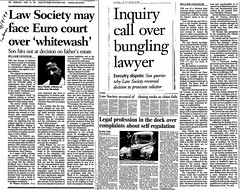
Scotsman coverage of some of the stories relating to Andrew PenmanLaw Society insider James Ness, famed for nobbling a Committee decision to send Borders solicitor Andrew Penman to the SSDT announced the vote would be cancelled. The opposing view from the Scottish Law Agents Society, revealed, amazingly, that James Ness, whom readers may remember, represented Scotland’s most famous crooked lawyer, Andrew Penman, before the Complaints Committee back in 1994 and got him off the hook from some of the most serious complaints imaginable, announced the vote proposed by the SLAS would not go ahead. Well, there’s a surprise ! So the shadow of crooked Borders solicitor Andrew Penman is still playing a hand in obstructing consumer reforms to legal services, and at the same time cancelling a vote by lawyers against their own Law Society of Scotland.

From the Scottish Law Agents Society website : “Deputy Registrar, James Ness announced that the motion to adjourn the meeting, once seconded, would go straight to a vote without need for a direct negative or opportunity for any members to address the motion, either in support or in opposition. Further, the proxy votes would be excluded from the vote so that the motion would be decided by those personally present. A number of points of order were raised from the floor and, while these were courteously answered, matters proceeded as initially ordered by the Deputy Registrar and the whole meeting suddenly disappeared through a sort of metaphorical trapdoor.”

“It had been fairly clear from the outset that, with the Law Society Council in attendance, the number of persons present who opposed the motion substantially outnumbered those who supported it, in the proportion of about 2:1, just as it was also obvious from the the proxy records which had been duly prepared and circulated by the organisers, that the proxies in favour of the motion outnumbered those against, in the proportion of almost 3:1. It was no surprise, therefore, when the option was certain defeat if the issue went to a vote, that those who opposed the motion duly voted for the adjournment of the meeting. This led to some further points of order and indeed to some outspoken adverse criticisms of the process which were finally brought to a conclusion when SLAS President Scanlan delivered a polite acknowledgement and acceptance of the technical correctness of the outcome.”

You can read more about how James Ness aided Mr Penman, blocking his prosecution before the Scottish Solicitors Discipline Tribunal, here : How Law Society's 'cancelled' prosecution of Borders solicitor Andrew Penman ignited moves to reform regulation of Scotland’s crooked lawyers

Scottish GovernmentScottish Government – ever so eager to concede to lawyers demands over consumer rights. Next week, we can expect more arm twisting from the legal profession on the Scottish Government & Scottish Parliament, inevitably bringing further concessions on the Legal Services Bill, perhaps watering down completely any chance that Scots will gain the right to choose their own legal representatives from an expanded legal services market, rather than be forced to live under the current regime where the legal profession itself determines who among us has the right to pay through the nose for access to justice …

Is this fair to consumers ? It certainly is not …. but as we see from the vested interests at play here, consumers have little or no voice in this battle over legal services at all, as the legal profession have already secured their political allies, even in the form of the Justice Committee Convener himself, Bill Aitken who, by the sounds of his praise for Douglas Mill and solicitors in general, is apparently dead against any reforms to giving people control over their own legal affairs … perhaps, then, as someone pointed out earlier to me today, the Office of Fair Trading will have to step in and force a change on behalf of Scots consumers, to ensure at least someone, is protecting our interests in this debate on legal services …

You can read my own coverage of the Legal Services Bill here : Legal Services Bill for Scotland - The story so far

Friday, March 12, 2010

Holyrood's Justice Committee offers ‘cautious support’ for Legal Services Bill reforms, as lawyers fight to hold back Scots wider access to justice

Debating chamberScottish Parliament supports legal services reforms. WIDER PUBLIC ACCESS TO JUSTICE in Scotland received a significant boost today as the Scottish Parliament’s Justice Committee gave their ‘cautious support’ to the Scottish Government’s Legal Services (Scotland) Bill proposals of opening up Scotland’s closed-shop monopolistic legal services market where for decades, consumers access to legal services & the courts has effectively been controlled by lawyers, advocates & the profession’s governing & self regulatory bodies such as the powerful Law Society of Scotland.

In a report published today, the Justice Committee agrees to the general principles of the Bill, which aims to widen public access to justice in Scotland and allow new entrants into the lucrative legal services market such as banks, supermarkets & others who may well provide legal services to the public at a much reduced cost than currently offered by law firms & solicitors represented & regulated by the Law Society of Scotland.

Which logoWhich? campaign led to access to justice reforms now before Holyrood. Speaking this afternoon, Julia Clarke, for the consumer organisation Which?, who started the process which has led to the proposals contained in the Legal Services Bill said : 'Which? has always said we would prefer to see an independent regulator, which would have answered the concerns being expressed by the Committee. However we do believe that the Legal Services Bill will bring benefits for the public using legal services, bringing with it more competition, more choice and better value.''

bill aitkenJustice Committee Convener Bill Aitken MSP. Holyrood’s Justice Committee Convener Bill Aitken MSP, speaking on the Committee’s report out today said: “This Bill will enable, but not oblige, the Scottish legal profession to enter into new forms of business that could create more competition and potentially offer consumers more choice in legal services. The committee’s evidence from the consumer lobby was in the main supportive of this Bill. The evidence from the profession itself was less supportive and in some cases fundamentally opposed to the Bill’s direction of travel.

Mr Aitken continued : “The committee understands the principles behind the consumer lobby’s arguments but received little in the way of hard evidence. Without this hard evidence, it could be argued that increased competition could result in detriment to the consumer as a consequence of the loss of local and high street legal firms if banks or supermarkets enter the legal services market.”

Little in the way of hard evidence …. someone obviously hasn't been paying attention to how the legal profession has been ruining clients and restricting Scots choice of legal representatives or access to justice for decades … which has already resulted in attempts through legislation such as the Legal Profession & Legal Aid (Scotland) Act 2007 to deal with some of that hard evidence some are now intent on ignoring.

Today’s committee report also highlights concerns about:

  • The extent of powers given to Scottish Ministers as a consequence of not establishing a new regulatory body similar to the Legal Services Board for England and Wales.
  • The potential lack of independence for Scotland’s legal profession when it is regulated by Scottish Ministers. The committee recommends giving the Lord President a greater role in the approval of regulators in order to address this concern.

Reservations were also expressed by the Justice Committee on whether the “fitness for involvement” test contained in Section 49 of the Legal Services Bill is robust enough to regulate any outside investors, such as banks or supermarkets, as desirable institutions (or individuals) having financial stakes in law firms & legal services providers.

Factors for determining the ‘fitness for involvement’ include the investor’s financial position and business record, probity and character (including any associations) – factors which, if enforced today over many law firms I have reported on in terms of client complaints & poor service, would probably closed own several of Scotland’s ‘leading law firms’, if the true characters of some of these ‘leading lights of the legal profession’ ever became public.

On the question of opening up access to advocates, the Committee agreed with the Scottish Government that “in a jurisdiction the size of Scotland and given the relatively small number of advocates, there is no need to impose alternative business structures on the Faculty of Advocates current business model” .. an issue at odds with the OFT’s findings and consumer experiences.

The Committee also said “it is not aware of there being any significant degree of dissatisfaction with how the regulatory arrangements for advocates presently operate but nevertheless would invite the Faculty to consider what steps it might take to modernise its regulatory regime” – complaints against advocates, who would contemplate such a thing !

Law Society of ScotlandLaw Society of Scotland wants to be ‘approved regulator’ of legal services despite history of anti-consumer bias. On the thorny question of regulation of an expanded legal services market, where the Law Society of Scotland has already stated it will seek to be the approved regulator to regulate all who provide legal services in Scotland, the Justice Committee’s report said : “Given that Scotland is a small jurisdiction, the Committee is not persuaded that there will be any great benefit in having more than one or two Approved Regulators. The Committee is particularly concerned about the prospect of bodies, external to Scotland, becoming Approved Regulators and seeks assurances from the Scottish Government in this respect.”

The Committee’s report went onto state : “The Committee observes that any body seeking to combine regulation and representation is likely to face some difficulties as a result of the inherent tension between the two roles. The Committee recognises that there are indeed tensions with and conflicting viewpoints about the Law Society’s dual role but is of the view that these are for the Law Society and its members to consider and resolve.” – this point has already led to debate & arguments between factions of the legal profession, which I reported earlier in the week, here : Lawyers squabble over control of legal services monopoly & regulation as Scots consumers forced to wait for wider access to justice

On a more hopeful note, the Committee felt that some parts of the Bill, namely Section 36 would unduly restrict the way in which voluntary or not-for-profit organisations can provide legal services. The Committee asked the Scottish Government to consider this point further after concerns were raised on this issue by Citizens Advice Scotland.

Background : The Legal Services Bill has come about in Scotland after the consumer organisation Which? issued a “super complaint” to the Office of Fair Trading under section 11 of the Enterprise Act 2002, stating that the consumer interest was being harmed the restrictions on advocates' business structures, solicitors and advocates providing services jointly, third party entry into the market, and direct consumer access to advocates.

The OFT’s response to the Which? super complaint can be viewed here : OFT response to super-complaint (pdf) along with their comments from July 2007 which stated : “Which? argued that the current restrictions against such practices prevent legal services providers in Scotland from adapting their business to best fit the needs of Scottish consumers. The OFT concluded that the restrictions are unnecessary and believes that there would be benefits to consumers if they were lifted – such as efficiency gains and higher levels of innovation in the provision of legal services.”

The Scottish Consumer Council, now renamed Consumer Focus Scotland, issued its response to the OFT’s consideration of the Which? super complaint, broadly supporting the moves to open up Scotland’s legal services market. The SCC’s reply to the OFT can be viewed HERE (pdf)

MacAskill tight lippedJustice Secretary MacAskill – no friend of independent regulation argument, It should be noted England & Wales already have the Legal Services Act 2007 in place, leaving Scotland trailing behind once again, simply because the legal profession north of the border has far too much influence over the pace of access to justice reforms. Missing from Scotland’s version is of course, the issue of independent regulation, where the current Justice Secretary Kenny MacAskill, seems to believe lawyers can still be trusted to regulate themselves – an obvious mistake, as lawyers have never been trustworthy when it comes to investigating complaints against their colleagues.

Over the years, many previous Scottish administrations including the present Scottish Government have dithered & delayed on giving Scots wider access to justice, while the legal profession put the brake on calls for reforms, even preventing enacted legislation from coming into effect, such as in the case of Sections 25-29 of the Law Reform (Misc Provisions) (Scotland) Act 1990, which allowed wider rights of audience in Scotland’s courts, but was held back by the legal profession’s seventeen year campaign to keep ‘outsiders’ out of courtrooms, while solicitors raked in exorbitant profits from clients who had no alternatives to turn to for legal representation.

The Legal Services (Scotland) Bill was introduced in the Scottish Parliament on 30 September 2009 and referred to the Justice Committee, who received written and oral evidence from a range of sources all of which can be found on the Justice Committee web page.

You can read my own coverage of the Legal Services Bill here : Legal Services Bill for Scotland - The story so far

Friday, January 08, 2010

Legal Services Bill : Consumer Focus & UNITE union differ over access to justice proposals as ‘Tesco Law’ comes under the Holyrood microscope

Consumer Focus ScotlandConsumer Focus Scotland gave evidence on proposed legal reforms. Continuing my reporting of the Legal Services Bill (dubbed by some as ‘Tesco Law’) which aims to widen Scots access to justice and yet again tackle the thorny question of regulating Scotland’s legal services marketplace, currently under the grip of the Law Society of Scotland, officials from Consumer Focus Scotland and the trade union, UNITE, attended the Scottish Parliament’s Justice Committee hearings earlier this week to be questioned on the Scottish Government’s proposals to tinker with the flawed, monopolised legal services market we have all been forced to use in Scotland for far too long.

Attending this evidence session was Sarah O'Neill, head of policy for Consumer Focus Scotland, and Fiona Farmer, a regional industrial officer for the Unite trade union, Scottish region.

Consumer Focus Scotland & UNITE officials attend Holyrood on Legal Services Bill :

Consumer Focus Scotland & UNITE evidence on Legal Services Bill Pt 2 Pt 2 Consumer Focus Scotland & UNITE evidence on Legal Services Bill Pt 3 Pt 3

Consumer Focus Scotland & UNITE  evidence on Legal Services Bill Pt 4 Pt 4 Consumer Focus Scotland & UNITE evidence on Legal Services Bill Pt 5 Pt 5

Fiona Farmer of Unite , in response to opening questions from the Justice Committee on what evidence is there that the Legal Services (Scotland) Bill is necessary and that the establishment of alternative business structures will benefit users of legal services in Scotland, said : “We have concerns about the marketisation of legal services under the bill, which we have outlined in our written evidence. We are not opposed to change, but we are concerned that opening up the market will result in inequality in the justice that is available to the public and to our members in Scotland. When the national health service in England was opened up to privatisation, we saw evidence of the most lucrative parts of the service being creamed off and the less attractive parts being left, which has caused problems in the sections concerned. There could also be conflicts of interest should the bill go ahead in its present form.”

After a question from Bill Aitken, the Justice Committee Convener on what could go wrong with the proposals contained in the Legal Services Bill, Fiona Farmer replied : “If we consider the privatisation of the NHS in England, the lucrative and attractive sections have been hived off, including children's services, acute services and surgery. Other services, such as care for the elderly and mental health services, are being left and are suffering financially as a result. The same detriments could apply in legal services here if the bill were to proceed. Certain sorts of claims and areas of justice would be snapped up, whereas services in other areas would become very costly. It would become much more expensive for our members to access justice, and we do not believe that access”

Sarah O'Neill, Head of Policy for Consumer Focus Scotland then entered the debate, giving the Justice Committee little doubt that CFS’s opinion was that the consumer interest was best served by opening up Scotland’s monopolistic legal services marketplace to competition.

Sarah O’Neill said : “Consumer Focus Scotland and our predecessor body, the Scottish Consumer Council, have long argued that there is a need to open up competition in the market for legal services in Scotland, and that we should consider new ways to deliver those services—subject to adequate consumer protections being put in place. We believe that lifting the existing restrictions through implementing the bill will bring consumers a number of advantages, including an increased choice of services, reduced prices, greater convenience and more consumer-focused services. Most important, we see potential in the bill to increase access to justice for consumers.”

“We have been concerned that much of the debate on the bill so far has focused on the benefits to big legal firms, external ownership by businesses and issues to do with legal markets where there is already healthy competition, such as conveyancing. We view the bill, together with other proposed reforms such as those in Lord Gill's recent civil courts review, as important for achieving modern, consumer-focused legal services in Scotland.”

Ms O’Neill continued : “The bill has the potential to lead to the development of entirely new structures in the voluntary, charity and advice sectors, not just in private practice and in services provided by solicitors and accountants, which we have been hearing about. Charitable and advice organisations should have flexibility in how they address unmet legal need, both in geographical areas and in areas of legal work where there is insufficient provision of legal services. In 2006, the legal markets research working group found that there are clear gaps in provision in areas of social welfare law such as debt, housing, employment and immigration. We would like to see the market opened up so that citizens advice bureaux, which we know want to have these powers, and other charities, can employ solicitors to work directly in those areas.”

As the debate rolled on, it became clear that while Consumer Focus Scotland supports opening up Scotland’s legal services market, there are gaps in the Scottish Government’s proposals to effectively regulate what might very well end up as the same regulatory mess caused by the inadequate powers created in the Legal Profession & Legal Aid (Scotland) Act 2007, which has seen over a year of complaints disgrace at the beleaguered Scottish Legal Complaints Commission, simply due to the sole fact that fully independent regulation over the legal profession was never enacted in the 2007 LPLA Act. Now, in 2010 with the Legal Services Bill, we are faced with the legal establishment, and other self regulators basically spinning the same tune, demanding to keep the powers of regulation for themselves, effectively shutting out the consumer once again, and unsurprisingly the Scottish Government are apparently happy to pander to those wishes of the professions once more.

The Trade Union UNITE on the other hand, have severe reservations about the Legal Services Bill, and take the opposite view to Consumer Focus Scotland saying that "The provisions of the Legal Services Bill will create an open-door for third parties with only profit on their agenda to influence, shape and dominate our justice system” and they do have a point, considering the many flaws of the Legal Services Bill as it currently stands, flaws which reflect back on the Scottish Government who produced the legislation, formerly called the “Legal Profession Bill” but renamed when the Law Society turned against it.

A spokeswoman for Consumer Focus Scotland replied to queries saying : “As we made clear in our response to the Scottish Government consultation ‘Wider Choice and Better Protection: a consultation paper on the regulation of legal services in Scotland’, we support the liberalisation of the legal services market in Scotland, subject to the necessary consumer protections being put in place. We believe that this will result in more consumer-friendly, high quality legal services in Scotland.”

Gilbert M Anderson, a solicitor with Glasgow law firm AndersonsLLP, rounded up the evidence session, claiming : "The public interest demands legal services should only be provided by a strong and genuinely independent legal profession which is thoroughly trained and disciplined in the practice of law."

Mr Anderson’s written submission to the Parliament on the Legal Services Bill can be read here : Gilbert M Anderson written submission (pdf)

Well, Mr Anderson, with respect, it is the Law Society of Scotland’s lack of enforcement of discipline, standards, and regulation which is constantly causing all these, admittedly half hearted attempts by Government to reform legal services in Scotland.

Perhaps if you clean up the Law Society, and hand over regulation and representing client’s interests to a fully independent authority, your claims might have more substance than the evidence of a distinct lack of access to justice in Scotland at present demonstrates fairly well. If it is so important to you the legal profession should be independent (as it is as important to me), then it should also be as important to you that protecting the public interest should also be independent, as the Law Society has never been willing, or able to do both as we both well know.

You can read the submissions from Consumer Focus Scotland here : Consumer Focus Scotland on Legal Services Bill (pdf) and the submission from UNITE trade union, here : UNITE Trade Union on Legal Services Bill (pdf)

The full report of the latest evidence session on the Legal Services Bill, including the contributions from Consumer Focus Scotland and UNITE can be viewed here : meeting is here : Justice Committee Tuesday 5 January 2010 Legal Services Bill Stage 1

All written submissions on the Legal Services Bill can be found here : Legal Services Bill written submissions

You can read my own submission on the Legal Services Bill, which deals mainly with regulation HERE (pdf)

All things considered, I do not feel the public interest and indeed consumer protection is being put first in the current set of proposals in the Legal Services Bill. What we are looking at is yet another regulatory mess created to appease the professions and industry, instead of prioritising those (us) who will have to pay to use these services.

Surely a little consumer protection would go a long way to giving us better standards and wider choice of legal services in Scotland, Mr MacAskill ? why the hold up on something so simple ?

Tuesday, September 08, 2009

Consumers & Govt insiders brand Law Society ‘too crooked’ to regulate ‘Tesco Law’ expansion of legal services in Scotland

Law Society of ScotlandLaw Society of Scotland branded too corrupt to regulate new legal services in Scotland. The Law Society of Scotland has been branded "too crooked" to regulate the Scottish legal services market after implementation of the changes proposed by the Scottish Government's “Tesco Law” Legal Services Bill, due to be introduced in a few weeks time to the Scottish Parliament. This view of many, including even insiders at the Scottish Government throws into question some proposals contained in the planned legislation, and rumours of ‘done deals behind closed doors with the Law Society’ over who will end up regulating non-lawyers entering the expanded legal services marketplace.

In my report of last week, the Scottish Government's Legal Services Bill announcement left many consumer groups and even some legal insiders questioning the scale of the changes proposed to the current legal services marketplace in Scotland. While the initial proposals contained little hints of policies to protect consumers from the increasing ranks of 'rogue lawyers' who are now routinely committing large scale & destructive frauds involving millions of pounds of clients funds in Scotland, there was much mention of ways in which law firms can receive external investment, and 'combine with other professionals' to offer legal services in new ways.

This afternoon, a Scottish Government insider who does not share a sympathetic view to continued self regulation of solicitors,, spoke of the need to avoid giving the Law Society of Scotland any more power in the arena of regulating those practicing legal services in any expanded market, branding the Law Society "too crooked to be trusted with regulating lawyers".

He said : "Even though the Law Society are lobbying hard to retain their regulation of legal services and come out on top in the Legal Services Bill proposals, the few sane thinkers in the Scottish Government who have had anything to do with them know these people are simply too crooked to be allowed anywhere near regulating complaints against their own colleagues."

He continued : "The fact is the Justice Department has been swamped by letters from members of the public over the years who cannot get anywhere near a fair hearing when they take their complaints to the Law Society about 'crooked lawyers'. Inevitably we as the Scottish Executive get dragged into their problems after having exhausted all avenues they either write to us directly or ask their local politicians to do so and on each occasion we have to write back to them saying the same thing that there is nothing we can do."

"This has happened thousands of times in the past few years, and if anyone is looking for an example of why the Law Society should not be allowed to regulate solicitors, they need only look at some of the cases brought to our attention, which include everything from fraud up to allegations of criminal activity by solicitors against the public. Any sane person having to read through thousands of such letters would come to the same conclusion that the Law Society, having ignored such quantity of pleas from the public, cannot be trusted as a regulator in any shape or form."

MacAskill tight lippedJustice Secretary Kenny MacAskill : Puppet of the legal profession or legal services consumer protection champion for Scotland ? As an experienced law reform campaigner I know full well the weight of representations made to the Scottish Government by members of the public, MSPs and MPs over the years, even having to go down the same route myself regarding the case of crooked lawyer Andrew Penman. I can therefore attest to the lack of help that successive administrations (including the present) have been to members of the public who have failed to secure justice when trying to pursue complaints & court cases against crooked members of Scotland's legal profession.

The lack of consumer protection measures in the Scottish Government's Legal Services Bill therefore concerns me, and on the basis of what is currently being talked about, I doubt we as the Scottish public will get much of a better deal and choice of legal representation as the proposals currently stand, unless the Bill’s parliamentary stage can incite significant amendments to some of what is currently proposed by the Justice Secretary.

Consumer Focus ScotlandConsumer Focus Scotland support an opened legal services market and consumer protection. Consumer Focus Scotland were asked for their reaction to the Government's announced plans for the Legal Services Bill, and issued the following statement : "We made clear in our response to the Scottish Government consultation ‘Wider Choice and Better Protection: a consultation paper on the regulation of legal services in Scotland’, we support the liberalisation of the legal services market in Scotland, subject to the necessary consumer protections being put in place. We believe that this will result in more consumer-friendly, high quality legal services in Scotland."

Consumer Focus Scotland did criticise the lack of promotion of fully independent regulation of legal services, as has occurred in England & Wales, stating : "While we note the regulatory objectives as proposed do not include two objectives included within the Legal Services Act in England and Wales – that of encouraging an independent, strong, diverse and effective legal profession and increasing public understanding of the citizen?s legal rights and duties – we believe the objectives proposed offer a suitable framework.In particular we welcome the objectives of promoting access to justice and protecting and promoting the interests of consumers. We believe these objectives should play a fundamental role in the future regulation of ABS."

You can read Consumer Focus Scotland's response to the Scottish Government's consultation on legal services reform here : Consumer Focus : Wider Choice & Better Protection (Legal Services Reform). In comparison, you can also download a copy of the Scottish Consumer Council's report on the poor & unchanging state of regulation in Scotland's legal profession here Scottish Consumer Council : Complaints Against Solicitors

A group representing users of legal services in Scotland however questioned Consumer Focus Scotland's approach to the question of regulating an expanded legal services market, citing calls from other national consumer organisations such as Which? for completely independent regulation of those in the legal services market as an example to follow.

A spokesman for the group said : "Just about anyone who has used a solicitor in Scotland will tell you that it is better to have non lawyers regulating lawyers than having lawyers themselves do it. Its not rocket science really. If lawyers were taken out of the regulatory equation then clients would feel a lot safer when having to deal with members of the legal profession or anyone who is allowed to work & operate in the legal services market."

He continued : “The fact is much stronger measures on regulation than are currently proposed will have to be taken if the public are going to be properly protected when their relationship with their solicitor goes wrong and I feel Consumer Focus and other high profile campaign groups must highlight this issue and stick with it.”

Which logoScottish campaigners for legal services reform pin their hopes on Which?, who are to be credited with adding considerable momentum to reform of legal services in Scotland. Today, a spokeswoman for the consumer organisation Which? commented on the Scottish Government's proposals for expanding legal services, saying : "Obviously we are pleased to see this legislation coming in, and hope that the consumer interest is squarely at the heart of it, with more choice and competition emerging as a result, and better access and affordability for consumers."

You can download a copy of the Which? “Super-Complaint” on restrictive practices in Scotland's legal services market here : Restrictions on Business Structures and Direct Access in the Scottish Legal Profession

Certainly as I reported late last week, there needs to be much more done in the Legal Services Bill to serve the public interest, and, as consumer groups demand, ensure that consumer protection and free choice is put first before the interests of a presently poorly regulated legal services industry which has become too used to having its own way at any cost.

It is a positive development that at least some in the Government also share that view. However, much work by way of campaigning and, when the time comes, submissions to Parliament, needs to be done on these proposals to ensure the individual has the unrestricted choice of legal services and access to justice which we as Scots certainly do not have currently.

Wednesday, January 07, 2009

Lawyers monopoly on legal services set to last until 2011 as MacAskill's 'dithering consultation' delays wider access to justice for Scots

Kenny MacAskillScottish Justice Secretary Kenny MacAskill today announced the long awaited 'consultation paper' on the Legal Profession Bill, which the Scottish Government claims will open up the Scottish legal services market to competition, a position which came about only after the Office of Fair Trading in 2007 ordered the current lawyer controlled monopoly on legal services to be ended.

The year long wait by Kenny MacAskill to do anything other than announce a rather long winded consultation document, which has been authored mostly by a consultation group comprising members of the Law Society of Scotland (who wish to retain market monopoly on legal services) questions any sentiments the move on the Scottish Government's part to widen access to justice is a genuine one.

Mr MacAskill it seems, prefers instead to stumble along at the slowest pace possible, at the behest of the likes of the Law Society of Scotland & Faculty of Advocates, to maintain the closed shop of legal services for as long as possible, where even after today’s consultation will end in April of 2009, it will take until at least mid 2010 to get the legislation into Parliament, in turn probably seeing no implementation until 2011 !

You can read my report relating to the OFT's 2007 announcement here : OFT recommends lifting of lawyers monopoly on access to justice & legal services in Scotland with Kenny MacAskill's fairly weak response here : MacAskill seeks 'Scottish Solution' amid Law Society arm twisting on legal reforms

The Law Society's pitiful proposals on opening the legal services market, with the proviso they are solely allowed to regulate it, can be read here : Law Society's proposals on legal services market overhaul spin wide of the mark on public interest with a further report here : MacAskill struggles to hold back 'Tesco Law' as Law Society dithers on access to justice reforms

Staggeringly, while Mr MacAskill was making the grandiose announcement today on his legal services consultation, there were revelations the Justice Secretary had made earlier attempts last week at the Scottish Parliament to kill off Petition 1197, brought about by Bill Alexander, the Chairman of the Association of Commercial Attorneys, who via his petition, is seeking to open the legal services market up, and allow Parliament a much speedier look this year at the advantages of an open legal services market model (where a host of qualified professionals could offer cheaper, more competitive and speedier legal services), as opposed to the Law Society of Scotland's preferred 'closed shop monopoly' model, where simply you have to use a Law Society controlled solicitor if you want access to justice, and of course be at the mercy of the Law Society's infamous lack of standards, regulation and control over its widely poor quality solicitor membership.

In stark ccontrast to today’s consultation announcement, Kenny Macaskill commented to the Scottish Parliament last week :

'”The Scottish Government believes that this legislation [the existing Sections 25-29 of the Law Reform (Misc Provisions) (Scotland) Act 1990 ]is appropriate to Scotland. It allows members of bodies who are not solicitors to apply for extensive rights to conduct litigation and of audience. It ensures that appropriate standards of conduct and practice are maintained in the Scottish courts.

It also safeguards the consumer in that the Lord President, in consultation with Scottish Ministers, will decide what in courts and in what cases it is appropriate for members of the applicant body to exercise those rights. In so doing, the Lord President and Scottish Ministers are mindful of the training and experience required of its members by the applicant body. Consequently, there are no plans at present to amend the system of authorisation for rights of audience"

However, the Justice Secretary went on to reveal in his comments to the Scottish Parliament that while he believed the law shouldn't change on legal services, the only application granted so far under present legislation was approved with severe restrictions and conditions, making a complete mockery of the concept of an open legal services market :

"The Lord President and Scottish Ministers have approved the scheme submitted by the Association of Commercial Attorneys for rights to conduct litigation and rights of audience subject to conditions. The Association has accepted those conditions."

You can read more about the conditions imposed on the Commercial Attorneys in a previous report on the issue I wrote here : Non-lawyer rights of audience approved ‘with restrictions’ as Scottish Government continues to waver on access to justice reforms

You can read Mr MacAskill's attempt to kill off any Parliamentary consideration of opening Scotland's legal services market this year, here : Kenny MacAskill - compention in legal services is generally not a good idea unless lawyers say so (pdf)

Anything for a little delay then, to protect the Law Society’s control over Scotland’s legal services market and the Scots public’s access to justice for a few years, forcing the public into using Scotland’s notoriously high cost, poor quality, and poorly regulated Law Society solicitor membership, who invariably end up ripping off clients on an unimaginable scale.

I will write more about Petition 1197 in a later article, but for now, here is Mr MacAskill’s announcement of the legal services consultation, along with details on how to participate, which I hope as many of you who can, will do so !

You can download a copy of the consultation direct, in Adobe Acrobat PDF format here : Wider choice and better protection: A consultation paper on the regulation of legal services in Scotland

Closing date for sending in the completed consultation to the Scottish Government is Friday 3 April 2009.

Please return your completed consultation document online to : Julie.Muir@scotland.gsi.gov.uk

You can also ask for a printed version of the consultation by contacting the Scottish Government direct at :

Legal System Division
Constitution, Law and Courts Directorate
Scottish Government
Area 2W
St Andrew's House
Regent Road
Edinburgh
EH1 3DG

Proposals for alternative business structures (ABS) for the legal profession in Scotland

Proposals for alternative business structures (ABS) for the legal profession in Scotland were today published for consultation by Justice Secretary Kenny MacAskill.

Some of the main proposals for inclusion in the forthcoming Legal Profession Bill include:

* Reform of the regulatory framework for legal services, and removal of the restrictions on the types of business models under which a solicitor can offer such services, while allowing the traditional business model to remain an option for those who choose to carry on practising within that structure.

* Regulation of ABS to apply to any other form of business where a legal professional is involved in the provision of legal services to third parties.

* ABS to be regulated by an approved regulator, authorised to regulate that form of business by Scottish Ministers, with the agreement of the Lord President.

* Professionals within that ABS to continue to be regulated by their own professional bodies.

* ABS and professionals working in them to continue to be subject to any subject-specific regulation (such as financial services and immigration advice).

* Outside ownership to be permitted where those holding an interest in a legal practice pass a "fit to own" test and comply with an appropriate code of conduct and

* The Governance of the Law Society to be reviewed and the regulatory arrangements for the Faculty of Advocates to be made clear.

Kenny MacAskill said:

"This is a once-in-a-generation opportunity to create a more flexible and modern regulatory framework for Scotland's legal services. A flourishing legal profession is a crucial part of the supportive environment for our businesses.

"The proposals put forward by the Law Society and Faculty of Advocates earlier this year made clear that the regulatory framework must be proportionate to the size and scope of the legal services market in Scotland. We want to avoid having too many bodies and unnecessary tiers of regulation. Instead we should concentrate on developing a robust system of regulation to protect the profession's core values and enshrine the profession's commitments to service, probity and excellence.

"We also want to avoid any confusion or disadvantage to consumers where there are new structures which may bring together different professions.

"I believe the proposals published today for consultation will help the profession to remain successful and innovative in the face of increased competition and in the difficult economic climate that we are all currently going through.

"I would encourage anyone with an interest in this important issue to have their say on the future of Scotland's legal services."

Which? submitted a super-complaint to the Office of Fair Trading (OFT) asserting that the current regulation of Scottish legal forms restricts choice to consumers and prevents the formation of alternative business structures (ABS). In its response the OFT did not assume that the changes being proposed in England and Wales at that time, and subsequently enshrined in the Legal Services Act 2007, would be automatically suitable for the Scottish market but it recommended that by the end of 2007 the Government should publish a statement detailing its policy views in response.

On November 1, 2007, the Law Society of Scotland published a consultation paper entitled 'The Public Interest: Delivering Scottish Legal Services - A Consultation on Alternative Business Structures".

Later that month Justice Secretary Kenny MacAskill outlined the Government's approach to Parliament which was unanimously endorsed. He asked Scotland's legal profession to meet the challenge of change in the light of a changing marketplace, both nationally and globally, and invited them to come forward with a Scottish solution.

The Scottish Government published its response to the OFT in December 2007 which detailed its policy views on lifting restrictions on ABS, where considered appropriate, for the Scottish legal services market.

The Society published detailed proposals and the Faculty of Advocates published their response in spring 2008. Kenny MacAskill welcomed these responses in Parliament on June 11, 2008.

To help inform the Government's proposals Kenny MacAskill set up a consultative group to explore these issues. Some of the country's leading legal and consumer experts were represented on it.

The Scottish Government today brings forward proposals for the Legal Profession Bill which the First Minister announced as part of the legislative programme on September 3, 2008. The proposals in this paper for a robust regulatory regime will allow alternative business structures to operate in an open, transparent and accessible way in Scotland's legal services market.

Sunday, May 25, 2008

Scots face wait on access to justice as lawyers, politicians go slow on legal market reform

The campaign to open the Scots legal services market scored another victory last Thursday at the Law Society of Scotland's Annual General Meeting, where in a shock vote against the policies of Law Society Chief Executive Douglas Mill , around 853 solicitors voted in favour of opening up the legal services market which should ultimately ensure wide access to justice and free choice of legal representatives for all Scots, similar to the Clementi reforms implemented in England & Wales.

I very much support the opening of Scotland's legal services market, in order to widen public choice in legal representation, and have reported on the campaign to open up the legal services market in previous articles, which can be viewed here : Opening the Scots legal services market

There are of course, still a great many obstacles to overcome in implementing what will be a historic change in the Scots legal services market, which for now, still forces anyone who wants access to the courts to go through a solicitor or advocate, who are members of the Law Society of Scotland.

Some of those obstacles include resistance from elements of the Law Society itself, who favour retaining control of their hugely profitable monopoly on access to justice, and also resistance from political allies, who themselves, are formerly practicing lawyers with a calling to protect their colleagues profitability.

While the Law Society will no doubt be eyeing ways to delay the implementation of legislation which will allow the public wider choice of legal representatives, the Scottish Government's own shifting policy on "Tesco Law" has seen some curious shifts over the past year or so, with the current Justice Secretary Kenny MacAskill expressing resistance himself to giving the public a much wider, and more dependable choice of legal representatives.

A previous article I note from Scottish Law Reporter, covering the SNP's wavering policy on "Tesco Law" can be viewed here : Leaked letter from MacAskill to Swinney on legal services 'misleads' Cabinet Secretary Swinney & Parliament on legal services admissions

I think Mr MacAskill's view of things, at least those expressed in Ian Fraser's article in the Herald Scots Government has ‘no appetite’ for legal change do give cause for concern that some in the Government, at least those who are lawyers themselves, don't want to give the public the reforms which the rest of the UK will enjoy in terms of being able to have wider choice of legal services & access to justice

The wholly unnecessary feet dragging by both the SNP Scottish Government and the Law Society are simply aimed at prolonging the public misery of lack of access to justice & legal services until the legal profession feels it can ween itself away from charging clients what they like for poor quality & unsafe legal services with no accountability when things go wrong.

We are over a year on from when the issue was first raised by the early 2007 Which? campaign group as a "supercomplaint" to the Office of Fair Trading, which culminated in the OFT making recommendations to open the legal services market in July 2007

Now, at the end of May 2008, there is still little obvious movement on the part of the Scottish Government to implement public freedom of choice for legal representation .. and many in the Law Society still see many months ahead, even years, before the Scots public can choose their own legal representatives without having to be forced into using a solicitor who is a member of the Law Society of Scotland.

Perhaps I wonder, if Mr MacAskill and the Law Society wish to take a leaf out of the seventeen year wait to implement Sections 25-29 of the Law Reform (Miscellaneous Provisions) Act 1990 Law, which sought to do much the same as the recommendations from the OFT to allow professionals other than solicitors & advocates the rights of audience & representation in Scotland's courts.

However, Sections 25-29 were only brought into law in March 2007 after an intense campaign to expose the Law Society of Scotland's part in holding back that particular legislation, which even though now implemented, has still to see anyone other than a Law Society member allowed into court, all because Mr MacAskill and the Lord President don’t seem to want it ...

Why should we be waiting ? Scots need access to justice now, not have their access to justice controlled by the legal profession itself ...

The Herald reports :

Legal firms vote to back historic ‘Tesco law’ partnership

LUCY ADAMS, Chief Reporter

Supermakets and banks could run or work in partnership with Scottish legal firms in future, following a "historic" vote taken by more than 1000 lawyers last night.

Some 853 solicitors voted in favour of opening up the legal services market yesterday following consultation on what has been dubbed "Tesco Law".

Most of the votes were cast by proxy, but only 152 voted against the move at the Law Society of Scotland's annual meeting.

The decision, which could lead to external ownership of law firms, partnerships between solicitors and non-solicitors, and organisations such as banks and supermarkets providing legal services including conveyancing and will-writing, will require further consultation before being put forward for legislation.

The move follows the lodging of a "super complaint" with the Office of Fair Trading (OFT) 12 months ago by Which?, the consumer watchdog, which said the current regulation of Scottish legal firms was hindering competition in the market, restricting choice and pushing up prices.

Kenny MacAskill was obliged to act after the OFT upheld the calls for a reform of Scotland's legal services market.

Following the Clementi Review in England and Wales, legislation was introduced to open up legal services there. This will be enacted in 2010 and both the AA and the Co-op have already moved to establish legal services companies.

Richard Henderson, president of the Law Society of Scotland, said: "This is a historic decision. The profession has been asked by the Scottish Government to decide on its future direction and I think that we have risen to that challenge today by voting in favour of change.

"There has been a great deal of thought and discussion surrounding alternative business structures. The society's council consulted the profession and it was apparent from the responses that there was an appetite for change within the legal profession."

He added: "This is only the first step in what will be a lengthy journey. The society will continue to work closely with its members from across all sectors of the profession, the government and other stakeholders to ensure that any future reforms will benefit those who require legal services and that access to justice remains central. A crucial part of developing successful and workable new policies will be to ensure that those providing legal services are properly regulated and work to the professional standards expected of them."

The debate around so-called "alternative business structures" has proven deeply divisive among lawyers. There are fears that many small Scots firms could be wiped out by a competitive free-for-all and that permitting external ownership could compromise professional integrity.

The OFT believes a "fit-to-own" test would safeguard the integrity of legal services delivery and claims many small firms and sole practitioners will actually benefit from outside investment.

Mr MacAskill said: "I am pleased that Law Society members have accepted the proposals presented to the AGM and I look forward to working with the profession in the coming months to implement these proposals.

"This is an exciting time and there will be great benefits for those who take advantage of the opportunities these proposals provide."