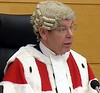
The Court of Session’s decision also hits out at numerous “mistaken” statements by SNP ministers of a ban on what many regard as an environmentally damaging process which uses water and chemicals pumped at high pressure into underground shale beds to release methane gas.
Earlier today, the Judiciary of Scotland published Lord Pentland’s ruling on the INEOS challenge to the Scottish Government’s claims of a ban on fracking – in which the court threw out the challenge, on the grounds there was and is no existing prohibition against shale gas extraction in Scotland.
Despite claims of a ban on fracking by numerous Scottish Government Ministers, including the First Minister herself Nicola Sturgeon, Lord Pentland ruled that no such ban exists, and that in reality there is little more than an evolving planning policy.
Revealing there is no existing legal basis for claims by the First Minister & others that a ban on fracking is in force - Lord Pentland said statements by ministers including Paul Wheelhouse MSP and First Minister Nicola Sturgeon that a ban existed “did not accurately express the legal effect of the decisions” involved.
The statement issued by the Judicial Office notes that [despite numerous claims by Ministers] “the Lord Advocate, on behalf of the Scottish Ministers, made it clear to the court that such statements were mistaken and did not accurately reflect the legal position”.
Lord Pentland’s judgement concludes that “as a matter of law, there is no prohibition against fracking in Scotland”.
The ruling issued today followed statements by the Scottish Government to the Scottish Parliament during October 2017 that fracking had effectively been banned through the use of new guidance on planning consent.
Energy minister Paul Wheelhouse – who once made false claims to a Holyrood Committee that fictitious gangsters made transparency in the judiciary impossible - told MSPs last year that “fracking cannot and will not take place in Scotland”.
Similarly, First Minister Nicola Sturgeon said “fracking is being banned in Scotland - end of story”.
Earlier this year, and after the continued claims by the Scottish Government and it’s supporters of a ban on fracking, Ineos Upstream Ltd and Reach CSG sought a judicial review of the effective ban, the Scottish Government began t changed its tune.
When the case was called in court, the Scottish Government’s own lawyer - James Mure QC - claimed the legal challenge by Ineos was premature as SNP ministers had “not yet adopted a position” and that in effect Ministers had merely announced a preference for a ban.
James Mure QC was forced to admit to the court that his client the Scottish Government had merely spun the issue of a preference of a ban, into an actual ban.
The QC was forced to tell the court in the earlier hearing: “The concept of an effective ban is a gloss. It is the language of a press statement.”
However, in the Court of Session opinion issued today, Lord Pentland’s judgement rubbished Ministerial claims of a ban on fracking, concluding that “as a matter of law, there is no prohibition against fracking in Scotland”.
In the judgment, Lord Pentland also rejected Ineos and Reach CSG's case on the basis that no ban exists.
The Herald newspaper reported on the court’s decision today, and also reported - “After the judgment was released, the SNP rewrote the environment section of its website, deleting the words "The Scottish Government has put in place a ban on fracking in Scotland".
Ineos, which runs the Grangemouth refinery and already imports US shale gas as a precursor for petrochemical works, would like to frack gas in the Central Belt.
It has previously accused the government of an “Alice in Wonderland” position on fracking.
Ineos said it now expected all planning applications for fracking to be considered on merit, not "prejudice and political expediency" and ministers of wasting public money by not being clearer earlier.
Mr Wheelhouse, who told MSPs there was a ban, welcomed the Court saying there wasn’t.
He said: “This decision vindicates the extensive process of research and consultation which the Scottish Government has undertaken since 2015.
“As I set out in October, our preferred position is not to support Unconventional Oil and Gas extraction in Scotland, and that position remains unchanged.
“I have repeatedly set out to parliament that we would undertake a Strategic Environmental Assessment (SEA) ahead of finalising that position and that approach has been endorsed by the overwhelming majority of the Scottish Parliament.
“The work to complete the SEA and a Business and Regulatory Impact Assessment is currently underway and the findings will be carefully considered.
“In the meantime, a moratorium is in place which means no local authority can grant planning permission and Ministers would defer any decision on any planning application that did come forward until the policymaking process is completed.
“The practical effect of the current moratorium and the policymaking process which is underway to finalise our position is that no fracking can take place in Scotland at this time.”
In his judgement published earlier today, Lord Pentland quoted First Minister Nicola Sturgeon and Mr Wheelhouse’s statements in parliament about there being a ban.
However, in what seems an attempt at appeasing the misleading statements by Ministers, Lord Pentland was forced to add that the accuracy of such misleading ministerial statements was not the core issue – even though the existence of the misleading claims by the First Minister & Scotish Government led to the Ineos legal challenge in the first place.
Lord Pentland said: “The legal question is not whether ministers have accurately described or commented on their understanding of the legal effect of the various steps they have taken or authorised to be taken under the planning system, but the fundamentally different question of what the legal effect of those steps really is.
He added: “The ministerial comments reflecting the opinion that there was an effective ban on fracking are (a) irrelevant to the legal question before the court; (b) not binding on the court; (c) in any event, not determinative of the question of construction that the court has to address; and (d) to the extent that they did not accurately express the legal effect of the decisions taken must be left out of account when it comes to answering the legal question.”
“To the extent that some sections of the ministerial statements made to the Scottish Parliament were capable of being read as suggesting that the policy would amount to a ban on fracking, Mr Mure QC accepted on behalf of the Lord Advocate that such statements did not accurately reflect the legal position; they were to that extent mistaken.”
The full statement issued by the Judicial Office for Scotland
Ineos Upstream Ltd and another v Lord Advocate
A petition seeking judicial review of certain acts and decisions of the Scottish Government in implementation of what was purportedly an indefinite ban on “fracking” has been refused. The Court of Session held that the legal effect of certain statements and planning directions made by the Scottish Ministers to the effect that the Scottish Government will not support the development of unconventional oil and gas extraction in Scotland, and a subsequent decision that the directions should continue in force indefinitely, is that there is in fact no prohibition against fracking in force. The following is a summary of the detailed opinion issued by Lord Pentland.
On 28 January 2015 the Scottish energy minister, Mr Fergus Ewing MSP, made a statement to the Scottish Parliament on the development of unconventional oil and gas extraction in Scotland (“UOG”) to the effect that there was to be work on planning and environmental regulation, a health impact assessment, and a consultation process on UOG. He stated that given the importance of this work it would be inappropriate to allow any planning consents in the meantime. He therefore announced what he described as a “moratorium” on the granting of planning consents for all UOG developments, including the method of oil and gas extraction known as hydraulic fracturing or “fracking”. The moratorium was to continue until such time as the work referred to had been completed. The minister stated that a direction would be sent to all Scottish planning authorities to give immediate effect to that policy. A similar direction would be issued to SEPA.
The 2015 Planning Direction and the 2015 SEPA Direction gave legal effect to the moratorium, by requiring planning authorities to intimate the receipt of planning applications for any UOG developments to the Scottish Ministers, prohibiting planning authorities from granting planning permission within 28 days of notification to ministers, and giving ministers the power to call in applications for determination by them. The power of the Scottish Government to call in planning applications for determination by them, coupled with the 2015 Planning Direction and the 2015 SEPA Direction gave Scottish Ministers the means to control two of the essential legal requirements for onshore extraction of UOG. By refusing planning permission or authorisation of controlled activities, the Scottish Government could prevent onshore UOG development extending beyond drilling of core samples. To date, the notification requirements under the 2015 Planning Direction have not been triggered. No application has been remitted to ministers by SEPA under the 2015 SEPA Direction.
Following further research into the impact of onshore UOG development in Scotland and a public consultation, the Minister for Business, Innovation and Energy, Mr Paul Wheelhouse MSP made a statement to the Scottish Parliament on 3 October 2017 in which he confirmed the Scottish Government’s “preferred position”, namely that it would not support the development of UOG in Scotland and that it would use planning powers to deliver its position; that it had written to local authorities across Scotland to make it clear that the directions that give effect to the moratorium would remain in place indefinitely; and that this action was sufficient to “effectively ban” UOG in Scotland.
On 5 October 2017 at First Minister’s question time, in reply to an observation that there was concern that the ban was not yet legally watertight, the First Minister said that: “What Paul Wheelhouse outlined to the chamber earlier this week is an effective way of banning fracking and … is the quickest way of banning fracking.”
At a debate on UOG in the Scottish Parliament on 24 October 2017, Mr Wheelhouse said that the Scottish Government was honouring the commitment it had previously given to allow MSPs an opportunity to “endorse our carefully considered and robust position on unconventional oil and gas”. An amended motion was passed endorsing the Scottish Government’s decision to introduce an immediate and effective ban on UOG and noting that this position would be subject to a strategic environmental assessment before being finalised.
In December 2017 Ineos Upstream Limited and Reach Coal Seam Gas Limited, which both hold interests in petroleum exploration and development licences (“PEDLs”) in respect of certain onshore areas in Scotland raised the present proceedings, seeking judicial review of the acts and decisions of the Scottish Government in relation to UOG in Scotland. The basis of the petitioners’ case was that in 2017 the Scottish Government unlawfully imposed an indefinite ban on fracking.
The Lord Advocate on behalf of the Scottish Ministers maintained that, on a correct understanding of its acts and decisions, the Scottish Government did not impose any such ban. He contended that since there was no ban the petitioners have no case; the petition for judicial review was based on a series of fundamental misunderstandings of the Scottish Government’s position and should accordingly be refused.
Refusing the petition, the judge held that, as a matter of law, there is no prohibition against fracking in Scotland. The fact that the emerging policy position was expressed as being a “preferred” one shows that the Scottish Government understood that unless and until the strategic environmental assessment was completed, a policy on UOG could not lawfully be finalised and adopted. Ministerial comments reflecting the opinion that there was an effective ban on fracking were (a) irrelevant to the legal question before the court; (b) not binding on the court; (c) in any event, not determinative of the question of construction that the court had to address; and (d) to the extent that they did not accurately express the legal effect of the decisions taken must be left out of account when answering the legal question.
Lord Pentland’s opinion stated: “The petition is predicated on the proposition that the Scottish Government has introduced an unlawful prohibition against fracking in Scotland. Whilst acknowledging that there have been a number of ministerial statements to the effect that there is an effective ban, the Lord Advocate, on behalf of the Scottish Ministers, made it clear to the court that such statements were mistaken and did not accurately reflect the legal position. The stance of the Scottish Government before the court is that there is no legally enforceable prohibition. For the reasons set out in this judgment, I consider that the Government’s legal position is soundly based and that there is indeed no prohibition against fracking in force at the present time. What exists at present is an emerging and unfinalised planning policy expressing no support on the part of the Scottish Government for the development or extraction of UOG in Scotland. The process of policy development is not yet complete; the important stages of a strategic environmental assessment and a business and regulatory impact assessment have still to be carried out. There is no basis on which the court should interfere with those procedures; the petitioners will have a full opportunity to contribute to and participate in them. I conclude that since there is no prohibition against fracking, the petitioners’ case is unfounded; their application for judicial review of the alleged ban must accordingly fail.”
The full opinion can be accessed online here: Ineos Upstream Ltd and another v Lord Advocate
The Top judge who said court lawyers & judiciary should profit from & serve shale gas extraction & fossil fuel interests:
THREE years ago, Scotland’s now former top judge - Lord Brian Gill spoke on the very same day the Scottish Government announced the ‘moratorium’ on fracking, expressing his desire – and ultimately judicial policy - that fracking for shale gas should go ahead, and will increase business in the courts.
In a speech given at a Holyrood digital media conference on the same day that Minister Fergus Ewing MSP announced the moratorium on fracking, Lord gill also said he wanted to turn Scotland's legal system into a mediation haven for big business, big oil, shale gas barons & bankers, according to a speech he gave on the theme of “Digital Justice” last week.
Lord Gill’s plans for fracking & big oil mediation was hoped to draw in millions for lawyers and judges - without the need to declare any interests.
During the fourteen page speech – Gill (72) also urged the legal sector to better exploit Scotland’s “natural resources” and renewable energy for their own profit.
Speaking on the issue of fracking, and taking aim squarely at the Scottish Government’s alleged policy on a moratorium, Lord Gill told conference delegates: “Our resources of energy may be increased by the retrieval of shale gas, if that should be allowed. It seems to me therefore that the opportunity that our natural resources present should be served by the court system.”
Speech by Lord Gill on Digital Justice, Fracking & Big Oil. During the speech, Lord Gill also chastised his own judicial colleagues & lawyers for missing out on exploitation of Scotland’s oil boom.
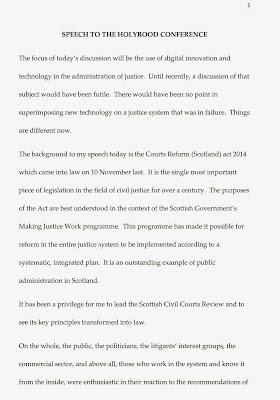 Lord Gill said: “In the 1960s and 1970s the economy of Scotland was transformed by the discovery of North Sea oil. The judges and lawyers of that time were not alert to the opportunity that Scotland could be an international forum for resolving disputes in the oil and gas industry. We paid a price for our complacency when the international oil and gas industry passed us by.”
Gill continued: “Half a century on we should look at Scotland's economic opportunities and see how the courts can best serve them. In recent years a commitment to renewable energy has brought wind power to the fore as an energy source. Other forms of renewable energy may follow.”
The top judge also claimed Scotland can be made an international centre for litigation and mediation.
Gill said "Our legal system should be a driver for economic progress in Scotland. Our courts and our judges can and should contribute to the prosperity of our country. We can do that if, by the excellence of our judges, and our legal profession and the efficiency of our courts, we make Scotland a forum of litigation that not only retains litigations that at present go elsewhere but also becomes a forum of choice for litigations from abroad.."
Lord Gill’s own speech on the issue of fracking, and personal desire for shale oil gas extraction to go ahead, as a matter of judicial policy – was at complete odds with the statement issued by Scottish Government Minister Fergus Ewing on the same day to MSPs at Holyrood.:
While Gill gave his ‘fracking is good for the legal profession, courts & judiary’ lecture, Mr Ewing told the Parliament: "I want to ensure that the voices of the communities likely to be most affected are heard, and are heard in a more formal and structured way.I am therefore announcing today that in addition to the technical work I've referred to on planning, environmental regulation and upon assessing the impact on public health, Scottish ministers will also launch a full public consultation on unconventional oil and gas extraction."
An earlier report on Lord Gill’s speech on the issue of fracking can be found here: FRACKING JUDGES: Scotland’s top judge promotes shale gas extraction, big oil and renewable energy as profit incentive for courts on same day Scottish Government announce ban on fracking