Showing posts with label hospitality. Show all posts

Wednesday, January 22, 2020

JURY SERVICED: Register of Interests for 1,700+ Scottish Court staff has only ONE ENTRY in 3 years – Court employee’s link to winning £13K Sheriff Court jury catering contract concealed from FOI scrutiny by Scottish Courts & Tribunals Service

Court employee links to jury catering contract. QUESTIONS over the accuracy of a Register of Interests for employees of the Scottish Courts and Tribunals Service (SCTS) have emerged - after a member of staff’s link to a catering contract to provide food to jurors at one Sheriff court – was concealed from a Freedom of Information disclosure.

The lack of information in the SCTS register of staff interests, and failure to disclose court employees links to the award of a successful rolling catering contract – providing £13,000 of catering & food to jurors at Stirling Sheriff Court – was only admitted by the Court service - after a series of FOI requests established contracts were being handed out to companies linked to court employees.

Some weeks ago, questions were put to the Scottish Courts and Tribunals Service in the form of an FOI request - after information was provided to the media suggesting significant failures of court employees to declare profitable interests linked to contracts providing services to the courts and judiciary in Scotland.

For some context on this - the probe on court staff failing to declare links to money making contracts providing services to the courts, came about during additional scrutiny of how law firms & some court staff are using hospitality to earn ‘referral fees’, employment for relatives and other financial favours linked to criminal defence law firms poaching each other’s clients.

A full report on hospitality in Scotland’s courts –with links to earlier articles- can be found here: COURT GIFTING, M’LORD: Transparency declarations of ‘hospitality’ to Scotland’s Courts reveal gift giving by Police & Prosecutors to court staff - and reductions in declared hospitality from Legal Aid millionaire law firms

In response to the Freedom of Information enquiry, Gillian Warner of the Scottish Courts & Tribunals Service issued a disclosure with one single declaration, stating the following:

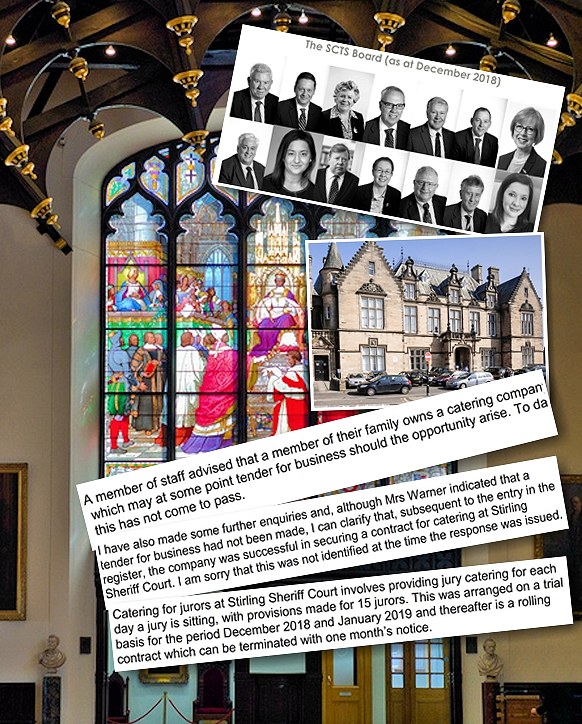
A member of staff advised that a member of their family owns a catering company which may at some point tender for business should the opportunity arise. To date this has not come to pass.

A request for a Freedom of Information review was submitted - and in response to that review - the SCTS were forced to reveal the contract for providing food to juries at Stirling Sheriff Court – was successful and had been awarded – despite the earlier claim that the contract had not been awarded.

Files reveal SCTS failure to disclose staff links to contracts. Margo Mackie, Deputy Head Information Governance & Correspondence said: “I have also made some further enquiries and, although Mrs Warner indicated that a tender for business had not been made, I can clarify that, subsequent to the entry in the register, the company was successful in securing a contract for catering at Stirling Sheriff Court. I am sorry that this was not identified at the time the response was issued.”

Ms Mackie added further detail in the FOI review with the entry as was declared in the SCTS staff register: “The company services a sports club in Stirling and provides outside catering for local companies for functions etc. There are no expected conflicts of interest here however, should a tendering exercise take place for any catering requirements within the Stirling area, it is quite possible that the company would attempt to secure that business. No specific additional steps identified or taken to mitigate any risk at this stage.”

However, when asked about the value of the contract and how long it had been running – the Court Service insisted a new Freedom of Information request must be submitted – which allowed the SCTS an extra twenty days for a response to be given.

It then emerged from the response to the new FOI request that the £13K rolling contract for catering – had been operational for at least a year – despite earlier claims from the Scottish Courts & Tribunals Service that no such contract existed.

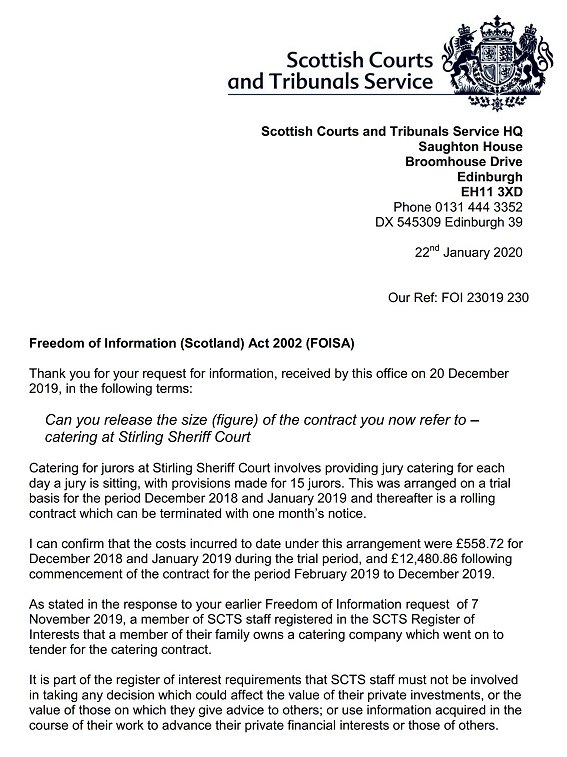
In response ot the second FOI request, Margo Mackie - Deputy Head Information Governance admitted: “Catering for jurors at Stirling Sheriff Court involves providing jury catering for each day a jury is sitting, with provisions made for 15 jurors. This was arranged on a trial basis for the period December 2018 and January 2019 and thereafter is a rolling contract which can be terminated with one month’s notice.”

“I can confirm that the costs incurred to date under this arrangement were £558.72 for December 2018 and January 2019 during the trial period, and £12,480.86 following commencement of the contract for the period February 2019 to December 2019.”

However, while elected politicians such as MSPs & MPs, and those in other public bodies such as Police Scotland are required to declare all their interests, a significant failing in in how employees of the Scottish Courts and Tribunals Service declare their interests has emerged – where Court staff are only required to declare interests they feel may be relevant, rather than a requirement for total disclosure.

A question was put to the SCTS, asking whether entries are only made in this SCTS staff register if a staff member feels they may have an interest to declare - rather than a full and comprehensive register of staff interests - per SCTS staff member - being kept and updated as appropriate - example the register of interests for Scottish Parliament MSPs.

In response, Margo Mackie - Deputy Head Information Governance stated: As regards your first point I can advise that SCTS follows the Civil Service Management Code which sets out regulations and instructions regarding the terms and conditions of service of civil servants. One of these regulations concerns "the declaration of relevant business interests which SCTS employees or members of their immediate family hold, which might compromise, or appear to compromise, their integrity, honesty, objectivity or impartiality”.

“SCTS staff are therefore required to declare any business interests (including directorships) or holdings of shares or other securities which they or members of their immediate family (spouse, including partner where relevant, and children) hold, to the extent which they are aware of them, which they would be able to further as a result of their official position.”

“This means that, where there is a potential for income or financial benefit to be gained from work related to the SCTS, staff must declare and register an interest. Such interests are declared by informing their Unit Head who considers whether the interest is appropriate and should be registered. Thereafter details are provided to Human Resources Unit for addition to the SCTS Register of Interests.Staff who do not declare and register an interest which subsequently comes to light may be subject to disciplinary action.”

After initially concealing information from a Freedom of Information request, admitting further details in a review, and then insisting on a second FOI request, the Scottish Courts & Tribunal Service claimed the member of staff had no part or involvement in procurement.

Margo Mackie Deputy Head Information Governance & Correspondence claimed: “It has been confirmed that the member of staff concerned is not involved in procurement and played no part in the quotes exercise which awarded the contract, nor do they have any active involvement in the running of the company.”

Margo Mackie added: “The matter of updating information contained in the register will be considered in future reviews of the procedures.”

However, no explanation has been given as to why the member of staff’s link to the successful contract was concealed from the initial Freedom of Information disclosure.

Independent Report – Court Employees Interests Register is insufficient

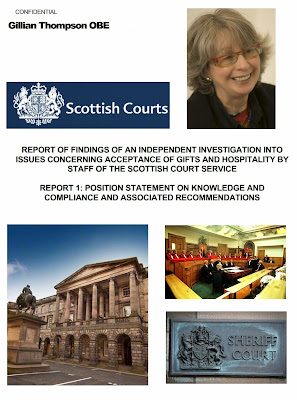
Report said SCS Registers insufficient, Court staff involved in private gains failed to declare. Former Judicial Complaints Reviewer Gillian Thompson’s Report on Hospitality & Gifts in the SCS stated:  “The information currently captured on the registers is insufficient to provide assurance that staff are using their common sense and considering issues such as conflict of interest.

Ms Thompson went on to recommend the “SCS should revise the Policy on Acceptance of Gifts, Rewards and Hospitality to ensure that it is fit for purpose for all staff, taking account of the various roles performed within SCS. It may also be time to revisit the levels of value for gifts and hospitality.”

The former AIB’s report also revealed court staff were using their positions to earn money privately from their links with lawyers and law firms operating in courts, stating “Several staff raised the issue of sheriff clerks who carry out extrajudicial taxations and private assessments and who personally benefit financially from these activities.”

Ms Thompson’s report roundly condemned this practice, stating: “Not only is it inappropriate in terms of the civil service code requirements for staff who are public servants to be able to receive private gain from their employment it is also highly divisive when other staff see such benefits being derived from simply being in the right post of Auditor of Court within the Sheriff Courts.”

Ms Thompson recommended in her report the “SCS should bring the practice of sheriff clerks profiting privately from their employment by SCS to an end as quickly as possible”.

Now, a number of additional claims by whistleblowers regarding undisclosed links between SCTS staff and high value contracts providing services to the courts are currently being examined by DOJ for further investigation and publication at a later date.

Readers should note the Scottish Parliament’s Justice Committee are currently considering an eight year cross party backed petition calling for a Register of Interests for members of Scotland’s judiciary.

Previous articles on the lack of transparency within Scotland’s judiciary, investigations by Diary of Injustice including reports from the media, and video footage of debates at the Scottish Parliament’s Public Petitions Committee can be found here : A Register of Interests for Scotland's Judiciary.

Previous articles on hospitality and gifts to the Scottish Courts and Tribunals Service, reports on gift giving to court employees and investigations by Diary of Injustice on the relationship between law firms and SCTS staff can be found here Hospitality and Gifts to the Scottish Courts.

Thursday, January 09, 2020

COURT GIFTING, M’LORD: Transparency declarations of ‘hospitality’ to Scotland’s Courts reveal gift giving by Police & Prosecutors to court staff - and reductions in declared hospitality from Legal Aid millionaire law firms

Hospitality Register identifies gifts to courts. A REGISTER which now requires the identification of anyone offering hospitality to Scotland’s Courts and judiciary – has seen a drop in high value gifts now recorded in more detail by the Scottish Courts and Tribunals Service (SCTS)

However, the latest declarations of hospitality to court staff in Scotland - reveals a slight decrease in gifts & hospitality from law firms raking in millions in publicly funded legal aid, while ‘anonymous’ gifts from unidentified “Member of the public” appear to be on the rise.

Among the providers of ‘hospitality’ to court staff are multiple law firms, technology companies, in-house legal teams of Scottish Local Authorities, and even Police Scotland, who provided a “Crystal engraved Police Scotland Armed Policing Specialist Firearms Unit ornament” to the Supreme Courts.

And now - thanks to media scrutiny, records of hospitality which is offered but refused - is also now part of the register.

Examples of refused hospitality include a burns supper dinner, offered by Microsoft to the Information Technology Unit in January 2019, and questionable offers of hospitality by Procuratir Fiscals to court staff – which included a faculty dinner offered to court staff at Kilmarnock Sheriff Court.

The rate of hospitality in terms of high value gifts has declined, at least if the disclosed records are to be believed.

And, law firms which are known to have received up to half a million pounds of legal aid every year – who were previously showering staff in local courts with gifts & hospitality – are no longer flooding the courts with perks & freebies after Diary of Justice began publishing disclosures on courtroom hospitality and it’s connections to legal aid & lawyers touting for business in local criminal courts.

The recently disclosed Register of Hospitality for Scotland’s Courts & Tribunals Service running from 2017-2019 – as provided by the SCTS in relation to a Freedom of Information request - can be viewed here: Scottish Courts & Tribunals Service Register of Hospitality 2017-2019

Among the extensive list of hospitality providing law firms are the following names, provided by a reader – which also highlight some gifts & hospitality from foreign Governments to Scotland’s courts. The location of hospitality offered/accepted is listed next to the provider: The Society of Solicitors of Hamilton (Hamilton Sheriff Court), Burnett & Co (Aberdeen Sheriff Court, Digby Brown Solicitors (Aberdeen Sheriff Court), McKinnon Hewitt Solicitors (Kilmarnock Sheriff Court), Belmonte & Co Solicitors (SCTS Lothian & Borders mgmt team), Leonards Solicitors (Hamilton Sheriff Court), Norwegian Civil Law Division (OPG & AOC), Innes Johnson LLP Kirkcaldy (Dunfermline Sheriff Court), Netherlands Judiciary, Lamont's Solicitors Ayr (Ayr Sheriff Court), Aberdeen Bar Association (Aberdeen Sheriff Court), George Mathers & Co solicitors (Aberdeen Sheriff Court), West Lothian College, Bar Association (Aberdeen Sheriff Court), Nigel Beaumont Solicitor (Edinburgh Sheriff Court), Unidentified Solicitor 3x Hospitality (Livingston Sheriff Court), Adams Whyte Defence Lawyers (Livingston Sheriff Court), Bar Association (Livingston Sheriff Court), Allcourt Solicitors (Livingston Sheriff Court), Balfour & Manson (Supreme Courts), Ministry of Justice - Korea (OPG & AOC) , Ministry of Justice republic of Korea (OPG & AOC), Chinese Delegation (Supreme Courts), School Mock Court Case Project (Supreme Courts), Marsh Insurance (OPG & AOC), University of Glasgow (Glasgow Sheriff Court), Solicitors for the Elderly (Supreme Courts), Inverness Legal Services (Inverness Sheriff Court), Malcolm Boyd Sheriff Officers (Airdrie Sheriff Court), BTO Solicitors (Supreme Courts & Edinburgh Sheriff Courts), Stewart and Watson property & Legal services (Elgin Sheriff Court), T Duncan & Co (Forfar Sheriff Court), Caesar & Howie Solicitors Alloa (Alloa Sheriff Court) , PoliceScotland (Supreme Courts), Cockburn McGrane Solicitors (Kirkcaldy Sheriff Court), G4S (Dundee Sheriff Court), MacDonald Law, Thurso (Kirkwall Sheriff Court), Caird Vaughan Solicitors (Dundee Sheriff Court), Lefevre Litigation (Supreme Courts), Alistair Young Solicitor (Dumbarton Sheriff Court), McKenna Law Practice (Kirkcaldy Sheriff Court), President of the Law Society of Scotland (SCTS Chief Executive Office), Court Police Officers (Kirkcaldy Sheriff Court), Hunter & Robertson solicitors (Paisley Sheriff Court), Procurator Fiscals Office Hamilton, Summary Unit (Hamilton Sheriff Court), Bonnar Accident Law (Airdrie Sheriff Court), JK Cameron solicitors (Dumbarton, Airdrie Sheriff Court), Kenneth M Greener solicitors (Hamilton Sheriff Court), Wink and MacKenzie solicitors (Elgin Sheriff Court), Aberdein Considine solicitors (Aberdeen Sheriff Court), Mackie Thomson & Co Ltd solicitors (Hamilton Sheriff Court), North Lanarkshire Council Legal (Hamilton Sheriff Court), Procurator Fiscal (Dundee Sheriff Court), Stirling Dunlop solicitors (Hamilton Sheriff Court), the MacKenzie Law Practice (Inverness Sheriff Court), AC O'Neill solicitors (Dumbarton Sheriff Court), Adairs solicitors (Dumbarton Sheriff Court).

A full listing of solicitors & law firms, companies and others who offered hospitality to court staff and the judiciary - can be viewed by searching the Register of Hospitality document which runs in detail to twenty eight pages, providing details of all disclosed hospitality from law firms, and others to the Scottish Courts & Tribunals Service.

Prior to Freedom of Information requests from DOJ journalists, the SCTS register of hospitality did not identify law firms – and was later found to be incomplete in recording hospitality, after an investigation was launched due to media coverage of gifts by law firms – some of which have received many millions of pounds of legal aid over the last decade.

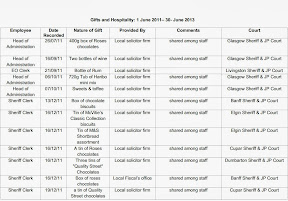
Extract of Register of Hospitality 2013 Scottish Courts Service. Disclosures from the Scottish Court Service in documents reveal that in the last five years, over 500 instances of gifts and hospitality received by publicly funded SCS were declared under the rules.

Gifts such as expensive champagne, wines, chocolates and dinner invitations were given by lawyers and others to Sheriff Clerks and SCS staff, along with invitations to the Royal Garden Party, paid-for trips in planes, tickets to football matches and a host of other goods, services & gifts many court users may well come to question in terms of how much this gift giving by lawyers dents the supposed impartiality of court staff.

During reporting of the issue back in 2013, it emerged in the media that in some cases, lawyers had paid for criminal fines accrued by court staff, leading some to question their reasons for doing so and what secret benefits this brought to the legal profession and court staff involved.

At the time, legal sources acknowledged to Diary of Justice that significant numbers of gifts have not been declared by court staff, and that much of the gift giving may well be seen as thanks for favours done in court for law firms, particularly those who are pursuing clients for unpaid fees.

The lack of declarations of hospitality and gifts, and the coverage by Diary of Justice, which reported on concerns regarding hospitality involving Scottish Court Service employees – led to an investigation by Gillian Thompson – who served as Scotland’s second Judicial Complaints Reviewer (JCR)

Ms Thompson was asked by the Scottish Court Service to investigate reports of irregularities in hospitality given to court staff.

The request for the investigation came after the Scottish Court Service received Freedom of Information requests regarding hospitality in the courts, prompting concerns some staff may have accepted gifts or hospitality but failed to register.

Report said SCS Registers insufficient, Court staff involved in private gains failed to declare. Gillian Thompson’s Report on Hospitality & Gifts in the SCS stated:  “The information currently captured on the registers is insufficient to provide assurance that staff are using their common sense and considering issues such as conflict of interest.

Ms Thompson went on to recommend the “SCS should revise the Policy on Acceptance of Gifts, Rewards and Hospitality to ensure that it is fit for purpose for all staff, taking account of the various roles performed within SCS. It may also be time to revisit the levels of value for gifts and hospitality.”

The former AIB’s report also revealed court staff were using their positions to earn money privately from their links with lawyers and law firms operating in courts, stating “Several staff raised the issue of sheriff clerks who carry out extrajudicial taxations and private assessments and who personally benefit financially from these activities.”

Ms Thompson’s report roundly condemned this practice, stating: “Not only is it inappropriate in terms of the civil service code requirements for staff who are public servants to be able to receive private gain from their employment it is also highly divisive when other staff see such benefits being derived from simply being in the right post of Auditor of Court within the Sheriff Courts.”

Ms Thompson recommended in her report the “SCS should bring the practice of sheriff clerks profiting privately from their employment by SCS to an end as quickly as possible”.

HOW COURT CHIEFS LOST HOSPITALITY INFORMATION BATTLE

When DOI launched an initial investigation into hospitality and graft among court staff, the Scottish Court Service refused to release information relating to the gift register, claiming “the names of the gift or hospitality provider would be deemed as personal information” and “as the provider of the gift or hospitality was not made aware at the time that their name may be released, we consider disclosure of such is likely to bring the Scottish Court Service into conflict with the data protection principles.”

However, the Freedom of Information request – from DOJ – triggered a review of hospitality policy at the Scottish Court Service, leading to names of ‘'hospitality’ providers being added to the register.

Richard Warner of the SCS said: “I can advise you that due to your request for this information, the Scottish Court Service has changed the policy covering hospitality and gifts to ensure that the provider of any hospitality or gift are made aware that their name shall be entered on to our register and may be disclosed if requested in any future information request. This policy change shall take effect as from 1 January 2014 so the release of names may be considered in any future request for gifts or hospitality offered from this date. The policy also states that if the provider does not consent to their name being considered for release then the gift or hospitality cannot be accepted by a member of staff.”

After a request for review of refusal to disclose the information, the SCS again refused - this time around, claiming it would cost them too much to contact each law firm to ask permission to disclose their ‘hospitality’ to court employees. The SCS claimed they would have to contact every lawyer who gave a gift and this would cost too much to provide the information.

DOJ journalists took the matter up with Rosemary Agnew - the Scottish Information Commissioner – who requested Courts Chief Eric McQueen provide an explanation as to why the courts were blocking release of information on hospitality relationships between the legal profession and court staff.

John Kelly, Freedom of Information Officer at the SIC said: “Having written to and discussed the matter with the SCS, without being required to do so by way of a formal Decision Notice, the SCS has agreed to provide you with the information requested, subject to redactions in terms of section 38(1)(b) of FOISA on the basis that to disclose some of the names of individuals would breach the first data protection principle of the Data Protection Act 1998 (the DPA). I understand that the names of Solicitor and Law Firms will be provided.”

After the intervention of the Scottish Information Commissioner, the SCS subsequently released the hospitality list to journalists.

Richard Warner for the SCS said: “Having reconsidered your request, and the SCS response, I now attach a list which indicates law firms where this information has been recorded.  For the reasons stated in our earlier response this does not include the names of any individuals concerned as there could have been no expectation on their part that this information would be circulated or published widely.  As indicated previously, steps are being taken to ensure that individual persons are made aware at the relevant time that their details made be released as a result of an information request.”

Previous articles on hospitality and gifts to the Scottish Courts and Tribunals Service, reports on gift giving to court employees and investigations by Diary of Injustice on the relationship between law firms and SCTS staff can be found here Hospitality and Gifts to the Scottish Courts.

Thursday, May 26, 2016

SCRUTINY OF THE BOUNTY: Court staff accepted gifts from law firms probed by Police for alleged legal aid fraud - days after appointment of Scotland’s latest top judge Lord Carloway

Court staff accepted gifts from lawyers being investigated by Police. DOCUMENTS obtained by journalists reveal just a few days after Lord Carloway was named as Scotland's new top judge – Court staff employed by the Scottish Courts and Tribunals Service (SCTS) accepted gifts from law firms under criminal investigation for alleged legal aid fraud.

The information came to light in an unpublished register of gifts and hospitality to Scottish Court Service staff - released in response to a Freedom of Information request.

The ‘Gifts and Hospitality’ register now identifies law firms & hospitality providers - after DOI journalists previously approached Scottish Information Commissioner Rosemary Agnew for help in breaking court secrecy.

Entries in the latest gifts register reveal that on 22 December 2015, Central Court Lawyers gave hospitality in the form of ‘Cake, 6 wine and 12 beers’ to Livingston Sheriff Court staff - who then entered the items into a "staff raffle".

However, it was reported by the media during February 2015 that Central Court Lawyers were under investigation by Police Scotland for irregularities in legal aid claims.

Last year, when the story was reported, Police Scotland confirmed "Central Court Lawyers are assisting us with our inquiries."

Officers are thought to have interviewed serving and former employees of Central Court Lawyers as part of their inquiry, which began in 2014.

Central Court Lawyers – based in Livingston – was established by lawyer Neil Robertson and solicitor-advocate Ian Bryce in 1997.

Ian Bryce has held a number of positions at the Law Society of Scotland, including vice-convener of the legal aid negotiating team.

Central Court Lawyers has previously been included in the Legal 500 - a publication listing the top law firms in the UK.

The Hospitality & Gifts Register 2015-2016 reveals staff took hospitality from legal aid probe lawyers.

In response to media enquiries, a spokesperson for the Scottish Courts & Tribunals Service (SCTS) claimed gifts had not been accepted.

The spokesperson said: “SCTS staff at Livingston Sheriff Court have not accepted hospitality from Central Court Lawyers. A small gift was accepted on behalf of staff in December 2015 and entered in the staff Christmas raffle.

The spokesperson continued: “This was fully declared in the Gifts and Hospitality Register.”

The SCTS were asked why staff accepted gifts from law firms under investigation by Police Scotland for legal aid irregularities.

A spokesperson said in response: “Gifts with a value over £15 require to be approved by a senior manager and the giver advised that details will be entered onto the register for transparency. If a manager has any concern regarding the offer of a gift HR will offer further advice.”

Previous versions of the hospitality register - Hospitality and Gifts to Court Staff 2010-2013 - have also included the names of solicitors such as Niels S Lockhart – who was investigated by the Scottish Legal Aid Board after he claimed over £600K in just two years.

Lockhart – who gave hospitality to staff at Ayr Sheriff Court in 2012 - subsequently withdrew from the legal aid register - with no action taken by the Law Society of Scotland or the Scottish Legal Aid Board.

Neils Lockhart continued to receive legal aid payments for unpaid accounts even after he quit the legal aid register, reported in further detail here: CASH TRAPPED: £1.2m legal aid Lawyer demanded more public cash after being barred from legal aid register

In response to details published by DOI during March 2015 in last year’s hospitality register to court staff - lawyers accused each other of using hospitality to poach clients from rival law firms and increase firms volume of legal aid business – reported in further detail here: GIFT HORSE: Secret gifts register reveals rogue lawyers & law firms using hospitality relationships with Scottish Court Service staff to increase legal aid business, poach clients from rival solicitors

Asked for comment on the current status of the investigation into Central Court Lawyers, the Scottish Legal Aid Board refused to provide further details.

A spokesperson for SLAB said: “It is inappropriate for us to comment on whether we are conducting specific investigations or enquiries into a solicitors’ firm, or if we are, what they involve.”

“The intention is not to be unhelpful but, for example, where there is an investigation we don’t generally comment because this would be premature in terms of the stage any enquiry has reached in determining if the matters being examined are improper or unlawful.”

“To do so would be inappropriate if an investigation subsequently concluded that nothing improper or unlawful had occurred. It could also be potentially prejudicial if an investigation found improper or unlawful activity and the matter was subsequently referred to the Crown.”

Court staff at Hamilton Sheriff court were also rapped on the knuckles for failing to properly record gifts from a number of local law firms who operate in the area.

An entry in the register reveals "A number of local solicitors firms including but not restricted to:Kenneth Greener & Co; Linda George Family; Diarmid Bruce; Ness Gallagher; Lanarkshire Law Practice gave "25 boxes/tins of chocolates; 10 boxes of biscuits; 18 bottles of wine; 2 bottles of spirits;   21 miniatures of whisky/baileys; 3 large cakes; 1 recipe book." to local court staff.

The failure to adequately record the 'hospitality' drew ire from Court chiefs who said "The correct procedure for recording gifts was not followed in this instance. Management in this court has been reminded of the need to follow the procedure in future."

A number of law firms & solicitors who operate at Hamilton & Livingston Sheriff Court have previously been investigated for legal aid fraud.

Commenting on earlier versions of the register - an Edinburgh solicitor said: “The contents of the court hospitality register read as a who’s who of legal aid investigations just waiting to happen.”

Previously - Diary of Injustice reported on concerns regarding hospitality involving Scottish Court Service employees where Gillian Thompson – who now serves as Judicial Complaints Reviewer (JCR) - was asked by the Scottish Court Service to investigate reports of irregularities in hospitality given to court staff.

The request for the investigation came after the Scottish Court Service received Freedom of Information requests regarding hospitality in the courts, prompting concerns some staff may have accepted gifts or hospitality but failed to register.

Report said SCS Registers insufficient, Court staff involved in private gains failed to declare. Gillian Thompson’s Report on Hospitality & Gifts in the SCS stated:  “The information currently captured on the registers is insufficient to provide assurance that staff are using their common sense and considering issues such as conflict of interest.

Ms Thompson went on to recommend the “SCS should revise the Policy on Acceptance of Gifts, Rewards and Hospitality to ensure that it is fit for purpose for all staff, taking account of the various roles performed within SCS. It may also be time to revisit the levels of value for gifts and hospitality.”

The former AIB’s report also revealed court staff were using their positions to earn money privately from their links with lawyers and law firms operating in courts, stating “Several staff raised the issue of sheriff clerks who carry out extrajudicial taxations and private assessments and who personally benefit financially from these activities.”

Ms Thompson’s report roundly condemned this practice, stating: “Not only is it inappropriate in terms of the civil service code requirements for staff who are public servants to be able to receive private gain from their employment it is also highly divisive when other staff see such benefits being derived from simply being in the right post of Auditor of Court within the Sheriff Courts.”

Ms Thompson recommended in her report the “SCS should bring the practice of sheriff clerks profiting privately from their employment by SCS to an end as quickly as possible”.

HOW COURT CHIEFS LOST HOSPITALITY INFORMATION BATTLE

When DOI launched an initial investigation into hospitality and graft among court staff, the Scottish Court Service refused to release information relating to the gift register, claiming “the names of the gift or hospitality provider would be deemed as personal information” and “as the provider of the gift or hospitality was not made aware at the time that their name may be released, we consider disclosure of such is likely to bring the Scottish Court Service into conflict with the data protection principles.”

However, the Freedom of Information request – from DOI – triggered a review of hospitality policy at the Scottish Court Service, leading to names of ‘'hospitality’ providers being added to the register.

Richard Warner of the SCS said: “I can advise you that due to your request for this information, the Scottish Court Service has changed the policy covering hospitality and gifts to ensure that the provider of any hospitality or gift are made aware that their name shall be entered on to our register and may be disclosed if requested in any future information request. This policy change shall take effect as from 1 January 2014 so the release of names may be considered in any future request for gifts or hospitality offered from this date. The policy also states that if the provider does not consent to their name being considered for release then the gift or hospitality cannot be accepted by a member of staff.”

After a request for review of refusal to disclose the information, the SCS again refused - this time around, claiming it would cost them too much to contact each law firm to ask permission to disclose their ‘hospitality’ to court employees. The SCS claimed they would have to contact every lawyer who gave a gift and this would cost too much to provide the information.

DOI journalists took the matter up with Rosemary Agnew - the Scottish Information Commissioner – who requested Courts Chief Eric McQueen provide an explanation as to why the courts were blocking release of information on hospitality relationships between the legal profession and court staff.

John Kelly, Freedom of Information Officer at the SIC said: “Having written to and discussed the matter with the SCS, without being required to do so by way of a formal Decision Notice, the SCS has agreed to provide you with the information requested, subject to redactions in terms of section 38(1)(b) of FOISA on the basis that to disclose some of the names of individuals would breach the first data protection principle of the Data Protection Act 1998 (the DPA). I understand that the names of Solicitor and Law Firms will be provided.”

After the intervention of the Scottish Information Commissioner, the SCS subsequently released the hospitality list to DOI.

Richard Warner for the SCS said: “Having reconsidered your request, and the SCS response, I now attach a list which indicates law firms where this information has been recorded.  For the reasons stated in our earlier response this does not include the names of any individuals concerned as there could have been no expectation on their part that this information would be circulated or published widely.  As indicated previously, steps are being taken to ensure that individual persons are made aware at the relevant time that their details made be released as a result of an information request.”

While the position of Scotland's latest top judge on court staff transparency is unknown - Lord Carloway has already attacked proposals to bring the judiciary into line with court employees and others in public life who are required to register their interests, gifts and hospitality.

Carloway recently attacked proposals before the Scottish Parliament - Petition PE1458: Register of Interests for members of Scotland's judiciary – calling on judges to register their own interests and hospitality.

Reported in further detail here: LORD NO-WAY: Top judge Lord Carloway hits out at judicial interests register proposal – Lord Carloway claimed justice could grind to a halt in a constitutional calamity if judges were forced to declare their vast wealth, property owning interests, professional links and other financial affairs – just like politicians, members of public bodies, local councillors are required to reveal in publicly available registers.

Lord Carloway (real name: Colin Sutherland) told MSPs: “The proper administration of justice could be inhibited by the disclosure of the judiciary's otherwise confidential financial arrangements. In that connection, there is the possibility that an individual judge may be the subject of misconceived criticism, deriving from the disclosure of personal financial information, where those interests are tangential and de minimis.”

The widely supported proposals - debated at the Scottish Parliament on 9 October 2014 - call for the creation of a publicly available register of judicial interests containing information on judges backgrounds, their personal wealth, undeclared earnings, business & family connections inside & outside of the legal profession, offshore investments, hospitality, details on recusals and other information routinely lodged in registers of interest across all walks of public life in the UK and around the world.

Previous articles on the lack of transparency within Scotland’s judiciary, investigations by Diary of Injustice including reports from the media, and video footage of debates at the Scottish Parliament’s Public Petitions Committee can be found here : A Register of Interests for Scotland's Judiciary.

Previous articles on hospitality and gifts to the Scottish Courts and Tribunals Service, reports on gift giving to court employees and investigations by Diary of Injustice on the relationship between law firms and SCTS staff can be found here Hospitality and Gifts to the Scottish Courts.

Monday, March 30, 2015

GIFT HORSE: Secret gifts register reveals rogue lawyers & law firms using hospitality relationships with Scottish Court Service staff to increase legal aid business, poach clients from rival solicitors

Legal Aid client poaching & hospitality racket in Scots Courts. LAWYERS accused of making suspicious, erroneous or fraudulent legal aid claims appear among a list of high earning legal aid law firms in a register of gifts & ‘hospitality’ received by staff at the Scottish Court Service (SCS).

The documents, finally disclosed to journalists after court bosses failed to convince the Scottish Information Commissioner it should remain secret – identify ‘significant’ hospitality relationships between law firms who have received tens of millions of pounds of legal aid, local courts and court employees right across Scotland.

And it has emerged the extent of ‘hospitality’ to court staff is so great - some local courts have been the scene of ‘gift wars’ between law firms – with solicitors raising the stakes over rivals using hospitality to ensure business came their way at the expense of competitors.

The extent of gift giving in exchange for business referrals - raises questions over whether it is appropriate for court staff – who run the courts at taxpayers expense - to enter into hospitality relationships  with solicitors who have a stake in dragging on court cases to beef up their fees and claims for legal aid.

And, some law firms on the list have been implicated in allegations of questionable legal aid claims. In other cases, law firms , activity resulting in criminal charges against staff.

In one case, the law firm of NS Lockharts Solicitors – run by Niels S Lockhart - a sole practitioner in Kilmarnock who was the subject of a Scottish Legal Aid Board investigation into huge sums of legal aid claims of over £600,000 in three years also appears in the list. NS Lockharts Solicitors are identified as providing hospitality to local court staff in Ayr Sheriff Court.

Lockhart ‘withdrew’ from the legal aid register after an investigation by the Scottish Legal Aid Board.

In another case of gift giving between lawyers on the legal aid ticket and court staff - the law firm of Bell & Co Solicitors are also identified as hospitality providers to staff at Kilmarnock Sheriff Court. However, Bell & Co hit the headlines two years ago when one of their Paralegals – Arlene Reid - was jailed for two years - for embezzlement and mortgage fraud totalling £87K after Reid defrauded her own employers and the Alliance & Leicester Building Society.

Gifts Register identifies Scots law firms ‘hospitality’ to court employees The list of law firms, together with a list of hospitality released by the Scottish Court Service identifies law firms who receive millions in taxpayer funded legal aid every year.

Hospitality on the list ranges from boxes of chocolates, alcohol, invitations to dinners with the ‘vested interests club’ - top lawyers, law firms, the Faculty of Advocates & the Law Society of Scotland,  big business hosts & even “Royal Garden Parties”. Other hospitality include trips on boats, gift vouchers for high street stores, dinner parties with Police, and - bunches of flowers.

The extent of hospitality relationships between court staff and law firms have raised suspicions SCS staff are providing lawyers & law firms with personal favours in return, which in some instances are leading to criminal cases ‘taking their time’ through the courts owing to overly friendly relationships with local law firms & local court staff.

Information has also been provided to journalists – alleging undeclared financial relationships between court staff and law firms, in relation to the purchase of properties & land, provision of free or discounted legal services to SCS staff in their personal legal affairs, and instances of SCS staff providing return favours for solicitors when asked to do so.

Speaking to Diary of Injustice earlier today, a solicitor from a law firm which has provided small amounts of hospitality as a matter of courtesy and thanks to local court staff, said he was aware some law firms were offering additional gifts to SCS staff as a way of drawing in business. He described the situation as “unfair practice”.

The solicitor told DOI he was aware of several cases where court staff received discounted or free legal services – from law firms who were taking clients from others including his own firm.

Asked if he believed all hospitality provided to court staff was being declared, the solicitor replied: “No, it is not.”

And. in an example of law firms poaching each other’s clients using hospitality to court staff – DOI uncovered a case where ‘regular’ criminal legal aid clients of one law firm - were allegedly directed to another law firm by a court clerk in receipt of ‘hospitality’.

However, the switch did not result in a good move for the clients -  who ended up jailed for minor criminal offences after a trainee solicitor from the law firm they were sent to – messed up their defences and pleadings.

Commenting on the documents, the Scottish Legal Aid Board said: “If there was ever any evidence that a solicitor providing legal aid had acted in an inappropriate manner in relation to the provision of legal aid we would investigate and, if appropriate, use the sanctions available to us under the legal aid legislation.”

In an earlier investigation by DOI, it was revealed Gillian Thompson OBE – now the Judicial Complaints Reviewer (JCR) – authored a report on undeclared relationships between employees of the Scottish Court Service, law firms, and other vested interests. The report, published by DOI – revealed court staff are making money on the side via relationships with law firms.

Diary of Injustice reported on concerns regarding hospitality involving Scottish Court Service employees where Ms Thompson was asked by the Scottish Court Service to investigate reports of irregularities in hospitality given to court staff. The request for the investigation came after the SCS received Freedom of Information requests regarding hospitality in the courts, prompting concerns some staff may have accepted gifts or hospitality but failed to register.

Report said SCS Registers were insufficient, and Court staff involved in private gain failed to declare. Gillian Thompson’s Report on Hospitality & Gifts in the SCS stated:  “The information currently captured on the registers is insufficient to provide assurance that staff are using their common sense and considering issues such as conflict of interest.

Ms Thompson went on to recommend the “SCS should revise the Policy on Acceptance of Gifts, Rewards and Hospitality to ensure that it is fit for purpose for all staff, taking account of the various roles performed within SCS. It may also be time to revisit the levels of value for gifts and hospitality.”

The former AIB’s report also revealed court staff were using their positions to earn money privately from their links with lawyers and law firms operating in courts, stating “Several staff raised the issue of sheriff clerks who carry out extrajudicial taxations and private assessments and who personally benefit financially from these activities.”

Ms Thompson’s report roundly condemned this practice, stating: “Not only is it inappropriate in terms of the civil service code requirements for staff who are public servants to be able to receive private gain from their employment it is also highly divisive when other staff see such benefits being derived from simply being in the right post of Auditor of Court within the Sheriff Courts.”

Ms Thompson recommended in her report the “SCS should bring the practice of sheriff clerks profiting privately from their employment by SCS to an end as quickly as possible”.

HOW COURT CHIEFS LOST HOSPITALITY INFORMATION BATTLE

The Scottish Court Service initially refused to release the gift register, claiming “the names of the gift or hospitality provider would be deemed as personal information” and “as the provider of the gift or hospitality was not made aware at the time that their name may be released, we consider disclosure of such is likely to bring the Scottish Court Service into conflict with the data protection principles.”

However, the request – from DOI – triggered a review of hospitality policy at the Scottish Court Service, leading to names of ‘'hospitality’ providers being added to the register.

Richard Warner of the SCS said: “I can advise you that due to your request for this information, the Scottish Court Service has changed the policy covering hospitality and gifts to ensure that the provider of any hospitality or gift are made aware that their name shall be entered on to our register and may be disclosed if requested in any future information request. This policy change shall take effect as from 1 January 2014 so the release of names may be considered in any future request for gifts or hospitality offered from this date. The policy also states that if the provider does not consent to their name being considered for release then the gift or hospitality cannot be accepted by a member of staff.”

After a request for review of refusal to disclose the information, the SCS again refused - this time around, claiming it would cost them too much to contact each law firm to ask permission to disclose their ‘hospitality’ to court employees. The SCS claimed they would have to contact every lawyer who gave a gift and this would cost too much to provide the information.

DOI journalists took the matter up with the Scottish Information Commissioner – who requested Courts Chief Eric McQueen provide an explanation as to why the courts were blocking release of information on hospitality relationships between the legal profession and court staff.

John Kelly, Freedom of Information Officer at the SIC said: “Having written to and discussed the matter with the SCS, without being required to do so by way of a formal Decision Notice, the SCS has agreed to provide you with the information requested, subject to redactions in terms of section 38(1)(b) of FOISA on the basis that to disclose some of the names of individuals would breach the first data protection principle of the Data Protection Act 1998 (the DPA). I understand that the names of Solicitor and Law Firms will be provided.”

After the intervention of the Scottish Information Commissioner, the SCS subsequently released the hospitality list to DOI.

Richard Warner for the SCS said: “Having reconsidered your request, and the SCS response, I now attach a list which indicates law firms where this information has been recorded.  For the reasons stated in our earlier response this does not include the names of any individuals concerned as there could have been no expectation on their part that this information would be circulated or published widely.  As indicated previously, steps are being taken to ensure that individual persons are made aware at the relevant time that their details made be released as a result of an information request.”

Friday, October 11, 2013

Access to Justice, Hospitality or Bribes ? Scotland’s Courts revealed as haven of lawyers gift giving to staff, secret favours & private profiteering by court clerks

Judges don't declare their gifts, interests while court staff do, sort of. SCOTLAND’S COURTS are little more than a haven of questionable hospitality from law firms, secret favours & errands run by Scottish Court Service staff for lawyers, gift giving and private profiteering by senior officers of the court who are paid large sums of public money to keep the wheels of Scotland’s creaky “Victorian” courts system turning at a pace most now regard as glacial.

The information comes to light in disclosures by the Scottish Court Service in response to Freedom of Information requests after it emerged that ordinary court service staff are required to declare the presents they receive from solicitors & others, while judges are not. Scotland’s judiciary have so far resisted calls to declare hospitality and their wealth, interests & links to the legal and other professions in a Register of Judicial Interests as called for in Petition PE1458: Register of Interests for members of Scotland's judiciary.

Extract of Register of Hospitality 2013 Scottish Courts Service. Disclosures from the Scottish Court Service in documents reveal that in the last five years, over 500 instances of gifts and hospitality received by publicly funded SCS were declared under the rules.

Gifts such as expensive champagne, wines, chocolates and dinner invitations were given by lawyers and others to Sheriff Clerks and SCS staff, along with invitations to the Royal Garden Party, paid-for trips in planes, tickets to football matches and a host of other goods, services & gifts many court users may well come to question in terms of how much this gift giving by lawyers dents the supposed impartiality of court staff.

It has also emerged in the media that in some cases, lawyers have actually paid for criminal fines accrued by court staff, leading some to question their reasons for doing so and what secret benefits this brought to the legal profession and court staff involved.

Privately, legal sources have acknowledged to Diary of Injustice that it is suspected a lot of gifts have not been declared by SCS staff, and that much of the gift giving may well be seen as thanks for favours done in court for law firms, particularly those who are pursuing clients for unpaid fees.

Confirming the air of suspicion over the hospitality register, the SCS explained in their response to the FOI request from Diary of Injustice : “In May 2010 we received an FOI relating to the acceptance of gifts by members of staff. On our investigation to establish the information we became concerned that some staff may have accepted gifts or hospitality but failed to register those in accordance with our policy.”

“We asked Gillian Thomson, former Chief Executive of the Accountant in Bankruptcy to investigate this and she reported to us in May 2010.  The report flagged up some areas of the then policy which merited strengthening to assist staff to understand their obligations regarding seeking authority for or registering gifts or hospitality.”

Report on gift giving at Scotland’s Courts by Gillian Thomson OBE. According to the report by the former AIB Chief Executive, “A few staff felt that all gifts and hospitality etc should be refused such a step is not likely to be workable, indeed it is more likely to have a detrimental effect on moral in some areas. Almost all who expressed a view, however, agreed that people who were external to SCS could misunderstand perceived close working relationships. And some others sought clarity on whether or not it was acceptable to receive gifts from or give gifts to the Judiciary.”

Ms Thomson’s report went on to state : “Staff are of course entitled to a family/private life and the public sector should not fear association with private however great care is needed over impropriety and conflict of interest.”

Ms Thomson recommended the “SCS should revise the Policy on Acceptance of Gifts, Rewards and Hospitality to ensure that it is fit for purpose for all staff, taking account of the various roles performed within SCS. It may also be time to revisit the levels of value for gifts and hospitality.”

The report was also highly critical of the state of the SCS Registers of Hospitality, stating : “The information currently captured on the registers is insufficient to provide assurance that staff are using their common sense and considering issues such as conflict of interest. The registers seem sparsely populated and some of the names appear more frequently as seen in Appendix E. Indeed, some of the entries on the hospitality register have been retrospectively recorded.”

“One interviewee commented that on the 2 occasions they had asked for hospitality to be recorded they were either not recorded or put on the wrong register. Although a small sample it may be worth consider the process of reporting. The formatting of documents was also raised, there is perhaps a need to ensure they are easy to read for all, including those with visual impairments. so that SCS may wish to look at the registers held by other organizations, a good example of which might be the gifts and hospitality register held by the Scottish Government which uses a self referral facility. Random audits could be carried out to ensure compliance.”

Ms Thomson went on to recommend : “SCS should develop the individual registers to contain more information to allow better monitoring of what was offered, to whom it was offered and by whom it was approved, these changes would provide better assurance that the policy is being complied with and more easily identify any attempt to offer inappropriate gifts or hospitality to staff.”

“In addition this should create  an opportunity to monitor the consistency of advice provided and to counter any assertions of conflict of interest. SCS should also consider improving access to the registers. This might take the form of an electronic self certifying document for lower value gifts, rewards and hospitality.”

The question of Sheriff Clerks profiteering on the side from their roles in court also raised recommendations to bring the practice to an end : “Several staff raised the issue of sheriff clerks who carry out extrajudicial taxations and private assessments and who personally benefit financially from these activities.”

“Not only is it inappropriate in terms of the civil service code requirements for staff who are public servants to be able to receive private gain from their employment it is also highly divisive when other staff see such benefits being derived from simply being in the right post of Auditor of Court within the Sheriff Courts.”

Ms Thomson recommended : “SCS should bring the practice of sheriff clerks profiting privately from their employment by SCS to an end as quickly as possible”

While the recommendation to prevent Sheriff Clerks from profiteering privately was made by Ms Thomson back in 2010, it appears not to have been heeded by all, as several cases brought to the attention of Diary of Injustice over the past two years have revealed financial relationships between court staff and law firms which have emerged through investigation of cases where solicitors were attempting to pursue clients for questionable fee demands, some of which have led to years of suffering and personal bankruptcy for innocent members of the public.

Curiously, while Scotland’s Lord President Lord Gill has continued to argue the setting up of Registers of Interest (and hospitality) for the judiciary would cause undue harm to judges, even dent the possibility of recruiting to the bench, it is the case the staff of the Scottish Court Service who run Lord Gill’s courts have been required to declare their hospitality for a number of years without any of the problems Lord Gill has thrown against a call for a Register of Judicial Interests.

Given we now have one half of the courts system declaring or being seen to declare some of their hospitality and interests, It is therefore clear the same rules must be applied to the judiciary, and even more so, given their position in public life.

Previous articles on the lack of transparency within Scotland’s judiciary, investigations of the judiciary by Diary of Injustice including reports from the Sunday Mail newspaper, and video footage of debates at the Scottish Parliament’s Public Petitions Committee can be found here : A Register of Interests for Scotland's Judiciary

Tuesday, November 01, 2011

First Minister opens Qatar Office of law firm who won DEBT RECOVERY & PROPERTY contracts from £20 Million Scottish Govt spending spree on lawyers

Scotland’s First Minister opens Qatar Office of law firm McGrigors, who won share in £20m Scottish Government spending spree on legal profession (pic-Scottish Govt). A PRESS RELEASE from the Scottish Government issued late last week reported Scotland’s First Minister, Alex Salmond opened a new office of the well known Scottish law firm McGrigors in Doha, Qatar. However what the press release from the Scottish Government failed to mention is that McGrigors recently won a share of contracts with the Scottish Government in a TWENTY MILLION POUND PLUS legal project by Mr Salmond’s Scottish Government to rapidly enlarge its already burgeoning 225 plus lawyer strong legal department to provide legal services outsourced by the Scottish Government's Legal Directorate (SLGD).

Among a long list of law firms who were also revealed to have taken part in hospitality to the Scottish Government’s legal directorate officials, McGrigors won contracts from the Scottish Government for DEBT RECOVERY and PROPERTY.

However, while the Scottish Government are apparently happy to send the First Minister on missions to open offices of the same law firms which won Scottish Government contracts, curiously, in response to Freedom of Information requests, the same Scottish Government claimed it is too expensive to release full details of exactly what work & duties these contracts involve, along with copies of the full tenders submitted by all the law firms involved including McGrigors.

Scots law firm opens new Qatar HQ

The First Minister Alex Salmond today officially opened a new business base for the Scottish law firm McGrigors in the Qatari capital, Doha. On the first full day of his five-day visit to Qatar and the UAE, Mr Salmond said : "By establishing a new base in this part of the Middle East, McGrigors are recognising this is an exciting time for business in this region. From its headquarters in the impressive Tornado Tower in the centre of Doha's financial district, it will play a leading part in supporting the energy, infrastructure and professional and financial services which are at the centre of the vision for this nation. Law firms, like all businesses, have had to grapple with the challenging environment following the credit crunch and the ensuing recession. The opening of this office by McGrigors is a demonstration of their commitment to the long-term future of growing business in the region."

James Elwen, a Partner and Head of McGrigors Qatar office, said that he is excited about the chance to encourage greater commercial links between Scotland and Qatar. He said : "We are delighted to be welcoming Mr Salmond to our new Doha office. This is a fantastic opportunity to discuss how Scottish and Qatari businesses can work together for the mutual benefit of both countries. There is a huge amount of knowledge experience to talk about. Both countries have a proud tradition of excellence in the energy sector and I am certain that we can learn from each other in this and many other respects."

The First Minister is visiting the region to develop business and trade links. During the visit, the First Minister will also be taking part in high-level talks hosted by McGrigors and Scottish Development International to discuss Scotland's experiences of transitioning from a hydrocarbon-based economy to a knowledge-based society. The discussion will invite views on how Scotland's experiences in embracing the green economy can be applied to Qatar and the wider region. Members of the Doha business community will be invited to discuss the advantages of sharing of skills, expertise and research between the two nations.

McGrigors was granted a licence to establish a branch office in Doha, Qatar, by the Qatar Financial Centre Authority earlier this year. The firm already carries out a significant amount of work in the region on energy matters, and derived a significant percentage of its turnover in 2009-10 from the Middle East region yet no mention was made of their recent successes in winning work from the Scottish Government itself.

Diary of Injustice earlier reported on how many of the law firms including McGrigors won the Scottish Government contracts here : HOSPITALITY WINS : Law firms who won £20 Million legal contract wined, dined & lobbied Scottish Government’s Legal Directorate for three years

Scottish GovernmentScottish Government was wined, dined & lobbied by law firms, lawyer regulators, lawyer lobby groups & universities. A HOST OF LAW FIRMS who secretly wined, dined & in some cases lobbied the Scottish Government over the past three years on areas of law & justice where in some cases, the legal profession’s interests are known to conflict with those of consumers, won valuable contracts in the latest recession busting taxpayer funded TWENTY MILLION POUND legal project by the current Scottish Government to rapidly enlarge its already burgeoning 225 plus lawyer strong legal department to include even more Scottish law firms who are to provide legal services outsourced by the Scottish Government's Legal Directorate (SLGD).

The details revealed in a Freedom of Information response by the Scottish Government show a host of law firms, regulators, lawyer lobby groups & even universities have offered so many dinners to officials from the Justice Directorate, one Government insider jokingly said it should be named the Justice Dining Directorate.

Hospitality Scottish Govt Legal DirectorateHospitality wins : Law firms who wine & dine Scottish Govt officials win stake in 4 year £20 Million contract for outsourced legal advice. Among a long list of hospitality & entertainment given to Scottish Government officials, many of the winners of the £20 Million contracts appear : 07/04/2008 Lunch Pinsent Masons, 18/04/2008 Lunch Dundas & Wilson, 26/06/2008 Meal Scottish Public Law Group, 29/05/2008 Lunch Dundas & Wilson, 20/08/2008 Meal and Edinburgh Festival Show Shepherd & Wedderburn, (No record held of date) Symposium and Dinner of the In House-Lawyers Group of the Law Society of Scotland Dundas & Wilson, 10/11/2008 invitation to In House Lawyers Dinner Burness (did not win a contract), Meal Glasgow University, 08/10/2009 Meal after Scottish Public Law Group Event, 13/11/2009 Invitation to WS Dinner LBC Wise Counsel, 3/11/2009 WS Society Dinner (invited as guest of Morton Fraser, Solicitors), 20/11/2009 Law Society of Scotland In House Lawyers Pinsent Masons, 20/11/2009 Dinner at In House Lawyers Group of Law Society of Scotland McGrigors, 15/01/2010 Meal provided by Glasgow University Law School Advisory Panel, 22/01/2010 Lunch Edinburgh University Law School, 25/02/2010 Meal after Scottish Public Law Group event Faculty of Advocates, 26/03/2010 15 lunch provided by Glasgow University Graduate Law School, 26/03/2010 Meal provided by Glasgow University Law School in connection with GLSS teaching to GU Diploma in Legal Practice students, 21/04/2010 Invitation Scotland PLC Dinner - Glasgow Hilton Hotel Law Society of Scotland, 17/08/2010 Attendance at Fringe show plus meal Shepherd & Wedderburn Solicitors, 27/10/2010 Dundas & Wilson Invitation to Chairman's Dinner, 11/03/2011 The Law Society of Scotland Dinner, 16/11/2010 Meal at Edinburgh University after Edinburgh Law School event "Scotland & Independence" 15/03/2011 Dundas & Wilson Invitation -Leadership Lunch.

Scrutiny of the information reveals several law firms who wined & dined the Scottish Government over the course of the last three years, also managed to win tenders to provide the Scottish Government with additional legal services via the new framework agreement across five legal subject areas, complementing the work of the Scottish Government Legal Directorate (SGLD), which also manages the outsourcing of legal work. There is of course, absolutely no suggestion whatsoever the wining, dining or even any lobbying, helped win the law firms any contracts from the latest multi million pound subsidy offered by the Scottish Government to Scotland’s legal profession. It is merely, coincidence...

The full list of those law firms who won the tenders to provide extra legal advice to the Scottish Government are :

Contract, commercial and corporate – Dundas & Wilson CS; DLA Piper Scotland; Morton Fraser; MacRoberts; Pinsent Masons

Debt recovery: Harper Macleod; Maclay Murray & Spens; McGrigors; MacRoberts; Morton Fraser

Litigation, inquiries and employment: Anderson Strathern; Brodies; DLA Piper Scotland; Ledingham Chalmers; Morton Fraser

Major projects: Biggart Baillie; Dundas & Wilson CS; DLA Piper Scotland; MacRoberts; Pinsent Masons Property: Harper Macleod; DLA Piper Scotland; Ledingham Chalmers; McGrigors; Morton Fraser

The budget for this latest legal venture by the SNP Scottish Government to expand the numbers of lawyers working for the Scottish Government comes in at a whopping cost of an additional TWENTY MILLION POUNDS to taxpayers, bringing in a convenient taxpayer funded subsidy to some of Scotland’s hard pressed for profits law firms in the current recession. The Scottish Government’s tender for the latest intake of law firms at vast taxpayer’s expense can be viewed online here : CONTRACT AWARD NOTICE £20 Million for a panel of law firms for four years although many of the web links contained within the tender which link back to the Scottish Government's website go to non-existent pages.

The new, if costly agreement will also be used through the Office of the Solicitor to the Advocate General, to source advice on Scots law for UK Government departments, agencies and NDPBs. Bodies within the Scottish Administration which obtain legal advice from Scottish Government Legal Directorate include : Accountant in bankruptcy, HM inspectorate of Education, General Register Office for Scotland, Historic Scotland, National Archives of Scotland, Registers of Scotland, The Rent Officer, Scottish Prison Service, Scottish Public Pensions Agency, Social Work Inspection Agency, Student Awards Agency for Scotland, Transport Scotland.

The Scottish Government added in their FOI response they did not keep a hospitality register for the Government Legal Services For Scotland (GLSS), possibly because there is so much hospitality & work going on between the GLSS, law firms & the Law Society of Scotland, it would be an embarrassment to publish it.

Diary of Injustice revealed in an earlier article Scottish Government spending £8.1 million on 225 lawyers salaries as more Scots miss out on legal representation, access to justice although it now appears two hundred & twenty five lawyers are not enough of a legal army to cover legal advice to Ministers, the Scottish Parliament and other departments including well known over budget quangos.

Thursday, October 06, 2011

Offshore trusts, property holdings, insurance syndicates, hospitality from dodgy lawyers, yet no plans for a register of interests for Scottish judges

Parliament_House,_EdinburghScottish Judges refuse to declare hospitality or interests, yet their decisions on civil cases frequently side with vested interests, affect billions of pounds & countless lives. SCOTTISH JUDGES are refusing to disclose hospitality they receive or complete a register of interests which may potentially reveal to many court users some members of the judiciary presiding over civil damages claims, a professional negligence or medical accident claims, or even in some cases criminal cases, may well have accepted hospitality from, have a friendship or association with, or might even have a business relationship with whoever is standing at the other side of the court room. No matter the severity of the conflict of interest, no one has has the right to know, because there is no register of interests or hospitality for Scottish judges and no plans to bring one in by the current Lord President Lord Hamilton.

The Judicial Office for Scotland, which represents Scotland’s judiciary was forced to publish judicial expenses figures over a year ago after Diary of Injustice investigated judicial expenses claims and Freedom of Information requests revealed a significant amount of money being claimed by judges & sheriffs all across Scotland. The story of Scotland’s multi million pound judiciary and their expenses claims can be read here : Scotland's Judiciary and its expenses claims.

However, it seems transparency in the judiciary only goes so far and will NOT extend to publishing a full & frank register of hospitality or interests, with the Judiciary Office for Scotland declaring there are NO PLANS to publish a register of hospitality for Scotland’s multi million pound judiciary. A further statement by the Lord President available on the Judiciary of Scotland website appears to indicate there are no plans for a register of interests

A spokesperson for the Judicial Office for Scotland stated : “The Judicial Office for Scotland does not hold a register of hospitality for members of the judiciary and there are no plans to do so. The Lord President has set out formal guidelines to the judiciary in the STATEMENT OF PRINCIPLES OF JUDICIAL ETHICS. Para 4.9 and 7.2 address this particular point.”

While the Judicial Office may be reluctant to disclose more information on its members, curious court users & legal insiders who have long been looking into the relationships & financial backgrounds of “some” members of the Scottish judiciary say it is in the interests of transparency & justice that judges to submit to a register of hospitality & pecuniary interests due to the power & effect their actions & judgements in court have over billions of pounds, legislation as passed by our elected representatives & the public at large.

In an age where it is now unthinkable for elected politicians and anyone in a public office to avoid registering their outside interests or hospitality received, members of the judiciary who in some cases earn £200K plus a year from the public purse are allowed to remain exempt from complying with any requirement to disclose their hospitality their financial interests, because the judges themselves decided it was not to be required of them to do so. However, in an age where transparency must be brought to all those funded by the public purse, there are growing calls for this to change and for judges who are ultimately paid by taxpayers, to fall into line with everyone else bankrolled by the public purse.

Naturally, anyone receiving such a large salary along with expenses and considerable power & influence to their name, in this case, all starting life from the public purse in the name of upholding justice, looks for safe, sometimes discreet, or even ‘out-of-reach-of-the-taxman’ havens to invest some of their ‘well earned’ crust for sitting in judgement over the rest of us.

From enquiries carried out by a group of court users investigating hospitality & the financial interests of members of the judiciary who quietly exert their considerable influence within ‘little talked about circles’, the investments of some of those on the bench (not just in Scotland) appear to follow a wide and not always expected, range of destinations, ranging from finance companies, insurance companies & their syndicates, care homes (including one accused of abusing its patients), gambling, private schools, & so on, while some others hold burgeoning property portfolios ranging from the expensive to houses on former Council estates, financial relationships with letting agents & housing associations, and even offshore investments along with somewhat dubious trusts managed by equally dubious Scottish law firms operating abroad, the details of which would easily drag down politicians in lurid headlines in the national press, and this is without even mentioning alleged investments in massage parlours, sex saunas & ‘themed dating agencies’ in Thailand.

A legal insider who has been studying some of the preliminary research on ‘judicial investments’ said it was only a matter of time before judges will be forced to declare their financial interests, hospitality and details of who they associate with, to ensure there is public confidence in an open & transparent judiciary.

He said : “The problem here is you have judges making their own rules. Its no use allowing judges to decide for themselves what they should or shouldn’t declare. In any profession such a power is a recipe for corruption, just as we saw during the expenses scandal at Westminster, where politicians were caught out stealing from the taxpayer and some were sent to jail.”

He continued : “In the case of judges, rather than the issue being a case of theft of public funds via expenses although of course it cannot be discounted, there may be conflicts of interests in terms of a judge’s investments, relationships, meetings etc which must be disclosed in the public interest otherwise you will end up with a situation where a judge has a vested interest in a case before him and says nothing. I’m sure its happened before given the numbers of cases in the courts.

It has been pointed out to Diary of Injustice some members of Scotland’s judiciary have relationships & links with law firms which secretly wined & dined the Scottish Government & its officials. The same law firms then went onto win contracts worth tens of millions of pounds with the Scottish Government, investigated by Diary of Injustice & reported in an earlier article here : HOSPITALITY WINS : Law firms who won £20 Million legal contract wined, dined & lobbied Scottish Government’s Legal Directorate for three years

A senior solicitor speaking to Diary of Injustice yesterday agreed there is a need for full disclosure in the judiciary and indicated the issue was under advanced discussion in other countries. He said : “The subject of a judicial register of interests is being discussed in other jurisdictions such as New Zealand, and I feel we should move with the times in Scotland to require the judiciary to do the same.”

In New Zealand, there is Member’s Bill in the New Zealand Parliament, introduced in late 2010 by Dr Kennedy Graham of the Green Party to introduce a Pecuniary Register of Interests for all judges, after a scandal involving the resignation of Justice Bill Wilson rocked the New Zealand legal establishment and brought into question the interests & relationships between judges & others.

Justice Wilson was forced to resign after it was reported he had failed to step down in a case or disclose his business and financial relationships with Auckland QC Alan Galbraith when sitting as a member of the Court of Appeal in an appeal in which Mr Galbraith successfully represented the Wool Board Disestablishment Company in their appeal against superfine wool producers Saxmere over wool board levies. There were allegations that Justice Wilson owed Mr Galbraith $242,804, which was not disclosed to the Court of Appeal hearing. The debt was denied by Justice Wilson. More on the scandal can be read HERE, HERE & HERE.

There are concerns similar relationships between members of the judiciary and law firms, lawyers & advocates may well exist in Scotland and may have had an effect particularly on some cases where members of the legal profession and even the Law Society of Scotland itself has faced legal action in the courts.

The full details of which can be viewed online here Register of Pecuniary Interests of Judges Bill. Dr Graham’s bill states :

It is a time-honoured principle of Western democracy that public servants of every kind must be beyond reproach, and suspicion thereof. Public confidence in the standard of behaviour and conduct observed by leading servants of the people is a cornerstone of social harmony and political stability. A threshold of confidence to that end should ideally be enshrined in constitutional and legislative form. Little scope should be available for individual discretion or subjective perception.

The principle of transparency in this respect pertains in particular to issues of financial (pecuniary) interest. Nothing undermines public confidence in a nation’s institutions and procedures more than suspicion that a public servant may have, and especially proof that one has, suffered a conflict of interest arising from a pecuniary interest in a particular dealing in which he or she was professionally involved.

The correct balance in this respect appears to have been achieved over the years–the public interest in such annual statements is significant without appearing prurient, and few complaints have been voiced by those on whom the obligations are placed. There seems to be a general acceptance that such exercises are in the public interest and are neither unduly onerous nor revealing.

No such practice, however, has been observed in the case of the judiciary. Recent developments within New Zealand’s judicial conduct processes suggest that application of the same practice observed by the other two branches of government might assist in the protection of the judiciary in future.

Being obliged under law to declare pecuniary interests that might be relevant to the conduct of a future case in which one is involved would relieve a judge from a repetitive weight of responsibility to make discretionary judgements about his or her personal affairs as each case arises. Having declared one’s pecuniary interests once, in a generic manner independent of any particular trial, a judge may freely proceed in the knowledge that, if he or she is appointed to adjudicate, public confidence for participation has already been met. Yet care is to be exercised to ensure that the final decision is left to the individual judge whether to accept a case. There should be no intention of external interference into the self-regulation of the judiciary by the judiciary.

This is the reasoning behind this draft legislation–the Register of Pecuniary Interests of Judges Bill. The purpose of the Bill, as stated, is to promote the due administration of justice by requiring judges to make returns of pecuniary interests to provide greater transparency within the judicial system, and to avoid any conflict of interest in the judicial role.

Additionally, in the New Zealand lawyer online, it was reported New Zealand’s Law Commission discussed the possibility the planned register of interests should be expanded to include all judicial officials who could affect a case, saying in Chapter 8.25 of their discussion paper. The Law Commission stated : “If there is to be legislation, should it apply to all judges, or only to judges of some levels, or to all judicial employees and officials such as prosecutors and registrars? An argument can be made that if there is to be financial disclosure it should be required of all officials whose positions give them sufficient potential to influence the outcome of a case, whether as a result of a bribe or other improper influence.” The New Zealand Law Commission’s discussion paper on a register of judicial interests can be downloaded here : NZLC IP21 - Towards a New Courts Act: A Register of Judges' pecuniary interests? (pdf)

In Scotland, the situation is the exact opposite of moves in New Zealand to clean up its judiciary by requiring a register of interests. Lord Hamilton, speaking on ‘corruption in the judiciary’ claimed such issues “are virtually unknown in this jurisdiction”.

Lord Hamilton judicialLord Hamilton, Scotland’s Lord President. Lord President Lord Hamilton said in his statement : “While attempts to corrupt the judiciary are virtually unknown in this jurisdiction, a judge should be circumspect in the acceptance of any gift, hospitality, or favour from any private source. Where the benefit sought to be conferred upon the judge is not commensurate with an existing family or social relationship between him or her and the donor, or host, it should normally be declined. However, it is recognised that a judge may, from time to time, legitimately be entertained by legal, professional or public organisations or office-holders, in furtherance of good relations between them and the judiciary as a whole, or representatives of it. Furthermore, nothing said here should be understood as inhibiting judges from accepting invitations to give lectures, addresses, or speeches of a non-legal nature at dinners, or other occasions, or, in such an event, from accepting commensurate hospitality, tokens of appreciation for their efforts, or appropriate expenses of travel or accommodation.”

Lord Hamilton's statement continues : “It is considered appropriate that a judge may write, lecture, teach and participate in activities concerning the law, the legal system, the administration of justice and related matters. However, to obviate the perception that judicial office is being exploited for personal gain, a judge holding a full-time appointment should not generally receive any remuneration for such activities, with the traditional exception of fees and royalties as an author or editor, although the acceptance of a modest gift in recognition of a service given would be unexceptionable. Where a judge is offered a substantial fee for the activities described, such fee should go directly to charity. There is, of course, no objection to a judge accepting reasonable reimbursement of the cost of any necessary travel or accommodation required in attending lectures, seminars, etc. In the event of a judge engaging in literary, or other creative or artistic activities, there can be no objection to that judge receiving the normal royalties, fees, or other payments in respect of the results of those activities.”

Sheriff Lothian scan 2Lacking the fear of being caught : Senior members of the judiciary & Crown Office knew of hooker sheriff sauna scandal for some time yet chose not to act. Rumours are another is around the corner. However, in spite of Lord Hamilton has said, it appears some members of Scotland’s judiciary are not very interested in excusing themselves from cases where their personal relationships, hospitality received, or professional gain may affect the outcomes of cases, nor are some members too bothered about who they associate with in private, where unpublished meetings include dates with dodgy businessmen, crime gang members, prostitutes from massage parlours & saunas (a scandal with forced one sheriff to resign, pictured), dodgy lawyers accused of fraud (who happen to escape prosecution), convicted sex offenders, and associations & meetings with lawyers who are known to act for tax dodgers in the Cayman Islands & other offshore tax havens. There are even cases of some members of Scotland’s judiciary using relationships with Police Officers to further their own professional interests outside of their judicial role, and also in some cases, members of the judiciary have used Police Officers to harass opponents of their private law firm’s high profile clients anxious their double lives are kept from the media & public’s prying eyes.

Clearly just as with solicitors escaping investigation into legal aid payments and fraud prosecutions courtesy of Mr MacAskill, there are also problems in Scotland’s judiciary where it appears regulation, or the fear of being caught out, is not strong enough to prevent some of its members abusing their positions either inside the court or outside. While the integrity of many of Scotland’s judges is not in question, a register of interests and more effective regulation must be applied, if Scots are to have any confidence in, or chance of a fair hearing where vested professional & personal interests may regularly collide with the public’s right of access to justice and a fair hearing in the Scottish courts.

However, it may come as no surprise to readers to learn Scotland’s judiciary are not alone in failing to keep a register of interests. The same is true for the judiciary of England & Wales, right up to judges at the UK’s Supreme Court, who maintain they do not require to keep a register of interests, yet as members of the House of Lords prior to the setting up of the Supreme Court, Law Lords did provide details in the House of Lords register of interests.

The UK Supreme Court’s stance on a register of interests is broadly the same as Scotland in that one is not required because the judges themselves have decided they need not declare their interests. The Supreme Court’s statement on a register of interests appears in an online document stating :

Prior to the creation of the Supreme Court of the United Kingdom, the highest court in the UK was the Appellate Committee of the House of Lords. The members of the Committee were Lords of Appeal in Ordinary appointed under the Appellate Jurisdiction Act 1876. Although those appointments gave them full voting and other rights in the House of Lords, the Law Lords had for some years voluntarily excluded themselves from participating in the legislative work of the House. Notwithstanding that, they were bound by the rules of the House and provided entries for the House of Lords Register of Interests.

On the creation of the Supreme Court the Lords of Appeal in Ordinary became Justices of the Supreme Court. They retain their titles as Peers of the Realm, but are excluded by statute from sitting or voting in the House, for so long as they remain in office as Justices of the Supreme Court. As such, they are treated as Peers on leave of absence; and do not have entries in the House of Lords Register of Interests. Historical information remains accessible via the House of Lords website.

Other judges in the UK, such as the judges of the Court of Appeal and the High Court in England and Wales, and in Northern Ireland, and the Court of Session in Scotland, do not have a Register of Interests. Instead they are under a duty to declare any interest where a case comes before them where this is or might be thought to be the case.

Against this background the Justices have decided that it would not be appropriate or indeed feasible for them to have a comprehensive Register of Interests, as it would be impossible for them to identify all the interests, which might conceivably arise, in any future case that came before them. To draw up a Register of Interests, which people believed to be complete, could potentially be misleading. Instead the Justices of the Supreme Court have agreed a formal Code of Conduct by which they will all be bound, and which is now publicly available on the UKSC website.

In addition all the Justices have taken the Judicial Oath – and they all took it again on 1 October 2009 – which obliges them to “do right to all manner of people after the law and usages of this Realm without fear or favour, affection or ill will”; and, as is already the practice with all other members of the judiciary, they will continue to declare any interest which arises in the context of a particular case and, if necessary, recuse themselves from sitting in that case – whether a substantive hearing, or an application for permission to appeal.

It is in the public interest and the interests of justice that our judges be required by law to join all others in public office, paid for by the public purse, to register their interests and any hospitality received. This is clearly in the interests of transparency, accountability and can only serve to reassure court users that they can expect fair & equal treatment - something we should all be entitled to as of right.