Showing posts with label consultation. Show all posts

Wednesday, February 03, 2016

LAW ROGUES SURVEY: Consultation launched by Scottish Legal Complaints Commission - What should lawyers & clients expect from solicitors’ regulator run by vested legal interests?

Legal regulator seeks consumer & legal views on ‘new’ strategy. SCOTLAND’S ‘independent’ regulator of complaints about solicitors – the Scottish Legal Complaints Commission (SLCC) has launched a consultation seeking views from the public, clients & the legal profession on a strategy for the next four years.

The SLCC – created by the Scottish Government in 2008 at a cost of over two million pounds of taxpayers money, was originally planned to be a single gateway for all complaints relating to the legal profession, and a break from endemic dishonesty and corruption in the system of self regulation of solicitors – managed by the Law Society of Scotland.

However, the past eight years of ‘managing’ public complaints about solicitors has brought few headline success cases for clients of rogue solicitors solicitors – despite a staggering £20 million pounds of clients’ funds in the form of complaints levies thrown at the widely criticised pro-lawyer SLCC.

After eight years of doing little to raise standards in Scotland’s legal profession, the SLCC now claims : “We want to continue that journey: looking at greater efficiency and effectiveness (especially around early resolution); how we can share trends and learning from the many complaints we have dealt with to inform better practice; increasing our visibility; improving our own customer service; and drawing on best practice principles in regulation and consumer policy.  In our strategy we discuss why this approach is good for consumers, and good for the sector – high confidence in legal services plays a vital role in sustaining and growing the market.”

However, a recent media investigation uncovered most of the staff and investigators at the Scottish Legal Complaints Commission are in-fact families, friends & business associates of solicitors, reported here: 'Independent' Scots legal watchdog consists of solicitors’ husbands, wives, sons, daughters, cousins, friends, & employers.

And in December last year, the commission announced it would publish selected details of cases the regulator had investigated in relation to corrupt lawyers.  NO NAME, NO SHAME: Scottish Legal Complaints Commission will protect identifies of rogue solicitors & dishonest law firms.

Pointedly, the SLCC refused to name or shame any solicitor or law firm involved in complaints and scams – leaving consumers in the dark on lawyers and their law firms who are the subject of frequent complaints for the same offences against clients & consumers of legal services in Scotland.

The latest annual report from the Scottish Legal Complaints Commission, 2014-2015 SLCC Annual report - published in December 2015 - indicated the regulator had paid out £401,000 to victims of rogue or corrupt solicitors, reported here: ROGUES PAY: 1009 cases of rogue lawyers reported to ‘independent’ legal regulator as SLCC claim mediation success up, £401K awarded to clients of dodgy solicitors.

However, the figure of £401K is thought to be a tiny fraction of the amount of fraud involving solicitors and their clients every year, demonstrated alone in one on-going case brought to the attention of the media where a sole solicitor is involved in the disappearance of around £500,000 from a trust.

Now, seeking what some in the legal profession are calling a “51st shade of grey”, the Scottish Legal Complaints Commission has announced  a consultation on a new strategy for the next four years, aimed at putting consumer understanding at its heart.

The draft strategy outlines a number of key priorities for the SLCC including work with consumer groups, lawyers and professional bodies such as the Law Society of Scotland and the Faculty of Advocates.

This work includes greater efficiency and effectiveness in complaints handling, increased visibility for the SLCC and considering whether the current regulatory set up delivers effective protection and redress for consumers.
SLCC consultation 2016  – Your views count.

Speaking with regard to the consultation, Bill Brackenridge, SLCC Chair said,  “At a time when consumer rights and redress are very much on the agenda for all sectors, this strategy lays out the path to an even more effective and efficient legal complaints handling system, where we build on the learning from complaints we’ve already undertaken in the last seven years.”

“We’re currently in a strong position and now is a great time to start planning for the years ahead – to our 10th anniversary in 2018 and beyond.  We think we can deliver even greater value to consumers and to lawyers, but working in partnership is a key part of this.  We’re looking forward to hearing what our stakeholders want to contribute to the refreshed approach we’re laying out.”

Former Law Society director, Neil Stevenson  - appointed SLCC Chief Executive during 2015 added, “One area we think will be of particular interest is focus on the consumer journey – we tend to talk about regulation from the perspective of the pieces of legislation, or the institutions involved. With the strategy we’re consulting on, we’ve lifted techniques used with patients in the NHS, and used them to examine the pathways along which lawyers and consumers experience regulation.  It makes you look very differently at the current landscape – for example, should a single complaint travel across as many as four organisations to be resolved? And even if that is the best way of handling it, how do you work together to give the consumer a single explanation of the system and the different stages? ”

“Personally, another project I see as vital is work to look at situations where we decide a client has suffered poor service, but the firm is being disbanded and the client never gets the refund in fees we award.  We think this undermines confidence in the regulation of the sector, and want to work with others to look for solutions.  We believe clients should be sure they will always get redress when things go wrong, and we know lawyers also want to be able to give this reassurance, but that’s not a promise that can always be made at the moment.   Of course, the purpose of the consultation is to see what focus and projects others think are important, and we’d really encourage debate and input.” 

Submit your questions, comments and responses to consult@scottishlegalcomplaints.org.uk.

The deadline for responses is Friday 11 March 2016.

The SLCC’s budget and operating plan for 2016-2017 are also out for consultation. All documents relating to the consultation can also be viewed on the SLCC’s website at the following links

Draft Strategy for 2016 - 2020 (PDF, 1.3 MB)  Draft Operating plan for 2016-2017 (PDF, 715 KB) Draft Budget and proposed levies for 2016-2017 (PDF, 847 KB)  Consultation questions,  on which we would specially value your views (PDF, 705 KB)

Previous media investigations, reports and coverage of issues relating to the SLCC can be found here: Scottish Legal Complaints Commission - A history of pro-lawyer regulation.

Wednesday, December 22, 2010

‘Law unto themselves’ Judicial Factors to be modernised as Scottish Law Commission reviews ‘Victorian’ Scots laws on court appointed administrators

SLCThe Scottish Law Commission’s latest consultation on the work of Judicial Factors. THE SCOTTISH LAW COMMISSION has announced a consultation with the aims of modernising yet another part of Scotland’s ‘Victorian’ justice system, the one hundred year old plus legislation of the Judicial Factors (Scotland) Act 1889 which governs Judicial Factors, who are more often than not solicitors or accountants appointed by the court to ‘look after’ or to gather in & distribute property belonging to someone else, living or more usually dead, in cases such as where disputes rage between beneficiaries & executors over the progress of a deceased’s estate being wound up, or if someone died without leaving a will.

The Scottish Law Commission’s announcement described the legislation relating to Judicial Factors as being “extremely old and is no longer fit for purpose”. The role & duties of Judicial Factors are featured in many well used if antiquated & sometimes heavily abused pieces of legislation such as the Trusts Act (Scotland) 1921.

Judicial Factors fees for their work, particularly when brought in to deal with a will have been known to be almost limitless, and near impossible to challenge in terms of regulation when things go wrong, therefore it is certainly in the interests of consumers there is as much public input into this consultation as possible, rather than simply allowing the legal & accountancy professions & their regulators to play the usual game with reforms being mostly directed in their members favour, rather than consumers and the public, who, in quite a few cases over the years, have been extremely ill served by Judicial Factors.

Indeed in certain cases, where allegations or evidence of corruption on the part of solicitors & accountants who have themselves mishandled, fleeced or plundered the estates of dead clients has been made by families & beneficiaries, the appointment of a Judicial Factor has sometimes been used as a threat against beneficiaries, accompanied with a letter from a solicitor reminding anyone the fees of appointing a Judicial Factor and the subsequent costs of their work may well make mincemeat of any assets left in the estate after the solicitor & accountant have helped themselves.

Law Society of Scotland & ICASUnsurprisingly the Law Society of Scotland & Institute of Chartered Accountants hardly ever take action on complaints against members appointed as Judicial Factors. Given the self regulating Law Society of Scotland & Institute of Chartered Accountants of Scotland stand by, ever eager to whitewash any complaints which may impugn their members reputations, it is often the case solicitors or accountants who are alleged to have plundered deceased client’s estates are almost never brought to justice for their misdeeds after a Judicial Factor has been appointed.

Two options for reform of Judicial Factors are are being put forward by the Scottish Law Commission, although more proposals of reform of the regulatory framework which govern their duties would have been welcome in a more consumer protection oriented society as we are now supposed to be.

The first proposal is to keep the existing structure but to modernise it and make it more efficient by means such as updating the powers and duties of judicial factors as well as the procedure by which they are discharged.

The second option proposes a new public official, the Official Judicial Factor, who would carry out all judicial factory work unless the court wished to appoint someone else. An existing public official would become the Official Judicial Factor so that the functions would be part of the functions of an existing public office. Costs would generally be recovered from the property being managed.

Patrick Layden QC, the lead Commissioner for this project, said: “The office of judicial factor is a useful institution which needs to be brought up to date. If it were properly modernised, it could be very helpful in a wide range of situations, from looking after the property of people who cannot do it themselves to taking charge of assets confiscated under the Proceeds of Crime legislation."

Mr Layden continued : "We would welcome comments on this Discussion Paper. The Discussion Paper is available on the Commission’s website at http://www.scotlawcom.gov.uk/ and comments on the proposals are welcome by 15 April 2011. The Commission would also be grateful for suggestions as to an appropriate alternative for the name “judicial factor”.

The Scottish Law Commission’s discussion paper on their proposals to reform Judicial Factors can be downloaded here : Discussion Paper on Judicial Factors (DP 146). The Commission state they would be most grateful to receive comments on our proposals, or any part of them, by 15 April 2011. Where possible, we would prefer the electronic submission of comments, for example by using the electronic response form, and more information if required is available from gillian.swanson@scotlawcom.gsi.gov.uk.

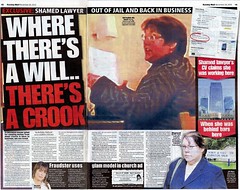
Where there's a will there's a crook - Sunday Mail November 28 2010Judicial Factor was appointed to wind up Valerie Macadam’s (now Valerie Penny) law firm in 2003 after embezzlement of £130K client finds was detected. A classic example somewhat related to recent events, of a Judicial Factor being appointed to wind up a law firm came after breaches of accounts rules and discrepancies in client accounts were uncovered during an inspection by the Society of law firm Macadams SSC in 2003, owned by the then Valerie Macadam, who was jailed in 2008 for three years for embezzling £130,000 of client funds. However, Valerie Macadam recently returned to fame with a new name, Valerie Penny, after being exposed by a Sunday Mail newspaper investigation into her new ‘will writing’ company, which I reported on, here : Former lawyer jailed for stealing clients £130K returns to run will-writing business as Law Society protects its own will rip-off solicitors

It should be noted while there are cases of complaints regarding the work of Judicial Factors with it coming as little surprise very few are ever resolved, equally the work of Judicial Factors can sometimes be invaluable, if pricey, when appointed in roles such as administration of a charity when allegations of fraud or misconduct emerge.

Equally, not all Judicial Factors appointed to handle the estates of deceased persons mishandle their work, however, as the circumstances of some appointments of Judicial Factors can leave much to be desired, it is well past time for a review and inquiry into the laws which permit their office & work, along with how they are regulated and how the affected persons can challenge their activities should the need arise.

Currently, the supervision of the work undertaken by Judicial Factors falls to The Accountant of Court, who is an Officer of Court appointed to :

  • supervise the actings of individuals appointed by the Courts as Judicial Factors or Administrators to manage estates under the Judicial Factors Act 1849 and the Proceeds of Crime (Scotland) Act 1995
  • administer or supervise the administration of property belonging to children under the age of 16 years as required by the Children (Scotland) Act 1995
  • administer Child Trust Fund accounts where there is no person who has parental responsibilities for a child under the age of 16 where the child is in care and accommodated in Scotland, all in terms of the Child Trust Fund Act 2004
  • manage funds consigned with the Accountant of Court in accordance with a Court of Session interlocutor or in the process of liquidation proceedings.

Perhaps an extra layer of independent scrutiny may be required, especially when the Judicial Factor turns out to be a solicitor or indeed any person who is a member of a self regulating profession such as an accountant.

While the Scottish Government have a track record of not always paying attention to consultations carried out by the Scottish Law Commission, I would encourage readers to participate in this consultation, to ensure all aspects of the one hundred year old laws which relate to Judicial Factors be looked at and brought into line with our times. Its in your interests as consumers and members of the public to do so.

Tuesday, July 27, 2010

Law Society consultation changes ‘a grab for elitist dictatorship’, leaving public in need of independent consumer body to protect client’s interests

Law Society of ScotlandLaw Society’s latest constitution consultation is viewed by solicitors & clients as attempt to consolidate power at the top. SCOTS CONSUMERS OF LEGAL SERVICES are again effectively being thrown to the sharks in the latest consultation exercise organised by the Law Society of Scotland, billed as an attempt to reform the solicitors governing body’s constitution, but more darkly revealed to be little more than the latest attempt to shore up the Law Society’s powerful position as self regulator of Scotland’s 10,000 plus solicitors, along with its ‘dual role’, mandated in the Solicitors (Scotland) Act 1980 of representing the client’s best interests – the latter duty of which the Law Society is infamous for failing to carry out in any shape or form.

The Law Society launched the consultation earlier in June, asking its members for their views on a revised constitution and its standing orders. The Law Society claimed its constitution “is being updated as part of a review and modernisation of the Society’s procedures to enable the Society to better represent and support its members”. However, and perhaps more dangerous from the consumers point of view is that the changes proposed by the Law Society, will, in its own words, “allow the Society to adapt to changing conditions in the future, without having to resort to further legislative change” – thus escaping any legislative scrutiny in the elected Scottish Parliament of changes which many expect will be counter to the consumers best interests.

The Law Society dressed up its proposed changes to the constitution as “measures which will also ensure that the Society is well placed to become a regulator of those wishing to adopt alternative business structures as defined by the Legal Services (Scotland) Bill once passed”. Clearly the Law Society wishes to regulate just about every aspect of Scots legal life … much to the danger of fee paying clients, who, once the Legal Services (Scotland) Bill is passed, will continue to have as little protection against poor legal services in the future, as is currently, and historically been the case in Scotland.

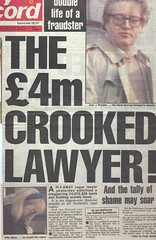
The 4m Crooked Lawyer - Daily Record 1991Is your lawyer crooked ? Chances are the answer could be “Yes” but you’d never know it ! As far as the Law Society representing the client’s best interests, anyone who has been put in the position of being forced to make a complaint about their solicitor to the Law Society of Scotland, or the hapless Scottish Legal Complaints Commission will probably by now, realise the futility of their position, where from the outset, their complaint, no matter its seriousness, had been treated by the Law Society with disdain, ending in up in a grand paper chase, sometimes lasting years, where often the solicitor being complained against escaped any punishment for their crimes or actions against clients.

This great service, of protecting its member solicitors from thousands of client complaints each year, is what the Law Society regards as its duty under Section 1 of the Solicitors (Scotland) Act 1980 where the Law Society of Scotland is mandated to undertake the promotion of (a) The interests of the solicitors’ profession in Scotland ; and (b) The interests of the public in relation to that profession. Clearly as far as the Law Society of Scotland are concerned, the interests of the solicitors’ profession have long come before the interests of the public, a charge backed up by earlier articles I have written on the subject, one of which readers may be interested in, here : Toxic levels of complaints, poor standards of service & soaring fraud by solicitors makes Law Society of Scotland 'World's worst regulator'

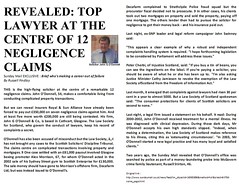
REVEALED - Top Lawyer at the centre of 12 negligence claimsThe Law Society of Scotland did not represent the interests of ‘crooked lawyer’ John G’O’Donnell’s clients, considering Mr O’Donnell, and thousands like him are still working as solicitors. However, as the years have gone by, many consumers, consumer protection organisations, critics and even some sections of the legal profession have questioned & campaigned against the Law Society’s dual role of representing solicitors and clients, a dual role viewed by many as posing an inherent conflict of interest, where as countless media reports over the decades have documented, the interests of solicitors have always overshadowed any regards for client protection from the likes of the John O'Donnell's of the legal world, of which there are a growing number.

The Law Society, seeing the flow of these reports, and our changing times where the word ‘regulation’ is now mostly viewed as another word for ‘cover up’ is simply trying to consolidate its grip on power with this latest ‘consultation’, ensuring it continues to be in charge of regulation and representing the clients ‘best interests’, because the Society and the profession well know, if it loses one role to the other, its grip over Scotland’s legal services market and the public’s access to justice is doomed.

However, the consultation has drawn some criticism from some parts of the legal profession itself, with the Glasgow Bar Association highlighting the conflict of interest in Section 1 of the Solicitors (Scotland) Act 1980 where the Law Society represents both clients & solicitors. It should be borne in mind however, the criticism from the Glasgow Bar Association is from the point of view of protecting its member solicitors, rather than making ‘consumer protection’ paramount … perhaps an obvious point of view, given the GBA is the bar association for law firms on Scotland’s west coast.

The response from the Glasgow Bar Association to the Law Society’s consultation states : “It is the view of the Glasgow Bar Association (the "GBA") that there is an irreconcilable conflict contained within s.1 of the Solicitors (Scotland) Act 1980 (the "Act"). That section legislates that it shall be "the object" of the Law Society of Scotland, inter alia, to "promote" the "interests of the solicitors' profession in Scotland" as well as "promoting the interests of the public in relation to that profession". It is impossible for the promotion of both interests to be mutually consistent, beneficial or indeed legitimate.”

The response from the GBA continues : “In the view of the GBA, the LSS has for decades failed to recognize the inherent and obvious conflict that arises in representing the public and the profession. The dilemma at the heart of the conflict can be put simply: how can the LSS represent or advise a solicitor that, for example, is the subject of a misconduct complaint to the LSS from his/her client? The answer too is simple: the LSS does not, and will not, offer advice, guidance or representation to that solicitor, under explanation that it is investigating the solicitor's alleged misconduct. Thus, the solicitor against whom perhaps serious, false and defamatory allegations have been made by a member of the public, will enjoy no "promotion" of his/her "interests" by the LSS in relation to that complaint; yet the "interests" of the member of the public making the complaint are "promoted" by the very investigation of that complaint itself. This conflict, in the view of the GBA, is irreconcilable.”

“The conflict is obvious and serves as a source of frustration to the profession. Solicitors, who currently pay over £1200 per year to the LSS (40% of which the LSS says is spent on "representation" of its members) cannot benefit from that representation in circumstances where their conduct is called into question, almost always on the basis of uncorroborated ex parte statements, by clients, former clients or members of the public. The individual solicitor is, in practice, left to his/her own devices. By contrast, the conflict which is embodied within s.1 of the Act, serves as a source of frustration to a public, rightly unconvinced that any such complaint can be fairly investigated, given that s.1 of the Act allows the very body to which the member of the public has complained, to "promote the interests of the solicitors' profession in Scotland".

The GBA went on to attack the Law Society’s proposals for its newly created ‘Board’, which allows a more "senatorial" role for Council, claiming the ‘Board’ distances ordinary solicitors further from the Law Society’s decision making process and branded it a result of the elite culture existing within the Law Society of Scotland.

The GBA said in their consultation response : “The establishment of this "Board" is, in the view of the GBA, typical of the "elite" culture existing within the LSS. The creation of the "Board" makes the LSS less accountable as a decision making body, inevitably increases costs for members by its creation, and is, ultimately, unaccountable in any direct sense to the LSS members. This elitism, and lack of any worthwhile accountability at the heart of the LSS, is manifested by the current refusal by the Council member for Hamilton, who is the Convener of the Legal Aid Committee, to address the hundreds of LSS members in Glasgow who practise criminal legal aid”

The GBA’s response to the consultation concluded : “The GBA believes that the "Proposals for Change" do not address in any way the conflict at the heart of the LSS highlighted herein. The GBA suggests that the proposed reform of the constitution will create an extra tier of unnecessary, costly administration, adding to the elitist development of the LSS. The reform proposals are proposals that the LSS hopes will dissuade those critics seeking a separation of the statutory "objects" of the LSS. Nothing more.”

More information on the Law Society of Scotland’s consultation can be found at the Law Society’s website here : Law Society of Scotland Consultation on Constitution along with detailed information on the ‘Proposals for Change’ at the following links :

Letter from Jamie Millar (pdf 34k) Background Information (pdf 37k) Draft constitution (pdf 119k) Draft Standing Orders (pdf 144k) Draft transitional provisions (pdf 73k)

jamie_millarLaw Society President Jamie Millar ‘will discuss’ proposals on consultation concerns. The consultation, now closed, was praised by the Law Society’s current President, Jamie Millar of the law firm Lindsays, who now own a Borders law firm which itself is infamous in the debate on regulation of the legal profession & the Law Society’s representation of client’s best interests. Mr Millar said in the Law Society’s Press release : "I am grateful to all those who have taken time to discuss with colleagues, faculties and organisations and respond, often in detail. The constitution changes have been planned since 2007. Recent events have brought the constitution into focus and feedback from the AGM in May was that change, particularly around voting procedures (including proxy votes), and bringing motions to the AGM was necessary.”

He continued : “Particular concerns about motions passed at Council and whether the changes should be held until the Legal Services (Scotland) Bill has completed stage 3 will be addressed and I am grateful to those members and organisations who raised these points. I also welcome the feedback given at meetings with some individuals and groups who took up the Society's offer to discuss the proposals, possible improvements to the draft and concerns to be addressed. "

SLCC LAW SOCIETYLaw Society & SLCC are both unfit to regulate the Scottish legal profession, leaving consumers without any real protection against ‘crooked lawyers’. While the legal profession bickers with itself over changes which amount to little more than window dressing, clients of solicitors & consumers of Scots legal services can be assured no changes which may benefit clients over the interests of their solicitors will take place until the Law Society is stripped of its regulatory role over complaints, with the duties passed to a new fully independent regulator, one which should be far and above the anti-client Scottish Legal Complaints Commission, which is nothing more than a front company for the Law Society in protecting solicitor’s vested interests over consumers best interests.