Showing posts with label Scottish Legal Aid Board. Show all posts

Thursday, October 20, 2022

SCOTS LAW: Legal Highs, Legal Lows. A legal profession which prides itself in preying on clients, ripping-off Legal Aid, fixing court outcomes, concealing malicious prosecutions & judicial conflicts of interest, obstructing public access to justice - and - Why you should really question much of what your lawyer tells you.

World leading? Not a chance M'lud. ONE DAY is a long time in Scotland’s legal world, let alone a full year – but we all can be assured the consistency of wrongdoing, industrial scale dishonesty, legal fee overcharging & outright malice - from Scotland’s legal profession - whether it be in dealing with clients, working in court in civil hearings or in criminal trials, or working for public authorities – is never ending.

While blog journalists have been working on real life cases for the past year, it may be worth reminding readers your rights with regard to regulation of your legal representatives, are as ineffective and futile as they have ever been in Scotland, right up to this date.

After all, since 2008 and some Thirty Five Million pounds plus, later – much of it recovered from fees you pay to your solicitors *and perhaps money & assets your solicitor strips you of when your case goes not the way you were told it would - the Scottish Legal Complaints Commission (SLCC) has not once named a corrupt solicitor or law firm – or actually had any impact on standards of legal service in Scotland.

Fourteen years for the Scottish Legal Complaints Commission - billed in 2008 as an “independent” regulator of Scotland’s legal services – to have absolutely zero material impact on the scale of dishonesty in Scotland’s legal profession – is itself a tribute to how corrupt Scotland’s legal mcmafia really is, and – an indicator of the sheer level of control exerted by professional groups such as the Law Society of Scotland, and Faculty of Advocates (to name but two) on how MSPS and the Scottish Government can or cannot give increased rights to consumers of legal services in Scotland.

For instance, are you looking for a lawyer right now to conduct legal business or perhaps pursue a civil claim, or defend you in a criminal trial?The fact is, if you are trying to find out if a particular solicitor or law firm has any record of complaints, discipline issues, or are just plain corrupt - you - the consumer - are not going to find out.

So, why would you even bother going to a lawyer or a law firm who has perhaps fleeced one hundred clients before you go through their doors? Think first, readers .. do you really need to spend Five thousand pounds on a batch of letters to, say - your next door neighbour for the next Five years over a fence which is 10cm higher than it should be … and then lose the case in court and have to pay your own solicitor say .. another Twenty Thousand pounds for losing, and then end up sequestrated by the solicitor’s good friend the local Sheriff – when you cannot pay the legal fees?

Yes, it is that easy. It’s your money, your lives, your home, your family, your business – consumers. Think first, Tens of thousands of people have gone before you thinking they are smarter than a Scottish lawyer, and what happened next? Well, the statistics tell their own story. Thousands of complaints a year to Scotland’s so-called ‘independent’ legal regulators – staffed by lawyers and their families – and guess what, a tiny amount of redress if anything, and thousands of clients lives ruined.

The public debate on legal services in Scotland is rather odd, and very biased.

Mostly, any public debate on Scotland’s legal profession, is driven by the legal profession itself.

Having examined Scotland’s cliquey legal profession for decades, worked on thousands of cases, reported on hundreds more – and when assigned cases to assist clients through the often murky, dishonest world of legal services and Scotland’s institutionally dishonest courts system and not forgetting the institutionally everything bad Crown Office – it can be easily said – consumers of legal services in Scotland have about as much chance of obtaining a fair hearing, as a baked pie in front of a group of staring, salivating alligators with Scottish LLB Law degrees & judicial robes.

The world, of course – is a bigger place. And, with the advantage of the internet, and the ability to communicate on global platforms, away from the Scots legal mcmafia sponsored public relations spin, and bought up influencers, clients, consumers, journalists and readers can find a more open and less legal profession driven debate on justice, the courts, legal services, and just about anything else you can think of.

Example - If you are interested in US politics and the US Courts, and judiciary – and trust me – you should be - readers who want to expand their knowledge of what judges and lawyers do in and out of court, should start looking at how the US media cover America’s justice system and the US Supreme Court - because - in the US, journalists and lobby groups are much more open and willing to investigate and write up exactly what is going on with a judges' interests, conflicts of interest and recusals.

Even better, there are Law Professors and Academics in the US, who will tell you – the public - the absolute truth about the workings of the US Judiciary and 'SCOTUS' - otherwise known as the Supreme Court of the United States.

Expand your knowledge, people. Look at how other countries media deal with their justice systems and those parts of the judiciary which consider themselves too powerful to be held accountable to ethics, expectation of justice, or even – the law itself.

Reading up on how other countries report on their judges, courts and the workings of the justice system will easily bring even the occasional reader to conclude much of what you have just read, is never reported in Scotland or the UK. In fact, academics here can very easily be roped into (mostly willingly) in what are absolutely vicious campaigns against journalists looking at the workings of the judiciary.

There are of course, other advantages of reading media outside the sphere of Scotland’s legal profession reach in that journalists don’t have to put up with ranting calls from UK or Scottish Judicial Office Press Officers, who end up screaming down the phone at journalists and editors because the thorny question of judges conflicts of interest, judges unexplained wealth & lifestyle, and participation in political deals, lobbying, international bargaining and political lobbying here in Scotland come up for scrutiny.

As colleagues in the media have observed – reviewing the audio records of those calls, would indeed one day make a good book.

So, what have blog journalists been looking at in the past year.

A deep dive into certain long running news articles in relation to the plight of victims in all kinds of scandals, from medical to ill treatment at the hands of whichever Scottish public service, such as Health, Policing, Courts, Judiciary, Local and Central Government – have revealed that lawyers and their law firms quoted three paragraphs down in the articles – are demanding their ‘clients’ sign up to Non Disclosure Agreements – even before legal representation is taken on – and that any compensation recovered be subject to significant success fees for the law firm involved, with clients also forced to sign an agreement they will not raise a complaint, or their representation will be terminated.

And, it certainly does not take too long for lawyers who give quotes to the media on how they are so involved in representing their clients case – to call in a client for a menacing chat, which – now that we live in a world where everyone records everyone … is much more able to be reviewed by journalists and people outwith the legal profession.

The law firms involved, are – unsurprisingly – all “Award Winning Law Firms” – based in Scotland’s big cities and regularly quoted in whatever scandal is the headliner for the week, or weekend.

Still think you are smarter than a Scottish Lawyer? … hmmm!

Does the following example apply to anyone you know?

A meeting with your lawyer goes like this.

Hello, dear client. Tell me your case. Wow! I have never heard of your predicament before ... This is a disgrace! I can take you on as a client but first, you must sign up to our terms of business, give us Five grand, and you also have to sign a Non Disclosure Agreement - and while you are at it, we would like to store your property titles, just in case you cant pay our fat padded faked-up legal fees and we will take your house instead.

Hey folks, this happens a hundred times a week in Scotland. And, for years. Decades even. So, why not get wise to it instead of being ripped off. Don't say you haven’t been told!

Here’s a question for readers:

Have you ever wondered why – in the past fourteen years from 2008 to 2022 – hardly anyone ever gets to see the actual detail in complaints investigations, outcomes, quantum on actual losses by clients compared to the derisory compensation (if any) paid out by predatory law firms after an ‘investigation’ by the Scottish Legal Complaints Commission?

Small numbers, isn’t it. A handful. And, few if any law firms named – in the past Fourteen Years.

In an active case currently under scrutiny, journalists were handed recordings which reveal clients are being threatened during arbitration hearings organised by the Scottish Legal Complaints Commission.

Yes, you read that correct. Clients who agreed to arbitration hearings organised by Scotland's legal regulator - are being openly threatened and intimidated by solicitors - in front of 'qualified' arbitrators and Legal Complaints Commission staff.

Perhaps, upon reading this, you may think the Arbitrators and SLCC staff may step in, even offer to assist the client over the lawyer's shouting, threats and intimidation and their audible threats of using courts and Scotland's ever-puppet judiciary to go after clients.

Not a chance. In fact, the Scottish Legal Complaints Commission denied the Arbitrators or their own staff members hear or witness anything – yet the audio records confirm these events.

In fact - journalists have also been handed communications where the Scottish Legal Complaints Commission actually threatened clients - who had already been threatened at SLCC run Arbitration hearings - that if they uttered a word of what happened - the Scottish Legal Complaints Commission would act against them in some undefined way.

To say the above is corruption at work, would be an understatement at least - but you can be sure, when our investigation is complete, the material in these cases will be published.

Now, to some other issues journalists have been looking into.

Recent cases brought to this blog's attention reveal solicitors are requesting extra payments over legal fees from clients, in crypto currency.

These payments, in many cases appearing to be forced payments, with a threat that if they are not made legal work will cease on anything from claims against councils, to writing a will - are being demanded by law firms from a wide spectrum of clients, including the elderly - the latter of which first drew journalists attention to - as reports were coming in of elderly clients unable to handle technology to the point law firm employees were visiting home addresses to help their clients set up crypto currency accounts which would pay into accounts held by solicitors or 'other persons' connected to a law firm - but which strangely do not show up in the law firm's accounts to the Law Society of Scotland or HMRC.

So, if any readers have elderly or vulnerable relatives who are being forced into making off-the-books crypto currency payments to Scottish law firms - you can email this blog with the details to add to the information now being collected by journalists.

Oh, and if you were wondering how deep Scotland’s legal profession has dived into crypto currencies - to make it all nice and legal, the Scottish Government working group on crypto assets and crypto currency is headed by a UK Supreme Court judge - Lord Hodge.

A number of cases where criminal complaints and investigations have arisen in relation to activities at properties owned by Scots lawyers, and several members of the judiciary in EU countries and in the Gulf states, have been passed to journalists.

Allegations in respect of these cases range from financial crime to tax avoidance, domestic violence, and sexual assault.

Interestingly, many of those who have passed on information in relation to allegations and criminal complaints in such cases, are from Scotland or the UK, and have attended properties owned by certain high flying Scots lawyers & Advocates - in a guest role, of sorts.

Further information in relation to properties in the Gulf States - owned by leading figures of Scotland’s legal world, including the judiciary document cases where persons employed by the owners have been subject to threats, and in certain cases, swift deportation back to their countries of origin, mostly in Asia after events witnessed at the premises became subject to allegations and investigations.

Several key figures within Scotland's legal establishment - have sought to ensure these cases - do not come to light in the media, however the leads are now being investigated and publication may occur at a later date.

In a case which relates to a cover-up within Scotland’s NHS Estate – journalists have been investigating links between Scotland’s legal world & the misuse of evidence by key NHS organisations, over the past 15 months.

The case extends to cover significant patient risks, concealed by NHS Executives who were involved in switching multi million pound contracts and trying to cover their tracks.

Journalists have been investigating the NHS scandal involving NHS Grampian, in which NHS Executives and staff arranged, and colluded to target and discredit Scottish Medical Providers, in a malicious campaign to remove their business, and transfer the contracts to preferred providers.

The sums involved total millions of pounds, and investigating the trail of wrongdoing within NHS Grampian has led to the detection of organised fraud and collusion within Scotland's entire NHS estate and factual evidence revealing corruption right at the heart of NHS National Procurement.

Some of the documents in relation to the NHS Grampian fraud have been posted to Twitter. However a full investigation and publication of material will appear in due course.

Another issue journalists are looking into - is the wide and varied property ownership of solicitors and law firms.

In towns and cities across Scotland, local law firms and solicitors own and hold interests in multiple properties.

How these properties have come to be owned by solicitors is indeed, a very murky affair and a lengthy battle to reveal.

In many cases, there are solicitors who own twenty plus properties in very intricate ownership arrangements clearly designed to thwart persons from finding out the real owner.

Some lawyers have chosen to spread ownership around their families and relatives, whereas others have created offshore trusts and networks of companies of which the aim is clearly to defeat any link between the solicitor and the properties.

The family ownership link has been known about for some time, and frequently emerges when – for example – a solicitor’s partner decides to separate, and they then find out they own a selection of properties they were unaware of when their solicitor partner unleashes his colleagues on their subsequent separation and divorce.

An interesting revelation from the property scrutiny project – identifies solicitors who own significant numbers of rental properties and who are all receiving Housing Benefit paid rents from – in some cases – their criminal legal aid clients,

Yes, You read that correctly.

Solicitors are housing clients in what are in many cases – run down, rat infested flats and properties around Scotland AND – the rent on the property is paid to the solicitor in Housing Benefit, while the solicitor is also collecting Legal Aid cash for representing the client, his tenant in criminal trials.

There are hundreds of such cases currently being looked at. An example of one such case currently being investigated involves a solicitor and Tribunal judge - who represented a client who was found guilty of sexually assaulting paramedics. The client turned out to be the tenant of the solicitor, who was receiving Housing Benefit for his client’s rent, as well as Criminal Legal Aid for representing his client, found guilty of sexually assaulting paramedics.

Turns out the solicitor & Tribunal judge has been at this for years, raking in public cash for tenants he houses, and represents in criminal court at the same time – and – many solicitors are doing exactly the same.

The petition on the Register of Judges Interests. Yes, the petition rumbles on, and journalists await action by the Scottish Government. However, the time has been spent usefully studying the judiciary, watching how assets move, who talks to who, which judge is threatening who about transparency, and how judges waft around the world doing their wee bit for greed, avarice and sheer dishonesty in the legal world.

An update on the petition will be published in the coming weeks.

So, as you see - never a dull moment in the media, or in the legal profession.

And finally.

Whistleblowers. If you want to speak out on what is occurring in your public service, company or whatever the issue is - use an email service such as Protonmail or wherever, and contact the blog or a journalist that you trust and an editor who will not burn you to his friends in whichever public service you are speaking up against.

Saturday, December 02, 2017

END OF CLAIMS: Rogue lawyer who claimed £600K in two years abandons £100K case against Scottish Legal Aid Board - over release of damning report revealing ‘unnecessary, deliberate and excessive’ legal aid claims

Lawyer abandons claim against legal aid board for £100K. AN INVESTIGATION has revealed a rogue lawyer - previously accused of making “unnecessary and excessive” claims for more than £600K Legal Aid in two years – attempted to sue the Scottish Legal Aid Board (SLAB) for £100,000 over release of a report detailing legal aid claims.

The three year court case – registered in the courts by Kilmarnock based solicitor Niels S Lockhart during December 2013 – finally came to an end in 2016 - with legal aid chiefs absolved of any blame for the release of a damning report which raised serious concerns over Lockhart’s multiple claims for legal aid public cash.

The size of the legal aid claims put Lockhart’s one man law firm higher up the scale of legal aid payments than many law firms with multiple partners, and advocates.

Last week, Legal Aid Chiefs finally admitted in a Freedom of Information disclosure to journalists - “the case A665/13 Niels Lockhart v The Scottish Legal Aid Board was a court action raised by Mr Lockhart at the Court of Session in which he sought payment of damages of £100,000 from SLAB. The court action has since been concluded.”

The response to the journalist continued: “You will recall that in early 2010 you submitted an FOI request to us, and that on 16 March 2010 we responded to your request by forwarding to you a report in relation to Mr Lockhart. This release of information to you was alleged by Mr Lockhart to be a breach of confidentiality by SLAB. SLAB defended the action.”

SLAB was represented in the action by in-house solicitors, and instructed counsel, John MacGregor, advocate.

The costs incurred by SLAB were: Counsels fees £2,100.00; Court dues £202.00; Printing cost of court documents; £92.07 Total; £2,394.07

The statement in the FOI response issued by SLAB concluded: “The court action was terminated in 2016 by agreement. Decree of absolvitor was granted in favour of SLAB together with an order of expenses in favour of SLAB in the sum of £1,750. No monies were found payable, or paid, to Mr Lockhart by SLAB.”

However, similar enquiries to the Scottish Courts and Tribunals Service (SCTS) – revealed court staff had been ordered to refuse to disclose details relating to Lockhart’s attempt to sue the Scottish Legal Aid Board.

A spokesperson for the SCTS initially said: “I’m told that typically we can’t reveal very much as you were not a party to the action. I’m told that we can say that the case concluded on 28 June 2016 and that it was a Joint minute and the defender was absolved.”

When pressed for further details, the spokesperson added: “I am afraid I cannot say what the case was about or about any amounts of money. I can say that the case was registered on 19/12/13, it was called on 24/1/14,  it did not call in court, it was sisted until early 2016 then concluded on 28 June 2016.”

Kilmarnock based solicitor Niels S Lockhart was subject of a lengthy investigation by the Scottish Legal Aid Board from 2005 to late 2010 over vastly inflated claims for Civil Advice & Assistance Legal Aid.

Legal Aid chiefs then send their report to the Law Society of Scotland, who carried out an investigation into Lockhart and the detailed SLAB report.

However, sources at the Legal Aid Board revealed a string of delays during the Law Society investigation, including a series of ‘complaints reporters’ who were tasked to study the SLAB report and recommend what action if any should be taken against Lockhart.

After several Law Society investigators had either refused to look at Lockhart’s legal aid claims, or finalise a report, a version was sent to the Scottish Legal Aid Board – which legal aid chiefs claimed they could not release because they had no permission from the Law Society of Scotland.

A timeline of events established that on 5 June 2005 the Scottish Legal Aid Board sent a report to the Law Society of Scotland in terms of S32 of the Legal Aid (Scotland) Act 1986 against the sole practitioner firm of Niels S Lockhart, 71 King Street, Kilmarnock. The secret report, obtained under Freedom of Information laws, can be downloaded here: SCOTTISH LEGAL AID BOARD S31 COMPLAINT REPORT TO THE LAW SOCIETY OF SCOTLAND : NIELS S LOCKHART(pdf)

The Legal Aid Board report outlined a number of issues that had been identified during the review of case files & accounts which raised concern about Mr Lockhart’s conduct and which fell to be considered as a breach of either Regulation 31 (3) (a) & (b), relating to his conduct when acting or selected to act for persons to whom legal aid or advice and assistance is made available, and his professional conduct generally. These issues illustrated the repetitious nature of Mr Lockhart’s failure to charge fees “actually, necessarily and reasonable incurred, due regard being bad to economy”

The heads of complaint submitted by the Scottish Legal Aid Board to the Law Society of Scotland were : (1) Excessive attendances, (2) Lack of Progress, (3) Splitting/Repeating Subject Matters, (4) Inappropriate Requests for Increases in Authorised Expenditure, (5) Matters resubmitted under a different guise, (6) Standard Attendance Times, (7) Attendances for Matters Not Related to the Subject Matter of the Case, (8) Unreasonable Charges, (9) Double Charging for Correspondence, (10) Account entries not supported by Client Files, (11) Attempt to Circumvent Statutory Payment Procedure for Property Recovered or Preserved, (12) Continued Failure to act with Due Regard to Economy.

The report by the Scottish Legal Aid Board revealed that, of all firms in Scotland, the sole practitioner firm of NS Lockhart, 71 King Street, Kilmarnock, granted the highest number of advice and assistance applications for "interdict" (392) for the period January-October 2004.The next ranked firm granted 146, while the next ranked Kilmarnock firm granted only 30.

The report stated : “While conducting a selective analysis of Niels S Lockhart's Advice and Assistance accounts, it was clear from the outset that much of his business comes from "repeat clients" and/or members of the same household/family, whom he has frequently admitted to Advice and Assistance. The analysis revealed persistent patterns of excessive client attendances, the vast majority of which are irrelevant, unnecessary and conducted without due regard to economy.”

“It was also clear that Niels S Lockhart makes grants for a number of interlinked matters, where there is clearly a "cross-over" of advice. Consecutive grants are also often made as a continuation of the same matter shortly after authorised expenditure has expired on the previous grant.”

“This appears to the Board to be a deliberate scheme by Niels S. Lockhart to make consecutive grants of Advice and Assistance on behalf of the same client for the same matter, for personal gain. By so doing, he has succeeded in obtaining additional funds by utilising new initial levels of authorised expenditure for matters where, had further requests for increases in authorised expenditure under the initial grant been made to the Board, they would with every likelihood have been refused by Board staff.”

“Closer scrutiny of Niels S Lockhart's accounts and some client files has given rise to a number of other serious concerns, e.g. numerous meetings, standard of file notes, encouraging clients to advance matters while demonstrating a lack of progress.”

“After a meeting between SLAB officials & Mr Lockhart on 14 April 2005, Mr Lockhart was advised that SLAB’s Executive Team had approved of his firm’s accounts being removed from the guarantee of 30-day turnaround for payment of accounts, and that henceforth, to allow the Board the opportunity to satisfy itself that all fees and outlays had been properly incurred and charged by the firm, he would be required to submit additional supporting documentation and information with his accounts (including client files).”

The report continued : “Over the next few months, Mr Lockhart telephoned Accounts staff many times, often on a daily basis, repeatedly asking questions about the type of charge they considered acceptable or unacceptable in a variety of situations. Staff reported that, despite their having given Mr Lockhart the same answers time and again (both via correspondence and over the telephone),he continued to submit accounts with unacceptable charges. In a final effort to counter these continuing problems and to emphasis the Board’s stance in relation to the various issues of concern, our Accounts Department sent him a letter on 23 December 2005.”

“Mr Lockhart did not provide a written response to this correspondence. He did however contact Mr McCann of the Legal Defence Union, who wrote to the Board seeking a meeting with Board officials to try to resolve the payments issue. Our view however was that this would not advance matters as Mr Lockhart had been given a clear steer both after the April 2005 meeting and in the December when Accounts wrote to him on a number of matters.”

However, a key error was made by the Legal Aid Board, who stunningly failed to interview any of Mr Lockhart’s clients despite SLAB’s claims of excessive legal aid claims.

The SLAB report revealed : “Board staff have not interviewed any of Mr Lockhart’s clients as we have no reason to believe that, for example, the multitude of meetings that he held with them—sometimes more than twice daily—did not take place; our concern is that they DID take place and he has sought to claim payment for these multitudinous meetings,very few of which could be described as necessary and reasonable. We believe that such work had no regard to the principle of economy: our contention is that it is highly unlikely that any private paying client would be willing to meet the cost of the service provided by Mr Lockhart. That aside, there are cases set out in the report where it is difficult to see what advice or assistance has actually been provided. Our Accounts staff are continuing to assess a number of his accounts and examining the corresponding client files which indicate repetition of the issues that gave rise to our initial concerns.”

The report’s findings concluded : “From April 2002—March 2005, Niels S Lockhart was paid £672,585 from the Legal Aid Fund. Of this, £596,734 (89%) was in relation to Advice and Assistance cases, with £570,528 (85%) solely in relation to Civil Advice and Assistance.”

“In the Board’s view, the ranges of actions taken by Niels S. Lockhart towards achieving those payments are not those appropriate to a competent and reputable solicitor.”

“Based on the supporting evidence he arranges for, or permits, his clients to attend his office on numerous occasions for excessive, unnecessary and often irrelevant meetings. In the main, these do not appear to have advantages for their further welfare or advance their case, but merely act as a mechanism for the firm to exploit the Legal Aid Fund by charging for these unnecessary and unproductive meetings.”

“The nature of subject matters is often repeated, resulting in numerous duplicate/multiple/consecutive grants submitted under various guises, thus avoiding the Board’s computerised checks on subject matter. This pattern of conduct is deliberate,recurring and persistent, serving—in the Board’s view—as a device to generate considerable additional income for the firm to the detriment of the Scottish Legal Aid Fund.”

Further documents released by the Scottish Legal Aid Board during 2015 - Extra Payments to Niels Lockhart - in response to a Freedom of Information request revealed Niels S Lockhart was paid a further £34,711 (excl VAT) of taxpayer funded legal aid by the Legal Aid Board – even though by that time he was already barred from claiming for any further legal aid work.

Historical payment accounts published by the Scottish Legal Aid Board also reveal Lockhart received a whopping £1.2million (£1,213,700) of public cash since the Legal Aid Board began publishing the names of firms and the size of payments from 2003 onwards.

From 2003 to 2013, Neils Lockhart claimed the following amounts of publicly funded legal aid: £280,200 in 2003-2004, £321,400 in 2004-2005, £95,400 in 2005-2006, £160,800 in 2006-2007, £133,300 in 2007-2008, £82,000 in 2008-2009, £65,800 in 2009-2010, £67,400 in 2010-2011, £7,200 in 2011-2012, £200 in 2012-2013

The Sunday Mail newspaper reported on the details of the now revealed court case:

Lawyer who made 'eye-watering legal aid claims' sued for £100,000 in compensation from taxpayer

Niels Lockhart said the Scottish Legal Aid Board (SLAB) had hurt his reputation amid the release of a damning report.

By Russell Findlay 26 November 2017 Sunday Mail

A rogue lawyer demanded £100,000 of taxpayers’ cash after legal aid chiefs revealed his history of inflated claims.

Niels Lockhart, 66, said the Scottish Legal Aid Board (SLAB) damaged his reputation by releasing a damning report which laid bare “unnecessary and excessive” payments.

He accused them of breaching his confidentiality and sued them for £100,000 – but has now dropped the claim.

The Sunday Mail obtained the report in 2011. We told how Lockhart claimed more than £600,000 of legal aid in two years and was accused of deliberately ramping up expenses.

The SLAB report stated: “He arranges for, or permits, his clients to attend his office on numerous occasions for excessive, unnecessary and often irrelevant meetings.”

They said the meetings merely acted as a mechanism for the firm to exploit the legal aid fund.

Legal reform campaigner Peter Cherbi, who unearthed the SLAB report through freedom of information laws, said: “Lockhart’s history of eye-watering legal aid claims was rightly subjected to public scrutiny yet he seems to see himself as the victim.”

SLAB said: “We were right to make public our complaint report to the Law Society of Scotland which set out our concerns about Mr Lockhart’s legal aid work.

“We successfully defended that decision in the court action raised against us by Mr Lockhart in which he sought payment of damages of £100,000 from SLAB. Mr Lockhart agreed to withdraw his action and pay us expenses of £1750.”

Lockhart said the decision to sue was taken after advice given by counsel who took the case on a no-win, no-fee basis.

He added: “The sum sued for was later altered to £30,000. There was thereafter a change in legal team who were not so optimistic.”

Lockhart claimed none of the SLAB allegations were proved to be correct and that they previously said no public funds had been compromised.

The original Sunday Mail report on Niels Lockhart in 2011 – reporting on the damning investigation of Lockhart’s legal aid claims

Solicitor made "unnecessary and excessive" claims for legal aid and raked in over £600,000 of public money

EXCLUSIVE: Mar 27 2011 Russell Findlay, Sunday Mail

This lawyer pocketed £600,000 Legal Aid in two years. His claims were 'excessive, unnecessary, inappropriate, deliberate and persistent' but it's all OK because watchdogs say it was never.. CRIMINAL

LEGAL AID watchdogs have accused a solicitor who took £600,000 of taxpayers' money in two years of deliberately ramping up his claims.

Niels Lockhart, 60, who runs a one-man firm in Kilmarnock, raked in £280,200 in 2004 then £321,400 the following year.

After he ignored a warning to curb his claims, the Scottish Legal Aid Board investigated before a probe team concluded that his applications were a systematic attempt to create extra fees.

But despite deciding that he routinely made "unnecessary and excessive" claims, SLAB did not call in police. They referred Lockhart to the Law Society who also decided no fraud had taken place.

The secret SLAB dossier, obtained through freedom of information laws, said: "Lockhart routinely makes consecutive grants of advice and assistance to the same clients for what appear to be similar matters submitted under a different guise.

In the board's view, the ranges of actions taken by Lockhart towards achieving those payments are not those appropriate to a competent and reputable solicitor.

"He arranges for, or permits, his clients to attend his office on numerous occasions for excessive, unnecessary and often irrelevant meetings.

"In the main, these do not appear to have advantages for their further welfare or advance their case but merely act as a mechanism for the firm to exploit the Legal Aid fund by charging for these unnecessary and unproductive meetings."

The audit discovered Lockhart's firm was granted 392 "advice and assistance" applications for clients considering civil legal actions over 10 months in 2004 - more than double the number granted to the firm making the second highest number of similar applications.

The report stated: "The analysis revealed persistent patterns of excessive client attendances, the vast majority of which are irrelevant, unnecessary and conducted without due regard to economy.

"This appears to the board to be a deliberate scheme by Lockhart to make consecutive grants of advice and assistance on behalf of the same client for the same matter for personal gain."

Slab officials warned Lockhart about his claims in April 2005 but he "continued to show contempt for the board's serious concerns regarding his practices that were discussed at that meeting".

That prompted SLAB to send their damning 13-page report to legal regulator the Law Society of Scotland in June 2006. Yet the Law Society did not report SLAB's concerns to police or refer him to the Scottish Solicitors' Discipline Tribunal. It took them another four years to even agree Lockhart should be banned from legal aid.

Last October, Lockhart's lawyer James McCann struck a deal with SLAB which allowed Lockhart to agree to quit legal aid voluntarily. He continues to do other legal work.

A slab spokesman said: "The matter was not one of fraud and, therefore, not a criminal matter. A Law Society spokeswoman said: "Our powers in this situation relate to considering the solicitor's conduct. It is not for the society to determine whether there has been fraud."

Married dad-of-two Lockhart, from Ayr, said: "There was no suggestion of any dishonesty. I voluntarily removed myself. I was going to withdraw anyway. Where did you get this report?"

Diary of Injustice continued to report on allegations surrounding Mr Lockhart and the Law Society of Scotland’s efforts to avoid a prosecution. All previous reports can be viewed HERE.

If you suspect a solicitor is committing legal aid fraud, or if you feel your own solicitor is making fraudulent legal aid claims, email Diary of Injustice at scottishlawreporters@gmail.com

Monday, September 25, 2017

ROGUES GALLERY: Lawyer who spoke at Holyrood on behalf of Law Society - struck off for dishonesty, meanwhile concerns Police probe at bust law firm Ross Harper may hit Crown Office block on prosecuting colleagues in legal profession

Rogue lawyers & Police probes dog Scots legal industry. A LAWYER who gave evidence to MSPS on behalf of the Law Society of Scotland has been struck off – for serious dishonesty - after earlier findings of professional misconduct a year earlier.

Michael McSherry, who once gave evidence to the Scottish Parliament’s Justice & Home Affairs Committee on Vulnerable and Intimidated witnesses – was struck off by the Scottish Solicitors Discipline Tribunal (SSDT) after being found guilty of professional misconduct in relation to misrepresentation to two law firms on the purpose of funds being held, and failures to carry out proper money laundering checks.

The findings issued by the Discipline Tribunal also reveal a former solicitor, listed as 'Ms B' worked for McSherry.

The unnamed solicitor recently had her practising certificate removed by the Law Society of Scotland, yet she was easily able to find employment back in the legal services sector and began working with McSherry.

While the name of the solicitor is anonymised, the latest incident again reveals a trend where crooked lawyers who are turfed out of the profession land jobs as 'consultants' or 'paralegals' following them being stripped of their right to practice law.

McSherry was previously found guilty of professional misconduct in 2016 for failing to bank fees taken from clients, and his continuing to act on behalf of the client in his capacity as a solicitor when he was not the holder of a practising certificate, was not affiliated to any practising firm of solicitors and had no professional indemnity insurance cover. Law Society of Scotland v Michael Thomas McSherry (21 January 2016)

The latest Scottish Solicitors Discipline Tribunal findings on Michael McSherry, recently published - are here: Law Society of Scotland v Michael Thomas McSherry (27 June 2017)

The full document listing the SSDT findings on Michael McSherry is here: SSDT Findings: Law Society of Scotland v Michael Thomas McSherry (27 June 2017)

Solicitor(s): Michael Thomas McSherry, Solicitor, 51 Morven Road, Bearsden, Glasgow

Tribunal Date: 27/06/2017 Appeal Status:No Appeal

Interlocutor: Edinburgh 27 June 2017.  The Tribunal having considered the Complaint at the instance of the Council of the Law Society of Scotland dated 11 April 2017 against Michael Thomas McSherry, Solicitor, 51 Morven Road, Bearsden, Glasgow; Find the Respondent guilty of professional misconduct singly in respect of his misrepresentation to Mr D about the purpose for which funds were held (issue 1), the improper, incomplete and inaccurate recording in the client ledgers (issue 2), and his misrepresentations to Slater, Hogg and Howieson and TLT Solicitors (issues 6 and 7); and in cumulo in respect of his failure to carry out proper money laundering checks on Company 1 and Mr C (issues 3 and 5), his failure to investigate the source of funds from Mr D (issue 4), his poor record-keeping and accounting practices (issue 8), his failure to reconcile bank statements (issue 9) and his failure to undertake training in connection with his role as cashroom manager (issue 10);  Order that the name of the Respondent be Struck Off the Roll of Solicitors in Scotland; Direct in terms of Section 53(6) of the Solicitors (Scotland) Act 1980 that this order shall take effect on the date on which the written findings are intimated to the Respondent; Find the Respondent liable in the expenses of the Complainers and of the Tribunal including expenses of the Clerk, chargeable on a time and line basis as the same may be taxed by the Auditor of the Court of Session on an agent and client, client paying basis in terms of Chapter Three of the last published Law Society’s Table of Fees for general business with a unit rate of £14.00; and Direct that publicity will be given to this decision and that this publicity should include the name of the Respondent but need not identify any other person.

And, it has also been reported in the media that a Police Scotland probe has been launched into the now bankrupt law firm – Ross Harper.

However, as observers to the ‘twilight zone’ world of Police investigations into lawyers will be well aware, most probes carried out by Police almost never result in a prosecution before the courts, as has previously been the case in relation to multiple cases involving fourteen law firms & millions of pounds of legal aid fraud – which resulted in not one case going to court, reported earlier here: FOURTEEN lawyers accused of multi-million pound legal aid fraud escape justice as Scotland’s Crown Office fail to prosecute all cases in 5 years

The Sunday Mail reports on the Police Scotland probe of bust law firm Ross Harper:

Cops launch cash probe into bust law firm Ross Harper and Co after partners struck off

The company had offices across Scotland before they were shut down in 2012 after operating for more than 50 years.

By Craig McDonald 06:00, 17 SEP 2017

A police investigation has been launched into the collapse of one of ­Scotland’s top law firms.

Ross Harper and Co, who had offices across Scotland, were shut down in 2012 after more than 50 years in practise.

It emerged that public cash claimed in Legal Aid fees was not paid to ­suppliers and experts hired by the Glasgow firm.

A lengthy probe by the Law Society of Scotland led to four partners being struck off and two more being censured.

We can reveal a dossier has now been passed to police, who have launched a criminal investigation.

The Mail understands the initial focus is on former ­senior partner Alan Miller, 38, who was struck from the roll of solicitors last month.

One expert witness hired by the firm welcomed the probe. Forensic psychologist Ian ­Stephen, who’s owed £5000 in fees, said: “I think it’s appropriate that police investigate.

“If anyone commits a crime, be it fraud or anything else, then you would expect police would make inquiries into it.

“If this happened in any other profession, the appropriate ­professional body would make inquiries and, if there was a criminal element to it, you would expect police to become involved.

“I don’t not see how the ­situation should be any different for solicitors.”

Stephen, a former senior medic at the State Hospital at Carstairs, said: “I felt badly let down by Ross Harper. You should be able to put your faith in a lawyer.

“I was always writing to them to ask why I was not being paid. I was shocked they were so ­blatant about it.”

Professor Hugh Pennington saw £4000 in fees go unpaid.

The bacteriolgoist said: “I was shocked to ­discover Ross Harper were ­withholding payments from me and others. There has been a betrayal of trust.”

Miller and Jim Price, also a senior partner, were struck off last month by the ­Scottish ­Solicitors ­Disciplinary Tribunal for professional misconduct.

Price was employed as general manager of Nottingham Forest in 2013 but left the football club within a year.

Two further partners, Paul McHolland and Joseph Mullen, were censured by the SSDT but are still able to practise.

The SSDT found Legal Aid cash lay in “a drawer”, the firm’s bank account, for up to two years.

The cash was used to help them ­balance their books after the 2008 financial crash.

Accounts also showed a cheque was cancelled and ­reissued three times before it reached its destination.

On at least two occasions, the same tactic was used to hold up payments of £300 to Pennington.

We told last month how legal watchdogs are facing more than £100,000 worth of claims from victims of the firm.

Any compensation would be paid from a Law Society client protection contingency fund.

Ross Harper had 12 offices in Scotland and were the country’s biggest earning Legal Aid firm, with 2006-07 earnings of £1.7million. They were founded in 1961 by ex-law professor Ross Harper.

A police spokeswoman said: “Inquiries are at an early stage.”

A Law Society of Scotland spokesman said: “Concerns were raised about the firm’s ­accounting record following one of our ­routine ­compliance inspections.

“This led to us going to the Court of Session to request the appointment of a judicial factor to the firm in April 2012 and, ­following investigation, we prosecuted all six former partners before the independent SSDT.

“We have a legal duty to report suspicious activity to the ­relevant authorities but cannot comment on whether reports have been made on specific cases.”

The SSDT decision on Ross Harper is here: Law Society of Scotland v-Alan Miller, Joseph Mullen, Paul McHolland & James Price

The full document detailing the SSDT’s findings in relation to the Ross Harper law firm partners can be found here: SSDT Findings: Law Society of Scotland v-Alan Miller, Joseph Mullen, Paul McHolland & James Price

Solicitor(s): Alan Matthew Miller, 22 Broomknowe Avenue, Lenzie, Joseph Mullen, 9 Glen Mark, St Leonard’s, East Kilbride, Paul John McHolland, 24 Portland Road, Kilmarnock and James Price, formerly residing at 2 Rigside, Douglas Water, Lanark and now residing at Calle Java 19, 29591, Malaga, Spain

Tribunal Date: 08/05/2017 Appeal Status:No Appeal

Interlocutor: Perth 8 May 2017.  The Tribunal having considered the amended Complaint at the instance of the Council of the Law Society of Scotland against Alan Matthew Miller, 22 Broomknowe Avenue, Lenzie, Joseph Mullen, 9 Glen Mark, St Leonard’s, East Kilbride, Paul John McHolland, 24 Portland Road, Kilmarnock and James Price, formerly residing at 2 Rigside, Douglas Water, Lanark and now residing at Calle Java 19, 29591, Malaga, Spain; Find the First Respondent guilty of Professional Misconduct in respect that (a) The First Respondent during his tenure as a Partner and principal in the said former firm of Ross Harper and in particular during the period when he was the designated Cashroom Manager being 1 April 2010 to 5 April 2012, operated a system or policy whereby the business of the former firm was improperly funded by payments due to third parties, whereby in particular, sums received from the Scottish Legal Aid Board and others were deposited in the firm’s bank accounts, and cheques were thereafter drawn on those accounts and purported payment of third parties outlays made which had been incurred on behalf of the former firm’s clients. Said system or policy resulted in sums validly due to Third Parties not being timeously paid.

Further, the firm, under the authority and direct instruction of the First Respondent, took unauthorised and excessive fees despite there being insufficient funds at the credit of the client ledgers to meet those fees and without having had any legitimate basis for taking fees at the point in which they were deducted from the client ledgers.  Said funds and fees were taken and rendered in a dishonest, wrongful and improper use of client’s funds without the knowledge or consent of the clients to allow the said firm to continue to trade and operate within the limit of its banking facilities. All of the foregoing in breach of the Solicitors (Scotland) Accounts etc. Rules 2001, the Code of Conduct for Scottish Solicitors, the Law Society of Scotland Practice Rules 2011: (b) The First Respondent submitted false and inaccurate Accounts Certificates to the Complainers thereby deliberately concealing from the Complainers the true financial position of the said firm; (c) The First Respondent acted dishonestly in reporting matters to the inspection team of the Financial Compliance Department of the Complainers, and that in breach of Rule B6.12 of the Law Society of Scotland Practice Rules 2011; (d) The First Respondent in his specific capacity as Designated Cashroom Manager between 1 April 2010 and 5 April 2012 failed to supervise the cashroom staff and cashroom systems to keep proper accounting records and that in breach of Rule B6.13 of the Law Society of Scotland Practice Rules 2011 and Rule 12 of the Solicitors (Scotland) Accounts etc. Rules 2001; (g)The First Respondent failed to settle invoices rendered by professional expert witnesses timeously, and that despite having received reimbursement of these sums from third parties;

Find the Second Respondent guilty of Professional Misconduct in respect that The Second Respondent during his tenure as a Partner and principal in the said former firm of Ross Harper acquiesced in the operation of a system or policy whereby the business of the former firm was improperly funded by payments due to third parties whereby in particular, sums received from the Scottish Legal Aid Board and others were deposited in the firm’s bank accounts, and cheques were thereafter drawn on those accounts and purported payment of third parties outlays made which had been incurred on behalf of the former firm’s clients. Said system or policy resulted in sums validly due to Third Parties not being timeously paid. 

All of the foregoing in breach of the Solicitors (Scotland) Accounts etc. Rules 2001, the Code of Conduct for Scottish Solicitors, the Solicitors (Scotland) (Standards of Conduct) Practice Rules 2008 and the Law Society of Scotland Practice Rules 2011;  Find the Third Respondent guilty of Professional Misconduct in that The Third Respondent during his tenure as a Partner and principal in the said former firm of Ross Harper acquiesced in the operation of  a system or policy whereby the business of the former firm was improperly funded by payments due to third parties whereby in particular, sums received from the Scottish Legal Aid Board and others were deposited in the firm’s bank accounts, and cheques were thereafter drawn on those accounts and purported payment of third parties outlays made which had been incurred on behalf of the former firm’s clients.

Said system or policy resulted in sums validly due to Third Parties not being timeously paid.  All of the foregoing in breach of the Solicitors (Scotland) Accounts etc. Rules 2001, the Code of Conduct for Scottish Solicitors, and the Solicitors (Scotland) (Standards of Conduct) Practice Rules 2008 and the Law Society of Scotland Practice Rules 2011; Find the Fourth Respondent guilty of Professional Misconduct in that (a) The Fourth Respondent during his tenure as a Partner and principal in the said former firm of Ross Harper operated a system or policy whereby the business of the former firm was improperly funded by payments due to third parties, whereby in particular, sums received from the Scottish Legal Aid Board and others were deposited in the firm’s bank accounts, and cheques were thereafter drawn on those accounts and purported payment of third parties outlays made which had been incurred on behalf of the former firm’s clients.

Said system or policy resulted in sums validly due to Third Parties not being timeously paid.  Further, the firm, under the authority and direct instruction of the Fourth Respondent as Joint Managing Partner, took unauthorised and excessive fees despite there being insufficient funds at the credit of the client ledgers to meet those fees and without having had any legitimate basis for taking fees at the point in which they were deducted from the client ledgers. 

The fees in these instances were deducted for the purposes of assisting the firm’s cashflow and financial position and to conceal the true level of the firm’s liabilities and overdraft. Said funds and fees were taken and rendered in a dishonest, wrongful and improper use of client’s funds without the knowledge or consent of the clients to allow the said firm to continue to trade and operate within the limit of its banking facilities. 

All of the foregoing in breach of the Solicitors (Scotland) Accounts etc. Rules 2001, the Code of Conduct for Scottish Solicitors, and the Solicitors (Scotland) (Standards of Conduct) Practice Rules 2008 and the Law Society of Scotland Practice Rules 2011; (b) The Fourth Respondent countersigned and submitted false and inaccurate Accounts Certificates to the Complainers thereby deliberately concealing from the Complainers the true financial position of the said firm; (c) The Fourth Respondent acted dishonestly in reporting matters to the inspection team of the Financial Compliance Department of the Complainers, and that in breach of Rule B6.12 of the Law Society of Scotland Practice Rules 2011; 

Order that the name of the First Respondent be Struck Off the Roll of Solicitors in Scotland; Direct in terms of Section 53(6) of the Solicitors (Scotland) Act 1980 that the order shall take effect on the date on which the written findings are intimated to the First Respondent; Censure the Second Respondent; Censure the Third Respondent; Order that the name of the Fourth Respondent be Struck Off the Roll of Solicitors in Scotland; Direct in terms of Section 53(6) of the Solicitors (Scotland) Act 1980 that the order shall take effect on the date on which the written findings are intimated to the Fourth Respondent; Find the Respondents jointly and severally liable in the expenses of the Complainers and of the Tribunal including expenses of the Clerk, chargeable on a time and line basis as the same may be taxed by the Auditor of the Court of Session on an agent and client, client paying basis in terms of Chapter Three of the last published Law Society’s Table of Fees for general business with a unit rate of £14.00 restricted in the case of the Second Respondent to 20% and in the case of the Third Respondent to 10%; and Direct that named publicity be given to this decision, declaring that such publicity shall not contain the name of the clients or otherwise identify them as the publication of their personal data is likely to damage individuals’ interests.

Alistair Cockburn Vice Chairman

Second Interlocutor:

The Tribunal having made findings of professional misconduct in respect of matters complained of by Thomas Aulds, ARM Architects LLP, 2a Berkeley Street, Glasgow; Dr Peter Thornton, 49 Carlogie Road, Carnoustie; Ian Stephen, 19 Glen View Crescent Gorebridge; The PRG Partnership, 111 Cowgate, Kirkintilloch, Glasgow; Ewa Daly, Pierwsza Pomoc Polscotia, St George’s Building, 5 St Vincent Place, Glasgow and David Bartolo, 2/52 Rallinson Road, North Coogee, Western Australia, appoints them if so advised to lodge statements of claim with the Clerk to the Tribunal at Unit 3.5, The Granary Business Centre, Coal Road, Cupar, Fife, within 21 days of the date of intimation hereof.

Alistair Cockburn,  Vice Chairman.

Compensation Interlocutor:

Glasgow,   21 August 2016.  The Tribunal having made a finding of professional misconduct against Alan Matthew Miller, 22 Broomknowe Avenue, Lenzie, Joseph Mullen, 9 Glen Mark, St Leonards, East Kilbride, Paul John McHolland, 24 Portland Road, Kilmarnock, and James Price formerly residing at 2 Rigside, Douglas Water, Lanark, and now residing at Calle Java 19, 29591, Malaga, Spain; Having allowed 21 days for the Secondary Complainers, Thomas Aulds, ARM Architects LLP, 2a Berkeley Street, Glasgow; Dr Peter Thornton, 49 Carlogie Road, Carnoustie; Ian Stephen, 19 Glen View Crescent Gorebridge; The PRG Partnership, 111 Cowgate, Kirkintilloch, Glasgow; Ewa Daly, Pierwsza Pomoc Polscotia, St George’s Building, 5 St Vincent Place, Glasgow; and David Bartolo, 2/52 Rallinson Road, North Coogee, Western Australia to lodge their claims for compensation;  Having received confirmation from Dr Peter Thornton that he does not wish to submit a claim for compensation and having received no correspondence from said Thomas Aulds, Ian Stephen, The PRG Partnership, Ewa Daly and David Bartolo within said 21 days; makes no further order and no further finding of expenses.

Alistair Cockburn, Vice Chairman

Previous reports on the Scottish Solicitors Discipline Tribunal can be found here: Cases of repeat offender rogue lawyers rise at Scottish Solicitors Discipline Tribunal

Friday, July 29, 2016

JUSTICE DENIED: Solicitor accuses Law Society of Scotland of "abuse of power" - as legal aid decision by solicitors regulator leaves disabled clients denied access to justice

Solicitor Daniel Donaldson campaigns for reinstatement of legal aid certification. THE Law Society of Scotland has been accused of “abuse of power” and terminating access to justice for disabled & vulnerable clients - after a law centre was forced to pull out of legal aid work due to what appear to be internal politics at the professional body for Scottish solicitors.

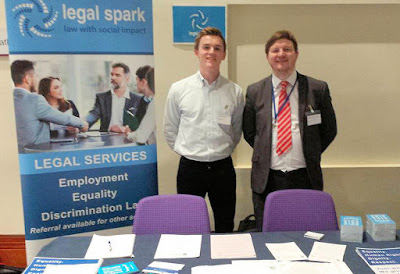
The claims are made by a disabled solicitor – Daniel Donaldson – who founded Legal Spark – a Glasgow based law centre - with the aim of helping disabled people and other clients excluded from Scotland’s legal system.

Last year, the Law Society of Scotland granted permission to law centre Legal Spark to take on legal aid cases – allowing the law practice to take on cases from disabled people who had been unable to secure legal representation for their discrimination cases.

However, after the Law Society approved the law practice to engage in legal aid work, certification for Legal Spark to take on new legal aid cases has since been withdrawn - with unconvincing explanations from the Edinburgh based regulator - resulting in clients facing an uncertain future in terms of their access to the legal system.

Daniel Donaldson – who qualified as a solicitor six years ago – spent a year discussing Legal Spark with the Law Society of Scotland - which originally described the disabled solicitor’s proposals to create a facility to provide disabled clients with access to justice as “refreshing” and “innovative”.

However, the solicitor has now accused the Law Society of abandoning disabled clients and has set up a public petition calling for help in restoring his law centre’s legal aid certification

Readers can view more details of the petition here: Law Society of Scotland: Allow Legal Spark Legal Practice to continue Legal Aid Work

Speaking to a DOI journalist earlier today, solicitor Daniel Donaldson said the Law Society’s decision would deprive disabled people of access to justice.

Mr Donaldson said: "It's completely unacceptable for any public authority to ignore disabled service users.  We set us Legal Spark because of a problem with access to justice.” 

“We volunteered to do legal aid work to help unrepresented disabled people.  Now the LSS has forced us to stop.  What's changed in six months? Nothing.  They've made this decision for other reasons and not ,"public protection" as claimed.”

“The LSS believes they can do what they like with no scrutiny or accountability. Individuals are free to abuse their position. I call upon the Scottish Parliament and Scottish Government to strip them off all their regulatory functions and being an end to their abuse of power"

Out of concern for clients welfare after the Law Society’s decision to revoke legal aid certification - Legal Spark contacted 134 lawyers from a list provided by the Law Society of Scotland of law firms who take on civil legal aid cases and specialise in discrimination law.

However, not one law firm has taken any of Legal Spark’s clients – a move which is generating suspicion among some legal observers that the Law Society is unfairly controlling and restricting certain law firms and their clients access to legal aid.

The Disability News Service reported on the story, quoting  a Law Society Scotland spokeswoman who said: her organisation had made “a mistake” in originally granting Legal Spark permission to carry out civil legal aid work, before realising that it was “not entitled to provide this type of advice under the society’s civil legal assistance quality assurance scheme”.

The Law Society spokeswoman said: “The committee made a final decision on 16 June that a waiver could not be granted for public protection reasons and as the compliance certificate for Legal Spark had been issued in error, it could no longer provide advice funded by legal aid.

“The committee agreed that given the circumstances, Legal Spark could continue working with its legal aid clients until 30 June, to allow sufficient time to make alternative arrangements for clients.”

She said law centres have to be “underpinned by a solicitor practice unit [which she said Legal Spark was not]in order to be able to be on the civil legal aid quality assurance scheme register and provide legal aid funded advice”.

She added: “While it is rare for something to go wrong, clients have to be able to seek redress and as it currently stands, Legal Spark is not in a position to meet those requirements.”

The Disability News Service further reported:  By noon yesterday (28 July), the Law Society Scotland had failed to explain why it has refused to enter into mediation, although it claims that it was “still in communication with Legal Spark”.

The website of Legal Spark describes the legal services provider as  an innovative legal practice. Legal spark is a law centre, not a firm of solicitors.

Legal Spark state: “All lawyers will provide legal services,  but our practice is unique. Our practice is driven to maximise social impact, rather than to maximise profits for shareholders. Our business is ethical, and our legal practice promotes social responsibility.”

The law centre also pledges to reinvest their profits of commercial legal work to help people by:

* organising and taking part in outreach events in communities

* providing legal advice and representation for disabled people

* maintaining a commitment to legal aid work

Legal Spark are located at 22 Montrose Street, Merchant City, Glasgow G1 1RE email: contact@legalspark.co.uk

Petition : Law Society of Scotland: Allow Legal Spark Legal Practice to continue Legal Aid Work

Campaign created by: Daniel Donaldson

Campaign website: http://www.legalspark.co.uk/

Campaign facebook: http://www.facebook.com/legalspark

To: The Law Society of Scotland, the Scottish Legal Aid Board and others

The Law Society and Legal Aid Board informed Legal Spark Legal Practice that they had to stop all legal aid work on 30th June. As a result, "A", "B' plus many other disabled clients are forced to forego representation. They have the power to reverse their decision, together we can make that happen.

Why is this important?

Legal Spark was formed as a result of the crisis in legal aid. People were going without representation because they could not afford a lawyer. This is particularly the case for disabled people.

No one else would do this type of work, as it was deemed too expensive, not financially viable and also too complex.

Daniel Donaldson, a disabled Solicitor, set up Legal Spark with the Support of the Scottish Institute for Enterprise under their Young Innovators Challenge 2015 programme.

Daniel wanted to develop creative solutions to help people access justice and to fix the exclusion that disabled people face from the legal system.

Daniel spent one year talking to the Law Society about this issue, highlighting that it was important that everyone could access a lawyer.

Legal Spark consulted with the Chief Executive (Lorna Jack), the Head of Professional Practice, the Registrar and the Deputy Registrar (James Ness) and the Secretary to the Civil Legal Aid Quality Assurance Committee (Hannah Sayers) amongst others.

A document was prepared that explained what Legal Spark was planning to do. The Law Society accepted this document and did not object. The Law Society encouraged Legal Spark and found their approach "refreshing" and "innovative".

Legal Spark was granted permission to do Legal Aid work in November 2015, and a compliance certificate was issued in December 2015. Legal Spark began helping the many disabled people that needed their help and began to have success.

In April 2016, the Law Society decided that they had made an "error" and instructed Legal Spark to stop all Legal Aid work by Thursday 30 June 2016. By this stage, Legal Spark had a number of clients, with active and complex cases, some of which were about to go to Court.

"A" is one such client. They had experienced awful disability discrimination from a University. They were not given adequate support to help them during a course, and had to leave. Additionally, Legal Spark uncovered evidence that the University's staff had used "unprofessional language" in their approach to "A". This case has now been lodged in Court.

"B" is another client adversely affected by this decision. B is also disabled and is housebound. They had tried to find a lawyer for sometime but because of their rural location in the Highlands there were no Solicitors available to help. Legal Spark took on this case and was successful (in part) in achieving a resolution for B. However, because B had been adversely affected by a decision of Highland Council, and had lost out financially, the case may need to go to Court. B is unable to find anyone else to help them.

These are only two examples of where Legal Spark is making a difference, there are others too.

Since establishing Legal Spark, Daniel Donaldson has not drawn a salary and has used some of his own money to sustain the Legal Practice while it develops and is able to stand on its own feet.

Legal Spark has also grown to enable it to employ staff and provide much need paid employment to some disabled people and unemployed law graduates.

The Legal Aid certificate meant that Legal Spark could help people who could not access help elsewhere. Now "A", "B" and other will have to go without representation because of the Law Society of Scotland's failures.

The Law Society's Chief Executive (Lorna Jack)says that they have to act in the public interest. The Director of Regulation (Philip Yelland) shares this view.

1. Where is the public interest in denying disabled people representation?
2. Also, where is the public interest is giving permission to do Legal Aid work only to revoke that permission 6 months later?

The Law Society say that there are other Solicitors who can help, however this is not true.

Legal Spark contacted 134 Civil Legal Aid lawyers with advertised specialism in discrimination law. Even the biggest Legal Aid firm in Scotland could not help.

The Law Society has said that this will cause Legal Spark’s disabled client’s “inconvenience”. This is an offensive comment; they have never met any client, they have ignored client’s opinions, and also refused to acknowledge that they will suffer substantial prejudice in their cases because of the Law Society’s decision.

This petition is addressed to the Law Society and the Scottish Legal Aid Board.

It is important that you fulfil your roles correctly.

Overturn your decision to stop Legal Spark doing legal aid work, remedy the mistake you have made and apologise. This is the only way you can restore public trust and continue to say you act in the public interest.

Allow Legal Spark, and their clients the opportunity to continue to work together for the public interest and tackle the horrors faced by disabled people on a daily basis.
How it will be delivered

Signatures to this petition will be emailed, delivered in person, or a press conference will be arranged.

Monday, May 30, 2016

NEW CHEATS FOR THE DOCK: Six lawyers probed by Police for legal aid fraud - as investigation uncovers banned legal aid solicitors raking in profits via law firms referral fees scam

Police & Prosecutors investigate lawyers for legal aid fraud. THE Scottish Legal Aid Board (SLAB) has confirmed a number of solicitors are currently under investigation by Police Scotland for alleged legal aid fraud.

The admission by Legal Aid chiefs – via Freedom of Information legislation - comes after journalists received tip offs relating to “high value” long term investigations involving a number of law firms and solicitors chiefly in the west of Scotland.

And, all the solicitors who are under investigation by Police Scotland and the Crown Office & Procurator Fiscal Service (COPFS) - are still working for law firms who are able to claim more public cash – despite substantive allegations they cheated taxpayers.

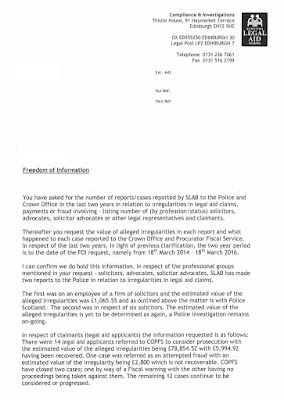
Information provided by SLAB in response to a Freedom of Information request reveals:

The first was on an employee of a firm of solicitors and the estimated value of the alleged irregularities was £1,065.55 and as outlined above the matter is with Police Scotland.

The second was in respect of six solicitors. The estimated value of the alleged irregularities is yet to be determined as again, a Police investigation remains on-going.

The Scottish Legal Aid Board also confirmed fourteen applicants for legal aid had been referred to the Crown Office.

In respect of claimants (legal aid applicants) the information requested is as follows:

There were 14 legal aid applicants referred to COPFS to consider prosecution with the estimated value of the alleged irregularities being £78,854.52 with £5,994.92 having been recovered.

One case was referred as an attempted fraud with an estimated value of the irregularity being £2,800 which is not recoverable.

COPFS have closed two cases; one by way of a Fiscal warning with the other having no proceedings being taken against them. The remaining 12 cases continue to be considered or progressed.

However, since SLAB confirmed the Police probes - information has come to light a number of solicitors who are now banned from the Legal Aid register and some  who have ‘voluntarily’ withdrawn after headline SLAB investigations - are still profiteering from legal aid cash.

The claims come as Scotland’s legal profession – led by the Law Society of Scotland – plot a strategy to resist ex Finance Secretary John Swinney’s announced cuts to the Legal Aid budget - which has soared to over £150 million a year - resulting in Scottish lawyers handed over £1.2 billion of public cash since the financial crash of 2008.

Enquiries by the media have also uncovered a new type of legal aid scam - whereby lawyers who currently cannot claim legal aid due to previous instances of defrauding the public purse - are now receiving hefty payments in the form of large referral fees from other local law firms they pass on civil & criminal clients.

The law firms who gain extra legal aid business from former legal aid solicitors – are suspected of inflating their own legal aid claims to cover referral fees paid to the referring solicitor.

One client - who did not wish to be identified - told journalists how his solicitor - already named in the media in relation to legal aid irregularities – passed on a civil damages claim against a West of Scotland local authority to another firm of solicitors in the same area.

The client later became aware an arrangement had been made by the second law firm for referral fees to be provided to the original solicitor.

The claimant was told if any problem arose or he was asked questions, he was to reply by stating his original solicitor was kept on in the case as his office was closer in terms of accessibility.

The client – who’s claim is being funded by civil legal aid – told journalists he was asked to go to three consultations with his original solicitor - all of which were suddenly cancelled at the last minute.

However, the client was asked to go to his new legal representatives for a consultation where his second lawyer claimed ‘valuable information had been learned from the consultations’ – which never took place.

Material which has emerged in relation to this case suggests the non-existent consultations – have since been charged up to legal aid.

A number of similar cases have since been identified involving the same solicitor who is now ‘de-registered’ from the Legal Aid register – potentially costing taxpayers tens of thousands of pounds in inflated legal aid claims designed to channel payments back from law firms still on the legal aid register - to the referring solicitor.

Most of the cases so far uncovered appear to involve small to medium sized civil claims against housing agencies, public bodies including health, local authorities and some private businesses.

Speaking to journalists, an individual who formerly specialised in complex financial investigations of law firms said the scale of fraud involving inflated legal aid claims being used to provide referral fees to de-registered and ‘non legal aid solicitors’ “is substantial” and “difficult to get to grips with”.

The individual also gave an account of a case where he alleged financial documents had been removed - under audit powers - from a law firm currently implicated in a multi million pound mortgage fraud racket – to shield a well known solicitor who formerly held high office at the Law Society of Scotland.

It is unknown if the Crown Office or Police Scotland have requested sight of the material from the legal profession’s regulator.

LAWYERS AVOID LEGAL AID RAPS:

A previous investigation by DOI into the lack of prosecutions by the Crown Office revealed fourteen cases were sent to prosecutors, with not one case going to court.

One solicitor even registered a plea of “insanity” to avoid being prosecuted for legal aid fraud.

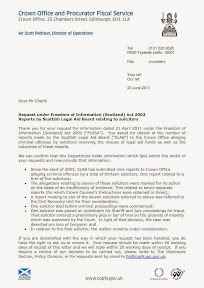
Since the start of 2005, SLAB has submitted nine reports to Crown Office alleging criminal offences by a total of thirteen solicitors. One report related to a firm of five solicitors;

The allegations relating to eleven of these solicitors were marked for no action on the basis of an insufficiency of evidence. This related to seven separate reports (for which Crown Counsel’s Instructions were obtained in three)

A report relating to one of the eleven solicitors referred to above was referred to the Civil Recovery Unit for their consideration;

One solicitor died before criminal proceedings were commenced;

One solicitor was placed on indictment for Sheriff and Jury proceedings for fraud. That solicitor entered a preliminary plea in bar of trial on the grounds of insanity which was sustained by the Court.  In light of that decision, the case was deserted pro loco et tempore; and

In relation to the final solicitor, the matter remains under consideration.

Further reporting on the lack of prosecutions was reported in the Sunday Mail newspaper and by DOI can be found here: FOURTEEN lawyers accused of multi-million pound legal aid fraud escape justice as Scotland’s Crown Office fail to prosecute all cases in 5 years

Thursday, May 26, 2016

SCRUTINY OF THE BOUNTY: Court staff accepted gifts from law firms probed by Police for alleged legal aid fraud - days after appointment of Scotland’s latest top judge Lord Carloway

Court staff accepted gifts from lawyers being investigated by Police. DOCUMENTS obtained by journalists reveal just a few days after Lord Carloway was named as Scotland's new top judge – Court staff employed by the Scottish Courts and Tribunals Service (SCTS) accepted gifts from law firms under criminal investigation for alleged legal aid fraud.

The information came to light in an unpublished register of gifts and hospitality to Scottish Court Service staff - released in response to a Freedom of Information request.

The ‘Gifts and Hospitality’ register now identifies law firms & hospitality providers - after DOI journalists previously approached Scottish Information Commissioner Rosemary Agnew for help in breaking court secrecy.

Entries in the latest gifts register reveal that on 22 December 2015, Central Court Lawyers gave hospitality in the form of ‘Cake, 6 wine and 12 beers’ to Livingston Sheriff Court staff - who then entered the items into a "staff raffle".

However, it was reported by the media during February 2015 that Central Court Lawyers were under investigation by Police Scotland for irregularities in legal aid claims.

Last year, when the story was reported, Police Scotland confirmed "Central Court Lawyers are assisting us with our inquiries."

Officers are thought to have interviewed serving and former employees of Central Court Lawyers as part of their inquiry, which began in 2014.

Central Court Lawyers – based in Livingston – was established by lawyer Neil Robertson and solicitor-advocate Ian Bryce in 1997.

Ian Bryce has held a number of positions at the Law Society of Scotland, including vice-convener of the legal aid negotiating team.

Central Court Lawyers has previously been included in the Legal 500 - a publication listing the top law firms in the UK.

The Hospitality & Gifts Register 2015-2016 reveals staff took hospitality from legal aid probe lawyers.

In response to media enquiries, a spokesperson for the Scottish Courts & Tribunals Service (SCTS) claimed gifts had not been accepted.

The spokesperson said: “SCTS staff at Livingston Sheriff Court have not accepted hospitality from Central Court Lawyers. A small gift was accepted on behalf of staff in December 2015 and entered in the staff Christmas raffle.

The spokesperson continued: “This was fully declared in the Gifts and Hospitality Register.”

The SCTS were asked why staff accepted gifts from law firms under investigation by Police Scotland for legal aid irregularities.

A spokesperson said in response: “Gifts with a value over £15 require to be approved by a senior manager and the giver advised that details will be entered onto the register for transparency. If a manager has any concern regarding the offer of a gift HR will offer further advice.”

Previous versions of the hospitality register - Hospitality and Gifts to Court Staff 2010-2013 - have also included the names of solicitors such as Niels S Lockhart – who was investigated by the Scottish Legal Aid Board after he claimed over £600K in just two years.

Lockhart – who gave hospitality to staff at Ayr Sheriff Court in 2012 - subsequently withdrew from the legal aid register - with no action taken by the Law Society of Scotland or the Scottish Legal Aid Board.

Neils Lockhart continued to receive legal aid payments for unpaid accounts even after he quit the legal aid register, reported in further detail here: CASH TRAPPED: £1.2m legal aid Lawyer demanded more public cash after being barred from legal aid register

In response to details published by DOI during March 2015 in last year’s hospitality register to court staff - lawyers accused each other of using hospitality to poach clients from rival law firms and increase firms volume of legal aid business – reported in further detail here: GIFT HORSE: Secret gifts register reveals rogue lawyers & law firms using hospitality relationships with Scottish Court Service staff to increase legal aid business, poach clients from rival solicitors

Asked for comment on the current status of the investigation into Central Court Lawyers, the Scottish Legal Aid Board refused to provide further details.

A spokesperson for SLAB said: “It is inappropriate for us to comment on whether we are conducting specific investigations or enquiries into a solicitors’ firm, or if we are, what they involve.”

“The intention is not to be unhelpful but, for example, where there is an investigation we don’t generally comment because this would be premature in terms of the stage any enquiry has reached in determining if the matters being examined are improper or unlawful.”

“To do so would be inappropriate if an investigation subsequently concluded that nothing improper or unlawful had occurred. It could also be potentially prejudicial if an investigation found improper or unlawful activity and the matter was subsequently referred to the Crown.”

Court staff at Hamilton Sheriff court were also rapped on the knuckles for failing to properly record gifts from a number of local law firms who operate in the area.

An entry in the register reveals "A number of local solicitors firms including but not restricted to:Kenneth Greener & Co; Linda George Family; Diarmid Bruce; Ness Gallagher; Lanarkshire Law Practice gave "25 boxes/tins of chocolates; 10 boxes of biscuits; 18 bottles of wine; 2 bottles of spirits;   21 miniatures of whisky/baileys; 3 large cakes; 1 recipe book." to local court staff.

The failure to adequately record the 'hospitality' drew ire from Court chiefs who said "The correct procedure for recording gifts was not followed in this instance. Management in this court has been reminded of the need to follow the procedure in future."

A number of law firms & solicitors who operate at Hamilton & Livingston Sheriff Court have previously been investigated for legal aid fraud.

Commenting on earlier versions of the register - an Edinburgh solicitor said: “The contents of the court hospitality register read as a who’s who of legal aid investigations just waiting to happen.”

Previously - Diary of Injustice reported on concerns regarding hospitality involving Scottish Court Service employees where Gillian Thompson – who now serves as Judicial Complaints Reviewer (JCR) - was asked by the Scottish Court Service to investigate reports of irregularities in hospitality given to court staff.

The request for the investigation came after the Scottish Court Service received Freedom of Information requests regarding hospitality in the courts, prompting concerns some staff may have accepted gifts or hospitality but failed to register.

Report said SCS Registers insufficient, Court staff involved in private gains failed to declare. Gillian Thompson’s Report on Hospitality & Gifts in the SCS stated:  “The information currently captured on the registers is insufficient to provide assurance that staff are using their common sense and considering issues such as conflict of interest.

Ms Thompson went on to recommend the “SCS should revise the Policy on Acceptance of Gifts, Rewards and Hospitality to ensure that it is fit for purpose for all staff, taking account of the various roles performed within SCS. It may also be time to revisit the levels of value for gifts and hospitality.”

The former AIB’s report also revealed court staff were using their positions to earn money privately from their links with lawyers and law firms operating in courts, stating “Several staff raised the issue of sheriff clerks who carry out extrajudicial taxations and private assessments and who personally benefit financially from these activities.”

Ms Thompson’s report roundly condemned this practice, stating: “Not only is it inappropriate in terms of the civil service code requirements for staff who are public servants to be able to receive private gain from their employment it is also highly divisive when other staff see such benefits being derived from simply being in the right post of Auditor of Court within the Sheriff Courts.”

Ms Thompson recommended in her report the “SCS should bring the practice of sheriff clerks profiting privately from their employment by SCS to an end as quickly as possible”.

HOW COURT CHIEFS LOST HOSPITALITY INFORMATION BATTLE

When DOI launched an initial investigation into hospitality and graft among court staff, the Scottish Court Service refused to release information relating to the gift register, claiming “the names of the gift or hospitality provider would be deemed as personal information” and “as the provider of the gift or hospitality was not made aware at the time that their name may be released, we consider disclosure of such is likely to bring the Scottish Court Service into conflict with the data protection principles.”

However, the Freedom of Information request – from DOI – triggered a review of hospitality policy at the Scottish Court Service, leading to names of ‘'hospitality’ providers being added to the register.

Richard Warner of the SCS said: “I can advise you that due to your request for this information, the Scottish Court Service has changed the policy covering hospitality and gifts to ensure that the provider of any hospitality or gift are made aware that their name shall be entered on to our register and may be disclosed if requested in any future information request. This policy change shall take effect as from 1 January 2014 so the release of names may be considered in any future request for gifts or hospitality offered from this date. The policy also states that if the provider does not consent to their name being considered for release then the gift or hospitality cannot be accepted by a member of staff.”

After a request for review of refusal to disclose the information, the SCS again refused - this time around, claiming it would cost them too much to contact each law firm to ask permission to disclose their ‘hospitality’ to court employees. The SCS claimed they would have to contact every lawyer who gave a gift and this would cost too much to provide the information.

DOI journalists took the matter up with Rosemary Agnew - the Scottish Information Commissioner – who requested Courts Chief Eric McQueen provide an explanation as to why the courts were blocking release of information on hospitality relationships between the legal profession and court staff.

John Kelly, Freedom of Information Officer at the SIC said: “Having written to and discussed the matter with the SCS, without being required to do so by way of a formal Decision Notice, the SCS has agreed to provide you with the information requested, subject to redactions in terms of section 38(1)(b) of FOISA on the basis that to disclose some of the names of individuals would breach the first data protection principle of the Data Protection Act 1998 (the DPA). I understand that the names of Solicitor and Law Firms will be provided.”

After the intervention of the Scottish Information Commissioner, the SCS subsequently released the hospitality list to DOI.

Richard Warner for the SCS said: “Having reconsidered your request, and the SCS response, I now attach a list which indicates law firms where this information has been recorded.  For the reasons stated in our earlier response this does not include the names of any individuals concerned as there could have been no expectation on their part that this information would be circulated or published widely.  As indicated previously, steps are being taken to ensure that individual persons are made aware at the relevant time that their details made be released as a result of an information request.”

While the position of Scotland's latest top judge on court staff transparency is unknown - Lord Carloway has already attacked proposals to bring the judiciary into line with court employees and others in public life who are required to register their interests, gifts and hospitality.

Carloway recently attacked proposals before the Scottish Parliament - Petition PE1458: Register of Interests for members of Scotland's judiciary – calling on judges to register their own interests and hospitality.

Reported in further detail here: LORD NO-WAY: Top judge Lord Carloway hits out at judicial interests register proposal – Lord Carloway claimed justice could grind to a halt in a constitutional calamity if judges were forced to declare their vast wealth, property owning interests, professional links and other financial affairs – just like politicians, members of public bodies, local councillors are required to reveal in publicly available registers.

Lord Carloway (real name: Colin Sutherland) told MSPs: “The proper administration of justice could be inhibited by the disclosure of the judiciary's otherwise confidential financial arrangements. In that connection, there is the possibility that an individual judge may be the subject of misconceived criticism, deriving from the disclosure of personal financial information, where those interests are tangential and de minimis.”

The widely supported proposals - debated at the Scottish Parliament on 9 October 2014 - call for the creation of a publicly available register of judicial interests containing information on judges backgrounds, their personal wealth, undeclared earnings, business & family connections inside & outside of the legal profession, offshore investments, hospitality, details on recusals and other information routinely lodged in registers of interest across all walks of public life in the UK and around the world.

Previous articles on the lack of transparency within Scotland’s judiciary, investigations by Diary of Injustice including reports from the media, and video footage of debates at the Scottish Parliament’s Public Petitions Committee can be found here : A Register of Interests for Scotland's Judiciary.

Previous articles on hospitality and gifts to the Scottish Courts and Tribunals Service, reports on gift giving to court employees and investigations by Diary of Injustice on the relationship between law firms and SCTS staff can be found here Hospitality and Gifts to the Scottish Courts.