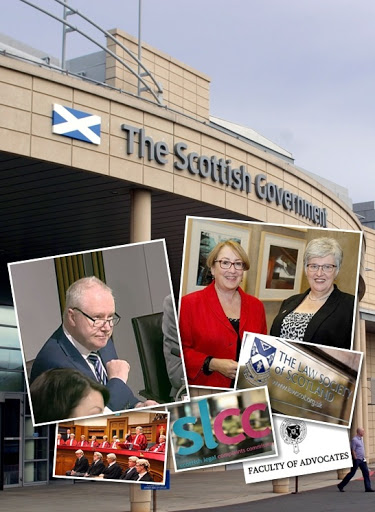
The move by Scottish Minsters, coming after discussions with the Law Society of Scotland - is intended to answer concerns amid rising numbers of complaints about poor legal services and the diminishing status of Scotland’s legal services sector,
However, former Cabinet Minister Alex Neil MSP (SNP Airdrie and Shotts) said the review should include judges and the membership of the review team should be expanded to balance up the panel’s current top heavy legal interests membership.
Mr Neil recently branded the Scottish Legal Complaints Commission (SLCC) “a toothless waste of time” – after the legal services regulator failed to act in a high profile case involving a senior QC caught up in a cash payments scandal.
The review, led by NHS 24 chair Esther Roberton, is intended to make recommendations to modernise laws underpinning the legal profession’s current regulatory system including how complaints are handled.
This follows concerns that the current legislative framework is not fit for purpose and has not kept up with developments in the legal services market. There are also worries that the current processes for people wishing to make complaints about their solicitor are too slow and too complex.
However, doubts about the impartiality of the panel have been raised after the announcement by Legal Affairs Minister Annabelle Ewing revealed a top-heavy compliment of figures from the legal establishment who are keen on protecting solicitors’ self regulation against any move to increase consumer protection by way of independent regulation.
The list of panel members includes:
*Two former Presidents of the Law Society of Scotland;
* The current Chief Executive of the pro-lawyer Scottish Legal Complaints Commission;
* An outgoing Scottish Public Services Ombudsman widely criticised for ineptitude;
* The current chair of the Scottish Solicitors Discipline Tribunal (SSDT) – who struck off only six solicitors last year;
* The chair of a law firm whose partners have regularly appeared before the SSDT;
* A QC from an advocates stable where colleagues have been linked to a cash payments scandal;
* A former Crown Office Prosecutor & QC linked to events in the David Goodwillie rape case – where the victim was forced to sue her assailant through the civil courts after the Lord Advocate refused to prosecute the footballer.
Announcing the review, Legal Affairs Minister Annabel Ewing said: “Members of the public must be able to have confidence in the service they get from their solicitor. While this happens most of the time, I have been listening carefully to concerns that the current regulatory system in Scotland may leave consumers exposed and does not adequately address complaints.”
Speaking yesterday to journalists, former Cabinet Minister & SNP MSP Alex Neil generally welcomed the review, adding the review remit should also include judges.
Alex Neil said: “I hope it produces radical and robust proposals. I also hope it covers the judiciary as well as lawyers.”
Mr Neil also called for greater fairness in the panel’s membership, to include members from outside the legal establishment.
Mr Neil added: “I hope the membership of this review panel will be expanded to get a better balance between lawyers and non-lawyers”
The latest move by Scottish Ministers to reform self regulation of solicitors and advocates comes years after a move in England & Wales to more robust independent regulation of legal services - which has left Scots consumers & clients at a clear disadvantage.
And while clients in the rest of the UK have much more of a chance to obtain redress against legal professionals who consistently provide poor legal services – and see their lawyers named and shamed in public by the Solicitors Regulation Authority (SRA) and Legal Ombudsman (LeO),
At pains to point out the ‘independent’ nature of the review, the Legal Affairs Minister said: “This independent review will consider what changes may be needed to the statutory framework for the regulation of legal services to protect consumer interests and promote a flourishing legal sector. This includes ensuring that consumers properly understand the options open to them when something goes wrong and that the regulatory framework is proportionate for legal firms. I look forward to receiving its recommendations in due course.”
Chair of the review - Esther Roberton said: “I am delighted to have been asked to undertake this review. Our legal profession and legal services in Scotland are the envy of many around the world. We should be just as ambitious for our system of regulation of legal services. I would hope we can simplify the current complaints process to maximise consumers’ confidence in the system. I look forward to working with the panel members who bring a broad range of experience across a range of sectors.”
However, questions have surfaced over the actual intentions of the review after legal insiders revealed today the proposals only came about after long discussions between the Scottish Government and the Law Society of Scotland – the legal profession’s main lobby group in Scotland who enjoy the greatest benefit of self regulation.
Legal insiders have suggested the review is not widely seen as a serious move by Scottish Ministers to reform self regulation.
Rather, this third attempt at addressing failures of regulation and poor legal services provided by increasingly less qualified legal representatives is a reaction to the failure of Scotland’s legal services sector to put it’s own house in order amid diminishing business, a reduced client base, rising numbers of complaints.
The latest Government sponsored shot in the arm of lawyers – which one solicitor said this morning “may end up calling for more public cash and an increase in the legal aid budget” – comes on the back of a complete failure to attract international litigants who are wary of entering Scotland’s famously unreliable, expensive and poor legal services market.
Access to justice and legal services in Scotland are internationally well known as being hampered by slow proceedings in courts dubbed “Victorian” and “out of date” by both of Scotland’s recent top judges.
VESTED INTERESTS - Legal Profession welcome their own review:
The SLCC welcomed the announcement by the Minister for Community Safety and Legal Affairs of a review of how best to reform and modernise the statutory framework for the regulation of legal services and complaints handling in Scotland.
SLCC Chief Executive Neil Stevenson, one of the review panel members, commented “We are pleased that the Scottish Government has announced this review, in line with the manifesto commitment. We hope our Reimagine Regulation legislative change priorities paper, which we published last year, will be one helpful contribution to the review. In that paper we looked at some of the innovative thinking in regulation and standards coming from the health professions, so we are especially delighted to see that expertise represented in the review panel alongside huge knowledge of the legal sector. We look forward to this range of experience and expertise being shared as part of this process, and a collaborative approach to identifying priorities and opportunities for reform.”
SLCC Chair Bill Brackenridge added, “This will be an excellent opportunity for all the key stakeholders involved to come together in supporting the review as it considers the regulatory landscape in order to support growth in the legal services sector and strengthen consumer protection. Despite many strengths to the current system, the Board of the SLCC believe there are significant opportunities to make regulation more targeted, more effective and more efficient."
The Law Society of Scotland has welcomed the Scottish Government’s announcement today, Tuesday, 25 April, of an independent review of legal services, saying that current legislation governing the legal sector is no longer fit for purpose.
Law Society of Scotland president, Eilidh Wiseman said: “There have been huge changes in the legal market over recent years. Changing consumer demands and new business structures are transforming the way legal services are being provided.
“This is why we have argued so strongly for reforms to the patchwork of legislation which covers the regulation of legal services in Scotland. The main Act of Parliament governing solicitors is more than 35 years old and simply no longer fit for purpose. We know the processes for legal complaints are slow, cumbersome, expensive and failing to deliver for solicitors or clients. There are gaps in consumer protection, contradictions and loop holes in the law. This is why change is so desperately needed to allow the legal sector to thrive and ensure robust protections are in place for consumers.
“The Scottish Government’s independent review offers the chance to build a consensus on how reforms should be taken forward. It is vital for the work of the group to move as quickly as possible so new legislation can be introduced before the Scottish Parliament.”
The Law Society has highlighted its concerns about areas of legal services which remain unregulated in Scotland.
Wiseman said: “One area we will highlight to the review group is the growing level of unregulated legal services where consumers are at risk if something goes wrong. Many people are unaware that some types of legal services are not regulated – for example, receiving employment advice from a non-solicitor. They may have little or no course of redress if something goes wrong. Consumers deserve the same level of protection whether they choose to go to a solicitor, and are therefore covered by Law Society client protections, or to use another legal services provider.”
Two former Law Society presidents, Christine McLintock and Alistair Morris, will serve on the legal services review panel.
Wiseman said: “I am particularly delighted that Christine McLintock and Alistair Morris will be part of the review group. With their considerable board-level expertise alongside their combined insight and knowledge of the legal sector, they will prove invaluable to the review process. They understand the need for reform and, having both served on regulatory sub-committees, bring a deep commitment to the public interest.”
Christine McLintock, as former general counsel for Pinsent Masons, was responsible for the firm’s in-house legal service, professional risk management and compliance. Christine joined the Law Society’s Council in 2005 and has served on the Society's Board since its inception in 2009. Prior to that, she was a member of the Strategy and Governance Group and was Convener of the Education and Training Committee, before to serving as President in 2015-16. She is currently part of the team working on the regulation of licensed legal services providers and is Convener of the Law Society’s Public Policy Committee.
Alistair Morris was appointed CEO of Pagan Osborne in 2005, having built extensive expertise in private client work at the firm. He was elected to join the Law Society Council in 1992, becoming one of its longest serving members at 24 years. Alistair also served as a board member between 2009 and 2016, and was Convener of the Guarantee Fund Sub-committee (now Client Protection Fund Sub-committee) prior to his election as President in 2014. Alistair currently sits on the Judicial Appointments Board for Scotland.
The Dean of Faculty, Gordon Jackson, QC, has responded to an announcement by the Scottish Government of an Independent Review of the Regulation of Legal Services.
Mr Jackson said: “I welcome that this review is taking place. It is very important that the legal profession retains the confidence of the public. I know that the Faculty of Advocates has earned that confidence, and that this thorough review will demonstrate that an independent referral bar has been, and will continue to be vital in maintaining an effective and fair justice system.
“The Faculty will willingly co-operate fully with the inquiry and I am confident that the considerable experience of the Faculty’s representatives, Laura Dunlop, QC, and Derek Ogg, QC, will be of great value.”
Review should include judiciary:
Scotland’s judges have earned themselves widespread criticism and condemnation at Holyrood and from the Judicial Complaints Reviewer (JCR) – after top judges failed to address complaints and become more transparent and accountable like other branches of Government.
Ongoing efforts by the Scottish Parliament’s Public Petitions Committee to create a register of judges’ interests have been flustered by two Lord Presidents – Lord Gill & current top judge Lord Carloway.
The proposal to bring greater transparency to Scotland’s judiciary - Petition PE1458: Register of Interests for members of Scotland's judiciary - first debated at the Scottish Parliament’s Public Petitions Committee in January 2013 – calls for the creation of a publicly available register of judicial interests – containing information on judges’ backgrounds, figures relating to personal wealth, undeclared earnings, business & family connections inside & outside of the legal profession, membership of organisations, property and land, offshore investments, hospitality, details on recusals and other information routinely lodged in registers of interest across all walks of public life in the UK and around the world.
The current review could include the judiciary in terms of how judges regulate themselves, however the Scottish Parliament should be left to get on with the task of creating a register of judges’ interests – given the five years of work already undertaken by MSPs on the thorny question of judicial declarations.
REVIEW THE REVIEW: Third attempt at reforming biased system of solicitors self regulation.
The latest review of the way lawyers regulate themselves marks the third attempt at addressing problems created by Scotland’s pro-lawyer system of self regulation, where lawyers write the rules, and look after their own.
In 2001, the Scottish Parliament’s Justice 1 Committee, under the Convenership of Christine Grahame MSP, met to consider evidence in relation to calls to reform regulation of the legal profession.
The inquiry, gained by the late, widely respected MSP, Phil Gallie, heard evidence in relation to how complaints were investigated by the legal profession.
However, Mr Gallie was replaced by Lord James Douglas Hamilton, and the Committee eventually concluded not to amend how the Law Society regulated Scottish solicitors.
A second, more substantive attempt to reform regulation of the legal profession came about in 2006, with the Scottish Parliament’s then Justice 2 Committee taking on consideration of the proposed Legal Profession & Legal Aid (Scotland) Act, which received Royal Assent in 2007.
The LPLA Act led to the creation of the now widely derided Scottish Legal Complaints Commission – once touted as an ‘independent’ solution to handing complaints against solicitors and advocates.
A mere nine years after the creation of the SLCC in 2008, the badly run legal quango, often itself the subject of scandal, charges of incompetence and downright bias – has become as much a threat to consumer protection as the Law Society itself was in the days when complaints were handled at the Law Society’s former HQ in Drumsheugh Gardens, Edinburgh.
The independent review of the regulation of legal services in Scotland is expected to consult widely with stakeholders and report to Scottish ministers by the end of 2018.
The independent chair of the review is Esther Roberton, current chair of NHS 24. Ms Roberton has extensive senior leadership experience in the NHS and other areas of public life. She is also currently a board member of the Scottish Ambulance Service (2014-18). She was chair of SACRO (2010-2014) and until recently also sat on the Crown Office and Procurator Fiscal Service Audit and Risk Committee (COPFS ARC).
The review panel have confirmed their participation as follows:
• Christine McLintock - immediate past president Law Society of Scotland
• Alistair Morris - chief executive of the management board, Pagan Osborne (Law Society of Scotland)
• Laura Dunlop QC - Hastie Stables (Faculty of Advocates)
• Derek Ogg QC - MacKinnon Advocates (Faculty of Advocates)
• Neil Stevenson – chief executive of the Scottish Legal Complaints Commission
• Nicholas Whyte – chair of Scottish Solicitors’ Discipline Tribunal
• Ray Macfarlane – chair of the Scottish Legal Aid Board
• Jim Martin – outgoing Scottish Public Services Ombudsman
• Dr Dame Denise Coia – chair of Healthcare Improvement Scotland
• Prof Lorne Crerar - chairman, Harper Macleod LLP
• Prof Russel Griggs - chair of the Scottish Government’s Independent Regulatory Review Group
• Trisha McAuley OBE - independent consumer expert

