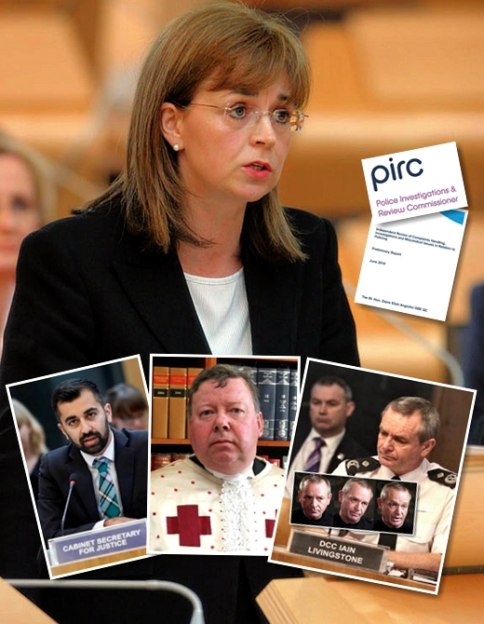
Showing posts with label Police Investigations & Review Commissioner. Show all posts

Saturday, June 22, 2019

POLICE STORY: Ex-Lord Advocate linked to Police union complaints lawyers - says Police should continue to investigate themselves, complaints against top cops should be heard by ‘quango style’ panel - headed & appointed by Scotland’s top judge

Police should investigate Police – report. A FORMER Lord Advocate once accused of undermining the judiciary by Scotland’s top judge – has delivered a preliminary report as part of a review on handling of complaints and investigations against officers of Police Scotland.

However, the report from Dame Elish Angiolini on “Independent review of complaints handling, investigations and misconduct issues in relation to policing” - continues to advocate Police should continue to investigate themselves - on the vast majority of complaints.

Angiolini also goes on to outline an eerily familiar procedure where – in the case of complaints against the most senior cops –  a ‘quango’ style panel will be convened and headed by Scotland’s top judge - along with selected ‘independent’ persons from other quangos or organisations - appointed to the panel by - Scotland’s top judge.

The report from Elish Anglioni – who herself is linked to lawyers & law firms which represent Police Officers against complaints - states “The vast bulk of complaints should properly be investigated by the police service itself” and “it is critical that those processes are clear, transparent and trusted”.

As far as the Police Investigations and Review Commissioner is concerned, Angiolini states that “Independent supervision and audit is also critical. In those cases rightly requiring independent investigation the police must also provide the fullest co-operation and assistance to allow timely and effective action.”

In a recommendation linked to deaths in custody, and with relevance to the death of Sheku Bayoh who died in 2015 after being restrained by police in Kirkcaldy.

Angiolini’s report states that Police officers involved in a death in custody should be separated to prevent them conferring and contaminating evidence.

This recommendation comes after what happened following the death of Mr Bayoh, where up to nine officers involved were together in the same room for more than eight hours - which led to allegations the cops conferred with each other in compiling their reports of what happened during their involvement in the incident which ultimately lead to Mr Bayoh’s death.

Angiolini’s report states “Police officers involved in a death in custody or serious incident, whether as principal officers or witnesses to the incident should not confer or speak to each other following that incident.

“Early separation of officers, other than in pressing operational circumstances, is the best way to ensure non-conferral in practice, give transparency to the process and preserve the integrity of each individual’s evidence.

“This is in the interests of both the individual police officers themselves and the public interest in order to safeguard public confidence in the integrity of their evidence.”

“In any group of people there is a danger of group-think that could contaminate or colour evidence inadvertently or otherwise.”

However, what is not revealed anywher in the report is that Elish Angiolini – has frequently used the legal services of the same lawyer – Peter Black Watson - who also represented Police Officers involved in the same incident which led to the death of Mr Bayoh.

In a BBC Disclosure investigation, it was reported : Days after his death, the Scottish Police Federation (SPF) lawyer Peter Watson told the media that "a petite female police officer was subjected to a violent and unprovoked attack by a very large man who punched, kicked and stamped on her."

The new evidence obtained by BBC Disclosure casts doubt on this account.

More on the BBC investigation can be read here: Sheku Bayoh: Fresh questions over death in police custody

It was also reported Peter Watson – who represented Angiolini in some high profile cases – had hit out against the family of Mr Bayoh over criticisms relating to the death in custody.

BBC News reported: Peter Watson of PBW Law said: "Comments made by those representing the family of the deceased promote a completely inaccurate and misleading account."

He added: "The officer injured remains off work, has had several hospital visits and is now in rehabilitation.

"An examination by a leading consultant confirms her injuries were significant. The injuries have been documented and photographed.

"The officers involved have never refused to provide statements. It was agreed at the outset with the Police Investigations and Review Commissioner (PIRC) that they would revert to us when they wanted statements and when they were clear on the basis that statements were to be given.

"PIRC emailed me this morning at 10:46 asking for our assistance to organise interviews and we answered at 11:29 confirming we would be pleased to assist. Those are the facts."

Peter Watson, and also his former law firm of Levy & Mcrae, both remain as legal service providers to the Scottish Police Federation – and have represented Police Officers facing complaints, and criminal charges – yet neither are identified in Angiolini’s report nor is her use of both Watson and Levy & Mcrae flagged up as a conflict of interest issue.

The report on scrutiny of complaints against the Police comes in a tough year for Police Scotland - after the appointment of Iain Livingstone to the top post of Chief Constable even after questions surfaced over Livingstone’s suitability for the role after he once faced five allegations of serious sexual assault against a female officer.

The allegations against Livingstone - who was demoted over the sexual assault allegations and then reinstated upon appeal after the case was heard by a male-led Police tribunal – resurfaced in the print media earlier in 2019 – and in a BBC Scotland investigation into cover ups and scandals at Police Scotland.

Previous articles reporting the sexual assault allegations against Iain Livingstone are available here: Scotland's Chief Constable & what happened to five allegations of serious sexual assault against a female officer
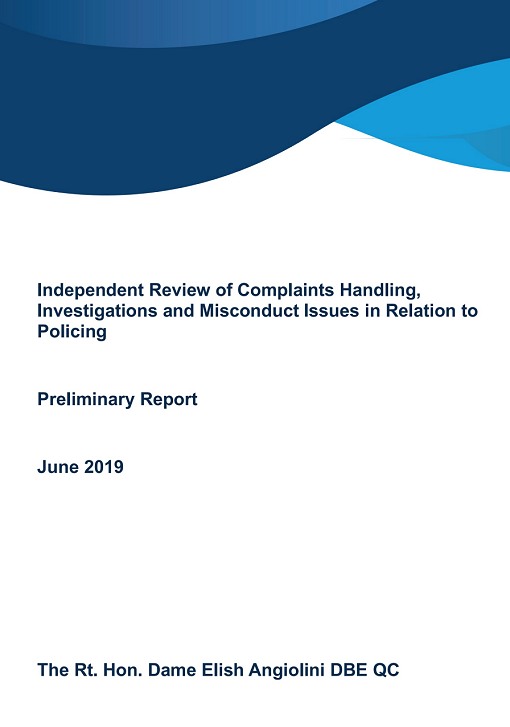
Full report available here: Independent review of complaints handling, investigations and misconduct issues in relation to policing

On complaints against top cops - Angiolini’s report on misconduct investigations against senior officers is critical of current procedures, and recommends responsibilities be transferred away from the Scottish Police Authority (SPA) – due to fears of familiarity between top cops and SPA figures, and a perceived lack of impartiality.

The report states: Police Scotland’s senior officers form a small group of 12 officers above the rank of Chief Superintendent. The members of this group are in regular contact with members and officials of the SPA at meetings of the Board of the Authority and its committees. The SPA, by its nature, also consists of a small group of members and executives. Regular engagement is right and proper and an essential part of the current accountability arrangements whereby it is the statutory function of SPA to hold the Chief Constable to account for the policing of Scotland. However, the regularity of that contact and the familiarity of senior police officers with board members and senior officials could lead to actual or perceived partiality, or antipathy, when it comes to disciplinary matters in which any of those same officers might be involved as the officer under complaint, a supporter to a subject, or a witness.

However, Angiolini’s solution to probes involving top cops - is to create a quango style panel of selected individuals - chaired by a very senior member of the judiciary or Scotland’s top judge – the Lord President – who will also appoint every one of the ‘independent’ persons to the quango style panel hearing complaints against senior cops.

From the report: The key stages of the senior officer misconduct proceedings (both misconduct and gross misconduct) should in future be removed from the responsibility of the SPA and made subject to consideration by an independent legally chaired panel appointed by a very senior member of the judiciary such as the Lord President. The Lord President should be consulted on this matter. The other members of the Panel should consist of an expert in senior policing and a lay person.

The process should follow the steps specified: 1) receipt of the complaint/allegations by SPA; 2) meaningful preliminary assessment and scrutiny of the complaint (within a strict deadline) by a senior Director; 3) prompt referral to the PIRC, or in the case of a criminal allegation to COPFS; 4) an independent investigation by the PIRC of the allegations which should remain confidential unless or until a prima facie case is established; 5) referral by the PIRC to an independent legally chaired panel and determination by the panel as to whether, in the light of the PIRC’s report, there is a case to answer of misconduct or gross misconduct; 6) a preliminary independent hearing by an independent, legally chaired panel to identify any evidence that is not in dispute and can be agreed, and any other matter which can be resolved prior to the formal hearing of the misconduct; 7) a hearing by the panel to consider the evidence, to determine the matter and if proven to decide the appropriate disciplinary action; 8) a right of appeal to a further and different legally chaired independent panel; and finally; 9) the implementation of the disciplinary action by the SPA as the “employer” of the senior officer. (Any constable may further appeal to a Police Appeals Tribunal against any decision to dismiss or demote him or her, and that should remain the case.)

The Panel should consist of independent people from other organisations or jurisdictions, and the Lord President should be consulted by the Scottish Government about the proposal that he should appoint suitable individuals. It is suggested that stages 5, 6 and 7 described in the preceding paragraph could be carried out by an independent 3-person panel comprising a legally qualified chair, one member with a senior UK policing background and one lay member; while the role of the SPA would be limited to stages 1, 2, 3 and 9. The appeal stage could also be conducted by a different independent panel appointed by the Lord President. 184. I believe that the principle of having an independent legally qualified chair for a misconduct hearing should also be extended to gross misconduct hearings for non-senior officers, that is, the rank of Chief Superintendents and below.

The Scottish Governemnt’s announcement of Elish Angiolini’s initial report mentions main points, does not allude to any relationships between the report’s author and law firms who have made millions of pounds from defending Police Officers from complaints and associated issues.

Independent review of complaints handling, investigations and misconduct issues in relation to policing: preliminary report Published: 21 Jun 2019

Dame Elish Angiolini's independent review addresses complaints handling, investigations and misconduct issues in relation to policing in Scotland, in the wake of the Police and Fire Reform (Scotland) Act 2012.

Foreword

In June 2018 Michael Matheson MSP, the then Cabinet Secretary for Justice, and the Lord Advocate, James Wolffe QC, invited me to conduct an independent review on complaints against the police in Scotland. The Review commenced in September 2018. Six years have passed since the creation of radical, new policing structures for Scotland. This is an appropriate juncture to review the effectiveness of the new systems for dealing with complaints against the police in Scotland, how well such complaints are investigated and the processes reviewed. This review also provides a significant opportunity to contribute to work on matters of profound public interest in a key area of human rights.

My mandate from the Ministers is to make recommendations that will help to strengthen public confidence in policing in Scotland. This first report makes recommendations that are preliminary. It will be followed next year by a wide‑ranging report seeking to ensure that the future legislation, regulations, guidance and practice are fit for purpose. It will also examine in detail the structures of the individual organisations charged with dealing with complaints against the police. Despite the very different responsibilities and natural tensions between the four separate organisations involved in the process, it is crucial that relationships are professional, respectful, and focused on continuous improvement of policing in Scotland and securing the rights of those they serve.

In 2017 I was asked by the then Home Secretary to carry out a review of deaths in police custody in England and Wales. In my report of that Review[1] I observed that we ask a lot of those who police us in the 21st century. The need to interact and sometimes intervene in the lives and freedom of members of the public is a daily occurrence for the police. Such duties involve the power to arrest or intervene where criminal conduct is suspected or where the welfare or life of that individual or others is at serious risk, as well as in many other emergency settings. The powers that flow from those duties are immense in their potential impact on citizens and are regulated by a complex framework of laws and regulations to prevent abuse or negligence in the exercise of those powers.

How those powers are exercised is also governed by the competence and integrity of the individual police officer as well as the wider police force within which he or she serves. In addition to law, training and guidance on how officers should approach encounters that may lead to detention, the community relies on the professionalism, wisdom, ethics and courage of police officers to approach incidents which may result in harm to the officers or others. These are often situations from which most in the community would wish to remove themselves immediately for their own personal safety. Where death or serious injury occurs for those detained by the police and, in other cases, where it is alleged the detention is unlawful, human rights considerations come into play and the state is obliged to carry out effective, timeous and independent investigations into those allegations. In those that result in death, the investigation must also be held in public and allow effective participation in the process by the next of kin of the deceased.

There is however a much wider set of complaints against the police which may involve other types of allegations of criminality. Serious complaints should also be the subject of independent investigation and consideration by a prosecution service independent of the police, others should be drawn to the attention of the prosecutor as soon as possible to allow the prosecutor to determine who should carry out the investigation. Further, members of the public who interact with the police may have complaints about the conduct or efficiency of officers or the quality of service they have received from the police service as an organisation. These matters represent the vast bulk of complaints and are principally directed at the quality of the service provided including rudeness, delay or ineffectiveness. These complaints are identified for a process which aims to be user friendly and capable of as swift and proportionate a response as possible by the police organisation itself, subject to independent supervision, audit and checks.

It can be seen therefore that the notion of a complaint against the police covers a very wide range of events, behaviours and conduct that can be very distinct from each other in character. There may also be occasions however where a combination of different categories of complaint can arise from any given situation. Similarly, the character of the complaint is not always apparent to those first to receive the intimation and further information needs to be sought or investigation undertaken before decisions are made about the route the complaint should take.

This variation in the nature of, and appropriate response to complaints, presents significant challenges for the police and appropriate agencies charged with supervising or investigating such matters; more so for any member of the public wishing to make a complaint. Any understanding of the operation of the different types of complaint and the complex routes for response flowing from the complaint has been described in another, similar context as displaying "the complexity of a wiring system from the star ship Enterprise"[2] This is certainly also the case in Scotland and it was put to this Review in evidence that "the current arrangements for handling complaints about the police are overly complex, lack clarity and can be open to a range of different interpretations".

The vast bulk of complaints should properly be investigated by the police service itself but it is critical that those processes are clear, transparent and trusted. Independent supervision and audit is also critical. In those cases rightly requiring independent investigation the police must also provide the fullest co‑operation and assistance to allow timely and effective action. The effectiveness of the relations among and between each of the four organisations charged with these responsibilities in Scotland is also critical to success of the process. While the interaction of these organisations requires a degree of autonomy, and in respect of the COPFS and PIRC, independence from the police, independence does not equate to isolation, which undermines the independence of an organisation. In order for the independence of organisations to be maintained and enhanced, and for checks and balances to be effective, there must be regular and meaningful interaction at all levels of these agencies. There must also be mutual respect and an atmosphere of genuine co‑operation.

This preliminary report identifies and discusses a number of issues about these central matters for immediate consideration and others about which further comment is invited before the full report next year. Elish Angiolini 21 June 2019

Independent Report or Political Interference by Scottish Ministers

After an earlier attempt by Scottish Ministers to interfere in complaints reports from the Police Investigations and Review Commissioner, some see the Angiolini report as a new attempt by Scottish Ministers to control how investigations are handled against Police officers and particularly officers who have shown political support for Scottish Government policies.

The review of Policing complaints handling came after the Police Investigations and Review Commissioner Kate Frame spoke out on the subject of who should investigate the Police in a Sunday Post article, here: So who should police the police? In her first interview in four years, Police Scotland watchdog breaks her silence

In the interview, Kate Frame called on MSPs to review who probes misconduct claims against officers and said whistleblowers should be able to turn to investigators outside the force.

Ms Frame said: “There is a discussion to be had about whether the police should investigate themselves.

“I think that from the public’s position, they would feel an independent investigation which has not been undertaken by the police would be preferable.”

In an earlier article it was revealed Police Complaints watchdog Kate Frame had accused Scottish Ministers of interfering in her functions as Scotland’s independent Police watchdog, reported by the Sunday Post here: Emails reveal police commissioner accused Scottish government of interfering after Justice Secretary’s aide asks her to delay scathing report

In an article featuring Scottish Government interference with PIRC, the Sunday post reported “the Police Investigations and Review Commissioner had to warn one of Justice Secretary Michael Matheson’s senior civil servants to back off after he attempted to persuade her to delay the publication of a damning report.”

”Ms Frame responded to the civil servant’s suggestion that her report might be delayed by writing: “My perception of your remarks is governmental interference with my independence.”

PROBE CONFLICT: Ex Lord Advocate used same lawyers who are paid to defeat complaints by Police Union

A FORMER Lord Advocate who has links to lawyers and a suspended judge who represent the Scottish Police Federation (SPF) and cops facing complaints – has been appointed to review how complaints are handled against cops.

However, details released of the review fail to mention that Dame Elish Angiolini (nee McPhilomy) – hired Levy and Mcrae - who have been paid hundreds of thousands of pounds by Police Scotland & the Scottish Police Authority (SPA) – to get cops off the hook from complaints - including probes into deaths.

One of the lawyers linked to ex Lord Advocate Elish Angiolini – is Sheriff Peter Watson –  who was suspended from the judicial bench by  Lord Brian Gill in 2015, after being named in a £28m writ linked to bust hedge fund Heather Capital.

Watson represents Police officers facing complaints and investigations by the Police Investigations and Review Commissioner.

More on Elish Angiolini’s connections to law firms representing Police Officers facing complaints, and an investigation revealing she earned over £600K on inquiry appointments can be found here: PROBE CONFLICT: £604K public cash inquiry magnate Ex Lord Advocate appointed to investigate Police complaints – linked to lawyers representing cops facing complaints

The Scottish Parliament’s Justice Committee is due to hear evidence on Monday 24 June 2019 from Elish Angiolini on the Independent review of complaints handling, investigations and misconduct issues in relation to policing.

Thursday, June 28, 2018

PROBE CONFLICT: £604K public cash inquiry magnate Ex Lord Advocate appointed to investigate Police complaints – linked to lawyers representing cops facing complaints

Ex Lord Advocate conflict of interest in inquiry role. A FORMER Lord Advocate who has links to lawyers and a suspended judge who represent the Scottish Police Federation (SPF) and cops facing complaints – has been appointed to review how complaints are handled against cops.

However, details released of the review fail to mention that Dame Elish Angiolini (nee McPhilomy) – hired Levy and Mcrae - who have been paid hundreds of thousands of pounds by Police Scotland & the Scottish Police Authority (SPA) – to get cops off the hook from complaints - including probes into deaths.

One of the lawyers linked to ex Lord Advocate Elish Angiolini – is suspended Sheriff Peter Watson.

Watson, who was suspended from the judicial bench by  Lord Brian Gill in 2015, after being named in a £28m writ linked to bust hedge fund Heather Capital - represents Police officers facing complaints and investigations by the Police Investigations and Review Commissioner.

Links between Angiolini and Watson are revealed in documents obtained from an investigation by Audit Scotland into payments of public cash by the Crown Office to Levy and McRae and Peter Watson.

Meanwhile Watson and his now former law firm Levy and Mcrae - also scoop up public cash for representing cops who are being investigated over complaints.

A recent report in the Scottish Sun found Police paid £187,000 to Peter Watson’s law firm PBW law for legal fees for representing cop clients facing complaints and other ‘issues’.

The newspaper also reported Police Scotland also paid £364,830 in charges over three years to Watson’s former law firm Levy & McRae – who are also linked to Angiolini.

Records also show Peter Watson represents Police Officers on behalf of the Scottish Police Federation – who assign Watson to officers facing difficult complaints investigations.

One of the high profile cases where Watson represents cops being investigated over complaints - includes  the three year investigation of Police Officers involved in the death of Sheku Bayoh.

Sheku, 31, died after being restrained by nine officers responding to reports of a man carrying the knife in the street in Kirkcaldy. Officers used CS spray, pepper spray and batons, after it was claimed Sheku struck Short. Dad-of-two Sheku lost consciousness and died in hospital shortly afterwards.

The Daily Record reported that Days after Sheku’s death in Police custody, the very same lawyer linked to Angiolini –  Peter Watson - who now has his own law firm PBW Law - issued a statement on behalf of the Scottish Police Federation and the officers involved.

He claimed Sheku “punched, kicked and stamped on” a female officer. However, none of this has been proved and a probe into the death is still underway.

The paper also reported Watson threatened the family of the deceased Mr Bayoh, in relation to a facebook posting, claiming the contents were a ‘breach of criminal law’.

A recent report in the Sunday Mail newspaper revealed PC Alan Paton, 44, has been paid about £75,000 to remain at home while the inquiry into the death of Mr Bayoh in Police custody, continues – three years after the events occurred.

A second officer involved in the investigation, PC Nicole Short, is also being paid similar amounts while off duty since Sheku’s death in 2015.

Now, an investigation by journalists into Elish Angiolini’s lucrative inquiry jobbing has revealed the former Lord Advocate has scooped well over half a million pounds of public cash - writing reports on policy areas which in reality have seen little change over the years, and are mainly used by ministers for PR purposes.

Details of large amounts of public cash payments to Elish Angiolini obtained by journalists using Freedom of Information legislation reveal Angiolini has received at least £603,985.41 for a handful of reports.

Payments of public cash from the City of Edinburgh Council to Elish Angiolini reveal the former Lord Advocate received large payments of public cash totalling £123,450 broken down to £40,350.00 in 2013-2014 and £83,100.00 in 2014-2015 - for the Mortonhall Crematorium Investigation and report.

However, the City of Edinburgh Council bitterly resisted releasing details of the payments, and the figures were only eventually disclosed after the intervention of the Scottish Information Commissioner.

Details obtained from the Scottish Government – who also resisted initial disclosure of what are listed as separate payments to Angiolini for a report into National Investigation into Infant Cremation Practices reveal Angiolini received even larger sums of public cash from the Scottish Government totalling at least £240,000 - broken down to £60,000 in 2014/15, £120,000 in 2015/16, and £60,000 in 2016/17

Expenses paid to Angiolini for the exact same report - which were claimed to involve meals for ‘other team members’ totalled £437.13 in 2014/2015, £621.18 in 2015/2016, and £292.05 2016/2017

A response from the UK Home Office disclosed the total amount paid to Dame Elish for work done on the review of Independent Review of Serious Incidents and Deaths in Police Custody was £116,667.

The Metropolitan Police, who paid Angiolini for a Report of the Independent Review into The Investigation and Prosecution of Rape in London – initially refused to release details of their huge payments to Angiolini,.

It then took over five months before the figures were released, and only after the matter had been reported to the Information Commissioner who began an investigation into the Metropolitan Police handling of the FOI request.

The response from the Metropolitan Police, received earlier this week stated: I can confirm the amount paid to Dame Elish Angiolini was £122,518.05 - £120,715.30 for the review and report; and £1802.75 for travel and hotel expenses.

Angiolini, who was Lord Advocate from 2006 to 2011, was appointed ten days ago by the now ousted Justice Secretary Michael Matheson - to look at how complaints are handled against the very same cops her own former lawyer now represents.

However, Angiolini had a chequered career as Lord Advocate, and was once accused of deliberately undermining the judiciary by Scotland’s top judge, the well respected Lord Hamilton.

In a letter released to the media, Lord Hamilton hit out at Elish Angiolini’s use of her Ministerial rank to tell a story of different sorts to the Scottish Parliament, for the collapse of the World’s End murder trial in 2007.

In her address to MSPs in 2007, Lord Advocate Angiolini attempted to blame the court for failures in the collapse of the high profile murder trial, failures which were clearly of her own Crown Office.

Taking issue with Angiolini’s statement in Holyrood’s main chamber, Lord Hamilton said in his letter to Angiolini at the time: I am of the clear opinion that the evidence that was made available to the court was sufficient to put before the jury to allow it the opportunity to decide on the case against Angus Sinclair. Let me set out the Crown case presented to the court."

You then set out, in a detailed and carefully crafted narrative, the evidence apparently adduced by the Crown and conclude at column 1769 -

"It was the Crown's position that the evidence in this case allowed ... an inference [of guilt] to be drawn."

It is clear that you were, as Lord Advocate, stating to the Parliament that in your "clear" opinion there was sufficient evidence to go to the jury. The plain implication from that statement was that you were publicly asserting that the decision of the trial judge was wrong.

Although I have read the whole of your statement to Parliament and the statement which the trial judge issued giving detailed reasons for his decision, I have formed no view as to whether or not that decision was sound in law. I am, however, concerned that you have thought it appropriate to challenge, in a public and political forum and in the way which you have, a final decision of the court (whether that decision be right or wrong).

Section 1(1) of the Judiciary (Scotland) Bill provides that certain office holders, including the Lord Advocate, must uphold the continued independence of the judiciary. That section, I believe, reflects an existing recognition that the Lord Advocate, among others, has such a duty. The independence of the judiciary depends, in my view, not only on freedom of individual judges from prior interference with decisions they have to take but a preparedness by the Lord Advocate and others to recognise, in all public pronouncements, that final decisions made by judges, whether on points of law or on applications of the law to particular facts or to particular evidence, reflect the law as it stands and must be respected as such. If such respect is not afforded, the independence of the judiciary as the final arbiter of legal issues is put at risk. An open challenge to the correctness of a final decision does not afford the requisite respect. Rather, it tends to undermine for the future the confidence which judges, faced with difficult decisions in controversial cases, can reasonably expect to have that their decisions will not be openly criticised by other organs of government.

The public prosecutor may of course entertain private views as to the soundness of legal decisions. In the light of experience steps may be taken to amend the law or in a legal forum to challenge the soundness of an earlier decision. But public criticism in a political forum of particular decisions, especially in controversial and sensitive areas, is in my view inappropriate.

My concern is not restricted to this case. The same situation might well arise in any case in which a trial judge sustained a submission under section 97. It might also arise where, on an appeal against conviction, the court held that there had been insufficient evidence in law to warrant it. While such events commonly occur without public interest, they may well occur in controversial cases. It would be most unfortunate were the Lord Advocate to adopt a practice of publicly criticising such decisions.

I can readily understand that, given the issue which had arisen as to whether the Advocate depute had properly exercised his discretion as to what evidence he should lead (or not lead), you would find it appropriate publicly to support him. But such support could have been afforded without public criticism of the judge. In particular, respect for what was treated as being a final decision of the High Court of Justiciary might have been expressly afforded.

I have discussed this letter with the Lord Justice Clerk. He agrees with its terms. He also agrees with my view that the letter should be made public.

The review of PIRC News comes after the PIRC Commissioner Kate Frame spoke out on the subject of who should investigate the Police in a recent Sunday Post article, here: So who should police the police? In her first interview in four years, Police Scotland watchdog breaks her silence

In the interview, Kate Frame called on MSPs to review who probes misconduct claims against officers and said whistleblowers should be able to turn to investigators outside the force.

Ms Frame said: “There is a discussion to be had about whether the police should investigate themselves.

“I think that from the public’s position, they would feel an independent investigation which has not been undertaken by the police would be preferable.”

In an earlier article it was revealed Police Complaints watchdog Kate Frame had accused Scottish Ministers of interfering in her functions as Scotland’s independent Police watchdog, reported by the Sunday Post here: Emails reveal police commissioner accused Scottish government of interfering after Justice Secretary’s aide asks her to delay scathing report

In the article,the Sunday post reported “the Police Investigations and Review Commissioner had to warn one of Justice Secretary Michael Matheson’s senior civil servants to back off after he attempted to persuade her to delay the publication of a damning report.”

“Ms Frame responded to the civil servant’s suggestion that her report might be delayed by writing: “My perception of your remarks is governmental interference with my independence.”

In the wake of the recently announced review to be conducted by the former Lord Advocate, legal insiders view the Scottish Government inquiry run by Angiolini move as an attempt to intimidate further outspoken views against Scottish Ministers interference in the Police Investigations and Review Commissioner and Police Scotland – which has been hit by multiple scandals used by senior officers & ministers in government to set their own agenda for Scotland’s single national Police force.

Angiolini’s glowing fanpage on Wikipedia records she was also working at the Crown Office as Solicitor General during the time in which prosecutors refused to look into 5 allegations of serious sexual assault against Scotland’s now current top cop, Deputy Chief Constable Iain Livingstone.

A report on the allegations of sexual assault against Iain Livingstone by a female Police Officer, allegations which were dismissed by a tribunal headed by male Police Officer colleagues of Livingstone was reported earlier by DOI here: TOP COP SECRETS: Transparency lacking at Police Scotland as spy scandal cops refuse to disclose files on complaints & historical sexual assault case details involving Deputy Chief Constable Iain Livingstone

Issues surrounding the allegations of sexual assault made by a female Police Officer against Iain Livingstone while he served at Lothian & Borders Police in 2003 resurfaced during recent scrutiny of Police Scotland over the past year.

Livingstone was however, cleared of the allegations by a hearing chaired by another senior Police officer - John McLean, Strathclyde assistant chief constable. The Police led hearing on allegations against Police Superintendent Livingstone established there had been no sexual impropriety or intent on Mr Livingstone's part.

However, interest in the 2003 case and details surrounding it has resurfaced – after the single Police service – created by the Scottish Government in 2013 - was hit by several scandals including numerous suspensions of senior officers, allegations of Ministerial meddling with ultimately led to the ousting of Chief Constable Phil Gormley, and the ongoing probe into senior officers use of a surveillance unit within Police Scotland to illegally spy on journalists & cops.

At the time of the sexual assault allegations in 2003, Iain Livingstone, 37, was working as an aide to Scotland's most senior police officer, Sir Roy Cameron, at Her Majesty's Inspectorate of Constabulary, when he was suspended in February 2003 over the claims - which arose from a drunken party at the Scottish Police College at Tulliallan.

It was reported at the time that Iain Livingstone - previously a solicitor and member of the Law Society of Scotland - had been suspended for 17 months after the WPC claimed she had been sexually assaulted during the party.

Five allegations of serious sexual assault made by the female Police officer against Livingstone were dismissed - but, at an internal misconduct hearing, Mr Livingstone admitted less serious allegations, including being in the woman's room overnight after falling asleep.

The Crown Office has refused to disclose any material in connection with their consideration of allegations of sexual assault again Iain Livingstone - and this would include material during the time which Elish Angiolini was Solicitor General.

Among the raft of appointments to write reports & reviews, including the position of Principal of St. Hugh's College of the University of Oxford - where she wrote a glowing appraisal of Aung San Suu Kyi, Angiolini is also listed as an Honorary Professor of  The Chinese University of Hong Kong.

Angiolini’s biography on the Honk Kong university site claims “As Lord Advocate she is seen as a moderniser, immediately announcing plans to speed-up justice and clear court congestion, including a scheme to quickly fine minor offenders and require them to pay compensation to victims.” - but makes no mention of significant failures during her time as Lord Advocate, including the episode where she was accused of undermining Scotland’s judiciary.

Michael Matheson’s announcement of Angiolini’s appointment by the Scottish Government was made in the Scottish Parliament:

Ministerial Statement on Police Complaints and Conduct Review

The written transcript of Michael Matheson’s statement:

Cabinet Secretary for Justice – Parliamentary Statement on review of complaints handling, investigations and misconduct issues in relation to Policing.

19 JUNE 2018

Thank you Presiding Officer.   

When I addressed the Chamber in November, on the leadership and performance of policing, I set out my intention to reflect on the operation of police complaints and conduct with key partners.   As I said then, I am open to considering whether there is scope for further improvement.

It is of the utmost importance to me and the public that parliamentary confidence in the police is high – and independently justifiably so – but equally that our systems provide suitable protection for the vast majority of police officers and staff who work hard to keep us safe.

Over recent months, I have listened to a range of different perspectives from those directly involved.  It is clear to me that complex issues have emerged in relation to the existing framework, operational responsibilities and procedures that need to be looked at afresh.

Five years on from the creation of Police Scotland, the Scottish Police Authority and the Police Investigations and Review Commissioner, the time is right to look at how the structures and processes are working.

To do that effectively will require an independent and authoritative assessment and that is why I, together with the Lord Advocate, have commissioned Dame Elish Angiolini QC to take this work forward.

I am delighted that Dame Elish has agreed to lead that Review.  As members will be aware, she is exceptionally well qualified to scrutinise these issues, as a former Procurator Fiscal, Solicitor General and Lord Advocate.

Her outstanding record of public service in Scotland is well known, having chaired the Commission on Women Offenders, as well as the Mortonhall Crematorium Investigation for the City of Edinburgh Council and National Cremations Investigation for the Scottish Government.

More recently, she led the independent Review into Serious Incidents and Deaths in Police Custody in England and Wales for the UK Government.

Under Dame Elish’s leadership, the Review of Complaints Handling, Investigations and Misconduct Issues in Relation to Policing will bring independent scrutiny to the framework and processes for handling complaints against the police and investigating serious incidents and alleged misconduct.

As well as assessing the current framework, the Review will report on the effectiveness of structures, operational responsibilities and processes. It will also make recommendations for improvements to ensure the system is fair, transparent, accountable and proportionate, in order to strengthen public confidence in policing in Scotland.

The Review will consist of two phases:

    The first phase will include a consideration of current procedures and guidance to identify areas for immediate improvement;
    The second phase will include a wider assessment of the frameworks and practice in relation to complaints handling, investigations and misconduct issues. It will cover the work of the Police and Investigations Review Commissioner, the Scottish Police Authority and Police Scotland.

The Review will take evidence from a broad range of stakeholders, including the Scottish Police Federation, the Association of Scottish Police Superintendents, the Scottish Chief Police Officers Staff Association, Unison, Unite, as well as the PIRC, SPA, Police Scotland and the Crown Office. Dame Elish may also wish to speak with those who have had experience of the current system to hear their views and understand where further improvement could be made.

Recommendations in the final report should take into account human rights considerations, as well as seeking to identify longer term improvements.

Presiding Officer, I am aware that the Justice Committee has invited evidence as part of its post-legislative scrutiny of the Police and Fire Reform (Scotland) Act 2012.  I welcome this scrutiny of the landmark legislation that enabled the creation of single police and fire services.

I am also aware that evidence has been submitted on the provisions within the Act that underpin our current system of police conduct, complaints and investigations. Those provisions were intended to strengthen the governance, accountability and scrutiny arrangements for policing and created a clear statutory framework for independent review and investigation.

It is only right that the Committee considers this evidence as part of its broader scrutiny of the Act and I look forward to seeing the outcomes of that process.

However, as the Cabinet Secretary with responsibility for the overall framework for dealing with police complaints and conduct issues in Scotland, which includes other primary and secondary legislation, I have a duty to ensure that the whole system is working well.  And the Lord Advocate has an independent interest, as head of the system for the investigation and prosecution of crime in Scotland.

The arrangements for complaints handling, investigations and misconduct issues in relation to policing, have seen a period of intense parliamentary, media and public scrutiny.

It is a framework that must ultimately build public confidence in policing and the events of recent months have raised questions about the way the system works and whether it could be improved.

It is only right that I listen to those questions and act decisively to address them, which is why the Lord Advocate and I have commissioned this Review.

The key outcomes of the Review will be to ensure that:

    roles and responsibilities at all levels are clear;
    there are agreed protocols that balance transparency with an appropriate level of confidentiality; and
    the framework and processes are fair, transparent, accountable and proportionate, upholding fundamental human rights.

Fairness. Transparency.  Accountability. Proportionality. These are the guiding principles of the Review and go to the very heart of what any system, which holds public services to account, should deliver.

The commitment to upholding fundamental human rights is embedded in police training, in the oath taken by officers and is central to Police Scotland’s Professional Ethics and Values. This is to ensure that policing operations respect the human rights of all people and officers, who in turn should have their rights respected.  This must also be central to the process for handling police complaints, conduct issues and investigations.

It is vital that the police are held to account when things go wrong.  Policing by consent depends upon that accountability.  And it is essential that lessons are learned and improvements made to prevent mistakes, bad practice - and criminality - recurring in the future.

In order to do that effectively, our systems must treat all parties fairly and justly if they are to earn the trust and respect of those involved and of the wider public.

Let me also be clear about what the Review will not do.  It will not consider the role of the Lord Advocate in investigating criminal complaints against the police.  Nor will it look at the role of HMICS in scrutinising the state, effectiveness and efficiency of Police Scotland and the Scottish Police Authority.

It is also important to emphasise that the Review will not re-examine specific cases or review specific decisions, although they may provide evidence for an overall assessment of the efficacy of current systems and processes. 

There are a number of high profile criminal investigations relating to serious incidents involving the police, currently underway. Those investigations are a matter for the Lord Advocate and it would be wrong to suggest that this Review should examine those cases – or pre-empt the investigation process.

Presiding Officer, I am confident that this Review, under the authoritative leadership of Dame Elish Angiolini will bring fresh scrutiny to the framework and structures we established 5 years ago, to ensure they are robust and true to the principles that I have outlined.

It is essential that our systems for complaints handling, investigations and misconduct issues in relation to policing are fair, transparent, and accountable, respecting the rights of all those involved.  Systems that police officers, staff and the public can have confidence in.

Let me finish, by putting on record my thanks and appreciation for the work of Police Scotland, the SPA, the PIRC, HMICS and the Crown Office, commending all those who work to keep our communities safe.

The Scottish Government’s announcement of Angiolini’s appointment makes no mention of her involvement with lawyers who also represent Police Officers facing complaints – including probes into deaths in custody: Police conduct review; Former Lord Advocate to consider investigation processes.

Former Lord Advocate Rt Hon Dame Elish Angiolini QC is to review the processes for handling complaints against the police and investigating serious incidents and alleged misconduct.

The independent review, jointly commissioned by Justice Secretary Michael Matheson and Lord Advocate James Wolffe QC, will assess the current framework and report on the effectiveness of structures, operational responsibilities and processes.

It will also make recommendations for improvements to ensure the system is fair, transparent, accountable and proportionate, in order to strengthen public confidence in policing in Scotland.

Mr Matheson said: “Most of us recognise and welcome the diligent, expert and often courageous work of the many thousands of police officers and staff who help keep Scotland’s communities safe.  That public confidence is also sustained by knowing that when things go wrong, the police are held to account, lessons are learned and improvements made.

“Given some of the questions raised in recent times about the processes for police complaints-handling, investigations and misconduct issues, and whether they could be improved, the time is right for this independent review, which will be ably led by Dame Elish.

“The review will seek to ensure that roles and responsibilities are clear, agreed protocols will balance transparency with appropriate levels of confidentiality, and that the processes are fair, transparent, accountable and proportionate, upholding fundamental human rights.”

Dame Elish said: “I am pleased to be invited to undertake this important independent review.  It is vital that systems for handling complaints, investigating serious incidents and alleged misconduct in relation to the police is both robust and fair, and trusted by all those involved.

“I look forward to engaging with those with direct involvement and experience of the current system – from all perspectives – to understand how it is working in practice and to identify areas for improvement.”

Background:

The independent review will formally begin in the autumn.

The Right Honourable Dame Elish Angiolini QC served as both Solicitor General for Scotland and, in 2006 was appointed Lord Advocate, the first to serve two different Scottish Government administrations.  She was appointed Dame Commander of the British Empire in 2011 for services to the administration of Justice.  In 2012, Dame Elish was elected Principal of St Hugh's College, Oxford, and is both visiting Professor at the University of Strathclyde and Chancellor of the University of the West of Scotland.

Dame Elish has chaired a number of ground-breaking reviews in the fields of law and criminal justice, as well as public health.  In June 2011 she was appointed as Chair of the Commission set up to examine the issue of how female offenders are dealt with in the Criminal Justice System in Scotland.  She led the Independent Review into the Investigation and Prosecution of Rape in London, which reported in 2015 and also chaired the Mortonhall Review for Edinburgh Council and the National Cremation Investigation for the Scottish Government, which reported in June 2016.  Dame Elish’s report into deaths in police custody in England and Wales, commissioned by the UK Home Secretary, was published in October 2017.

Previous article in relation to Police Scotland can be found here: Police Scotland - Previous articles

Previous articles in relation to the Crown Office & Lord Advocate can be found here: Crown Office - Previous articles & Lord Advocate - Previous articles