Showing posts with label Sheriff Alastair Dunlop QC. Show all posts

Friday, September 09, 2016

STILL BANKING, M’LORDS: Judicial quango in charge of Scotland’s Courts & Tribunals remains mired in financial links to Banks, investment funds, insurance, property & corporate vested interests

Banks & corporate interests are ‘quids in’ for judges. THE LATEST snapshot of financial investments held by a select few members of Scotland’s ultra secretive judiciary who sit on the judge-controlled body in charge of the courts – reveals banks convicted of rate-rigging, insurance cartels, property and corporate vested interests - remain favoured havens for judicial wealth.

Registers of Interests declaring the shareholdings of Scotland’s top judges – released by the Scottish Courts and Tribunals Service (SCTS) - in response to a Freedom of Information request – show minor changes in the pro-banks & big business investment structures of a handful of leading judges - since the issue was first revealed in the media and reported in further detail by Diary of Injustice in 2014.

However, Scotland’s top judge – Lord President Lord Carloway – who earns a salary of £220,655 a year – is listed under shareholdings in the register as holding “none”.

Lord Justice Clerk Lady Dorrian - who earns £213,125 a year - is also listed under shareholdings in the same register as holding “none”.

Three other members of the judiciary who currently sit on the powerful Scottish Courts & Tribunals Service Board – also have nothing to declare in terms of shareholdings – leaving former Lord President Lord Brian Gill, Lady Smith and Justice of the Peace Johan Findlay as the only three remaining judges to declare any financial investments.

The existence of the shareholdings register of a select few judges came to the attention of the Scottish Parliament’s Public Petitions Committee who have been conducting a three year probe into proposals to create a judicial interests register - after details of judges' shareholdings were revealed in an investigation published by the Sunday Herald newspaper.

The Sunday Herald investigation also revealed Sheriff Principal Dunlop QC – who presided over a court hearing involving Tesco – held shares in the supermarket giant yet did not absent himself because having shares in a company that is party to a court action does not require a member of the judiciary to step down from a case.

And, as a result of further investigations by the Scottish Sun newspaper - it was revealed the same Sheriff Principal Alistair Dunlop (who was also a member of the powerful Scottish Court Service Board until leaving this role in 2015) – held shares in companies convicted of paying bribes in Iraq, and China - reported in further detail here: PROCEEDS OF CRIME: Judicial Interests investigation reveals top Sheriff Principal has shares in company fined £13.9million for Iraq bribes case & mining giant caught in China bribe scandal.

The current Scottish Courts and Tribunals Service Board Register of Shareholdings reveals the following declarations of shareholdings:

Lord President - Rt Hon Lord Carloway: None
Lord Justice Clerk - Rt Hon Lady Dorrian: None
President of Scottish Tribunals - Rt Hon Lady Smith: Artemis Fund Managers, Barclays, Blackrock AM, Brown Advisory, Goldman Sachs, Global Access, Henderson Investment, Ishares PLC, JP Morgan, Lazard Fund Managers, Pimco Global, Vanguard Funds PLC, Fundrock Management CO Gsquaretrix.
Sheriff Principal Duncan L Murray: None
Sheriff Iona McDonald: None
Sheriff A Grant McCulloch: None
Johan Findlay OBE JP: Aviva, Vodaphone, Santander, Unilever, Norwich Union, Legal & General, Fidelity Funds Network, Lloyds Banking Group, Thus Group, HBOS, Trafficmaster, Standard Life.
Dr Joseph Morrow QC: None
Lord President – Rt Hon Lord Gill (note: Lord Gill retired on 31 May 2015 and was succeed by Lord Carloway). :Henderson UK Growth Fund Retail Class Acc, Newton Global Equity Fund, Aviva Investors UK Equity Fund, Scottish Widows UK Growth Sub-Fund, HSBC Balanced Fund (Retail Acc), Royal Mail Plc, TSB Group Plc, Urban and Civil Plc, Vestry Court Ltd.

Among the non-judicial members of the same SCTS Board, declarations in their registers of interests, also disclosed via FOI legislation reveal:

Eric McQueen: None
Dr Kirsty J Hood QC: None
Simon J D Catto: Aberdeen Football Club PLC, Scottish Power UK Plc, Royal Mail PLc.
Joe Al-Gharabally: RBS, Ryanair, Aviva, AT & T
Professor R Hugh MacDougall: None
Colonel David McIlroy: None
Anthony McGrath: (note - Mr McGrath was a Board member until 31 December 2015 and was succeeded by Col David McIlroy, following completion of his term of office): Accys Technology, Alexander Mining, Apple, Ashley House, Asian Citrus, Augean, Avanti Comms, Barclays Bank Bond, Billings Services, Camkids, Cell Therapeutics, Centamin, Chariot Oil, Chemring, Coal Of Africa, Consolidated General Minerals, Correro, Cupid, East West Resources, Emblaze, Essenden, e-Trade Financial, Fox Marble, Globo plc , Goldenport Holdings, Goldplat, Heritage Oil, HSBC Holdings, Imic, Infrastrata, Interpublic, Jubilee Platinum, Lloyds Banking, Magnolia Petroleum, Mobile Streams, Norseman Gold, Polo Resources, Pure Bioscience, Quindell, Reach4entertainment, Resource Holdings, Royal Bank of Scotland, Saltire Taverns, Stagecoach, Standard Chartered, STV, Tanfield, Tower resources, Volga Gas, Westminster Group.

However, missing from any register is property ownership by judges and their relatives, together with interests in real estate, buy to let and property companies – a well known and profitable area of big business for members of the judiciary and their family members.

Big ticket items such as property are suspiciously omitted from the meagre financial declarations of high earning elite judges - who remain eager to keep their vast interests in property off the books and out of reach from potential accusations of conflict of interest in swathes of land & property related court hearings going through the courts.

The very limited disclosures of the Scottish Courts and Tribunals Service Board members also contain no references to outside earnings & work, relationships to law firms, big business and more detailed declarations which may be picked up by a fully published register of judicial interests as is currently being considered by MSPs.

The three year probe by the Scottish Parliament’s Public Petitions Committee on proposals to create a register of judicial interests: Petition PE1458: Register of Interests for members of Scotland's judiciary previously heard ‘claims’ from Scotland’s former top judge – Lord Brian Gill – that a register listing all financial interests of judges was “unworkable” for the entire judiciary.

However, some members of the Petitions Committee have voiced their unease during previous committee hearings that such a register as already exists for a handful of judges who sit on the SCTS Board - could not be implemented for the entire judiciary in Scotland.

If the judicial transparency proposal becomes reality, all members of Scotland’s judiciary - instead of just the elite few who sit on the board of the Scottish Courts - will be required to declare their vast and varied interests including their backgrounds, personal wealth, undeclared earnings, business & family connections inside & outside of the legal profession, membership of organisations, property and land interests, offshore investments, hospitality, details on recusals and other information routinely lodged in registers of interest across all walks of public life in the UK and around the world.

The proposal to require all members of the judiciary to declare their interests gained cross party support from msps during a debate on the petition - held at the Scottish Parliament on 7 October 2014, and reported along with video footage and the official record, here: Debating the Judges. MSPs overwhelmingly supported a motion urging the Scottish Government to create a register of judicial interests.

COMPANIES CONVICTED OF BRIBES, & SCOTTISH JUDGES WHO INVEST IN THEM:

The Scottish Sun newspaper reported how one judge – Sheriff Principal Alistair Dunlop – held shares in Weir Group – who were hit with a £13.9m Proceeds of Crime bill for bribing Saddam Hussein’s regime in Iraq.

JUDGE HAS SHARES IN BRIBE FIRM

Stocks Register Plea

EXCLUSIVE: by Russell Findlay
Scottish Investigations Editor The Scottish Sun on Sunday May 11 2014

A TOP judge holds shares in a firm hit with a £13.9million proceeds-of-crime bill for bribing Saddam Hussein's regime,The Scottish Sun on Sunday can reveal.

Sheriff Principal Alastair Dunlop 62, has a stake in Glasgow based Weir Group, hammered in 2011 for paying kickbacks to land contracts in Iraq.

He also has shares in mining giant Rio Tinto, whose executives admitted bribery in China four years ago.

Sheriff Dunlop - the most senior sheriff in Tayside, Central and Fife - must declare his interests as a Scottish Court Service Board member but they are not made public.

Last night campaigner Peter Cherbi - who led calls for a register to improve transparency - said "I believe judges like Sheriff Principal Dunlop cannot hold investments in firms guilty of breaking the law"

Tory MSP John Lamont added "The public would fully expect judges to be transparent. A register would improve public confidence."

Sheriff Dunlop declined to comment but the Judicial Office for Scotland said investments were "a matter for the individual".

A full listing of Sheriff Principal Alistair Dunlop’s declared shareholdings - published by Diary of Injustice in August 2014 – revealed a significant list of companies caught up in allegations of corruption around the world.

Sheriff Principal R A Dunlop QC: Astrazeneca, BHP Billiton, Blackrock AM UK Gold & General, Bluescope Steel, BNY Mellon Newton Global, CG Real Return Inc, Close Brothers Group, Diageo, Findlay Park FDS American Smaller Cos., G4S, Henderson Global Invs, ING Global Real Estate Securities, Intercontinental Hotels, JP Morgan Private Equity, Lomond Shipping Co, Lloyds Banking, M&G (Guernsey) Global Leaders, National Grid, Oakley Capital Investments, Origo Partners, Pernod Ricard, Prudential, Rio Tinto, Royal Bank of Scotland, Royal Dutch Shell, Scottish Oriental Smaller Cos, Tesco, Vodafone, Weir Group.

Further details including information on criminal cases involving companies in the investment portfolios of Scotland's judiciary is reported here: JUDICIAL RICH LIST: Register reveals top judges investments in dodgy justice system providers, companies linked to international bribes scandals.

Previous articles on the lack of transparency within Scotland’s judiciary, investigations by Diary of Injustice including reports from the media, and video footage of debates at the Scottish Parliament’s Public Petitions Committee can be found here : A Register of Interests for Scotland's Judiciary

Sunday, September 21, 2014

Business as Usual: Judicial investments in Corporate Crime put to one side as Scotland’s top judge Lord Gill opens the Legal Year 2014

Top judge hails business as usual in legal year opening speech. WHILE Scotland’s top judge, Lord President & Lord Justice General Brian Gill opened the new legal year for 2014 in Edinburgh last Friday with a promise of … business as usual, the growing list of companies on judges investment portfolios now convicted of criminality, bribery & financial market rigging added one more corporate giant - this time with the addition of GlaxoSmithKline (GSK) - fined £297 Million by the Changsha Intermediate People's Court in Hunan Province, China after drugs giant GSK was caught in a bribery scandal.

And, despite the fact the Serious Fraud Office is conducting a criminal investigation into GSK’s sales practices around the world and the US Department of Justice is also investigating GSK for possible breaches of the Foreign Corrupt Practices Act, Lord Gill chose not to comment on investments held by judicial colleagues in companies linked to criminality, both at home and abroad – even though it has been revealed judges are deciding cases in courts which involve companies on their shareholdings portfolios.

Choosing instead to have a dig at the independence referendum among the other now familiar claims of speeding up justice and the creation of Arms Length Organisations within the courts system such as the Judicial institute – which helps train judges on how to dodge calls for openness & speedier justice, Lord Gill also welcomed new QC’s, guests and other vested interests whose lives revolve around extracting exorbitant legal fees from clients desperately seeking justice in Scotland’s “Victorian” courts and other jurisdictions.

And, despite a two year battle with the Scottish Parliament over proposals to create a register of interests for Scotland’s judiciary, which Lord Gill opposes, the Lord President’s only reference to transparency during the opening address for the new legal year was limited to references to the Edinburgh Festival and his exhibition of the courts.

Gill told those in attendance explanations to the public on how the courts operate were sufficiently satisfied by exhibiting the £58 Million pound publicly funded spend on a Stained Glass window and new door handles for Parliament House which also comprises Scotland’s Highest Court – the Court of Session – the most inaccessible, inhospitable and adversarial venue in the land for ordinary Scots who attempt to secure justice against vested interests favoured by the judiciary.

Lord President’s speech. Opening of the Legal Year 2014: The Opening of the Legal Year coincides with the biennial celebrations of the Faculty of Advocates. On behalf of the court it is my pleasure to extend a warm welcome to the guests of the Faculty and to my own guests. We are honoured by your presence. On behalf of my colleagues I wish you all a most enjoyable weekend and hope that you will have pleasant memories of your visit to Edinburgh.

It is customary on this occasion for the Lord President to review the legal year that has passed and to set out our hopes and plans for the coming year. I realise that in these momentous days in our history, my brief remarks today may not command the rapt attention that you would otherwise have given them.

The Referendum was in essence a choice of two ways by which Scotland could express its nationhood. Now that the people have expressed their will, it is timely to point out that we are in the middle of a historic programme of national significance which will reform the structure and the procedures of our civil courts. This programme would have had the same validity whatever had been the outcome of the Referendum.

These reforms are not just about process. They are a means to an end. By creating efficient and responsive courts to bring civil justice to the citizen, we will safeguard and enhance the integrity of Scots law and ensure its survival as a vigorous system. That aim can be achieved only if the efficiency of our courts is matched by the commitment of the profession, and if the Judiciary at all levels displays the highest standards of excellence.

We are fortunate that our Judicial Institute has established an international reputation for the quality of its judicial training. I am grateful to everyone involved in the work of the Institute for all that they have done.

Throughout the last 30 years this court has suffered from the seemingly intractable problem of backlogs and excessive waiting times. I am pleased to say that by the Spring of this year there were no longer any backlogs in this building in either the civil or criminal courts. This is a milestone. I congratulate and thank the administrative judges and my willing colleagues through whose efforts it has been achieved.

We have also made great progress in the first instance business of the High Court. Through intensive and skilful case management the average number of preliminary hearings in each prosecution has in two years, been halved. The problem of churning at first instance is now under control and will soon be eliminated for all practical purposes.

In June of this year I took the Appeal Court to the great city of Glasgow for two weeks. It was a successful visit in every way and I propose to establish this as a regular practice. From October the High Court in Glasgow will be the dedicated centre for preliminary hearings. This will free up court time for other hearings and effect significant savings in legal aid. I am grateful to Lord Turnbull and the Glasgow judges for having transformed the work of the court.

I think that a modern court has a duty to explain itself to the public. If there is proper public understanding of what we do then we may reasonably hope for public support. For that purpose we had an exhibition in Parliament Hall throughout the summer which explained the work of the courts and encouraged the public to take an interest in what we are trying to achieve. The exhibition was attended by about 3000 visitors and has, I think, been generally accounted as a considerable success. This marked the completion of our £58 million redevelopment of this historic building, which was on time and under budget.

I conclude by expressing my heartfelt thanks and appreciation to my colleagues and friends on the bench and my colleagues and friends in the Scottish Court Service. I am grateful to them for their enthusiasm and their commitment. Together we have, I think, created a court that is efficient and responsive to change. By the end of this year the Courts Reform legislation will have completed its progress through the Parliament and by early next year implementation will have begun. It will be an eventful year. I wish you all every success.

It is now my pleasure to welcome those members of the Bar who have been appointed to the rank and dignity of Her Majesty's Counsel.

Mr Borland, your extensive experience in the field of commercial and construction law is informed by your impressive academic credentials. You have made a significant contribution to the work of the Scottish Law Commission. You are in every way fitted for the rank of Queen's Counsel. We look forward to your presence in the Inner House.

Mr McIlvride, you practised as a solicitor for many years. That experience led to a distinguished career as an advocate. You have already presented a case, as leader, in the Supreme Court. You will be a considerable asset at the Senior Bar.

Mr Simpson, you are a leading tax specialist in both Scotland and England. In your work as a lecturer at Aberdeen University and in your contributions to specialist tax journals, you have established your reputation. I look forward to your appearances in tax appeals when you will explain to us what it all means.

Mr Scullion, our criminal courts have benefitted from your careful and forensic presentation in the most challenging and sensitive cases. As Assistant Principal Crown Counsel, your appearances in the Appeal Court have given you ample opportunity to demonstrate your coolness under fire.

The award of silk is a mark of distinction. For all four of you it is an honour that is richly deserved. It is also a privilege; and I hope and trust that you will always be worthy of it.

The Court is adjourned.

UNETHICAL INVESTMENTS OF SCOTS JUDGES:

Judicial shareholdings snapshot of top judges shares. In a report by Diary of Injustice last month, disclosures of judges personal shareholdings revealed judges benefit financially from owning shareholdings in companies fined for providing poor services to Scottish courts, companies involved in and convicted of crimes such as ‘industrial’ espionage, international financial market manipulation, and bribes, bid rigging, and tax dodging.

Sheriff Principal RA Dunlop who heads the courts in Tayside, Central & Fife was revealed to hold shares in G4S who were fined £335,000 for court delays in Scotland, BHP Billiton – embroiled in an anti-corruption investigation by the US authorities, Rio Tinto - caught up in a spying and corruption scandal in China, and Diageo, who are supporting the drinks industry’s legal challenge against the Scottish Government’s minimum alcohol pricing policy.

The snapshot register of ‘some’ declarations made by the seven members of the Scottish Court Service Board have since been made available to members of the Scottish Parliament’s Public Petitions Committee, who are currently considering Petition PE1458: Register of Interests for members of Scotland's judiciary.

Previous articles on the lack of transparency within Scotland’s judiciary, investigations by Diary of Injustice including reports from the media, and video footage of earlier debates at the Scottish Parliament’s Public Petitions Committee on Petition PE1458 can be found here: A Register of Interests for Scotland's Judiciary.

Friday, August 15, 2014

JUDICIAL RICH LIST: Register reveals top judges investments in dodgy justice system providers, companies linked to international bribes scandals, mercenaries, tax avoidance & banks fined for financial markets manipulation

Judges shareholdings in companies guilty of breaking the law raise questions of ethical investments. DISCLOSURES of judges personal shareholdings obtained under Freedom of Information legislation from the Scottish Court Service have revealed a startling snapshot of the wealth of several key members of Scotland’s judiciary who sit on a controlling quango which flexes its muscle over the entire court structure in Scotland.

The declarations of the seven judicial members of the Scottish Court Service Board – including Scotland's top judge, the Lord President & Lord Justice General Brian Gill on £220K a year - reveal members of the judiciary benefit financially from shareholdings in companies who won huge public contracts to provide services to the courts & justice system, companies convicted of breaking the law around the world, companies involved in ‘industrial’ espionage against countries such as China, banks fined for international financial market manipulation, and companies involved in bribes, bid rigging, and tax dodging to name but a few.

The documents – handed over by the Scottish Court Service after officials initially denied holding the information in an effort to delay full publication, bring further revelations on top of reports in the Scottish Sun newspaper where it was revealed Sheriff Principal RA Dunlop holds shares in Weir Group - hit with a £13.9 million Proceeds of Crime fine for dodging UN sanctions by paying bribes to Saddam Hussein’s regime. The Sunday Herald also revealed Sheriff Principal RA Dunlop held shares in Tesco while presiding over a case involving the multi national supermarket giant.

Shareholdings of top judges on Scottish Court Service Board:

Lord President Lord Brian Gill: Henderson UK Growth Fund Retail Class Acc, Newton International Growth Fund, Aviva Investors UK Equity Fund, Terrace Hill Group, Vestry Court Ltd

Sheriff Principal R A Dunlop QC: Astrazeneca, BHP Billiton, Blackrock AM UK Gold & General, Bluescope Steel, BNY Mellon Newton Global, CG Real Return Inc, Close Brothers Group, Diageo, Findlay Park FDS American Smaller Cos., G4S, Henderson Global Invs, ING Global Real Estate Securities, Intercontinental Hotels, JP Morgan Private Equity, Lomond Shipping Co, Lloyds Banking, M&G (Guernsey) Global Leaders, National Grid, Oakley Capital Investments, Origo Partners, Pernod Ricard, Prudential, Rio Tinto, Royal Bank of Scotland, Royal Dutch Shell, Scottish Oriental Smaller Cos, Tesco, Vodafone, Weir Group

Sheriff Iona McDonald: Glaxosmithkline, Royal Dutch Shell, Unilever, Equiniti, Barclays, Standard Life, HBOS

Johan Findlay OBE: Aviva, Vodafone, Santander, Unilever, Norwich Union, Legal & General, Fidelity Funds Network, Scottish Widows, Lloyds Banking Group, Thus Group, HBOS, Trafficmaster, Standard Life

Sheriff A Grant McCulloch: “None significant”

Hon Lord Bannatyne: None

Lord Justice Clerk - Lord Carloway: None (and no declarations of any kind whatsoever)

The registers reveal more of the judges shareholdings in companies with questionable histories - Sheriff Dunlop is also a shareholder in G4S who were fined £335,000 for court delays in Scotland after it was revealed the company brought prisoners to court late - on at least 21,735 occasions.

In March 2014, G4S agreed to repay £109 million to the UK government after a scandal involving overcharging on contracts to tag offenders. The overcharging is believed to include billing for monitoring the movements of 3,000 "phantom" offenders, including some who had been sent back to prison and even some who had died.

And the firm was also implicated in several scandals in Iraq where the company operate as ArmorGroup, supplying armed guards & security. A BBC Scotland investigation into G4S revealed the company had been warned not to employ a former British paratrooper who went on to kill two colleagues including Private security guard Paul McGuigan, from the Scottish Borders.

Dunlop also has shares in mining giant BHP Billiton – embroiled in an anti-corruption investigation by the US authorities into a lobbying scam aimed at defeating the landmark US climate change bill involving forged letters sent to US congressmen. BHP Billiton is also under investigation in another anti-corruption investigation in Australia over its major sponsorship of the 2008 Beijing Olympics and the alleged payment of "tea money" to secure rights to a since-abandoned bauxite exploration project in Cambodia.

Another mining giant on Sheriff Dunlop’s extensive share portfolio is Rio Tinto - caught up in a spying and corruption scandal in China where four of the firm’s executives admitted bribery and were jailed. Sheriff Dunlop is also listed in the documents as holding shares in Vodafone - which paid no UK corporation tax for the past two years despite massive profits and sales of £5 Billion in Britain last year.

And, in what must be a humiliating slap in the face of the Scottish Government, documents show Sheriff Principal Dunlop also holds shares in drinks giant Diageo, who are supporting the drinks industry’s legal challenge against the Scottish Government’s minimum alcohol pricing policy.

Another judge, Sheriff Iona McDonald who also holds the position of Deputy Lieutenant for Ayrshire and Arran, is revealed to invest in pharmaceutical giant GlaxoSmithKline. GSK are also caught up in a huge corruption scandal in China over allegations it’s sales team targeted influential doctors with bribes, expensive gifts and cash to win business.

Among the list of other investments of SCS Board members are banks such as Lloyds - fined £218 Million for manipulating the Libor rate and Barclays - recently fined £26 Million for gold price fixing. Barclays were also fined £290 million over their part in the Libor rate rigging scandal.

Also on the list are insurance firms who do business with law firms all across Scotland and are directly linked to the Law Society of Scotland’s Master Insurance Policy - which protects corrupt solicitors from damages claims by clients who have been ripped off. A Research Report by the University of Manchester School of Law linked the Law Society’s Master Policy to suicides of court litigants & clients of Scottish solicitors.

Speaking to Diary of Injustice, a legal insider said: “While it may not be of concern to members of the judiciary which firms they choose to invest in, it should be of concern to the public, as many of these companies and their subsidiaries are regulars in the courts where judicial recusals are historically hard to come by on financial grounds.”

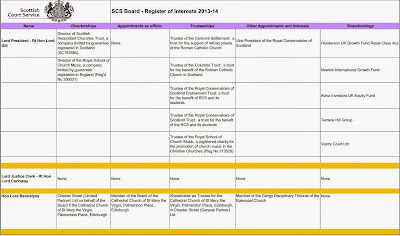
The SCS Board register of interests, which date back to 2010 – also list the shareholding portfolio of the then Lord President - Lord Hamilton. Additional declarations in the register reveal a snapshot of current SCS Board members directorships, trusteeships, links to businesses and relationships with shady regulators of the accountancy profession:

Lord President Lord Gill: Director of Scottish Redundant Churches Trust, a company limited by guarantee registered in Scotland (SC162884). Director of the Royal School of Church Music, a company limited by guarantee registered in England (Reg'd No 250031). Trustee of the Carmont Settlement: a trust for the support of retired priests of the Roman Catholic Church. Trustee of the Columba Trust: a trust for the benefit of the Roman Catholic Church in Scotland.Trustee of the Royal Conservatoire of Scotland Endowment Trust: a trust for the benefit of RCS and its students. Trustee of the Royal Conservatoire of Scotland Trust: a trust for the benefit of the RCS and its students. Trustee of the Royal School of Church Music, a registered charity for the promotion of church music in the Christian Churches (Reg No 312828). Vice President of the Royal Conservatoire of Scotland.

Sheriff Principal R A Dunlop QC: Member of Stirling University Conference. Chair of Local Criminal Justice Boards in Tayside Central and Fife. Commissioner of Northern Lighthouses. Trustee of St John's Kirk of Perth Trust. Elder of Gorebridge Parish Church of Scotland. Member of Royal Northern & Clyde Yacht Club. Member of the New Club, Edinburgh.

Sheriff Iona McDonald: Deputy Lieutenant for Ayrshire and Arran. Partner in property rental firm.

Johan Findlay OBE: Honorary Sheriff & Justice of the Peace

Sheriff A Grant McCulloch: Chair West Fife Education Trust. Chair Relationship Scotland- Couple Counselling Fife. Chair - Discipline Committee ICAS (Institute for Chartered Accountants of Scotland – Accountants self regulator). Committee Member Cammo Residents Association.

Hon Lord Bannatyne: Chester Street (Limited Partner) Ltd on behalf of the Board if the Cathedral Church of St Mary the Virgin, Palmerston Place, Edinburgh. Member of the Board of the Cathedral Church of St Mary the Virgin, Palmerston Place, Edinburgh. Shareholder as Trustee for the Cathedral Church of St Mary the Virgin, Palmerston Place, Edinburgh, in Chester Street (General Partner) Ltd. Member of the Clergy Disciplinary Tribunal of the Episcopal Church.

Lord Justice Clerk - Lord Carloway: No declarations of Directorships or other positions.

Multiple property ownership and interests in real estate, buy to let and property companies is big business for members of the judiciary and their family members – however there are no details or disclosures of any property directly owed by the SCS Board members contained in the declarations released by the SCS. It is as if Scotland’s top judges are on the homeless register – but it is clear from their wealth, they don't use food banks.

The limited disclosures of SCS Board members contain no references to outside earnings & work, relationships to law firms, big business and others more detailed declarations which may be picked up by a fully published register of judicial interests as is currently being investigated by the Scottish Parliament’s public Petitions Committee.who are considering proposals contained in Petition PE1458: Register of Interests for members of Scotland's judiciary.

The registers as released by the Scottish Court Service have now been handed to MSPs who are to be asked to consider the question of ethical investments of the judiciary as part of their on-going debate on proposals to create a full register of judicial interests for all Scottish judges.

Previous articles on the lack of transparency within Scotland’s judiciary, investigations by Diary of Injustice including reports from the media, and video footage of earlier debates at the Scottish Parliament’s Public Petitions Committee on Petition PE1458 can be found here: A Register of Interests for Scotland's Judiciary.

Monday, April 05, 2010

Scottish Courts Service becomes an ‘arm's length’ independent quango led by Lord President & corporate board

Scottish Courts ServiceThe status of the Scottish Courts Service, the organisation which runs Scotland’s Courts has been changed by the Scottish Government into what some in the legal profession now describe as an ‘arm's length’, 'independent’ body, governed by a Corporate Board chaired by Scotland’s top judge, the Lord President Lord Hamilton. It is claimed, the new arrangements, introduced from 1st April, “will reaffirm the independence of the judiciary and help improve strategic decisions about the operation of the Scotland’s courts.”

The new arrangements, set out in the Judiciary and Courts (Scotland) Act 2008, are intended to improve the justice system by modernising the arrangements for the judiciary and strengthening the relationship between the judiciary and the Scottish Court Service (SCS).

Lord Hamilton judicialLord President Lord Hamilton. Commenting on the changes, the Rt Hon Lord Hamilton, the Lord President and Chair of the SCS Board said: “The changes taking place today - the creation of a Scottish Court Service under the direction of an independent Board and the creation of a unified judiciary - are important constitutional changes. The effect will be to place the Scottish Court Service decision-making process closer to those who are directly involved in the delivery of justice. I believe the new arrangements will provide an opportunity for the creation of a better and closer relationship between judicial office holders and staff, working together to deliver to the public the sound and prompt judgments to which it is entitled.”

“The members of the Board have among them a wide range of knowledge, skills and experience of working within the courts, in government and in the commercial sector. This breadth of understanding will help us develop the direction of the Scottish Court”

“Service and the delivery of services to all those who have need to use them. It will allow us, over the next few months, to consider and develop the strategic direction for the Service. We face, along with the public sector generally, difficult financial conditions. We must not underestimate the challenges this presents.”

In addition to the Lord President, the Scottish Court Service Board includes 12 other members – six members from different tiers of the judiciary and six non-judicial members, including the SCS Chief Executive, an advocate, a solicitor and three members with experience and knowledge from other backgrounds, including business, finance and administration. The ‘new’ members of the Scottish Court Service Board are The Lord President, Lord Justice Clerk, Chief Executive of the Scottish Court Service, The Rt Hon Lord Reed, Sheriff Principal R Alastair Dunlop QC, Sheriff Derek Pyle, Sheriff Iona McDonald, & Mrs Johan Findlay JP (all Judicial Members), Mr Robert Milligan QC (Advocate Member), Mr Mark Higgins (Solicitor Member), Mrs Deborah Crosbie, Mr Anthony McGrath & Mrs Elizabeth Carmichael CBE (Members from ‘outside’ the justice system).

The SCS Board will develop the strategic direction for the Scottish Court Service and deliver an operationally effective SCS, which is responsible for providing the staff, buildings and technology to support Scotland’s courts, the work of the independent judiciary, the courts’ Rules Councils and the Office of the Public Guardian.

The new SCS will work closely with the judiciary, Scottish Government, other justice agencies, professional bodies and consumer and court user organisations to help maintain and strengthen public confidence in the Justice system. SCS Chief Executive Eleanor Emberson has been appointed as Chief Executive to the new organisation. Ms Emberson has been Chief Executive of the Scottish Court Service since 2004. The Scottish Court Service remains part of the Scottish Administration and staff continue to be civil servants.

Those interested in the changes to the Scottish Courts Service status, which have come about from the Judiciary and Courts (Scotland) Act 2008 can view video coverage of the Lord President’s appearance at the Scottish Parliament at LawyerTV where the Lord President was questioned by members of the Justice Committee. While Lord Hamilton, the Lord President was mostly in favour of the bill, former Court of Session judge Lord McCluskey was more critical of many key points, including the amount of Judicial Administration Duties involved in the now passed legislation, along with questions over Judicial Independence.

Lord Hamilton on appointing the Judiciary – An element of trust involved …

Profiles of the members of the ‘new’ Scottish Court Service Board :

The Rt Hon Lord Hamilton, Lord President and Lord Justice General (Arthur Campbell Hamilton).Chair of the Scottish Court Service BoardLord Hamilton was appointed Lord President in December 2005. He was appointed a Judge of the Court of Session in 1995. He is a graduate of the Universities of Oxford (BA, Worcester College) and Edinburgh (LLB). He was admitted to the Faculty of Advocates in 1968.

The Rt Hon Lord Gill, Lord Justice Clerk (Brian Gill) Lord Gill was appointed Lord Justice Clerk in November 2001. He was appointed a Judge of the Court of Session in 1994. He is a graduate of the Universities of Glasgow (MA, LLB) and Edinburgh (PhD). He was admitted to the Faculty of Advocates in 1967, appointed Queen’s Counsel in 1981 and is a member of the English Bar.

Chief Executive of the Scottish Court Service. The Board appointed Eleanor Emberson as Chief Executive of the Scottish Court Service in February 2010. Ms Emerson was Chief Executive of the Scottish Court Service from 2004.The Board will appoint a chief executive in due course, who will also be a member of the Board.

Members of the Board appointed by the Lord President

The Rt Hon Lord Reed (Robert John Reed)
Lord Reed has been a judge of the Court of Session since 1998. He was appointed to the Inner House in 2008, having previously been the principal judge of the Commercial Court. He was admitted to the Faculty of Advocates in 1983.

Sheriff Principal Alastair Dunlop QC
Alastair Dunlop QC has been Sheriff Principal of Tayside, Central and Fife since 2000. He was educated at Trinity College, Glenalmond and the University of Dundee (LLB). He was admitted as a solicitor in 1976 and called to the Faculty of Advocates in 1978. He was appointed Queen’s Counsel in 1990. He is currently a member of the Judicial Studies Committee and chairman of the three local criminal justice boards in his sheriffdom.

Sheriff Derek Pyle
Sheriff Pyle has been a sheriff for ten years. He is based at Dundee and was, prior to that, a sheriff in Inverness. He was formerly a solicitor in private practice in Edinburgh, specialising in commercial litigation. He has a particular interest in the reform of civil law and procedure in commercial disputes and was instrumental in founding the Highland Commercial Court.

Sheriff Iona McDonald
Sheriff McDonald was appointed a part-time Sheriff in 1995 and a full time Floating Sheriff in 2000. She has been Senior Sheriff at Kilmarnock since 2007. She is a graduate of the University of Glasgow (MA, LLB) 1978 and was a solicitor in private practice for almost 20 years.

Mrs Johan Findlay JP
Johan Findlay has been a Justice of the Peace since 1986 in Dumfries and is immediate past Chairman of the Scottish Justices Association. She was a Member of the Parole Board for Scotland from 2000 to 2006 and is an Honorary Sheriff. She is author of ‘All Manner of People, the History of the Justices of the Peace in Scotland’.

Mr Robert Milligan QC
Robert Milligan took silk in 2009. He is a graduate of the universities of Oxford (BA, University College) and Edinburgh (LLB and Dip LP). He was admitted to the Faculty of Advocates in 1995

Mr Mark Higgins
Mark Higgins is a practising solicitor and a member (partner) of the multinational firm Irwin Mitchell LLP. He is a graduate of the University of Glasgow (LLB (Hons) and Dip LP) and is the author of the book Scottish Repossessions (W Green, 2002).

Mrs Deborah Crosbie
Deborah Crosbie graduated from Strathclyde University in 1991 BA (Hon) in Business law and industrial relations. She has had a successful career in the financial services industry and is currently Chief Information Officer for the UK businesses (Clydesdale & Yorkshire Bank) of the National Australia Bank.

Mr Anthony McGrath
Anthony McGrath, graduated from Glasgow University in 1978 BSc (Hon) in Mathematical Statistics. He has had a successful career in marketing and management in the food and drinks industry, including 11 years with Scottish and Newcastle, latterly as a member of its Group and UK management boards. Since 2005 he has been managing director of a chain of public houses.

Mrs Elizabeth Carmichael CBE
Elizabeth Carmichael graduated from Edinburgh University in 1970 MA (hons) History. She has spent most of her working life in the Civil Service, retiring in 2007. From 1999 – 2007 she was Head of the Community Justice Services Division, and since then she has taken on governance roles in the public and voluntary sector, as a Board member of the Scottish Social Services Council and the Deputy Chair of SACRO.

MacAskill tight lippedScotland’s Justice Secretary Kenny MacAskill. Kenny MacAskill Cabinet Secretary for Justice made little comment on the changes, simply saying : “Today marks a milestone in the work being done to modernise and strengthen arrangements for the Scottish judiciary and administration of the courts. It is fundamental to any democracy that the judiciary is independent of the legislative and executive branches of government.”

For my part, I note the appointment of Sheriff Alastair Dunlop QC, who represented me in the case against crooked Scottish Borders lawyer Andrew Penman, and was prepared to take Mr Penman to court and have his negligence & deceit exposed for all to see.

However, the then Alastair Dunlop QC, was speedily appointed to the bench as a Sheriff after just a week had passed after I'd met him, denying my access to my own legal counsel & court as I couldn’t find another advocate who was allowed to continue the case.

I have the feeling we are looking at the formation of yet another quango to run the justice system in its own interests, rather than the interests of the public who has to pay for it through taxes … and only time will tell if any actual improvements come about through these ‘changes’ …