Showing posts with label Iain Livingstone. Show all posts

Thursday, January 11, 2024

NEW COP ON THE BLOCK: Complaints, infighting & resentment inside Police Scotland as files reveal new Chief Constable Jo Farrell was judged “Best candidate to meet the challenge of stability & operation excellence” at Scotland’s single national Police service

Candidate for change: Jo Farrell FOLLOWING a series of reports raising questions of judgement of the new Chief Constable of Police Scotland, it has emerged the Scottish Police Authority were of no doubt the ex Durham Constabulary Chief Jo Farrell - was the best candidate to lead ‘rapid cultural change” at Scotland’s national Law enforcement agency.

Documents obtained via Freedom of Information on the recruitment process for a new Chief Constable to replace ex Chief Iain Livingstone – reveal Lynn Brown, Chief Executive of the Scottish Police Authority (SPA) - informed Don McGillivray Director of Safer Communities at the Scottish Government of the SPA’s intention to appoint Ms Farrell as  the new Chief Constable of Police Scotland

Lynn Brown wrote: “Ms Farrell performed and scored consistently strongly across all elements of the assessment process, including the final interview, and against all the core Competencies and Values Framework for a senior officer in Scotland. It was the unanimous view of the panel that she should be appointed to the role.”

“Overall the panel's view is that Ms Farrell is the best candidate to meet the challenge of stability of operational excellence and the requirement for rapid cultural change against a back drop of financial constraints.”

“The Board met on the afternoon of Monday 12 June 2023 and agreed unanimously to approve the panels recommendation.”

“The Board approved that a 4-year contract (legislation allows for a contract of between 2 and 5 years) should be offered, although at this point this remains to be discussed and agreed with the recommended candidate. In addition, an appropriate start date will need to be agreed with the candidate.”

“The Authority will contact all the candidates and move to announce this appointment as soon as practicable if Ministers approve this appointment.”

Writing to Craig Naylor, the current HM Inspector of Constabulary - Martyn Evans, Chair of the Scottish Police Authority stated: “Jo Farrell is an outstanding and highly experienced senior police leader who has made an exceptional contribution to policing over her extensive career. Her appointment will bring exceptional professionalism, building on the high level of policing operational stability and effectiveness achieved in recent years and further accelerate the culture change programmes in Police Scotland”

It has since emerged the only other candidate for the Chief Constable role was Deputy Chief Constable Malcolm Graham.

Earlier this week, Deputy Chief Constable Graham announced his retirement from Police Scotland, leaving the force on 8 April 2024.

The full Freedom of Information disclosure on the recruitment round for a new Chief Constable of Police Scotland can be read or downloaded at the following link: LET 20231208 FOI Response - 2023-24-052 incl appendices collective

In additional reporting this week, it has been revealed a complaint has been made against Chief Constable Jo Farrell - by the civilian Deputy Chief Officer of Police Scotland - David Page - who is responsible for finance, procurement, and estates at the cash strapped force.

This complaint comes after an incident in November 2023, where Chief Constable Farrell was forced to apologise for an "error of judgement" after it emerged in news reports that a police officer drove the Chief Constable and Gary Ridley - chief finance officer for Durham Constabulary - home to England after her train was cancelled during Storm Babet in October.

There are suggestions from sources within Police Scotland that complaints now circulating against the Chief Constable are a result of anger that the new Chief brought in ‘outside help’ to look at how the force has been financially run into the ground by the Scottish Government and senior Police officers.

It is of note that while Police Scotland now faces severe financial constraints in spending cuts – the final months of Iain Livingstone’s lead of Police Scotland saw the force dubbed “Institutionally racist” by the now former Chief Constable - who has now moved on to another Police job in Northern Ireland.

Livingstone has been given a position as Officer in Overall Command of the ‘independent’ Kenova probe in Northern Ireland – which is tasked with examining Troubles-era offences, including more than 200 murders as well as kidnaps and torture.

There has been an extensive PR war by allies of the former Chief Constable to PR Police Scotland’s flaws and faults as other people’s responsibility.

However the reality in which Scotland’s single Police service now finds itself has became increasingly apparent with the crumbling of Scottish Government PR tactics to spin any issue as far from reality.

A previous report on on the reality of Police Scotland and the five years of Iain Livingstone’s leadership and SNP Government meddling in policing can be found here: POLICE SCOTLAND: Non Disclosure Agreements, whistle-blower witch-hunts, £Ms paid to silence victims, institutionally discriminatory & corrupt – The Scottish Govt Policing PR machine & lawyer-led Scottish National Police service that simply ran out of lies

More questions on Iain Livingstone’s leadership at Police Scotland can be found here: TOP COP SECRETS: Transparency lacking at Police Scotland as spy scandal cops refuse to disclose files on complaints & historical sexual assault case details involving Deputy Chief Constable Iain Livingstone

Any information sources wish to share with blog journalists on matters in relation to Police Scotland and policing matters, please contact via usual and known routes.

Monday, December 11, 2023

COPS CASH TO LAWYERS: Scotland’s single Police Service name Law firms who were paid TWENTY FOUR million pounds - during last Three years of Iain Livingstone’s term as Police Scotland Chief

Scots lawyers cash-in on cops SCOTLAND’s hard-up national police force – Police Scotland – paid over TWENTY FOUR million pounds to lawyers, advocates and Kings Counsel in just under a three year period – according to documents obtained via Freedom of Information legislation.

And some of the biggest earners among Scots law firms each received over THREE MILLION pounds from the SNP Scottish Government’s single Police service - which was until a few weeks ago run by Iain Livingstone – a ‘former’ lawyer whose register of interests earlier revealed he was still a member of Scotland’s dominant legal regulator and pro-lawyer lobbyist - the Law Society of Scotland.

A list of law firms named by Police Scotland in the Freedom of Information disclosure reveal the sheer scale of law firms, solicitors and advocates cashing in on Scotland’s beleaguered and broke law enforcement agency.

Journalists continue to look at the scale of payouts - declared, and undeclared from Police Scotland in relation to wrongdoing, the use of Non Disclosure Agreements and a range of other ‘confidentiality agreements’ to cover-up issues including misogyny, criminality and other wrongdoing at Scotland's National Police Service, including issues this blog earlier reported here: POLICE SCOTLAND: Non Disclosure Agreements, whistle-blower witch-hunts, £Ms paid to silence victims, institutionally discriminatory & corrupt – The Scottish Govt Policing PR machine & lawyer-led Scottish National Police service that simply ran out of lies

The new list of law firms identified by Police Scotland reveal high earning law firms such as Digby Brown, Pbw Law – run by ex-Sheriff Peter Watson, Glasgow based law firm Levy & Mcrae and other law firms of interest named in the FOI disclosure.

The list includes all payments ‘currently declared’ by Police Scotland in the FOI disclosure - in UK pounds sterling to law firms, and Faculty Services Ltd – the ‘accounting arm’ of the Faculty of Advocates.

Digby Brown £3,542,599.74; Faculty Services Limited £3,278,006.95; Pbw Law £3,125,900.10; R S Vaughan & Co £2,416,844.59; Levy & McRae Solicitors LLP £2,289,992.27; Ledingham Chalmers £1,921,785.46; Km Law £1,688,753.90; Clyde & Co £932,049.54; Morton Fraser Llp £788,754.02; Miller Beckett & Jackson £665,000.00; Thompsons Solicitors £460,255.00; Slater & Gordon £412,075.54; Gildeas Ltd £275,645.02; Reid Cooper Partnership £272,696.20; Bdo Llp £247,219.86; Macroberts Llp £145,329.69; Thorntons Law £111,842.70; Balfour & Manson Llp £96,791.77; BTO Solicitiors LLP £94,000.00; Jackson Boyd LLP £90,814.14

Watermans Solicitors Ltd £84,908.93; £Tlt Llp 82,305.60; £Kerr Brown 79,337.49; £Dac Beachcroft 70,985.38; £Horwich Farrelly 64,717.72; £Lawford Kidd 63,580.00; £MML Client 50,000.00; £Keoghs LLP £46,582.99; £Anderson Strathern Llp £44,611.80; Jane Gordon Legal Consultancy £42,126.10; Newlaw Scotland LLP £39,112.38; Kindertons £38,763.30; Brodies Llp £36,405.05; DJ MacKay £33,896.04; Livingstone Brown £31,976.30; John Boyle £30,170.00; Harper Macleod Llp £29,927.98; G A Fordyce & Co Solicitors £28,542.20; Lyons Davidson Scotland LLP £27,292.63; Brechin,Tindal,Oatts Solicitors; £26,076.90; Dla Piper Scotland Llp £25,240.76; D J McFall £25,000.00; Carpenters £20,572.94; DWF Law LLP £19,242.50; Curle Stewart £14,574.87; SatchellMoran £13,000.00; Irwin Mitchell £11,581.30

Mullen&Co £9,799.68; Parabis Scot £9,351.50; P I Campbell t/a Campbell McCartney £9,250.00; Aamer Anwar £8,598.20; Kudos Legal £7,952.66; Grant Smith Law £7,625.20; Braenalli&Or £7,500.00; Belmont Legal £7,064.20; DallasMcMillan £7,011.60; Rollos Law £6,603.20; J Myles & Co £6,568.80; Bridge Litigation £6,509.59; Bonnar Accident £5,742.20; Sheperd&Wedderburn £5,500.00; HEDS Law £5,497.20; Jones Whyte £4,615.09; Grigor & Young £4,500.00; Winn Sols £4,500.00; Crawford Legal £4,270.12; Henderson Chambers £3,240.00; Friends Legal £2,883.38; Bond Turner Limited £2,675.40; Spectra Drive Ltd £2,527.33; MacLeod & MacCallum £2,386.80; Lindsays £2,240.15; Burness Paull Llp £2,137.20; Keoghs £2,062.98; Gray&Gray £2,000.00; Kennedys £1,786.31; Mclennan Adam Davis Solicitors £1,248.00; I M S Ltd £1,128.00; Canford Law £1,107.90; McCready / Co £1,094.00

Strata Sol £829.35; Russells Gibson & Mccaffrey £804.00; McLennan Adams Davies £780.00; MSM Law £720.00; Walker & Sharpe Solicitors £652.15; RSAMotability £549.33; Legal Services Agency Limited £504.25; Corrigall Black £324.00; Cullen Kilshaw £312.00; Hunter And Robertson £306.00; Morgan Law £285.00; Boyd Turner £218.50; Killean & Co £194.78; Tc Young Solicitors £132.00; W & As Bruce Solicitors £84.00; Mcmullen Law Limited £72.00; Linda George Family Law £48.00; Milne/Burge £19.40

The Freedom of Information disclosure from Police Scotland stated: “I would ask that you note that the figures provided relate to all categories of payments made to law firms. Accordingly, the attached information encompasses payments in respect of compensation, legal fees and outlays - all in relation to firms instructed by Police Scotland, and firms on the opposing side of a court action or a claim.”

“Additionally, the figures provided are inclusive of payments made to firms and the Faculty of Advocates relating to Police Scotland’s participation in Public Inquiries, most notably the Sheku Bayoh Public Inquiry.”

However, Police Scotland refused to release the identities of advocates and Kings Counsel who received substantial public cash payments from the underfunded force – claiming their names were exempt from release.

The FOI disclosure stated: “Finally, in relation to advocates, payments are made to the Faculty of Advocates, however, the individual names of advocates instructed to represent the Chief Constable is considered exempt.”

“In terms of section 16 of the Freedom of Information (Scotland) Act 2002, I am refusing to provide you with this information.”

Commenting on the scale of payments to law firms, a solicitor who did not wish to be named said: “While some of the smaller payments to law firms relate to administration and other genuine legal work, the scale and frequency of larger payments to some law firms identified in the disclosure give us all an idea of the scale of secrecy, wrongdoing and cover up at Police Scotland.”

A now retired Police Officer described Police Scotland as “a sinister work environment” adding “senior officers prefer to cover up crime and wrongdoing within policing to please their political masters in the Scottish Government”

Tuesday, June 27, 2023

POLICE SCOTLAND: Non Disclosure Agreements, whistle-blower witch-hunts, £Ms paid to silence victims, institutionally discriminatory & corrupt – The Scottish Govt Policing PR machine & lawyer-led Scottish National Police service that simply ran out of lies

Outgoing Chief Constable Iain Livingstone. FOR FIVE YEARS and despite publicly aired views of former senior Police officers against his appointment - Scotland’s National Police service has been lawyer-led by a Chief Constable - who was once accused, then ‘cleared’ by a Tribunal composed of male Police colleagues - of FIVE allegations of serious sexual assault made against him by a female Police officer.

On 23 February 2023, just days after Nicola Sturgeon announced her resignation as First Minister on 15 February 2023 - Chief Constable Iain Livingstone announced his own resignation and intention to ‘retire’ from leading Police Scotland – with a lengthy departure date of August 2023.

However, in the weeks which followed the Chief Constable’s long goodbye to Scotland’s decimated national Police service - Mr Livingstone took the opportunity to brand Police Scotland as Institutionally discriminatory, institutionally sexist and instructionally racist.

What followed was a very scripted set of headlines involving public inquiries, SNP politicians praising the outgoing Chief Constable, and gangland representing lawyers seeking their own ego boosting headlines in what many came to realise was a carefully orchestrated exercise in press releases and organised spin.

However – Chief Constable Iain Livingstone was certainly not wrong in his accusations against his own Scottish National Police service.

Indeed, across five years of presiding over Police Scotland, the outgoing Chief Constable – who was branded unfit to lead Police Scotland by former Assistant Chief Constable Angela Wilson, and a host of public critics & campaigners – must shoulder some of the blame for a dysfunctional Police Service which – at low points – assisted the Lord Advocate & Crown Office in fitting up prosecutions against persons whose crimes did not exist – most notably the Administrators & Accountants of Rangers Football Club.

However, fitting up prosecutions on a £100 Million scale with the cooperation, orders even – of Scotland’s top law officers, top prosecutors and even with the evidenced involvement of the judiciary itself in the plot to lock up a few accountants for events which were mostly made-up – are but one entry in a long list of greed, avarice & corruption within Scotland’s National Police service and across key stakeholders in Scotland’s justice system – from the Crown Office to the Scottish Government itself.

But lets not kid ourselves everyone. We knew it all along, right?

The Scottish Government and it’s slavishly political, critic & media hostile - intensive Civil Servant-Special Adviser Policing group – were hell bent on control of almost every facet of Policing in Scotland and were grimly determined to ensure Scotland’s National Police Service drifted into the same chasm of control freakery, public relations and spin as the SNP Scottish Government live by each day and eek out their grim control over public life until the next week and the next scandal.

Few surprises there - as control freakery, PR and spin is so typical of the way the Scottish Government and every public organisation and regulator in Scotland operates – when faced with questions and scrutiny of the level of wrongdoing & dishonesty in whichever public authority is under the microscope that particular day.

To back up Iain Livingstone’s scripted admission of institutionally everything-wrong at his own five year grip on power Police Scotland, a series of senior officers were paraded on television to support the Chief Constable’s claims – with absolutely not one sounding believable in any of their responses.

And, to round off the increasingly diversionary campaign of ruining the reputation of Policing in Scotland to take the cameras and attention away from high profile political resignations and investigations into political funding – which appear to be more focussed on what they cannot prove rather than going after actual events and a rather complicated set of – lets call it “Heather Capital” type activities – the Chief Constable’s sexist, discriminatory & institutionally corrupt Police Service scandals were capped off with an arranged slew of new female officer appointments and the appointment of a female Chief Constable to replace Mr Livingstone.

If only it would be advantageous to publish the chat apps content of senior lawyers, civil servants and others on these few weeks of a dodgy Scottish National Police Service, and the dodgiest of dodgy Scottish Governments, ever.

Lets return to some of those issues in the headlines.

Non Disclosure Agreements at Police Scotland under Chief Constable Iain Livingstone – have seen millions of pounds in public cash paid out to victims of wrongdoing, corruption, sexism and misogyny during Livingstone’s five year grip on power at Scotland’s lawyer-led National Police Service – and millions of pounds more of public cash in the five years preceding Livingstone’s appointment as the preferred Scottish Government candidate of Chief Constable in 2018.

For years – cases of wrongdoing in policing – from the time of Scotland’s eight forces to the creation of Police Scotland by the SNP Scottish Government in 2014 – have been looked at by blog journalists.

The numbers are big, the pay-outs to victims even bigger, the wrongdoing, corruption, sexism, misogyny, vendetta witch-hunts of sources to journalists, pursuit of police officers who lodge legitimate grievances on issues relating to their service - and targeting of whistle-blowers has been – and remains to this day – off the scale.

It should not surprise readers that private law firms, solicitors, ‘leading’ members of the Faculty of Advocates & even some members of Scotland’s judiciary – have also collectively gained millions of pounds of public cash over the past decade in burying scandals for Police Scotland and forcing victims to sign Non Disclosure Agreements to prevent anyone talking to the media, public, their families and friends - or even their elected political representatives and the Scottish Parliament.

Readers can view earlier Freedom of Information disclosures obtained by blog journalists here Police Scotland - Non Disclosure Agreements FOI - 2019 which give some idea of the scale of pay-outs and a very limited understanding of the level of institutional wrongdoing at Police Scotland.

More than 20 victims of discrimination and wrongdoing who received financial compensation from Police Scotland were gagged from speaking publicly and the FOI material reveals Non-Disclosure Agreements (NDAs) were used in at least 21 cases in which pay-outs totalling £677,389 were made to police officers, civilian staff and members of the public.

At least ten police constables, an inspector, a sergeant and four civilian workers were found to have signed Non Disclosure Agreements, involving a variety of discrimination disputes on the grounds of sex, sexual orientation, disability and age.

Other Non Disclosure Agreements involving Police Scotland related to wrongful arrest, personal injury and unfair dismissal and a whistle-blower was required to sign an NDA.

In the figures which go up to the year 2019 – Scotland’s National Police service paid an additional £203,380 to cover victims’ legal fees – bringing the total cost to taxpayers to £880,769 over six years.

Initially – and as is routine with all Scottish Public Authorities – Police Scotland refused to identify the law firms which received public cash in relation to Non Disclosure Agreements. The data was only obtained after requests for FOI Reviews were lodged – naming the following law firms in figures: Clyde & Co solicitors £50,782.20, Morton Fraser Solicitors £72,162.56, Thorntons Solicitors £4,910.40.

And in an additional refusal by Police Scotland to identify law firms involved in Non Disclosure Agreements – again for figures up to 2019 – the same law firms were again identified in an FOI review disclosure – Morton Fraser Solicitors £22,208.80, Clyde & Co solicitors £41,460.01

Police Scotland’s key role in the malicious prosecution of the Rangers Administrators has been well documented on this blog PROSECUTION ADVOCATE: Conflicts of interest, failure to recuse & judge swapping in court - Rangers Admin malicious prosecution case illustrates why Scotland’s Prosecutors & Judiciary must be required to register, declare & publish all their interests - and publish all details of judges’ recusals from court hearings, and more widely in the media.

There also remains no further disclosure by Police Scotland into the allegations of five serious sexual assaults against the outgoing Chief Constable Iain Livingstone – information which Police Scotland refused to release to Freedom of Information requests by blog journalists in an article reported earlier here: TOP COP SECRETS: Transparency lacking at Police Scotland as spy scandal cops refuse to disclose files on complaints & historical sexual assault case details involving Deputy Chief Constable Iain Livingstone

Curiously, in the past year – several media publications published articles identifying outgoing Chief Constable Iain Livingstone as a “Frontrunner” for the positions of Commissioner of the Metropolitan Police Service for London , and “Frontrunner” for the post of Director of the UK National Crime Agency.

As readers will be well aware - both positions were filled by other candidates.

Interestingly and perhaps coincidentally - INTERPOL – the International Police Agency recently announced – apparently after much lobbying – the annual Interpol General Assembly is to be held next year in Glasgow, 2024.

The choice, which would be as odd as a group of environmental campaigners choosing to hold their gathering in the middle of an oil refinery – is coincidentally slated for the same year to which candidates for the 2025 Interpol Presidency will begin lobbying for their chance to follow several well known – and even some later jailed figures – to become the new Interpol President in 2025.

A previous example of Interpol Presidency candidates cite the following:

https://hansard.parliament.uk/commons/2018-11-20/debates/59705E54-A997-4F64-AFCA-2D4200158A62/InterpolPresidencyElection

The Minister for Africa (Harriett Baldwin)

Interpol is currently holding its general assembly in Dubai, and a UK delegation, led by Lynne Owens, the director general of the National Crime Agency, is there at the moment. Interpol is electing a new president at the general assembly after former Interpol president and Chinese Vice-Minister of Public Security, Meng Hongwei, resigned from the position on Sunday 7 October after Chinese authorities confirmed that he had been detained and is being investigated on anti-corruption charges.

Two candidates have formally declared for the post and remain in the running as candidates. They are current acting president South Korean Kim Jong Yang and Russian vice-president—one of four vice-presidents—Alexander Prokopchuk. Members of Interpol at the general assembly will vote on the next president on Wednesday. We do not speculate on the outcome of the election, but the UK supports the candidacy of acting president Kim Jong Yang.

Sir Vince Cable

Can the Minister confirm that the British Government are doing all they can to campaign against the candidacy of Mr Prokopchuk? Will she confirm that, until recently, he was head of the central bureau in Russia and was directly responsible for the issuing of red notices, which have been abused and used against opponents of the Putin regime—such as Mr Bill Browder, the proponent of the Magnitsky sanctions? Does she not agree that if this Russian gentleman were to become head of Interpol, it would be an absolute insult to the victims of the Salisbury incident?

Will the Minister explain how the Government intend to pursue their own pursuit of red notices in Russia with that gentleman in this post? Does she not accept that, if this gentleman were to succeed in his election, this would be a massive propaganda victory for the Putin regime, just ahead of a vote in the European Union on fresh sanctions? Would it, in effect, not amount to accepting that Interpol has become a branch of the Russian mafia? I use my words carefully when I say that. Finally, does this not underline the absolute folly of undermining in any way Europol at a time when Interpol is becoming totally dysfunctional and potentially corrupted?

Harriett Baldwin

The right hon. Gentleman raises a number of points. The central point is to clarify for the House the role of the secretary general of Interpol, who, of course, is the German Jürgen Stock. He has the executive role of day-to-day responsibility for the conduct of Interpol, and the UK confirms that it has a very good working relationship with him.

The right hon. Gentleman also raises the question about the candidacy of the current vice-president of the organisation. The UK, as I said in my opening remarks, will be supporting the candidacy of the acting vice-president, Kim Yong Yang. We always seek to endorse candidates who have a history of observing standards of international behaviour.

With regard to the point that the right hon. Gentleman makes about the potential for misuse of Interpol, red notices are a very important point. He will be aware of the systems that are in place to protect individuals’ rights and, indeed, of article 3 of the Interpol constitution, which forbids any organisation to undertake any intervention or activities of a political, military, religious or racial character. Of course, there need to be safeguards, and this Government take any misuse of Interpol notices very, very seriously.

Interestingly, the lobbying – both at National UK level and in Scotland – for a UK/Scotland candidate to ensnare, be ‘elected to’ or assume the Interpol 2025 Presidency - is highly reminiscent of recent attempts to place certain Scots figures in policing positions outside of Scotland – none of which appear to have succeeded given these individuals pasts.

The lobbying between administrations resorted to embittered strings of emails and Chat app platform communications, including claims several detailed reports in newspapers of officers pasts “had been withdrawn and therefore should be discounted in considering applications” and that “a segment in a television interview was misinformed and contained patently false information”.

The exchanges between advisers, media communications officers & administrations on lobbying attempts, currently cannot be published for legal reasons - however the attempts by some within government, at Scotland & UK level to engineer candidates for jobs without serious interviews, and deploy comms officers, even politicians to brief against the media in what became an increasingly bitter recruitment process and ultimately concluded in all parties engaging in infighting – are certainly of public interest in terms of who is appointed to which role in the UK, and why.

Historically, when it comes to any form of transparency and accountability for Police Scotland and policing organisation in Scotland – every effort appears to be expended to ensure secrecy on all fronts remains the case as this blog has previously reported: FOI PROBE: Holyrood Committee hear Scottish Information Commissioner backed off promise to bring Freedom of Information to Scottish Police Federation - even after Info. Tsar knew England & Wales Police Fed. already complied with FOI legislation

And finally – Three sourced tips in relation to stories being looked into.

An audio file submitted to a number of journalists reveals a recently retired policing figure and frequent user of sauna shops - boasted of holding information in relation to politicians and a financial scandal relating to cash and goods - to which the existence of this information was used to gain political lobbying and favours. A crime journalist confirmed the identity of persons in the audio.

An opportunity for that person or others with knowledge of this matter exists to contact journalists and answer questions on why this policing figure’s organisation felt it could play politics and gain favours - in relation to information clearly accumulated as a result of investigations – and why ageing, named former politicians were paid to lobby for, and attack journalists, critics - on behalf of this policing organisation.

Long running enquiries into court cases and complaints investigations revealed the use of Scotland based Private Investigator firms recruiting former Police Officers to utilise in-person surveillance on litigants, solicitors and journalists. Certain of these cases saw persons working for PI firms gaining entry to offices and litigants homes, images of which were recorded on camera equipment. Blog journalists are open to hear explanations from these firms and any employees in relation to their activities.

A long running investigation of digital surveillance employed by organisations in Scotland – which began with the Emma Caldwell case – turned up evidence of a highly organised cyber-hacking ring – which appears to have involvement of former Police Officers from a UK force other than Scotland, England & Wales which continues to snoop on newsrooms and identified journalists, and others including what appear to be opposition politicians.

Emails between lawyers & identified former officers revealed these ex cops regularly offer their services to law firms and any organisation which will hire then. To put it bluntly, these former officers boast of their technical proficiency in defending against cyber-attacks and taking the surveillance and cyber war back to those who whichever entity or organisation perceive as an enemy.

One of the lawyers boasting to clients of how they can deploy ex Police professionals to hack their way through opposing clients and legal representation’s files – sits on committees formed by Scotland’s current top judge – making the link between the judiciary and this surveillance enterprise as clear as was the case in the Emma Caldwell case. If anyone wants to talk, get in touch.

Lastly – Chose your method of giving tips to journalists carefully. Major social media platforms owned by a variety of anti-transparency vested interests - are a no-go area as your Direct Messages and similar are often read before the intended journalists gain sight of it – as a Digital Media employee from a political party recently confirmed in lengthy chats with example communications provided to journos.

Tuesday, May 14, 2019

POLICE DECLARED: Cops Interests Register reveals controversial Chief Constable retains Law Society of Scotland membership, holds seat on ‘Sentencing Council’ quango – yet details fail to give clear picture of highly paid top cops links, interests

Top Cops interests ‘declared’  WHILE Scotland’s judiciary continue to battle against declaring their considerable wealth, influence, links & financial interests, Police Scotland has released new information into the less than detailed world of how Scotland’s well paid top cops are required to declare their interests.

The information, published in response to a Freedom of Information request also reveals Police Scotland’s current Chief Constable Iain Livingstone – who once faced a case involving five allegations of sexual assault from a female colleague – retained his membership of the powerful lawyers lobby – the Law Society of Scotland.

It is worth noting, Chief Constable Iain Livingstone - a former solicitor - appears to have retained his Law Society membership – since joining the Police in the 1990’s, through the critical phase of the tribunal hearings into the sexual assault allegations during his time at Lothian & Borders Police - to his appointment as Chief Constable of Police Scotland, and to this date.

The declarations of interests by all officers, regardless of rank – also note Iain Livingstone’s position on the Scottish Sentencing Council – a quango created by the Scottish Government after the retirement of Lord Brian Gill – who once criticised the quango as politicial interference with the judiciary.

The Scottish Sentencing Council’s role is to create sentencing guidelines for the courts - and is currently headed by the Lord Justice Clerk – Lady Dorrian.

However, while the declarations are a welcome window on the interests of Scotland’s senior Police Officers, the lack of detail in comparison to information contained in registers of interest such as those required by Members of the Scottish Parliament – do raise questions any keen financial investigators would quickly notice – such as the flow of salaries, cash, assets and other business interests which may have been purposely placed in relatives names.

The declarations of interests o Police Scotland’s current top cops – which were supplied by Police Scotland’s ‘information unit’ only after an initial refusal to release the information, reveal the following:

CC Iain Livingstone:

Public Appointments:

Member - Independent Steering Group (Op Kenova), Reviewed Annually - No remuneration.

Member - Scottish Sentencing Council, Reviewed Annually - No remuneration.

No Financial and Business interests No Political activity No related party transactions No conflict of interest

DCC Fiona Taylor:

No Public Appointments

Financial and Business interests - Owns a flat which is let No Political activity No related party transactions No conflict of interest

ACC Bernard Higgins:

Public Appointments:

Trustee - Police Care UK (formerly known as Police Dependents Trust), May 2013 - Present - No remuneration.

Board Member - Euro 2020 Local Organising Committee, 2017 - Present - No remuneration

No Financial and Business interests No Political activity No related party transactions No conflict of interest

ACC Angela McLaren:

Public Appointments:

Trustee - The Police Treatment Centres, for a period of 3 years - No remuneration. - Companies House shows Appointed on: 01st December 2018.

Trustee - St George's Police Children Trust, for a period of 3 years - No remuneration. - Companies House shows appointed on 1st December 2018.

No Financial and Business interests No Political activity No related party transactions No conflict of interest

ACC Paul Anderson:

Public Appointments:

Chair Racing Committee, Scottish Canoe Association, 2019-2020 - No remuneration.

No Financial and Business interests No Political activity No related party transactions No conflict of interests

Other Executive Officers

DCC Johnny Gwynne (retired 15/03/2019 but in post at the date of request)

DCC Will Kerr, ACC Mark Williams, ACC John Hawkins, ACC Gillian MacDonald, ACC Alan Speirs, ACC Malcolm Graham, ACC Steve Johnson

No Public Appointments No Financial and Business interests No Political activity No related party transactions No conflict of interest

A previous media investigation into Police Officers interests in Scotland, revealed offices are required to declare their interests, with the information held on a database which can be accessed via Freedom of Information legislation.

The earlier report is published here: COPS & JOBBERS: Scotland’s 1,512 ‘Two Job’ Cops required to declare outside business interests – meanwhile 700+ strong Scots judiciary resist Holyrood probe calling for judges' register of interests

Police Service of Scotland Regulations 2013 - Business interests:

5.—(1) A constable must not have a business interest without the consent of— (a) the Authority, in the case of a senior officer; (b) the chief constable, in the case of any other constable, provided that, in the case of any such constable in whose case the chief constable has an interest otherwise than as chief constable, the chief constable must refer the matter to the Authority for it to consider whether to consent.

(2) If a constable acquires or is likely to acquire a business interest, the constable must forthwith give written notice of that interest to the chief constable or, in the case of a senior officer, the Authority.

(3) If a constable has a business interest and is appointed to the office of chief constable, deputy chief constable or assistant chief constable, the constable must forthwith give written notice of that interest to the Authority unless the constable has previously disclosed that interest to the Authority.

(4) An individual applying for appointment to the Police Service, other than an individual referred to in paragraph (5), must give written notice to the chief constable of any business interest which that individual has or is likely to acquire after appointment.

(5) An individual applying for appointment to the office of chief constable, deputy chief constable or assistant chief constable must give written notice to the Authority of any business interest which that individual has or is likely to acquire after appointment.

(6) An individual or constable is regarded as having a business interest if— (a) that individual or constable carries on any business or holds any office or employment for hire or gain (otherwise than as a constable) in the United Kingdom; (b) that individual or constable resides at any premises where any member of that individual’s or constable’s family keeps a shop or carries on any like business in Scotland; (c) that individual or constable holds, or any member of that individual’s or constable’s family living with that individual or constable holds, any licence, certificate or permit granted in pursuance of the laws relating to liquor licensing or betting and gaming or regulation of places of public entertainment in Scotland or has any pecuniary interest in such licence, certificate or permit; or (d) that individual’s or constable’s spouse (not being separated from that individual or constable), civil partner (not being separated from that individual or constable) or cohabitant (not being separated from that individual or constable) keeps a shop or carries on any like business in Scotland.

(7) For the purposes of this regulation— (a) “member of that individual’s or constable’s family” includes parent, son, daughter, dependant, brother, sister, spouse (not being separated from that individual or constable), civil partner (not being separated from that individual or constable) or cohabitant (not being separated from that individual or constable); and (b) “cohabitant” means a member of a couple consisting of— (i) a man and a woman who are living together as if they were husband and wife; or (ii) two individuals of the same sex who are living together as if they were civil partners.

COPS DECLARE, JUDGES CONCEAL:

While Police Officers have been required to declare their interests for a number of years, members of Scotland's judiciary continue to wage a bitter SEVEN YEAR campaign against proposals to require members of Scotland’s judiciary to declare their interests, and links to big business.

The salary scales of officers in Police Scotland - where all officers are required to declare their interests - show a Police Scotland constable can expect £26,037 per annum going up to £91,179 for a Chief Superintendent with 3 years experience to Assistant Chief Constables: £118,485 , Deputy Chief Constables: £174,741 and the Chief Constable: £214,404

However – Scotland;s judges have no such requirement to declare interests, despite huge judicial salaries which rank as the highest in all of Europe - skyrocketing from Sheriffs on £137,538 a year up to Sheriff Principals on £148,526 a year while judges of the Outer House of the Court of Session earn £185,197 a year and Inner House judges earning £210,876 per annum.

The Lord Justice Clerk (currently Lady Dorrian) earns £221,757 a year, and the Lord President (currently Lord Carloway, aka Colin Sutherland) earns £229,592 a year.

The proposal to bring greater transparency to Scotland’s judiciary - Petition PE1458: Register of Interests for members of Scotland's judiciary - first debated at the Scottish Parliament’s Public Petitions Committee in January 2013 – calls for the creation of a publicly available register of judicial interests – containing information on judges’ backgrounds, figures relating to personal wealth, undeclared earnings, business & family connections inside & outside of the legal profession, membership of organisations, property and land, offshore investments, hospitality, details on recusals and other information routinely lodged in registers of interest across all walks of public life in the UK and around the world.

A full debate on the proposal to require judges to declare their interests was held at the Scottish Parliament on 9 October 2014 - ending in a motion calling on the Scottish Government to create a register of judicial interests. The motion was overwhelmingly supported by MSPs from all political parties.

Previous articles on the lack of transparency within Scotland’s judiciary, investigations by Diary of Injustice including reports from the Sunday Herald and Sunday Mail newspapers, and video footage of debates at the Scottish Parliament’s Public Petitions Committee can be found here : A Register of Interests for Scotland's Judiciary.

Monday, September 17, 2018

TOP OF THE COPS: Police Scotland media team in row over “wrong” word in transcript of top cop explaining away suspension, demotion & reinstatement after male-led cop tribunal cleared him from FIVE allegations of serious sexual assault

Scotland’s new Top Cop once faced serious sexual assault probe. THE “WRONG” word in a transcribed version of an interview with the officer who is now Scotland’s new Chief Constable – Iain Livingstone – became the subject of bitter exchanges between media officers of Police Scotland and a national newspaper.

Reports from inside the media have revealed the matter became the subject of protracted requests to the Daily Mail newspaper from Police Scotland’s media unit – which includes a Communications officer identified as Chris Starr.

The dispute arose after a mistake was identified in the paper’s published transcript of a television interview asking Iain Livingstone about how he dealt with five allegations of serious sexual assault from a female colleague.

The mistake amounted to one word – “all” .. which should have read from interview as “wrong”.

However, questions have arisen as to why Police Scotland’s media unit hare being used to target the media over the wording of a transcript – a task which should have been allocated to a law firm.

And, while cops have taken issue with reporting of the sexual assault allegations against Scotland’s new Chief Constable, Police Scotland and the Scottish Police Authority continue to resist full disclosure and publication of the full details of the FIVE allegations of sexual assault made against Iain Livingstone by a female officer who has since left the force.

Livingstone was recently confirmed as Scotland’s new Chief Constable after a gruesome sequence of suspensions of colleagues, a damning report on how Scots Police spied on journalists and whistle-blowers, and the Ministerial backed ousting of former Chief Constable Phil Gormley.

During the BBC Scotland Investigates documentary “A Force In Crisis” - investigative journalist Sam Poling asked Mr Livingstone about the 'allegations of sexual assault' and about him being 'bumped down from superintendent to constable and suspended'.

Mr Livingstone said: “There was a set of circumstances in 2000 whereby at a social event at Tulliallan, at a training event I had too much to drink.

I fell asleep in the wrong place and that was “wrong” and I shouldn't have done that, and clearly I accept that.

I was suspended, I spent time off work. There was a hearing convened where I did accept I fell asleep.

I was cleared of any sexual impropriety.

I was cleared of any level of sexual intent and at that hearing, initially, I was then demoted from superintendent to constable.

I immediately appealed against that and I was reinstated.

I came back to work, I accepted that I made a mistake, I accepted I had learned from it and since that time I have continued to conduct my duties with absolute rigour and professionalism.”

Asked whether he could be the 'strong professional leader with integrity' that the public want as chief constable, Iain Livingstone said: “I think I could discharge the responsibilities of the job. 'One of my main strengths, I think, is the ability to work collectively and to work in a collegiate manner.”

“I do think I could do the job, I just need to be quite clear in my own mind that that's what I want to do for the next three to five years.”

Mr Livingstone was suspended in 2003 after a female officer said she was sexually assaulted at Tulliallan, Scotland's police training college.

At the time he was 36, a father of three, and held a post in Her Majesty's Inspectorate of Constabulary, which used to oversee regional police forces.

There were no legal proceedings - although Mr Livingstone was demoted from superintendent to constable in 2004 following a disciplinary hearing.

Five allegations of serious sexual assault were dismissed but, at an internal misconduct hearing, he admitted being in the woman's room overnight after falling asleep.

The hearing, chaired by the then assistant chief constable of Strathclyde Police, found there had been no sexual impropriety or intent.

The woman, who had been on the accelerated promotion scheme for graduates, was reported to have left the scheme, which guarantees fast-track promotion.

A statement to the Press issued by a Police Scotland media representative in May on the subject of the BBC Scotland interview stated: “This matter was subject to due process by Lothian and Borders Police and was formally concluded under police regulations 14 years ago.”

“A hearing concluded that there was no sexual impropriety or intent on Mr Livingstone's part and he has nothing further to add.”

TIMELINE OF SEXUAL ASSAULT ALLEGATIONS AGAINST TOP COP:

FEBRUARY 2003: Iain Livingstone, then 36, is suspended amid sexual assault claims and admits he is 'shattered'.

AUGUST 2003: Prosecutors drop proceedings against Mr Livingstone - but he faces internal disciplinary proceedings.

JUNE 2004: Mr Livingstone is demoted from the rank of superintendent to constable, which means a loss of more than £1million in salary and pension payments.

AUGUST 2004: Tayside's Chief Constable John Vine upholds Mr Livingstone's appeal and reinstates him, agreeing that the original decision was 'harsh'.

OCTOBER 2015: Now Deputy Chief Constable of Police Scotland, Mr Livingstone emerges as a candidate for the top job after Sir Stephen House quits.

DECEMBER 2015: Former Norfolk Constabulary Chief Constable Phil Gormley is named as the new boss of Police Scotland.

JULY 2017: Mr Livingstone announces his retirement, saying it was a 'privilege to serve the people of Scotland'.

SEPTEMBER 2017: Amid the bullying row engulfing Mr Gormley, Mr Livingstone cancels his retirement plan and takes charge of the single force.

APRIL 2018: Front runner to become the new full time chief, Mr Livingstone is confronted about his conduct in a BBC Scotland TV documentary.

Journalist Sam Poling questioned Iain Livingstone during the BBC Scotland documentary, A Force in Crisis, which aired on Monday 30 April 2018.

The transcript of the interview between Sam Poling & then Deputy Chief Constable Iain Livingstone (now promoted to Chief Constable) reads as follows:

SAM POLING: What about your background?

DCC IAIN LIVINGSTONE: My background as a police officer?

SAM POLING: The allegations of sexual assault. You ended up admitting misconduct, staying in the room of a junior officer.

You were bumped down from superintendent to constable and suspended. Am I right?

DCC IAIN LIVINGSTONE: No, not on that, no you're not right.

SAM POLING: You weren't taken down from superintendent to constable?

DCC IAIN LIVINGSTONE: No, I wasn't taken down from superintendent to constable and then suspended.

There was a set of circumstances in 2000 whereby at a social event at Tulliallan, at a training event, I had too much to drink.

I fell asleep in the wrong place and that was wrong and I shouldn't have done that, and clearly I accept that.

I was suspended, I spent time off work. There was a hearing convened, where I did accept I fell asleep.

I was cleared of any sexual impropriety. I was cleared of any level of sexual intent and at that hearing, initially, I was then demoted from superintendent to constable.

I immediately appealed against that and I was reinstated.

I came back to work, I accepted that I made a mistake, I accepted I had learned from it and since that time I have continued to conduct my duties with absolute rigour and professionalism.

SAM POLING: The public want a strong professional leader with integrity in their chief constable. Is that you?

DCC IAIN LIVINGSTONE: I think I could discharge the responsibilities of the job. One of my main strengths, I think, is the ability to work collectively and to work in a collegiate manner.

I do think I could do the job, I just need to be quite clear in my own mind that that's what I want to do for the next three to five years.

SEXUAL ASSAULT ALLEGATIONS AGAINST TOP COP TO REMAIN SECRET:

A statement from Police Scotland in response to the Freedom of Information request refused any form of disclosure or acknowledgement of the status of any files held by Scotland’s single national Police service read as follows:

“Police Scotland endeavors to provide information whenever possible. However, under section 18(1) of the Act, a public authority may refuse a request where:

• if the information existed and was held by the authority, it would be exempt from release under any of Sections 28 to 35, 38, 39(1) or 41 of the Act; and

• the authority considers that to reveal whether the information exists, or is held by it, would be contrary to the public interest.

In this instance, it is considered that to reveal whether the information you have requested exists, or is held by Police Scotland, would be both exempt from release under the Act and contrary to the public interest. There is a strong public interest in protecting individuals' privacy, and personal information is exempt from release into the public domain under section 38 of the Act if it would be unfair, unlawful or otherwise breach the Data Protection Act.

For these reasons, Police Scotland must refuse your request under section 18(1) of the Act.

This notice should not be taken as conclusive evidence that the information you have requested exists or is held.”

Material in relation to new complaints made against DCC Iain Livingstone was sought from the Scottish Police Authority in February of this year, after information was received with regards to further serious complaints made against Police Scotland’s current ‘interim’ Chief Constable.

However, the Scottish Police Authority under Susan Deacon deliberately delayed releasing their response to the Freedom of Information request – by a number of months, as members of the Scottish Police Federation and Scottish Government ministers bolstered DCC Livingstone’s position as front runner for the top job – despite the grim details of a case involving 5 allegations of serious sexual assault which were dismissed by a tribunal composed of Livingstone’s male cop colleagues.

The Scottish Police Authority were asked to provide details of :

  • The numbers of complaints, subject of complaints, and identities (not name, but by rank, status as Police Officer, civilian employee, member of the public or other)

  • Who have made complaints (and the numbers of complaints) against current DCC Iain Livingstone from 1 April 2013 to the date of this FOI request

  • The status, and outcomes of these complaints.

However, and some time after discussions over the Freedom of Information request had taken place, inside & outside the SPA - the Scottish Police Authority responded to the FOI request four months late, in early June - denying access to all of the information sought in relation to DCC Livingstone.
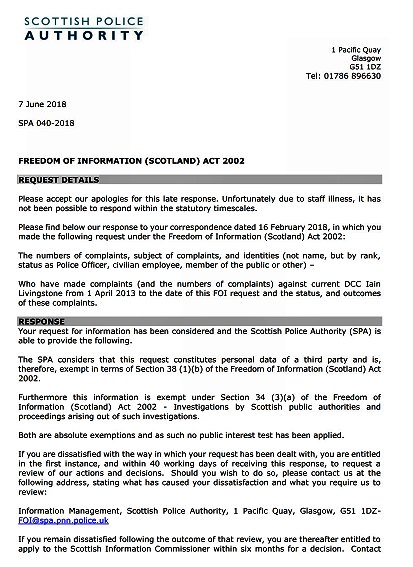
In their response, issued months late and outwith Freedom of Information timescales, the Scottish Police Authority wrongly claimed the material sought was “personal data of a third party” in a concerted attempt to conceal further details of complaints against DCC Livingstone from the public.

The Scottish Police Authority stated in it’s letter of response, dated 8 June 201: 

The SPA considers that this request constitutes personal data of a third party and is, therefore, exempt in terms of Section 38 (1)(b) of the Freedom of Information (Scotland) Act 2002.

Furthermore this information is exempt under Section 34 (3)(a) of the Freedom of Information (Scotland) Act 2002 - Investigations by Scottish public authorities and proceedings arising out of such investigations.

Both are absolute exemptions and as such no public interest test has been applied.

A request for review has been lodged, and material also sent to the Scottish Information Commissioner with regards to the SPA’s refusal to disclose the information.

The Scottish Police Authority’s eagerness to conceal information in relation to a senior Police Officer - who has been previously accused of 5 allegations of serious sexual assault, and has faced further complaints including an ‘interaction’ with another officer - raises questions about the impartiality of the recruitment round to appoint a new Chief Constable to Scotland’s crisis hit single Police service.

With reference to the five allegations of serious sexual assault, Iain Livingstone was cleared of sexual impropriety or intent – by a tribunal headed by a male top cop colleague – Assistant Chief Constable John McLean of Strathclyde Police.

The former lawyer and Raith Rovers footballer had been suspended for 17 months after the WPC claimed she had been sexually assaulted during the party.

A qualified lawyer and member of the Law society of Scotland, Mr Livingstone switched careers in 1992, joining Lothian and Borders Police.

In just 10 years, Livingstone – who had also once played for Raith Rovers - had clearly been fast tracked, reaching the rank of superintendent.

At the time of the allegations and ‘internal’ investigation by his Police colleagues, Livingstone was not prosecuted by the Crown Office over the claims.

Instead, Livingstone admitted a less serious allegation about being in the woman's room overnight and falling asleep.

It should be noted that during the time of the investigation & tribunal, handled by Police, the Lord Advocate was Colin Boyd, Baron Boyd of Duncansby – now a judge in the Court of Session, and the Solicitor General was Elish Angiolini – recently appointed by Nicola Sturgeon a Scottish Minister to investigate how complaints are handled against Police in Scotland – reported here: PROBE CONFLICT: £604K public cash inquiry magnate Ex Lord Advocate appointed to investigate Police complaints – linked to lawyers representing cops facing complaints

A full report on Police Scotland’s refusal to release the details of allegations against Iain Livingstone can be found in an earlier article here: TOP COP SECRETS: Transparency lacking at Police Scotland as spy scandal cops refuse to disclose files on complaints & historical sexual assault case details involving Deputy Chief Constable Iain Livingstone

A report on the Scottish Police Authority’s refusal to release information in connection with the allegations of sexual assault against Iain Livingstone can be found here: THE COP FACTOR: Scottish Police Authority refuse to release documents on sex assault case top cop who wants to be Chief Constable - now, new info said to contain more complaints & references to ‘interaction with another officer’

Friday, July 06, 2018

THE COP FACTOR: Scottish Police Authority refuse to release documents on sex assault case top cop who wants to be Chief Constable - now, new info said to contain more complaints & references to ‘interaction with another officer’

SPA block files release on sex case cop who wants top job. DOCUMENTS detailing new, and serious complaints against a senior cop previously linked to a case involving five allegations of sexual assault, and now, fresh details of an additional ‘interaction with another officer’, are being kept secret by the Scottish Police Authority (SPA).

The secrecy move by the Scottish Police Authority, under their new chair of ex MSP & former Health Minister Susan Deacon – comes as three senior Police officers - including current Deputy Chief Constable Iain Livingstone – submitted their applications to be considered for the £216,549 a year role as Chief Constable of Police Scotland.

Material in relation to new complaints made against DCC Iain Livingstone was sought from the Scottish Police Authority in February of this year, after information was received with regards to further serious complaints made against Police Scotland’s current ‘interim’ Chief Constable.

However, the SPA under Susan Deacon deliberately delayed releasing their response to the Freedom of Information request – by a number of months, as members of the Scottish Police Federation and Scottish Government ministers bolstered DCC Livingstone’s position as front runner for the top job – despite the grim details of a case involving 5 allegations of serious sexual assault which were dismissed by a tribunal composed of Livingstone’s male cop colleagues.

The Scottish Police Authority were asked to provide details of :

  • The numbers of complaints, subject of complaints, and identities (not name, but by rank, status as Police Officer, civilian employee, member of the public or other)
  • Who have made complaints (and the numbers of complaints) against current DCC Iain Livingstone from 1 April 2013 to the date of this FOI request
  • The status, and outcomes of these complaints.

It should be noted Information in relation to a number of these complaints, has recently been shared with MSPs, and the media.

However, and some time after discussions over the Freedom of Information request had taken place, inside & outside the SPA - the Scottish Police Authority responded to the FOI request four months late, in early June - denying access to all of the information sought in relation to DCC Livingstone.

In their response, issued months late and outwith Freedom of Information timescales, the Scottish Police Authority wrongly claimed the material sought was “personal data of a third party” in a concerted attempt to conceal further details of complaints against DCC Livingstone from the public.

The Scottish Police Authority stated in it’s letter of response, dated 8 June 201: 

The SPA considers that this request constitutes personal data of a third party and is, therefore, exempt in terms of Section 38 (1)(b) of the Freedom of Information (Scotland) Act 2002.

Furthermore this information is exempt under Section 34 (3)(a) of the Freedom of Information (Scotland) Act 2002 - Investigations by Scottish public authorities and proceedings arising out of such investigations.

Both are absolute exemptions and as such no public interest test has been applied.

A request for review has been lodged, and material also sent to the Scottish Information Commissioner with regards to the SPA’s refusal to disclose the information.

The Scottish Police Authority’s eagerness to conceal information in relation to a senior Police Officer - who has been previously accused of 5 allegations of serious sexual assault, and has faced further complaints including an ‘interaction’ with another officer - raises questions about the impartiality of the recruitment round to appoint a new Chief Constable to Scotland’s crisis hit single Police service.

With reference to the five allegations of serious sexual assault, Iain Livingstone was cleared of sexual impropriety or intent – by a tribunal headed by a male top cop colleague – Assistant Chief Constable John McLean.

The former lawyer and Raith Rovers footballer had been suspended for 17 months after the WPC claimed she had been sexually assaulted during the party.

A qualified lawyer and member of the Law society of Scotland, Mr Livingstone switched careers in 1992, joining Lothian and Borders Police.

In just 10 years, Livingstone – who had also once played for Raith Rovers - had clearly been fast tracked, reaching the rank of superintendent.

At the time of the allegations and ‘internal’ investigation by his Police colleagues, Livingstone was not prosecuted by the Crown Office over the claims.

Instead, Livingstone admitted a less serious allegation about being in the woman's room overnight and falling asleep.

It should be noted that during the time of the investigation & tribunal, handled by Police, the Lord Advocate was Colin Boyd, Baron Boyd of Duncansby – now a judge in the Court of Session, and the Solicitor General was Elish Angiolini – recently appointed by Nicola Sturgeon a Scottish Minister to investigate how complaints are handled against Police in Scotland.

Asked about the sexual assault allegations during a recent BBC Scotland documentary, DCC Iain Livingstone said he “fell asleep in the wrong place and that was wrong”.

Although he admitted that he 'shouldn't have done that', he insisted that he still has the right attributes for the job.

During the BBC Scotland documentary - PoliceScotland A Force In Crisis, investigative journalist Sam Poling asked Mr Livingstone about the 'allegations of sexual assault' and about him being 'bumped down from superintendent to constable and suspended'.

Quotes from DCC Livingstone’s responses when questioned about the allegations of sexual assault reveal the following remarks by the Police Officer:

Mr Livingstone said: “There was a set of circumstances in 2000 whereby at a social event at Tulliallan, at a training event I had too much to drink.”

“I fell asleep in the wrong place and that was wrong and I shouldn't have done that, and clearly I accept that.”

'I was suspended, I spent time off work. There was a hearing convened where I did accept I fell asleep.I was cleared of any sexual impropriety.”

'I was cleared of any level of sexual intent and at that hearing, initially, I was then demoted from superintendent to constable. I immediately appealed against that and I was reinstated.”

MSPs at the Scottish Parliament also questioned his suitability for the job after his response to the claims in a BBC documentary this week - saying only that he 'fell asleep in the wrong place and that was all'.

However, Livingstone’s application for the top job – which appears to be backed by Scottish Ministers, and the Scottish Police Federation has been called into question after a former Assistant Chief Constable said Livingstone should not get the top job.

COPS TURN ON THEIR OWN: Scottish Police Federation boss launches twitter attack on ex colleague:

Following criticisms by former Assistant Chief Constable Angela Wilson - of Iain Livingstone’s bid to become Chief Constable, Calum Steele – General Secretary of the Scottish Police Federation (SPF) launched a highly personalised attack on his female former colleague - on the twitter social media platform.

The Sunday Mail reported that Calum Steele – a Police Constable with an honorary rank as Chief Inspector due to his Police Federation duties -  also branded ex ACC Wilson “useless” and a “buffoon” and wrongly claimed in tweets that a corruption inquiry in her former force Tayside “extended” to her.

Steele is general secretary of the Scottish Police Federation (SPF) who have 18,500 members and represent 98 per cent of police officers.

Steele posted a string of six tweets last week after Wilson spoke out on the prospect of DCC Iain Livingstone gaining the top job as Chief Constable of Police Scotland.

The first of Calum Steele’s tweets said she was “one of the most incompetent imbeciles ever to have held rank in the police service”.

It claimed she was continuing “a smear on one of the very best”, adding: “You really need to ask – who is driving this?”

He went on to say that Wilson had served in Thames Valley Police as did Claire Gormley, the wife of Phil Gormley who quit as head of Police Scotland in February following bullying allegations against him.

Steele added: “AW [Angela Wilson] and the Gormleys have an axe to grind. It’s frankly pathetic.”

He also described Livingstone as “one of the most talented, able, skilled and resilient police officers”.

Scottish Tories justice spokesman Liam Kerr said: “Mr Steele has a position of responsibility and should probably have thought more carefully before embarking on this chain of tweets.

“The result of this is now a potential legal case which will drag the force and its associated bodies through the mud at a time it never needed it less.”

Angela Wilson subsequently lodged a formal complaint with Police Scotland and the SPF.

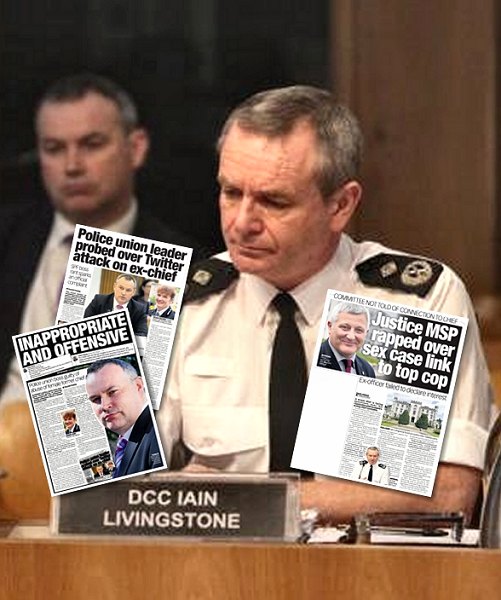
It was then reported in the Sunday Mail newspaper that - as a result of the complaint raised by ex ACC Wilson, Constable Calum Steele was found guilty of posting “inappropriate and offensive” online comments about a female ex-police chief.

Upholding the complaint, Chief Inspector Jacqui Campbell, of the Professional Standards Department (PSD), ruled the comments were “inappropriate and offensive” and that Wilson was “never investigated for corruption”.

Steele claimed to be off duty when he launched the Twitter tirade on May 3 but the Professional Standards Department probe discovered that he was working.

Campbell said: “The record revealed Constable Steele’s duty for that date was 0900 to 1700 hours, therefore, at the time the tweets were posted he was on duty.”

Campbell has issued Wilson a “sincere apology for the undoubted upset Constable Steele’s actions have caused”.

But Steele – who heads the federation representing 98 per cent of Police Scotland officers – “makes no apology” and refuses to delete the messages.

Campbell said: “We have asked Constable Steele to remove the relevant tweets from his Twitter account. Unfortunately, it is his own personal Twitter account and, as such, we are unable to order him to remove or delete them.”

Despite Steele’s messages being from a personal account, Campbell found “they are directly related to his role as a police officer and particularly his role as general secretary” of the SPF.

Mr Livingstone has been regarded as the favourite to replace Phil Gormley, who quit in February after being accused of bullying by colleagues.

Following Gormley’s leave of absence last year, a campaign of suspensions, bitter infighting dubbed ‘backstabbing cops’ in the media, and now scrapped criminal investigations into colleagues of the ousted Chief Constable then took place over a number of months – setting the stage for DCC Livingstone to conveniently scrap his retirement plans, and campaign, along with vested interests in the Scottish Police Federation to replace the ousted Chief Constable.

Steele, who spoke to PSD officers through a lawyer, now faces a further hearing which may result in disciplinary action. His lawyer quoted a dictionary definition of “imbeciles” as meaning “a fool” and that it was “a fair and honest comment that represents Constable Steele’s honestly-held belief”.

Scottish Conservative justice spokesman Liam Kerr said: “Calum Steele should really back down, apologise and delete the offending tweets. Otherwise this row will rumble on.”

Chief Superintendent Mark Hargreaves, head of the Professional Standards Department, said: “The investigation into this complaint has concluded and as this is an internal matter it would be inappropriate to comment further.”

THE MSP & SEX CASE TOP COP: Ex cop MSP failed to declare link to sex case cop Livingstone:

In an earlier report in the Sunday Mail newspaper, it was also revealed that while DCC Iain Livingstone was giving evidence to the Scottish Parliament's Justice Committee in January, Justice Committee member & former police officer John Finnie had failed to tell fellow MSPs he had represented Iain Livingstone when he was cleared of sexual misconduct.

At Holyrood’s justice committee in January, John Finnie quizzed Livingstone about staffing levels and said losing chief officers was one of the benefits of creating a single police force.

Scottish Labour justice spokesman Daniel Johnson said: “John is a valued colleague on the justice committee but I am alarmed that he did not see fit to declare this link with the acting chief constable.

“Police Scotland are in desperate need of scrutiny – and the public will expect such scrutiny to be conducted professionally.

“I would urge him to correct the record and to ensure he declares interests fully and promptly in future.”

A spokesman for the Scottish Conservatives added: “He also owes parliament an explanation as to why he neglected to mention this very important link.”

Finnie spent 14 years as an official for the Scottish Police Federation (SPF) – the organisation who represent police officers up to the rank of chief inspector.

And, it emerged in February of this year that during evidence given by Deputy Chief Constable Iain Livingstone to the Scottish Parliament’s Justice Committee, neither Livingstone or the Justice Sub Committee Convener John Finnie declared any previous links to each other while Livingstone testified before MSPs.

A report in the Sunday Mail newspaper in February revealed Mr Finnie – previously a serving Police Officer and representative for the Scottish Police Federation (SPF) - had represented Mr Livingstone when he was cleared of the sexual misconduct claims in 2003.

The issue was reported by the Sunday Mail newspaper here:

Green MSP under fire after failing to reveal sex case link to top cop Iain Livingstone

John Finnie failed to tell MSPs he represented the acting chief constable when he was cleared of sexual misconduct.

By Mark Aitken 18 FEB 2018

John Finnie failed to tell MSPs he represented Iain Livingstone

A Green MSP is facing questions over his connection with Scotland’s acting chief constable.

Former police officer John Finnie failed to tell fellow MSPs he had represented Iain Livingstone when he was cleared of sexual misconduct.

He failed to declare the link at a meeting of Holyrood’s justice committee when Livingstone was being questioned.

Finnie spent 14 years as an official for the Scottish Police Federation (SPF) – the organisation who represent police officers up to the rank of chief inspector.

Livingstone, the frontrunner to replace Phil Gormley as Scotland’s chief constable, was acccused in 2004 of sexually assaulting a female police officer.

Livingstone admitted falling asleep in the woman’s room at the Scottish Police College in Tulliallan, Fife, after a drunken party in 2000.

Iain Livingstone was accused of sexually assaulting a female police officer in 2004

At an internal hearing, more serious allegations were dropped.

Livingstone, who was then a superintendent, was demoted to constable but won his job back on appeal. Livingstone’s appeal was backed by the SPF.

Finnie said at the time that the case had highlighted “the ease with which the system can be abused and the punitive consequences which affect not only the officer but their family”.

At Holyrood’s justice committee in January, Finnie quizzed Livingstone about staffing levels and said losing chief officers was one of the benefits of creating a single police force.

Scottish Labour justice spokesman Daniel Johnson said: “John is a valued colleague on the justice committee but I am alarmed that he did not see fit to declare this link with the acting chief constable.

“Police Scotland are in desperate need of scrutiny – and the public will expect such scrutiny to be conducted professionally.

“I would urge him to correct the record and to ensure he declares interests fully and promptly in future.”

A spokesman for the Scottish Conservatives added: “He also owes parliament an explanation as to why he neglected to mention this very important link.”

Finnie began his career with Lothian and Borders Police in 1976 and moved to Northern Constabulary three years later.

He served as a full-time officer with the SPF from 1992 to 2006.

Finnie was elected as an SNP MSP in 2011 but quit the party the following year in protest at the decision to end their long-standing opposition to Nato membership.

Finnie and the Greens failed to respond to the Sunday Mail’s calls.

SCOTLAND’S NEXT TOP COP:

There are three shortlisted candidates for the Chief Constable role at Police Scotland.

Deputy Chief Constable Iain Livingstone, whose past & current complaints records are being kept secret by the Scottish Police Authority, and Police Scotland.

A second candidate - Police Scotland Deputy Chief Constable Johnny Gwynne - a former head of the National Crime Agency's (NCA) Child Exploitation and Online Protection command - has also applied for the job.

Gwynne, a former Royal Ulster Constabulary (RUC) officer also previously held the post of former deputy director-general of the Scottish Crime and Drug Enforcement Agency – which was absorbed into Police Scotland in 2014.

The third candidate is Lincolnshire Police Chief Constable Bill Skelly, who joined Devon and Cornwall Police from Police Scotland as Deputy Chief Constable in 2013 and was appointed as chief Constable of the force last year.

The shortlisted candidates will undergo a selection process including two panel interviews, chaired by the Scottish Police Authority’s own boss Susan Deacon.

And the selection panel will also include SPA board member Mary Pitcaithly, NHS Scotland chief executive Paul Gray, Professor Lorne Crerar, - chairman of legal firm Harper MacLeod; and National Crime Agency Director General Lynne Owens.

Gill Imery – the current Her Majesty's Chief Inspector of Constabulary in Scotland will also act as an ‘advisor’ to the team.

According to the job information pack: "Shortlisted candidates will be invited to participate in a psychometric and personality profile exercise, an Assessment Centre, and an interview with the Selection Panel."The assessment centre will include a scenario exercise and a mock media interview.

Final interviews of the three candidates are expected to take place on 13 and 14 August.

A report on the allegations of sexual assault against Iain Livingstone by a female Police Officer, allegations which were dismissed by a tribunal headed by male Police Officer colleagues of Livingstone was reported earlier by DOI here: TOP COP SECRETS: Transparency lacking at Police Scotland as spy scandal cops refuse to disclose files on complaints & historical sexual assault case details involving Deputy Chief Constable Iain Livingstone

Thursday, March 15, 2018

TOP COP SECRETS: Transparency lacking at Police Scotland as spy scandal cops refuse to disclose files on complaints & historical sexual assault case details involving Deputy Chief Constable Iain Livingstone

Police Scotland refused to disclose secret files on top cop. SCOTLAND’S single national Police service – Police Scotland has refused to disclose details of secret files on a case involving allegations of sexual assault against the force’s most senior office – Deputy Chief Constable Iain Livingstone.

The force also refused to disclose any non-disclosure agreements which may have been part of any settlement of the case – which ultimately led to the female officer leaving her job,

And, the information has been categorised as so sensitive, Police Scotland refuse to confirm if the files even exist.

The move came in relation to Freedom of Information requests seeking details of information held by Police Scotland on accusations and allegations of sexual assault made by a female Police Officer against current DCC Iain Livingstone during his time in Lothian and Borders Police.

Also sought for disclosure was information contained in any discussions or misconduct hearings in relation to these allegations and information contained in any admissions by Iain Livingstone with regards to these allegations and, any information contained in any non-disclosure agreements, termination of employment, resignation or retirement of any persons or Police Officers making these allegations against Iain Livingstone.

However a statement from Police Scotland in response to the Freedom of Information request refused any form of disclosure or acknowledgement of the status of any files held by Scotland’s single national Police service – who said:

“Police Scotland endeavours to provide information whenever possible. However, under section 18(1) of the Act, a public authority may refuse a request where:

• if the information existed and was held by the authority, it would be exempt from release under any of Sections 28 to 35, 38, 39(1) or 41 of the Act; and

• the authority considers that to reveal whether the information exists, or is held by it, would be contrary to the public interest.

In this instance, it is considered that to reveal whether the information you have requested exists, or is held by Police Scotland, would be both exempt from release under the Act and contrary to the public interest. There is a strong public interest in protecting individuals' privacy, and personal information is exempt from release into the public domain under section 38 of the Act if it would be unfair, unlawful or otherwise breach the Data Protection Act.

For these reasons, Police Scotland must refuse your request under section 18(1) of the Act.

This notice should not be taken as conclusive evidence that the information you have requested exists or is held.”

Issues surrounding the allegations of sexual assault made by a female Police Officer against Iain Livingstone while he served at Lothian & Borders Police in 2003 resurfaced during recent scrutiny of Police Scotland over the past year.

Livingstone was however, cleared of the allegations by a hearing chaired by another senior Police officer - John McLean, Strathclyde assistant chief constable. The Police led hearing on allegations against Police Superintendent Livingstone established there had been no sexual impropriety or intent on Mr Livingstone's part.

However, interest in the 2003 case and details surrounding it has resurfaced – after the single Police service – created by the Scottish Government in 2013 - was hit by several scandals including numerous suspensions of senior officers, allegations of Ministerial meddling with ultimately led to the ousting of Chief Constable Phil Gormley, and the ongoing probe into senior officers use of a surveillance unit within Police Scotland to illegally spy on journalists & cops.

At the time of the sexual assault allegations in 2003, Iain Livingstone, 37, was working as an aide to Scotland's most senior police officer, Sir Roy Cameron, at Her Majesty's Inspectorate of Constabulary, when he was suspended in February 2003 over the claims - which arose from a drunken party at the Scottish Police College at Tulliallan.

It was reported at the time that Iain Livingstone - previously a solicitor and member of the Law Society of Scotland - had been suspended for 17 months after the WPC claimed she had been sexually assaulted during the party.

Five allegations of serious sexual assault made by the female Police officer against Livingstone were dismissed - but, at an internal misconduct hearing, Mr Livingstone admitted less serious allegations, including being in the woman's room overnight after falling asleep.

A qualified lawyer and member of the Law society of Scotland, Mr Livingstone switched careers in 1992, joining Lothian and Borders Police. In just 10 years, he reached the rank of superintendent.

Livingstone was ultimately demoted from superintendent to constable following the disciplinary hearing, although is now in the position of caretaker Chief Constable of Police Scotland, while the Scottish Government attempt to find another ‘suitable’ candidate to fill the Chief Constable post vacated by Phil Gormley.

However, recent interest in the case surfaced after it emerged DCC Iain Livingston was being promoted to fill the Chief Constable slot vacated by Gormley – who had effectively been ousted from his job after Justice Secretary Michael Matheson intervened in a decision taken by the Scottish Police Authority to allow Mr Gormley to return to work

And, it later emerged that during evidence given by Deputy Chief Constable Iain Livingstone to the Scottish Parliament’s Justice Committee, neither Livingstone or the Justice Sub Committee Convener John Finnie declared they knew each other, after papers revealed Mr Finnie had represented Mr Livingstone when he was cleared of the sexual misconduct claims in 2003.

In a further refusal to disclose information on the current top cop in Scotland, Police Scotland refused to reveal any information in relation to additional complaints made against Deputy Chief Constable Iain Livingstone.

And, again, Police Scotland refused even to confirm if such information was held – this despite information already available in the public arena including discussions on social media platforms relating to additional complaints made against DCC Livingstone by Police Officers.

A request for information relating to numbers of complaints, subject of complaints, and identities (not name, but by rank, status as Police Officer, civilian employee, member of the public or other) - who have made complaints (and the numbers of complaints) against current DCC Iain Livingstone from 1 April 2013 to the date of this FOI request and the status, and outcomes of these complaints – resulted in the following response from Police Scotland, with a refusal to disclose:

“Police Scotland endeavours to provide information whenever possible. However, under section 18(1) of the Act, a public authority may refuse a request where:

• if the information existed and was held by the authority, it would be exempt from release under any of Sections 28 to 35, 38, 39(1) or 41 of the Act; and

• the authority considers that to reveal whether the information exists, or is held by it, would be contrary to the public interest.

In this instance, it is considered that to reveal whether the information you have requested exists, or is held by Police Scotland, would be both exempt from release under the Act and contrary to the public interest. There is a strong public interest in protecting individuals' privacy, and personal information is exempt from release into the public domain under section 38 of the Act if it would be unfair, unlawful or otherwise breach the Data Protection Act.

For these reasons, Police Scotland must refuse your request under section 18(1) of the Act.

This notice should not be taken as conclusive evidence that the information you have requested exists or is held.”

And, it emerged in February of this year that during evidence given by Deputy Chief Constable Iain Livingstone to the Scottish Parliament’s Justice Committee, neither Livingstone or the Justice Sub Committee Convener John Finnie declared any previous links to each other while Livingstone testified before MSPs.

A report in the Sunday Mail newspaper in February revealed Mr Finnie – previously a serving Police Officer and representative for the Scottish Police Federation (SPF) - had represented Mr Livingstone when he was cleared of the sexual misconduct claims in 2003.

The issue was reported by the Sunday Mail newspaper here:

Green MSP under fire after failing to reveal sex case link to top cop Iain Livingstone

John Finnie failed to tell MSPs he represented the acting chief constable when he was cleared of sexual misconduct.

ByMark Aitken 18 FEB 2018

John Finnie failed to tell MSPs he represented Iain Livingstone

A Green MSP is facing questions over his connection with Scotland’s acting chief constable.

Former police officer John Finnie failed to tell fellow MSPs he had represented Iain Livingstone when he was cleared of sexual misconduct.

He failed to declare the link at a meeting of Holyrood’s justice committee when Livingstone was being questioned.

Finnie spent 14 years as an official for the Scottish Police Federation (SPF) – the organisation who represent police officers up to the rank of chief inspector.

Livingstone, the frontrunner to replace Phil Gormley as Scotland’s chief constable, was acccused in 2004 of sexually assaulting a female police officer.

Livingstone admitted falling asleep in the woman’s room at the Scottish Police College in Tulliallan, Fife, after a drunken party in 2000.

Iain Livingstone was accused of sexually assaulting a female police officer in 2004

At an internal hearing, more serious allegations were dropped.

Livingstone, who was then a superintendent, was demoted to constable but won his job back on appeal. Livingstone’s appeal was backed by the SPF.

Finnie said at the time that the case had highlighted “the ease with which the system can be abused and the punitive consequences which affect not only the officer but their family”.

At Holyrood’s justice committee in January, Finnie quizzed Livingstone about staffing levels and said losing chief officers was one of the benefits of creating a single police force.

Scottish Labour justice spokesman Daniel Johnson said: “John is a valued colleague on the justice committee but I am alarmed that he did not see fit to declare this link with the acting chief constable.

“Police Scotland are in desperate need of scrutiny – and the public will expect such scrutiny to be conducted professionally.

“I would urge him to correct the record and to ensure he declares interests fully and promptly in future.”

A spokesman for the Scottish Conservatives added: “He also owes parliament an explanation as to why he neglected to mention this very important link.”

Finnie began his career with Lothian and Borders Police in 1976 and moved to Northern Constabulary three years later.

He served as a full-time officer with the SPF from 1992 to 2006.

Finnie was elected as an SNP MSP in 2011 but quit the party the following year in protest at the decision to end their long-standing opposition to Nato membership.

Finnie and the Greens failed to respond to the Sunday Mail’s calls.

It has since come to light there are a number of non disclosure agreements in force which relate to Police Officers and others connected to Policing in Scotland, a matter now being probed by the media for further reporting.