Showing posts with label Information Commissioner. Show all posts

Friday, September 15, 2017

SUPREME SECRETS: UK Supreme Court refuses to publish recusal data - Court rejects release of info on UKSC justices' conflicts of interest in response to Freedom of Information recusals probe on top UK court

Top UK court obstructed Scots media judicial recusals probe. THE UK Supreme Court (UKSC) has refused to disclose how many of it’s justices have recused themselves from court hearings over conflicts of interest or requests to step aside from cases.

And, the top court’s refusal to disclose the information only came about after the Information Commissioner (ICO) decided to issue a decision notice forcing the Supreme Court to respond to Freedom of Information requests submitted in May 2017.

Unlike in Scotland, where the Judiciary of Scotland publish a Register of Judicial Recusals– listing judges who have stood aside in cases for certain conflicts of interest (not including financial, wealth or other status related interests), the United Kingdom’s Supreme Court in London does not publish any recusal information.

However, Freedom of Information requests seeking disclosure of the UK Supreme Court’s recusal data encountered obstacles after UKSC officials took a decision to refuse to respond to Scottish journalists FOI requests.

And, it can also be revealed the Ministry of Justice – the body in charge of all courts in England & Wales followed the Supreme Court’s anti-transparency position – refusing to respond to a similar FOI request again sent from Scotland in May 2017.

Four months after the original Freedom of Information request was made to the UK Supreme Court, and amid numerous reminders to UKSC officials, the Information Commissioner’s office was contacted in July for assistance.

After discussions with ICO staff, the Information Commissioner gave the top court an extra month to reply.

However, the Supreme Court again refused to respond to any Freedom of Information requests from Scotland on the subject of recusals.

A legal insider claimed the refusal to reply to the requests originated over fears the material was to be referred to at the Scottish Parliament in connection with a five year probe on judges’ interests and a call to create a register of judicial interests - Petition PE1458: Register of Interests for members of Scotland's judiciary.

However, after the Information Commissioner again contacted Scottish journalists making the requests, the ICO confirmed it would issue a determination to order the UK Supreme Court to respond to the requests.

In an email of 25 August 2017, Matthew Cresswell of the Information Commissioner’s office informed journalists seeking the recusal information: “As the Supreme Court have failed to respond to your information request within the statutory time limit set out in section 10(1) of the FOIA, the Commissioner can now start the process of ordering a decision notice on this case. A decision notice is a legally binding document that will require the public authority to provide a response.”

Coverage of the case then appeared in The National newspaper on 30 August – which prompted the Supreme Court to finally issue a response to the Freedom of Information requests.

However, the UKSC refused to divulge any details of UKSC justices’ recusals, citing cost grounds of gathering the information.

Paul Brigland, for the UK Supreme Court claimed logging errors where the real reasons for a lack of reply to the FOI requests, rather than a determined policy by the UK Supreme Court not to respond to a Scottish Freedom of Information request.

Paul Brigland, the Head of Office and Building Services & Departmental Records Officer said: “Firstly, I would like to apologise for the mishandling of your request and the failure to reply. This is entirely due to an error in our logging process in which this request was incorrectly marked as dealt with, but had in fact been mistaken for a separate request you made under the FOLA at the same time which we responded to within the correct time limit. I hope you will accept our apologies for this error. I should also explain that since you made your request we have changed the way in which we log and handle FOI requests, so this situation should not arise in the future.”

Paul Brigland then confirmed the UKSC held information relevant to the request.

Mr Brigland said: “I can confirm that we do hold some information relevant to your request.”

However, Paul Brigland claimed the work involved and cost would prohibit the information being disclosed.

Brigland added: “In order to provide you with the information on the scale that you have requested would require a search of individual paper case records. We do not maintain a central record of any such requests as there is no business need to do so.”

“Section 12 of the FOLA makes provision for public authorities to refuse requests for information where the cost of dealing with them would exceed the appropriate limit, which for central government is set at £600. This represents the estimated cost of one person spending 3.5 working days in determining whether the Department holds the information, locating, retrieving and extracting the information.”

“As your request is widely framed, I estimate that it will take us more than 3.5 working days to determine appropriate material within the scope of your request, and locate, retrieve and extract that information.”

“I am sorry that on this occasion I cannot suggest ways in which you could narrow the scope of your request to bring it within the cost limit. This is because any information sought under a revised request, for example requesting information for a shorter time period, would still be exempt under section 32 (court records).”

“However, outside the terms of the Act, and to be helpful, I can explain the following.”

“Where there are reasons that a Justice considers there might be an issue of recusal, that information is sent to the Justice chairing the panel (normally the President or Deputy President) and then a letter is sent to the parties. I can confirm that there have been no instances where we have written to parties that has subsequently led to a request from the parties for a Justice to stand down.”

“Similarly, I can confirm that there have been no instances where a Justice has recused themselves following a request initiated by a party to a case.”

However, the explanation offered by the UKSC does not actually confirm if any justices have refused to recuse themselves following any request from litigants or parties to do so.

And, as no register of recusals currently exists at the UK Supreme Court, legal insiders have suggested the explanations from the UKSC on recusal data should be taken with a pinch of salt.

A legal insider has suggested legal teams operating in the UK Supreme Court are dissuaded from – or not minded to ask for recusals.

The source said “ justices do not take well to their position being questioned to recuse from a hearing”.

A solicitor from England who has now come forward on the issue said he was aware of certain cases at the Supreme Court which may have necessitated a recusal.

The solicitor, who has studied the details contained in Scotland’s register of judicial recusals said it was clear in some cases before the UKSC, comparable examples of justices links to issues do exist, and therefore should be acknowledged in a similar register of recusals at the Supreme Court.

However, the solicitor cited the Supreme Court’s determination to avoid declaring justice’s interests in a register of interests as one reason which the UKSC is avoiding publishing any data on it’s justices’ recusals.

Amid the Supreme Court’s refusal to release information on recusals, Scottish journalists asked for a review of the decision, which was handled by William Arnold, the Head of Corporate Services.

Mr Arnold did not provide a review response on material with the UK Supreme Court logo, instead responding by email in the following terms.

Willian Arnold said: “As Mr Brigland explained, the UK Supreme Court does not maintain any formal central register of requests  to Justices to recuse themselves  from particular cases, since there has never been any operational need to do so.”

“Identifying the record of any such requests would therefore entail reviewing all the case papers in every case heard since January 2014 to the present date. I am satisfied that Mr Brigland was correct in assessing that carrying out this review would require staff resource input, which would exceed the cost limit for answering FOI requests of £600.”

“As Mr Brigland went on to say, this would be a pointless exercise in any event, because any such recusal request, if one was found, would form part of the records of the individual court case; and in Section 32 of the FOI Act Parliament has enacted an exemption of court records from the FOI regime. This exemption is not subject to any kind of public interest test, so the UKSC would not in any case be able to release any such recusal request, if one was found, to you under the FOI regime. I agree with this analysis.”

“In order to try to be helpful, Mr Brigland, however, went on to tell you, outside the provisions of the Act, since this is not recorded information which the UKSC holds, that the practice is that where a Justice considers he might have interests which might generate a request for recusal, a letter is sent to the parties outlining those interests.”

“Nobody here of those staff who have been at the UKSC since its inception in 2009 can remember any instance where such a letter has resulted in a request from a party to a case for a Justice to recuse themselves. Equally nobody here can recall any instance where a party has ever initiated a request for a Justice to recuse themselves, so the question of acceding to or rejecting such a request has never arisen.”

Mr Arnold went on to contradict Paul Brigland’s initial explanation where he stated the UKSC did hold material in relation to recusal information.

William Arnold stated: “The only sentence in Mr Brigland’s letter which I do repudiate is on page one  where he says “I can confirm that we do hold some information relevant to your request.”

“He may have been thinking of the letters we send to parties, where a Justice believes they have interests they should disclose, as set out above, but it is not clear to me that these are strictly relevant to your request; and I cannot find any other evidence which leads to the conclusion that the UKSC ‘holds some information relevant to your request’.”

“Indeed I have reached the opposite conclusion – that we likely do not hold any such information, although we could not be formally sure of that without carrying out the review of all our cases, which on cost grounds, as set out above, we have declined to do.”

A barrister who studied the correspondence from the UK Supreme Court, including the initial FOI response and the UKSC’s review – said the responses were evasive.

He also noted the UKSC’s position on holding no recusal data revolved around process where a letter is sent out to parties in relation to a justices’ conflict of interest - rather than an interest being raised by a party or legal representative.

The barrister said: “The UK Supreme Court has existed for eight years. I think it highly unlikely not one single request for a recusal at the Supreme Court has been made during such a considerable length of time.”

While the UK Supreme Court remains determined to refuse any further disclosure of information on judicial recusals, the Information Commissioner has been contacted again over the Ministry of Justice’s refusal to answer similar requests for disclosure of recusal information from the English courts.

A decision from the Information Commissioner on this matter is awaited.

However, the position Scottish users of the UK Supreme Court now face is that judges in Scotland are required to publish their recusal data, while the UKSC has decided against any such transparency – leaving Scottish court users at a considerable disadvantage.

The National reported on the battle to obtain recusal information from the UK Supreme Court and the Ministry of Justice in two articles, published below:

Victory for Scottish information campaigner in battle with Supreme Court

Martin Hannan Journalist 30th August

THE UK Supreme Court will be ordered by the Information Commissioner to reply to question from a Scottish legal rights campaigner, after it refused to say whether it had a register of recusals by court justices.

Recusal is the term used when a judge has to step aside from a case because of a possible conflict of interest. It is thought that various Supreme Court justices have recused themselves from numerous cases, but no such information is made public.

The National can reveal the Information Commissioner has decided to act after the Supreme Court and the Ministry of Justice for England and Wales failed to reply to blogger and campaigner Peter Cherbi’s request for information.

A register of recusals has been in existence for several years in Scotland – it can be viewed online – and Cherbi wants to see the system extended to all the judiciary in the UK.

The Information Commissioner told Cherbi, above: “As the Supreme Court has failed to respond to your information request within the statutory time limit set out in section 10 (1) of the Freedom of Information Act, the Commissioner can now start the process of ordering a decision notice on this case.

“A decision notice is a legally binding document that will require the public authority to provide a response.”

Sources at the Supreme Court have indicated that the decision notice has not been received by the court, but that it will be acted upon.

Cherbi’s long-term aim is to see the creation of a register of judicial interests similar to that which MPs, MSPs and police officers must complete. His petition calling for that register has been debated by MSPs for nearly six years, and a decision is due next year. He feels the delay is an attempt to stop the register of interests. The National can reveal that lawyers in London support Cherbi’s case, but think judges will oppose it.

One legal source said: “They fear recusals up here in Scotland are inevitably leading to a register of judicial interests and it will lead to the same thing happening in England and Wales.”

The Supreme Court has already decided against a register of interests, stating: “The justices have decided it would not be appropriate, or indeed feasible, for them to have a comprehensive register of interests, as it would be impossible for them to identify all the interests, which might conceivably arise, in any future case that came before them.

“To draw up a register of interests, which people believed to be complete, could potentially be misleading. Instead the justices of the Supreme Court have agreed a formal code of conduct by which they will all be bound, and which is now publicly available on the court’s website.

“In addition, all the justices have taken the judicial oath … which obliges them to ‘do right to all manner of people after the law and usages of this realm without fear or favour, affection or ill will.

“And, as is already the practice with other members of the judiciary, they will continue to declare any interest which arises in the context of a particular case and, if necessary, recuse themselves, whether it is a substantive hearing, or an application for permission to appeal.”

Cherbi said: “Refusing access to information is not accidental. We are looking here at a coordinated attempt to thwart the introduction of Scottish judicial transparency to the rest of the UK.”

The Ministry of Justice referred The National to the Supreme Court where a spokesman confirmed that they were awaiting the Commissioner’s formal decision.

Supreme Court finally responds to Scottish FoI request about recusals ... and rejects it

Martin Hannan Journalist 06 September 2017

THE UK Supreme Court has refused to issue information on how many of its justices have stood aside from cases because of a conflict of interest.

The National revealed last week that the Information Commissioner in England had ordered the Supreme Court to deal with Scottish law campaigner Peter Cherbi’s freedom of information request after it failed to reply to him in time.

Now the Supreme Court has written to Cherbi apologising for failing to deal with his request timeously but saying it will not give him the information as it would cost too much to provide it.

“That’s just ludicrous,” Cherbi said yesterday, “and it just makes people all the more suspicious that the Supreme Court is covering up something that the public should have the right to know.”

In another development, Cherbi is to ask the Scottish Parliament’s Petitions Committee to invite the new President of the Supreme Court to give evidence as to why she and her fellow justices oppose a register of interests for the judiciary similar to that for MPs and police officers.

The committee has been discussing Cherbi’s call for a register of judicial interests in Scotland for almost five years.

Cherbi said: “I would like Lady Hale to come to Holyrood and explain why the UK Supreme Court’s members are so set against a register of interests.

“We have already seen Scotland’s top judges opposing it, and it would be good to know why the UK Supreme Court opposes it – after all, the Supreme Court sits in judgement on Scottish cases all the time, so why should the public not be able to see what interests, financial and otherwise, that judges have?

“As the President of the UK Supreme Court, Baroness Hale will be able to give a substantive account of why Supreme Court justices no longer consider they require to adhere to the expectation of completing a register of interests as they did pre-UK Supreme Court days as Law Lords in the House of Lords.

“After all, we ask our MPs and MSPs and police officers to register their interests so that everything is seen to be above board, so why not the judges in the highest court in the land?”

Cherbi also wants Lady Hale to tell the committee why the Supreme Court does not keep a register of recusals (when judges step aside from a case) as happens in the Scottish courts.

In its delayed response to Cherbi, the Supreme Court said: “To provide you with the information on the scale that you have requested would require a search of individual paper case records. We do not maintain a central record of any such requests as there is no business need to do so. Section 12 of the Freedom Of Information Act makes provision for public authorities to refuse requests for information where the cost of dealing with them would exceed the appropriate limit, which for central government is set at £600.

“This represents the estimated cost of one person spending 3.5 working days in determining whether the department holds the information, locating, retrieving and extracting the information.

“As your request is widely framed, I estimate that it will take us more than 3.5 working days to determine appropriate material within the scope of your request, and locate, retrieve and extract that information.”

A legal expert told The National: “The information on recusals certainly exists, so all that needs to be done is to send an email to the justices and their assistants and the information could be gathered in a day.”

Cherbi said: “We have a register of recusals in Scotland. It’s time they had one for the Supreme Court and all English and Welsh courts.”

Previous reports on moves to publish judicial recusals in Scotland and a media investigation which prompted further reforms of the Scottish Register of Judicial Recusals can be found here: Judicial Recusals in Scotland - Cases where judges have stood down over conflicts of interest

Recent reforms to the way in which judicial recusals are recorded and entered in Scotland’s register of judicial recusals were reported here: RECUSALS JUST GOT REAL: Judicial Office concedes to reforms for Judicial Recusals Register, full case details where judges stand down from court hearings to be entered after media & FOI probe success

Tuesday, January 31, 2012

SHHH HAPPENED : Scotland’s new Information Commissioner to be Legal Complaints CEO Rosemary Agnew, rebuked FIVE TIMES for being ANTI-FOI

SLCC & FOISLCC’s Chief Executive Rosemary Agnew is to be the new Scottish Information Commissioner. THE Scottish Parliament has announced today that ROSEMARY AGNEW, the current Chief Executive of the Scottish Legal Complaints Commission (SLCC) is to be appointed on Tuesday 1 February after a ‘formality vote’ by msps as the new Scottish Information Commissioner, replacing the highly successful Kevin Dunion who has served two terms in the role. However, in comparison to the widely  respected Mr Dunion, Ms Agnew, who take up the post in April to be FOI Chief for the next SIX YEARS at £78K a year, is widely viewed to be anti-foi, given her less than glowing record of handling FOI requests at the SLCC, where she was rebuked at least FIVE TIMES by the current Information Commissioner for unfairly using FOI legislation to obstruct the release of data to journalists and members of the public who submitted Freedom of Information requests.

Ms Agnew was made the politicians choice for the post of Information Commissioner after a series of closed to the public recruitment hearings took place by an all women msp selection panel, comprising the following msps : Presiding Officer, Tricia Marwick MSP – Chair, Margaret Burgess MSP, Helen Eadie MSP, Christine Grahame MSP, Alison McInnes MSP, Mary Scanlon MSP, Maureen Watt MSP.

Documents obtained by Diary of Injustice under Freedom of Information legislation after the SLCC was forced to publish its “Gifts & Hospitality Register revealed the Presiding Officer of the Parliament, Tricia Marwick MSP who was also chair of the all women msp panel who made Ms Agnew their choice as Information Commissioner, had offered hospitality to Ms Agnew during the time msps were considering the candidates to replace Mr Dunion. Diary of Injustice reported on these revelations, here : Legal Complaints CEO & ‘front runner’ for Scottish Information Commissioner role received hospitality from msps, law firms & Law Society of Scotland

Ms Agnew was widely tipped for the role, after leaks to the media confirmed msps wanted someone on their side in the job, covered earlier by Diary of Injustice here : SHHH Happens : SLCC Legal Complaints CEO Rosemary Agnew tipped for FOI Commissioner role after 5 FOI ‘rebukes’ & refusals to monitor Master Policy

While the Scottish Parliament’s Press Release on the appointment claims Ms Agnew “…committed to the principles of accountability and transparency …” her term at the Scottish Legal Complaints Commission, firstly as Head of Investigations, and secondly as Chief Executive, replacing the SLCC’s first CEO Eileen Masterman who resigned after a year in the job, saw the SLCC fail to recommend any prosecutions of crooked lawyers, a move even criticised by the Scottish Solicitors Discipline Tribunal.

Ms Agnew in her role as the SLCC’s Chief Executive was also revealed to have taken decisions which led to some clients who had complained about their solicitors facing financial ruin, after she refused repeated requests by members of the public to monitor claims made against the Master Insurance Policy, the Professional Indemnity Insurance scheme operated by the Law Society of Scotland to compensate victims of negligent “Crooked lawyers.”

The Master Policy which Ms Agnew refused to monitor claims against, was linked in an independent report carried out by the SLCC to client suicides covered up by the Law Society of Scotland & the insurers. Diary of Injustice reported on the report into the Master Policy here : Suicides, illness, broken families and ruined clients reveal true cost of Law Society's Master Policy which 'allows solicitors to sleep at night'

The Scottish Legal Complaints Commission were asked for comment on the Scottish Parliament's announcement of its recommendation to appoint current CEO Rosemary Agnew as FOI Commissioner and what impact the loss of a second Chief Executive in three years has on the SLCC. No response has been received from the SLCC.

There is also no word yet on recruitment for a new SLCC Chief Executive, to a position which must be so fantastic, everyone wants out of the job as soon as they are in it.

BACKGROUND : ROSEMARY AGNEW, SLCC CHIEF EXECUTIVE

Rosemary Agnew is the SLCC’s second Chief Executive in three years. Ms Agnew took on the role after a short recruitment phase to replace the SLCC’s first Chief Executive Eileen Masterman who resigned after a bitter exchange with Cabinet Secretary for Finance John Swinney over issues involving meetings the SLCC held in connection with the Master Policy.

Ironically, one of Rosemary Agnew’s key refusals to disclose information to the public was information and discussions surrounding the SECRET SUBSTANTIAL PAY-OFF negotiated by lawyers acting for former SLCC CEO Eileen Masterman and the Scottish Legal Complaints Commission. The secret payoff was also backed by the Justice Secretary Kenny MacAskill, and Scottish Ministers also refused to disclose the amount paid to Ms Masterman. Diary of Injustice reported on the secret pay-off scandal in an earlier article here : HUSH & MONEY : Former SLCC law complaints Chief Executive Eileen Masterman received secret Scottish Government approved payoff in deal with lawyers

The Scottish Parliament’s Press Release (below) makes little reference to Ms Agnew’s work at the Scottish Legal Complaints Commission.

NEW SCOTTISH INFORMATION COMMISSIONER TO BE APPROVED BY PARLIAMENT

The Scottish Parliament will tomorrow be asked to approve the nomination of Rosemary Agnew as the new Scottish Information Commissioner.

Mrs Agnew, who is currently the Chief Executive of the Scottish Legal Complaints Commission, is set to replace Kevin Dunion who demits office on 23 February 2012.

Created under the Freedom of Information (Scotland) Act 2002, the Scottish Information Commissioner is responsible for enforcing and promoting Scotland’s freedom of information legislation.

The appointment will be for a fixed term of six years and attracts a salary of £78,000 per annum. The Parliament will be invited to agree Mrs Agnew’s nomination before the recommendation goes to Her Majesty The Queen for formal appointment. If approved, it is expected that Mrs Agnew will take up post in April.

Biographical Information

Prior to her work with the Scottish Legal Complaints Commission, Mrs Agnew worked for the Local Government Ombudsman for 8 years. Throughout her career she has been committed to the principles of accountability and transparency and has worked with a range of public and private sector organisations to deliver service and procedural improvements.

Text of Motion to be approved by Parliament on 1 February 2012

That the Parliament nominates Rosemary Agnew to Her Majesty The Queen, for appointment as the Scottish Information Commissioner.

Thursday, January 19, 2012

Legal Complaints CEO & ‘front runner’ for Scottish Information Commissioner role received hospitality from msps, law firms & Law Society of Scotland

SLCC & FOILegal Complaints CEO Rosemary Agnew is ‘front runner’ for Scottish Information Commissioner role. DOCUMENTS published in response to FOI requests after an investigation by Diary of Injustice today reveal ROSEMARY AGNEW, the Chief Executive of the Scottish Legal Complaints Commission (SLCC) who is tipped to be the Scottish Parliament’s choice as the new Scottish Information Commissioner, replacing the highly successful Kevin Dunion, has been forced to declare multiple receipts of hospitality from law firms, the Law Society of Scotland, and from politicians such as the Scottish Parliament’s very own Presiding Officer, Tricia Marwick MSP, who also chaired the selection panel of seven msps who interviewed Ms Agnew as a candidate to serve as Scotland's Information Commissioner for the next EIGHT YEARS.

The SLCC was forced to publish its “Gifts & Hospitality Register” in response to Freedom of Information requests from Diary of Injustice after this journalist began investigating rumours of multiple gifts, hospitality & undeclared contact with law firms, staff & key figures from the Law Society of Scotland including former Law Society Presidents, clandestine no-notes-taken meetings in posh Edinburgh hotels between SLCC Chiefs & shady organisations such as the Legal Defence Union, insurers such as Royal Sun Alliance PLC & Marsh UK, and MSPs & their staff.

Some of the entries in the SLCC’s Gifts & Hospitality Register, which does not appear to have been kept up to date with current events, show a range of Hospitality gifts by way of dinners & occasions attended by Ms Agnew which raise questions over the closeness of contact between key staff at the Scottish Legal Complaints Commission and the legal profession, which the SLCC are supposed to be regulating.

SLCC Rosemary Agnew HospitalityHospitality rules ? 26/8/10 Rosemary Agnew John Schmidt, Regulation and Markets Shepherd & Wedderburn Festival Show (2) and Dinner, Chair also invited and attended.

30/09/10 Rosemary Agnew Patricia Goldie Scott Moncrieff – Internal Auditors Business Lunch

6/12/10 Rosemary Agnew Law Society of Scotland Law Society of Scotland Invitation to Christmas drinks party at their offices. Accepted

13/01/11 Rosemary Agnew Law Society of Scotland Law Society of Scotland Invitation to LSS Dinner with charity raffle 11th March 2011. Accepted

21/02/11 Rosemary Agnew Scott-Moncrieff SLCC’s Internal Auditors Informal Business Lunch at offices – accepted.

24/02/11 Rosemary Agnew Ayr Faculty Law Book token for delivering presentation, donated to the Office Charity

25/05/11 Rosemary Agnew Jamie Millar, President Law Society of Scotland Reception for the CEO of the Law Society of Malawi. Accepted

26.7.11 Rosemary Agnew National Museum of Scotland Museum Accepted. Invitation to reopening of the Museum.

2011_12 staff gifts and hospitality register redacted 19.811_Page1Hospitality offered by Presiding Officer & Chair of selection panel during meetings to decide new Info Commissioner 12.07.11 Rosemary Agnew Tricia Marwick MSP MSP Declined. Invitation to launch reception of 2011 Festival of Politics and the World Press Photo Exhibition in Parliament’s main hall. In one entry, dated July of 2011, the SLCC’s Chief Executive Rosemary Agnew also received an invitation from the Scottish Parliament’s Presiding Officer, Tricia Marwick, to attend a reception at the Scottish Parliament. While the hospitality from Ms Marwick was declined, it appears to have come at the same time Ms Agnew was considering her position in relation to applications & interviews held at the Scottish Parliament for the role of Freedom of Information Tsar after the current Information Commissioner, Kevin Dunion, finished his second & final term as Scotland’s Freedom of Information guardian. of Information Commissioner in which msps were speaking to candidates who were interested in taking on the

However it now transpires from an investigation, the Scottish Parliament’s Presiding Officer, Tricia Marwick who offered hospitality to Ms Agnew also sat on the all women msp selection panel which conducted the highly secret interviews of the five candidates seeking the post of Information Commissioner. The panel is rumoured in the media and by insiders to have made Ms Agnew their choice to replace Mr Dunion.

A Scottish Parliament official confirmed the identities of the cross party panel, which was made up of the following Members : Presiding Officer, Tricia Marwick MSP – Chair, Margaret Burgess MSP, Helen Eadie MSP, Christine Grahame MSP, Alison McInnes MSP, Mary Scanlon MSP, Maureen Watt MSP.

While Mr Dunion is set to leave office in a matter of days, there is still no official announcement from the Scottish Parliament on who is to succeed him as the new Information Commissioner. On being quizzed about an announcement regarding the identity of who is to be Scotland’s new Information Commissioner a Scottish Parliament spokesman said: “A seven member, cross-party selection panel followed an open recruitment process with candidates assessed against a number of criteria. We expect to be in a position to confirm the nominee to Parliament, ahead of Kevin Dunion’s departure in February.”

However, amid claims msps have been looking for “a less enthusiastic candidate for the key FOI role" than Mr Dunion, who is generally regarded as being pro information disclosure, the Scottish Parliament have REFUSED to release any details about who was interviewed for the post and what information particularly concerning the candidate’s backgrounds was considered.

A solicitor from a well known law firm who have used FOI on a number of occasions spoke to to Diary of Injustice today on the subject, saying : “Given the position of Information Commissioner is of significant public interest I would have thought we are entitled to open hearings at the Scottish Parliament with the candidates appearing in front of Committees to be questioned about their attitude towards Freedom of Information rather than this secret interview process which appears to have descended into a version of the old pals act.”

He went onto say : “It seems rather suspicious to me that our msps are waiting until the last few days to announce Mr Dunion’s replacement when the position is of such importance to the public. What does the Scottish Parliament have to hide about who is taking up the role ?”

Earlier this week, in the wake of reports in the media regarding Ms Agnew’s apparent position as ‘front runner’ to replace Kevin Dunion, a key player in the recruitment process has approached Diary of Injustice for more information on Ms Agnew’s position at the Scottish Legal Complaints Commission and her history of dealing with Freedom of Information disclosures after it was reported Ms Agnew has been slapped down at least FIVE times by the current Information Commissioner over significant failures in releasing information to the public & media.

Diary of Injustice asked the Information Commissioner’s office if it have been informed of who is to replace Mr Dunion in the role of Information Commissioner. A spokesperson said : “I can confirm that we have not received any notification or confirmation from the Scottish Parliamentary Corporate Body regarding who Kevin Dunion’s successor might be. As such it would be inappropriate for us to comment on the speculation that has surfaced in the press.”

The Scottish Legal Complaints Commission and Ms Agnew have not made any comment on the situation, and so far, the SLCC have not made any public moves to advertise Ms Agnew’s job as Chief Executive, which she has held for a little over a year after replacing the controversial former SLCC CEO Eileen Masterman, who resigned after a bitter exchange with Cabinet Secretary for Finance John Swinney over issues involving meetings the SLCC held in connection with the Master Policy and claims of “ill health” which led to a secret & substantial pay-off, personally signed off by Justice Secretary Kenny MacAskill. Diary of Injustice reported on the secret Masterman pay-off scandal in an earlier article here : HUSH & MONEY : Former SLCC law complaints Chief Executive Eileen Masterman received secret Scottish Government approved payoff in deal with lawyers

If Ms Agnew is appointed to replace Kevin Dunion as Scotland’s Information Commissioner, the SLCC will be forced to recruit its third Chief Executive in three years, leading to concerns from consumer groups, clients, and even the legal profession that there is little continuity at the anti-client law complaints quango which has achieved little since being created in 2008 by the Scottish Government as an ‘independent’ regulator to deal with complaints against Scottish lawyers

Ms Agnew’s position as front runner to be the new Scottish Information Commissioner was reported in an earlier article, here : SHHH Happens : SLCC Legal Complaints CEO Rosemary Agnew tipped for FOI Commissioner role after 5 FOI ‘rebukes’ & refusals to monitor Master Policy

The Daily Record newspaper featured further comment :

stop secret Daily Record 9 January 2012STOP SECRET : Revealed: Government, police & local councils all among public bodies who flouted anti-secrecy laws

TIP FORCED TO DISCLOSE Jan 9 2012 Exclusive by Chris Musson

A WOMAN tipped to be Scotland's new anti-secrecy tsar has had a string of rulings made against her by the man she could replace.

Rosemary Agnew, who heads the Scottish Legal Complaints Commission, is one of six people interviewed to be the next Information Commissioner. But Kevin Dunion has slapped down the SLCC eight times - five since Agnew took over as Chief Executive in October 2010.

Legal Reform campaigner Peter Cherbi, who had several requests knocked back by the SLCC, cast doubt over her suitability. He said : "How someone like that could be put in charge of openness is beyond me, unless they want to shut down openness and accountability."

Agnew did not respond to requests for a comment.

HOSPITALITY FREE FOR ALL AT THE SCOTTISH LEGAL COMPLAINTS COMMISSION

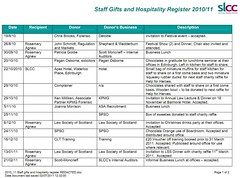
2010_11 staff gifts and hospitality register redacted_Page1The Hospitality Club : More gifts than complaints findings at Scotland’s law complaints quango. The SLCC’s registers of gifts & hospitality contains items such as invitations to dinners, drinks parties, lectures events and other gifts offered by several personalities from Scotland’s legal world including past Law Society Presidents Ian Smart & Jamie Millar, law firms such as Pagan Osborne, Shepherd & Wedderburn, Anderson Strathern, Beveridge & Kellas SSC, auditors KPMG & Deloitte, consumer organisations Consumer Focus Scotland & Which?, the Law Society of Scotland, Faculty of Advocates, the Institute of Chartered Accountants Scotland, the Medical Protection Society, the Administrative Justice & Tribunals Council Scottish Committee (AJTC), Scottish Government & others. While some members of staff are identified, others apparently are not, leaving a degree of suspicion over who attended some of the events such as law lectures at the Balmoral Hotel in Edinburgh.

Tuesday, January 03, 2012

Information Commissioner’s Office clarifies FOI law on ‘official business’ information held in private email accounts, texts. Scotland to follow ?

ico logoSneaky exchanges between civil servants, politicians & those in public bodies via private or secret email accounts can be revealed through FOI. SNEAKS in Government, Local Government public bodies & public services who use private email facilities to discuss official business in attempts to avoid the information leaking out through Freedom of Information legislation have now been told in no uncertain terms by the Information Commissioner’s Office (ICO) that information concerning official business held in private email accounts is subject to the Freedom of Information Act.

However, as the Guardian newspaper reports, the ICO’s move which brings Ministers private emails and text messages within the scope of FOI has angered politicians at Westminster who are now fearful Freedom of Information laws appear (to them) to be allowing too much openness following the latest ruling. The Guardian goes onto report “The chairman of the public administration committee, Bernard Jenkin, is understood to be considering a select committee inquiry next year in the wake of the recent ruling by Christopher Graham, the information commissioner.”

Currently there is no clarification from the Scottish Information Commissioner on how the ICO’s ruling on private emails affects FOI in Scotland, however, as they say, there’s no time like the present to test it out, particularly as it appears the practice of using private, secret, & throw-away email accounts by civil servants & certain ‘advisers’ to the Scottish Government appears widespread…

Commenting on the ICO ruling, Information Commissioner Christopher Graham said: “It should not come as a surprise to public authorities to have the clarification that information held in private email accounts can be subject to Freedom of Information law if it relates to official business. This has always been the case – the Act covers all recorded information in any form.

Mr Graham continued : “It came to light in September that this is a somewhat misunderstood aspect of the law and that further clarification was needed. That’s why we’ve issued new guidance today with two key aims – first, to give public authorities an authoritative steer on the factors that should be considered before deciding whether a search of private email accounts is necessary when responding to a request under the Act. Second, to set out the procedures that should generally be in place to respond to requests. Clearly, the need to search private email accounts should be a rare occurrence; therefore, we do not expect this advice to increase the burden on public authorities.”

Key points set out in the guidance include:

Where a public authority has decided that a relevant individual’s email account may include official information which falls within the scope of the request and is not held elsewhere, it will need to ask that individual to search their account.

Where people are asked to check private email accounts, there should be a record of the action taken. The public authority needs to be able to demonstrate, if required, that appropriate searches have taken place.

Although the main emphasis of the guidance is on official information held in private email accounts, public authorities should be aware that the law covers information recorded in any form

Public authorities should remind staff that deleting or concealing information with the intention of preventing its disclosure following receipt of a request is a criminal offence under section 77 of the Act.

It is accepted that, in certain circumstances, it may be necessary to use private email for public authority business. There should be a policy which clearly states that in these cases an authority email address should be copied in to ensure the completeness of the authority’s records.

Mr Graham continued: “As part of our work on understanding more generally how FOI handling works across government, we conducted a good practice visit at the Department for Education. We’ve today published the findings of that visit and are now keen to carry out similar visits to other Whitehall departments. Work on specific complaints made to the Commissioner about the Department of Education’s handling of individual FOI requests is still ongoing. We hope to issue our decisions on these cases early in the New Year.”

So, next time readers & FOI’ers do requests to the Scottish Government, local authorities, public bodies and so on, you may want to ask for any information contained in private email facilities used by those in the relevant organisations which relate to the business or subject access of your FOI request…