Showing posts with label Scottish Consumer Council. Show all posts

Thursday, February 10, 2011

Why a lawyer should NEVER be his own judge : The limits of self regulation in Scotland’s legal profession which place lawyers interests before clients

SCCScottish Consumer Council’s 1999 report echoes today’s client concerns of poor legal services & calls to scrap lawyers self regulation. A REPORT published by the former Scottish Consumer Council twelve years ago in 1999, “Complaints About Solicitors” concluded many clients who complained about their solicitor to the Law Society of Scotland felt the entire complaints procedure was biased, unfair, and discouraging. The report went onto recommend fully independent regulation of Scotland's legal profession.

Most of those clients who managed to somehow survive the Law Society’s torturous complaints system, where some cases took years to be heard, feel to this very day the Law Society of Scotland is nothing short of a thoroughly corrupt self regulator which spares no expense to ensure lawyers, no matter the crime they have committed, retain their jobs, titles, wealth & privileged position while their clients are left blacklisted from access to justice, financially ruined, and in some reported cases involving claims against the Law Society’s Master Policy, ill or even dead.

The Scottish Consumer Council’s 1999 report “Complaints About Solicitors” stated in its conclusion : “This report provides considerable evidence of consumer dissatisfaction with the way in which complaints against solicitors are presently handled in Scotland, both by solicitors and by the Law Society. We believe that there is an urgent need for both to adopt a more client-oriented approach to dealing with complaints. Solicitors must embrace the concept of client care, which would help to reduce complaints, while at the same time ensuring a better deal for clients. The Law Society’s procedure contains many major flaws, and we have suggested a number of ways in which these could be remedied. Were these changes to be carried out, this would go some way towards improving the lot of consumers who complain about solicitors.”

The SCC report continued : “However, such changes would not go far enough. It is essential that complaints are dealt with by a body which is seen to be independent and impartial. Those who complain must be able to feel that their complaint has been fairly dealt with. It is clear that the fundamental root of the problem from the consumer’s point of view is that the Law Society is seen as being on the side of the solicitor. The only effective solution to the problem is the establishment of an independent review body to deal with complaints against solicitors in Scotland”

Today in 2011, the expectations & experiences of thousands of clients who complain to either the Law Society of Scotland or the less-than-independent Scottish Legal Complaints Commission remain unchanged, where most consumers who encounter difficulties with their solicitors view the Law Society & SLCC as little more than systems put in place by the legal profession to cover up complaints against their own colleagues, continuing the long held, if corrupt tradition that a lawyer is still his own judge.
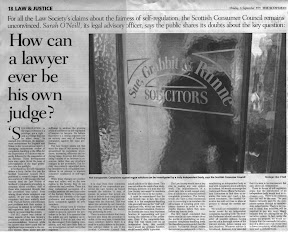
Scottish Consumer Council recommended independent regulation of legal profession in 1999. Writing in the Scotsman newspaper in September 1999, the Scottish Consumer Council’s Sarah O’Neill went some way to explaining the conclusions of the SCC’s “Complaints About Solicitors” report, going onto recommend the Scottish Parliament’s then Justice & Home Affairs Committee study the issue, saying : “The SCC report concluded that there must be an open debate about the merits of establishing an independent complaints-handling body. We therefore recommend that the Scottish Parliament should review the current procedure with a view to establishing an independent body to deal with complaints about solicitors in Scotland. We would encourage the Justice and Home Affairs Parliamentary Committee to find time to examine this issue and reach a balanced conclusion. The Scottish Executive has told us it has no plans at present to change the current system.”

Ms O’Neill went onto say : “We would not recommend a particular model for an independent complaints-handling body. The Scottish Parliament should carefully consider all possible options, having carried out a thorough review of the current system, before making any firm decisions. Whatever scheme is introduced, however, it is essential that it is seen to be transparent, fair and above all, independent.”

Scotland on Sunday February 2001 - Legal Profession in the dock over complaints about self regulationThe newspaper Scotland on Sunday reported in 2001 there would be an investigation into regulation of the legal profession at Holyrood. Scots had to wait until 2001 before there was substantive movement at the Scottish Parliament to secure an inquiry into regulation of the legal profession, a move made possible only from the much appreciated efforts of the late Phil Gallie, then an MSP. Mr Gallie at the time sat on the Justice Committee and was eager to participate in the investigation, a prospect welcomed by many law reform campaigners, including particularly myself as Mr Gallie had written to me confirming the inquiry was to go ahead.

Regrettably however, the Scottish Conservative’s hierarchy & leadership were not too keen on this idea, so Mr Gallie was taken off his Shadow Justice portfolio and replaced by Lord James Douglas Hamilton in the Justice 1 Committee’s “Regulation of the Legal Profession” inquiry, which, under the Convenership of Christine Grahame MSP, mangled the issue so much, even forbidding public entry & testimony to some of the hearings, the only people to get a say in the matter were lawyers, lawyers, and more lawyers.

Scots had another wait until 2006, when the Justice 2 Committee of the Scottish Parliament was given the task of investigating changes to regulation of the legal profession with its consideration of the Legal Profession & Legal Aid (Scotland) Bill.
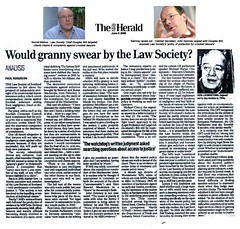
Would Granny Swear by the Law Society - The Herald June 5 2006Law Society Chief Executive Douglas Mill threatened legal action against complaints reform bill, also crossed swords with the SNP’s John Swinney. After a long year of bitter parliamentary hearings & debates, legal threats against the Scottish Executive & Scottish Parliament from the legal profession, public testimony & even evidence from now serving Government Ministers that the Law Society was a corrupt organisation, which regularly stage managed complaints & damages claims against ‘crooked lawyers’, the Scottish Parliament again mangled the issue, passing a butchered piece of legislation, the Legal Profession & Legal Aid (Scotland) Act 2007, which left the SNP to create the Scottish Legal Complaints Commission, a quango very far from independent, populated by lawyers, lawyers, more lawyers, a few ex lawyers, and a few ex senior Police Officers, with some quangocrats thrown in just for good measure.

The much-promoted-as-independent Scottish Legal Complaints Commission has, in its three years of existence, managed to uphold only one single complaint against an unknown solicitor or law firm, the remainder being handed back to the Law Society of Scotland for its own style of ‘crooked’ self regulation, you know, the one where the lawyer is his own judge …

So as things currently go, the position we remain in is that lawyers in Scotland are still their own judges. Clearly this is not what consumers of today’s world expect when they are forced into a position of having to make a complaint about their solicitor, not is it what was intended from all those numerous reports published by the Scottish Consumer Council, and even, dare I say, Consumer Focus Scotland over the many years which have passed.

The Scottish Consumer Council’s 1999 report “Complaints About Solicitors” stated in its conclusion : “This report provides considerable evidence of consumer dissatisfaction with the way in which complaints against solicitors are presently handled in Scotland, both by solicitors and by the Law Society. We believe that there is an urgent need for both to adopt a more client-oriented approach to dealing with complaints. Solicitors must embrace the concept of client care, which would help to reduce complaints, while at the same time ensuring a better deal for clients. The Law Society’s procedure contains many major flaws, and we have suggested a number of ways in which these could be remedied. Were these changes to be carried out, this would go some way towards improving the lot of consumers who complain about solicitors.”

The SCC continued : “However, such changes would not go far enough. It is essential that complaints are dealt with by a body which is seen to be independent and impartial. Those who complain must be able to feel that their complaint has been fairly dealt with. It is clear that the fundamental root of the problem from the consumer’s point of view is that the Law Society is seen as being on the side of the solicitor. The only effective solution to the problem is the establishment of an independent review body to deal with complaints against solicitors in Scotland”

The Scottish Consumer Council recommended in it’s 1999 report : “A Scottish Parliament should establish a review of the Law Society of Scotland’s complaints procedure, with a view to establishing an independent complaints body to deal with consumer complaints against solicitors in Scotland.”

The SCC went onto say : “We believe that such a review should be an urgent priority for a Scottish Parliament, in the interests of consumer protection. This review should involve an examination of best practice in complaints handling in other fields. All possible options, including statutory regulation and a non-statutory ‘arms-length’ scheme, should be carefully considered by the parliament.”

The Scottish Consumer Council’s 2001 report “The limits of self regulation in the legal profession” went on to state : “It has been the Scottish Consumer Council’s position for many years that complaints against solicitors in this country should be handled by an independent body, because this is necessary to ensure that there is public confidence in the impartiality of the complaints process.”

The 2001 report further stated : “The Law Society’s procedure continues to be run by solicitors, for solicitors. The existence of lay members on the complaints committees cannot by itself ensure independence. A large number of complaints do not even get as far as being considered by a committee because they are disposed of administratively by Law Society staff before then.”

Now, eleven years on, in spite of all which has passed at the Scottish Parliament, nothing has changed, mainly because the Law Society of Scotland has continued to intercept & interdict any effort to reform regulation of the legal profession, and of course, msps have allowed it.

Indeed, the Law Society of Scotland is as anti-client, & anti-consumer as ever, and their complaints system has not changed one bit. The Scottish Solicitors Discipline Tribunal, that alleged second tier of impartial prosecution of ‘crooked lawyers’ has also not changed. The SSDT’s habit of whitewashing even the worst cases of solicitor misconduct, negligence, poor service, or even criminality, has remained as constant as the numbers of ‘crooked lawyers’ getting a slap on the wrist.

Right at the heart of the Scots justice system, the Scottish Courts policy towards sidelining or discouraging cases involving the pursuit of ‘crooked’ or negligent lawyers has not changed, and to make matters worse, the Scottish Executive’s policy on regulation of the legal profession has actually regressed to the point it now advocates a stronger view for lawyers regulating themselves even more so than lawyers do. It is of course now well known, the ‘independent’ Scottish Legal Complaints Commission, the supposed new broom as a result of Holyrood’s intervention to clean up complaints against solicitors, has only managed to uphold one single complaint in its three years of existence, is not independent, not one bit.

However, what has stayed the same is the frequency of letters sent to msps by constituents who encounter difficulties with the legal profession, the Law Society of Scotland, and now, difficulties with the Scottish Legal Complaints Commission, yet it appears msps again do not want to give Scots a fully independent complaints system for legal services which now operates in other parts of the UK.

Clearly a new campaign is in need of being launched to end self regulation of the legal profession, and bring to an end the deadly era where lawyers are their own judges.

Those who are interested in campaigning on the issue of removing self regulation of the legal profession may wish to & should read some of the earlier Scottish Consumer Council reports on regulation of the legal profession, which can be viewed online or downloaded in pdf format at the following links :

The limits of self regulation in the legal profession (Scottish Consumer Council) 2001

Complaints Against Solicitors (Scottish Consumer Council) 1999

Getting the best from your solicitor (Scottish Consumer Council) 1994

I'm not happy with my solicitor (Scottish Consumer Council) 1986

Thursday, October 21, 2010

Consumer Focus Scotland will continue to make sure Scots consumers get a fair deal until Tory-Libdem axe falls in 2012

Consumer Focus Scotland logoConsumer Focus Scotland helped Scots consumers on many issues, including access to justice. CONSUMER FOCUS SCOTLAND staff have been told by their Chairman Douglas Sinclair, the organisation will continue to make sure Scots consumers get a fair deal in both private markets & public services until the Westminster coalition’s very anti-consumer decision to scrap the organisation takes effect sometime in 2012. I previously reported on the UK Government’s decision to scrap Consumer Focus & Consumer Focus Scotland HERE & HERE.

There is of course to be a “consultation” on the closure of Consumer Focus & Consumer Focus Scotland, details of which will follow in further reports, so there’s still time to try and save what is certainly a much needed voice for consumers all across the UK, and especially in Scotland.

Scots will also have a chance to voice their opinion at the ballot box next May 2011 on which Scottish political party is doing the most to protect Scots consumers, so use your vote wisely when the time comes, and make your voice heard against those who would strip us of much needed consumer protection, especially in these perilous times of financial hardship where a lack of consumer advocacy will assist those professions who seek to rip-off consumers when no one is around to do anything about it.

Douglas-SinclairConsumer Focus Scotland’s Chairman, Douglas Sinclair told his staff in a letter released to the media : “I am writing to you in the light of the announcement last week that the UK Government has decided to transfer Consumer Focus’ functions to Citizens Advice and Citizens Advice Scotland. Subject to the approval of the UK Parliament, it is proposed that the work of Consumer Focus Scotland will transfer to Citizens Advice Scotland in 2012, and at that point, it is planned that Consumer Focus will be abolished.”

“As it is expected that the necessary legislative measures, if passed by the UK Parliament, will not take effect until sometime in 2012, we will continue our work in making sure that consumers get a fair deal in both private markets and public services. We will be issuing a draft work plan for 2011/12 and look forward to working with you to deliver more benefits for consumers.”

“We will be working with the Scottish Government to ensure the best future management arrangements for the Scottish Government funded national development projects – healthy living award, Community Food and Health (Scotland), Scottish Accessible Information Forum and Health Rights Information Scotland. We will also continue to work with the Scottish Government on the planned transfer of Waterwatch Scotland’s advocacy powers to find a solution that works effectively for consumers.”

“I am immensely proud of everything which Consumer Focus Scotland, formed by the merger of the Scottish Consumer Council, Energywatch and Postwatch, has achieved in the first two years of its life, and of the legacy of over thirty years of work by these bodies in bringing about real benefits for consumers in Scotland. Consumer Focus and Consumer Focus Scotland have achieved a huge amount for consumers. Earlier this month, Consumer Focus obtained a £70 million energy bill refund for consumers across the UK.”

Consumer Focus Scotland’s achievements have included:

* Establishing the Scotland-based Extra Help Unit to support vulnerable consumers across Great Britain with their energy and post complaints. Since beginning work, the Extra Help Unit has dealt with thousands of complaints and enquiries and obtained over £1.4 million in compensation for vulnerable consumers.

* Following years of campaigning and influencing work, helping to secure the passage of the Legal Services (Scotland) Bill which will widen choice for users of legal services and increase access to justice.

* Securing the inclusion of a new duty on scrutiny bodies to continuously improve user focus in the Public Services Reform (Scotland) Act.

* Playing a key role in the establishment of the Post Office Challenge Fund for Scotland to support the development of Scotland’s post offices.

Considering some of their achievements, and their work as the former Scottish Consumer Council, they’ve done pretty well for us Scots, in many areas of consumer interest, particularly on issues relating to legal services, access to justice & regulation of the legal profession – my specialist areas of reporting. For what it costs to run Consumer Focus as an organisation, well, we’d be better saving it, than handing millions from the taxpayer over to those negligent bankers who have caused the cuts now facing public services & jobs in the UK.

Thursday, October 14, 2010

Bitter blow for Scots & access to justice reforms as Tory-LibDem coalition scraps Scottish consumer champion Consumer Focus Scotland

Consumer Focus Scotland logoScots consumer champion Consumer Focus Scotland axed by London Government. SCOTS CONSUMERS suffered a bitter blow today at the hands of the Westminster Conservative-LibDem coalition Government as it was announced Consumer Focus Scotland and its parent organisation Consumer Focus are being scrapped as part of the ‘savings drive’ to abolish ‘quangos’ which has so far only affected 200 out of 900 ‘Quasi-Autonomous Non-Governmental Organisations’ & other statutory bodies reviewed for closure, with at least 380 apparently being retained.

The announcement of the spending cuts caused the Cabinet Office’s website to temporarily crash, however the list of publicly funded bodies is now available HERE (pdf). The entry for Consumer Focus reads : “No longer an NDPB - Government will consider the outcome of ongoing sectoral reviews and consult early next year on proposals to abolish Consumer Focus and transfer its function to Citizens Advice.”. The Taxpayers Alliance are left to gloat now their demand Consumer Focus be axed, has come true.

Douglas-SinclairDouglas Sinclair, Chairman of Consumer Focus Scotland. Responding to the announcement by the UK Government today, Douglas Sinclair, Chair of Consumer Focus Scotland, said : “Consumer Focus, and Consumer Focus Scotland have achieved a huge amount for consumers. In the last few months alone Consumer Focus has obtained a £70 million pound energy bill refund for consumers across the UK and in Scotland the passage of the Legal Services (Scotland) Bill has meant the culmination of Consumer Focus Scotland’s campaign to widen choice and protection for users of legal services, and we played a key role in the establishment of the Post Office Challenge Fund.”

Mr Sinclair continued : “The UK Government has decided to transfer at least some of our functions to Citizens Advice and Citizens Advice Scotland. I am immensely proud of what we have achieved. The issue now is not who does the work but that the work is done at a time when consumers are facing difficult economic circumstances, especially those who are vulnerable and whom we have a particular duty to protect.”

“What matters now is that the transfer happens in a way that works in consumers’ interests. We will be working with the UK and Scottish Government to do this in the best possible way in the interest of consumers in Scotland. The expertise and knowledge that has enabled us to fight for consumers must not be lost. Changes must not be at the expense of the public’s rights and needs - which organisations like Consumer Focus Scotland were created to protect.”

The Office of Fair Trading (OFT) is also being scrapped, its competition functions merged with the Competition Commission along with a transfer of its consumer and enforcement functions. High-profile consumer right challenges in the future will be mounted by underfunded local trading standards officers – I don't think so.

BBC News reported on the quango cuts saying Cabinet Office Minister Francis Maude had told MPs money would be saved by axing the quangos, saying the main reason for the cull had always been to improve accountability, by having decisions taken by ministers and local authorities where possible.

Consumer group Which?, who will remain as one of the few remaining consumer protection organisations said today the shakeup of the consumer landscape with the scrapping of Consumer Focus must not leave consumers exposed.

Peter Vicary SmithWhich? CEO Peter Vicary-Smith. Which? Chief Executive, Peter Vicary-Smith commenting on the axing of Consumer Focus & other consumer bodies said : "It’s vital that front line advice and enforcement services are maintained, so we’re pleased that Trading Standards and Citizens’ Advice have survived the cull. Which? is talking to the Government about how it can help with providing extra support to consumers in the new regime and continue to do so without taking Government money.”

He continued : "These changes also raise questions about moving responsibility for national enforcement to dedicated individual Trading Standards authorities. How will a local Trading Standards have the resources or the expertise to take on national companies such as the big banks, the airlines and the supermarkets?

"The merger of the Competition Commission offers the opportunity to strengthen competition regulation in the UK, but this will only happen if the new body is given the resources it needs to match its task and police markets effectively."

Perth based law reform campaigner Stewart MacKenzie, author of Petition 1247 - the McKenzie Friend petition which brought about one of the most significant changes in Scots courts for decades and won him the Which? Consumer Champion award for 2010 condemned today’s decision to scrap Consumer Focus Scotland.

Mr MacKenzie said : “'Consumer Focus have done incredible, important work since they were formed 2 years ago, as did their predecessor, the Scottish Consumer Council over many, many years. This is a shattering blow and I can only hope there is a route yet available which may be able to stop this happening and that is why I’ve asked my msp John Swinney to get the First Minister involved in this matter.”

The Scottish Government were asked for comment on today’s blow against Scots consumers. Their statement will appear here if one is issued.

This is of course, a bad day for Scots. No matter how this disgraceful decision is spun, Consumer protection in Scotland will suffer with the loss of Consumer Focus Scotland. Good people and a lot of valuable experience centralised in a well respected national coherent body have been thrown out under the guise of saving money, when in reality it will cost consumers in Scotland and across the country, dearly.

The plan by the Westminster Government, apparently, is to hand over Consumer Focus Scotland’s duties to Citizens Advice Scotland and the many uncoordinated local Trading Standards teams scattered across the regions who themselves are now subject to huge cuts in local authority spending. From experience in dealing with CAB/CAS & local Trading Standards outfits in Scotland, these organisations will have to up their game considerably if they are to match the effective, coordinated campaigning by the Scottish Consumer Council and its successor, Consumer Focus Scotland who served all of us in Scotland so very well over many years.

From the beginnings of my dealings with the Scottish Consumer Council in the mid 1990’s, during its leadership by Derdrie Hutton, DBE, to its current form as Consumer Focus Scotland, I can safely say they have always been a beneficial & much-listened-to voice for change, in the many areas of consumer interest & protection in Scotland, especially those issues on which I report including civil justice reform, regulation of the legal profession & access to justice.

Sadly in 2010, I am now reporting this much valued voice and effort on the part of Scots consumers is to be lost in this very anti-consumer move by the coalition Government in London.

Saturday, March 06, 2010

Consumer protection 'a low priority' as law firms call for split from Law Society masks solicitors power grab for Scots legal services market

Law Society of ScotlandLaw Society of Scotland faces division over Legal Services reform. LEGAL SERVICES REFORM which would bring Scots wider access to justice is facing a new , if perhaps temporary hurdle as several solicitors & law firms who are upset over the plans contained in the Scottish Government’s Legal Services Bill, call for a break away from the Law Society of Scotland, who are now being accused of not representing solicitors best interests, by not protecting the ‘independence’ of Scotland’s legal profession – which actually translates into not protecting solicitors current monopoly over consumers access to justice.

The Legal Services Bill, which you can read more about in my previous reports HERE, if passed by the Scottish Parliament, will effectively allow much wider competition in Scotland’s currently ‘solicitor only’ dominated legal services market, freeing consumers from being forced to use a member solicitor or law firm of the Law Society of Scotland to gain access to justice or legal services.

In a reformed legal services market, banks, supermarkets and others will be able to provide Scots consumers with legal services at costs much less than those currently charged by law firms controlled by the Law Society of Scotland, who are now more widely known for their failures to represent clients best interests while charging huge fees for little work, than achieving actual successes for clients who often end up worse off than before they walked in the lawyers front door.

Those leading the call to split from the Law Society are the Glasgow Bar Association, the Govan Law Centre, along with two Glasgow law firms, MacRoberts & Thomsons , all warning that introducing Legal Services Reform to Scotland (the same reforms introduced in England & Wales during 2007 with much less fuss) will undermine centuries of independent legal representation in Scotland. While client & consumer protection appear very low down on the list of priorities in this argument which is essentially between law firms & the Law Society vying for control over the consumers right to choose their legal representative, the Glasgow Bar Association have now called for a referendum for all solicitors to decide whether the Law Society of Scotland should represent their interests.

Now that certain sections of Scotland’s antiquated, monopolistic legal services market realise their income & influence via the current business model is under threat, a drive is underway by solicitors to influence members of the Scottish Parliament to vote against the Legal Services Bill, citing among the arguments, that Government Ministers will be able to interfere in the selection of members of the Council of the Law Society, where up to 20% of the 60 will be made up of members of the public Government stooges, who could be picked according to criteria set by ministers – just like we saw at the Scottish Legal Complaints Commission, where the Law Society managed to stuff the SLCC with its own people as I reported earlier here : Call for MacAskill appointments 'sleaze investigation' as revelations show Legal Complaints Commission member was subject of Police inquiry

The problem with that argument about Ministerial interference however, is as you can see that despite Ministers apparently having the power to make independent selections, they always appear to select more stooges from the profession itself, so in reality nothing much will change, other than perhaps certain sections of the legal profession not being able to stuff the Council of the Law Society as they have always been used to doing …

Clearly solicitors don't want anyone other than solicitors on the Law Society’s ‘Council’, although that would be fine with me if the Law Society were to be stripped of its regulatory & disciplinary role, and left to be nothing more than a representative union for solicitors, rather than the all controlling, all powerful, all crooked regulator it has always been.

An official from one of Scotland’s consumer organisations branded the current debate ‘a diversion’ and accused certain sections of the legal profession from trying to obstruct reforms which would lead to greater consumer choice and protection from Scotland’s notoriously poor legal services market.

He said : “Clearly certain sections of the legal profession seem intent on staging a coup for control of the Law Society in an attempt to thwart much needed reforms to Scotland’s legal services market. This is purely a selfish move designed to promote the interests of solicitors over consumer choice.”

He continued : “The only way to resolve the fears of solicitors in this debate would be to strip the Law Society of its regulation role and that of representing clients best interests, steps we would wholeheartedly welcome.”

Ian SmartLaw Society President Ian Smart – independence is essential. The response from the Law Society of Scotland was to claim it had always promoted independence of the legal profession as being fundamental to its support of the Legal Services (Scotland) Bill. Mr Smart said : “In its response to the Bill and during parliamentary evidence sessions, the Society insisted that independence is essential and that the role of the Lord President should be strengthened to ensure that this remains the case. The Society will continue to lobby changes to section 92, which has been raised as a concern by both the Society and its members.

Mr Smart continued : “The Bill as it currently stands provides ministers with powers to make regulations which could specify the criteria they considered appropriate for appoint ability and the number of lay members on Council and can prescribe a minimum number or proportion if they believe such a prescription is necessary. Before these regulations are made, Scottish ministers would have to consult with Council, the Lord President, OFT and other consumer bodies. That would only be the case if the Society failed to implement section 92 properly. Only the Society can appoint any lay members to the Council, not Scottish ministers. It should be remembered that most other professional bodies have for many years appointed lay members because of the qualities, expertise and talent they bring, including the GMA (General Medical Council, GDA (General Dentists ' Council), ICAS (accountants), RICS (surveyors) and the BMA (British Medical Council), which although is a representative body also has large patient representative committees.”

“It may be difficult to accept any input by politicians into how the Society functions, despite it being a body set up by statute, but the 20% lay membership on Council, which will become part of the Society's obligations, was decided by Council members and has been agreed as appropriate by ministers. This is despite continued pressure from the consumer lobby for somewhere between 50% to 75% of lay membership on the Society's council. Lay members have also been on the Society's regulatory committees for around 20 years and all now have 50% lay membership. Non-regulatory committees are predominantly made up of practicing solicitors.”

“None of this represents a handing over of independence of Scotland's largest legal profession and taking an antagonistic stance does not help negotiate any long term benefits for the profession.”

If solicitors are going to have a say in who represents them, without giving any regard as to who will represent the very clients who fund their ill deserved lavish offices & law firms, perhaps clients and consumers should also be able to have a referendum on who they want to regulate legal services and handle complaints against the legal profession.

Which logoWhich? revealed recently most want independent regulation of legal services. We already know from research which has already taken place on this issue, some of it dating back over a decade from the Scottish Consumer Council, to current research undertaken by UK consumer organisation Which?, consumers have always wanted a fully independent regulator of legal services in Scotland, rather than the half way, hapless, ‘just as crooked’ Scottish Legal Complaints Commission, which now ranks among most clients as Law Society MkII when it comes to dealing with complaints against solicitors.

Only fully independent regulation of Scotland’s legal services market will resolve these and many other problems faced by consumers and solicitors alike but as we have seen from the dithering Justice Secretary, fully independent regulation of solicitors is apparently a step too far for Mr MacAskill who according to his own civil servants, is too busy purging the Justice Department than addressing issues affecting Scots access to justice …

For more on this story, read THIS REPORT in the Herald

Friday, July 31, 2009

Scotland's civil courts system is a mess and consumers have little access to justice, reports 'limited' Consumer Focus survey

Consumer Focus ScotlandLong awaited Consumer Focus research points to lack of access to justice in Scotland's civil courts. SIX YEARS after the Scottish Consumer Council began investigating the mess that is Scotland's civil justice system, the SCC’s latest incarnation, Consumer Focus Scotland, has reported to a rather unsurprised audience that Scotland's civil courts are indeed in the mess we all know them to be, and that access to justice in the civil courts is limited at best, descending to 'non-existent' for most Scots who try to pursue civil law issues on their own.

The research, funded by Consumer Focus Scotland, managed by the Scottish Legal Aid Board, and implemented by market research group IPSOS-MORI, which was initially hoped would interview hundreds of people, eventually only took in the views of 35 court users, because the Scottish Court Service, as I reported yesterday, blocked the release of crucial documents on cases to the research team.

You can download & read a copy of the Consumer Focus Scotland research in acrobat .pdf format : HERE

The problem I have with the report is that there are too few numbers involved in the actual survey, and therefore too few experiences studied & reported to back up what should be wide ranging reform proposals we are all expecting to hear from the work of Lord Gill’s civil court review. The Consumer Focus report conclusion does highlight these shortcomings of a lack of interview subjects for the research, but as many pointed out yesterday in my report on the Scottish Court Service blocking the success of the Consumer Focus research, much more could have been done to attract people into the project.

The Report’s conclusion makes reference to a lack of interview subjects, twice : “This report contains the findings of a small scale, exploratory piece of research which has aimed to build on the existing weak evidence base of the experiences of civil court users in Scotland. Because of the difficulties involved in identifying and accessing court users, our eventual sample of litigants (a combination of those who had contacted an in-court advice service and litigants identified through Scottish Legal Aid Board applications data) cannot be said to be typical of the population of unrepresented litigants currently pursuing cases through the courts – in terms of factors relating to demographics, case and litigant type as well as their experiences, attitudes and behaviour.”

and here : “Lastly, because of the narrow range of sample available to us in order to conduct the research, those interviewed had gone through either a small claims or summary cause action. None had experienced ordinary cause procedure, and considering that these cases are likely to be more complicated, with no standard forms available to help unrepresented litigants, there is good reason for ensuring this group is included in future studies.”

Law Society of ScotlandMissing from the report is the fact that for now, consumers access to justice is controlled by the legal services market monopoly enforced by Law Society of Scotland and individual solicitors. The glaring omission in the Consumer Focus research, is the obvious fact that problems with the public’s access to justice in the civil court system can really be explained in one obvious sentence - a lack of access to trustworthy, transparent & accountable legal services & legal representation at a reasonable cost. Access to justice in Scotland, will always be restricted until the element of control the legal profession itself exhibits over the justice system is taken away from them.

A person’s right of access to justice should not be decided by a solicitor on the back of the legal profession’s business for profit model, brutally enforced as a monopoly by the Law Society of Scotland for far too long … a person’s access to justice should be decided by the court after a fair hearing on the individual’s case, with that individual having unrestricted access to the trustworthy, transparent & accountable legal services & legal representation at a reasonable cost which everyone deserves, regardless of wealth or status.

Reforming civil justice and the civil courts is one thing, but any such reforms are meaningless unless the legal services sector itself is reformed, and fully opened up to competition and effective independent regulation, so that people don't need to face the court alone and defend themselves against not only an adversary, but also the less than friendly court environment and also the usual opposing legal counsel who will use every trick in the book to prevent party litigants from gaining a fair hearing in civil court cases.

Now of course, the test comes on how exactly these findings, and indeed the experiences of tens of thousands of other Scots who have used or attempted to use the civil justice system in Scotland, will impact on the forthcoming Civil Courts Review, chaired by Lord Gill, the Lord Justice Clerk. Reform must take place, sooner rather than later - and this time, for the good of the public, not the legal profession.

Here is the Press Release from Consumer Focus Scotland which accompanies the release of the research :

Views and experiences of civil sheriff court users

What’s going to happen to me?

Snapshot of court users points to need for better information and guidance

A study involving people taking and defending civil cases in Scotland’s sheriff courts suggests people too often don’t know what’s going on around them. The snapshot study commissioned by Consumer Focus Scotland and the Scottish Legal Aid Board shows court users can find themselves believing what’s to come is going to be far worse than it turns out to be.

Head of Policy at Consumer Focus Scotland, Sarah O’Neill – herself a solicitor and former in-court adviser – says the research points to an urgent need for better information for the public, and wider access to support services in all courts:

“People who bring their civil cases to court, or defend cases brought against them, who are often representing themselves, told us that it can be worrying and bewildering. While solicitors and some businesses that use the courts a lot may find it all straightforward, the lack of information, and sometimes advice and help services, are disadvantaging people taking or defending a civil case in court, often for the first time.”

Due to advice from the Scottish Court Service that for data protection reasons they were unable to allow us access to court records, the research was confined to in-depth interviews with 35 people contacted through the Scottish Legal Aid Board and In Court Advice Services.

“This can only be a snapshot as we did not manage to reach the numbers and variety of court users needed to create a bigger picture,” says Sarah O’Neill. “However, it is very rare indeed for anyone to ask court users in Scotland for their opinions on the system – there has been little previous research into these issues. A consistent message we got back was that few knew what to expect and many were deeply concerned about understanding the language and procedures.”

In Court Advice Services, now funded by the Scottish Legal Aid Board, were generally praised by users who suggested they needed to be better publicised. Some litigants felt the services were over-stretched and lacked connections with the court’s own staff.

Sarah O’Neill says courts themselves are not seen as user-friendly:

“One complaint was that little thought seems to be given to what is convenient for court users. As one person who pursued a small claims action and represented himself put it: ‘It’s always ten o’clock and it’s always on a Thursday, but you can sit there for two hours.’

“Of course, what no research with court users will ever tell us is how many people are put off pursuing their case as a result of their preconceptions about what’s involved. This is another reason why investment in giving people a deeper understanding of the Scottish legal system is essential to opening up civil justice.”

The findings of the study are being submitted to the Civil Courts review being led by Lord Gill, and to the Scottish Government.

Notes for Editors

The interviews undertaken by Ipsos MORI with litigants covered:

* Accessing civil justice
* Appearing in court
* Fairness of process
* Self-representation
* Information provision
* Court staff
* In-court advice services
* Cost of litigation
* Timescales

Those interviewed had been involved in a variety of case types, including small claims actions, debt, housing and eviction cases and mortgage repossession proceedings. The court users interviewed fell into categories:

respondent TYPE

Civil Legal Aid Applicant : 19

Received advice from in-court advice service : 16

LITIGANT TYPE

Defender : 26 Pursuer : 9

COURT HEARINGS

Case heard in court : 17 Case not heard in court : 17 Not sure whether case heard in court : 1

Representation in court

Of 17 cases heard in court Represented by solicitor in court at some stage in proceedings : 6

Represented self in court at some stage in proceedings : 9 Case heard in court but did not attend : 2

Quotes from Interviews:

[About the prospect of going to court] They seem to use a lot of legal jargon…I’m pretty much a straight talking person, I’m not one for the words that they use….I could possibly have used the wrong word or put it in a different way and it wouldn’t have helped me.

Pursuer, small claims action, received advice from in-court advice service, case not heard in court

I wouldn’t have a clue what to do anyway, they’re professionals so they know the ins and outs….I’d rather they did it and did it correct than I did it and made an ass of it.

Defender, mortgage arrears, represented by solicitor in court

“I was actually shaking to be quite honest with you….What was going to happen to me, was I going to go to jail? I was sitting outside the courtroom and I was biting my nails and I was like, ‘what’s going to happen to me?’. I was in a terrible state and the boy next to me said, ‘nothing’s going to happen to you’, and I was actually crying. I thought honestly….I thought I was going to jail. Nobody had said what would happen to me”

Defender, rent arrears, received advice from in-court advice service, represented self in court

“Perhaps a leaflet or some form of information about what to expect, you know, how the process runs through….along with my letter to appear in court.”

Defender, rent arrears, represented by solicitor in court

In-court advice services

The Scottish Consumer Council, one of Consumer Focus’s predecessor organisations, established the first in-court advice service in Edinburgh alongside Citizens’ Advice Scotland, and has been a key supporter of their expansion. There are now six in-court advice services in Scotland, in Aberdeen, Airdrie, Dundee, Edinburgh, Hamilton and Kilmarnock. The Scottish Legal Aid Board assumed funding responsibility for these services in April 2009 and is working with them to build capacity where needed and ensure that they are responsive to the needs of those appearing in court unrepresented.

‘McKenzie Friends’

Consumer Focus Scotland is also submitting its written evidence to the Public Petitions committee of the Scottish Parliament on the introduction of ‘McKenzie Friends’ to assist unrepresented litigants The evidence states that Consumer Focus Scotland supports the introduction of McKenzie Friends, and that while the research does not purport to offer a definitive conclusion on the views of court users, it does suggest that unrepresented litigants might benefit from the opportunity to have a McKenzie Friend with them in court, who could provide them with moral support and other appropriate assistance. Having such support available could help take away some of the fear associated with appearing in court and therefore potentially improve the experience of unrepresented litigants in court.

Friday, November 28, 2008

Scotsman legal debate : Complaints Chief ‘left speechless’ over file shredding claims as solicitors struggle to regain public confidence

On Monday of this week, the Scotsman held a live legal 'debate' on the future of the legal profession and the Scottish legal services market.The 'debate', which opens the nominations for the legal awards 2009, where you might even be able to nominate Scotland’s most crooked lawyer, was intended as a “Have Your Say” on the state of the legal profession.

Sadly however, spectators and guests alike coming out of the meeting claimed the 'debate' such as it was, did nothing to address the public's continued scepticism over attempts by the Scottish Government and the legal profession itself to reform the way in which solicitors are regulated in Scotland.

The tone of the debate, as one solicitor himself put it seemed to be that of a self congratulatory pat on the back, for avoiding the creation of a completely independent regulator which may have ended up exposing the vast amount of corruption in complaints & the poor handling of client affairs which many associate with the Scots legal profession.

However, consumers & clients, concerned over the lack of progress in reforming the legal profession, and access to justice in Scotland, cited examples such as the huge numbers of client complaints and continuing almost daily scandals portraying many of Scotland's legal firms to be either crooked or incompetent at their job, coupled with the Law Society’s inability to raise standards of service in what is now recognised as one of the worst quality legal services markets in the developed world, as being issues which to the panel members present at the ‘debate’, seemed unwilling to address.

One bright point of the night was a question from the floor to Jane Irvine, the Chairman of the 'independent' Scottish Legal Complaints Commission on why during her time as Scottish Legal Services Ombudsman, she had done little over the Law Society of Scotland allowing solicitors to shred and destroy files before & during an investigation, in a practice which surely borders on the criminal.

The apparently acceptable practice of solicitors destroying files before & during Law Society investigations was compared to the recent example of the Conrad Black case where it was alleged there had been mass destruction of files, inevitably leading to Blacks’ guilty verdict and jail term, and Jane Irvine was asked what steps she had taken to deal with the matter.

Unsurprisingly, Mrs Irvine was “left speechless” as one onlooker put it ... as it has emerged there has been nothing done since the issue was mentioned in her annual report of 2006-2007, covered here and there has not even been a report made to the Police & Crown Office, despite a ‘memorandum of understanding’ which states that all criminal activities must be reported to the authorities.

No doubt for the sake of consumer protection, and not least the definition of the word "Honesty", the SLCC will amend this policy of allowing rogue solicitors to shred their files or selectively delete parts of files before they are handed over to clients upon request. However, when they will get around to doing that, is anyone’s guess …

While the 'debate' dragged on with questions coming mostly from the Chair rather than the floor, notable lack of mentions included a decision by the SLCC to engage with the notorious insurers Marsh UK on presentations to the Commission over the workings of the corrupt Master Insurance Policy which insures Scottish solicitors against negligence & financial damages claims from clients.

You can read more about the Master Insurance Policy here : Previous articles on the Master Policy

The corrupt practices of the Master Policy and the Law Society’s part in restricting or blocking client’s access to legal representation against its own crooked lawyers was, it seems, too hot and honest a topic for the ‘debate’ on Monday, but as I remember well, there was a time when the Scotsman did not shrink from such controversial issues, such as is covered here : How the Scotsman once honestly covered the legal profession

Eileen Masterman Also failing in a mention at the 'debate' was the SLCC's Chief Executive, Eileen Masterman (pictured from a Which? article) refusal so far to allow potentially hundreds of client victims of the Law Society’s ‘Master Policy’ to make an equivalent presentation to the Commission on their appalling experiences with access to justice and the insurance claims process against crooked lawyers.

It may do Mrs Masterman some good to note and reflect on the fact it was the same terrible experiences experiences of clients and the public with the Law Society of Scotland and the Master Policy, which the current Cabinet Secretary for Finance, John Swinney aired at the Justice 2 Committee hearings into the passage of the legislation, which created the Commission and gave Mrs Masterman her current job & salary.

One guest at the debate who left with a feeling it didn’t go the way the Law Society figures present wanted, made the following comment: ”The Vice President of the Society (Ian Smart) was positively boiling with rage - he kept it disguised, but he knew that the wee public relations event was a shambles, akin to a puppets convention"

Another guest who attended was highly critical of the SLCC, and unimpressed with the Scottish Government’s efforts to give the public a measure of fair & independent regulation of the legal profession.

He spoke out against Jane Irvine’s input into the debate : "Irvine, the SLCC Chairman appeared a complete non-entity. She spoke with sufficient 'expression' that just about belied the emptiness of content in her words which sounded like a script she'd been given to read out to a room full of lawyers who all know the game is all about protecting their backs after they are caught out fleecing their clients."

Martyn Evans, Director of Consumer Focus Scotland who also attended the 'debate' managed a few critical remarks, and agreed that some of the questions raised in the debate by clients of solicitors who were dissatisfied with how complaints were being handled, were those kinds of issues which represented the majority of communications that his organisation (the former Scottish Consumer Council) had been receiving for years - and that this ‘reflected the fact that the Law Society had nothing to be proud about in its prior conduct of complaints handling.’

Sadly however, Mr Evans indicated ‘he preferred to look forward, as looking backwards would not assist progress to making the future better’, so clearing up the sins of the past doesn't seem to be on the minds of Consumer Focus Scotland for now.

Consumer Focus Scotland were contacted for a comment on the debate – they refused.

Perhaps, as one experienced journalist put it who also failed to get a comment out of the Consumer Focus camp - "They have been told not to rock the boat or support any moves to recompense or reconsider past cases of complaints against solicitors, due to the sheer volume and corruption which has taken place over the years at the Law Society of Scotland".

So at the end of the day, the ‘debate’, such as it was, didn’t really do much to give anyone hope the future of Scotland’s legal profession and legal services market would be any better than it is now .. and that is simply not good enough.

As it stands, with apparently even Consumer organisations being told to sweep the dirt under the carpet, clients of solicitors might do well to save themselves from any further harm from the veritable army of rogue lawyers out there, by taking their legal business elsewhere, or holding off using a crooked lawyer, until an honest one comes along …

Here follows the story from the Scotsman which advertised the ‘debate’, on the same day … you could just tell it was going to be one of those ‘don’t raise the big issue’ meetings …. and look out for the ‘other’ version of how the ‘debate’ went sometime next week in the paper itself …

Jennifer Veitch: Have your say in debate on state of the profession

EVEN if it was possible to forget about the recession, there has been no shortage of challenges facing lawyers and those who depend upon their services.

Tonight, Scotsman readers will have a rare opportunity to ask a panel comprising some of the key figures in the profession – and those tasked with keeping a close eye on what it is getting up to – what the future holds both for solicitors and their clients.

As I am chairing the debate, I have been reflecting on some of the big issues that are likely to come up.

From the point of view of consumers (and that includes me), one of the biggest is likely to be just how is the new complaints landscape shaping up?

Following widespread and ultimately insurmountable public cynicism about the Law Society’s ability to carry out impartial investigations into complaints about its own members, the new Scottish Legal Complaints Commission opened for business just over a month ago.

Commission chair Jane Irvine will be on hand to give a progress report on how the complaints gateway has fared during its first weeks in operation and to answer queries as to what the new rules and regulations will mean in practice for lawyers and consumers.

Joining her on the panel will be Ian Smart, vice-president of the Law Society, who will be able to give his perspective as a practising solicitor – and may want to take the opportunity to point out that there has been a downward trend in complaints in recent years.

Nevertheless, the audience might well want to know what the society is doing to drive up standards in the profession – a project that is due to come to fruition next year – and to prevent service complaints from cropping up in the first place.

With the recession kicking in, law firms have their part to play in growing Scotland’s economy, so perhaps the most pressing issue that the Law Society and firms now want some clarity about is what the advent of alternative business structures will mean for the future.

Following last year’s Which? supercomplaint to the Office of Fair Trading, solicitors are now awaiting the Scottish Government’s proposals for ABS, which could allow non-lawyers to be partners or investors in firms.

Panel member Martyn Evans, director of Consumer Focus Scotland, will be well-placed to set out the arguments in favour of deregulation to increase choice and drive down prices for clients.

Morton Fraser chief executive and CBI Scotland vice-chair Linda Urquhart will bring her unique perspective on ABS and other issues to the panel. Just what does the Scottish Government need to do in order to support firms competing in the UK and around the world?

Solicitor advocate John Scott, a partner with Capital Defence and a high-profile campaigner on human rights, will doubtless have much to say on the potential impact of ABS on access to justice. Legal aid funding, and the impact of recent changes to summary legal aid are also likely to be high up on his agenda.

Amid all the economic doom and gloom, there is also the question of who will provide legal services in the future – is the profession doing enough to nurture talent, or has the LLB been devalued by the increase in students graduating from Scottish law schools?

Will the Law Society’s proposals to shake-up education and training really serve to improve the diversity of the profession? And, crucially for recent diploma graduates, will a more robust traineeship only make it less attractive for firms to take on aspiring solicitors?

While tonight’s event is designed to shine a bright light on what could and should be improved in the Scottish legal profession, it should not be forgotten that there is also much to celebrate.

The debate marks the official launch of the 2009 Legal Awards to be held in Edinburgh next March. Entries are open now – who would you nominate?

Sunday, July 13, 2008

Law Society of Scotland to allow 'secret reports' from lawyers against clients amid prejudiced complaints handling reforms

In an effort to regain some control over the expected uncontrollable rising numbers of complaints against Scottish solicitors, the Law Society of Scotland has embarked on a little talked about series of adjustments to complaints procedures & reduction of client's rights in dealings with lawyers in an effort to regain the high ground over consumers of legal services in Scotland.

The Law Society has, decided to bring back the bad old days of complaints whitewashing, where a client who had complained against their solicitor had little or no part in the actual investigation & consideration of the complaint by the Law Society's infamous Complaints Committee structure, where lawyers had commonly put forward personal submissions either from themselves or their very own Law Society representative before the Committee, while the client of course, had no such luxury or entitlement.

There can be little doubt in this move, the Law Society wishes to retain full control over complaints against solicitors, and the client’s ability to gain access to justice to resolve any difficulties brought upon them by their less than honest or competent legal agents and no doubt the raft of whitewashing from the Law Society itself.

I myself experienced a version of this procedure, where James Ness, the now head of "Law Care", which specialises in dealing with stressed out crooked lawyers, put forward secret submissions for Kelso solicitor Andrew Penman of Stormonth Darling Solicitors, which I was not allowed to see or reply to.

The secret submissions in the Penman complaint then forced the Complaints Committee to change their original decision to prosecute Penman over an unbelievable wide range of frauds found by one of the Law Society's own investigators, which included deceiving Banks, the Inland Revenue, myself, other beneficiaries on legal & financial information relevant to Mr Penman’s woefully poor and rather dishonest legal service provided to my late father’s estate, even going so far to fiddling & falsifying files in an attempt to cover up his actings.

You can read more about the Andrew Penman complaint and how the Law Society of Scotland mishandled it here : Andrew Penman & Norman Howitt : Borders lawyer & accountant team up to ruin Cherbi executry estate

It is fairly clear, from not only my experience, but those of others reported to me, that clients must have a full involvement in the complaints process, whether that be at the Law Society of Scotland or the Scottish Legal Complaints Commission itself ... and from the following letter issued by the Scottish Consumer Council to the Law Society of Scotland over this matter, it would seem there are others in agreement on this :

SCC Director Martyn Evans takes issue with the Law Society of Scotland shifting the goal posts for clients once again …

SCC response to new process for handling conduct complaints

Martyn Evans, SCC Director :

“While we are unable to comment in detail on the proposed process, we are, as you might expect, concerned at the limited involvement which the complainer will have in the process. While we understand the argument that the complainer is seen as a witness, rather than as a party to the proceedings, we do not consider that this justifies allowing the complainer to have no involvement in the process other than to receive a copy of the final written report on the matter.

We are well aware that this has been an issue of contention in the past, with the solicitor being allowed to make representations on their own behalf, while the complainer is not allowed to do so. It is proposed that only the solicitor will have the opportunity to comment on, and make representations in relation to, the narrative and assessment document produced by the case investigator. This is a very one-sided process and is unlikely to be viewed by complainers as being fair.

If the Society is to ensure that its process is viewed as fair, rather than being seen to take the side of the solicitor, as has been the case in the past, the complainer must also be given the opportunity to comment on this document. It cannot be in the interests of natural justice to refuse to allow the complainer, who may have suffered considerably as a result of the solicitor’s conduct, the opportunity to comment on any representations made by the solicitor.”

Certainly a good thing the Scottish Consumer Council have taken this issue on board, and scanning through my own work on this matter over the years, I note the Scottish Legal Services Ombudsman of the time, who investigated how the Law Society of Scotland whitewashed the Andrew Penman complaint, recommended that solicitors should be banned from making personal submissions in the future as was made for Andrew Penman ... because as I found out from further revelations of the 'Penman submissions', it seems such submissions are usually full of lies and accusations against clients in a desperate attempt by 'crooked lawyers' to get themselves off the hook.

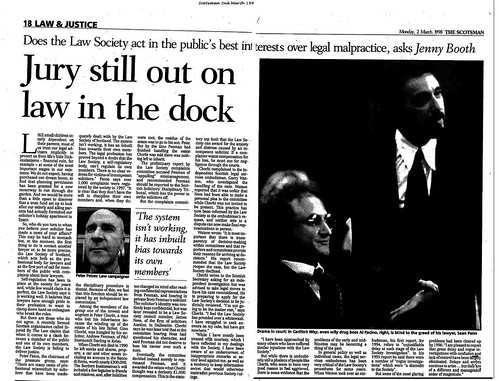
The Scotsman reports on Andrew Penman’s ‘secret representations’ to the Law Society of Scotland’s Complaints Committee :

Jury  still out on law in the dock - The Scotsman 2 March 1998

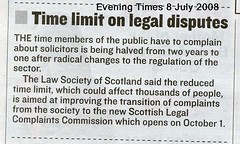
However, not content with reducing clients rights in terms of involvement in the complaint itself, the Law Society of Scotland has went one step further and reduced the time limit which clients have to complain against a solicitor from the current two years to one year - claiming this 'little talked about' alteration will "help clients" rather than hinder their ability to raise a complaint over poor legal service or conduct in the future.

Time limit on legal disputes – Evening Times 8 July 2008

Time Limit on Legal Disputes Evening Times July 8th 2008

So, as you can see from the above short comment in the Evening Times newspaper, if your lawyer has served you poorly and covered up his actions to the extent you don't find out what they did until a year afterwards .. there's no chance of getting any redress in the new system .. which is rapidly turning out to sound like the old system now ...

The Scottish Consumer Council’s reaction to this was issued in a Press Release last week as follows :

SCC News Release

Comment on the announcement by the Law Society of Scotland that the deadline for making complaints to them is to reduce to one year as part of the transition to the new Scottish Legal Complaints Commission

Sarah O'Neill, Legal Officer at the Scottish Consumer Council said it was essential that people who have a grievance don't delay lodging their complaint:

"The new Scottish Legal Complaints Commission will be able to award four times as much in compensation where cases are found against a solicitor as the Law Society of Scotland, but there's no point hanging on until October to bring your case in the belief that you’ll get a better outcome under the new SLCC.

"Any complaints relating to work handed to a solicitor for the first time up to and including 30th September 2008 will still be dealt with by the Law Society, which will continue to handle all pre October 2008 cases right up until 2010.

"We accept that there has to be a cut-off and that the Law Society needs to be able to manage the transition of its work to the new body. It's not ideal, though, as there will be cases where solicitors are instructed before October but problems only arise or become apparent long after that date, where clients may be justified in expecting their case to be dealt with under the new, potentially more generous SLCC system."

With two regulators chasing complaints against lawyers, all being handled by either serving or ex Law Society of Scotland staff, the only people to benefit from the Law Society’s changes will of course, be crooked lawyers …

Perhaps our political masters would like to step in and preserve the original intentions of the Legal Profession & Legal Aid (Scotland) Act 2007, which was to clear up corruption in regulation of the legal profession and make things somewhat independent from the lawyers .. which so far, we do not seem to be getting anywhere near ...

Tuesday, June 24, 2008

Rough Justice for clients as new complaints commission refuses to investigate cases mishandled by Law Society

Amazingly or not, the work of watering down the intentions of the Legal Profession & Legal Aid Act (2007) goes on.

The latest salvo fired by the legal profession against clients takes the form of rigid conditions imposed by the new Scottish Legal Complaints Commission, itself now mostly staffed by employees of the Law Society of Scotland who have transferred over to the new 'independent' regulator .. which has now definitely lost the tag of 'independence' by any measure of the word.

As reporter in last week’s article but now confirmed, the Scottish Legal Complaints Commission has now categorically stated that it will refuse to handle any complaints regarding any legal work instructed prior to 1st October 2008, the date the new Scottish Legal Complaints Commission begins its work as regulator of 'service' complaints against Scotland's 10,500 solicitors.

This may spell disaster for clients whose complaints are now caught in this tricky period, where it is rumoured, the Law Society are binning complaints against lawyers at an alarming rate before the new Commission takes effect, dishing out infinite measures of 'rough justice' to clients who have fell victim to crooked members of the legal profession.

The SLCC has also decided, after apparently receiving 'counsel's opinion' on complaints handling, that it will refuse to examine historical cases of complaint mishandled by the Law Society of Scotland. A small reminder to readers that ‘Counsel’ would of course, be a member of the Law Society of Scotland ! – so it’s hardly surprising the Law Society would want its old mishandled cases re-examined by the new complaints body.

Being unable to examine cases of the past, may not be such a bad thing though, as the SLCC itself is staffed by many members of the Law Society of Scotland who have performed questionably on complaints against solicitors in the past - and I doubt they would be so willing to reexamine their own work and find against how poorly they had treated clients beforehand while working at the Law Society.

The Law Society of Scotland are of course, very happy about these two policy decisions. It was the Law Society who asked for it, and they have got it. That shouldn't surprise anyone, it was always the goal of the Law Society to ensure the new Commission was 'brought to heal' like an errant puppy, and it has certainly achieved that by populating the new Commission with its staff and lay committee members.

After all, the legal profession is to pay for the new Complaints Commission, so they will definitely want a say in how that money is spent, while ensuring continued control of the regulatory process via former staff from the Law Society who will no doubt continue in the vein they have become accustomed to.

Jane Irvine, the new Chairman of the SLCC confirmed in a statement the Scottish Legal Complaints Commission won't be looking into complaints prior to work instructed before the first of October 2008.

Jane Irvine : "The simple fact is the SLCC's powers to award redress, particularly compensation, would be as limited as those of the Law Society if we re-opened old cases. We wished therefore to avoid re-opening old cases where we could have little effect and instead would probably simply inconvenience parties by taking them through our investigation system. The SLCC will therefore focus on work instructed after 1-10-08"

I have to say, on the whole, I agree with Jane Irvine that the SLCC is not a safe venue to reexamine old cases where the Law Society of Scotland deliberately or incompetently mishandled complaints against solicitors.

We can't have the same people who worked for the Law Society and may have worked on many of these mishandled complaints, re examine their own work now they are based at the new Scottish Legal Complaints Commission. It simply is not on at all. How on earth could they be trusted to come up with an impartial view of their own work or that of their colleagues ? Simply not possible in the real world ... and it would only malign the name of the SLCC further.

There is no doubt that old cases must be reopened - there are many to consider, where the Law Society has let crooked lawyers off the hook but a new body must be created to do that, if only for that task, as I pointed out in my Petition PE1033.

You can read about my ideas for re examining historical cases of injustice caused by the legal profession & the Law Society of Scotland in the following articles :

The polluter pays - Why cleaning up lawyers sins of the past would be good for the public & legal profession alike

Law chiefs & politicians who left Scots denied access to justice should move to heal legal system's sins of the past

There .. not too difficult is it now - and it doesn’t involved rocket science .. only needing the will to clean up the sins of the past and do some good, for maligned clients, the legal profession, the justice system, and the general public interest. Has to be a good idea, surely !

Truth & reconciliation is the way ahead, but putting together the legal profession, maligned clients, politicians who must lead the process or at least encourage it, and consumer organisations is not the easiest of tasks but it is definitely the way to proceed on this difficult and thorny issue, itself which has led to the changes in legislation and the creation of the new complaints commission.

It seems apparent there will have to be an independent Commission created for the purpose of re examining injustice caused by past mishandled cases of complaint against solicitors.

To achieve this, I hope the Scottish Government can see their way to bringing political leadership to this issue, by way of a fully independent Truth & Reconciliation Commission, ensuring a fair hearing for many people who have most certainly been denied such a right by the legal profession in the past - and are now seeing their rights abused again by what was to be a new broom in the legal world, now sadly losing its bristles before it even begins its work.

Hoping to repair the situation somewhat, the Scottish Consumer Council has also been campaigning for historical cases of poorly handled complaints against solicitors to be re examined by the new Commission, and has replied to the SLCC's rules consultation, pointing out inadequacies in the way the SLCC's remit and complaints handling is to be implemented.

In fact, looking at the SLCC’s remit, one could be forgiven of thinking it was … written by the Law Society of Scotland ?

The Scottish Consumer Council's response to the SLCC's consultation can be viewed here : Rules of the Scottish Legal Complaints Commission 2008 Consultation Draft (in pdf format), and is reprinted below.. You can read more about the SLCC consultation HERE

10 June 2008

Dear Jane

Rules of the Scottish Legal Complaints Commission 2008 - consultation draft

Thank you for consulting the Scottish Consumer Council (SCC) on the draft rules of the Scottish Legal Complaints Commission. We welcome the opportunity to comment on the consultation draft.

General comments

While we understand the need for the rules to be formal and precise, it is important that complainers are able to understand how they operate.

We hope, therefore, that the rules will be supplemented by clear, easily understood guidance for complainers on the Commission’s rules and procedures.We understand that the Commission is also to set up a ‘gateway team’ to advise and assist complainers, and we welcome this.

We are concerned that the Commission does not intend to consider re-opening historic complaints, particularly in relation to complaints about endowments sold by solicitors. We consider these to be a class of complaints which may merit being re-considered, for the reasons which we have previously outlined to the Commission.

Specific comments Rule 3 – making a complaint etc.

We are concerned about the implications of draft rule 3(6), which go beyond the issue of historic cases. As the draft rule stands, where the conduct or service complained about relates to a matter in which the practitioner was instructed by the complainer before 1 October 2008, the Commission will not accept the complaint.

This means that such cases will continue to be dealt with by the relevant professional bodies. This could mean that those bodies will have to continue to deal with such cases for many years after the work was carried out – where, for example, there has been a mistake in a conveying a property or in drafting a will, the problem may only be discovered many years after the event.

We presume that this also means that anyone who has a complaint falling into this category will only be entitled to the level of compensation which the professional body was able to award at the time the work was carried out, rather than the maximum £20,000 which the Commission will be able to award.

While it is understandable that the Commission wishes to start with a clean sheet, it seems unlikely that this situation is what the Scottish parliament intended. It also seems unfair on the professional bodies who could continue to receive such complaints for many years.

We would suggest that an appropriate compromise might be to apply rule 3(7) to cases falling within rule 3(6) (a), which would allow the Commission to deal with genuine long-term cases, without opening the floodgates. This would also mean that the professional bodies would know that there was a clear cut-off point for them beyond which they would not have to deal with service complaints. We would expect this date to be 1 October2009, on the basis that they will only accept complaints for up to one year after 1 October, which we understand is the intention of the Law Society of Scotland.

Rules 13-14: hearings

We are concerned that the terms of these rules – which refer to ‘hearings’, ‘evidence’ etc.- suggest an adversarial procedure, although the Commission has made clear it intends to operate in a more inquisitorial fashion.

Rule 21: quorum

We would suggest that draft rule 21(2) should provide that a quorum of any committee should include at least one non-lawyer member and one lawyer member.

Rule 22: reasons for determination

We would suggest that the Commission should give written reasons for its determinations, decisions etc.

Draft application form

It is not clear whether this is intended to be a paper form or if it can be completed electronically. Presumably the need for a signature means that even if it can be filled in electronically, it will need to be printed off and signed.

Again, we assume that the form will be accompanied by guidance explaining the meaning of terms such as ‘instructed’, ‘practitioner’ and ‘professional body’.

Question 1 – it may be helpful to make clear that an approximate date will be sufficient, where the complainer is unsure as to the exact date when they instructed the practitioner.

Question 2- it would be helpful to clarify from whom the details might be kept confidential – presumably the practitioner complained about. It could also be made clearer that not all of the possible types of contact details are required - only a name and postal address are needed in terms of the rules. Clearly, however, other forms of contact may be helpful to the Commission and would also be more convenient for the complainer.

Question 3 – is there a need to state here, as in relation to Question 6, that if the complainer refuses to allow the form to be copied to the practitioner, the Commission cannot investigate the complaint?

Question 4 – it is not clear what happens if the person filling in the form is not the client. Presumably if the Commission is to make a determination under draft rule 3(4) as to whether it is appropriate for that person to make the complaint on the client’s behalf, it will need further information about the substance of the complaint, as set out in the rest of the form.

It is not clear whether this question is also intended to cover the situation where the complainer wishes to complain about a practitioner’s service, but is neither the client nor acting on behalf of the client. This might be someone else who has suffered as a result of the practitioner’s alleged poor service/negligence, such as a beneficiary of a will or the client of a solicitor on the other side of a transaction, for example.

Question 9 - we are not convinced that complainers should be asked about why they want a particular resolution. This could be seen to be intrusive and is not necessarily relevant to the complaint. We would suggest that instead, question 8 could be opened up a bit more – to ask the complainer what ‘other action’ they would like to see, for example.

Finally we would have expected to see a question in the form about whether the complainer has already complained to the practitioner / firm / been through the firm’s complaints procedure. While the new process requires people to go through this stage before going to the Commission, not everyone will be aware of this.

I hope that these comments are helpful.

Martyn Evans Director