Showing posts with label Justice of the Peace. Show all posts

Sunday, March 08, 2020

INJUSTICE OF THE PEACE: Judge admits Scottish Courts concealed conflict of interest recusals - Justices of the Peace were told by Court staff any cases where JP judges decided to step down from court hearings - would NOT be recorded in official register of judicial recusals

Court staff concealed judges’ recusals from register. AN ENTIRE TIER of Scotland’s judiciary were told by Scottish Courts and Tribunals Service (SCTS) staff that any cases where Justices of the Peace stood down from a court case due to conflict of interest - would NOT be recorded in an official Register of Judicial Recusals – according to papers released by Holyrood’s Justice Committee in relation to Petition PE1458: Register of Interests for members of Scotland's judiciary.

The recusals register - set up by a former top judge to record conflicts of interest leading to judges standing aside in court hearings - has until this year failed to publish recusals by Justices of the Peace – according to an admission by the Secretary of the the Scottish Justices Association (SJA) to Holyrood’s Justice Committee.

Writing in a letter to the Justice Committee Convener, Mr Barr – who is also a Justice of the Peace - admitted to unrecorded instances where he personally has stood aside in court cases – said “We have established that recusals by JPs do happen occasionally, but to date all such instances have been initiated by the JP themselves.”

Mr Barr also claimed in his letter Court staff had informed the Scottish Justices Association that any recusals by Justices of the Peace in cases of conflicts of interest - would not be recorded.

Mr Barr said: “If I may use myself as an example, I have recused myself on three separate occasions, sitting in the JP Courts in Glasgow over the past ten years, as I have personally known the accused. We have been advised by Scottish Courts and Tribunals Service (SCTS) staff, that in instances where the JP has initiated the recusal themselves, it is treated as an informal administrative decision not to sit in a particular case, and as such is not recorded.”

The admission from the Scottish Justices Association comes amid an EIGHT YEAR probe by the Scottish Parliament in moves to create a register of judges’ interests.

The cross party backed judicial register petition filed at the Scottish Parliament in 2012 – calls for the creation of a publicly available register of judicial interests – containing information on all judges’ backgrounds, figures relating to personal wealth, undeclared earnings, business & family connections inside & outside of the legal profession, membership of organisations, property and land, offshore investments, hospitality, details on recusals and other information routinely lodged in registers of interest across all walks of public life in the UK and around the world.

The Register of Judicial Recusals was created in April 2014 by the then Lord President – Brian Gill – in an attempt to persuade to drop their investigation of a proposal to create a fully published register of judges interests.

However, Lord Gill deliberately excluded all Justices of the Peace (numbering around 300 judges) from the recusals register in 2014.

To this day, no convincing explanation has been offered as to why a significant number of members of Scotland’s judiciary were allowed to keep all their conflicts of interest secret from the public during court hearings.

And - only one recusal by a Justice of the Peace has since been recorded – coincidentally, just after the date of the Scottish Justices Association letter to Holyrood’s Justice Committee.

The recusal is listed as occurring on 04 February 2020 at Dumfries JP Court as "Of member's own accord - accused's family are known to the Justice"

The Scottish Parliament’s Justice Committee will hear Petition PE 1458 on Tuesday 10 March 2020, and will consider evidence submitted from the Scottish Justices Association.

Letter from the Scottish Justices Association to Margaret Mitchell MSP, Convener, Scottish Parliament Justice Committee

Dear Ms Mitchell,

Petition 1458 - Proposal to establish a register of judicial interests

With reference to both your letter to Mr Gordon Hunter, the Chair of the Scottish Justices Association, on 22nd November 2019, and his reply dated 24th November 2019 on the matter of Justice of the Peace (JP) recusals, I can now advise that we have investigated this matter further.

We have established that recusals by JPs do happen occasionally, but to date all such instances have been initiated by the JP themselves. If I may use myself as an example, I have recused myself on three separate occasions, sitting in the JP Courts in Glasgow over the past ten years, as I have personally known the accused. We have been advised by Scottish Courts and Tribunals Service (SCTS) staff, that in instances where the JP has initiated the recusal themselves, it is treated as an informal administrative decision not to sit in a particular case, and as such is not recorded.

If, however, the court receives a formal motion from either the Procurator-fiscal or the defence agent then it must be recorded by the Clerk of the Court and details must be sent to the Judicial Office, where the information is collated on behalf of the Lord President. This formal notification is recorded irrespective of whether the motion for the recusal was granted or refused. This arrangement has been in place in the JP Courts since 2018.

It is evident from the pro-forma used by SCTS staff acting as Clerk of the Court, for recording such motions, that use of the pro-forma applies to all levels of the Judiciary in Scotland, including JPs. In discussions with SCTS in each of the six Sheriffdoms it became clear that nobody could recall the use of the pro-forma in any Scottish JP Court over the past two years.

I do think it important to stress that in principle JPs do consider themselves to be fully integrated members of the Scottish Judiciary and would seek to be subject to the same processes and procedures as other members. The lack of formal motions for the recusal of JPs is, we believe, more reflective of the fact that JPs are representative members of the community they live within and serve; and clearly wish to demonstrate their impartiality in the cases that come before them. The relative minor nature of the criminal cases heard by JPs may also be a factor, notwithstanding the fact that some cases may have a relatively high public profile.

I can assure you that all of the Sheriffdom Legal Advisors (SLAs), who sit alongside JPs in court, are aware of the requirement to use the standard pro-forma when a formal motion for a recusal is made. I am not aware of any formal recording of instances where a JP has recused themselves from a case, and thereby it would not be possible to provide the public with such details.

As far as the S JA believe, this policy of regarding self-recusals as informal administrative decisions, and thus not recorded, applies to all levels of the Judiciary in Scotland. To this extent we understand that we are treated in the same manner as Sheriffs, and indeed Senators, and it is an approach that we would vigorously support.

I hope that this clarifies the position, but if you do require any further information then I and all other members of the SJA Executive Committee would be very happy to assist.

Yours sincerely Dennis W Barr

Responding to Mr Barr’s letter to the Justice Committee, the petitioner provided further information to MSPs of the variance in how recusals of Justices of the Peace have not been recorded – and evidence where senior figures at the Judicial Office had misled enquiries on the issue of Justice of the Peace recusals.

Response to letter from Scottish Justices Association 27 January 2020

The Scottish Justice Association's view of how Justices of the Peace recuse themselves and how recusals are recorded, appears to contradict information previously provided on recusals by Justices of the Peace - by the Head of Strategy and Governance for the Judicial Office in material which I have previously provided to the Public Petitions Committee, and which has also been reported in the media.

In a query to the Judicial Office, I was informed on 21/12/2017:

"The JP courts will start reporting any recusals to us (Judicial Office) come January.  When we may see the first we don’t know until we get one of course.  But January we have asked them to start sending us any notes of recusals and that will be reported on our website.

I am in touch with the tribunal presidents but don’t yet know when we will be able to start reporting in this area.  I’ll hopefully have an update for you re timescales come mid-January on tribunals"

There are admissions in the SJA response of Justices of the Peace, including the author of the letter Mr Dennis Barr - recusing themselves from cases.

In the case of Mr Barr - he states "If I may use myself as an example, I have recused myself on three separate occasions, sitting in the JP Courts in Glasgow over the past ten years, as I have personally known the accused"

Mr Barr goes on to state: "We have been advised by Scottish Courts and Tribunals Service (SCTS) staff, that in instances where the JP has initiated the recusal themselves, it is treated as an informal administrative decision not to sit in a particular case, and as such is not recorded."

I draw members attention to my submission of 29 November 2017 - PE1458/JJJ to the Public Petitions Committee on the issue of Justice of the Peace which refer to communications between myself and the Judicial Office on JPs recusals. The Justice of the Peace issue was also reported in the media: Campaigner calls on Scotland's top judge to extend register of recusals

Justices of the Peace were excluded from the creation of the Register of Recusals in 2014 - despite making up the largest membership of Scotland's judiciary. No reason has been given for their exclusion.

Successive hearings by the Public Petitions Committee and requests for my response to Committee hearings, improved the coverage and content of the Register of Recusals over the course of this petition, however, not until 2018 and after communications with the Judicial Office were Justices of the Peace included in the recusals register,

There is only one single published recusal of a Justice of the Peace - coincidentally - which was published in the recusals register at Judicial-Recusals - Judiciary of Scotland after the SJA's letter to the Justice Committee of 27 January.

The recusal is listed as occurring on 04 February 2020 at Dumfries JP Court as "Of member's own accord - accused's family are known to the Justice"

Mr Barr states in his response to the Justice Committee: "I do think it important to stress that in principle JPs do consider themselves to be fully integrated members of the Scottish Judiciary and would seek to be subject to the same processes and procedures as other members."

I feel the time has come to ensure JPs recusals are formalised and properly published in the same way as recusals of other members of the judiciary which have been published since April 2014..

Justices of the Peace - who comprise a significant number in the total membership of Scotland's judiciary, should be included in a publicly available register of judicial interests.

In January 2019, DOJ reported on the lack of any published recusals involving Justices of the Peace in Scotland, the article can be found here: THE UNRECUSED: Mystery as 450 Justices of the Peace fail to register one single recusal in a full year after conflict of interest rules change for Scotland’s secretive army of lay magistrates

In response to media enquiries last year - the Judicial Office claimed it had not been informed of any recusal motion by any of Scotland’s Justices of the Peace.

The Judicial Office said: “We have received no notification of a JP recusing themselves from a case since the guidance came into force, which was in January 2018”

In response to further enquiries for information relating to any refusals of Justices of the Peace to recuse, the Judicial Office stated: “We are to be informed if a formal motion for recusal is granted or refused, or if the Judicial Office holder decides at their own accord to recuse.  Nothing has yet been reported to us.”

However – the admission in the letter from the Scottish Justices Association to the Justice Committee throw previous claims of not being informed of judicial recusals into doubt.

Guidance requiring Justices of the Peace to declare conflicts of interest and recuse themselves from court hearings came into force in 2018 after calls for JPs to be brought into line with rules of recusals which apply to the remainder of Scotland’s judiciary.

This guidance was created after a report on DOJ here: DECLARE YOUR JUSTICE: Judicial Office consults with Lord Carloway on including Justices of the Peace in Register of Judicial Recusals - as questions surface over Lord Gill’s omission of 500 JPs from judicial transparency probe.

In an UPDATE to this article, the National featured a report on evidence submitted to the Scottish Parliament’s Justice Committee ahead of the hearing on Tuesday 10 March.

Battle for Scottish judges to register interests in court cases

By Martin Hannan The National 10 March 2020

ALMOST eight years since it was registered, a public petition to the Scottish Parliament calling for a system in which judges must register their financial and other interests reaches a crunch point today.

Journalist and law blogger Peter Cherbi first registered his petition in 2012 and it has been supported by both the Petitions and Justice Committees at Holyrood.

It is the latter committee which will meet today to discuss comprehensive refusals to start such a register made by both Justice Secretary Humza Yousaf and Scotland’s most senior judge and head of the judiciary, Lord Carloway, the Lord President of the Court of Session and Lord Justice General.

The latter’s predecessor, Lord Gill, agreed in 2014 that a register of judges’ recusals – when a judge stands aside because of a perceived or actual conflict of interest – would be kept.

The National can reveal, however, that this register has NOT been kept for Scotland’s 250-plus Justices of the Peace (JPs) despite assurance by the Judiciary Office that it would be. According to a leading JP, that’s because they don’t have to.

In a letter to the Justice Committee, Dennis Barr, secretary of the Scottish Justices Association states: “If I may use myself as an example, I have recused myself on three separate occasions sitting in the JP courts in Glasgow over the past ten years, as I have personally known the accused.”

Barr goes on: “We have been advised by Scottish Courts and Tribunals Service (SCTS) staff, that in instances where the JP has initiated the recusal themselves, it is treated as an informal administrative decision not to sit in a particular case, and as such is not recorded.”

Peter Cherbi commented: “I was assured in 2017 that such a register would be kept. The register of recusals was created in April 2015 by the then Lord President – Brian Gill – in an attempt to persuade MSPs to drop their investigation of a proposal to create a fully published register of judges interests. However, Lord Gill deliberately excluded all Justices of the Peace.

“To this day, no convincing explanation has been offered as to why a significant number of members of Scotland’s judiciary were allowed to keep all their conflicts of interest secret from the public during court hearings.”

Cherbi is adamant that a register of interests is necessary and is hopeful the committee will carry on with it despite Humza Yousaf ‘s opposition. Yousaf says that it is “not necessary”, while Lord Carloway stated: “I remain of the view that, from the constitutional perspective, the extent of any monitoring of judicial conduct, including judges’ interests relative to the performance of their duties, should remain a matter for the Judiciary and not for Government or Parliament.”

Cherbi told the Committee in a letter: “While noting the Lord President’s repeat of his earlier comments in relation to issues involving the Council of Europe, and the Judicial Council in Scotland, Lord Carloway has not provided any convincing argument against creating a register of judicial interests. It is also very clear from Lord Carloway’s letter, the judiciary continue to maintain resistance to the very notion of a register of judicial interests, and will not create one on their own.

“I urge members to take the petition forward and advance PE1458 to primary legislation, to ensure all members of Scotland’s judiciary declare and register their interests in the same way as all others in public life, including all 129 MSPs of the Scottish Parliament.”

A report in the Scottish National newspaper in 2017 also featured the calls for JPs to register recusals, which can be viewed here:

Campaigner calls on Scotland's top judge to extend register of recusals

Exclusive by Martin Hannan Journalist The National 3rd October 2017

SCOTLAND’S Justices of the Peace should have to register their recusals when they step aside from cases in their courts due to conflicts of interests, according to the man who is leading a campaign on judges’ interests.

The judicial register of recusals was established by Scotland’s most senior judge in April 2014, former Lord President Lord Gill, and the judiciary website shows all such recusals by judges and sheriffs and the reasons why they stepped away from a case.

Now legal campaigner Peter Cherbi has called for the register to be extended to Justices of the Peace, who are lay magistrates dealing with less serious cases such as breach of the peace or minor driving offences.

For five years Cherbi has been petitioning the Scottish Parliament on the issue of judges’ interests, and he sees a register of recusals as vital for public confidence in all the judiciary.

Cherbi said: “Given there are nearly 500 Justices of the Peace in Scotland who must act in accordance with the same rules laid down for other members of the judiciary, JPs should now be included in the Register of Recusals.

“I am surprised Lord Gill omitted Justices of the Peace when he created the Register of Recusals in April 2014. This was a significant omission, given the numbers of JPs across Scotland, and Lord Gill should have corrected this flaw before he left office in May 2015.

“I note Lord Carloway (left) has not attended to this glaring omission since taking office as Lord President in January 2016 until now being asked to do so.

“The omission of Justices of the Peace from the Register of Recusals has left out a significant portion of the judiciary and therefore concealed a more truer representation of numbers of recusals and interests across Scotland’s judges and courts, which are of significant public interest.

“I shall be informing the Public Petitions Committee of this development and if the need should arise, I will request MSPs write to the Judicial Office and Scottish Justices Association to make enquiries as to when JPs will be added to the Register of Recusals, and to seek an explanation why they were originally left out from the data, despite it being a relatively simple operation to include JPs in the recusals statistics.”

The National contacted the Scottish Justices Association, which represents the Justices of the Peace, but no reply had been received by the time we went to press.

Previous articles on the lack of transparency within Scotland’s judiciary, investigations by Diary of Injustice including reports from the media, and video footage of debates at the Scottish Parliament’s Public Petitions Committee can be found here : A Register of Interests for Scotland's Judiciary.

Monday, January 28, 2019

THE UNRECUSED: Mystery as 450 Justices of the Peace fail to register one single recusal in a full year after conflict of interest rules change for Scotland’s secretive army of lay magistrates

Justices of the Peace listed no recusals in court. CONCERNS are being expressed that Justices of the Peace are unwilling to declare conflicts of interest in court proceedings - after it emerged NOT ONE of Scotland’s Four Hundred and Fifty Justices of the Peace recused themselves from court proceedings in the past year – according to

The revelation comes after the Judicial Office for Scotland was quizzed on the lack of any registered recusal by a Justice of the Peace in the published Register of Recusals available on the Judiciary of Scotland website here: Judicial Recusals - Judiciary of Scotland.

In response to media enquiries the Judicial Office admitted it had not been informed of any recusal motion by any of Scotland’s Justices of the Peace.

The Judicial Office said: “We have received no notification of a JP recusing themselves from a case since the guidance came into force, which was in January 2018”

In response to further enquries for information relationg to any refusals of Justices of the Peace to recuse, the Judicial Office stated: “We are to be informed if a formal motion for recusal is granted or refused, or if the Judicial Office holder decides at their own accord to recuse.  Nothing has yet been reported to us.”

The worrying admission from Scotland’s top judges of their lower ranking colleagues failure to declare any conflicts of interest - comes after a solicitor suggested Justices of the Peace are unwilling or are refusing to declare what are known to be numerous conflicts of interest.

The statistics of not one single recusal by Justices of the Peace – who vastly outnumber Sheriffs, Judges of the High Court and Court of Session – have raised eyebrows in legal circles – after the steep increase in published judicial recusals from around 20 a year to 49 resulted after a change in recusal guidance last year - which saw requirements placed on tribunal members to register conflicts of interest.

Further enqiuries to legal sources have established there is some reticence on the part of Justices of the Peace to comply with the new guidance on recusals.

Speaking on condition of anonymity - a solicitor who has represented clients in relation to cases with troubling outcomes - heard by a Justice of the Peace with a known history of failing to address issues in the JP court – commented that he felt Justices of the Peace were not respecting requirements to list or declare their conflicts of interest.

The solicitor added that - particularly if someone is unrepresented before a JP court, there is little incentive for court clerks or the Justice of the Peace themselves to recuse themselves – given there is currently no fully published Register of Judicial Interests in Scotland.

Guidance requiring Justices of the Peace to declare conflicts of interest and recuse themselves from court hearings came into force in 2018 after calls for JPs to be brought into line with rules of recusals which apply to the remainder of Scotland’s judiciary.

This guidance was created after reports on Diary of Injustice here: DECLARE YOUR JUSTICE: Judicial Office consults with Lord Carloway on including Justices of the Peace in Register of Judicial Recusals - as questions surface over Lord Gill’s omission of 500 JPs from judicial transparency probe.

A report in the Scottish National newspaper in 2017 also featured the calls for JPs to register recusals, which can be viewed here: Campaigner calls on Scotland's top judge to extend register of recusals.

The remainder of Scotland’s judiciary – currently headed by Lord Carloway (Colin Sutherland) – have been required from April 2014 to recuse themselves from court hearings in which a potential conflict of interest may emerge, the Register of Recusals.

However, and curiously - the numerically superior force of Justices of the Peace were excluded from the Register of Recusals, created by Lord Brian Gill in April 2014 as a response to a probe by the Scottish Parliament into a petition calling for a fully published Register of Judicial Interests:

There has never been an explanation offered by Lord Gill, or his successor Lord Carloway – for the exclusion of Justices of the Peace from the Register of Recusals when it was created five years ago after the then Lord President Brian Gill, attempted to thwart what became a six year Parliamentary probe by the Public Petitions Committee into Judicial Interests - Petition PE1458: Register of Interests for members of Scotland's judiciary.

The proposal, first debated at the Scottish Parliament’s Public Petitions Committee in January 2013 – calls for the creation of a publicly available register of judicial interests – containing information on judges’ backgrounds, figures relating to personal wealth, undeclared earnings, business & family connections inside & outside of the legal profession, membership of organisations, property and land, offshore investments, hospitality, details on recusals and other information routinely lodged in registers of interest across all walks of public life in the UK and around the world.

The move to create a register of judicial interests enjoys cross party support from a full debate at Holryood in October 2014.

The petition has generated over sixty two submissions of evidence, twenty one Committee hearings, a private meeting and fifteen speeches by MSPs during a full Holyrood debate.

The investigation by MSPs of the proposal to create a Register of Judicial Interests – now in it’s seventh year - has since been taken over by the Scottish Parliament’s Justice Committee - and is due to be heard again on 5 February 2019.

Justices of the Peace resited scrutiny of junkets – demanded cull of whistleblowers:

It has also emerged that bitter divisions within the Scottish Justices Association – which saw ‘hysteria’ by senior figures in the Justice of the Peace courts against the Sunday Herald – after the paperreported on numerous publicly funded junkets for Justices of the Peace to New Zealand  and around the world – have similarly been expressed in private against the  new requirements of Justices of the Peace to reveal their conflicts of interest.

The Sunday Herald reported on the junkets for Justices of the Peace here: Justices of the Peace group under fire for latest 'junket' 

A further article in the Sunday Herald in relation to troubles at the Scottish Justices Association – after the Sunday Herald exposed the JP junkets - is reprinted below:

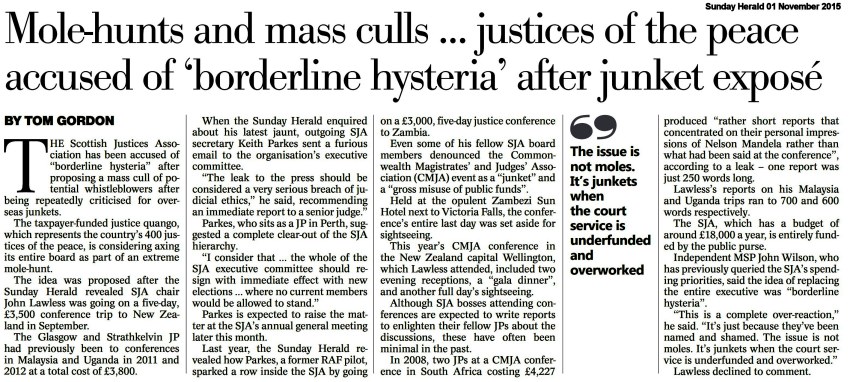
Mole-hunts and mass culls ... justices of the peace accused of 'borderline hysteria' after junket exposé

By TOM GORDON Sunday Herald 1 November 2015

THE Scottish Justices Association has been accused of "borderline hysteria" after proposing a mass cull of potential whistleblowers after being repeatedly criticised for overseas junkets.

The taxpayer-funded justice quango, which represents the country's 400 justices of the peace, is considering axing its entire board as part of an extreme mole-hunt.

The idea was proposed after the Sunday Herald revealed SJA chair John Lawless was going on a five-day, £3,500 conference trip to New Zealand in September.

The Glasgow and Strathkelvin JP had previously been to conferences in Malaysia and Uganda in 2011 and 2012 at a total cost of £3,800.

When the Sunday Herald enquired about his latest jaunt, outgoing SJA secretary Keith Parkes sent a furious email to the organisation's executive committee.

"The leak to the press should be considered a very serious breach of judicial ethics," he said, recommending an immediate report to a senior judge."

Parkes, who sits as a JP in Perth, suggested a complete clear-out of the SJA hierarchy.

"I consider that … the whole of the SJA executive committee should resign with immediate effect with new elections … where no current members would be allowed to stand."

Parkes is expected to raise the matter at the SJA's annual general meeting later this month.

Last year, the Sunday Herald revealed how Parkes, a former RAF pilot, sparked a row inside the SJA by going on a £3,000, five-day justice conference to Zambia.

Even some of his fellow SJA board members denounced the Commonwealth Magistrates' and Judges' Association (CMJA) event as a "junket" and a "gross misuse of public funds".

Held at the opulent Zambezi Sun Hotel next to Victoria Falls, the conference's entire last day was set aside for sightseeing.

This year's CMJA conference in the New Zealand capital Wellington, which Lawless attended, included two evening receptions, a "gala dinner", and another full day's sightseeing.

Although SJA bosses attending conferences are expected to write reports to enlighten their fellow JPs about the discussions, these have often been minimal in the past.

In 2008, two JPs at a CMJA conference in South Africa costing £4,227 produced "rather short reports that concentrated on their personal impressions of Nelson Mandela rather than what had been said at the conference", according to a leak - one report was just 250 words long.

Lawless's reports on his Malaysia and Uganda trips ran to 700 and 600 words respectively.

The SJA, which has a budget of around £18,000 a year, is entirely funded by the public purse.

Independent MSP John Wilson, who has previously queried the SJA's spending priorities, said the idea of replacing the entire executive was "borderline hysteria".

"This is a complete over-reaction," he said. "It's just because they've been named and shamed. The issue is not moles. It's junkets when the court service is underfunded and overworked." Lawless declined to comment.

The issue is not moles. It's junkets when the court service is underfunded and overworked;

_________________________________

BACKGROUND - JUSTICES OF THE PEACE:

Justices of the peace are lay magistrates who sit with a legally qualified adviser to deal with summary criminal cases.

There are around 450 justices, who are drawn from all walks of life.

Justices sit either alone or on a treble bench and deal with many driving offences such as speeding, careless driving, tachograph offences and driving without insurance.

They also deal with less serious assault, breach of the peace, theft and other less serious crimes. Their powers of punishment are limited to 60 days’ imprisonment or a fine of up to £2,500 or both and to disqualify drivers on a discretionary basis.

The office of Justice of the Peace dates back to 1609, originally involving administrative, policing and judicial functions. The current justice of the peace courts were created in 2007 to replace district courts, which were operated by local authorities.

The Scottish Courts and Tribunals Service is now responsible for the administration of Justice of the Peace courts, which are organised by sheriffdom rather than local authority area. Throughout their history, justices have remained lay people, dispensing criminal justice on a local basis.

Justices are appointed by Scottish Ministers for five-year periods on the recommendation of Justice of the Peace Advisory Committees.Portree.

Monday, October 16, 2017

DECLARE YOUR JUSTICE: Judicial Office consults with Lord Carloway on including Justices of the Peace in Register of Judicial Recusals - as questions surface over Lord Gill’s omission of 500 JPs from judicial transparency probe

Calls to include Justices of the Peace in Recusals Register. SCOTLAND’S top judge has been called upon to include nearly five hundred members of the Judiciary of Scotland in a Register of Judicial Recusals which was created in response to a five year Scottish Parliament probe on lack of transparency within the judiciary.

The Lord President – Lord Carloway (real name Colin Sutherland) - is currently being consulted by the Head of Strategy and Governance of the Judicial Office on collecting recusal data from Justices of the Peace courts.

The move comes after journalists queried why JPs were not included in the current register of recusals listing when judges stand down from a case due to conflicts of interest.

The addition of Justices of the Peace to the recusals register follows recent development where Lord Carloway conceded to calls for full transparency on judicial recusals, reported here: RECUSALS JUST GOT REAL: Judicial Office concedes to reforms for Judicial Recusals Register, full case details where judges stand down from court hearings to be entered after media & FOI probe success

However, amid an ongoing probe on Justices of the Peace – where it has now been established some JPs have undeclared criminal convictions - there has been no explanation provided by the Judicial Office as to why some five hundred Justices of the Peace who comprise the bulk of membership of the Judiciary of Scotland - were left out of the publication of recusals by Lord Gill during the register’s creation in April 2014.

Moves by Scotland’s judiciary to become more transparent and open up the workings of Scotland’s courts and judiciary to the public, have come in response to MSPs consideration of judicial transparency proposals contained in Petition PE1458: Register of Interests for members of Scotland's judiciary.

The petition, first debated at the Scottish Parliament’s Public Petitions Committee in January 2013 – calls for the creation of a publicly available register of judicial interests.

The creation of such a register would ensure full transparency for the most powerful people in the justice system – the judiciary.

The resulting publicly available register of judicial interests would contain information on judges’ backgrounds, figures relating to personal wealth, undeclared earnings, business & family connections inside & outside of the legal profession, membership of organisations, property and land, offshore investments, hospitality, details on recusals and other information routinely lodged in registers of interest across all walks of public life in the UK and around the world.

A full debate on the proposal to require judges to declare their interests was held at the Scottish Parliament on 9 October 2014 - ending in a motion calling on the Scottish Government to create a register of judicial interests. The motion was overwhelmingly supported by MSPs from all political parties.

A full listing of evidence in support of the petition calling for a register of judicial interests can be found here: JUDICIAL REGISTER: Evidence lodged by Judicial Investigators, campaigners, judges & journalists in four year Holyrood probe on judges’ interests - points to increased public awareness of judiciary, expectation of transparency in court.

The move to create a register of judicial interests has also secured the support of two Judicial Complaints Reviewers.

Moi Ali – who served as Scotland’s first Judicial Complaints Reviewer (JCR) - appeared before the Public Petitions Committee of the Scottish Parliament in a hard hitting evidence session during September of 2013.

At the hearing, Ms Ali supported the proposals calling for the creation of a register of judicial interests.– reported here: Judicial Complaints Reviewer tells MSPs judges should register their interests like others in public life.

Scotland’s second Judicial Complaints Reviewer Gillian Thompson OBE also backed the petition and the creation of a register of judicial interests during an evidence session at Holyrood in June 2015.

Both of Scotland’s recent top judges - former Lord President Lord Brian Gill, and current Lord President Lord Carloway, have testified before the Scottish Parliament on the petition, both failing to prove any case against creating a register of judicial interests.

A report on Lord Brian Gill’s evidence to the Scottish Parliament in November 2015 can be found here: JUDGE ANOTHER DAY: Sparks fly as top judge demands MSPs close investigation on judges’ secret wealth & interests - Petitions Committee Chief brands Lord Gill’s evidence as “passive aggression”

A report on Lord Carloway’s widely criticised evidence to the Scottish Parliament in July 2017 can be found here: REGISTER TO JUDGE: Lord Carloway criticised after he blasts Parliament probe on judicial transparency - Top judge says register of judges’ interests should only be created if judiciary discover scandal or corruption within their own ranks

The National newspaper reports on the call to include Justices of the Peace in the Judiciary of Scotland Register of Judicial Recusals.

Campaigner calls on Scotland's top judge to extend register of recusals

Exclusive by Martin Hannan Journalist The National 3rd October 2017

SCOTLAND’S Justices of the Peace should have to register their recusals when they step aside from cases in their courts due to conflicts of interests, according to the man who is leading a campaign on judges’ interests.

The judicial register of recusals was established by Scotland’s most senior judge in April 2014, former Lord President Lord Gill, and the judiciary website shows all such recusals by judges and sheriffs and the reasons why they stepped away from a case.

Now legal campaigner Peter Cherbi has called for the register to be extended to Justices of the Peace, who are lay magistrates dealing with less serious cases such as breach of the peace or minor driving offences.

For five years Cherbi has been petitioning the Scottish Parliament on the issue of judges’ interests, and he sees a register of recusals as vital for public confidence in all the judiciary.

Cherbi said: “Given there are nearly 500 Justices of the Peace in Scotland who must act in accordance with the same rules laid down for other members of the judiciary, JPs should now be included in the Register of Recusals.

“I am surprised Lord Gill omitted Justices of the Peace when he created the Register of Recusals in April 2014. This was a significant omission, given the numbers of JPs across Scotland, and Lord Gill should have corrected this flaw before he left office in May 2015.

“I note Lord Carloway (left) has not attended to this glaring omission since taking office as Lord President in January 2016 until now being asked to do so.

“The omission of Justices of the Peace from the Register of Recusals has left out a significant portion of the judiciary and therefore concealed a more truer representation of numbers of recusals and interests across Scotland’s judges and courts, which are of significant public interest.

“I shall be informing the Public Petitions Committee of this development and if the need should arise, I will request MSPs write to the Judicial Office and Scottish Justices Association to make enquiries as to when JPs will be added to the Register of Recusals, and to seek an explanation why they were originally left out from the data, despite it being a relatively simple operation to include JPs in the recusals statistics.”

The National contacted the Scottish Justices Association, which represents the Justices of the Peace, but no reply had been received by the time we went to press.

Previous articles on the lack of transparency within Scotland’s judiciary, investigations by Diary of Injustice including reports from the media, and video footage of debates at the Scottish Parliament’s Public Petitions Committee can be found here : A Register of Interests for Scotland's Judiciary.