Showing posts with label Westminster. Show all posts

Sunday, September 29, 2019

SUPREME INTERESTS: UK Supreme Court Judge Lord Reed's undeclared links to Lord Carloway selection panel & appeal review work - will not alter UKSC "unlawful" Parliament suspension ruling - but should feature in register of judges' interests

UKSC judge Lord Reed linked to Lord Carloway job panel. A POTENTIAL undeclared conflict of interest of the next President of the UK Supreme Court (UKSC) – in relation to a recent ruling on the unlawful suspension of Parliament - has been discovered from documents obtained from the Scottish Government.

Papers obtained via Freedom of Information legislation and published in 2016 reveal that Scottish judge Lord Reed – who has sat on the Supreme Court since 2012 – also sat on the selection panel which recommended the appointment of Lord Carloway (Colin Sutherland) as Lord President in 2015.

The potential conflict of Lord Reed - identified during discussions with legal sources – has a bearing (but no overall effect) on the ruling by eleven Supreme Court justices in relation to the findings of three Scottish appeal court judges – headed by Lord Carloway – who declared Prime Minister Boris Johnson’s decision to suspend parliament in the run-up to the October Brexit deadline as unlawful.

In that ruling, Lord President, Lord Carloway, decided that although advice to HM the Queen on the exercise of the royal prerogative of prorogating Parliament was not reviewable on the normal grounds of judicial review, it would nevertheless be unlawful if its purpose was to stymie parliamentary scrutiny of the executive, which was a central pillar of the good governance principle enshrined in the constitution; this followed from the principles of democracy and the rule of law. The circumstances in which the advice was proffered and the content of the documents produced by the respondent demonstrated that this was the true reason for the prorogation.

However, the failure of Lord Reed to declare he sat on the appointments panel which recommended Lord Carloway for the top judicial job in Scotland – is one of two potential conflicts of interest for the Supreme Court judge which may have required to have – at the very uleast - been aired and debated for recusal - prior to the UKSC hearing on the suspension of the Westminster Parliament.
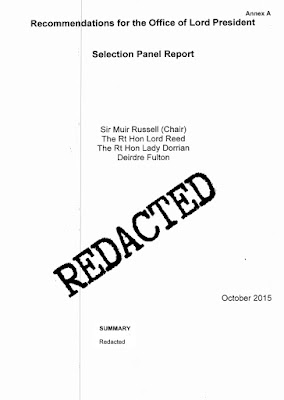
How judges select Scotland’s judges - in secret Scottish Government documents previously obtained by the media revealed the selection panel for the office of Lord President - of which Lord Reed was a member, along with Sir Muir Russell, Judge Lady Dorrian, and Deirdre Fulton – considered five candidates for the position of Scotland’s top judge.

Written exchanges between civil servants and the selection panel which are included in the released papers - reveal a short listing meeting was held on 1 September 2015.

The panel considered that two applicants Lord Carloway [Redacted] merited an interview on the basis of the quality of their applications.

Two emails from Lord Reed, dated 14th ^ 15 October 2015 – released by the Scottish Government in the FOI documents - give a minimal, and heavily redacted description of Lord Reed’s role in the panel’s work, which ultimately recommended Lord Carloway for the position of Scotland’s top judge.

In one email, Lord Reed states: “This strikes me as an excellent report. I have made a few minor suggestions as shown on the attached version. Most of the suggestions are trivial, [redacted]”

In a second email Lord Reed writes “I am content with the amended report. I agree, in particular, with the points which were made by Leeona. The amended version beems to me to present an accurate account, and a fair and balanced assessment [redacted]”

A further potential interest not declared, brought ot the attention of journalists by a legal source, identifies Lord Reed’s work together with Lord Carloway – on a ‘compatibility issues review’ to consider if the High Court of Justiciary in Scotland would still have to give permission for appeals in criminal cases to go forward to the UK Supreme Court.

The review group was itself established by Lord Carloway, with others appointmed to the group being Lord Reed (Deputy President of the UKSC), and others - Lady Dorrian (Lord Justice Clerk); David Harvie (Crown Agent); Roddy Dunlop QC (Treasurer of the Faculty of Advocates); and John Scott QC (President of the Society of Solicitor Advocates).

The review concluded - "Appeals to the Supreme Court of the United Kingdom (UKSC) should not require certification by the High Court of Justiciary that the issue raises a point of law of general public importance, a review chaired by the Lord Justice General has concluded."

Although – it should be pointed out – coincidentally, the review on appeals to the UKSC – limited to appeals in criminal cases - came too late to help in several serious cases of judicial conflicts of interest in Scotland – particularly on a well known case where Court of Session judge & Privy Councillor - Lord Malcolm (Colin Campell QC) heard a case up to eight times - while failing to declare his own son represented the defenders in multi million pound damages action.

A report on the Lord Malcolm conflict of interest case can be found here: CONFLICT OF INTEREST: Papers lodged at Holyrood judicial interests register probe reveal Court of Session judge heard case eight times - where his son acted as solicitor for the defenders.

The two potential conflicts of interest, not declared by Lord Reed in relation to what is a law changing UKSC ruling of significant impact – again highlight the need for a publicly available Register of judges’ interests - to ensure members of the judiciary do not forget to disclose interests which may have a bearing on cases before them.

The issue also brings into question again, the self imposed secrecy on judicial interests by the judges of the UK Supreme Court and wider UK Judiciary – who have resisted calls to become more transparent and declare their interests in the same way all public servants and elected politicians are required to declare in publicly available registers of interest.

The current stance of UK Supreme Court judges on transparency in relation to declarations of interest, is a point blank refusal by the judiciary to comply with the public expectation of transparency.

The UK Supreme Court’s website states the following in relation to judicial expenses and interests:

Justices' interests and expenses

Background

Prior to the creation of the Supreme Court of the United Kingdom, the highest court in the UK was the Appellate Committee of the House of Lords. The members of the Committee were Lords of Appeal in Ordinary appointed under the Appellate Jurisdiction Act 1876. Although those appointments gave them full voting and other rights in the House of Lords, the Law Lords had for some years voluntarily excluded themselves from participating in the legislative work of the House. Notwithstanding that, they were bound by the rules of the House and provided entries for the House of Lords Register of Interests.

On the creation of the Supreme Court the Lords of Appeal in Ordinary became Justices of the Supreme Court. They retain their titles as Peers of the Realm, but are excluded by statute from sitting or voting in the House, for so long as they remain in office as Justices of the Supreme Court. As such, they are treated as Peers on leave of absence; and do not have entries in the House of Lords Register of Interests. Historical information remains accessible via the House of Lords website.

Other judges in the UK, such as the judges of the Court of Appeal and the High Court in England and Wales, and in Northern Ireland, and the Court of Session in Scotland, do not have a Register of Interests. Instead they are under a duty to declare any interest where a case comes before them where this is or might be thought to be the case.

Current position

Against this background the Justices have decided that it would not be appropriate or indeed feasible for them to have a comprehensive Register of Interests, as it would be impossible for them to identify all the interests, which might conceivably arise, in any future case that came before them. To draw up a Register of Interests, which people believed to be complete, could potentially be misleading. Instead the Justices of the Supreme Court have agreed a formal Code of Conduct by which they will all be bound, and which is now publicly available on the UKSC website.

In addition all the Justices have taken the Judicial Oath - and they all took it again on 1 October 2009 - which obliges them to "do right to all manner of people after the law and usages of this Realm without fear or favour, affection or ill will"; and, as is already the practice with all other members of the judiciary, they will continue to declare any interest which arises in the context of a particular case and, if necessary, recuse themselves from sitting in that case - whether a substantive hearing, or an application for permission to appeal.

In relation to the UK Supreme Court’s stance on declarations of interests, and declarations of conflicts of interest, Diary of Injustice reported on the issue in detail during 2017, here: SUPREME SECRETS: UK Supreme Court refuses to publish recusal data - Court rejects release of info on UKSC justices' conflicts of interest in response to Freedom of Information recusals probe on top UK court

During the probe of UKSC recusals and failure to declare interests, a common thread of dishonesty was noted in court staff’s handling of a Freedom of Information request from Scotland – which was only answered after coverage of the issue in The National newspaper, which prompted the Information Commissioner’s Office to order the court to respond to the request.

Lord Reed’s limited biography on the UK Supreme Court website (reprinted below) does not feature either of the issues identified linking the judge to Lord Carloway’s appointment as Lord President nor any mention of review & other work undertaken with Lord Carloway – including the UK Supreme Court sitting in Edinburgh, which included Lord Carloway as a sitting judge on the UKSC panel.

LORD REED BIOGRAPHY:

Robert John Reed, Lord Reed became Deputy President of The Supreme Court on 7 June 2018. He was appointed as a Justice of The Supreme Court in February 2012.

He studied law at Edinburgh University and undertook doctoral research in law at the University of Oxford. He qualified as an advocate in Scotland and as a barrister in England. He practised at the Scottish Bar in a wide range of civil cases, and also prosecuted serious crime.

He served as a senior judge in Scotland for 13 years. From 2008 to 2012 a member of the Inner House of the Court of Session, and from 1998 to 2008 a member of the Outer House of the Court of Session, where he was the Principal Commercial Judge.

As well as sitting on the Supreme Court and the Judicial Committee of the Privy Council, he is also a member of the panel of ad hoc judges of the European Court of Human Rights, and is a Non-Permanent Judge of the Court of Final Appeal in Hong Kong. He is also the Visitor of Balliol College, Oxford.

Lord Reed is one of the two Scottish Justices of The Supreme Court.

To update readers – on 24 July 2019, the last working day of Prime Minister Theresa May, HM the Queen appointed Lord Reed to serve as the President of the Supreme Court of the United Kingdom and declared her intention to raise him to the peerage. 

Lord Reed will take over as President of the United Kingdom Supreme Court from Baroness Hale of Richmond on 11 January 2020.

IMPORTANT NOTE: Readers should note this article does not take sides in the brexit debate. Rather this article is a reporting of a failure to declare or discuss relevant interests and a potential failure to recuse - by a senior judge who has been appointed as the new President of the UK Supreme Court.

Tuesday, May 05, 2015

Scotland 2015: Someone said there is a General Election …

Look up, and you can see Scotland from anywhere in the UK. SCOTLAND should have a strong voice at Westminster. That much is certain.

We are a berth for the UK’s nuclear submarines. We build the ships of the Royal Navy. We are so popular (and important) bears fly off our coasts and sneaky submarines sneak around our fishing boats.

We contribute to the UK’s economy and the fabric of the country as a whole (regardless of the denial brigade) so much, London could never bear to let us go. It’s true!

And – yes - we house a collection of 700 year old judges hell bent on protecting their highly secretive and dubiously achieved judicial wealth from prying eyes.

It is also true our little, big, country is a possible candidate for vested interests & big business to frack for their own gain. Yes, their gain, not the wider community at large.

Vested interests, corporate boards and Chief Executives do not toast champagne over throwing free money at citizens or vital public services without some fiddle in the background. Fact.

And – sadly - we are an outpost of dodgy financial & legal services who go to extreme efforts to avoid scrutiny, accountability, regulation & transparency. Heather Heather. And some Capital.

In any case, there is a General Election this Thursday, and it is your right as a citizen - to vote.

Will anything change next week? Not really.

The NHS will still be in crisis. Statistics on crime (and everything else) will still be fiddled beyond plausibility. Increasing numbers of people across the UK will be forced to use Food Banks.

Oh .. Shocker. People in power you rely on for help will write back to you saying they cannot help.

Lord Gill – the Lord President & Lord Justice General - almost Napoleonic in title, will still be in Parliament House dancing to “Mysterious Ways” – or perhaps “Insidious Ways” - gaming out his latest military style exercise against judicial transparency on his WOPR WarGames computer.

Oh yes – and the rich get richer while the poor get poorer.

But, once every few years - when you – the electorate – are needed - it is YOUR chance to hold Government and all it’s fantasy and all it’s power – to account.

As you hold Government to account this week with your vote - think on this.

Some might say … a Government is only as good as it’s opposition. Inevitably, a Government is only as good as those who vote for it.

A strong opposition can - or at least should - hold a Government to account.

A strong, independent media often holds, and frequently advances the line on transparency and accountability - which helps hold Government to account.

Thursday 7 May 2015 is your choice, your voice, and your vote. Think. Don’t be bullied by vested interests or false and fantastical promises.

However you decide to vote, you have the right to decide for yourself. But please, do vote.

Wednesday, October 26, 2011

JUDGE OUR JUDGES : Petition seeks ‘judicial transparency’, asks Westminster require judiciary to ‘declare all’ to a Register of Interests

Britain’s highly paid judges are unaccountable & currently refuse to submit to a register of interests, so let’s change their minds in the public interest. A REGISTER OF INTERESTS FOR JUDGES will provide greater transparency within the judicial system, will assist in the administration of justice & public confidence in its procedures, and most of all, will avoid any conflicts of interest in the judiciary which currently go unnoticed due to the fact judges have until now REFUSED to hold themselves to a higher standard of transparency & accountability than most politicians & public servants who are required by Government or Parliamentary rules & even the law itself to register their financial & other interests & any hospitality received.

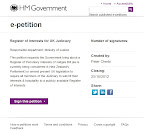
E-Petition to Downing Street Petitions website asks for judges to be required to declare all to a register of interests. An E-Petition, filed yesterday on the No10 website asks the following : This petition requests the Government bring about a Register of Pecuniary Interests of Judges Bill (as is currently being considered in New Zealand's Parliament) or amend present UK legislation to require all members of the Judiciary to submit their interests & hospitality to a publicly available Register of Interests.

PLEASE CLICK THIS LINK AND SIGN THE PETITION : Register of Interests for UK Judiciary

In an age of public expectations of full accountability & transparency, it is time to end some or indeed all of the myths created around the judiciary by the legal establishment, vested interests and even the judiciary itself, by bringing the UK’s highly paid, if not always highly respected or respectable judges into line with all other public servants in requiring them to comply with a full register of interests & hospitality.

While this e-petition relates only to members of the judiciary in England & Wales, it does apply to members of the UK’s Supreme Court, who for now have said in an online document : “… The Justices have decided that it would not be appropriate or indeed feasible for them to have a comprehensive Register of Interests, as it would be impossible for them to identify all the interests, which might conceivably arise, in any future case that came before them. To draw up a Register of Interests, which people believed to be complete, could potentially be misleading”.

Politicians and other public servants simply cannot get away such a statement with excusing themselves from transparency & accountability via a register of interests & hospitality, so why should members of the judiciary. Judge our judges by signing the petition.

Here in Scotland, the judiciary have also REFUSED to submit to a register of interests or hospitality, however their reasons for refusing to bring greater transparency to the judicial process in Scotland may well have something to do with the fact no all Scottish judges have been honest in excusing themselves from cases where they have conflicting interests with vested interests before them in court or in their private lives, as I reported in an earlier article here : Offshore trusts, property holdings, insurance syndicates, hospitality from dodgy lawyers, yet no plans for a register of interests for Scottish judges 

A spokesperson for the Judicial Office for Scotland, commenting on the lack of a register of interests for Scottish judges who receive up to £230K a year plus expenses & massive gold plated pensions, stated : “The Judicial Office for Scotland does not hold a register of hospitality for members of the judiciary and there are no plans to do so. The Lord President has set out formal guidelines to the judiciary in the STATEMENT OF PRINCIPLES OF JUDICIAL ETHICS. Para 4.9 and 7.2 address this particular point.”

Lord Hamilton judicialLord Hamilton, Scotland’s Lord President has REFUSED to create a register of interests for Scottish judges. Lord President Lord Hamilton said in his statement : “While attempts to corrupt the judiciary are virtually unknown in this jurisdiction, a judge should be circumspect in the acceptance of any gift, hospitality, or favour from any private source. Where the benefit sought to be conferred upon the judge is not commensurate with an existing family or social relationship between him or her and the donor, or host, it should normally be declined. However, it is recognised that a judge may, from time to time, legitimately be entertained by legal, professional or public organisations or office-holders, in furtherance of good relations between them and the judiciary as a whole, or representatives of it. Furthermore, nothing said here should be understood as inhibiting judges from accepting invitations to give lectures, addresses, or speeches of a non-legal nature at dinners, or other occasions, or, in such an event, from accepting commensurate hospitality, tokens of appreciation for their efforts, or appropriate expenses of travel or accommodation.”

Lord Hamilton's statement continues : “It is considered appropriate that a judge may write, lecture, teach and participate in activities concerning the law, the legal system, the administration of justice and related matters. However, to obviate the perception that judicial office is being exploited for personal gain, a judge holding a full-time appointment should not generally receive any remuneration for such activities, with the traditional exception of fees and royalties as an author or editor, although the acceptance of a modest gift in recognition of a service given would be unexceptionable. Where a judge is offered a substantial fee for the activities described, such fee should go directly to charity. There is, of course, no objection to a judge accepting reasonable reimbursement of the cost of any necessary travel or accommodation required in attending lectures, seminars, etc. In the event of a judge engaging in literary, or other creative or artistic activities, there can be no objection to that judge receiving the normal royalties, fees, or other payments in respect of the results of those activities.”

A similar petition has been filed with the Scottish Parliament’s Public Petitions Committee, which is now being discussed with Scottish Parliament officials prior to being published on the Scottish Parliament’s website, which Diary of Injustice will continue to report on.

A MODEL FOR OPENNESS : NEW ZEALAND MOVES AHEAD OF UK WITH JUDICIAL TRANSPARENCY

New Zealand’s Parliament will enact laws to require judges to comply with register of interests. In New Zealand, there is Member’s Bill in the New Zealand Parliament, known as the Register of Pecuniary Interests of Judges Bill, introduced in late 2010 by Dr Kennedy Graham of the Green Party to introduce a Pecuniary Register of Interests for all judges, after a scandal involving the resignation of Justice Bill Wilson rocked the New Zealand legal establishment and brought into question the interests & relationships between judges & others. Justice Wilson was forced to resign after it was reported he had failed to step down in a case or disclose his business and financial relationships with Auckland QC Alan Galbraith when sitting as a member of the Court of Appeal in an appeal in which Mr Galbraith successfully represented the Wool Board Disestablishment Company in their appeal against superfine wool producers Saxmere over wool board levies. There were allegations that Justice Wilson owed Mr Galbraith $242,804, which was not disclosed to the Court of Appeal hearing. The debt was denied by Justice Wilson. More on the scandal can be read HERE, HERE & HERE.

There are concerns similar relationships between members of the judiciary and law firms, lawyers & advocates have now been found to exist in Scotland and have now been found to significantly affect some cases where big business, members of professions including the legal profession and even the Law Society of Scotland itself have faced legal action in the courts, cases which all went the way of vested interests.

The full details of New Zealand’s intentions to bring about judicial transparency via a register of interests can be viewed online here Register of Pecuniary Interests of Judges Bill. Dr Graham’s bill states :

It is a time-honoured principle of Western democracy that public servants of every kind must be beyond reproach, and suspicion thereof. Public confidence in the standard of behaviour and conduct observed by leading servants of the people is a cornerstone of social harmony and political stability. A threshold of confidence to that end should ideally be enshrined in constitutional and legislative form. Little scope should be available for individual discretion or subjective perception.

The principle of transparency in this respect pertains in particular to issues of financial (pecuniary) interest. Nothing undermines public confidence in a nation’s institutions and procedures more than suspicion that a public servant may have, and especially proof that one has, suffered a conflict of interest arising from a pecuniary interest in a particular dealing in which he or she was professionally involved.

The correct balance in this respect appears to have been achieved over the years–the public interest in such annual statements is significant without appearing prurient, and few complaints have been voiced by those on whom the obligations are placed. There seems to be a general acceptance that such exercises are in the public interest and are neither unduly onerous nor revealing.

No such practice, however, has been observed in the case of the judiciary. Recent developments within New Zealand’s judicial conduct processes suggest that application of the same practice observed by the other two branches of government might assist in the protection of the judiciary in future.

Being obliged under law to declare pecuniary interests that might be relevant to the conduct of a future case in which one is involved would relieve a judge from a repetitive weight of responsibility to make discretionary judgements about his or her personal affairs as each case arises. Having declared one’s pecuniary interests once, in a generic manner independent of any particular trial, a judge may freely proceed in the knowledge that, if he or she is appointed to adjudicate, public confidence for participation has already been met. Yet care is to be exercised to ensure that the final decision is left to the individual judge whether to accept a case. There should be no intention of external interference into the self-regulation of the judiciary by the judiciary.

This is the reasoning behind this draft legislation–the Register of Pecuniary Interests of Judges Bill. The purpose of the Bill, as stated, is to promote the due administration of justice by requiring judges to make returns of pecuniary interests to provide greater transparency within the judicial system, and to avoid any conflict of interest in the judicial role.

Additionally, in the New Zealand lawyer online, it was reported New Zealand’s Law Commission discussed the possibility the planned register of interests should be expanded to include all judicial officials who could affect a case, saying in Chapter 8.25 of their discussion paper. The Law Commission stated : “If there is to be legislation, should it apply to all judges, or only to judges of some levels, or to all judicial employees and officials such as prosecutors and registrars? An argument can be made that if there is to be financial disclosure it should be required of all officials whose positions give them sufficient potential to influence the outcome of a case, whether as a result of a bribe or other improper influence.” The New Zealand Law Commission’s discussion paper on a register of judicial interests can be downloaded here : NZLC IP21 - Towards a New Courts Act: A Register of Judges' pecuniary interests? (pdf)

The intentions of the New Zealand Parliament to move ahead with a register of interests for judges should serve as a model for a similar register of interests for all members of the UK’s judiciary, whether in Scotland, England, Wales or Northern Ireland. I also support the idea from the New Zealand Law Commission that all officials whose positions give them sufficient potential to influence the outcome of a case should be required to disclose their financial & other interests.

I therefore ask all of you who feel our judges should be more accountable, rather than being shrouded in myth & secrecy, to sign the Westminster version of the petition and the Scottish petition when it is published, to be featured on Diary of Injustice in the near future.

Thursday, October 21, 2010

Consumer Focus Scotland will continue to make sure Scots consumers get a fair deal until Tory-Libdem axe falls in 2012

Consumer Focus Scotland logoConsumer Focus Scotland helped Scots consumers on many issues, including access to justice. CONSUMER FOCUS SCOTLAND staff have been told by their Chairman Douglas Sinclair, the organisation will continue to make sure Scots consumers get a fair deal in both private markets & public services until the Westminster coalition’s very anti-consumer decision to scrap the organisation takes effect sometime in 2012. I previously reported on the UK Government’s decision to scrap Consumer Focus & Consumer Focus Scotland HERE & HERE.

There is of course to be a “consultation” on the closure of Consumer Focus & Consumer Focus Scotland, details of which will follow in further reports, so there’s still time to try and save what is certainly a much needed voice for consumers all across the UK, and especially in Scotland.

Scots will also have a chance to voice their opinion at the ballot box next May 2011 on which Scottish political party is doing the most to protect Scots consumers, so use your vote wisely when the time comes, and make your voice heard against those who would strip us of much needed consumer protection, especially in these perilous times of financial hardship where a lack of consumer advocacy will assist those professions who seek to rip-off consumers when no one is around to do anything about it.

Douglas-SinclairConsumer Focus Scotland’s Chairman, Douglas Sinclair told his staff in a letter released to the media : “I am writing to you in the light of the announcement last week that the UK Government has decided to transfer Consumer Focus’ functions to Citizens Advice and Citizens Advice Scotland. Subject to the approval of the UK Parliament, it is proposed that the work of Consumer Focus Scotland will transfer to Citizens Advice Scotland in 2012, and at that point, it is planned that Consumer Focus will be abolished.”

“As it is expected that the necessary legislative measures, if passed by the UK Parliament, will not take effect until sometime in 2012, we will continue our work in making sure that consumers get a fair deal in both private markets and public services. We will be issuing a draft work plan for 2011/12 and look forward to working with you to deliver more benefits for consumers.”

“We will be working with the Scottish Government to ensure the best future management arrangements for the Scottish Government funded national development projects – healthy living award, Community Food and Health (Scotland), Scottish Accessible Information Forum and Health Rights Information Scotland. We will also continue to work with the Scottish Government on the planned transfer of Waterwatch Scotland’s advocacy powers to find a solution that works effectively for consumers.”

“I am immensely proud of everything which Consumer Focus Scotland, formed by the merger of the Scottish Consumer Council, Energywatch and Postwatch, has achieved in the first two years of its life, and of the legacy of over thirty years of work by these bodies in bringing about real benefits for consumers in Scotland. Consumer Focus and Consumer Focus Scotland have achieved a huge amount for consumers. Earlier this month, Consumer Focus obtained a £70 million energy bill refund for consumers across the UK.”

Consumer Focus Scotland’s achievements have included:

* Establishing the Scotland-based Extra Help Unit to support vulnerable consumers across Great Britain with their energy and post complaints. Since beginning work, the Extra Help Unit has dealt with thousands of complaints and enquiries and obtained over £1.4 million in compensation for vulnerable consumers.

* Following years of campaigning and influencing work, helping to secure the passage of the Legal Services (Scotland) Bill which will widen choice for users of legal services and increase access to justice.

* Securing the inclusion of a new duty on scrutiny bodies to continuously improve user focus in the Public Services Reform (Scotland) Act.

* Playing a key role in the establishment of the Post Office Challenge Fund for Scotland to support the development of Scotland’s post offices.

Considering some of their achievements, and their work as the former Scottish Consumer Council, they’ve done pretty well for us Scots, in many areas of consumer interest, particularly on issues relating to legal services, access to justice & regulation of the legal profession – my specialist areas of reporting. For what it costs to run Consumer Focus as an organisation, well, we’d be better saving it, than handing millions from the taxpayer over to those negligent bankers who have caused the cuts now facing public services & jobs in the UK.

Wednesday, October 20, 2010

UK Spending Review hits after poorly regulated banker's failures rip public services, jobs, armed forces & consumer protection apart

HMS Ark RoyalHMS Ark Royal, scrapped along with the rest of us to pay off banker’s debts. ON the day it has been announced nearly 500,000 public sector jobs are to go, as well as £7 billion slashed from the welfare budget, Police funding cut by 4% a year & the retirement age to rise from 65 to 66 by 2020 – to name but a few of Chancellor George Osborne’s decisions in the spending review, and reflecting on developments earlier in the week where we were told our armed services are to be cut to the bone, and then some, perhaps we should take a minute out to remember exactly why this is happening, and exactly who is responsible.

Fred GoodwinSir Fred Goodwin who ruined the Royal Bank of Scotland, dubbed “The World’s Worst Banker” by the media. Exactly why these cuts are happening and exactly who is responsible are not difficult questions to answer. The reckless actions of our bankers through the lack of regulation in the banking sector caused it, by bringing down many of the UK’s ‘premier’ financial institutions to the point the former Labour Government had to use massive amounts of public money to prop up the likes of the Royal Bank of Scotland, HBOS & others.

Lack of regulation is nothing new however, as thousands of consumers of legal services in Scotland discover every year, as well as tens of thousands of consumers a year in England & Wales. Since before I can remember, the Scots legal profession have ripped-off the public on an almost unregulated basis. Complaints, scandals, financial turmoil, client losses, you-name-it, was all guaranteed to be covered up by one self regulator in Scotland, the Law Society of Scotland, and one self regulator in England & Wales, the Law Society of England & Wales.

Now in 2010, with regard to legal services, the rest of the UK has moved on, with Law Society of England & Wales no longer controlling regulation of the UK’s legal services marketplace or, crucially the vast amounts of money which flow within it. However in Scotland, the exact opposite is true, with Law Society of Scotland still ruling the roost on every issue imaginable such as regulation, complaints, deciding who can provide legal services to the public, how much can be charged by way of fees, and inevitably also controlling exactly who among us can actually have access to justice and who cannot.

The Law Society of Scotland even controls financial claims made against [equally-as-reckless-&-corrupt-as-the-bankers] Scots law firms who will still continue to dominate Scotland’s legal services market, dressed up by the Law Society as providing access to justice, however in reality they operate little more than the same multi billion pound business full of scandals, financial crashes & fraud run by many of our less than glorious bankers who have, fortunately for them, found new highly paid jobs to keep their billionaire lifestyles going, while the remainder of the UK ends up on the scrap heap, along with the Ark Royal.

Without doubt, lack of regulation in the banking sector has ripped our country’s public services, armed services, and economy clean apart. Politicians have since claimed they have done everything to prevent this happening again, and will ensure the bankers pay it all back. Personally, I doubt many believe this. The bankers will not pay it back. They couldn’t really care less about the rest of the country, as we found out in a BBC Scotland report “Trust me, I’m a banker” although the programme must have been so good, its no longer available on the BBC’s iplayer to watch again.

So, tough new regulation for bankers so we never have another banking crisis again, ever, in the history of the planet. I don't think so. However, no tough new regulation for the billions of pounds of consumer’s money swishing around law firms in Scotland’s legal services market. No, that would be just too much regulation and too much consumer protection for Scots, and anyone who argues we should have increased and fully independent regulation of legal services in Scotland and all those billions sloshing around in it under the control of one, very closed shop unaccountable self regulator, is just plain wrong, right ?

A reminder of exactly what happened at the Royal Bank of Scotland, which cost us billions to bail out, sacrificing thousands of jobs, livelihoods & even the prestige of the country to do so, while also reminding us of who defended the actions of those who caused it :

Ex-Law Society Chief Exec, now University of Glasgow Legal Practice Director Douglas Mill said Sir Fred Goodwin’s failure was down to lack of regulation ! (click image to watch video)

Justice ? or just us who would allow it ? Ex-Bank boss Goodwin who ruined the bank (and the country) gets huge pension, keeps knighthood while bringing UK's Treasury, public services & armed forces to their knees. (click image to watch video)

A nice little earner for Sir Fred Goodwin, and he mostly got away with it … (click image to watch video)

Sunday, October 10, 2010

A cut too far : Coalition Government ‘turns its back' on UK consumers as BBC reports Consumer Focus & OFT to be scrapped

Consumer Focus Scotland logoUK Consumers to be without a champion as BBC reports Consumer Focus to be scrapped. UK CONSUMERS will soon lose their greatest consumer champion according to BBC News who reported earlier today that Consumer Focus, the £6m-a-year publicly funded consumer champion for Scotland, England & Wales is to be scrapped as part of the Conservative/LibDem coalition UK Government’s soon-to-be-announced review of spending on public bodies. Also lining up to be axed in an approaching dawn firing squad is Consumer Direct & the OFT.

This is a bitter blow for consumers all across the UK, particularly in Scotland, where Consumer Focus Scotland, formed from the Scottish Consumer Council did important work for Scots consumer rights in many priority areas, especially those where few other voices or help existed for many fellow citizens trapped in our stagnant justice system as I have frequently covered over many years. As Consumer Focus Scotland receives much of its funding from London, it’s Glasgow based HQ faces an uncertain future, probably to be closed unless the Scottish Government take on the full funding cost which I cant see happening given the public service cuts being forced on us by London.

The work of the Scottish Consumer Council to quote one example out of many, has been instrumental in pushing for serious reforms to Scotland’s “Victorian” civil justice system by way of Lord Gill’s Civil Courts Review and also the SCC’s work promoting independent regulation of the legal profession. Without doubt I can say not only as a journalist but also as a law reform campaigner, the long road to reforms in the Scots justice system would not be as ‘advanced’ as they are now, had it not been for the invaluable work Consumer Focus Scotland has done for Scots consumers, albeit sometimes needing a little push here & there to keep up the pace.

Law Society of ScotlandLaw Society’s Rogue lawyers & many others will benefit from Consumer Focus being scrapped. Scrapping Consumer Focus - a national consumer champion which costs a lot less than politicians expenses, and the money thrown at shady unaccountable political ‘think-tanks’ (to mention one of a million other well deserving savings the country should be making), will ensure all the rogue traders, rip-off merchants, crooks, con artists, villains, fraudsters, & overcharging industries will have a field day, ripping off British consumers at will, all apparently at the behest of the Taxpayers Alliance, who BBC News reports “wrote to Business Secretary Vince Cable on 8 October calling for Consumer Focus to be abolished, says it duplicates work done by private organisations such as the Consumers' Association.”

With all due respect Mr Cable, you would do well to refuse the Taxpayers Alliance on this one, and a few others too by the sounds of it.

Speaking on the BBC FOUR Radio’s Saturday MoneyBox programme, Matthew Sinclair Director of the Taxpayer’s Alliance said Consumer Focus was also too close to government to be fully effective. He said : "It does fulfil a function which is replicated in the private sector. It's not representing consumers because it can't speak against Government.”

Rubbish. Consumer Focus Scotland has done a terrific job for Scots consumers, as has Consumer Focus in England & Wales. Granted, Which? are a great organisation but they don't have any statutory powers as Consumer Focus have, and there are currently no private bodies who will be fully able to take on the work of Consumer Focus Scotland. For a start, Citizens Advice (CAB) in Scotland certainly have no capability or stature to take on all of Consumer Focus Scotland’s work and in my recent experience on the McKenzie Friend campaign, I’d have to say CAB are just not up to the job.

It seems the Westminster coalition’s knives are certainly being sharpened for consumers as another target of the slash & cut review is, amazingly the Office of Fair Trading, who along with Consumer Focus & Which? have been instrumental in many consumer reforms – and had it not been for the three bodies working together in many cases, the lobbying powers of the various industries or professions ripping off consumers on a daily basis would have prevented many reforms I am now able to report on such as wider access to justice for all Scots.

BBC Radio 4's MoneyBox is broadcast on Saturdays at 12 noon, and repeated on Sundays at 9pm. Download the podcast. The direct link to the audio file from the Saturday , 9 Oct 10 programme is here : Download 12MB (right click & "save target as") You can listen to it in Windows Media Player or any mp3 player.

Alternatively you can listen to the audio clip below, featuring the Moneybox report on Consumer Focus and its possible closure by the UK Government : (click on image to listen)

I would recommend any consumer with an interest in what happens to their consumer rights, and the standards of service they receive from any industry or profession in the UK, downloads & listens to this programme, especially taking note of the zeal in which Mr Sinclair and the Taxpayers Alliance want to kill off what has been one of the best products of consumer protection in the United Kingdom since … well, ever.

You might represent some taxpayers on this one Mr Sinclair, but you don't represent me.

If anyone feels like writing to Vince Cable MP, the Business Secretary, and support calls to retain Consumer Focus as one of our well deserved Consumer Champions, please email Mr Cable using the online correspondence form of his Department HERE or write to him at : Ministerial Correspondence Unit, Department for Business, Innovation & Skills, 1 Victoria Street, London SW1H 0ET.

If you value your consumer protection in this country, please write in to Mr Cable. I know I will be.

BBC News reports :

Consumer Focus faces axe in quango cull

By Paul Lewis
Presenter, Radio 4's Money Box

Consumer Focus, the body set up by the last Government to represent consumers and challenge companies, will be scrapped, the BBC has learned.

Other consumer bodies facing abolition include the Office of Fair Trading and Consumer Direct. Their activities will be taken over by Citizens Advice and Trading Standards offices. The Government refused to confirm or deny the changes ahead of an imminent announcement on public bodies.

Speaking on Radio 4's Money Box programme Consumer Focus chief executive Mike O'Connor, who warned his staff on Wednesday that their future was in doubt, would not confirm the move publicly. "Government has to take this decision and we wait to see what they have got to say."

But he defended the value for money of his organisation. "We cost the taxpayer in our core grant about £6m a year. Just last week we won a return to consumers of over £70m from the energy companies. And three months ago through our super complaint we changed the ISA rules so savers will get an extra £15m a year."

nPower has recently refunded £70m to 1.8 million customers who it had overcharged for gas in 2007. Banks will pay interest eight days earlier on ISAs that have been moved.

But the TaxPayers' Alliance, which wrote to Business Secretary Vince Cable on 8 October calling for Consumer Focus to be abolished, says it duplicates work done by private organisations such as the Consumers' Association.

Speaking on the programme its director Matthew Sinclair said Consumer Focus was also too close to government to be fully effective. "It does fulfil a function which is replicated in the private sector. It's not representing consumers because it can't speak against Government," he said.

Mike O'Connor said that no other organisation had its powers or could be so effective. "The Consumers' Association does not have the powers which we do. We have a vital power, we can make companies and regulators and government give us information so you may be asking people to do things but without the powers that we have."

The BBC has also learned that Citizens Advice is being lined up to take over the activities of Consumer Direct, which offers free help over the phone to consumers who are victims of scams or want advice on their rights. The Office of Fair Trading, which took the long running but ultimately unsuccessful case over the banks' overdraft charges, will be merged with the Competition Commission. The Government has discussed passing the OFT's consumer activities - including court action - to trading standards departments in local authorities.

Mick McAteer, founder and Director of the Financial Inclusion Centre, told Money Box: "If you take away one of the main bodies whose tasks is to represent consumers I think you will undermine consumer protection."

A Cabinet Office spokeswoman said the report on the future of hundreds of public bodies "is likely to happen in the next couple of weeks." She would not comment on the claims that these consumer bodies would be scrapped or merged.

Thursday, May 06, 2010

UK Election 2010 : Vote, because you should !

House of CommonsThe Palace of Westminster – It’s our Parliament too ! Over the past few weeks of the UK’s election campaign, I’ve noticed many readers saying in comments & emails ‘its just not worth voting'. Never could I disagree with a statement more than this. As citizens, British subjects, the electorate, the one thing we have to hold our politicians to account, to maintain or change the way we are governed, and help decide our nation’s future, is the ballot box. Use the opportunity we have today, participate, and vote !

Some politicians say they are giving us an invitation to join the Government. Well, if that is the case, use your vote, and power as a citizen to ‘join’ such a Government, and hold them to account on each & every issue, policy or law they propose, address or change, along with the very way they may govern us if elected.

Some politicians say we, the people, are the boss. This is the way it should be. If you feel this way, use your vote and power as a citizen to ensure they continue to do their best for the country, and you, through the good times and the bad.

Some politicians say we need a change in British politics, that it should be cleaned up once & for all, and that the very nature of how we vote should be changed to allow ‘wider representation’ of the population. If you feel that way, then again, use your vote and power as a citizen to bring such change, and never let up until such change is upon us.

Some politicians say we need a local champion fighting for Scots at Westminster. We certainly do. All the candidates in Scotland, for whichever political party they are standing for, are very much local champions in their own constituencies. If you feel we need those local champions, find yours, and vote for them !

Lets face it, you can be rest assured the professions will be voting in their numbers, to ensure, or help along the party they wish to be in power … so we as individuals should also use our vote, to make our voice heard.

So, to my readers today … certainly to those of you who may have given up on the political process – take a few minutes out of your day, go along and vote for whichever candidate, local champion, or political party you feel will do their best for the nation, you, your family, your finances, your wellbeing, the causes you may campaign on, or the injustice you may fight, personal or otherwise. We cant grumble if we don't participate, so participate !

BBC election coverage: Log on and tune in

Wednesday, September 02, 2009

Westminster’s 1996 condemnation of Law Society’s Master Policy ‘avoids mention’ by anti-client Scottish Legal Complaints Commission

House of CommonsThirteen year old motion at Westminster reveals long standing knowledge of corruption at Law Society of Scotland and its ‘Master Policy’ Insurers. An Early Day Motion from the UK’s Westminster Parliament during early 1996 has revealed long standing knowledge by politicians of intense corruption at both the Law Society of Scotland and the insurers who manage & underwrite the Scottish legal profession’s ‘Master Insurance Policy’ arrangements to cover crooked & negligent lawyers against claims by ruined clients.

Amazingly, the details of this motion and testimony connected with the original case, which was raised in 1996 by the now deceased Labour MP Gordon McMaster, have been conveniently left out of discussions and investigations by the Scottish Legal Complaints Commission over their role of ‘monitoring’ the claims process of the Master Policy & Guarantee Funds which clients are forced to go through to try and claim damages against losses inflicted on them by the massing ranks of rogue & crooked lawyers in Scotland.

Gordon McMaster’s Early Day Motion reads : “That this House is astonished to learn of the case of Iain McIntyre of Paisley who has suffered estimated losses of £2.7 million due to a series of incidents of negligence and bad faith at the hands of consecutive firms of solicitors; finds it incredible that what started out as a simple conveyancing error has developed into a 10 year legal nightmare of horrific complexity involving seven court processes; believes that inherent conflicts exist between the Law Society of Scotland's duties to guard the public interest and protect its members' interests which have forced Mr McIntyre to endure the loss of his business, the forced sale of his home, long periods of severe depressive illness and liability for expenses amounting to £173,000”.

The motion goes onto state : “further believes that it is unjustifiable that the Law Society of Scotland holds the master professional indemnity insurance policy which has built into it penalties and bonuses which give solicitors a vested interest in minimising negligence claims at unfair levels; is convinced that the principle of Scots law that everyone is entitled to independent legal representation has been breached by the Secretary of the Law Society of Scotland actively encouraging one firm of solicitors to cease acting for Mr McIntyre; and calls for a judicial inquiry into Mr McIntyre's case and an urgent review of the self-regulatory status of the Law Society of Scotland.”

A legal insider commented on the 1996 Westminster motion condemning the Law Society and its infamous Master Policy, claiming : “No one in Scotland wants to talk about this now because it proves many politicians and those in the legal world have known for decades that the Master Policy is a corrupt arrangement forcibly held in place by the Law Society to protect its members from claims against their negligent services and corruption involving clients funds.”

He continued : “It beggars belief that 13 years after this was made public, the Scottish Legal Complaints Commission are still struggling with discussions on how to develop their reluctant remit to monitor the Master Policy which the London Parliament clearly condemned all those years ago.”

Law SocietyHuge levels of corruption at Law Society of Scotland prompted Westminster condemnation. The McMaster motion at Westminster came several months after a series of media reports in the Scottish newspapers about corruption in the claims process against crooked lawyers in Scotland, which frequently saw the Law Society intervene to kill off the legal representation of any clients who were trying to pursue crooked lawyers through the Scottish Courts, and in an 1995 interview related to the case which resulted in the McMaster motion at Westminster, Scottish Television’s Bernard Ponsonby revealed the scale of client claims against crooked lawyers in Scotland in the early 1990’s, which have rocketed nearly two decades later, stating : “In the four years from 1989 to 1993 the premiums paid into the Master Policy have totalled £24,833,000, in the same period £27,441,000 has been paid out in actions against solicitors, a deficit of over £2,600,000.”

Mr Ponsonby reached some pertinent conclusions in the interview such as : “Pursuing justice against negligent solicitors requires a deep pocket and great patience, many potential litigants have neither, they have to live with the results of injustice forever !”. You can download the STV transcript of that interview here : STV's Bernard Ponsonby interview & report on Master Policy

However, the Law Society of Scotland and insurers have now made the claim game against crooked lawyers an almost impossible task for clients, with routine intervention from the Law Society now commonplace, resulting in many negligence claims against crooked lawyers going to the wall, and even suicides of clients whose claims have failed. You can read a previous article about the Master Policy here : Suicides, illness, broken families and ruined clients reveal true cost of Law Society's Master Policy which 'allows solicitors to sleep at night'

Scottish Legal Complaints CommissionScottish Legal Complaints Commission don't want to hear about Master Policy ‘suicides’. Reaction as we have seen at the Scottish Legal Complaints Commission to the ‘suicides’ side of the Master Policy has been minimal, with the SLCC’s board members and senior staff seemingly intent on talking down the whole question of regulating the Master Policy, preferring to indulge in name calling and insults against the Master Policy’s victims, rather than actually engaging their experiences for useful application. After my report last week on David Smith and Eileen Masterman’s bitter accusations against consumers who took part by invitation in the SLCC’s own Master Policy investigation, Jane Irvine, the SLCC’s Chair said no comment could be issued, citing “Mr Smith was not available for the next two and a half weeks”.

A participant in the SLCC’s Master Policy investigation commented : “Perhaps Smith is away doing some frequent flying of his own. I wonder if he and the rest of the SLCC would like to meet the family of a dead client who put both barrels of a shotgun in his mouth and blew his brains out after finding out his lawyers had been stitching his Master Policy claim up all the time they were working on it. Would he call them frequent flyers too ?”

Debating chamberScottish MSPs don’t want to raise motions condemning corruption in the legal profession. Of course, while Westminster seemed well convinced of corruption at the Law Society of Scotland some thirteen years ago, the road to obtaining even an investigation into the Master Policy in Scotland and proper independent regulation of the legal profession has proved distinctly rocky, as most MSPs at Holyrood who are called in by constituents with similar problems against ‘crooked lawyers’, openly refuse to raise such motions in the Scottish Parliament, even though they certainly have the power to do so.

One well known consumer activist today put MSPs reluctance to raise motions against injustice and the legal profession down to “fear of upsetting lawyers and the Law Society”.

He said : “Most Scottish politicians when faced with a choice between helping a constituent against the legal profession itself, or remaining in favour of the legal profession, will take the latter option. It is simply a more profitable arrangement for them. Helping a constituent will produce little by way of return, but remaining in the favour of the legal profession invariably produced high returns for many politicians as we have seen occasionally revealed in newspaper headlines over the past few years.”

Given the apparent lack of understanding by the SLCC’s board members as to the difficulties faced by those clients & members of the public who become involved with the Master Policy, it may do some good for the likes of David “Frequent Flyers” Smith, and Margaret “Chancers” Scanlan to have a read of the 1996 Westminster motion, although as one Commission insider pointed out on Monday, “… anyone with chips on their shoulder within the commission who has to resort to that kind of language against people they are supposed to be there to help, are long past understanding the public’s point of view and experiences regarding those in the legal profession.”

I would tend to agree … so, when do we see some action against the Law Society and their corrupt Master Policy ?

How many more clients lives is the Law Society going to use up to ‘allow crooked lawyers to sleep at night’ and why all the opposition to opening up a review of failed claims where the Law Society intervened and stopped such cases progressing ?

Thursday, June 18, 2009

Westminster Expenses : They work for you, are paid for by you, have possibly stolen from you, but they feel they are not accountable to you

House of CommonsWestminster publishes MPs expenses online with most details blanked out. The House of Commons has finally published MPs expenses online, however many of the details have been blanked out, because while we as taxpayers are paying MPs salaries and their expenses, we are it seems not entitled to see what we are paying for, or by the looks of it, any returns the country actually gains by allowing politicians to claim for all & sundry from us, the taxpayer.

MP Phone BillAn MP’s British Telecom reminder blacked out – would you pay a bill if it landed through your letterbox in this state ?. While members of the House of Commons seemingly can get anything & everything paid for by the taxpayer, from mortgage interest, to second homes allowances, to telephone bills to the removal of moss from their umpteenth house, or duck houses and repairs to swimming pool boilers .. the ones paying it – us, are not entitled to see exactly where the money is going and what the justification is for their huge expenses to the country, particularly in these crushing financial times.

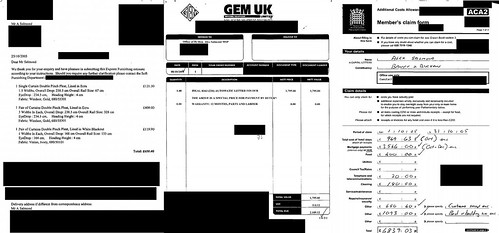
For a couple of samples of today’s publication of expenses from Westminster, via Freedom of Information (in other words, the blacked out version, as opposed to the Telegraph ‘warts and all’ version) we see among the Scottish contingent, Alex Salmond claiming for mortgage expenses and a rather costly envelope folder, as well as curtains & bedding .. with Scottish Conservative MP David Mundell keeping the First Minister company on mortgage expenses, which I'm sure probably most of the country would like to join in with, having mortgages, bedding, curtains, food, and letter folder contraptions paid for out of thin air out of other people's taxes & hard work.

A sample of First Minister Alex Salmond’s Westminster Expenses as an MP :

Alex Salmond Expenses examples

A sample of South of Scotland MP David Mundell’s Westminster expenses :

David Mundell Mortgage expenses

Virtually all the documents have blacked out parts, leading one to conclude democracy, transparency and accountability have most definitely been blacked out in the entire country. I wonder where politicians learned that little trick from ? It surely couldn’t be the legal profession, could it ? … and lets not forget Kenny MacAskill, Scotland’s Justice Secretary is busy trying to keep the Law Society of Scotland exempt from Freedom of Information laws, just in case we begin to find out many of the dirty secrets of Scotland’s less than honest legal profession : MacAskill’s ‘no intention to include Law Society in FOI review’ allows lawyers to keep scandals & criminal records hidden from public scrutiny

Telegraph front pageIf it had not been for the Telegraph newspaper, we would have been none the wiser on crooked politicians expenses claims. Exposing this organised ‘thieving’ from the country of course, fell to the Telegraph newspaper, rather than Freedom of Information legislation, because as we now see in today’s release of expenses information from Westminster, it would not be possible to see who had been flipping homes, and who was claiming what for which property. It is therefore clear that FOI legislation will have to change because it is being used to deceive rather than empower, just as we have seen the Scottish Legal Complaints Commission use FOI to cover up scandalous workings within its increasingly bizarre operations of allegedly regulating the Scottish legal profession.

I reported some rather secretive goings on at the SLCC where similar blacked out documents were issued to hide controversial information here : FOI disclosures censored to law journalists as MacAskill’s legal complaints commission prefers secrecy to public accountability

David Mcletchie taxiMSP David McLetchie was among those politicians caught out at Holyrood claiming thousands for expenses. MSPs might like to think they are whiter than their Westminster counterparts, but as we know here in Scotland, that is most certainly not the case. While MSPs expenses are now published online, again, it took pressure from newspaper investigations such as those in the Sunday Herald to force the changes at Holyrood which Westminster will now have to go through.

You can read more about MSPs expenses milking in an earlier article, here : First Minister Alex Salmond admits he's not 'whiter than white' over Westminster expenses scandal as questions arise over £800 food allowance claims

If you want to find out more about your own MP’s expenses at Westminster (and there is a lot to find out !), click the following link which leads to the BBC News website :

MPs' expenses: Find your MP

and the main story from BBC News :

MPs' expenses made public online

The expenses claims of every MP for the past four years have been published, but with some key details blacked out.

Commons authorities have published the details after a long-running Freedom of Information battle.

The addresses that claims relate to - and correspondence - have been removed on privacy and security grounds.

This means it is not possible to see if MPs "flipped" second homes - a key part of the Daily Telegraph's revelations from its leaked version of the data.

MPs have said some details, like addresses and travel patterns, have to be withheld for security reasons .

But other details have been removed in the official version such as Prime Minister Gordon Brown's claims for his Sky television subscription - despite the fact it was published last year, also under the Freedom of Information Act.

The uncensored details obtained by the Daily Telegraph have led to weeks of revelations and a slew of resignations from MPs.

On Wednesday Treasury minister Kitty Ussher stepped down amid reports that she changed the designation of her constituency home to avoid capital gains tax.

Ms Ussher said she acted within the rules but wanted to protect the government from further embarrassment amid public anger about expenses.

The BBC's political editor Nick Robinson said that if the full uncensored claims had not been leaked to the Telegraph, then MPs like Miss Ussher would still be in their jobs.

Among Daily Telegraph revelations that do not appear in the blacked out versions of MPs' receipts are:

  • Andrew MacKay - From the official receipts it would not have been possible to know the Tory MP claimed for a second home without having a main constituency home.
  • Margaret Moran - The Labour MP who claimed £22,000 for dry rot on her second home. The receipts do not show her second home was in Southampton -100 miles from her Luton constituency.
  • Sir Peter Viggers - Tory MP who tried to claim £1,645 for a "duck island", the official receipts show no evidence of the unsuccessful claim.
  • Hazel Blears - The former Labour minister claimed second home expenses for three different properties in a single year but the redacted receipts do not show this as addresses are blacked out.

Heather Brooke, one of the campaigners who brought the Freedom of Information case, told the BBC the official publication was a "substandard version".

She pointed out the High Court had ordered that second home addresses be published - MPs rejected this in a later Commons vote, arguing it would jeopardise their security.

"It's the only way to police effectively whether there is a second home and whether the mortgage exists whether it's been paid off or not and they are still claiming. It's really the only way we can hold them to account on that second home allowance."

'Seismic changes'

She said the security argument had been "totally discredited" adding: "I can see that avoiding embarrassment has been the key motivating factor of what's been deleted."

And Maurice Frankel, of the Campaign for Freedom of Information, also said the official version was a "very poor substitute": "The mood of the House of Commons was that they did not want any of this information to be published and, failing that, as little as possible."

But cabinet minister Hilary Benn told BBC Radio 4's Today programme: "The argument for keeping bank details, phone numbers and addresses confidential I think is a fair one."

But he said the system needed to change: "That's why we've seen seismic changes, that's why Parliament has already taken steps to alter the rules why Christopher Kelly's committee will look at what the new system will be."

He added the problems were the result of self regulation - now expenses would be audited independently.

For the Conservatives, shadow Commons leader Alan Duncan said: "I think the black ink is justified where it is things like ex-directory phone numbers ... and personal details and bank accounts."

He said changes had been made to ensure MPs could not "play around with the second home address in order to extract as much money as possible out of the system".

Exclusions

But he said "at the very least" addresses should be properly audited.

"Whether the exact address should be put up which would allow people to walk up your front drive I think is a grey area - but the verification of the house and the consistency of the house that is registered is important."

More than a dozen MPs have said they plan to stand down since the furore over expenses began and many have had to repay money - more than £300,000 has been repaid.

Claims made by all 646 MPs under three different allowances since 2004 have been published alphabetically on the Parliament website with thousands of receipts made available in a series of PDF files.

The Telegraph's reports focused largely on the additional costs allowance, designed to cover costs associated with second homes.

WITHIN THE RULES

£24,000-a-year Additional Costs Allowance, which covers the running of MPs' second homes

£22,193-a-year Incidental Expenses Provision, which pays for running an office

£10,400-a-year Communications Allowance, which funds websites, newsletters, stationery and postage

The paper highlighted the practice of "flipping" - by which some MPs switched the designation of their homes and claimed allowances for several properties over the four year period and other claims that were within the rules - but questionable.

Last year, the Commons agreed to blank out certain information considered sensitive including addresses and all communications with the Fees Office. MPs have been able to suggest further exclusions.

Other information published on Thursday includes the incidental expenses provision for office costs and the communications allowance - Parliament had been ordered to publish them by the High Court.

Labour has referred MPs accused of making questionable claims to an internal disciplinary panel, which has barred five MPs from standing at the next election.

The Tories have asked all its MPs to submit their claims to an internal panel for scrutiny, with a handful of MPs either being forced to stand down or choosing to retire.

The furore has led to interim changes to the second homes allowance while the Committee of Standards in Public Life is holding an inquiry into expenses and will recommend changes to allowances rules.

Gordon Brown has said oversight of MPs expenses must be handed over to an external regulator as part of a root and branch reform of Parliament.

The Daily Telegraph's assistant editor Andrew Pierce told the BBC they would publish the entire list of claims submitted by the cabinet on Friday and every MP's expenses on Saturday - to allow people to draw their own conclusions about what had been "censored".

"I suspect it could be that more MPs will be considering their position and maybe their party leaders will be considering whether they are really fit to be an MP," he said.

Sunday, June 07, 2009

First Minister Alex Salmond admits he's not 'whiter than white' over Westminster expenses scandal as questions arise over £800 food allowance claims

Alex_Salmond smileScotland's First Minister Alex Salmond blamed expensive food allowance claims on William Wallace events. Scotland's First Minister Alex Salmond who is also an MP at Westminster, been sucked into the expenses scandal at the House of Commons in London, with revelations Mr Salmond had claimed £800 for food expenses for two months, while the Parliament was actually in summer recess.

Mr Salmond, speaking on BBC radio last week, did not give specifics to callers on his expenses claims, choosing to blame attending William Wallace commemoration events as one of the reasons for the large food claims. Mr Salmond continued, saying he was "quite happy to go before an independent audit" but admitted no one including himself could claim they were "whiter than white" in the expenses scandal.

First Minister Alex Salmond on £800 food claims admits "I'm not whiter than white" in expenses scandal.

nigel_donThe SNP's Nigel Don embarked on a series of property deals to get Holyrood to pay his mortgage. While the First Minister claimed on BBC Radio that no one within the SNP had been 'house flipping' to claim thousands of pounds from the taxpayer on second homes, recent revelations over Nigel Don's property deals to secure £688 a month from the taxpayer to pay his mortgage, despite receiving a salary of £55,381. It is worth noting that Mr Don is also Parliamentary assistant to Justice Secretary Kenny MacAskill, and is also a member of Holyrood’s Petitions Committee, where recently Mr Don’s remarks on an access to justice petition ‘constituted disinformation’ as some pointed out at the time.

I wrote about Mr Don’s mortgage arrangements and work on the Petitions Committee in an earlier article here : Influencing Justice reforms in Scotland worth ‘price of a mortgage allowance’ as MacAskill's ministerial aide gets £688 a month to fund capital flat

christine_grahameChristine Grahame, the SNP’s MSP for South Scotland claimed a staggering £26,465 for ‘stationery’. Another example of huge expenses claims at Holyrood surfaced recently with revelations the SNP’s Christine Grahame claimed a staggering £26,465 for postage and stationery, while other politicians from the Tories and Liberal Democrats representing the same area claimed ‘significantly less’ sums. You can read more about MSPs stationery claims here : Scottish Parliament : Christine Grahame’s £26k stationery expenses claim on 'consultations'

Currently, up to 28 MSPs at the Scottish Parliament, 12 of that number being SNP MSPs and 6 of those being Cabinet Ministers in the Scottish Government, including the Cabinet Secretary for Finance, John Swinney, are claiming mortgage interest payments of up to £1000 a month from the Scottish taxpayer to pay for their second homes in Edinburgh. This state of affairs could hardly be described as being ‘whiter than white’ – Scottish MSPs collectively claiming millions of pounds from the taxpayer in expenses while themselves claiming they are a model for transparency & accountability compared to their colleagues caught up in the Westminster expenses scandal.

You can read more about the Scottish Parliament’s own expenses milking scandal here : An extra £2m for MSPs at Holyrood while Westminster’s reputation withers in expenses scandal

Many MSPs have ensured they have not been outdone by their Westminster counterparts in expenses claims, in examples I have previously covered here : Scottish MSPs get in on the act of expenses milking too

david_mcletchieEx Tory leader & lawyer David McLetchie was brought down over huge taxi expenses claims. The Scottish Conservatives, who have raised the issue of the First Minister’s food expenses, have themselves suffered expenses scandals, which led to the resignation of David McLetchie as the Scottish Conservative Party leader, after revelations he claimed more than £11,500 for taxi journeys ‘into the unknown’, some of the destinations being revealed later as his law office at Tods Murray, and a few trips to Morningside …. You can read more of the McLetchie scandal here : McLetchie taxi details revealed

It is also worth noting that while the Liberal Democrats in England have been told to pay back any Capital Gains Tax on profits made by selling properties funded by taxpayers, the Scottish end of the party, seems to have a different policy for its members, as has been covered in the media here : LibDems leader Tavish Scott refuses to reveal capital gains tax payments on property profits

Lets also not forget that Scottish politicians were also recently caught for even claiming wreaths from the taxpayer, reported last month here : Scottish Parliament MSPs 'as crooked Westminster' claimed expenses for funeral wreaths

What is so disgusting to me, is that while there are people including children literally begging for cancer or other medical treatments to their local NHS Trusts throughout the country, only to be told there is either no money to pay for it, or that they are in the wrong postcode, politicians from all political parties, including the SNP are able to basically claim for what they want. A thoroughly disgusting situation which no honest decent person can defend.

How could a politician, already being paid over £70,000 plus, justify they deserve £800 for food, or £14,000 to clean moss off the front of their house, while, say, a 14 year old child cannot get a life saving course of medication simply because they live in the wrong area or their own health board has run out of money. That HAS to be an affront to humanity, politicians putting money and self gain before the lives of constituents while having such a huge salary for allegedly representing our interests.

Indeed the caller in the radio show who questioned Mr Salmond on his food expenss may well be right when he said “All you politicians are in it to line your own pockets”.That much is true – they certainly do, but it must now stop, and we the electorate must hold all politicians to account for their actions of lining their own pockets, no matter which party they are from.

The Sunday Herald reports :

Fresh challenge to Salmond over London meals claims

By Tom Gordon, Scottish Political Editor

ALEX SALMOND is facing fresh accusations over his expenses as an MP, after the Conservatives proved he was out of London for several weeks during the whole period for which he submitted maximum claims for meals from the House of Commons.

The first minister claimed the monthly £400 maximum for both August and September 2005, despite Westminster being in summer recess.

Salmond has repeatedly refused to publish his diaries for the months, dismissing suggestions the claims were unjustified as "laughable".

Last week, he told a BBC Radio Scotland phone-in: "I was in London in recess in 2005. MPs often go to London. They were all legitimate Parliamentary claims."

But the Scottish Tories last night produced a list culled from SNP press releases and newspapers showing Salmond was in Scotland on at least 22 of the 61 days in question. His eight August engagements included Robin Cook's funeral, a cricket match in Edinburgh, a gala in Rhynie, an art exhibition in Banff, and a constituent's 100th birthday in Portsoy.

The following month he was in Scotland for at least a fortnight, campaigning in the Livingston and Cathcart by-elections, and attending the SNP conference in Aviemore.

Salmond's spokesman said the first minister had never stated he was in London all the time, and suggested some of the claims might refer to days when parliament was sitting.

Besides claiming £400 for food in August and September, Salmond also claimed the maximum for six other months in 2005-06, a total of £3200. He also claimed £1751 for food in 2007-08, when he was first minister, despite voting on only six days in the Commons.

Annabel Goldie, the Scots Tory leader, last night wrote to Salmond urging him to publish his diaries. She said: "I am asking him to be open and transparent with the taxpayers about his Westminster expenses. He claimed the maximum food allowance of £800 for August and September 2005, but there are doubts over how much time he actually spent in London during that period that would justify such a large claim.

"I hope for the sake of the Scottish Parliament he takes this opportunity to clear up any lingering doubt."

Salmond has been the MP for Banff and Buchan since 1987 and is also the MSP for Gordon.

The continuing row over his Commons expenses comes as a fresh review of the MSP expenses system begins at Holyrood.

Sir Neil McIntosh is to examine whether "key elements of the scheme could be expected to continue to command public confidence".

Although praised as more transparent than Westminster, the Holyrood scheme still allows MSPs to keep all profit from the sale of second homes funded by the taxpayer.

Last month, the Sunday Herald revealed 28 MSPs currently claiming mortgage interest would make around £2 million profit if they sold up.

A Holyrood source said the McIntosh review, which will report by December, was aimed squarely at closing the second homes loophole. Tavish Scott, the Scottish LibDems leader, who would make a £120,000 profit on his second home, is under fresh attack over "despicable" expense claims by his MSPs.

Peter Nield, a LibDem councillor in Angus, resigned from the party in disgust at Scott's failure to discipline four LibDems who claimed for Remembrance Day poppy wreaths.

Although all agreed to repay the money after the claims were publicised, Nield said that was "irrelevant".

Now sitting as an independent, he said of Scott: "When a party leader is so out of touch with society he does nothing to reprimand those responsible, it is a step too far for me. It is despicable MSPs on good salaries and generous expenses claim back Remembrance Day poppies as expenses."

A LibDem spokesman described Nield's decision as "disappointing".

In a statement, Salmond said he was "entirely confident" about his expenses. "I was in London in both August and September, securing an unfurnished rented flat and other engagements, and during that period also paid bills from the Commons refreshment department incurred during the parliamentary session."

***

Council expenses cost taxpayer £3m Argyll and Bute Scotland's most expensive authority By Tom Gordon, Scottish Political Editor

SCOTLAND'S councillors claimed more than £3 million in expenses last year on top of £22.4m in salaries, according to new official figures. In recent days, all 32 local authorities were forced by law to publish councillors' salaries and expenses for 2008-09, showing spending on travel, accommodation, meals, phones and IT.

Analysis by the Sunday Herald shows that the average expenses claimed per councillor ranged from £325 in the country's smallest authority, Clackmannanshire, to £6004 per head in the largest, Argyll and Bute. The Scottish average was £2486.

Under a complicated remuneration formula, all 1222 councillors earned a basic salary of at least £15,000, with more for those in bigger councils and those with special responsibilities, such as committee chairs, and provosts.

The most expensive council in terms of salaries was the City of Edinburgh, with its 58 members taking home an average £21,079 in pay.

The least expensive was Moray, with its 26 members earning an average salary of £17,314. The average across the country was £18,351.

Overall, the most expensive council, including salaries and expenses, was Argyll and Bute, run by a coalition of Independents and the SNP. Its 36 councillors cost an average of £24,088. With 25 inhabited islands covering the largest geographical area of any council, their expense claims included £152,974 on mileage and £10,703 on ferry fares.

The least expensive was Labour-run Inverclyde, whose 20 members each cost £18,128 overall. Across Scotland, the average councillor cost £20,837.

Despite outnumbering them 10 to one, the councillors expense claims came to less than a third of those made by MSPs.

The highest expenses claim was made by the SNP's Donald Manford, chairman of the transportation committee in the Western Isles, whose £20,081 claim was larger than his £17,819 salary - it included £11,740 in travel and £5300 in subsistence claims.

In contrast, several dozen councillors around the country claimed no expenses at all.

Argyll and Bute said its unique geography contributed to high costs. A spokeswoman said: "We have very strict controls on what can be claimed as expenses, and in what circumstances claims can be authorised.

"Receipts are required not only for subsistence or accommodation claims, but also for fuel ...

"Councillor remuneration is fixed by the government by statutory order, not by councils themselves. Mileage rate is also fixed by government."

Robert McGill, the deputy leader of Labour-run Clackmannanshire council, said: "We are looking to offer value for money to our constituents. It's important that local people trust their council and the expenses are all itemised and accounted for."

The Convention of Scottish Local Authorities, the umbrella body which represents all of the country's 32 councils, said: "Scotland's democratically elected councillors offer extremely good value for money.

"Councils put a real value on the public pound and therefore operate extremely well controlled systems around expenses for councillors.

"All expenditure rightly needs to be proven and would include things like the cost of mobile phone calls, IT and the sort of other businesslike necessities being a democratically elected member committed to representing communities entails."