Showing posts with label Calum Steele. Show all posts

Sunday, January 12, 2020

POLICE UNION SECRETS: Transparency petition by whistle-blower ex Police Officer closed by msps as Scottish Government block move to bring Freedom of Information compliance to Scottish Police Federation

Scots Police Fed. keeps secrets. A PETITION calling for Holyrood to recommend Freedom of Information compliance for the Scottish Police Federation (SPF) - has been closed - after the Scottish Government said it would block transparency compliance for the Union which covers all Police Scotland officers.

Petition PE1763 Freedom of Information Legislation (Scottish Police Federation) – submitted by whistleblower & ex-Police Officer Robert Brown – sought to bring the Scottish Police Federation into line with its counterpart - the Police Federation of England & Wales – which has been covered by Freedom of Information legislation since 2017

Legislation in England & Wales states: Freedom of Information Act etc: Police Federation for England and Wales: The Police Federation for England and Wales is to be treated for the purposes of— (a)10the Freedom of Information Act 2000,(b)the Data Protection Act 1998, and (c)section 18 of the Inquiries Act 2005, as if it were a body listed in Part 5 of Schedule 1 to the 2000 Act (public authorities).

The Police Federation of England & Wales FOI website section states the following: “The Police Federation of England and Wales (PFEW) is funded in part by police officers who pay subscriptions from their wages. We are not funded by the public, and we are the only staff association to be subject to Freedom of Information (FoI), which came into effect for the PFEW in April 2017. The Freedom of Information Act (2000) provides public access to relevant information held by public authorities. Should you wish to submit an FoI request, please contact us.”

Given the Police Federation of England & Wales obvious compliance with Freedom of Information legislation, Police Officers in Scotland and others with an interest in policing – an intense area of public interest – would benefit considerably to access to information - from the same level of transparency applied to the Scottish Police Federation - via compliance with the Freedom of Information (Scotland) Act 2002.

Commenting on the petition submitted by ex Police Officer Robert Brown to the Scottish Parliament’s Public Petitions Committee - Brian Whittle MSP said “The petition has real merit, especially given that England and Wales have already gone down the same route”

Howeverm a short debate then took place – with the Convener Johann Lamont & Deputy Convener Gail Ross of the Public Petitions Committee backing away from taking the matter further.

The petition to bring equality of transparency for the Scottish Police Federation was then abruptly closed – after Committee members were told the Scottish Government will not bring Freedom of Information accountability to the Scottish Police Federation.

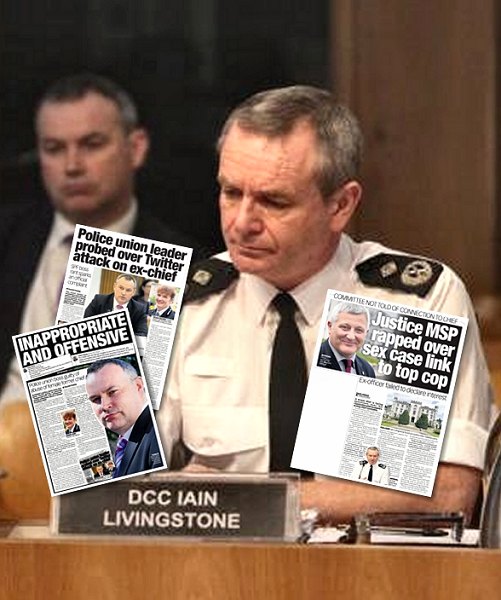
Last year - the powerful and secretive Scottish Police Federation – which acts as a lobbying force for police officers in Scotland and has the power to decide or deny help to Police Officers – saw it’s General Secretary - Police Constable Calum A Steele - found guilty by PoliceScotland in relation to a complaint of online social media abuse against a former senior Police Officer - 'Inappropriate and offensive' Police union boss guilty of abusing female former chief in Twitter tirade.

The issue arose from comments made by Calumn Steele in response to criticisms about the appointment of a Chief Constable – Iain Livingstone – who had previously been accused of five allegations of serious sexual assault against a female Police Officer – reported in further detail here: TOP COP SECRETS: Transparency lacking at Police Scotland as spy scandal cops refuse to disclose files on complaints & historical sexual assault case details involving Deputy Chief Constable Iain Livingstone

An earlier probe by Diary of Justice also revealed the Scottish Police Federation received millions of pounds of public cash over the years from the SNP Scottish Government - a full report can be viewed here: PROBE THE FED: Calls for Holyrood to probe secretive Scottish Police Federation as files reveal SPF General Secretary asked Scottish Government to withdraw £374K public cash grant funding - after social media transparency calls from cops

And, days after the Scottish Information Commissioner made an online statement via Twitter that it would recommend the Scottish Police Federation for Freedom of Information compliance – SPF General Secretary Calum Steele asked the Scottish Government to end the £374,000 public cash grant paid each year by Scottish Ministers to the Scottish Police Federation.

A full report on how Daren Fitzhenry – the Scottish Information Commissioner - backed away from promises to recommend FOI compliance for Scottish Police Federation, and evidence submitted by DOJ journalists to the Public Audit and Post Legislative Scrutiny Committee of the Scottish Parliament, is covered in further detail here: FOI PROBE: Holyrood Committee hear Scottish Information Commissioner backed off promise to bring Freedom of Information to Scottish Police Federation - even after Info. Tsar knew England & Wales Police Fed. already complied with FOI legislation

As thngs stand at the date of publication - the Scottish Police Federation remain exempt from Freedom of Information legislation – despite the same transparency laws applying to the Police Federation of England & Wales.

Video footage and a transcript report of the Petitions Committee debate on bringing Freedom of Information compliance to the Scottish Police Federation follows:

Scottish Police Federation Freedom of Information petition - Public Petitions Committee 5 Dec 2019

Freedom of Information Legislation (Scottish Police Federation) (PE1763)

The Convener (Johann Lamont, Scottish Labour): The next new petition is PE1763, headed “Make the Scottish Police Federation comply with FOI legislation” and lodged by Robert Brown. The petition calls on the Scottish Parliament to urge the Scottish Government to make the Scottish Police Federation comply with the Freedom of Information (Scotland) Act 2002.

Our briefing explains that freedom of information requirements apply broadly to public authorities such as Governments, councils and health boards. Police Scotland is subject to the requirements of the 2002 act, but the Scottish Police Federation is not. As police officers are prohibited from joining trade unions, the Scottish Police Federation was created as a staff association with responsibility for the welfare and efficiency of police officers. Trade unions are not covered by freedom of information legislation.

It could be argued that the Scottish Police Federation is akin to a trade union and, therefore, should not be covered by freedom of information requirements. However, the Scottish Police Federation was established by legislation; therefore, it could be argued that it has some similarities with public bodies. The Police Federation of England and Wales is required to comply with freedom of information legislation as a result of changes to the law that were made in 2017. The Scottish Government stated in July 2019 that it had no plans to make the Scottish Police Federation subject to freedom of information legislation.

Elaine Smith, who has noted her support for the petition, says:“I have realised that the Scottish Police Federation appear to be totally self-governing and do not conform to the standards set for England and Wales Federations”.

Do members have any comments or suggestions for action?

Brian Whittle (Scottish Conservative & Unionist):The petition has real merit, especially given that England and Wales have already gone down the same route. However, the Scottish Government has indicated that it has no intention of changing its position. Frustrating as it may be to both the petitioner and the committee with regard to investigating the issue, I do not know that there is anything in particular that we can do to push the matter forward, given that we know where the Scottish Government stands.

The Convener: I do not think that trade unions should fall within the remit of, or be caught by, freedom of information legislation. The police are not allowed to have a trade union, and the only way that they can have a staff association is through legislation. Would it be fair if what is, in effect, a trade union for the police fell under different legislation from that which applies to other trade unions?

The SPF is a unique organisation. However, given that I perceive the organisation as a trade union, I do not see why—unless I am arguing that all trade unions should be in the same position—it should be singled out. The police do not have any choice—they are not allowed, under different legislation, to set up a trade union.

Brian Whittle: The whole matter is really interesting following incidents down south, such as the plebgate scenario, that have brought the police there under the auspices of FOI legislation. Again, I go back to the fact that the Scottish Government has been quite firm in saying that it has no intention of moving down that route. I am, therefore, not quite sure what we can do with the petition.

Maurice Corry (Scottish Conservative & Unionist): It is a difficult one. The release of any information under FOI is entirely in the jurisdiction of the body that is being requested to release it, and there may be valid reasons why it cannot be released. There is some sort of parity. Perhaps we should go back and question the Scottish Government, just to double-check that it is still of the same view.

The Convener: The matter was not in the programme for government.

The Government said what it said in July 2019, so we know what the answer is going to be. We would only be deferring our decision on whether we want to explore the matter further. My feeling is that the case has not been made for why the SPF, as a quasi-trade union, should fall within the remit of FOI legislation, unless we are arguing that all trade unions should be subject to FOI—I would argue that they should not be. Why would we be inconsistent? There are particular circumstances that have led to the current position in England and Wales, but my sense is that there is not an issue in Scotland.

Gail Ross (Deputy Convener) (Scottish National Party): I agree. The Government has made it quite clear what its policy is, and that is not going to change. I agree with Brian Whittle—as a committee, we cannot really take the petition forward.

Maurice Corry: I have not said that I disagree with that; I just wanted to play the devil’s advocate, because the petition raises an issue that needs to be given serious thought. I understand the reasons why the SPF was set up.

The Convener: The petition highlights the difference between the circumstances in England and Wales and those in Scotland, and it gives us an opportunity to reflect on the situation. However, my sense is that there is no pressure for such a change in Scotland. It would require broader discussion about how a staff association inside the police should operate if it is not to operate like a trade union, and I do not think the case has been made for such a change.

My sense is that the committee agrees that we should close the petition under rule 15.7 of the standing orders, on the basis that the Scottish Government has confirmed very recently that it has no plans to make the Scottish Police Federation subject to freedom of information legislation.

Do members agree? Members indicated agreement.

Petition documents submitted by the petitioner, ex Police Officer Robert Brown – stated:

Elaine Smith MSP has made many representations on my behalf including writing to the various First Ministers, Justice Ministers, Lord Advocates, Police Complaints Commission, Strathclyde Police Authority, Police Investigation Review Commission, Strathclyde Police Federation and the Scottish Police Federation. Mrs Smith also lodged a number of parliamentary questions on my behalf including seeking clarification on the issue in July 2019 from the Cabinet Secretary for Justice and from the Scottish Parliament Information centre.

The Scottish Police Federation (SPF) is currently not required to comply with The Freedom of Information (Scotland) Act 2002, whereas the Police Federation of England and Wales is required to comply with the Freedom of Information Act 2000.

All UK police forces, except Police Scotland are also required to comply with the Act. In my opinion, the foregoing is an anomaly, given the situation in England and Wales and I would suggest that making the SPF compliant with The Freedom of Information (Scotland) Act 2002 would assist every member of the SPF, every one of the 17,000 police officers in Scotland as well as members of the public who come into contact with the police and who are interested in openness and transparency.

The SPF hold large amounts of information about police officers including financial and medical information, as well as details about criminal and misconduct allegations made against officers. As a result of their position in representing police officers who are subject to investigation, the SPF receive and retain information about members of the public

Neither SPF members, police officers, nor members of the public are able to access this information. The SPF also hold large amounts of information about police officers’
pay, pensions, welfare and how SPF subscriptions are spent and used among other matters which can be accessed by other Federation members, police officers and members of the public, elsewhere in the UK, but not in Scotland.

The current anomaly in my opinion is a bar to any SPF member, police officer, member of the public or other interested party to gain access to information which is readily available to interested parties in other parts of the UK. If Scotland prides itself on openness and transparency then a body which represents many people and holds information on many more should not be allowed to be excluded from this legislation when equivalent bodies in other parts of the UK are not excluded from the equivalent legislation, i.e. The Freedom of Information Act 2000. The Freedom of Information Act 2000 is specific to England and Wales and is therefore not applicable in Scotland. In my opinion, common sense dictates that the same standard should apply across the UK and accordingly this petition is calling for the SPF to be required to comply with the equivalent legislation in Scotland.

A question from Elaine Smith MSP on Freedom of Information compliance for the Scottish Police Federation – was answered by Humza Yousaf - the current Justrice Secretary – on 17 July 2019.

Elaine Smith (Central Scotland) (Scottish Labour): To ask the Scottish Government what its position is on making the Scottish Police Federation compliant with data protection and freedom of information legislation, in line with the Police Federation of England and Wales.

(S5W-24011)

Humza Yousaf: The Freedom of Information (FoI) acts provide for access to information held by public authorities and Trade Unions and Staff Associations are not generally covered by these acts.

The decision to add the Police Federation of England and Wales to FoI legislation was made by the Home Office and there are currently no plans to add the Scottish Police Federation to the Scottish FoI legislation.

Data Protection legislation does apply to the Scottish Police Federation and a link is attached below to their Privacy Statement, which explains how they processes personal data:

A briefing from the Scottish Parliament Information Centre (SPICe) - prepared for the Public Petitions Committee consideration of Petition 1763 - stated:

Background: Freedom of information

Freedom of information legislation allows individuals to request information held by public authorities. Freedom of information is devolved to the Scottish Parliament, so the legislative framework is slightly different between Scotland and England and Wales.

Broadly, freedom of information requirements apply to public authorities, such as governments, councils and health boards. They don’t generally apply to private bodies, although some private bodies carrying out public functions are covered (in relation to their public functions, rather than their wider work).

Police Scotland is subject to the requirements of the Freedom of Information (Scotland) Act 2002.

The Scottish Police Federation is not. The Scottish Police Federation Police officers are prohibited from joining trade unions.

The Scottish Police Federation was created by the Police Act 1 919 as a staff association with responsibility for the welfare and efficiency of police officers.

Trade unions are not covered by freedom of information legislation. They are seen as private bodies representing the interests of members. It could be argued that the Scottish Police Federation is akin to a trade union and therefore should not be covered by freedom of information requirements.

However, the Scottish Police Federation was established by legislation and could be argued to have some similarities with public bodies.

The Police Federation in England and Wales

The Police Federation in England and Wales is required to comply with freedom of information legislation, as a result of changes to the law in 20171.

The then Home Secretary Theresa May argued that this change was necessary to improve transparency and accountability2.

It formed part of a wider reform initiative covering the Police Federation, which had been hit by several scandals. These included the so-called “plebgate” incident, involving allegations that the then UK Government Chief Whip, Andrew Mitchell MP, had called police officers “plebs”.

Data protection legislation

Separately, data protection legislation controls how personal data (covering any information from which a living individual can be identified) can be used.

Individuals have rights to access information that organisations (including private bodies) hold about them personally under data protection legislation. Data protection is reserved to the UK Parliament (and is, at present, mainly controlled at a European Union level).

Freedom of information legislation cannot be used to require the release of information which would identify a living individual, unless this would also be possible under data protection legislation.

This would include information which would identify a police officer (including a police officer who was subject to a complaint) or a member of the public.

Data protection legislation will usually mean that the consent of the person affected would be required before their data can be released.

However, it is possible to release personal data to a third party without consent where it is “reasonable” to do so.

Consideration must be given to the circumstances of the case, including the type of information which would be disclosed. It is also possible for organisations to redact (block out) information which could lead to the identification of a living individual when responding to freedom of information requests.

Scottish Government Action

The Scottish Government has stated, in response to a parliamentary question from July 20193, that it has no plans to make the Scottish Police Federation subject to freedom of information legislation.

Scotland keeps it secrets, meahwhile England & Wales Police Federation is covered by Freedom of Information law:

Access to information Freedom of Information

The Police Federation of England and Wales (PFEW) is funded in part by police officers who pay subscriptions from their wages. We are not funded by the public, and we are the only staff association to be subject to Freedom of Information (FoI), which came into effect for the PFEW in April 2017. Much of the information you may ask for may already be on this website, so please take the time to search for what you need first.

How to ask for information: The Freedom of Information Act (2000) provides public access to relevant information held by public authorities. Should you wish to submit an FoI request, please contact us at foi@polfed.org

The General Data Protection Regulations and the UK Data Protection Act (2018) Subject Access provides a right for the requester to see their own personal data, rather than a right to see copies of documents that contain their personal data. If you wish to submit a SAR, please contact us at dataprotection@polfed.org.

For either of the above, we will have a better chance of finding the information you want if you are as specific as you are able to be and provide us as much detail as possible.

How long will it take to receive the information I want?: This will depend upon nature of the information you have asked for. If you have requested personal information about yourself then we should respond to your request within 1 calendar month from the point at which your request and identity has been verified.

For other requests you have a right to receive the information, or receive a valid refusal, within 20 working days, unless we need clarification.

Do you have an issue or case with the Scottish Police Federation (SPF) or any other information relevant to the SPF you wish to discuss? If so, please contact Diary of Justice with further details via scottishlawreporters@gmail.com.

Tuesday, November 05, 2019

FOI PROBE: Holyrood Committee hear Scottish Information Commissioner backed off promise to bring Freedom of Information to Scottish Police Federation - even after Info. Tsar knew England & Wales Police Fed. already complied with FOI legislation

Scots Police Fed FOI scrutiny. A POST LEGISLATIVE inquiry into Freedom of Information law by the Scottish Parliament has published an account of how the Scottish Information Commissioner backed off promises to recommend FOI compliance for the union which represents all Police Officers in Police Scotland.

Evidence submitted to the Public Audit and Post Legislative Scrutiny Committee (PAPLS) inquiry reveals how the office of the Scottish Information Commissioner initially promised to recommend Freedom of Information compliance for the Scottish Police Federation (SPF) on the social media network Twitter.

However, the SIC then backtracked over multiple enquiries from journalists as to what further work had taken place by Daren Fitzhenry and his staff.

In a tweet dated 18 May 2017, the Scottish Information Commissioner's office wrote in response to calls for FOI compliance to recommended for the Scottish Police Federation: "Thanks - we'll add it to our list of bodies to propose to Ministers. Individuals can also make their own representations to the Scot Gov"

The positive response came after the SIC was informed of the Freedom of Information compliance status of the Police Federation of England & Wales – which is enshrined in legislation:

Freedom of Information Act etc: Police Federation for England and Wales: The Police Federation for England and Wales is to be treated for the purposes of— (a)10the Freedom of Information Act 2000,(b)the Data Protection Act 1998, and (c)section 18 of the Inquiries Act 2005, as if it were a body listed in Part 5 of Schedule 1 to the 2000 Act (public authorities).

However, after further enquiries from the medial, no further work on the issue by the Scottish Information Commissioner took place, and in response to further enquiries, the SIC claimed they were under resourced to look into the case and requested journalists make a recommendation to the Scottish Government.

An investigation by journalists into the Scottish Police Federation funding – by using Freedom of Information laws to quiz the Scottish Government – revealed SPF Boss Calum Steele, wrote to the Scottish Government SEVEN DAYS after the Information Commissioner’s promise to recommend FOI compliance for the SPF.

The letter from PC Calum Steele to the Scottish Government informed Ministers the Scottish Police Federation no longer wanted an annual public cash handout of £374,000.

The annual Scottish Government funding grant – which has seen the Police Union rake in significant amounts of public cash over the years – is thought to be one of several reasons serving and former Police Officers along with journalists are seeking FOI compliance for the Scottish Police Federation.

The Public Audit and Post Legislative Scrutiny Committee has now published an evidence submission from journalist Peter Cherbi on how the Scottish Information Commissioner backed off their initial promise to recommend Freedom of Information Compliance for the Scottish Police Federation.

The full submission, available online here is published below:

PUBLIC AUDIT AND POST-LEGISLATIVE SCRUTINY COMMITTEE

POST LEGISLATIVE SCRUTINY - FREEDOM OF INFORMATION (Scotland) ACT 2002

With regard to an example of a failure by the Scottish Information Commissioner to recommend an organisation (in this case the Scottish Police Federation) for FOISA compliance, I would like to submit this matter for consideration by the committee

In my role as a journalist, I was approached by persons including ex Police Officers who drew my attention to the lack of FOI compliance for the Scottish Police Federation and problems which members had experienced when attempting to make enquiries with the SPF - which - had the enquiry been via Freedom of Information legislation, would have been answered, and within a legal framework.

Noting the equivalent Police Federation of England & Wales has been FOI compliant for some time, I approached the Scottish Information Commissioner with a request the Commissioner look to recommend compliance for the Scottish Police Federation - given various transparency issues which had been brought to my attention, and the fact the equivalent Police Federation of England & Wales was already FOI Compliant.

However, while initially the SIC made what appeared to be a policy statement via twitter that they would "add it to the list of bodies to propose to ministers” on 18 May 2017 via twitter https://www.twitter.com/FOIScotland/status/865234073316470785 - further communications between myself and the SIC saw the Scottish Information Commissioner retreat from their earlier position.

A further chaser to the SIC on recommending compliance for the SPF then saw the SIC claim it was under-resourced, and could not undertake the work (although the SIC had written in considerable length on the issue to myself).

Ultimately the SIC then suggested I personally make a recommendation to Scottish Ministers on the matter - however, given what has already been learned in terms of how the Scottish Government treat such requests, and indeed my own experience of Freedom of Information compliance with the Scottish Government, a recommendation from myself as a journalist was unlikely to carry the same weight as one from the Scottish Information Commissioner.

The material accumulated as part of my research, including FOI disclosures from the Scottish Government, and contact with the Scottish Information Commissioner - is published online here: PROBE THE FED: Calls for Holyrood to probe secretive Scottish Police Federation as files reveal SPF General Secretary asked Scottish Government to withdraw £374K public cash grant funding - after social media transparency calls from cops

Given the Scottish Police Federation were in receipt of some £374,000 a year of public funds - an additional matter drawn to my attention by serving & former Police officers, I then sent FOI requests to the Scottish Government and took up the issue - noting that since the SPF was in receipt of public funds, this was an additional reason to bring the organisation within FOISA.

However, it is worth noting after I began to raise the issue with the Scottish Information Commissioner on social media, and some days after I approached the SIC with regards to recommending SPF compliance with FOISA the General Secretary of the SPF wrote to the Scottish Government and requested cancellation of the public cash grant.

It is difficult to conclude the raising of FOI compliance with the SIC, and the SPF’s decision to cancel the £374,400 public cash grant - all occurring within the same week - is a coincidence.

I feel the Committee should look into this matter, as an example of the process of recommending organisations for FOISA compliance.

And perhaps with the question of public funds to the Scottish Police Federation, and the notable request by the SPF for withdrawal of the public cash grant - only days after the issue of FOI compliance was raised publicly, there may be issues which the Committee may wish to explore further.

Among the additional FOI documents disclosed by the Scottish Government include some, but not all minutes of meetings & discussions around the grant funding for the Scottish Police Federation, and as has been consistent with recent Scottish Government releases, documents are subject to significant redactions.

However, while the letter from the SPF General Secretary to the Scottish Government reveals scant detail of SPF finances, former and currently serving Police Officers have posted their concerns on social media with regards to figures of up to ten million pounds held by the Scottish Police Federation in bank accounts & assets.

Social media postings by current and former Police Officers also refer to trips undertaken by SPF representatives including Callum Steele and suspended Sheriff Peter Watson - to various gatherings funded by the Scottish Police Federation.

Meanwhile, as current & former Police Officers & journalists asking questions of the SPF are either blocked online, or subject to social media attacks by supporters of the Scottish Police Federation and politically friendly elements – some of whom give after dinner speeches or lobby for public cash for their ventures, the Scottish Information Commissioner appears to have reneged on their enthusiasm for recommending FOI compliance for the SPF.

HOLROOD COMMITTEE PROBES FREEDOM OF INFORMATION LEGISLATION

The Post Legislative Scrutiny of the Freedom of Information (Scotland) Act 2002 began with MSPs taking evidence from stakeholders on 22 March 2018. The Committee took evidence from the Scottish Information Commisioner on 10 January 2019 and agreed to undertake post-legislative scrutiny of the Freedom of Information (Scotland) Act 2002.

A SPICe briefing was also prepared for the Committee and also contains information about recent developments.

A second SPICe briefing was prepared, which includes global right to information data, September 2019.

Call for Evidence

The Public Audit and Post-legislative Scrutiny Committee launched a call for written views as part of its post-legislative scrutiny of the Freedom of Information (Scotland) Act 2002 (the 2002 Act). The call for views launched on 6 of March 2019. The deadline was extended until the 21 June 2019.

Call for Views; Read the written submissions

The Freedom of Information inquiry has since heard evidence from journalists in an earlier session, where the Committee took evidence in a roundtable format from - Claire Cairns, Coalition of Carers; Severin Carrell, Scotland Editor, The Guardian; Dr Craig Dalzell, Head of Policy Research, Common Weal; Rob Edwards, Director and co-founder The Ferret; Carole Ewart, Convener, Campaign for Freedom of Information Scotland; Stephen Lowe, Policy Officer, UNISON Scotland; Nick McGowan-Lowe, Organiser Scottish Office, National Union of Journalists; and Bailey-Lee Robb, MSYP and Trustee, Scottish Youth Parliament.

A second evidence session also heard from Professor Kevin Dunion, Honorary Professor in the School of Law and Executive Director of the Centre of Freedom of Information, University of Dundee; Dr Karen McCullagh, Lecturer in Law and Course Director, LLM Media Law, Policy and Practice, UEA Law School, University of East Anglia; Professor Colin Reid, Professor of Environmental Law, University of Dundee; Alistair Sloan, Solicitor, Inksters Solicitors; Dr Ben Worthy (by video link), Senior Lecturer in Politics at Birkbeck College, University of London.

A further evidence session later this week on 7 November will feature evidence from Police Scotland; NHS Lanarkshie; Angus Council; NHS Greater Glasgow and Clyde; University of Edinburgh; Scottish Courts and Tribunals Service; Aberdeen City Council; Society of Local Authority Lawyers and Administrators in Scotland.

All updates and progress on the PAPLS inquiry on the Freedom of Information (Scotland) Act 2002 can be found at the Scottish Parliament's website here: Post-legislative Scrutiny : Freedom of Information (Scotland) Act 2002

Friday, July 06, 2018

THE COP FACTOR: Scottish Police Authority refuse to release documents on sex assault case top cop who wants to be Chief Constable - now, new info said to contain more complaints & references to ‘interaction with another officer’

SPA block files release on sex case cop who wants top job. DOCUMENTS detailing new, and serious complaints against a senior cop previously linked to a case involving five allegations of sexual assault, and now, fresh details of an additional ‘interaction with another officer’, are being kept secret by the Scottish Police Authority (SPA).

The secrecy move by the Scottish Police Authority, under their new chair of ex MSP & former Health Minister Susan Deacon – comes as three senior Police officers - including current Deputy Chief Constable Iain Livingstone – submitted their applications to be considered for the £216,549 a year role as Chief Constable of Police Scotland.

Material in relation to new complaints made against DCC Iain Livingstone was sought from the Scottish Police Authority in February of this year, after information was received with regards to further serious complaints made against Police Scotland’s current ‘interim’ Chief Constable.

However, the SPA under Susan Deacon deliberately delayed releasing their response to the Freedom of Information request – by a number of months, as members of the Scottish Police Federation and Scottish Government ministers bolstered DCC Livingstone’s position as front runner for the top job – despite the grim details of a case involving 5 allegations of serious sexual assault which were dismissed by a tribunal composed of Livingstone’s male cop colleagues.

The Scottish Police Authority were asked to provide details of :

  • The numbers of complaints, subject of complaints, and identities (not name, but by rank, status as Police Officer, civilian employee, member of the public or other)
  • Who have made complaints (and the numbers of complaints) against current DCC Iain Livingstone from 1 April 2013 to the date of this FOI request
  • The status, and outcomes of these complaints.

It should be noted Information in relation to a number of these complaints, has recently been shared with MSPs, and the media.

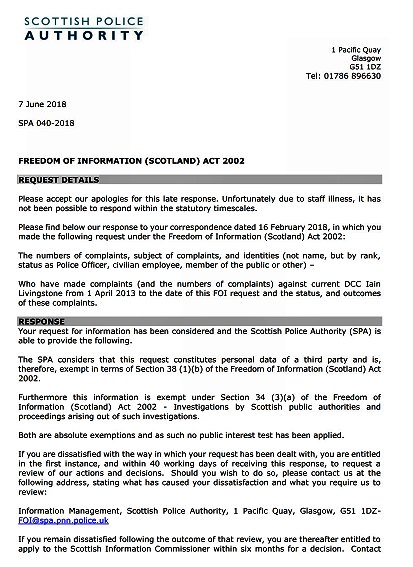
However, and some time after discussions over the Freedom of Information request had taken place, inside & outside the SPA - the Scottish Police Authority responded to the FOI request four months late, in early June - denying access to all of the information sought in relation to DCC Livingstone.

In their response, issued months late and outwith Freedom of Information timescales, the Scottish Police Authority wrongly claimed the material sought was “personal data of a third party” in a concerted attempt to conceal further details of complaints against DCC Livingstone from the public.

The Scottish Police Authority stated in it’s letter of response, dated 8 June 201: 

The SPA considers that this request constitutes personal data of a third party and is, therefore, exempt in terms of Section 38 (1)(b) of the Freedom of Information (Scotland) Act 2002.

Furthermore this information is exempt under Section 34 (3)(a) of the Freedom of Information (Scotland) Act 2002 - Investigations by Scottish public authorities and proceedings arising out of such investigations.

Both are absolute exemptions and as such no public interest test has been applied.

A request for review has been lodged, and material also sent to the Scottish Information Commissioner with regards to the SPA’s refusal to disclose the information.

The Scottish Police Authority’s eagerness to conceal information in relation to a senior Police Officer - who has been previously accused of 5 allegations of serious sexual assault, and has faced further complaints including an ‘interaction’ with another officer - raises questions about the impartiality of the recruitment round to appoint a new Chief Constable to Scotland’s crisis hit single Police service.

With reference to the five allegations of serious sexual assault, Iain Livingstone was cleared of sexual impropriety or intent – by a tribunal headed by a male top cop colleague – Assistant Chief Constable John McLean.

The former lawyer and Raith Rovers footballer had been suspended for 17 months after the WPC claimed she had been sexually assaulted during the party.

A qualified lawyer and member of the Law society of Scotland, Mr Livingstone switched careers in 1992, joining Lothian and Borders Police.

In just 10 years, Livingstone – who had also once played for Raith Rovers - had clearly been fast tracked, reaching the rank of superintendent.

At the time of the allegations and ‘internal’ investigation by his Police colleagues, Livingstone was not prosecuted by the Crown Office over the claims.

Instead, Livingstone admitted a less serious allegation about being in the woman's room overnight and falling asleep.

It should be noted that during the time of the investigation & tribunal, handled by Police, the Lord Advocate was Colin Boyd, Baron Boyd of Duncansby – now a judge in the Court of Session, and the Solicitor General was Elish Angiolini – recently appointed by Nicola Sturgeon a Scottish Minister to investigate how complaints are handled against Police in Scotland.

Asked about the sexual assault allegations during a recent BBC Scotland documentary, DCC Iain Livingstone said he “fell asleep in the wrong place and that was wrong”.

Although he admitted that he 'shouldn't have done that', he insisted that he still has the right attributes for the job.

During the BBC Scotland documentary - PoliceScotland A Force In Crisis, investigative journalist Sam Poling asked Mr Livingstone about the 'allegations of sexual assault' and about him being 'bumped down from superintendent to constable and suspended'.

Quotes from DCC Livingstone’s responses when questioned about the allegations of sexual assault reveal the following remarks by the Police Officer:

Mr Livingstone said: “There was a set of circumstances in 2000 whereby at a social event at Tulliallan, at a training event I had too much to drink.”

“I fell asleep in the wrong place and that was wrong and I shouldn't have done that, and clearly I accept that.”

'I was suspended, I spent time off work. There was a hearing convened where I did accept I fell asleep.I was cleared of any sexual impropriety.”

'I was cleared of any level of sexual intent and at that hearing, initially, I was then demoted from superintendent to constable. I immediately appealed against that and I was reinstated.”

MSPs at the Scottish Parliament also questioned his suitability for the job after his response to the claims in a BBC documentary this week - saying only that he 'fell asleep in the wrong place and that was all'.

However, Livingstone’s application for the top job – which appears to be backed by Scottish Ministers, and the Scottish Police Federation has been called into question after a former Assistant Chief Constable said Livingstone should not get the top job.

COPS TURN ON THEIR OWN: Scottish Police Federation boss launches twitter attack on ex colleague:

Following criticisms by former Assistant Chief Constable Angela Wilson - of Iain Livingstone’s bid to become Chief Constable, Calum Steele – General Secretary of the Scottish Police Federation (SPF) launched a highly personalised attack on his female former colleague - on the twitter social media platform.

The Sunday Mail reported that Calum Steele – a Police Constable with an honorary rank as Chief Inspector due to his Police Federation duties -  also branded ex ACC Wilson “useless” and a “buffoon” and wrongly claimed in tweets that a corruption inquiry in her former force Tayside “extended” to her.

Steele is general secretary of the Scottish Police Federation (SPF) who have 18,500 members and represent 98 per cent of police officers.

Steele posted a string of six tweets last week after Wilson spoke out on the prospect of DCC Iain Livingstone gaining the top job as Chief Constable of Police Scotland.

The first of Calum Steele’s tweets said she was “one of the most incompetent imbeciles ever to have held rank in the police service”.

It claimed she was continuing “a smear on one of the very best”, adding: “You really need to ask – who is driving this?”

He went on to say that Wilson had served in Thames Valley Police as did Claire Gormley, the wife of Phil Gormley who quit as head of Police Scotland in February following bullying allegations against him.

Steele added: “AW [Angela Wilson] and the Gormleys have an axe to grind. It’s frankly pathetic.”

He also described Livingstone as “one of the most talented, able, skilled and resilient police officers”.

Scottish Tories justice spokesman Liam Kerr said: “Mr Steele has a position of responsibility and should probably have thought more carefully before embarking on this chain of tweets.

“The result of this is now a potential legal case which will drag the force and its associated bodies through the mud at a time it never needed it less.”

Angela Wilson subsequently lodged a formal complaint with Police Scotland and the SPF.

It was then reported in the Sunday Mail newspaper that - as a result of the complaint raised by ex ACC Wilson, Constable Calum Steele was found guilty of posting “inappropriate and offensive” online comments about a female ex-police chief.

Upholding the complaint, Chief Inspector Jacqui Campbell, of the Professional Standards Department (PSD), ruled the comments were “inappropriate and offensive” and that Wilson was “never investigated for corruption”.

Steele claimed to be off duty when he launched the Twitter tirade on May 3 but the Professional Standards Department probe discovered that he was working.

Campbell said: “The record revealed Constable Steele’s duty for that date was 0900 to 1700 hours, therefore, at the time the tweets were posted he was on duty.”

Campbell has issued Wilson a “sincere apology for the undoubted upset Constable Steele’s actions have caused”.

But Steele – who heads the federation representing 98 per cent of Police Scotland officers – “makes no apology” and refuses to delete the messages.

Campbell said: “We have asked Constable Steele to remove the relevant tweets from his Twitter account. Unfortunately, it is his own personal Twitter account and, as such, we are unable to order him to remove or delete them.”

Despite Steele’s messages being from a personal account, Campbell found “they are directly related to his role as a police officer and particularly his role as general secretary” of the SPF.

Mr Livingstone has been regarded as the favourite to replace Phil Gormley, who quit in February after being accused of bullying by colleagues.

Following Gormley’s leave of absence last year, a campaign of suspensions, bitter infighting dubbed ‘backstabbing cops’ in the media, and now scrapped criminal investigations into colleagues of the ousted Chief Constable then took place over a number of months – setting the stage for DCC Livingstone to conveniently scrap his retirement plans, and campaign, along with vested interests in the Scottish Police Federation to replace the ousted Chief Constable.

Steele, who spoke to PSD officers through a lawyer, now faces a further hearing which may result in disciplinary action. His lawyer quoted a dictionary definition of “imbeciles” as meaning “a fool” and that it was “a fair and honest comment that represents Constable Steele’s honestly-held belief”.

Scottish Conservative justice spokesman Liam Kerr said: “Calum Steele should really back down, apologise and delete the offending tweets. Otherwise this row will rumble on.”

Chief Superintendent Mark Hargreaves, head of the Professional Standards Department, said: “The investigation into this complaint has concluded and as this is an internal matter it would be inappropriate to comment further.”

THE MSP & SEX CASE TOP COP: Ex cop MSP failed to declare link to sex case cop Livingstone:

In an earlier report in the Sunday Mail newspaper, it was also revealed that while DCC Iain Livingstone was giving evidence to the Scottish Parliament's Justice Committee in January, Justice Committee member & former police officer John Finnie had failed to tell fellow MSPs he had represented Iain Livingstone when he was cleared of sexual misconduct.

At Holyrood’s justice committee in January, John Finnie quizzed Livingstone about staffing levels and said losing chief officers was one of the benefits of creating a single police force.

Scottish Labour justice spokesman Daniel Johnson said: “John is a valued colleague on the justice committee but I am alarmed that he did not see fit to declare this link with the acting chief constable.

“Police Scotland are in desperate need of scrutiny – and the public will expect such scrutiny to be conducted professionally.

“I would urge him to correct the record and to ensure he declares interests fully and promptly in future.”

A spokesman for the Scottish Conservatives added: “He also owes parliament an explanation as to why he neglected to mention this very important link.”

Finnie spent 14 years as an official for the Scottish Police Federation (SPF) – the organisation who represent police officers up to the rank of chief inspector.

And, it emerged in February of this year that during evidence given by Deputy Chief Constable Iain Livingstone to the Scottish Parliament’s Justice Committee, neither Livingstone or the Justice Sub Committee Convener John Finnie declared any previous links to each other while Livingstone testified before MSPs.

A report in the Sunday Mail newspaper in February revealed Mr Finnie – previously a serving Police Officer and representative for the Scottish Police Federation (SPF) - had represented Mr Livingstone when he was cleared of the sexual misconduct claims in 2003.

The issue was reported by the Sunday Mail newspaper here:

Green MSP under fire after failing to reveal sex case link to top cop Iain Livingstone

John Finnie failed to tell MSPs he represented the acting chief constable when he was cleared of sexual misconduct.

By Mark Aitken 18 FEB 2018

John Finnie failed to tell MSPs he represented Iain Livingstone

A Green MSP is facing questions over his connection with Scotland’s acting chief constable.

Former police officer John Finnie failed to tell fellow MSPs he had represented Iain Livingstone when he was cleared of sexual misconduct.

He failed to declare the link at a meeting of Holyrood’s justice committee when Livingstone was being questioned.

Finnie spent 14 years as an official for the Scottish Police Federation (SPF) – the organisation who represent police officers up to the rank of chief inspector.

Livingstone, the frontrunner to replace Phil Gormley as Scotland’s chief constable, was acccused in 2004 of sexually assaulting a female police officer.

Livingstone admitted falling asleep in the woman’s room at the Scottish Police College in Tulliallan, Fife, after a drunken party in 2000.

Iain Livingstone was accused of sexually assaulting a female police officer in 2004

At an internal hearing, more serious allegations were dropped.

Livingstone, who was then a superintendent, was demoted to constable but won his job back on appeal. Livingstone’s appeal was backed by the SPF.

Finnie said at the time that the case had highlighted “the ease with which the system can be abused and the punitive consequences which affect not only the officer but their family”.

At Holyrood’s justice committee in January, Finnie quizzed Livingstone about staffing levels and said losing chief officers was one of the benefits of creating a single police force.

Scottish Labour justice spokesman Daniel Johnson said: “John is a valued colleague on the justice committee but I am alarmed that he did not see fit to declare this link with the acting chief constable.

“Police Scotland are in desperate need of scrutiny – and the public will expect such scrutiny to be conducted professionally.

“I would urge him to correct the record and to ensure he declares interests fully and promptly in future.”

A spokesman for the Scottish Conservatives added: “He also owes parliament an explanation as to why he neglected to mention this very important link.”

Finnie began his career with Lothian and Borders Police in 1976 and moved to Northern Constabulary three years later.

He served as a full-time officer with the SPF from 1992 to 2006.

Finnie was elected as an SNP MSP in 2011 but quit the party the following year in protest at the decision to end their long-standing opposition to Nato membership.

Finnie and the Greens failed to respond to the Sunday Mail’s calls.

SCOTLAND’S NEXT TOP COP:

There are three shortlisted candidates for the Chief Constable role at Police Scotland.

Deputy Chief Constable Iain Livingstone, whose past & current complaints records are being kept secret by the Scottish Police Authority, and Police Scotland.

A second candidate - Police Scotland Deputy Chief Constable Johnny Gwynne - a former head of the National Crime Agency's (NCA) Child Exploitation and Online Protection command - has also applied for the job.

Gwynne, a former Royal Ulster Constabulary (RUC) officer also previously held the post of former deputy director-general of the Scottish Crime and Drug Enforcement Agency – which was absorbed into Police Scotland in 2014.

The third candidate is Lincolnshire Police Chief Constable Bill Skelly, who joined Devon and Cornwall Police from Police Scotland as Deputy Chief Constable in 2013 and was appointed as chief Constable of the force last year.

The shortlisted candidates will undergo a selection process including two panel interviews, chaired by the Scottish Police Authority’s own boss Susan Deacon.

And the selection panel will also include SPA board member Mary Pitcaithly, NHS Scotland chief executive Paul Gray, Professor Lorne Crerar, - chairman of legal firm Harper MacLeod; and National Crime Agency Director General Lynne Owens.

Gill Imery – the current Her Majesty's Chief Inspector of Constabulary in Scotland will also act as an ‘advisor’ to the team.

According to the job information pack: "Shortlisted candidates will be invited to participate in a psychometric and personality profile exercise, an Assessment Centre, and an interview with the Selection Panel."The assessment centre will include a scenario exercise and a mock media interview.

Final interviews of the three candidates are expected to take place on 13 and 14 August.

A report on the allegations of sexual assault against Iain Livingstone by a female Police Officer, allegations which were dismissed by a tribunal headed by male Police Officer colleagues of Livingstone was reported earlier by DOI here: TOP COP SECRETS: Transparency lacking at Police Scotland as spy scandal cops refuse to disclose files on complaints & historical sexual assault case details involving Deputy Chief Constable Iain Livingstone

Friday, February 16, 2018

PROBE THE FED: Calls for Holyrood to probe secretive Scottish Police Federation as files reveal SPF General Secretary asked Scottish Government to withdraw £374K public cash grant funding - after social media transparency calls from cops

Calls for MSPs to probe ‘secretive’ Scottish Police Federation CALLS are being made for an influential Scottish Parliament committee to probe the highly secretive Scottish Police Federation (SPF) - which has received substantial public cash grants from the Scottish Government cumulatively totalling millions of pounds over a period of years.

The call for an audit & scrutiny of the Scottish Police Federation - which represents rank & file Police Officers – comes as files obtained via Freedom of Information legislation – reveals the General Secretary of the SPF asked the Scottish Government in May 2017 to withdraw £374,000 of public cash funding to the cash rich Police Union.

Coincidentally, the request by Police Federation boss PC Calum Steele to the Scottish Government to drop the cash payments – came seven days after the Scottish Information Commissioner stated on their twitter social media account that the Scottish Police Federation would be added to their recommendations to the Scottish Government - for compliance with Freedom of Information legislation.

However, nine months on from the Calum Steele’s request to cancel the public funding arrangement, the Scottish Government has now admitted it is still considering public cash grant funding for the Scottish Police Federation – and has not actually agreed to cut the public cash – as requested by Steele..

While the Scottish Government have so far refused to release much of the discussions on the SPF’s public cash funding arrangements, a list of payments disclosed in papers reveal the sequence of grant funding payments for the year 2016-2017 - where a total of £368,778 public cash was paid in four payments of £92,197 during April, July, October 2016, and a further payment in January 2017.

Peter Jamieson of the Scottish Government's Police Powers and Workforce group confirmed funding is still being considered, stating: “To note, that we are still considering the Scottish Police Federation grant funding for 2017/18.”

The Scottish Government have yet to respond to a request for further details on why they are still considering public cash for the Scottish Police Federation,

However, sources have indicated civil servants and Special Advisers (SPADS) have discussed the matter of ending the grant funding, where some expressed the view that the public cash grant funding gives the Scottish Government a ‘carrot and stick’ hold over the SPF – which regularly supports Government policy in any area.

More recently, the Scottish Police Federation has been accused of having a vested interest in the leadership crisis at Police Scotland – which saw extensive efforts to oust the now former Chief Constable Phil Gormley, and replace him with DCC Iain Livingstone.

However, while the Scottish Government delay a decision on how to slip more public cash to the Scottish Police Federation, a letter from the SPF’s General Secretary Calum Steele  to Tansy Main, the Head of Police Workforce Team – claims the Scottish Police Federation is no longer reliant on the public cash.

The letter from PC Calum Steele to the Scottish Government reads as follows:

I refer to the above and to our ongoing conversations on the subject.

As you are aware the history of the Scottish Police Federation Grant was simply to ensure that no single police force was left carrying the costs of the elected officials of the Scottish Police Federation (SPF). The Scottish Government (and its predecessor bodies) paid a grant to the SPF, which was in turn utilised to reimburse the relevant force for the costs of the elected officials. This was entirely appropriate.

Since the creation of the Police Service of Scotland the issue of which force pays the costs of the elected officials of the SPF is no longer relevant. The practical effect is therefore that the SPF receives the grant in quarterly instalments only to immediately pass them to the Scottish Police Authority (SPA) to meet the costs of the official's salaries. This however creates an administrative burden for both the SPF and SPA that is completely unnecessary. It demands amongst other things that the account is audited, that accounting fees are paid and that a purely administrative set of accounts is created and published.

The grant also covered the costs of ancillary matters including (but not limited to) accoutrements, rates and rent for the SPF headquarters, the costs of the then annual conference, and the costs of the statutory meetings of the Joint Central Committee. You will be aware that the grant has reduced in value in recent years and as the accounts show, whilst continuing to cover the cost of officials, it no longer comes close to covering the costs of the items it was originally intended to.

Whilst the grant accounts shows a paper loss, the SPF considers that beyond costs of officials, we are no longer reliant on the additional grant monies to pay for these elements.

The SPF considers therefore that continued payment of a grant to the SPF makes little sense and formally request the termination of SPF grant facilities, with the monies being paid directly to the SPA, as part of the global policing settlement (or otherwise as Government sees fit).

Self-evidently the SPF would expect that in doing so this would result in the termination of the expectation that the SPF continues to reimburse the SPA for the cost associated with officials, without detriment to the provisions of the Police Federation (Scotland) Regulations, insofar as they relate to the payment of pay and pension for officials of the SPF in particular.

The SPF would also ask that the surplus elements be considered to cover any notional future costs the SPF might be expected to incur as a consequence of the Trade Union Bill.

Any scrutiny of the Scottish Police Federation’s use of public funds, and their position as a body created by legislation, is liable to be carried out by the highly effective Public Audit and Post Legislative Scrutiny Committee (PAPLS) – which took on the Scottish Police Authority (SPA) in spectacular style, providing ground breaking scrutiny of a dysfunction, secretive authority dubbed a “secret society” by MSP Alex Neil (SNP).

Among the additional FOI documents disclosed by the Scottish Government include some, but not all minutes of meetings & discussions around the grant funding for the Scottish Police Federation, and as has been consistent with recent Scottish Government releases, documents are subject to significant redactions.

However, while the letter from the SPF General Secretary to the Scottish Government reveals scant detail of SPF finances, former and currently serving Police Officers have posted their concerns on social media with regards to figures of up to ten million pounds held by the Scottish Police Federation in bank accounts & assets.

Social media postings by current and former Police Officers also refer to trips undertaken by SPF representatives including Callum Steele and suspended Sheriff Peter Watson - to various gatherings funded by the Scottish Police Federation.

Meanwhile, as current & former Police Officers & journalists asking questions of the SPF are either blocked online, or subject to social media attacks by supporters of the Scottish Police Federation and politically friendly elements – some of whom give after dinner speeches or lobby for public cash for their ventures, the Scottish Information Commissioner appears to have reneged on their enthusiasm for recommending FOI compliance for the SPF.

An earlier statement from the Scottish Information Commissioner claimed the SIC would add the SPF to their list of organisations which should be covered by Freedom of Information legislation.

The statement came in response to a request made on behalf of serving & former Police Officers - who queried why the Scottish Police Federation remained except from Freedom of Information legislation in Scotland, while their English counterpart was brought within FOI laws in England & Wales some years ago.

A twitter post from Scottish Law Reporter on 17 May 2017 pointed out  “as @PFEW_HQ is #FOI compliant in England, @ScotsPolFed should comply with #FOIScotland suggest you call for this improvement”

A tweet dated 18 May 2017 from @FOIScotland in response stated “Thanks - we'll add it to our list of bodies to propose to Ministers. Individuals can also make their own representations to the Scot Gov”

The Police Federation of England and Wales (PFEW) is funded in part by police officers who pay subscriptions from their wages.

Differing from it’s Scottish counterpart – the Scottish Police Federation - which has cumulatively received millions of pounds in public cash over the years, the PFEW is not a public body and not funded by the public and is the only staff association to be subject to Freedom of Information (FoI) - which came into effect for the PFEW in April 2017 by way of the following legislation:

Freedom of Information Act etc: Police Federation for England and Wales: The Police Federation for England and Wales is to be treated for the purposes of— (a)10the Freedom of Information Act 2000,(b)the Data Protection Act 1998, and (c)section 18 of the Inquiries Act 2005, as if it were a body listed in Part 5 of Schedule 1 to the 2000 Act (public authorities).

However, nine months later in Scotland, after the Scottish Information Commissioner had said it would act on the matter, no action has been taken by the Scottish Information Commissioner to include the Scottish Police Federation in their recommendations of FOI compliance to Ministers.

Queried over the lack of action on the subject, a response from the SIC claimed the Scottish Information Commissioner could not divert financial resources to make any necessary representation to the Scottish Government.

A journalist who viewed the SIC’s claim of being under resourced -  branded their response as “a delaying tactic”.

Scottish Information Commissioner’s role in FOI transparency.

A query to the Scottish Information Commissioner of 30 May 2017 on the subject of recommending Freedom of Information compliance be applied to the Scottish Police Federation generated the following response from the SIC:

The power to designate bodies as Scottish public authorities under sections 4 or 5 of FOISA lies with Ministers. Section 43(4) of FOISA provides that the Commissioner can, from time to time, make proposals to the Ministers “for the exercise by them of their functions” under those provisions. Of course anyone can make such proposals to Ministers and we know that people do so.

It’s important that proposals to Ministers are framed in terms of considerations for designations of each body. The Commissioner’s Special Report in 2015 FOI 10 years on: Are the right organisations covered? (copy attached) suggests the sorts of considerations Ministers might apply to deciding whether or not to designate bodies under section 5 (the more complex of the two designation provisions).

We’ve made a number of proposals to Ministers over the years about bodies they might consider for designation. Most of those proposals have concerned section 5 – see consultation responses at http://www.itspublicknowledge.info/home/SICReports/OtherReports/otherReports.aspx

We’ve made few proposals to Ministers for consideration of designation of bodies under section 4. This is because there is rarely a need to do so. Scottish Government Bill Teams routinely ensure that primary legislation founding new bodies includes a modification of Schedule 1 of FOISA to ensure they are included as bodies under jurisdiction.

The most recent example I can recall of a section 4 proposal from the Commissioner is one in 2010 for consideration of the Court Rules Councils. I’ve attached a copy of the submission which sets out the sorts of considerations that Ministers might consider. These bodies were subsequently designated by Ministers.

The reference in our tweet is to a working list we maintain of bodies that the Commissioner might propose to Ministers. We revisit that list annually, at the latest, in the final quarter of each operational year (January – March). We research the possible considerations that might apply to designation of those bodies. If we conclude there is a persuasive case for a proposal, the Commissioner will make a proposal to that effect to the Ministers. Currently our list includes the following bodies:

Adult Protection Committee, Leisure trusts, etc, which were established other than by one or more local authorities, Learning Network West, Police Federation of Scotland

In terms of your request for comment on “non compliance of SPF in Scotland”, I hope you will appreciate that there is nothing we can offer until we have researched any designation considerations for that body. We’re grateful to you for bringing to our attention what appears to be an anomaly arising from the designation of a similar English and Welsh body under UK FOI law, but we have not yet looked into the background. Our research in this case will include looking at the reasons for the UK FOI designation and comparing issues such as legal status, function and control.

A further enquiry of September 2017 to the Scottish Information Commissioner on the subject of the Police Federation’s FOI compliance was then treated as an FOI request by the SIC, who responded, claiming they could not divert resources away from other work.

Shockingly, the Scottish Information Commissioner requested journalists make a submission to the Scottish Government instead of a fully researched submission by the Information Commissioner with all the weight such a report would carry in government & parliamentary circles.

The Information Commissioner’s response reads as follows, and accompanying documents released with the response can be found here:

Thank you for your enquiry on 29 September 2017 in which you asked for an update to the SIC’s position with regard to research or a recommendation for the inclusion of the Scottish Police Federation in FOISA. I have treated your enquiry as a request for information that we hold, because you are seeking information about the progress we have made since your media enquiry of 30 May 2017 about the FOI status of the Scottish Police Federation (our reference 201700982).

I also attach copies of my correspondence with Andrew Gunn of the FOI Unit in the Scottish Government (described in the attached schedule). I have redacted both Andrew’s, and Sinead Campbell’s email addresses as these may be personal information to which section 38(1)(b) of the Freedom of Information (Scotland) Act 2002 applies. This should not affect the readability of the information and it is not information you asked to see.

I expect you will also want to know when we expect to carry out our research. When I wrote to you in May this year, I explained that our usual timetable for looking at potential recommendations for designation is the final quarter of the operational year (January to March 2018). This work is set out in our operational plan http://www.itspublicknowledge.info/home/AboutSIC/StrategicPlan.aspx. The relevant reference can be found on p10, line item 4.

Though I appreciate you are keen for us to research the status of the Police Federation of Scotland, regrettably there has been no opportunity to divert resources to the work ahead of our schedule. You do not, of course, have to wait for us to reach our conclusions; anyone can make a designation proposal to Ministers. Making your own proposal would ensure your own arguments for designation of the Police Federation of Scotland were taken into consideration. 

To-date, the Scottish Information Commissioner has not made any submission to the Scottish Government on recommending the Scottish Police Federation be brought within Freedom of Information legislation – as is the case with the Police Federation of England & Wales.

And while this exemption continues, serving and former Police Officers who are still members of the SPF are effectively blacklisted or blocked on social media when they try to obtain answers to the lack of support they received from the SPF when help was needed.

Currently it is known the Scottish Police Federation are represented by law firms such as Levy and Mcrae, and Peter Black Watson of PBW Law.

During 2015, Levy and Mcrae, and their former partner Peter Black Watson were named in a multi million pound civil claim in the Court of Session.

Peter Watson – who is a member of Scotland’s judiciary, was suspended “to protect public confidence in the judiciary” by the then Lord President Lord Brian Gill.

How Scottish Police Federation spend their members money:

The Scottish Police Federation recently faced criticism for an office revamp that included the restoration of marble fireplaces and new French and Italian furnishings.

The headquarters upgrade was completed in 2015 and is said to have cost £1m, although that figure is disputed by the federation.

Concerns have been raised because the SPF receives taxpayers’ money in the form of a Scottish government grant worth £374,400.

The federation claimed “not a single penny” of taxpayer money was spent on the project at the HQ, which is in a listed building in Glasgow.

The head of Scotland’s police union was also embroiled in a spending row after splashing out £5,000 to attend a charity dinner headlined by former US president Barack Obama.

The Scottish Police Federation  paid the money to secure a table at the prestigious event hosted by Sir Tom Hunter in Edinburgh last month.

The disclosure has caused upset amid claims the dinner was a “jolly” for top brass based at the union’s Glasgow headquarters in Woodside Place.

Police Federation spending in England resulted in fraud investigation:

An alleged £1m fraud at the Police Federation in England has been referred to prosecutors.

Lawyers at the Crown Prosecution Service are currently considering if criminal charges should be brought against Will Riches, the former vice-chair of the federation and a serving Metropolitan police officer.

The investigation began in March 2016 and it is alleged £1m in Police Federation funds was transferred to an organisation called the Peelers Charitable Foundation.

The Police Federation has been riven by internal divisions and was under government pressure to reform, after a series of controversies about how it spends and manages the money it raises.

It represents 123,000 rank and file police officers in England and Wales, and in 2014 Riches ran to be its chair. He got the same number of votes as his rival, but lost the job on a coin toss to Steven White, the current chair.

The Police Federation in England & Wales has previously faced allegations of bullying and secret multimillion-pound bank accounts.