Showing posts with label Scottish Courts Service. Show all posts

Thursday, September 20, 2018

JUDGE SCANDAL: Dark side of Scotland’s judiciary reveals how judges & courts covered up scandal hit judges - from fraud, tax avoidance, alcohol related violence to the wife-beating Sheriff - who all avoided action from Crown Office & Police

Judiciary, Police & prosecutors failed to act on retired scandal Sheriff. THE WAY in which the Judiciary of Scotland deal with allegations against their own members, was never more evident, and in remiss than when the wife of a now deceased Sheriff tried in vain to report her judge husband to Police and prosecutors.

The late Sheriff Lothian, who it turns out - was well known to judicial figures and even Scottish Court Service staff - for his visits to sauna parlours, rumours of mistreatment of his family and use of prostitutes – is one of the dark, yet not so far away chapters of Scotland’s legal circuit.

Yet to this day, snippets of similar behaviour by sheriffs & senior legal figures from unpublished court documents, hearings in chambers,quietly arranged divorces and even missing Police reports - is as shielded from the public today, as it was during Lothian’s reign in the Sheriff courts.

Far from the image of judicial figures cosying up to First Ministers, Lord Advocates and the reluctant ex top judges lecturing politicians and the public on morality, transparency and accountability - members of the judiciary have recently been caught up in all kinds of seedy accusations, ranging from mega millions in hedge fund linked financial impropriety, to carefully concealed court cases and even divorce, where allegations against judges range from wife battering to drunken rages and smashing objects.

Yet, the public learn very little, if usually nothing of these events - and mysteriously, the courts, prosecutors, even Police, all comply with a very judicial silence.

The “me too” #metoo movement - a campaign to denounce sexual assault and harassment – which has somehow mysteriously skipped Scotland under First Minister Nicola Sturgeon – certainly stands no chance against angry, embittered & wife beating members of the judiciary.

Nor does “me too” stand a chance against shady senior figures in Police Scotland- who support each other when reports of sexual assault or harassment end up buried with a ‘no action’ ticket at the Policeman’s ball.

The history of the demise of Sheriff Lothian – who died in 2016 – is well known.

However, the cover up by colleagues on the bench, who knew of Lothian (and other judicial figures) associations with prostitutes, sauna bars, and the attempts by Lothian’s wife to report her husband to the Police & Crown Office – stands to this day as an example of the dark side of Scotland’s judiciary.

A carefully crafted system of cover up, denial and protection of a 500 year old white male dominated judiciary - which runs from the lowly Justices of the Peace who have criminal records for shop lifting & assault, to the most senior levels of the bench where tax avoidance, failures to declare interests, wife beating & carefully denied allegations of sexual misconduct in the workplace never see the inside of a court, the pages of a recusal register or the ink of a charge sheet.

It is also worth noting, many of Scotland’s current senior judges were on the judicial bench during Sheriff Lothian (among others) penchant for boozing, sexual assault, use of prostitutes & reign of terror at home. Yet, to this day, not one judge ever spoke out.

Sheriff Lothian quietly retired on a pension of £7,000 a month.

A Freedom of Information disclosure from the Scottish Government to DOI Journalists also revealed Sheriff Lothian received substantial payments from the Scottish Government & service awards.

Documents within the FOI disclosure reveal that under the Judicial Pensions Act 1981, Sheriff Lothian was entitled to a pension of £63,200.00 per annum and a lump sum of £84,547.00 and in addition Lothian would receive a service award of £50,560.00, based on a salary of £126,400.

Additionally, under the Judicial Pensions and Retirement Act 1993, Sheriff Lothian was entitled to a pension of £62,627.00 per annum, and a lump sum of £84,547.00 together with a net service award of £52,920.00 – based on his pensionable pay of £125,253.33.

Exchanges within the documents disclosed by the Scottish Government also reveal the then Justice Secretary – Kenny MacAskill – was not informed of Sheriff Lothian’s sudden decision to quit the bench, and further emails between heads of the justice department show concern at enquiries from newspapers as to the conduct & status of Sheriff Lothian.

In relation to the allegations against Sheriff Lothian of wife beating and other reports to Police - no action was ever taken against him by the Crown Office or Lothian & Borders Police.

A report on the allegations against Sheriff Lothian and the suffering of his wife, which exposed brutality at a judicial level, featured in the former News of the World newspaper.

It may be a grim read for some, but a necessary read for all – and much further afield than Scotland:

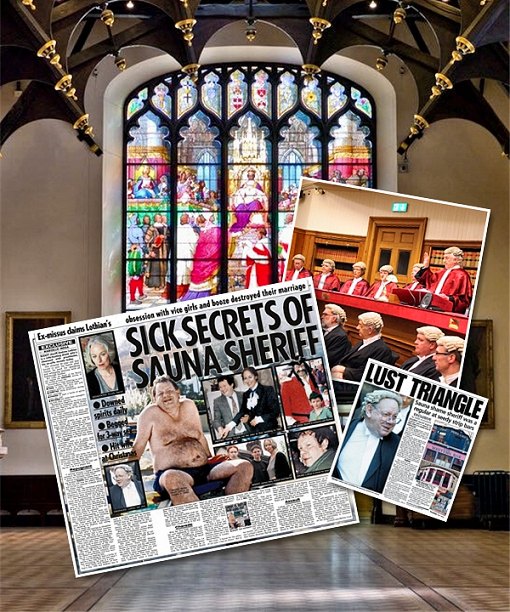
SICK SECRETS OF SAUNA SHERIFF  

Ex-missus claims Lothian's obsession with vice girls and booze destroyed their marriage  Downed sprits daily  Begged for 3-way sex  Hit wife at Christmas

By MARCELLO MEGA News of the World 15 March 2009

SLEAZY sheriff Andrew Lothian is a wife-beating drunk who's obsessed with prostitutes, his ex-wife reveals today.

The shamed 66-year-old was forced to quit the bench after claims he paid for spanking and whipping sessions with an Edinburgh hooker.

But today the News of the World can expose the SHOCKING secrets of his sordid private life.

According to long-suffering ex-wife Harriet Lothian, the twisted beak TRIED to make her have sex with strangers while he watched

ADMITTED using prostitutes during their marriage

DOWNED at least a bottle of spirits every day, and BATTERED her while their unsuspecting kids slept upstairs.

Speaking at length for the first time since her ex-husband's sauna shame, disgusted Harriet, 57, said: "I'm surprised it took so long for his activities to be exposed.

"I tried repeatedly to alert the police and the Crown to his unsuitability for office because of his behaviour, but to no avail.

"I suffered greatly at his hands, both during our marriage and for many years after I divorced him."

We told last November how Lothian quit his £125,000-a-year job after Crown Office bosses confronted him about allegations over his private life.

But, according to Harriet his obsession with sordid sex had been going on for YEARS.

Lothian's wife of 19 years said: "Sexually, there were problems from an early stage in the marriage.

"I found it so unsettling that I sought advice from my father, who was a doctor, and who I could talk to about anything.

"Andrew was into kinky but fairly inadequate sex. He also had fantasies about introducing third parties, men or women, into the bedroom.

"I had no interest, but he kept asking me to do it to please him.

Repugnant

"I refused because I found the idea repulsive. He said he could pay people to make his fantasies come true." Harriet suspected her hubby was using hookers DURING their marriage.

And she told how her elderly father was forced to confront Lothian about the sleazy claims.

Harriet said: "He confessed without any shame. He told me he had lost his virginity at 16 to a prostitute, and that he'd always been turned on by them.

"I was devastated. I told him I'd never have unprotected sex with him again but he was totally unrepentant.

"Once his obsession was out in the open, he became more demanding. If he was out at a dinner, he would bring men home and want me to have sex with them while he watched.

"I would have to throw them out, which was embarrassing. I found the idea repugnant. Apart from anything else, I had children in the house.

"My father was 68, but was very close to me and he had no hesitation in speaking to Andrew and telling him to shape up."

The couple had married on December 28, 1983, after a whirlwind romance.

Lothian already had a son, also Andrew, from the first of two previous marriages, and Harriet had a young son, James, from a previous relationship.

Two years after their wedding, Harriet gave birth to their son Robert, but already the foundations of the marriage were beginning to crumble.

She says: "By the time Robert came along, I had serious concerns about his father's alcoholism and how terribly ill it was making him.

"He was drinking at least a bottle of spirits a day, and that was just what I was witnessing. He was in a mess.

"I went home with Robert on New Year's Day 1986 and Andrew was in such a terrible state that he became abusive. I threw a milk bottle at him and hit him on the side of the head.

"The next day, I insisted he saw a doctor, and he agreed because his mother was in the house.

Harriet tried to alert senior legal officals to her husband's alcohol abuse but was snubbed at every turn.

Things spiralled further out of control and by Christmas 1996 Harriet demanded Lothian move out.

She said: "His language became more abusive. There were implied threats of violence and the odd punch to the side of the head where no visible marks were left, but I was still shocked by what happened then."

Harriet told how their sons, James, now 27, and Robert, now 23, were in their bedrooms when a huge row erupted on Christmas Eve that year.

She claims Lothian slapped her hard in the face, before punching her full on the nose.

As their shocked mother took refuge in the bathroom, where she tried to stem the flow of blood, both sons plucked up the courage to leave their rooms and go to her aid.

Charade

With her face badly marked and her eyes beginning to blacken, the family went through the motions the next day, exchanging presents and eating dinner — but the mood was understandably bleak.

Harriet said: "Until that point, I'd been trying to hold things together for my sons, but I couldn't go on with the charade.

No child should have to see their mother pouring with blood from a blow their father has struck.

It was a total nightmare." Robert said: "I remember clearly what happened that night and it sickens me the way he behaved. It is more than ten years since I have spoken to him.

"When I was 12 I wrote him a letter telling him I wanted nothing to do with him." Following the attack Harriet demanded that Lothian move out of the family home in Lauder, Berwickshire.

She wept: "I feared for the safety of our sons. I had no choice."

But in SLEAZE: summer 2001 Lothian — then living in Edinburgh — launched a court bid to SELL the house.

She said: "The move was especially hurtful as Robert was about to start his Higher courses.

"It was also difficult to understand as Andrew had inherited a six-figure sum the previous year when his mother died."

Lothian's partner at that time, Eleanor Burns, daughter of Sir John and Lady Eleanor Burns, had also inherited a substantial sum on the death of her mother, just a week before Catriona Lothian's death.

By 2002, when they finally divorced, Harriet claims exclusive that Lothian enjoyed a six-figure salary whilst Harriet took care of their children and could only work part-time as a rape crisis counsellor.

In the end she had to pay Lothian £28,000 to buy him out of the family home and finish the marriage.

Assault

Lothian and his brother Murdoch were subject to an Inland Revenue investigation in 2000 after claiming the contents of their late mother's Stirling home were worth a mere £5,000.

This included antique furniture, jewellery, silver, paintings and pottery.

It's understood the Inland Revenue later valued the list at £300,000.

But Harriet still wishes justice had been done for the assault she endured in 1996. She said: "Successive governments on both sides of the border have claimed to wage war on domestic violence.

"There was an opportunity for the Scottish establishment to show there was substance behind the platitudes by taking action against a senior lawyer. But typically, they covered his back." Now self-employed in horticulture, Harriet added: "I have to work extremely hard to make a living.

Andrew's disgrace has not made life any easier, but I feel vindicated."

Lothian served on the Glasgow bench from 1979 to 1992 before moving to Edinburgh. He's expected to keep his £7,000-a-month pension.

He was unavailable to comment on the allegations.

Read more articles about the Judiciary of Scotland here : Judiciary of Scotland - Previous articles

Thursday, October 06, 2016

PUBLISH & BE JUDGED: As Lord President, Lord Hamilton gave nod to transparency after media interest prompted decision to publish judges’ expenses claims

Former Lord President Lord Hamilton, now of Qatar court. TRANSPARENCY has not always been the perceived sworn & deadly enemy of Scotland’s jet setting, boozing, partying, public-funds-cheating & tax-avoiding-island-hopping-bank-fiddling Judiciary of Scotland  - as one former Lord President proved when confronted by journalists investigating the veil of secrecy around our ermine clad public servants.

For the story of how Scotland’s judiciary finally surrendered details of their own cash splurging expenses claims – began with an investigation by Diary of Injustice during 2010 – prompting a decision by the then Lord President – Lord Arthur Hamilton – to publish judges expenses claims on a quarterly basis ever since.

The task – to break the secrecy around how much public cash our judges were burning up for junkets here, there and everywhere – was admittedly difficult.

The Scottish Government – initially claimed they held no such figures - and none existed.

The same was true of the Scottish Courts Service – eager to keep the open wallet policy of throwing cash at the judiciary out of the headlines.

But, there was Freedom of Information – a tool to be used by all – media and public alike – to break the secrecy of our public institutions no matter how high up the ladder they regard themselves.

Compared to England & Wales – where the judiciary were required to publish their expenses claims and had done so for many years, going that little bit further in Scotland appeared almost impossible, with the resistance encountered from public bodies responsible for  the figures.

The more resistance, the more suspicion there was … something to hide.

On top of judicial salaries in 2010 – around £6.1 million, the judges were topping up their positions with cumulative expenses claims of £200K.

Admittedly perhaps not in the Westminster Parliament’s expenses fiddling league – but getting there – if left secretive and unchecked.

However, once told of the queries - Lord Hamilton – the top man - was having none of it - and the Scottish Courts Service were ordered to make the figures public on a rolling basis – every quarter.

And since 2010, on a more often than not regular basis, the public are able to read up on how much Scotland’s eerily secretive, not-very-diverse-or-representative-of-the-wider-community judges plunder from the public purse by clicking here: Judiciary of Scotland - Judicial Expenses Claims

In one quarter alone this year – from 1 April to 31 June, our Court of Session Senators on salaries of up to £225K a year - claimed a whopping £17,331.57 extra in expenses.

Lord Carloway – who is otherwise occupied in fighting proposals before the Scottish Parliament to create an even greater and more effective level of transparency – Petition PE1458: Register of Interests for members of Scotland's judiciary – claimed £1315.66 expenses in the last quarter available.

Lady Dorrian – The Lord Justice Clerk – claimed a mere £338, Lady Smith - £176.55. Lady A Carmichael- £121. Lord Kinclaven claimed a whopping £6,195.35 – most of which falls under the heading of “accommodation and subsistence”. Lord Brailsford required £14.85 from the public purse – the same judge whose name appears on the title deeds of the Laigh Hall – as a “trustee” for the Faculty of Advocates who swiped it from public ownership. Lord Matthews claimed £308.70. Lord Pentland claimed £385.86. Lady Stacey claimed £741.50. Lord Tyree claimed £490.52. Lord Stewart claimed £3,990.75. Lord Burns claimed £103.80.Lord Armstrong claimed £2,709.50. and Lady Rae claimed £439.53. Bringing a grand total of £17,331.57 for a mere three months work for a handful of judges.

It’s a tough life being a Senator of the Court of Session.

All that jet setting, sitting in court, gatherings with the legal crowd at taxpayers expense. resisting declaring their interests.

A tough life indeed – but at least Lord Hamilton allowed the media and the public the chance to peer a little deeper into how our cash flowed out on judicial jet set junkets and judicial expenses claims.

Since retiring as Lord President, Lord Hamilton now serves on the supplementary panel of the United Kingdom Supreme Court (UKSC).

Additionally, from April 2015 - the former Lord President now holds a position on the Qatar International Court and Dispute Resolution Centre – where big business can confront each other over – as the title suggests – disputes.

The Qatar International Court (QIC) is based in Doha, Qatar. The Court’s mission statement from their website states: “To provide a world-class international court and dispute resolution Centre that will maintain the highest ethical standards, act in accordance with internationally recognized best practices and deliver justice fairly and efficiently with a firm commitment to upholding the Rule of Law.”

The court is led by QIC President, The Rt. Hon. The Lord Phillips of Worth Matravers – former Lord Chief Justice of England and Wales who served as President of the Supreme Court of the UK from 2009 to 2012.

Appointed along with Lord Hamilton was Edwin Glasgow QC from England, Gopal Subramaniam from India and Justice Laurence Li, a former supplementary judge of the Qatar International Court, from Hong Kong.

The QIC comprises the QFC Civil and Commercial Court and the QFC Regulatory Tribunal established pursuant to QFC Law No 7 of 2005, as amended by QFC Law No 14 of 2009. The QIC has internationally renowned judges with expertise in complex commercial disputes and serves to uphold the rule of law, applying the highest quality international legal standards to civil and commercial disputes between individuals and business entities operating both in and outside the QFC.

Readers will be familiar with Lord Brian Gill’s five day state visit to Qatar LORD JET SET: Scotland’s top judge Lord Gill takes 5 day STATE VISIT to Qatar as investigation reveals judiciary's international travel junkets spree.

Gill took the junket in preference to appearing before the Scottish Parliament to give evidence on A Register of Interests for Scotland's Judiciary

Saturday, August 29, 2015

JUDGE JET: Sheriffs’ £15K tour of Africa adds to air miles racket of Scots judiciary - as top judges' clampdown on judicial jet set junkets takes flight

Judges’ use of overseas junkets in the dock. A CLAMPDOWN on judicial jet set junkets announced by Scotland’s top judge last October has failed to curb the ever spiralling jet set habits of the judiciary - it can be revealed.

Figures released by the Judicial Office in response to a Freedom of Information request - report the costs of Overseas travel of Scottish judges in 2014-2015 has in fact – increased – from the previous year (2013-2014) – which saw Scots judges take lavish 5 day judicial junkets to international destinations including middle eastern dictatorships.

And the frequency of flights & journeys suggest Scotland’s judiciary are still clocking up air miles regardless of spending cuts across other public services - often at brutal expense & little gain to the justice system.

The latest list of overseas travel – which the Judicial Office claim is necessary for judges to share their understanding of the law and court processes – also includes a five day junket for three Sheriffs who travelled to Africa.

The taxpayer funded £15,000 junket to Zambia - paid for Sheriff Gordon Liddle, Sheriff Lindsay Wood and Sheriff Michael Fletcher to attend a five-day conference hosted by the Commonwealth Magistrates' and Judges' Association. The event was held at a hotel by the Victoria Falls and ended with a sunset cruise on the Zambezi.

Speeches at the five day event included "building public confidence through judicial accountability" and "identifying and eliminating corruption in the legal system".

The latest revelations of judges taking taxpayer funded trips to ‘law conferences’ & river tours emerged after last year’s investigation by the Scottish Sun newspaper which revealed Scotland's top judges spent £26,000 on thirty three international trips funded by taxpayers - including journeys to destinations such as Russia, Israel, Switzerland,Germany, France, Bulgaria, Lithuania.

The now retired top judge Lord Gill – who has yet to respond to a third invitation requesting his appearance at the Scottish Parliament’s Public Petitions Committee  to answer questions from msps on judges undeclared wealth & interests - also jetted off on a five day state visit to Qatar during 2014.

Last April, Gill (73) gave a sixteen page speech on ‘judicial ethics’ in the Gulf Emirate of Qatar – a country which stands accused of multiple breaches of human rights, using slave labour and funding terrorism & war.

Asked for further details of Lord Gill’s itinerary in Qatar, a spokesperson for the Judiciary of Scotland said no information could be provided. The Judicial Office claimed there were no photographs or video footage of Lord Gill’s trip to Qatar, even though the trip was paid for by the taxpayer.

In response to media scrutiny of judicial air junkets and mentions in the Scottish Parliament, top judge Brian Gill announced a crackdown on overseas trips made by judges.

The Lord President issued an edict on judicial jet junkets, setting out new rules stating judges would have to make a written business case for clocking up more air miles via taxpayers cash.

However, as total figures for this year reveal, the cost of flying the highly secretive, wealthy & elderly Scottish judges around the globe at taxpayers expense surpassed last year’s £30K figures – and this is only for trips admitted to by the Judicial Office and the Scottish Courts & Tribunals Service.

Overseas travel of Scottish judges in 2014-2015:

Listed by: Date, Judicial Office Holder, Reason for Trip & Destination, Cost, Expenses Claimed, Total Cost.
15-18 May 2014  Lord Eassie EAJ Conference in Larnaca   £731.53   £0.00  £731.53
10-13 June 2014  Lord Tyre  ENCJ General Assembly of the ENCJ in Rome  £984.00  £110.90  £1,094.90
10-13 June 2014  Sheriff Normand  ENCJ General Assembly of the ENCJ in Rome  £945.16  £65.00  £1,010.16
21-28 June 2014  Lord Carloway  ISCRCL Conference Vancouver in Canada  £1,885.28   £39.00  £1,924.28
21-28 June 2014  Sheriff McFadyen  ISCRCL Conference Vancouver in Canada  £1,408.31 £0.00  £1,408.31
Jan 14 - June 14  ENCJ Reimbursement -£150.10  -£150.10
Jan 14 - June 14  ENCJ Reimbursement  -£298.00  -£298.00
07 - 11 September 2014  Sheriff M Fletcher CMJA Council meeting and Conference in Zambia £4,624.74  £290.53  £4,915.27
07 - 11 September 2014  Sheriff G Liddle CMJA Council meeting and Conference in Zambia  £4,810.77  £45.78  £4,856.55
07 - 11 September 2014  Sheriff L Wood  CMJA Council meeting and Conference in Zambia  £4,998.30  £119.68  £5,117.98
18-19 September 2014  Lord Tyre  ENCJ project group meeting in Madrid  £336.74  £95.39  £432.13
21 - 23 September 2014  Lord Turnbull  Judicial and Academic visit in Luxembourg  £384.30    £0.00    £384.30
21 - 23 September 2014  Lord Burns Judicial and Academic visit in Luxembourg  £384.00  £0.00  £384.00
13 October 2014  Lord Tyre ENCJ project group meeting - The Hague, Netherlands  £468.01 £82.88  £550.89
16 - 17 October 2014  Lord Brailsford  Judges seminar in Antwerp  £782.27  £0.00  £782.27
17 - 19 November 2014  Lady Rae  Judges Forum in Luxembourg  £270.74  £0.00  £270.74
17 - 19 November 2014  Lord Bannatyne  Judges Forum in Luxembourg  £299.97  £0.00    £299.97
1-2 December 2014  Lord Tyre  ENCJ Project Independence & Accountability 1-2 December 2014- Brussels  £488.04  £70.25  £558.29
08 December 2014  Sheriff Liddle  ENCJ Project group meeting in Dublin £183.19  £0.00  £183.19
Sept 14 - Dec 14  ENCJ Reimbursement -£284.54  -£284.54
25-26 January 2015  Lord Tyre ENCJ Expert Group meeting in Brussels  £487.25  £75.50  £562.75
29 - 31 January 2015  Lord Turnbull ECHR- Strasbourg on behalf of the LP  £847.90  £0.00  £847.90
11-13 February 2015  Lord Tyre  ENCJ Project Group meeting in Bucharest  £466.25  £56.09  £522.34
25-26 February 2015  Sheriff Liddle ENCJ project group meeting in Madrid  £135.25  £0.00  £135.25
23-24 March 2015  Sheriff G Liddle  ENCJ project group Committee Meeting in Amsterdam  £264.18    £7.40    £271.58
09 - 10 April 2015  Lord Tyre ENCJ - Project Group meeting, Lisbon  £452.87  £87.44  £540.31
16 - 17 April 2015  Sheriff G Liddle  ENCJ Project group Meeting in Brussels  £367.52  £0.00  £367.52

Total  for Trips: £26,273.93,  Expenses: £1,145.84,  Total Cost: £27,419.77

Dates, Traveller, Reason for Trip & Destination, Hotel & flight costs, Expenses Claimed
25-28 August 2014  Lord Carloway  Evidence Review Group meeting in Hague & Oslo  *298.26
25-28 August 2014  Lady Dorrian  Evidence Review Group meeting in Hague & Oslo       
25-28 August 2014  Sheriff Principal Scott Evidence Review Group meeting in Hague & Oslo       
25-28 August 2014  Eric McQueen  SCTS Staff  Evidence Review Group meeting in Hague & Oslo   ** £412.96
25-28 August 2014  Tim Barraclough  SCTS Staff  Evidence Review Group meeting in Hague & Oslo  *** £146.60
5 people    £3,712.37  The Hague - Hotel meeting room fees  £146.50   
Subtotals: £3,858.87,   Expenses:£857.82,  TOTAL: £4,716.69

The latest round of judicial jet set junkets was reported in the Sunday Mail newspaper:

Judges' £15,000 Zambia Junket
Fury over sheriffs' bill
By Mark Aitken, 09 August 2015 Sunday Mail

More than £15,000 of taxpayers' cash was spent on three sheriffs going on a junket to Africa - despite a clampdown on overseas trips.

Scotland's judges and sheriffs spent more than £27,000 on overseas trips in 2014-2015.

Destinations included Amsterdam, Rome, Madrid, Vancouver and Lisbon.

The most expensive trip was £14,890 for sheriffs Gordon Liddle, Lindsay Wood and Michael Fletcher to attend a five-day conference in Zambia hosted by the Commonwealth Magistrates' and Judges' Association.

Speeches included "building public confidence through judicial accountability" and "identifying and eliminating corruption in the legal system".

The event was held at a hotel by the Victoria Falls and ended with a sunset cruise on the Zambezi.

Before retiring this year as Scotland's top judge, Lord gill ordered a clampdown on overseas trips by sheriffs and judges.

But legal campaigner Peter Cherbi said: "The list of judges on the jet set circuit at taxpayers' expense does not seem to have decreased".

The Judicial Office for Scotland's spokesman said: "Conferences provide judges with opportunities to share knowledge and good practice with practitioners in over jurisdictions.

Judges wishing to attend conferences must first apply for funding and make a business case.

"We hold a budget for conferences and overseas business travel and  guidance exists to ensure that costs are controlled and maximum benefit is gained"

JUDICIAL PROMISE TO CUT BACK ON JETS TAKES FLIGHT:

Late last summer, Lord Brian Gill issued a travel advisory in an attempt to clamp down on judges demanding taxpayer cash to fund jet junkets.

The edict issued by Gill stated that costs of travel, numbers of judges attending, an explanation of the wider benefit of the trip to the judicial system and details of what may be learned - must feature in documents required to be written up by judges and submitted to the Lord President for approval.

Attendance at conferences and authorisation of overseas travel From the Lord President:

I have been reviewing the arrangements to control expenditure to meet attendance at conferences by the judiciary, especially where the conference is taking place outwith the United Kingdom. I have also been considering the arrangements for the authorisation of all other overseas travel to be paid from public funds. With immediate effect the following arrangements are to apply to future requests.

Requests for funding for attendance at conferences and for all other overseas travel should be sought only from the Judicial Office [1] . No request for support to meet attendance at conferences, or other overseas travel should be made to any other part of the Scottish Court Service.

In all cases where funding is being sought I require a business case to be produced by the judicial office holder or the judicial representative body that is seeking funding. The business case does not need to be long, but it must:

(i) identify the nature of the conference;

(ii) the number of judicial office holders it is suggested should attend;

(iii) why that number is necessary if it is more than one;

(iv) the benefit either to those attending or to the judiciary more widely from attendance at the conference;

(v) the likely costs of attendance [2]; and

(vi) the likely impact on the efficient administration of business.

The business case should be sent to the Executive Director of the Judicial Office for Scotland, Stephen Humphreys. He will assess whether funds are available to meet the costs of attendance and if so pass the business case to me.

I will then consider all requests and respond directly to the judicial office holder. I will need a clear justification for any overseas travel. As a general rule it should only be necessary for one judicial office holder to attend a conference overseas. It will only be in exceptional cases that I am likely to consider it necessary for more than one person to attend.

Where support is provided to attend a conference a report is to be prepared and sent to the Executive Director within one month of the end of the conference. The report will be placed on the Judicial Hub and the Judicial website. It is important that as many of the judiciary as possible are able to benefit from the investment of public money in attending the conference.

[1] In respect of attendance at events by Sheriffs, the Sheriffs Association will continue to consider the need for attendance by sheriffs at conferences before preparing the business case and seeking funding. The Association undertakes this activity on behalf of all sheriffs and it considers applications equally from both its members and non-members. If a sheriff wishes to attend a conference he or she should in the first instance contact the Secretary to the Sheriffs' Association. I am grateful to the Association for undertaking this function.

[2] When considering the costs of attendance at a conference, Judicial Office Holders should consult the Judicial Office for an estimate of the likely travel and accommodation costs, if required. Travel and subsistence rules apply to all travel whether inside or outside the UK.

Now,  a year on from the Lord President’s travel guidance - the evidence suggests Lord Gill’s move to make judges more prudent with public cash for travel junkets - has clearly failed.

And – suspiciously - the Judicial Office for Scotland and Scottish Court Service refused to reveal any details of hundreds of taxpayer funded trips taken by Scottish judges around the UK.

When further enquiries were made regarding domestic UK destinations of Scottish judges, staff at the Scottish Court Service switched destinations of Scotland’s second most powerful judge – Lord Carloway from Bristol in England, to Dublin in the Republic of Ireland –  in an attempt to avoid having to disclose the information on UK judicial travel via Freedom of Information legislation.

Full details of trips undertaken by Scottish judges were previously published here: LORD JET SET: Investigation reveals judiciary's international travel junkets spree & LORD FLY-BYE: Scotland's courts in the slow lane as judges prefer law conferences, business & 'diplomatic' trips to life on the bench

Thursday, May 07, 2015

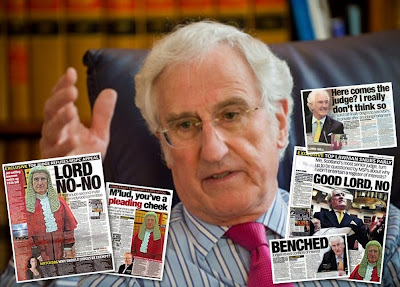
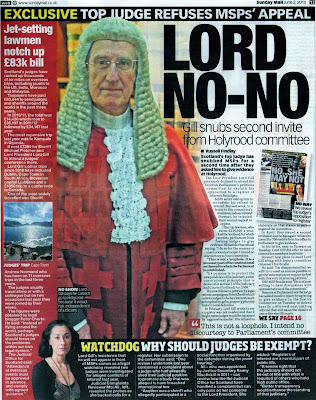
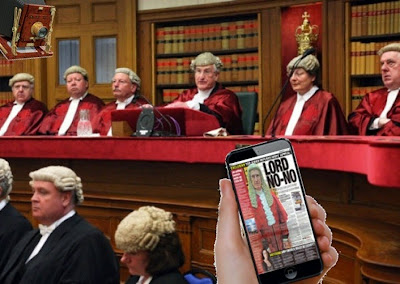
Lord NO-NO to GO-GO: Scotland’s top judge Lord Brian Gill steps down after controversial three year term as Lord President - amid battles with Holyrood, media & transparency

Lord Gill to ‘retire’ after run-ins with politicians, press & transparency. SCOTLAND’S top judge, Lord President Lord Brian Gill has announced he is stepping down from office on 31 May 2015. Until a successor is found, the Lord President’s duties will be taken up by the Lord Justice Clerk, Lord Carloway.

Gill (73) who is Scotland's longest serving judge, has served a short three year term as Lord President, compared to previous holder of the office Lord Hamilton, who held the post for seven years.

In the course of a long and distinguished legal career Gill presided over significant changes to the Scottish legal system.

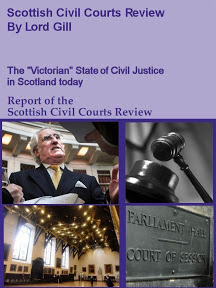
He also famously branded much of the Scots legal system as “Victorian” and “unfit for purpose” in his Scottish Civil Courts Review - which sought to change some of the antiquated structures of Scotland’s expensive, closed shop and out of reach civil courts.

However, many of the Civil Courts Review proposals were watered down by the Taylor Review, carried out at the insistence of the Scottish Government and the legal establishment - who feared giving the public easier and cheaper access to court may affect law firms’ profits.

For the past two years, Lord Gill fought a very public and bitter battle with the Scottish Parliament concerning MSPs investigations of transparency and accountability in the Scottish judiciary, amid plans to create a register of judicial interests as called for in Petition PE1458: Register of Interests for members of Scotland's judiciary

The proposals to create a register of judicial interests envisages the creation of a single independently regulated register of interests containing information on judges backgrounds, their personal wealth, undeclared earnings, business & family connections inside & outside of the legal profession, offshore investments, hospitality, details on recusals and other information routinely lodged in registers of interest across all walks of public life in the UK and around the world.

Gill refused three invitations to appear before MSPs to give evidence on his intense opposition to a register requiring judges to declare their significant wealth and links to big business.

Faced with a no-show of Scotland’s top judge, members of the Scottish Parliament’s Public Petitions Committee took evidence from Scotland’s first Judicial Complaints Reviewer (JCR) Moi Ali. During questions at the Scottish Parliament’s Petitions Committee, Moi Ali told msps there was little transparency or accountability in Scotland’s judiciary.

And, in spite of Scottish Ministers attempts to thwart a debate at Holyrood last October 2014, msps overwhelmingly backed a motion urging the Scottish Government to create a register of judicial interests – reported along with video footage & the official record, here: Debating the Judges

At the recent Commonwealth Law Conference held in Glasgow during March 2015, Lord Gill fired another salvo at politicians, transparency and the democratic process – branding all as “insidious”.

Lord Gill told his startled audience: “The threats to judicial independence do not always come with a knock on the door in the middle of the night.  In a society that prides itself on the  independence  of  its  judiciary,  the  threat  may  come  in  insidious ways, even at the hands of well-meaning governments and legislators, in the name of efficiency and, ironically,  in the name of  transparency.”

After the speech, Gill and several judicial figures including Lord Neuberger fled the conference after learning Wikileaks founder Julian Assange was booked to speak at the event.

Lord Gill also supported the retention of corroboration – a key legal safeguard against miscarriage of justice - where evidence must be verified by two sources.

Brian Gill was first appointed as a Senator of the College of Justice in 1994. He was appointed Lord President of the Court of Session and Lord Justice General in June 2012, having held the position of Lord Justice Clerk from November 2001.

Under the Judiciary and Courts (Scotland) Act 2008, First Minister Nicola Sturgeon will now establish a panel to recommend individuals who are suitable for appointment to fill the vacancy.

It has been rumoured for several months senior figures in the Scottish Government have lobbied for a female candidate to become Scotland’s first Lady Lord President.

Court of Session judge Anne Smith, who was made President of the tribunals service by Lord Gill last summer, is seen by some as ‘a good bet for the post’.

TOP JUDGE WHO SAID NO-NO TO TRANSPARENCY & SCOTTISH PARLIAMENT:

Scotland’s top judge Lord President Lord Brian Gill fiercely opposes calls for any form of transparency & public accountability of the judiciary and Scotland’s Courts.

Over the course of nearly two years, Scotland’s top judge Lord Gill has focussed his anger on a Scottish Parliament investigation into calls for a register of judicial interests. The register proposal would reveal the judiciary's vast personal, undeclared wealth, extensive family and business connections throughout the legal profession, links to big business, offshore trusts & investments, ownership of numerous and high value properties through a variety of ‘creative’ arrangements, directorships, shareholdings, and even unpublished criminal records of members of the judiciary.

Lord Gill refused at least two invitations to appear before the Scottish Parliament to give evidence and face questions on his opposition to the proposal to create a register of judicial interests. The top judge has also used the Scotland Act as a loophole to avoid further scrutiny on the matter.

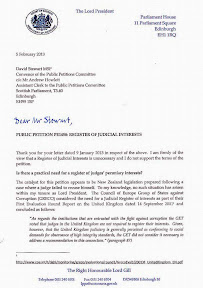
Lord Gill’s challenge to MSPs declared judicial opposition to transparency. In Lord Gill’s opening letter to MSPs on the call for a register of judicial interests, the judge claimed “In practical terms it would be impossible for all judicial office holders to identify all the interests that could conceivably arise in any future case. The terms of the Judicial Oath and the Statement of Principles of Judicial Ethics ensure that such a difficulty does not arise and that the onus is on the judicial office holder to declare any interest at the outset.”

In what was a hint of the sheer hostility felt by the judiciary against a call to bring transparency to judges interests, Lord Gill went onto accuse the media, press, litigants, court users and just about everyone else with an interest in transparency of being potentially hostile and aggressive, simply because someone may wish to raise questions of judges interests similar to the same kinds of questions which are raised of interests in other public officials and those in public life, politics & government.

And, if MSPs were unsure of the depth of Lord Gill’s attitude towards transparency, the top judge went on to refuse to appear before the Scottish Parliament, and used a loophole in the Scotland Act to justify his sweeping declaration he did not require to answer questions from Scotland’s democratically elected politicians. 

Lord Gill’s use of Scotland Act against MSPs was reported in the media. Writing in a letter to msps, Lord Gill implied cooperation with Parliament would be withdrawn over calls to make judges more transparent in register : “Section 23(7) of the Scotland Act provides inter alia that the Parliament may not require a judge to attend its proceedings for the purposes of giving evidence. This is not a loophole. It is a necessary part of the constitutional settlement by which the Parliament is established. Its purpose is to protect the independence of the judiciary, a vital constitutional principle that is declared in section 1 of the Judiciary and Courts (Scotland) Act 2008”

The judge continued: “When a committee invites a judge to give evidence before it, I have to decide whether the subject matter might infringe the principle of judicial independence; and whether the evidence required could be satisfactorily given in writing.”

Even though Scotland’s top judge opposes the creation of a register of interests, MSPs held a debate in the Scottish Parliament’s main chamber on Thursday 7 October 2014, which saw cross party support for the proposal. MSPs overwhelmingly supported motion S4M-11078 - in the name of Public Petitions Convener David Stewart MSP on petition PE1458, urging the Scottish Government to give further consideration to a register of interests for judges.

The parliamentary debate was reported by Diary of Injustice along with video coverage here: TRANSPARENCY TIME: Top judge & Scottish Government told to rethink refusal on declarations of judges as Holyrood MSPs support calls to create a register of judicial interests

Previous articles on the lack of transparency within Scotland’s judiciary, investigations by Diary of Injustice including reports from the media, and video footage of debates at the Scottish Parliament’s Public Petitions Committee can be found here : A Register of Interests for Scotland's Judiciary

Civil Courts Review : Scots Justice still “Victorian” years after judge called for reforms:

The Scottish Civil Courts Review of 2009 authored by then Lord Justice Clerk, now Lord President Lord Brian Gill, castigated Scotland’s Civil Justice System as being Victorian, costly, and unfit for purpose, yet years on from the review, little of the proposed reforms have been implemented due to pressure from vested interests in the legal world, and a lack of political will to deliver access to justice to all Scots.

The Civil Courts Review can be viewed online here : Scottish Civil Courts Review Synopsis, Scottish Civil Courts Review Vol1 Chapters 1-9 & Scottish Civil Courts Review Vol2 Chapters 10-15

Gill, giving a speech to the Law Society of Scotland’s 60 year anniversary conference several years ago, reproduced in full here said : “The civil justice system in Scotland is a Victorian model that had survived by means of periodic piecemeal reforms. But in substance its structure and procedures are those of a century and a half ago. It is failing the litigant and it is failing society.

“It is essential that we should have a system that has disputes resolved at a judicial level that is appropriate to their degree of importance and that disputes should be dealt with expeditiously and efficiently and without unnecessary or unreasonable cost. That means that the judicial structure should be based on a proper hierarchy of courts and that the procedures should be appropriate to the nature and the importance of the case, in terms of time and cost. Scottish civil justice fails on all of these counts. Its delays are notorious. It costs deter litigants whose claims may be well-founded. Its procedures cause frustration and obstruct rather than facilitate the achievement of justice."

Previous articles on the Civil Courts Review and reforms of Scotland's antiquated civil justice system can be found on Diary of Injustice here: Scottish Civil Courts Review.

Monday, March 30, 2015

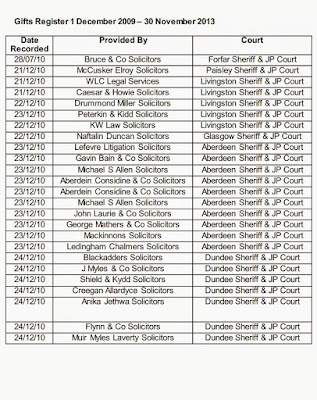
GIFT HORSE: Secret gifts register reveals rogue lawyers & law firms using hospitality relationships with Scottish Court Service staff to increase legal aid business, poach clients from rival solicitors

Legal Aid client poaching & hospitality racket in Scots Courts. LAWYERS accused of making suspicious, erroneous or fraudulent legal aid claims appear among a list of high earning legal aid law firms in a register of gifts & ‘hospitality’ received by staff at the Scottish Court Service (SCS).

The documents, finally disclosed to journalists after court bosses failed to convince the Scottish Information Commissioner it should remain secret – identify ‘significant’ hospitality relationships between law firms who have received tens of millions of pounds of legal aid, local courts and court employees right across Scotland.

And it has emerged the extent of ‘hospitality’ to court staff is so great - some local courts have been the scene of ‘gift wars’ between law firms – with solicitors raising the stakes over rivals using hospitality to ensure business came their way at the expense of competitors.

The extent of gift giving in exchange for business referrals - raises questions over whether it is appropriate for court staff – who run the courts at taxpayers expense - to enter into hospitality relationships  with solicitors who have a stake in dragging on court cases to beef up their fees and claims for legal aid.

And, some law firms on the list have been implicated in allegations of questionable legal aid claims. In other cases, law firms , activity resulting in criminal charges against staff.

In one case, the law firm of NS Lockharts Solicitors – run by Niels S Lockhart - a sole practitioner in Kilmarnock who was the subject of a Scottish Legal Aid Board investigation into huge sums of legal aid claims of over £600,000 in three years also appears in the list. NS Lockharts Solicitors are identified as providing hospitality to local court staff in Ayr Sheriff Court.

Lockhart ‘withdrew’ from the legal aid register after an investigation by the Scottish Legal Aid Board.

In another case of gift giving between lawyers on the legal aid ticket and court staff - the law firm of Bell & Co Solicitors are also identified as hospitality providers to staff at Kilmarnock Sheriff Court. However, Bell & Co hit the headlines two years ago when one of their Paralegals – Arlene Reid - was jailed for two years - for embezzlement and mortgage fraud totalling £87K after Reid defrauded her own employers and the Alliance & Leicester Building Society.

Gifts Register identifies Scots law firms ‘hospitality’ to court employees The list of law firms, together with a list of hospitality released by the Scottish Court Service identifies law firms who receive millions in taxpayer funded legal aid every year.

Hospitality on the list ranges from boxes of chocolates, alcohol, invitations to dinners with the ‘vested interests club’ - top lawyers, law firms, the Faculty of Advocates & the Law Society of Scotland,  big business hosts & even “Royal Garden Parties”. Other hospitality include trips on boats, gift vouchers for high street stores, dinner parties with Police, and - bunches of flowers.

The extent of hospitality relationships between court staff and law firms have raised suspicions SCS staff are providing lawyers & law firms with personal favours in return, which in some instances are leading to criminal cases ‘taking their time’ through the courts owing to overly friendly relationships with local law firms & local court staff.

Information has also been provided to journalists – alleging undeclared financial relationships between court staff and law firms, in relation to the purchase of properties & land, provision of free or discounted legal services to SCS staff in their personal legal affairs, and instances of SCS staff providing return favours for solicitors when asked to do so.

Speaking to Diary of Injustice earlier today, a solicitor from a law firm which has provided small amounts of hospitality as a matter of courtesy and thanks to local court staff, said he was aware some law firms were offering additional gifts to SCS staff as a way of drawing in business. He described the situation as “unfair practice”.

The solicitor told DOI he was aware of several cases where court staff received discounted or free legal services – from law firms who were taking clients from others including his own firm.

Asked if he believed all hospitality provided to court staff was being declared, the solicitor replied: “No, it is not.”

And. in an example of law firms poaching each other’s clients using hospitality to court staff – DOI uncovered a case where ‘regular’ criminal legal aid clients of one law firm - were allegedly directed to another law firm by a court clerk in receipt of ‘hospitality’.

However, the switch did not result in a good move for the clients -  who ended up jailed for minor criminal offences after a trainee solicitor from the law firm they were sent to – messed up their defences and pleadings.

Commenting on the documents, the Scottish Legal Aid Board said: “If there was ever any evidence that a solicitor providing legal aid had acted in an inappropriate manner in relation to the provision of legal aid we would investigate and, if appropriate, use the sanctions available to us under the legal aid legislation.”

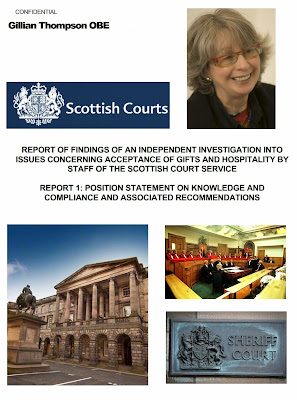
In an earlier investigation by DOI, it was revealed Gillian Thompson OBE – now the Judicial Complaints Reviewer (JCR) – authored a report on undeclared relationships between employees of the Scottish Court Service, law firms, and other vested interests. The report, published by DOI – revealed court staff are making money on the side via relationships with law firms.

Diary of Injustice reported on concerns regarding hospitality involving Scottish Court Service employees where Ms Thompson was asked by the Scottish Court Service to investigate reports of irregularities in hospitality given to court staff. The request for the investigation came after the SCS received Freedom of Information requests regarding hospitality in the courts, prompting concerns some staff may have accepted gifts or hospitality but failed to register.

Report said SCS Registers were insufficient, and Court staff involved in private gain failed to declare. Gillian Thompson’s Report on Hospitality & Gifts in the SCS stated:  “The information currently captured on the registers is insufficient to provide assurance that staff are using their common sense and considering issues such as conflict of interest.

Ms Thompson went on to recommend the “SCS should revise the Policy on Acceptance of Gifts, Rewards and Hospitality to ensure that it is fit for purpose for all staff, taking account of the various roles performed within SCS. It may also be time to revisit the levels of value for gifts and hospitality.”

The former AIB’s report also revealed court staff were using their positions to earn money privately from their links with lawyers and law firms operating in courts, stating “Several staff raised the issue of sheriff clerks who carry out extrajudicial taxations and private assessments and who personally benefit financially from these activities.”

Ms Thompson’s report roundly condemned this practice, stating: “Not only is it inappropriate in terms of the civil service code requirements for staff who are public servants to be able to receive private gain from their employment it is also highly divisive when other staff see such benefits being derived from simply being in the right post of Auditor of Court within the Sheriff Courts.”

Ms Thompson recommended in her report the “SCS should bring the practice of sheriff clerks profiting privately from their employment by SCS to an end as quickly as possible”.

HOW COURT CHIEFS LOST HOSPITALITY INFORMATION BATTLE

The Scottish Court Service initially refused to release the gift register, claiming “the names of the gift or hospitality provider would be deemed as personal information” and “as the provider of the gift or hospitality was not made aware at the time that their name may be released, we consider disclosure of such is likely to bring the Scottish Court Service into conflict with the data protection principles.”

However, the request – from DOI – triggered a review of hospitality policy at the Scottish Court Service, leading to names of ‘'hospitality’ providers being added to the register.

Richard Warner of the SCS said: “I can advise you that due to your request for this information, the Scottish Court Service has changed the policy covering hospitality and gifts to ensure that the provider of any hospitality or gift are made aware that their name shall be entered on to our register and may be disclosed if requested in any future information request. This policy change shall take effect as from 1 January 2014 so the release of names may be considered in any future request for gifts or hospitality offered from this date. The policy also states that if the provider does not consent to their name being considered for release then the gift or hospitality cannot be accepted by a member of staff.”

After a request for review of refusal to disclose the information, the SCS again refused - this time around, claiming it would cost them too much to contact each law firm to ask permission to disclose their ‘hospitality’ to court employees. The SCS claimed they would have to contact every lawyer who gave a gift and this would cost too much to provide the information.

DOI journalists took the matter up with the Scottish Information Commissioner – who requested Courts Chief Eric McQueen provide an explanation as to why the courts were blocking release of information on hospitality relationships between the legal profession and court staff.

John Kelly, Freedom of Information Officer at the SIC said: “Having written to and discussed the matter with the SCS, without being required to do so by way of a formal Decision Notice, the SCS has agreed to provide you with the information requested, subject to redactions in terms of section 38(1)(b) of FOISA on the basis that to disclose some of the names of individuals would breach the first data protection principle of the Data Protection Act 1998 (the DPA). I understand that the names of Solicitor and Law Firms will be provided.”

After the intervention of the Scottish Information Commissioner, the SCS subsequently released the hospitality list to DOI.

Richard Warner for the SCS said: “Having reconsidered your request, and the SCS response, I now attach a list which indicates law firms where this information has been recorded.  For the reasons stated in our earlier response this does not include the names of any individuals concerned as there could have been no expectation on their part that this information would be circulated or published widely.  As indicated previously, steps are being taken to ensure that individual persons are made aware at the relevant time that their details made be released as a result of an information request.”

Friday, February 06, 2015

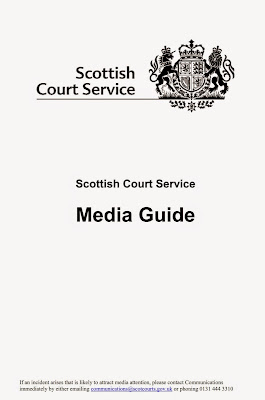
GOOD LIE GUIDE: Scottish Court Service forced to release censored media advice to staff after ‘public interest’ intervention by Scottish Information Commissioner

Court media guide faces dishonesty claims. DOCUMENTS giving advice on how the courts should handle media enquiries reveal staff at the Scottish Court Service (SCS) are told to provide a scripted response of false information when faced with certain questions from journalists.

The Scottish Court Service media guide - obtained in response to a Freedom of Information request, was initially released in a redacted format - deliberately concealing the sections of the guide which recommend court staff lie to the press when asked about convictions.

However, after the Scottish Information Commissioner became involved in the matter, the guide was grudgingly released by the SCS in an unredacted format - revealing the controversial written advice to SCS staff on how they should conceal types of information when queried by journalists.

In one section detailing how SCS employees should reply to enquiries relating to spent convictions, Page 18 of the redacted version of the SCS media guide states “If a conviction is spent it should be treated as though it never existed.” with the remaining details concealed.

On Page 19 of the unredacted version of the SCS media guide - released after the SIC became involved in the case, the uncensored advice reveals Court staff are provided with a ‘suggested reply’ equivalent to providing the media with false information, stating: “Thank you for your enquiry regarding XXX. I can confirm that a search of our records has failed to reveal such a conviction.”

Private Proceedings also came in for censored advice after it emerged the Court Service had deliberately concealed references on page 14 of the redacted version of the SCS media guide to judges holding proceedings in private - merely as a convenience, and to avoid a hearing in open court – which may end up in the press.

The guide warns Court staff to take advice, and states on page 15 in the unredacted version of the SCS media guide : “If proceedings take place in private, you may be able to provide limited information. Explain to the judge that there is media interest and ask whether proceedings are being held in private merely as a convenience (for example in chambers late in the day to avoid having to convene a court) and therefore basic information can be supplied, or whether it was the judge’s intention to exclude the public and the media.”

Scottish Court Service Media Guide. Court Service staff are also advised on every page of the guide: “If an incident arises that is likely to attract media attention, please contact Communications … immediately.”

SCS employees are also told not to get chatty with journalists: “When providing factual information, it is important that you are not drawn into conversation on other matters. You should not be asked to provide views, or to summarise what was said in evidence or by the judge during the court hearing.”

The media guide also bans any “fishing enquiries”. Court staff are told to deal only with requests about specific cases.

The guide states: “You should not answer fishing enquiries on the basis that you are only able to deal with requests about specified cases. Do not answer vague questions such as: Can you tell me if James Smith of the High Street has a criminal record? Are there any other civil actions against Jones and Co? There was a case up the other week about a man who assaulted his wife, who was that?”

Court staff are also told that if media excluded from a case, they should “take advice” and “should clarify with the judge if any information can be provided.”

During the summer of 2014, Scotland’s top judge threatened to ban the media from access to court documents & cases. Lord Gill, Scotland’s top judge issued an angry edict against press freedom to report on cases in Scotland’s courts, reported here: COURT SECRETS: Scotland’s anti-transparency top judge Lord Brian Gill threatens media censorship in row over reporting access to court papers

Wednesday, January 28, 2015

COURTS ON CAMERA: Television & Twitter ‘may’ be allowed in Scotland’s “Victorian” courts but on judiciary’s terms and with permission of sitting judge

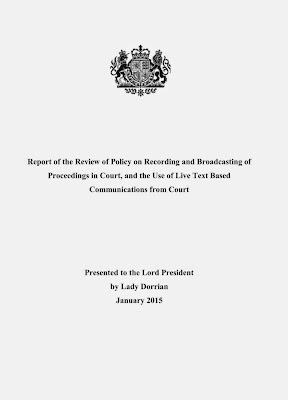
Cameras & tweets in Scotland’s courts – under judicial terms only. CAMERAS and tweets could be allowed in Scotland’s courts, according to the findings of a review carried out by Court of Session judge Lady Dorrian on recording and broadcasting of proceedings in court, and use of live text-based communications.

The proposals to introduce television and other digital media to courts on a limited, controlled basis, come almost twenty three years after Lord Hope - Scotland’s top judge in 1992 issued a statement to the media he was “considering the television question for some time and now believed it was not in the public's long-term interest for restrictions to remain.”

Accepting the limited proposals for members of the media to film and tweet in court, Scotland’s current top judge Lord President Brian Gill (72) said: “I am grateful to Lady Dorrian and her group for having carried out this exercise so thoroughly. These well-considered recommendations have the support of the judges. I accept all of the recommendations. They are entirely appropriate in the contemporary world. My office will now prepare guidance on the implementation of Lady Dorrian’s report.”

However, Gill – who previously threatened judicial censorship of journalists access to documents and court hearings in a fit of pique against the media last year - said journalists will only be granted use of digital media in courts if they register with the Scottish Court Service.

In a speech to a conference on Digital Justice this week, Lord Gill – who is currently fighting a two year battle with the Scottish Parliament against proposals to create a register of judges interests, wealth and links to big business - made it clear any member of the press who was going to tweet or make use of digital equipment must do so on the court’s terms only. Gill also said anyone not registered with the courts could not tweet unless the judge hearing the case gave permission to do so.

Gill said: “Journalists who register with the Scottish Court Service to gain access to the electronic portal-based system, should also be required to undertake compliance with the Contempt of Court Act. Journalists so registered should be permitted to use live text-based communication. Any person who is not on the register should require the permission of the presiding judge.”

And, in a separate submission to the consultation, an unidentified Court of Session judge who backs the proposals to introduce cameras said there would have to be tight controls on how cases were filmed.

The anonymous judge wrote: “Educating the film company regarding the nature of court proceedings the paramount importance of the interests of justice, and cultivating a relationship of trust with the film company so that the risk of erroneous impressions/misrepresentations, is minimised.”

In summary, the report recommends the following:

*Filming of civil and criminal appeals, and legal debates in civil first instance proceedings, such as judicial review or procedure roll hearings, should be allowed for live transmission. Subsequent news broadcasting and documentary film-making should be allowed subject to clear and comprehensive guidelines.
*The court should allow criminal trials to be filmed for documentary purposes in certain circumstances, subject to the safeguards referred to in the report. Cases involving children, sexual offences and vulnerable witnesses should not be filmed.
*No live transmission or filming for subsequent news broadcast should be allowed for criminal first instance business or for civil proceedings involving witnesses.
*For subsequent news broadcasts, the delivery of sentencing remarks of the judge should be permissible, with filming focused only on the sentencing judge.
* Filming of criminal trials for live transmission should not be allowed.
*In civil cases at first instance, filming for documentary purposes only should be allowed, but should exclude certain groups such as family cases and those involving asylum seekers.
*A structured approach to considering applications to film.
*All filming should be subject to robust, clear and comprehensive guidelines.  
*Journalists who register in advance with the Scottish Court Service should be permitted the use of live text-based communications such as Twitter from court, subject to guidelines which will be issued in due course.

The consultation and review – chaired by Lady Dorrian, comprised almost exclusively a judicial membership of Lord Bracadale, Lord Woolman, Sheriff Principal Stephen, and Sheriff Drummond. The group was supported by: Christopher Nicholson, Deputy Legal Secretary to the Lord President; Elizabeth Cutting, Head of Judicial Communications; Steven D’Arcy, Head of Strategy and Governance, Judicial Office for Scotland.

While the move to bring more transparency to Scotland’s courts is a welcome one, no substantive explanation has been given for hold ups in televising courts or why it has taken over two decades to address earlier statements in 1992 by former top judge Lord Hope on the introduction of cameras and other technology to Scotland’s antiquated courts – branded “Victorian” and ‘unfit for purpose’ by Gill himself in the Civil Courts Review.

During 1992, Lord Hope, the then Lord President, in effect opened Scotland's courtroom doors to the cameras when he announced, through the Principal Clerk of the Justiciary in Edinburgh's supreme courts, that modern technology had now advanced to a state 'where proceedings in court could be televised without undue interference in the conduct of proceedings'. Twenty Three years later in 2015, the glacial pace of change in Scotland’s courts once again promises occasional cameras & tweets, but only when judges deign it in their interests or perhaps, the interests of justice - to allow.

And, despite receiving over £80million pounds a year from public coffers to run the Scottish Courts Service, and multi million pound blank cheques to fund items such as the recent £60 million refurbishment of Parliament House in Edinburgh – Lord Gill’s seat of power, it is a fact public records on what goes on in the civil courts are hard to come by, with findings routinely anonymised where vested interests including lawyers are concerned of being identified in dodgy cases where judges secretly linked to litigants, law firms & big business, are not serving the interests of justice.

TOP JUDGE ISSUED THREAT TO BAN MEDIA IN COURT:

During the summer of 2014, in a bizarre fall out with the press, Scotland’s top judge Lord Brian Gill issued an edict threatening to ban journalists and the press from accessing court papers and hearings.

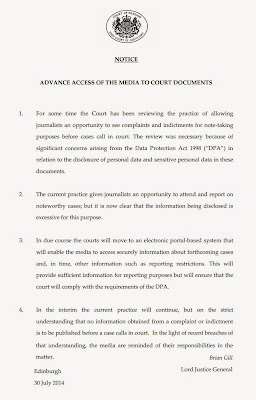
Lord Gill’s warning to the media read as follows:

NOTICE: ADVANCE ACCESS OF THE MEDIA TO COURT DOCUMENTS

1. For some time the Court has been reviewing the practice of allowing journalists an opportunity to see complaints and indictments for note-taking purposes before cases  call in court.The review was necessary because of significant concerns arising from the  Data  Protection Act 1998 (“DPA”) in relation to the disclosure of personal data and sensitive personal data in these documents.

2.  The current  practice  gives  journalists  an  opportunity to attend and report  on noteworthy cases; but  it is now clear that the information being disclosed is excessive for this purpose.

3.  In due course the courts will  move to an electronic  portal-based system  that will enable the media  to access  securely  information about  forthcoming  cases and,  in  time,  other  information  such  as  reporting  restrictions.  This  will provide sufficient information for reporting  purposes  but will ensure that  the court will comply with the requirements of the DPA.

4.  In  the  interim  the  current  practice  will  continue,  but  on  the  strict understanding that no information obtained from a complaint or indictment is to be published before a case calls in court.  In the light of recent breaches of that  understanding,  the  media  are  reminded  of  their  responsibilities  in  the matter.

Brian Gill Lord Justice General Edinburgh 30 July 2014

Friday, October 17, 2014

LORD NO-FLY: Globetrotting top judge takes control of air miles, tells judiciary to write plea for jet travel after media investigations on overseas junkets

Top judge - I would like to take the jet because … SCOTLAND’S top judge, the Lord President & Lord Justice General Brian Gill has signalled his ire over recent media exposes on his judicial colleagues use of publicly funded overseas jet travel with the issuing of an edict requiring all judges to seek permission from his own office before embarking on future international travel junkets.

The document, finally released in a Freedom of Information request after weeks of delays by the Judicial Office for Scotland, reveals Lord Gill - himself no stranger to the travel circuit after a now-not-so-secret six day state visit to Qatar - is to require his judicial colleagues to write up a short story on why they feel they need to take a taxpayer funded trip abroad instead of carrying judicial duties in Scotland’s overstretched courts.

Costs, numbers of judges attending, an explanation of the wider benefit of the trip to the judicial system and details of what may be learned must feature in any essay now required to be written up by all members of Scotland’s judiciary if they want to fly off into the sunset to law conferences & business meetings – all of which are mostly held at posh venues including golf courses, saunas and gala dress balls, followed by tours around museums, and off the books meetings at the personal haunts of the world’s rich, powerful elite.

The clampdown over overseas trips by Scotland’s judiciary appears to have been sparked after investigations by the Scottish media into the jet set lifestyle of Scotland’s secretive judiciary.

Reports first appearing in the Sunday Mail newspaper during June 2013, and more recently an investigation by the Scottish Sun - which included references to Lord Gill’s state visit to Qatar - sparked concerns Scots judges have lost sight of their station in court, instead appearing to prefer the jet set lifestyle to hearing what some judges refer to as “boring mundane cases” in Scotland’s courts.

From the Lord President: Attendance at conferences and authorisation of overseas travel

I have been reviewing the arrangements to control expenditure to meet attendance at conferences by the judiciary, especially where the conference is taking place outwith the United Kingdom. I have also been considering the arrangements for the authorisation of all other overseas travel to be paid from public funds. With immediate effect the following arrangements are to apply to future requests.

Requests for funding for attendance at conferences and for all other overseas travel should be sought only from the Judicial Office [1] . No request for support to meet attendance at conferences, or other overseas travel should be made to any other part of the Scottish Court Service.

In all cases where funding is being sought I require a business case to be produced by the judicial office holder or the judicial representative body that is seeking funding. The business case does not need to be long, but it must:

(i) identify the nature of the conference;

(ii) the number of judicial office holders it is suggested should attend;

(iii) why that number is necessary if it is more than one;

(iv) the benefit either to those attending or to the judiciary more widely from attendance at the conference;

(v) the likely costs of attendance [2]; and

(vi) the likely impact on the efficient administration of business.

The business case should be sent to the Executive Director of the Judicial Office for Scotland, Stephen Humphreys. He will assess whether funds are available to meet the costs of attendance and if so pass the business case to me.

I will then consider all requests and respond directly to the judicial office holder. I will need a clear justification for any overseas travel. As a general rule it should only be necessary for one judicial office holder to attend a conference overseas. It will only be in exceptional cases that I am likely to consider it necessary for more than one person to attend.

Where support is provided to attend a conference a report is to be prepared and sent to the Executive Director within one month of the end of the conference. The report will be placed on the Judicial Hub and the Judicial website. It is important that as many of the judiciary as possible are able to benefit from the investment of public money in attending the conference.

[1] In respect of attendance at events by Sheriffs, the Sheriffs Association will continue to consider the need for attendance by sheriffs at conferences before preparing the business case and seeking funding. The Association undertakes this activity on behalf of all sheriffs and it considers applications equally from both its members and non-members. If a sheriff wishes to attend a conference he or she should in the first instance contact the Secretary to the Sheriffs' Association. I am grateful to the Association for undertaking this function.

[2] When considering the costs of attendance at a conference, Judicial Office Holders should consult the Judicial Office for an estimate of the likely travel and accommodation costs, if required. Travel and subsistence rules apply to all travel whether inside or outside the UK.

While the clampdown on overseas trips is a welcome move by the Lord President, the Judicial Office for Scotland and Scottish Court Service are currently REFUSING to reveal any details of hundreds of trips taken by Scottish judges around the UK.

When enquiries were made regarding domestic UK destinations of Scottish judges, staff at the Scottish Court Service switched destinations of Scotland’s second most powerful judge – Lord Carloway from Bristol in England, to Dublin in the Republic of Ireland –  in an attempt to avoid having to disclose the information on UK judicial travel via Freedom of Information legislation.

Full details of trips undertaken by Scottish judges were previously published by Diary of Injustice here: Overseas Travel of Scotland’s Judges 2013-2014 & Judicial trips & extra expenses claims 2010-2013