Showing posts with label Party Litigants. Show all posts

Friday, February 21, 2014

MSPs hear Scots Party Litigants face Supreme Court civil appeal lock-out due to "window dressing"measures from Faculty of Advocates & lack of help from top judge

MSPs hear of little help for Scots Party Litigants in Supreme Court appeals. MEMBERS of the Scottish Parliament's Petitions Committee were told earlier this week that measures put in place by the Faculty of Advocates to help Party Litigants raise appeals in civil court cases to the UK Supreme Court – measures which require signatures from two counsel for a Party Litigant’s appeal to proceed, are mere “window dressing” and only serve to further obstruct or block access to justice for people who do not have legal representation.

Kathie Mclean Toremar, who took her Petition 1504 to the Scottish Parliament’s Petitions Committee this week in a quest to obtain reform to the way in which the legal profession make life difficult for unrepresented party litigants to appeal against decisions taken in the Court of Session, detailed the difficulties faced by those who do not have expensive legal teams in place to represent their cases before Scotland's judiciary. The petitioner also revealed to MSPs that the average length of case for the majority of party litigants in Scotland is a shocking 11 years.

And it emerged in answers to further questions from MSPs that Scotland’s top judge Lord President Lord Brian Gill - famed for his own sharp criticism of the Civil Justice system and his Scottish Civil Courts Review can only manage to direct people with no legal representation or experience of the law to a web page, rather than provide help or answers to why no party litigant has ever been able to approach the Supreme Court after enduring lengthy, bruising encounters in front of Scotland’s highest court, the Court of Session.

Mrs Mclean Toremar, who has been through a prolonged & arduous case in front of Scotland’s unsympathetic judiciary told an amazed Petitions Committee: “I approached Lord Gill, but he simply sent a letter from his secretary telling me to go www.supremecourt.com. I did not ask for legal advice and I did not ask any unusual questions. I just asked about paragraph 1.8, but he would not answer me.”

In an attempt to secure a fair hearing for her own legal case, Mrs Mclean Toremar also revealed to MSPs she had tried thirty eight different solicitors, all recommended by the Law Society of Scotland in an attempt to secure a fair hearing for an appeal against a decision. However, every single solicitor out of the 38 refused to take the case on, citing reasons  including “conflict of interests, lack of  funding, too many hurdles, and, last but not least, the fact that the pursuer in the appeal has been a party litigant, in relation to which the legalities are a minefield that a solicitor would be reluctant to enter.”

Prior to questions from MSPs in relation to the petition, the Petitions Committee Deputy Convener Chic Brodie criticised the way in which the Scots legal establishment fails to deliver information or help for those who need access to the courts.

Mr Brodie said:  “I will begin with a general point, which does not relate only to the Public Petitions Committee. I am very concerned about how hard it is to get information out of the legal system in Scotland. Given that a number  of approaches have been made and that hardly any replies have been received, I wonder what on earth is going on and how our legal system is being administered. People should at least have the decency to provide a reply, whether we are talking about the Lord President, the cabinet secretary or whoever. I leave that point lying.”

In response to questions from members of the Petitions Committee, Mrs Mclean Toremar also referred to a response from the Faculty of Advocates to the consultation on the Courts Reform (Scotland) Bill which is soon to be heard by the Scottish Parliament’s Justice Committee. In that response, the Faculty of Advocates said it found Party Litigants “Burdensome” and confirmed it was aware party litigants have difficulty with obtaining signatures from counsel.

MSPs also heard evidence from the petitioner, that so far, not one party litigant from Scotland has ever been granted the right to appeal to the Supreme Court, so they cannot fulfil the criteria for making an appeal to the European Court of Human Rights.

The Scottish Government have recognised there is an issue in how party litigants appeals are dealt with in Scotland and have included ‘some’ reforms in the forthcoming Courts Reform (Scotland) Bill. However the current proposals on offer from the Scottish Government do not go far enough and apparently do not even mention the phrase “party litigant” and in response to questions from David Stewart, the Convener of the Petitions Committee, Mrs Mclean Toremar said the proposals from the Scottish Government would not solve the problems raised in her petition.

Video footage and the official report from Tuesday’s Petitions Committee discussion of Petition 1504 by Kathie Mclean Toremar :

Petition PE1504 by Kathie Mclean Toremar on party litigants civil appeals to the Supreme Court

Supreme Court (Civil Appeals) (PE1504)

The Convener:  The next item of business is consideration of one new petition, PE1504, by Kathie Mclean-Toremar, on party litigant civil appeals to the Supreme Court. As previously agreed by the committee, we will take evidence from the petitioner. Members have a  note by the clerk, the Scottish Parliament information centre briefing and the petition.

I welcome the petitioner and Gordon Mclean to the meeting. I invite Ms Mclean-Toremar to make a short presentation of approximately five minutes to set the context for  the petition, after which I will start with some questions and then my colleagues will ask additional questions.

Kathie Mclean-Toremar:  Good morning, ladies and gentlemen. I hope that you understand that the petition is about not just me but a gross imbalance in the law regarding all persons in Scotland who find themselves being a party litigant—that is, someone who has to represent themselves in court. We are lucky enough to live in a democratic society in which that is possible.

As I said in my petition,  in “A guide to bringing a case to The Supreme Court”, paragraph 1.8, which is headed “Appeals from the Court of Session in Scotland”, states that, although “permission to appeal is not required from an interlocutor of the Inner House of the Court of Session”, the appeal “must be signed by two Scottish counsel”.

That is where the flaw is.

As we all know, a party litigant is a person who, for whatever reason, such as a lack of funds for a solicitor, represents themselves. Nowadays, people are more likely  to represent themselves because of a lack of funding for solicitors from the Scottish Legal Aid Board. I myself have seen solicitors demonstrating about the issue. We will have a situation in which more and more people will be forced to represent themselves in court.

When a party litigant represents themselves in the Court of Session, loses their case, then appeals and loses that appeal—I learned through a freedom of information request that there are no statistics on how many party litigants have won their  case in the Court of Session—they are also then denied the right to appeal to the Supreme Court, which, according to the European Court of Human Rights, is deemed to be the highest court in the United Kingdom. On the Court’s website, which is www.echr.coe.int, frequently asked question 26 states that an individual must have taken their case to the highest court in the land before they can put it to the European Court of Human Rights.

The fact is that people are being denied their human rights; in this case, the relevant article is article 6, on equality of arms. Everyone deserves a fair hearing. We should be on a level playing field, not divided between the have and have-nots in society. Party litigants lose their right to appeal because of paragraph 1.8, which states that two Scottish counsel must sign the appeal, while the experience of all party litigants is that they cannot approach Scottish counsel in their chambers or in the Court of Session, and certainly not at the advocates library. The only way to  approach counsel is through a solicitor, which is where the even larger difficulty lies.

The solicitor has only 42 days to read a case that might have been going on for many years. They then need to speak to two counsel and have them read the case, print their opinion and apply for an appeal to the Supreme Court. Although in theory that process can happen, in practice it cannot and does not happen. Legal aid has to be applied for, which takes time. If legal aid is granted, the solicitor can then contact counsel—I said “if” it is granted; the committee should please take into consideration the cuts to legal aid.

The real problem is that solicitors are wary of taking on a case at such a late stage. As part of my research, I obtained a list of 38 solicitors via Law Society of Scotland recommendations.

Having telephoned all 38 with the scenario I have just described, I found that not one of them was willing to take on such a Herculean task. The reasons cited by many of them included conflict of interests, lack of  funding, too many hurdles, and, last but not least, the fact that the pursuer in the appeal has been a party litigant, in relation to which the legalities are a minefield that a solicitor would be reluctant to enter. It is not the solicitors’ fault; it is  the fault of paragraph 1.8, which denies party litigants their rights.

In paragraph 6 of its response to the consultation on the Courts Reform (Scotland) Bill, the Faculty of Advocates states that it knows that party litigants have difficulty with obtaining signatures from counsel. It goes on to say:“It has also become increasingly burdensome. The number of such cases has been increasing: between 2005 and 2010 the Faculty received five such requests from party litigants”.

That is five requests in five years. “Burdensome” is defined as heavy, onerous, troublesome and hard to deal with, so we can deduce that the faculty does not think highly of party litigants I am still waiting for a response from the Faculty of Advocates to my freedom of information request about how many party litigants it has helped to appeal to the Supreme Court, but I have also contacted the Supreme Court and I already know the answer. Not one party litigant from Scotland has ever been granted the right to appeal to the Supreme Court, so they cannot fulfil the criteria for making an appeal to the European Court of Human Rights.

Paragraph 1.8 denies a party litigant the right to appeal to the Supreme Court and to appeal to the European Court of Human Rights. That is a blatant human rights issue. The theory is there but, as I say, the practicalities deny a party litigant the right of appeal. Everyone must be treated equally, with fairness and respect. The current situation contradicts the Human Rights Act 1998 severely.

This is a flaw in Scottish justice. The system that is in place is not fit for purpose. It places insurmountable barriers in the way of the party litigant. That happens in any civil case, and civil appeals show that party litigants have fewer rights. The Scottish Government  has clearly recognised that there is a problem. Mr MacAskill mentions the issue in the Courts Reform (Scotland) Bill, but nowhere do the two words “party litigant” appear in the bill.

I believe that my petition could serve to support any further planned measures to bring relief in such cases, so I feel that it is in the interests of justice and of all party litigants for the committee to consider it.

The Convener: Thank you very much. If Mr Mclean would like to respond to any of the questions that we ask,  I encourage him to catch my eye.You have probably dealt with my first question, but I will ask it anyway, just for the record. You mentioned the two-counsel rule, which seems to be crucial. Are you arguing that article 6 of the European convention on human rights, which is on the right to a fair hearing, is being breached?

Kathie Mclean-Toremar:  I am saying that a party litigant does not have the right to approach counsel. That is a breach of equality of arms, for which article 6 provides, so people’s human rights are being breached. A party litigant cannot approach counsel directly—they must go through a solicitor.

The Convener:  My second question is about future legislation. You mentioned the Government’s Courts Reform (Scotland) Bill, which will be considered by the Justice Committee, and you hinted at what it could do. My understanding is that that bill will take away the two-counsel rule and that it will be for the inner house to decide whether there are sufficient grounds for someone to go to the Supreme Court. What is your view of that assessment? If the bill went through, would it solve your problem?

Kathie Mclean-Toremar:  No, it would not. The bill, which I believe was introduced on 6 February, does not mention party litigants, and I think that that  is a gross problem. The phrase “party litigant” does not appear in the bill. Will the bill provide a big umbrella, under which everyone will fit, or will it provide for people who are legally represented? That is where the problem lies. If someone is not legally represented, how will they be able to go to the inner house, which is what it is proposed will happen?

The Convener:  So you are arguing that the bill would not solve your problem.

Kathie Mclean-Toremar:  It would not cover party litigants.

The Convener: Okay—thank you for that.

Chic Brodie:  I will begin with a general point, which does not relate only to the Public Petitions Committee. I am very concerned about how hard it is to get information out of the legal system in Scotland. Given that a number  of approaches have been made and that hardly any replies have been received, I wonder what on earth is going on and how our legal system is being administered. People should at least have the decency to provide a reply, whether we are talking about the Lord President, the cabinet secretary or whoever. I leave that point lying.

What is your view of the proposed change, whereby someone would be able to approach the Faculty of Advocates, rather than having to have two solicitors approve their appeal to the inner house?

Kathie Mclean-Toremar:  At the moment, a party litigant has to get two signatures from Scottish counsel. That is where the problem lies. It is not possible to approach counsel, to go to the Court of Session to speak to counsel or to phone up counsel. They will have nothing whatever to do with you. It is necessary to go to a solicitor, who will go on your behalf to counsel.

Chic Brodie:  I am sorry to interrupt, but in the petition you say:“only a solicitor practising in Edinburgh can contact a counsel.”

Kathie Mclean-Toremar:  Yes, that is another problem.

Chic Brodie: Where is the evidence for that?

Kathie Mclean-Toremar:  I believe that a solicitor from Glasgow submitted a petition a few months ago on the problem whereby a Glasgow solicitor has to instruct an Edinburgh solicitor in order to be able to go to the Court of Session. That is my understanding—that is the way in which the situation was explained to me. I went to a Glasgow solicitor who told me that. A solicitor cannot do that unless they have what I think is called the right of audience.

Chic Brodie:  If that is the case, I find it most disconcerting. I have one last question. I know that we cannot go into the detail of your case, but do you agree that there has to be some filtering out of the number of cases in which the inner house might be approached, other than through the two solicitor rule? Have you any idea how that process might be performed?

Kathie Mclean-Toremar:  We do not know how long it will take for the Courts Reform (Scotland) Bill to go through. It could be changed so that a party litigant who had gone through the Court of Session, appealed and lost their appeal would have the right to go directly to counsel.

It might be argued that there is already a free legal services unit. You can go to various agencies and ask them to make an application to the FLSU, which is run by certain advocates on a pro bono basis, but the unit can give people only three days. Many cases have taken years to go through the Court of Session, so three days is not enough. It takes more than three days to read the case and do research. The FLSU does not cover a party litigant in that regard.

Angus MacDonald:  I appreciate your bringing these anomalies to the Parliament’s attention. It seems unfair that  party litigants can approach counsel only through a solicitor, which defeats the purpose of the individual having the right to represent themselves.

I agree with you that the 42-day period for filing a notice of appeal seems excessively short. You did not really touch on that in your preamble. It has been noted that the Courts Reform (Scotland) Bill seeks to introduce a provision that requires litigants to seek leave to appeal, rather than there being a requirement for two counsel to certify appeals. I understand that, in the bill, there is no intention to increase the 42-day period for filing a notice of appeal, although I could be wrong. Clearly you would wish that period to be increased.

Kathie Mclean-Toremar: Yes, if possible.

The Convener: As you probably know, we get a briefing from our information service—SPICe—on every single petition that is lodged. Our briefing states:“the Faculty of Advocates suggests that party litigants can approach the Faculty directly for assistance in this regard.”Do you have any comments on that?

Kathie Mclean-Toremar:  I have tried—and I know of three other party litigants who have tried—to address the Faculty of Advocates. The faculty does not reply.I sent a freedom of information request on the matter eight weeks ago, but I have not had a reply. As it says in its response to the Government consultation, the Faculty of Advocates finds party litigants “burdensome”. That is shocking. That means that we are not on a level playing field where everyone has the right to represent themselves. The system does not work.

The Convener:  Is it reasonable to say that there is an outstanding issue around the Faculty of Advocates? We have picked up that it is offering to provide help and advice, but you are saying that you have found it difficult to get a response.

Kathie Mclean-Toremar:  It does not respond. That is where the free legal services unit comes in, which the Faculty of Advocates runs on a pro bono basis. The problem is that you have to find an agency, which could be Strathclyde  law clinic or a citizens advice bureau, to make the application to the free legal services unit at the advocates library, and somebody will read it and say yes or no. However, as you can have only three days from the unit, and they take perhaps one day to read it and one day to do a bit of research, when will they stand in court and do the proof? There is no time. I hate to say this, but I feel that the Faculty of Advocates is just doing some window dressing and not addressing the problem. It does not respond to freedom of information requests.

I made an FOI request to the Supreme Court in London, which told me that not one party litigant from Scotland has ever been able to appeal. Why?

The Convener:  I am not putting words in the mouth of our information service, but the general comments that we get through it are that the two advocates or counsel that you refer to will not sign an appeal unless they feel that there is a valid issue in law for the case to go to the next stage. That is the general legal position. Do you accept that that summarises where we are in the law?

Kathie Mclean-Toremar:  Yes. The average length of case for the majority of party litigants is 11 years. I think that they have a point in law; otherwise, they would not have kept going for more than 11 years and their cases would have been thrown out of court. It is up to the party litigant to put forward the points of law to the advocate, which is not done lightly. However, they are not paying for the advocate or counsel, and I think that money really speaks.

The Convener:  Mr McLean, do you have anything to add at this point?

Gordon Mclean: No.

Kathie Mclean-Toremar:  Might I add something?

The Convener: Sure.

Kathie Mclean-Toremar:  I approached Lord Gill, but he simply sent a letter from his secretary telling me to go www.supremecourt.com. I did not ask for legal advice and I did not ask any unusual questions. I just asked about paragraph 1.8, but he would not answer me. Everybody whom I have asked in the legal system has told me to go to paragraph 1.8.

The Convener:  Thank you for that. We have come to the end of questions, but we want you to stay while we look at how to deal with your petition.

You have raised a lot of very interesting points and shown that there is real frustration among party  litigants, particularly about getting to the Supreme Court and using ECHR. Normally, the committee wants to go as far as we can with each petition. There are some exceptions, however, such as where another committee is looking at legislation that is relevant to the petition. As you will know, the Justice Committee is looking at the Courts Reform (Scotland) Bill. It would therefore make a lot of sense for us to refer the petition to that committee so that it can consider whether the bill could help you.

My advice to the committee is that we refer the petition as soon as possible to the Justice Committee so that, as part of its consideration of the bill, it can look at the issues raised by the petitioner. I think that the petition raises quite a lot of questions, and I would be pleased if our colleagues in the Justice Committee could have a look at it. However, that is a matter for committee members to decide. What are members’ views?

Chic Brodie:  I agree with your view. However, sometimes we forget why we are  here, which is to respond to people who have genuine issues. I fail to understand why the powers that be are not responding, at least with some degree of courtesy, to the petitioner. Personally, I find it wholly unacceptable that information is not being provided—there is not even the courtesy of a letter. I hope that the message that we send from here, whether formally or not, is that we are here to represent petitioners, whether they are right or wrong, and that they should be treated with courtesy, no matter what part of Government is involved. Frankly, in my opinion, some of the answers—indeed, the lack of answers—that have been received in this case are wholly unacceptable.

The Convener:  Mr Brodie makes an excellent point. Do members agree with the recommendation that we refer the petition to the Justice Committee? Members indicated agreement.

The Convener:  As the petitioners will have heard, we are keen to ensure that the committee focusing on the bill also focuses on your petition. We will therefore arrange for it to be transferred immediately to the Justice Committee, which will keep you up to date with progress. The petition is still active in the Scottish Parliament; it is simply being referred to the appropriate committee that is considering the legislation.

Kathie Mclean-Toremar:  When I went to my local MSP, Michael Russell, he informed me that he had spoken to Kenny MacAskill, who said that the law will be changed when Scotland gets independence.

The Convener: Right.

Kathie Mclean-Toremar:  I just wanted to put that on the record.

The Convener: I have to say that that is slightly beyond my pay grade. Mr Russell is entitled to his comments but, as far as what the Public Petitions Committee can do—

Jackson Carlaw:  I am sorry, convener, but I must ask the witness whether that comment was communicated to her in writing.

Kathie Mclean-Toremar:  Well, my husband was there—

Jackson Carlaw:  But do you have written confirmation of it?

Kathie Mclean-Toremar: No.

Jackson Carlaw:  It would be very interesting if you were able to obtain that commitment in writing and shared it with the committee.

The Convener: Thank you, Mr Carlaw.

As I have said, the petition is still active and will be referred to our colleagues on the Justice Committee, who will consider it alongside the bill.I thank the petitioners for coming along and raising a number of very worrying points. I hope that the Justice Committee will be able to look at the matter in more detail.I suspend the meeting for a minute to allow our witnesses to leave.

Gordon Mclean: Thank you.

Kathie Mclean-Toremar: Thank you very much for listening to us.

The Committee agreed to refer the petition, under Rule 15.6.2, to the Justice Committee as part of its scrutiny of the Courts Reform (Scotland) Bill.

Thursday, November 03, 2011

Lord Hamilton tells Holyrood £200K salaries for judges are not enough, attacks party litigants for clogging up courts system while praising lawyers

Lord HamiltonScotland’s Lord President, Lord Hamilton feels judges should not be subject to a wage freeze. LORD HAMILTON, Scotland’s Lord President who recently announced he is retiring in the summer of 2012 told the Scottish Parliament’s Justice Committee earlier this week that judges salaries are currently so low (from £128,296 for Sheriffs rising to £214,000 for the Lord President himself) the breadline rates of pay are inhibiting recruitment of what the Lord President described as the “best people” from the legal profession to join the bench.

As if the ‘low pay’ of up to £3,800 a week, the lack of accountability to external regulation, and lack of a register of interests were already making life difficult for judges, Lord Hamilton also rounded on unrepresented party litigants for taking up too much time of judges & courts while praising lawyers for being focussed on the legal issues of cases rather than the realities of the situations party litigants find themselves in, often at the hands of the legal profession, public services or vested interests who are all well represented in the courts and in some of the judiciary’s own personal finances, business dealings & relationships.

The judge’s remarks came at a meeting to discuss the Scottish Government’s latest budget and spending review, where like all other public services, the justice system will be expected to bear some of the large public funding cuts caused by the recession and the UK’s multi billion bailout of the banks. The Lord President went onto tell msps the lack of ‘suitable candidates’ for judicial posts, which Lord Hamilton put down to lack of a decent six figure salary & a gold plated guaranteed pension most of the country and the rest of Europe can now only dream of, has already had an impact on Scotland’s justice system where courts are now functioning with a reduced number of judges, the High Court in Scotland already operating with one judge short.

Please Ma’am, can we have some more (Gasp) : Lord Hamilton says there should be more pay & no wage freeze on judges, who earn up to £200K a year (Click image or HERE to watch video)


Asked whether there are concerns about the small rise of salaries for judges, Lord Hamilton said it does concern the judges at all levels. The Lord President said while salaries are determined at a UK level, the senior salaries review board has done a number of reviews and on each occasion recommended increases in judicial salaries just to keep up with inflation. However, as none of the review’s recommendations on raising judicial salaries have been implemented, Lord Hamilton said judges are in real terms being remunerated significantly less than they were five or seven years ago. Along with the pay freeze is the provision of pension provisions which the UK Parliament is currently considering, raising concerns from the judiciary about their pensions, and in turn, giving rise to problems in attracting the “best people” to judicial posts,.

Lord Hamilton said : “One of the problems that we had last year was that there was a competition. But the board (referring to the Judicial Appointments Board), having interviewed some of these persons, found that none of those who applied were suitable for appointment. So we’ve been in a situation where we have been running one judge short for the last year or so.”

The issue of the wages freeze on the judiciary was covered at length in The Herald newspaper, their report can be read here : Fears judges’ pay freeze deterring top candidates and Diary of Injustice has previously reported on the expenses claims of Scotland’s judiciary after FOI requests saw their full publication, here : Expenses claims of Scotland's Judiciary

I doubt any arguments to increase the already huge salaries of the judiciary will gain much sympathy from the rest of the country in these tough financial times, however now the Lord President has raised the issue, it will be interest to see what happens next … perhaps a small little-publicised judicial salary increase, or perhaps as with politicians, the judges will be allowed to claim a little more, and then a little more again on expenses.

Whatever the outcome, if judges are so poor while being paid so much, it is certainly worth bearing in mind members of the judiciary have currently exempted themselves from any register of financial & non financial interests which most public officials are now expected or even required by law to comply with. A campaign to require the judiciary to declare their financial & non financial interests was started by Diary of Injustice in an earlier article here : JUDGE OUR JUDGES : Petition seeks ‘judicial transparency’, asks Westminster require judiciary to ‘declare all’ to a Register of Interests with a petition to the Scottish Parliament still under discussion with Holyrood officials.

The meeting between the head of Scotland’s judiciary along with the Chief Executive of the Scottish Court Service and the members of the Scottish Parliament’s Justice Committee heard concerns on many other issues such as the reforms proposed by the Lord Justice Clerk Lord Gill’s CIVIL COURTS REVIEW, most of which has not been implemented by the current Scottish Government, who are now engaged on ‘a review of the review’.

Lord Hamilton also managed some barbed attacks against party litigants, expressing his concerns about how the growing numbers of party litigants in Scotland’s courts were apparently taking too much of the judiciary’s time on cases. However readers will by now be well aware the time party litigants take in court could be greatly reduced if the judiciary had reacted more positively towards the issue of lay assistance for party litigants in Scottish courts rather than implementing bans on remunerating lay assistants and discouraging a lay assistant knowledge base & service from forming in Scotland for unrepresented court users.

MSPs question Lord Hamilton over increasing numbers of party litigants in Scotland’s Courts due to lack of legal aid & inability to fund legal representation (Click image or HERE to watch video)


On the subject of party litigants, Christine Grahame MSP, who is serving a second term as the Justice Committee’s Convener, asked the Lord President whether he thought the changes in legal aid & economic circumstances for people there many be more party litigants appearing in Scottish courts.

Lord Hamilton replied there were increasing numbers of party litigants in the courts, and said there is a real risk there will be more people who will not be able to get legal aid and therefore more people who will bring cases but who will have no means obtaining representation for these cases.

More people as party litigants in civil courts also means a problem for the fair despatch of the business itself because, the Lord President claimed : “Whatever people may think about lawyers on the whole lawyers are able to concentrate on what the legal issues are in the litigation and lay people are very often unable to see the wood from the trees the relevant from the irrelevant”.

Lord Hamilton further commented that in many cases with party litigants “there is are a mass of complaints being made” which required more judicial application, time & resources to find the nugget to address the problems.

Christine Grahame asked has anyone costed a case presented by a party litigant with the additional costs to the justice system. Lord Hamilton replied he didn't think so and said it would be a difficult exercise to carry out.

The full forty eight minute session of evidence from Lord Hamilton & Eleanor Emberson to the Scottish Parliament’s Justice Committee can be viewed below :

Lord Hamilton gives evidence to the Scottish Parliament’s Justice Committee on budget cuts in the justice system & more (Click image or HERE to watch video, 48mins)


Clearly little changes in the Scottish justice system, where it could well be argued after watching Tuesday’s Justice Committee meeting, prejudice against party litigants & favouritism for the legal profession & vested interests is still well in play with the judiciary, no matter how many Civil Courts Reviews are undertaken and promises of reform continually made & broken.

BACKGROUND TO BROKEN PROMISE OF CIVIL JUSTICE REFORM IN SCOTLAND

Lord Gill Lord Justice ClerkThe Lord Justice Clerk, Lord Gill, author of the Civil Courts Review. The Lord Justice Clerk, Lord Gill, in his speech to the Law Society of Scotland’s 60 year anniversary conference last year, reproduced in full here said : “The civil justice system in Scotland is a Victorian model that had survived by means of periodic piecemeal reforms. But in substance its structure and procedures are those of a century and a half ago. It is failing the litigant and it is failing society. It is essential that we should have a system that has disputes resolved at a judicial level that is appropriate to their degree of importance and that disputes should be dealt with expeditiously and efficiently and without unnecessary or unreasonable cost. That means that the judicial structure should be based on a proper hierarchy of courts and that the procedures should be appropriate to the nature and the importance of the case, in terms of time and cost. Scottish civil justice fails on all of these counts. Its delays are notorious. It costs deter litigants whose claims may be well-founded. Its procedures cause frustration and obstruct rather than facilitate the achievement of justice."

Against the background of Lord Gill’s criticisms of Scotland’s “Victorian” civil justice system, in which some cases continue to be heard by judges some fifteen years after they first entered the court system, the current Scottish Government have a poor track record of responding to the many recommendations contained in Lord Gill’s 2009 Civil Courts Review, as I have previously reported, here : Civil Courts Review one year on : Scotland’s out-of-reach justice system remains Victorian, untrustworthy and still controlled by vested interests & here : Scottish Government’s response to Civil Courts Review : Class Actions, more cases to Sheriff Courts, & faster, easier access to justice ‘over years’.

Readers can download the Civil Courts Review report in pdf format, from the Scottish Courts Website at the following links : Volume 1 Chapter 1 - 9 (Covers McKenzie Friends, procedures, advice etc, 2.99Mb) Volume 2 Chapter 10 - 15 (Covers mainly the issue of Class (multi party) actions etc, 2.16Mb) Synopsis (215Kb)

My coverage of the Civil Courts Review from its publication to the present, and the pace of reforms to civil justice in Scotland can be found here : Civil Courts Review - The story so far

Wednesday, September 08, 2010

Holyrood Petitions Committee to keep McKenzie Friend campaign open until Sheriff Court plans are scrutinised by MSPs & formally introduced

Petitions CommitteeHolyrood’s Petitions Committee heard latest on McKenzie Friends Petition. THE PETITIONS COMMITTEE of the Scottish Parliament have said they will not close Petition 1247 – McKenzie Friends for Scotland until MSPs have seen and had a chance to comment on the proposals from the Sheriff Court Rules Council to implement McKenzie Friends (otherwise known as lay assistants) in Scotland’s Sheriff Courts, following on from the Lord President's Act of Sederunt, passed earlier in the summer which introduced McKenzie Friends to Scotland’s Court of Session in mid June, some 40 years after McKenzie Friends were first introduced to the English court system.

Nigel Don Petitions CommitteeNigel Don MSP (SNP) said Petition should not be closed until Parliament scrutinises Sheriff Court plans. During the Petitions Committee’s Tuesday session, Committee member Nigel Don said progress was being made ‘very fast’ and expressed his gratitude to the Lord President for introducing McKenzie Friends to Scotland’s Court of Session. Mr Don went onto say the ”Sheriff Court Rules are being dealt with but they seem to have gone a little bit slower” and said he believed Petition 1247 should not be closed until the rules for the use of McKenzie Friends in Scotland’s Sheriff Courts are “in the public domain” and the Petitions Committee has a chance to see & comment on the Sheriff Court Rules Council proposals.

Mr Don’s comments came after the Petitioner, Perth based law reform campaigner Mr Stewart MacKenzie had written to the Petitions Committee urging members to contact the Sheriff Court Rules Council for a clearer timescale for the completion of the implementation of McKenzie Friends in Scotland’s Sheriff Courts, bearing in mind the Court of Session and the Lord President had managed to complete the process in around five weeks.

Petitions Committee Convener Rhona Brankin MSP concluded the discussion on Petition 1247, by continuing the petition until the Committee receive more information.

Petitions Committee 7th Sept. 2010 - Nigel Don : Parliament should have a chance to see & comment on the Sheriff Court rules for McKenzie Friends before petition is closed. (click image below to watch video)

I have reported previously on the Sheriff Court Rules Council’s discussions on the introduction of McKenzie Friends to Scotland's Sheriff Courts, here : Sheriff Court Rules Council reveals McKenzie Friends on course to help party litigants in Scottish Sheriff Courts by end of summer 2010

While party litigants in Scotland’s Court of Session have been able to apply for a McKenzie Friend to assist their case since mid June of this year, party litigants in Scotland’s Sheriff Courts, where most hearings in which McKenzie Friends will have a ‘helping hand’ take place, will have to wait until the Sheriff Court Rules Council formalise their plans for rules governing the use of lay assistants in Sheriff Courts before being able to apply to a Sheriff for lay assistance.

A spokesperson for the Sheriff Court Rules Council stated : “I can advise that the Sheriff Court Rules Council is still considering the procedure for McKenzie friends within the Sheriff Court and, in particular, is considering whether the approach by the Court of Session is appropriate in the Sheriff Court. At this stage, I am not able to advise when the provisions will be commenced.”

McKenzie Friends for ScotlandMcKenzie Friends for Scotland. You can read my earlier coverage of the campaign to bring McKenzie Friends to Scotland, and how having a McKenzie Friend in court may assist party litigants here : McKenzie Friends for Scotland : The story so far. All written submissions for the McKenzie Friend petition (Petition 1247) at the Scottish Parliament can be read here : Written submissions for Petition 1247, McKenzie Friends for Scotland

Thursday, September 02, 2010

Access to justice improved : McKenzie Friends advice now included in guide for Court of Session’s party litigants

Guide for Party Litigants coverScottish Court Service offer guidance on McKenzie Friends. After a year of the Scottish Parliament considering the McKenzie Friend question for Scotland, in the form of Petition 1247, assisted by a ruling in the Court of Session last November, the Scottish Court Service have now updated their GUIDE FOR PARTY LITIGANTS “Raising & Defending ordinary actions in the Court of Session” (pdf) with details on how people who are conducting their own litigation (party litigants) can apply for “lay assistance”, (otherwise known as ”McKenzie Friends” in the rest of the world) to accompany them and offer help in proceedings in Scotland’s highest court, the Court of Session.

All party litigants in Scotland and anyone with an interest in the justice system are advised to read the guide, which can be downloaded from the Scottish Court Service website HERE in pdf format. Currently no similar guide exists for party litigants in Scotland’s Sheriff Courts, although with the Sheriff Court Rules Council currently considering how to implement the use of McKenzie Friends across Scotland’s lower courts, as I reported last month HERE, it is hoped something along the lines of the Court of Session’s party litigant guide will be issued for use in Scotland’s Sheriff courts where most small actions involving party litigants are heard.

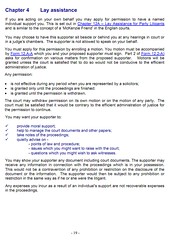
Guide for Party Litigants Lay AssistanceGuidance from the Scottish Court Service on how to apply for McKenzie Friends. The updated guidance from the Scottish Court Service on McKenzie Friends statees : “If you are acting on your own behalf you may apply for permission to have a named individual support you. This is set out in Chapter 12A – Lay Assistance for Party Litigants (pdf) and is similar to the concept of a ‘McKenzie Friend’ in the English courts. You may choose to have this supporter sit beside or behind you at any hearings in court or in a judge’s chambers. The supporter is not allowed to speak on your behalf. You must apply for this permission by enrolling a motion. You motion must be accompanied by Form 12.A-A (Application by party litigant for lay support) which you and your proposed supporter must sign. Part 2 of Form 12.2-A) asks for confirmation on various matters from the proposed supporter. Motions will be granted unless the court is satisfied that to do so would not be conducive to the efficient administration of justice.”

Any permission:
* is not effective during any period when you are represented by a solicitors;
* is granted only until the proceedings are finished:
* is granted until the permission is withdrawn.

The court may withdraw permission on its own motion or on the motion of any party. The court must be satisfied that it would be contrary to the efficient administration of justice for the permission to continue.

You may want your supporter to :

* provide moral support;
* help to manage the court documents and other papers;
* take notes of the proceedings;
* quietly advise on -
- points of law and procedure;
- issues which you might want to raise with the court;
- questions which you might wish to ask witnesses.

Form 12.A-A Application by party litigant for lay supportApplication for McKenzie Friend Form 12.A-A. You may show your supporter any document including court documents. The supporter may receive any information in connection with the proceedings which is in your possession. This would not be a contravention of any prohibition or restriction on the disclosure of the document or the information. The supporter would then be subject to any prohibition or restriction in the same way as if he or she were the litigant. Any expenses you incur as a result of an individual’s support are not recoverable expenses in the proceedings.

You can read my earlier coverage of the campaign to bring McKenzie Friends to Scotland, and how having a McKenzie Friend in court may assist party litigants here : McKenzie Friends for Scotland : The story so far. All written submissions for the McKenzie Friend petition (Petition 1247) at the Scottish Parliament can be read here : Written submissions for Petition 1247, McKenzie Friends for Scotland

Monday, July 19, 2010

Lord President softens rules on Scottish McKenzie Friends, remuneration issue still out of step with England & Wales

Lord Hamilton 2Scotland’s Lord President, Lord Hamilton. LORD HAMILTON, Scotland’s Chief Judge has written to the Scottish Parliament’s Petitions Committee informing MSPs of a slight softening of the requirements of McKenzie Friends or ‘lay assistants’ applying to assist unrepresented party litigants in Scotland’s Court of Session. However while the changes proposed to the terms of who can be a McKenzie Friend in Scotland are welcome small steps, there are still a number of issues yet to be settled to bring Scottish Courts into line with the rest of the UK, after McKenzie Friends first came into existence in an English courtroom forty years ago.

The changes, although minimal, are a retreat from Lord Hamilton’s previous plans to question those applying to be a McKenzie Friend whether they are related to the party litigant. It will now be the case, according to the Lord President the document which accompanies the application for lay support requires now only to state whether or not the supporter has a financial interest in the case and if so to set out what that is.

Lord Hamilton to Petitions Committee 5 July 2010 McKenzie Friends for Scotland Page 1Lord Hamilton’s letter to Petitions Committee informed MSPs of rule changes. Lord Hamilton wrote : “The draft Act of Sederunt was considered by the Court of Session Rules Council at its meeting on 10 May. I refer to item 6 of the draft minutes of the meeting. The Council took account of the substantive points made in the Committee’s discussion at its meeting on 4 May. The draft was modified slightly so that document which accompanies the application for lay support requires now only to state whether or not the supporter has a financial interest in the case and if so to set out what that is.”

On the thorny subject of McKenzie Friends being paid for their help in Scottish courts, as they are in England & Wales – an issue now supported by case law, the Lord President informed the Parliament : “And the prohibition on remuneration was confined to remuneration from the litigant; it is not (and never was) intended to prohibit members of advice services from providing lay support on the basis that they were remunerated by a public body or a charitable organisation. Indeed, support from those sources is manifestly to be encouraged.”

The reference to case law in the English courts family division to support the right of a McKenzie Friend to charge for their services, reports that Mr Justice Munby, ruling over a case of costs arising from contentious contact and residence litigation between unmarried parents [N (A Child) [2009] EWHC 2096 (Fam)] concluded the child’s father's McKenzie Friend "is entitled to charge, if he can find clients willing to pay his fees, at an hourly rate which can hardly be said to be extravagant when contrasted with the fees one frequently finds being charged to privately paying clients in family cases".

Serious questions remain over the Lord President’s desire to forbid any payment to McKenzie Friends in Scotland, with some campaigners questioning whether the prospect of not even a small reward for the services of a lay assistant may well put off many capable individuals from offering to serve as McKenzie Friends to unrepresented party litigants, particularly when the lay assistant scheme is passed for use in Scotland’s Sheriff Courts later this year, as I reported earlier here : Sheriff Court Rules Council reveals McKenzie Friends on course to help party litigants in Scottish Sheriff Courts by end of summer 2010

Lord Hamilton to Petitions Committee 5 July 2010 McKenzie Friends for Scotland page 2Lord Hamilton also informed Holyrood he would keep the arrangements for McKenzie Friends ‘under review’. Lord Hamilton went onto inform MSPs there had been no difficulties reported to him so far over the McKenzie Friend issue : “The Act of Sederunt was duly made (SSI 2010/205). It came into force in relation to lay support on 15 June. At the time of writing it is not possible to offer the Committee any information about how it is working out in practice, other than to say that no difficulties have yet been communicated to me. Once the new arrangements have been in place for a reasonable period, I intend to survey my colleagues to establish the effectiveness of them. I would wish to stress that the arrangements will be kept under review and that, if there are any difficulties, they can be communicated to my Private Office and taken forward with the Rules Council as appropriate.”

Lord Hamilton concluded his letter to the Petitions Committee, informing MSPs the Sheriff Court Rules Council were drafting rules for the Sheriff Courts later in the summer : “That deals, I think, with the Court of Session. So far as the sheriff court is concerned, I understand that the Rules Council continues to have the matter under consideration and anticipates considering a draft of amendments of the sheriff court rules at its meeting on 6 August.”

Recent background to McKenzie Friends in Scotland :

Lord WoolmanCourt of Session judge Lord Woolman granted Scotland’s first civil law McKenzie Friend in late 2009. During the course of the Scottish Parliament’s consideration of the McKenzie Friend petition, one of Scotland’s longest running civil claims actions, M.Wilson v North Lanarkshire Council & Others (A1628/01), overtook events at Holyrood and introduced Scotland’s first civil law McKenzie Friend in the Court of Session, granted by Lord Woolman, making the decision to introduce McKenzie Friends to general use in the Court of Session and lower Sheriff Courts, a formality, albeit one taking the best part of a year to complete.

Lord GillLord Gill proposed McKenzie Friends in Civil Courts review. Progress to finally bring lay assistants to Scotland’s civil courts was helped considerably by McKenzie Friends being recommended by Scotland’s Lord Justice Clerk, Lord Gill who had spent considerable time on the issue of lay representation as part of the two year Civil Courts Review. Lord Gill had also recommended a ‘super McKenzie Friend’ with a right of audience, enabling a lay assistant to address the court on behalf of party litigants, a proposal now part of the Legal Services (Scotland) Bill, which I recently reported here : McKenzie Friends from today in Court of Session, Lord Gill’s ‘super’ McKenzie Friend with rights of audience proposal goes to Holyrood

I will report further on the McKenzie Friend issue when the Sheriff Court Rules Council publish more details on their draft rules and timescale for formal introduction.

You can read my earlier coverage of the campaign to bring McKenzie Friends to Scotland, here : McKenzie Friends for Scotland : The story so far

All written submissions for the McKenzie Friend petition at the Scottish Parliament can be read here : Written submissions for Petition 1247, McKenzie Friends for Scotland

Friday, July 02, 2010

Sheriff Court Rules Council reveals McKenzie Friends on course to help party litigants in Scottish Sheriff Courts by end of summer 2010

McKenzie Friends for ScotlandMcKenzie Friends for Scotland are coming to Sheriff Courts. SHERIFF COURTS across Scotland will shortly see the formal introduction of McKenzie Friends or “Lay Assistants” to assist unrepresented party litigants in civil law cases after the Sheriff Court Rules Council released a statement confirming its members, mostly appointed by Scotland’s Lord President, Lord Hamilton, have accepted the introduction to Scotland's Sheriff Courts of the popular non-lawyer courtroom helper which has existed in the English legal system for some four decades.

Among the members of the Sheriff Court Rules Council are officials from the former Scottish Consumer Council, now renamed Consumer Focus Scotland, who backed the introduction of lay assistants.

A spokesman for the Sheriff Court Rules Council confirmed McKenzie Friends are on their way to Scotland’s Sheriff Courts, saying : “I can advise you that the Sheriff Court Rules Council’s Working Group met on 16 June when it considered the proposed use of a McKenzie Friend in civil proceedings in the sheriff court. The Group agreed that provision be made in the rules along the lines of those recently made by the Court of Session. These rules have now been instructed and it is hoped they will be available in time for consideration by the Council at its next meeting on 6 August.”

Lord HamiltonScotland’s Lord President Lord Hamilton recently enacted McKenzie Friends in Court of Session. The move to introduce McKenzie Friends to Scotland’s Sheriff Courts was necessary after the recent decision by the Court of Session Rules Council & Scotland’s Lord President, Lord Hamilton to formally introduce McKenzie Friends to Scotland’s highest court, after a long running petition to the Scottish Parliament on the issue highlighted the lack of lay assistance in Scottish Courts while English courts, and indeed many international jurisdictions allowed the use of lay assistants for the growing numbers of unrepresented party litigants.

Lord WoolmanCourt of Session judge Lord Woolman granted Scotland’s first civil law McKenzie Friend in late 2009. During the course of the Scottish Parliament’s consideration of the McKenzie Friend petition, one of Scotland’s longest running civil claims actions, M.Wilson v North Lanarkshire Council & Others (A1628/01), overtook events at Holyrood and introduced Scotland’s first civil law McKenzie Friend in the Court of Session, granted by Lord Woolman, making the decision to introduce McKenzie Friends to general use in the Court of Session and lower Sheriff Courts, a formality, albeit one taking the best part of a year to complete.

Lord GillLord Gill proposed McKenzie Friends in Civil Courts review. Progress to finally bring lay assistants to Scotland’s civil courts was helped considerably by McKenzie Friends being recommended by Scotland’s Lord Justice Clerk, Lord Gill who had spent considerable time on the issue of lay representation as part of the two year Civil Courts Review. Lord Gill had also recommended a ‘super McKenzie Friend’ with a right of audience, enabling a lay assistant to address the court on behalf of party litigants, a proposal now part of the Legal Services (Scotland) Bill, which I recently reported here : McKenzie Friends from today in Court of Session, Lord Gill’s ‘super’ McKenzie Friend with rights of audience proposal goes to Holyrood

I will report further on the McKenzie Friend issue when the Sheriff Court Rules Council publish more details on their draft rules and timescale for formal introduction.

Background of the Sheriff Court Rules Council :

Membership of the Council

The Sheriff Court Rules Council (the Council) was established in its current form by Section 33 of the Sheriff Courts (Scotland) Act 1971. Members of the Council are appointed by the Lord President. Membership comprises two sheriffs principal, three sheriffs, one advocate, five solicitors, two sheriff clerks and two lay members. Lay members should have a knowledge of the working procedures and practices of the civil courts, a knowledge of consumer affairs and an awareness of the interests of litigants in the sheriff courts. The Lord President consults the Minister for Justice before appointing lay members. The membership is completed by one person appointed by the Minister for Justice, who appears to the Minister for Justice to be qualified for such appointment. This position is currently held by the Head of the Civil Justice Division & International Division, Scottish Government Justice Department Civil and International Group.

The current members of the Council are:

Appointed by the Lord President for the period 21 January 2008 to 20 January 2011:

  • Sir Stephen S T Young Bt QC, Sheriff Principal of Grampian, Highlands & Islands (Chairman)
  • James A Taylor QC, Sheriff Principal of Glasgow & Strathkelvin
  • Michael J Fletcher, Sheriff of Tayside, Central and Fife at Perth
  • Craig Scott, Sheriff of Glasgow and Strathkelvin at Glasgow
  • William Holligan, Sheriff of Lothian and Borders at Edinburgh
  • Mr Simon Di Rollo QC, Faculty of Advocates
  • Mr Joseph d’Inverno, Solicitor-Advocate, Edinburgh
  • Mr Fraser Simpson, Solicitor, Glasgow
  • Mr Gregor Murray, Solicitor, Dundee
  • Ms Clair McLachlan, Solicitor, Glasgow
  • Mr Stephen Brand, Solicitor, Dundee
  • Mr Alan Johnston, Sheriff Clerk’s Office, Glasgow
  • Mr Roland McMillan, Sheriff Clerk, Dundee
  • Ms Sarah O’Neill, Scottish Consumer Council
  • Ms Rachel Smith, In Court Advisor, Aberdeen

Appointed by the Minister for Justice:

  • Mr Colin McKay

Minutes of Meetings & Consultation Papers of the Sheriff Court Rules Council are well worth a read for all court users & party litigants.

Functions of the Council

These functions are defined in Section 34 of the Sheriff Court (Scotland) Act 1971. The function of the Council is to review the procedure and practice in civil proceedings in the Sheriff Court. In the light of that review, the Council prepares draft rules and submits them to the Court of Session for approval. The rules submitted to the Court of Session are designed to regulate and prescribe procedure and practice. The review of procedure and practice is an ongoing process. The Council prepares and submits to the Court of Session, draft rules designed to deal with any matters relating to the Sheriff Court.

The Court of Session, having made any modifications it thinks expedient, makes an Act of Sederunt embodying the rules. To assist it in the discharge of its functions, the Council may invite representations on any aspect of the procedure or practice in civil proceedings in the Sheriff Court. The Council considers any representations received. These can be in response to an invitation (e.g. in a consultation paper) or in another manner (e.g. by correspondence or having been raised by a member of the Council).

Power of Court of Session to Regulate Civil Procedure in the Sheriff Court

This power is defined in Section 32 of the Sheriff Courts (Scotland) Act 1971. The Court of Session, by Act of Sederunt, regulates and prescribes the procedure and practice to be followed in any civil proceedings in the Sheriff Court.Before making an Act of Sederunt, the Court of Session consults the Council and takes into consideration their views, unless the Act of Sederunt embodies draft rules submitted to the Court of Session by the Council.

You can read my earlier coverage of the campaign to bring McKenzie Friends to Scotland, here : McKenzie Friends for Scotland : The story so far

Wednesday, June 02, 2010

Questions remain over access, costs & funding of McKenzie Friends in Scottish Courts as Rules Council minutes reveal ‘devil in the detail’

Lord Hamilton 2Scotland’s Lord President Lord Hamilton. As the minutes of the most recent meeting of the Court of Session Rules Council were published earlier this week, further details emerged on the discussions between members of Scotland’s judiciary & legal profession over the now confirmed introduction of McKenzie Friends, or as the Lord President prefers to call them “Lay Assistants” to Scotland’s courts. Details of the meeting included how the now signed Act of Sederunt allowing McKenzie Friends would take shape, although mention of exactly why it has taken forty years and a petition to the Scottish Parliament) to bring lay assistants to Scottish Courts was unsurprisingly avoided.

Lord GillThe Lord Justice Clerk, Lord Gill who recommended McKenzie Friends with a right of audience be introduced to Scotland was present at Rules Council meeting. During the Court of Session Rules Council meeting which took place on 10 May 2010, those present, Lord Hamilton & Lord Reed, Ronnie Clancy QC, Graeme Hawkes (Advocate) from the Faculty of Advocates, along with four members of the Law Society of Scotland, Gordon Keyden (Solicitor), Robin Macpherson (Solicitor), Duncan Murray (Solicitor) & Sydney Smith (Solicitor) discussed the McKenzie Friend issue, going onto acknowledge the significant alteration to lay courtroom assistance in Scottish courts had ‘been inspired’ by a public petition at the Scottish Parliament. Others present included the Lord Justice Clerk, Lord Gill (who earlier recommended McKenzie Friends be introduced to Scottish Courts via his Civil Courts Review), & Colin McKay of the Scottish Government’s Constitution, Law and Courts Directorate.

The published minutes (pdf) reflected the following discussions :

6.1 The Council considered a draft set of rules relating to “McKenzie Friends”. The Council was advised that the draft rules had been inspired by a petition which is currently being considered by the Public Petitions Committee at the Scottish Parliament. The petition urges the introduction of a facility in the Scottish courts whereby a party litigant may be assisted by a lay supporter.

6.2 The Council noted that the draft rules before it did not seek to confer any rights of audience on lay persons. It also noted that the Civil Courts Review Report had included a recommendation for the conferral of such a right. The Council was advised that it was not thought that this recommendation would be capable of implementation by rules of court without further primary legislation. However, the Council noted that it was understood that this recommendation was under consideration for early implementation by the Scottish Government.

6.3 In relation to the provision of lay assistance to party litigants through means other than addressing the court, the Council noted the terms of correspondence between the Public Petitions Committee and the Lord President. It was noted that the Lord President had invited Lord Reed and Lord Hodge, as judges with responsibility for administration of Court of Session business, to consider the matter and make recommendations. Following on from recommendations made by Lord Reed and Lord Hodge, the Lord President had agreed that it would be appropriate to make an Act of Sederunt amending the rules in certain respects to acknowledge and regulate lay assistance. The draft provisions before the Council sought to achieve this.

6.4 The Council noted that the Public Petitions Committee at the Scottish Parliament had indicated that it was content for the Lord President to proceed to make the court rules on this matter. It was noted that the latest draft of the rules had been adjusted to take into account points that had been recently been raised by the Committee in correspondence.

6.5 The Council discussed the extent to which the provisions should be included in the body of the rules or by declaration in a form. It also discussed the extent to which the draft rules would discourage or prevent the provision of lay assistance by persons who might be unsuitable for the role. It was agreed that the Private Office would consider the Council’s discussions on these matters in finalising the Chapter which is to be inserted into the Rules.

I reported on the above meeting in an earlier article, published here : McKenzie Friend ‘success’ for Scotland as Court of Session Rules Council signals June 2010 implementation after 40 years of Law Society opposition and you can read more on the rules in the Act of Sederunt, which resulted from the Court of Session Rules Council meeting in a further article here : McKenzie Friend ‘Act of Sederunt’ published, Lord President enforces strict conditions, calls Scots non-lawyer courtroom helpers “Lay Assistants”

For further reference, readers should also consider Scotland’s First McKenzie Friend in a Civil Court, granted by Lord Woolman in M.Wilson v North Lanarkshire Council & Others (Case ref : A1628/01) which I reported on here : First use of McKenzie Friend in Scotland as Court of Session sweeps aside 40 years of lawyers monopoly over public access to justice

While the Act of Sederunt on ‘Lay Assistants’ is due to come into force around 15 June 2010, according to legal insiders, there are still many questions remaining over what will happen if McKenzie Friends are refused, and particularly in which types of cases McKenzie Friends, or “Lay Assistants” may be refused, together with what rights of appeal party litigants will have over a judge’s decision to refuse the use of a McKenzie Friend, or “Lay Assistant”.

A solicitor said this afternoon there should be a properly laid down procedure for right of appeal if a litigant’s request for a lay assistant is refused, as not having one will inevitably tie up court time and confuse party litigants even further.

It has also emerged today that the cost of applying for a McKenzie Friend (Lay Assistant) in a Scottish court could be at least £45, being the price of a motion in the Court of Session. However, according to litigants with cases already in the Court of Session, party litigants may well be looking at about £100 (including the motion fee) if travelling to & from the Court of Session in Edinburgh is required, with additional costs of another £150 up to as much as £750 if a party litigant is required to pay the other sides costs, depending on how long the hearing lasts.

An official with one of Scotland’s Consumer organisations expressed her fears the costs of McKenzie Friend applications may be an obstruction to unrepresented litigants obtaining the necessary help in Scotland’s Civil Courts.

The official said : “Given the use of a McKenzie Friend would greatly speed up the court process in cases where the party litigant is often unrepresented due to a lack of funds and therefore an inability to obtain legal representation, I believe there should be a review of the charges on lay assistance, to encourage the wider use of McKenzie Friends in Scotland’s courts.

She continued : “However, if the report of £45 is accurate, I think the Scottish Court Service could do some good by halving this figure at least, to lessen the burden on party litigants who are already struggling in civil court cases which could be progressed much faster if a McKenzie Friend were there to help.”

While the issue of the cost of applying for a McKenzie Friend in Scotland has been raised, there also remains the thorny issues of McKenzie Friends or ‘Lay Assistants’ in Scotland being allowed to charge for their services, a right which is supported by case law in England & Wales.

While the Lord President has been adamant in his Act of Sederunt that McKenzie Friends or “Lay Assistants” cannot charge for their services, legal insiders have condemned Lord Hamilton’s proposals on the remuneration question as “unenforceable”, with MSPs raising the issue in the Scottish Parliament, particularly given the terms of the non-remuneration policy, which may incur significant disadvantages, to the point of exclusion, of any lay assistants who may be employed by a Non Governmental Organisation or a Charity.

The Petitions Committee of the Scottish Parliament will again discuss Petition 1247 later in the summer.

You can read my earlier coverage of the campaign to bring McKenzie Friends to Scotland, here : McKenzie Friends for Scotland : The story so far

All written submissions for the McKenzie Friend petition at the Scottish Parliament can be read here : Written submissions for Petition 1247, McKenzie Friends for Scotland