Showing posts with label Lord Justice Clerk. Show all posts

Thursday, April 14, 2016

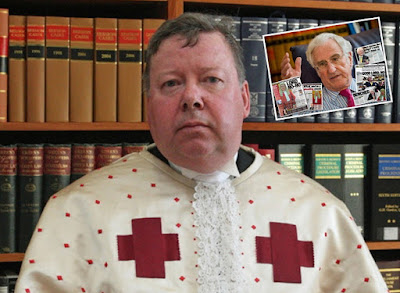
M'LADY JUSTICE CLERK: Lady Dorrian becomes first female judge appointed to position of Lord Justice Clerk - second most powerful judge in Scotland

First female judge appointed Lord Justice Clerk. FOR THE first time in the history of Scotland’s legal system, a female judge has been appointed to the role of Lord Justice Clerk, the second most powerful position in Scotland’s judiciary.

Lady Leonna June Dorrian (58), who is currently a judge of the inner house of the Court of Session - will take up her appointment as Lord Justice Clerk on 26 April 2016, the day of her installation.

The post of Lord Justice Clerk comes with a salary of £213,125 a year.

The Lord Justice Clerk also holds the office of President of the Second Division of the Inner House of the Court of Session, and, by virtue of the post, is Chair of the Scottish Sentencing Council.

The appointment of Lady Dorrian to the second most powerful judicial position comes after the recent appointment of the previous holder of the office of Lord Justice Clerk – Lord Carloway – to the top role of Lord President & Lord Justice General of the Court of Session.

During the six month search for a new Lord President which took place after the sudden retirement of Lord Brian Gill in May, 2015 - Lady Dorrian was appointed to a selection panel convened by the First Minister Nicola Sturgeon to interview applicants for the position of Lord President, reported in further detail here: To play the President - Hunt begins for Scotland’s next top judge

The panel, which comprised Sir Muir Russell – Judicial Appointments Board for Scotland, Mrs Deirdre Fulton – Judicial Appointments Board for Scotland, Rt Hon Lord Reed – Justice of the Supreme Court of the United Kingdom,  Rt Hon Lady Dorrian – Senator, Inner House of the Court of Session – concluded their deliberations with a recommendation Lord Carloway (real name Colin Sutherland) be appointed to the position of Lord President – reported in further detail here: Top judge of Parliament House: Lord Carloway appointed as Scotland’s Lord President

With the ascension of Lord Carloway to the post of Lord President, the move required the appointment of a new Lord Justice Clerk.

A selection panel to interview candidates for the role was again convened by the First Minister earlier in January 2016 – the panel comprising of Rt Hon Lord Carloway – Lord President, Sir Muir Russell – Judicial Appointments Board for Scotland, Alison Mitchell – Judicial Appointments Board for Scotland, The Hon Lady Stacey – Senator of the College of Justice to select a candidate for the position of Lord Justice Clerk.

Lady Dorrian was then nominated by the First Minister Nicola Sturgeon to Her Majesty the Queen - after taking account of recommendations made by the selection panel constituted under the Judiciary and Courts (Scotland) Act 2008 .

The panel which made the recommendations included Lord Carloway – who had been nominated for the position of Lord President by the previous panel which Lady Dorrian was a member of.

Lady Dorrian - Biography:

Lady Dorrian is a graduate of the University of Aberdeen and was admitted to the Faculty of Advocates in 1981 before becoming Standing Junior Counsel to the Health and Safety Executive and Commission between 1987 and 1994.

She served as Advocate Depute between 1988 and 1991, and as Standing Junior to the Department of Energy between 1991 and 1994. In 1994, she was also appointed Queen's Counsel. Between 1997 and 2001 she was a member of the Criminal Injuries Compensation Board. Lady Dorrian was appointed as a judge of the Supreme Courts in 2005, having served as a temporary judge since 2002. She was appointed to the Inner House in November 2012.

SECRETLY SELECTING A PRESIDENT, SO SECRETLY:
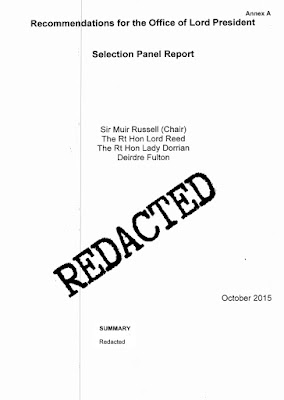
 How judges select Scotland’s judges - in secret The selection panel for the office of Lord President - of which Lady Dorrian was a member – considered five candidates for the position of Scotland’s top judge – according to papers released by the Scottish Government in response to a Freedom of Information request by the media.

While there was significant speculation during 2015 that a female judge would be appointed to the top judicial post of Lord President, the unpredicted shift away from a male only top judge did not happen this time around.

Responding to queries, the Scottish Government refused to disclose the genders & diversity information relating to any of the candidates for the top job, citing privacy concerns.

Written exchanges between civil servants and the selection panel reveal a short listing meeting was held on 1 September 2015. The panel considered that two applicants Lord Carloway  [Redacted] merited an interview on the basis of the quality of their applications.

The panel agreed that given the level of appointment, candidates needed to be able to demonstrate that they met the criteria to an exceptional degree [Redacted].

The content of the selection panel’s report recommending Lord Carloway for the nomination of Lord President, was completely censored by the Scottish Government.

Emails between Scottish Government show First Minister Nicola Sturgeon had decided on Lord Carloway’s nomination as Lord President around 18 November 2015. Lord Carloway’s appointment as Lord President was finally made public a month later in December 2015.

Scotland’s judiciary faces a testing time as calls grow for judges to apply the same levels of transparency to themselves as is required of all other branches of Government, the justice system and those in public life.

SPOTLIGHT ON JUDICIAL INTERESTS SECRECY:

Scotland’s current Lord President - Lord Carloway is to be asked to give evidence to the Scottish Parliament’s Public Petitions Committee in connection with three year probe on proposals to require judges to register their interests, as called for in Petition PE1458: Register of Interests for members of Scotland's judiciary.

The petition calls for the creation of a publicly available register of judicial interests containing information on judges backgrounds, their personal wealth, undeclared earnings, business & family connections inside & outside of the legal profession, offshore investments, hospitality, details on recusals and other information routinely lodged in registers of interest across all walks of public life in the UK and around the world.

The proposal to require judges to declare their interests enjoys cross party support, and was widely backed by MSPs during a full debate in the Scottish Parliament’s main chamber on 9 October 2014 - reported in full with video footage of MSPs and Scottish Ministers speaking during the Holyrood debate, here: Debating the Judges.

Previous articles on the lack of transparency within Scotland’s judiciary, investigations on judicial interests including reports from the media, and video footage of debates at the Scottish Parliament’s Public Petitions Committee can be found here : A Register of Interests for Scotland's Judiciary

Friday, February 05, 2016

THE DEPUTY: Search is on for a new Lord Justice Clerk as First Minister convenes selection panel to appoint Scotland’s second most powerful judge

Legal figures begin secret selection process for new Lord Justice Clerk. AMID the turmoil caused by the sudden retirement in May 2015 of Lord Brian Gill from the post of Lord President - and the subsequent elevation of his deputy - Lord Carloway to the top judicial post, Scotland’s First Minister Nicola Sturgeon has been forced to initiate another recruitment round to fill the post of Scotland’s second most senior judge – the position of Lord Justice Clerk.

A two week window for applications for the number two judicial role in Scotland -  which comes with a salary of £213,125 a year - was announced late last month by the Scottish Government – with a closing date of this Sunday, 7 February 2016.

The Lord Justice Clerk is the second most senior judge in Scotland and has a particular role in relation to the criminal justice system. In addition to its judicial duties, the office carries with it certain statutory duties relative to the provision of support to the Lord President in the discharge of his responsibilities as Head of the Judiciary.

The office brings with it responsibilities for providing leadership to the judiciary, not only in supporting the Lord President but also, separately, as a member and deputy chair of the Scottish Courts and Tribunals Service (SCTS), in providing leadership to the staff of the SCTS.

The Lord Justice Clerk is also chair of the Scottish Sentencing Council.

Sitting on the latest behind-closed-doors selection panel are: The Rt Hon Lord Carloway – Lord President, Sir Muir Russell – Judicial Appointments Board for Scotland, Alison Mitchell – Judicial Appointments Board for Scotland, The Hon Lady Stacey – Senator of the College of Justice.

A sift of applications for the post of Lord justice Clerk will take place on Thursday 11 February 2016 in order to provide a short list of candidates for interview. Invitations to interview will be issued by Friday 12 February 2016. The interviews will take place on 29 February 2016 in central Edinburgh, at a venue to be confirmed.

The selection panel will make recommendations to the First Minister by early March, who then makes her nomination to the Prime Minister after statutory consultation with the Lord President. The Prime Minister recommends a name for the new Lord Justice Clerk to Her Majesty, but may not recommend anybody who has not been nominated by the First Minister.

Eligibility for appointment as Lord Justice Clerk is the same as that for a Judge of the Court of Session. Serving judges of the Court of Session are eligible for appointment as Lord Justice Clerk.

Article xix of the Union with England Act 1707 and section 20A of the Judiciary and Courts (Scotland) Act 2008 provide that:  sheriffs principal and sheriffs who have held continuous office for at least 5 years immediately preceding the appointment;  solicitors who have had rights of audience in both the Court of Session and the High Court of Justiciary for a continuous period of at least 5 years immediately preceding the appointment; advocates of 5 years standing; and Writers to the Signet of 10 years standing who have passed an examination in civil law set by the Faculty of Advocates 2 years before appointment - are eligible to apply for the office of judge of the Court of Session and therefore appointment as Lord Justice Clerk.

The Lord Justice Clerk must be acknowledged by the judiciary and the legal profession to be among the most able lawyers of his or her generation. The holder of the office must have the capacity to command public confidence in the justice system and the confidence and respect of judicial colleagues, and to develop positive and productive relationships with judicial colleagues and others in the justice system. He or she must have the necessary knowledge, experience and judgement to be able to give authoritative opinions in the most complex and important cases both in civil appeals and in criminal cases at first instance and on appeal. Successful candidates will therefore have to demonstrate that they meet the criteria listed below to an appropriately high level

Personal Qualities and criteria for appointment: Legal and Judicial: A candidate shall: be an outstanding lawyer in the main areas of law that come to be determined in the Court of Session and the High Court of Justiciary; possess a thorough understanding of the theory and principles on which the law is based, its practical application and an ability to analyse and explore legal problems creatively and imaginatively; be able to set out complex legal issues clearly and succinctly, both orally and in writing, and to explain the reasoned basis for any decision; and be aware of the areas in which the law is developing and demonstrate a desire to master new and unfamiliar areas.

Leadership and Management: A candidate shall be able to: provide leadership and strategic direction across the full range of management issues, including through appropriate delegation, to ensure the effective and efficient delivery of the courts and tribunals service across Scotland in support of the Lord President; demonstrate an inclusive management style which builds consensus and facilitates the management of change; set and promote the highest standards of judicial behaviour in and out of court; inspire confidence, command respect and gain commitment from others; and ensure that decisions are taken and implemented to deliver an effective and efficient courts and tribunals service across Scotland.

Personal Qualities: A candidate should be able to demonstrate: Integrity, independence of mind, moral courage and the ability to command respect; Social awareness and understanding of the contemporary world; Resilience; Sound temperament, consideration and courtesy; Excellent communications skills which support the representational role on behalf of the SCTS; Fairness, impartiality and a responsible attitude.

WHO’LL BE THE JUDGE:

Diary of Injustice previously reported on the recruitment round for the role of Lord President,and featured reports from the Scottish Sun newspaper on the hunt for a new top judge, here: TO PLAY THE PRESIDENT: Hunt begins for Scotland’s next top judge & Lord President of the Court of Session.

The position of Scotland’s top judge became vacant after Lord Brian Gill – who served a short term as Lord President from 2012-2015 unexpectedly walked out of the top judicial post in May 2015 – giving only 30 days notice he intended to quit.

Lord Carloway was appointed to replace Lord Gill, in late December 2015, reported here: TOP JUDGE OF PARLIAMENT HOUSE: Lord Carloway appointed as Scotland’s Lord President & Lord Justice General of the Court of Session.

The elevation of the Lord Justice Clerk to the top job of Lord President came after recommendations were received from a secretive panel constituted by First Minister Nicola Sturgeon under the Judiciary and Courts (Scotland) Act 2008.

The behind-closed-doors panel, comprising of Sir Muir Russell & Mrs Deirdre Fulton from the Judicial Appointments Board for Scotland, Lord Reed of the UK Supreme Court and Court of Session judge Lady Dorrian - began a search in July for a new top judge in July 2015, with orders to recommend a name to the First Minister by 30 October 2015.

Lord Carloway was officially installed as Lord President in a ceremony at the Court of Session in Edinburgh on 8 January 2016, reported here: NEW JUDGE ON THE BLOCK: Lord Carloway installed as Lord Justice General & Lord President of the Court of Session.

Saturday, December 19, 2015

TOP JUDGE OF PARLIAMENT HOUSE: Lord Carloway appointed as Scotland’s Lord President & Lord Justice General of the Court of Session

Top judicial post of Lord President taken by Lord Carloway. SCOTLAND’S Lord Justice Clerk - Lord Carloway - has been confirmed as the new Lord President & Lord Justice General of the Court of Session.

The post of Lord President – with a salary of £220,655 per year - became vacant after Lord Brian Gill unexpectedly walked out of the top judicial post in May of this year – giving only 30 days notice he intended to quit.

The move, elevating the Lord Justice Clerk to the top job of Lord President comes after a secretive panel constituted by First Minister Nicola Sturgeon under the Judiciary and Courts (Scotland) Act 2008.

The behind-closed-doors panel, comprising Sir Muir Russell & Mrs Deirdre Fulton from the Judicial Appointments Board for Scotland, Lord Reed of the UK Supreme Court and Court of Session judge Lady Dorrian - began a search in July for a new top judge - with orders to recommend a name to the First Minister by 30 October 2015.

The secretive recruitment process for a Lord President is reported in further detail here: To play the President - Hunt begins for Scotland’s next top judge

Lord Carloway – real name Colin Sutherland - is known for his backing for the Scottish Government’s failed plan to remove corroboration from Scots law.

While in the role of Lord Justice Clerk, Lord Carloway authored the Carloway Review Report & Recommendations 2011 – which backed a joint effort by Scottish Ministers and the Crown Office to remove the centuries old safeguard against wrongful convictions requiring evidence in criminal trials to be corroborated from two independent sources.

The Carloway Review and it’s recommendation to abolish corroboration - was opposed by members of the judiciary in their Response by the Senators of the College of Justice to SG consultation : Reforming Scots Criminal Law & Practice.

The campaign to retain corroboration was backed by Lord Gill - the then Lord President - who spoke out at the Scottish Parliament’s Justice Committee - defining the injustice safeguard as one of the "finest features" of Scotland’s justice system. Video footage of Lord Gill’s evidence to MSPs can be found here: Lord President Brian Gill evidence to Justice Committee on retention of corroboration

The same Justice Committee – who voted against plans to remove corroboration from Scots Law - dubbed Lord Carloway “disdainful and dismissive” over his support for scrapping the need for corroboration in criminal cases.

In April of this year, as the Scottish Government retreated on their plans to abolish corroboration - Lord Carloway hit out at elements of the legal profession who campaigned for retention of the injustice safeguard.

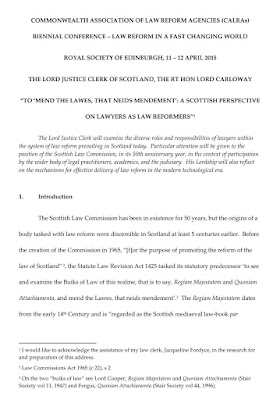
During Lord Carloway’s speech to the Commonwealth Association of Law Reform Agencies Biennial Conference - the Lord Justice Clerk accused lawyers & critics of having "transparent self-interest" in retaining the centuries old injustice safeguard.

Lord Carloway said: "Reactionary or excessively defensive forces among the legal profession can, and often do, behave in a manner obstructive to progressive law reform, especially where there is transparent perceived financial self-interest."

The judge’s remarks provoked robust responses from Thomas Ross - the Chair of the Criminal Bar Association, reported in The Herald HERE

Mr Ross argued lawyers opposed to ending the safeguard - under which two pieces of evidence are required to secure a conviction - were acting against their own financial interests.

Recently Lord Carloway was appointed head of the Scottish Sentencing Council – a quango created by Scottish Ministers which was condemned by two previous Lord Presidents – Lord Gill and Lord Hamilton – as a political attempt to interfere with the judiciary and Scotland’s courts system.

The appointment of Lord Carloway to the role of Lord President – made by the Queen upon receiving a nomination from the First Minister - retains the 500 year old tradition of male only top judges.

Lord Carloway will be formally installed as Lord President early in the new year, 2016.

Once appointed as Lord President, Lord Carloway will be asked to give evidence to the Scottish Parliament’s Public Petitions Committee in connection with three year probe on proposals to require judges to register their interests, as called for in Petition PE1458: Register of Interests for members of Scotland's judiciary.

If Lord Carloway’s stated views on ‘transparency and self interest of vested legal interests’ are anything to go by, perhaps the new Lord President will reach a different view from his predecessor Lord Gill – who spent two of his three year term as top judge fighting plans to enhance judicial transparency with a register of judges’ interests.

The petition calls for the creation of a publicly available register of judicial interests containing information on judges backgrounds, their personal wealth, undeclared earnings, business & family connections inside & outside of the legal profession, offshore investments, hospitality, details on recusals and other information routinely lodged in registers of interest across all walks of public life in the UK and around the world.

The proposal to require judges to declare their interests enjoys cross party support, and was widely backed by MSPs during a full debate in the Scottish Parliament’s main chamber on 9 October 2014 - reported in full with video footage of MSPs and Scottish Ministers speaking during the Holyrood debate, here: Debating the Judges.

Previous articles on the lack of transparency within Scotland’s judiciary, investigations on judicial interests including reports from the media, and video footage of debates at the Scottish Parliament’s Public Petitions Committee can be found here : A Register of Interests for Scotland's Judiciary

Lord Carloway’s appointment as Lord President has been welcomed by the Dean of the Faculty of Advocates, who were recently revealed to have taken ownership of Scotland’s top court buildings from Edinburgh City Council.

James Wolffe QC, Dean of the Faculty of Advocates, said: “His appointment as head of Scotland’s judiciary is richly merited – having regard not only to his personal qualities but to his distinguished career of service, as an advocate before his appointment to the bench in 2000, as a judge since that date, and since 2012 as Lord Justice Clerk.

“Lord Carloway becomes Lord President at an important time for our legal system as it responds to technological, social and institutional change. I look forward very much indeed to working with him.”

Christine McLintock, President of the Law Society of Scotland who spent much of the week condemning legal aid cuts, commented: “I warmly congratulate Lord Carloway on his appointment. As one of our most senior and respected judges, and with a wealth of experience across both criminal and civil law, he has already made a substantial contribution to justice and the rule of law here in Scotland. I have every confidence he will make an even greater contribution as our Lord President.

“Lord Carloway assumes this role at a critical time for Scotland’s justice system, with major reforms to improve the efficiency of our courts but also pressures from reductions in public spending. We are also seeing a transformation in the legal services market, with new business models, changing expectations from clients and a greater internationalism amongst legal firms. Against this backdrop of change, we look forward to working with Lord Carloway, building on the excellent relationship we have enjoyed with him as Lord Justice Clerk.”

The appointment now creates a vacancy for the office of Lord Justice Clerk.

The First Minister is required by s19 of the Judiciary and Courts (Scotland) Act 2008 to establish a panel to recommend individuals suitable for this appointment.

Lord Carloway’s most recent appearance at the Scottish Parliament came during an evidence session before the Justice Committee on 8 December 2015 during which the Lord Justice Clerk gave evidence to MSPs on the Abusive Behaviour & Sexual Harm (Scotland) Bill.

Lord Carloway Justice Committee Scottish Parliament 8th December 2015

LORD CARLOWAY:

Lord Carloway is a graduate of Edinburgh University (LLB Hons) and was admitted to the Faculty of Advocates in 1977. He served as an Advocate Depute from 1986 to 1989 and was appointed Queen’s Counsel in 1990. From 1994 until his appointment as a Judge he was Treasurer of the Faculty of Advocates.

Lord Carloway was appointed a Judge in February 2000 and was elevated to the Inner House in August 2008. He became Lord Justice Clerk in August 2012.

He was an editor of ‘Green’s Litigation Styles’ and contributed the chapters on ‘Court of Session Practice’ to the Stair Memorial Encyclopedia and ‘Expenses’ in Court of Session Practice.

Lord Carloway was the joint editor of ‘Parliament House Portraits: the Art Collection of the Faculty of Advocates’ and is a former president of the Scottish Arts Club. He is the author of the Carloway Review on key elements of criminal law and practice which was published on 17 November 2011. Many of the recommendations from this review have been taken forward in the Criminal Justice (Scotland) Bill, approved by Parliament earlier this week.

Lord Carloway is also currently leading a steering group overseeing the Scottish Court and Tribunal Service review into Evidence and Procedure, including options for improving how children and other vulnerable witnesses provide evidence in criminal cases.