Showing posts with label Judicial Complaints Rules. Show all posts

Thursday, April 09, 2015

THE LORD'S RULES: Top judge's two year consultation & tweaks to rules allowing judges to investigate themselves is 'missed opportunity' says former Judicial Complaints Reviewer

Lord Gill’s new rules more like old - says former JCR. A TWO YEAR consultation held by Scotland’s top judge Lord President Lord Brian Gill on proposed updates to rules governing complaints about judges has been criticised by Scotland’s first Judicial Complaints Reviewer (JCR) as an “opportunity missed”.

Moi Ali – who stood down from the post of JCR last year after telling msps her role to review judicial complaints was “window dressing”, said: “The Lord Presidents’ consultation ended in 2013 and I am surprised that it has taken until now to come up with what appear to be largely the same rules, albeit with a few small tweaks.”

The proposed rules on judicial complaints, published by the Judiciary of Scotland only last week - coming two weeks after an investigation revealed the lack of activity by Lord Gill on the promised changes to judicial rules – bring little comfort for those seeking transparency and accountability in Scotland’s judiciary.

Lord Gill (73) also sent a copy of the consultation and rules changes to members of the Scottish Parliament’s Public Petitions Committee - who are investigating calls to create a register of judicial interests as proposed in Petition PE1458: Register of Interests for members of Scotland's judiciary.

The Judicial Office claim the new rules and guidance for complainers simplify and streamline the process for dealing with complaints and make clear the matters that can properly be investigated.

However, there is in fact little in the changes proposed by Gill which satisfy falls for increased transparency and accountability in the judiciary.

Consultation & rule changes feature in letter to MSPs scrutinising judicial interests register petition. The proposals – which took the top judge an incredible two years to consider - in between international trips & ‘diplomatic commitments’ – do not include the creation of a register of judicial interests - which court users & legal teams could use to require judges to recuse themselves from hearing a case – rather than as the rules prefer – complain about matters to a judge up to three months after the event took place.

While serving as Judicial Complaints Reviewer, Moi Ali launched her own consultation on judicial complaints procedures.

Commenting on the results of her own consultation, Moi Ali said: “I conducted a detailed consultation of my own when I was Judicial Complaints Reviewer, speaking with those who had used the complaints process. They deemed it unfit for purpose at that time.”

Ms Ali continued: “I am disappointed that the thrust of my response to the Lord President, based on that feedback from ordinary Scots, has not been incorporated. I asked for more user-friendly, plain English Rules, but this has not happened. I also hoped that a mindset that welcomed complaints and recognised the genuine value of encouraging complaints would have shaped the new Rules, but instead the inbuilt deterrent to complainers remains. The new Rules are an opportunity missed.”

Among the small changes to the rules announced by Lord Gill, is a proposal to publish details of those who make complaints about a judge – as well as revealing the identity of the judge involved in the complaint.

However, Gill’s idea to out members of the public in a bid to deter them from complaining about poor or dodgy judges may fall foul of data protection laws.

Speaking on the Lord President’s idea to publish, former JCR Moi Ali said: “I note that the Lord President has included a new Rule which allows the publication of complaints cases. If this is a bid to increase transparency and to bring Scotland into line with England and Wales, where details of upheld complaints  are published on the internet, then I welcome the move. However, I am concerned that the details of the complainer may also be published, as I fear that this may deter people from making legitimate complaints. Entirely innocent parties should have their confidentiality protected."

The Judicial Office refused to make further comment on the small changes to the rules announced by Lord Gill.

At a date yet to be decided in May 2015, the Scottish Parliament’s Public Petitions Committee will consider the rule changes proposed by Lord Gill - who has so far refused three invitations to appear before msps to answer questions on his hostility to judicial transparency and the creation of a register of judicial interests.

Gillian Thompson – who took over from Moi Ali as Judicial Complaints Reviewer recently told msps she also supports the creation of a register of judicial interests – reported here: New Judicial Complaints Reviewer supports proposal to Scottish Parliament to create a register of interests for judges

Previous articles on the lack of transparency within Scotland’s judiciary, investigations by Diary of Injustice including reports from the Sunday Herald and Sunday Mail newspapers, and video footage of debates at the Scottish Parliament’s Public Petitions Committee can be found here : A Register of Interests for Scotland's Judiciary

JUDGES WHO WRITE THEIR OWN COMPLAINTS RULES:
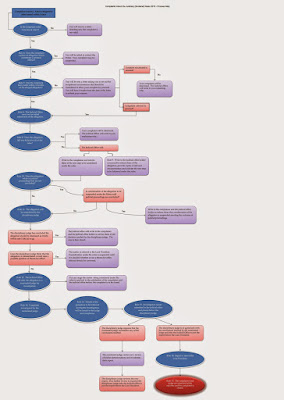
How YOUR complaint against a judge ends up in a tangle of judicial gobbledygook. As head of the Scottish Judiciary, the Lord President is responsible for making and maintaining appropriate arrangements for investigating and determining matters concerning the conduct of judicial office holders. The Judiciary and Courts (Scotland) Act 2008 makes provision for the Lord President to make rules in connection with these matters.

The previous Lord President made the Complaints about the Judiciary (Scotland) Rules in 2011. After two years of administering the Rules, some administrative issues had been noted and it was agreed that a review of the Rules should be undertaken. The Judicial Office for Scotland (JOS), on behalf of the Lord President ran a consultation for 12 weeks in 2013. The consultation document sought views on several matters relating to proposals for revised Complaints about the Judiciary (Scotland) Rules and included draft rules.

The Judicial Office proposed rules on what can and cannot be investigated state: “We can only investigate complaints about a judge’s personal conduct. We cannot consider complaints about judicial decisions or the way a case has been managed. These matters can only be challenged by appeal. The definition of personal conduct covers a wide range of behaviour both in and outside of court. However, you should understand that on occasions a judge may have to be firm, direct or assertive in his or her management of a case. A complaint must be made within 3 months of the incident you wish to complain about.”

Listed among examples for complaints are: Use of racist, sexist or offensive language, Falling asleep in court, Misusing judicial status for personal gain or advantage, Conflict of interest.

Examples of what cannot be investigated include judges accused of criminal behaviour : A judgment, verdict or order, Sentencing decisions, What evidence should be, or has been considered, The award of costs and damages, Whose attendance is required at court,  Who should be allowed to participate in a hearing, Allegations of criminal activity (criminal allegations should be directed to the police)

Wednesday, March 25, 2015

GOOD LORD, RULES? Scotland’s top judge keeps MSPs next move on register of judges interests on hold - as files reveal two year consultation on judicial complaints rules is exercise in ‘perception’

Top judge Lord Gill & the two year rules consultation. TWO YEARS after Scotland’s top judge Lord Brian Gill launched a ‘consultation’ on amending rules governing complaints about the judiciary, documents obtained from the Judicial Office appear to suggest the entire exercise is little more than an attempt to delay calls for greater judicial accountability.

The development comes as legal observers await the next move by members of the Scottish Parliament’s Public Petitions Committee in their two year investigation of judicial transparency and proposals to create a register of interests for judges - Petition PE1458: Register of Interests for members of Scotland's judiciary.

In cryptic exchanges between staff of the Scottish Court Service, a short series of emails reveal the consultation exercise on amending complaints rules is seeking to create a process where there is a ‘perception’ complaints about the conduct of judicial figures are being more fully investigated and dealt with than under the current regime of judicial self regulation – where Lord Gill decides the fate of each complaint himself – usually resulting in the dismissal of a complaint.

And despite calls for Gill (73) to update members of Holyrood’s Public Petitions Committee on the rules consultation, over four months since the last exchange from Scotland’s longest serving judge – dubbed Lord NO-NO for his refusal to face MSPs questions at Holyrood – the Lord President has yet to report back to the Public Petitions Committee on his intentions to ‘improve’ the process by which court users, litigants, legal agents and the public can make complaints about judges.

In the documents released by the Scottish Court Service in response to a Freedom of Information request, it is clear little activity with a motive to create fair rules around judicial accountability has taken place on the ‘consultation’ which began in early 2013.

In one poorly edited email, the true nature of the consultation emerges –  a staff member at the Scottish Courts Service states: “… it has to be agreed to - and perception about this being a process for the complainer to be satisfied? However, I might be remembering incorrectly - let me know.”

Two years of silence & secrecy ensue, while Lord Gill and his colleagues on the bench fly around the world to posh meetings with big business, vested legal interests, and lavish state visits to Qatar.

Then, finally in mid January of this year, court staff again discuss the rules which are yet to be implemented, two years on.

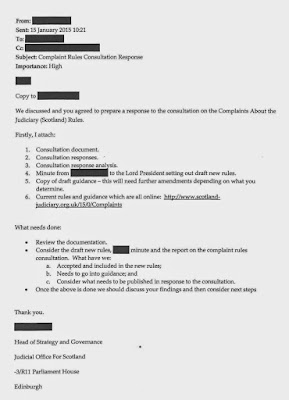
An email dated 15 January 2015 from the “Head of Strategy for the Judicial Office” states: We discussed and you agreed to prepare a response to the consultation on the Complaints About the Judiciary (Scotland) Rules. Firstly, I attach:

1. Consultation document.
2. Consultation responses.
3. Consultation response analysis.
4. Minute from to the Lord President setting out draft new rules.
5. Copy of draft guidance - this will need further amendments depending on what you determine.
6. Current rules and guidance which are all online:
Complaints about the Judiciary

What needs done:
• Review the documentation.
• Consider the draft new rules, 'minute and the report on the complaint rules consultation.

What have we:
a. Accepted and included in the new rules;
b. Needs to go into guidance; and
c. Consider what needs to be published in response to the consultation.
• Once the above is done we should discuss your findings and then consider next steps

The Scottish Court Service refused to identify the authors of, or release any of the consultation responses or any further material on the discussions relating to proposed new rules on judicial complaints.

The existing rules on judicial complaints - in force since 2013 - were condemned by Moi Ali - Scotland’s first Judicial Complaints Reviewer as ““window dressing” during an evidence session at the Scottish Parliament’s Public Petitions Committee in September 2013, reported here: As Scotland’s top judge battles on against transparency, Judicial Complaints Reviewer tells MSPs judges should register their interests like others in public life

Coverage of a full debate on the creation of a register of interests for Scotland’s judiciary – held at the Scottish Parliament on 7 October 2014 - where MSPs overwhelmingly backed a motion urging the Scottish Government to create a register of judicial interests was reported here: Debating the Judges

Previous articles on the lack of transparency within Scotland’s judiciary, investigations by Diary of Injustice including reports from the media, and video footage of debates at the Scottish Parliament’s Public Petitions Committee can be found here : A Register of Interests for Scotland's Judiciary

JUDICIAL COMPLAINTS – NO INDEPENDENT ELEMENT

JCR should have more powers – Moi Ali. In the second annual report as Judicial Complaints Reviewer, Moi Ali called for the Scottish Government to give more powers to the JCR’s office to deal with errant judges. Ms Ali said: “I think fundamentally the problem is the legislation. “The way it’s created, it’s about self- regulation so you have judges judging judges’ conduct. There isn’t really an independent element.“I’m presented as the independent element but, without the powers, I can’t be independent. We have the appearance of independent oversight but not the reality.”

After Scottish Ministers refused to give the JCR role a wider remit in 2014, Moi Ali stepped down from the position, citing she had no power and the role was "tokenistic".

Moi Ali’s third and final report as JCR : Report of the Judicial Complaints Reviewer 2013-2014 - details complaints of alleged racial bigotry, bullying, lying, conflicts of interest and making secret recordings of meetings.

Commenting on the attitude of the judiciary, Moi Ali said: "Unfortunately, there has been little interest in the positive difference that the JCR could make.Although I have had a good working relationship with the judicial office, I have met the Lord President just once in three years.”

"My interactions with both the Lord President's office and the judicial office have focused more on what I cannot do rather than what I can do and as such, an opportunity for whole system improvement has been lost.

In an earlier letter to MSPs, Moi Ali wrote of her support for the creation of a register of judicial interests and an increase in judicial accountability & transparency.

Ms Ali told MSPs: “The position of the judiciary is incredibly powerful. They have the power to take away people’s assets, to separate families, to lock people away for years. Some of these people will not have committed a crime. They may be women who want protection from abusing partners, fathers who want access to their children, or people whose home is at stake due to various legal or family wrangles. People going through the court system face stress and anxiety, perhaps financial pressures, and fear about the future. Their perspective is important and must be a consideration in this matter.

Given the position of power held by the judiciary, it is essential not only that they have absolute integrity but crucially, that they are seen to have absolute integrity. Again, a register of interests is a way of demonstrating that a judicial office holder is impartial and has no vested interest in a case –financially, through family connections, club/society membership or in any other way. Conversely, the refusal to institute a register of interests creates suspicion that in turn undermines judicial credibility. So once more, a register of interests is good for the judiciary and good for the public.”