Independent Law journalists report on legal news for consumers, litigants & Scotland's legal community including features on justice, access to justice, law reform, the judiciary, politics & in-depth investigations, analysis and commentaries on legal related issues.
Judges & Prosecutors at centre of Post Office IT scandal.AMID the almost daily headlines of dishonest, manipulated practices and flawed evidence used by the UK’s Post Office and Prosecutors to convict over nine hundred postmasters and postmistresses - there is one key group which has so-far escaped the slightest calling before the Inquiry – The judiciary.
And on the sheer scale of injustice contained in the prosecutions, and convictions of over nine hundred postmasters – there can be no doubt the UK and Scotland’s judiciary have many questions to answer.
The Law Gazette recently reported Post Office lawyers held secret meeting with judge to stop disclosure : “Lawyers for the Post Office arranged a secret meeting with a judge to prevent disclosure to defence solicitors in a criminal trial, the Post Office Inquiry heard yesterday. Solicitor Martin Smith and his barrister colleague Simon Clarke met the judge at Birmingham Crown Court in 2013 on the eve of a trial of a sub-postmaster accused of theft.
“The prosecuting lawyers applied for public interest immunity on the report, successfully persuading the judge that the defence solicitors should not be made aware of it.”
Clearly, the judiciary are much more involved in the Post Office Horizon scandal than the Judicial Office Media relations teams across the UK would like us journalists, and the public to believe.
Yet to date in the Post Office inquiry, not one member of the judiciary who convicted and sentenced the postmasters has appeared to face questions and give evidence on how they and the judiciary as an institution did not appear to even question the hundreds of prosecutions brought against Postmasters.
The figures are grim - Around 736 people were prosecuted between 1999 and 2015 based on information from the faulty Horizon computer accounting system – ‘evidence’ from which was then used by Prosecutors, the courts and the judiciary to secure over 900 convictions.
A further 283 cases were brought against postmasters, using information from the same faulty Horizon accounting system - by other bodies, including the Crown Office and Procurator Fiscal Service (COPFS) in Scotland.
In total, 236 postmaster and postmistresses have been sent to prison.
However, in not one hearing of the Post Office inquiry to date of publication - have the public heard from members of the judiciary – the same judges who convicted over 900 postmasters, and then sent 236 postmasters to jail.
As readers, and all court reporters will be well aware - more often than not when a conviction is secured by the prosecution, and particularly so when that conviction will result in a prison sentence – the judge often reads out a sentencing statement or comments to those who are found guilty in court.
The content of these sentencing statements and comments from trial judges - upon the court finding an accused guilty – often result in diatribes of piercing detail, grim listening and reading.
Many times, journalists & others in court rooms have listened to sentencing comments from the bench - while Prosecutors smirk at their side of the court, the Trial judge will often cast up details of what was previously heard in the trial, rounding on the convicted person’s past, their character, background, perhaps even their family and other issues as perceived by Prosecutors to justify the guilty verdict.
The strength of sentencing statements & comments from the presiding judge, are often designed to ensure no one, not even the media – can take issue with what occurred in that court room or question the evidence used to convict – what we now understand to be wrongful prosecutions based on a faulty computer system.
And when a trial concludes, and the accused who are found guilty deserve such comments for their crimes, there are few who would not agree such statements are very much well deserved, and in the public interest.
However, and for all to see in the Post Office Inquiry so-far, whatever the judges said in court to the hundreds of postmasters wrongly - perhaps even maliciously convicted - and the hundreds of postmasters sent by judges to prison – there is an absolute public interest case for all such comments and statements from the judiciary to be published, and accounted for.
Over Nine Hundred convictions – and - Two hundred and Thirty Six persons sent to jail – all sent there by a judge – is an alarming scale of wrongful, perhaps even malicious prosecutions.
The justice system has been used, and willingly so – to target and convict, then jail UK Postmasters on an industrial scale – in an effort which very likely was motivated to protect the Post Office and the Horizon IT accounting system it used, from the scrutiny and accountability which we now see coming to the fore in the questioning of witnesses in the Post Office inquiry.
If the Post Office Horizon inquiry is to reveal the true extent of the complicity of the justice system in the scale of the determined and malicious application of justice against the Postmasters – every single sentencing judge should be called to appear before the Post Office inquiry, read out their sentencing comments or statements and face questions on every single conviction and prison sentence handed down by a judge.
When do we get to hear from the judges who sentenced and sent all the Postmasters to jail?
Convicting over Nine Hundred people and sending Two Hundred and Thirty Six to jail – is not the act of any honest institution, honest courts, honest Prosecutors, honest justice system or an honest judiciary.
This cannot be explained away, no matter how many at-times- Media Relations Spokespersons for the judiciary & demanding members of the UK’s legal professions call up journalists to steer us away from questioning why the judges did their bit for the Post Office and Government.
POSTMSTER PROSECUTIONS IN SCOTLAND
In Scotland, over 100 Postmasters were prosecuted by the Crown Office and convicted, sentenced by Scottish judges on the basis of information provided by the faulty Post Office Horizon accounting system.
The Crown Office first became aware of issues linked to the Horizon system in 2013 but only stopped pursuing new cases in 2015.
According to a Law Society of Scotland 2022 Press release, - In Scotland postmasters were convicted of embezzlement or fraud – prosecutions taking place between 2004 and 2013. Postmasters in Scotland who were convicted in court were sentenced to a range of penalties, which also included being sent to prison. Some of these cases are under consideration by the Scottish Criminal Cases Review Commission (SCCRC).
The Lord Advocates who were responsible for the Crown Office during prosecutions of Postmasters during this period - from 2004 to 2013 were: Colin Boyd (2000-2006); Elish Angiolini (2006 – 2011); and Frank Mulholland (2011- 2016)
Both Colin Boyd (Right Hon Lord Boyd of Duncansby), and Frank Mulholland (Rt Hon Lord Mulholland) are now judges in the Court of Session - Scotland’s highest court.
Lord Boyd if Duncansby’s biography on the Judiciary of Scotland website states the following:
Lord Boyd was appointed as a judge of the Supreme Courts in June 2012.
He qualified as a solicitor in 1978; became an advocate in 1983; and was appointed as a Queen's Counsel in 1995.
He practised at Caesar & Howie from 1978 to 1982 and as an advocate from 1983 to 1997, building up a practice in civil and particularly planning law.
He acted as an advocate depute from 1993 to 1995 and was appointed Solicitor General for Scotland (for the UK Government) in 1997 and for the Scottish Executive in 1999.
He was Lord Advocate from 2000 to 2006. His time in office saw the devolution of legislative responsibility to the new Scottish Parliament and the introduction of the European Convention on Human Rights into domestic law. He brought in significant reforms to the Crown Office and Procurator Fiscal Service. He was also responsible for the prosecution of the Lockerbie trial.
He returned to practice as a solicitor advocate in 2007 joining Dundas & Wilson Solicitors as a Consultant and Head of Public Law. He was appointed a privy councillor in 2000 and became a life peer in 2006.
In 2019, he was appointed Vice-President of the Investigatory Powers Tribunal.
Lord Frank Mulholland’s biography on the Judiciary of Scotland website states:
Lord Mulholland was appointed as a judge of the Supreme Courts in May 2016.
He graduated in law at Aberdeen University (1981) and also graduated with a masters degree in business administration at Edinburgh University (1997).
He was appointed as the Solicitor General for Scotland in 2007 and the Lord Advocate in 2011.
He has wide experience including having been Procurator Fiscal in Edinburgh, Area Procurator Fiscal for Lothian and Borders, Crown Counsel and Senior Crown Counsel.
He has dealt with the most challenging and high profile cases as a prosecutor and has appeared in the appellate courts, including a full bench of the Appeal Court and in the UK Supreme Court.
Ex Lord Advocate Elish Angiolini (nee McPhilomy) - the only recent Lord Advocate (outwith James Wolffe KC) not to be given a judicial seat in the Court of Session - has a number of other credits listed in various online biographies as the following:
Since September 2012, Angiolini has been the Principal of St Hugh's College, Oxford. Angiolini has been a pro-vice-chancellor of the University of Oxford since 2017 and is an Honorary Professor of the Chinese University of Hong Kong. Angioolini also served as Chancellor of the University of the West of Scotland from 2013 to 2021.
In June 2022, Angiolini was appointed a Lady of the Order of the Thistle by Queen Elizabeth II. Angiolini took part in the Coronation of Charles III, representing the Order of the Thistle.
In June 2023, Angiolini was appointed to the office of Lord Clerk Register by King Charles III, the first woman to hold the role since its creation in the 13th century.
However, despite all the decorations of judicial office or and Royal orders of the Lord Advocates who were responsible for the Crown Office, and COPFS prosecutions in Scotland - including the wrongful prosecutions of the Postmasters, and a few other cases known to journalists - so far, not one of Scotland’s Lord Advocates have appeared at the Post Office Inquiry to face questions or answer why their Prosecutors went after Postmasters using information provided by the Post Office which is now clearly in dispute.
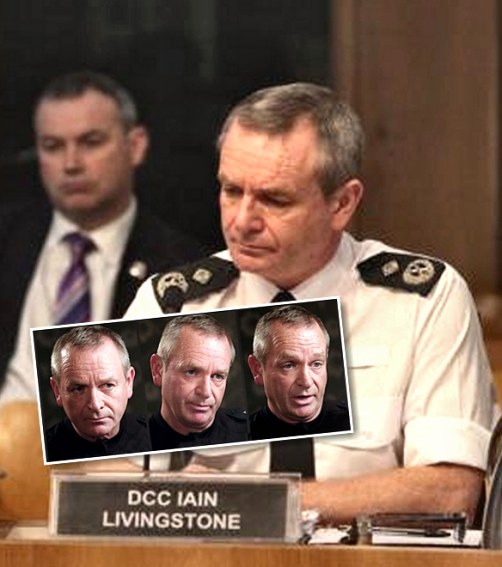
Outgoing Chief Constable Iain Livingstone.FOR FIVE YEARS and despite publicly aired views of former senior Police officers against his appointment - Scotland’s National Police service has been lawyer-led by a Chief Constable - who was once accused, then ‘cleared’ by a Tribunal composed of male Police colleagues - of FIVE allegations of serious sexual assault made against him by a female Police officer.
On 23 February 2023, just days afterNicola Sturgeon announced her resignation as First Minister on 15 February 2023 - Chief Constable Iain Livingstone announced his own resignation and intention to ‘retire’ from leading Police Scotland – with a lengthy departure date of August 2023.
However, in the weeks which followed the Chief Constable’s long goodbye to Scotland’s decimated national Police service - Mr Livingstone took the opportunity to brand Police Scotland as Institutionally discriminatory, institutionally sexist and instructionally racist.
What followed was a very scripted set of headlines involving public inquiries, SNP politicians praising the outgoing Chief Constable, and gangland representing lawyers seeking their own ego boosting headlines in what many came to realise was a carefully orchestrated exercise in press releases and organised spin.
However – Chief Constable Iain Livingstone was certainly not wrong in his accusations against his own Scottish National Police service.
Indeed, across five years of presiding over Police Scotland, the outgoing Chief Constable – who was branded unfit to lead Police Scotland by former Assistant Chief Constable Angela Wilson, and a host of public critics & campaigners – must shoulder some of the blame for a dysfunctional Police Service which – at low points – assisted the Lord Advocate & Crown Office in fitting up prosecutions against persons whose crimes did not exist – most notably the Administrators & Accountants of Rangers Football Club.
However, fitting up prosecutions on a £100 Million scale with the cooperation, orders even – of Scotland’s top law officers, top prosecutors and even with the evidenced involvement of the judiciary itself in the plot to lock up a few accountants for events which were mostly made-up – are but one entry in a long list of greed, avarice & corruption within Scotland’s National Police service and across key stakeholders in Scotland’s justice system – from the Crown Office to the Scottish Government itself.
But lets not kid ourselves everyone. We knew it all along, right?
The Scottish Government and it’s slavishly political, critic & media hostile - intensive Civil Servant-Special Adviser Policing group – were hell bent on control of almost every facet of Policing in Scotland and were grimly determined to ensure Scotland’s National Police Service drifted into the same chasm of control freakery, public relations and spin as the SNP Scottish Government live by each day and eek out their grim control over public life until the next week and the next scandal.
Few surprises there - as control freakery, PR and spin is so typical of the way the Scottish Government and every public organisation and regulator in Scotland operates – when faced with questions and scrutiny of the level of wrongdoing & dishonesty in whichever public authority is under the microscope that particular day.
To back up Iain Livingstone’s scripted admission of institutionally everything-wrong at his own five year grip on power Police Scotland, a series of senior officers were paraded on television to support the Chief Constable’s claims – with absolutely not one sounding believable in any of their responses.
And, to round off the increasingly diversionary campaign of ruining the reputation of Policing in Scotland to take the cameras and attention away from high profile political resignations and investigations into political funding – which appear to be more focussed on what they cannot prove rather than going after actual events and a rather complicated set of – lets call it “Heather Capital” type activities – the Chief Constable’s sexist, discriminatory & institutionally corrupt Police Service scandals were capped off with an arranged slew of new female officer appointments and the appointment of a female Chief Constable to replace Mr Livingstone.
If only it would be advantageous to publish the chat apps content of senior lawyers, civil servants and others on these few weeks of a dodgy Scottish National Police Service, and the dodgiest of dodgy Scottish Governments, ever.
Lets return to some of those issues in the headlines.
Non Disclosure Agreements at Police Scotland under Chief Constable Iain Livingstone – have seen millions of pounds in public cash paid out to victims of wrongdoing, corruption, sexism and misogyny during Livingstone’s five year grip on power at Scotland’s lawyer-led National Police Service – and millions of pounds more of public cash in the five years preceding Livingstone’s appointment as the preferred Scottish Government candidate of Chief Constable in 2018.
For years – cases of wrongdoing in policing – from the time of Scotland’s eight forces to the creation of Police Scotland by the SNP Scottish Government in 2014 – have been looked at by blog journalists.
The numbers are big, the pay-outs to victims even bigger, the wrongdoing, corruption, sexism, misogyny, vendetta witch-hunts of sources to journalists, pursuit of police officers who lodge legitimate grievances on issues relating to their service - and targeting of whistle-blowers has been – and remains to this day – off the scale.
It should not surprise readers that private law firms, solicitors, ‘leading’ members of the Faculty of Advocates & even some members of Scotland’s judiciary – have also collectively gained millions of pounds of public cash over the past decade in burying scandals for Police Scotland and forcing victims to sign Non Disclosure Agreements to prevent anyone talking to the media, public, their families and friends - or even their elected political representatives and the Scottish Parliament.
Readers can view earlier Freedom of Information disclosures obtained by blog journalists here Police Scotland - Non Disclosure Agreements FOI - 2019 which give some idea of the scale of pay-outs and a very limited understanding of the level of institutional wrongdoing at Police Scotland.
More than 20 victims of discrimination and wrongdoing who received financial compensation from Police Scotland were gagged from speaking publicly and the FOI material reveals Non-Disclosure Agreements (NDAs) were used in at least 21 cases in which pay-outs totalling £677,389 were made to police officers, civilian staff and members of the public.
At least ten police constables, an inspector, a sergeant and four civilian workers were found to have signed Non Disclosure Agreements, involving a variety of discrimination disputes on the grounds of sex, sexual orientation, disability and age.
Other Non Disclosure Agreements involving Police Scotland related to wrongful arrest, personal injury and unfair dismissal and a whistle-blower was required to sign an NDA.
In the figures which go up to the year 2019 – Scotland’s National Police service paid an additional £203,380 to cover victims’ legal fees – bringing the total cost to taxpayers to £880,769 over six years.
Initially – and as is routine with all Scottish Public Authorities – Police Scotland refused to identify the law firms which received public cash in relation to Non Disclosure Agreements. The data was only obtained after requests for FOI Reviews were lodged – naming the following law firms in figures: Clyde & Co solicitors £50,782.20, Morton Fraser Solicitors £72,162.56, Thorntons Solicitors £4,910.40.
And in an additional refusal by Police Scotland to identify law firms involved in Non Disclosure Agreements – again for figures up to 2019 – the same law firms were again identified in an FOI review disclosure – Morton Fraser Solicitors £22,208.80, Clyde & Co solicitors £41,460.01
Curiously, in the past year – several media publications published articles identifying outgoing Chief Constable Iain Livingstone as a “Frontrunner” for the positions of Commissioner of the Metropolitan Police Service for London , and “Frontrunner” for the post of Director of the UK National Crime Agency.
As readers will be well aware - both positions were filled by other candidates.
Interestingly and perhaps coincidentally - INTERPOL – the International Police Agency recently announced – apparently after much lobbying – the annual Interpol General Assembly is to be held next year in Glasgow, 2024.
The choice, which would be as odd as a group of environmental campaigners choosing to hold their gathering in the middle of an oil refinery – is coincidentally slated for the same year to which candidates for the 2025 Interpol Presidency will begin lobbying for their chance to follow several well known – and even some later jailed figures – to become the new Interpol President in 2025.
A previous example of Interpol Presidency candidates cite the following:
Interpol is currently holding its general assembly in Dubai, and a UK delegation, led by Lynne Owens, the director general of the National Crime Agency, is there at the moment. Interpol is electing a new president at the general assembly after former Interpol president and Chinese Vice-Minister of Public Security, Meng Hongwei, resigned from the position on Sunday 7 October after Chinese authorities confirmed that he had been detained and is being investigated on anti-corruption charges.
Two candidates have formally declared for the post and remain in the running as candidates. They are current acting president South Korean Kim Jong Yang and Russian vice-president—one of four vice-presidents—Alexander Prokopchuk. Members of Interpol at the general assembly will vote on the next president on Wednesday. We do not speculate on the outcome of the election, but the UK supports the candidacy of acting president Kim Jong Yang.
Can the Minister confirm that the British Government are doing all they can to campaign against the candidacy of Mr Prokopchuk? Will she confirm that, until recently, he was head of the central bureau in Russia and was directly responsible for the issuing of red notices, which have been abused and used against opponents of the Putin regime—such as Mr Bill Browder, the proponent of the Magnitsky sanctions? Does she not agree that if this Russian gentleman were to become head of Interpol, it would be an absolute insult to the victims of the Salisbury incident?
Will the Minister explain how the Government intend to pursue their own pursuit of red notices in Russia with that gentleman in this post? Does she not accept that, if this gentleman were to succeed in his election, this would be a massive propaganda victory for the Putin regime, just ahead of a vote in the European Union on fresh sanctions? Would it, in effect, not amount to accepting that Interpol has become a branch of the Russian mafia? I use my words carefully when I say that. Finally, does this not underline the absolute folly of undermining in any way Europol at a time when Interpol is becoming totally dysfunctional and potentially corrupted?
The right hon. Gentleman raises a number of points. The central point is to clarify for the House the role of the secretary general of Interpol, who, of course, is the German Jürgen Stock. He has the executive role of day-to-day responsibility for the conduct of Interpol, and the UK confirms that it has a very good working relationship with him.
The right hon. Gentleman also raises the question about the candidacy of the current vice-president of the organisation. The UK, as I said in my opening remarks, will be supporting the candidacy of the acting vice-president, Kim Yong Yang. We always seek to endorse candidates who have a history of observing standards of international behaviour.
With regard to the point that the right hon. Gentleman makes about the potential for misuse of Interpol, red notices are a very important point. He will be aware of the systems that are in place to protect individuals’ rights and, indeed, of article 3 of the Interpol constitution, which forbids any organisation to undertake any intervention or activities of a political, military, religious or racial character. Of course, there need to be safeguards, and this Government take any misuse of Interpol notices very, very seriously.
Interestingly, the lobbying – both at National UK level and in Scotland – for a UK/Scotland candidate to ensnare, be ‘elected to’ or assume the Interpol 2025 Presidency - is highly reminiscent of recent attempts to place certain Scots figures in policing positions outside of Scotland – none of which appear to have succeeded given these individuals pasts.
The lobbying between administrations resorted to embittered strings of emails and Chat app platform communications, including claims several detailed reports in newspapers of officers pasts “had been withdrawn and therefore should be discounted in considering applications” and that “a segment in a television interview was misinformed and contained patently false information”.
The exchanges between advisers, media communications officers & administrations on lobbying attempts, currently cannot be published for legal reasons - however the attempts by some within government, at Scotland & UK level to engineer candidates for jobs without serious interviews, and deploy comms officers, even politicians to brief against the media in what became an increasingly bitter recruitment process and ultimately concluded in all parties engaging in infighting – are certainly of public interest in terms of who is appointed to which role in the UK, and why.
And finally – Three sourced tips in relation to stories being looked into.
An audio file submitted to a number of journalists reveals a recently retired policing figure and frequent user of sauna shops - boasted of holding information in relation to politicians and a financial scandal relating to cash and goods - to which the existence of this information was used to gain political lobbying and favours. A crime journalist confirmed the identity of persons in the audio.
An opportunity for that person or others with knowledge of this matter exists to contact journalists and answer questions on why this policing figure’s organisation felt it could play politics and gain favours - in relation to information clearly accumulated as a result of investigations – and why ageing, named former politicians were paid to lobby for, and attack journalists, critics - on behalf of this policing organisation.
Long running enquiries into court cases and complaints investigations revealed the use of Scotland based Private Investigator firms recruiting former Police Officers to utilise in-person surveillance on litigants, solicitors and journalists. Certain of these cases saw persons working for PI firms gaining entry to offices and litigants homes, images of which were recorded on camera equipment. Blog journalists are open to hear explanations from these firms and any employees in relation to their activities.
A long running investigation of digital surveillance employed by organisations in Scotland – which began with the Emma Caldwell case – turned up evidence of a highly organised cyber-hacking ring – which appears to have involvement of former Police Officers from a UK force other than Scotland, England & Wales which continues to snoop on newsrooms and identified journalists, and others including what appear to be opposition politicians.
Emails between lawyers & identified former officers revealed these ex cops regularly offer their services to law firms and any organisation which will hire then. To put it bluntly, these former officers boast of their technical proficiency in defending against cyber-attacks and taking the surveillance and cyber war back to those who whichever entity or organisation perceive as an enemy.
One of the lawyers boasting to clients of how they can deploy ex Police professionals to hack their way through opposing clients and legal representation’s files – sits on committees formed by Scotland’s current top judge – making the link between the judiciary and this surveillance enterprise as clear as was the case in the Emma Caldwell case. If anyone wants to talk, get in touch.
Lastly – Chose your method of giving tips to journalists carefully. Major social media platforms owned by a variety of anti-transparency vested interests - are a no-go area as your Direct Messages and similar are often read before the intended journalists gain sight of it – as a Digital Media employee from a political party recently confirmed in lengthy chats with example communications provided to journos.
So grim was the determination of Prosecutors, Police and the Judiciary itself to see this malicious prosecution through to a result - at one point in November 2017 – the Lord Advocate’s own judge wife – Lady Sarah Wolffe QC – was neatly arranged – by the judiciary – to hear the civil damages claims against her own husband in his role as the Lord Advocate, and similar damages claims against Scotland’s Chief Constable.
Back in February of this year, Scotland’s top law officer – Lord Advocate James Wolffe QC gave a statement at the Scottish Parliament on 9 February 2021 in which Mr Wolffe conceded - the prosecution of Rangers Administrators – by the Crown Office & Police Scotland – was a malicious prosecution.
James Wolffe publicly apologised to the two Administrators who were wrongly prosecuted during a fraud investigation carried out by the Crown Office and Police Scotland, in relation to the sale of Rangers Football Club.
David Whitehouse and Paul Clark acted as administrators during the sale of the football club, settled out of court with the Crown Office in December and were both awarded £10.5 million in damages while legal costs are thought to total more than £3 million – all of which will be paid from public cash.
Lord Advocate James Wolffe publicly apologised for the malicious prosecution, however – Wolffe denied anyone had acted with malice but was accused of “brushing this appalling state of affairs under the carpet” if public confidence isn’t restored through an independent inquiry.
Mr Whitehouse and Mr Clark were arrested in 2014 but the Crown Office has admitted the prosecution that followed was “malicious”.
Mr Wolffe said in his statement to Holyrood that decisions made in the Crown Office probe were “indefensible in law”.
Missing from the statement to MSPs was a key fact in the order of events, in which Lord Advocate James Wolffe had earlier said nothing during court hearings in late 2017 where his judge wife – Lady Sarah Wolffe was scheduled by fellow judges to hear financial claims for damages in this case case against her own husband – Lord Advocate James Wolffe.
The NINE million pound damages claim against Scotland’s top cop and top prosecutor has been lodged by David Whitehouse – a former administrator at Rangers FC – who is seeking financial damages from Police Scotland's Philip Gormley and Lord Advocate James Wolffe QC.
A copy of the Court Rolls handed to the media at the time reveal Lady Sarah Wolffe QC – an outer house senator of the Court of Session – was scheduled to hear the case involving the claim involving the Lord Advocate - her own husband - A295/16 David Whitehouse (represented by Urquharts) v Liam Murphy &c (represented by Ledingham Chambers for SGLD - Scottish Government Legal Directorate) - on November 15 2017.
Liam Murphy was at the time - listed as a Crown Office Procurator Fiscal on “Specialist Casework”.
Claims have since been made Lady Wolffe was suddenly dropped from the hearing when it ‘emerged at the last minute’ her husband – Lord Advocate James Wolffe - was involved in the case.
A report from a source claims a second Court of Session Judge - Lady WiseQC - was then scheduled to hear the case.
However, the silent replacement of Lady Wolffe with Lady Wise - has now raised serious questions as to why there are no references to any note of recusal made by Lady Wolffe – who clearly had a conflict of interest in the case given one of the core participants in the action is her own husband – the Lord Advocate.
The case then took another turn after media reports of the hearing on Wednesday 15 November reveal a third judge – Lord ArthursonQC – eventually heard the case, and has since arranged for a four day hearing for legal arguments.
Questions then arose as to why the Judicial Office avoided publishing any official recusal by Lady Sarah Wolffe QC – the wife of Lord Advocate James Wolffe - in relation to the scheduling of the case to be heard by the Lord Advocate’s.
These events and others, illustrate very well why all members of Scotland’s judiciary should be required to declare and publish their interests in a Register of Judges’ Interests – which is now part of the Scottish Government’s work programme for 2021 –2022.
A Register of Judges’ Interests should contain information on all judges’ backgrounds, figures relating to personal wealth, undeclared earnings, business & family connections inside & outside of the legal profession, membership of organisations, property and land, offshore investments, hospitality, details on recusals and other information routinely lodged in registers of interest across all walks of public life in the UK and around the world.
Readers can watch the full statement in relation to the malicious prosecutions of the Rangers Administrators - from the Lord Advocate James Wolffe to MSPs on 9 February 2021 here:
Malicious Prosecutions of Rangers FC Administrators by the Crown Office, Lord Advocate & Police Scotland – Scottish Parliament 9 February 2021
The Deputy Presiding Officer (Lewis Macdonald)
The next item of business is a statement by the Lord Advocate, on malicious prosecutions. The Lord Advocate will take questions at the end of his statement, so there should be no interventions or interruptions.
The Lord Advocate (James Wolffe) Thank you, Presiding Officer. I am grateful for the opportunity—[Inaudible.] I am sorry about that sound issue, Presiding Officer.
I am grateful for the opportunity to make a statement following the disposal last week of the actions that David Whitehouse and Paul Clark brought against me. Those actions concerned events that predated my appointment as Lord Advocate, but it was and is my responsibility, as the current incumbent, to account for them. The on-going proceedings that relate to the matter constrain what I can say today, but I welcome the fact that I am now free to begin the process of public and parliamentary accountability and to reiterate the commitment that the Crown has given to that process.
The prosecutions that gave rise to the cases arose from police investigations into the purchase of Rangers Football Club by Craig Whyte in 2011 and into the administration of the club and its sale to Charles Green in 2012. The investigations were large and complex. Ultimately, seven individuals were prosecuted. This statement concerns only the position of Mr Clark and Mr Whitehouse.
On 14 November 2014, Mr Clark and Mr Whitehouse were detained and brought to Glasgow. They were held in custody before appearing in court on 17 November on a petition that contained charges that related to Mr Whyte’s purchase of Rangers. That started the clock for a statutory time bar that, unless extended, required the Crown to serve an indictment in respect of the charges by 16 September 2015.
In High Court cases, after an accused has appeared on petition, the Crown undertakes a process of investigation and analysis that is called precognition. When it is completed, the precognition contains a detailed narrative of the evidence and an analysis of whether the evidence is sufficient to support criminal charges.
The precognition is submitted to Crown counsel for a decision on whether to issue an indictment. Precognition is not a statutory requirement, but it is a long-standing, routine and essential feature of Crown practice in relation to High Court cases. It provides assurance that there is a proper evidential basis for the indictment and, along with Crown counsel’s instruction, it provides a record of the basis for the decision.
This case was exceptional in its scale and complexity. By early September 2015, with the expiry of the time bar approaching, the precognition process was incomplete and essential investigations were still on-going. On 3 September, the Crown applied to the court for a nine-month extension of the time bar; the sheriff granted a three-month extension. An appeal by Mr Clark and Mr Whitehouse against that extension was refused. In the meantime, on 2 and 3 September, Mr Clark and Mr Whitehouse appeared in court again on a second petition that contained new and separate charges that related to the second matter that the police had been investigating—the administration of Rangers and its sale to Charles Green in 2012.
On 16 September 2015, Mr Clark and Mr Whitehouse, with five other accused, were indicted. The charges against them derived from the November 2014 and September 2015 petitions. At that time, the precognition process in relation to the November 2014 petition was still incomplete and there was, demonstrably, no precognition in relation to the September 2015 petition, which had only just been initiated. Essential investigations were still on-going in respect of the charges that derived from the November 2014 petition, and there was evidence available that was—objectively—obviously inconsistent with the charges against these two accused that derived from the September 2015 petition.
On 2 December 2015, a second indictment was served that superseded the first. At a preliminary hearing in February 2016, following legal argument, Crown counsel withdrew certain of the charges. On 22 February, the judge dismissed the remaining charges against Mr Clark and Mr Whitehouse. Crown counsel advised the court that consideration would be given to a further indictment against them. A Crown Office press statement that was issued that day indicated that a fresh indictment would be brought, but that was corrected by a further statement the following day.
On 25 May 2016, the Crown advised Mr Clark and Mr Whitehouse that there would be no further proceedings against them. On 3 June 2016, Crown counsel formally advised the court of that position.
In August 2016, Mr Clark and Mr Whitehouse initiated civil actions against me—I had been appointed on 2 June 2016—to seek damages on the grounds of malicious prosecution and breaches of articles 5 and 8 of the European convention on human rights. They also advanced claims against the chief constable of Police Scotland.
I advanced a defence that relied on established legal authority that the Lord Advocate is immune from common-law liability. That defence was upheld at first instance, but, in October 2019, the inner house of the Court of Session overturned the previous legal authority and allowed the claims to proceed.
On 20 August 2020, I admitted liability to Mr Clark and Mr Whitehouse. Those admissions followed the conclusion of a very substantial and lengthy investigation that was undertaken by the legal team, including external counsel, instructed on my behalf. As a result of that investigation, I concluded that the decisions to place Mr Clark and Mr Whitehouse on petition in September 2015 and to indict them were indefensible in law.
I concluded that those decisions proceeded without probable cause—that is, without a proper evidential basis—in circumstances that met the legal test for malicious prosecution. That legal test can, in certain circumstances, be met even though no individual had malice, in the popular sense of a spiteful motive. My acceptance of liability in this case did not depend on any individual being malicious in that popular sense.
I cannot, at this time, disclose in detail the basis upon which liability was admitted, but, when it is free to do so, the Crown will disclose the basis for those admissions in full—including to this Parliament. What I can say is that there were, in this case, profound departures from the normal practices, including precognition, that are designed to ensure—and routinely do ensure—that any prosecution in the High Court has a proper basis.
I also admitted breaches of article 5 in respect of the detention of Mr Clark and Mr Whitehouse in November 2014 and September 2015, and of article 8 in respect of the incorrect press release of February 2016.
After the admissions of liability, mediations took place with both pursuers, and agreement was reached to settle their claims. Each of them has been paid £10.5 million in damages, and, to date, more than £3 million has been paid to them in aggregate by way of expenses. Those two pursuers were very high-earning professional people and the damages paid reflect a reasonable estimate of the loss that they sustained as a result of being prosecuted. I have written to the Justice Committee about the financial implications.
On 24 December 2020, I issued written apologies to each of Mr Clark and Mr Whitehouse. They should not have been prosecuted, and, as the current Lord Advocate and head of the system of criminal prosecution, I apologised unreservedly for the fact that they had been. I reiterate that unreserved apology publicly to Mr Clark and Mr Whitehouse today.
Although the case involved significant departures from standard practice, lessons have been learned and will continue to be learned. The precognition process has been reinforced, and, in 2018, I established new arrangements for the management and oversight of large and complex cases. Those arrangements are now well established and provide a substantial safeguard against anything like this happening again.
In my JUSTICE human rights day lecture in December 2016, I said this:
“a fair and independent prosecution service, taking decisions rigorously, independently and robustly in accordance with the evidence, is, I believe, essential to the freedom under the law which we enjoy as citizens of this country.”
Scottish prosecutors and the Crown Office and Procurator Fiscal Service have a justified reputation for fairness, integrity and independence. The seriousness of what happened in this case should not obscure the truth that, day in and day out, Scotland’s public prosecutors and the staff who support them fulfil their responsibilities with professionalism and skill. They take hard decisions rigorously, robustly and in accordance with the evidence, and they secure the public interest in the fair, effective and robust administration of criminal justice in Scotland.
In this case, there was a serious failure in the system of prosecution. It did not live up to the standards that I expect, that the public and this Parliament are entitled to expect and that the Crown Office and Procurator Fiscal Service expects of itself.
What happened in this case should not have happened. As the Lord Advocate and head of the system of prosecution in Scotland, I tender my apology to this Parliament and to the public for the fact that it did happen and for the consequent cost to the public purse. I confirm my commitment and that of the Crown to supporting a process of inquiry into what happened in this case once related matters have concluded, and I express my determination that nothing like it should ever happen again.
The Deputy Presiding Officer The Lord Advocate will now take questions on the issues that were raised in his statement. I intend to allow about 20 minutes for questions, after which we will move on to the next item of business.
Liam Kerr (North East Scotland) (Con) I remind members that I am a practising solicitor, and I thank the Lord Advocate for advance sight of his statement.
There has been an extraordinary catalogue of unexplained and profound departures from normal practices. What is “indefensible”, to use the Lord Advocate’s word, is that, given that the
“decisions proceeded without probable cause—that is, without a proper evidential basis”,
the prosecution was malicious.
Let us be absolutely clear: this was not simple human error or an obscure legal mistake. Rather, our system of prosecution has admitted that it acted with malice in its move to throw innocent men behind bars and destroy their reputations. That begs an obvious question: how many times in Scottish legal history has there been a malicious prosecution?
In any event, I note that the Crown is, crucially, committed to a process of inquiry. Can the Lord Advocate confirm that there will be a fully independent, judge-led public inquiry that demands to know why malicious prosecutions were pursued in defiance of evidence? Will it investigate the actions of the Lord Advocate, his predecessor and all agents who were involved? If not, how on earth can the Crown expect the people of Scotland to conclude anything other than that it is brushing this appalling state of affairs under the carpet?
The Lord Advocate (James Wolffe) Given that I have come to Parliament at the first opportunity when I have been free to do so, I hope that nobody would suggest that I could properly be accused of “brushing” anything “under the carpet”. I have committed myself and the Crown to supporting a process of inquiry once related matters have been concluded. Those matters need to be resolved before the process of inquiry can proceed.
On Mr Kerr’s first point, as I observed in my statement, the legal test for malicious prosecution can be met in circumstances even when no individual has malice in the popular sense of their having a spiteful motive. I should make it clear that my acceptance of liability in this case did not depend on any individual being malicious in the popular sense. That is not for a moment to minimise the seriousness of what happened. Quite the reverse is the case; as I observed in my statement, what happened represents a very serious failure in the system of prosecution in Scotland.
I have been asked how many times there has been a malicious prosecution in Scotland. As I emphasised in my statement, a process that is known as precognition is undertaken routinely in High Court cases. That process necessarily involves careful collection, investigation and analysis of evidence. It involves a system of cross-checking and should provide significant reassurance to the public that, in our system of prosecution, cases are routinely brought on a proper basis.
As I explained in my statement, in this case, that process was incomplete when the case was indicted; essential investigations had not been completed. The normal processes that are routinely followed in every High Court case were not followed, but the public should take reassurance from what I have said that the prosecution system in Scotland is robust, fair and independent, and is one on which they can rely.
Rhoda Grant (Highlands and Islands) (Lab) I, too, thank the Lord Advocate for advance sight of his statement.
This case raises serious concerns. That it was thought that the Lord Advocate was immune from common-law liability would suggest that he should also have been beyond reproach. We imagine that there are, in the system, checks and balances between the police and the Crown Office and Procurator Fiscal Service, with both of them challenging and questioning the activities and evidence in a case. That appears either not to have happened or to have gone seriously wrong in this case, with both being sued by David Whitehouse and Paul Clark.
How could that have happened? Were concerns raised, internally or externally, about the actions of both organisations at the time, especially when it came to light that there was inconsistent evidence?
The Lord Advocate said that the system has been improved, but there cannot be proper scrutiny until we know exactly what went wrong in the first place. Until that happens, how can we expect to restore confidence in the system?
The Lord Advocate (James Wolffe) The first thing that I should say is that, at this time, there are continuing live proceedings relating to the matter, which regrettably—I do regret it—constrains what I can say.
I have committed the Crown to engaging fully with public accountability in the matter, and the Crown has committed to making more information available when it is free to do that. That includes the basis upon which liability was admitted in this case and supporting the process of inquiry when it is possible to do that. I hope that that gives some assurance to Rhoda Grant that lessons will be learned and that there will be public understanding of what happened.
Perhaps it is worth noting—I do not say this to minimise, in any sense, what happened in this case—that the court fulfilled its functions in dealing with certain charges and the Crown fulfilled its responsibilities in withdrawing charges and ultimately confirming that no prosecution would proceed. I do not say that to minimise the significance of a prosecution having been brought without proper basis. However, on those issues the checks and balances in the system fulfilled their functions.
As I explained, there is, in the Crown Office, routinely preparation of High Court cases, which involves cross-checking of cases by staff of the Crown Office and Procurator Fiscal Service initially, and ultimately by Crown counsel, on the basis of there being a full narrative of the evidence and analysis of that evidence. Those processes are designed to ensure that we can be confident—I am confident—that, across the system in Scotland, prosecutions are brought properly and that this case was wholly exceptional.
Rona Mackay (Strathkelvin and Bearsden) (SNP) Can the Lord Advocate reiterate what lessons have been learned and what improvements are being made to ensure that this will never happen again?
The Lord Advocate (James Wolffe) The key lesson relates to the management of large and complex cases. As I said in my statement, I have instituted new procedures for internal management and oversight of the particular category of case. The arrangements involve early agreement of the investigation and prosecution strategy; early and continuous engagement with the police; a project management approach to case preparation; a system of case management panels to scrutinise case strategy and to keep under review the progress of the case, with reference to the strategy; and any issues that might emerge being addressed.
All of that aligns with a protocol that the High Court issued in 2018, with my support, in relation to the management of such cases once they are in court. That protocol, again, encourages a proactive approach to the management of such cases.
Murdo Fraser (Mid Scotland and Fife) (Con) The Lord Advocate referred to the payment of £24 million that was made to Whitehouse and Clark, but that sum might well be just the tip of the iceberg, because the report suggests that the total cost of the case could top £100 million, given that there are outstanding cases.
Will the Lord Advocate tell us whether it is correct that, in addition to those payments, Whitehouse and Clark were also given tax indemnities so that, should HM Revenue and Customs pursue them for payment of tax, that demand would be met by the Scottish Crown Office, and that the cost to the Scottish taxpayer will therefore be far higher than the £24 million that has been paid out already?
The Lord Advocate (James Wolffe) I acknowledge the significance of the sum involved. Murdo Fraser is correct in observing that, with other cases pending, the cost to the public purse will increase and the ultimate cost is yet to be seen.
The approach that has been taken in settling cases was to make a reasonable estimate of the actual loss that individuals could demonstrate. An arrangement was entered into such that if—it is “if”—they can properly show that they have sustained additional loss of the type that Mr Fraser described, that loss will be borne.
If that happens, the Crown will account to the Justice Committee, as it did last week, for the costs in the cases.
John Mason (Glasgow Shettleston) (SNP) Now that it has been established that the Lord Advocate does not have absolute immunity from civil liability, will the Crown be more cautious in pursuing prosecutions, and will that mean that criminals are less likely to be convicted?
The Lord Advocate (James Wolffe) I am determined that any change in the law regarding the immunity of the Lord Advocate should not have that effect. That is one reason why I have put in place measures to strengthen the management of large and complex cases.
It is essential that there is a proper basis for prosecutorial decisions in all cases. As I explained in my statement, the process of precognition that is routinely undertaken in all High Court cases provides confidence and assurance both to prosecutors and to the public.
I have confidence in the robustness of Scotland’s prosecutors. They make difficult decisions every day, in exercising their judgment. I am determined to have in place systems that enable prosecutors to continue to take robust decisions in effective prosecution of crime.
James Kelly (Glasgow) (Lab) The decisions that were made in this case might predate the current Lord Advocate, but they raise serious questions about decision making and accountability within the Crown Office. Serious errors were made. The system failed, and we have been told that the cost to the public purse will be at least £24 million. What other area of the Scottish budget has had to be to be raided to fund the incompetence of the Crown Office and Procurator Fiscal Service?
The Lord Advocate (James Wolffe) As the Cabinet Secretary for Finance told Parliament last week, arrangements have been made so that the cases will not affect the Crown Office’s resource budget or its operational effectiveness. The member’s question would be better directed to the finance secretary.
Liam McArthur (Orkney Islands) (LD) This is a true scandal. In monetary terms, it is on a scale with BiFab and the Ferguson Marine shipyard. The colossal waste of taxpayers’ money runs to tens of millions of pounds. That money could have been spent on supporting businesses during the pandemic, on educational catch-up or on investment in mental health. There might be worse news to come, given that we do not yet know the extent of Police Scotland’s exposure or of the additional cases to which the Lord Advocate referred.
Given that the overturning of the Hester v MacDonald decision means that the Lord Advocate can now be held liable for serious errors from the past, what assurance can he offer that there are no other skeletons lurking in the Crown Office closet?
The Lord Advocate (James Wolffe) The principal assurance that I can give is the description that I have already given of the routine precognition processes that are carried out in every High Court case.
It is fair to say that this case was wholly exceptional in all sorts of ways—that is the principal answer to Liam McArthur’s question. We have a system of prosecution that has demonstrated robustness, fairness, effectiveness and integrity. This case was a serious falling below the standards that all of us expect of that system, but the very fact that those expectations are so high and that this case has occasioned the justified reaction that it has is a reflection of the high standards that our prosecutors routinely meet, day in and day out, in courts across the country.
John Finnie (Highlands and Islands) (Green) I, too, thank the Lord Advocate for early sight of his statement. This was a serious failure of the system of prosecution, and public confidence in our justice system is vital. Can the Lord Advocate outline what further steps will be taken to reassure a public that might reasonably think, “Wow! If this can happen in such a high-profile case, with all that publicity, what chance do I have against the system?”
The Lord Advocate (James Wolffe) The first reason why the public should have reassurance is the point that I made a moment ago to Liam McArthur, that routinely—day in and day out—our prosecution system operates effectively, robustly and fairly, and it is understood and seen by the public to do so. Prosecutors take decisions that, if taken to court, are tested in the independent court and by the examination and cross-examination skill of those who represent accused persons. So, not only are there protections and reassurances to be taken from the well-justified recognition of the integrity and skill of our public prosecutors, but the public can also have confidence because of the reputation, integrity and skill of the defence bar in testing prosecutions that are brought—and, ultimately, because of our court system, in which any case that is brought to court is tried fairly and independently.
James Dornan (Glasgow Cathcart) (SNP) Having previously been a precognition officer, I am surprised to see that the lack of precognition appears to have been a major failing in this case. Further to your statement, Lord Advocate, can you give some detail to help provide reassurance that the Crown is, indeed, equipped to deal with complex financial crime going forward?
The Lord Advocate (James Wolffe) Yes, indeed. The Crown successfully prosecutes thousands of cases every year, including complex financial crime cases. For example, an accused was prosecuted last year in respect of a £12 million Ponzi scheme fraud involving 140 complainers and laundering the proceeds of the crime. He was convicted and imprisoned for 14 years. Serious financial crime cases are dealt with in accordance with the arrangements that I have described for large and complex cases. Those new arrangements, which were put in place in 2018, should give reassurance that such cases will be effectively and properly investigated and prosecuted. In the course of this Parliament, the budget allocation to the Crown Office and Procurator Fiscal service has increased by some 42 per cent. Although that was to deal with a range of pressures on the system, part of that additional budgetary resource has gone to ensure that the new system for the management of large and complex cases can be operated as it is intended to be.
Adam Tomkins (Glasgow) (Con) What happened was completely indefensible, Lord Advocate. I therefore have a simple question, to which I want an answer: was it incompetence or was it corruption?
The Lord Advocate (James Wolffe) I have said what I can say about the circumstances. There were significant departures from the normal practices that routinely provide safeguards against what happened in this case. I have made it clear that the admission of liability in this case was not predicated on any individual having subjective malice.
I should also say that the investigation that was carried out into the prosecutorial work on the case did not report any criminal conduct to me. Had it done so, I would have taken action. However, should criminal allegations come forward, that does not preclude their being considered and, if appropriate, investigated. I am putting in place arrangements, including the instruction of external senior counsel, so that such a process can happen if that is required.
Alex Neil (Airdrie and Shotts) (SNP) Do the former Lord Advocate, Frank Mulholland, Police Scotland and the team of prosecutors who worked on the case agree with the current Lord Advocate’s decision to pay out millions of pounds of public money on the basis that the prosecution was malicious? Is the Lord Advocate’s decision making in this case up to scratch and robust?
The Lord Advocate (James Wolffe) I have had to take the decision on the civil action that was brought against me. I took that decision following the conclusion of a substantial, lengthy and carefully considered investigation that was undertaken by the legal team, including a team of external counsel instructed on my behalf. That decision fell to me to take, and it is one for which I stand here and account to the Parliament.
Bill Kidd (Glasgow Anniesland) (SNP) Can the Lord Advocate provide reassurance to victims and witnesses that arrangements have been made so that the settlements that are made will not affect the service that the Crown Office provides?
The Lord Advocate (James Wolffe) Yes. A moment ago, I reminded members that the Cabinet Secretary for Finance told Parliament last week that arrangements had been made so that the meeting of the settlements would not have an impact on the resource budget of the Crown Office. Indeed, the budget allocation to the Crown Office this year is significantly larger than it was last year. As ever, that, in part, reflects the commitment of the service to supporting victims and witnesses.
Neil Findlay (Lothian) (Lab) The Lord Advocate admits to a malicious prosecution but says that no one showed malice. That takes political doublespeak to a whole new level. Can the Lord Advocate answer these clear questions? Who is responsible for this expensive fiasco? Who is accountable? Where is the money coming from to pay for it? Those are clear questions. Can I have clear answers, please?
The Lord Advocate (James Wolffe) Yes. I proceeded in addressing the case on the basis of the relevant legal tests. As I explained in my statement, the legal test for malicious prosecution—I appreciate that the wrong has that description—can, in certain circumstances, be met even though no individual had malice in the popular sense of the word. That is the basis on which I accepted liability in this case.
In terms of our responsibility, ultimately, in our constitutional arrangements, it is for the Lord Advocate, as head of the systems of criminal prosecution and the investigation of deaths, to answer for the conduct of criminal prosecutions, whether in court—as I do every day in relation to the prosecutions that are brought in my name—or here, in Parliament, as I am doing today. As the current Lord Advocate, it is my constitutional responsibility to answer to the Parliament for what happened at that time.
I have said what I can say today about the circumstances, given other pending processes. When it is free to do so, the Crown Office will disclose further information.
Gillian Martin (Aberdeenshire East) (SNP) The Lord Advocate has already given quite a lot of detail, but I ask him to outline what additional steps he will take to support public accountability for and understanding of such cases.
The Lord Advocate (James Wolffe) As I have said, as and when the Crown is free to do so, it will disclose further information about what happened in this case. In particular, it will disclose the basis for the admission of liability. I and the Crown will support a process of inquiry once all related matters have been dealt with.
The Deputy Presiding Officer We have a very brief final question from Graham Simpson.
Graham Simpson (Central Scotland) (Con) Will there be a fully independent, judge-led public inquiry?
The Lord Advocate (James Wolffe) We will debate a motion in the name of Murdo Fraser on that subject tomorrow. In my statement, I have made it very clear that I and the Crown will support a process of inquiry when all other related matters have been concluded. The ultimate form of such an inquiry will be a matter for determination at the appropriate time.
Events have since moved on from the now former Lord Advocate’s statement to the Scottish Parliament in February 2021.
Later in March it was confirmed both the Lord Advocate – James Wolffe – and his deputy – Solicitor General Alison Di Rollo (maiden name Lafferty) were to resign from their respective roles at the Crown Office – due to events conceded in relation to the malicious prosecution of the Rangers Administrators.
After James Wolffe and Alison Di Rollo resigned their office, a ‘short’ recruitment process took place, which saw former Advocate Depute Dorothy Bain QC appointed as Lord Advocate to replace James Wolffe, and Ruth Charteris QC replacing Alison Di Rollo as Solicitor General.
However, material passed to journalists revealed Bain was not the first choice to replace James Wolffe.
As the recruitment round took place, a list of several well known legal figures who turned down offers of accepting the Lord Advocate role was passed to journalists.
One legal figure involved in the process - who does not wish to be identified – said he felt the Lord Advocate role was poisoned by the Rangers debacle.
The legal figure added “The Crown Office is badly damaged as an institution”.
After Dorothy Bain’s appointment to the Lord Advocate role, issues of Ms Bain’s involvement in the Rangers case were reported by the media - resulting in claims Ms Bain held a conflict of interest in any involvement in further proceedings relating to the malicious prosecution of the Rangers Admins.
The new conflict of interest which emerged - was that Dorothy Bain had previously acted for a firm of solicitors who represented the Rangers Administrators company - Duff and Phelps.
As a result of increased media scrutiny of the new Lord Advocate’s conflicts of interest in the Rangers case – Dorothy Bain has since recused herself from further involvement in related matters – with the new Solicitor General, Ruth Charteris QC, assigned to issue instructions to the ‘independent’ legal team and senior counsel advising on the remaining Rangers claims cases.
Noting James Wolffe made no mention of matters which arose in court in relation to the judiciary’s scheduling of Lady Wolffe to hear and rule on the financial claims against her husband – Lord Advocate James Wolffe, and damages claims lodged against the Chief Constable of Police Scotland - a report on Lady Sarah Wolffe’s role in the sequence of events and her initial appointment to decide on the claim against her own husband, featured in a Sunday Mail newspaper investigation, here:
Lady Sarah Wolffe was originally scheduled to oversee a hearing in David Whitehouse's £9m lawsuit against Lord Advocate James Wolffe.
By Craig McDonald 24 DEC 2017
A former Rangers administrator’s £9million lawsuit against Lord Advocate James Wolffe was given an emergency judge swap – after it emerged the case was originally handed to his wife.
David Whitehouse, 51, is suing Wolffe, Police Scotland chief Phil Gormley and prosecutor Liam Murphy amid claims he was “unlawfully detained” during an investigation into Craig Whyte’s doomed 2011 club takeover.
Court officials had to draft in a replacement judge when they realised Wolffe’s wife Lady Sarah Wolffe was scheduled to sit on the bench for a procedural hearing at the Court of Session in Edinburgh last month.
The late switch from Lady Wolffe was ordered after the conflict was discovered.
Lady Morag Wise was asked to take her place, although the hearing eventually went ahead in front of Lord Paul Arthurson.
Yet another judge, Lord Neil Brailsford, was on the bench when the case was called again earlier this month. It is scheduled to go ahead next year.
The removal of Lady Wolffe is not noted in the official list of judicial recusals – where a judge declines jurisdiction – as it was reallocated before it was called in court.
A Scottish courts spokesman said: “Lady Wolffe was assigned to hear procedural matters in a number of cases on November 15.
“One of those cases was listed on the court rolls as David Whitehouse v Liam Murphy and others.
“Subsequently, when the papers were checked by the Keeper’s office, it became apparent the Lord Advocate was the third defender and, accordingly, the case was reallocated to a different judge.
“The case was initially reallocated to Lady Wise but, having regard to the level of business and in order to avoid unnecessary delay to the parties, was ultimately dealt with by Lord Arthurson.”
Whitehouse and colleague Paul Clark were arrested during the Rangers probe but charges against the pair were later dropped.
They worked for Duff & Phelps, who were appointed as administrators of the club in February 2012. The business and assets of The Rangers Football Club plc, who entered liquidation later that year, were sold to a consortium led by Charles Green for £5.5million.
Police launched an investigation into the circumstances surrounding the takeover. Whyte was cleared of fraud by a jury at the High Court in Glasgow in June.
Lawyers acting for Whitehouse claimed their client was “unlawfully detained” by detectives in November 2014. They also said that, throughout the period of detention, there were no reasonable grounds to suspect he had broken the law.
Whitehouse claims police and prosecutors didn’t follow correct legal procedure and his arrest damaged his reputation and caused him significant loss of income.
The defenders in the action, including the chief constable and Lord Advocate, claim correct legal procedure was followed and want his case to be dismissed.
Previous articles on the lack of transparency within Scotland’s judiciary, investigations by Diary of Injustice including reports from the media, and video footage of debates at the Scottish Parliament’s Public Petitions Committee can be found here :A Register of Interests for Scotland's Judiciary
Documents uncovered from Court of Session case files reveal the Faculty of Advocates and Scottish Legal Complaints Commission failed to act on evidence where a Scottish Advocate now working as a Barrister in London -Craig Murray of 12 Kings Bench Walk - submitted two versions of written evidence in connection with an investigation of a senior QC - John Campbell QC.
John Campbell – a well known figure in Scottish legal circles - was found to have demanded cash payments direct from clients for legal work at the Court of Session in Edinburgh.
However, while Campbell was receiving cash from his clients – a move strictly forbidden by the Faculty of Advocates – court files also revealed Campbell removed – without instruction - over £4million and a costs claim from the same Court of Session case where he had also sought cash payments from his clients.
Now - a fresh consideration of the same court files which identify Craig Murray as junior counsel to Campbell in the same Court of Session damages claim – show Craig Murray was also paid for his own work from the same irregular cash payments Campbell demanded from his clients.
Material previously obtained by the media established Advocate Craig Murray as the author of two versions of the same letter to the Scottish Legal Complaints Commission (SLCC) in connection with their investigation of serious allegations against John Campbell QC.
And, while Mr Murray communicated to his clients by email he was writing a letter of evidence in connection with their complaints against Campbell – it transpired Murray’s second version of the same letter was used by the Faculty of Advocates to dodge taking any action against John Campbell.
Critically - Records from the Faculty of Advocates reveal Gordon Jackson QC was Vice Dean of the Faculty of Advocates - and Scotland’s current top prosecutor – Lord Advocate James Wolffe QC was the Dean of the Faculty of Advocates - during the time of the Faculty of Advocates investigation of John Campbell.
Gordon Jackson & James Wolffe’s terms of office at the Faculty of Advocates also match up with Craig Murray’s two versions of the same letter to legal regulators in connection with the probe against John Campbell.
The media investigation prompted by papers obtained from legal regulators focused on Craig Murray’s role as Junior Counsel in Nolan v Advance Construction Ltd, and the conduct of legal figures in the case – spanning eight Court of Session judges - one a member of the privy Council, several Sheriffs, high profile QCs and Levy & Mcrae – the law firm identified in the £400million collapse of a Gibraltar based hedge fund - Heather Capital.
Enquiries by the media established the version of Murray’s letter to the Scottish Legal Complaints Commission, on the subject of John Campbell’s role in Nolan v Advance Construction Ltd – was sent to the Faculty of Advocates via the law firm Clyde & Co (formerly, Simpson & Marwick) – who are known to represent members of the legal profession who are subject to complaints, allegations of dishonesty, corruption and negligence claims.
The complaint against John Campbell QC arose from his provision of legal services and representation to former National Hunt jockey & trainer Donal Nolan, who was the pursuer in - Nolan v Advance Construction Ltd – a case which exposed serious conflicts of interest in Scotland’s judiciary where Lord Malcolm (Colin Campbell QC) failed on multiple occasions to disclose the fact his own son was representing the defenders in the same court.
Upon scrutiny of the two letters sent by Craig Murray to legal regulators – serious questions arose regarding the extensive differences between Murray’s two versions of the same letter to the Scottish Legal Complaints Commission and the version which was eventually sent to the Faculty of Advocates.
It is important to note both versions of the same letter used by the Scottish Legal Complaints Commission, and the Faculty of Advocates - identify Craig Murray as the author.
Significantly, certain references to allegations of bribery involving employees of a construction company and elected councillors, have been altered in a second version of Mr Murray’s letter - which bears no date.
Advocate Craig Murray’s letter to SLCC (Text marked in pink shows extent of deletions in Faculty’s version). In a letter dated 22 July 2014 to the SLCC, Craig Murray writes: “The most accurate account of Councillor Taggart’s position will be in that statement. My recollection of Ms Moore’s summary is that a person, whose identity was unknown to Mr Taggart, telephoned him about this case and offered a bribe. There was nothing to identify that person or connect that person to the defenders.”
However, the second version of the letter, has the references to bribery removed from the end of the sentence.
The undated letter still bearing Craig Murray’s name and Advocates address, then reads: “The most accurate account of Councillor Taggart's position will be in that statement. My recollection of Ms Moore's summary is that a person, whose identity was unknown to Mr Taggart, telephoned him about this case. There was nothing to connect that person to the defenders.”
Then, both versions of the letter from Craig Murray to the SLCC continue: “An allegation that the defenders had been involved in bribing an elected public official to commit perjury in court would have been extremely serious. There was no basis upon which an allegation of that sort could have been made by a responsible solicitor or advocate. There could also be no further investigation (particularly in the midst of the proof diet) as it was not known who made the telephone call.”
Councillor John Taggart - who is referred to by Murray, was interviewed late last week.
Councillor Taggart’s role in discovering the dumping of contaminated waste by Advance Construction Ltd, and his further efforts to assist Mr Nolan, and constituents affected by events, was crucial in bringing the case to court and into the public eye.
In discussions with a journalist, Councillor Taggart made clear in his own view, the evidence in relation to the offer of an inducement related to an event occurred at the opening of Calderbridge Primary School (former site of Coltness Primary School), and NOT in a telephone conversation as Mr Murray claimed in his letter to the SLCC.
Further, Councillor Taggart indicated the “person, whose identity was unknown to Mr Taggart” – according to Craig Murray’s statement, had in fact handed his business card to the Councillor during the school opening event.
The Councillor further alluded to the identity of the person as an employee of a main contractor for North Lanarkshire Council.
It has since been established both Advocate Craig Murray, and Fiona Moore of Drummond Miller were present with the Councillor when his precognition of evidence was taken.
Further enquiries by journalists have now revealed the person who allegedly offered the inducement is an employee of a major construction contractor on North Lanarkshire Council’s list of approved contractors.
When it became known the incident involving the inducement was to be used in evidence, the person who approached the councillor left Scotland for Ireland and did not return for a number of months – despite being cited as a witness to attend court to give evidence in the Nolan v Advance Construction Ltd case.
The record later shows – John Campbell QC - failed to call the witness even though the individual alleged to have offered the inducement to the councillor appears on the final witness list for the proof hearing before Lord Woolman in 2014..
If the evidence of bribery had emerged during lines of questioning at the Court of Session, the testimony may well have had a significant impact on the case, and most probably initiated a Police Scotland investigation into the companies involved, and North Lanarkshire Council.
However, Senior Counsel for Mr Nolan - John Campbell QC - chose not to introduce the conversation about the allegations of bribery in court.
Undated, altered version of Advocate Craig Murray’s letter to SLCC. The removal of references to a bribe, and swathes of material removed from the second, ‘undated’ version of Craig Murray’s letter to the SLCC - raises further questions over the written testimony offered by the Advocate & some time Prosecutor to the Scottish Legal Complaints Commission.
Curiously, the undated version of Murray’s letter then surfaces at the Faculty of Advocates – who chose to rely on this heavily altered version of Murray’s original letter - in relation to an investigation which ultimately dismissed the complaint against John Campbell QC.
In a letter dated 7 October 2015 from the Faculty of Advocates to Melanie Collins, Iain WF Fergusson QC confirmed the Faculty of Advocates preferred the lesser content of the undated letter to be used in the complaint against the QC.
Fergusson wrote: ”The earlier of your two e-mails refers to two versions of a letter by Mr Craig Murray, Advocate to the SLCC. The committee relied on the undated version of the letter as support for Mr John Campbell QC's version of events. This has brought to light an administrative error - the version of the letter dated 22 July 2015 was not before the committee when it considered and determined your complaint”
In a letter of 2 May 2016 to the Scottish Legal Complaints Commission, law firm Clyde & Co - acting as legal agent for John Campbell QC against the complaint attempted to explain the discrepancy between the two versions of Craig Murray’s letter and how the undated version ended up at the Faculty of Advocates.
Anne Kentish, of Clyde & Co wrote: “We have reviewed our files and have ascertained the sequence of events surrounding the letter. When the complaint was originally made against Mr Campbell, we were provided with a copy of the undated version of the letter from Craig Murray to the SLCC. It was provided to us on the basis that it set out the background to the complaint and Mr Murray’s recollection of events.. We did not, at that time appreciate that the letter was in draft. It resembled a file copy letter.”
“When senior counsel for Mr Campbell, Alistair Duncan QC prepared the response to the complaint on behalf of Mr Campbell, he indicated that Mr Murray’s letter to the SLCC should be included in the appendix to the response. When we prepared the appendix, we used the version of the letter that we had within our files which was the undated version. We did not at that time appreciate that the final, dated version, existed.”
“Later that day, Mr Duncan forwarded to us some emails which happened to have the dated version of the letter attached. We understand that Mr Duncan had been provided with the final version of the letter by Mr Murray. Neither we nor Mr Duncan realised that we were working from slightly different versions of the same letter (one being a draft and one being a final version)”
“As soon as we realised a final dated version of the letter existed (the day after the response was submitted to the Faculty) we provided Faculty with the final dated version of the letter and asked it to replace the undated version.”
“Mr Murray has confirmed that the undated version is a draft version of the final version dated 22 July 2014.”
However, the lengthy and laboured explanation from Clyde & Co to the Scottish Legal Complaints Commission, and the email from Iain Fergusson QC are completely at odds with a written explanation provided by Advocate Craig Murray to Mr Nolan’s partner, Ms Collins.
Seeking to explain the situation regarding his letter, an email dated 23 June 2015 from Craig Murray to Mr Nolan’s partner, Melanie Collins, stated the following: “I finished writing this letter on 22 July 2014. I signed it and sent it to the SLCC that day. Copies were also sent to you and to John Campbell QC. I did not submit one to the Faculty of Advocates, nor did any Office-bearer or member of Faculty staff see the letter before it was sent (or for that matter have I passed a copy to any Office-bearer or member of Faculty staff since). I do not know how the Faculty of Advocates came to have a copy of the letter. Could you possibly provide me with a copy of the letter or email from the Faculty of Advocates, enclosing my copy letter?”
“I note that you have provided two copies of the letter. One is dated 22 July 2014 and has page numbers and footnotes. That is the letter I submitted to the SLCC and copied to you. The letter you have labelled 5B has no date, no page numbers and no footnotes. This letter is not in a form which I saved on my computer or sent to anyone else. It appears to have the same content, font and (roughly) layout as the dated version, but I have not checked on a line-by-line basis.”
It is unusual for such material to be made public as papers submitted to the SLCC remain unreleased due to confidentiality rules.
However, the papers have been made available to journalists who are investigating the litigation process of Nolan v Advance Construction Ltd - after the case was brought to the attention of MSPs at the Scottish Parliament.
And, given the author of the letter - Craig Murray also works as an ad hoc Advocate Depute prosecutor in Scotland’s courts, concerns were raised over the implications of a Prosecutor writing various versions of the same letter – where one version contained alterations to witness testimony in relation to criminal acts - and references to evidence in what has now become a key case of judicial failures to recuse, and accusations of bias in the courts.
The Crown Office were previously asked for comment on the matter and the impact on Murray’s role as a prosecutor when the court files first came to light in 2017,
Initially, the Crown Office refused to comment, and demanded any request for media reaction be put in the form of a Freedom of Information request.
Pressed on the matter, a spokesperson for the Crown Office then suggested: “..as Mr Murray is not a COPFS employee any request for formal comment in relation to his professional conduct as an Advocate should be submitted to Mr Murray himself, the Dean of the Faculty of Advocates or the SLCC. Any allegations of criminal conduct should be raised with Police Service of Scotland.”
However, there are clearly public interest questions in relation to a prosecutor named as the author of a letter where one version, used by a law firm with direct connections to the judiciary - removed evidence in relation to criminal acts and bribery.
The Crown Office was then asked if the Lord Advocate intends to act to protect public confidence in the Crown Office and Procurator Fiscal Service by ordering an investigation into the use of altered versions of Mr Murray’s letter to the SLCC, and act on the status of Mr Murray as an Advocate Depute.
No reply was received.
However, the Dean of the Faculty of Advocates during the sequence of events which lead to the Faculty of Advocates investigation of John Campbell – is the current Lord Advocate James Wolffe QC.
As part of his current role as Lord Advocate - James Wolffe QC can call Craig Murray to prosecute criminal cases while acting as an ad hoc Advocate Depute.
Papers from the court files, and digital evidence now being considered by journalists indicate the legal team of John Campbell QC, Advocate Craig Murray & Gregor McPhail who acted for Mr Nolan in Nolan v Advance Construction (Scotland) Ltd - received disbursements from John Campbell from funds Campbell obtained by personally collecting substantial cash sums from clients.
The payments - outwith the normal procedure of paying advocate’s fees via a solicitor and to faculty services – have previously been reported in the media and Diary of Justice due to concerns in relation to irregularities and potential tax avoidance issues.
During the earlier media investigation, Craig Murray was contacted for his comments on material handed to the press.
Craig Murray was asked why there were significant differences between two versions of his letter to the Scottish Legal Complaints Commission, one dated, the other undated.
Craig Murray refused to comment.
Craig Murray was asked to confirm if his letter was altered by someone other than himself.
Craig Murray refused to comment
Craig Murray was asked if he was aware of Lord Malcolm's true identity (Colin Malcolm Campbell) and his relationship to solicitor Ewen Campbell, one of the legal agents working for the defenders.
Craig Murray refused to comment.
Lastly, Craig Murray was asked to comment on both versions of the letter he sent to the Scottish Legal Complaints Commission. He was asked which one he wrote and if he was aware anyone altered the second undated version of his letter.
Craig Murray refused to give any comment.
A billing document from Craig Murray’s Compass Chambers to the client, revealed he was to be paid £800 +VAT per day for proof preparation and £1,250 + VAT per day for Court, which ran to 8 days. A bill was subsequently received from Mr Murray’s stables for around £39,000.
It has since been established, the SLCC relied on the dated version of Murray’s letter, while the Faculty of Advocates relied on the heavily altered undated version of Murray’s letter regarding their consideration of a complaint against John Campbell QC.
Papers obtained from case files and published in this investigation confirm the second, undated version of Craig Murray’s letter appears to have originated from the Edinburgh law firm – Clyde & Co (formerly Simpson & Marwick).
The letter from Clyde & Co also confirms the second, undated version of Murray’s letter was sent to the Faculty of Advocates, on the instructions of Alistair Duncan QC.
Duncan was tasked with defending John Campbell QC in relation to the complaint investigatoin launched by the Scottish Legal Complaints Commission.
However, Court papers record the same Alistair Duncan QC – who went on to defend John Campbell QC against the legal regulator’s complaints investigation - once appeared for the defenders against Mr Nolan - in the Nolan v Advance Construction case - on 9 November 2011.
Previously - the Scottish Legal Complaints Commission was provided with the two versions of Craig Murray’s letter, and a copy of a letter from Clyde & Co, admitting their role in providing the second, undated version with alterations to the Faculty of Advocates.
The Scottish Legal Complaints Commission were asked for a statement on the existence of the two versions of Craig Murray’s letter in connection with the investigation of John Campbell QC - and what action the regulator intended to take.
The SLCC refused to comment.
However, the SLCC confirmed a meeting had taken place between their Chief Executive – Neil Stevenson – and former Cabinet Minister Alex Neil MSP - who has provided powerful backing for his constituent – Donal Nolan.
A spokesperson for the SLCC said: “I can confirm that a meeting between our CEO and Alex Neil MSP took place. The meeting was to discuss the SLCC’s process: what powers we have; actions we can take; and what we can’t do.”
The case involving Murray was brought to the attention of the Scottish Parliament’s Public Petitions Committee – who are probing judicial interests, failures of judges to recuse over conflicts of interest, and opposition of Scotland’s current Lord President – Lord Carloway – to calls for the creation of a register of judicial interests.
Had a comprehensive and publicly available register of judicial interests existed at the time of the Nolan v Advance Construction Ltd case, details of judicial links in the register could have prevented injustice in the Nolan case – and many others in the courts - from the very outset.
Scrutiny of publicly available legal profiles for Advocate & barrister Craig Murray now reveal there are NO REFERENCES on his current work profiles to his role and legal representation in Nolan v. Advance Construction [2014] CSOH 4 CA132/11 - the same land contamination case he served with senior counsel John Campbell QC - which led to investigations by two legal regulators in Scotland, and evidence Murray was paid from secret cash payments collected by John Campbell QC.
Craig Murray currently maintains a practice at Compass Chambers in Edinburgh while also working as a barrister in London. Murray also continues to advertise his work as a Prosecutor for the Crown Office & Procurator Fiscal Service (COPFS).
Qualifications: LLM in Commercial Law (Distinction),University of Edinburgh Member, Chartered Institute of Arbitrators Faculty Scholar, Faculty of Advocates LLM in Human Rights Law, University of Strathclyde, Dip Forensic Medical Sciences, Society of Apothecaries, Dip Legal Practice, University of Edinburgh LLB (Hons), University of Edinburgh.
Craig has a busy defender personal injury practice in the Court of Session, representing insurers and local authorities. A substantial practice part of his practice is in defending fraudulent claims at all levels, in particular employers’ liability cases and road traffic claims.Craig also represents claimants in medical and dental negligence claims.
Craig has been instructed in a number of complex product liability cases, including pharmaceutical cases (Vioxx and Celebrex) and medical products (mesh surgical implants and PIP silicone implants).
Craig has substantial experience in property damage claims and other aspects of reparation.Craig occasionally acts in public law and human rights cases, including judicial review, mental health appeals and immigration.Craig has previously been a tutor on the Diploma in Regulatory Occupational Health & Safety at the University of Warwick and on the Civil Court Practice course at the University of Edinburgh.
Craig was appointed as an Advocate Depute ad hoc in July 2015. He is a member of the Children’s Panel for the Scottish Borders.
Call: 2017 – Bar of England and Wales 2008 – Scottish Bar
Craig joined 12 King’s Bench Walk as a tenant in December 2018, having successfully completed a practising pupillage at these Chambers.
Craig has been an Advocate at the Scottish Bar for over 10 years, where he has considerable experience in a full range of personal injury and clinical negligence work. He has appeared in the Supreme Court (Campbell v. Peter Gordon Joiners Ltd [2016] UKSC 38) and has conducted a civil jury trial without a leader (Bridges v. Alpha Insurance 2016 SLT 859). He has appeared in an 8-day trial against experienced senior and junior counsel (Pocock v. Highland Council [2017] CSOH 40 (aff’d [2017] CSIH 76). He has appeared in numerous appeals to the Inner House of the Court of Session, with and without a leader. He has prosecuted serious crime (including attempted murder) in the High Court of Justiciary. Craig is primarily instructed by UK-wide insurers and local authorities, but accepts instructions to act for claimants, particularly in clinical and professional negligence cases. He is regularly instructed in high-value RTA claims involving fatalities or brain injury. He has considerable experience in defending stress at work, harassment and assault claims, in particular those arising in schools and care establishments. Craig has an interest in local authority liability and issues of justiciability. During his pupillage, Craig had experience of motor insurance law. Craig is available to accept instructions throughout the jurisdiction. He maintains a practice at Compass Chambers in Edinburgh.
Personal Injury: Craig has experience in all aspects of personal injury law, including high value road traffic accidents, employers’ liability claims, occupiers’ liability claims, disease cases and common law liability.
He has acted for defendants and claimants in high value RTA claims involving vehicles, cyclists and pedestrians. He is familiar with preparing and leading evidence on driver perception, conspicuity and accident reconstruction. He regularly prepares and leads evidence from motor engineers and forensic collision investigators.
He has experience of a full range of employer liability claims, including: work equipment cases, accidents at height, accidents on construction sites, and fatal diving accidents.
Craig has successfully defended occupiers’ liability claims concerning listed buildings (Brown v. Lakeland 2012 Rep LR 140; Norgate v. Britannia Hotels [2018] 8 WLUK 71).
Craig has acted for claimants and defendants in mesothelioma and other asbestos-related disease cases. He has acted for claimants in noise-induced hearing loss cases, HAVS cases and silicosis claims. He has acted for claimants and defendants in Legionella claims.
Craig is regularly instructed by Scottish local authorities. He has succeeded in novel arguments concerning the non-justiciability of certain claims (Ryder v. Highland Council [2013] CSOH 95; Macdonald v. Comhairle Nan Eilean Siar [2015] CSOH 132) and recently appeared in the important appeal of Bowes v. Highland Council [2018] CSIH 757.
Clinical Negligence: Craig has a keen interest in clinical negligence and the wider aspects of medical law. He holds a Diploma in Forensic Medical Sciences. He has acted for claimants in clinical negligence and dental negligence cases in Scotland for 10 years. He has also acted for defendants in clinical negligence and ophthalmic negligence cases.
Recent cases include:A fatal claim concerning a failure to diagnose lung cancer.
A substantial claim by a young competition dancer for a failure to diagnose a mid-foot fracture, leading to 5 operations, arthrodesis and life-long disability.
A failure to diagnose deep vein thrombosis, leading to amputation of a lower leg.
Product Liability: Craig has been instructed in some of the largest group litigations in Scotland concerning product liability, including:
Medicines. In a claim against Merck relating to Vioxx, an NSAID painkiller, 6.5 million documents were produced by the defendant. Claims concerning the drug Celebrex are ongoing (see Richards & Jarvie v. Pharmacia [2017] CSOH 77 (aff’d [2018] CSIH 31).
Surgical mesh products. PIP implants. Metal on metal hips. Craig also has experience of claims arising from motor vehicles and surgical stents.
Industrial Disease: Craig regularly acts for claimants and defendants in mesothelioma and other asbestos-related disease cases in Scotland. He is familiar with the aetiology of lung disease and the latency period of asbestos-related disease. He has acted for claimants in noise-induced hearing loss cases, both cumulative exposure and ‘acoustic shock’ cases. Craig has been involved in HAVS cases and silicosis claims. He has acted for claimants and defendants in Legionella claims.
Public Authority Liability: Craig is regularly instructed by Scottish local authorities. He has succeeded in novel arguments concerning the non-justiciability of certain claims (Ryder v. Highland Council [2013] CSOH 95; Macdonald v. Comhairle Nan Eilean Siar [2015] CSOH 132) and recently appeared in the important appeal of Bowes v. Highland Council [2018] CSIH 757. Craig has represented Scottish police forces in a number of cases.
Fraud: Craig is regularly instructed in Scotland to represent insurers in personal injury claims arising from road traffic accidents where fraud is suspected. He has run several trials of 4 days’ duration or more, in which fraud has been pled on the basis of contrived accidents, fictitious accidents or phantom passengers.
Agricultural Accidents: Craig has a particular interest in personal injury claims arising from agricultural accidents.
Recent cases include: Defending numerous claims of injuries caused by cattle at market.
Defending landowners in respect of accidents involving trees (Craig holds a LANTRA tree felling qualification)
Defending a claim by a worker who lost an arm in a thresher (ongoing)
Road traffic accident involving a tractor, in which Craig was trained on a John Deere 6930 tractor
Work equipment cases involving JCBs, grain dryers, crushers and fence post drivers.
Qualifications & Awards: LLB (Hons), University of Edinburgh LLM (DIst), Commercial Law, University of Edinburgh LLM, Human Rights Law, University of Strathclyde Dip Legal Practice, University of Edinburgh Dip Forensic Medical Sciences, Worshipful Society of Apothecaries Member Chartered Institute of Arbitrators Faculty of Advocates Scholarship (2007)
Appointments & Memberships: Personal Injuries Bar Association Chartered Institute of Arbitrators
Directories: Legal 500, Leading Individual, 2019 “His written work is of an impeccably high standard.” Legal 500, 2019 “His attention to detail is phenomenal; he has an excellent legal mind. He always gives advice in a clear manner and is very pragmatic and thorough. He also has very good negotiation skills.” Chambers & Partners, 2020
DO you have a complaint with the Scottish Legal Complaints Commission or Faculty of Advocates?
What is your experiences of dealing with the SLCC or the Faculty? Has your solicitor, advocate or QC demanded cash payments from you at any stage of a civil or criminal case? Tell us more about it in confidence,by email to scottishlawreporters@gmail.com