Showing posts with label Legal Aid strike. Show all posts

Monday, November 17, 2014

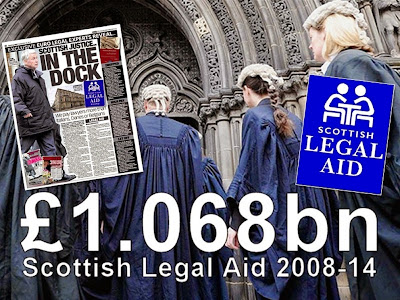
BILLION DOLLAR DRAIN: FMQ's & the £1.068bn Legal Aid of YOUR money paid to ‘struggling’ lawyers since 2008 financial crash is “unfit for purpose” says Law Society of Scotland

Over a billion of YOURS since 2008, now struggling lawyers want more. IF ANY public service in Scotland, the NHS, local hospitals, local government, schools, transport, local policing, care services, wildlife protection, otters, or even just ordinary Scots themselves had received over one billion pounds extra since the Financial market crash of 2008, they would rightly be grateful.

Everyone would be appreciative at receiving such an amount during the toughest of times, everyone … except, perhaps, lawyers.

Even though ‘struggling’ lawyers have received over £150million a year (some years, more) of YOUR money from the Scottish Legal Aid Board (SLAB), their self regulating & combined lobby group – the Law Society of Scotland have now described the massive annual public subsidy as “unfit for purpose.”

It just won’t do. It is just not enough. Lawyers cannot live on an extra £150million a year … especially when there are the likes of sole practitioners – a single lawyer, who walks off with £700K of it in three years, and despite feelings of fiddle, nothing is reclaimed.

The staggering amount of Scottish Legal Aid paid to legal profession since 2008 (figures provided by SLAB): 2013-14 £150.5m, 2012-13 £150.2m, 2011-12 £150.7m, 2010-11 £161.4m, 2009-10 £150.5m, 2008-09 £150.2m, 2007-08 £155.1m, making £1.06Billion (£1,068.6m)
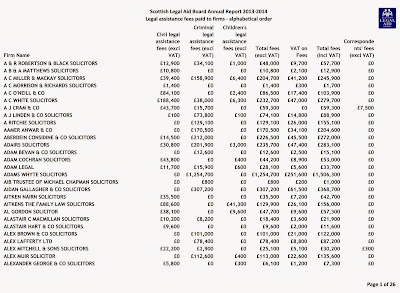
BIG SPENDERS: Spot your solicitors & law firms who take home the legal aid pounds. From total figures of £150.5 million, spend on civil legal assistance was £47.8 while criminal legal assistance was a mere £94 million. Children’s legal assistance stands at £4.9 million. Payments to solicitors increased by 1.7% from £115.1 million to £117.1 million while payments to advocates fell by 21% from £18.3 million to £14.5 million. Payments to solicitor advocates fell by 4.2% from £4.5 million to £4.3 million and expert witnesses along with ‘court reports’ raked in £19.5 million of public money.

And what is legal aid anyway? It goes to lawyers. It does not go to someone who is trying to fight a case in court or secure justice for a case which could have been resolved if some lying toad in a public body up to their eyes in fiddled expenses claims had not covered up for someone else. It goes to lawyers for all sorts of people … even for those of some fraud rap business baron who jaunts off to Dubai on a luxury holiday after his lawyers took nearly £200K in legal aid.

Hands up any of you who flew off to Qatar for a holiday after pocketing nearly a quarter of a million in legal aid from taxpayers. Hello there, Mr Mafia gang boss. Ah, another .. this time, a drug dealer. Another one, a lawyer. And there at the back, is a QC, with a fresh tan after coming back from the Cayman Islands.

No ordinary people then. Not the builder’s labourer next door who has been fighting for legal aid funding after his young child was overdosed with the wrong medication 22 times in hospital and the hospital’s lawyers spent 3 years lying about it.

Strange, that. Isn’t it. Legal Aid for all, Legal Aid for justice. Legal Aid for ordinary Scots. Not really.

Then, there are the judges who sit there hearing criminal cases funded by legal aid, not letting on they have financial, or ‘other’ links to the same firms in front of them, on either side of the court.

Almost laughably, the ‘good lord’ dressed in an 18th Century wig and flashy robe, complete with power bling, sits there in silence wondering if anyone will rumble the fact he received a fat cheque for giving a speech at a function hosted by one of the law firms taking tens of thousands in legal aid.

Never fear m’lud, your secret fat cheque is safe as long as you do not need to declare it. After all, what is a bung between friends, especially when it is at the expense of taxpayers, and justice.

Sure, there are lawyers and law firms who do their clients proud on civil or criminal legal aid … and there are solicitors who defend their clients against reams of somewhat dodgy charges just so the Crown Office can occasionally have a press release to claim a success which crumbles into falsehoods after further analysis. But this is not typical .. it is more the exception to the rule.

During Alex Salmond’s last First Minister’s Questions last Thursday, the thorny, almost un-debatable subject of the legal profession’s massive taxpayer bung was raised for discussion. Witness what happened next:

Graeme Pearson MSP LEGAL AID First Minister's Questions Scottish Parliament 13 Nov 2014

5. Graeme Pearson (South Scotland) (Lab): To ask the First Minister what the Scottish Government’s response is to the Law Society of Scotland’s discussion paper, “Legal Assistance in Scotland”, which says that the current system is not fit for purpose. (S4F-02386)
                   
The First Minister (Alex Salmond): The Scottish Legal Aid Board makes hundreds of thousands of grants of legal assistance each year, whether to help people to deal with welfare benefit problems or to help those who are accused of criminal offences to defend themselves. Expenditure on legal assistance last year was £150.5 million. The Scottish Legal Aid Board’s annual report shows that, since 2011, changes to the legal system have saved the public purse £52 million. However, there is still more to do.

The Law Society’s paper is intended to open up discussion. We have a shared perspective on some points, such as the need for simplification, and we will of course take a detailed look at the Law Society’s proposals over the coming weeks, with a view to assessing their potential impact on public funds and on those who rely on legal aid.

Graeme Pearson: The First Minister may remember that I raised concerns last year about proposed changes to legal aid. The president of the Law Society of Scotland said this week that legal aid cuts are likely to curb rights to justice for people on low and modest incomes who rely on legal aid. Does the First Minister agree that the prospect of citizens of modest means being denied access, as the Law Society suggests, while career criminals repeatedly access legal aid unfettered is indefensible and a foreseeable consequence arising from Mr MacAskill’s changes? Will the First Minister use whatever influence he has to ensure that the situation is addressed by his successor urgently?

The First Minister: As Graeme Pearson knows, expenditure on legal assistance in Scotland has been held at £150 million since 2007. Of course, that is not what has happened south of the border, where there have been substantial cuts. [Interruption.] Labour members should understand that, under the Barnett formula, the consequentials that come to Scotland are directed by expenditure in England. Unless they put forward a position where the great resources of Scotland are available for the Scottish people to direct our own spending, I am afraid that such matters are relevant.

Graeme Pearson should also understand that, although we were extremely interested in some aspects of the Law Society’s paper, such as the need for simplification, the paper has proved deeply controversial. He can see that from the debate that is opening up, in which people are pointing out that many areas of civil law are vital as part of legal aid assistance and criminal lawyers are pointing out that the fundamental right of people to defend themselves against a criminal charge is the essence of a free society.

There are no easy answers to the questions at present, but Graeme Pearson can rest assured that this Government and the Government of the immediate future will protect the right of the people of Scotland to legal assistance so that they can pursue their claims for justice.

Monday, November 03, 2014

BANK OF LEGAL AID: £1billion of public money thrown at ‘struggling’ lawyers since 2008 financial crash adds up with latest £150.5 million Legal Aid hand-out for Scotland's rip-off legal sector

Struggling lawyers? Here’s a billion of YOURS to keep THEM going. TIMES ARE TOUGH – we all know it. Not for Scotland’s legal profession though, as the latest figures released by the Scottish Legal Aid Board (SLAB) show another £150.5 million of public money sliding into the pockets of ‘struggling’ Scots lawyers on the premise of keeping the already buckled wheels of Lord Gill’s “Victorian” justice system turning.

Feeling poor? Have no fear, as ‘struggling’ lawyers hankering after a second estate car, a chance to buy fishing rights, send their own kids to posh private schools, or in need of a third buy-to-let property stuffed in the name of some fictitious client … need not worry as the Billion pound Bank of Legal Aid funded by taxpayers is there to help them out.

It is of course, time for the annual announcement of taxpayer funded hand outs to struggling lawyers, meaning, if you haven’t been keeping track, around ONE BILLION POUNDS of public money has been thrown at Scotland’s ‘struggling’ legal profession in the years since the 2008 financial crash. Go back a few more years, and it’s a billion more.

Scottish Legal Aid paid to legal profession since 2008 (figures provided by SLAB): 2013-14 £150.5m, 2012-13 £150.2m, 2011-12 £150.7m, 2010-11 £161.4m, 2009-10 £150.5m, 2008-09 £150.2m, 2007-08 £155.1m, making £1.06Billion (£1,068.6m)

Add to those billions the hundreds of millions over the years spent on lawyers by the Scottish Government and a vast range of law related quangos, the courts, rich judges wallowing in offshore tax dodges & undeclared investments, dodgy prosecutors, public service crooks, spivs and even top cops over the years, another billion can join the total. And for what exactly? To keep the wheels of justice going and prevent injustice? Not likely.

BIG SPENDERS: Spot your solicitors & law firms who take home the legal aid pounds. From total figures of £150.5 million, spend on civil legal assistance was £47.8 while criminal legal assistance was a mere £94 million. Children’s legal assistance stands at £4.9 million. Payments to solicitors increased by 1.7% from £115.1 million to £117.1 million while payments to advocates fell by 21% from £18.3 million to £14.5 million. Payments to solicitor advocates fell by 4.2% from £4.5 million to £4.3 million and expert witnesses along with ‘court reports’ raked in £19.5 million of public money.

Speaking about the release of this year’s figures, Iain A Robertson CBE, Chairman of the Scottish Legal Aid Board, said: “This is by far the most challenging time for legal aid in Scotland since my appointment. The continuing pressure on public finances has led Scottish Ministers to seek further savings and efficiencies in legal aid expenditure, and legal aid must play its part in achieving savings alongside all other public services.

“The need to find savings in legal aid expenditure means that businesses have to work with us to achieve efficiencies. Where legal aid reforms are required to deliver savings and also enhance the long term sustainability of legal aid then they must be considered, even if they are deemed radical or unpopular by business.”

Mr Robertson added: “2014-15 will bring continued challenges. Maintaining and developing constructive relationships with the legal profession and other stakeholders will be crucial.”

Among the list of regular legal aid recipients, readers should note all those ‘top notch’ Edinburgh law firms who tell clients they refuse to do legal aid work just so they can extract higher fees for doing the same work. But, sure, there are a few law firms who do their clients proud on legal aid, and a few solicitors who are actually human beings. At least two or three, anyway.

But the system of legal aid grubbery and the results it delivers, mostly for drug dealers, embezzlers, ex prosecutors & court staff on criminal charges, and of course, murderers, hit-men and dodgy businessmen is not really worth £150 million a year, to the community, is it. Not really.

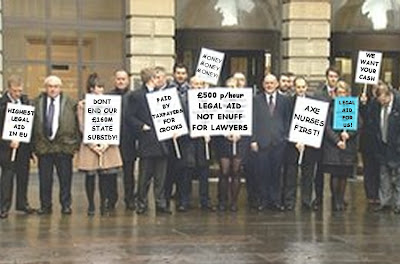
The flip side of the argument. Well, solicitors will say the £150 million a year sub is, of course, about providing justice and therefore worth it for lawyers. Worth it so much, a bunch of lawyers once surrounded the entrance of the Scottish Parliament and loitered around in the rain outside Edinburgh Sheriff Court, blocking the doors of courts holding placards begging to ‘save justice’. However, everyone outside the legal bubble who witnessed the spectacle knew the posters really meant “Axe Nurse First”.

Legal Aid is not about justice or providing access to justice, is it. It’s about money for the legal profession.

Investigation on Legal Aid in Scotland: SCOTTISH JUSTICE IN THE DOCK : Scotland's lawyers earn more from Legal Aid than whole of Italy, shock report reveals

The Euro study showed that Scotland disciplined a tiny number of lawyers compared to countries of similar size. Just three were struck off and 13 reprimanded in Scotland in 2010. Denmark, with a similar population, took action against 309 lawyers, with six struck off and 145 fined. And in Finland, also close in size, 99 rogue solicitors were sanctioned. Critics blame the Law Society of Scotland’s dual role of representing lawyers while also acting as regulator.

A large proportion of alleged criminals reported to prosecutors in Scotland are not being put in the dock. Of 265,830 cases sent to the Crown Office, only 41.7 per cent were brought to court. In England and Wales, 90.6 per cent of all cases resulted in court action.

The difference is thought to be partly due to Scotland’s recent introduction of spot fines and fiscal fines for what the authorities insist are more minor offences. Critics claim such fines lead to a secret justice system.

The report reveals that Scotland’s sheriffs top the European pay league.

Our sheriffs, with an average salary of 150,106 euros (£120,000), were number one, ahead of the Irish and Swiss. Next were sheriffs’ counterparts in England and Wales, who were paid 120,998 euros (£95,000). Not only were sheriffs the highest-paid, they also topped the table comparing their earnings to the national average. They earned 5.2 times the average Scot’s wage.

Friday, November 30, 2012

THEY WANT YOUR CASH : Scotland has highest legal aid budget in EU, yet lawyers chant “save justice” and strike to demand more for them, less for you

STRIKE ! More money for them, but Clients see little access to justice for legal aid hand-outs. LET’S not kid ourselves about the motives for recent strikes & protests by the Scottish legal profession against plans to cut Scotland’s ONE HUNDRED & SIXTY MILLION POUND legal aid budget, the highest legal aid budget in the entire European Union. This strike, and the protests outside the Scottish Parliament by cohorts of Scots lawyers carrying banners crying for “justice” is purely about more money for solicitors & law firms and has little to do with the profession’s call access to justice for Scots who may, rightly, or even wrongly,  find themselves at the sharp end of the justice system for deeds they may or may not have committed.

The strike certainly has nothing to do with Scots access to justice for civil legal aid, because in a week of listening to solicitors bleat like sheep about the rights of accused criminals to be funded on the legal aid purse, (and for those same solicitors to be entitled to collect more than £500 per hour), not one member of the legal profession has come forward to argue for increased attention to civil legal aid, particularly in cases where the legal profession’s own regulators have done the dirty on members of the public.

Yes, it’s all about easy pickings for the legal profession, rather than helping Scots out of complicated legal difficulties created not by their own doing, rather their reliance on the professions who claim to have their clients best interests at heart …

The fuss, as great as it appears to be, is all about our Justice Secretary Kenny MacAskill’s idea to force solicitors to collect legal aid contributions from clients accused of criminal offences.

Solicitors argue they should not become the Scottish Legal Aid Board’s debt collectors, while the Justice Secretary argues it is not cost effective for SLAB to collect these same contributions from clients (yet it appears to be cost effective for SLAB’s senior staff to fly around on international airlines apparently learning nothing about how legal aid is done in the rest of the world)

Perhaps what is really at stake is some of the nasty habits solicitors and certain advocates have developed, such as in some cases, well known to journalists & the Scottish Legal Aid Board where some of Scotland’s supposedly esteemed legal professionals regularly ask their clients for cash bungs to continue to defend them on criminal charges. Clearly, clients may end up asking why they have to make a cash contribution to SLAB as well as their solicitor if justice is really being served …

Of course, with the headlines of legal aid fraud, and solicitors walking away with millions of pounds of legal aid money even after being accused by SLAB of making dodgy claims, it would be reasonable for anyone to ask “Is MacAskill’s plan for lawyers to collect our money safe ?” Well, put it this way, his plan is about as safe as allowing gangsters & loan sharks to collect for the Red Cross.

Predictably, several strikes & protests on, Mr MacAskill is being forced back to the negotiating table with the legal profession and, as has happened before in previous cases where solicitors have threatened to strike such as in 2008 he will give in and the legal profession will continue to enjoy its £160 Million state subsidy for the time being. Times are tough, the legal profession must survive, axe nurses first, but don't axe your lawyers they say …. yet the important questions, such as whether an independent Scotland can afford its legal aid budget, and why legal aid fraudsters in the legal profession are never prosecuted … are never answered …

Time for a new Justice Secretary, anyone ? Surely after five years of disasters in the justice system, from World’s End to the continuing Lockerbie cover up to the review of the review of the review of Lord Gill’s condemnation of the Scottish Justice system in his 2009 Civil Courts Review and recent allegations of “Institutional Corruption” at Scotland’s Crown Office is well enough to require a new, firm pair of hands on the broken bottle that is our Scottish justice system ?

WHERE DOES ALL THE LEGAL AID GO ?

Scots Legal Aid ‘a £161Million public subsidy for legal profession’ as EU report reveals judges salaries & lawyers legal aid claims come before public's access to justice

Scottish justice in the Dock - Sunday Mail 30 September 2012EU report reveals Scots justice is more about lawyers & judges making money than delivering justice. A REPORT published by the European Commission for the Efficiency of Justice and featured in an article in Scotland’s Sunday Mail newspaper has revealed Scottish lawyers take tens of millions of pounds more in publicly funded legal aid representing the Scots population of just over five million people than lawyers working Italy, which has a population of sixty million, twelve times greater than that of Scotland.

The figures show that Scots lawyers ‘earned’ around ONE HUNDRED & SIXTY MILLION POUNDS of legal aid in 2010 while their Italian counterparts working for a much larger client base only took £100million, making the Scots legal aid bill, running at a cost of £31 a head, the most expensive in Europe in terms of population. The grim figures show that Scots legal aid is working out at a cost of £31 a head, with little in the way of access to justice to show for it.

The report, available on the EU website HERE (pdf) or online here : The European Commission for the Efficiency of Justice Report on Evaluation of European Judicial Systems also reveals Scots judges are paid the highest in Europe with Scottish Sheriffs taking home an average taxpayer funded salary of a staggering £120,000, while others on Scotland’s judicial benches take up to £200,000 a year plus expenses.

The Sunday Mail article reported on the EU study which exposed Scotland’s justice system as the costliest in the entire European Union :

Scottish justice in the Dock - Sunday Mail 30 September 2012SCOTTISH JUSTICE IN THE DOCK : Scotland's lawyers earn more from Legal Aid than whole of Italy, shock report reveals

By Russell Findlay Sunday Mail 30 September 2012

THE European Commission report reveals that Legal Aid in Scotland cost 203million euros (£161million) in 2010 - more than in Italy, which has a population of 61million.

SCOTS lawyers collected more taxpayers’ cash for Legal Aid than their counterparts in Italy – a country 12 times the size.

A European Commission report reveals that Legal Aid in Scotland cost 203million euros (£161million) in 2010 – around 39 euros, or £31, for every one of our 5.2million people.

Lawyers in Italy, which has a population of 61million, got just £100million of public cash – £1.50 per person.

The 450-page Brussels report also found that Denmark, with 5.6million people, paid its lawyers only 88million euros (£70million).

And in Belgium – population 10.9million – legal aid cost 75million euros (£59million).

The revelations, in a 450-page report by the European Commission for the Efficiency of Justice – came as the Scottish Legal Aid Board banned three lawyers from claiming cash for criminal cases.

We can reveal that Gerard Tierney, Massimo D’Alvito and Andrew Brophy, of Blantyre, Lanarkshire, breached the board’s code of practice. Tierney and D’Alvito have been reported to the Crown Office, who will decide whether to prosecute.

The ban also extends to Tierney’s firm G Tierney & Co, of Auchinleck, Ayrshire, who have raked in £610,500 in Legal Aid over three years, and Edinburgh firm Massimo D’Alvito Defence Lawyers.

The European report looked at 47 criminal justice systems across the continent.

It found the cost per person of Legal Aid in Scotland was third-highest – behind only Northern Ireland and England and Wales. The cost per person was 53.5 euros in Northern Ireland and 45.7 euros in England and Wales.

The findings led to calls for a radical overhaul of Legal Aid.

Central Ayrshire Labour MP Brian Donohoe said: “It seems major organised criminals and terror suspects qualify for unlimited Legal Aid, yet I have constituents who don’t get a penny simply because they have a few thousand pounds of savings.

“The system in Scotland and the rest of the UK is out of control.”

Legal blogger Peter Cherbi added: “Legal Aid is no longer about access to justice for the poor, but a state subsidy for the legal profession – and one they don’t seem keen on talking about.”

The Sunday Mail has exposed a series of rogue lawyers banned from claiming Legal Aid. But none of the 14 reported to prosecutors was put in the dock, prompting claims that Scotland’s legal self-regulation system protects lawyers.

Kilmarnock solicitor Niels Lockhart, who took £600,000 in Legal Aid in just two years, was found to have made “unnecessary and excessive” claims. The Legal Aid board withdrew their complaint to the Law Society after he agreed to stop claiming.

Reacting to the Brussels report, the Scottish Legal Aid Board said: “Across Europe, there are substantial differences between judicial systems and very different approaches to the provision of legal aid and its cost.

“The Scottish system is highly regarded internationally for the efforts made to ensure access to justice.

“The Scottish Government’s budget allocation for the Legal Aid Fund has reduced significantly in 2011-12 and is planned to reduce further in future years.”

Justice Secretary Kenny MacAskill hopes to cut the Legal Aid bill by making criminals pay some of their costs. The planned move, outlined in a Holyrood Bill, could save taxpayers around £3.9million.

• The Euro study showed that Scotland disciplined a tiny number of lawyers compared to countries of similar size.

Just three were struck off and 13 reprimanded in Scotland in 2010.

Denmark, with a similar population, took action against 309 lawyers, with six struck off and 145 fined. And in Finland, also close in size, 99 rogue solicitors were sanctioned.

Critics blame the Law Society of Scotland’s dual role of representing lawyers while also acting as regulator.

• A large proportion of alleged criminals reported to prosecutors in Scotland are not being put in the dock.

Of 265,830 cases sent to the Crown Office, only 41.7 per cent were brought to court. In England and Wales, 90.6 per cent of all cases resulted in court action.

The difference is thought to be partly due to Scotland’s recent introduction of spot fines and fiscal fines for what the authorities insist are more minor offences.

Critics claim such fines lead to a secret justice system.

• The report reveals that Scotland’s sheriffs top the European pay league.

Researchers compared the wages of lower court judges across Europe.

Our sheriffs, with an average salary of 150,106 euros (£120,000), were number one, ahead of the Irish and Swiss.

Next were sheriffs’ counterparts in England and Wales, who were paid 120,998 euros (£95,000).

Not only were sheriffs the highest-paid, they also topped the table comparing their earnings to the national average. They earned 5.2 times the average Scot’s wage.

Monday, May 31, 2010

Law Society to fight legal aid cuts on ‘access to justice’ ticket as Scots struggle to find law firms handling legal aid work

SLAB_logoThe Scottish Legal Aid Board has often been the cash cow of the legal profession. LEGAL AID – Described by some as a state funded route to justice for those who cannot afford it, however, in reality something which has been grossly abused by many law firms & solicitors over the years who have neither represented the interests of their clients nor given those who cannot afford a solicitor an effective route to our courts, is unsurprisingly facing huge cuts in its budget as the recession looms large over the UK’s public finances.

While talk of cuts to legal aid may seem an unimportant subject these days, since many law firms in Scotland claim to have given up legal aid work altogether, the threat of a few thousand pounds less in the pockets of solicitors is apparently still enough to galvanise the Law Society into its well worn call for unity among its members to ensure any cuts to the legal aid budget in Scotland are as minimal as possible.

Law Society of ScotlandLaw Society issues legal aid plea over expected cuts. Cue the expected, if comical Press Release from the Law Society of Scotland, who typically raise the threat of a “damaging effect on access to justice” if there are significant cuts to Scotland’s legal aid budget. Doubtless we can expect the threat of the oh-so-damaging ‘lightning strikes’ at Scotland’s Sheriff courts, principally in the Glasgow area where solicitors will yet again walk out, leaving criminal cases clogging up the system due to lack of legal representation etc just as has happened in the past .. and just as has happened in the past, there will be compromises and emergency payments from the Scottish Government & Westminster to soothe the wallets minds of our esteemed legal profession across the country …

An official from a consumer organisation today claimed that with so many law firms across Scotland giving up legal aid work it was difficult enough for consumers to find a solicitor willing to take on a case with legal aid funding.

He said : “It is all very well for the Law Society to ask its members to come together to fight legal aid cuts but what has the Society said about its many member firms who have given legal aid work up, making it impossible for many consumers to find a solicitor in their area who will take on a case with legal aid funding.”

He continued : “The problem here is that legal aid is only payable to solicitors, and the Law Society want it keep it that way, blocking anyone else from coming into the legal services market who might take legal aid cases. Since many law firms have or are giving up legal aid work, its time to break open the monopoly over legal aid payments, to ensure consumers across Scotland can find a legal services provider who will undertake legal aid work if Law Society member firms don't offer it.”

One client who reported his solicitor to the Law Society of Scotland for legal aid irregularities and is yet to hear back about his complaint said the legal aid system in Scotland was “poorly policed” and was little more than “a Law Society controlled public handout to bankroll solicitors who end up doing nothing for their clients”.

The following release is how the Law Society see their role in the expected battle over cuts to the legal aid budget :

Law Society warning over legal aid

Scottish solicitors have been urged to form a united front to fight a looming threat to legal aid budgets – because any cuts will have a hugely damaging effect on access to justice.

New Westminster Justice Secretary Ken Clarke has indicated that the legal aid budget for England and Wales is in his sights when he looks to identify cuts – although it has been frozen for the last six years and the Coalition Agreement states that a "fundamental review" of Legal Aid is planned.

In Scotland, while the legal aid system is not subject to Westminster control, it is certain to come under massive scrutiny, according to Andrew Alexander, the Law Society of Scotland’s Legal Aid co-ordinator.

Mr Alexander said it was time to fight to protect both criminal and civil legal aid now – rather than waiting for cuts to happen. Civil legal aid in particular had already been “cut to the bone”, he added.

“The freezing of the English legal aid budget for six years has amounted to almost a 20 per cent cut in real terms,” Mr Alexander said. “The pressure to deliver justice to a fixed budget has placed the justice system in England and Wales under extreme pressure – and solicitors are being paid later and later.”

The Legal Services Commission (LSC) delayed some payments to legal aid practitioners until April and its new financial year. Also, the LSC is now routinely delaying payments to solicitors, and the Law Society in England and Wales has needed to advise banks of the consequent cashflow problems for legal firms.

The attempt to drive down costs at the LSC has led to tendering proposals for criminal work that would see around 500 firms receive contracts for criminal work in England and Wales: the remainder of the 1,700 criminal firms south of the border would, from 2011, leave the market."

“Whether these tendering proposals go ahead under the new Government, it is clear that cuts to the Legal Aid system in England and Wales are likely to be severe,” said Mr Alexander. “In Scotland, the Law Society will strongly defend the interests of solicitors in criminal and civil Legal Aid practice, just as these practitioners strongly defend some of the most vulnerable in society at the most vulnerable stages of their lives.

“It is vital that the profession is united in facing this challenge: not just Legal Aid practitioners but also solicitors working at Law Centres and at voluntary organisations, bodies which rely on public funds to provide assistance to the public.

“We could find ourselves in a double dip recession and the Society will fight any cuts toe-to-toe.”

Mr Alexander said reforms to speed up justice and reduce costs had to continue: the Society's criminal negotiating team had substantial input to the summary justice reform process, and are now active in monitoring and evaluating its progress. He stressed that these recent reforms had delivered bigger savings than predicted and that work would go on to encourage early pleas to save money and time.

He warned that civil justice was under particular threat: “We need to say enough is enough and work to protect all areas – but civil justice, in particular, is in danger.”

The Law Society of Scotland has recently met with Lord Bach, former Legal Aid Minister for England and Wales; with Helen Edwards, current Director General at the Ministry of Justice in London; with its counterparts at the Law Society of England and Wales; and will shortly be visited by Ministry of Justice officials from New Zealand. In fighting for access to justice in Scotland, learning lessons from other jurisdictions will be vital.

"Legal Aid was intended as the fourth pillar of the welfare state," Mr Alexander concludes. "It remains vitally important that people who are unable to afford representation have that paid by the state. This is a concept that is intuitive – 68% of people in a recent YouGov survey agreed with this principle – and one which the Society will strive to maintain."

As you can see from the above Law Society media release, the legal profession’s representative body has been busy, readying itself to fight for the pockets of its own members … just don't expect the Law Society to fight for the rights of clients .. who will clearly come out last again in this annual game of catch the legal aid handout …

Incidentally, I do know a few law firms who still take on legal aid work, one of which works tirelessly for its clients … so its not all bad … there is at least one law firm in the whole of Scotland who can be approached to handle a case without clients fearing their legal aid is going to be ripped off, as well as their own finances …

Thursday, January 11, 2007

Lawyers protests over low legal aid fees revealed to be fake as Law Society's own research points to increase

The so-called 'strike' by Scotland's legal profession over the alleged lack of payments of legal aid in the Fixed Fees system, seems to have been rubbished by research from the Law Society of Scotland itself, throwing into question the validity of the claims of local Bar Associations of impoverished Solicitors having to boycott everything from family law cases to Criminal cases, .. just to get that wee bit more legal aid into their pockets.

I covered this story back in October, here : Scottish legal profession supports using family law cases to blackmail Executive for more legal aid fees & less reform. and here :
Legal Aid dispute continues to be used by lawyers against planned reforms of legal profession by LPLA Bill

However, today in the Scotsman newspaper, we have the legal profession spinning out an 'unpublished report' - which was actually conducted under their own auspices by Cyrus Tata & Professor Frank Stephens of Manchester University .. showing the Legal Aid reforms announced by the Scottish Executive back in 1999 have failed to stem the rise of legal aid payments to lawyers.

Wait a second though ... didn't lawyers up and down Scotland only a couple of months ago claim they weren't getting enough money .... so they had to strike & boycott legal cases to gain increased legal aid payments ?

Well, as of this morning so far, the Law Society of Scotland haven't joined in the fun with a press release of it's own on the shrill cries of Executive bury's evidence of legal aid reform failure. That in itself, is unusual, as the Law Society usually fire out a Press Release to accompany whatever story they wished published for the next day, unless of course, they don't want it to look as if it's been managed that way .. which incidentally, it does.

So, Cyrus Tata and Frank Stephens report in their findings that when fixed fees were introduced, £30 million was being spent a year on summary legal aid in sheriff courts. Following the introduction of fee-capping, that fell to £27 million. But by 2002, the bill had increased to £32 million with an extra 10,000 cases being funded by legal aid.

How does this square with the recent claims by lawyers they were impoverished and had to strike, boycotting a range of civil law & criminal law cases to gain increases in fixed fees from the Executive - which of course they did - after their strike.

Lawyers even went off to form a new national Bar Association on the pretext the Law Society wasn't up to the job of lobbying for their interests Hundreds to join new lawyers' union - with regard to legal aid payments & the loss of regulating (fiddling) complaints against their colleagues and up & down Scotland, local Bar Associations organised strikes & boycotts of cases, causing even delays to criminal trials of the likes of sex offenders, .. all because lawyers were getting paid more legal aid ?

Well, thanks for clearing that one up, Mr Tata & Mr Stephens. The claims in the strike were obviously bogus. Lawyers were getting more money all the time, & claiming for things they weren't claiming for before .. we never heard anything of that in the legal profession's protests & briefings on the alleged lack of legal aid payments.

This time certainly, I don't think the blame lies with the Scottish Executive at all on the allegations of burying the evidence - this is Law Society sponsored research - that's why it appeared in the Journal of the Law Society - their own publication. Why didn't the Law Society do their usual open press briefings, releases & multiple phone calls to all the newspapers to ensure the story was going in ?

If we want the Executive to publish every little bit of research into the legal profession, maybe we should expect stories appearing on the Executive site like this Daily Record expose on lawyers bribing clients to fill out legal aid forms: BUNG TO RIGHTS .. which is more common than some would have the public believe ..

For that matter, does the Executive have to publish all the Law Society's paid opinions such as the one of FibDem peer Lord Lester of Herne Hill QC who concluded it would be a breach of lawyers human rights to have complaints against lawyers independently regulated so they basically couldn't continue to fiddle client complaints against their colleagues ? ..... I think we don't need to hear propaganda from the legal profession coming straight out of the Executive.

Such a pity the Scotsman didn't put a link in the story to the summary of Tata & Stephen's report published by the Executive on 7th December, rather than that long tedious description of where it lies in some 'sandwiched state'... which is obviously just for effect .. after all .. links to You Tube videos on vandalism in the Capital & reports on everything from health to the McKie case, have made it to the Scotsman website .. why not be a little more consistent .. or is it just because the legal profession says so, this story appears.

With all respect to Kenny MaCaskill & the rest at Holyrood, I wish he was more tuned into the way the legal profession handles the media & stories like this, although it is ironic the 'unpublished' research, which the Law Society actually did publish itself, kills off the legal profession's own protests of lack of legal aid .... How about someone point that one out please ? .. or is it even too much of an effort to state the obvious these days.

I'll be kind and link to the Journal of the Law Society's published version of this 'unpublished research'. See it here : Fixed payments: a real impact?

As for me, well, I like my sandwiches with plenty bacon, or even a salad for that healthy touch.. but I never .. NEVER .. bury my sandwiches between sandwiches !

Article from the Scotsman :

http://thescotsman.scotsman.com/scotland.cfm?id=52402007

Legal aid cash saving plan is a flop
MICHAEL HOWIE HOME AFFAIRS CORRESPONDENT

* Unpublished report shows legal-aid reforms have been unsuccessful
* Lawyers now making claims where previously they would not have
* Executive accused of 'burying bad news' in failure to publish

Key quote
"We are in danger of seeing the Executive covering up and the legal-aid board simply burgeoning as a bureaucracy, not as a service-provider. The whole legal-aid system is in meltdown." - KENNY MACASKILL, SNP

Story in full LEGAL-AID reforms aimed at saving millions of pounds have been a failure and the Scottish Executive has been accused of concealing damning evidence.

The Scotsman has learned that a study completed two years ago - which has yet to be published - found that fixed fees for lawyers have failed to deliver an anticipated £10 million cut in Scotland's legal-aid bill.

The research concludes that fee-capping for summary criminal work, introduced in 1999, may in fact have increased the overall legal-aid bill by encouraging lawyers to submit thousands more claims.

The findings have led to claims of a "meltdown" in the legal-aid system, which last year cost taxpayers £148 million.

And the failure to publish the research has also prompted fresh accusations that ministers and senior civil servants are suppressing information.

A spokesman for the Executive said the research was being held "for a variety of factors", but was unable to explain what these were. However, he said researchers had been given permission to present their findings at conferences and in journals.

He also said that a brief, three-page summary of the report's findings was posted on the Executive's website last month.

Fixed fees of £300 for cases in the district court and £500 for those in the sheriff courts were introduced to cut costs by speeding up the system.

Writing about their research in the latest issue of the Law Society Journal, Cyrus Tata and Frank Stephens, from Strathclyde and Manchester universities, said that prior to fixed fees, lawyers often did not bother to claim for all advice and assistance given, instead only billing for main cases.

But they found that after the fees were introduced, lawyers were far more meticulous in their billing, making up shortfalls from individual cases by submitting more claims.

When fixed fees were introduced, £30 million was being spent a year on summary legal aid in sheriff courts. Following the introduction of fee-capping, that fell to £27 million. But by 2002, the bill had increased to £32 million with an extra 10,000 cases being funded by legal aid.

Kenny MacAskill, the SNP's justice spokesman, said the Executive's failure to release the report was "utterly unacceptable".

He added: "We are in danger of seeing the Executive covering up and the legal-aid board simply burgeoning as a bureaucracy, not as a service-provider. The whole legal-aid system is in meltdown."

Margaret Mitchell, the Scots Tories' justice spokeswoman, accused the Executive of "burying bad news".

"They have sat on this report for 18 months, putting a sledgehammer through their claims that this would be an open, accountable and transparent government."

A spokesman for the Executive said allowing researchers to present their findings "demonstrates our willingness to have the findings in the public domain". He added: "We are hoping to publish the full report very soon."

BURYING BAD NEWS?

A SUMMARY of Cyrus Tata's and Frank Stephens' findings was posted on the Scottish Executive website on 7 December.

The paper boils down to three short pages, 14 months of research, involving analysis of legal-aid board data over five years and scores of interviews with solicitors.

No press release was issued to announce the release of the long-awaited findings, which have been kept under wraps for nearly two years. The document was instead posted among hundreds of other papers in the website's "publications" section, which can be entered by clicking on a link on the home page.

It can be found sandwiched between the chief fire and rescue service inspector's annual report, and a justice department circular on "the implementation of the integrated case management process from 1 June, 2006".

Saturday, October 21, 2006

Legal Aid dispute continues to be used by lawyers against planned reforms of legal profession by LPLA Bill

There was an interesting story in last week's Sunday Times, on members of the House of Lords taking up Directorships of companies and relating to the story, you can see the Press Release on former NATO Chief Lord Robertson joining a joint anglo russian company as a Deputy Chairman of the Board I'm sure this story will come along as time goes on, my sources tell me.

In any case, last week was taken up by articles reflecting my involvement with the Scottish Borders .. a necessary part of the story of my campaign I'm afraid .. even though it tires me to write about it, due to the fact the region seems more corrupt than when I left it .. and even with the recent formation of a new Borders Political Party to fight seats at the next council election ... nothing will ever change in that place. I also had the flu, so writing about the Borders was a break from writing about crooked lawyers ..I may return to visit the Borders issue next week.

Now, back to the legal profession, I'm afraid .. and today, we have a timely article in the form of a warning from the legal profession, claiming the rise in legal aid payments will jeopardise the right to a fair trial.

The article is timely, because this coming week, the LPLA Bill is back before the Justice 2 Committee for further scrutiny ... and from my sources in the newspapers, I'm told we can expect a few more planted stories in the next few days & weeks showing how indispensible the legal profession is to Scotland .. which really, it isn't.

So, what's the big threat to the right to a fair trial ?? Well, it's the lawyers of course . .it's the lawyers and the legal profession who are threatening your right to a fair trial, not the Scottish Executive .. and it's nothing to do with the countless inadequacies in Scottish Law .. its soley about money .. the money that solicitors stuff in their pockets .. that, is what is affecting your right to a fair trial - nothing else, just the money.

Do you think the lawyers have your best interests at heart in staging strikes and boycotts of civil & criminal cases in order to get their legal aid fees raised ? No .. they certainly don't care about you at all .. it's all about .. money .. which is usually the case when it comes to things the legal profession campaign on with such vigour.

Part of the lawyers claims centre on the Scottish Executive's appointment of six more Public Defence Solicitor Offices .. which the Executive claims "would provide "justice for all" by offering the accused a greater choice of affordable lawyers." .. this is more about criminal law though .. so don't try hiring these people to take on a case against a crooked lawyer who has swindled you out of your life savings or your house .. they just won't do it.

The new PDSO offices are to be in Dundee, Aberdeen, Falkirk, Ayr, Dumfries and Kirkwall, and are expected to open next year, which it is claimed, will increase the number of Scottish Legal Aid Board (SLAB) solicitors from nine to 20. I have to say, I am aware of some of the solicitors who work for the Scottish Legal Aid Board. They are, rubbish - and actually are quite hostile towards people who try to pursue cases against crooked lawyers.

Why is the legal profession so upset about this ? well, it seems to be about control .. and the same arguement which took out the Temporary Sheriffs in 2000 has surfaced again .. where lawyers said that directly employing public defenders threatens the independence of the judiciary because they are under the influence of their employers and provide unfair competition.

Yet another diversion created by whinging lawyers who want more money, to try & stall reforms of the legal profession in Scotland planned in the forthcoming LPLA Bill, I'm afraid .. nothing more than that .. after all, they got an increase in legal aid payments .. what more do they want ? .. it's not the taxpayer's fault that lawyers have become used to fleecing clients and getting fat payments for very little work.

I hope the Scotsman journalist who was talking to me the other day was right in what he said ... which was .. "Peter .. Why do you think we are printing all this stuff ?, because it shows the extent of the control freakery of the legal profession in Scotland who are out to kill off any reforms & any reformers like you".

Bravo !!! .. in that case, the Scotsman has done an excellent job ! .. with the likes of Campbell Deane's rants against victims of the legal profession, praise of some of his more famous clients (albeit some who have failed to sue newspapers) .. and among other things, Jennifer Veitch's rose tinted articles on Douglas Mill .. I'd say the readership of the Scotsman have had their eyes opened as to just what kind of people are in charge of the legal profession - a bunch of consumer hating political manipulators who are up to no good.

Read on for the link, from The Scotsman, at : http://thescotsman.scotsman.com/index.cfm?id=1558802006

Lawyers say rise in legal aid will jeopardise fair trials
LOUISE GRAY SCOTTISH POLITICAL CORRESPONDENT (lgray@scotsman.com)

THE right to a fair trial is under threat, lawyers warned yesterday, after the Executive trebled the amount of legal aid provided directly by the state.

Hugh Henry, the deputy justice minister, said moves to increase the number of Public Defence Solicitor Offices (PDSO) from three to nine would provide "justice for all" by offering the accused a greater choice of affordable lawyers.

The new offices in Dundee, Aberdeen, Falkirk, Ayr, Dumfries and Kirkwall - expected to open next year - will increase the number of Scottish Legal Aid Board (SLAB) solicitors from nine to 20.

However, lawyers said that directly employing public defenders threatens the independence of the judiciary because they are under the influence of their employers and provide unfair competition.

Their concern intensifies the long-running dispute with the Executive over legal aid. Earlier this month an Executive report warned that miscarriages of justice are more likely because the introduction of fixed fees, instead of payment by the hour, means lawyers are not spending as much time on cases.

Lawyers have even threatened to boycott cases involving alleged sex offenders in protest over legal aid fees - a move labelled "disgraceful" by Jack McConnell, the First Minister.

Last year the legal aid bill was £152 million and is set to rise to £168 million by 2007-8.

Yesterday, Mr Henry said the new PDSOs will provide a more affordable way to provide legal representation.

"We believe that publicly funded criminal legal assistance in Scotland is best delivered by a mix of salaried legal professionals and those in private practice," he explained.

Mr Henry said the PDSOs also increase choice. "There are other parts of Scotland where there may be limited competition for publicly funded criminal legal advice. We have therefore decided to open new PDSOs in some areas to provide an additional element of competition."

However, Gerry McClay, president of the Glasgow Bar Association, disputed that the plan was anything to do with cost or choice. He said: "At the moment we have 1,500 solicitors registered to do criminal legal aid in Scotland. I do not see why there is a need for more choice. It is nothing to do with need or cost, it is because they do not want private solicitors that are willing to stand up and challenge them. You need an independent defence system and defence lawyer - but you have to pay for that."

But Iain Robertson, SLAB chairman, defended the news. He said: "The expansion of PDSOs allows Scotland to see criminal legal assistance delivered by a combination of salaried solicitors and those in private practice.

"This combination of private and public provision is common around the world and brings a number of benefits. PDSOs help ensure comprehensive access to criminal legal assistance."

Legal experts put the case for the defence

LAWYERS are increasingly at logger-heads with the Executive over the independence of the judiciary.

LEGAL AID: Fees have not risen for 14 years prompting fears fewer and fewer high quality lawyers are willing to defend the accused. Lawyers believe a rise in fees for private practice would protect independence.

COMPLAINTS: The new Legal Aid Bill aims to strip the Law Society of the authority to deal with complaints against lawyers in favour of a Scottish Legal Complaints Commission whose members are appointed by ministers. Senior judges have branded the plan a threat to their independence. The Executive insist it would safeguard clients' interests.

THE LORD ADVOCATE: The new appointment of Elish Angiolini, by Jack McConnell, the First Minister, re-opened old wounds. Senior lawyers question how the head of the prosecution service in Scotland can be independent while also advising the Executive on legal matters.

THE COURTS: Executive proposals to place the control of all Scotland's courts under one person, the lord president, would undermine judicial independence say senior figures. There are proposals to unify the sheriff and high courts and make the operation of all courts the responsibility of the lord president.

Monday, October 09, 2006

Scottish legal profession supports using family law cases to blackmail Executive for more legal aid fees & less reform.

Like North Korean dictators who are currently polluting our planet with nuclear tests, to make political ends for their benefit, the Scottish legal profession has decided to support it's own political campaign against reform of the legal profession, by the use of withdrawing representation for abuse victims & other types of family law cases, in the long running dispute over Civil legal aid feels with the Scottish Executive.

It's no accident that solicitors are now resorting to stronger tactics in their quest to gain more legal aid fees .. with the LPLA Bill currently being considered in the Scottish Parliament, anything which the legal profession can do to 'gum up the works' has been passed by the Law Society of Scotland as 'fair use' against the planned reforms of the way lawyers conduct business in Scotland.

What with the recent resignation of the Lord Advocate over 'unspecified matters', howls from many members of the legal profession, including retired judges, embittered over the loss of self regulation of complaints against their own members, we now see the true face of Scotland's hallowed legal fraternity ... who will stop at nothing to get their own way .. and there is more to come.

Not a very honourable thing for Scotlands legal profession to be doing .. and I haven't noticed retired judges such as Lord McCluskey & otbers in the judiciary, legal profession, or many msps coming out on this one to protest the Human Rights of the public to be defended in court, versus the thing they are so big on lately, being the howls of Human Rights abuse against the solicitors who face losing the power to regulate complaints against themselves. Surely the rights of abuse victims to be protected from violent attackers outweights the rights of lawyers to fiddle complaints against their colleagues ? One would surely think so ...

Of course .. pay someone what they want .. or allow them to set their own pay scales .. and you get a situation like this which we are now in ... and with lawyers over the years being used to milking the legal aid system for whatever they wanted (as long as it didn't include cases against other lawyers) ... they have gotten used to getting the levels of fees they asked for .. so in part, it is certainly the Executive's fault (and previous Governments of course) for allowing this situation to develop in the first place.

Civil legal aid rates are lower than Criminal legal aid rates, and Civil legal aid is more difficult to obtain than Criminal legal aid - because, barring the odd strike by lawyers using victims as a blackmail to obtain more legal aid, it is of course, a right for someone to be defended at a criminal trial - and if they have no defence or representation, either as a result of not being able to obtain a lawyer themselves, or having their legal aid withdrawn, occasionally, Sheriffs have dismissed criminal cases against accused on these grounds.

Civil legal aid applications can be opposed by the defender of the action - this alone, makes it obviously more difficult to persuade the Scottish Legal Aid Board that Civil legal aid should be granted in a case.

Many abuse victims have, at one point or anther, have also had to use a particular rule for claiming Civil legal aid, known as "Regulation 18" where a solicitor can apply for legal aid funding, on the basis they had to take urgent steps to bring a case into court for a client .. This rule has had to be used where there have been difficulties in obtaining Civil legal aid for such cases, in the past, however, sometimes SLAB have also been known to refuse 'Regulation 18" legal aid applications, dependent on the nature of the claimant's case.

A Solicitor can backdate a claim for legal aid using the "regulation 18" rule for emergency legal aid, and you can find out more about 'regulation 18" legal aid and how a case qualifies for it, Here

However, there are great dispartities in the way Civil legal aid is awarded by the Scottish Legal Aid Board, as anyone who has tried to make a claim for Civil legal aid knows .. and there is an even greater disparity in the way the legal profession treats particular types of civil law cases, particularly those which involve civil litigation against colleagues.

For instance, try making an application to the Scottish Legal Aid Board for Civil legal aid in a case against a crooked or negligent solicitor, and you would find, like many before you, it's almost impossible to obtain legal aid .

A claimant in a case against a lawyer, would be faced with all matter of representations coming in from the Law Society of Scotland & the rest of the legal profession to SLAB, to interdict a claimant's application for Civil legal aid. A good example, of this, is my own claim for Civil legal aid, which was obstructed by the Chief Executive of the Law Society of Scotland, Douglas Mill .. but this is typical of the Law Society of Scotland, who make sure most civil legal aid cases against lawyers get killed off, or are obstructed to the point they never make it to court.

For example, an applicant for civil legal aid (who may also be in receipt of state benefits), in a civil law case against a lawyer might find that the lawyer they are trying to bring to court, has supplied the Legal Aid Board with deliberately false or erroneous information against their person. This has happened many times.

Solicitors up and down Scotland, when faced with a case against themselves, have went all out to 'get' members of the public who have tried to claim against a crooked lawyer who has ruined their finances .. and such dirty tricks as providing false information to SLAB, false information to the Benefits Agency, and even false information to the Inland Revenue & the Police, is quite a common practice - and nothing is ever done about this by the Law Society of Scotland, or even, the Crown Office, who know full well what is happening.

If a claimant makes a knowingly false statement to the Legal Aid Board regarding their claim for legal aid - it;s a criminal offence - and the claimant can be prosecuted in such a case.

If a lawyer makes a knowingly false statement to the Legal Aid Board regarding a claim for legal aid in a court case against a lawyer - nothing is done ..

If a member of the public wishing to claim state benefits gives false informatino to the Benefits Agency .. they get prosecuted ..

If a lawyer or a professional colleague, such as, an accountant, provides false information to the Benefits Agency against a member of the public who is trying to take that lawyer or accountant to court .. nothing gets done but the information remains on file, and is almost impossible for that member of the public to challenge.

I wonder if we may have a few words from the new Lord Advocate, Elish Angiolini ?

I would hope the Lord Advocate should have a role & somethjing to say for the public's point of view in this legal aid battle .. where undoubtably, the interests of the public far outweigh the financial interests of the legal profession to rack up legal aid fees.

However, nothing seems to stop lawyers using the most vulnerable people in society for their own financial ends, as we see today in the Scotsman newspaper, who report on more strike threats by the legal profession if their demands for increased legal aid payments aren't met by the Scottish Executive.

http://thescotsman.scotsman.com/scotland.cfm?id=1492002006

Strike threat may see abuse victims go to court without lawyer
TANYA THOMPSON SOCIAL AFFAIRS CORRESPONDENT

SCOTTISH lawyers are threatening to strike over legal aid payments in a move that could force victims of domestic violence to represent themselves in court.

Family lawyers are furious about the recent introduction of fixed fees for civil legal aid, which replaced itemised payments and an hourly rate for court work.

The Scotsman has learned that a number of family lawyers have called for strike action in the hope of forcing the Scottish Executive to change its policy.

Rachael Kelsey, chairwoman of the Family Law Association, said: "There is a strong feeling among family lawyers that this is coming to a crisis. Some members have said we will have to strike.

"We simply can't afford to do this kind of work anymore; my hairdresser charges more for hourly work than I get paid for legal aid work."

Many lawyers are refusing to represent families in divorce, child custody and domestic abuse cases in an escalating dispute over legal aid.

Next month, the association's 300 members will meet to discuss the option of an all-out boycott of legal aid work, introducing strike action for the first time in its 20-year history.

"We will hold a meeting to canvass views on the prospect of a strike. It would mean a ban on all legal aid work," said Ms Kelsey. "If you have someone who is suffering domestic violence, they would have to represent themselves in court against their alleged abuser.

"I'm currently representing a ten-year-old girl in a particularly difficult case. A strike would mean I would not be able to represent her. It would be heart-breaking to pull out of that case ... but if the association voted for a strike, I would not be a strike-breaker."

Lawyers warned yesterday that a range of sensitive court work would be placed in jeopardy and the most vulnerable clients, including children, would be let down.

A spokeswoman for Scottish Women's Aid said it was appalling that women should be forced to represent themselves in court. "The courts are not places for lay people," she said. "Family law is very complex and needs to be handled sensitively.

"These women won't know the law and to represent themselves could be hugely detrimental to their case."

In recent weeks, the Family Law Association has received more than 100 letters from members concerned about the rates of pay for legal aid work.

Family lawyers have cut the amount of publicly-funded family work they are prepared to carry out as they believe current legal aid payments are so poor.

Helen Hughes, a family lawyer in Paisley, said: "The fees we're paid simply do not reflect the amount of work done.

"In some cases, we're getting about £30 an hour for drawing up writs, appearing in court and speaking to very vulnerable clients. You're running at a loss when you take into account the rent and staff salaries."

A Scottish Executive spokesman said it was currently in negotiation with lawyers over possible changes to the fees for civil legal aid.

Tuesday, August 08, 2006

Blackmail and strike action pays off for Scottish legal profession in the way of increased deal from the Scottish Executive for legal aid fees.

A quick word about the Sheridan case, which I commented on last Friday.

Over the weekend, I was introduced to some 'documents', of which I barely read, but could see their significance, even in my poorly focussed view of them.

It is not my fight, but of course, as a person who has broken many scandals over the years, and used the newspapers in Scotland to great effect to do it (even if I am lurking in the background on a story) ... I take an interest in such things of a political nature.

I have, of course, given articles to the News of the World from time to time. Of course, that was when David Leslie was in Glasgow .. along with Peter Laing who used to be at the NotW before moving on to Scotland on Sunday .. and beyond.

In any case, the NotW does a lot of good, from my point of view .. breaking the stories on crooked Britain ... and believe me - there's a lot of crooks here .. especially in the legal profession, as I continue to reveal .. and of course, in the accountancy profession - where some of the people who run it, are themselves, crooks. Crooks - get it ? they are crooks ... made myself clear, did I ? Good.

It doesn't take a rocket scientist to realise that the dark art of political manipulation is at hand here, where some don't seem to have the maturity to realise they are being played off against each other in order to kill off their party, as luck would have it, just before next year's Scottish Parliamentary elections - where some of the current major players in Scottish politics just might end up with bloody noses at the electoral counts ... (unless they fiddle that too, of course - like what seems to have happened in some local council elections both south and north of the border.)

As for my own views on it, well .. a good friend at one of the Sunday Newspapers gave me a piece of advice - to keep out of the mess .. and that, is one good piece of advice, so, no more emails from journalists please to me on what I know or don't know ... simply not interested now - got other steaks to roast thanks - but if you want to cover some articles on crooked lawyers, or crooked accountants, or crooked politicians, well, that's another story .. isn't it !

Anyway, amidst the burning of Arthur's Seat earlier yesterday, here in Edinburgh and the continuing fall out over the Sheridan v News of the World case conclusion ... Blackmail is back in fashion .. with a success for our crooked gang of Scottish lawyers gaining more money from the public purse to line their pockets ... only because they went on strike.

Whatever happened to the days when strikes were broken by the British Government ?

Remember how the Miners were all but wiped out by Margaret Thatcher ? ... and the rest of the unions marginalised ?

Well, it certainly didn't work with the lawyers, did it ... and just who is to blame for that one ?

Easy answer - the same people (the Government) who allowed this self-regulating monopoly of legal services to exist through the years, stage managed by the famously corrupt Law Society of Scotland. ... and since there's no one to take the lawyers place in the courts ... of course they are going to get their wicked way, holding the country to ransom, for a few pieces of silver.

I have to say, reading through some of the newspapers, Scotland seems almost an upside down country these days, where leaders of strikes & boycotts which allow criminals back onto the streets to continue their raping, pillaging and murdering sprees, get great write ups in the press - paid for, and influenced by sweetners from the legal profession.

What kind of journalism is that ?

Aren't such people who delay or desert justice for those who deserve it, at the virtual point of a gun,, no better than the crooks ?

How about a child molestor gets his trial delayed, or even trial deserted, because some lawyer bent on getting more money for his latest convertible calls a halt to legal aid cases ?

Does that really deserve praise in the media ?

Seems a bit iffy to me .. in fact, it almost seems as iffy as a journalist at a newspaper I know, who seems to be too busy snorting coke these days to cover the injustices of what professionals do to the public, but not too busy to alert those same bent professionals that contacts have been made on certain cases in the hopes of raising publicity ... but in the twisted world of administration of the professions, the people who are warned of those maligned clients seeking publicity .. have recorded the conversations .. not trusting the journalists either .. after all, who trusts a traitor ? or a junkie ?

Nasty stuff, isn't it ... even nastier when it gets blown out the wrong way and implicates others.

My goodness .. if the Nazis were in power in Scotland, would this lot be doing soft focus profiles on Hitler ? perhaps ... but remember, I didn't name any newspapers .. so .. work that one out for yourselves, readers.

Well, read on for the view from the legal profession, printed in today's Scotsman newspaper, link at :
http://thescotsman.scotsman.com/index.cfm?id=1147542006

'Patch up' deal on legal aid ends court crisis - for now
ALISON HARDIE SENIOR NEWS WRITER

THE bitter legal aid row which had threatened to bring chaos to Scotland's courts was settled yesterday, amid warnings that the "patch up" deal may not prevent a dispute in the future.

Solicitors had threatened to boycott legal aid cases involving alleged sex offenders in pursuit of their pay demands with ministers.

But in an emergency meeting in Edinburgh yesterday, the Law Society of Scotland accepted a package from Hugh Henry, the deputy justice minister, that will increase their payments by up to 12 per cent.

The rise in legal aid fees, while significantly above the rate of inflation, is only the second increase in 14 years, leading some solicitors to brand the Executive's offer "derisory". One solicitor said last night the conflict over legal aid fees was certain to be revived next year, when the way solicitors are paid is changed.

Vincent McGovern, chairman of the Hamilton Bar Association, said: "The problem has not been solved, it has been patched up with this agreement.

"If we had this level of dispute over a system of payment that is due to be scrapped, it does not bode well for relations between solicitors and the Executive when the new payment system comes in next year."

The deal means legal aid rates for solicitors in the most serious cases - known as solemn work - will rise to around £70 an hour for court appearances and around £49 an hour for other work.

The dispute arose after solicitors accused the Executive of dragging its feet over legal aid reform and the introduction of block payment for work, although that is now likely to come in next year.

In a statement yesterday, Oliver Adair, convener of the society's legal aid (solicitors) committee, said: "I consider that the amended offer [by Mr Henry] reflects a renewed commitment by the Scottish Executive to fair remuneration.

"It also reflects the minister's appreciation of the work done by the profession in ensuring the effectiveness of the Bonomy reforms in the High Court.

"I will continue to work with the profession to ensure that solicitors are properly remunerated for the work which they do."

However, Mr Adair hinted later that a further dispute over legal aid pay was almost inevitable.

He said: "As far as the society is concerned, this agreement means we can resume our place at the negotiating table to ensure fair remuneration for our members when the pay structure is changed.

"This deal is an interim solution to an on-going problem."

A spokeswoman for the Executive said: "We welcome the decision of the Law society. This was a generous and considered offer from the deputy justice minister at a time of great pressure on the public purse.

"We hope that this will lead to the removal of any local threats to disrupt court business."

Mr Adair confirmed last night that the society's "policy on non-co-operation with the Scottish Executive and Scottish Legal Aid Board on criminal matters will be reversed".

It appeared last night that threats from individual bar associations across Scotland to boycott sex cases had also been lifted by the agreement.

Wednesday, June 14, 2006

Scottish Lawyers boycott of legal aid cases scores a meeting at the Scottish Executive - it`s more about money than clients interests ...

In the words of solicitor Vincent McGovern, spokesman of the Hamilton Bar Association speaking to `The Scotsman` newspaper - "This is about trust and respect, before it is about money. The Executive has rolled us over for many years. That has to stop."

"Trust and respect" ? isn`t that something the client has to have with their solicitor ?, well, one would think so ... but "trust and respect" went out the window many years ago on Scotlands near 10,000 solicitors .. with a rising tide of some 5000 + complaints a year to the Law Society of Scotland.

... and what is this about the Executive rolling them over for many years ? in reality, the Scottish Executive have been receiving well over 1000 complaints from individuals and representations from constituency MSPs & MPs against crooked Scottish solicitors and the way in which the Law Society of Scotland has fiddled & controlled complaints investigations ... with Mike West, Malcolm Pringle, and the rest of the gang over at the Justice Department, Civil Law Division, answering letter after letter trying to fill in for the crooked schemes of lawyers either fiddling clients or fiddling legal aid ... in effect, they have actually been doing the legal profession a service, by not getting the Executive involved (up until now) in regulatory matters.

... so, lets say, if the truth be told, the legal profession have been rolling us all over for more than just a few years ... and it has most definitely got to stop now !

Wait a minute though ... aren`t lawyers and the Law Society of Scotland supposed to be concerned with the rights of their clients ? hmm ... yes ? no ? .. well, the legal profession usually pontificate to us that they have their clients best interests at heart in whatever they do ... so, where in all this hullaballoo about the lack of fat legal aid payments to lawyers, appears the best interests of the client ? ... don`t see any mention of that in the recent articles.

...and what happened to the fact that, as I commented on yesterday - lawyers are also boycotting family law cases over the lack of fat legal aid payments ? ... no mention of that today either .. we are back to the sex cases instead.

Maybe after yesterday`s article in "The Scotsman" .. the Law Society of Scotland felt it better public relations .. or better `spin` to say that any further reporting on the matter centred on the criminal cases side of matters ... rather than the family law stuff .. which sounded very bad indeed .. sort of made Scottish lawyers look like ... terrorists .. kidnappers ... thieves ... muggers ... gangsters ... - well .. these are some of your own suggestions which came in via email today ... and I would have to agree of course - after what I have been through myself .. and after what I know many of you and many other silent victims have also been through - at the hands of Scottish lawyers.

Well, `The Scotsman` reports that today, an `Emergency meeting` will be held between the Scottish Executive and lawyers to try and resolve the legal aid payments dispute - so you can bet there will be plenty arm twisting by the legal mafia to get their wicked way.

I wonder ... what will fall in any demands by the legal profession ? Perhaps some of the reforms planned to the complaints system ?

Ending the prospect of independent regulation is something high on the agenda of the Law Society of Scotland these days ... in public they decided to agree with it.. but started a costly private campaign to derail and kill off the regulatory reforms proposed in the new"Legal Profession & Legal Aid (Scotland) Bill, currently under consideration by the Justice 2 Committee.

Also on the agenda of course ... would be the immediate increases in fat legal aid payments to Scottish lawyers so they can keep their profession`s expensive habits up, and probably, some compensation for the few months they have missed the fat legal aid payments they were used to.

Mind you though ... I have had my own battles with the Scottish Legal Aid Board ... and I would have to describe them as a bunch of crooks themselves .. with only a few consciencious individuals I ever had cause to contact.

However, the woes of SLAB ... are mostly again, down to the obviously political and `grace & favour` style appointments to it`s Board, along with SLAB`s infamous crew of in-house lawyers ... stopping legal aid to people who`s cases might upset their pals over the road in Drumsheugh Gardens (the offices of the Law Society of Scotland are opposite the Legal Aid Board !)

I have been in Court several times to see case hearings, criminal trials, and proofs, were SLAB have either failed to award funding for cases and lawyers have subsequently pulled out from acting for their clients due to lack of funding (even happened to me once).

In another case I remember well ... SLAB even failed to represent itself one day in Jedburgh Sheriff Court on a challenge over legal aid expenses .. which the Sheriff, if I remember correctly, awarded against the Scottish Legal Aid Board and commented on the fact that it seemed the Legal Aid Board was either unable to find a lawyer to represent itself - or couldn`t be bothered ... which of these Sheriff`s theories were correct that day, we shall never know.

So ... while the lawyers have certainly got used to ... (too much) .. rocketing uncontrolled charges for civil & criminal law work necessitating greater legal aid payments... it is also the fault of the Scottish Executive for allowing this situation to get out of hand over the years ... and instead of spending over two decades shielding the legal profession from complaints and keeping out of regulatory matters, the Scottish Executive and it`s former creation, the Scottish Office, should have nipped this in the bud a long time ago ... say ... 1990 and you know what ? we wouldn`t be in this mess today.

What do I mean by the uncontrolled charges ?

Well .. take for instance one example .. but common to many different kinds of cases - and certainly a trick employed in the legal aid sphere by some but NOT all solicitors ... we could have a case, where perhaps your parent dies .. a lawyer administers the will .. the will takes 6 years to settle .. and that lawyer obviously wants to meet the family over that period of time ... maybe a few meetings.

Well .. I looked at a case like this (not mine) .. the lawyer .. asked for and had 12 meetings with the family .. sent them letters asking for meetings beforehand ..(at £65 a letter) then obviously sent 12 further letters confirming each appointment and then sent another 12 or more letters confirming the details of the said meetings ... so that`s 36 letters .. @ £65 each ..hmm .. say about £2340 and add that to all the other charges made to that particular estate ... was well over £10,000.

£2340 for 36 letters .. most of them on one sheet of A4 .. with only a few lines .. and most of it being quite unneccessary in the first place ... but - the lawyer has to generate some fees for his office of course .. so this is a good way to fatten the bills to the client. How about it ? could you write letters for £65 a time ? good way to earn money, isn`t it ?!

The thing is though - how come letters now cost anywhere from £65 to well over £100 + ? why has this cost been allowed to spiral out of control .. along with all sorts of other `expenses` at lawyers offices up and down the length of Scotland ? - easy answer - because the Law Society of Scotland has made sure there has been no opposition or independent scrutiny of such charges and restrictive business practices of the legal profession up until now.

There are plenty of other tricks too ... photocopies for instance ... one case I looked at saw a man billed £50,000 for photocopying .. and there wasn`t muich proof that the work was actually done .. even some of the supposed copier task reports had differing dates on from when the alleged copying took place ! .. or stuffing the final account when it`s presented to the client ... and the favourite trick of keeping particular file notes out of the files so a client never gets them after they pay for the work and request the full file.

So, we are back to the situation at hand, which really - the Scottish Executive is guilty of allowing to happen in the first place - by letting the legal profession have it`s way for so long ... so, really .. it`s the lawyers who have been rolling the Clients over for far too long and that`s exactly what those who take advantage of a lack of oversight tend to do, until they are stopped .. isn`t it ?

See if you can spot any concern from the Scottish legal profession for client`s rights of representation in the following article, from "The Scotsman", at : http://thescotsman.scotsman.com/index.cfm?id=871962006

Emergency meeting aims to avoid lawyers' sex trial boycott
MICHAEL HOWIE

EMERGENCY talks will be held tomorrow between the Scottish Executive and lawyers in an attempt to resolve a bitter dispute over legal aid which could lead to the collapse of sex cases.

Justice department officials will meet the Law Society of Scotland amid rising anger over the amount solicitors are paid to defend people accused of murder, rape and other crimes.

More than 1,000 lawyers registered to take on legal aid work say they will boycott sex crime cases after "broken promises" by ministers over the introduction of new payments.

The Glasgow Bar Association began the legal profession's unprecedented grass-roots rebellion earlier this month, voting not to defend people accused of sexual offences from 1 August unless they are given a substantial pay increase.

Their militant position has been backed by the Edinburgh, Hamilton and Dumbarton bar associations, and by last night the strike pledge had spread to Aberdeen, Stirling, Paisley, Elgin, Banffshire, Roxburgh, Lanark and Fort William.

It is thought that around three-quarters of the 1,500 legal aid defence lawyers are signed up to the boycott.

The planned strike is targeting sex offence cases because people accused of such crimes are not allowed to cross-examine witnesses in court, so without a defence agent, trials cannot go ahead.

The meeting was arranged after Jack McConnell's scathing attack on lawyers last Thursday. The First Minister called the boycott "irresponsible" and urged lawyers to get round the table for talks. The following day the Law Society, which had already requested a meeting with the deputy justice minister, Hugh Henry, to discuss legal aid, was invited to a meeting with Executive officials. It is expected that tomorrow's meeting will be followed by further talks with Mr Henry.

Solicitors receive £66.40 an hour for court appearances and £44.20 for preparation and for waiting in court for cases to be called. They say the rate has not changed since 1992 and are furious at delays in introducing new block payments to replace hourly rates.

Lawyers have been told the new fees will not be introduced before April next year - nearly 18 months later than promised - and have dismissed a proposed interim pay rise of 8 per cent for court work and 5 per cent for other work as derisory.

Vincent McGovern, spokesman for the Hamilton Bar Association, which represents around 300 criminal defence lawyers, said solicitors had never before been so united on a single issue. "This is new landscape as far as the legal profession is concerned. We've never seen such a unified position on something.

"The Law Society has a mandate to negotiate with the Executive and we trust them to do that. But the Law Society will understand they will require to consult widely with the profession on any possible resolution.

"This is about trust and respect, before it is about money. The Executive has rolled us over for many years. That has to stop."

He said to restore the value of legal aid to the 1992 level, a 50 per cent rise would be required.

"That's a conservative estimate. But I understand that, politically, that's impossible. However, the Executive is going to have to move ground."

The Executive says contingency plans are being drawn up in an effort to prevent rape and other sex cases collapsing should the boycott go ahead.

"The offer is still on the table and we are wanting to continue negotiations to try and reach an agreement," said a spokeswoman.


Oliver Adair, convener of the Law Society's legal aid solicitors' committee, said he understood how lawyers felt about the issue.

Mr Adair said: "I'm acutely aware of the strength of feeling in the profession and I would not be entering into any binding commitment without first testing the support of bar associations."