Showing posts with label ABS. Show all posts

Monday, September 20, 2010

Christmas for Crooked Lawyers : Law Society say ‘make us approved regulator’ and we will continue to protect dishonest solicitors who rip-off clients

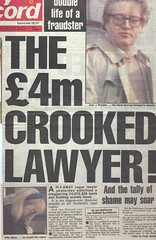
The 4m Crooked Lawyer - Daily Record 1991Expect more of these as Law Society of Scotland’s campaign to be sole regulator of legal services in Scotland begins. CHRISTMAS FOR CROOKED SCOTS LAWYERS is apparently just around the corner as the Law Society of Scotland today step up their ‘public offensive’ in the media to ensure the Scottish Government appoints the infamously anti-client lawyers-regulating-lawyers body as one of, or perhaps the sole ‘approved regulator’ of all legal related services in Scotland, after the Legal Services (Scotland) Bill clears the Scottish Parliament. The move, if allowed to happen could, according to consumer sources ensure dark decades ahead for ever growing numbers of Scots consumers who end up being ripped off by their poorly regulated solicitors.

The Legal Services Bill proposes a system of licensed legal service providers, overseen by regulators approved and licensed by the Scottish Government, an idea which came about from the results of the Scottish Government’s consultation euphemistically titled : Wider choice and better protection: A consultation paper on the regulation of legal services in Scotland. This consultation came in response to a ‘supercomplaint’ filed by consumer organisation Which? to the Office of Fair Trading in 2007, alleging lack of competition in Scotland’s solicitor only dominated legal services market.

Applications for the position of “approved regulator” do not appear at this late stage of the Scottish Parliament’s consideration of the bill to include any bodies other than the Law Society of Scotland, which would spell double disaster for consumer protection and the now forlorn hopes of the Office of Fair Trading to inject a degree of consumer choice & competition in Scotland’s monopolistic legal services market, currently under the control of Law Society member law firms.

The Scottish Government’s consultation did mention the OFT’s ‘concerns’ over the Law Society continuing to maintain its regulatory role, stating : “The Office of Fair Trading (OFT), amongst others, has expressed concerns about the regulatory and representative roles of the Society. Its view is that, in the interests of consumer protection, there should be a clear separation of the regulatory function from the responsibilities for representing and promoting the interests of the profession. It is argued that, for a profession that places emphasis on the avoidance of conflicts of interest (of even the appearance of such), undertaking both roles creates such a conflict.”

Scottish GovernmentScottish Government decided against independent regulation of legal services market, preferring to hand it over to Law Society. The Scottish Government and the Scottish Parliament have, however, brushed these concerns aside, and legal insiders close to the Justice Committee and the Scottish Government have indicated there is a will “to simply hand the matter over to the Law Society and let them get on with it”. Scots consumers should be in no doubt at all the Legal Services Bill in its current form, tweaked & twittered by the Law Society beyond all recognition from the aims of the OFT & the Which? “supercomplaint”, will definitely not bring wider choice or any “better protection” from Scotland’s traditionally poorly regulated, poor quality & extortionately expensive legal services market.

Law Society of ScotlandThe Law Society of Scotland are now promoting their regulation skills & Guarantee Fund to gain approved status for expanded legal services market. Undaunted by facts, history, and copious media coverage over the years of crooked lawyers ‘getting away with it’, the Law Society of Scotland are pressing ahead with their campaign to be confirmed by the Scottish Government as the approved regulator, touting their current regulatory regime as “rigorous”, and almost laughably describing the Scottish Solicitors Guarantee Fund as “one of the jewels in the crown of their system to protect those who have lost money because of dishonest solicitors”.

In reality, the Law Society’s deceptively titled Guarantee Fund does not live up to its title, preferring to throw out, stall, or kill off most claims made against dishonest solicitors. I reported more on the actual workings of the Guarantee Fund in March 2009, here : Law Society's 'Guarantee Fund' for clients of crooked lawyers revealed as multi million pound masterpiece of claims dodging corruption. During my reporting on the Guarantee Fund last March, so many emails & cases came in regarding clients difficulties with the Guarantee Fund, the Law Society’s supposed ‘jewel in the crown’, I issued an ADVISORY for clients to protect their funds from the lack of protection offered by the Guarantee Fund itself.

While the Guarantee Fund does all it can to avoid paying out compensation for clients money taken by dishonest solicitors, the fund also operates a policy of shifting the goal posts on whether claims qualify for its own Guarantee Fund requirements, or should be sent to the equally disingenuous “Master Policy”, the Law Society of Scotland’s Professional Indemnity Insurance scheme, linked by an independent report carried out by the University of Manchester’s Law School to suicides of clients who had attempted to claim damages against ‘crooked lawyers’.

One client who attempted to claim against the Guarantee Fund for an amount of over £118,000 which had been embezzled by his solicitor, found his claim shifted back & forth between the Guarantee Fund & Master Policy over six times, and has still not received any compensation for the money his solicitor stole from him, after over six years from making the original claim. Does that sound like “consumer protection” ? I think not …

It will also come as no surprise to readers virtually all claims against the Master Policy are also delayed, shifted between it & the Guarantee Fund, or more likely closed down by the Law Society and its insurers, Royal Sun Alliance & Marsh.
SLCC report headerReport into Master Policy revealed Law Society concealed information on client suicides. The University of Manchester’s REPORT into the Master Policy found that claimants "described being intimidated, being forced to settle rather than try to run a hearing without legal support, and all felt that their claims’ outcomes were not fair. Some claimants felt that they should have received more support, and that this lack was further evidence of actors within the legal system being “against” Master Policy claimants. Judges were described as being “former solicitors”, members of the Law Society – and thus, against claimants. Some described judges and other judicial officers as being very hostile to party litigants."

The Manchester University report concluded, “Thus, the Master Policy is essentially an insurance scheme intended to provide professional indemnity insurance coverage for solicitors.The purpose of the Master Policy, the simple answer is to allow solicitors to sleep at night. It provides professional indemnity insurance cover for firms."

Asked why the Scottish Parliament’s current Justice Committee, chaired by the Conservative’s Bill Aitken MSP, had pointedly REFUSED to call members of the public who had actual experience of making claims to the Guarantee Fund & Master Policy, a source close to the Committee said “What do you expect ? The Committee simply don't want to hear it, and the Law Society doesn't want such testimony from aggrieved consumers entering into the Legal Services Bill equation which might raise the same kinds of questions & problems that arose in the LPLA Bill.”

Clearly the Scottish Parliament’s Justice Committee are not one bit interested in the actual experiences of those who have attempted to claim compensation against either the Guarantee Fund or the Master Policy, as a vote taken by the Justice Committee and the Scottish Parliament will, just as the Law Society hoped, force anyone in Scotland making a claim against a dishonest lawyer to go through the Guarantee Fund’s abhorrent procedures, as I reported earlier in June, here : Legal Services Bill vote by MSPs will force all victims of 'crooked lawyers' to use Law Society's corrupt ‘claims dodging’ Guarantee Fund

The Scottish Government have also chose the ‘appease the aggressor’ approach, caving into the Law Society on several key consumer protection planks of the Legal Services Bill, which now appears to be little more than a self congratulatory belated birthday present for the Law Society of Scotland.

The Law Society of Scotland’s current President, Jamie Millar said in a Press Release : “The Society has sought to ensure that the Legal Services (Scotland) Bill sets out robust regulatory objectives to make sure that those providing legal services are regulated according to a strict code of conduct and professional principles to ensure that the public interest remains at the heart of legal services provision in Scotland.”

Nonsense. The Law Society’s regulation of legal services in Scotland to this date has always proved the public interest and certainly the client’s best interests remain the last issue to be considered when dealing with regulation.

An official from one of Scotland’s law reform campaign groups said this morning : “Bringing in the Law Society of Scotland as an approved regulator or perhaps, if the Law Society has its way, the only approved regulator will do nothing to enhance consumer protection against rogue elements of the legal services market should the bill become law and we will be still taking about crooked lawyers and poor regulation by the Law Society ten years from now. It will be like Christmas for crooked lawyers.”

Christmas for Crooked Lawyers indeed .. if the Law Society of Scotland remain regulator of legal services ….

You can read my own coverage of the Legal Services Bill here : Legal Services Bill for Scotland - The story so far

Friday, October 02, 2009

Legal Services Bill promises nightmare complaints scenario for consumers as Law Society campaigns to control regulation over ‘Tesco Law’ reforms

Debating chamberHolyrood's Justice Committee will consider MacAskill's Legal Services bill as arguments grow over who will regulate legal sector. Scottish consumers will be given a wider choice of who will represent their legal interests with the introduction of the Legal Services Bill, which seeks to promote alternative business structures within Scotland’s legal services sector. However, a gigantic flaw in the Scottish Government's proposals reveals confusion and poorly thought out plans to appoint ‘a regulator of its choice’ to regulate an expanded legal services market, leading to expectations the Law Society of Scotland will end up engineering its own appointment to regulate and manage anyone who seeks to enter Scotland’s legal services sector, irrespective of their professional background.

Approved Regulators for ABSRegulation nightmare for consumers predicted as Scottish Government 'to choose' a regulator with the help of the Lord President, the OFT and others. A Consumer affairs insider while welcoming the improvement in choice of legal representatives, condemned the proposals over regulation, calling them "half baked" and claiming there will be little change in the usual closed shop complaints system run by the Law Society of Scotland and the Scottish Legal Complaints Commission. She said : "The Scottish Government's proposals over appointing a regulator to oversee the expanded legal services market after the bill becomes law are a bit of a joke, given it is widely expected the Law Society of Scotland will end up as the sole regulator of the entire industry yet again. I doubt consumers would benefit from any such arrangement when it is clearly evident consumers have never benefited from the Law Society's regulation in the past."

She continued : "There are some competent proposals to widen public choice in the legal services market, however, the Legal Services Bill as it currently stands is a long way off from the expectations of consumer organisations and doubtless the many law reformers who are calling for the full opening up of Scotland's monopolistic legal services market."

The Scottish Government’s Press Release described the main points of the Legal Services Bill as being to allow solicitors to secure external investment and business expertise and to combine with other professionals to offer legal services to the public in new ways, to allow the removal of restrictions on solicitors entering into business relationships with non-solicitors, to make it easier for Scotland's leading commercial law firms to compete effectively with other UK firms and internationally, while also allegedly (and laughably) creating a robust regulatory framework in which the Scottish Government will appoint approved regulators who will regulate the new business structures

MacAskill tight lippedJustice Secretary Kenny MacAskill has chosen to concentrate on beefing up the legal profession's profits, sidelining the long standing problems of poor regulation. Justice Secretary Kenny MacAskill said: "A strong and independent legal profession is part of the institutional framework of a modern democracy. The legal profession also contributes to the Scottish economy with an estimated turnover of over one billion pounds per annum. This new legislation will help Scotland's legal profession to grow and compete both in the UK and internationally.In developing these proposals, we have worked closely with the profession to ensure that we protect the profession's core values,at the same time as freeing solicitors to offer new services in new ways. Our proportionate and flexible approach will allow the profession to move quickly to respond to changes in the market by removing outdated restrictions on business models."

Scotland’s Justice Secretary Kenny MacAskill again puts lawyers £billions before consumer protection & independent regulation.

The Government’s proposals for regulation laughably state : “There are six such principles to which persons providing legal services should adhere. These principles do not differ substantially from the professional principles by which solicitors and other legal professionals act, and are intended to ensure that the current standard of quality in the delivery of legal services is safeguarded. Licensed providers would be expected to “act in the best interests of their clients” meaning that they should, for example, observe the duty of confidentiality, avoid conflicts of interest and safeguard a client’s money and property. Licensed providers would be expected to maintain good standards of work, meaning that they should act competently, communicate effectively, be diligent and show respect and courtesy.” Surely these claims must relate to another country, because they certainly do not describe the Scottish legal services market !

A representative of legal services users today branded the Legal Services Bill 'little more than window dressing for the legal profession which contains nothing for consumers'. He said : "This is all about bringing new money into law firms and giving regulatory control back to the Law Society of Scotland. I don't see anything beneficial or productive for consumers in these legislative proposals."

Jane IrvineSLCC's Chair Jane Irvine offered no view on the new proposals. The Scottish Legal Complaints Commission's Chair, Jane Irvine was asked for comment, and replied : "I have not studied this yet." However, an SLCC insider said : "The Government's proposals over regulation of abs are messy and will cause more confusion for clients over who to make a complaint over problems with their legal representatives. The SLCC was given the role as single gateway for all complaints regarding legal services and funding that role comes from levying all entrants to the legal services market. It now looks as if the Government are now trying to undo the Commission's remit and hand regulatory power back to the profession which will be a bad thing as far as consumers are concerned."

A client with a complaint currently being investigated by both the Law Society of Scotland and the Scottish Legal Complaints Commission rounded on both organisations, branding them "useless, prejudiced, anti-client, against the public, and part of the problem of crooked lawyers, rather than a solution to cleaning up the profession."

Ian Smart Law Society PresidentPresident Ian Smart of the Law Society of Scotland is campaigning hard to become the sole regulator of the expanded legal services market, by any means possible. Quick off the hoof, Ian Smart, President of the Law Society of Scotland reacted to the Justice Secretary's proposals, saying “The Society believes that Scotland’s legal profession should be able to adapt to best meet the needs of modern society and a global economy. Scots lawyers are well respected around the world and we want to ensure that our members have access to the opportunities that ABSs could present to adopt new practices, to deliver the services their clients expect and develop their businesses in Scotland, as well as elsewhere in the UK and overseas.”

"However it will be vitally important that the Bill ensures the independence of the legal profession, promotes access to justice and maintains robust consumer protections and high standards among those delivering legal services. Effective regulation will be key to any plans for change. We look forward to engaging with the Scottish Government, the Parliament and other interested parties in the future development of legal services in Scotland.”

An analysis of Ian Smart's comments of how the Law Society has handed the debate on alternative business structures indicate his claims are pure fantasy. In reality, the Law Society attempted to vote down the abs proposals, which only passed into the profession's overall policy after legal firms themselves took the initiative and demanded changes. Where Mr Smart speaks of 'promoting access to justice and maintaining robust consumer protections and high standards among those delivering legal services', the simple fact as we all know is these fanciful 'consumer protections and high standards of service’ have never existed in Scotland's justice system, nor has unrestricted access to justice, a fact which Lord Gill's Civil Courts Review more than adequately attests to, alongside the Lord Justice Clerk's own condemnation of Scotland's Justice system as being that of a Victorian justice system stuck in the past.

With Ian Smart's call for ‘effective regulation to be key to any plans for change', readers can take that to mean the Law Society of Scotland will be cracking the whip over Kenny MacAskill to ensure it is conveniently appointed as regulator of choice, and internal memorandums seen by this reporter do seem to suggest that will be the case, even before the bill has been debated at the Scottish Parliament's Justice Committee.

Make no mistake, the Law Society of Scotland do not deserve any further regulatory function over the Scottish legal services market. This has been proved time and again over the decades, which have seen average complaints figures of around 5000 individual complaints a year made against less than 10,000 solicitors, leaving a trail of literally thousands of clients who have fell victim to crooked lawyers who mostly remain in practice to this day, through the protection of the Law Society's considerably corrupt system of self regulation, brutally enforced by its sinister Client Relations office.

Which logoConsumer group Which? criticised the Scottish Government for failing to bring in an independent regulator to protect Scots consumers. Which? principal public affairs officer, Julia Clarke, said : “This legislation will improve access to justice for people in Scotland and sweeps away outdated restrictions on how lawyers work.The Bill promises to breathe new choice and competition into legal services, which should lead to economies of scale and costs, and possible one-stop shops offering better service to consumers.”

She continued : “While we would have preferred an independent regulator, we are pleased that the Law Society of Scotland’s regulatory committee will have a lay majority and a lay Chair, introducing a much-needed consumer voice in this sector. It is disappointing that Advocates are not included in the new legislation, as we see no reason for them to be exempted from the opportunity to offer more choice to consumers.”

Consumer Focus ScotlandConsumer Focus Scotland broadly welcomes the Legal Services Bill. Sarah O’Neill, Head of Policy and Solicitor at Consumer Focus Scotland, said : “We have long campaigned for a more open market in legal services in Scotland and the creation of new ways of delivering them. The Legal Services Bill paves the way to open up competition in the market and widen choice for users of legal services.”

Clearly the Legal Services Bill is flawed, in respect of regulation, and the number of alternative choices it offers Scotland's consumers in terms of who we wish to represent our legal interests. You can read two of my earlier reports on the flaws of the Legal Services Bill, here : Scottish Govt's Legal Services Bill 'must do more' to break Law Society's grip on legal marketplace & give public wider choice over access to justice and a topical one on the subject of the proposals over regulation, here : Consumers & Govt insiders brand Law Society ‘too crooked’ to regulate ‘Tesco Law’ expansion of legal services in Scotland

You can download the Legal Services Bill from the Scottish Parliament’s website using the following links :

The opportunity to debate the Legal Services Bill, make submissions on personal experiences on dealings with the legal profession, and suggest changes & improvements to the Scottish Government's proposals should not be missed by the public, who can contact the Scottish Parliament's Justice Committee when bill begins its path through the Parliament.

You can contact the Justice Committee by email on the subject of the Legal Services Bill, offering your thoughts, submissions and suggestions on the Legal Services Bill, here : justice.committee@scottish.parliament.uk or use their online communication form.

Monday, May 12, 2008

Law Society's proposals on legal services market overhaul spin wide of the mark on public interest

In the latest salvo of publicity from the Law Society of Scotland fired in an attempt to sell the recent Alternative Business Structure policy document as the legal profession's 'acceptance' of an opened legal services market, I was pointed by a solicitor to an article in today's Scotsman, with a comment that 'drivel knows no bounds' - admittedly, his own firm siding on the 'open the legal services market' argument, which I support myself - intended to bring access to justice for all, not some, as the Law Society would have it ...

The Law Society does seem at pains to sell their proposals as an 'acceptance' that the current closed shop of the Scottish legal services market, which forces anyone who wishes to use legal services or gain access to the courts to go through a member of the Law Society of Scotland itself, will be opened up.

In reality however, as I covered in my earlier article on the ABS proposals, the Law Society's ideas for 'alternative business structures' fall very short of any form of acceptance of an opened legal services market. You can read more of my earlier coverage of this issue here : Law Society policy blunders on legal market reforms leave public in the cold, favouring control of regulation & access to justice

Indeed, within the ABS policy paper recently produced by the Law Society, there are several attempts by the current governing body of the Scots legal profession to retain and even extend the Law Society's control over the legal services market, notably recommending the Law Society itself be reinstated as the sole regulator of the Scots legal services market - a recommendation which if Kenny MacAskill accepted, would have dire consequences for the public's access to justice and clients rights.

In today's Scotsman, I found the following portions of their 'report' (actually written by a freelancer studying for an LLB to become a solicitor herself perhaps) to be rather interesting :

From the Scotsman : "In its new policy paper on alternative business structures (ABS), the Law Society has embraced the principle of allowing solicitors to explore new working models.

Aside from the inevitable caveat that appropriate regulation needs to be in place to deal with issues such as independence and conflicts of interest, the society's council says it wants to set out a timetable for "early and energetic progress" towards the framework for ABS."

Well ... it seems that despite the Law Society's attempts at making what is a 'leap into the public interest' it cannot resist qualifying its efforts with conditions such as 'nothing gets done unless we, the Law Society, get to regulate what comes next' - a true sign that in reality, nothing much has changed within the Law Society itself, where the desire to regulate and in effect, control the entire legal services market for itself, is still far more important than clients rights, or even the voting rights of its own solicitors in the profession's policy doctrine.

The Law Society of Scotland, based on its previous & current administration of complaints against lawyers, certainly can have no claim whatsoever to remain as the regulator of any opened up legal services market, for such a development would spell the certain disaster for the future, which has constantly troubled the legal profession in the past and present.

The Law Society cannot be allowed to have any say or role in regulating what should and hopefully will be an opened legal services market, which provides the Scots public with direct and unrestricted access to justice, offering quality and dependable legal services with an unrivalled consumer protection system which the Law Society itself could never offer or provide.

Going back to the Scotsman article once more : "If one thing has been consistently clear during the debate about ABS it is that change was going to happen. The question for the Law Society was whether that change would be driven by them or foisted upon them."

I'd say there is little doubt that some measure of 'foisting' must surely be the case, and soon, because if we travel at the Law Society's pace over the ABS proposals, we will still be discussing them this time next year ...

Finally, if perhaps to inject some macabre humour into the article, the final lines attempt to gloss over the Law Society's policy of resistance to what is now the Legal Profession & Legal Aid (Scotland) Act 2007 ...

Again, from the Scotsman : "Those who recall the society's handling of the complaints handling consultation leading up to the Legal Profession and Legal Aid (Scotland) Act might have expected it to take a similarly conservative approach to ABS.

This time, by embracing both the reality and the opportunity of change, the society has taken a significant step forward."

Yes, many remember the Society's handling of the complaints handling consultation - and the likes of Douglas Mill's threats against the Scottish Parliament & Government if the then LPLA Bill made it into legislation.

The Herald : Douglas Mill threatens the Scots Parliament with legal action if regulation of complaints against lawyers is made independent ...

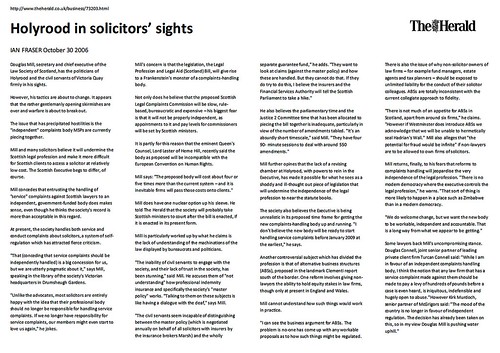
Holyrood in Solicitor's Sights Octover 30 2006 The Herald

For myself though, I would have to point to the ferocity in which Douglas Mill, the current but resigning Law Society Chief Executive gave controversial testimony to the Scottish Parliament's Justice 2 Committee, which revealed a concerted policy by not only himself but others at the Law Society and their insurance arm Marsh UK to undermine and restrict not only clients rights, but also the general rights of the public over those 'complaints handling procedures' the Law Society cherishes so much and oh .. just by chance, that testimony is of course available on video ...

Law Society Chief Executive Douglas Mill tells a few lies to the Scottish Parliament ... and Cabinet Secretary John Swinney ...

And just for good measure, here is the Herald's excellent report on that same Justice 2 Committee confrontation between Douglas Mill & Cabinet Secretary John Swinney here :

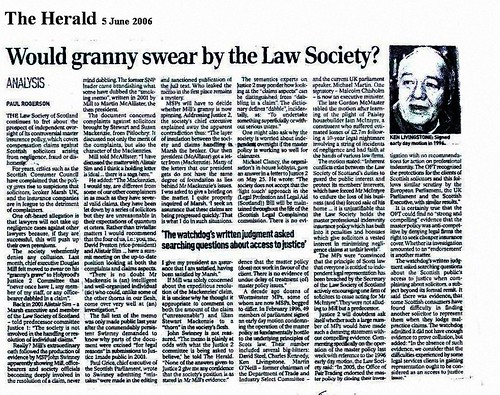
The Herald: Douglas Mill's granny would definitely not swear by her grandson or his Law Society ...

The Herald 5 June 2006 - Would granny swear by the law society

Should such people as Mill and such organisations as the Law Society really be allowed to have any say in regulating their own or a future 'opened market' when they have demonstrated such maligning of the public in the past and where still, there is no will to resolve and heal their terrible sins of the past ?

I think not ... not at least until those who have done the most damage to the Scots legal profession and the client's trust in it, come to the table with an attitude to put things right.

However, the Scottish Government, well .. to be more precise, the current Justice Secretary Kenny MacAskill came out with a statement regarding the Law Society's proposals - one could say .. the following is a predictable choice of words, coming from Mr MacAskill who seems uninterested in change for the public good ? :

“The Justice Secretary is considering the detail of the Law Society’s proposals and will respond in due course. The Scottish Government’s overarching aim is access for all to high quality legal services, within a competitive market which is appropriately regulated.

“At the Law Society’s conference in September last year, the Justice Secretary challenged the legal profession to take a lead in identifying how it can move forward and the Scottish Parliament endorsed this approach in a debate last November. The Law Society has now consulted its members and these proposals have followed on from that consultation.

“In his response to the OFT following the super complaint by Which?, the Justice Secretary said that he did not envisage setting up a new regulatory body in Scotland because this would be disproportionate and inefficient. Oversight of regulation is provided by Scottish Ministers and the Lord President and the Scottish Government believes this framework remains generally appropriate.

A slight abandonment of the Scots public by our Justice Secretary once again, where leadership in this defining issue, in the public interest should be shown but sadly it looks like none is present ? Could it be that Mr MacAskill is falling hook line and sinker for the Law Society's ABS policy line ? frightening stuff indeed ...

The Scotsman reports :

Significant step for Law Society

By Jennifer Veitch

HOW time flies for the legal profession in Scotland. Can it be a year since Which? made their 'super-complaint' to the OFT about our legal services market?
Yet here we are, 12 uncertain months later, and the full implications of the consumer group's move are only just beginning to take effect – but what an effect that might be.

In its new policy paper on alternative business structures (ABS), the Law Society has embraced the principle of allowing solicitors to explore new working models.

Aside from the inevitable caveat that appropriate regulation needs to be in place to deal with issues such as independence and conflicts of interest, the society's council says it wants to set out a timetable for "early and energetic progress" towards the framework for ABS.

Further, it has encouraged the Scottish Government to "amend or repeal" legislation that "impedes or prevents" ABS "as soon as possible." So, barring some sort of grassroots revolt at next week's AGM, it looks like some form of alternative structure will become reality.

The timescale could be relatively swift if the regulation, which is covered in some detail in the policy paper, was all that was required to be addressed. But there is a much bigger problem facing the profession that will be much more difficult to resolve.

As the society's council acknowledges, one of the core themes to emerge from its consultation on ABS earlier this year was that any new structures should not "negatively affect" access to justice. The policy paper's references to the current make-up of the profession in Scotland indicate why it should be of such concern. While large and medium-sized firms have been arguing for a level playing field with the post-Clementi English marketplace, the vast majority of Scottish lawyers do not play in a UK league.

According to the society, there are 1,247 firms in Scotland, of which nearly half are sole practitioners. More than a quarter of the 10,500 solicitors with practising certificates are working in-house and cannot offer direct services to members of the public.

The society's policy paper acknowledges that introducing ABS will affect access to legal services, and it has called on Holyrood to "protect and promote" fair and equal access.

The focus now needs to shift on to how the profession and government can work together, in partnership with the voluntary sector and consumer groups, to ensure that happens in tandem with any regulatory reforms.

While access to justice is a major concern, change to the traditional business model will bring new opportunities, and not just for the big firms. This week's article on the new Community Law Advice Network shows that there are innovative ways of working in the not-for-profit sector.

If one thing has been consistently clear during the debate about ABS it is that change was going to happen. The question for the Law Society was whether that change would be driven by them or foisted upon them.

Those who recall the society's handling of the complaints handling consultation leading up to the Legal Profession and Legal Aid (Scotland) Act might have expected it to take a similarly conservative approach to ABS.

This time, by embracing both the reality and the opportunity of change, the society has taken a significant step forward.