Friday, June 05, 2009

Justice Secretary accused of attempt to undermine Lord Gill civil justice review as Government backed survey targets only 35 court users

MacAskill tight lippedJustice Secretary Kenny MacAskill's woefully limited survey may undermine civil justice reform proposals. SCOTLAND'S Justice Secretary Kenny MacAskill is today facing allegations of covering up litigation difficulties & failures in the Civil Courts as a taxpayer funded survey carried out by Ipsos-MORI on behalf of Consumer Focus Scotland and the Scottish Legal Aid Board is today revealed to have targeted only THIRTY FIVE PEOPLE from the thousands of litigants who each year use the Scottish Courts system for civil litigation.

SLAB & CFSScottish Legal Aid Board & Consumer Focus sponsored the ‘limited’ research. The survey, titled "Consumer views and experiences of using the civil courts in Scotland" was to be intended to support the forthcoming release of the Lord Justice Clerk Lord Gill's review of Scotland's Civil Justice system, including his recommendations for reforms, which are rumoured to be ‘groundbreaking’ and will also include recommendations to allow Scots to use the facility of McKenzie Friends (used successfully in England & Wales for 39 years) to assist civil litigation cases where legal representation cannot be secured for a number of reasons.

A spokesman for the Scottish Legal Aid Board gave some background to the survey : "There is very little information currently available in relation to the actual experiences of litigants as they move through the court processes. The press release which accompanied the consultation paper to the Civil Court Review picked up this point :

‘We are especially interested in hearing from members of the public about their experiences of the civil court system. In this way we can ensure that their voice is heard and that their interests are central to any recommendations for reform that we make’.

In response to the weak evidence base and this statement, the Scottish Legal Aid Board (the Board) and Consumer Focus Scotland agreed to jointly commission research that would help us better understand the nature and drivers of civil litigants’ views and experiences of Sheriff Courts. The research describes the experiences and views of people coming before Sheriff Courts in Scotland for civil matters. It identifies and explores the factors associated with these experiences and levels of satisfaction.

A Research Advisory Group was established to help steer this work and to ensure the methods and approach were appropriate. The Board, Consumer Focus Scotland, Scottish Government, the Scottish Court Service and members of the Civil Courts Review Policy Group were members of the advisory group.

At the initials stages of the research we had hoped to deliver a relatively large scale quantitative survey of court users. However we were unable to access the court records that would be needed to deliver such a representative survey.

A second option was therefore subsequently developed. This involved contacting and securing the support of In Court Advice services to gain access to their service users. In addition to in court advice clients, we also contacted people who received legal aid for their sheriff court case. This allowed us to gather views from people who had representation for their case.

The research is qualitative in nature, an appropriate way of exploring views and experiences. Thirty five interviews were conducted with a range of civil litigants. Litigants had been involved in a variety of case types, including small claims actions, debt, housing/eviction actions and mortgage repossession proceedings.

The sample did not include other court users such as witnesses or jurors in civil cases. The sample included both defenders and pursuers. It included not only those whose case was actually heard in court, but those who were involved in civil legal proceedings at other stages. The interviews covered a range of issues, from access to legal advice and representation through to expectations and experience of going to court e.g. specific concerns; how people felt about the experience and the communication they had with the court.

The scope of this research must be stressed. The research is qualitative in nature therefore it does not measure the incidence of or how representative views and opinions are. It does however provide valuable provide insight into views and experiences, which we hope will be built upon in the future as evidence in this area grows.

We were unable to talk with people who were unrepresented and did not use an In Court Advice service. We are aware that this group may be even more likely to report some of the problems highlighted in the research and or may possibly report different experiences and views of the court process.”

Lord GillLord Justice Clerk Lord Gill looks set to give some harsh criticisms of Scotland’s Civil justice system. On hearing of the difficulties with the Scottish Government inspired survey, sources from both the legal profession and public campaign groups claimed the survey of Civil Courts users was not advertised enough throughout the Courts system for members of the public to participate, and may have had an unfair restricted remit due to the fact the Scottish Government fear extensive negative views from the general public on their inability to use the civil justice system or even secure the necessary legal representation to access the courts – the latter being a topic of constant debate for many years in Scotland, amid many proposals by the Scottish Law Commission and surveys the former Scottish Consumer Council requesting civil law reform.

I have written about Lord Gill’s criticisms of Scotland’s Civil justice system in an earlier report here : Lord Gill : 'Victorian' justice system fails public as soaring injustice & poor legal services undermine credibility of Scots law.

You can read more about Lord Gill’s Civil Justice review here : Lord Gill's Civil Courts Review

A legal source this morning said "For a survey which is supposed to back up Lord Gill's review of the civil justice system, it looks more like the Government has attempted to railroad the Lord Justice Clerk's findings before they are published, giving themselves reasons not to undertake the necessary reforms to be recommended, which we know ourselves as solicitors, must be implemented if the issues of lack of public access to justice are to be tackled properly."

A source from a consumer group called the survey “A political stunt which will hopefully backfire on the Justice Secretary due to the limited numbers of individuals approached for evidence on such an important issue.”

A client with an ongoing civil case who has experienced "incredible difficulty over a number of years with his litigation due to the dismal state of the civil justice system said : "I have some questions for the Research Advisory Group. Why did they not publicize this much more widely if they were concerned to obtain litigants views, particularly careless of them when they claim there is an already existing 'weak evidence base'. Thirty five interviews is a damning indictment when complaints about the legal profession run into the thousands annually.”

Further questions were raised over the incredibly limited remit of the survey and apparent unwillingness of even the Scottish Court Service to divulge court records : "Who refused them access to Court Records and why? - past published case law is readily available on the internet. What is the point of research which does 'not measure the incidence of or how representative views and opinions are' ? Why were they 'unable' to talk to people who were unrepresented ? “

An official from IPSOS MORI speaking in response to inquiries made on the little known research said : "The scope of the research was fairly limited, and this is acknowledged in our report. We spoke to a very small sample of litigants who had contacted an in-court advice service and a sample of litigants identified through Scottish Legal Aid Board applications data was also provided to us."

The Justice Secretary could not be contacted today for comment on the revelations.

So. Can a survey of 35 people from the thousands of Scots who have to use the Courts system for litigation, defence of their legal affairs & interests, and pursuit of justice, be a fair indication of the problems which many individuals encounter when they try to take a case to court, especially if the issues involve going up against notoriously corrupt professions or cases where access to justice is routinely denied ?

I think not, and I do hope Lord Gill is taking note of these goings-on, and makes appropriate comment when the time comes ….

Thursday, June 04, 2009

Westminster Expenses : Ex Scottish Borders Libdem MP Lord Kirkwood claimed furnishings & more on taxpayer - should be stripped of title

archiekirkwoodArchy Kirkwood as a member of Parliament offered little help to victims of crooked Scottish Borders lawyers. Former Scottish Borders MP, now 'Lord' Archy Kirkwood features in today's Telegraph newspaper revelations on the Westminster expenses scandals, and deservingly so, as the paper reports he "claimed £5,000 in expenses to refurbish his London flat before retiring as an MP and selling it to his daughter for less than half its value."

Scotsman coverage of some of the stories relating to Andrew PenmanArchy Kirkwood offered little help against crooked lawyer Andrew Penamn & crooked accountant Norman Howitt. I always wondered what Archy Kirkwood did for the Scottish Borders, because all I was ever able to secure from him was a letter writing contest to the former Scottish Office then Scottish Executive on the corruption of crooked Borders lawyer Andrew Penman of Stormonth Darling solicitors, Kelso - right in the heart of Archy Kirkwood's constituency. It seemed to me, backed up by information provided by others in the region, Mr Kirkwood was a touch soft on the likes of crooked lawyers, and particularly didn't want to do much regarding corrupt Borders accountants such as Norman Howitt, who you can read more about here : A picture is worth a thousand words - Images of fraud reveal corruption & deceit by lawyers & accountants in the Scottish Borders

Norman Howitt Accountant JRW Group Hawick Scottish BordersBorders accountant Norman Howitt of JRW Group, Hawick took pensioner’s pension & bank book, even made false statements to Police to cover his tracks, but Kirkwood did nothing. Now, you’d think ‘Lord’ Kirkwood would have done something about a crooked accountant confiscating a pensioner’s pension book and wanting to take control of a pensioner’s entire savings for himself .. but, strangely, no. It seems there was too much to gain from supporting the same crooked accountancy and legal firms as one of the region’s leading solicitors informed me …

However, it wasn't just me who felt the lack of support from Mr Kirkwood during his time as an MP, after several people in the Borders began to contact me over similar problems in getting Mr Kirkwood to do anything for them at all other than the standard fair of writing letters, while refusing to raise issues or early day motions at the Westminster Parliament, during the time where that's all we had as a legislature.

Taking a look around the Scottish Borders as I did before I left it years ago (and apparently it has changed little to-date) backs up the idea the region needs younger, harder working idealistic politicians who have the region's people and Scotland's interests at heart, rather than preferring the Westminster cabal to give them long term jobs and the facility to milk the taxpayer for expenses while their constituency lies in ruins.

I note Lord Kirkwood still remains in the LibDems armoury, his name cropping up on the GovNet website here, alongside other such luminaries as Lord Foulkes of Cummock, also an MSP : Govnet Advisory Board, which lists his following details as :

Lord Archy Kirkwood of Kirkhope

Archy Kirkwood was MP for Roxburgh and Berwickshire for 22 years, standing down at the May 2005 General Election. First elected in June 1983, he became the Liberal Party’s spokesman on Health, Social Services and Social Security. In 1992, he became the Chief Whip of the Liberal Democrat parliamentary party. In 1997 Archy became Chair of the Social Security Select Committee (now Work & Pension Committee).

He served on the House of Commons Audit Committee and on the House of Commons Commission and was knighted in 2003 for services to Parliament. Archy was made a life peer in 2005. He is currently head of external relations at the office of the Liberal Democrat Leader.

However, despite all of his positions, 'Lord' Kirkwood is now revealed as just another British politician who has milked the taxpayer, for, as the Telegraph reports, everything down to £3,000 for carpets and flooring for his kitchen and bathroom from John Lewis and £94 for a lavatory paper holder and tiles from Fired Earth.

Not satisfied with that, as the Telegraph continues to report, he returned to John Lewis to buy a £207 bathroom cupboard and mirror, curtains for £90 and lighting worth £72. Whatever relationship carpets, flooring, and other furnishings has to politics, evades me. Pay the money back. In fact, give up your title - as sure as all titles should be stripped from any politician caught milking the system.

Congratulations to the Telegraph for their excellent reporting, and I hope someone makes 'Lord' Kirkwood pay all the money back he has claimed from the taxpayer, along with all the other Westminster, and Scottish politicians who have done the same. Politicians are paid plenty for their job, and should bear in mind its all about representing the community, not ripping us off.

Pay the money back 'Lord' Kirkwood. In fact, since everyone was recently shouting to take Sir Fred Goodwin's title away, give up your title too, 'Lord' Kirkwood, as sure as all titles & privileges should be stripped from any politician caught milking the system.

The Telegraph reports :

MPs' expenses: Lord Kirkwood did up flat on expenses, then sold it cheaply to daughter

Lord Kirkwood, a Liberal Democrat peer, claimed £5,000 in expenses to refurbish his London flat before retiring as an MP and selling it to his daughter for less than half its value.

By Jon Swaine
Published: 10:30AM BST 03 Jun 2009

The peer, a work and pensions spokesman, used public funds to buy carpets, curtains and bathroom furniture for his Westminster flat from stores including John Lewis and Fired Earth.

He made the purchases after announcing in April 2004 that he would retire as MP for Roxburgh and Berwickshire at the general election in May 2005. During his final year in the Commons, he claimed a total of £18,806 in allowances for the flat, which he bought for £182,500 in 2001.

These included about £670 a month to pay the interest on its mortgage. He then sold it in May 2007 to his daughter Holly, 31, a journalist for Country Life magazine, for £100,000. On Tuesday he said the flat had been valued at £225,000.

Three weeks before the sale, a flat in the same building sold for £358,000.

When he made the claims, Lord Kirkwood, then Sir Archy Kirkwood, sat on the House of Commons commission which was overseeing the first publication of basic details of MPs' expenses. As the details were published in October 2004, he said that he welcomed the fact that "taxpayers can really see how their money is being spent".

However, he dismissed suggestions that voters would be shocked by the amount of money involved. "I'm not saying it's an insignificant sum, but it's pretty small beer," he said.

Between November and December 2004, Lord Kirkwood claimed more than £3,000 for carpets and flooring for his kitchen and bathroom from John Lewis. He also claimed £94 for a lavatory paper holder and tiles from Fired Earth.

In April 2004, the month he announced his intention to step down as an MP, he claimed £200 for repairs to the flat's electrics. In June 2004, he claimed £50 for fans. In July he claimed £660 for unspecified work by a contractor.

Over the following months, he returned to John Lewis to buy a £207 bathroom cupboard and mirror, curtains for £90 and lighting worth £72.

In February 2005, he claimed £145 for a clothes rail and storage devices, £78 for kitchen stools and £56 for roller blinds. He also claimed £115 for computer equipment through his office expenses two months before he retired.

Lord Kirkwood, 63, had designated as his main home a house in Selkirk where he still lives with his wife Rosemary.

He claimed more than £63,000 in House of Lords allowances last year, including £20,019 on overnight subsistence: the Lords' equivalent of second home allowances.

He claimed £11,419 in "day subsistence" allowances, £11,419 in office running costs and £9,741 in travel costs.

Lord Kirkwood, who was knighted for services to Parliament in 2003, was one of five Lib Dem MPs put forward for peerages by Charles Kennedy, the then party leader, after the 2005 election. He announced his retirement after it was decided that his seat should merge with that of Tweeddale, Ettrick and Lauderdale, which was held by Michael Moore, a fellow Lib Dem.

Lord Kirkwood said yesterday: "When I sold the flat to my daughter a professional valuation was secured on the property. It was valued at £225,000. This was declared for capital gains.

"The fuse box and wiring system was unsafe and needed to be replaced. There were some costs of relaying flooring in parts of the property."

Wednesday, June 03, 2009

Scotland's Got Crooked : Police investigation reveals hundreds of crooked lawyers & accountants assisting organised crime gangs

Law Society of ScotlandHundreds of Law Society of Scotland ‘crooked lawyers’ are helping crime gangs. A survey reported today in the Scotsman newspaper reveals what many inside & outside the legal profession already know - that organised crime gangs in Scotland are assisted by hundreds of crooked lawyers, crooked accountants and other "specialists" who help criminals evade justice.

Law Society of Scotland & ICASScottish lawyers & accountants self-regulate, allowing criminality to flourish in their professions. While the self regulating bodies of lawyers & accountants in Scotland - the Law Society of Scotland & the Institute of Chartered Accountants of Scotland profess to maintain their 'respective' professions in order, in reality hundreds of solicitors & accountants and their firms are in the pay of criminal gangs, with some of those concerned masquerading as small legal or accountancy firms, taking on innocent local clients & businesses to cover the profits generated from some of their less respectable associations.

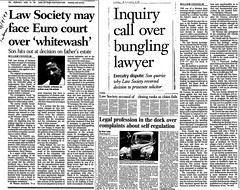
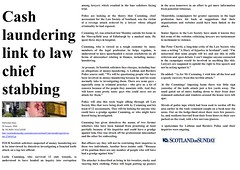
Cash laundering link to law chief stabbing - Scotland on Sunday 29 January 2006Law Society chief Leslie Cumming suffered mafia style hit from his own crooked lawyer colleagues. While members of the public who trust their legal affairs to solicitors & legal firms who have an undisclosed darker side of clientele, even the Law Society of Scotland itself was hit in a mafia style assault in early 2006, when the solicitor's regulatory body's Chief Accountant, Leslie Cumming was attacked in a 'hit' arranged from within Scotland's crooked legal establishment over what some claim were investigations which involved big legal names,

Douglas Mill 4Law Society Chief Exec Douglas Mill tried to pin blame on campaigners in newspaper reports on Cumming attack but real culprits were crooked lawyers. To-date, the assault on Mr Cumming, apparently arranged by colleagues from within the legal profession itself, remains unresolved, with Lothian & Borders Police still looking for clues. However, several legal insiders say the investigation into the attack on Cumming “was heavily compromised” after the then Law Society of Scotland's Chief Executive Douglas Mill viciously tried to implicate campaigners & law reformers in the mafia style hit on Mr Cumming, to deflect attention away from critical legislative reforms which were due later in 2006 and which ultimately led to Mill's subsequent downfall and resignation from the Law Society after a serious parliamentary confrontation with Cabinet Secretary for Business, John Swinney.

Lothian & Borders Police still looking for crooked lawyers who arranged attack on Law Society Chief :

With an ever growing criminal element within Scotland’s legal profession, we are of course, back to the problem of 'self regulation' where, specifically on the matter of 'crooked lawyers', the Law Society of Scotland has failed to maintain standards within Scotland's legal profession, and all the while has operated a closed shop, highly corrupt system of self regulation where the criminal element of Scotland's 10,000 solicitors can basically get away with criminality, as long as they pay their subscription fees to the Law Society, which help the Society continue to maintain its power of self regulation over the profession.

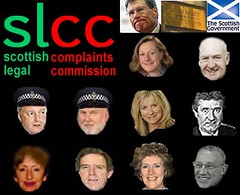
SLCC membersScottish Legal Complaints Commission is as protective of crooked lawyers as the Law Society of Scotland. The £650 a year to the Law Society of Scotland in annual subscriptions, and the £400 complaints levy to the SLCC which solicitors willingly pay, keeps self regulation of the legal profession going, which allows solicitors to assist the likes of criminal gangs, or fleece clients at will, mostly without fear of a criminal prosecution because the Law Society, and as we see now, the new ‘independent’ Scottish Legal Complaints Commission, are both so incompetent or closed minded at investigating corruption within the legal profession that the evidence which the Police & Crown Office would have to rely on to prosecute solicitors for stealing from their clients is more often than not, covered up by the solicitors regulators.

money£650 a year to fund Law Society ‘ in-house complaints system’ guarantees lawyers will face no charges over widespread criminality in handling client affairs or law breaking. Its as simple as that - pay £650 a year in subscription fees, and a crooked lawyer can go do what they please, overcharge, embezzle, steal, bend the law, bribe, act as drug dealers, threaten clients, blackmail, anything, and not get sent to jail, unless of course, whatever they are doing and whoever they are representing becomes just too public and attracts too much media attention.

It may well be the case you are unknowingly entrusting your life savings, last will & testament, or funds for a house purchase or sale to a solicitor who is little more than a convicted criminal, and you will never know it unless the law is changed, and there is considerable resistance from the legal profession in Scotland to changing the law to disclose the criminal records of solicitors, although in England & Wales, you do stand a greater chance of finding out, as I reported earlier, here : Criminal records of lawyers : Scots public kept in dark over convictions while England & Wales get ‘right to know’

Sadly the Scots legal profession, as crooked as it is, has far too many key supporters & defenders in high places, as Scotland’s own Justice Secretary, Kenny MacAskill himself demonstrated in outrageous comments during a Scottish Parliament debate, even claiming the SNP controlled minority Scottish Government owed the legal profession a mysterious ‘great debt’ :

Would Justice Secretary Kenny MacAskill be so quick to defend the criminal element of Scotland’s legal profession ?

This is the reality of self regulation, nothing more than a cover for criminality, and with business & profits on the slide in Scotland's legal & accounting professions, expect to see a lot more crooked lawyers, accountants and other so-called 'professionals' out there who might also just be your solicitor or accountant too.

Those who defend self regulation are, these days, in the wake of the Westminster expenses scandals, generally viewed as defending unacceptable, often morally wrong conduct, cronyism & criminality, and in my view, have no place in public life.

The Scotsman reports :

The gangster map: 3,000 hardcore criminals and their crooked lawyers

Tuesday, June 02, 2009

‘It’s all about money, not justice’ as lawyers greed on legal fees spills over at Law Society AGM

Law SocietyLaw Society of Scotland won vote delaying practising fees row for now. PROTESTS from lawyers at last week's annual general meeting of the Law Society of Scotland over the 'high cost' of an annual practising certificate which allows solicitors to work, were insufficient to sway enough of the votes for an immediate reduction in the current annual practising certificate levy on solicitors of £665, raising the threat that many solicitors will increase their already exorbitant fees for legal work carried out on behalf of clients.

Instead, the Law Society won a five month delay to consider how it will react to members unwillingness to pay £665 a year to fund the huge salaries of staff and officials at the Law Society of Scotland's Drumsheugh Garden headquarters in Edinburgh, where as we saw in an earlier report, the current Chief Executive, Lorna Jack's salary along with the costs of her office which now stand at £326,000 a year.

Eileen Masterman & Philip YellandLaw Society’s Philip Yelland & SLCC’s Eileen Masterman do similar jobs on £1,350 a week. With solicitors already having to fork out £400 or so a year to fund the Scottish Legal Complaints Commission, where Commission members are on up to £350 a day plus expenses, and officials such as the Law Society’s Director of Standards, Philip Yelland, and SLCC Chief Executive Eileen Masterman, are both doing the same job on salaries of £1,350 a week - all paid for out of solicitors pockets.

No doubt, the grumbles within the profession over these legal fat cat salaries will continue, but some legal firms are seemingly using their imagination to recover from clients, what they perceive to be the high costs of being a solicitor.

In several examples of accounts sent out to clients which have been brought to my attention, legal firms across Scotland are recouping their running costs and issues such as the cost of the practising fee, by issuing false fee demands to clients for legal work which has never been done.

I have reported on this subject earlier, here : Lawyers stealing from clients to earn 'double fees' while Law Society looks the other way in vast network of legal aid fraud & embezzlement & here : Lawyers fraudulent fee demands must be curbed by independent fee watchdog as culture of greed prohibits public access to justice

It is now becoming commonplace for legal firms to send out accounts to clients, falsely claiming they owe money on case work, some examples of which date back to over 10 years, where solicitors and their firms are regularly claiming to clients that “accounts have been overlooked and must now be settled”, with little or no explanation being provided for what work was actually done on the clients behalf.

Examples I have seen of some of these purely fake fee demands to clients have run into tens of thousands of pounds, the bills usually being accompanied with a seven day threat of legal action if payment is not made immediately, although when the legal firms are asked for specification & evidence as to exactly what work the solicitor did, the accounts are ‘reduced’ to in some cases, about a tenth of what was originally sought from the client, on threat of recovery.

A legal insider today admitted he was well aware many firms were sending out inflated bills. He said : “Many solicitors feeling the pinch have decided to look back through their work to see if they have missed sending out bills to clients.”

“Several of my colleagues are aware of a rising tide of complaints to the Law Society where clients are alleging they are in receipt of accounts from their solicitors for work which was never authorised or agreed to, and which there is no evidence even took place.”

He went on to claim that lawyers were being protected from criminal charges over the false fee demands, simply because of self regulation of the legal profession in Scotland : “If it were not for the fact the profession self regulates, I have no doubt the Police could be called in and fraud charges laid against several legal firms & individual solicitors.”

Of course, none of these issues were discussed at last week’s annual general meeting, although most or all of those legal firms attending are currently engaged in such practices, inspired by weak & corrupt self regulation, carefully maintained by the Law Society of Scotland, with any legislative reforms stifled by political allies to the legal profession.

Arguing about the cost of a practising certificate, while complaints, corruption, negligence, criminality and fraud spirals out of control among Scottish legal firms, will not repair the damage that lawyers have done to themselves, and their own business, and to public access to justice in Scotland.

The Scotsman reports :

No fireworks, but membership costs the burning issue