Showing posts with label Scottish Courts and Tribunals Service. Show all posts

Thursday, October 20, 2022

SCOTS LAW: Legal Highs, Legal Lows. A legal profession which prides itself in preying on clients, ripping-off Legal Aid, fixing court outcomes, concealing malicious prosecutions & judicial conflicts of interest, obstructing public access to justice - and - Why you should really question much of what your lawyer tells you.

World leading? Not a chance M'lud. ONE DAY is a long time in Scotland’s legal world, let alone a full year – but we all can be assured the consistency of wrongdoing, industrial scale dishonesty, legal fee overcharging & outright malice - from Scotland’s legal profession - whether it be in dealing with clients, working in court in civil hearings or in criminal trials, or working for public authorities – is never ending.

While blog journalists have been working on real life cases for the past year, it may be worth reminding readers your rights with regard to regulation of your legal representatives, are as ineffective and futile as they have ever been in Scotland, right up to this date.

After all, since 2008 and some Thirty Five Million pounds plus, later – much of it recovered from fees you pay to your solicitors *and perhaps money & assets your solicitor strips you of when your case goes not the way you were told it would - the Scottish Legal Complaints Commission (SLCC) has not once named a corrupt solicitor or law firm – or actually had any impact on standards of legal service in Scotland.

Fourteen years for the Scottish Legal Complaints Commission - billed in 2008 as an “independent” regulator of Scotland’s legal services – to have absolutely zero material impact on the scale of dishonesty in Scotland’s legal profession – is itself a tribute to how corrupt Scotland’s legal mcmafia really is, and – an indicator of the sheer level of control exerted by professional groups such as the Law Society of Scotland, and Faculty of Advocates (to name but two) on how MSPS and the Scottish Government can or cannot give increased rights to consumers of legal services in Scotland.

For instance, are you looking for a lawyer right now to conduct legal business or perhaps pursue a civil claim, or defend you in a criminal trial?The fact is, if you are trying to find out if a particular solicitor or law firm has any record of complaints, discipline issues, or are just plain corrupt - you - the consumer - are not going to find out.

So, why would you even bother going to a lawyer or a law firm who has perhaps fleeced one hundred clients before you go through their doors? Think first, readers .. do you really need to spend Five thousand pounds on a batch of letters to, say - your next door neighbour for the next Five years over a fence which is 10cm higher than it should be … and then lose the case in court and have to pay your own solicitor say .. another Twenty Thousand pounds for losing, and then end up sequestrated by the solicitor’s good friend the local Sheriff – when you cannot pay the legal fees?

Yes, it is that easy. It’s your money, your lives, your home, your family, your business – consumers. Think first, Tens of thousands of people have gone before you thinking they are smarter than a Scottish lawyer, and what happened next? Well, the statistics tell their own story. Thousands of complaints a year to Scotland’s so-called ‘independent’ legal regulators – staffed by lawyers and their families – and guess what, a tiny amount of redress if anything, and thousands of clients lives ruined.

The public debate on legal services in Scotland is rather odd, and very biased.

Mostly, any public debate on Scotland’s legal profession, is driven by the legal profession itself.

Having examined Scotland’s cliquey legal profession for decades, worked on thousands of cases, reported on hundreds more – and when assigned cases to assist clients through the often murky, dishonest world of legal services and Scotland’s institutionally dishonest courts system and not forgetting the institutionally everything bad Crown Office – it can be easily said – consumers of legal services in Scotland have about as much chance of obtaining a fair hearing, as a baked pie in front of a group of staring, salivating alligators with Scottish LLB Law degrees & judicial robes.

The world, of course – is a bigger place. And, with the advantage of the internet, and the ability to communicate on global platforms, away from the Scots legal mcmafia sponsored public relations spin, and bought up influencers, clients, consumers, journalists and readers can find a more open and less legal profession driven debate on justice, the courts, legal services, and just about anything else you can think of.

Example - If you are interested in US politics and the US Courts, and judiciary – and trust me – you should be - readers who want to expand their knowledge of what judges and lawyers do in and out of court, should start looking at how the US media cover America’s justice system and the US Supreme Court - because - in the US, journalists and lobby groups are much more open and willing to investigate and write up exactly what is going on with a judges' interests, conflicts of interest and recusals.

Even better, there are Law Professors and Academics in the US, who will tell you – the public - the absolute truth about the workings of the US Judiciary and 'SCOTUS' - otherwise known as the Supreme Court of the United States.

Expand your knowledge, people. Look at how other countries media deal with their justice systems and those parts of the judiciary which consider themselves too powerful to be held accountable to ethics, expectation of justice, or even – the law itself.

Reading up on how other countries report on their judges, courts and the workings of the justice system will easily bring even the occasional reader to conclude much of what you have just read, is never reported in Scotland or the UK. In fact, academics here can very easily be roped into (mostly willingly) in what are absolutely vicious campaigns against journalists looking at the workings of the judiciary.

There are of course, other advantages of reading media outside the sphere of Scotland’s legal profession reach in that journalists don’t have to put up with ranting calls from UK or Scottish Judicial Office Press Officers, who end up screaming down the phone at journalists and editors because the thorny question of judges conflicts of interest, judges unexplained wealth & lifestyle, and participation in political deals, lobbying, international bargaining and political lobbying here in Scotland come up for scrutiny.

As colleagues in the media have observed – reviewing the audio records of those calls, would indeed one day make a good book.

So, what have blog journalists been looking at in the past year.

A deep dive into certain long running news articles in relation to the plight of victims in all kinds of scandals, from medical to ill treatment at the hands of whichever Scottish public service, such as Health, Policing, Courts, Judiciary, Local and Central Government – have revealed that lawyers and their law firms quoted three paragraphs down in the articles – are demanding their ‘clients’ sign up to Non Disclosure Agreements – even before legal representation is taken on – and that any compensation recovered be subject to significant success fees for the law firm involved, with clients also forced to sign an agreement they will not raise a complaint, or their representation will be terminated.

And, it certainly does not take too long for lawyers who give quotes to the media on how they are so involved in representing their clients case – to call in a client for a menacing chat, which – now that we live in a world where everyone records everyone … is much more able to be reviewed by journalists and people outwith the legal profession.

The law firms involved, are – unsurprisingly – all “Award Winning Law Firms” – based in Scotland’s big cities and regularly quoted in whatever scandal is the headliner for the week, or weekend.

Still think you are smarter than a Scottish Lawyer? … hmmm!

Does the following example apply to anyone you know?

A meeting with your lawyer goes like this.

Hello, dear client. Tell me your case. Wow! I have never heard of your predicament before ... This is a disgrace! I can take you on as a client but first, you must sign up to our terms of business, give us Five grand, and you also have to sign a Non Disclosure Agreement - and while you are at it, we would like to store your property titles, just in case you cant pay our fat padded faked-up legal fees and we will take your house instead.

Hey folks, this happens a hundred times a week in Scotland. And, for years. Decades even. So, why not get wise to it instead of being ripped off. Don't say you haven’t been told!

Here’s a question for readers:

Have you ever wondered why – in the past fourteen years from 2008 to 2022 – hardly anyone ever gets to see the actual detail in complaints investigations, outcomes, quantum on actual losses by clients compared to the derisory compensation (if any) paid out by predatory law firms after an ‘investigation’ by the Scottish Legal Complaints Commission?

Small numbers, isn’t it. A handful. And, few if any law firms named – in the past Fourteen Years.

In an active case currently under scrutiny, journalists were handed recordings which reveal clients are being threatened during arbitration hearings organised by the Scottish Legal Complaints Commission.

Yes, you read that correct. Clients who agreed to arbitration hearings organised by Scotland's legal regulator - are being openly threatened and intimidated by solicitors - in front of 'qualified' arbitrators and Legal Complaints Commission staff.

Perhaps, upon reading this, you may think the Arbitrators and SLCC staff may step in, even offer to assist the client over the lawyer's shouting, threats and intimidation and their audible threats of using courts and Scotland's ever-puppet judiciary to go after clients.

Not a chance. In fact, the Scottish Legal Complaints Commission denied the Arbitrators or their own staff members hear or witness anything – yet the audio records confirm these events.

In fact - journalists have also been handed communications where the Scottish Legal Complaints Commission actually threatened clients - who had already been threatened at SLCC run Arbitration hearings - that if they uttered a word of what happened - the Scottish Legal Complaints Commission would act against them in some undefined way.

To say the above is corruption at work, would be an understatement at least - but you can be sure, when our investigation is complete, the material in these cases will be published.

Now, to some other issues journalists have been looking into.

Recent cases brought to this blog's attention reveal solicitors are requesting extra payments over legal fees from clients, in crypto currency.

These payments, in many cases appearing to be forced payments, with a threat that if they are not made legal work will cease on anything from claims against councils, to writing a will - are being demanded by law firms from a wide spectrum of clients, including the elderly - the latter of which first drew journalists attention to - as reports were coming in of elderly clients unable to handle technology to the point law firm employees were visiting home addresses to help their clients set up crypto currency accounts which would pay into accounts held by solicitors or 'other persons' connected to a law firm - but which strangely do not show up in the law firm's accounts to the Law Society of Scotland or HMRC.

So, if any readers have elderly or vulnerable relatives who are being forced into making off-the-books crypto currency payments to Scottish law firms - you can email this blog with the details to add to the information now being collected by journalists.

Oh, and if you were wondering how deep Scotland’s legal profession has dived into crypto currencies - to make it all nice and legal, the Scottish Government working group on crypto assets and crypto currency is headed by a UK Supreme Court judge - Lord Hodge.

A number of cases where criminal complaints and investigations have arisen in relation to activities at properties owned by Scots lawyers, and several members of the judiciary in EU countries and in the Gulf states, have been passed to journalists.

Allegations in respect of these cases range from financial crime to tax avoidance, domestic violence, and sexual assault.

Interestingly, many of those who have passed on information in relation to allegations and criminal complaints in such cases, are from Scotland or the UK, and have attended properties owned by certain high flying Scots lawyers & Advocates - in a guest role, of sorts.

Further information in relation to properties in the Gulf States - owned by leading figures of Scotland’s legal world, including the judiciary document cases where persons employed by the owners have been subject to threats, and in certain cases, swift deportation back to their countries of origin, mostly in Asia after events witnessed at the premises became subject to allegations and investigations.

Several key figures within Scotland's legal establishment - have sought to ensure these cases - do not come to light in the media, however the leads are now being investigated and publication may occur at a later date.

In a case which relates to a cover-up within Scotland’s NHS Estate – journalists have been investigating links between Scotland’s legal world & the misuse of evidence by key NHS organisations, over the past 15 months.

The case extends to cover significant patient risks, concealed by NHS Executives who were involved in switching multi million pound contracts and trying to cover their tracks.

Journalists have been investigating the NHS scandal involving NHS Grampian, in which NHS Executives and staff arranged, and colluded to target and discredit Scottish Medical Providers, in a malicious campaign to remove their business, and transfer the contracts to preferred providers.

The sums involved total millions of pounds, and investigating the trail of wrongdoing within NHS Grampian has led to the detection of organised fraud and collusion within Scotland's entire NHS estate and factual evidence revealing corruption right at the heart of NHS National Procurement.

Some of the documents in relation to the NHS Grampian fraud have been posted to Twitter. However a full investigation and publication of material will appear in due course.

Another issue journalists are looking into - is the wide and varied property ownership of solicitors and law firms.

In towns and cities across Scotland, local law firms and solicitors own and hold interests in multiple properties.

How these properties have come to be owned by solicitors is indeed, a very murky affair and a lengthy battle to reveal.

In many cases, there are solicitors who own twenty plus properties in very intricate ownership arrangements clearly designed to thwart persons from finding out the real owner.

Some lawyers have chosen to spread ownership around their families and relatives, whereas others have created offshore trusts and networks of companies of which the aim is clearly to defeat any link between the solicitor and the properties.

The family ownership link has been known about for some time, and frequently emerges when – for example – a solicitor’s partner decides to separate, and they then find out they own a selection of properties they were unaware of when their solicitor partner unleashes his colleagues on their subsequent separation and divorce.

An interesting revelation from the property scrutiny project – identifies solicitors who own significant numbers of rental properties and who are all receiving Housing Benefit paid rents from – in some cases – their criminal legal aid clients,

Yes, You read that correctly.

Solicitors are housing clients in what are in many cases – run down, rat infested flats and properties around Scotland AND – the rent on the property is paid to the solicitor in Housing Benefit, while the solicitor is also collecting Legal Aid cash for representing the client, his tenant in criminal trials.

There are hundreds of such cases currently being looked at. An example of one such case currently being investigated involves a solicitor and Tribunal judge - who represented a client who was found guilty of sexually assaulting paramedics. The client turned out to be the tenant of the solicitor, who was receiving Housing Benefit for his client’s rent, as well as Criminal Legal Aid for representing his client, found guilty of sexually assaulting paramedics.

Turns out the solicitor & Tribunal judge has been at this for years, raking in public cash for tenants he houses, and represents in criminal court at the same time – and – many solicitors are doing exactly the same.

The petition on the Register of Judges Interests. Yes, the petition rumbles on, and journalists await action by the Scottish Government. However, the time has been spent usefully studying the judiciary, watching how assets move, who talks to who, which judge is threatening who about transparency, and how judges waft around the world doing their wee bit for greed, avarice and sheer dishonesty in the legal world.

An update on the petition will be published in the coming weeks.

So, as you see - never a dull moment in the media, or in the legal profession.

And finally.

Whistleblowers. If you want to speak out on what is occurring in your public service, company or whatever the issue is - use an email service such as Protonmail or wherever, and contact the blog or a journalist that you trust and an editor who will not burn you to his friends in whichever public service you are speaking up against.

Wednesday, April 01, 2020

TOP JUDGE - SCRAP JURIES: Scottish Government’s attempt to abolish jury trials during coronavirus outbreak put on hold after outcry from legal profession & politicians

Lord Carloway - scrap most juries during virus outbreak. AN ATTEMPT by Scotland’s top judge and the Scottish Government to ‘temporarily’ axe jury trials as part of emergency Coronavirus legislation – was withdrawn from legislation passing Holyrood today - after the legal profession & politicians criticised the move.

However – the plan to axe juries in many trials – which Scotland’s Lord Justice General Lord Carloway attempted to justify as a method of ‘speeding up’ justice – has not been totally dropped by the Scottish Government.

Constitutional Relations Secretary Michael Russell told the Scottish Parliament that Ministers will revisit the issue of pushing through emergency reforms of the justice system at a later date.

Mr Russell  said further discussions would “allow an intensive and wide-ranging discussion by all interested parties, including victims, whose voice has not yet been fully heard, about the right way to ensure that justice continues to be done in Scotland”.

The emergency legislation being heard today (Wednesday) at Holyrood had proposed allowing judge-only trials for the most serious charges to “ensure that criminal justice systems can continue to operate during the coronavirus restrictions”.

Scotland’s top judge – Lord Carloway (real name Colin Sutherland) claimed axing juries would speed up justice and prevent a “monumental backlog”.

Lord Carloway said in a statement: “We will be facing a monumental backlog of solemn criminal trials once the current restrictions are lifted and trials can recommence. Unless action is taken to mitigate the impact of this, there will be substantial delays in bringing accused persons to trial. These are likely to stretch into years rather than months. The delays will be unprecedented in Scottish legal history. This will have many adverse impacts, including uncertainty for the accused, complainers and witnesses. Such delays will have a highly disruptive effect on their lives, and potentially on the wider system.”

However, the plan drew ire from many quarters, including even SNP politicians where Justice spokeswoman Joanna Cherry criticised the plan in a tweet – stating: "I don’t believe this is necessary. Trials being delayed is enough. This is the obvious compromise. The reality is that life is on hold for everyone."

Last night, John Mulholland, President of the Law Society of Scotland said: “We respect the fact that the public health threat posed by Covid-19 has presented government with an unprecedented challenge. However, it should not limit our responsibility for ensuring proper scrutiny of measures proposed and an understanding of the impact they may have.

“Juries have been an important principle of the Scottish Criminal Justice system for hundreds of years. To remove this provision for the most serious of crimes would be a significant step and have major implications. We fully appreciate the desire to avoid any backlog in cases which might interfere with the proper administration of justice. However, we have not reached that point and so there is not sufficient justification to warrant trials without jury for serious criminal offences. We believe the case for taking such an extraordinary measure has not been made.

“We have taken this view after consulting with many of the most experienced solicitors in criminal law and those with direct experience of serious criminal cases. There is deep concern, right across the legal profession, at the reform being proposed.

“We want to continue to work positively with the Scottish Government around the changes which are necessary to our justice system to deal with the spread of Covid-19. The past few weeks have proved that we need to be flexible and responsive to emerging situations and creative in our solutions. There are provisions within current legislation which allow flexibility and it is important that these are explored fully before additional measures are introduced.”

And in an updated statement today, the Law Society of Scotland President said: “I am reassured that the Scottish Government has listened to the concerns raised by the Law Society on behalf of our members about the possibility of allowing trials to take place without a jury in the most serious of cases. I would like to thank all our members who took the time to provide their views on this fundamental issue. We look forward to engaging positively with the Scottish Government and partners as they investigate practical ways to ensure that justice can continue to be carried out effectively during the outbreak."

responded to the withdrawal of the jury axe proposal, saying: “I am reassured that the Scottish Government has listened to the concerns raised by the Law Society on behalf of our members about the possibility of allowing trials to take place without a jury in the most serious of cases.”

The Scottish Government also took the opportunity to use the Coronavirus bill to extend deadlines for Freedom of Information responses – from 20 days to 60 days – however in another concession from the Scottish Government after criticism from the Libdems & Scottish Greens - Europe minister Jenny Gilruth announced amendments will be tabled to address concerns over the extension of the deadline for FOI requests.

The ‘temporary’ nature of the measures announced today can be legally enforced for the next 18 months, a term that would include the need for Parliament to agree to two separate six-month extensions.

Lord Carloway’s proposal to axe juries in most trials can be read in full, below: LJG response to Coronavirus Bill 

The Lord Justice General has made a statement in response to the Coronavirus (Scotland) Bill introduced in the Scottish Parliament today.

In his statement, the Lord Justice General said: "The Coronavirus (Scotland) Bill introduced in the Scottish Parliament today contains provisions relating to the justice system. Some of these measures impact on long-standing and well-established elements of the system designed, in normal times, to form part of a suite of protections and safeguards for all those participating in, or affected by, the administration of justice. They are not to be altered lightly.

"These are not normal times. My overriding concern is to ensure that, in these extreme circumstances, we can continue to preserve the fair, effective, and efficient administration of justice, in the hope that we can facilitate the return to normal operations as early as is possible.

"The most noteworthy proposal in the Bill is that which would allow for solemn trials to be heard without a jury; with the verdict determined instead by a judge or sheriff. This would represent a significant, if temporary, change to the way the courts conduct business.

"I would like to set out the rationale for this, from the perspective of the judiciary and courts. We will be facing a monumental backlog of solemn criminal trials once the current restrictions are lifted and trials can recommence. Unless action is taken to mitigate the impact of this, there will be substantial delays in bringing accused persons to trial. These are likely to stretch into years rather than months. The delays will be unprecedented in Scottish legal history. This will have many adverse impacts, including uncertainty for the accused, complainers and witnesses. Such delays will have a highly disruptive effect on their lives, and potentially on the wider system.

"The scale of the potential backlog is very daunting. At a conservative estimate, the backlog will be over 1000 trials, on the optimistic assumption that the restrictions are lifted by the start of the summer. Before the current crisis began, measures were already being put in place to help the High Court process an unprecedented number of new indictments each year. The increasing levels of prosecution would have stretched the Court’s capacity to its limits. This new challenge threatens to overwhelm the system. Jury citation will prove difficult and take longer, in a country recovering from high sickness rates, schools and public services re-commencing, business recovering after lengthy staff absences and people taking missed holidays after lengthy restrictions.

"Anything that can be done, therefore, to address the forthcoming backlog will help avert a critical logjam in the system in the period of recovery once restrictions are lifted. Of course some form of time limitation on this measure is required, although it would be needed for all of the period during which the country recovers from the full effects of the current suspension of trial business in the courts. 

"Ultimately, Parliament must decide how it wishes to maintain public confidence in our justice system and allows the courts to continue to administer justice effectively. This means balancing the legitimate concerns about removing juries for a time-limited period against the potential for excessive delay and disruption of the system that the backlog will cause. My concern is that the potential delay and disruption, if mitigatory measures are not taken, may be so severe that it will compromise the effective administration of justice for some years to come."

Media Notes:

This is a Parliamentary Bill introduced by the Scottish Ministers and it will be for them to draft any regulations further to the Bill’s passage, including when and how the measure discussed in the statement might be used.

The Lord Justice General has explained that “ultimately Parliament must decide how it wishes to maintain public confidence in our justice system and allows the courts to continue to administer justice effectively”.

Sunday, March 08, 2020

INJUSTICE OF THE PEACE: Judge admits Scottish Courts concealed conflict of interest recusals - Justices of the Peace were told by Court staff any cases where JP judges decided to step down from court hearings - would NOT be recorded in official register of judicial recusals

Court staff concealed judges’ recusals from register. AN ENTIRE TIER of Scotland’s judiciary were told by Scottish Courts and Tribunals Service (SCTS) staff that any cases where Justices of the Peace stood down from a court case due to conflict of interest - would NOT be recorded in an official Register of Judicial Recusals – according to papers released by Holyrood’s Justice Committee in relation to Petition PE1458: Register of Interests for members of Scotland's judiciary.

The recusals register - set up by a former top judge to record conflicts of interest leading to judges standing aside in court hearings - has until this year failed to publish recusals by Justices of the Peace – according to an admission by the Secretary of the the Scottish Justices Association (SJA) to Holyrood’s Justice Committee.

Writing in a letter to the Justice Committee Convener, Mr Barr – who is also a Justice of the Peace - admitted to unrecorded instances where he personally has stood aside in court cases – said “We have established that recusals by JPs do happen occasionally, but to date all such instances have been initiated by the JP themselves.”

Mr Barr also claimed in his letter Court staff had informed the Scottish Justices Association that any recusals by Justices of the Peace in cases of conflicts of interest - would not be recorded.

Mr Barr said: “If I may use myself as an example, I have recused myself on three separate occasions, sitting in the JP Courts in Glasgow over the past ten years, as I have personally known the accused. We have been advised by Scottish Courts and Tribunals Service (SCTS) staff, that in instances where the JP has initiated the recusal themselves, it is treated as an informal administrative decision not to sit in a particular case, and as such is not recorded.”

The admission from the Scottish Justices Association comes amid an EIGHT YEAR probe by the Scottish Parliament in moves to create a register of judges’ interests.

The cross party backed judicial register petition filed at the Scottish Parliament in 2012 – calls for the creation of a publicly available register of judicial interests – containing information on all judges’ backgrounds, figures relating to personal wealth, undeclared earnings, business & family connections inside & outside of the legal profession, membership of organisations, property and land, offshore investments, hospitality, details on recusals and other information routinely lodged in registers of interest across all walks of public life in the UK and around the world.

The Register of Judicial Recusals was created in April 2014 by the then Lord President – Brian Gill – in an attempt to persuade to drop their investigation of a proposal to create a fully published register of judges interests.

However, Lord Gill deliberately excluded all Justices of the Peace (numbering around 300 judges) from the recusals register in 2014.

To this day, no convincing explanation has been offered as to why a significant number of members of Scotland’s judiciary were allowed to keep all their conflicts of interest secret from the public during court hearings.

And - only one recusal by a Justice of the Peace has since been recorded – coincidentally, just after the date of the Scottish Justices Association letter to Holyrood’s Justice Committee.

The recusal is listed as occurring on 04 February 2020 at Dumfries JP Court as "Of member's own accord - accused's family are known to the Justice"

The Scottish Parliament’s Justice Committee will hear Petition PE 1458 on Tuesday 10 March 2020, and will consider evidence submitted from the Scottish Justices Association.

Letter from the Scottish Justices Association to Margaret Mitchell MSP, Convener, Scottish Parliament Justice Committee

Dear Ms Mitchell,

Petition 1458 - Proposal to establish a register of judicial interests

With reference to both your letter to Mr Gordon Hunter, the Chair of the Scottish Justices Association, on 22nd November 2019, and his reply dated 24th November 2019 on the matter of Justice of the Peace (JP) recusals, I can now advise that we have investigated this matter further.

We have established that recusals by JPs do happen occasionally, but to date all such instances have been initiated by the JP themselves. If I may use myself as an example, I have recused myself on three separate occasions, sitting in the JP Courts in Glasgow over the past ten years, as I have personally known the accused. We have been advised by Scottish Courts and Tribunals Service (SCTS) staff, that in instances where the JP has initiated the recusal themselves, it is treated as an informal administrative decision not to sit in a particular case, and as such is not recorded.

If, however, the court receives a formal motion from either the Procurator-fiscal or the defence agent then it must be recorded by the Clerk of the Court and details must be sent to the Judicial Office, where the information is collated on behalf of the Lord President. This formal notification is recorded irrespective of whether the motion for the recusal was granted or refused. This arrangement has been in place in the JP Courts since 2018.

It is evident from the pro-forma used by SCTS staff acting as Clerk of the Court, for recording such motions, that use of the pro-forma applies to all levels of the Judiciary in Scotland, including JPs. In discussions with SCTS in each of the six Sheriffdoms it became clear that nobody could recall the use of the pro-forma in any Scottish JP Court over the past two years.

I do think it important to stress that in principle JPs do consider themselves to be fully integrated members of the Scottish Judiciary and would seek to be subject to the same processes and procedures as other members. The lack of formal motions for the recusal of JPs is, we believe, more reflective of the fact that JPs are representative members of the community they live within and serve; and clearly wish to demonstrate their impartiality in the cases that come before them. The relative minor nature of the criminal cases heard by JPs may also be a factor, notwithstanding the fact that some cases may have a relatively high public profile.

I can assure you that all of the Sheriffdom Legal Advisors (SLAs), who sit alongside JPs in court, are aware of the requirement to use the standard pro-forma when a formal motion for a recusal is made. I am not aware of any formal recording of instances where a JP has recused themselves from a case, and thereby it would not be possible to provide the public with such details.

As far as the S JA believe, this policy of regarding self-recusals as informal administrative decisions, and thus not recorded, applies to all levels of the Judiciary in Scotland. To this extent we understand that we are treated in the same manner as Sheriffs, and indeed Senators, and it is an approach that we would vigorously support.

I hope that this clarifies the position, but if you do require any further information then I and all other members of the SJA Executive Committee would be very happy to assist.

Yours sincerely Dennis W Barr

Responding to Mr Barr’s letter to the Justice Committee, the petitioner provided further information to MSPs of the variance in how recusals of Justices of the Peace have not been recorded – and evidence where senior figures at the Judicial Office had misled enquiries on the issue of Justice of the Peace recusals.

Response to letter from Scottish Justices Association 27 January 2020

The Scottish Justice Association's view of how Justices of the Peace recuse themselves and how recusals are recorded, appears to contradict information previously provided on recusals by Justices of the Peace - by the Head of Strategy and Governance for the Judicial Office in material which I have previously provided to the Public Petitions Committee, and which has also been reported in the media.

In a query to the Judicial Office, I was informed on 21/12/2017:

"The JP courts will start reporting any recusals to us (Judicial Office) come January.  When we may see the first we don’t know until we get one of course.  But January we have asked them to start sending us any notes of recusals and that will be reported on our website.

I am in touch with the tribunal presidents but don’t yet know when we will be able to start reporting in this area.  I’ll hopefully have an update for you re timescales come mid-January on tribunals"

There are admissions in the SJA response of Justices of the Peace, including the author of the letter Mr Dennis Barr - recusing themselves from cases.

In the case of Mr Barr - he states "If I may use myself as an example, I have recused myself on three separate occasions, sitting in the JP Courts in Glasgow over the past ten years, as I have personally known the accused"

Mr Barr goes on to state: "We have been advised by Scottish Courts and Tribunals Service (SCTS) staff, that in instances where the JP has initiated the recusal themselves, it is treated as an informal administrative decision not to sit in a particular case, and as such is not recorded."

I draw members attention to my submission of 29 November 2017 - PE1458/JJJ to the Public Petitions Committee on the issue of Justice of the Peace which refer to communications between myself and the Judicial Office on JPs recusals. The Justice of the Peace issue was also reported in the media: Campaigner calls on Scotland's top judge to extend register of recusals

Justices of the Peace were excluded from the creation of the Register of Recusals in 2014 - despite making up the largest membership of Scotland's judiciary. No reason has been given for their exclusion.

Successive hearings by the Public Petitions Committee and requests for my response to Committee hearings, improved the coverage and content of the Register of Recusals over the course of this petition, however, not until 2018 and after communications with the Judicial Office were Justices of the Peace included in the recusals register,

There is only one single published recusal of a Justice of the Peace - coincidentally - which was published in the recusals register at Judicial-Recusals - Judiciary of Scotland after the SJA's letter to the Justice Committee of 27 January.

The recusal is listed as occurring on 04 February 2020 at Dumfries JP Court as "Of member's own accord - accused's family are known to the Justice"

Mr Barr states in his response to the Justice Committee: "I do think it important to stress that in principle JPs do consider themselves to be fully integrated members of the Scottish Judiciary and would seek to be subject to the same processes and procedures as other members."

I feel the time has come to ensure JPs recusals are formalised and properly published in the same way as recusals of other members of the judiciary which have been published since April 2014..

Justices of the Peace - who comprise a significant number in the total membership of Scotland's judiciary, should be included in a publicly available register of judicial interests.

In January 2019, DOJ reported on the lack of any published recusals involving Justices of the Peace in Scotland, the article can be found here: THE UNRECUSED: Mystery as 450 Justices of the Peace fail to register one single recusal in a full year after conflict of interest rules change for Scotland’s secretive army of lay magistrates

In response to media enquiries last year - the Judicial Office claimed it had not been informed of any recusal motion by any of Scotland’s Justices of the Peace.

The Judicial Office said: “We have received no notification of a JP recusing themselves from a case since the guidance came into force, which was in January 2018”

In response to further enquiries for information relating to any refusals of Justices of the Peace to recuse, the Judicial Office stated: “We are to be informed if a formal motion for recusal is granted or refused, or if the Judicial Office holder decides at their own accord to recuse.  Nothing has yet been reported to us.”

However – the admission in the letter from the Scottish Justices Association to the Justice Committee throw previous claims of not being informed of judicial recusals into doubt.

Guidance requiring Justices of the Peace to declare conflicts of interest and recuse themselves from court hearings came into force in 2018 after calls for JPs to be brought into line with rules of recusals which apply to the remainder of Scotland’s judiciary.

This guidance was created after a report on DOJ here: DECLARE YOUR JUSTICE: Judicial Office consults with Lord Carloway on including Justices of the Peace in Register of Judicial Recusals - as questions surface over Lord Gill’s omission of 500 JPs from judicial transparency probe.

In an UPDATE to this article, the National featured a report on evidence submitted to the Scottish Parliament’s Justice Committee ahead of the hearing on Tuesday 10 March.

Battle for Scottish judges to register interests in court cases

By Martin Hannan The National 10 March 2020

ALMOST eight years since it was registered, a public petition to the Scottish Parliament calling for a system in which judges must register their financial and other interests reaches a crunch point today.

Journalist and law blogger Peter Cherbi first registered his petition in 2012 and it has been supported by both the Petitions and Justice Committees at Holyrood.

It is the latter committee which will meet today to discuss comprehensive refusals to start such a register made by both Justice Secretary Humza Yousaf and Scotland’s most senior judge and head of the judiciary, Lord Carloway, the Lord President of the Court of Session and Lord Justice General.

The latter’s predecessor, Lord Gill, agreed in 2014 that a register of judges’ recusals – when a judge stands aside because of a perceived or actual conflict of interest – would be kept.

The National can reveal, however, that this register has NOT been kept for Scotland’s 250-plus Justices of the Peace (JPs) despite assurance by the Judiciary Office that it would be. According to a leading JP, that’s because they don’t have to.

In a letter to the Justice Committee, Dennis Barr, secretary of the Scottish Justices Association states: “If I may use myself as an example, I have recused myself on three separate occasions sitting in the JP courts in Glasgow over the past ten years, as I have personally known the accused.”

Barr goes on: “We have been advised by Scottish Courts and Tribunals Service (SCTS) staff, that in instances where the JP has initiated the recusal themselves, it is treated as an informal administrative decision not to sit in a particular case, and as such is not recorded.”

Peter Cherbi commented: “I was assured in 2017 that such a register would be kept. The register of recusals was created in April 2015 by the then Lord President – Brian Gill – in an attempt to persuade MSPs to drop their investigation of a proposal to create a fully published register of judges interests. However, Lord Gill deliberately excluded all Justices of the Peace.

“To this day, no convincing explanation has been offered as to why a significant number of members of Scotland’s judiciary were allowed to keep all their conflicts of interest secret from the public during court hearings.”

Cherbi is adamant that a register of interests is necessary and is hopeful the committee will carry on with it despite Humza Yousaf ‘s opposition. Yousaf says that it is “not necessary”, while Lord Carloway stated: “I remain of the view that, from the constitutional perspective, the extent of any monitoring of judicial conduct, including judges’ interests relative to the performance of their duties, should remain a matter for the Judiciary and not for Government or Parliament.”

Cherbi told the Committee in a letter: “While noting the Lord President’s repeat of his earlier comments in relation to issues involving the Council of Europe, and the Judicial Council in Scotland, Lord Carloway has not provided any convincing argument against creating a register of judicial interests. It is also very clear from Lord Carloway’s letter, the judiciary continue to maintain resistance to the very notion of a register of judicial interests, and will not create one on their own.

“I urge members to take the petition forward and advance PE1458 to primary legislation, to ensure all members of Scotland’s judiciary declare and register their interests in the same way as all others in public life, including all 129 MSPs of the Scottish Parliament.”

A report in the Scottish National newspaper in 2017 also featured the calls for JPs to register recusals, which can be viewed here:

Campaigner calls on Scotland's top judge to extend register of recusals

Exclusive by Martin Hannan Journalist The National 3rd October 2017

SCOTLAND’S Justices of the Peace should have to register their recusals when they step aside from cases in their courts due to conflicts of interests, according to the man who is leading a campaign on judges’ interests.

The judicial register of recusals was established by Scotland’s most senior judge in April 2014, former Lord President Lord Gill, and the judiciary website shows all such recusals by judges and sheriffs and the reasons why they stepped away from a case.

Now legal campaigner Peter Cherbi has called for the register to be extended to Justices of the Peace, who are lay magistrates dealing with less serious cases such as breach of the peace or minor driving offences.

For five years Cherbi has been petitioning the Scottish Parliament on the issue of judges’ interests, and he sees a register of recusals as vital for public confidence in all the judiciary.

Cherbi said: “Given there are nearly 500 Justices of the Peace in Scotland who must act in accordance with the same rules laid down for other members of the judiciary, JPs should now be included in the Register of Recusals.

“I am surprised Lord Gill omitted Justices of the Peace when he created the Register of Recusals in April 2014. This was a significant omission, given the numbers of JPs across Scotland, and Lord Gill should have corrected this flaw before he left office in May 2015.

“I note Lord Carloway (left) has not attended to this glaring omission since taking office as Lord President in January 2016 until now being asked to do so.

“The omission of Justices of the Peace from the Register of Recusals has left out a significant portion of the judiciary and therefore concealed a more truer representation of numbers of recusals and interests across Scotland’s judges and courts, which are of significant public interest.

“I shall be informing the Public Petitions Committee of this development and if the need should arise, I will request MSPs write to the Judicial Office and Scottish Justices Association to make enquiries as to when JPs will be added to the Register of Recusals, and to seek an explanation why they were originally left out from the data, despite it being a relatively simple operation to include JPs in the recusals statistics.”

The National contacted the Scottish Justices Association, which represents the Justices of the Peace, but no reply had been received by the time we went to press.

Previous articles on the lack of transparency within Scotland’s judiciary, investigations by Diary of Injustice including reports from the media, and video footage of debates at the Scottish Parliament’s Public Petitions Committee can be found here : A Register of Interests for Scotland's Judiciary.

Wednesday, January 22, 2020

JURY SERVICED: Register of Interests for 1,700+ Scottish Court staff has only ONE ENTRY in 3 years – Court employee’s link to winning £13K Sheriff Court jury catering contract concealed from FOI scrutiny by Scottish Courts & Tribunals Service

Court employee links to jury catering contract. QUESTIONS over the accuracy of a Register of Interests for employees of the Scottish Courts and Tribunals Service (SCTS) have emerged - after a member of staff’s link to a catering contract to provide food to jurors at one Sheriff court – was concealed from a Freedom of Information disclosure.

The lack of information in the SCTS register of staff interests, and failure to disclose court employees links to the award of a successful rolling catering contract – providing £13,000 of catering & food to jurors at Stirling Sheriff Court – was only admitted by the Court service - after a series of FOI requests established contracts were being handed out to companies linked to court employees.

Some weeks ago, questions were put to the Scottish Courts and Tribunals Service in the form of an FOI request - after information was provided to the media suggesting significant failures of court employees to declare profitable interests linked to contracts providing services to the courts and judiciary in Scotland.

For some context on this - the probe on court staff failing to declare links to money making contracts providing services to the courts, came about during additional scrutiny of how law firms & some court staff are using hospitality to earn ‘referral fees’, employment for relatives and other financial favours linked to criminal defence law firms poaching each other’s clients.

A full report on hospitality in Scotland’s courts –with links to earlier articles- can be found here: COURT GIFTING, M’LORD: Transparency declarations of ‘hospitality’ to Scotland’s Courts reveal gift giving by Police & Prosecutors to court staff - and reductions in declared hospitality from Legal Aid millionaire law firms

In response to the Freedom of Information enquiry, Gillian Warner of the Scottish Courts & Tribunals Service issued a disclosure with one single declaration, stating the following:

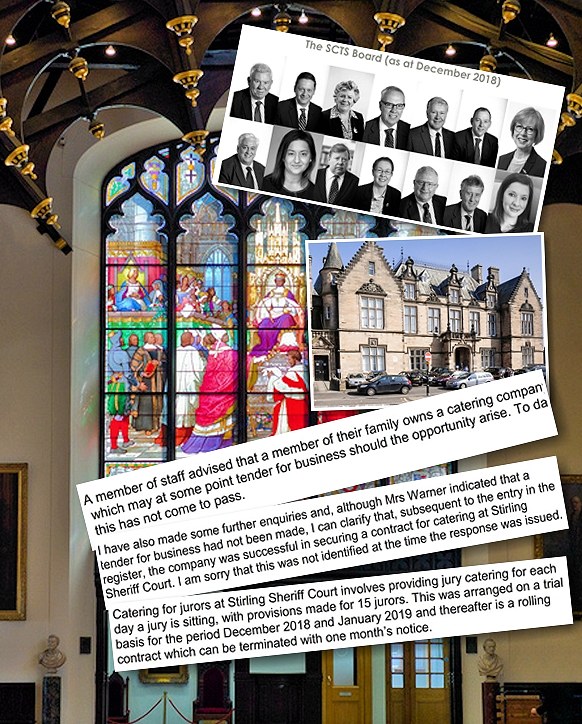
A member of staff advised that a member of their family owns a catering company which may at some point tender for business should the opportunity arise. To date this has not come to pass.

A request for a Freedom of Information review was submitted - and in response to that review - the SCTS were forced to reveal the contract for providing food to juries at Stirling Sheriff Court – was successful and had been awarded – despite the earlier claim that the contract had not been awarded.

Files reveal SCTS failure to disclose staff links to contracts. Margo Mackie, Deputy Head Information Governance & Correspondence said: “I have also made some further enquiries and, although Mrs Warner indicated that a tender for business had not been made, I can clarify that, subsequent to the entry in the register, the company was successful in securing a contract for catering at Stirling Sheriff Court. I am sorry that this was not identified at the time the response was issued.”

Ms Mackie added further detail in the FOI review with the entry as was declared in the SCTS staff register: “The company services a sports club in Stirling and provides outside catering for local companies for functions etc. There are no expected conflicts of interest here however, should a tendering exercise take place for any catering requirements within the Stirling area, it is quite possible that the company would attempt to secure that business. No specific additional steps identified or taken to mitigate any risk at this stage.”

However, when asked about the value of the contract and how long it had been running – the Court Service insisted a new Freedom of Information request must be submitted – which allowed the SCTS an extra twenty days for a response to be given.

It then emerged from the response to the new FOI request that the £13K rolling contract for catering – had been operational for at least a year – despite earlier claims from the Scottish Courts & Tribunals Service that no such contract existed.

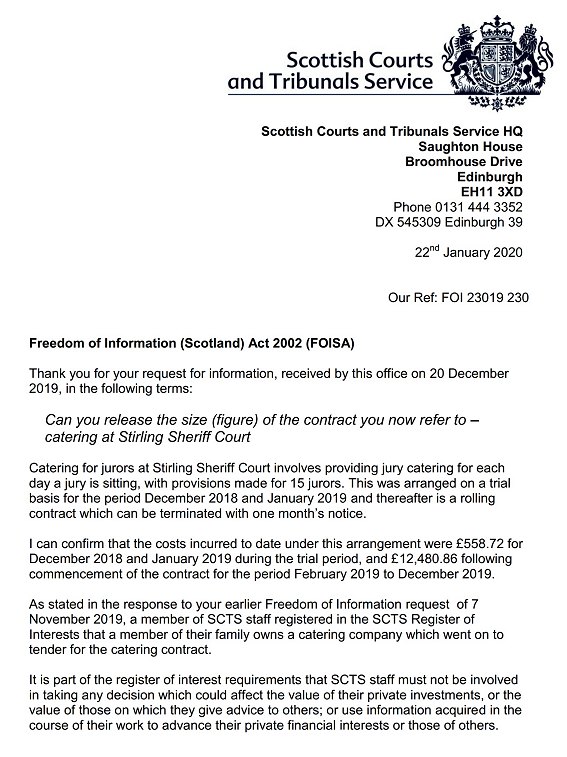
In response ot the second FOI request, Margo Mackie - Deputy Head Information Governance admitted: “Catering for jurors at Stirling Sheriff Court involves providing jury catering for each day a jury is sitting, with provisions made for 15 jurors. This was arranged on a trial basis for the period December 2018 and January 2019 and thereafter is a rolling contract which can be terminated with one month’s notice.”

“I can confirm that the costs incurred to date under this arrangement were £558.72 for December 2018 and January 2019 during the trial period, and £12,480.86 following commencement of the contract for the period February 2019 to December 2019.”

However, while elected politicians such as MSPs & MPs, and those in other public bodies such as Police Scotland are required to declare all their interests, a significant failing in in how employees of the Scottish Courts and Tribunals Service declare their interests has emerged – where Court staff are only required to declare interests they feel may be relevant, rather than a requirement for total disclosure.

A question was put to the SCTS, asking whether entries are only made in this SCTS staff register if a staff member feels they may have an interest to declare - rather than a full and comprehensive register of staff interests - per SCTS staff member - being kept and updated as appropriate - example the register of interests for Scottish Parliament MSPs.

In response, Margo Mackie - Deputy Head Information Governance stated: As regards your first point I can advise that SCTS follows the Civil Service Management Code which sets out regulations and instructions regarding the terms and conditions of service of civil servants. One of these regulations concerns "the declaration of relevant business interests which SCTS employees or members of their immediate family hold, which might compromise, or appear to compromise, their integrity, honesty, objectivity or impartiality”.

“SCTS staff are therefore required to declare any business interests (including directorships) or holdings of shares or other securities which they or members of their immediate family (spouse, including partner where relevant, and children) hold, to the extent which they are aware of them, which they would be able to further as a result of their official position.”

“This means that, where there is a potential for income or financial benefit to be gained from work related to the SCTS, staff must declare and register an interest. Such interests are declared by informing their Unit Head who considers whether the interest is appropriate and should be registered. Thereafter details are provided to Human Resources Unit for addition to the SCTS Register of Interests.Staff who do not declare and register an interest which subsequently comes to light may be subject to disciplinary action.”

After initially concealing information from a Freedom of Information request, admitting further details in a review, and then insisting on a second FOI request, the Scottish Courts & Tribunal Service claimed the member of staff had no part or involvement in procurement.

Margo Mackie Deputy Head Information Governance & Correspondence claimed: “It has been confirmed that the member of staff concerned is not involved in procurement and played no part in the quotes exercise which awarded the contract, nor do they have any active involvement in the running of the company.”

Margo Mackie added: “The matter of updating information contained in the register will be considered in future reviews of the procedures.”

However, no explanation has been given as to why the member of staff’s link to the successful contract was concealed from the initial Freedom of Information disclosure.

Independent Report – Court Employees Interests Register is insufficient

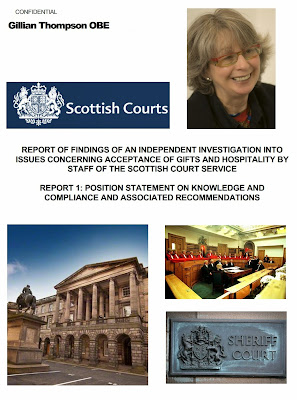
Report said SCS Registers insufficient, Court staff involved in private gains failed to declare. Former Judicial Complaints Reviewer Gillian Thompson’s Report on Hospitality & Gifts in the SCS stated:  “The information currently captured on the registers is insufficient to provide assurance that staff are using their common sense and considering issues such as conflict of interest.

Ms Thompson went on to recommend the “SCS should revise the Policy on Acceptance of Gifts, Rewards and Hospitality to ensure that it is fit for purpose for all staff, taking account of the various roles performed within SCS. It may also be time to revisit the levels of value for gifts and hospitality.”

The former AIB’s report also revealed court staff were using their positions to earn money privately from their links with lawyers and law firms operating in courts, stating “Several staff raised the issue of sheriff clerks who carry out extrajudicial taxations and private assessments and who personally benefit financially from these activities.”

Ms Thompson’s report roundly condemned this practice, stating: “Not only is it inappropriate in terms of the civil service code requirements for staff who are public servants to be able to receive private gain from their employment it is also highly divisive when other staff see such benefits being derived from simply being in the right post of Auditor of Court within the Sheriff Courts.”

Ms Thompson recommended in her report the “SCS should bring the practice of sheriff clerks profiting privately from their employment by SCS to an end as quickly as possible”.

Now, a number of additional claims by whistleblowers regarding undisclosed links between SCTS staff and high value contracts providing services to the courts are currently being examined by DOJ for further investigation and publication at a later date.

Readers should note the Scottish Parliament’s Justice Committee are currently considering an eight year cross party backed petition calling for a Register of Interests for members of Scotland’s judiciary.

Previous articles on the lack of transparency within Scotland’s judiciary, investigations by Diary of Injustice including reports from the media, and video footage of debates at the Scottish Parliament’s Public Petitions Committee can be found here : A Register of Interests for Scotland's Judiciary.

Previous articles on hospitality and gifts to the Scottish Courts and Tribunals Service, reports on gift giving to court employees and investigations by Diary of Injustice on the relationship between law firms and SCTS staff can be found here Hospitality and Gifts to the Scottish Courts.

Thursday, January 09, 2020

COURT GIFTING, M’LORD: Transparency declarations of ‘hospitality’ to Scotland’s Courts reveal gift giving by Police & Prosecutors to court staff - and reductions in declared hospitality from Legal Aid millionaire law firms

Hospitality Register identifies gifts to courts. A REGISTER which now requires the identification of anyone offering hospitality to Scotland’s Courts and judiciary – has seen a drop in high value gifts now recorded in more detail by the Scottish Courts and Tribunals Service (SCTS)

However, the latest declarations of hospitality to court staff in Scotland - reveals a slight decrease in gifts & hospitality from law firms raking in millions in publicly funded legal aid, while ‘anonymous’ gifts from unidentified “Member of the public” appear to be on the rise.

Among the providers of ‘hospitality’ to court staff are multiple law firms, technology companies, in-house legal teams of Scottish Local Authorities, and even Police Scotland, who provided a “Crystal engraved Police Scotland Armed Policing Specialist Firearms Unit ornament” to the Supreme Courts.

And now - thanks to media scrutiny, records of hospitality which is offered but refused - is also now part of the register.

Examples of refused hospitality include a burns supper dinner, offered by Microsoft to the Information Technology Unit in January 2019, and questionable offers of hospitality by Procuratir Fiscals to court staff – which included a faculty dinner offered to court staff at Kilmarnock Sheriff Court.

The rate of hospitality in terms of high value gifts has declined, at least if the disclosed records are to be believed.

And, law firms which are known to have received up to half a million pounds of legal aid every year – who were previously showering staff in local courts with gifts & hospitality – are no longer flooding the courts with perks & freebies after Diary of Justice began publishing disclosures on courtroom hospitality and it’s connections to legal aid & lawyers touting for business in local criminal courts.

The recently disclosed Register of Hospitality for Scotland’s Courts & Tribunals Service running from 2017-2019 – as provided by the SCTS in relation to a Freedom of Information request - can be viewed here: Scottish Courts & Tribunals Service Register of Hospitality 2017-2019

Among the extensive list of hospitality providing law firms are the following names, provided by a reader – which also highlight some gifts & hospitality from foreign Governments to Scotland’s courts. The location of hospitality offered/accepted is listed next to the provider: The Society of Solicitors of Hamilton (Hamilton Sheriff Court), Burnett & Co (Aberdeen Sheriff Court, Digby Brown Solicitors (Aberdeen Sheriff Court), McKinnon Hewitt Solicitors (Kilmarnock Sheriff Court), Belmonte & Co Solicitors (SCTS Lothian & Borders mgmt team), Leonards Solicitors (Hamilton Sheriff Court), Norwegian Civil Law Division (OPG & AOC), Innes Johnson LLP Kirkcaldy (Dunfermline Sheriff Court), Netherlands Judiciary, Lamont's Solicitors Ayr (Ayr Sheriff Court), Aberdeen Bar Association (Aberdeen Sheriff Court), George Mathers & Co solicitors (Aberdeen Sheriff Court), West Lothian College, Bar Association (Aberdeen Sheriff Court), Nigel Beaumont Solicitor (Edinburgh Sheriff Court), Unidentified Solicitor 3x Hospitality (Livingston Sheriff Court), Adams Whyte Defence Lawyers (Livingston Sheriff Court), Bar Association (Livingston Sheriff Court), Allcourt Solicitors (Livingston Sheriff Court), Balfour & Manson (Supreme Courts), Ministry of Justice - Korea (OPG & AOC) , Ministry of Justice republic of Korea (OPG & AOC), Chinese Delegation (Supreme Courts), School Mock Court Case Project (Supreme Courts), Marsh Insurance (OPG & AOC), University of Glasgow (Glasgow Sheriff Court), Solicitors for the Elderly (Supreme Courts), Inverness Legal Services (Inverness Sheriff Court), Malcolm Boyd Sheriff Officers (Airdrie Sheriff Court), BTO Solicitors (Supreme Courts & Edinburgh Sheriff Courts), Stewart and Watson property & Legal services (Elgin Sheriff Court), T Duncan & Co (Forfar Sheriff Court), Caesar & Howie Solicitors Alloa (Alloa Sheriff Court) , PoliceScotland (Supreme Courts), Cockburn McGrane Solicitors (Kirkcaldy Sheriff Court), G4S (Dundee Sheriff Court), MacDonald Law, Thurso (Kirkwall Sheriff Court), Caird Vaughan Solicitors (Dundee Sheriff Court), Lefevre Litigation (Supreme Courts), Alistair Young Solicitor (Dumbarton Sheriff Court), McKenna Law Practice (Kirkcaldy Sheriff Court), President of the Law Society of Scotland (SCTS Chief Executive Office), Court Police Officers (Kirkcaldy Sheriff Court), Hunter & Robertson solicitors (Paisley Sheriff Court), Procurator Fiscals Office Hamilton, Summary Unit (Hamilton Sheriff Court), Bonnar Accident Law (Airdrie Sheriff Court), JK Cameron solicitors (Dumbarton, Airdrie Sheriff Court), Kenneth M Greener solicitors (Hamilton Sheriff Court), Wink and MacKenzie solicitors (Elgin Sheriff Court), Aberdein Considine solicitors (Aberdeen Sheriff Court), Mackie Thomson & Co Ltd solicitors (Hamilton Sheriff Court), North Lanarkshire Council Legal (Hamilton Sheriff Court), Procurator Fiscal (Dundee Sheriff Court), Stirling Dunlop solicitors (Hamilton Sheriff Court), the MacKenzie Law Practice (Inverness Sheriff Court), AC O'Neill solicitors (Dumbarton Sheriff Court), Adairs solicitors (Dumbarton Sheriff Court).

A full listing of solicitors & law firms, companies and others who offered hospitality to court staff and the judiciary - can be viewed by searching the Register of Hospitality document which runs in detail to twenty eight pages, providing details of all disclosed hospitality from law firms, and others to the Scottish Courts & Tribunals Service.

Prior to Freedom of Information requests from DOJ journalists, the SCTS register of hospitality did not identify law firms – and was later found to be incomplete in recording hospitality, after an investigation was launched due to media coverage of gifts by law firms – some of which have received many millions of pounds of legal aid over the last decade.

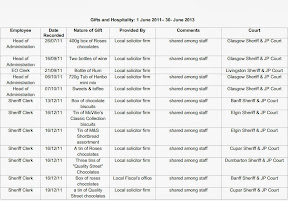
Extract of Register of Hospitality 2013 Scottish Courts Service. Disclosures from the Scottish Court Service in documents reveal that in the last five years, over 500 instances of gifts and hospitality received by publicly funded SCS were declared under the rules.

Gifts such as expensive champagne, wines, chocolates and dinner invitations were given by lawyers and others to Sheriff Clerks and SCS staff, along with invitations to the Royal Garden Party, paid-for trips in planes, tickets to football matches and a host of other goods, services & gifts many court users may well come to question in terms of how much this gift giving by lawyers dents the supposed impartiality of court staff.

During reporting of the issue back in 2013, it emerged in the media that in some cases, lawyers had paid for criminal fines accrued by court staff, leading some to question their reasons for doing so and what secret benefits this brought to the legal profession and court staff involved.

At the time, legal sources acknowledged to Diary of Justice that significant numbers of gifts have not been declared by court staff, and that much of the gift giving may well be seen as thanks for favours done in court for law firms, particularly those who are pursuing clients for unpaid fees.

The lack of declarations of hospitality and gifts, and the coverage by Diary of Justice, which reported on concerns regarding hospitality involving Scottish Court Service employees – led to an investigation by Gillian Thompson – who served as Scotland’s second Judicial Complaints Reviewer (JCR)

Ms Thompson was asked by the Scottish Court Service to investigate reports of irregularities in hospitality given to court staff.

The request for the investigation came after the Scottish Court Service received Freedom of Information requests regarding hospitality in the courts, prompting concerns some staff may have accepted gifts or hospitality but failed to register.

Report said SCS Registers insufficient, Court staff involved in private gains failed to declare. Gillian Thompson’s Report on Hospitality & Gifts in the SCS stated:  “The information currently captured on the registers is insufficient to provide assurance that staff are using their common sense and considering issues such as conflict of interest.

Ms Thompson went on to recommend the “SCS should revise the Policy on Acceptance of Gifts, Rewards and Hospitality to ensure that it is fit for purpose for all staff, taking account of the various roles performed within SCS. It may also be time to revisit the levels of value for gifts and hospitality.”

The former AIB’s report also revealed court staff were using their positions to earn money privately from their links with lawyers and law firms operating in courts, stating “Several staff raised the issue of sheriff clerks who carry out extrajudicial taxations and private assessments and who personally benefit financially from these activities.”

Ms Thompson’s report roundly condemned this practice, stating: “Not only is it inappropriate in terms of the civil service code requirements for staff who are public servants to be able to receive private gain from their employment it is also highly divisive when other staff see such benefits being derived from simply being in the right post of Auditor of Court within the Sheriff Courts.”

Ms Thompson recommended in her report the “SCS should bring the practice of sheriff clerks profiting privately from their employment by SCS to an end as quickly as possible”.

HOW COURT CHIEFS LOST HOSPITALITY INFORMATION BATTLE

When DOI launched an initial investigation into hospitality and graft among court staff, the Scottish Court Service refused to release information relating to the gift register, claiming “the names of the gift or hospitality provider would be deemed as personal information” and “as the provider of the gift or hospitality was not made aware at the time that their name may be released, we consider disclosure of such is likely to bring the Scottish Court Service into conflict with the data protection principles.”

However, the Freedom of Information request – from DOJ – triggered a review of hospitality policy at the Scottish Court Service, leading to names of ‘'hospitality’ providers being added to the register.

Richard Warner of the SCS said: “I can advise you that due to your request for this information, the Scottish Court Service has changed the policy covering hospitality and gifts to ensure that the provider of any hospitality or gift are made aware that their name shall be entered on to our register and may be disclosed if requested in any future information request. This policy change shall take effect as from 1 January 2014 so the release of names may be considered in any future request for gifts or hospitality offered from this date. The policy also states that if the provider does not consent to their name being considered for release then the gift or hospitality cannot be accepted by a member of staff.”

After a request for review of refusal to disclose the information, the SCS again refused - this time around, claiming it would cost them too much to contact each law firm to ask permission to disclose their ‘hospitality’ to court employees. The SCS claimed they would have to contact every lawyer who gave a gift and this would cost too much to provide the information.

DOJ journalists took the matter up with Rosemary Agnew - the Scottish Information Commissioner – who requested Courts Chief Eric McQueen provide an explanation as to why the courts were blocking release of information on hospitality relationships between the legal profession and court staff.

John Kelly, Freedom of Information Officer at the SIC said: “Having written to and discussed the matter with the SCS, without being required to do so by way of a formal Decision Notice, the SCS has agreed to provide you with the information requested, subject to redactions in terms of section 38(1)(b) of FOISA on the basis that to disclose some of the names of individuals would breach the first data protection principle of the Data Protection Act 1998 (the DPA). I understand that the names of Solicitor and Law Firms will be provided.”

After the intervention of the Scottish Information Commissioner, the SCS subsequently released the hospitality list to journalists.

Richard Warner for the SCS said: “Having reconsidered your request, and the SCS response, I now attach a list which indicates law firms where this information has been recorded.  For the reasons stated in our earlier response this does not include the names of any individuals concerned as there could have been no expectation on their part that this information would be circulated or published widely.  As indicated previously, steps are being taken to ensure that individual persons are made aware at the relevant time that their details made be released as a result of an information request.”

Previous articles on hospitality and gifts to the Scottish Courts and Tribunals Service, reports on gift giving to court employees and investigations by Diary of Injustice on the relationship between law firms and SCTS staff can be found here Hospitality and Gifts to the Scottish Courts.

Saturday, November 02, 2019

FACULTY LORD: 'Abbotsford Art & Faculty of Advocates trustee' declaration of globetrotting £223K a year anti-transparency top judge Lord Carloway, with 20 years on the judicial bench – calls into question scrutiny of Court quango interests register

Judges declarations questioned. LATER this month - the Scottish Parliament's Justice Committee are to consider further evidence on a cross party backed petition calling for judges to declare their interests: Petition PE1458: Register of Interests for members of Scotland's judiciary

The petition calls for the creation of a publicly available register of judicial interests – containing information on judges’ backgrounds, figures relating to personal wealth, undeclared earnings, business & family connections inside & outside of the legal profession, membership of organisations, property and land, offshore investments, hospitality, details on recusals and other information routinely lodged in registers of interest across all walks of public life in the UK and around the world.

However, EIGHT YEARS on from when the petition was originally filed with Holyrood's Public Petitions Committee in October 2012 - there has been little movement on creating a register of judicial interests for all members of Scotland's judiciary.

The Public Petitions Committee’s support for creating the register of judicial interests and transfer of work to the Justice Committee - was reported in detail here: JUDICIAL REGISTER: Holyrood Petitions Committee calls for legislation to require Scotland’s judges to declare their interests in a register of judicial Interests

And - despite cross party support for the petition during a full Holyrood debate in 2014, and backing from the Public Petitions Committee who passed the petition to the Justice Committee with a recommendation in May 2018 - Scotland's 700 strong judges continue to resist calls to declare their interests in exactly the same way all 129 Members of the Scottish Parliament are required to declare.

While Lord Carloway continues to fight calls for judicial transparency - the existence of a register of interests for the quango which oversees the Scottish Courts and Tribunals Service (SCTS) – gives a miniscule, carefully controlled snapshot of interests - which are far from the reality of a globetrotting top judge who has been on the judicial bench for two decades on a sizeable public salary.

During 2016-18, the previous, and sole declaration of Lord Carloway in the SCTS register was that of "Trustee Scottish Art Club".

After nearly two decades on the bench as a judge, connections to countless law firms, cases, decisions, and politically charged campaigns such as the removal of corroboration from Scots Law – one could be forgiven for questioning how and why Scotland’s top judge on a quarter of a million pounds a year – with a pension to match – gets away with declaring working with art as an interest - and nothing else.

In the latest SCTS Board register of interests, a new declaration appears for Lord Carloway - under the heading of Appointments Ex Officio – noting the following: Trustee for the Faculty of Advocates, Abbotsford Collection Trust.

The remaining declarations of interests - which notably do not include any references to law firms, property or financial interests are as follows:

Lord President - The Right Hon. Lord Carloway (real name: Colin John Maclean Sutherland) : Appointments Ex Officio: Trustee for the Faculty of Advocates; Abbotsford Collection Trust.

Lord Justice Clerk - The Right Hon. Lady Dorrian: Directorships: Cranley School Ltd; Glenside Court Ltd; Franco- British Lawyers Society Ltd; Appointments Ex Officio: Commissioner of the Honours of Scotland; Senior Commissioner, Queen Victoria School, Dunblane; Trusteeships: Cranley Trust; Faculty of Advocates 1985 Trust; Scottish Arts Club;

Rt Hon. Lady Smith Trusteeships: President and Trustee - Friends of the Music of St. Giles Cathedral; Other Appointments & Interests: Chair - Scottish Child Abuse Inquiry; Honorary Bencher - Gray’s Inn

Sheriff Principal Duncan Murray: Appointments Ex Officio: Commissioner, Northern Lighthouse Board; Trustee Kibble Education and Care Centre

Sheriff Aisha Anwar: No declarations

Sheriff A Grant McCulloch: Trusteeships: Chair West Fife Education Trust. Other Appointments & Interests: Chair Relationship Scotland – Couple Counselling, Fife; Committee Member Cammo Residents Association; Chair – Discipline Committee ICAS; Chair East & West Fife Education Trusts

Morna Rae JP: Appointments Ex Officio: Justice of the Peace; Other Appointments & Interests: Employee North Ayrshire Council Church of Scotland Elder

Dr Joseph Morrow QC: Directorship: Non Executive Director, St. John’s Scotland Appointments Ex Officio: Lord Lyon King of Arms; Member of Judicial Council Trusteeships: Trustee, Mudie Trust, Dundee; Trustee, Kidney Trust, Dundee; Trustee, Tealing Community Hall; Trustee, Scottish Churches Trust; Chairman & Trustee of Highland Cadet Force Foundation; Other Appointments & Interests: Legal Assessor, South Episcopal Church President, Society of Messengers at Arms President, Scottish Genealogical Society Patron, Scottish Family History Society

Dr Kirsty J Hood QC: Directorship: Scottish Universities Law Institute Ltd. Trusteeships: The Stair Society’s Council; Trustee, Clark Foundation Education; Other Appointments & Interests: Self-employed Advocate; Regular ad hoc employment with the University of Edinburgh – delivering seminars on LLB courses; Regular ad hoc employment with the University of Glasgow– delivering lectures / seminars on LLB courses; Periodically providing materials for LexisPSL Dispute Resolution (online services – LexisNexis); Clerk of Faculty – Faculty of Advocates (non remunerated); Member of the Scottish Committee of Frank-British Lawyers Society (non remunerated); Contributor of updates to “Scottish Family Law Service” (LexisNexis Publishers); Guernsey Financial Services Commission’s Panel of Senior Decision Makers.

Simon JD Catto: Other Appointments & Interests: Member of Cornerstone Exchange LLP Member of XT Property LLP Member of Addleshaw Goddard LLP (Head of Litigation Scotland)

Professor R Hugh MacDougall: Trusteeships: Cunningham Trust; Cross Trust; St. Columba’s Hospice; Other Appointments & Interests: St Giles Cathedral Elder, Edinburgh

Joe Al-Gharabally: Directorship: Ernst & Young

Col. David Mcilroy: Other Appointments & Interests: Independent Prison Monitor (Voluntary position supporting HM Inspector of Prisons in Scotland)

Eric McQueen: Appointments Ex Officio: Member of the Scottish Civil Justice Council

Further information in relation to SCTS Board members shareholdings, which was only obtained via a Freedom of Information request to the Scottish Courts & Tribunals Service reveals the following shareholdings declarations:

Rt Hon Lady Smith, President of Scottish Tribunals: Shareholdings: Artemis Fund Managers; Barclays; Ishares PLC; Royal London; Axa Framlington UK; Majedie Asset Management; X Trackers S&P; Blackrock; Invesco; Robeco Capital.

Sheriff Aisha Anwar: Shareholdings: SRZ Commercial Ltd

Sheriff A Grant McCulloch: Shareholdings: Scotgold Resources Ltd

Simon JD Catto: Shareholdings: Cornerstone Asset Management General Investments; Jupiter Merlin Income Portfolio; Schroder MM Diversity Z inc; M&G Recovery 1 Inc; M&G Corporate Bond Fund.

Joe Al-Gharabally: Shareholdings: Ryan Air; AT&T.

HOLYROOD’S EIGHT YEAR JUDICIAL INTERESTS PROBE:

The judicial register petition - first debated at the Scottish Parliament’s Public Petitions Committee in January 2013 – calls for the creation of a publicly available register of judicial interests.

A full debate on the proposal to require judges to declare their interests was held at the Scottish Parliament on 9 October 2014 - ending in a motion calling on the Scottish Government to create a register of judicial interests. The motion was overwhelmingly supported by MSPs from all political parties.

The lengthy Scottish Parliament probe on judicial interests has generated over sixty two submissions of evidence, at least twenty one Committee hearings, a private meeting and fifteen speeches by MSPs during a full Holyrood debate and has since been taken over by Holyrood’s Justice Committee after a recommendation to take the issue forward from the Public Petitions Committee in March 2018.

A full report containing video footage of every hearing, speech, and evidence sessions at the Scottish Parliament on Petition PE1458 can be found here: Scottish Parliament debates, speeches & evidence sessions on widely supported judicial transparency petition calling for a Register of Interests for Scotland's judiciary.

The Scottish Parliament’s Justice Committee has backed calls for further work on the judicial interests register during at least THREE further Holyrood hearings, including the latest hearing from June 2019, reported here: JUDICIAL REGISTER: Justice Committee to hear evidence from ex-Judicial Investigator, top judge on judicial interests register, MSP says Scottish judges should not be involved with Gulf States implicated in unlawful wars, mistreatment of women's rights

A report on the Justice Committee’s consideration of the Judicial Interests Register Petition in May 2019 can be found here: JUDICIAL REGISTER: Justice Committee investigate approach to judges’ interests in other countries – MSPs say ‘Recusals register not comprehensive enough’ ‘Openness & transparency do not contradict independence of the judiciary’

A report on the Justice Committee’s consideration of the Judicial Interests Register Petition in February 2019 can be found here: JUDICIAL REGISTER - MSPs urged to take forward SEVEN year petition to create a Register of Judges’ Interests as Holyrood Justice Committee handed evidence of Scottish Judges serving in Gulf states regimes known to abuse Human Rights

TWO TOP SCOTS JUDGES FAIL IN HOLYROOD JUDICIAL TRANSPARENCY PROBE:

Both of Scotland’s recent top judges failed to convince MSPs that a register of interests is not required for judges – even after both Lord Presidents attempted to press home the existence of judicial oaths and ethics – which are both written, and approved by – judges.

Video footage and a full report on Lord Brian Gill giving evidence to the Scottish Parliament in November 2015 can be found here: JUDGE ANOTHER DAY: Sparks fly as top judge demands MSPs close investigation on judges’ secret wealth & interests - Petitions Committee Chief brands Lord Gill’s evidence as “passive aggression”

Video footage and a full report on Lord Carloway (Colin Sutherland) giving widely criticised evidence to the Scottish Parliament in July 2017 can be found here: REGISTER TO JUDGE: Lord Carloway criticised after he blasts Parliament probe on judicial transparency - Top judge says register of judges’ interests should only be created if judiciary discover scandal or corruption within their own ranks

Previous articles on the lack of transparency within Scotland’s judiciary, investigations by Diary of Injustice including reports from the media, and video footage of debates at the Scottish Parliament’s Public Petitions Committee can be found here : A Register of Interests for Scotland's Judiciary.