Independent Law journalists report on legal news for consumers, litigants & Scotland's legal community including features on justice, access to justice, law reform, the judiciary, politics & in-depth investigations, analysis and commentaries on legal related issues.
Top judge says judiciary must regulate lawyers.SCOTLAND’S top judge – Lord Carloway (real name Colin Sutherland) has declared his role as Lord President, and Scotland's unelected judiciary - should remain as the final regulator of Scotland’s legal services market - currently composed of around 11,000 self-regulating solicitors, advocates & Kings Counsel.
The statement by Scotland’s top judge came in Lord Carloway’s address to lawyers, judges and other legal vested interests in his recent Opening of the Legal Year 2023-2024 speech – where Carloway attacked plans to reform how lawyers regulate themselves in the Regulation of Legal Services (Scotland) Bill which is currently at Stage 1 consideration a the Scottish Parliament.
In a jibe at the Scottish Government’s admittedly feeble plans to reform regulation of the Legal profession in Scotland, Lord Carloway claimed the reforms to lawyers looking after themselves in complaints regulation – “gives rise to serious constitutional concerns about the rule of law …”
Lord Carloway said: “The first is the Regulation of Legal Services. The senior judiciary recently responded to Parliament's call for views on the Bill. They were unanimous in the view that the Bill, as currently drafted, gives rise to serious constitutional concerns about the rule of law and the separation of powers. It is a threat to the independence of the legal profession and the judiciary. If the Bill is passed in its current form, Scotland will be viewed internationally as a country whose legal system is open to political interference. This will have serious adverse consequences.”
Scotland’s top judge went on to declare his unelected office of Lord President and his judiciary, should instead remain the ultimate regulator of rogue lawyers facing any complaint or question about their provision of legal services to clients.
Lord Carloway stated: “The rights of clients, who are the ultimate consumers of legal services, to obtain legal advice, must be protected from interference by the government. The only way to ensure that lawyers will be able to stand up for the individual, whether a person or an institution, against the government of the day, is for the Lord President, and the Court of Session, to remain as the ultimate regulator of the legal profession.”
The Scottish Legal Complaints Commission is funded by client fees to solicitors and Advocates who then pay the complaints levy to the Scottish Legal Complaints Commission.
In Scotland, a decades old, repressive and at times highly vindictive regime of lawyers looking after themselves – has seen thousands of clients & consumers of legal services each year – ripped-off by their own solicitors with little or no recompense for the millions of pounds lost to legal services overcharging, theft, embezzlement & outright solicitor client fraud each year in Scotland’s legal services market.
In some of the most appalling cases of Scots lawyers found to have looted their clients assets - legal regulators have reacted to unwanted media coverage by using private briefings and turning newspapers and journalists against each other. In some well known cases, legal regulators encouraged articles against legal reforms, blocked publication of newspaper reports on identified lawyers & law firms, and personally went after ;law reform campaigners who seek nothing more than removing the self regulation element from regulation of legal services and legal representatives in Scotland.
However – despite the public protests of Lord Carloway and other ‘leaders’ of Scotland’s legal profession – including the Dean of the Faculty of Advocates who has also attacked the proposed legal reforms, the reality is the Scottish Government’s Regulation of Legal Services Bill falls far short of what is needed to quell Scots lawyers appetite for ripping off consumers and clients.
And unsurprisingly, according to legal and political sources - there are allegations much of the Scottish Government’s claimed solicitor regulation reform proposals are ‘deliberately deceptive’ and have already been negotiated away with legal interests and political partners in deals to water down what is currently in the bill.
Speaking on condition of anonymity, an MSP who along with others is said to be facing de-selection by their own embittered party – informed journalists of private briefings and meetings between MSPs of all parties - and lawyers and legal regulators who are anxious to ensure much of the already watered down proposals in the reform of legal regulation bill are eliminated or that the entire bill is stalled or axed completely.
No references to any of these meetings appear to exist in entries of the Holyrood lobbying register but it has been established meetings did take place and lawyers who met MSPs appear to believe they succeeded in their lobbying aims, stating so in private lawyer-only social media chat groups.
This latest attempt by a Scottish Government and the pro-lawyer Scottish Parliament to reform regulation of lawyers is the third attempt since 2000 – where in 2001 – and amid bitter evidence sessions - Holyrood’s Justice Committee led by Christine Grahame threw out calls for reform of how lawyers cover up complaints for their own colleagues.
A second attempt by another of Holyrood’s Justice Committees in 2006 saw arm twisting from legal regulators to shelve much of the proposals in the Legal Profession & Legal Aid Bill, which became law in 2007 after multiple amendments lodged by MSPs, including Scottish Conservative MSPs on behalf of legal vested interests.
What became the LPLA Act 2007, which led to the formation of the Scottish Legal Complaints Commission in 2008 – which in turn has led to some fifteen years and counting of disastrous complaints regulation by an overly false legal regulator which is in fact staffed and run by the same lawyers and vested legal interests who ran complaints at the Law Society of Scotland.
To make matters worse, the Scottish Legal Complaints Commission later set into policy a system which intimidated clients who had already been ripped off by their solicitors – into signing Non Disclosure Agreements to conceal thousands of complaints against Scots multiple law firms over the last decade – with many law firms appearing week after week at the Scottish Legal Complaints Commission to demand complainants sign more NDAs to conceal some of the worst and repetitive acts against clients which even the old Law Society of Scotland regime failed to keep away from public gaze.
And, it should be noted the Scottish Legal Complaints Commission has cost clients of Scottish solicitors around £40million pounds in complaints levies – paid for by law firms hiking client fees to meet their annual complaints levy.
Lord President Lord Carloway’s Legal Year address to lawyers, which takes the usual Judicial Office tone of launching threats against one piece of reform legislation, then absorbing another piece of legislation – the Victims, Witnesses and Justice Reform Bill as a form of pro-justice system judicial PR and follow-the-money-supply-to-law-firms – is well worth a read.
It should be glaringly obvious to all the Victims, Witnesses and Justice Reform Bill – more of which can be read here Victims, Witnesses and Justice Reform Bill - Scottish Parliament has only come about because Scotland’s judges, courts & lawyers have been mistreating and preying on victims of crime, abuse & countless other crimes for decades to the point the public and victims themselves demanded action – rather than the action coming willingly from the judiciary or legal profession who seem to believe they own the law.
Welcome to the opening of the legal year. I thank you all for coming. Since the abolition of formal court terms, today is primarily a ceremonial occasion, but it remains a useful opportunity to reflect on the progress we have made in the past year, and on what will, or at least might, happen next.
I extend a special welcome to Lord Burnett of Maldon, the Lord Chief Justice of England and Wales and thank him particularly for his work during his years in office in ensuring that Scotland's voice was heard on legal matters in the Halls of Westminster and elsewhere.
Law Reform: Regulation of Legal Services and Criminal Justice
Looking to what it is that might happen next, there are two Bills on which views are currently being sought. Each proposes a series of notable reforms to the justice system.
The first is the Regulation of Legal Services. The senior judiciary recently responded to Parliament's call for views on the Bill. They were unanimous in the view that the Bill, as currently drafted, gives rise to serious constitutional concerns about the rule of law and the separation of powers. It is a threat to the independence of the legal profession and the judiciary. If the Bill is passed in its current form, Scotland will be viewed internationally as a country whose legal system is open to political interference. This will have serious adverse consequences.
The rights of clients, who are the ultimate consumers of legal services, to obtain legal advice, must be protected from interference by the government. The only way to ensure that lawyers will be able to stand up for the individual, whether a person or an institution, against the government of the day, is for the Lord President, and the Court of Session, to remain as the ultimate regulator of the legal profession.
On a more encouraging note, the Victims, Witnesses and Justice Reform Bill contains proposals for significant reform of the criminal justice system, many of which are based on the Lord Justice Clerk's Review. The judiciary welcome the reforms insofar as they aim to make giving evidence a less traumatic experience for witnesses, including the creation of a right to anonymity and to independent legal representation for complainers in relation to applications under the rape shield legislation, the establishment of a specialist sexual offences court and the abolition of the not proven verdict.
Overall, the judiciary believe the Bill proposes a number of measures which, in principle, represent improvements to the existing system.
The Criminal Courts: Recover, Renew, Transform
Following the build-up of criminal cases which have waited for a considerable period of time to go to trial as a result of lockdown, the court service began the Recover, Renew and Transform programme in September 2021.
The recovery aspect aimed to restore the courts to their pre-pandemic capacity. It involved recruiting more sheriffs and court staff and the setting up of more High Court and sheriff trial courts. Good progress has been made. The challenge now is an ever-increasing volume of indictments and complaints which libel sexual offences. In the face of this new volume of criminal business, we no longer expect to restore matters to the pre-pandemic position. We need to adjust our expectations and set a new reasonable baseline for the number of cases waiting to go to trial at any one time.
Our modelling predicts that the number of High Court cases waiting for trial will recover to a new reasonable baseline level by March 2025, and sheriff solemn trials by March 2026.
Prisoner escort services are causing those in custody to arrive at court late. This has an impact on the smooth operation of the criminal courts. We are looking to accelerate plans to move to virtual custodies. Pilots have already taken place. As I have said many times before, the need to bring those arrested before a court as soon as practicable, must remain a priority.
The purpose of renewal is to establish better ways of working which promote the resolution of cases at the earliest opportunity. The Summary Case Management pilot continues in Dundee, Hamilton and Paisley Sheriff Courts. It aims to reduce the number of hearings to those which are necessary, by encouraging early resolution through early disclosure. Early disclosure has allowed the Crown to take a more targeted approach to the citation of witnesses. There has been earlier resolution of proceedings brought in the pilot courts and a reduction in the number of witness citations being issued in those proceedings. Work is underway to roll the pilot out to Glasgow Sheriff Court.
Specialist online courts are being set up to deal with domestic abuse cases. The idea is to ensure that the complainer and the accused do not require to meet each other. This reduces potential trauma for complainers.
Juries continue to be balloted remotely, thus sparing the public the inconvenience of coming to court. Over the course of the past year, over 450 police and expert witnesses have given their evidence remotely in High Court trials.
A key component of transformation lies in the implementation of the recommendations of Lady Dorrian's Review. The court service has been making substantial progress in relation to those recommendations which do not require legislation. The creation of facilities to pre-record the evidence of children and vulnerable witnesses and the giving of evidence remotely is being accelerated. We now have designated facilities for commissions in Edinburgh, Glasgow, Inverness and Aberdeen.
Earlier this month, I visited the Bairns' Hoose. The Hoose is designed to feel like a family home. It is based on an international model first developed in Iceland, called the Barnahus, which brings together justice, health, social work and recovery support for children in one location. The Hoose is, in essence, a comfortable and safe space in which children can give evidence, receive medical care, take part in decisions about their protection and obtain support to recover from trauma.
The Hoose is the first of its kind in Scotland. The Barnahus model was first advocated for in early 2016, as part of SCTS's Evidence and Procedure Review. I am very pleased to see it implemented into the system, and I hope that we will see more of them developed in due course.
The Civil Courts: Technology and Transparency
On the civil side, there have been a number of notable technological improvements this year.
The importance of making the people's courts as accessible as possible cannot be understated. The advent of new technology means that we can implement new, more efficient and convenient ways to do this. In June, we officially launched Court of Session Live, a new streaming service for Inner House proceedings. I thank Lord Pentland, and his cross-departmental task force, for their hard work in getting this up and running.
Alongside Court of Session Live, we are publishing information about, and summaries of, upcoming appeals much earlier than we have ever done before. We hope that this will enable those who are interested in viewing proceedings, whether online or in person, to make plans to do so.
We launched the new and improved Civil Online portal in May and have significantly expanded the level of service which the portal offers. In Simple Procedure cases, court users can now raise and respond to actions through the portal.
We secured funding from the Scottish Government to start developing a new case management system for the Office of the Public Guardian. The new interface will provide a more accessible and broader range of online services to the public.
Many of our Tribunals are experiencing growth in the volume of business. The work of the Social Security Chamber is expected to increase significantly. The new Local Taxation Chamber has inherited over 40,000 cases from its predecessor, the Valuation Appeals Committee. We are working closely with the Government to ensure that sufficient resources are made available to support this. Reform of the Tribunal system generally also continues, with the further expansion of the General Regulatory Chamber's jurisdiction, and the potential transfer of the MHT into the First-tier Tribunal during 2024.
The court service are in discussions with the Faculty about the re-establishment of the practice of making justiciary and session papers available to the Advocates Library. This will enable advocates and, via the National Library, members of the public, to view them.
We are working hard to deliver these improvements, but, as ever, we can only do as much as resources allow. We will continue to do what we can within budgetary constraints. I ask only that the government continues to support us by providing us with sufficient funding to continue to deliver core services, as well as these improvements to the system.
Ends.
Earlier relevant coverage from this blog - of how the Legal Profession & Legal Aid Act (2007) was deliberately mangled by the Scottish Government, and Scottish Parliament – which allowed lawyers to continue to regulate themselves to the current date, can be found here: The Legal Profession & Legal Aid (Scotland) Act 2007
So grim was the determination of Prosecutors, Police and the Judiciary itself to see this malicious prosecution through to a result - at one point in November 2017 – the Lord Advocate’s own judge wife – Lady Sarah Wolffe QC – was neatly arranged – by the judiciary – to hear the civil damages claims against her own husband in his role as the Lord Advocate, and similar damages claims against Scotland’s Chief Constable.
Back in February of this year, Scotland’s top law officer – Lord Advocate James Wolffe QC gave a statement at the Scottish Parliament on 9 February 2021 in which Mr Wolffe conceded - the prosecution of Rangers Administrators – by the Crown Office & Police Scotland – was a malicious prosecution.
James Wolffe publicly apologised to the two Administrators who were wrongly prosecuted during a fraud investigation carried out by the Crown Office and Police Scotland, in relation to the sale of Rangers Football Club.
David Whitehouse and Paul Clark acted as administrators during the sale of the football club, settled out of court with the Crown Office in December and were both awarded £10.5 million in damages while legal costs are thought to total more than £3 million – all of which will be paid from public cash.
Lord Advocate James Wolffe publicly apologised for the malicious prosecution, however – Wolffe denied anyone had acted with malice but was accused of “brushing this appalling state of affairs under the carpet” if public confidence isn’t restored through an independent inquiry.
Mr Whitehouse and Mr Clark were arrested in 2014 but the Crown Office has admitted the prosecution that followed was “malicious”.
Mr Wolffe said in his statement to Holyrood that decisions made in the Crown Office probe were “indefensible in law”.
Missing from the statement to MSPs was a key fact in the order of events, in which Lord Advocate James Wolffe had earlier said nothing during court hearings in late 2017 where his judge wife – Lady Sarah Wolffe was scheduled by fellow judges to hear financial claims for damages in this case case against her own husband – Lord Advocate James Wolffe.
The NINE million pound damages claim against Scotland’s top cop and top prosecutor has been lodged by David Whitehouse – a former administrator at Rangers FC – who is seeking financial damages from Police Scotland's Philip Gormley and Lord Advocate James Wolffe QC.
A copy of the Court Rolls handed to the media at the time reveal Lady Sarah Wolffe QC – an outer house senator of the Court of Session – was scheduled to hear the case involving the claim involving the Lord Advocate - her own husband - A295/16 David Whitehouse (represented by Urquharts) v Liam Murphy &c (represented by Ledingham Chambers for SGLD - Scottish Government Legal Directorate) - on November 15 2017.
Liam Murphy was at the time - listed as a Crown Office Procurator Fiscal on “Specialist Casework”.
Claims have since been made Lady Wolffe was suddenly dropped from the hearing when it ‘emerged at the last minute’ her husband – Lord Advocate James Wolffe - was involved in the case.
A report from a source claims a second Court of Session Judge - Lady WiseQC - was then scheduled to hear the case.
However, the silent replacement of Lady Wolffe with Lady Wise - has now raised serious questions as to why there are no references to any note of recusal made by Lady Wolffe – who clearly had a conflict of interest in the case given one of the core participants in the action is her own husband – the Lord Advocate.
The case then took another turn after media reports of the hearing on Wednesday 15 November reveal a third judge – Lord ArthursonQC – eventually heard the case, and has since arranged for a four day hearing for legal arguments.
Questions then arose as to why the Judicial Office avoided publishing any official recusal by Lady Sarah Wolffe QC – the wife of Lord Advocate James Wolffe - in relation to the scheduling of the case to be heard by the Lord Advocate’s.
These events and others, illustrate very well why all members of Scotland’s judiciary should be required to declare and publish their interests in a Register of Judges’ Interests – which is now part of the Scottish Government’s work programme for 2021 –2022.
A Register of Judges’ Interests should contain information on all judges’ backgrounds, figures relating to personal wealth, undeclared earnings, business & family connections inside & outside of the legal profession, membership of organisations, property and land, offshore investments, hospitality, details on recusals and other information routinely lodged in registers of interest across all walks of public life in the UK and around the world.
Readers can watch the full statement in relation to the malicious prosecutions of the Rangers Administrators - from the Lord Advocate James Wolffe to MSPs on 9 February 2021 here:
Malicious Prosecutions of Rangers FC Administrators by the Crown Office, Lord Advocate & Police Scotland – Scottish Parliament 9 February 2021
The Deputy Presiding Officer (Lewis Macdonald)
The next item of business is a statement by the Lord Advocate, on malicious prosecutions. The Lord Advocate will take questions at the end of his statement, so there should be no interventions or interruptions.
The Lord Advocate (James Wolffe) Thank you, Presiding Officer. I am grateful for the opportunity—[Inaudible.] I am sorry about that sound issue, Presiding Officer.
I am grateful for the opportunity to make a statement following the disposal last week of the actions that David Whitehouse and Paul Clark brought against me. Those actions concerned events that predated my appointment as Lord Advocate, but it was and is my responsibility, as the current incumbent, to account for them. The on-going proceedings that relate to the matter constrain what I can say today, but I welcome the fact that I am now free to begin the process of public and parliamentary accountability and to reiterate the commitment that the Crown has given to that process.
The prosecutions that gave rise to the cases arose from police investigations into the purchase of Rangers Football Club by Craig Whyte in 2011 and into the administration of the club and its sale to Charles Green in 2012. The investigations were large and complex. Ultimately, seven individuals were prosecuted. This statement concerns only the position of Mr Clark and Mr Whitehouse.
On 14 November 2014, Mr Clark and Mr Whitehouse were detained and brought to Glasgow. They were held in custody before appearing in court on 17 November on a petition that contained charges that related to Mr Whyte’s purchase of Rangers. That started the clock for a statutory time bar that, unless extended, required the Crown to serve an indictment in respect of the charges by 16 September 2015.
In High Court cases, after an accused has appeared on petition, the Crown undertakes a process of investigation and analysis that is called precognition. When it is completed, the precognition contains a detailed narrative of the evidence and an analysis of whether the evidence is sufficient to support criminal charges.
The precognition is submitted to Crown counsel for a decision on whether to issue an indictment. Precognition is not a statutory requirement, but it is a long-standing, routine and essential feature of Crown practice in relation to High Court cases. It provides assurance that there is a proper evidential basis for the indictment and, along with Crown counsel’s instruction, it provides a record of the basis for the decision.
This case was exceptional in its scale and complexity. By early September 2015, with the expiry of the time bar approaching, the precognition process was incomplete and essential investigations were still on-going. On 3 September, the Crown applied to the court for a nine-month extension of the time bar; the sheriff granted a three-month extension. An appeal by Mr Clark and Mr Whitehouse against that extension was refused. In the meantime, on 2 and 3 September, Mr Clark and Mr Whitehouse appeared in court again on a second petition that contained new and separate charges that related to the second matter that the police had been investigating—the administration of Rangers and its sale to Charles Green in 2012.
On 16 September 2015, Mr Clark and Mr Whitehouse, with five other accused, were indicted. The charges against them derived from the November 2014 and September 2015 petitions. At that time, the precognition process in relation to the November 2014 petition was still incomplete and there was, demonstrably, no precognition in relation to the September 2015 petition, which had only just been initiated. Essential investigations were still on-going in respect of the charges that derived from the November 2014 petition, and there was evidence available that was—objectively—obviously inconsistent with the charges against these two accused that derived from the September 2015 petition.
On 2 December 2015, a second indictment was served that superseded the first. At a preliminary hearing in February 2016, following legal argument, Crown counsel withdrew certain of the charges. On 22 February, the judge dismissed the remaining charges against Mr Clark and Mr Whitehouse. Crown counsel advised the court that consideration would be given to a further indictment against them. A Crown Office press statement that was issued that day indicated that a fresh indictment would be brought, but that was corrected by a further statement the following day.
On 25 May 2016, the Crown advised Mr Clark and Mr Whitehouse that there would be no further proceedings against them. On 3 June 2016, Crown counsel formally advised the court of that position.
In August 2016, Mr Clark and Mr Whitehouse initiated civil actions against me—I had been appointed on 2 June 2016—to seek damages on the grounds of malicious prosecution and breaches of articles 5 and 8 of the European convention on human rights. They also advanced claims against the chief constable of Police Scotland.
I advanced a defence that relied on established legal authority that the Lord Advocate is immune from common-law liability. That defence was upheld at first instance, but, in October 2019, the inner house of the Court of Session overturned the previous legal authority and allowed the claims to proceed.
On 20 August 2020, I admitted liability to Mr Clark and Mr Whitehouse. Those admissions followed the conclusion of a very substantial and lengthy investigation that was undertaken by the legal team, including external counsel, instructed on my behalf. As a result of that investigation, I concluded that the decisions to place Mr Clark and Mr Whitehouse on petition in September 2015 and to indict them were indefensible in law.
I concluded that those decisions proceeded without probable cause—that is, without a proper evidential basis—in circumstances that met the legal test for malicious prosecution. That legal test can, in certain circumstances, be met even though no individual had malice, in the popular sense of a spiteful motive. My acceptance of liability in this case did not depend on any individual being malicious in that popular sense.
I cannot, at this time, disclose in detail the basis upon which liability was admitted, but, when it is free to do so, the Crown will disclose the basis for those admissions in full—including to this Parliament. What I can say is that there were, in this case, profound departures from the normal practices, including precognition, that are designed to ensure—and routinely do ensure—that any prosecution in the High Court has a proper basis.
I also admitted breaches of article 5 in respect of the detention of Mr Clark and Mr Whitehouse in November 2014 and September 2015, and of article 8 in respect of the incorrect press release of February 2016.
After the admissions of liability, mediations took place with both pursuers, and agreement was reached to settle their claims. Each of them has been paid £10.5 million in damages, and, to date, more than £3 million has been paid to them in aggregate by way of expenses. Those two pursuers were very high-earning professional people and the damages paid reflect a reasonable estimate of the loss that they sustained as a result of being prosecuted. I have written to the Justice Committee about the financial implications.
On 24 December 2020, I issued written apologies to each of Mr Clark and Mr Whitehouse. They should not have been prosecuted, and, as the current Lord Advocate and head of the system of criminal prosecution, I apologised unreservedly for the fact that they had been. I reiterate that unreserved apology publicly to Mr Clark and Mr Whitehouse today.
Although the case involved significant departures from standard practice, lessons have been learned and will continue to be learned. The precognition process has been reinforced, and, in 2018, I established new arrangements for the management and oversight of large and complex cases. Those arrangements are now well established and provide a substantial safeguard against anything like this happening again.
In my JUSTICE human rights day lecture in December 2016, I said this:
“a fair and independent prosecution service, taking decisions rigorously, independently and robustly in accordance with the evidence, is, I believe, essential to the freedom under the law which we enjoy as citizens of this country.”
Scottish prosecutors and the Crown Office and Procurator Fiscal Service have a justified reputation for fairness, integrity and independence. The seriousness of what happened in this case should not obscure the truth that, day in and day out, Scotland’s public prosecutors and the staff who support them fulfil their responsibilities with professionalism and skill. They take hard decisions rigorously, robustly and in accordance with the evidence, and they secure the public interest in the fair, effective and robust administration of criminal justice in Scotland.
In this case, there was a serious failure in the system of prosecution. It did not live up to the standards that I expect, that the public and this Parliament are entitled to expect and that the Crown Office and Procurator Fiscal Service expects of itself.
What happened in this case should not have happened. As the Lord Advocate and head of the system of prosecution in Scotland, I tender my apology to this Parliament and to the public for the fact that it did happen and for the consequent cost to the public purse. I confirm my commitment and that of the Crown to supporting a process of inquiry into what happened in this case once related matters have concluded, and I express my determination that nothing like it should ever happen again.
The Deputy Presiding Officer The Lord Advocate will now take questions on the issues that were raised in his statement. I intend to allow about 20 minutes for questions, after which we will move on to the next item of business.
Liam Kerr (North East Scotland) (Con) I remind members that I am a practising solicitor, and I thank the Lord Advocate for advance sight of his statement.
There has been an extraordinary catalogue of unexplained and profound departures from normal practices. What is “indefensible”, to use the Lord Advocate’s word, is that, given that the
“decisions proceeded without probable cause—that is, without a proper evidential basis”,
the prosecution was malicious.
Let us be absolutely clear: this was not simple human error or an obscure legal mistake. Rather, our system of prosecution has admitted that it acted with malice in its move to throw innocent men behind bars and destroy their reputations. That begs an obvious question: how many times in Scottish legal history has there been a malicious prosecution?
In any event, I note that the Crown is, crucially, committed to a process of inquiry. Can the Lord Advocate confirm that there will be a fully independent, judge-led public inquiry that demands to know why malicious prosecutions were pursued in defiance of evidence? Will it investigate the actions of the Lord Advocate, his predecessor and all agents who were involved? If not, how on earth can the Crown expect the people of Scotland to conclude anything other than that it is brushing this appalling state of affairs under the carpet?
The Lord Advocate (James Wolffe) Given that I have come to Parliament at the first opportunity when I have been free to do so, I hope that nobody would suggest that I could properly be accused of “brushing” anything “under the carpet”. I have committed myself and the Crown to supporting a process of inquiry once related matters have been concluded. Those matters need to be resolved before the process of inquiry can proceed.
On Mr Kerr’s first point, as I observed in my statement, the legal test for malicious prosecution can be met in circumstances even when no individual has malice in the popular sense of their having a spiteful motive. I should make it clear that my acceptance of liability in this case did not depend on any individual being malicious in the popular sense. That is not for a moment to minimise the seriousness of what happened. Quite the reverse is the case; as I observed in my statement, what happened represents a very serious failure in the system of prosecution in Scotland.
I have been asked how many times there has been a malicious prosecution in Scotland. As I emphasised in my statement, a process that is known as precognition is undertaken routinely in High Court cases. That process necessarily involves careful collection, investigation and analysis of evidence. It involves a system of cross-checking and should provide significant reassurance to the public that, in our system of prosecution, cases are routinely brought on a proper basis.
As I explained in my statement, in this case, that process was incomplete when the case was indicted; essential investigations had not been completed. The normal processes that are routinely followed in every High Court case were not followed, but the public should take reassurance from what I have said that the prosecution system in Scotland is robust, fair and independent, and is one on which they can rely.
Rhoda Grant (Highlands and Islands) (Lab) I, too, thank the Lord Advocate for advance sight of his statement.
This case raises serious concerns. That it was thought that the Lord Advocate was immune from common-law liability would suggest that he should also have been beyond reproach. We imagine that there are, in the system, checks and balances between the police and the Crown Office and Procurator Fiscal Service, with both of them challenging and questioning the activities and evidence in a case. That appears either not to have happened or to have gone seriously wrong in this case, with both being sued by David Whitehouse and Paul Clark.
How could that have happened? Were concerns raised, internally or externally, about the actions of both organisations at the time, especially when it came to light that there was inconsistent evidence?
The Lord Advocate said that the system has been improved, but there cannot be proper scrutiny until we know exactly what went wrong in the first place. Until that happens, how can we expect to restore confidence in the system?
The Lord Advocate (James Wolffe) The first thing that I should say is that, at this time, there are continuing live proceedings relating to the matter, which regrettably—I do regret it—constrains what I can say.
I have committed the Crown to engaging fully with public accountability in the matter, and the Crown has committed to making more information available when it is free to do that. That includes the basis upon which liability was admitted in this case and supporting the process of inquiry when it is possible to do that. I hope that that gives some assurance to Rhoda Grant that lessons will be learned and that there will be public understanding of what happened.
Perhaps it is worth noting—I do not say this to minimise, in any sense, what happened in this case—that the court fulfilled its functions in dealing with certain charges and the Crown fulfilled its responsibilities in withdrawing charges and ultimately confirming that no prosecution would proceed. I do not say that to minimise the significance of a prosecution having been brought without proper basis. However, on those issues the checks and balances in the system fulfilled their functions.
As I explained, there is, in the Crown Office, routinely preparation of High Court cases, which involves cross-checking of cases by staff of the Crown Office and Procurator Fiscal Service initially, and ultimately by Crown counsel, on the basis of there being a full narrative of the evidence and analysis of that evidence. Those processes are designed to ensure that we can be confident—I am confident—that, across the system in Scotland, prosecutions are brought properly and that this case was wholly exceptional.
Rona Mackay (Strathkelvin and Bearsden) (SNP) Can the Lord Advocate reiterate what lessons have been learned and what improvements are being made to ensure that this will never happen again?
The Lord Advocate (James Wolffe) The key lesson relates to the management of large and complex cases. As I said in my statement, I have instituted new procedures for internal management and oversight of the particular category of case. The arrangements involve early agreement of the investigation and prosecution strategy; early and continuous engagement with the police; a project management approach to case preparation; a system of case management panels to scrutinise case strategy and to keep under review the progress of the case, with reference to the strategy; and any issues that might emerge being addressed.
All of that aligns with a protocol that the High Court issued in 2018, with my support, in relation to the management of such cases once they are in court. That protocol, again, encourages a proactive approach to the management of such cases.
Murdo Fraser (Mid Scotland and Fife) (Con) The Lord Advocate referred to the payment of £24 million that was made to Whitehouse and Clark, but that sum might well be just the tip of the iceberg, because the report suggests that the total cost of the case could top £100 million, given that there are outstanding cases.
Will the Lord Advocate tell us whether it is correct that, in addition to those payments, Whitehouse and Clark were also given tax indemnities so that, should HM Revenue and Customs pursue them for payment of tax, that demand would be met by the Scottish Crown Office, and that the cost to the Scottish taxpayer will therefore be far higher than the £24 million that has been paid out already?
The Lord Advocate (James Wolffe) I acknowledge the significance of the sum involved. Murdo Fraser is correct in observing that, with other cases pending, the cost to the public purse will increase and the ultimate cost is yet to be seen.
The approach that has been taken in settling cases was to make a reasonable estimate of the actual loss that individuals could demonstrate. An arrangement was entered into such that if—it is “if”—they can properly show that they have sustained additional loss of the type that Mr Fraser described, that loss will be borne.
If that happens, the Crown will account to the Justice Committee, as it did last week, for the costs in the cases.
John Mason (Glasgow Shettleston) (SNP) Now that it has been established that the Lord Advocate does not have absolute immunity from civil liability, will the Crown be more cautious in pursuing prosecutions, and will that mean that criminals are less likely to be convicted?
The Lord Advocate (James Wolffe) I am determined that any change in the law regarding the immunity of the Lord Advocate should not have that effect. That is one reason why I have put in place measures to strengthen the management of large and complex cases.
It is essential that there is a proper basis for prosecutorial decisions in all cases. As I explained in my statement, the process of precognition that is routinely undertaken in all High Court cases provides confidence and assurance both to prosecutors and to the public.
I have confidence in the robustness of Scotland’s prosecutors. They make difficult decisions every day, in exercising their judgment. I am determined to have in place systems that enable prosecutors to continue to take robust decisions in effective prosecution of crime.
James Kelly (Glasgow) (Lab) The decisions that were made in this case might predate the current Lord Advocate, but they raise serious questions about decision making and accountability within the Crown Office. Serious errors were made. The system failed, and we have been told that the cost to the public purse will be at least £24 million. What other area of the Scottish budget has had to be to be raided to fund the incompetence of the Crown Office and Procurator Fiscal Service?
The Lord Advocate (James Wolffe) As the Cabinet Secretary for Finance told Parliament last week, arrangements have been made so that the cases will not affect the Crown Office’s resource budget or its operational effectiveness. The member’s question would be better directed to the finance secretary.
Liam McArthur (Orkney Islands) (LD) This is a true scandal. In monetary terms, it is on a scale with BiFab and the Ferguson Marine shipyard. The colossal waste of taxpayers’ money runs to tens of millions of pounds. That money could have been spent on supporting businesses during the pandemic, on educational catch-up or on investment in mental health. There might be worse news to come, given that we do not yet know the extent of Police Scotland’s exposure or of the additional cases to which the Lord Advocate referred.
Given that the overturning of the Hester v MacDonald decision means that the Lord Advocate can now be held liable for serious errors from the past, what assurance can he offer that there are no other skeletons lurking in the Crown Office closet?
The Lord Advocate (James Wolffe) The principal assurance that I can give is the description that I have already given of the routine precognition processes that are carried out in every High Court case.
It is fair to say that this case was wholly exceptional in all sorts of ways—that is the principal answer to Liam McArthur’s question. We have a system of prosecution that has demonstrated robustness, fairness, effectiveness and integrity. This case was a serious falling below the standards that all of us expect of that system, but the very fact that those expectations are so high and that this case has occasioned the justified reaction that it has is a reflection of the high standards that our prosecutors routinely meet, day in and day out, in courts across the country.
John Finnie (Highlands and Islands) (Green) I, too, thank the Lord Advocate for early sight of his statement. This was a serious failure of the system of prosecution, and public confidence in our justice system is vital. Can the Lord Advocate outline what further steps will be taken to reassure a public that might reasonably think, “Wow! If this can happen in such a high-profile case, with all that publicity, what chance do I have against the system?”
The Lord Advocate (James Wolffe) The first reason why the public should have reassurance is the point that I made a moment ago to Liam McArthur, that routinely—day in and day out—our prosecution system operates effectively, robustly and fairly, and it is understood and seen by the public to do so. Prosecutors take decisions that, if taken to court, are tested in the independent court and by the examination and cross-examination skill of those who represent accused persons. So, not only are there protections and reassurances to be taken from the well-justified recognition of the integrity and skill of our public prosecutors, but the public can also have confidence because of the reputation, integrity and skill of the defence bar in testing prosecutions that are brought—and, ultimately, because of our court system, in which any case that is brought to court is tried fairly and independently.
James Dornan (Glasgow Cathcart) (SNP) Having previously been a precognition officer, I am surprised to see that the lack of precognition appears to have been a major failing in this case. Further to your statement, Lord Advocate, can you give some detail to help provide reassurance that the Crown is, indeed, equipped to deal with complex financial crime going forward?
The Lord Advocate (James Wolffe) Yes, indeed. The Crown successfully prosecutes thousands of cases every year, including complex financial crime cases. For example, an accused was prosecuted last year in respect of a £12 million Ponzi scheme fraud involving 140 complainers and laundering the proceeds of the crime. He was convicted and imprisoned for 14 years. Serious financial crime cases are dealt with in accordance with the arrangements that I have described for large and complex cases. Those new arrangements, which were put in place in 2018, should give reassurance that such cases will be effectively and properly investigated and prosecuted. In the course of this Parliament, the budget allocation to the Crown Office and Procurator Fiscal service has increased by some 42 per cent. Although that was to deal with a range of pressures on the system, part of that additional budgetary resource has gone to ensure that the new system for the management of large and complex cases can be operated as it is intended to be.
Adam Tomkins (Glasgow) (Con) What happened was completely indefensible, Lord Advocate. I therefore have a simple question, to which I want an answer: was it incompetence or was it corruption?
The Lord Advocate (James Wolffe) I have said what I can say about the circumstances. There were significant departures from the normal practices that routinely provide safeguards against what happened in this case. I have made it clear that the admission of liability in this case was not predicated on any individual having subjective malice.
I should also say that the investigation that was carried out into the prosecutorial work on the case did not report any criminal conduct to me. Had it done so, I would have taken action. However, should criminal allegations come forward, that does not preclude their being considered and, if appropriate, investigated. I am putting in place arrangements, including the instruction of external senior counsel, so that such a process can happen if that is required.
Alex Neil (Airdrie and Shotts) (SNP) Do the former Lord Advocate, Frank Mulholland, Police Scotland and the team of prosecutors who worked on the case agree with the current Lord Advocate’s decision to pay out millions of pounds of public money on the basis that the prosecution was malicious? Is the Lord Advocate’s decision making in this case up to scratch and robust?
The Lord Advocate (James Wolffe) I have had to take the decision on the civil action that was brought against me. I took that decision following the conclusion of a substantial, lengthy and carefully considered investigation that was undertaken by the legal team, including a team of external counsel instructed on my behalf. That decision fell to me to take, and it is one for which I stand here and account to the Parliament.
Bill Kidd (Glasgow Anniesland) (SNP) Can the Lord Advocate provide reassurance to victims and witnesses that arrangements have been made so that the settlements that are made will not affect the service that the Crown Office provides?
The Lord Advocate (James Wolffe) Yes. A moment ago, I reminded members that the Cabinet Secretary for Finance told Parliament last week that arrangements had been made so that the meeting of the settlements would not have an impact on the resource budget of the Crown Office. Indeed, the budget allocation to the Crown Office this year is significantly larger than it was last year. As ever, that, in part, reflects the commitment of the service to supporting victims and witnesses.
Neil Findlay (Lothian) (Lab) The Lord Advocate admits to a malicious prosecution but says that no one showed malice. That takes political doublespeak to a whole new level. Can the Lord Advocate answer these clear questions? Who is responsible for this expensive fiasco? Who is accountable? Where is the money coming from to pay for it? Those are clear questions. Can I have clear answers, please?
The Lord Advocate (James Wolffe) Yes. I proceeded in addressing the case on the basis of the relevant legal tests. As I explained in my statement, the legal test for malicious prosecution—I appreciate that the wrong has that description—can, in certain circumstances, be met even though no individual had malice in the popular sense of the word. That is the basis on which I accepted liability in this case.
In terms of our responsibility, ultimately, in our constitutional arrangements, it is for the Lord Advocate, as head of the systems of criminal prosecution and the investigation of deaths, to answer for the conduct of criminal prosecutions, whether in court—as I do every day in relation to the prosecutions that are brought in my name—or here, in Parliament, as I am doing today. As the current Lord Advocate, it is my constitutional responsibility to answer to the Parliament for what happened at that time.
I have said what I can say today about the circumstances, given other pending processes. When it is free to do so, the Crown Office will disclose further information.
Gillian Martin (Aberdeenshire East) (SNP) The Lord Advocate has already given quite a lot of detail, but I ask him to outline what additional steps he will take to support public accountability for and understanding of such cases.
The Lord Advocate (James Wolffe) As I have said, as and when the Crown is free to do so, it will disclose further information about what happened in this case. In particular, it will disclose the basis for the admission of liability. I and the Crown will support a process of inquiry once all related matters have been dealt with.
The Deputy Presiding Officer We have a very brief final question from Graham Simpson.
Graham Simpson (Central Scotland) (Con) Will there be a fully independent, judge-led public inquiry?
The Lord Advocate (James Wolffe) We will debate a motion in the name of Murdo Fraser on that subject tomorrow. In my statement, I have made it very clear that I and the Crown will support a process of inquiry when all other related matters have been concluded. The ultimate form of such an inquiry will be a matter for determination at the appropriate time.
Events have since moved on from the now former Lord Advocate’s statement to the Scottish Parliament in February 2021.
Later in March it was confirmed both the Lord Advocate – James Wolffe – and his deputy – Solicitor General Alison Di Rollo (maiden name Lafferty) were to resign from their respective roles at the Crown Office – due to events conceded in relation to the malicious prosecution of the Rangers Administrators.
After James Wolffe and Alison Di Rollo resigned their office, a ‘short’ recruitment process took place, which saw former Advocate Depute Dorothy Bain QC appointed as Lord Advocate to replace James Wolffe, and Ruth Charteris QC replacing Alison Di Rollo as Solicitor General.
However, material passed to journalists revealed Bain was not the first choice to replace James Wolffe.
As the recruitment round took place, a list of several well known legal figures who turned down offers of accepting the Lord Advocate role was passed to journalists.
One legal figure involved in the process - who does not wish to be identified – said he felt the Lord Advocate role was poisoned by the Rangers debacle.
The legal figure added “The Crown Office is badly damaged as an institution”.
After Dorothy Bain’s appointment to the Lord Advocate role, issues of Ms Bain’s involvement in the Rangers case were reported by the media - resulting in claims Ms Bain held a conflict of interest in any involvement in further proceedings relating to the malicious prosecution of the Rangers Admins.
The new conflict of interest which emerged - was that Dorothy Bain had previously acted for a firm of solicitors who represented the Rangers Administrators company - Duff and Phelps.
As a result of increased media scrutiny of the new Lord Advocate’s conflicts of interest in the Rangers case – Dorothy Bain has since recused herself from further involvement in related matters – with the new Solicitor General, Ruth Charteris QC, assigned to issue instructions to the ‘independent’ legal team and senior counsel advising on the remaining Rangers claims cases.
Noting James Wolffe made no mention of matters which arose in court in relation to the judiciary’s scheduling of Lady Wolffe to hear and rule on the financial claims against her husband – Lord Advocate James Wolffe, and damages claims lodged against the Chief Constable of Police Scotland - a report on Lady Sarah Wolffe’s role in the sequence of events and her initial appointment to decide on the claim against her own husband, featured in a Sunday Mail newspaper investigation, here:
Lady Sarah Wolffe was originally scheduled to oversee a hearing in David Whitehouse's £9m lawsuit against Lord Advocate James Wolffe.
By Craig McDonald 24 DEC 2017
A former Rangers administrator’s £9million lawsuit against Lord Advocate James Wolffe was given an emergency judge swap – after it emerged the case was originally handed to his wife.
David Whitehouse, 51, is suing Wolffe, Police Scotland chief Phil Gormley and prosecutor Liam Murphy amid claims he was “unlawfully detained” during an investigation into Craig Whyte’s doomed 2011 club takeover.
Court officials had to draft in a replacement judge when they realised Wolffe’s wife Lady Sarah Wolffe was scheduled to sit on the bench for a procedural hearing at the Court of Session in Edinburgh last month.
The late switch from Lady Wolffe was ordered after the conflict was discovered.
Lady Morag Wise was asked to take her place, although the hearing eventually went ahead in front of Lord Paul Arthurson.
Yet another judge, Lord Neil Brailsford, was on the bench when the case was called again earlier this month. It is scheduled to go ahead next year.
The removal of Lady Wolffe is not noted in the official list of judicial recusals – where a judge declines jurisdiction – as it was reallocated before it was called in court.
A Scottish courts spokesman said: “Lady Wolffe was assigned to hear procedural matters in a number of cases on November 15.
“One of those cases was listed on the court rolls as David Whitehouse v Liam Murphy and others.
“Subsequently, when the papers were checked by the Keeper’s office, it became apparent the Lord Advocate was the third defender and, accordingly, the case was reallocated to a different judge.
“The case was initially reallocated to Lady Wise but, having regard to the level of business and in order to avoid unnecessary delay to the parties, was ultimately dealt with by Lord Arthurson.”
Whitehouse and colleague Paul Clark were arrested during the Rangers probe but charges against the pair were later dropped.
They worked for Duff & Phelps, who were appointed as administrators of the club in February 2012. The business and assets of The Rangers Football Club plc, who entered liquidation later that year, were sold to a consortium led by Charles Green for £5.5million.
Police launched an investigation into the circumstances surrounding the takeover. Whyte was cleared of fraud by a jury at the High Court in Glasgow in June.
Lawyers acting for Whitehouse claimed their client was “unlawfully detained” by detectives in November 2014. They also said that, throughout the period of detention, there were no reasonable grounds to suspect he had broken the law.
Whitehouse claims police and prosecutors didn’t follow correct legal procedure and his arrest damaged his reputation and caused him significant loss of income.
The defenders in the action, including the chief constable and Lord Advocate, claim correct legal procedure was followed and want his case to be dismissed.
Previous articles on the lack of transparency within Scotland’s judiciary, investigations by Diary of Injustice including reports from the media, and video footage of debates at the Scottish Parliament’s Public Petitions Committee can be found here :A Register of Interests for Scotland's Judiciary
Ex-Sheriff Watson statement confirms judges’ son on conflict case.COURT PAPERS obtained in an ongoing probe of claims made by Scotland’s top judge at Holyrood – now reveal Peter Watson – a judicial colleague of Lord Carloway - ran the case for a construction company at the centre of a land contamination scandal linked to Court of Session judges who concealed conflicts of interest in court.
The court-sourced witness statement of solicitor and ex-Sheriff Peter Black Watson to the Court of Session - confirms Watson employed the son of Lord Malcolmin the case to represent the client – Advance Construction Scotland Ltd– which ended up being heard by Lord Malcolm - who concealed his link to his son during multiple court hearings.
The new material is a further blow to Lord Carloway – who demanded MSPs on the Scottish Parliament’s Public Petitions Committee accept his version of events in that there was no active involvement of Lord Malcolm’s son in the case whatsoever – a claim also contradiced by a witness statement from Lord Malcolm’s son: Ewen Campbell - Witness Statement - Nolan v Advance Construction
In the opening lines of Watson’s witness statement - ex Sheriff Peter Watson states: “I have been instructed by Advance Construction (Scotland) Limited (“Advance”) in relation to Mr Nolan’s action against the company. I have been running this case and acting on behalf of Advance since. I was approached by Advance in relation to defending an action raised against them by the Pursuer in this case Mr.Donal Nolan and accepted those instructions.”
Critical to the ongoing probe of Lord Carloway – Watson goes on to confirm he asked Lord Malcolm’s son – Ewen Campbell – to work alongside him in representing Advance Construction.
Watson states: ”Throughout these proceedings, I have been assisted by Mr. Ewen Malcolm Campbell and latterly, Mr. James Anthony Robb. During their involvement, both Mr Campbell and Mr Robb were also enrolled solicitors employed by the firm.”
Curiously, at no point in Mr Watson’s witness statement to the Court of Session does he refer to himself as a Sheriff and member of Scotland’s judiciary. Instead, Mr Watson refers to himself as “Professor Peter Black Watson”.
However, the admission by Watson that he employed Lord Malcolm’s son on a case in which Lord Carloway claimed Ewen Campbell had no active involvement - raises more questions of the Lord President’s evidence to the Scottish Parliament’s Public Petitions Committee at a crucial hearing during their six year probe of judicial interests and the creation of a register of judges’ declarations of interests.
At the time of the case – Nolan v Advance Construction Scotland Ltd [2014] CSOH 4 CA132/11 – Peter Watson was a Sheriff on the judicial bench alongside Lord Carloway (Colin Sutherland) – and Lord Malcolm (Colin Campbell QC).
An earlier investigation of this case revealed when Lord Woolman (who heard the proof after the case was passed to him by Lord Malcolm) - stated in court papers that Mr Nolan had a case, John Campbell QC removed – without instruction – most of his client’s own case including over £4million and a claim for legal costs – after he had discussions with the current vice dean of the Faculty of Advocates – Roddy Dunlop QC.
During the evidence session - Lord Carloway faced questions from Mr Neil on the Court of Session case - where judge & Privy CouncillorLord Malcolm (real name Colin Campbell QC) – heard a land contamination case - up to EIGHT TIMES while his own son represented the defenders - Advance Construction Scotland Ltd in the same court room.
In response to questions from the MSP, Lord Carloway (real name Colin Sutherland) furiously claimed that Lord Malcolm’s son DID NOT have any “active involvement with the case whatsoever.”
However – a witness statement dated May 2013 - signed by Ewen Campbell – covering the time Campbell worked for Glasgow law firm Levy and Mcrae – contains a written admission Mr Campbell confirming he did in-fact represented the construction company, alongside lawyer Peter Black Watson – who was at the time a Sheriff and partner at the same law firm.
During the hearing, Alex Neil - MSP for Airdrie & Shotts - asked Lord Carloway: “If, in any case—without referring to a specific case—a close relative of a judge is participating in the case, rightly or wrongly, the perception is that there may be a degree of prejudice.”
Mr Neil said there were concerns the reputation of the judiciary should be protected and added: “I would argue that, certainly in at least one case recently, which we have referred to briefly, the perception is that there may have been unfairness and prejudice in the way in which the matter was conducted, particularly as the judge concerned was involved in the case not once but on a number of occasions.”
In response – a clearly flustered Lord Carloway claimed no such events had taken place.
Carloway took a strong line against the questions, and replied to the MSP stating: “I disagree entirely with your analysis of that particular case and I repeat what I said earlier. The case that you refer to did not involve the judge’s son having any active involvement with the case whatsoever.”
However - on page one of the released witness statement of Ewen Campbell – Mr Campbell confirms he did work for the defenders – Advance Construction.
Ewen Campbell states: “In September 2011 I was asked by Professor Peter Watson (witness) to assist in a new case in which we were to act for Advance Construction (Scotland) Limited (“Advance”).”
Ewen Campbell goes on to admit he worked on the case for nearly a year: “I assisted with this case until Friday 15th June 2012. At this point I ceased assisting Professor Watson as I was informed by Senior Counsel that I was a potential witness in the matter.”
Within the statement, Lord Malcolm’s son – who Carloway told MSPs had no involvement in the case - goes on at length to document numerous on-site visits he undertook at the behest of Carloway’s then judicial colleague – ex Sheriff Peter Watson, and on behalf of the client – Advance Construction (Scotland) Ltd.
In just one example, Ewen Campbell states: “At approximately 4 p.m. I left Levy and McRae’s offices and attended at Branchal Road. I was driven by Ian Butler, a colleague at Levy Sc McRae. On arrival at the site I observed that a number of vehicles were at the gate of the site. Mr Butler and I therefore parked our vehicle just round the comer from the entrance of the site.”
Ewen Campbell is later forced to account for allegations a Grangemouth based firm - IKM Consulting Ltd – employed by Levy and Mcrae as their ‘experts’ in the case – dumped contaminated materials at a site owned by the pursuer – Mr Nolan.
Despite Lord Carloway’s abrupt statement that Lord Malcolm’s son did not have “any active involvement with the case whatsoever” - Ewen Campbell goes on to say in his witness statement he personally talked to a legal representative of the pursuer - and talked the solicitor down from his client’s initial allegation IKM Consulting Ltd dumped contaminated material during their on-site activities for Levy and Mcrae & Advance Construction (Scotland) Ltd.
Ewen Campbell states: “I contacted [solicitor] regarding this who detailed that his clients had originally stated to him that IKM had dumped contaminated materials on the site but after further questioning reduced the allegation to having dumped soil like materials on site.”
Bizarrely, Lord Malcolm’s son adds within his statement he did not instruct IKM Consulting Ltd to dump any materials during their on-site activities under his supervision.
Campbell also admits to accepting additional instructions to work on the case in which Carloway claimed he played no active role in.
Ewen Campbell further stated: “Before I ceased assisting Professor Peter Watson in relation to this case, I was instructed on a number of occasions to prepare and send letters and emails to those acting on behalf of Mr Nolan.”
It should be noted that despite Ewen Campbell’s ‘account’ of events around the IKM Consulting incident - Advance Construction were subsequently forced to admit in the Court of Session before Lord Woolman that they had in-fact illegally dumped contaminated materials on Mr Nolan’s land.
The video footage and transcript of Alex Neil’s questions to Lord Carloway can be found here:
Alex Neil (Airdrie and Shotts) (SNP): I apologise for being slightly late. I had to go to the Public Audit and Post-legislative Scrutiny Committee. I apologise in advance if I cover ground that has already been covered.
Lord Carloway, as an issue of principle, do you think that it should be left only to a judge to decide whether they are going to recuse themselves, or should you or the keeper of the rolls be able to insist on recusal if you believe that there is a potential conflict of interest?
Lord Carloway: The short answer is that I do not believe that there is any problem with the current system, which is that the judge, who knows what his connection is to the case or the parties to it, should make the initial decision. That decision is made in open court, when the parties are present, and it is subject to review on appeal. In other words, if somebody is dissatisfied with that decision and if the litigant eventually loses the case, the decision will come before three judges who will review whether it was correct. If it was incorrect, the decision on the case would fall.
Alex Neil: The person bringing the case to court may not be aware of any conflict of interest that the judge may have and may never find out that there was one, but the judge may well have been influenced by a particular interest. Surely that is not right. If there is any potential conflict of interest, surely there should be a declaration or commitment by the judge, making an explicit statement that there is no conflict of interest. People may not have the resources to appeal, for example. Is the system not balanced against people who come to court for justice?
Lord Carloway: No, it is not. I go back to something that I mentioned earlier, which is very important. Scotland does not have a corrupt judiciary. The matter has been examined by independent persons, notably the GRECO anti-corruption body that operates under the auspices of the Council of Europe, which examined the UK judiciary, including the Scottish judiciary. It was clear that, fortunately, we, as distinct from many other countries, do not suffer from corruption in the judiciary. For that reason, it did not consider that a register of interests was necessary. If one introduces such a measure, one has to be satisfied that it is necessary and also that it is proportionate. If one analyses its proportionality, one has to look at what exactly we are guarding against. If the situation were to be that there was corruption in the Scottish judiciary—which we would discover at some point or another—of course we would have to consider measures to prevent that, one of which might be a register of certain interests. Until such time as it is demonstrated that there is corruption in the Scottish judiciary, I am entirely satisfied that there is no requirement for a register of interests and that it would be positively detrimental to the administration of justice, particularly in relation to the recruitment of judges and especially at the higher level of the judiciary.
Alex Neil: I want to draw a parallel with the register of interests that members of the Scottish Parliament have to sign and regularly update. That came about not because of any allegations or belief that the system was corrupt or that members of the Scottish Parliament are corrupt. In the 18 years that we have been here, I have not heard one allegation of corruption. The register is there not because of allegations of corruption but to ensure that there is no prejudice. If I participate in a debate and I have an interest that I have not declared, I will be open to an allegation not of corruption but of prejudice. Because there is a register of interests and because I have to declare interests in a debate or in a committee meeting such as this one, there is a transparency to ensure that I do not act in a prejudicial fashion.
To go back to the case that Mr MacDonald cited as I came in—the case of Advance Construction and Donal Nolan, in which Lord Malcolm’s son was involved as a lawyer for one of the parties—the issue there was not an allegation of corruption but one of possible prejudice or perception of prejudice. That is a very good example of why either a register of interests or a more robust system of recusal—or perhaps both—might serve the judiciary very well.
Lord Carloway: I am satisfied that Lord Malcolm’s actions were entirely honourable and that he acted in accordance with the code of judicial ethics. I am not sure what is—
Alex Neil: Have you investigated it?
Lord Carloway: I am aware of the background to it.
Alex Neil: No, but have you investigated it?
Lord Carloway: I have read the papers that it involves.
Alex Neil: With all due respect, Melanie Collins and Donal Nolan have written to you on numerous occasions, and at no time have you replied to them, let alone met them, so you have not heard the other side of the case.
Lord Carloway: I am sorry, but I am not aware of letters to me by those particular persons.
Alex Neil: Your office—
The Convener: Alex, let us be careful that we do not get into anything specific on that.
Alex Neil: Yes—absolutely. My point is about how Lord Carloway can reach that conclusion if he has not heard the other side.
Lord Carloway: I have read documents emanating from the persons that you have mentioned. As far as I am aware, they were not addressed to me, but I could be wrong about that. The position is that I am aware of the circumstances of the case. I am satisfied that Lord Malcolm’s conduct was entirely correct in the circumstances. That is part of the problem that you have perhaps highlighted. That case has nothing to do with a register of pecuniary interests. The suggestion is that we should start registering what our relatives are doing, where they are working and matters of that sort, which I suspect would go way beyond even what is expected of politicians.
Alex Neil: No—we have to register what close relatives do.
Lord Carloway: Can I deal with the difference between MSPs and the judiciary, which I think I dealt with earlier this morning? It is quite a different function. A politician is by nature someone who is not independent in the sense that the public expect the judiciary to be. That is not a criticism; it is a reality. As a generality, judges do not deal with the type of issues that politicians deal with. Politicians have executive power. They are dealing with major economic interests of one sort or another. As a generality, judges are not dealing with that type of thing. They are dealing with issues that are usually between private individuals but can be between private individuals and Government or others. Judges are not dealing with the type of issues that politicians are dealing with such as planning inquiries and so on at a local level or major economic development in society as a whole.
The need for independence in the judiciary is different from the kind of independence that a politician requires, because with a politician it is primarily, as Alex Neil has pointed out, about issues of a pecuniary nature. Those are not the issues that arise in most of the recusal cases with which we are concerned. What we are concerned with as judges is that we appear to be independent of all connection with the case. It is not a question of having a pecuniary interest.
If one looks at the register of recusals in the past year, I do not think that any of them were to do with pecuniary interest at all. They were to do with social connections with people—whether someone is a friend; whether a party to the litigation is a friend of a friend; and matters of that sort. Those are the types of situations that are raised by people in the practical reality of litigation and those are the issues that are being dealt with. Unless you are suggesting a register of one’s friends—and presumably, therefore, one’s enemies—the real issue with recusal in the judicial system would not be addressed.
The Convener: Last question, please, Mr Neil.
Alex Neil: If I can just finally draw the parallel between our register and what has been talked about in terms of either recusal or financial interest, MSPs—as individuals and collectively—do not have executive power per se unless they are ministers, but what is very important is the perception of fairness and the perception that justice is being carried out.
If, in any case—without referring to a specific case—a close relative of a judge is participating in the case, rightly or wrongly, the perception is that there may be a degree of prejudice. It might be very unfair, but the point is to try to ensure that the excellent reputation of the judiciary down the years in Scotland is retained. That reputation is not just for not being corrupt, which we all accept—we are not accusing anybody of corruption. The perception of fairness and the perception of not being prejudiced are also extremely important. I would argue that, certainly in at least one case recently, which we have referred to briefly, the perception is that there may have been unfairness and prejudice in the way in which the matter was conducted, particularly as the judge concerned was involved in the case not once but on a number of occasions.
Lord Carloway: I disagree entirely with your analysis of that particular case and I repeat what I said earlier. The case that you refer to did not involve the judge’s son having any active involvement with the case whatsoever. We have very clear rules in our statement of principles of judicial ethics on how to deal with such matters and it is made very clear in that statement that if a relative is the advocate in the case before one, the modern approach is that the judge should not hear the case, or one could put it another way round—the relative should not be presenting the case. Whichever way it happens to be put, the situation that we had 20 or 30 years ago, when it was commonplace for the relatives of judges of one sort or another to be advocating the case, no longer exists.
That practice no longer exists not because it was thought that there was any actual problem with the decision making but, as you say, because of a perception of unfairness. There is a clear judicial rule about that and I am not aware of any case in which it has been breached. I myself have been in a situation in which my son was involved in a firm that was litigating before me. In such a case, the judge would be expected to declare it and the parties would then decide whether to take the point. However, if they took the point and the relative just happened to be a member of the same firm operating in a different department, I would not encourage the judge to recuse himself.
The Convener: There are no final questions, so I thank you very much for your evidence. It has been helpful to clarify many of the issues that you presented to us in written evidence and to have an opportunity to explore some of the issues around prejudice, for instance.
ADVANCE SHERIFF AT COURT: Ex-Sheriff Peter Watson resigned from judicial bench in 2018
Peter Black Watson a former partner in Glasgow based law firm Levy and Mcrae – who was named in a £28million writ linked to the collapse of bust hedge fund Heather Capital – resigned his commission as a part time Sheriff on 10 October 2018.
The information was released by the Scottish Courts and Tribunals Service in response to a Freedom of Information request in 2019 –SCTS - Sheriff Watson resignation
The SCTS stated: “I can advise that Mr Peter Watson resigned his commission as a part-time sheriff on 10 October 2018. Mr Watson did not hear any cases between the lifting of the suspension on 12 July 2018 and his resignation. Mr Watson has not submitted any claims for expenses, nor attended any events, nor carried out any judicial functions, since the suspension was lifted.”
Watson’s resignation came less than three months after Lord Carlowayhad lifted Mr Watson’s record suspension from judicial office of over three years – imposted byLord Brian Gillin February 2015
Mr Watson was suspended from theJudiciary of Scotlandon February 16, 2015 - after the then Lord President, Lord Brian Gill, was informed by a journalist of the claims in the case against Levy and McRae, and specifically against Watson, over Heather Capital’s collapse in 2010.
The move came after allegations surfaced in a £28million writ naming part time Sheriff Peter Black Watson - and his former law firm Levy and Mcrae, and a number of individuals under investigation in connection with the collapsed Heather Capital hedge fund.
In response to queries from the media in February 2015 on the contents of the writ - the Judicial Office subsequently issued a statement confirming Lord Brian Gill had suspended Sheriff Peter Black Watson (61) on 16 February 2015.
The suspension came after Gill demanded sight of the writ.
Responding to the Lord President’s request, Watson then offered to step aside temporarily – while the litigation concluded - however a Judicial Office spokesperson said “The Lord President concluded that in the circumstances a voluntary de-rostering was not appropriate and that suspension was necessary in order to maintain public confidence in the judiciary.”
Astatement from the Judicial Office for Scotlandread as follows: Sheriff Peter Watson was suspended from the office of part-time sheriff on 16 February 2015, in terms of section 34 of the Judiciary and Courts (Scotland) Act 2008.
“On Friday 13 February the Judicial Office was made aware of the existence of a summons containing certain allegations against a number of individuals including part-time sheriff Peter Watson.
The Lord President’s Private Office immediately contacted Mr Watson and he offered not to sit as a part-time sheriff on a voluntary basis, pending the outcome of those proceedings.
Mr Watson e-mailed a copy of the summons to the Lord President’s Private Office on Saturday 14 February.
On Monday 16 February the Lord President considered the matter.
Having been shown the summons, the Lord President concluded that in the circumstances a voluntary de-rostering was not appropriate and that suspension was necessary in order to maintain public confidence in the judiciary.
Mr Watson was therefore duly suspended from office on Monday 16 February 2015.”
Later in July 2018. a statement from the Judicial Office for Scotland on the continuing suspension of part-time sheriff Peter Watson stated:
Following the extra judicial settlement of the Heather Capital action in which part-time sheriff Peter Watson was named as one of the defenders, the Lord President has lifted the suspension imposed upon him in terms of section 34 of the Judiciary and Courts (Scotland) Act 2008. Sheriff Watson will resume part-time judicial duties with effect from 12 July 2018.
Sheriff Watson was suspended from the office of part-time sheriff on 16 February 2015, in terms of section 34 of the Judiciary and Courts (Scotland) Act 2008.
Watson’s former law firm - Levy & McRae, was one of several companies being sued by Heather's liquidator, Ernst & Young, after the fund's collapse in 2010.
Watson was also a director of a company called Mathon Ltd - a key part of the Heather empire.
The collapsed hedge fund Heather Capital – run by lawyer Gregory King was the subject of a Police Scotland investigation and a FIVE YEAR probe by the Crown Office.
The Crown Office later admitted there would be no prosecutions in the cases of the four individuals - lawyers Gregory King & Andrew Sobolewski, accountant Andrew Millar and property expert Scott Carmichael – who were charged by Police Scotland in connection with a Police investigation of events relating to the collapse of Heather Capital.
Peter Watson now has his own law business, PBW Law.
Watson, and his former law firm named in the Heather Capital writ - Levy and Mcrae – also represent the Scottish Police Federation.
Responding to queries from reporters, a spokesperson for the Judicial Office said: “The action, in which suspended part time Sheriff Peter Watson was among the defenders, has settled. An interlocutor to that effect has been issued. The Lord President will consider what, if any, steps now require to be taken.”
Watson subsequently resigned from the judicial bench.
Despite EY’s withdrawal of the £28million claim against Levy and Mcrae & Peter Watson, detailed claims in the Court of Session revealed the following:
[21] In the Levy Mcrae case:
On 4 January 2007, HC transferred £19 million to its client account with LM (Lord Doherty paragraph [5]).
On 24 January 2007, HC transferred £9.412 million to its client account with LM (Lord Doherty paragraph [5]).
The money was intended to be loaned to a first level SPV Westernbrook Properties Ltd (WBP) for onward lending to second level SPVs (Lord Doherty paragraph [5]).
On 9 January 2007, LM transferred £19 million to a Panamanian company (Niblick) owned and controlled by Mr Levene:the money was not therefore transferred to WBP.The transfer was undocumented and without security (Lord Doherty paragraph [5], and Condescendence 6 and 17, pages 20 and 44 of LM reclaiming print).
By a memorandum dated 17 March 2007, HC’s auditors KPMG “identified a number of concerns relating to the documentation provided in respect of these loans”.Further work and information was required (Condescendence 5, page 13 of LM reclaiming print).
On 29 March 2007, LM transferred £9.142 million to Hassans, solicitors, Gibraltar, under the reference “Rosecliff Limited” (a company controlled by Mr King):the money was not therefore transferred to WBP.The transfer was undocumented and without security (Lord Doherty paragraph [5], and Condescendence 6 and 17, pages 20 and 44 of LM reclaiming print).
In April to June 2007, amounts equivalent to the loans thought to have been made to WBP (including accrued interest) were “repaid” to HC via Cannons, solicitors, Glasgow.The directors were unable to ascertain the source of these repayments (Lord Doherty paragraph [7]).
Approaches made by HC to Mr Volpe and Triay & Triay, a firm of solicitors in Gibraltar, were met with a total lack of co-operation (Lord Doherty paragraph [8]).
At a board meeting on 6 September 2007, “KPMG could not approve HC’s accounts … Santo Volpe had executed certain loans to SPV companies where non‑standard procedures had been followed which meant that inadequate security had been given for some loans … Gregory King stated that the loans to the SPVs had been repaid in full in May 2007” (Condescendence 5, page 13 of LM reclaiming print).
By email to a non‑executive director of HC (Mr Bourbon) dated 7 September 2007, Mr McGarry of KPMG referred to the previous day’s board meeting, and expressed concerns about the situation.He asked for further information, namely “all possible evidence regarding the movement of monies out of Heather Capital into these SPVs and onwards to whatever purpose the funds were applied – ie, sight of bank statements, payment/remittance instructions, certified extracts from solicitors clients’ money accounts etc”.(It should be noted that, contrary to HC’s averment in Condescendence 5 at page 13C‑D of LM reclaiming print, the email did not restrict the inquiries requested to “explaining what information was required from Santo Volpe”:the request was much broader.)
In October 2007 the non‑executive directors of HC met with the Isle of Man Financial Services Commission (FSC) to discuss “the issues” (Lord Doherty paragraph [8]).A director also disclosed the suspicious activity and Mr Volpe’s obstruction to the Isle of Man Financial Crime Unit (FCU), who said they would investigate (Condescendence 5 page 14 of LM reclaiming print).The auditors KPMG carried out an additional full scope audit.
By letter dated 18 October 2007, FSC wrote to the directors of HC setting out further information which they required.
By letter dated 26 November 2007 Mr King advised the HC board that “some sort of fraud had been deliberately introduced with invalid land registry details on a number of the loans”.He stated that he had applied pressure to Mr Volpe and Mr Cannon, whereupon there had been “full repayment of the loans with relevant interest” which meant that “investors were secure”.
On 17 December 2007, KPMG signed the accounts and added a completion note using language such as “The risk of fraud increased to high as a result of the documentation issues surrounding the SPVs, where some form of fraud appeared to have been attempted”.In their audit report opinion, they stated “We have been unable to verify where funds advanced to the SPVs were invested.In addition, we were supplied with false documentation in relation to the SPVs which appears to have been a deliberate attempt to mislead us.Given these loans were repaid in the period, we consider that the effect of this is not so material and pervasive that we are unable to form an opinion on the financial statements [opting instead for express qualifications that loan and security documentation could not be validated] … There is uncertainty as to where the monies lent to the [SPVs] were then subsequently invested … Investigations continue to determine what party (or parties) were involved in and were accountable for these events, and whether any action should be taken against them …” (Lord Doherty paragraph [9]).
By letter to HC dated 4 January 2008, KPMG gave serious warnings about their inability to validate loan and security documentation, and lack of evidence as to the purpose for which the money advanced to SPVs was applied.In their words:
“ … Our report is designed to … avoid weaknesses that could lead to material loss or misstatement. However, it is your obligation to take the actions needed to remedy those weaknesses and should you fail to do so we shall not be held responsible if loss or misstatement occurs as a result … [Having explained the disappearance of the funds and the apparent repayments, on which legal advice had been received, KPMG warned] … these matters are extremely serious … an attempted fraud appears to have been perpetrated … We would recommend that the Board continue their investigation into this matter and formally document their decision as to whether or not to inform the criminal justice authorities …”
FIRM FIRM SLAPPED WITH COURT SUMMONS - Top legal outfit in megabucks lawsuit
Practice is linked to bust hedge fund - Briefs with ties to big business and high-profile clients
By RUSSELL FINDLAY Scottish Sun 15 February 2015
A TOP law firm has been hit with a multi-million pound writ linked to a finance company at the centre of a fraud investigation.
Legal practice Levy & McRae — which acts for footballers, politicians, cops and newspapers — faces the claim over its role in connection with £400million investment scheme Heather Capital.
It's claimed millions of pounds went missing following the collapse of the hedge fund. And The Scottish Sun told last week how four men — including tycoon Gregory King — have been reported to prosecutors probing the allegations.
King, 46, ran Heather subsidiary Mathon, where Sheriff Peter Watson — a former senior partner at Levy & McRae — was also briefly a director.
The Court of Session summons was served on the firm six months after he left the legal firm.
Watson is one of the country's most high-profile lawyers and spent 33 years with Levy & McRae before quitting to set up his own business.
The visiting Strathclyde University professor sat on an expert panel created by former First Minister Alex Salmond to look into media regulation in Scotland.
Watson also acted for former Lord Advocate Elish Angiolini after she was harassed by a campaigner who was later jailed.
'Their clients are a who's who of Scotland' And he includes ex-Glasgow City Council chief Steven Purcell among his list of clients, as well as senior police and prison officers.
The legal expert, 61 — chairman of Yorkhill Sick Kids' Hospital charity — has also acted for former Rangers owner Sir David Murray.
And a Gers supporters' group closed down its website following legal threats from Watson, who was working for under-fire directors Sandy and James Easdale.
A source said: "Watson and Levy & McRae are very well known and their clients are a who's who of Scotland."
Investors from around the world sunk their cash into Gibraltar-based fund Heather Capital, which launched in 2004.
Some of the cash was loaned to Mathon to bankroll developments across Scotland. But many of the Mathon-funded plans did not happen — and some of the cash was not repaid.
Liquidator Paul Duffy of Ernst & Young has been battling to recover investors' cash since 2010 and is suing Heather's auditors KPMG for negligence over their role. Isle of Man court documents — acquired by The Scottish Sun — claim Heather was operating a "Ponzi" scheme to dupe investors.
They alleged that as early as December 2006, senior KPMG staff feared that Heather Capital "may have been perpetrating a fraud".
And in August 2007, KPMG employee Raymond Gawne told a colleague that he was "very uncomfortable" acting for the fund which "may have acted in a criminal manner".
The claim also alleges that millions of pounds of loans passed through the client account of Glasgow lawyer Frank Cannon who acted for Heather. KPMG senior executive David McGarry sent an email to Gregory King stating: "Frank Cannon has been uncooperative, either in providing some form of explanation for all of the security documentation prepared by his firm, or in agreeing to facilitate access to Cannon's clients' money account". McGarry added he did not accept "that this is due" to Cannon.
Watson declined to comment on the writ and Levy & McRae and Cannon did not respond to our requests for comment.
The Police Scotland report naming Mr King and his associates Andrew Sobolewski, Andrew Millar and Scott Carmichael is now being considered by the Crown Office.
A spokesman for Ernst & Young confirmed: "Heather Capital, via Ernst & Young, has made a claim against Levy & McRae." And a KPMG spokesman said: "The passages in the plaintiff's summons provide a selective and misleading picture and are drawn out simply to seek to make what is a wholly unsubstantiated case.
"The allegations are completely unfounded and are being fully contested by KPMG."
GREGORY KING MARBELLA-based former Glasgow Academy pupil, 46, was a lawyer and taxi firm boss before launching Heather Capital in 2004. Family business dynasty includes nightclub boss cousin Stefan King.
PETER WATSON GREENOCK-born solicitor advocate, 61, carved out a fearsome reputation as a media lawyer during 33 years at Levy & McRae. He also dishes out justice as a part-time sheriff across Scotland.
KING'S £400million hedge fund Heather Capital loaned millions of pounds to Glasgow-based Mathon, of which Watson was briefly a director.
TOP lawyer and part-time sheriff Watson has acted for a string of high profile celebrity, political, sport and media clients in a glittering legal career:
Watson’s clients included Alex Salmond, Stephen Purcell, Elish Angiolini, Yorkhill Hospital Board, Rangers Chiefs.
and a further development reported by the Scottish Sun on the suspension of Sheriff Peter Watson:
By RUSSELL FINDLAY 25th February 2015, Scottish Sun
A SHERIFF was suspended after he was linked to a collapsed finance firm at the centre of a massive fraud probe.
Peter Watson, 61, was barred from the bench by judges’ boss Lord President Lord Gill following an inquiry by The Scottish Sun.
Watson, whose past clients include ex-First Minister Alex Salmond, was briefly a director of Mathon, a company run by Glasgow bookie’s son Gregory King, 46.
It received millions in loans from King’s hedge fund Heather Capital which crashed owing a seven-figure sum.
Watson’s suspension came 24 hours after we revealed Heather liquidators Ernst & Young filed a multi-million court demand against his former law firm Levy & McRae.
Lord Gill, 73, can suspend sheriffs and judges if it’s “necessary for the purpose of maintaining public confidence”.
Watson forged a fearsome reputation as a media lawyer over 33 years with Levy & McRae before he left the firm six months ago.
King is one of four men named in a police report which is being considered by the Crown Office.
The Judicial Office for Scotland said last night: “Sheriff Peter Watson was suspended from the office of part-time sheriff on February 16.”
Watson subsequently resigned from the judiciary later in October 2018 – which was confirmed in an FOI response from the Judicial Office in 2019.Earlier reports on the Heather Capital writ, and subsequent collapse of prosecutions in the collapsed £400M hedge fund can be viewed here:The collapsed £400M Hedge Fund with direct links to Scotland's judiciary
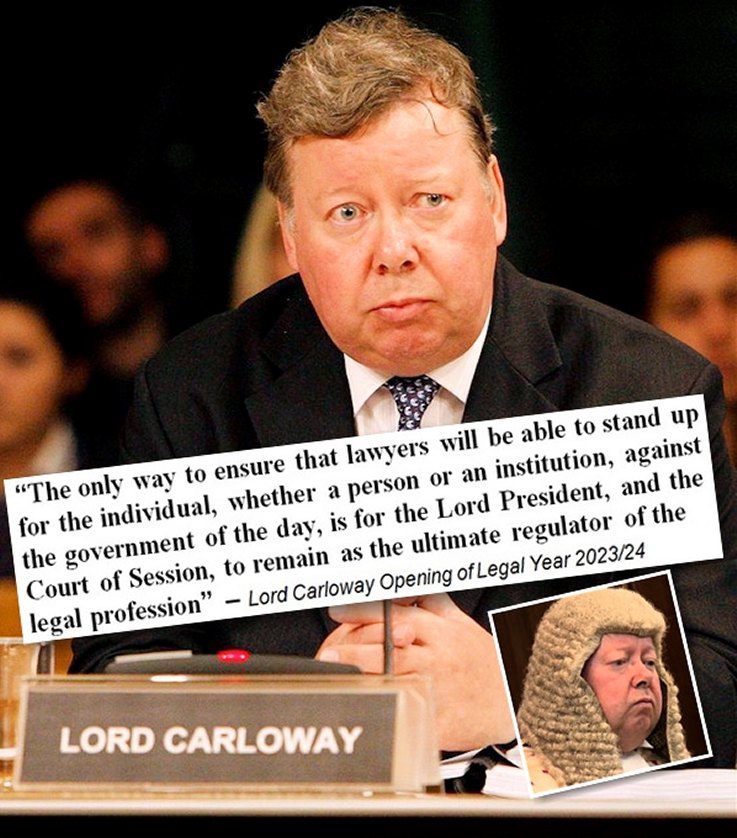





 WRIT HITS THE FAN