
Showing posts with label Banking. Show all posts

Thursday, June 18, 2015

YOUR BANK, M’LORD? The £40m trail of secretive judicial interests, billionaires, aristocrats & offshore trusts in Hampden & Co, Scotland’s latest bank

Judges, mega rich & offshore money mix in new Scots bank. A RICH LIST of investors in Hampden & Co - Scotland’s first new bank in 30 years – reveals members of the judiciary including a suspended judge - among the ranks of billionaires, aristocrats and anonymous offshore trusts who have pumped in £40 million into the financial institution - located in Charlotte Square, Edinburgh.

Among the ranks of investors in the new bank are figures from the judiciary such as the now suspended Sheriff Peter Black Watson – who was suspended from his current judicial duties by Lord President Lord Gill in February of this year - in relation to legal writs linked to the £400m collapse of hedge fund Heather Capital.

Other judicial figures include Court of Session judges and former EU judge, Scottish lawyer & academic Sir David Edward KCMG QC FRSE.

Today, the Judicial Office for Scotland refused to comment on, or confirm the identities of any judges who hold shares in the new bank.
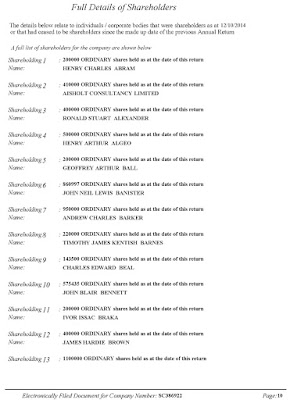
Hampden & Co annual return reveals wealthy shareholder list. In accounts filed by Hampden & Co, Edinburgh, a Michael Scott Jones - is the registered as owner of 200,000 shares.

The Judicial Office refused to confirm or deny if this is the same Michael Scott Jones who is Court of Session judge Lord Jones.

The accounts for the bank also reveal Peter Black Watson is the holder of 400,000 shares.

While the Judicial Office refused to confirm if this is the same Peter Black Watson who was suspended by Lord President Lord Gill earlier this year “to maintain public confidence in the judiciary”, Watson’s identity as one of the shareholders of Hampden & Co has been confirmed in a report in The Scottish Sun newspaper earlier this week.

Speaking to the media today, the Judicial Office refused to be drawn on the issue of judges investments and the need for a register of judicial interests to enable the public to scrutinise judges interests and links to big business, banks and other vested interests.

A spokesperson for the Judicial Office for Scotland would only say : “Personal investment decisions are a matter for individual judicial office holders.

“Judicial office holders are bound by the Statement of Principles of Judicial Ethics and in the event of a case presenting a potential conflict of interests, by reason of an investment or otherwise, will recuse themselves. These recusal decisions are a matter of public record”.

However, it is a matter of public record not one Scottish judge has declared a financial interest in a case which has resulted in a published recusal, and one senior Sheriff – Sheriff Principal Alistair Dunlop - who held shares in Tesco – did not recuse himself in the case involving the supermarket giant.

No public record of any refusals or failures of judges to recuse themselves have appeared in the list of recusals published by the judiciary.

Neither have any financial details of members of the judiciary appeared in the list of recusals.

A petition currently under consideration by the Scottish Parliament - Petition PE1458: Register of Interests for members of Scotland's judiciary - calls for the creation of a single independently regulated register of interests containing information on judges backgrounds, their personal wealth, undeclared earnings, business & family connections inside & outside of the legal profession, offshore investments, hospitality, details on recusals and other information routinely lodged in registers of interest across all walks of public life in the UK and around the world.

The petition has cross party support from msps who backed a motion urging the Scottish Government to create a register of judicial interests at Holyrood on 7 October 2014 - reported along with video footage and the official record, here: Debating the Judges.

In an investigation earlier this week by the Scottish Sun newspaper, it was revealed there are fears among some of Hampden & Co’s shareholders of a second independence referendum, tax rises and how the business climate in Scotland will fare under policies of the SNP Scottish Government.

The bank’s investor list reveals predominantly rich, unionist shareholders such as tycoon Alastair Salvesen, self-storage tycoon Alister Jack, Greenock-born financier Malcolm Offord, Dobbie's garden centre chief James Barnes, Edinburgh art dealer Alexander Meddowes and Stirling-based construction tycoons Duncan Fletcher & Duncan Ogilvie, both worth over £50million. Aristocratic customers includes the Queen's cousin David Bowes-Lyons and the Earl of Rosebery's daughter Lady Caroline Primrose.

Euripides Investments Ltd, the new bank's second largest shareholder, is based in Jersey — meaning its ownership is secret and that owners are likely to pay less tax on profits than individual UK shareholders.

Another major shareholder is Guernsey-based Kusapi Ltd.

Hampden & Co are refusing to reveal the identity of a major Chinese investor - Cai Dang Fang – listed in Companies House records as Hampden's fourth largest shareholder. But it's not known whether that is a person or a company — and the bank won't say if they are based in the UK or overseas.

The private bank's headquarters in Charlotte Square, Edinburgh, are just a few doors away from First Minister Nicola Sturgeon's Bute House residence.

However, many of Hampden's super-rich backers are staunch unionists who fear their savings may be hit by a rampant SNP push for full fiscal autonomy and another independence referendum.

Speaking to The Sun – Founder & Chairman Ray Entwistle (70) insisted "we have absolutely no intention of racing into any kind of decision".

But referring to the SNP's election success he warned: "I suspect a host of businesses that were anxious over the referendum last year remain partially anxious about what happened last month.

"This bank is registered in Scotland, the head office is in Edinburgh and we have a large number of friends we want to do business both in Scotland and in London.

"We are going to wait and see what happens over the next few months. "And I suspect that a lot of other businesses are waiting to see what transpires politically."

Commenting on the bank, Deputy First Minister & Finance Secretary John Swinney said: "We have a world-leading financial services sector and a talented workforce, making Scotland a great place for new businesses to locate. The Scottish Government has been clear about its approach to taxation. This will be based on ability to pay, certainty, convenience and efficiency of collection."

THE SUSPENDED SHERIFF

Lord Gill (73) suspended Sheriff Peter Black Watson (61) after demanding sight of a multi million pound writ against Glasgow law firm Levy & Mcrae - Watson’s former law firm -  which is one of several companies being sued by Heather Capital’s liquidator, Ernst & Young, after the fund's collapse in 2010. Watson was a director of a company called Mathon Ltd, and another - Aarkad PLC - key parts of the Heather empire.

The collapsed hedge fund Heather Capital – run by lawyer Gregory King is now the subject of a Police Scotland investigation and reports to the Crown Office. Gregory King – a lawyer - is named along with three others – lawyer Andrew Sobolewski, accountant Andrew Millar and property expert Scott Carmichael in a police report.

An earlier statement from the Judicial Office for Scotland on Watson’s suspension reported: Sheriff Peter Watson was suspended from the office of part-time sheriff on 16 February 2015, in terms of section 34 of the Judiciary and Courts (Scotland) Act 2008.

“On Friday 13 February the Judicial Office was made aware of the existence of a summons containing certain allegations against a number of individuals including part-time sheriff Peter Watson. The Lord President’s Private Office immediately contacted Mr Watson and he offered not to sit as a part-time sheriff on a voluntary basis, pending the outcome of those proceedings.

Mr Watson e-mailed a copy of the summons to the Lord President’s Private Office on Saturday 14 February. On Monday 16 February the Lord President considered the matter.  Having been shown the summons, the Lord President concluded that in the circumstances a voluntary de-rostering was not appropriate and that suspension was necessary in order to maintain public confidence in the judiciary.

Mr Watson was therefore duly suspended from office on Monday 16 February 2015.”

BANK OPENS AMID GLARE OF PUBLICITY:

Today, 18 June 2015 – Hampden & Co., the first private bank to come through the new process to obtain a banking licence, has opened its doors to clients after securing final regulatory approval at the beginning of June. It is the first private bank to be set up in the UK for 30 years and will address the significant demand in the UK for a new, high quality banking service.

Founded in 2010 by Ray Entwistle, the former Chairman of Adam & Company, the bank has recruited an impressive team of over 50 qualified professional bankers and support staff, headed up by Chief Executive Graeme Hartop, formerly CEO of Scottish Widows Bank.

The bank will deliver a traditional private banking service built on long-term client relationships and personal service from offices initially in Edinburgh and London. Capital of nearly £50 million has been raised for the launch, which demonstrates the confidence investors have in the business opportunity.

Ray Entwistle commented: "There is strong demand for a new private bank which delivers the right quality of service with long-term continuity of personnel and speed of decision making. Over 250 shareholders have come to the same conclusion and they have been prepared to back our experienced team with the capital required to launch our new bank."

Graeme Hartop added: "The timing for launch is ideal as we continue to experience an improved economic environment, strong client demand and a favourable competitive landscape as a large number of the existing banks continue to deal with significant legacy issues. We will deliver a traditional client-led private banking service, fully focussed on client needs and not product sales targets, which will lead to strong client-to-banker relationships. We are delighted to be welcoming clients on board."

Thursday, June 20, 2013

When “Sorry” won’t do : Criminal law should be used to protect the public from the 'off the hook' style self-regulation empires of banking, finance, legal and key public services

Broken regulation applies to many more services than just banks. During a week in which England’s NHS regulator, the Care Quality Commission (CQC) was forced to admit (in response to a review) it had covered up information relating to the deaths of babies at a hospital in Cumbria, and at Westminster, the Cross-party Parliamentary Commission on Banking Standards report recommended bankers found guilty of a yet to be created criminal offence of “reckless misconduct” be jailed, it is not too difficult to put forward the point once more that regulation as we know it is ineffective and does not pose any deterrent to those it purports to regulate.

Let’s face it, if regulators are happy enough to cover up the deaths of babies in hospitals, and profit from such a cover up, what chance does any of us have in getting justice against any complaint lodged with any of the current regulators of any profession or public service ?

Diary of Injustice has previously reported on cases in Scottish hospitals where in one particularly case of the death of baby McKenzie Wallace at an NHS Forth Valley hospital reported HERE, regulation in the form of the Scottish Public Services Ombudsman (SPSO) ‘Complaints Reviewer’, Eileen Masterman, did nothing to explain the tragic events, other than to produce a ‘whitewash report’ which only contributed further to the hospital’s cover up.

Time and again, we are promised change, told “lessons will be learned” and what happened will never happen again, but it does, whether it’s another avoidable death in a hospital, or an avoidable rip off of consumers and those who should face a court and be found guilty escape with a big fat pension while their victims are left to pick up the pieces.

The recommendations of the Parliamentary Commission on Banking Standards tell a story many consumers have known for years when it comes to regulation. With particular regard to the creation of a criminal offence of reckless misconduct, such a move should not only be limited to bankers, rather also it should be applied to all those professions where the long standing cosy clubs of self regulation have seen the public are let down time & again.

The key recommendations of the report on Banking standards could well be applied to the legal system, where client’s lives are regularly ruined by legal ‘professionals’ who rely on their system of self regulation to get them off the hook just as the bankers have so far escaped punishment for their actions :

* A new Senior Persons Regime, replacing the Approved Persons Regime, to ensure that the most important responsibilities within banks are assigned to specific, senior individuals so they can be held fully accountable for their decisions and the standards of their banks in these areas

* A new licensing regime underpinned by Banking Standards Rules to ensure those who can do serious harm are subject to the full range of enforcement powers;

* A new criminal offence for Senior Persons of reckless misconduct in the management of a bank, carrying a custodial sentence;

* A new remuneration code better to align risks taken and rewards received in remuneration, with much more remuneration to be deferred and for much longer;

* A new power for the regulator to cancel all outstanding deferred remuneration, along with unvested pension rights and loss of office or change of control payments, for senior bank employees in the event of their banks needing taxpayer support, creating a major new incentive on bankers to avoid such risks.

Just imagine if the ‘independent’ Scottish Legal Complaints Commission called for the same powers, and demanded the added protection of criminal law for clients whose finances are regularly wiped out by solicitors free to do it again and again …

Similarly, the key points of the report on Banking standards also tell the same story of problems in the legal profession, and those others in the justice system who work in, manage, and rule over our “Victorian” courts system.

* Given the misalignment of incentives in banking, it should be no surprise that deep lapses in standards have been commonplace. The Commission’s Final Report, ‘Changing banking for good’, contains a package of recommendations to raise standards.

* The recommendations cover several main areas including: making senior bankers personally responsible, reforming bank governance, creating better functioning and more diverse markets, reinforcing the powers of regulators and making sure they do their job.

Just as in banking, when there is no incentive to be honest in our justice system, whether you are a member of the judiciary, a court clerk, a solicitor or even a member of a self regulator of solicitors, the same deep lapses in standards have also become commonplace because there is no deterrent in current regulation and no fear of being caught.

The full report on banking standards by the cross party Committee on Banking Standards can be found at the following links :

If we are going to charge the bankers with reckless misconduct for ruining the banks, we may as well also charge the lawyers who ruin countless clients, and get away with it in the same way the bankers have done up to now.

If this were to happen, and the likes of the John O'Donnell's and countless other reckless lawyers in Scotland face a custodial term for their wholesale thieving, attitudes within the prosecution service would also have to change, particularly in Scotland where our own Lord Advocate’s Crown Office refused to prosecute FOURTEEN lawyers for legal aid fraud.

But of course, when these events happen around the fringes of a stone age legal system where our top judge would rather listen to organ music and play ‘fly me to the moon’ than show up to answer questions in our sovereign Parliament about transparency in the judiciary, and perhaps give an indication as to why judges seem to think they are above the law, then what can we expect ?

Tuesday, May 17, 2011

The Crooked & The Crooked : Scottish solicitors claim banks & financial services ‘are historically too crooked’ to own Scots law firms

slasBanks are too crooked to own law firms, FSA is rubbish at regulation, say Scottish Law Agents Society. BIZARRE CLAIMS that High Street Banks and other ‘Financial Service Providers’ are TOO CROOKED to hold majority ownership in equally crooked Scottish law firms have emerged today in a response from the Scottish Law Agents Society to a Scottish Government consultation on proposed changes to the ownership of law firms as laid down in the Legal Services (Scotland) Act 2010, passed last year by the Scottish Parliament only after a raft of changes & amendments had been ordered by the Law Society to water down the Scottish Government’s initial proposals to expand Scotland’s closed shop legal industry.

The Scottish Government consultation on which categories of regulated professionals other than solicitors should qualify to meet the 51% ownership requirement in the Legal Services (Scotland) Act 2010 has caused fierce bickering within the Scottish legal profession over their decades old control of Scotland notorious closed shop solicitor dominated legal profession where members of the public who require access to justice or the courts are forced to go solicitors who are members of the Law Society of Scotland.

Today, amid the fears of lawyers the financial industry will come into Scotland’s legal profession and scoop up law firms, or even open their own and bring much needed competition into the legal services marketplace where solicitors have got used to charging sky high fees for doing very little work on behalf of their clients, the Scottish Law Agents Society issued a series of damning accusations against the financial services sector, essentially claiming financial services providers are historically too corrupt to own a majority stake in a Scottish law firm.

In a response to the Scottish Government consultation, the Scottish Law Agents Society claimed : “The financial services industry over the last 30 years does not inspire confidence in the professional standards in the industry. There have been widespread scandals with the mis-selling of endowment policies, personal pension plans, home income plans, precipice bonds and other structured investment products. Currently there is a further scandal with the mis-selling of payment protection insurance.”

The same is true of the legal profession in Scotland. Solicitors have spent decades mis-selling legal services to clients who end up paying extortionate fees for useless and often unsuccessful litigation.

The response from SLAS continued : “The key to each of these scandals is the selling of the products. Notwithstanding the veneer of professionalism the old adage that financial products are sold and not bought remains true. The whole culture of financial services remains one of sales rather than the provision of professional services where the professional puts the interests of the client ahead of his own interests. The regulatory scheme which has applied since the Financial Services Act 1986 has done little to curb this culture.”

While it is true regulation may well have done little to curb bad practice in the financial services sector, it is equally true regulation in the legal services sector, provided in Scotland by the Law Society of Scotland, Scottish Legal Complaints Commission, Scottish Solicitors Discipline Tribunal & last but not least, the Faculty of Advocates, has collectively done little or nothing to curb the incessant corruption, client rip offs, negligence, dishonesty and bad service which continues to plague Scotland’s legal services sector today.

The statement from SLAS also attacked the Financial Services Authority, claiming : “The present regulator of financial services is the FSA and, despite its wide ranging powers, the provisions of the Legal Services (S) Act 2010 with tests of fit to own and fit to manage are not sufficiently robust to allow us to have confidence that the public would be protected from a sales culture approach which could lead to the mis-selling of legal services.”

It should be noted the response from the Scottish Law Agents Society fail to contain any references to many Scots law firms who are themselves caught up in similar scandals of mis-selling of mortgages & financial products and even legal services to clients who are then forced to lodge complaints with the Law Society of Scotland and Scottish Legal Complaints Commission. Unsurprisingly the Law Society & SLCC are reported to be ignoring such complaints.

While SLAS went onto cover themselves by stating : “It would degrade significantly the intended benefits of the Act and indeed the rationale for liberalising the provision of legal services if regulated professions were restricted only to those of Solicitor and Accountant”. Although it would require approved regulators to evolve and enforce robust “fitness for involvement” tests, it would be inconsistent with the purpose of the Act to deny the opportunity to participate in the provision of legal services to other regulated professionals.” the response indicated they would be happy to form “associations between solicitors and surveyors or indeed any regulated profession as defined in Article 3 of European Directive 2005/36 with one exception“, that exception being the Financial Services Industry.

I am not surprised solicitors are happy to form associations with the likes of surveyors.

Law firms forming associations with surveyors is something I’ve seen first hand in Edinburgh and particularly in the Scottish Borders, usually ending up in a very corrupt arrangement where surveyors dish out fraudulent valuations to house buyers or sellers or solicitors on behalf of executry estates of deceased clients, resulting in one particular case I remember where a single solicitor ended up owning twelve properties, some purchased through middle men after it took years to sell particular properties of deceased clients which ended up being sold in some cases for a quarter of their value during the property value boom between 2000 – 2008.

The response from the Scottish Law Agents Society also came down hard on will writers & confirmation agents, stating : “Will Writers and Confirmation Agents are not professionals. At present they require no proper education and training. The qualifications needed to do that work properly requires the same training that solicitors receive. A full training in and understanding of the law on all aspects of property law, succession, taxation etc, are required to offer proper advice. It is obvious that no one should offer services in Will writing and Confirmation without current practising solicitors trained in that area.”

SLAS continued : “Furthermore we note that there are no adequate mechanisms for consumer complaints to be made and investigated free of cost to the consumer and no evidence of adequate professional standards or disciplinary procedures. There is evidence of widespread consumer detriment in the quality of services provided and in the marketing practices of will writers.”

Clearly standards must be kept, but with the ever increasing amount of fraud by solicitors against executries & wills in Scotland, reaching into the tens of millions of pounds each year or by some estimates much more, I hardly think trusting regulation of the legal services market to the likes of the Law Society of Scotland and the remains of the current self-regulation of solicitors gang, including the SLCC, will do anything to improve regulation, increase public confidence or increase consumer protection in Scotland’s best-to-be-avoided legal services marketplace, even after terms of the much-watered-down Legal Services (Scotland) Act 2010 takes hold.

The Scottish Government were asked to comment on the SLAS response and their accusations against the Financial sector. A spokesman for the Scottish Government said: "The Legal Services (Scotland) Act 2010 will modernise the Scottish legal profession, and will offer firms of every size the flexibility to adopt a business model that works for them and their clients. It will give Scottish firms greater opportunities, within a robust regulatory system, to expand and compete effectively, both within and outwith Scotland.”

"The consultation in question sought views on those who should be permitted to own a majority or controlling share in the new licensed legal services providers. All responses will be analysed and considered along with other evidence before a decision is taken. A report on the consultation will be prepared in due course, and will be available on the Scottish Government website.”

We are therefore left to ask ourselves as consumers of legal services, are banks & financial services providers too crooked to own outright a law firm, or is it just these law firms are themselves too crooked to want anyone else to own them or compete in their markets ?

Judge for yourselves on the evidence aplenty already reported on Diary of Injustice, although you may be forgiven for coming to the conclusion neither of the professions can really be trusted with our financial or our legal & justice needs.

Wednesday, January 28, 2009

Dean of Faculty calls for class actions against banks as Scots legal profession turns against financial sector

richard keen qcEarlier this week the Dean of Faculty, Richard Keen QC, appeared in the media to call for a lifting of the ban on Class Action litigation in Scotland, ending a long tradition and campaign by Scotland's legal profession to keep class action litigation out of reach of Scots, due to the Law Society of Scotland's fears that thousands of clients of 'crooked lawyers' may turn on the legal profession itself and instigate class actions for the profession's governing body's poor regulation of solicitors work and lack of compensation to victims.

A lifting of the Scottish Government's ban on class action litigation in Scotland would be a most welcome matter, ending a prejudice maintained against ordinary Scots for too long, at the behest of vested interests in the legal profession, who until now, have not raised the issue as a matter for reform, with regard solely to the public interest.

However, the Scottish Consumer Council, now renamed Consumer Focus Scotland, have been calling for class action litigation to be allowed since 1992, and the Scottish Law Commission also recommended progress on the issue in 1996, so Mr Keen QC is slightly tardy in his recent call that class actions be allowed.

The Royal Bank of Scotland is of course, first in the firing line apparently, as members of Scotland's legal profession are letting it be known they feel there should be a raft of class actions against the RBS, particularly due to an alleged lack of information relating to rights issues, which have been used to fund takeovers, such as the disastrous RBS participation in the deal for Dutch banking giant ABN Amro, which has effectively brought the RBS to its knees.

As we see however, from the Scotsman’s report on Richard Keen QC’s call for class actions to be enabled in Scotland, his suggestion apparently relates only to the banking sector, as perish the thought class actions could be used against any other sector of business in Scotland, including of course, his own beloved colleagues in the legal profession, who themselves receive upwards of four thousands complaints a year on everything from poor service to widespread embezzlement of client funds.

It is slightly strange, the Scots legal profession should now feel this way about its own bank, as the Royal Bank of Scotland handles a significant amount of business for the Law Society of Scotland itself, as well as thousands of solicitors and legal firms in Scotland.

As things appear not to be as they seem, we must therefore examine the legal profession's motives for this abrupt change of strategy towards their once friendly business partners such as the RBS, who even sponsor the Scots legal profession’s annual legal awards ceremonies for the ‘quality’ of solicitors legal work !

I note for instance, what has seemingly escaped mention by the Dean of Faculty, is the coincidental fact many of those 'sweet finance deals' which solicitors & legal firms have regularly received from the banks, as a reward for steering client funds into particular banks & other financial institutions, have effectively come to a halt due to the financial turmoil in the banking sector and the low levels of interest rate returns currently on offer.

Basically these ‘sweat finance deals’ work like this : A solicitor will steer any funds received from his clients to his preferred bank or financial institution, in return for a 'sweet finance deal' at special interest rates, which ordinary consumers could never hope to negotiate. These funds include money received for all types of legal work, including conveyancing, handling deceased wills & probate, financial claims litigation including settlements, legal aid payments, account fees etc ...

The only person excluded from this deal, is you, the client.

So, while perhaps, your house purchase is delayed supposedly due to the signing of a few extra documents, or a few loose ends, or perhaps your dead wife's estate takes a whopping four years to be confirmed & finalised, or some other legal work or case you are involved in is taking years and hundreds of letters to achieve only a little momentum, your solicitor and their legal firm will be earning a significant rate of interest and finance, and the bank will be profiting from their holding of clients funds for a little longer, while you are none the wiser for what is going on.

Little doubt therefore remains as to why the legal profession has now turned against it’s once business partners in the financial community .. its all about money, and the lack of it, nothing to do with the public interest or improving the rights & entitlements of Scots when it comes to Justice & Law.

As it happens however, there is a more reasonable & public spirited approach to the matter, in the form of a Petition before the Scottish Parliament calling for class action litigation to be allowed in Scotland.

You can visit the Petition and sign it online HERE.

Please sign the petition, it is in your best interests that we as a country are not excluded from the legal rights & entitlements which hundreds of millions of others enjoy around the world.

Scottish class action procedure

Raised by: Peter Brown on 12 January 2009

Calling on the Scottish Parliament to urge the Scottish Government to instigate a class action procedure or similar in Scots Law to correspond with the legal systems of many other countries including England and the United States.

The background to the Petition can be read here : Background to Class Action Petition

A Brief extract of the Background to the Petition :

There is documented evidence (ref1) that some people are denied access to justice within the Scottish legal system for many reasons including their perception that court action is prohibitively expensive.

Specifically, in Scots Law there is no mechanism to allow a group of people with the same grievance to collectively take litigation action against a commercial company.

A Class Actions procedure in Scots Law has been called for since 1982 (ref2) and, in fact, was recommended in 1996 by the Scottish Law Commission (ref3). Draft court rules were also presented in this report. Nevertheless, in 2000 the Court of Session Rules Council decided that existing procedures were adequate and, hence, the recommendation of the Scottish Law Commission has, to date, not been implemented.

The ongoing Scottish Civil Courts Review is currently considering the introduction of a Class Action procedure in conjunction with many other proposals. Its recommendations are due for publication in Spring 2009. This is a promising development but, as stated by Lord Gill at the consultation paper launch in November 2007, the review needs to ensure that [members of the publics] voice is heard and that their interests are central to any recommendations for reform that we make.

MacAskill tight lippedOne can only wonder as to why the SNP controlled Scottish Government have not made it a priority to change the law allowing class actions, but as Justice Secretary Kenny MacAskill has always said, even on video, he will always protect the legal profession from just about anyone or anything .. so perhaps not too much need to wonder why there has been no action on the matter yet.

Here follows the Scotsman’s report on the Dean of Faculty ‘breaking ranks’, so to speak, and calling for class actions … against banks. How about allowing class actions, without restrictions, Mr Keen ?

QC: Allow class actions against banks

Published Date: 26 January 2009
By Jane Bradley and John Forsyth

ONE of Scotland's most senior lawyers is calling for ministers to scrap the restriction banning class actions in Scots law, a move that could see a wave of claims against banks.

The suggestion by Richard Keen, QC, the dean of the Faculty of Advocates, would open up the prospect of challenges by groups of shareholders against financial institutions over a lack of information about the state of their business.

It is understood that Scotland's legal profession believes there could be a raft of actions against Royal Bank of Scotland and other financial institutions on the basis that the information given out at the time of rights issues had been inadequate.

Mr Keen said: "The absence of class action certification inhibits pursuit of remedy. It is difficult to fund major litigation of that kind unless you can put together a class action."

Mr Keen's comments follow a string of calls from politicians demanding legal and political action to tackle the crisis – with RBS most in the firing line. Alex Salmond, the First Minister, said yesterday that he believed a parliamentary inquiry should be carried out into the banking crisis in Scotland.

He said any investigation should cover the Financial Services Authority and the role of politicians in overseeing the administration of the financial sector "to ask them why they were asleep on the job".

He said: "I'd rather favour a parliamentary investigation, not just into the Royal Bank of Scotland – that would be daft, as the Royal Bank of Scotland is only one of hundreds of banks worldwide which has got into serious trouble – but into the financial sector."

It emerged at the weekend that Christine Grahame, an SNP MSP, has written to Lothian and Borders Police, demanding that an investigation be carried out into RBS's conduct over its two rights issues last year, while Tavish Scott, MSP, the leader of the Scottish Liberal Democrats, has called for an investigation by the Serious Fraud Office.

Under the leadership of Sir Fred Goodwin, RBS carried out its first £12 billion rights issue in April last year, when thousands of investors forked out £2 a share for a tranche of new stock in the firm. A second rights issue, in November, was shunned by investors and the government had to underwrite the £15 billion issue. RBS's fortunes have nosedived in recent months, with investors watching shares plummet, to close at 12.1p on Friday.

Mrs Grahame's letter told police she believed RBS "appeared to have committed a fraud".

RBS revealed last week it was on course for the biggest loss in UK corporate history, as it expected to write down as much as £20 billion on the falling value of its assets.

Mr Scott said: "I think the banks across the UK must have known what their financial position was much earlier than they were letting on, and that particularly applies to RBS.

"At the time they were asking investors for more money to help their financial position, as RBS giving a full picture of how strong or weak they were as a financial institution? I genuinely don't know, but I believe that the Serious Fraud Office should have a look at it."

He warned that a political inquiry could turn the crisis into a partisan issue and could detract from solving the question of whether investors were misled.

Just last week, the veteran lawyer Ian Hamilton lodged a small-claims action against RBS, saying he had been persuaded to buy 640 shares at the £2 offer price in its 2008 rights issue.

A spokeswoman for RBS refused to comment.

Wednesday, January 21, 2009

Royal Bank failure blamed on lack of regulation by ex Law Society Boss who campaigned against stronger regulation of solicitors

The Royal Bank of Scotland's failure, which has led to the bank effectively being nationalised by the UK Government to save it, and save its customers, was nothing to do with either Sir Fred Goodwin or the Bank's 'takeover too far' of the Dutch Bank ABN Amro, so says Douglas Mill, former Law Society Chief Executive and school friend of Sir Fred Goodwin.

Douglas Mill - it wasn't the Bank or Sir Fred’s fault, it was the lack of governance & control !


Douglas Mill, said in a BBC Scotland interview, which highlighted the alleged failures of Sir Fred Goodwin, whom some newspapers have dubbed "The World's worst banker" :"Well scapegoating is the right expression.".

Douglas Mill would know all about scapegoating, and how to avoid it, as he did for around eleven years as Chief Executive of the Law Society of Scotland, who interfered & intervened in just about any case involving crooked lawyers which had the possibility to bring changes to the way solicitors were regulated by the Law Society.

Douglas Mill, staggeringly went on in the interview to blame the Royal Bank of Scotland's huge losses & failures on the financial markets on poor regulation of the Banking sector !

Douglas Mill went on in usual form : "The real failures here are failures of financial services regulation and that extends beyond the Royal Bank.

The real failures here are failures of lack of governance and lack of control in the whole banking sector not just the Royal Bank again its easy to be wise after the event but scapegoating Fred isn't going to address the problems here."

An amazing outburst indeed, from Mr Mill, who tirelessly campaigned against any strengthening of regulation against the legal sector in Scotland, and whose aims to prevent consumers being protected by increased safeguards & independent regulation of Scottish legal services are still being carried out today by the present Justice Secretary, Kenny MacAskill, who himself said on video in the past, he would also protect lawyers from anything or anyone …

You can read an earlier article on how Mr MacAskill carries on Douglas Mill's 'traditions' of protecting the worst elements of Scotland's legal profession here : Justice Secretary rejects independent regulation of lawyers and public right of choice in legal services market

Indeed, it was, as you will all recall, Douglas Mill who infamously once threatened the Scottish Parliament and the previous Scottish Government with legal action if legislation was passed in the Scottish Parliament to protect consumers and strengthen regulation against Scottish solicitors.

Douglas Mill threatens to sue Parliament & Govt : ‘Holyrood in Solicitors’ sights by Ian Fraser

Holyrood in Solicitor's Sights Octover 30 2006 The Herald

I wrote about Douglas Mill’s court challenge threat to Parliament here : Law Society of Scotland threatens Court challenge against Scottish Executive over LPLA legal reform Bill

We must also not forget this is the same Douglas Mill who famously scrapped with John Swinney, the Cabinet Secretary for Finance, in front of Holyrood's Justice 2 Committee, where Mr Swinney, then in opposition, exposed the secret memos of Mill himself which eventually led to the end of Mill's career at the Law Society after the video coverage of the event was posted to You Tube.

You can read more about the Holyrood confrontation between Douglas Mill & John Swinney here : Law Society boss Mill lied to Swinney, Parliament as secret memos reveal policy of intervention & obstruction on claims, complaints.

Douglas Mill Memo to Martin MacAllister 5 July 2001In the memos, it was revealed by John Swinney that Douglas Mill had been, and was still engaged in a bitter & protracted campaign against some of Mr Swinney's constituents to prevent them from obtaining access to legal services and financial settlements in long running claims against several of Scotland leading legal firms, which Mr Mill, and the Law Society's insurers Marsh UK, intended to delay and destroy at any cost.

It is worth noting that every single claim and complaint against 'crooked lawyers' which the now discredited ex-Law Society Chief Douglas Mill personally intervened in, ultimately failed to be resolved, and the particular case which Mr Swinney raised before the Justice 2 Committee along with Mill's own memos, also remains unresolved and without settlement.

Career ending video : Douglas Mill contradicts his own secret memos released by John Swinney during Justice Committee investigation


You may all be wondering why someone such as Douglas Mill may blame a lack of regulation of the banking sector as the cause of its catastrophic failure ?

Well, wonder no longer, as the banking sector, such as it used to be, went hand in hand with the legal sector, gaining billions of pounds of business & finance in Scotland from solicitors who themselves used clients funds and a myriad of other less than open financial deals with the banks, using clients money to gain personal finance deals and deals for their legal firms on spectacularly low interest rates which ordinary consumers had to prop up through exhorbitant costs of poor legal services and thousands of cases of lost clients funds each year which the Law Society under Douglas Mill did nothing about.

FSA denies it will block independent complaints bodyInterestingly, the same failures of regulation which Douglas Mill claims let down his friend, Sir Fred Goodwin, were the same kinds of regulation Mill actually fought against being implemented on the Law Society of Scotland, such as in the case where Douglas Mill claimed in an interview with Business Journalist Ian Fraser, that the Financial Services Authority would not allow any independent oversight of such things as the infamously corrupt Indemnity Insurance arrangements for Scottish solicitors known as the "Master Policy" which has led to some of the worst cases of corruption involving insurance in Scotland for decades.

It turned out the FSA were quite happy there would be independent regulation of the Master Policy, and I wrote some more about that issue here : Chief Executive of the Law Society of Scotland branded a liar after FSA denies claims of intervention to block complaints body.

You can read more about the Master Policy and how Douglas Mill as Chief Executive of the Law Society and his staff at ‘Client Relations’ implemented his 'policy for protection' of solicitors against claims & complaints here : The Corrupt Link Revealed - How the Law Society of Scotland manages client complaints & settlements.

More can be read about the Master Policy HERE

Perhaps what we learn from this story is that the banking world and legal world do tend to go hand in hand, when it comes to business, and scandals …. so both worlds need a fairly strong dose of independent regulation with effective policing of their activities, rather than the hands off approach which Mill and his kind have preferred over the years.

Mr MacAskill – adjust your policies accordingly, or step aside for someone who can protect the public, rather than simply protect the professions …