 Top judge Brian Gill attacks calls for judicial reforms. IN a speech to the Commonwealth Law Conference held in Glasgow SECC last weekend, Scotland’s top judge Lord President Lord Brian Gill accused government, legislators and transparency as being “insidious” threats to his way of doing things and the judiciary at large.
The lengthy speech from Gill (73), supposedly on independence of the judiciary & legal profession ended up as a bitter tirade aimed at politicians and those calling for reform of the secretive world of the nation’s judiciary and the vested interests of those at the top of the justice system.
Launching a fierce attack on calls for judicial transparency, the political process and Holyrood MSPs who are investigating accountability and transparency within the judiciary amid calls for a register of judges interests, Lord Gill told his audience: “The threats to judicial independence do not always come with a knock on the door in the middle of the night. In a society that prides itself on the independence of its judiciary, the threat may come in insidious ways, even at the hands of well-meaning governments and legislators, in the name of efficiency and, ironically, in the name of transparency.”
And, Gill – Scotland’s longest serving judge - went on to tell his audience of lawyers, judges & academics that protesters he encountered standing on the Heart of Midlothian in Edinburgh’s Royal Mile were lucky they were not dragged off by Police.
In a swipe at unidentified persons who were apparently calling for the top judge’s resignation, Gill told his audience: “Two years ago, I was crossing the square outside my court when I noticed two individuals standing, perhaps appropriately, at the Heart of Midlothian, the scene of public executions in Edinburgh in former times. They were holding a large banner. It caught my eye. It said "Lord Gill - Resign!" I never discovered what their reasons were; but I thought what a privilege it was to be a judge in a society where the public could make a constructive suggestion of that nature without being taken away by the police.”
The barbed comments from the ageing judge against all and sundry come as Gill continues to fight a bitter two year battle against Holyrood msps who overwhelmingly support proposals to establish a register of interests for members of the judiciary as called for in Petition PE1458: Register of Interests for members of Scotland's judiciary.
Since early 2013 Lord Gill has refused three invitations to appear before the Scottish Parliament’s Public Petitions Committee and be questioned on the issue of judges refusing to declare their interests.
The top judge has instead sent several strongly worded letters to msps warning them they cannot compel a judge to appear at Holyrood. Gill used a loophole in the Scotland Act to dodge questions on his hostility to transparency and also implied in a further letter he may have to reconsider allowing judges to cooperate with the Scottish parliament in the future.
The proposals to create a register of judicial interests envisages the creation of a single independently regulated register of interests containing information on judges backgrounds, their personal wealth, undeclared earnings, business & family connections inside & outside of the legal profession, offshore investments, hospitality, details on recusals and other information routinely lodged in registers of interest across all walks of public life in the UK and around the world.
Faced with investigating the secretive world of judicial vested interests, MSPs who sit on the Scottish Parliament’s Public Petitions Committee instead took evidence from Scotland’s first Judicial Complaints Reviewer (JCR) Moi Ali. During questions at the Scottish Parliament’s Petitions Committee, Moi Ali told msps there was little transparency or accountability in Scotland’s judiciary.
And, despite Scottish Ministers attempt to thwart a debate at Holyrood last October 2014, most msps backed a motion urging the Scottish Government to create a register of judicial interests – reported along with video footage & the official record, here: Debating the Judges
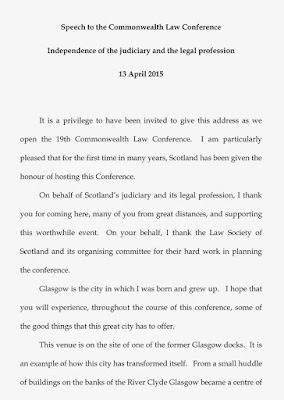 Speech given by Lord Gill to Commonwealth Law Conference Glasgow 2015 Continuing his lengthy seventeen page speech, Gill told his audience of legal professionals that judges lead a lonely life and have no support from anyone else except themselves.
He told his listeners: “The highest priority of judicial education is not to teach judges the law, but to teach them about themselves. The life of a judge is a lonely one where the only support network available is that of one's colleagues.”
However, the sad lonely life of a judge - as Gill would have the public believe - does not appear to preclude the judiciary from becoming involved in tax avoidance schemes, huge movements of wealth around the world, investing in companies who benefit from business in the courts and jet setting around the world at taxpayers expense.
Last year for example, Lord Gill flew off to a five day state visit to Qatar – details of which have been kept mainly hidden from prying eyes.
Gill was later criticised in the Scottish Parliament for attending Qatar and giving a speech on judicial ethics, while refusing to answer questions from msps on judicial ethics, accountability and transparency. MSP Jackson Carlaw even joked the Petition Committee should have gone to Qatar to question the top judge after he refused to show up at Holyrood,
Following Lord Gill’s frequent attacks on “aggressive media” over calls for transparency - and the top judge’s subsequent threat to ban journalists from accessing court documents last year in a highly public fit of pique, Gill launched another broadside against the press for their reporting of cases in the courts.
Gill said: “Criticism of one's judgments in the media is never a pleasant experience; but, as Lord Woolf has commented, we must swallow our pride and be thankful for a free press which stands to safeguard our independence.
Independence relies upon public understanding of our courts and the way in which they should expect our courts to operate. Public awareness breeds public confidence. For most people, newspaper accounts of court cases are the source of their knowledge of our justice system. There is inevitably a tension in the relationship between the judiciary and the media. The court adjudicates on matters involving the media fairly frequently. Therefore, as Lord Woolf rightly observes, we should be circumspect about having a relationship with the media that might cast doubt on judicial independence. It is a fine line to tread.
In modern times, our court systems have a dedicated media team, who liaise with the media to ensure that there is an open and accurate flow of information. For, the media are helpful to our cause only if facts are reported with accuracy. Good communication with the media – at arm's length - is a sign that our court system is in touch with the community and. I would argue, is in itself an important aspect of judicial independence.”
Speaking on his two year consultation to change the rules on judicial discipline and complaints – which ended up with much the same rules as before, Gill said: “A related and more obvious aspect of judicial professionalism is judicial discipline. It is immediately obvious that there is a tension between the concepts of accountability and independence. There must be an effective mechanism in place for investigating and sanctioning misconduct without eroding the independence of the judiciary.”
“Appointment to the bench does not confer immunity from discipline. It is therefore usually suggested that judicial discipline should be left in the hands of the judiciary themselves. That excludes the possibility of interference from the executive, but it does not entirely resolve the independence problem. If the judiciary is essentially self-regulating, the perception of a judiciary driven by self-interest and self-protection, and shrouded in mystery, will do us great damage. It does little to ensure that the public have a satisfactory impression of accountability.”
“In Scotland, this difficulty has been overcome by our adopting two distinct processes, namely, a complaints procedure and a 'fitness for office' procedure. If I were to conclude that a judicial office holder was unfit for office, the matter would be referred to an independent tribunal to investigate and report on whether there was unfitness to hold office by reason of inability, neglect, or misbehaviour. I have never had to take such a step. Disciplinary procedures of this nature are rare. We are fortunate to have a professional and dedicated judiciary. Perhaps, that is a reflection of the fact that we now have a comprehensive Statement of Principles of Judicial Ethics that spells out exactly what conduct we expect of our judiciary.”
Gill ended his speech describing his idea of the “ideal judge”, notably leaving out transparency as a requirement for those on the bench.
Gill told his audience: “So, what kind of judge do we wish to have? First and foremost a judge who is appointed fairly and publicly. Every decision to appoint is made ad hoc. Therefore we should not be excessively prescriptive lest we fail to allow for the unforeseen. But certain general priorities are there for your consideration. It is surely desirable that our ideal judge should be one who has experienced the true meaning of an independent profession and who exemplifies excellence allied to good judgment. A judge who is willing to learn and to be accountable. A judge who has self-knowledge, humility, and an understanding of the nobility of the office to which he has been called.”
Judges, lawyers and academics from many Commonwealth nations attended the conference at the Scottish Exhibition & Conference Centre (SECC). Those organising the conference claimed the gathering of legal eagles generated an economic boost in the region of £1.4m for the city.
The conference - last held in 2013 in Cape Town, South Africa – which Lord Gill jetted to at taxpayers expense has been brought to Glasgow in partnership between the Law Society of Scotland, Glasgow City Marketing Bureau (GCMB) and the SECC. It is officially the conference of the Commonwealth Lawyers Association, which works to promote human rights and the rule of law across the Commonwealth, and to support lawyers in countries where their work may incur sanctions from the authorities.
Just prior to the start of the event, it was revealed Wikileaks founder Julian Assange was booked to speak to the conference via video link.
During his speech, Mr Assange suggested communications were being monitored between legal professionals and the wikileaks team.
However, when judges discovered the Assange booking, several judicial figures including Lord Gill and also Lord Neuberger & Lord Hodge of the UK Supreme Court among others - walked out of the conference.
A spokesperson for the Judicial Office for Scotland said: “The conference programme was changed to include Mr Assange’s participation at short notice and without consultation. Mr Assange is, as a matter of law, currently a fugitive from justice and it would therefore not be appropriate for judges to be addressed by him.Under these circumstances the Lord President, Lord Gill and the other Scottish judicial office holders in attendance have withdrawn from the conference.”
A spokesman for the UK Supreme Court said: “Lord Neuberger and Lord Hodge share the concerns expressed by Lord Gill and his fellow senior Scottish judges regarding the late addition of Mr Assange to the conference programme. As a result of this unfortunate development, they trust that delegates will understand their decision to withdraw from the conference.The justices took this action regretfully, as they value greatly the work of the Commonwealth Lawyers Association and the role of the conference as an important forum for sharing experiences and good practice across the legal profession.”
The Judicial Office have offered no further comment on Lord Gill’s remarks.
Previous articles on the lack of transparency within Scotland’s judiciary, investigations by Diary of Injustice including reports from the media, and video footage of debates at the Scottish Parliament’s Public Petitions Committee can be found here : A Register of Interests for Scotland's Judiciary
 Judges splurged £15K on Glasgow Law gathering then fled at sight of Wikileaks transparency advocate. THE COST of sending nine Scottish judges including Scotland’s top judge Lord Gill from Edinburgh to a law conference held in the remote, far away city of Glasgow - cost taxpayers fifteen thousand pounds – according to information released this week by the Judicial Office.
 Book them in – Judicial Office release details of CLC 2015 costs. Sheriff Principal Scott agreed to chair a session entitled "Human trafficking and migration", which was scheduled to take place on the morning of Wednesday 15 April.

