Showing posts with label Faculty of Advocates. Show all posts

Monday, December 11, 2023

COPS CASH TO LAWYERS: Scotland’s single Police Service name Law firms who were paid TWENTY FOUR million pounds - during last Three years of Iain Livingstone’s term as Police Scotland Chief

Scots lawyers cash-in on cops SCOTLAND’s hard-up national police force – Police Scotland – paid over TWENTY FOUR million pounds to lawyers, advocates and Kings Counsel in just under a three year period – according to documents obtained via Freedom of Information legislation.

And some of the biggest earners among Scots law firms each received over THREE MILLION pounds from the SNP Scottish Government’s single Police service - which was until a few weeks ago run by Iain Livingstone – a ‘former’ lawyer whose register of interests earlier revealed he was still a member of Scotland’s dominant legal regulator and pro-lawyer lobbyist - the Law Society of Scotland.

A list of law firms named by Police Scotland in the Freedom of Information disclosure reveal the sheer scale of law firms, solicitors and advocates cashing in on Scotland’s beleaguered and broke law enforcement agency.

Journalists continue to look at the scale of payouts - declared, and undeclared from Police Scotland in relation to wrongdoing, the use of Non Disclosure Agreements and a range of other ‘confidentiality agreements’ to cover-up issues including misogyny, criminality and other wrongdoing at Scotland's National Police Service, including issues this blog earlier reported here: POLICE SCOTLAND: Non Disclosure Agreements, whistle-blower witch-hunts, £Ms paid to silence victims, institutionally discriminatory & corrupt – The Scottish Govt Policing PR machine & lawyer-led Scottish National Police service that simply ran out of lies

The new list of law firms identified by Police Scotland reveal high earning law firms such as Digby Brown, Pbw Law – run by ex-Sheriff Peter Watson, Glasgow based law firm Levy & Mcrae and other law firms of interest named in the FOI disclosure.

The list includes all payments ‘currently declared’ by Police Scotland in the FOI disclosure - in UK pounds sterling to law firms, and Faculty Services Ltd – the ‘accounting arm’ of the Faculty of Advocates.

Digby Brown £3,542,599.74; Faculty Services Limited £3,278,006.95; Pbw Law £3,125,900.10; R S Vaughan & Co £2,416,844.59; Levy & McRae Solicitors LLP £2,289,992.27; Ledingham Chalmers £1,921,785.46; Km Law £1,688,753.90; Clyde & Co £932,049.54; Morton Fraser Llp £788,754.02; Miller Beckett & Jackson £665,000.00; Thompsons Solicitors £460,255.00; Slater & Gordon £412,075.54; Gildeas Ltd £275,645.02; Reid Cooper Partnership £272,696.20; Bdo Llp £247,219.86; Macroberts Llp £145,329.69; Thorntons Law £111,842.70; Balfour & Manson Llp £96,791.77; BTO Solicitiors LLP £94,000.00; Jackson Boyd LLP £90,814.14

Watermans Solicitors Ltd £84,908.93; £Tlt Llp 82,305.60; £Kerr Brown 79,337.49; £Dac Beachcroft 70,985.38; £Horwich Farrelly 64,717.72; £Lawford Kidd 63,580.00; £MML Client 50,000.00; £Keoghs LLP £46,582.99; £Anderson Strathern Llp £44,611.80; Jane Gordon Legal Consultancy £42,126.10; Newlaw Scotland LLP £39,112.38; Kindertons £38,763.30; Brodies Llp £36,405.05; DJ MacKay £33,896.04; Livingstone Brown £31,976.30; John Boyle £30,170.00; Harper Macleod Llp £29,927.98; G A Fordyce & Co Solicitors £28,542.20; Lyons Davidson Scotland LLP £27,292.63; Brechin,Tindal,Oatts Solicitors; £26,076.90; Dla Piper Scotland Llp £25,240.76; D J McFall £25,000.00; Carpenters £20,572.94; DWF Law LLP £19,242.50; Curle Stewart £14,574.87; SatchellMoran £13,000.00; Irwin Mitchell £11,581.30

Mullen&Co £9,799.68; Parabis Scot £9,351.50; P I Campbell t/a Campbell McCartney £9,250.00; Aamer Anwar £8,598.20; Kudos Legal £7,952.66; Grant Smith Law £7,625.20; Braenalli&Or £7,500.00; Belmont Legal £7,064.20; DallasMcMillan £7,011.60; Rollos Law £6,603.20; J Myles & Co £6,568.80; Bridge Litigation £6,509.59; Bonnar Accident £5,742.20; Sheperd&Wedderburn £5,500.00; HEDS Law £5,497.20; Jones Whyte £4,615.09; Grigor & Young £4,500.00; Winn Sols £4,500.00; Crawford Legal £4,270.12; Henderson Chambers £3,240.00; Friends Legal £2,883.38; Bond Turner Limited £2,675.40; Spectra Drive Ltd £2,527.33; MacLeod & MacCallum £2,386.80; Lindsays £2,240.15; Burness Paull Llp £2,137.20; Keoghs £2,062.98; Gray&Gray £2,000.00; Kennedys £1,786.31; Mclennan Adam Davis Solicitors £1,248.00; I M S Ltd £1,128.00; Canford Law £1,107.90; McCready / Co £1,094.00

Strata Sol £829.35; Russells Gibson & Mccaffrey £804.00; McLennan Adams Davies £780.00; MSM Law £720.00; Walker & Sharpe Solicitors £652.15; RSAMotability £549.33; Legal Services Agency Limited £504.25; Corrigall Black £324.00; Cullen Kilshaw £312.00; Hunter And Robertson £306.00; Morgan Law £285.00; Boyd Turner £218.50; Killean & Co £194.78; Tc Young Solicitors £132.00; W & As Bruce Solicitors £84.00; Mcmullen Law Limited £72.00; Linda George Family Law £48.00; Milne/Burge £19.40

The Freedom of Information disclosure from Police Scotland stated: “I would ask that you note that the figures provided relate to all categories of payments made to law firms. Accordingly, the attached information encompasses payments in respect of compensation, legal fees and outlays - all in relation to firms instructed by Police Scotland, and firms on the opposing side of a court action or a claim.”

“Additionally, the figures provided are inclusive of payments made to firms and the Faculty of Advocates relating to Police Scotland’s participation in Public Inquiries, most notably the Sheku Bayoh Public Inquiry.”

However, Police Scotland refused to release the identities of advocates and Kings Counsel who received substantial public cash payments from the underfunded force – claiming their names were exempt from release.

The FOI disclosure stated: “Finally, in relation to advocates, payments are made to the Faculty of Advocates, however, the individual names of advocates instructed to represent the Chief Constable is considered exempt.”

“In terms of section 16 of the Freedom of Information (Scotland) Act 2002, I am refusing to provide you with this information.”

Commenting on the scale of payments to law firms, a solicitor who did not wish to be named said: “While some of the smaller payments to law firms relate to administration and other genuine legal work, the scale and frequency of larger payments to some law firms identified in the disclosure give us all an idea of the scale of secrecy, wrongdoing and cover up at Police Scotland.”

A now retired Police Officer described Police Scotland as “a sinister work environment” adding “senior officers prefer to cover up crime and wrongdoing within policing to please their political masters in the Scottish Government”

Tuesday, October 31, 2023

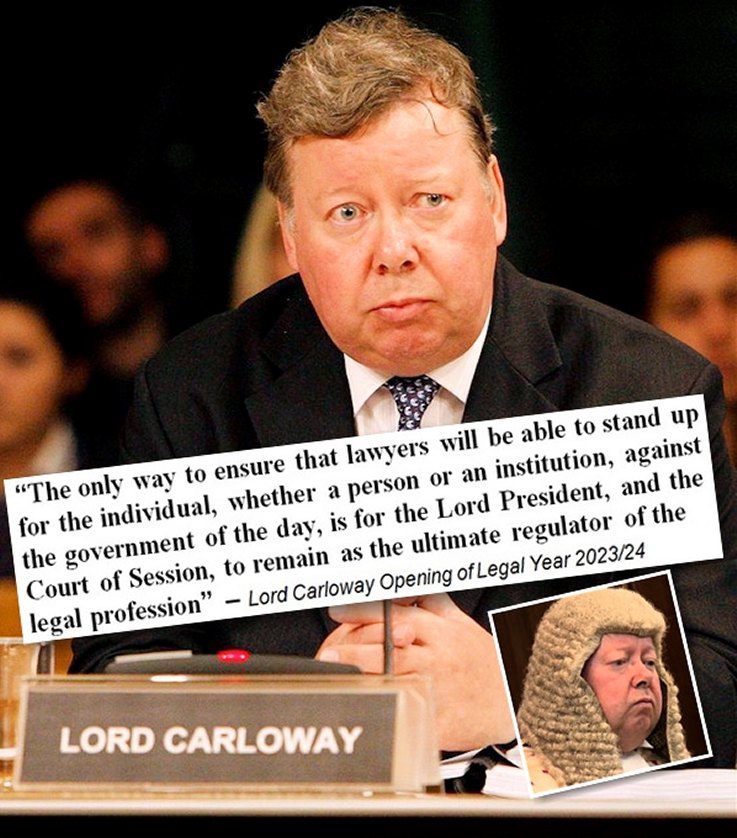
RULE BY JUDGE: Top judge Lord Carloway declares Lord President’s office & unelected judiciary - should remain final regulators of Scotland’s lawyer-regulates-lawyer legal profession & legal services market

Top judge says judiciary must regulate lawyers. SCOTLAND’S top judge – Lord Carloway (real name Colin Sutherland) has declared his role as Lord President, and Scotland's unelected judiciary - should remain as the final regulator of Scotland’s legal services market - currently composed of around 11,000 self-regulating solicitors, advocates & Kings Counsel.

The statement by Scotland’s top judge came in Lord Carloway’s address to lawyers, judges and other legal vested interests in his recent Opening of the Legal Year 2023-2024 speech – where Carloway attacked plans to reform how lawyers regulate themselves in the Regulation of Legal Services (Scotland) Bill which is currently at Stage 1 consideration a the Scottish Parliament.

In a jibe at the Scottish Government’s admittedly feeble plans to reform regulation of the Legal profession in Scotland, Lord Carloway claimed the reforms to lawyers looking after themselves in complaints regulation – “gives rise to serious constitutional concerns about the rule of law …”

Lord Carloway said: “The first is the Regulation of Legal Services. The senior judiciary recently responded to Parliament's call for views on the Bill. They were unanimous in the view that the Bill, as currently drafted, gives rise to serious constitutional concerns about the rule of law and the separation of powers. It is a threat to the independence of the legal profession and the judiciary. If the Bill is passed in its current form, Scotland will be viewed internationally as a country whose legal system is open to political interference. This will have serious adverse consequences.”

Scotland’s top judge went on to declare his unelected office of Lord President and his judiciary, should instead remain the ultimate regulator of rogue lawyers facing any complaint or question about their provision of legal services to clients.

Lord Carloway stated: “The rights of clients, who are the ultimate consumers of legal services, to obtain legal advice, must be protected from interference by the government. The only way to ensure that lawyers will be able to stand up for the individual, whether a person or an institution, against the government of the day, is for the Lord President, and the Court of Session, to remain as the ultimate regulator of the legal profession.”

Regulation of lawyers in Scotland is currently controlled by the Law Society of Scotland, Faculty of Advocates and a lawyer dominated Scottish Legal Complaints Commission (SLCC)

The Scottish Legal Complaints Commission is funded by client fees to solicitors and Advocates who then pay the complaints levy to the Scottish Legal Complaints Commission.

In Scotland, a decades old, repressive and at times highly vindictive regime of lawyers looking after themselves – has seen thousands of clients & consumers of legal services each year – ripped-off by their own solicitors with little or no recompense for the millions of pounds lost to legal services overcharging, theft, embezzlement & outright solicitor client fraud each year in Scotland’s legal services market.

In some of the most appalling cases of Scots lawyers found to have looted their clients assets - legal regulators have reacted to unwanted media coverage by using private briefings and turning newspapers and journalists against each other. In some well known cases, legal regulators encouraged articles against legal reforms, blocked publication of newspaper reports on identified lawyers & law firms, and personally went after ;law reform campaigners who seek nothing more than removing the self regulation element from regulation of legal services and legal representatives in Scotland.

However – despite the public protests of Lord Carloway and other ‘leaders’ of Scotland’s legal profession – including the Dean of the Faculty of Advocates who has also attacked the proposed legal reforms, the reality is the Scottish Government’s Regulation of Legal Services Bill falls far short of what is needed to quell Scots lawyers appetite for ripping off consumers and clients.

And unsurprisingly, according to legal and political sources - there are allegations much of the Scottish Government’s claimed solicitor regulation reform proposals are ‘deliberately deceptive’ and have already been negotiated away with legal interests and political partners in deals to water down what is currently in the bill.

Speaking on condition of anonymity, an MSP who along with others is said to be facing de-selection by their own embittered party – informed journalists of private briefings and meetings between MSPs of all parties - and lawyers and legal regulators who are anxious to ensure much of the already watered down proposals in the reform of legal regulation bill are eliminated or that the entire bill is stalled or axed completely.

No references to any of these meetings appear to exist in entries of the Holyrood lobbying register but it has been established meetings did take place and lawyers who met MSPs appear to believe they succeeded in their lobbying aims, stating so in private lawyer-only social media chat groups.

You can read more about the Scottish Government’s Reform of Legal Services Bill here: Reform of Legal Services Bill - Scottish Parliament

This latest attempt by a Scottish Government and the pro-lawyer Scottish Parliament to reform regulation of lawyers is the third attempt since 2000 – where in 2001 – and amid bitter evidence sessions - Holyrood’s Justice Committee led by Christine Grahame threw out calls for reform of how lawyers cover up complaints for their own colleagues.

A second attempt by another of Holyrood’s Justice Committees in 2006 saw arm twisting from legal regulators to shelve much of the proposals in the Legal Profession & Legal Aid Bill, which became law in 2007 after multiple amendments lodged by MSPs, including Scottish Conservative MSPs on behalf of legal vested interests.

What became the LPLA Act 2007, which led to the formation of the Scottish Legal Complaints Commission in 2008 – which in turn has led to some fifteen years and counting of disastrous complaints regulation by an overly false legal regulator which is in fact staffed and run by the same lawyers and vested legal interests who ran complaints at the Law Society of Scotland.

To make matters worse, the Scottish Legal Complaints Commission later set into policy a system which intimidated clients who had already been ripped off by their solicitors – into signing Non Disclosure Agreements to conceal thousands of complaints against Scots multiple law firms over the last decade – with many law firms appearing week after week at the Scottish Legal Complaints Commission to demand complainants sign more NDAs to conceal some of the worst and repetitive acts against clients which even the old Law Society of Scotland regime failed to keep away from public gaze.

And, it should be noted the Scottish Legal Complaints Commission has cost clients of Scottish solicitors around £40million pounds in complaints levies – paid for by law firms hiking client fees to meet their annual complaints levy.

Lord President Lord Carloway’s Legal Year address to lawyers, which takes the usual Judicial Office tone of launching threats against one piece of reform legislation, then absorbing another piece of legislation – the Victims, Witnesses and Justice Reform Bill as a form of pro-justice system judicial PR and follow-the-money-supply-to-law-firms – is well worth a read.

It should be glaringly obvious to all the Victims, Witnesses and Justice Reform Bill – more of which can be read here Victims, Witnesses and Justice Reform Bill - Scottish Parliament has only come about because Scotland’s judges, courts & lawyers have been mistreating and preying on victims of crime, abuse & countless other crimes for decades to the point the public and victims themselves demanded action – rather than the action coming willingly from the judiciary or legal profession who seem to believe they own the law.

Lord Carloway’s Opening of the Legal Year 2023-2024 speech can be downloaded here Lord Carloway - Opening of Legal Year Scotland 2023-24 with relevant content below:

Welcome to the opening of the legal year. I thank you all for coming. Since the abolition of formal court terms, today is primarily a ceremonial occasion, but it remains a useful opportunity to reflect on the progress we have made in the past year, and on what will, or at least might, happen next.

I extend a special welcome to Lord Burnett of Maldon, the Lord Chief Justice of England and Wales and thank him particularly for his work during his years in office in ensuring that Scotland's voice was heard on legal matters in the Halls of Westminster and elsewhere.

Law Reform: Regulation of Legal Services and Criminal Justice

Looking to what it is that might happen next, there are two Bills on which views are currently being sought. Each proposes a series of notable reforms to the justice system.

The first is the Regulation of Legal Services. The senior judiciary recently responded to Parliament's call for views on the Bill. They were unanimous in the view that the Bill, as currently drafted, gives rise to serious constitutional concerns about the rule of law and the separation of powers. It is a threat to the independence of the legal profession and the judiciary. If the Bill is passed in its current form, Scotland will be viewed internationally as a country whose legal system is open to political interference. This will have serious adverse consequences.

The rights of clients, who are the ultimate consumers of legal services, to obtain legal advice, must be protected from interference by the government. The only way to ensure that lawyers will be able to stand up for the individual, whether a person or an institution, against the government of the day, is for the Lord President, and the Court of Session, to remain as the ultimate regulator of the legal profession.

On a more encouraging note, the Victims, Witnesses and Justice Reform Bill contains proposals for significant reform of the criminal justice system, many of which are based on the Lord Justice Clerk's Review. The judiciary welcome the reforms insofar as they aim to make giving evidence a less traumatic experience for witnesses, including the creation of a right to anonymity and to independent legal representation for complainers in relation to applications under the rape shield legislation, the establishment of a specialist sexual offences court and the abolition of the not proven verdict.

Overall, the judiciary believe the Bill proposes a number of measures which, in principle, represent improvements to the existing system.

The Criminal Courts: Recover, Renew, Transform

Following the build-up of criminal cases which have waited for a considerable period of time to go to trial as a result of lockdown, the court service began the Recover, Renew and Transform programme in September 2021.

The recovery aspect aimed to restore the courts to their pre-pandemic capacity. It involved recruiting more sheriffs and court staff and the setting up of more High Court and sheriff trial courts. Good progress has been made. The challenge now is an ever-increasing volume of indictments and complaints which libel sexual offences. In the face of this new volume of criminal business, we no longer expect to restore matters to the pre-pandemic position. We need to adjust our expectations and set a new reasonable baseline for the number of cases waiting to go to trial at any one time.

Our modelling predicts that the number of High Court cases waiting for trial will recover to a new reasonable baseline level by March 2025, and sheriff solemn trials by March 2026.

Prisoner escort services are causing those in custody to arrive at court late. This has an impact on the smooth operation of the criminal courts. We are looking to accelerate plans to move to virtual custodies. Pilots have already taken place. As I have said many times before, the need to bring those arrested before a court as soon as practicable, must remain a priority.

The purpose of renewal is to establish better ways of working which promote the resolution of cases at the earliest opportunity. The Summary Case Management pilot continues in Dundee, Hamilton and Paisley Sheriff Courts. It aims to reduce the number of hearings to those which are necessary, by encouraging early resolution through early disclosure. Early disclosure has allowed the Crown to take a more targeted approach to the citation of witnesses. There has been earlier resolution of proceedings brought in the pilot courts and a reduction in the number of witness citations being issued in those proceedings. Work is underway to roll the pilot out to Glasgow Sheriff Court.

Specialist online courts are being set up to deal with domestic abuse cases. The idea is to ensure that the complainer and the accused do not require to meet each other. This reduces potential trauma for complainers.

Juries continue to be balloted remotely, thus sparing the public the inconvenience of coming to court. Over the course of the past year, over 450 police and expert witnesses have given their evidence remotely in High Court trials.

A key component of transformation lies in the implementation of the recommendations of Lady Dorrian's Review. The court service has been making substantial progress in relation to those recommendations which do not require legislation. The creation of facilities to pre-record the evidence of children and vulnerable witnesses and the giving of evidence remotely is being accelerated. We now have designated facilities for commissions in Edinburgh, Glasgow, Inverness and Aberdeen.

Earlier this month, I visited the Bairns' Hoose. The Hoose is designed to feel like a family home. It is based on an international model first developed in Iceland, called the Barnahus, which brings together justice, health, social work and recovery support for children in one location. The Hoose is, in essence, a comfortable and safe space in which children can give evidence, receive medical care, take part in decisions about their protection and obtain support to recover from trauma.

The Hoose is the first of its kind in Scotland. The Barnahus model was first advocated for in early 2016, as part of SCTS's Evidence and Procedure Review. I am very pleased to see it implemented into the system, and I hope that we will see more of them developed in due course.

The Civil Courts: Technology and Transparency

On the civil side, there have been a number of notable technological improvements this year.

The importance of making the people's courts as accessible as possible cannot be understated. The advent of new technology means that we can implement new, more efficient and convenient ways to do this. In June, we officially launched Court of Session Live, a new streaming service for Inner House proceedings. I thank Lord Pentland, and his cross-departmental task force, for their hard work in getting this up and running.

Alongside Court of Session Live, we are publishing information about, and summaries of, upcoming appeals much earlier than we have ever done before. We hope that this will enable those who are interested in viewing proceedings, whether online or in person, to make plans to do so.

We launched the new and improved Civil Online portal in May and have significantly expanded the level of service which the portal offers. In Simple Procedure cases, court users can now raise and respond to actions through the portal.

We secured funding from the Scottish Government to start developing a new case management system for the Office of the Public Guardian. The new interface will provide a more accessible and broader range of online services to the public.

Many of our Tribunals are experiencing growth in the volume of business. The work of the Social Security Chamber is expected to increase significantly. The new Local Taxation Chamber has inherited over 40,000 cases from its predecessor, the Valuation Appeals Committee. We are working closely with the Government to ensure that sufficient resources are made available to support this. Reform of the Tribunal system generally also continues, with the further expansion of the General Regulatory Chamber's jurisdiction, and the potential transfer of the MHT into the First-tier Tribunal during 2024.

The court service are in discussions with the Faculty about the re-establishment of the practice of making justiciary and session papers available to the Advocates Library. This will enable advocates and, via the National Library, members of the public, to view them.

We are working hard to deliver these improvements, but, as ever, we can only do as much as resources allow. We will continue to do what we can within budgetary constraints. I ask only that the government continues to support us by providing us with sufficient funding to continue to deliver core services, as well as these improvements to the system.

Ends.

Earlier relevant coverage from this blog - of how the Legal Profession & Legal Aid Act (2007) was deliberately mangled by the Scottish Government, and Scottish Parliament – which allowed lawyers to continue to regulate themselves to the current date, can be found here: The Legal Profession & Legal Aid (Scotland) Act 2007

Thursday, October 20, 2022

SCOTS LAW: Legal Highs, Legal Lows. A legal profession which prides itself in preying on clients, ripping-off Legal Aid, fixing court outcomes, concealing malicious prosecutions & judicial conflicts of interest, obstructing public access to justice - and - Why you should really question much of what your lawyer tells you.

World leading? Not a chance M'lud. ONE DAY is a long time in Scotland’s legal world, let alone a full year – but we all can be assured the consistency of wrongdoing, industrial scale dishonesty, legal fee overcharging & outright malice - from Scotland’s legal profession - whether it be in dealing with clients, working in court in civil hearings or in criminal trials, or working for public authorities – is never ending.

While blog journalists have been working on real life cases for the past year, it may be worth reminding readers your rights with regard to regulation of your legal representatives, are as ineffective and futile as they have ever been in Scotland, right up to this date.

After all, since 2008 and some Thirty Five Million pounds plus, later – much of it recovered from fees you pay to your solicitors *and perhaps money & assets your solicitor strips you of when your case goes not the way you were told it would - the Scottish Legal Complaints Commission (SLCC) has not once named a corrupt solicitor or law firm – or actually had any impact on standards of legal service in Scotland.

Fourteen years for the Scottish Legal Complaints Commission - billed in 2008 as an “independent” regulator of Scotland’s legal services – to have absolutely zero material impact on the scale of dishonesty in Scotland’s legal profession – is itself a tribute to how corrupt Scotland’s legal mcmafia really is, and – an indicator of the sheer level of control exerted by professional groups such as the Law Society of Scotland, and Faculty of Advocates (to name but two) on how MSPS and the Scottish Government can or cannot give increased rights to consumers of legal services in Scotland.

For instance, are you looking for a lawyer right now to conduct legal business or perhaps pursue a civil claim, or defend you in a criminal trial?The fact is, if you are trying to find out if a particular solicitor or law firm has any record of complaints, discipline issues, or are just plain corrupt - you - the consumer - are not going to find out.

So, why would you even bother going to a lawyer or a law firm who has perhaps fleeced one hundred clients before you go through their doors? Think first, readers .. do you really need to spend Five thousand pounds on a batch of letters to, say - your next door neighbour for the next Five years over a fence which is 10cm higher than it should be … and then lose the case in court and have to pay your own solicitor say .. another Twenty Thousand pounds for losing, and then end up sequestrated by the solicitor’s good friend the local Sheriff – when you cannot pay the legal fees?

Yes, it is that easy. It’s your money, your lives, your home, your family, your business – consumers. Think first, Tens of thousands of people have gone before you thinking they are smarter than a Scottish lawyer, and what happened next? Well, the statistics tell their own story. Thousands of complaints a year to Scotland’s so-called ‘independent’ legal regulators – staffed by lawyers and their families – and guess what, a tiny amount of redress if anything, and thousands of clients lives ruined.

The public debate on legal services in Scotland is rather odd, and very biased.

Mostly, any public debate on Scotland’s legal profession, is driven by the legal profession itself.

Having examined Scotland’s cliquey legal profession for decades, worked on thousands of cases, reported on hundreds more – and when assigned cases to assist clients through the often murky, dishonest world of legal services and Scotland’s institutionally dishonest courts system and not forgetting the institutionally everything bad Crown Office – it can be easily said – consumers of legal services in Scotland have about as much chance of obtaining a fair hearing, as a baked pie in front of a group of staring, salivating alligators with Scottish LLB Law degrees & judicial robes.

The world, of course – is a bigger place. And, with the advantage of the internet, and the ability to communicate on global platforms, away from the Scots legal mcmafia sponsored public relations spin, and bought up influencers, clients, consumers, journalists and readers can find a more open and less legal profession driven debate on justice, the courts, legal services, and just about anything else you can think of.

Example - If you are interested in US politics and the US Courts, and judiciary – and trust me – you should be - readers who want to expand their knowledge of what judges and lawyers do in and out of court, should start looking at how the US media cover America’s justice system and the US Supreme Court - because - in the US, journalists and lobby groups are much more open and willing to investigate and write up exactly what is going on with a judges' interests, conflicts of interest and recusals.

Even better, there are Law Professors and Academics in the US, who will tell you – the public - the absolute truth about the workings of the US Judiciary and 'SCOTUS' - otherwise known as the Supreme Court of the United States.

Expand your knowledge, people. Look at how other countries media deal with their justice systems and those parts of the judiciary which consider themselves too powerful to be held accountable to ethics, expectation of justice, or even – the law itself.

Reading up on how other countries report on their judges, courts and the workings of the justice system will easily bring even the occasional reader to conclude much of what you have just read, is never reported in Scotland or the UK. In fact, academics here can very easily be roped into (mostly willingly) in what are absolutely vicious campaigns against journalists looking at the workings of the judiciary.

There are of course, other advantages of reading media outside the sphere of Scotland’s legal profession reach in that journalists don’t have to put up with ranting calls from UK or Scottish Judicial Office Press Officers, who end up screaming down the phone at journalists and editors because the thorny question of judges conflicts of interest, judges unexplained wealth & lifestyle, and participation in political deals, lobbying, international bargaining and political lobbying here in Scotland come up for scrutiny.

As colleagues in the media have observed – reviewing the audio records of those calls, would indeed one day make a good book.

So, what have blog journalists been looking at in the past year.

A deep dive into certain long running news articles in relation to the plight of victims in all kinds of scandals, from medical to ill treatment at the hands of whichever Scottish public service, such as Health, Policing, Courts, Judiciary, Local and Central Government – have revealed that lawyers and their law firms quoted three paragraphs down in the articles – are demanding their ‘clients’ sign up to Non Disclosure Agreements – even before legal representation is taken on – and that any compensation recovered be subject to significant success fees for the law firm involved, with clients also forced to sign an agreement they will not raise a complaint, or their representation will be terminated.

And, it certainly does not take too long for lawyers who give quotes to the media on how they are so involved in representing their clients case – to call in a client for a menacing chat, which – now that we live in a world where everyone records everyone … is much more able to be reviewed by journalists and people outwith the legal profession.

The law firms involved, are – unsurprisingly – all “Award Winning Law Firms” – based in Scotland’s big cities and regularly quoted in whatever scandal is the headliner for the week, or weekend.

Still think you are smarter than a Scottish Lawyer? … hmmm!

Does the following example apply to anyone you know?

A meeting with your lawyer goes like this.

Hello, dear client. Tell me your case. Wow! I have never heard of your predicament before ... This is a disgrace! I can take you on as a client but first, you must sign up to our terms of business, give us Five grand, and you also have to sign a Non Disclosure Agreement - and while you are at it, we would like to store your property titles, just in case you cant pay our fat padded faked-up legal fees and we will take your house instead.

Hey folks, this happens a hundred times a week in Scotland. And, for years. Decades even. So, why not get wise to it instead of being ripped off. Don't say you haven’t been told!

Here’s a question for readers:

Have you ever wondered why – in the past fourteen years from 2008 to 2022 – hardly anyone ever gets to see the actual detail in complaints investigations, outcomes, quantum on actual losses by clients compared to the derisory compensation (if any) paid out by predatory law firms after an ‘investigation’ by the Scottish Legal Complaints Commission?

Small numbers, isn’t it. A handful. And, few if any law firms named – in the past Fourteen Years.

In an active case currently under scrutiny, journalists were handed recordings which reveal clients are being threatened during arbitration hearings organised by the Scottish Legal Complaints Commission.

Yes, you read that correct. Clients who agreed to arbitration hearings organised by Scotland's legal regulator - are being openly threatened and intimidated by solicitors - in front of 'qualified' arbitrators and Legal Complaints Commission staff.

Perhaps, upon reading this, you may think the Arbitrators and SLCC staff may step in, even offer to assist the client over the lawyer's shouting, threats and intimidation and their audible threats of using courts and Scotland's ever-puppet judiciary to go after clients.

Not a chance. In fact, the Scottish Legal Complaints Commission denied the Arbitrators or their own staff members hear or witness anything – yet the audio records confirm these events.

In fact - journalists have also been handed communications where the Scottish Legal Complaints Commission actually threatened clients - who had already been threatened at SLCC run Arbitration hearings - that if they uttered a word of what happened - the Scottish Legal Complaints Commission would act against them in some undefined way.

To say the above is corruption at work, would be an understatement at least - but you can be sure, when our investigation is complete, the material in these cases will be published.

Now, to some other issues journalists have been looking into.

Recent cases brought to this blog's attention reveal solicitors are requesting extra payments over legal fees from clients, in crypto currency.

These payments, in many cases appearing to be forced payments, with a threat that if they are not made legal work will cease on anything from claims against councils, to writing a will - are being demanded by law firms from a wide spectrum of clients, including the elderly - the latter of which first drew journalists attention to - as reports were coming in of elderly clients unable to handle technology to the point law firm employees were visiting home addresses to help their clients set up crypto currency accounts which would pay into accounts held by solicitors or 'other persons' connected to a law firm - but which strangely do not show up in the law firm's accounts to the Law Society of Scotland or HMRC.

So, if any readers have elderly or vulnerable relatives who are being forced into making off-the-books crypto currency payments to Scottish law firms - you can email this blog with the details to add to the information now being collected by journalists.

Oh, and if you were wondering how deep Scotland’s legal profession has dived into crypto currencies - to make it all nice and legal, the Scottish Government working group on crypto assets and crypto currency is headed by a UK Supreme Court judge - Lord Hodge.

A number of cases where criminal complaints and investigations have arisen in relation to activities at properties owned by Scots lawyers, and several members of the judiciary in EU countries and in the Gulf states, have been passed to journalists.

Allegations in respect of these cases range from financial crime to tax avoidance, domestic violence, and sexual assault.

Interestingly, many of those who have passed on information in relation to allegations and criminal complaints in such cases, are from Scotland or the UK, and have attended properties owned by certain high flying Scots lawyers & Advocates - in a guest role, of sorts.

Further information in relation to properties in the Gulf States - owned by leading figures of Scotland’s legal world, including the judiciary document cases where persons employed by the owners have been subject to threats, and in certain cases, swift deportation back to their countries of origin, mostly in Asia after events witnessed at the premises became subject to allegations and investigations.

Several key figures within Scotland's legal establishment - have sought to ensure these cases - do not come to light in the media, however the leads are now being investigated and publication may occur at a later date.

In a case which relates to a cover-up within Scotland’s NHS Estate – journalists have been investigating links between Scotland’s legal world & the misuse of evidence by key NHS organisations, over the past 15 months.

The case extends to cover significant patient risks, concealed by NHS Executives who were involved in switching multi million pound contracts and trying to cover their tracks.

Journalists have been investigating the NHS scandal involving NHS Grampian, in which NHS Executives and staff arranged, and colluded to target and discredit Scottish Medical Providers, in a malicious campaign to remove their business, and transfer the contracts to preferred providers.

The sums involved total millions of pounds, and investigating the trail of wrongdoing within NHS Grampian has led to the detection of organised fraud and collusion within Scotland's entire NHS estate and factual evidence revealing corruption right at the heart of NHS National Procurement.

Some of the documents in relation to the NHS Grampian fraud have been posted to Twitter. However a full investigation and publication of material will appear in due course.

Another issue journalists are looking into - is the wide and varied property ownership of solicitors and law firms.

In towns and cities across Scotland, local law firms and solicitors own and hold interests in multiple properties.

How these properties have come to be owned by solicitors is indeed, a very murky affair and a lengthy battle to reveal.

In many cases, there are solicitors who own twenty plus properties in very intricate ownership arrangements clearly designed to thwart persons from finding out the real owner.

Some lawyers have chosen to spread ownership around their families and relatives, whereas others have created offshore trusts and networks of companies of which the aim is clearly to defeat any link between the solicitor and the properties.

The family ownership link has been known about for some time, and frequently emerges when – for example – a solicitor’s partner decides to separate, and they then find out they own a selection of properties they were unaware of when their solicitor partner unleashes his colleagues on their subsequent separation and divorce.

An interesting revelation from the property scrutiny project – identifies solicitors who own significant numbers of rental properties and who are all receiving Housing Benefit paid rents from – in some cases – their criminal legal aid clients,

Yes, You read that correctly.

Solicitors are housing clients in what are in many cases – run down, rat infested flats and properties around Scotland AND – the rent on the property is paid to the solicitor in Housing Benefit, while the solicitor is also collecting Legal Aid cash for representing the client, his tenant in criminal trials.

There are hundreds of such cases currently being looked at. An example of one such case currently being investigated involves a solicitor and Tribunal judge - who represented a client who was found guilty of sexually assaulting paramedics. The client turned out to be the tenant of the solicitor, who was receiving Housing Benefit for his client’s rent, as well as Criminal Legal Aid for representing his client, found guilty of sexually assaulting paramedics.

Turns out the solicitor & Tribunal judge has been at this for years, raking in public cash for tenants he houses, and represents in criminal court at the same time – and – many solicitors are doing exactly the same.

The petition on the Register of Judges Interests. Yes, the petition rumbles on, and journalists await action by the Scottish Government. However, the time has been spent usefully studying the judiciary, watching how assets move, who talks to who, which judge is threatening who about transparency, and how judges waft around the world doing their wee bit for greed, avarice and sheer dishonesty in the legal world.

An update on the petition will be published in the coming weeks.

So, as you see - never a dull moment in the media, or in the legal profession.

And finally.

Whistleblowers. If you want to speak out on what is occurring in your public service, company or whatever the issue is - use an email service such as Protonmail or wherever, and contact the blog or a journalist that you trust and an editor who will not burn you to his friends in whichever public service you are speaking up against.

Wednesday, September 08, 2021

REFORM JUSTICE: Scottish Government announce host of justice sector reforms - including register of judges’ interests, reform to regulation of lawyers & legal profession, Police complaints transparency & consultation on not-proven trial verdict

Justice reforms announced by Scottish Govt. PUBLIC CONSULTATIONS and key reforms to Scotland’s justice sector have been announced in the Scottish Government Work Programme 2021-2022 - including a register requiring all Scottish judges to declare their interests, and long awaited reforms to how Scotland’s lawyers investigate themselves.

In relation to regulation of the legal profession - the Scottish Govenrment Work Programme document states: “..we will also launch a public consultation on reform of legal services regulation, expected later in 2021, to consider what changes may be required to the statutory framework to protect consumer interests and promote a flourishing legal sector.”

And, on the subject of transparency and accountability in Scotland’s courts – the Ten year investigation of Scotland’s judiciary by the media and a petition to require judges to register and publish all their interests - backed by Scottish Parliament’s Public Petitions Committee – has contributed to action in the form of a committment to create the judicial interests register for all members of Scotland’s judiciary.

The Work Programme document states “To safeguard the independence and reputation of the judiciary, we will begin work on establishing a register of interests of its members to increase public confidence and improve transparency.”

Petition PE1458 was originally lodged at the Scottish Parliament in 2012. The Petition calls for the creation of a publicly available register of judicial interests – containing information on all judges’ backgrounds, figures relating to personal wealth, undeclared earnings, business & family connections inside & outside of the legal profession, membership of organisations, property and land, offshore investments, hospitality, details on recusals and other information routinely lodged in registers of interest across all walks of public life in the UK and around the world.

An earlier report on Petition PE 1458 and the committment to create a register of judges’ interests can be found here: JUDICIAL REGISTER: Scottish Government confirm Register of Judges’ Interests will be created - after Holyrood TEN YEAR probe of judicial interests & recusals survives lobbying by legal vested interests to close public interest transparency petition

The package of measures also include body worn cameras and reforms to complaints handling for Police Scotland, legislation to pardon Miners from convictions & unfair treatment suffered as a result of their participation in the 1980’s strikes, increased access to justice for court users & a re-visit of earlier proposals to reform the law of corroboration – where evidence must be verified from two independent sources.

The proposals can be found in the Scottish Government’s 2021-2022 work programme, available here: Scottish Government Work Programme 2021-2022

The full text of the Scottish Government’s Reforming the Justice System to Make Scotland Fairer, Safer & More Equal:

“We are proud of Scotland’s justice system and our distinctive Scots law. We will build on their foundations to bring in targeted reforms aimed at making Scottish justice still stronger and better.

During this year, we will launch a public consultation on the three verdict system and whether the not‑proven verdict should be abolished.

We will also consider reform of the corroboration rule, engaging with justice partners, opposition parties and people with direct experience of the criminal justice system to develop a shared understanding of the evolving legal position, and the implications and potential unintended consequences of corroboration reform, including in relation to sexual crimes.

The Scottish Government’s law officers, amongst other roles, act as the head of the independent prosecution service and as members of the Scottish Government. We will consult on whether the prosecution and government functions of the law officers should be separated.

We have already begun to address the backlog of court cases that accumulated during the pandemic, providing £50 million this year to help drive forward recovery.

We will review how offending is dealt with by the summary justice process, to make access to justice as efficient and effective as possible.

We will engage with both legal professionals and victim support organisations to review the Legal Aid system, and will introduce a Legal Aid Reform Bill in this Parliament, ensuring that the system is flexible, easy to access and meets the needs of those who use it.

And we will also launch a public consultation on reform of legal services regulation, expected later in 2021, to consider what changes may be required to the statutory framework to protect consumer interests and promote a flourishing legal sector.

Access to the courts is an important part of upholding individual rights and the rule of law; but there are times when other non‑litigious means of resolving disputes are preferable, notably in non‑criminal proceedings.

The Scottish Government will work with stakeholders to expand the availability of mediation and arbitration services within the civil justice system. The Scottish Government is working with stakeholders, and will consult on future changes as appropriate, to give people access to flexible, affordable and less stressful means of settling disputes, benefiting them and saving time in courts.

To safeguard the independence and reputation of the judiciary, we will begin work on establishing a register of interests of its members to increase public confidence and improve transparency.

Scotland’s police officers work hard every day to keep their communities safe, and have shown a strong, rights‑based approach to compliance during the pandemic. We will work to build on that model of policing by consent. To better understand and service the needs of our communities, we will support Police Scotland and wider partners to improve the diversity of their workforce and to enhance the quality of data across the justice system.

We will support Police Scotland and wider partners to build on improvement work in response to Dame Elish Angiolini’s review. We intend to accept and implement the majority of Dame Elish’s findings following consultation in 2022. This will include bringing forward a Bill and Regulations to promote fairness and transparency and strengthen public confidence in our Police.

We want Scotland’s police force to benefit from and take advantage of new technologies, such as body‑worn video, but to do so in a controlled way that commands public confidence. The Independent Advisory Group on Emerging Technologies will report to Ministers in 2022, recommending changes that should be made to existing legislative frameworks and policing practices: we will respond to its findings and act to ensure there is robust scrutiny and oversight where new technology is adopted.

We will also address the disproportionate consequences and stigma suffered by many miners as a result of their participation in the 1984‑85 strike. We will bring forward a Miners’ Strike Pardon Bill, and implement the pardon as soon as practicable should it become law – restoring the good name of the miners, and bringing comfort to their friends and families, and to former mining communities.

We will also support and resource the Sheku Bayoh Public Inquiry in its thorough scrutiny of the circumstances of his tragic death.”

With regard to the consultation later this year on how to reform regulation of legal services & solicitors – readers with experience of how complaints are handled by the Scottish Legal Complaints Commission, Law Society of Scotland, and Faculty of Advocates – should ensure their views are made known to the consultation when it is launched by the Scottish Government.

Anyone with cases which involve questions relating to Scotland’s judiciary, the conduct of judges in court, conflicts of interest & related issues should continue to email material to this blog for further study and reporting as appropriate.

Wednesday, May 19, 2021

LAW, & LAWYERS: Scottish Legal Complaints Commission reveal FIVE cases of sexual offence allegations against lawyers & advocates – clients & courts go uninformed, regulator ‘does not record’ crimes, or consistently record if criminal complaints are made to Police Scotland or Crown Office

Legal regulator reveals sexual offence cases. SCOTLAND’S ‘independent’ legal services regulator – the Scottish Legal Complaints Commission (SLCC) - has revealed it received at least five cases containing allegations of a sexual nature against members of the legal profession since 2017.

In response to a media investigation of allegations of serious sexual assault and related offences alleged to be committed by solicitors & advocates – the Scottish Legal Complaints Commission disclosed the information in response to a series of Freedom of Information requests for relevant data from 2017 to 2021.

In one of three FOI responses, the legal regulator revealed: “Five cases containing an allegation of a sexual nature have been made to the SLCC within the time period specified”

However, the Scottish Legal Complaints Commission went on to state their response came with a caveat - in that the regulator’s search may not have captured all allegations of a sexual offence nature made against solicitors & advocates

The SLCC’s Information Officer stated: “I would reiterate that the SLCC cannot determine what criminal behaviour is and therefore this figure relates to allegations of a sexual nature and we make no comment on whether they would amount to a crime. These figures are subject to a caveat that the SLCC does not record if a crime has been committed or alleged in a recordable format, therefore the above represents a search within the summary of complaint and may not capture all allegations made.”

The SLCC further confirmed four cases were referred to the relevant professional bodies for investigation by the SLCC.

However – the Scottish Legal Complaints Commission went on to admit the regulator does not hold a record of reporting any matters directly to Police Scotland or the Crown Office.

The SLCC stated: “The SLCC does not consistently record if a complaint has also been made to Police Scotland or the Crown Office, however it may be referred to by the complainer at any point. It is entirely for the complainer if they decide to inform the SLCC that they have reported the matter to any other agencies. In respect of the cases identified above, the SlCc was made aware that two of the cases were reported to another agency.”

The SLCC were asked for information in the following questions using Freedom of Information legislation to obtain responses:

1. allegations of, complaints of - and evidence provided to the SLCC of; sexual offences including alleged rape, abuse and assault - committed by solicitors and Advocates/QCs

and information contained in;

2. How many such cases have been reported to the SLCC since January 2017 to the date of this FOI request

3. How many such cases have included evidence material handed to the SLCC since January 2017 to the date of this FOI request

4. How many of these cases resulted in the SLCC reporting matters to - Police Scotland and Crown Office and Faculty of Advocates & Law Society of Scotland

How many of these cases were the SLCC aware or had been made aware these cases had also been reported to - Police Scotland and/or Crown Office, and the Faculty of Advocates and the Law Society of Scotland

The SLCC Response:

I confirm that the SLCC holds some of the information that you have requested and I have responded to each point in turn below. The SLCC endeavours to release as much information as possible. However, it has decided that some of the information you have requested is exempt from disclosure under the exemption(s) found in section(s) 25 (1) of FOISA. I have explained below the reasons for the application of the exemption(s).

1. The SLCC procedure for dealing with allegations of a criminal nature are contained within the Policy and Procedure for the SLCC Complaints Process, s 3. 4. 28. I have included a link here. The SLCC and RPOs are unable to consider an allegation of crime as such as outlined in the Manual, however we can consider if specific actions have breached the professional standards. If a member of the public is of the opinion that a criminal act has occurred, SLCC staff will advise them to contact the Police in the first instance.

2. Five cases containing an allegation of a sexual nature have been made to the SLCC within the time period specified. I would reiterate that the SLCC cannot determine what criminal behaviour is and therefore this figure relates to allegations of a sexual nature and we make no comment on whether they would amount to a crime. These figures are subject to a caveat that the SLCC does not record if a crime has been committed or alleged in a recordable format, therefore the above represents a search within the summary of complaint and may not capture all allegations made.

3. The SLCC is not able to state what would constitute evidence of a crime as it is not a criminal reporting agency. All complaints to the SLCC to be properly made must be submitted on a complaint form outlining what the complaint is and a complainer may provide whatever supporting evidence they feel appropriate. The SLCC is unable to answer this point for the above reason as we do not hold this information. As the SLCC holds no information in relation to the scope of your request, and in line with the Freedom of Information (Scotland) Act 2002, I am issuing you with a Section 17 (1) (b) Notice stating that the information is not held.

4. Four cases were referred to the relevant professional bodies for investigation by the SLCC. Please note the SLCC does not hold a record of reporting any matters directly to Police Scotland or the Crown Office.

5. The SLCC is the gateway for all legal complaints. The SLCC does not consistently record if a complaint has also been made to Police Scotland or the Crown Office, however it may be referred to by the complainer at any point. It is entirely for the complainer if they decide to inform the SLCC that they have reported the matter to any other agencies. In respect of the cases identified above, the SlCc was made aware that two of the cases were reported to another agency.

A second FOI request to the Scottish Legal Complaints Commission sought information in response to the following questions:

1. I would like to make a Freedom of Information request for information contained in; the SLCC's procedures for how to deal with allegations of, complaints of - and evidence provided to the SLCC of; acts of a criminal nature which can be prosecuted under criminal law - committed by solicitors and Advocates/QCs and information contained in;

2. How many such cases have been reported to the SLCC since January 2017 to the date of this FOI request

3. How many such cases have included evidence material handed to the SLCC since January 2017 to the date of this FOI request

4. How many of these cases resulted in the SLCC reporting matters to - Police Scotland and Crown Office and Faculty of Advocates & Law Society of Scotland

5. How many of these cases were the SLCC aware or had been made aware these cases had also been reported to - Police Scotland and/or Crown Office, and the Faculty of Advocates and the Law Society of Scotland

The SLCC Response

I confirm that the SLCC holds some of the information that you have requested. The SLCC endeavours to release as much information as possible. However, it has decided that some of the information you have requested is exempt from disclosure under the exemption(s) found in section 25 (1) of FOISA. I have explained below the reasons for the application of the exemption(s).

1. The SLCC procedure for dealing with allegations of a criminal nature are contained within the Policy and Procedure for the SLCC Complaints Process, s 3. 4. 28. I have included a link here. The SLCC and RPOs are unable to consider an allegation of crime as such as outlined in the Manual, however we can consider if specific actions have breached the professional standards. If a member of the public is of the opinion that a criminal act has occurred, SLCC staff will advise them to contact the Police in the first instance.

2. The SLCC cannot determine what criminal acts are, however I have identified 12 cases where the complainer has made reference to crimes allegedly being committed by practitioners. The SLCC can only look at complaints in terms of the Rules and Standards applicable to solicitors and advocates in Scotland and we do not consistently record where a crime has occurred or been alleged in a searchable manner. These figures are subject to a caveat that the SLCC does not record if a crime has been committed or alleged in a recordable format, therefore the above represents a search within the summary of complaint and may not capture all allegations made.

3. The SLCC is not able to state what would constitute evidence of a crime as it is not a criminal reporting agency. All complaints to the SLCC to be properly made must be submitted on a complaint form outlining what the complaint is. The SLCC is unable answer this point for the above reason as we do not hold this information. As the SLCC holds no information in relation to the scope of your request, and in line with the Freedom of Information (Scotland) Act 2002, I am issuing you with a Section 17 (1) (b) Notice stating that the information is not held.

4. With the caveat of point 2, 5 of the 12 cases were referred to the relevant professional bodies for investigation by the SLCC. Please note the SLCC does not hold a record of reporting any matters directly to Police Scotland or the Crown Office. As the SLCC holds no information in relation to the scope of your request, and in line with the Freedom of Information (Scotland) Act 2002, I am issuing you with a Section 17 (1) (b) Notice stating that the information is not held.

5. The SLCC is the gateway for all legal complaints and therefore it is not possible to make a complaint directly to the Law Society of Scotland to the Faculty of Advocates.The SLCC does not consistently record if a complaint has also been made to Police Scotland or the Crown Office, however it may be referred to by the complainer at any point. It is entirely for the complainer if they decide to inform the SLCC that they have reported the matter to any other agencies.

Given the nature of several cases where serious allegations of sexuual offences committed by members of the legal profession have been reported to the Scottish Legal Complaints Commission, and material has been provided to regulators to support such allegations – clients, and members of the public may have cause for concern - given the SLCC appears to operate a deliberate policy of failing to record such incidents or notify Police Scotland and the Crown Office.

Information which has been provided to regulators in relation to allegations of sexual offences committed by lawyers and advocates - is currently being investigated by journalists as part of a wide ranging probe of how the legal profession in Scotland deal with offences of a sexual nature committed by solicitors and advocates.

From documents and material handed to the media - which currently cannot be published for legal reasons – there are strong indications both solicitors and advocates have remained in practice, and continued to represent clients in civil hearings, and criminal trials and criminal appeals – while their clients, and accused persons -  remained oblivious and uninformed as to to the nature of serious criminal allegations made against their legal representatives.

And, it appears from scrutiny of the material – which is also in the possession of MSPs – the Law Society of Scotland, the Scottish Legal Complaints Commission, and the Faculty of Advocates – have all sat on cases where allegations of a specific nature of rape, and other serious sexual assault – alleged to have been committed by named individuals within the Scottish legal profession – have been reported by clients, and victims.

In some cases currently being investigated, it can be revealed allegations reported to legal regulators – alleging serious sexual offences committed by named legal practitioners, and potential sexual misconduct committed over lengthy periods of time relating to lawyers working in the courts, and also those working for the prosecution service - have provided credible testimony where legal representatives have broken legal professional privilege in discussing cases related to clients, and accused – and have in writing – actively sought to undermine criminal trials and appeals by breaking confidentiality rules on multiple occasions.

The Judicial Office for Scotland were asked for comment on how the courts and judges should deal with legal representatives facing criminal allegations and investigations while the accused legal representative continues to represent clients, and appear in cases in court.

The media enquiry to the Judicial Office, submitted on 6 April 2021 is as follows:

Can the Judicial Office, Lord President, and Scottish Courts & Tribunals Service provide detail on what your procedures are for dealing with cases where you have been informed or become aware of: criminal complaints (including allegations of serious sexual offences) have been made against QCs, Advocates & solicitors who are representing clients in current court cases, criminal trials and appeals.

and can the Judicial Office, Lord President, and Scottish Courts & Tribunals Service comment on what steps you take to inform & notify:

current cases, criminal trials, appeals, presiding judges, clients & their legal representatives:

that allegations of criminal complaints (including allegations of serious sexual offences) against QCs, Advocates & solicitors have been notified to the Judicial Office, Lord President, and Scottish Courts & Tribunals Service

Additionally When allegations of criminal complaints (including allegations of serious sexual offences) are made to, or notified to the Judicial Office, and Scottish Courts & Tribunals Service by any or all of the following -

legal regulators such as the Faculty of Advocates, SLCC & Law Society of Scotland,PoliceScotland,Crown Office & Procurator Fiscal Service, a victim who has reported such allegations against QCs, Advocates, solicitors or law firms

What steps are then taken by the Judicial Office, Lord President and Scottish Courts & Tribunals service to ensure;

the allegations, Police investigations and any potential criminal charges do not impact on, or impede:

current cases, criminal trials & appeals currently represented by or involving the QC, Advocate or solicitor who is/are subject of criminal complaints (including allegations of serious sexual offences) ?

Does the Judicial Office, Lord President, and Scottish Courts & Tribunals Service require an Advocate or QC or solicitor who is subject to criminal complaints (including allegations of serious sexual offences) to notify:

current clients, the Scottish Courts & Tribunal Service,Crown Office,Advocate's chambers, law firm, the Judicial Office, and Lord President,The Faculty of Advocates,Scottish Legal Complaints Commission,Law Society of Scotland,and any presiding judges in current cases or criminal trials - that they are subject to a report of allegations of a criminal nature (including allegations of serious sexual offences) ?

As of date of publication, no response has been received from the Judicial Office in relation to the above media enquiry.

A Freedom of Information request to Police Scotland for information in relation to allegations of sexual offences committed by members of Scotland’s legal profession - resulted in a blanket refusal to disclose any information – on the grounds of cost of recovery of such information.

Police Scotland were asked for information in relation to:

allegations of, complaints of - and evidence provided to Police Scotland of;

sexual offences including alleged rape, abuse and assault - committed by solicitors and Advocates/QCs

and information contained in the following (from January 2017 to the date of this FOI request);

How many such cases have been reported since January 2017 to the date of this FOI request

How many such cases have included evidence material handed to Police Scotland since January 2017 to the date of this FOI request

How many of these cases resulted in Police Scotland reporting matters to - Crown Office and legal regulators Faculty of Advocates & Law Society of Scotland

How many of these cases were Police Scotland aware or had been made aware - cases reported to Police Scotland had also been reported to - the Crown Office directly, and reported by complainants to the Faculty of Advocates and the Law Society of Scotland

Police Scotland response:

Having considered your request in terms of the Act, I regret to inform you that I am unable to provide you with the information you have requested, as it would prove too costly to do so within the context of the fee regulations.

As you may be aware the current cost threshold is £600 and I estimate that it would cost well in excess of this amount to process your request.

As such, and in terms of Section 16(4) of the Freedom of Information (Scotland) Act 2002 where Section 12(1) of the Act (Excessive Cost of Compliance) has been applied, this represents a refusal notice for the information sought.

By way of explanation, it is not mandatory to record an individual’s occupation. I can further advise you that even when an occupation is recorded the only way to access this information is via each crime report. There are no relevant markers which allow the automatic retrieval of this level of information. As such this is an exercise which I estimate would far exceed the cost limit set out in the Fees Regulations.

You may be interested in our published crime statistics, which you can access via the following link: https://www.scotland.police.uk/about-us/our-performance

A media enquiry was also sent to the Crown Office and Procurator Fiscal Service (COPFS) on 29 March 2021 seeking a response

However, Andrew Coyle, Communications Manger for the Crown Office replied, stating “As per previous discussions with the Media Relations team, I'm passing your enquiry on to our Freedom of Information team for a response.”

COPFS intentionally converted the media enquiry into Freedom of Information request – with the goal of delaying a response for as long as possible.

The media enquiry to the Crown Office read as follows:

1. Can the Crown Office provide detail on your procedures for dealing with criminal complaints involving allegations of serious sexual offences against members of Scotland's legal profession

2. And, what procedures exist (including procedures for averting conflict of interest) for investigating allegations of, or criminal complaints of serious sexual offences against members of Scotland's legal profession (including Advocates & solicitors) who have previously worked at the Crown Office & Procurator Fiscal Service in any role including Advocate Depute

3. and can the Crown Office offer comment on how COPFS handle cases of, & allegations of criminal complaints (including allegations of serious sexual offences) against Advocates and QCs who have previously worked for COPFS and represented COPFS in court.

4. If the Lord Advocate and Crown Office become aware an Advocate or QC (and also an Advocate or QC who currently works for, or has previously worked for the Crown Office in any capacity) has become the subject of criminal complaints (including allegations of serious sexual offences)

Is the Crown Office & Lord Advocate obliged, or required to notify: the Scottish Courts & Tribunal Service, the Judicial Office, and Lord President,The Faculty of Advocates, Scottish Legal Complaints Commission

H Hart of the Crown Office Information and Response Unit replied on query 1 only – stating the following:

There is a general requirement that where an accused or potential accused is a member of the Crown Office & Procurator Fiscal Service (COPFS) staff the case must be reported to the office of the Deputy Crown Agent for Serious Casework (DCA SC). The case will be referred to Crown Counsel for instructions. If an allegation relates to a serving Advocate Depute, then external counsel can be appointed to oversee the investigation.

Where police report a case in which a Justice, Sheriff or other officer of the court is involved as an accused or is implicated in unlawful activities, then a report is required to be made to the DCA SC. Decisions around case marking do not require to be referred to Crown Counsel, although there are occasions where Crown Counsel’s Instructions (CCIs) are sought if the case is deemed to merit it. Factors that would be considered would include the seriousness of the alleged offending.

When a solicitor or trainee solicitor is reported to the Procurator Fiscal for criminal conduct, the DCA SCG will report the case to the Secretary of the Law Society of Scotland. Decisions around case marking do not need to be referred to Crown Counsel, although, again, there are occasions where CCIs are sought if the case is deemed to merit it. Factors that would be considered would include the seriousness of the alleged offending.

If COPFS receives a case in which an Advocate is an accused, following receipt of CCIs, the DCA SCG would write to the Dean of Faculty to make them aware. Similarly, information could be shared with the Judicial Office and/or Lord President if the accused under investigation is a serving member of the judiciary.

Media enquiries to the Faculty of Advocates on the specific nature of how the Faculty handle complaints and allegations relating to serious sexual offences involving advocates and QCs, resulted in the Faculty providing a link to their own procedures.

The Faculty of Advocates were asked the following questions for media comment:

Can the Faculty of Advocates provide detail on what your procedures are for dealing with criminal complaints (including allegations of serious sexual offences) against your members and can the Faculty of Advocates comment on how you handle cases of, & allegations of criminal complaints (including allegations of serious sexual offences) against your members

Additionally When allegations of a criminal complaints (including allegations of serious sexual offences) are made to, or notified to the Faculty of Advocates by - legal regulators such as the SLCC & Law Society of Scotland,Police Scotland,Crown Office & Procurator Fiscal Service, or a victim who has reported such allegations against your members

Does the Faculty notify the Advocate or QC who is the subject of the allegations?, and what steps are then taken by the Faculty?

Also, if there are allegations of serious sexual offences made against members of the Faculty of Advocates -

Is the Advocate or QC who is subject to the allegations allowed to continue practising in cases related to sexual offences, and/or any other criminal cases?

Is the Advocate or QC who is subject to the allegations obliged to notify their clients that they are subject to a report of allegations of a criminal nature (including allegations of serious sexual offences) ?

Is the Advocate or QC who is subject to allegations of a criminal nature (including allegations of serious sexual offences) obliged, or required to notify: the Scottish Courts & Tribunal Service, Crown Office, the Judicial Office, and Lord President, Scottish Legal Complaints Commission, Law Society of Scotland - that they are subject to a report of allegations of a criminal nature (including allegations of serious sexual offences)?

Fay McIsaac, Communications Officer for the Faculty of Advocates responded by email with the following short statement:

“The procedure for lodging a complaint against an advocate and how we handle any complaint is outlined on our website here: http://www.advocates.org.uk/making-a-complaint/how-to-make-a-complaint

Efforts to investigate the blanket silence by legal regulators, Police Scotland, Crown Office and the Judicial Office on cases involving allegations of a serious sexual nature and other allegations of serious criminal conduct committed by members of Scotland’s legal profession - has not hampered the ongoing media probe, which continues to review new material related to allegations of criminal offences against solicitors, advocates and QCs.

All responses to Freedom of Information requests from the Scottish Legal Complaints Commission, Crown Office & Procurator Fiscal Service, and Police Scotland can be read here: SLCC COPFS PoliceScotland FOI responses related to criminal cases solicitors advocates

Monday, December 28, 2020

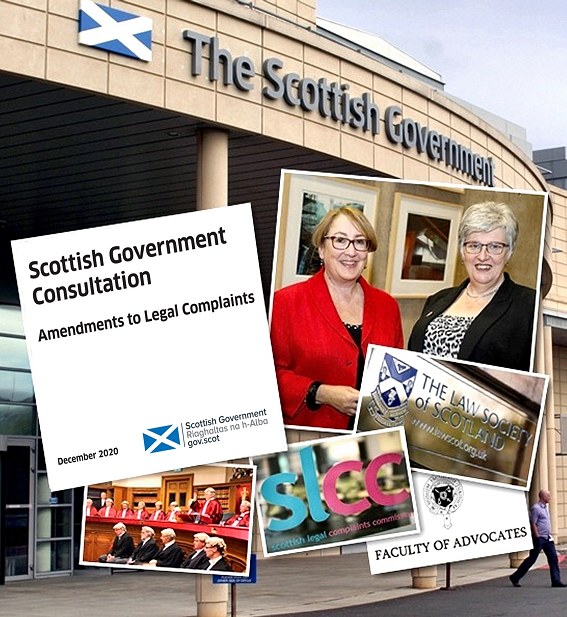
LOOKING AFTER LAWYERS: Scotland’s THIRD attempt in 20 YEARS at reforming complaints against lawyers is doomed to fail at the hands of vested interests - but there is a Scottish Government consultation you can all participate in - for purposes of PR & distraction politics

Clients, their lawyers, & complaints reform. IN THE past TWENTY years since the Scottish Parliament came into being, there have been two earlier attempts at creating a transparent, independent body to investigate complaints against the legal profession.

As many readers will be well aware, both previous attempts at reforming self regulation of lawyers in Scotland failed miserably - after two Justice Committee probes of how the legal profession regulates itself.

It was inevitable, that the combined vested interests of Scotland’s legal profession – the Law Society of Scotland, Faculty of Advocates, along with all their sub-groups, backed up by the judiciary - lobbied to remain in charge of looking after their own.

And, Scotland’s legal profession did exactly that – looked after their own.

Headline after headline, investigation after investigation, and even when BBC Scotland deigned to come along in 2014 with “Lawyers Behaving Badly” - albeit using fantastical cases resembling dubious, ever altering cave paintings carved in fossilised stone from the Jurassic age to put their point across - about dodgy legal regulators looking after their own rogue lawyers – nothing changed.

Yes, it is true – the Scottish Legal Complaints Commission (SLCC) came along in 2008 – as a response to an ‘extensive’ probe by the Scottish Parliament’s Justice 2 Committee in 2006 of complaints against lawyers and how the Law Society of Scotland ‘handled’ clients & consumers who complained against the legal profession - to the point of destruction.

However, twelve years on from the creation of the Scottish Legal Complaints Commission, anyone with a serious & geniune complaint who has used it, knows the SLCC as more of a Cayman Islands front company for lawyers to look after their own, rather than the allegedly ‘independent’ SLCC was created and put in place by civil servants who had little clue or knowledge what they were actually doing.

Sadly, the Scottish Legal Complaints Commission spent the last twelve years mirroring the work previously done by the Law Society of Scotland where lawyers were protected time & again, while clients were often targeted by the legal profession after complaints had been submitted to the ‘independent’ SLCC.

In any case, there is now a third attempt at reforming complaints against lawyers, and you can participate in it.

On 23 December 2020, the Scottish Government published the latest consultation on reforming complaints about the legal profession - along with a questionnaire for those who like that sort of thing to fill out, and send back in the forlorn hope your views and experiences will be taken into account.

You can download the Scottish Government consultation documents here: Scottish Government Consultation: Amendments to Legal Complaints (pdf) and here Respondent Information Form and Questionnaire (docx)

The details are as follows:

Complaints against lawyers and legal firms in Scotland: consultation

Published: 23 Dec 2020

This consultation sets out proposals and seeks views on potential improvements to the legal complaints system, within the current legislative framework of the Legal Profession and Legal Aid (Scotland) Act 2007.

The handling of complaints is one of the most important parts of any regulatory system. It is crucial that users of legal services have access to an efficient, effective and fair process for dealing with their complaint. Equally, legal professionals rely on a complaints system which is efficient, effective and can resolve complaints in an impartial manner.

There is a compelling case for the consideration of amendments to the current regulatory framework for dealing with complaints that would seek to improve the way in which the legal services complaints system operates.

The objectives behind these proposals

This Consultation seeks views on whether these proposals would meet the objectives of:

1. Reducing the overall time taken to deal with complaints.

2. Achieving greater proportionality in the complaints system, allowing the SLCC to identify earlier in the process which issues are more likely to require investigation.

3. Reducing the cost of the complaints system.

4. Continuing to ensure an independent and fair system.

5. Providing greater flexibility in the system.

The changes proposed in this paper seek to build on previous changes made in 2014[1] and are based on 10 years’ working knowledge of the current legislation and the experience of the current system.

The current proposals in this Consultation on which views are sought, and which are intended to have a cumulative effect in meeting the objectives, fall into three categories:

1. Changes to the process of complaint categorisation;

2. Changes to the process of complaint investigation, reporting, determination and conclusion of cases; and

3. Changes to the rules for fee rebates.

The proposed changes listed at 1 and 3 can be viewed as standalone amendments but those listed at 2 should be viewed as a package of amendments in order to gain the maximum impact from the changes.

The proposals - a summary

The aim of the proposals detailed below is to explore options to create a more flexible and proportionate complaints system, that will be more efficient yet just as effective, if not more so. Views on whether these proposals address stated frustrations of those who have been involved in the complaints system, who often perceive it to be time consuming and overly complex, are also sought in response to this consultation.

Why is this important?

Those who make or are subject to complaints in respect of legal services have indicated that they would wish for a speedy, robust and proportionate response to each complaint. While all complaints are equally important, there is a recognition that not all complaints are the same. Those who manage the complaints process, as well as many of those who have experienced it, have stated that they consider the current statutory framework insufficiently flexible to enable the process to be adapted to the specific subject of the complaint in each individual case.

While a one-size-fits-all-approach provides consistency in the application of the complaints process, there is an argument that this does not always lead to an efficient system, with the result in the current system that the end of the complaints process can often be some time away from the time of the original incident that led to the complaint. This can be unsatisfactory for all of those involved in the process. These proposals are intended to reduce this time period and improve efficiency while continuing to maintain a robust and fair system.

Costs

The cost of the legal services complaints process administered by the SLCC is met by way of levies on the legal profession. These take the form of an annual general levy paid by all legal services providers[1] as well as a separate complaints levy[2] which is payable only by those legal professionals who are subject to a complaint which is upheld.

Should the proposals set out in this Consultation be taken forward then they will likely take time to be fully implemented. There is also likely to be a cost implication for implementation. Depending on the range of amendments ultimately decided to be taken forward, implementation in year one is likely to have associated costs in terms of changing rules, process and IT systems. These costs will be borne by the SLCC and it is not presently expected that these will require an increase in funding to either of the above levies. However, in the first full year of operation, and likely after set-up costs are offset, the proposed changes in this Consultation could lead to longer term savings.

A. About this Consultation

The objective of this consultation paper is to offer an opportunity for targeted views to be gathered on the technicalities of making specific changes to the legal complaints system in Scotland.

The main proposals relate to possible changes to the categorisation of complaints to introduce hybrid-issue complaints as well as changes to the processes of assessment, investigation, reporting, determination and conclusion of complaints. Possible changes to the rules on fee rebates are also proposed.

Responding to this consultation

The Scottish Government are inviting responses to this consultation by 20 February 2021.

Please respond to this consultation using the Scottish Government’s consultation hub, Citizen Space (http://consult.gov.scot). Access and respond to this consultation online at https://consult.gov.scot/iustice/amendments-to-legal-complaints/. You can save and return to your responses while the consultation is still open. Please ensure that consultation responses are submitted before the closing date of 20 February 2021.

If you are unable to respond using our consultation hub, please complete the Respondent Information Form to:

Access to Justice Unit Scottish Government Justice Directorate St Andrew’s House Edinburgh EH13DG

Or by email to: LegalServicesRegulationReform@gov.scot

An earlier report on the Esther Roberton review, and how it began, is here: LOOK AFTER THE LAWYERS: Law Society proposals to pro-lawyer legal review seek to reclaim control of regulation & complaints, appoint ‘window dressing’ ombudsman & criminalise ‘misuse’ of the term “lawyer”