Showing posts with label Complaints Research. Show all posts

Thursday, May 31, 2012

Consumer Focus Scotland supports publication of solicitors complaints outcomes as law regulator SLCC ‘launders’ survey data out of FOI reach

Consumer Focus Scotland logoConsumer Focus Scotland support publication of complaints against Scottish solicitors. OUTCOMES of complaints against Scottish solicitors should be published, says Glasgow based consumer protection body Consumer Focus Scotland in response to a new study being undertaken by the Scottish Legal Complaints Commission (SLCC) of law firms' complaints handling, reported by Diary of Injustice at the beginning of May, Consumers ‘locked out of debate’ as Scottish Legal Complaints Commission carries out yet more research on how solicitors handle complaints

The SLCC’s latest study which is seeking disclosure of information from individual law firms on how solicitors deal with complaints has drawn sharp criticism from the legal profession itself and provoked calls by lawyers lobby groups to boycott the survey after fears were raised that actual complaints data would end up being published by the media as a result of Freedom of Information requests to the SLCC.

SLCCLawyer’s so-called ‘independent’ regulator said it would avoid Freedom of Information laws by stashing data out of reach of media. Proving the SLCC has little interest in public opinion or confidence in it’s alleged role as an ‘independent’ regulator of solicitors, the law complaints quango responded to lawyers concerns by saying they would dodge Freedom of Information legislation by refusing to look at the actual complaints data gathered up by research company TNS Research International TNS-BMRB who are under contract to carry out the survey. The FOI dodge was reported by Diary of Injustice earlier in the month, here : Law regulator SLCC responds to lawyers call to boycott complaints research : ‘We will AVOID Freedom of Information by stashing data with researchers'

Responding to questions over the SLCC’s latest complaints survey which effectively shuts out consumers, a spokesperson for Consumer Focus Scotland said : We are pleased that the SLCC is undertaking research to improve its knowledge of the ways in which firms of solicitors deal with complaints. Ideally, consumer complaints about legal services should be dealt with quickly and effectively at a local level, by the business or professional involved, so far as possible. Many complaints can be resolved by way of an apology or informal agreement at this stage, and only where local resolution fails, should the complaint then go to a higher complaints handling body.”

The spokesperson continued : “We know consumers find it important to see complaints data so wider consideration of how this might be best achieved for legal services in Scotland would be helpful. The SLCC currently produces some complaints data within their annual report. This includes information on the number of complaints it received, the areas of law to which these relate and the stage of the SLCC’s process at which these complaints were resolved.”

“In its ‘Complaints about solicitors’ research, the Scottish Consumer Council, one of our predecessor bodies recommended that performance targets for each stage of the complaints process be published. Case study examples are published routinely by ombudsmen in the public sector, and used to be published by the Scottish Legal Services Ombudsman in its annual report. In 2010, a survey of our consumer network of volunteers to inform the Scottish Public Services Ombudsman’s model complaints handling process found that the publication of the outcomes of complaints was a particularly important principle for these consumers”

Consumer Focus Scotland in their previous incarnation as the Scottish Consumer Council conducted several studies & investigations into the notorious difficulties encountered by members of the public who are forced by circumstances to file complaints about their solicitors to the self regulating Law Society of Scotland and ‘independent’ Scottish Legal Complaints Commission. In what is now well over two decades of surveys & investigations by consumer groups & bodies into the complaints processes of Scotland’s legal profession, very little has changed from the 1999 SCC report “Complaints About Solicitors”, with most clients encountering a significant anti-consumer prejudice when making complaints about their solicitors to the legal profession’s in-house closed shop regulators.
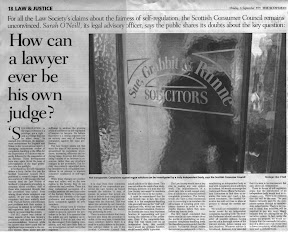
Scottish Consumer Council recommended independent regulation of legal profession in 1999. Writing in the Scotsman newspaper in September 1999, the Scottish Consumer Council’s Sarah O’Neill went some way to explaining the conclusions of the SCC’s “Complaints About Solicitors” report, going onto recommend the Scottish Parliament’s then Justice & Home Affairs Committee study the issue, saying : “The SCC report concluded that there must be an open debate about the merits of establishing an independent complaints-handling body. We therefore recommend that the Scottish Parliament should review the current procedure with a view to establishing an independent body to deal with complaints about solicitors in Scotland. We would encourage the Justice and Home Affairs Parliamentary Committee to find time to examine this issue and reach a balanced conclusion. The Scottish Executive has told us it has no plans at present to change the current system.”

Ms O’Neill went onto say : “We would not recommend a particular model for an independent complaints-handling body. The Scottish Parliament should carefully consider all possible options, having carried out a thorough review of the current system, before making any firm decisions. Whatever scheme is introduced, however, it is essential that it is seen to be transparent, fair and above all, independent.”

The Scottish Consumer Council’s 1999 report “Complaints About Solicitors” stated in its conclusion : “This report provides considerable evidence of consumer dissatisfaction with the way in which complaints against solicitors are presently handled in Scotland, both by solicitors and by the Law Society. We believe that there is an urgent need for both to adopt a more client-oriented approach to dealing with complaints. Solicitors must embrace the concept of client care, which would help to reduce complaints, while at the same time ensuring a better deal for clients. The Law Society’s procedure contains many major flaws, and we have suggested a number of ways in which these could be remedied. Were these changes to be carried out, this would go some way towards improving the lot of consumers who complain about solicitors.”

The SCC report continued : “However, such changes would not go far enough. It is essential that complaints are dealt with by a body which is seen to be independent and impartial. Those who complain must be able to feel that their complaint has been fairly dealt with. It is clear that the fundamental root of the problem from the consumer’s point of view is that the Law Society is seen as being on the side of the solicitor. The only effective solution to the problem is the establishment of an independent review body to deal with complaints against solicitors in Scotland”

An earlier research project commissioned by the SLCC in 2009 & carried out by the University of Manchester’s Law School in to the Law Society of Scotland's Master Insurance Policy revealed clients had committed suicide because of the way they had been treated over claims made against negligent or corrupt solicitors. Diary of Injustice reported on the Master Policy research revelations here : Suicides, illness, broken families and ruined clients reveal true cost of Law Society's Master Policy which 'allows solicitors to sleep at night'

However, the SLCC has steadfastly refused to monitor individual claims to the Master Policy in spite of being asked by members of the public to do so, and no detectable changes have been made to how the SLCC deals with complaints made against negligent solicitors.

The Scottish Legal Complaints Commission has not released any further statements on the progress of the survey or any response to criticisms it is avoiding Freedom of Information laws by refusing to look at complaints data gathered by it’s contract researchers.

Meanwhile in England & Wales, the Legal Ombudsman is pressing ahead with full identification of solicitors & law firms who fail their clients, reported by Diary of Injustice in April, here : Clients of Scots solicitors miss out on ‘right to know’ as UK Legal Ombudsman moves to name & shame ‘crooked lawyers’ in England & Wales

As of 1 April 2012 the Legal Ombudsman began collating names of lawyers and law firms subject to complaints resolved by an ombudsman's decision. Any data collected will be made publicly available by the Legal Ombudsman at the end of July 2012 and then subsequently every quarter.

Friday, May 04, 2012

Law regulator SLCC responds to lawyers call to boycott complaints research : ‘We will AVOID Freedom of Information by stashing data with researchers'

SLCCScottish Legal Complaints Commission says it will avoid FOI requests by stashing lawyers dirty complaints info with researchers. THE Scottish Legal Complaints Commission (SLCC) has responded to calls from a representative body & lobby group for lawyers to boycott a research project into complaints against Scottish solicitors, by assuring the legal profession that any data collected from law firms over how they deal with complaints from clients will AVOID Freedom of Information legislation (FOI) because the data gathered ‘will be held confidentially by a third party’ (in this case, a commercial firm of pollsters) and thus not subject to FOI requirements of disclosure.

Responding to a call by the Scottish Law Agents Society (SLAS) for solicitors to effectively not participate in the survey, reported by Diary of Injustice here :  Consumers ‘locked out of debate’ as Scottish Legal Complaints Commission carries out yet more research on how solicitors handle complaints, the SLCC sought to alleviate concerns over complaints data falling into the hands of the media & FOI requests, stating : “While it is the case that the SLCC is subject to Freedom of Information (Scotland) Act 2002 (FOISA), it should be noted that information is being ingathered on a confidential basis by the researchers purely for the purpose of statistical analysis by them. Information from individual legal firms, or data that could identify any legal firms or individual practitioners, will not be passed on to the SLCC.”

The statement from the SLCC has been widely taken to mean it has signalled to the Scottish Law Agents Society that it’s plans for how the research is gathered and by whom, will deter any leakage of the complaints data to the media or to journalists, individuals or other solicitors making Freedom of Information requests for full disclosure of the research and how it will eventually arrive at any conclusions.

A spokesperson for the SLCC added : “The SLCC sees this as a valuable piece of research which will inform all of our stakeholders, including both the profession and consumers, about how complaints are being dealt with. In particular, the results of the research will inform the SLCC when issuing guidance to the profession on hw practitioners deal with complaints made to them – this is one of the SLCC’s statutory functions contained in Section 40 of the Legal Profession & Legal Aid (Scotland) Act 2007.”

The spokesperson continued : “Prior to engaging the researchers, the SLCC discussed the research with the Law Society of Scotland and the Faculty of Advocates, both of whom agreed to assist the SLCC in conducting the research. In terms of funding, the cost of the research was included in the SLCC’s budget for last year – ie the budget approved in April 2011. It therefore has no impact on the budget recently approved for the forthcoming year, nor has it an impact on the level of next year’s levy.”

A legal insider confirmed to Diary of Injustice this morning, the new research being carried out by the SLCC was discussed with the Law Society of Scotland & Faculty of Advocates. He indicated that “steps had been put in place to see none of the complaints research data leaks out to the press, consumers or clients of solicitors.”

Diary of Injustice further asked the SLCC what its intentions were if the effective boycott of the research by SLAS resulted in a lack of solicitors or law firms participating in the project, after SLAS released a lengthy tirade against the research plans earlier this week, claiming : “The Scottish Legal Complaints Commission has written to solicitors’ firms requesting disclosure of information regarding complaints made against firms by clients and, presumably, other interested parties. It is always a matter of great difficulty for solicitors to disclose to third parties information derived from their clients’ files. There is an instinctive reaction to treat clients’ information in the same way that clients’ money is treated and to regard it as not being at the disposal of third parties. There is also the issue as to the privacy of the solicitor’s own business information. When we sought the views of a number of experienced practitioners and advisers as to whether this information should be supplied to SLCC, the immediate response was unanimously negative.”

SLAS went on to list 10 points concerning the SLCC’s complaints research project, among them suggesting a delaying action, and also advising member solicitors they had no obligation to hand over complaints information to the SLCC.

The SLCC responded to the SLAS statement, confirming it had no powers of compelling solicitors to take part in the research. The SLCC spokesperson said : “In respect of your questioning concerning solicitor participation, the SLCC is confident that it shall receive helpful contribution from solicitors when conducting its research into complaints. While the SLCC does not have the power to compel solicitors to take part in the research, we aver that most will consider the results of this research to offer valuable guidance to the profession on how practitioners deal with complaints made to them.”

Late yesterday, a senior Scottish Government insider indicated his displeasure of the way in which the Scottish Legal Complaints Commission was seeking to cover up complaints data from the public. He said : “Earlier this week the Chair and the outgoing Chief Executive of the Scottish Legal Complaints Commission used the media to publicly criticise the Scottish Government for not prioritising the SLCC or allowing it leeway to work within its legislative framework, which they also condemned as being badly written, complicated and costly to operate. Now they are telling lawyers they don't need to worry about their complaints data being made public because the SLCC, a body which is FOI compliant is going to have someone else hold the data so it can avoid any FOI request for its disclosure ? These people don't know if they are coming or going.”

A report on the media interview in which Jane Irvine, the Chair of the Scottish Legal Complaints Commission, and the SLCC’s now former Chief Executive, Rosemary Agnew, criticised the Scottish Government and the 2007 Legal Profession & Legal Aid (Scotland) Act, can be read in an article featured on law blog Scottish Law Reporter, here : After spending £14 million, legal complaints pair admit "We are crap and so is the law that created us" as one jets off to £80K position as FOI Chief

While Jane Irvine remains Chair of the Scottish Legal Complaints Commission, Rosemary Agnew has now left her position as the SLCC’s Chief Executive, replacing Kevin Dunion as Scotland’s new Information Commissioner, which was reported by Diary of Injustice earlier this year, here : SHHH HAPPENED : Scotland’s new Information Commissioner to be Legal Complaints CEO Rosemary Agnew, rebuked FIVE TIMES for being ANTI-FOI.

It is of course very difficult to have confidence in public bodies or regulators who are required to comply with Freedom of Information legislation to take such overt steps to ensure important information such as how solicitors deal with complaints is withheld from the public by using what can only be described as unfair and foul means to inhibit transparency & accountability. However, Diary of Injustice will follow this research project and report issues & developments relating to it in the public interest.

PLOY TO AVOID FOI : THIRD PARTIES USED TO STASH DATA FROM PUBLIC GAZE

Allowing ‘third parties’ to collect, collate or hold data on behalf of another is a popular device used by many public bodies including most Scottish Government departments, local authorities.

The tactic is also commonly used throughout NHS Scotland, Scottish Water, environmental regulators, most Ombudsmen, the Scottish Parliament, and throughout the justice sector including the Scottish Court Service right up to even the Lord President’s Office in an effort to avoid information falling into public hands via FOI requests using exemptions under Section 3(2)(a)(i) the Freedom of Information (Scotland) Act 2002, where data held by a third party on behalf of another is usually exempt from disclosure.

Tuesday, May 01, 2012

Consumers ‘locked out of debate’ as Scottish Legal Complaints Commission carries out yet more research on how solicitors handle complaints

SLCCScottish Legal Complaints Commission commissions more research on complaints against solicitors. FOURTEEN MILLION POUNDS and FOUR YEARS LATER, with little to show for it in the way of struck-off ‘crooked lawyers’ or clients happy their complaints were fully resolved or fully compensated for their losses, the Scottish Legal Complaints Commission (SLCC) has announced it is to embark on YET ANOTHER round of research into how Scottish solicitors ‘deal with complaints’ and ‘the subject of those complaints’ with the commissioning of a new research project, this time being handled by TNS Research International TNS-BMRB for an as yet undisclosed sum.

The research is to be conduced via telephone interviews between TNS Research and law firms, although there is apparently no obligation on solicitors to participate. Clients & consumers WILL NOT be asked for their input in the SLCC’s latest research.

Diary of Injustice recently reported on another SLCC research project into how the Law Society of Scotland handled conduct complaints, here : Protection Racket : SLCC’s ‘whitewash’ investigation of Law Society of Scotland’s conduct complaint process ends in failure to publish full report. However, the SLCC has so far refused to publish its full findings, limiting published information to a brief mention on it’s website.

Consumers of legal services in Scotland should not expect any improvement in how the SLCC address client complaints after the close of this research, as no improvements to complaints handling at the SLCC have taken place since October 2008 in spite of a number of costly research projects undertaken by the notoriously anti-client legal complaints watchdog whose board members branded financially ruined clients as “frequent flyers” and “chancers”.

An earlier research project commissioned by the SLCC in 2009 & carried out by the University of Manchester’s Law School in to the Law Society of Scotland's Master Insurance Policy revealed clients had committed suicide because of the way they had been treated over claims made against negligent or corrupt solicitors. Diary of Injustice reported on the Master Policy research revelations here : Suicides, illness, broken families and ruined clients reveal true cost of Law Society's Master Policy which 'allows solicitors to sleep at night'

However, the SLCC has steadfastly refused to monitor individual claims to the Master Policy in spite of being asked by members of the public to do so, and no detectable changes have been made to how the SLCC deals with complaints made against negligent solicitors.

The SLCC’s announcement of the new research :

SLCC Research into complaint numbers and practitioners' handling of complaints

As part of its oversight role the SLCC monitors complaints and identifies trends in practice, in relation to how practitioners deal with complaints and the subject of those complaints.  This includes undertaking research.  The latest research the SLCC is carrying out is into complaints made to, and dealt with, by the legal profession in Scotland.

The SLCC has commissioned TNS-BMRB to carry out research into:

the numbers of complaints which solicitors and advocates deal with on an annual basis, including those made directly to the practitioners which are never referred to the SLCC, and complaints which are made through the SLCC's complaints process; and
whether the number and types of transactions carried out by practitioners have any correlation to numbers of complaints received by the SLCC.

During April and May 2012, TNS-BMRB will be contacting Client Relations Managers (CRMs) and advocates for information about their practice (where applicable) and complaints, including:

the size of the firm (e.g. number of partners and Scottish qualified staff practising in Scotland);
scope of practice areas;
the number of transactions, by practice area, the firm dealt with in the last 3 years;
the number of complaints received in the last 3 years, by practice area; and
from whom complaints originate (e.g. from clients or other third parties).

For CRMs, the research will be conducted via a telephone interview, which should take an average of 7 - 10 minutes.  A data sheet will be emailed in advance of the interview to allow CRMs time to retrieve records and to use that information as an aide memoire during the interview.  Advocates will be sent questionnaires to complete and return by post. The SLCC aims to collate information about general complaint handling and expertise employed by those who deal with complaints, and to identify whether there are any unmet training needs.

Practitioners will be asked about:

the processes and procedures in place to deal with and record complaints;
how complaints are disposed of;
the outcome of complaints (e.g. resolved, action taken where complainer remains dissatisfied); and
the level, frequency and type of training (either internally or externally) which they have received regarding complaint handling, how to improve services to prevent/avoid complaints and client care, and how this knowledge and training is disseminated to employees.

The telephone interviews will be carried out during the first few weeks of May 2012.  Advocates should receive their information pack in the first week of May.  Once all data has been obtained from the telephone interviews, the information will be collated, scrutinised and a report prepared by TNS-BMRB.  The SLCC will publish a report on its research in due course. The participation of practitioners is critical to the success of this research and to enabling the SLCC to provide advice, guidance and support in relation to complaints handling in the future which adds value to and reduces costs to the profession. Please refer also to the SLCC Strategy and Corporate Plan  and the SLCC Operational Plan.

There has been no media reaction as yet from the Law Society of Scotland to the SLCC’s latest research plan, however the Scottish Law Agents Society has condemned the SLCC’s complaints research proposal, also raising issues about the SLCC’s compliance with Freedom of Information legislation and pointing out solicitors are not required to hand out complaints information to the SLCC’s researchers. SLAS invited their members to submit their own reflections and suggestions in relation to this development, and issued a statement on their website, reprinted here : SLCC REQUEST FOR FIRMS’ COMPLAINTS INFORMATION

The Scottish Legal Complaints Commission has written to solicitors’ firms requesting disclosure of information regarding complaints made against firms by clients and, presumably, other interested parties. It is always a matter of great difficulty for solicitors to disclose to third parties information derived from their clients’ files. There is an instinctive reaction to treat clients’ information in the same way that clients’ money is treated and to regard it as not being at the disposal of third parties. There is also the issue as to the privacy of the solicitor’s own business information. When we sought the views of a number of experienced practitioners and advisers as to whether this information should be supplied to SLCC, the immediate response was unanimously negative. The following observations are offered:

1. The notice given by SLCC of this enquiry is insufficient to enable the solicitors’ profession to give collegiate consideration to and to make a considered decision upon the very important issue as to whether or not this sensitive information should be disclosed. 2. The cost of this exercise has to be borne by the solicitors’ profession and no information has been provided as to whether that cost has been estimated and as to whether the exercise will be cost effective. 3. No information is given as to whether or how SLCC has satisfied itself that this exercise falls within its statutory remit and its entitlement to expose solicitors to these costs. 3. The SLCC request does not advise as to whether or not there is any obligation on the part of solicitors to provide this information. 4. Information held by solicitors is private whereas information held by SLCC is subject to Freedom of Information enquiry, disclosure and publication. 5. Law Society officials recommend that firms disclose this information to SLCC. 6. Solicitors do not have any obligation to disclose this information to SLCC. 7. A better option might be for the information to be gathered within the profession where it would remain confidential and beyond the scope of Freedom of Information enquiry and only the conclusions be transmitted to SLCC. This might be achieved through the faculty structure or through the Scottish Law Agents Society. 8. Any research carried out at this stage might helpfully include enquiry into the extent to which the current complaints system accommodates abuse of process by persons who are dissatisfied with proper legal findings 9. The best initial response to this enquiry might be to ask for a further period of time to enable the foregoing issues to be considered and resolved.