Independent Law journalists report on legal news for consumers, litigants & Scotland's legal community including features on justice, access to justice, law reform, the judiciary, politics & in-depth investigations, analysis and commentaries on legal related issues.
Showing posts with label independent regulation. Show all posts
Showing posts with label independent regulation. Show all posts
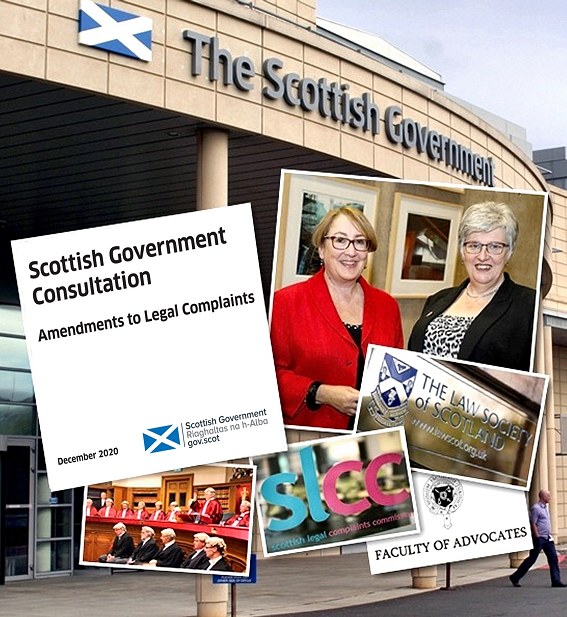
Clients, their lawyers, & complaints reform.IN THE past TWENTY years since the Scottish Parliament came into being, there have been two earlier attempts at creating a transparent, independent body to investigate complaints against the legal profession.
As many readers will be well aware, both previous attempts at reforming self regulation of lawyers in Scotland failed miserably - after two Justice Committee probes of how the legal profession regulates itself.
It was inevitable, that the combined vested interests of Scotland’s legal profession – the Law Society of Scotland, Faculty of Advocates, along with all their sub-groups, backed up by the judiciary - lobbied to remain in charge of looking after their own.
And, Scotland’s legal profession did exactly that – looked after their own.
Headline after headline, investigation after investigation, and even when BBC Scotland deigned to come along in 2014 with “Lawyers Behaving Badly” - albeit using fantastical cases resembling dubious, ever altering cave paintings carved in fossilised stone from the Jurassic age to put their point across - about dodgy legal regulators looking after their own rogue lawyers – nothing changed.
Yes, it is true – the Scottish Legal Complaints Commission (SLCC) came along in 2008 – as a response to an ‘extensive’ probe by the Scottish Parliament’s Justice 2 Committee in 2006 of complaints against lawyers and how the Law Society of Scotland ‘handled’ clients & consumers who complained against the legal profession - to the point of destruction.
However, twelve years on from the creation of the Scottish Legal Complaints Commission, anyone with a serious & geniune complaint who has used it, knows the SLCC as more of a Cayman Islands front company for lawyers to look after their own, rather than the allegedly ‘independent’ SLCC was created and put in place by civil servants who had little clue or knowledge what they were actually doing.
Sadly, the Scottish Legal Complaints Commission spent the last twelve years mirroring the work previously done by the Law Society of Scotland where lawyers were protected time & again, while clients were often targeted by the legal profession after complaints had been submitted to the ‘independent’ SLCC.
In any case, there is now a third attempt at reforming complaints against lawyers, and you can participate in it.
Complaints against lawyers and legal firms in Scotland: consultation
Published: 23 Dec 2020
This consultation sets out proposals and seeks views on potential improvements to the legal complaints system, within the current legislative framework of the Legal Profession and Legal Aid (Scotland) Act 2007.
The handling of complaints is one of the most important parts of any regulatory system. It is crucial that users of legal services have access to an efficient, effective and fair process for dealing with their complaint. Equally, legal professionals rely on a complaints system which is efficient, effective and can resolve complaints in an impartial manner.
There is a compelling case for the consideration of amendments to the current regulatory framework for dealing with complaints that would seek to improve the way in which the legal services complaints system operates.
The objectives behind these proposals
This Consultation seeks views on whether these proposals would meet the objectives of:
1. Reducing the overall time taken to deal with complaints.
2. Achieving greater proportionality in the complaints system, allowing the SLCC to identify earlier in the process which issues are more likely to require investigation.
3. Reducing the cost of the complaints system.
4. Continuing to ensure an independent and fair system.
5. Providing greater flexibility in the system.
The changes proposed in this paper seek to build on previous changes made in 2014[1] and are based on 10 years’ working knowledge of the current legislation and the experience of the current system.
The current proposals in this Consultation on which views are sought, and which are intended to have a cumulative effect in meeting the objectives, fall into three categories:
1. Changes to the process of complaint categorisation;
2. Changes to the process of complaint investigation, reporting, determination and conclusion of cases; and
3. Changes to the rules for fee rebates.
The proposed changes listed at 1 and 3 can be viewed as standalone amendments but those listed at 2 should be viewed as a package of amendments in order to gain the maximum impact from the changes.
The proposals - a summary
The aim of the proposals detailed below is to explore options to create a more flexible and proportionate complaints system, that will be more efficient yet just as effective, if not more so. Views on whether these proposals address stated frustrations of those who have been involved in the complaints system, who often perceive it to be time consuming and overly complex, are also sought in response to this consultation.
Why is this important?
Those who make or are subject to complaints in respect of legal services have indicated that they would wish for a speedy, robust and proportionate response to each complaint. While all complaints are equally important, there is a recognition that not all complaints are the same. Those who manage the complaints process, as well as many of those who have experienced it, have stated that they consider the current statutory framework insufficiently flexible to enable the process to be adapted to the specific subject of the complaint in each individual case.
While a one-size-fits-all-approach provides consistency in the application of the complaints process, there is an argument that this does not always lead to an efficient system, with the result in the current system that the end of the complaints process can often be some time away from the time of the original incident that led to the complaint. This can be unsatisfactory for all of those involved in the process. These proposals are intended to reduce this time period and improve efficiency while continuing to maintain a robust and fair system.
Costs
The cost of the legal services complaints process administered by the SLCC is met by way of levies on the legal profession. These take the form of an annual general levy paid by all legal services providers[1] as well as a separate complaints levy[2] which is payable only by those legal professionals who are subject to a complaint which is upheld.
Should the proposals set out in this Consultation be taken forward then they will likely take time to be fully implemented. There is also likely to be a cost implication for implementation. Depending on the range of amendments ultimately decided to be taken forward, implementation in year one is likely to have associated costs in terms of changing rules, process and IT systems. These costs will be borne by the SLCC and it is not presently expected that these will require an increase in funding to either of the above levies. However, in the first full year of operation, and likely after set-up costs are offset, the proposed changes in this Consultation could lead to longer term savings.
A. About this Consultation
The objective of this consultation paper is to offer an opportunity for targeted views to be gathered on the technicalities of making specific changes to the legal complaints system in Scotland.
The main proposals relate to possible changes to the categorisation of complaints to introduce hybrid-issue complaints as well as changes to the processes of assessment, investigation, reporting, determination and conclusion of complaints. Possible changes to the rules on fee rebates are also proposed.
Responding to this consultation
The Scottish Government are inviting responses to this consultation by 20 February 2021.
Please respond to this consultation using the Scottish Government’s consultation hub, Citizen Space (http://consult.gov.scot). Access and respond to this consultation online at https://consult.gov.scot/iustice/amendments-to-legal-complaints/. You can save and return to your responses while the consultation is still open. Please ensure that consultation responses are submitted before the closing date of 20 February 2021.
If you are unable to respond using our consultation hub, please complete the Respondent Information Form to:
Access to Justice Unit Scottish Government Justice Directorate St Andrew’s House Edinburgh EH13DG
MSPs seek views on reform of legal regulation.TEN YEARS after the contentious passage of theLegal Profession & Legal Aid (Scotland) Act 2007 - which saw the creation of the Scottish Legal Complaints Commission (SLCC) as the lawyer-lawyer led regulator of legal services - MSPs are to seek views on creating a fully independent non-lawyer regulator of Scots legal services.
Two petitions calling for a complete reform of legal services regulation in Scotland have been debated by members of the Scottish Parliament’s Public Petitions Committee.
MSPs have now decided to call for views on bringing Scotland into line with the rest of the UK – where a much greater independent level of legal regulation exists compared to the current Law Society of Scotland & SLCC pro-lawyer regulation model.
Petition 1660 calls on the Scottish Parliament to urge the Scottish Government to review the operation of the Scottish Legal Complaints Commission with a view to making the process of legal complaints more transparent and independent.
Petition 1661 calls on the Scottish Parliament to urge the Scottish Government to reform and amend the regulation of complaints about the legal profession in Scotland, which is currently delegated to the Scottish Legal Complaints Commission, by creating a new independent regulator of legal services with powers equivalent to the Solicitors Regulation Authority, Legal Ombudsman, Bar Standards Board and Solicitors Disciplinary Tribunal which serve consumers and clients of legal service providers in England and Wales.
The move by MSPs comes after the Scottish Government announced a ‘review’ of legal services regulation in Scotland, back in April 2017.
However, the Scottish Government ‘review’ – will not report back until the end of 2018 and with non binding recommendations – and has come in for significant criticism after it was found there was only one consumer related interest among the legal related membership.
When the review was announced earlier this year, former Cabinet Minister & SNP MSP Alex Neil said the review remit should also include judges.
Alex Neil said: “I hope it produces radical and robust proposals. I also hope it covers the judiciary as well as lawyers.”
Mr Neil also called for greater fairness in the panel’s membership, to include members from outside the legal establishment.
Mr Neil added: “I hope the membership of this review panel will be expanded to get a better balance between lawyers and non-lawyers”
After members discussed the two petitions, the Petitions Committee agreed to join these petitions together for future consideration on the basis that they raise similar issues.
The Committee also agreed to write to the Scottish Government, the Scottish Legal Complaints Commission, the Law Society of Scotland, the Faculty of Advocates, Scottish Solicitors' Discipline Tribunal, Citizens Advice Scotland and the Judicial Complaints Reviewer.
The Convener: The next two new petitions are PE1660 by Bill Tait and PE1661 by Melanie Collins, both of which raise similar issues in relation to the current system for complaints about legal services in Scotland. Members have a copy of the petitions and the respective SPICe briefings.
PE1660 calls on the Scottish Parliament to urge the Scottish Government to review the operation of the Scottish Legal Complaints Commission to make the process of legal complaints more transparent and independent. PE1661 calls on the Scottish Parliament to urge the Scottish Government to reform and amend the regulation of complaints about the legal profession in Scotland, which is currently delegated to the Scottish Legal Complaints Commission, by creating a new independent regulator of legal services with powers equivalent to the Solicitors Regulation Authority, the Legal Ombudsman, the Bar Standards Board and the Solicitors Disciplinary Tribunal, all of which serve consumers and clients of legal service providers in England and Wales.
Do members have any comments or suggestions for action on the petition?
Michelle Ballantyne: First of all, I note that there is a review under way. However, although it was launched in April, it is not due to report until the end of next year, which seems an awfully long time.
I am concerned about a turkeys voting for Christmas arrangement with regard to oversight of this matter. There needs to be some clear water between lawyers and those who review them, and this feels a bit close for comfort. We should check where the review is going and what it is looking at, because if it has been launched, the question is whether we need to be doing something parallel alongside it.
Angus MacDonald: Both petitions are extremely timely. Bill Tait and Melanie Collins have highlighted serious issues with regard to the legal profession and the way in which the SLCC operates in respect of complaints. I agree with Melanie Collins that there is a strong argument in favour of creating a new independent regulator of legal services, and I agree with Bill Tait’s call to make the process of legal complaints more transparent and independent.
In recent years, we have seen a degree of conflict between the SLCC and the Law Society of Scotland over the operation of the complaints system. I am sure that I was not the only MSP to receive representations from the Law Society earlier this year, stating frustration and disappointment at the increase in the SLCC levy to be paid by solicitors. It also stated that the complaints system was slow, complex, cumbersome and expensive. There is no doubt in my mind that this is the right time to look at this issue.
As Michelle Ballantyne has mentioned, the Scottish Government has acknowledged that the current process for people wishing to make complaints about their solicitor is too slow and complex, so I was certainly pleased to see the Scottish Government launch its independent review of the regulation. However, I take on board Michelle Ballantyne’s point about the review not being due to report back until the end of 2018; the period seems quite lengthy, but clearly, we can contact the Government for clarification. Given the similarity of the two petitions, there is a strong argument for joining them together to help move them forward.
The Convener: First of all, does the committee agree to join the petitions together? It seems to me that they deal with the same issues.
Members indicated agreement.
Brian Whittle: Am I correct in thinking that the Law Society called for a change and was rebuffed?
Angus MacDonald: I am not entirely sure—it certainly was not happy.
Rona Mackay: It was about the levy. It was not happy with some of the SLCC’s operation, but, as far as I am aware, it has not formally called for a change.
Brian Whittle: I thought that it was investigating this very point and was rebuffed. I might be wrong.
The Convener: It would be worth getting it clear in our own heads where all of this stands. We can obviously ask for that information.
The suggestion is that we write to the Scottish Government about the review’s timescale and remit, and I think that we should write to the relevant stakeholder bodies to ask about what issues they have. It does not feel that long since the legislation was passed, so it would be a natural time to look at and reflect on whether it has been effective and what the alternatives might be. My sense is that, when the legislation went through Parliament, we wrestled with the options—it did not go through without debate. Perhaps we should look at whether this is a bedding-in issue or an actual structural problem and whether, as the petitioner suggests, the issue needs to be revisited and a different kind of regulatory body put in place.
I think that we have agreed to write to the Scottish Government, the Scottish Legal Complaints Commission, the Law Society of Scotland and the Faculty of Advocates. Citizens Advice Scotland was mentioned, as was the Scottish Solicitors Discipline Tribunal. Are there any others?
Angus MacDonald: Would it be worth contacting the Judicial Complaints Reviewer? Although it deals with judicial complaints, as per the title, it would be good to get its view, if it has one. Of course, it is not compelled to reply.
The Convener: Do we agree to deal with both petitions in that way?
Members indicated agreement.
HOLYROOD BRIEFING: MSPs hear of differences between Scotland & UK on regulation of legal services:
4. The SLCC was set up by the Legal Profession and Legal Aid (Scotland) Act 2007 (the Act) to deal with complaints against legal practitioners (primarily solicitors or advocates) in Scotland.
5. It is an independent body whose Board is appointed by the Scottish Ministers in consultation with the Lord President of the Court of Session. It is supported by a management team and staff who carry out investigations.
6. The SLCC is funded by a levy paid by legal practitioners and is required to consult with the relevant professional bodies when setting its annual budget. A copy of the finalised budget has to be laid before the Scottish Parliament no later than 30 April in each year (the budget is not, however, subject to parliamentary approval).
7. The SLCC acts as the initial gateway for complaints. Unresolved complaints have to be made to it in the first instance. Complaints made directly to a professional body (e.g. the Law Society of Scotland (Law Society) or Faculty of Advocates (Faculty)) have to be forwarded by these bodies to the SLCC.
8. Once the SLCC has received a complaint, it assesses whether it is a:
1. Service complaint – i.e. related to the quality of work;or a
2. Conduct complaint –i.e. related to a legal practitioner’s fitness to carry out work and behaviour outside of business.
7. Cases often involve issues of both service and conduct, with the result that both the SLCC and professional bodies can investigate different aspects of the same complaint.
8. If the complaint, or part of the complaint, concerns inadequate professional service, the SLCC investigates following procedures laid down in itsrules and the Act. The SLCC can ultimately:
• Award the complainer up to £20,000 for any loss, inconvenience or distress resulting from inadequate professional service.
• Require the relevant legal practices/practitioners to reduce fees, re-do work and rectify any mistakes at their own expense.
• Report the matter to the relevant professional body if the practitioner shows a lack of legal competence.
9. Decisions of the SLCC can be appealed to the Court of Session.
10. If the complaint, or part of the complaint, concerns the conduct of a legal practitioner, the SLCC passes it on to the relevant professional body to investigate. The SLCC is not permitted to investigate conduct complaints, but it can investigate the way these have been handled by the relevant professional organisation (known as ahandlingcomplaint).
11. The Law Society is able to impose sanctions on solicitors whose conduct has been “unsatisfactory” and can prosecute solicitors before the ScottishSolicitorsDisciplineTribunal(SSDT) where behaviour amounts to professional misconduct. The maximum compensation payable to a complainer is £5,000. In the most serious cases the SSDT can suspend a solicitor’s practising certificate or strike them from the roll of solicitors.
12. The Faculty deals with conduct complaints through a Complaints Committee comprising an equal number of advocates and lay members. Its decisions can be appealed to the Faculty of Advocates Disciplinary Tribunal – chaired by a retired senior judge and whose members include advocates and lay persons. In September 2016 the SLCC published areportwhichauditedtheoperationoftheFaculty’sinvestigationanddisciplinaryprocesses.
13. For further details on the complaints system see:
14. In recent years there has been a degree of conflict between the SLCC and the Law Society over the operation of the complaints system. For example, in December 2016, the Law Society announcedthat it had commenced legal action against the SLCC over the way in which it categorises complaints as service complaints or conduct complaints. In addition, in April 2017 the Law Society noted in a pressreleasethat it was “frustrated and disappointed” about the increase in the SLCC levy to be paid by solicitors. The press release also referred to the complaints system as being, “slow, complex, cumbersome and expensive.”
16. In session 4, the SLCC submitted a letter to the Scottish Parliament’s Justice Committee in which it argued that a review of the complaints procedure was needed. In response, the Justice Committee wrote to the Cabinet Secretary for Justice and received aresponsedated31October2012indicating that the SLCC and Law Society were, “developing a consensual approach to reach an agreement on the key improvements required.” Regulations amending the powers and duties of the SLCC were subsequently scrutinisedbytheJusticeCommittee, which recommended their approval by the Parliament (approval was granted on 13August2014).
17. The adequacy of the complaints system has also been raised in the current parliamentary session (see for example MotionS5M-05079 lodged by Douglas Ross MSP on 6 April 2017).
The motion lodged by Douglas Ross, who is now an MP at Westminster read:
That the Parliament recognises the concerns of solicitors and advocates following the announcement that the annual levy on legal practitioners to the Scottish Legal Complaints Commission (SLCC) is set to rise by 12.5%; understands that the SLCC has argued that recent increases in the number of complaints received against solicitors requires a commensurate increase in its budget; believes that some solicitors and advocates consider that these costs could be absorbed by the SLCC without a rise in the levy; understands that the Law Society of Scotland submitted a paper to the SLCC in response to the plans, but that its proposals were rejected and the increase was maintained; recognises the reported concerns among legal practitioners that the levy can be adjusted by any amount without a mechanism to effectively challenge it; acknowledges what it sees as the risk that the increase in the levy could be passed on to consumers, and calls on the SLCC to carefully consider the feedback that it has received from solicitors, advocates and the Law Society of Scotland.
Supported by: Dean Lockhart, Alexander Stewart, John Lamont, Alison Harris, Peter Chapman, Liz Smith, Gordon Lindhurst R, Edward Mountain, Donald Cameron R, Liam Kerr R, Miles Briggs, Murdo Fraser R, Adam Tomkins, John Scott, Margaret Mitchell, Rachael Hamilton R, Jackson Carlaw, Annie Wells, Jeremy Balfour, Ross Thomson, Brian Whittle, Jamie Greene, Alexander Burnett, Bill Bowman, Maurice Golden
Scottish Government Action
18. On 25 April 2017, the Scottish Government announced the launch of an independentreview of the regulation of legal services in Scotland including the complaints system. According to the Scottish Government, the review
“…follows concerns that the current legislative framework is not fit for purpose and has not kept up with developments in the legal services market. There are also worries that the current processes for people wishing to make complaints about their solicitor are too slow and too complex.”
19. The review is expected to report to Scottish Ministers by the end of 2018.
FLAWED LEGAL SERVICES REVIEW – How Scottish Government’s attempt at independent review of lawyers ended up back in the hands of … lawyers:
In April 2017, the Scottish Government announced an ‘independent’ review into how lawyers regulate their own colleagues – with a remit to report back by the end of 2018.
The move by Scottish Minsters, coming after discussions with the Law Society of Scotland - is intended to answer concerns amid rising numbers of complaints about poor legal services and the diminishing status of Scotland’s legal services sector,
However, former Cabinet Minister Alex Neil MSP (SNP Airdrie and Shotts) said the review should include judges and the membership of the review team should be expanded to balance up the panel’s current top heavy legal interests membership.
The review, led by NHS 24 chair Esther Roberton, is intended to make recommendations to modernise laws underpinning the legal profession’s current regulatory system including how complaints are handled.
This follows concerns that the current legislative framework is not fit for purpose and has not kept up with developments in the legal services market. There are also worries that the current processes for people wishing to make complaints about their solicitor are too slow and too complex.
However, doubts about the impartiality of the panel have been raised after the announcement by Legal Affairs Minister Annabelle Ewing revealed a top-heavy compliment of figures from the legal establishment who are keen on protecting solicitors’ self regulation against any move to increase consumer protection by way of independent regulation.
The list of panel members includes:
*Two former Presidents of the Law Society of Scotland;
* The current Chief Executive of the pro-lawyer Scottish Legal Complaints Commission;
* An outgoing Scottish Public Services Ombudsman widely criticised for ineptitude;
* The current chair of the Scottish Solicitors Discipline Tribunal (SSDT) – who struck off only six solicitors last year;
* The chair of a law firm whose partners have regularly appeared before the SSDT;
* A QC from an advocates stable where colleagues have been linked to a cash payments scandal;
* A former Crown Office Prosecutor & QC linked to events in the David Goodwillie rape case – where the victim was forced to sue her assailant through the civil courts after the Lord Advocate refused to prosecute the footballer.
Announcing the review, Legal Affairs Minister Annabel Ewing said: “Members of the public must be able to have confidence in the service they get from their solicitor. While this happens most of the time, I have been listening carefully to concerns that the current regulatory system in Scotland may leave consumers exposed and does not adequately address complaints.”
The latest move by Scottish Ministers to reform self regulation of solicitors and advocates comes years after a move in England & Wales to more robust independent regulation of legal services - which has left Scots consumers & clients at a clear disadvantage.
And while clients in the rest of the UK have much more of a chance to obtain redress against legal professionals who consistently provide poor legal services – and see their lawyers named and shamed in public by the Solicitors Regulation Authority(SRA) andLegal Ombudsman (LeO).
Review should include judiciary:
Scotland’s judges have earned themselves widespread criticism and condemnation at Holyrood and from the Judicial Complaints Reviewer (JCR) – after top judges failed to address complaints and become more transparent and accountable like other branches of Government.
Ongoing efforts by the Scottish Parliament’s Public Petitions Committee to create a register of judges’ interests have been flustered by two Lord Presidents – Lord Gill & current top judge Lord Carloway.
The proposal to bring greater transparency to Scotland’s judiciary - Petition PE1458: Register of Interests for members of Scotland's judiciary - first debated at the Scottish Parliament’s Public Petitions Committee in January 2013 – calls for the creation of a publicly available register of judicial interests – containing information on judges’ backgrounds, figures relating to personal wealth, undeclared earnings, business & family connections inside & outside of the legal profession, membership of organisations, property and land, offshore investments, hospitality, details on recusals and other information routinely lodged in registers of interest across all walks of public life in the UK and around the world.
The current review could include the judiciary in terms of how judges regulate themselves, however the Scottish Parliament should be left to get on with the task of creating a register of judges’ interests – given the five years of work already undertaken by MSPs on the thorny question of judicial declarations.
REVIEW THE REVIEW: Third attempt at reforming biased system of solicitors self regulation.
The latest review of the way lawyers regulate themselves marks the third attempt at addressing problems created by Scotland’s pro-lawyer system of self regulation, where lawyers write the rules, and look after their own.
In 2001, the Scottish Parliament’s Justice 1 Committee, under the Convenership of Christine Grahame MSP, met to consider evidence in relation to calls to reform regulation of the legal profession.
The inquiry, gained by the late, widely respected MSP, Phil Gallie, heard evidence in relation to how complaints were investigated by the legal profession.
However, Mr Gallie was replaced by Lord James Douglas Hamilton, and the Committee eventually concluded not to amend how the Law Society regulated Scottish solicitors.
A second, more substantive attempt to reform regulation of the legal profession came about in 2006, with the Scottish Parliament’s then Justice 2 Committee taking on consideration of the proposed Legal Profession & Legal Aid (Scotland) Act, which received Royal Assent in 2007.
The LPLA Act led to the creation of the now widely derided Scottish Legal Complaints Commission – once touted as an ‘independent’ solution to handing complaints against solicitors and advocates.
A mere nine years after the creation of the SLCC in 2008, the badly run legal quango, often itself the subject of scandal, charges of incompetence and downright bias – has become as much a threat to consumer protection as the Law Society itself was in the days when complaints were handled at the Law Society’s former HQ in Drumsheugh Gardens, Edinburgh.
The independent review of the regulation of legal services in Scotland is expected to consult widely with stakeholders and report to Scottish ministers by the end of 2018.
The independent chair of the review is Esther Roberton, current chair of NHS 24. Ms Roberton has extensive senior leadership experience in the NHS and other areas of public life. She is also currently a board member of the Scottish Ambulance Service (2014-18). She was chair of SACRO (2010-2014) and until recently also sat on the Crown Office and Procurator Fiscal Service Audit and Risk Committee (COPFS ARC).
The review panel have confirmed their participation as follows:
• Christine McLintock - immediate past president Law Society of Scotland • Alistair Morris - chief executive of the management board, Pagan Osborne (Law Society of Scotland) • Laura Dunlop QC - Hastie Stables (Faculty of Advocates) • Derek Ogg QC - MacKinnon Advocates (Faculty of Advocates) • Neil Stevenson – chief executive of the Scottish Legal Complaints Commission • Nicholas Whyte – chair of Scottish Solicitors’ Discipline Tribunal • Ray Macfarlane – chair of the Scottish Legal Aid Board • Jim Martin – outgoing Scottish Public Services Ombudsman • Dr Dame Denise Coia – chair of Healthcare Improvement Scotland • Prof Lorne Crerar - chairman, Harper Macleod LLP • Prof Russel Griggs - chair of the Scottish Government’s Independent Regulatory Review Group • Trisha McAuley OBE - independent consumer expert
UK Solicitors regulator plans to publish more data on lawyers. A PROPOSAL to publish more detailed information about law firms and solicitors in a public register has been launched by the Solicitors Regulation Authority (SRA) – the body charged with investigating solicitors in England & Wales.
The move to advance consumer protection south of the border by the English legal regulator could help consumers make more informed choices on the use of legal services, and result in a more competitive legal sector with higher standards of service and client care.
However, this is in stark contrast to Scotland, where DOI recently reported on the Scottish Legal Complaints Commission (SLCC) who refuse to publish any useable information to Scots consumers which could help clients steer clear from corrupt lawyers and law firms.
However, and with the advantage of not being held back in the middle ages by the Law Society of Scotland, the England based Solicitors Regulation Authority has launched a discussion paper, "Regulatory data and consumer choice in legal services” exploring what information the SRA could publish through a public register.
The SRA suggests that consumers could benefit from information such as a solicitor’s qualifications or practice restrictions, and complaints data and insurance claims. The SRA also considers what information law firms might want to publish voluntarily, such as quality marks and service prices.
The proposals echo recent calls by the Competition and Markets Authority's (CMA), in its interim report on its market study, as well as from the Legal Services Consumers Panel (LSCP), to improve the level of information available for consumers. The SRA agrees that a lack of clear, targeted information means it is difficult for consumers to compare providers and make informed choices. This is dampening competition in the sector.
Better information could help tackle the problem that the legal needs of individuals and small businesses are not being met.
Only one in ten people use a solicitor when they have a legal problem. And legal problems are estimated to cause small businesses almost £10 billion of losses a year, yet 83 percent of the population see legal services as unaffordable.
Greater transparency would also bring legal services more in line with other sectors, such as financial services and energy, where regulators are already making sure consumer-focused information, such as complaints data, is available.
The SRA recognises that there needs to be careful consideration of the implications of publishing more information. Risks to consider include increased burdens on firms and a one-size-fits-all approach working well for some and not others. For example, the needs of corporate clients will be different to those of an individual consumer.
Paul Philip, SRA Chief Executive, said: "Most people and small businesses are still not accessing legal services. When they do, they are not shopping around. It is unsurprising when the information out there is so limited.
"We want to help consumers, so they are not left making blind choices. Information such as enforcement action, complaints and claims data are exactly the type of things I would want to know when choosing a solicitor.
"We know that the public look to the regulators to provide credible, authoritative, objective information.
"If we get this right, we could help create a more competitive market, where consumers can make better choices and forward-thinking firms thrive. It will also help small businesses access the legal services that could help them succeed and grow.
"Yet we need to think carefully about what we publish and how. More information will not benefit consumers if they find it confusing, hard to access, or it is unhelpful. We have also made good progress on getting rid of unnecessary burdens on firms. We will not ask firms to do more in this area, unless there is a clear benefit.
"This is just the start of a discussion, so we are keen to hear what everyone thinks."
The SRA has already taken steps to improve the information available to consumers by publishing its law firm search in April. And it already publishes details of enforcement action. Publishing useful data in one place would not only help consumers directly, but indirectly as data re-publishers could use it to develop comparison tools that could help make the market more competitive.
SCOTLAND: Legal Services Consumers held back by Law Society of Scotland & self regulation.
Away from the fantastical claims of the Law Society of Scotland, the oh-so-easy free pr and spin of how the Law Society protects access to justice while offering client protection, the fact is, consumers of legal services in Scotland have no chance whatsoever of selecting a legal representative based on their regulatory history – because the Law Society of Scotland refuse to publish any detailed regulation histories of their members.
A BBC Scotland investigation “Lawyers Behaving Badly” exposed further weaknesses in the Law Society of Scotland’s system of control freakery self regulation. The BBC programme lifted the lid once more on lawyers investigating their own, how dishonesty plays out at the Scottish Solicitors Discipline Tribunal, and legal aid fraud.
Lawyers cannot be trusted to regulate themselves – say public.RESEARCH conducted by the Solicitors Regulation Authority (SRA) – the body charged with investigating solicitors in England & Wales, shows there is strong support in the rest of the UK for a move to make the SRA fully independent of the Law Society of England & Wales.
And, unlike Scotland, where the Law Society of Scotland ‘fronted’ regulation model – the Scottish Legal Complaints Commission (SLCC) – continues to be driven by former Law Society staff - the English based Solicitors Regulation Authority wants a complete break from the over arching power & influence of the legal profession’s representative body – to enable it to conduct fully independent regulation of legal practitioners.
Proposals from the UK Government to fully separate legal regulators from professional bodies have been backed by polls reporting that 82 percent of adults in England and Wales say solicitors should be regulated independently.
Research conducted by ComRes - a leading research consultancy on behalf of the SRA, has found that 86 percent of adults in England and Wales believe solicitors should be regulated—similar to doctors and more than for other professions such as dentists and accountants.
And when asked about the type of regulation, there is overwhelming support for independent regulation.
Looking at how regulation affected public trust in solicitors, 68 percent of respondents said they were more likely to trust an independently regulated profession.
When asked directly about the proposals to deliver fully independent regulation, 77 percent agreed that they support the Government's attempts to do so.
Commenting on the research, Chief Executive of the SRA, Paul Philip, said: "This research shows that the public overwhelmingly support independent regulation. Public confidence is key and, as this polling shows, people say they will have greater trust in their solicitor if they know they are independently regulated.
“I am clear that separating out regulator and representative body would not only meet public expectations, but would enhance the important role of the Law Society in making sure the voice of solicitors is heard and respected.”
The Solicitors Regulation Authority recently ran a campaign titled “A Question of Trust” – which invited the public and profession to share their views on what should happen when solicitors fall short of the professional standards set out in the SRA Handbook.
The campaign used scenarios based on real-life cases to ask how serious the issues are and what action should be taken.
The response has been impressive with thousands of people getting involved.
In total the campaign secured: More than 2,350 online survey responses, 6.5m impressions on social media, including 10,000 engagements on Twitter and 1,636 answers via our Twitter polls, Almost 4,500 visitors to our website's "Hot topics" page, where the Question of Trust toolkit for firms could be found, 3,000 attendees to our events around England and Wales.
The input from the four-month campaign will help with the development of a reference framework for our staff to use when making regulatory decisions, including whether to refer to the Solicitors Disciplinary Tribunal.
Commenting on the campaign, SRA CEO, Paul Philip, said: "This is a landmark campaign that has really engaged people. Regulation is part of the social contract between the profession and the public and it important that we calibrate and validate what we do. Thank you to the thousands of solicitors and members of the public who have helped us with this.
"We asked people about what should happen when things go wrong. I believe that clear, consistent and transparent decision making is fundamental to good regulation and we are reviewing our end to end procedures accordingly. Our new reference framework will help staff and the profession alike.
"We refer the most serious cases to the SDT. The Tribunal is rightly independent and our campaign was not about how it operates. It was about stimulating a debate on the standards the public can expect of solicitors. Of course, each case must turn on its merits and we have a right of appeal where we think the Tribunal has got it wrong.
"A Question of Trust addressed the big issues at the heart of regulation and shows that there is real public interest in the high standards expected of solicitors. Testing what we do with the profession and the public increases public confidence, not only in regulation but in the profession itself."
The Solicitors Regulation Authority is due to report further on their campaign later this year.
Responding to the SRA statement on regulatory independence, Law Society chief executive Catherine Dixon said: “We support independent regulation. Regulation is about the minimum regulatory rules which should apply to the whole market to protect consumers. This is very different from professional standards of behaviour, conduct and ethics, which should be the responsibility of the profession, as they are best placed to raise these standards.”
“There is an opportunity to put in place better and simpler regulation which applies to all legal services, as currently many legal services providers are not regulated. This means that purchasers of some legal services are not protected.”
“Currently the regulatory maze is complex. There are numerous regulators of legal services and there is an opportunity to consolidate to save cost. There is also confusion because currently there is a very broad definition of regulation, which includes regulatory rules, professional standards and conduct, ethics, entry into the profession and awarding the professional title.”
“Paradoxically, the most qualified and trained are the most regulated; the least qualified and trained are not regulated. This is a mistake. There is an opportunity to redefine what regulation should cover to ensure that it is simple and better, and applies to all legal services. Regulation should not include professional standards and conduct, nor entry into the profession and awarding a professional title. In order to drive professional standards, the responsibility needs to be with the profession. This will ensure that the reputation of the profession at home and internationally is secured and that England and Wales remains the jurisdiction of choice, and that the legal profession is seen to be independent from government, enabling it to uphold the rule of law.”
The Times newspaper reported on the research conducted by the Solicitors Regulation Authority, excerpt follows here:
Should solicitors be independently regulated? The public certainly thinks so, according to a new poll this week, Frances Gibb writes. In the latest move in the current battleground between the Solicitors Regulation Authority (SRA), the profession's watchdog and the Law Society, the professional body for 160,000 solicitors in England and Wales, the SRA has published a poll showing strong support for its wish to become fully independent of the society.
The move could radically change the role and funding of the society — at present bound with the SRA. How it works is that the SRA tells the society what it needs and the society agrees the figure. The society's council then adds a sum for activities that it is authorised to conduct and together the figure determines what solicitors pay for their practising certificate fee.
Paul Philip, SRA chief executive, says: "The present arrangement is not understandable to the man or woman on the street. Most people would be surprised to know that the people who regulate solicitors are part of the body that represents the profession. In terms of public trust, you might have a question mark about that."
Meanwhile, the SRA is ready to make a strong case when ministers consult on regulation in March. "There's an inherent conflict between representing the profession and the public," Philip says. "When push comes to shove, we're part of the Law Society. If independent, we'd be less expensive and confidence in the profession would be bolstered."
SCOTLAND – Where the legal profession ensures solicitors look after their own:
In the past eight years of investigating complaints about legal services practitioners in Scotland, the allegedly ‘independent’ Scottish Legal Complaints Commission (SLCC has amassed a lengthy history of abusing clients expectations of action against wayward, rogue and corrupt Scots solicitors.
In attempts to placate calls to scrap the SLCC in current form and replace it with a fully independent regulator, the Law Society of Scotland has embarked on regular polls, one of which was widely published in the media claiming huge levels of client satisfaction with legal practitioners.
The move came after a challenging year for self regulation of Scotland’s legal profession – left reeling from the effects of the damaging BBC Scotland investigation “Lawyers Behaving Badly” - which blew the mask off lawyers investigating their own and legal aid fraud.
Kenny MacAskill – Reign of error as Justice Secretary since 2007AS SCANDALS continue to rock Scotland’s legal profession, leaving a growing trail of clients who suffer heavy financial losses, the price of having a second hand High Street solicitor in charge of Scotland’s justice system for the past FIVE YEARS is clearly beginning to tell on Scots access to justice, where, with no end in sight to Kenny MacAskill’s reign of error, now entering it’s SIXTH YEAR, the Justice Secretary has now indicated his Scottish Government does not consider further independent regulation of the solicitor profession in Scotland to be necessary.
In response to a series questions raised in the Scottish Parliament by Justice Committee member Margaret McDougall MSP (West Scotland, Scottish Labour), on the subject of regulation of the legal profession, Mr MacAskill replied that there will be no further review of regulation of the Law Society of Scotland.
The Justice Secretary also indicated in his responses that the Scottish Government is apparently, supportive of the present arrangements of regulation of Scotland’s legal profession, arrangements which have seen a series of high profile corrupt solicitors escape punishment for complex frauds against their clients involving huge sums of money, while other solicitors have escaped criminal prosecution for the theft of millions of pounds of taxpayer funded legal aid.
The series of questions put to Mr MacAskill by mps Margaret McDougall are published on the Scottish Parliament’s website, among a series of evasive responses from Scottish Ministers on other topics : HERE (pdf)
Margaret McDougall (West Scotland) (Scottish Labour): To ask the Scottish Executive who oversees the work of the Law Society of Scotland. (S4W-08503)
Kenny MacAskill: The Law Society of Scotland is an independent professional body. It is not regulated by the Scottish Government nor any other body but is subject to the provisions of the Solicitors (Scotland) Act 1980 and other enactments.
Margaret McDougall (West Scotland) (Scottish Labour): To ask the Scottish Executive whether it plans to review the regulatory system in place for the Law Society of Scotland. (S4W-08504)
Kenny MacAskill: The Scottish Parliament has recently considered and approved two pieces of legislation which significantly modify the regulatory system in place for the Law Society of Scotland, namely the Legal Profession and Legal Aid (Scotland) Act 2007 and the Legal Services (Scotland) Act 2010. The Scottish Government has no further plans to review the regulation of the Law Society of Scotland.
Margaret McDougall (West Scotland) (Scottish Labour): To ask the Scottish Executive what assessment it has made of the performance of the Law Society of Scotland. (S4W-08505)
Kenny MacAskill: The Scottish Government does not assess the performance of the Law Society of Scotland.
Margaret McDougall (West Scotland) (Scottish Labour): To ask the Scottish Executive what its position is on the need for independent regulation of the legal profession. (S4W-08506)
Margaret McDougall (West Scotland) (Scottish Labour): To ask the Scottish Executive what its position is on self-regulation of the legal profession. (S4W-08507)
Kenny MacAskill: The Law Society of Scotland is an independent self-regulating professional body for solicitors and conveyancing and executry practitioners. Section 120 of the Legal Services (Scotland) Act 2010 laid down the regulatory framework for the regulation of the Faculty of Advocates by the Court of Session. Sections 25-29 of the Law Reform (Miscellaneous Provisions) (Scotland) Act 1990 provide for the Lord President of the Court of Session and the Scottish Ministers to approve and regulate professional or other bodies which apply to enable their members to have rights to conduct litigation and rights of audience in the courts.
There are safeguards in place. Complaints about all legal practitioners can be made to the Scottish Legal Complaints Commission which is an independent body. Further, allegations of misconduct by solicitors may be heard by the Scottish Solicitors’ Discipline Tribunal, another independent body. In addition, the Legal Services (Scotland) Act 2010 provided for increased lay involvement in the work of the Law Society, and a lay majority on its regulatory committee. The Scottish Government considers these arrangements appropriate and that there are adequate safeguards. It does not consider further independent regulation of the solicitor profession in Scotland to be necessary.
Clearly, from Mr MacAskill’s responses to questions on the subject of regulation of solicitors, Scots consumers of legal services do not stand a chance against lawyers out to rip them off. Similarly, anyone wishing to bring their legal business or litigation to Scotland should take note of the fact that regulation and the lack of real safeguards against rip offs, will also let international & corporate clients down, sooner or later.
Asked about the content of Mr MacAskill’s responses to questions, Margaret McDougall told Diary of Injustice : “I have concerns about self-regulatory bodies and how “independent” they are and how they best serve the public needs. Since raising these PQs the Law society has kindly offered to meet with me to discuss my concerns and I am looking forward to meeting with them in the near future.”
Speaking to Diary of Injustice, a leading campaigner on reform of regulation of the legal profession condemned Mr MacASkill’s pro-lawyer stance to msps.
He said : “Given Mr MacAskill’s robust defence of the Law Society of Scotland and what are effectively two front companies to get lawyers off the hook - the Scottish Legal Complaints Commission & the Scottish Solicitors Discipline Tribunal, it might appear to anyone viewing the situation with a degree of knowledge or experience that the legal profession has a Scottish Minister in its pocket, bought & paid for.”
Diary of Injustice has been covering injustice against clients & consumers in Scotland’s legal system since 2006, repeating time & again the system of regulation of Scotland’s legal profession is corrupt in name, and corrupt in nature.
In spite of Mr MacAskill’s claims to msps of new regulation, the reality of dealing with Scottish solicitors has shown us time & again that nothing has changed to improve the rights of clients against vindictive, prejudiced and thoroughly dishonest regulatory practices operated by the Law Society of Scotland, Scottish Solicitors Discipline Tribunal and the Scottish Legal Complaints Commission.
Clearly however, there are some msps who do feel the system must be changed, and therefore Diary of Injustice would like to encourage readers who feel strongly on the matter to contact their msps and ask for progress and the introduction of reforms such as fully independent regulation of the legal profession in Scotland and further powers of protection for consumers, such as naming & shaming ‘crooked lawyers’, a policy now implemented in England & Wales by the Legal Ombudsman. If it’s good for the rest of the UK, we Scots can have it too .. and also, a much needed replacement in the Justice portfolio.