Showing posts with label Lady Smith. Show all posts

Thursday, October 19, 2017

TRIBUNAL INTERESTS: Calls for wealthy, well connected interests & professions who dominate tribunals & appeals system to be brought into line with transparency & declarations in published register of interests

Tribunals are dominated by wealthy, powerful individuals & professional groups. AMID an ongoing media probe into the undeclared, and significant interests of individuals and professional groups who dominate public tribunals, a call has been made for all tribunal members to declare and register their interests.

The manner in which tribunals are created and governed in Scotland, is a familiar model of professionals within the same groups and spheres of influence - awarding jobs to colleagues, the favoured, and vested interests.

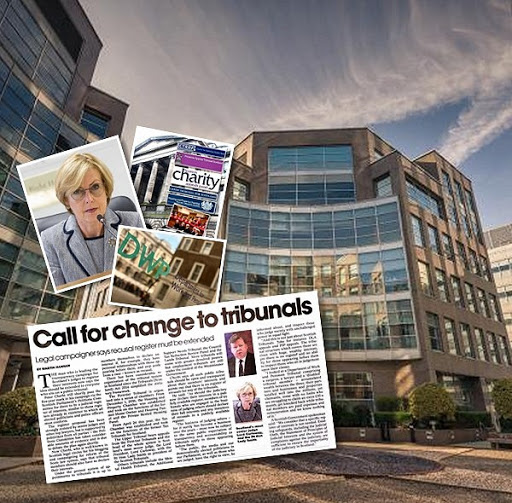
A no expenses spared approach for tribunal members who tow the line is often the case, enhanced with office accommodation such as the new tribunals centre being created in Glasgow at 3 Atlantic Quay, a high-quality office development close to the River Clyde in the centre of the city.

Last week, the Scottish Courts & Tribunals Service (SCTS) confirmed they and Her Majesty’s Courts and Tribunals Service (HMCTS) have decided to rationalise their accommodation and move jointly into the new centre – which is being rented out at nearly £2million a year from the Moorfield Group and partners Resonance Capital.

The moves planned to start next year will also mean that accommodation is ready for the tribunals that are going to be devolved to the SCTS.

Members of tribunals are recruited by the Judicial Appointments Board (JAB) during appointments rounds regularly held to fill vacancies in the murky world of the Scottish Courts and Tribunals Service and Judiciary of Scotland.

Applicants face interviews from their peers across the legal, professional, charitable and public service world & industries awash with public cash, junkets, charity interests, coaching, arbitration & consultancy profits.

Successful candidates are subsequently appointed by Scottish Ministers.

An example of a recent appointments round run by the Judicial Appointments Board saw 30 new Legal Members and 19 Ordinary Members appointed by the Scottish Ministers to the First-tier Tribunal for Scotland and assigned to the Housing and Property Chamber by the President of Scottish Tribunals, Lady Smith.

A full report on the appointments can be found here: TRIBUNAL REGISTER: Calls for transparency as legal & wealthy, well connected interests dominate Tribunals system membership - Register of Recusals & Interests should be extended to cover all Tribunals in Scotland

The names of those appointed are:

Legal Members: Yvonne McKenna; Lesley-Anne Mulholland; Nairn Young; Shirley Evans; Alastair Houston; Steven Quither; Petra Hennig McFatridge; Colin Dunipace; Lesley Johnston; Anne Mathie; Kay Springham; Alan Strain; Aidan O’Neill; Jan Todd; Alison Kelly; Valerie Bremner; Eleanor Mannion; Virgil Crawford; Pamela Woodman; Lynsey MacDonald; Karen Kirk; Neil Kinnear; Fiona Watson; Nicola Irvine; Graham Dunlop; Andrew Upton; Joel Conn; Melanie Barbour; Lesley Ward; Andrew McLaughlin.

Ordinary Members: Eileen Shand; Elizabeth Williams; Janine Green; Jennifer Moore; Linda Reid; Angus Lamont; David Fotheringham; David MacIver; David Wilson; Gerard Darroch; Gordon Laurie; James Battye; Leslie Forrest; Tony Cain; Elizabeth Currie; Frances Wood; Jane Heppenstall; Melanie Booth; Sandra Brydon.

Not one of these members  - the thirty lawyers – or the nineteen ‘ordinary’ members - has declared any interests in a publicly available register of interests – as there is currently no requirement to do so.

The Judicial Appointments Board publish a version of a register of interests,- available here: Judicial Appointments Board - Register of Interests

However, the JAB register of interests leaves out any mention of property wealth and many other interests known to be held by those serving on the quango tasked with recruiting Scotland’s judiciary and tribunal members.

A legal insider commenting on the JAB register observed: “It appears as if members are poor souls sitting round a table with little to declare, whereas the undeclared financial wealth and status on this list is significant and ought to be declared”

The world of Disability Living Allowance appeals and PIP appeals has too come under the spotlight - after a study of appeal panels revealed members wealth and property totalling in the millions compared to disabled applicants who were being ‘knocked back’ on applications for a few extra pounds a month.

The tribunal structure which covers benefits appeals are riven with huge, wealthy interests, yet there is no register and no ability for those appearing before them to inspect those who sit in judgement upon their claims.

In one look at a DWP Tribunal comprising a surgeon, a lawyer and a 'disabled' tribunal member - accumulated wealth between the three, their partners and businesses and properties totalled well into the millions, yet claimants, some with no limbs who are struggling to claim an extra £30 a month and get knocked back while tribunal members are paid expenses & remuneration know nothing of it.

An adviser who assists those facing benefits appeal tribunals gave an example of a benefits tribunal membership:

A surgeon tribunal member - of 25 years experience as a medical practitioner owned several properties, has several positions on public bodies, has a long history of advising Government departments on medical legislation, has appeared as an expert witness on many occasions for NHS trusts and assisted Medical Defence Unions in the UK against hospital negligence claims.

His partner has a similar level of interests in terms of wealth and property, has a wide variety of positions in advising and acting for quangos,public bodies, professions, local and central government.

A solicitor member of the tribunal, who has over 20 years experience of a solicitor owns numerous properties, holds several other positions on tribunals and has made a lucrative career of advising and representing quangos, public bodies and has fought and won cases for professional groups.

However, the third member – the disability member of the tribunal – proved to be the most interesting.

The disability member, who is in receipt of DLA – holds significant assets and property well out of the reach of any typical DLA or PIP claimant.

This same disability member appears to hold several positions on public bodies and has frequently travelled on publicly funded junkets.

And, the same disability member has been the author of written reports on individuals – one which was described by a former local Government employee as “a personal vendetta” against a claimant from the same town in which the tribunal was held.

The former benefits adviser also recalled a recorded hearing – in which the same disability member became aggressive during a benefits appeal hearing - and demanded an assisted blind claimant remove their black glasses.

The net worth of the three members of this particular DLA tribunal was estimated at around £5.2m – taking into account the tribunal members partners, whose interests often coincided with public bodies, professions, local and central government.

It has also been alleged remuneration and expenses for benefits appeal tribunal members include payments for “knocking back applicants”.

A former Local Government employee who worked in the benefits section of a council told of how he had been part of a discussion at his former workplace where a senior member of staff claimed DLA tribunal members had on occasion been paid hundreds of pounds more for throwing out DLA applications.

Clearly, those before such a tribunal have the right to know who they face, and the interests of those who judge them.

The National reports further:
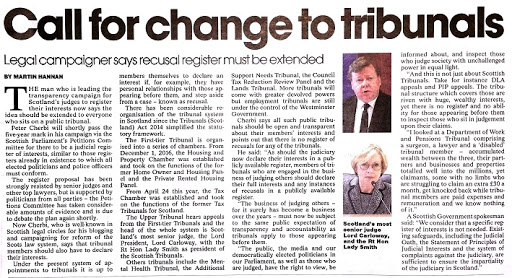
Call for change to tribunals - Legal campaigner says recusal register myst be extended

Martin Hannan Journalist 14 October 2017 The National

THE man who is leading the transparency campaign for Scotland’s judges to register their interests now says the idea should be extended to everyone who sits on a public tribunal.

Peter Cherbi will shortly pass the five-year mark in his campaign via the Scottish Parliament’s Petitions Committee for there to be a judicial register of interests, similar to those registers already in existence to which all elected politicians and police officers must conform.

The register proposal has been strongly resisted by senior judges and other top lawyers, but is supported by politicians from all parties – the Petitions Committee has taken considerable amounts of evidence and is due to debate the plan again shortly.

Now Cherbi, who is well-known in Scottish legal circles for his blogging and campaigning for reform of the Scots law system, says that tribunal members should also have to declare their interests.

Under the present system of appointments to tribunals it is up to members themselves to declare an interest if, for example, they have personal relationships with those appearing before them, and step aside from a case – known as recusal.

There has been considerable re-organisation of the tribunal system in Scotland since the Tribunals (Scotland) Act 2014 simplified the statutory framework.

The First-tier Tribunal is organised into a series of chambers. From December 1, 2016, the Housing and Property Chamber was established and took on the functions of the former Home Owner and Housing Panel and the Private Rented Housing Panel.

From April 24 this year, the Tax Chamber was established and took on the functions of the former Tax Tribunals for Scotland.

The Upper Tribunal hears appeals from the First-tier Tribunals and the head of the whole system is Scotland’s most senior judge, the Lord President, Lord Carloway, with the Rt Hon Lady Smith as president of the Scottish Tribunals.

Others tribunals include the Mental Health Tribunal, the Additional Support Needs Tribunal, the Council Tax Reduction Review Panel and the Lands Tribunal. More tribunals will come with greater devolved powers but employment tribunals are still under the control of the Westminster Government.

Cherbi says all such public tribunals should be open and transparent about their members’ interests and points out that there is no register of recusals for any of the tribunals.

He said: “As should the judiciary now declare their interests in a publicly available register, members of tribunals who are engaged in the business of judging others should declare their full interests and any instances of recusals in a publicly available register.

“The business of judging others – for it surely has become a business over the years – must now be subject to the same public expectation of transparency and accountability as tribunals apply to those appearing before them.

“The public, the media and our democratically elected politicians in our Parliament, as well as those who are judged, have the right to view, be informed about, and inspect those who judge society with unchallenged power in equal light.

“And this is not just about Scottish Tribunals. Take for instance DLA appeals and PIP appeals. The tribunal structure which covers those are riven with huge, wealthy interests, yet there is no register and no ability for those appearing before them to inspect those who sit in judgement upon their claims.

“I looked at a Department of Work and Pensions Tribunal comprising a surgeon, a lawyer and a ‘disabled’ tribunal member – accumulated wealth between the three, their partners and businesses and properties totalled well into the millions, yet claimants, some with no limbs who are struggling to claim an extra £30 a month, get knocked back while tribunal members are paid expenses and remuneration and we know nothing of it.”

A Scottish Government spokesman said: “We consider that a specific register of interests is not needed. Existing safeguards, including the Judicial Oath, the Statement of Principles of Judicial Interests and the system of complaints against the judiciary, are sufficient to ensure the impartiality of the judiciary in Scotland.”

YOUR TRIBUNAL: A publicly funded adversarial environment full of vested interests:

Next year, tribunals will move to an expensive new home in the centre of Glasgow.

The Scottish Courts and Tribunals Service (SCTS) and Her Majesty’s Courts and Tribunals Service (HMCTS) are to rationalise accommodation in Glasgow and the new Tribunals Centre will be located at 3 Atlantic Quay. 

The SCTS claim the 34 hearing rooms for cases to be heard, the design of the centre will provide excellent facilities for all tribunal users, and specific  support for young users with additional support needs.  Additionally, the centre will provide facilities for vulnerable witnesses to give evidence to both Glasgow Sheriff Court and the High Court.

During 2018, the SCTS-supported Housing and Property and Health and Education Tribunal Chambers will move into the new Centre. The HMCTS-operated social security tribunal will move at a similar time with other tribunals HMCTS services to follow at a later date.

The SCTS provides support to many of Scotland’s devolved tribunals and is making preparations for the future transfer of the UK reserved tribunals operations in Scotland, currently provided by HMCTS.

Lady Smith, President of Scottish Tribunals – who is in charge of the £7.8million Scottish Child Abuse Inquiry – claimed:  “The creation of the new Tribunals Centre in Glasgow is the latest important development in the evolution of the Scottish Tribunals. The premises will act as a hub for tribunals supported by SCTS, providing a range of modern facilities and services for tribunals users. They will also offer a separate, appropriately designed space, for vulnerable witnesses and users, including for witnesses providing evidence for Sheriff and High Court cases in Glasgow. This co-located approach to provision for the tribunals should be regarded as a flagship for the administration of justice in Scotland in the 21st century.”

Eric McQueen, Chief Executive, SCTS said: "This has been an exciting opportunity with SCTS and HMCTS working together to create a bespoke tribunals centre, improving the services we provide for tribunals, while reducing costs.  It also provides an early opportunity to bring together SCTS and HMCTS staff to prepare for forthcoming tribunal reforms.”

Kevin Sadler, Deputy Chief Executive, HMCTS said: “We are committed to improving people’s experience of the justice system by providing facilities that are modern, comfortable and accessible.We have worked collaboratively with SCTS on this opportunity and we look forward to creating a joint tribunals centre with them in the heart of Glasgow.”

If you have any experience before any of these Tribunals, or information in relation to cases, Diary of Injustice journalists would like to hear about it. All information and sources will be treated in strict confidence, contact us at scottishlawreporters@gmail.com

Previous articles on the lack of transparency within Scotland’s judiciary, investigations by Diary of Injustice including reports from the media, and video footage of debates at the Scottish Parliament’s Public Petitions Committee can be found here : A Register of Interests for Scotland's Judiciary.

Previous reports on moves to publish judicial recusals in Scotland and a media investigation which prompted further reforms of the Scottish Register of Judicial Recusals can be found here: Judicial Recusals in Scotland - Cases where judges have stood down over conflicts of interest

Friday, September 29, 2017

TRIBUNAL REGISTER: Calls for transparency as legal & wealthy, well connected interests dominate Tribunals system membership - Register of Recusals & Interests should be extended to cover all Tribunals in Scotland

Calls for tribunal members to publish interests & recusals. WITH THE announcement earlier this week of at least thirty solicitors have joined the First-tier Tribunal for Scotland, Housing & Property Chamber – there are calls for all members to be held to account by way of the publication of registers of interests for those who wish to take part in judgements affecting the lives of others.

The move comes after media enquiries have established a number of members of the tribunals have links to property businesses including letting, landlords services and other related interests which are not yet publicly declared by the Scottish Courts & Tribunals Service (SCTS).

And, with the existence of a Register of Judicial Recusals since 2014 – which recently saw significant improvements after a media investigation exposed failures to record judges standing aside in cases – there are also calls for a fully pubic Register of Tribunal Recusals to be published with equivalent detail on cases and Tribunal members as is currently disclosed by the Judiciary of Scotland.

Moves to improve transparency in the Tribunals system - and bring it up to speed with the judiciary - have come about after a number of cases have been brought to the attention of the media – where Tribunal members have failed to declare significant interests or step aside from hearings – which some participants have described as “rigged”.

An enquiry to the Scottish Courts & Tribunals Service last month – in the form of a Freedom of Information request – also revealed the SCTS is failing to keep any records of recusals of Tribunal members – despite the requirements in place for over three years that members of the judiciary have to notify and publish their recusals from court hearings.

In a response to the FOI request, the Scottish Courts & Tribunals Service refused to provide any information on Tribunal members standing aside from cases. The SCTS – who manage the tribunals - indicated no such information was held.

The SCTS response ended with a note all Tribunal members are subject to the same guidance to judicial office holders in terms of the Statement of Principles of Judicial Ethics – which has already been found to be flouted on a regular basis by even senior Court of Session judges who have been the subject of cases now reported in the media where they deliberately concealed conflicts of interest.

The SCTS said in response to the request asking for information on Recusals of Tribunal members: “The only information held by the Scottish Courts and Tribunals Service that falls within the description of your request is contained within guidance issued to judicial office holders. That guidance is the Statement of Principles of Judicial Ethics.”

A Tribunals User Charter for the Tribunals managed by the SCTS makes no mention of Tribunal members recusals or any registers of Tribunal members interests.

The announcement of the latest intake of members into the Tribunals system – an intake which is managed by the Judicial Appointments Board, was made by the Judiciary of Scotland here:

New Legal and Ordinary Members of the First-tier Tribunal for Scotland, Housing & Property Chamber

Thirty new Legal Members and 19 Ordinary Members have been appointed by the Scottish Ministers to the First-tier Tribunal for Scotland and assigned to the Housing and Property Chamber by the President of Scottish Tribunals, Lady Smith.

The announcement follows a recruitment round by the Judicial Appointments Board for Scotland (JABS), which invited applications from any suitably qualified individuals who wished to be considered for appointment.

The new members were recruited to assist in managing the increased jurisdiction of the Housing and Property Chamber that will handle more private rented sector cases from December 2017, including the new letting agents’ regime; transfer of jurisdiction from the sheriff courts; and new private tenancies.

The new members are as follows:

Legal Members

Yvonne McKenna; Lesley-Anne Mulholland; Nairn Young; Shirley Evans; Alastair Houston; Steven Quither; Petra Hennig McFatridge; Colin Dunipace; Lesley Johnston; Anne Mathie; Kay Springham; Alan Strain; Aidan O’Neill; Jan Todd; Alison Kelly; Valerie Bremner; Eleanor Mannion; Virgil Crawford; Pamela Woodman; Lynsey MacDonald; Karen Kirk; Neil Kinnear; Fiona Watson; Nicola Irvine; Graham Dunlop; Andrew Upton; Joel Conn; Melanie Barbour; Lesley Ward; Andrew McLaughlin.

Ordinary Members

Eileen Shand; Elizabeth Williams; Janine Green; Jennifer Moore; Linda Reid; Angus Lamont; David Fotheringham; David MacIver; David Wilson; Gerard Darroch; Gordon Laurie; James Battye; Leslie Forrest; Tony Cain; Elizabeth Currie; Frances Wood; Jane Heppenstall; Melanie Booth; Sandra Brydon.

The appointments came into effect on 18 September 2017.

Under changes to Scotland’s tribunals system which came into effect in July 2014, the Lord President is the head of Scottish Tribunals.  He has various statutory functions, including responsibility for the training, welfare and conduct of its members.

The Lord President has assigned Lady Smith to the role of President of Scottish Tribunals. She has various statutory functions, including responsibility for the efficient disposal of business in the Scottish tribunals, for the assignment of members to individual Chambers within the First-tier Tribunal, and for review of the members.

The First-Tier Tribunal for Scotland comprises a number of separate Chambers within which similar jurisdictions are grouped. The Housing and Property Chamber, which was established on 1 December 2016, performs the functions of the former Private Rented Housing Panel (PHRP) and the Homeowner Housing Panel (HOHP) in relation to tenancy and property related disputes. The Chamber will also start to handle more private rented sector cases from December 2017 including those arising in relation to the new letting agents’ regime; transfer of jurisdiction from the sheriff courts; and new private tenancies.

Appeals from the First-tier Tribunal go to the second tier of the new structure, the Upper Tribunal for Scotland.

Appeals from decisions of the Upper Tribunal go to the Inner House of the Court of Session.

Further information about the Scottish Tribunals visit the Scottish Courts and Tribunals Service can be found here: About Scottish Tribunals

The Tribunals (Scotland) Act 2014 created a new, simplified statutory framework for tribunals in Scotland, bringing existing jurisdictions together and providing a structure for new ones. The Act created two new tribunals, the First-tier Tribunal for Scotland and the Upper Tribunal for Scotland.

The Lord President is the head of the Scottish Tribunals and has delegated various functions to the President of Scottish Tribunals, the Rt Hon Lady Smith.

The Upper Tribunal for Scotland: The Upper Tribunal hears appeals on decisions of the chambers of the First-tier Tribunal.

The First-tier Tribunal is organised into a series of chambers .

From 1 December 2016, the Housing and Property Chamber was established and took on the functions of the former Home Owner and Housing Panel and the Private Rented Housing Panel.

From 24 April 2017, the Tax Chamber was established and took on the functions of the former Tax Tribunals for Scotland.

Housing and Property Chamber

Tax Chamber

Tribunals Administered by the SCTS:

The Mental Health Tribunal for Scotland

The Additional Support Needs Tribunals for Scotland

The Council Tax Reduction Review Panel

The Pensions Appeals Tribunal

The Lands Tribunal for Scotland

The Scottish Charity Appeals Panel

If you have any experience before any of these Tribunals, or information in relation to cases, Diary of Injustice journalists would like to hear about it. All information and sources will be treated in strict confidence, contact us at scottishlawreporters@gmail.com

Previous articles on the lack of transparency within Scotland’s judiciary, investigations by Diary of Injustice including reports from the media, and video footage of debates at the Scottish Parliament’s Public Petitions Committee can be found here : A Register of Interests for Scotland's Judiciary.

Previous reports on moves to publish judicial recusals in Scotland and a media investigation which prompted further reforms of the Scottish Register of Judicial Recusals can be found here: Judicial Recusals in Scotland - Cases where judges have stood down over conflicts of interest

Friday, October 07, 2016

INTERESTS AMISS, M’LORD: Property, paid work, links to big business & professions not included in judges’ declarations on Courts & Tribunals Service Board register

Declarations in register reveal few details on judiciary. THE LATEST declarations by a select few powerful judges who control the running of Scotland’s Courts – is more revealing in what is missing from the limited disclosures in the latest annual report of Scottish Courts and Tribunals Service (SCTS).

Ruling over our courts in their ermine robes - in some cases decades longer than any Prime Minister could hope to remain in office – the handful of judicial declarations after years on the bench and millions in taxpayers cash - are even in some cases even less than newly minted msps cobble together in their first few weeks at Holyrood.

This year, Scotland’s current top judge, the Lord President & Lord Justice General - Lord Carloway – (real name Colin Sutherland), has but one declaration (Trustee, Scottish Arts Club) – dwarfing the vast listing of directorships & positions of his predecessor – Lord Brian Gill.

Lord Carloway (62) was appointed to the Court of Session since 2000. Sixteen years later, and now in the top job – his salary is currently listed in the UK Government guidance on judicial salaries as of 1 April 2016 as £222,862.00.

Another judicial member of the SCTS Board - Lady Smith (61) was appointed to the Court of Session in 2001. Fifteen years later, her salary as a judge of the inner house of the Court of Session is listed by the UK Government as £204, 695.00.

Admittedly, Lady Smith has a few more declarations than her boss. Rt. Hon. Lady Smith:  Chair and Trustee - Royal Scottish National Orchestra Foundation, President and Trustee - Friends of the Music of St Giles Cathedral, Honorary Bencher - Gray's Inn

Lord Brian Gill (74) - appointed to the Court of Session in 1994, ‘retired’ from his judicial tenure in Scotland as Lord President 21 years later in June 2015 - on a salary of £220,665.00.

Rt. Hon. Lord Gill: (from 1 April to 31 May 2015) Director of Scottish Redundant Churches Trust, a company limited by guarantee registered in Scotland (SC162884), Director of the Royal School of Church Music, a company limited by guarantee registered in England (Reg'd No 250031), President of the Royal Society for Home Relief to Incurable, Edinburgh, Trustee of the Columba Trust: a trust for the benefit of the Roman Catholic Church in Scotland, Trustee of the Royal Conservatoire of Scotland Endowment Trust: a trust for the benefit of RCS and its students, Trustee of the Royal Conservatoire of Scotland Trust: a trust for the benefit of the RCS and its students, Trustee of the Royal School of Church Music: a registered charity for the promotion of church music in the Christian Churches (Reg No 312828) Vice President of the Royal Conservatoire of Scotland, Chairman of Council, Royal School of Church Music

Lord Gill’s roll of directorships fill out a page on their own, yet you get the feeling his name was only included in the 2016 version of the register to leave in some detail , mainly because if Brian Gill’s long list of interests were missing – as they should be, given Lord Gill left the role before the September 2015-16 period covered by the register - there would be little to read of the rest.

Far from being retired, Gill is still a judge, only now based at the UK Supreme Court in London, and is scheduled to hear a tax case appeal involving Volkswagen Financial Services (UK) Ltd (Respondent) v Commissioners for Her Majesty's Revenue and Customs (Appellant) in November.

Compared to registers of interest which apply to other public servants including elected politicians, the three Court of Session senators, three sheriffs and a Justice of the Peace declare – as the Judicial Office for Scotland will tell you - only what is required in terms of the rules – rules written and approved by, themselves.

A bit like you writing the rules of your own tax return or register of interest.

Think on, for a moment. If you wrote the rules, what would you pay in tax or declare as interests in a register? Right. Now you understand.

Comparing these ‘declarations’ with judges long legal careers and glowing biographies complete with not one hint of hardship, scandal, financial loss or deviation from a perfect business record – there is little trace of the millions of pounds of public cash paid in judicial salaries over the years.

And this is one of the blanks in the life of the judiciary which raises questions on what judges are so hostile about declaring in a fully published register of interests.

Put it this way - If you were paid around £200,000 public cash (and not forgetting pension perks) for ten or fifteen years, picked up work along the way and positions on powerful quangos, you could imagine picking up a few interests, properties, and so on over the years. Life would indeed, be a jolly.

There is, for example no trace of declarations which appear in registers required by other public sector workers – such as hospitality, paid outside work and other earnings, jobs, consultancies, speeches, connections, you name it they do it, and of course, the big one – property.

Lord Gill owned a plush £1.7m Victorian mansion in Edinburgh, yet not once in any version of the register from 2012 to now, did said mansion or at least a property value ever appear.

The same is true for all the other judges who have come and gone on the now renamed SCTS Board register.

Property? forget it. This paltry register for a few judges is not the place for transparency.

The lack of detail in someone’s life in terms of interests, and assets – is, perhaps as any HMRC investigator or clued up person may come to realise .. inconsistent with the subject’s receipt of significant sums over the course of time.

Reality Check. £40 million in public cash (along with any unlisted extras in that ever so dodgy Scottish budget) is lavished on Scotland’s judiciary every year.

£220K a year for just one judge - for years, well connected, investments, art, properties as grand as a Prince and more international travel junkets than James Bond.

Yet when the judiciary are asked questions about their interests, and to explain why their position is judges should not declare their interests like everyone else - every response ends with a carefully constructed threat, given out in a public arena, with no shame.

From shares in bribes companies Sheriffs to private banks & hedge funds, and big wigs with big wings, little trace exists of the enormous sums of public cash and where it goes.

This seems a little unfair – for a collection of people who, at the swish of a pen, can change your life as you know it, public life as we know it, strike down legislation from our parliaments, or shut off your child’s life support – or even yours – if you have no one to speak for you.

Thus, the case is easy to present why those with the most power, must feel the full weight of transparency even more than the rest of us. Not rocket science, is it – M’Lud.

Compare – if you will -  the judiciary’s £40 million or more a year and every year - to msps who may find themselves ordered to pay back hotel expenses.

Unpleasant for some, isn’t it -  while a judge pitches up, demands a £5K bag of public cash to fly off to some mystery law conference at the other side of the world, everyone else must account for the last penny, and declare all their interests or face the possibly of an appearance in front of a judge who does not adhere to such indignities as transparency.

Easy therefore to understand, why the judiciary should be required to register their interests in full, like everyone else – rather than the scant declarations in the latest Register of Interests published by the Scottish Courts and Tribunals Service Board:

Rt. Hon. Lord Gill: (from 1 April to 31 May 2015) Director of Scottish Redundant Churches Trust, a company limited by guarantee registered in Scotland (SC162884), Director of the Royal School of Church Music, a company limited by guarantee registered in England (Reg'd No 250031), President of the Royal Society for Home Relief to Incurable, Edinburgh, Trustee of the Columba Trust: a trust for the benefit of the Roman Catholic Church in Scotland, Trustee of the Royal Conservatoire of Scotland Endowment Trust: a trust for the benefit of RCS and its students, Trustee of the Royal Conservatoire of Scotland Trust: a trust for the benefit of the RCS and its students, Trustee of the Royal School of Church Music: a registered charity for the promotion of church music in the Christian Churches (Reg No 312828) Vice President of the Royal Conservatoire of Scotland, Chairman of Council, Royal School of Church Music

Rt. Hon. Lord Carloway: Trustee, Scottish Arts Club

Rt. Hon. Lady Smith:  Chair and Trustee - Royal Scottish National Orchestra Foundation, President and Trustee - Friends of the Music of St Giles Cathedral, Honorary Bencher - Gray's Inn

Sheriff Principal Duncan Murray: Commissioner, Northern Lighthouse Board, Trustee Kibble Education and Care Centre

Sheriff Iona McDonald: Deputy Lieutenant for Ayrshire and Arran, Partner in property rental firm

Sheriff A Grant McCulloch: Chair West Fife Education Trust, Chair Relationship Scotland - Couple Counselling Fife, Committee Member Cammo Residents Association, Chair - Discipline Committee ICAS

Johan Findlay JP OBE Honorary Sheriff Justice of the Peace

Dr Joseph Morrow QC: Lord Lyon King of Arms, Member of Judicial Council, Trustee, Munday Trust, Dundee Trustee, Kidney Trust, Dundee Trustee, Tealing Community Hall Legal Assessor, South Episcopal Church President, Society of Messengers at Arms President, Scottish Genealogical Society Patron, Scottish Family History Society

Dr Kirsty J Hood QC: Self Employed Advocate Regular ad hoc employment with the University of Edinburgh – delivering seminars on one of the LLB courses, Regular ad hoc employment with the University of Glasgow - delivering lectures/seminars on one of the LLB courses, Contributor of updates to “Scottish Lawyers Factbook” (W Green. Publishers), Clerk of Faculty - Faculty of Advocates (non-remunerated) Member of the Scottish Committee of Franco-British Lawyers Society (non- remunerated)

Simon J D Catto: Member Gateley (Scotland) LLP: Head of Litigation, Member of Cornerstone Exchange LLP, Member of Cornerstone Exchange No2 LLP

Professor R Hugh MacDougall: None Eriska Trust, Cunningham Trust, Cross Trust, St Columba’s Hospice, Visiting Professor University of Edinburgh

Joe Al-Gharabally: Ernst & Young

Anthony McGrath: (from 1 April 2015 to 31 December 2015) Saltire Taverns Ltd, Consultation and mentoring assignment with Cantrell & Cochrane PLC. This includes sitting on the commercial Board of a subsidiary called The Shepton Mallet Cider Mill based in Somerset.

Col. David McIlroy: (from 1 January 2016) Independent Prison Monitor

Eric McQueen: Member of the Scottish Civil Justice Council

In August this year, DOI reported on the shareholdings of members of the same SCTS Board, in an article here: STILL BANKING, M’LORDS: Judicial quango in charge of Scotland’s Courts & Tribunals remains mired in financial links to Banks, investment funds, insurance, property & corporate vested interests

The current Scottish Courts and Tribunals Service Board Register of Shareholdings reveals the following declarations of shareholdings:

Lord President - Rt Hon Lord Carloway: None
Lord Justice Clerk - Rt Hon Lady Dorrian: None
President of Scottish Tribunals - Rt Hon Lady Smith: Artemis Fund Managers, Barclays, Blackrock AM, Brown Advisory, Goldman Sachs, Global Access, Henderson Investment, Ishares PLC, JP Morgan, Lazard Fund Managers, Pimco Global, Vanguard Funds PLC, Fundrock Management CO Gsquaretrix.
Sheriff Principal Duncan L Murray: None
Sheriff Iona McDonald: None
Sheriff A Grant McCulloch: None
Johan Findlay OBE JP: Aviva, Vodaphone, Santander, Unilever, Norwich Union, Legal & General, Fidelity Funds Network, Lloyds Banking Group, Thus Group, HBOS, Trafficmaster, Standard Life.
Dr Joseph Morrow QC: None
Lord President – Rt Hon Lord Gill (note: Lord Gill retired on 31 May 2015 and was succeed by Lord Carloway). :Henderson UK Growth Fund Retail Class Acc, Newton Global Equity Fund, Aviva Investors UK Equity Fund, Scottish Widows UK Growth Sub-Fund, HSBC Balanced Fund (Retail Acc), Royal Mail Plc, TSB Group Plc, Urban and Civil Plc, Vestry Court Ltd.

In an effort to bring greater transparency to Scotland’s judiciary - Petition PE1458: Register of Interests for members of Scotland's judiciary - first debated at Holyrood’s Public Petitions Committee in January 2013 – calls for the creation of a publicly available register of judicial interests – containing information on judges’ backgrounds, figures relating to personal wealth, undeclared earnings, business & family connections inside & outside of the legal profession, membership of organisations, property and land, offshore investments, hospitality, details on recusals and other information routinely lodged in registers of interest across all walks of public life in the UK and around the world.

A full debate in the Scottish Parliament’s main chamber was held at the Scottish Parliament on 9 October 2014 - ending in a motion calling on the Scottish Government to create a register of judicial interests. The motion was overwhelmingly supported by MSPs from all political parties.

Previous articles on the lack of transparency within Scotland’s judiciary, investigations by Diary of Injustice including reports from the media, and video footage of debates at the Scottish Parliament’s Public Petitions Committee can be found here : A Register of Interests for Scotland's Judiciary

Friday, September 09, 2016

STILL BANKING, M’LORDS: Judicial quango in charge of Scotland’s Courts & Tribunals remains mired in financial links to Banks, investment funds, insurance, property & corporate vested interests

Banks & corporate interests are ‘quids in’ for judges. THE LATEST snapshot of financial investments held by a select few members of Scotland’s ultra secretive judiciary who sit on the judge-controlled body in charge of the courts – reveals banks convicted of rate-rigging, insurance cartels, property and corporate vested interests - remain favoured havens for judicial wealth.

Registers of Interests declaring the shareholdings of Scotland’s top judges – released by the Scottish Courts and Tribunals Service (SCTS) - in response to a Freedom of Information request – show minor changes in the pro-banks & big business investment structures of a handful of leading judges - since the issue was first revealed in the media and reported in further detail by Diary of Injustice in 2014.

However, Scotland’s top judge – Lord President Lord Carloway – who earns a salary of £220,655 a year – is listed under shareholdings in the register as holding “none”.

Lord Justice Clerk Lady Dorrian - who earns £213,125 a year - is also listed under shareholdings in the same register as holding “none”.

Three other members of the judiciary who currently sit on the powerful Scottish Courts & Tribunals Service Board – also have nothing to declare in terms of shareholdings – leaving former Lord President Lord Brian Gill, Lady Smith and Justice of the Peace Johan Findlay as the only three remaining judges to declare any financial investments.

The existence of the shareholdings register of a select few judges came to the attention of the Scottish Parliament’s Public Petitions Committee who have been conducting a three year probe into proposals to create a judicial interests register - after details of judges' shareholdings were revealed in an investigation published by the Sunday Herald newspaper.

The Sunday Herald investigation also revealed Sheriff Principal Dunlop QC – who presided over a court hearing involving Tesco – held shares in the supermarket giant yet did not absent himself because having shares in a company that is party to a court action does not require a member of the judiciary to step down from a case.

And, as a result of further investigations by the Scottish Sun newspaper - it was revealed the same Sheriff Principal Alistair Dunlop (who was also a member of the powerful Scottish Court Service Board until leaving this role in 2015) – held shares in companies convicted of paying bribes in Iraq, and China - reported in further detail here: PROCEEDS OF CRIME: Judicial Interests investigation reveals top Sheriff Principal has shares in company fined £13.9million for Iraq bribes case & mining giant caught in China bribe scandal.

The current Scottish Courts and Tribunals Service Board Register of Shareholdings reveals the following declarations of shareholdings:

Lord President - Rt Hon Lord Carloway: None
Lord Justice Clerk - Rt Hon Lady Dorrian: None
President of Scottish Tribunals - Rt Hon Lady Smith: Artemis Fund Managers, Barclays, Blackrock AM, Brown Advisory, Goldman Sachs, Global Access, Henderson Investment, Ishares PLC, JP Morgan, Lazard Fund Managers, Pimco Global, Vanguard Funds PLC, Fundrock Management CO Gsquaretrix.
Sheriff Principal Duncan L Murray: None
Sheriff Iona McDonald: None
Sheriff A Grant McCulloch: None
Johan Findlay OBE JP: Aviva, Vodaphone, Santander, Unilever, Norwich Union, Legal & General, Fidelity Funds Network, Lloyds Banking Group, Thus Group, HBOS, Trafficmaster, Standard Life.
Dr Joseph Morrow QC: None
Lord President – Rt Hon Lord Gill (note: Lord Gill retired on 31 May 2015 and was succeed by Lord Carloway). :Henderson UK Growth Fund Retail Class Acc, Newton Global Equity Fund, Aviva Investors UK Equity Fund, Scottish Widows UK Growth Sub-Fund, HSBC Balanced Fund (Retail Acc), Royal Mail Plc, TSB Group Plc, Urban and Civil Plc, Vestry Court Ltd.

Among the non-judicial members of the same SCTS Board, declarations in their registers of interests, also disclosed via FOI legislation reveal:

Eric McQueen: None
Dr Kirsty J Hood QC: None
Simon J D Catto: Aberdeen Football Club PLC, Scottish Power UK Plc, Royal Mail PLc.
Joe Al-Gharabally: RBS, Ryanair, Aviva, AT & T
Professor R Hugh MacDougall: None
Colonel David McIlroy: None
Anthony McGrath: (note - Mr McGrath was a Board member until 31 December 2015 and was succeeded by Col David McIlroy, following completion of his term of office): Accys Technology, Alexander Mining, Apple, Ashley House, Asian Citrus, Augean, Avanti Comms, Barclays Bank Bond, Billings Services, Camkids, Cell Therapeutics, Centamin, Chariot Oil, Chemring, Coal Of Africa, Consolidated General Minerals, Correro, Cupid, East West Resources, Emblaze, Essenden, e-Trade Financial, Fox Marble, Globo plc , Goldenport Holdings, Goldplat, Heritage Oil, HSBC Holdings, Imic, Infrastrata, Interpublic, Jubilee Platinum, Lloyds Banking, Magnolia Petroleum, Mobile Streams, Norseman Gold, Polo Resources, Pure Bioscience, Quindell, Reach4entertainment, Resource Holdings, Royal Bank of Scotland, Saltire Taverns, Stagecoach, Standard Chartered, STV, Tanfield, Tower resources, Volga Gas, Westminster Group.

However, missing from any register is property ownership by judges and their relatives, together with interests in real estate, buy to let and property companies – a well known and profitable area of big business for members of the judiciary and their family members.

Big ticket items such as property are suspiciously omitted from the meagre financial declarations of high earning elite judges - who remain eager to keep their vast interests in property off the books and out of reach from potential accusations of conflict of interest in swathes of land & property related court hearings going through the courts.

The very limited disclosures of the Scottish Courts and Tribunals Service Board members also contain no references to outside earnings & work, relationships to law firms, big business and more detailed declarations which may be picked up by a fully published register of judicial interests as is currently being considered by MSPs.

The three year probe by the Scottish Parliament’s Public Petitions Committee on proposals to create a register of judicial interests: Petition PE1458: Register of Interests for members of Scotland's judiciary previously heard ‘claims’ from Scotland’s former top judge – Lord Brian Gill – that a register listing all financial interests of judges was “unworkable” for the entire judiciary.

However, some members of the Petitions Committee have voiced their unease during previous committee hearings that such a register as already exists for a handful of judges who sit on the SCTS Board - could not be implemented for the entire judiciary in Scotland.

If the judicial transparency proposal becomes reality, all members of Scotland’s judiciary - instead of just the elite few who sit on the board of the Scottish Courts - will be required to declare their vast and varied interests including their backgrounds, personal wealth, undeclared earnings, business & family connections inside & outside of the legal profession, membership of organisations, property and land interests, offshore investments, hospitality, details on recusals and other information routinely lodged in registers of interest across all walks of public life in the UK and around the world.

The proposal to require all members of the judiciary to declare their interests gained cross party support from msps during a debate on the petition - held at the Scottish Parliament on 7 October 2014, and reported along with video footage and the official record, here: Debating the Judges. MSPs overwhelmingly supported a motion urging the Scottish Government to create a register of judicial interests.

COMPANIES CONVICTED OF BRIBES, & SCOTTISH JUDGES WHO INVEST IN THEM:

The Scottish Sun newspaper reported how one judge – Sheriff Principal Alistair Dunlop – held shares in Weir Group – who were hit with a £13.9m Proceeds of Crime bill for bribing Saddam Hussein’s regime in Iraq.

JUDGE HAS SHARES IN BRIBE FIRM

Stocks Register Plea

EXCLUSIVE: by Russell Findlay
Scottish Investigations Editor The Scottish Sun on Sunday May 11 2014

A TOP judge holds shares in a firm hit with a £13.9million proceeds-of-crime bill for bribing Saddam Hussein's regime,The Scottish Sun on Sunday can reveal.

Sheriff Principal Alastair Dunlop 62, has a stake in Glasgow based Weir Group, hammered in 2011 for paying kickbacks to land contracts in Iraq.

He also has shares in mining giant Rio Tinto, whose executives admitted bribery in China four years ago.

Sheriff Dunlop - the most senior sheriff in Tayside, Central and Fife - must declare his interests as a Scottish Court Service Board member but they are not made public.

Last night campaigner Peter Cherbi - who led calls for a register to improve transparency - said "I believe judges like Sheriff Principal Dunlop cannot hold investments in firms guilty of breaking the law"

Tory MSP John Lamont added "The public would fully expect judges to be transparent. A register would improve public confidence."

Sheriff Dunlop declined to comment but the Judicial Office for Scotland said investments were "a matter for the individual".

A full listing of Sheriff Principal Alistair Dunlop’s declared shareholdings - published by Diary of Injustice in August 2014 – revealed a significant list of companies caught up in allegations of corruption around the world.

Sheriff Principal R A Dunlop QC: Astrazeneca, BHP Billiton, Blackrock AM UK Gold & General, Bluescope Steel, BNY Mellon Newton Global, CG Real Return Inc, Close Brothers Group, Diageo, Findlay Park FDS American Smaller Cos., G4S, Henderson Global Invs, ING Global Real Estate Securities, Intercontinental Hotels, JP Morgan Private Equity, Lomond Shipping Co, Lloyds Banking, M&G (Guernsey) Global Leaders, National Grid, Oakley Capital Investments, Origo Partners, Pernod Ricard, Prudential, Rio Tinto, Royal Bank of Scotland, Royal Dutch Shell, Scottish Oriental Smaller Cos, Tesco, Vodafone, Weir Group.

Further details including information on criminal cases involving companies in the investment portfolios of Scotland's judiciary is reported here: JUDICIAL RICH LIST: Register reveals top judges investments in dodgy justice system providers, companies linked to international bribes scandals.

Previous articles on the lack of transparency within Scotland’s judiciary, investigations by Diary of Injustice including reports from the media, and video footage of debates at the Scottish Parliament’s Public Petitions Committee can be found here : A Register of Interests for Scotland's Judiciary

Friday, September 25, 2015

COURT BANKING, M’LORD: ‘Unworkable’ register of judicial interests reveals top judges’ financial links to world of big money, insurance giants, vested interests & banks fined billions in plea deals with financial regulators

Register reveals judicial links to bank cartels & rate rigging. A REGISTER of judicial interests – described by Scotland’s former Lord President Lord Brian Gill & First Minister Nicola Sturgeon as being “unworkable” – has revealed financial links between some of Scotland’s top judges & banks fined by regulators for rigging international exchange rates, failure to report to regulators, and operating in cartels like “the mafia”.

The documents, released by the Scottish Courts & Tribunals Service in response to a Freedom of Information request – reveal the latest lists of shareholdings & interests of Scotland’s top judges - who are fighting to prevent the public from scrutinising their hidden wealth.

Also disclosed for the first time are the shareholdings of non judicial members who sit on the Scottish Courts Service Board (SCSB) – now renamed as the Scottish Courts & Tribunals Service Board (SCTSB) – the influential body which makes decisions on how the courts operate.

Among those who now feature in the register of interests for top judges who decide on court administration are new faces to the SCTS Board, including Lady Anne Smith – who was appointed head of the Tribunals by former top judge Lord Brian Gill.

The substantial declarations of shareholdings reveal judicial links to financial institutions such as JP Morgan – fined over foreign exchange & Libor rate rigging, Goldman Sachs – fined for reporting violations by US authorities & Barclays – who were fined a record £284.4 million by British regulators and around £1.5bn in total as part of a UK and US settlement with authorities over the foreign exchange trading scandal.

MSPs on the Scottish Parliament’s Public Petitions Committee are currently investigating a plan to create a register of judicial interests as called for in Petition PE1458: Register of Interests for members of Scotland's judiciary

If the judicial transparency proposal becomes reality, all members of Scotland’s judiciary - instead of just the elite few who sit on the board of the Scottish Courts - will be required to declare their vast and varied interests from membership of charities to undeclared paid work, property ownership, financial wealth and connections to big business & the legal profession among a host of details many in public life are already required to enter in declarations of interests.

JUDICIAL DECLARATIONS: ‘Unworkable’ register is very workable … and very revealing:

President of Scottish Tribunals - Rt Hon Lady Smith: Shareholdings: Artemis Fund Managers, Barclays, Blackrock AM, Brown Advisory, Goldman Sachs, Global Access, Henderson Investment, Ishares PLC, JP Morgan, Lazard Fund Managers, Pimco Global, Skandia Investment, Vanguard Funds PLC.

Lord Justice Clerk Lord Carloway: None, Sheriff Principal Duncan L Murray: None, Sheriff A Grant McCulloch: None significant, Dr Joseph Morrow: None

Sheriff Iona McDonald:  Glaxosmithkline, Royal Dutch Shell, Unilever, Equiniti, Barclays, Standard Life, HBOS, Royal Mail.

Johan Findlay OBE JP:  Aviva, Vodaphone, Santander, Unilever, Norwich Union, Legal & General, Fidelity Funds Network, Lloyds Banking Group, Thus Group, HBOS, Trafficmaster, Standard Life.

Eric McQueen: None, Dr Kirsty J Hood: None, Professor R Hugh MacDougall: None

Simon J D Catto: Aberdeen Football Club PLC, Scottish Power UK Plc, Royal Mail PLB.

Joe Al-Gharabally: RBS, Ryan Air, Aviva, AT&T.

Anthony McGrath: Accys Technology, Alexander Mining, Apple, Ashley House, Asian Citrus, Augean, Avanti Comms, Barclays Bank Bond, Billings Services, Camkids, Cell Therapeutics, Centamin, Chariot Oil, Chemring, Coal Of Africa, Consolidated General Minerals, Correro, Cupid, East West Resources, Emblaze, Essenden, e-Trade Financial, Fox Marble, Globo plc, Goldenport Holdings, Goldplat, Heritage Oil, HSBC Holdings, lmic, Infrastrata, Interpublic, Jubilee Platinum, Lloyds Banking, Magnolia Petroleum, Mobile Streams, Norseman Gold, Polo Resources, Pure Bioscience, Quindell, Reach4entertainment, Resource Holdings, Royal Bank of Scotland, Saltire Taverns, Stagecoach, Standard Charter, STV, Tanfield, Tower resources, Volga Gas, Westminster Group.

And, in further documents released by the Scottish Courts & Tribunals Service - the last snapshot of the Scottish Court Service Board (SCSB), reveals the final declaration of interests, directorships & shareholdings of Scotland’s now retired top judge Lord Brian Gill – who bitterly fought proposals to increase judicial transparency by creating a register of judicial interests.

SCSB Interests 2015. Lord President - Rt Hon Lord Gill: Director of Scottish Redundant Churches Trust, a company limited by guarantee registered in Scotland (SC162884). President of the Royal Society for Home Relief to Incurable, Edinburgh Trustee of the Columba Trust: a trust for the benefit of the Roman Catholic Church in Scotland, Vice President of the Royal Conservatoire of Scotland,Trustee of the Royal School of Church Music, a registered charity for the promotion of church music in the Christian Churches (Reg No 312828) Chairman of Council, Royal School of Church Music, Trustee of the Royal Conservatoire of Scotland Endowment Trust: a trust for the benefit of RCS and its students, Trustee of the Royal Conservatoire of Scotland Trust: a trust for the benefit of the RCS and its students, Director of the Royal School of Church Music, a company limited by guarantee registered in England (Reg'd No 250031)

Shareholdings: Henderson UK Growth Fund Retail Class Acc, Aviva Investors UK Equity Fund, Newton Global Equity Fund, Scottish Widows UK Growth Sub-Fund, HSBC Balanced Fund (Retail Acc), Royal Mail Plc,TSB Group Plc, Urban and Civil Plc, Vestry Court Ltd.

Hon Lord Bannatyne: Chester Street (Limited Partner) Ltd on behalf of the Board if the Cathedral Church of St Mary the Virgin, Palmerston Place, Edinburgh Member of the Board of the Cathedral Church of St Mary the Virgin, Palmerston Place, Edinburgh Shareholder as Trustee for the Cathedral Church of St Mary the Virgin, Palmerston Place, Edinburgh, in Chester Street (General Partner) Ltd Member of the Clergy Disciplinary Tribunal of the Episcopal Church, Member of the Clergy Disciplinary Tribunal of the Episcopal Church.

Shareholdings: Dimensional Emerging Mkts Core Equity, Dimensional Global Short Date Bond, Dimensional Global Targeted Value, Dimensional UK Small Companies, Dimensional UK Value, Ishares FTSE EPRA UK Prop, L&G All Stocks Gilt Index, L&G All Stocks IL Gilt Index, L&G UK Index I, Vanguard FTSE D World ex-UK Equity Index.

Sheriff Principal R Alastair Dunlop QC: Chair of Local Criminal Justice Boards in Tayside Central and Fife,Commissioner of Northern Lighthouses, Elder of Gorebridge Parish Church of Scotland, Member of Royal Northern & Clyde Yacht Club, Member of the New Club, Edinburgh, Trustee of St John's Kirk of Perth Trust.

Shareholdings: Astrazeneca, BHP Billiton, Blackrock AM UK Gold & General, Bluescope Steel, BNY Mellon Newton Global, Carador Income Fund, CG Real Return Inc, Diageo, Findlay Park FDS American Smaller Cos, Intercontinental Hotels, Lomond Shipping Co, Lloyds Bank, M&G (Guernsey) Global Leaders, National Grid, Oakley Capital Investments, Pernod Ricard, Real Estate Credit Investors, Rio Tinto, Royal Bank of Scotland, Royal Dutch Shell, Scottish Oriental Smaller Cos, Tesco, Verizon Communications, Vodafone, Weir Group.

INTERESTS FOR REGISTER:

The proposal to require all members of the judiciary to declare their interests gained cross party support from msps during a debate on the petition - held at the Scottish Parliament on 7 October 2014, and reported along with video footage and the official record, here: Debating the Judges. MSPs overwhelmingly supported a motion urging the Scottish Government to create a register of judicial interests.

However, in an unprecedented intervention by First Minister Nicola Sturgeon on behalf of the wealthy secretive elite judiciary who head Scotland’s courts, Ms Sturgeon attacked the idea of judicial transparency and plans to create a register of interest for judges.

The First Minister – herself a former solicitor - joined the now retired Lord President Lord Brian Gill in accusations of aggressive media & litigants – in an attempt to block the judicial transparency proposal. The First Minister also quoted the 73 year old former judge, backing his claim such a register – which revealed Gill’s own substantial interests – is “unworkable” and cannot possibly be applied to the entire judiciary.

The First Minister claimed in a letter to the Petitions Committee: The breadth of such a register would make it virtually unworkable. It would need to cover not only financial interests, but also memberships of groups and associations and familial and social relationships. Even so, such a register might not capture relevant issues that could arise.”

Ms Sturgeon continued: “The position of the judiciary is different from that of MSPs and others who hold public office. The judiciary cannot publicly defend themselves. The Lord President has cautioned that such a register could also have unintended consequences. Consideration requires to be given to judges' privacy and freedom from harassment by aggressive media or hostile individuals, including dissatisfied litigants. In addition, there is currently no evidence that judges who should have recused themselves from cases have not done so.”

Aside from legal vested interests ‘aggressive’ opposition to the judicial transparency plan, the proposal to require judges to declare their interests has powerful backing from judicial watchdogs.

Scotland’s first ever Judicial Complaints Reviewer (JCR) - Moi Ali supported the judicial transparency proposal during an evidence session held at Holyrood in September 2013.

In a letter to the Public Petitions Committee, Ms Ali told MSPs: The position of the judiciary is incredibly powerful. They have the power to take away people’s assets, to separate families, to lock people away for years. Some of these people will not have committed a crime. They may be women who want protection from abusing partners, fathers who want access to their children, or people whose home is at stake due to various legal or family wrangles. People going through the court system face stress and anxiety, perhaps financial pressures, and fear about the future. Their perspective is important and must be a consideration in this matter.

Ms Ali continued: “Given the position of power held by the judiciary, it is essential not only that they have absolute integrity but crucially, that they are seen to have absolute integrity. Again, a register of interests is a way of demonstrating that a judicial office holder is impartial and has no vested interest in a case –financially, through family connections, club/society membership or in any other way. Conversely, the refusal to institute a register of interests creates suspicion that in turn undermines judicial credibility. So once more, a register of interests is good for the judiciary and good for the public.”

Current JCR Gillian Thompson OBE gave further support for the plan to create a register of interests for judges during an evidence session at Holyrood in June 2015.

Multiple property ownership and interests in real estate, buy to let and property companies is big business for members of the judiciary and their family members – however there are no details or disclosures of any property directly owed by the SCS Board members contained in the declarations released by the SCS.

Additionally, the limited disclosures of SCS Board & SCTSB contain no references to outside earnings & work, relationships to law firms, big business and others more detailed declarations which may be picked up by a fully published register of judicial interests as is currently under investigation by the Scottish Parliament’s Public Petitions Committee.

Previous articles on the lack of transparency within Scotland’s judiciary, investigations by Diary of Injustice including reports from the media, and video footage of debates at the Scottish Parliament’s Public Petitions Committee can be found here : A Register of Interests for Scotland's Judiciary

Wednesday, June 23, 2010

FOI Chief Dunion orders Scottish Legal Complaints Commission to release board member’s anti-client jibes, Master Policy study details

Kevin DunionScotland’s Freedom of Information Chief Kevin Dunion. SCOTLAND’s FOI COMMISSIONER Kevin Dunion has ordered the Scottish Legal Complaints Commission to release information relating to its research on the Law Society of Scotland’s notoriously corrupt Master Policy, the insurance protection scheme designed to protect the ever growing number of crooked lawyers in Scotland again claims for compensation to cover the millions of pounds of funds misappropriated from clients each year by solicitors in Scotland without recompense.

Frequent Flyers SLCCSLCC’s David Smith expressed anti-client jibes in emails around the anti-consumer law complaints quango. Among the papers ordered to be disclosed in a decision published late last week by Mr Dunion are emails containing anti-client jibes from one of the SLCC’s board members, David Smith who was personally appointed to the SLCC by Justice Secretary Kenny MacAskill. Mr Smith, a lawyer who served much of his career at law firm Shepherd & Wedderburn, who themselves often act for the Master Policy in protection of questionable solicitors against negligence claims, referred to participants in the Master Policy survey & deceased clients who had committed suicide as a direct result of involvement with the Master Policy, as “Frequent flyers”, a term (among many unprintable) apparently widely used among SLCC Board members & staff against anyone who submits complaints against solicitors.

Margaret Scanlan - Called to the Bars - Sunday Mail  15 March 2009 emailEvidence from earlier FOI releases featured in newspapers points to SLCC’s anti client culture among board members & senior officials. The redacted, but readable emails from David Smith to SLCC staff including the SLCC’s Chief Executive Eileen Masterman , who resigned recently in mysterious circumstances after a 6 month absence from work, support evidence from earlier FOI releases which featured in the national media, there is a hate fuelled anti-client culture operating at the highest levels of the Scottish Legal Complaints Commission, which has seen other board members such as Glasgow divorce lawyer Margaret Scanlan who was revealed in emails to have rubbed victims of crooked lawyers as “complete chancers” while of course, having nothing to say about her legal colleagues conduct. In additional emails, other board members chastised consumer organisations, and sought to exclude them from the Master Policy investigation, no doubt for fear of what would be revealed …

My earlier article on the SLCC’s demands that Scotland’s FOI Commissioner shield David Smith’s anti-client jibes, which can be read here : Scottish Legal Complaints Commission demand judge’s husband’s insults against solicitors clients be shielded from FOI investigation

Master Policy Report Suicides revealedSLCC’s Master Policy report revealed client suicides, board members were more interested in attacking victims instead of helping them. Mr Dunion’s decision, commenting on the SLCC’s argument to withhold the already visible written attacks by its board member David Smith against participants of the Master Policy survey stated the SLCC had argued against disclosure of the information, including Mr Smith’s anti-client remarks, saying : “In citing section 30(b)(ii) of FOISA, the SLCC noted its concern that, if disclosed, the terminology used in this email exchange could be misinterpreted, and argued that effective working relationships with key stakeholders outwith the SLCC requires a certain amount of private space for discussions to take place.The SLCC went on to argue that not being able to discuss cases freely and openly in email for fear of being misinterpreted would affect the way it records information in the future, requiring change to its whole way of working and adding expense and delay which would substantially prejudice the free and frank exchange of views.”

Basically, the SLCC are arguing that it’s staff & board members just want to sit there and rip the living daylights out of consumers who fall victim to rogue lawyers while board members shower £135K a year on themselves in lavish expense claims and staff earn anything up to £1350 per week. It sounds reminiscent of the orgy of client hate which fuels the Law Society of Scotland … so its clear where the SLCC has learned its nasty habits from …

Mr Dunion rejected the SLCC’s arguments to keep secret its board member’s bitter attitude towards consumers, and ordered the release of the information relating to Mr Smith’s anti-client jibes, along with a further eight documents withheld by the SLCC relating to the Master Policy research carried out last year which I reported on here : 'Ground-breaking' investigation into Law Society's Master Policy insurance reveals realities of corrupt claims process against crooked lawyers and also here : Suicides, illness, broken families and ruined clients reveal true cost of Law Society's Master Policy which 'allows solicitors to sleep at night'

Mr Dunion’s decision in full can be read here : Decision 089/2010 Mr Peter Cherbi and the Scottish Legal Complaints Commission : Master Policy and Guarantee Fund Research

A separate issue which was raised in the investigation – that of the SLCC’s poor quality redactions which led to the identification of individuals names, locations & contact information was dealt with ‘as a separate issue’ by Mr Dunion, and apparently no action was taken by Mr Dunion against the SLCC in this respect, even though individual's home addresses had been disclosed by the SLCC’s failure to properly redact several documents released under FOI.

A legal insider speaking this morning on condition of anonymity dubbed the Scottish Legal Complaints Commission as ‘nothing more than a den of bitterness against those who complain about their solicitors’.

He said : “Clients who are forced to complain to the SLCC about their solicitors should be in no doubt they are hated at all levels of the organisation.”

He continued : “It is common knowledge there are those at the SLCC who constantly slur, insult and tell jokes about clients who have written into the organisation after being put in the most difficult circumstances by their solicitor’s failings. I’m sure these poor clients would not be impressed if they knew what was being said about them behind their backs”

An official from one of Scotland’s consumer organisations which is now receiving letters complaining against the SLCC itself, alleging the quango is covering up for crooked lawyers, said this afternoon : “It is clear from the public feedback we are receiving, the Scottish Legal Complaints Commission is not the solution to resolving the historical problems of bias in the regulation of Scotland’s legal profession which now date back many years.”

slcc suicides1Advice ? Don’t trust a regulator that hates consumers. Based on my previous articles reporting on news & consumer difficulties with the SLCC, I also would not advise any member of the public to trust the Scottish Legal Complaints Commission to investigate any complaint against a solicitor. Those who complain may well get the results of an investigation but you can bet there are so many get-out-of-jail clauses for the solicitor concerned, it wont be worth the paper its printed on. The Scottish Legal Complaints Commission is, as so many now say, nothing more than a front organisation for the Law Society of Scotland and crooked lawyers.

Only fully independent regulation of legal services in Scotland will bring any protection for consumers and I urge anyone who can, to campaign for independent regulation of the legal profession – its in everyone’s interests to do so.

As for Mr Smith and the others at the SLCC who apparently hate clients who dare complain about their solicitors, well, why don't you all resign and make way for people who the public can trust, instead of people who just sit there insulting everyone and keep taking the expenses & salaries cheques for doing so … what is that called again ?

Wednesday, May 19, 2010

Scottish Legal Complaints Commission demand judge’s husband’s insults against solicitors clients be shielded from FOI investigation

SLCCScottish Legal Complaints Commission censored documents to protect top judge’s husband’s anti-public insults. CONTINUING REVELATIONS OF AN ANTI-CLIENT POLICY at Scotland’s legal complaints regulator – the Scottish Legal Complaints Commission have led to the SLCC demanding key documents revealing a series of insults against Scots consumers made by one of its lawyer board members David Smith, the husband of Court of Session judge Lady Smith, be withheld from release in an investigation currently being carried out by Scotland’s Freedom of Information Commissioner, Kevin Dunion.

Kevin Dunion Information Commissioner ScotlandScotland’s Information Commissioner Kevin Dunion. FOI Commissioner Kevin Dunion was asked to investigate the Scottish Legal Complaints Commission over a Freedom of Information response which contained heavily blacked out, yet readable details of insults & tirades by the SLCC’s board members against consumers, individuals, and solicitors clients who had been invited by the Commission to take part in the first ever external investigation into the infamously corrupt Master Insurance Policy & Guarantee Fund, operated by the Law Society of Scotland & Insurers Marsh & Royal Sun Alliance, the purpose of which is to compensate victims of ‘crooked lawyers’ but which in reality rarely ever pays out to consumers.

The Scottish Legal Complaints Commission’s findings in their report on the Master Insurance Policy, carried out by the University of Manchester Law School, revealed as I reported earlier : Suicides, illness, broken families and ruined clients reveal true cost of Law Society's Master Policy which 'allows solicitors to sleep at night'.

The investigation by Mr Dunion, which has yet to reach a conclusion, has revealed significant amounts of documents released by the SLCC were so poorly censored that personal details of individuals, identifiable home addresses & contact information, all of which is firmly contrary to the practices of the Freedom of Information Act were easily readable to those in receipt of the documentation.

David Smith SLCC - Frequent FlyersSLCC Board member David Smith branded consumers as “Frequent flyers”. In one example document, Mr Smith, a lawyer member of the SLCC’s board, who formerly served with Edinburgh legal firm Shepherd & Wedderburn, said in censored but readable emails to the SLCC's now former Chief Executive Eileen Masterman, who resigned recently on grounds of ‘ill health’ : "I have read through the Report and it is quite clear that it is of only limited value because of time (and funding ?) constraints and the fact that the claimants interviewed were all frequent flyers." Mr Smith went onto repeat the insults further, stating : "I suspect that when we go public we will be seen by the claimant lobby and consumer organisations to have achieved nothing and that we have paid only lip service to our monitoring role. Conversely I think LSS and the profession will think we have achieved nothing as the research has only focussed on the frequent flyers who have longstanding grievances against LSS/the profession."

Mr Smith’s remarks against clients stemmed from the Scottish Legal Complaints Commission’s findings in their report on the Master Insurance Policy, carried out by the University of Manchester Law School, which revealed as I reported earlier : Suicides, illness, broken families and ruined clients reveal true cost of Law Society's Master Policy which 'allows solicitors to sleep at night'

Realising the significant public humiliation of being revealed as an anti-consumer quango which appears more pro-lawyer than pro-client, the Scottish Legal Complaints Commission have made new demands to the FOI Commissioner’s office that it be allowed to extend the initial exemptions used to conceal the bitter insults by its own board members against the public under at least five more categories (sections 30(b)(ii), 30(c), 33(1)(b), 36(2) and 39(1) of FOISA), in an attempt to thwart any public backlash against its increasingly pro-lawyer policies which have ensured not one successful complaint outcome for a member of the public against a rogue lawyer, since the SLCC took up its remit ion 1 October 2008 at an accumulated cost to both the taxpayer & legal profession of well over £6.5 million.

A legal insider said today the SLCC ‘were desperate’ to prevent the censored information from becoming public knowledge, despite the fact the redactions undertaken by the SLCC could be read by all.

He said : “The SLCC are going all out on this one to protect the judge’s husband from public humiliation even though a anyone could tell from the tone of the documents the Commission has become more anti-client than ever.”

He continued : “People are beginning to notice outside the Commission there is a huge problem with the lawyer complement on the SLCC’s board, where several of its members have expressed unhelpful and insulting views against individuals. We all know these insults & rants translate to operational policy very easily but no one is allowed to talk about it openly. Personally I am in no doubt the Commission has become overly protective of the legal profession and is now failing to perform its function under the legislation which created it.”

An official from one of Scotland’s consumer organisations said this morning : “We have long felt the inbuilt bias of the Law Society of Scotland’s regulation of complaints against solicitors would eventually transfer over to the new Scottish Legal Complaints Commission, which now seems to be the confirmed.”

“It appears the Scottish Legal Complaints Commission from the top down, hate the publoc. An organisation with such an overtly hostile approach to consumers does not deserve to command any confidence, respect or trust from members of the public."

He continued : "If, as seems to be the case from the FOI documents the SLCC’s board members feel so embittered against consumers who are in many cases, forced through the most appalling circumstances to approach the Commission for an investigation into a solicitor, these board members should hand over their regulatory duties to someone of a more balanced and less partisan approach."

"We would however prefer to see a fully independent regulator of legal services in Scotland which would address most of the SLCC’s problems.”

So far the Scottish Legal Complaints Commission have made no official comment on the ongoing investigation into the badly redacted documents, however one member of the public who was identified, along with his address within some of the released papers which contained details of communications with the Scottish Government’s Finance Chief Mr John Swinney, said he would pursue the matter further, as the Commission had been negligent in their duty to handle FOI material in a responsible manner.

You can read just how effective the SLCC has been since 2008 as a regulator of complaints against solicitors, in my earlier reports HERE

The Freedom of Information Commissioner’s office is yet to make a ruling on this latest case involving the Scottish Legal Complaints Commission.