Independent Law journalists report on legal news for consumers, litigants & Scotland's legal community including features on justice, access to justice, law reform, the judiciary, politics & in-depth investigations, analysis and commentaries on legal related issues.
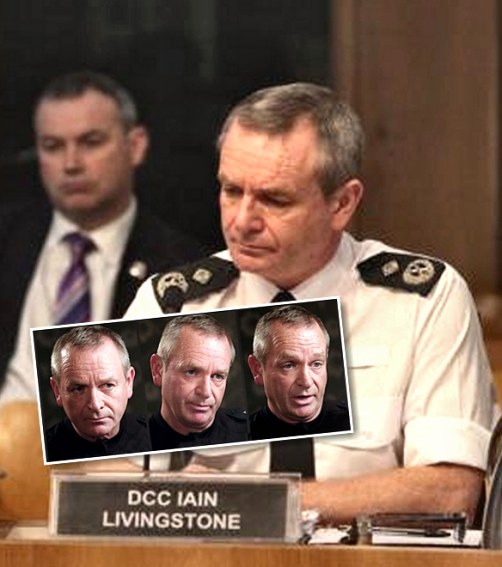
Scotland’s new Top Cop once faced serious sexual assault probe.THE “WRONG” word in a transcribed version of an interview with the officer who is now Scotland’s new Chief Constable – Iain Livingstone – became the subject of bitter exchanges between media officers of Police Scotland and a national newspaper.
Reports from inside the media have revealed the matter became the subject of protracted requests to the Daily Mail newspaper from Police Scotland’s media unit – which includes a Communications officer identified as Chris Starr.
The dispute arose after a mistake was identified in the paper’s published transcript of a television interview asking Iain Livingstone about how he dealt with five allegations of serious sexual assault from a female colleague.
The mistake amounted to one word – “all” .. which should have read from interview as “wrong”.
However, questions have arisen as to why Police Scotland’s media unit hare being used to target the media over the wording of a transcript – a task which should have been allocated to a law firm.
And, while cops have taken issue with reporting of the sexual assault allegations against Scotland’s new Chief Constable, Police Scotland and the Scottish Police Authority continue to resist full disclosure and publication of the full details of the FIVE allegations of sexual assault made against Iain Livingstone by a female officer who has since left the force.
Livingstone was recently confirmed as Scotland’s new Chief Constable after a gruesome sequence of suspensions of colleagues, a damning report on how Scots Police spied on journalists and whistle-blowers, and the Ministerial backed ousting of former Chief Constable Phil Gormley.
During the BBC Scotland Investigates documentary “A Force In Crisis” - investigative journalist Sam Poling asked Mr Livingstone about the 'allegations of sexual assault' and about him being 'bumped down from superintendent to constable and suspended'.
Mr Livingstone said: “There was a set of circumstances in 2000 whereby at a social event at Tulliallan, at a training event I had too much to drink.
I fell asleep in the wrong place and that was “wrong” and I shouldn't have done that, and clearly I accept that.
I was suspended, I spent time off work. There was a hearing convened where I did accept I fell asleep.
I was cleared of any sexual impropriety.
I was cleared of any level of sexual intent and at that hearing, initially, I was then demoted from superintendent to constable.
I immediately appealed against that and I was reinstated.
I came back to work, I accepted that I made a mistake, I accepted I had learned from it and since that time I have continued to conduct my duties with absolute rigour and professionalism.”
Asked whether he could be the 'strong professional leader with integrity' that the public want as chief constable, Iain Livingstone said: “I think I could discharge the responsibilities of the job. 'One of my main strengths, I think, is the ability to work collectively and to work in a collegiate manner.”
“I do think I could do the job, I just need to be quite clear in my own mind that that's what I want to do for the next three to five years.”
Mr Livingstone was suspended in 2003 after a female officer said she was sexually assaulted at Tulliallan, Scotland's police training college.
At the time he was 36, a father of three, and held a post in Her Majesty's Inspectorate of Constabulary, which used to oversee regional police forces.
There were no legal proceedings - although Mr Livingstone was demoted from superintendent to constable in 2004 following a disciplinary hearing.
Five allegations of serious sexual assault were dismissed but, at an internal misconduct hearing, he admitted being in the woman's room overnight after falling asleep.
The hearing, chaired by the then assistant chief constable of Strathclyde Police, found there had been no sexual impropriety or intent.
The woman, who had been on the accelerated promotion scheme for graduates, was reported to have left the scheme, which guarantees fast-track promotion.
A statement to the Press issued by a Police Scotland media representative in May on the subject of the BBC Scotland interview stated: “This matter was subject to due process by Lothian and Borders Police and was formally concluded under police regulations 14 years ago.”
“A hearing concluded that there was no sexual impropriety or intent on Mr Livingstone's part and he has nothing further to add.”
TIMELINE OF SEXUAL ASSAULT ALLEGATIONS AGAINST TOP COP:
FEBRUARY 2003: Iain Livingstone, then 36, is suspended amid sexual assault claims and admits he is 'shattered'.
AUGUST 2003: Prosecutors drop proceedings against Mr Livingstone - but he faces internal disciplinary proceedings.
JUNE 2004: Mr Livingstone is demoted from the rank of superintendent to constable, which means a loss of more than £1million in salary and pension payments.
AUGUST 2004: Tayside's Chief Constable John Vine upholds Mr Livingstone's appeal and reinstates him, agreeing that the original decision was 'harsh'.
OCTOBER 2015: Now Deputy Chief Constable of Police Scotland, Mr Livingstone emerges as a candidate for the top job after Sir Stephen House quits.
DECEMBER 2015: Former Norfolk Constabulary Chief Constable Phil Gormley is named as the new boss of Police Scotland.
JULY 2017: Mr Livingstone announces his retirement, saying it was a 'privilege to serve the people of Scotland'.
SEPTEMBER 2017: Amid the bullying row engulfing Mr Gormley, Mr Livingstone cancels his retirement plan and takes charge of the single force.
APRIL 2018: Front runner to become the new full time chief, Mr Livingstone is confronted about his conduct in a BBC Scotland TV documentary.
Journalist Sam Poling questioned Iain Livingstone during the BBC Scotland documentary, A Force in Crisis, which aired on Monday 30 April 2018.
The transcript of the interview between Sam Poling & then Deputy Chief Constable Iain Livingstone (now promoted to Chief Constable) reads as follows:
SAM POLING: What about your background?
DCC IAIN LIVINGSTONE: My background as a police officer?
SAM POLING: The allegations of sexual assault. You ended up admitting misconduct, staying in the room of a junior officer.
You were bumped down from superintendent to constable and suspended. Am I right?
DCC IAIN LIVINGSTONE: No, not on that, no you're not right.
SAM POLING: You weren't taken down from superintendent to constable?
DCC IAIN LIVINGSTONE: No, I wasn't taken down from superintendent to constable and then suspended.
There was a set of circumstances in 2000 whereby at a social event at Tulliallan, at a training event, I had too much to drink.
I fell asleep in the wrong place and that was wrong and I shouldn't have done that, and clearly I accept that.
I was suspended, I spent time off work. There was a hearing convened, where I did accept I fell asleep.
I was cleared of any sexual impropriety. I was cleared of any level of sexual intent and at that hearing, initially, I was then demoted from superintendent to constable.
I immediately appealed against that and I was reinstated.
I came back to work, I accepted that I made a mistake, I accepted I had learned from it and since that time I have continued to conduct my duties with absolute rigour and professionalism.
SAM POLING: The public want a strong professional leader with integrity in their chief constable. Is that you?
DCC IAIN LIVINGSTONE: I think I could discharge the responsibilities of the job. One of my main strengths, I think, is the ability to work collectively and to work in a collegiate manner.
I do think I could do the job, I just need to be quite clear in my own mind that that's what I want to do for the next three to five years.
SEXUAL ASSAULT ALLEGATIONS AGAINST TOP COP TO REMAIN SECRET:
A statement from Police Scotland in response to the Freedom of Information request refused any form of disclosure or acknowledgement of the status of any files held by Scotland’s single national Police service read as follows:
“Police Scotland endeavors to provide information whenever possible. However, under section 18(1) of the Act, a public authority may refuse a request where:
• if the information existed and was held by the authority, it would be exempt from release under any of Sections 28 to 35, 38, 39(1) or 41 of the Act; and
• the authority considers that to reveal whether the information exists, or is held by it, would be contrary to the public interest.
In this instance, it is considered that to reveal whether the information you have requested exists, or is held by Police Scotland, would be both exempt from release under the Act and contrary to the public interest. There is a strong public interest in protecting individuals' privacy, and personal information is exempt from release into the public domain under section 38 of the Act if it would be unfair, unlawful or otherwise breach the Data Protection Act.
For these reasons, Police Scotland must refuse your request under section 18(1) of the Act.
This notice should not be taken as conclusive evidence that the information you have requested exists or is held.”
Material in relation to new complaints made against DCC Iain Livingstone was sought from the Scottish Police Authority in February of this year, after information was received with regards to further serious complaints made against Police Scotland’s current ‘interim’ Chief Constable.
However, the Scottish Police Authority under Susan Deacon deliberately delayed releasing their response to the Freedom of Information request – by a number of months, as members of the Scottish Police Federation and Scottish Government ministers bolstered DCC Livingstone’s position as front runner for the top job – despite the grim details of a case involving 5 allegations of serious sexual assault which were dismissed by a tribunal composed of Livingstone’s male cop colleagues.
The Scottish Police Authority were asked to provide details of :
The numbers of complaints, subject of complaints, and identities (not name, but by rank, status as Police Officer, civilian employee, member of the public or other)
Who have made complaints (and the numbers of complaints) against current DCC Iain Livingstone from 1 April 2013 to the date of this FOI request
The status, and outcomes of these complaints.
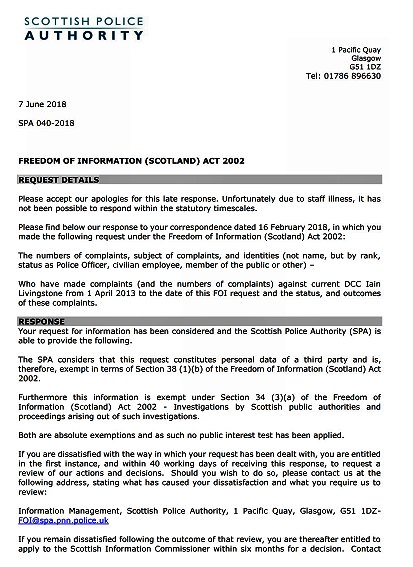
However, and some time after discussions over the Freedom of Information request had taken place, inside & outside the SPA - the Scottish Police Authority responded to the FOI request four months late, in early June - denying access to all of the information sought in relation to DCC Livingstone.
In their response, issued months late and outwith Freedom of Information timescales, the Scottish Police Authority wrongly claimed the material sought was “personal data of a third party” in a concerted attempt to conceal further details of complaints against DCC Livingstone from the public.
The Scottish Police Authority stated in it’s letter of response, dated 8 June 201:
The SPA considers that this request constitutes personal data of a third party and is, therefore, exempt in terms of Section 38 (1)(b) of the Freedom of Information (Scotland) Act 2002.
Furthermore this information is exempt under Section 34 (3)(a) of the Freedom of Information (Scotland) Act 2002 - Investigations by Scottish public authorities and proceedings arising out of such investigations.
Both are absolute exemptions and as such no public interest test has been applied.
A request for review has been lodged, and material also sent to the Scottish Information Commissioner with regards to the SPA’s refusal to disclose the information.
The Scottish Police Authority’s eagerness to conceal information in relation to a senior Police Officer - who has been previously accused of 5 allegations of serious sexual assault, and has faced further complaints including an ‘interaction’ with another officer - raises questions about the impartiality of the recruitment round to appoint a new Chief Constable to Scotland’s crisis hit single Police service.
With reference to the five allegations of serious sexual assault, Iain Livingstone was cleared of sexual impropriety or intent – by a tribunal headed by a male top cop colleague – Assistant Chief Constable John McLean of Strathclyde Police.
The former lawyer and Raith Rovers footballer had been suspended for 17 months after the WPC claimed she had been sexually assaulted during the party.
A qualified lawyer and member of the Law society of Scotland, Mr Livingstone switched careers in 1992, joining Lothian and Borders Police.
In just 10 years, Livingstone – who had also once played for Raith Rovers - had clearly been fast tracked, reaching the rank of superintendent.
At the time of the allegations and ‘internal’ investigation by his Police colleagues, Livingstone was not prosecuted by the Crown Office over the claims.
Instead, Livingstone admitted a less serious allegation about being in the woman's room overnight and falling asleep.
SPA block files release on sex case cop who wants top job.DOCUMENTS detailing new, and serious complaints against a senior cop previously linked to a case involving five allegations of sexual assault, and now, fresh details of an additional ‘interaction with another officer’, are being kept secret by the Scottish Police Authority (SPA).
The secrecy move by the Scottish Police Authority, under their new chair of ex MSP & former Health Minister Susan Deacon – comes as three senior Police officers - including current Deputy Chief Constable Iain Livingstone – submitted their applications to be considered for the £216,549 a year role as Chief Constable of Police Scotland.
Material in relation to new complaints made against DCC Iain Livingstone was sought from the Scottish Police Authority in February of this year, after information was received with regards to further serious complaints made against Police Scotland’s current ‘interim’ Chief Constable.
However, the SPA under Susan Deacon deliberately delayed releasing their response to the Freedom of Information request – by a number of months, as members of the Scottish Police Federation and Scottish Government ministers bolstered DCC Livingstone’s position as front runner for the top job – despite the grim details of a case involving 5 allegations of serious sexual assault which were dismissed by a tribunal composed of Livingstone’s male cop colleagues.
The Scottish Police Authority were asked to provide details of :
The numbers of complaints, subject of complaints, and identities (not name, but by rank, status as Police Officer, civilian employee, member of the public or other)
Who have made complaints (and the numbers of complaints) against current DCC Iain Livingstone from 1 April 2013 to the date of this FOI request
The status, and outcomes of these complaints.
It should be noted Information in relation to a number of these complaints, has recently been shared with MSPs, and the media.
However, and some time after discussions over the Freedom of Information request had taken place, inside & outside the SPA - the Scottish Police Authority responded to the FOI request four months late, in early June - denying access to all of the information sought in relation to DCC Livingstone.
In their response, issued months late and outwith Freedom of Information timescales, the Scottish Police Authority wrongly claimed the material sought was “personal data of a third party” in a concerted attempt to conceal further details of complaints against DCC Livingstone from the public.
The Scottish Police Authority stated in it’s letter of response, dated 8 June 201:
The SPA considers that this request constitutes personal data of a third party and is, therefore, exempt in terms of Section 38 (1)(b) of the Freedom of Information (Scotland) Act 2002.
Furthermore this information is exempt under Section 34 (3)(a) of the Freedom of Information (Scotland) Act 2002 - Investigations by Scottish public authorities and proceedings arising out of such investigations.
Both are absolute exemptions and as such no public interest test has been applied.
A request for review has been lodged, and material also sent to the Scottish Information Commissioner with regards to the SPA’s refusal to disclose the information.
The Scottish Police Authority’s eagerness to conceal information in relation to a senior Police Officer - who has been previously accused of 5 allegations of serious sexual assault, and has faced further complaints including an ‘interaction’ with another officer - raises questions about the impartiality of the recruitment round to appoint a new Chief Constable to Scotland’s crisis hit single Police service.
With reference to the five allegations of serious sexual assault, Iain Livingstone was cleared of sexual impropriety or intent – by a tribunal headed by a male top cop colleague – Assistant Chief Constable John McLean.
The former lawyer and Raith Rovers footballer had been suspended for 17 months after the WPC claimed she had been sexually assaulted during the party.
A qualified lawyer and member of the Law society of Scotland, Mr Livingstone switched careers in 1992, joining Lothian and Borders Police.
In just 10 years, Livingstone – who had also once played for Raith Rovers - had clearly been fast tracked, reaching the rank of superintendent.
At the time of the allegations and ‘internal’ investigation by his Police colleagues, Livingstone was not prosecuted by the Crown Office over the claims.
Instead, Livingstone admitted a less serious allegation about being in the woman's room overnight and falling asleep.
It should be noted that during the time of the investigation & tribunal, handled by Police, the Lord Advocate was Colin Boyd, Baron Boyd of Duncansby – now a judge in the Court of Session, and the Solicitor General was Elish Angiolini – recently appointed by Nicola Sturgeon a Scottish Minister to investigate how complaints are handled against Police in Scotland.
Asked about the sexual assault allegations during a recent BBC Scotland documentary, DCC Iain Livingstone said he “fell asleep in the wrong place and that was wrong”.
Although he admitted that he 'shouldn't have done that', he insisted that he still has the right attributes for the job.
During the BBC Scotland documentary - PoliceScotland A Force In Crisis, investigative journalist Sam Poling asked Mr Livingstone about the 'allegations of sexual assault' and about him being 'bumped down from superintendent to constable and suspended'.
Quotes from DCC Livingstone’s responses when questioned about the allegations of sexual assault reveal the following remarks by the Police Officer:
Mr Livingstone said: “There was a set of circumstances in 2000 whereby at a social event at Tulliallan, at a training event I had too much to drink.”
“I fell asleep in the wrong place and that was wrong and I shouldn't have done that, and clearly I accept that.”
'I was suspended, I spent time off work. There was a hearing convened where I did accept I fell asleep.I was cleared of any sexual impropriety.”
'I was cleared of any level of sexual intent and at that hearing, initially, I was then demoted from superintendent to constable. I immediately appealed against that and I was reinstated.”
MSPs at the Scottish Parliament also questioned his suitability for the job after his response to the claims in a BBC documentary this week - saying only that he 'fell asleep in the wrong place and that was all'.
However, Livingstone’s application for the top job – which appears to be backed by Scottish Ministers, and the Scottish Police Federation has been called into question after a former Assistant Chief Constable said Livingstone should not get the top job.
COPS TURN ON THEIR OWN: Scottish Police Federation boss launches twitter attack on ex colleague:
Following criticisms by former Assistant Chief Constable Angela Wilson - of Iain Livingstone’s bid to become Chief Constable, Calum Steele – General Secretary of the Scottish Police Federation (SPF) launched a highly personalised attack on his female former colleague - on the twitter social media platform.
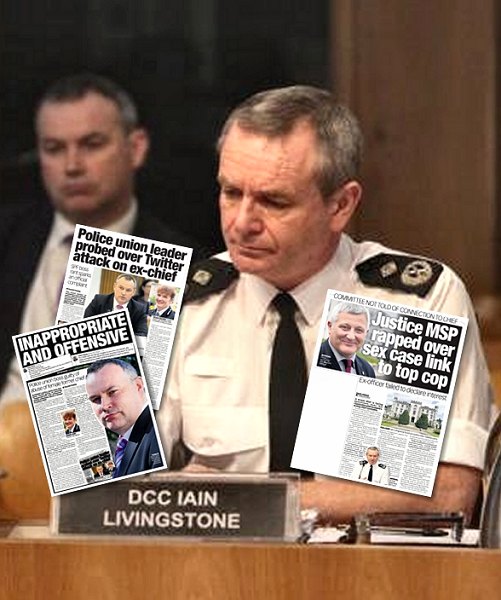
TheSunday Mail reported that Calum Steele – a Police Constable with an honorary rank as Chief Inspector due to his Police Federation duties - also branded ex ACC Wilson “useless” and a “buffoon” and wrongly claimed in tweets that a corruption inquiry in her former force Tayside “extended” to her.
Steele is general secretary of the Scottish Police Federation (SPF) who have 18,500 members and represent 98 per cent of police officers.
Steele posted a string of six tweets last week after Wilson spoke out on the prospect of DCC Iain Livingstone gaining the top job as Chief Constable of Police Scotland.
The first of Calum Steele’s tweets said she was “one of the most incompetent imbeciles ever to have held rank in the police service”.
It claimed she was continuing “a smear on one of the very best”, adding: “You really need to ask – who is driving this?”
He went on to say that Wilson had served in Thames Valley Police as did Claire Gormley, the wife of Phil Gormley who quit as head of Police Scotland in February following bullying allegations against him.
Steele added: “AW [Angela Wilson] and the Gormleys have an axe to grind. It’s frankly pathetic.”
He also described Livingstone as “one of the most talented, able, skilled and resilient police officers”.
Scottish Tories justice spokesman Liam Kerr said: “Mr Steele has a position of responsibility and should probably have thought more carefully before embarking on this chain of tweets.
“The result of this is now a potential legal case which will drag the force and its associated bodies through the mud at a time it never needed it less.”
Angela Wilson subsequently lodged a formal complaint with Police Scotland and the SPF.
It was then reported in the Sunday Mail newspaper that - as a result of the complaint raised by ex ACC Wilson, Constable Calum Steele was found guilty of posting “inappropriate and offensive” online comments about a female ex-police chief.
Upholding the complaint, Chief Inspector Jacqui Campbell, of the Professional Standards Department (PSD), ruled the comments were “inappropriate and offensive” and that Wilson was “never investigated for corruption”.
Steele claimed to be off duty when he launched the Twitter tirade on May 3 but the Professional Standards Department probe discovered that he was working.
Campbell said: “The record revealed Constable Steele’s duty for that date was 0900 to 1700 hours, therefore, at the time the tweets were posted he was on duty.”
Campbell has issued Wilson a “sincere apology for the undoubted upset Constable Steele’s actions have caused”.
But Steele – who heads the federation representing 98 per cent of Police Scotland officers – “makes no apology” and refuses to delete the messages.
Campbell said: “We have asked Constable Steele to remove the relevant tweets from his Twitter account. Unfortunately, it is his own personal Twitter account and, as such, we are unable to order him to remove or delete them.”
Despite Steele’s messages being from a personal account, Campbell found “they are directly related to his role as a police officer and particularly his role as general secretary” of the SPF.
Mr Livingstone has been regarded as the favourite to replace Phil Gormley, who quit in February after being accused of bullying by colleagues.
Following Gormley’s leave of absence last year, a campaign of suspensions, bitter infighting dubbed ‘backstabbing cops’ in the media, and now scrapped criminal investigations into colleagues of the ousted Chief Constable then took place over a number of months – setting the stage for DCC Livingstone to conveniently scrap his retirement plans, and campaign, along with vested interests in the Scottish Police Federation to replace the ousted Chief Constable.
Steele, who spoke to PSD officers through a lawyer, now faces a further hearing which may result in disciplinary action. His lawyer quoted a dictionary definition of “imbeciles” as meaning “a fool” and that it was “a fair and honest comment that represents Constable Steele’s honestly-held belief”.
Scottish Conservative justice spokesman Liam Kerr said: “Calum Steele should really back down, apologise and delete the offending tweets. Otherwise this row will rumble on.”
Chief Superintendent Mark Hargreaves, head of the Professional Standards Department, said: “The investigation into this complaint has concluded and as this is an internal matter it would be inappropriate to comment further.”
THE MSP & SEX CASE TOP COP: Ex cop MSP failed to declare link to sex case cop Livingstone:
In anearlier report in the Sunday Mail newspaper, it was also revealed that while DCC Iain Livingstone was giving evidence to the Scottish Parliament's Justice Committee in January, Justice Committee member & former police officer John Finnie had failed to tell fellow MSPs he had represented Iain Livingstone when he was cleared of sexual misconduct.
At Holyrood’s justice committee in January, John Finnie quizzed Livingstone about staffing levels and said losing chief officers was one of the benefits of creating a single police force.
Scottish Labour justice spokesman Daniel Johnson said: “John is a valued colleague on the justice committee but I am alarmed that he did not see fit to declare this link with the acting chief constable.
“Police Scotland are in desperate need of scrutiny – and the public will expect such scrutiny to be conducted professionally.
“I would urge him to correct the record and to ensure he declares interests fully and promptly in future.”
A spokesman for the Scottish Conservatives added: “He also owes parliament an explanation as to why he neglected to mention this very important link.”
Finnie spent 14 years as an official for the Scottish Police Federation (SPF) – the organisation who represent police officers up to the rank of chief inspector.
And, it emerged in February of this year that during evidence given by Deputy Chief Constable Iain Livingstone to the Scottish Parliament’s Justice Committee, neither Livingstone or the Justice Sub Committee Convener John Finnie declared any previous links to each other while Livingstone testified before MSPs.
A report in the Sunday Mail newspaper in February revealed Mr Finnie – previously a serving Police Officer and representative for the Scottish Police Federation (SPF) - had represented Mr Livingstone when he was cleared of the sexual misconduct claims in 2003.
The issue was reported by the Sunday Mail newspaper here:
John Finnie failed to tell MSPs he represented the acting chief constable when he was cleared of sexual misconduct.
By Mark Aitken 18 FEB 2018
John Finnie failed to tell MSPs he represented Iain Livingstone
A Green MSP is facing questions over his connection with Scotland’s acting chief constable.
Former police officer John Finnie failed to tell fellow MSPs he had represented Iain Livingstone when he was cleared of sexual misconduct.
He failed to declare the link at a meeting of Holyrood’s justice committee when Livingstone was being questioned.
Finnie spent 14 years as an official for the Scottish Police Federation (SPF) – the organisation who represent police officers up to the rank of chief inspector.
Livingstone, the frontrunner to replace Phil Gormley as Scotland’s chief constable, was acccused in 2004 of sexually assaulting a female police officer.
Livingstone admitted falling asleep in the woman’s room at the Scottish Police College in Tulliallan, Fife, after a drunken party in 2000.
Iain Livingstone was accused of sexually assaulting a female police officer in 2004
At an internal hearing, more serious allegations were dropped.
Livingstone, who was then a superintendent, was demoted to constable but won his job back on appeal. Livingstone’s appeal was backed by the SPF.
Finnie said at the time that the case had highlighted “the ease with which the system can be abused and the punitive consequences which affect not only the officer but their family”.
At Holyrood’s justice committee in January, Finnie quizzed Livingstone about staffing levels and said losing chief officers was one of the benefits of creating a single police force.
Scottish Labour justice spokesman Daniel Johnson said: “John is a valued colleague on the justice committee but I am alarmed that he did not see fit to declare this link with the acting chief constable.
“Police Scotland are in desperate need of scrutiny – and the public will expect such scrutiny to be conducted professionally.
“I would urge him to correct the record and to ensure he declares interests fully and promptly in future.”
A spokesman for the Scottish Conservatives added: “He also owes parliament an explanation as to why he neglected to mention this very important link.”
Finnie began his career with Lothian and Borders Police in 1976 and moved to Northern Constabulary three years later.
He served as a full-time officer with the SPF from 1992 to 2006.
Finnie was elected as an SNP MSP in 2011 but quit the party the following year in protest at the decision to end their long-standing opposition to Nato membership.
Finnie and the Greens failed to respond to the Sunday Mail’s calls.
SCOTLAND’S NEXT TOP COP:
There are three shortlisted candidates for the Chief Constable role at Police Scotland.
Deputy Chief Constable Iain Livingstone, whose past & current complaints records are being kept secret by the Scottish Police Authority, and Police Scotland.
A second candidate - Police Scotland Deputy Chief Constable Johnny Gwynne - a former head of the National Crime Agency's (NCA) Child Exploitation and Online Protection command - has also applied for the job.
Gwynne, a former Royal Ulster Constabulary (RUC) officer also previously held the post of former deputy director-general of the Scottish Crime and Drug Enforcement Agency – which was absorbed into Police Scotland in 2014.
The third candidate is Lincolnshire Police Chief Constable Bill Skelly, who joined Devon and Cornwall Police from Police Scotland as Deputy Chief Constable in 2013 and was appointed as chief Constable of the force last year.
The shortlisted candidates will undergo a selection process including two panel interviews, chaired by the Scottish Police Authority’s own boss Susan Deacon.
And the selection panel will also include SPA board member Mary Pitcaithly, NHS Scotland chief executive Paul Gray, Professor Lorne Crerar, - chairman of legal firm Harper MacLeod; and National Crime Agency Director General Lynne Owens.
Gill Imery – the current Her Majesty's Chief Inspector of Constabulary in Scotland will also act as an ‘advisor’ to the team.
According to the job information pack: "Shortlisted candidates will be invited to participate in a psychometric and personality profile exercise, an Assessment Centre, and an interview with the Selection Panel."The assessment centre will include a scenario exercise and a mock media interview.
Final interviews of the three candidates are expected to take place on 13 and 14 August.
Chief Constable says Police Scotland hindered probe.SCOTLAND’S single national Police service – Police Scotland has been accused of fabricating intelligence to justify spying on journalists and sources - in connection with the unsolved murder of Emma Caldwell – who was murdered in South Lanarkshire, in May 2005.
Last Thursday, the Scottish Parliament’s Justice Committee heard from Michael Barton - the Chief Constable of Durham Constabulary – who candidly told MSPs that ‘evidence’ in the form of intelligence used by Scottish Police Officers to spy on their colleagues, and journalists – “was a lie”.
Chief Constable Barton was attending the Scottish Parliament to give evidence in connection with the Durham Constabulary investigation into events at Police Scotland where officers were found to have deliberately and illegally obtained communications data on journalists, while circumventing the judicial process around obtaining interception warrants.
The damning statement from the Durham Constabulary Chief in relation to Scottish Police officers fabricating intelligence - came in an exchange with Justice Committee member Stewart Stevenson MSP (SNP).
During questions, Mr Stevenson attempted to make a legal point to Mr Barton, stating: “… It would be perfectly legal for Police Scotland to have the intelligence that led to the action.”
However, Chief Constable Barton responded to the MSP, stating : “Not if it is wrong.”
Stewart Stevenson continued: ” No. I was going to make the point that having it does not make it correct.”
However, Chief Constable Barton did not back down, and said: “Police Scotland cannot keep something about somebody when it is a lie.”
Stewart Stevenson again raised the issue of the validity & existence of the intelligence at Police Scotland, stating: “I understand that, but it was perfectly proper for Police Scotland to have it in the first place before it concluded, as you say, that it was a lie.”
However, Chief Constable Barton was candid in his response, stating: “No. It was never legitimate for Police Scotland to have it, because it had made it up.”
The exchange between the two then ended with Stewart Stevenson saying: “Okay. That is clear.”
After that short, yet critical exchange, the meeting was brought to a halt, due to an ‘overrun of time’.
However, during earlier questions & answers, Chief Constable Michael Barton also accused the single Scottish Police force of preventing him from carrying out a full-scale misconduct probe.
Michael Barton said came up against a "culture of secrecy" at Police Scotland.
He also said Police Scotland's complaints staff should be "put into a sack and shaken up"
The Counter Corruption Unit (CCU) was used by Police Scotland to secretly spy on journalists & sources while circumventing judicial procures to obtain communications interception warrants.
Police Scotland has earlier claimed that a full investigation had eventually been carried out into events at the Counter Corruption Unit (CCU), adding that there had been "significant organisational learning" from the case.
Police Scotland had asked their counterpart in Northern Ireland – the Police Service of Northern Ireland (PSNI) to ‘examine’ the allegations of misconduct.
The investigation, by Assistant Chief Constable Mark Hamilton, concluded that there was no misconduct on the part of any officer.
An investigation by the Interception of Communications Commissioner's Office (IOCCO) into the actions of Police Scotland officers said the failures "could properly be viewed as reckless", however, Police Scotland’s senior officers maintained throughout that it had been an issue of "misjudgement" by an officer "misinterpreting" a newly-introduced code.
After the Interception of Communications Commissioner's Office (IOCCO) identified that there had been a breach of protocols in June 2015, Durham Constabulary was asked to look into the breach.
The English force recommended a full misconduct probe, which was carried out by the Police Service of Northern Ireland - which resulted in all seven officers being cleared by their Northern Ireland Police colleagues.
Mr Barton told MSPs that he had initially been asked to conduct a full investigation, but later found this was downgraded to an inquiry - a lesser form of probe which would mean he would not have access to all documents or be able to interview people under caution.
He said: "As far as I was concerned, I was asked to investigate. That's what I wanted to do. And I was prevented from doing so."
Mr Barton said he was frustrated by the decision, and said there was "a lack of openness in certain parts of the organisation - and that remains so".
He added: "I think currently, the lawyers in Police Scotland are not transparent, and they're overly defensive, and they're risk-averse, and that got in my way."
In responses to questions Michael Barton added: "I got dreadfully cross with the legal people and the professional standards department people because I think they misinterpreted the rules, frankly, and I think they're too risk averse, but they're still smashing people. But it's the culture.
"It's that secrecy, that lack of transparency, that's incredibly unfair to everybody, because there isn't speedy justice."
Mr Barton told Holyrood's justice sub-committee on policing that the complaints processes at the Scottish single force needed to be "shaken up".
He said: "What's happened here, over time, is people have dug them into the trenches. So you can't seem to get out of it. I think it's preposterous that in an inquiry I was asked to go and speak to officers, and they couldn't be held to account for what they told me.
"They could have just told me a load of old bunkum and I'd have had to write it down and hand it on to somebody who's investigating, and then they'd look at me and say, 'you're not so good Mick, you've just put a load of bunkum in front of me' because it couldn't be a probing interview under caution.
"I think it's grown over time. But I do think it needs everybody put into a sack and shaken up and told, 'for heaven's sake fix it, and stop it'. Because the only people who are suffering as a result of this are the complainants who are making complaints, and they have a less than optimal service, and the officers themselves, because it's dreadful that they're held under suspicion for quite so long."
Following the conclusion of the misconduct probe, Police Scotland acknowledged that guidelines had been breached and said there had been "significant organisational learning" as a result of the case.
"The PSNI investigation found that there was no misconduct on the part of any of the seven officers who were investigated. It is our position, supported by external and independent legal opinion from a QC, that our regulations would not have permitted Chief Constable Barton from carrying out both the complaint enquiry and the misconduct investigation.
"We have previously said that there has been significant organisational learning from these enquiries and a report on this has been provided to the Scottish Parliament's justice sub-committee."
In the wake of additional revelations during the testimony of Chief Constable Michael Barton – who told MSPs that Police Scotland officers wanted to destroy evidence of illegally obtained surveillance data, the Justice Committee has since written to Police Scotland asking for assurances the data will not be destroyed.
A letter to Police Scotland, from the Justice sub-Committee on Policing states the following:
The Justice Sub-Committee on Policing is aware that Police Scotland has written to at least one of the complainants involved in the Counter Corruption Unit (CCU) investigation to inform them of the process going forward now that the conduct investigation has concluded.
The correspondence indicates that it is Police Scotland’s intention in the coming weeks to cleanse the contents of the relevant Force databases and to remove all material not considered to reflect the truth of those matters. Police Scotland is taking this action to reflect the Investigatory Powers Tribunal (IPT) judgement of 8 August 2016.
The Sub-Committee understands that the IPT’s view is that the destruction of this data without the consent of the applicants would appear to be in breach of the agreement contained within the order. The IPT has instructed that Police Scotland should desist from this action, unless it makes a further application to the Tribunal.
The conduct investigation has been completed, but there may be continuing related proceedings, for example in the High Court. The Sub-Committee is therefore seeking an urgent assurance from Police Scotland that it will not destroy any evidence or data until the applicants have consented.
The Justice sub-committee on Policing also wrote to the Scottish Police Authority, asking for information on the SPA’s oversight responsibilities for the process and the CCU investigation and the SPA’s view on Police Scotland’s proposed action to destroy evidence of illegality, and timeframe.
The full evidence session with Durham Chief Constable Michael Barton, Investigator Darren Ellis of Durham Constabulary and the Justice sub-Committee on Policing can be viewed here:
Full report of Justice sub-Committee on Policing, Counter-corruption Unit (Durham Constabulary Reports):
The Convener: Item 2 is an evidence session on Durham Constabulary’s reports on Police Scotland’s counter-corruption unit. I refer members to paper 1, which is a note by the clerk, and paper 2, which is a private paper. I welcome Michael Barton, chief constable, and Darren Ellis, senior investigator, from Durham Constabulary. Thank you for travelling to see us. Chief constable, I invite you to make some opening remarks, if you wish to.
Chief Constable Michael Barton (Durham Constabulary): Thank you for your invitation to us both. This is not the first time that we have been in Scotland, because we were up for seven months on our investigation. The reason why I wrote to the committee was that I read the Official Report of a previous meeting that you had in relation to the matter, and I felt that some of the evidence that was given to you needed to be corrected.
The Convener: Your report and others have generated a considerable amount of paper and contain a lot of detailed information. Can I ask first about your terms of reference? Do you believe that there was clarity about that?
Chief Constable Barton: I will ask Darren Ellis to follow up on what I say. I was called by Chief Constable Gormley and asked to do an inquiry. It was going to be in two parts. First of all, there was to be an independent investigation, as described by the Investigatory Powers Tribunal. The law department in Police Scotland had given the IPT in London an undertaking that it would conduct an independent investigation, because the authorisations that had been gained within the counter-corruption unit were deemed to be unlawful by the IPT. I agreed to do that. The other part of the investigation involved reviewing a number of cases that the counter-corruption unit had been part of. When I scoped that part of the inquiry, I realised that it would be too much for us. It would have been an inordinate amount of work for Durham to do all its own business as well as both sides of the inquiry, so I asked the chief constable of Northumbria Police, with Chief Constable Gormley’s agreement, whether they would do that part of the inquiry.
When I was given the inquiry, it was made clear to me by the chief constable that we were being asked to do an investigation. That means that we can investigate, access all the documents and interview people, so that we can make a recommendation on whether or not there may be misconduct. Of course, all the way through any such inquiry, we must be cognisant that criminal matters may be revealed. By the way, we were satisfied all the way through the inquiry that there were no criminal matters that needed to be referred, but it is always something that we have at the back of our mind.
However, as we were doing our inquiry we were told, “This isn’t an investigation. This is an inquiry.” That is where I became a little bit confused and concerned. Have I got that right, Darren?
Darren Ellis (Durham Constabulary): Yes. What struck me was that, although the terms of reference for the piece of work were eminently clear, the chronology—without getting too detailed—was such that an inspection by the Interception of Communications Commissioner’s Office in June 2015 identified something that was later deemed to be unlawful. That was reported a month later, and then in more detail in November 2015.
The four adversely affected people, as they were termed by the Investigatory Powers Tribunal process, were in themselves complainants. Let us not lose sight of the fact that, at that time, two of the four were serving members of Police Scotland. Those people did not provide a complaint statement until February 2016. They were clear that the Investigatory Powers Tribunal process was to ensue, but they did not know what they did not know—one could argue, that those individuals were perhaps not engaged with, and nor were matters explained in any great detail or with any great haste, so they really did not know the position until the IPT position, in the August, was clear. That led to my staff having to re-engage with the complainants at that juncture, to find out what they were concerned about, and to determine the length and breadth of the work that needed to be done. That was done subsequent to any terms of reference.
In short, I think that the terms of reference were set far too early. The work that we were required to do was based on an undertaking on Police Scotland’s behalf to the IPT to fulfil an independent investigation. There were also four complainants who needed to be engaged with, reassured and satisfied, and answers given. The terms of reference, I would argue, were set far too early.
The Convener: That seems to be a pivotal part of the issue. The relationship between any misconduct or discipline issues—call them what you will; I am not sure what they would be called south of the border—and criminal matters would also be pivotal. It would be important for the individuals to understand their status and to know whether they were a witness, a suspect or an accused. Was no clarity given on those aspects in the initial brief? How were you initially advised?
Chief Constable Barton: I was initially asked to conduct an investigation, and that is what I agreed with Phil Gormley. Subsequently, the professional standards department in Police Scotland decided that we should conduct only an inquiry. I argued with the department all the way through that I should be allowed to do an investigation, because that was the commitment that Police Scotland had given the IPT, but I was never allowed to do an investigation. We were not allowed investigation status, which would have enabled us to speak to officers who may or may not have been guilty of misconduct and who it was certainly pivotal for us to speak to under caution.
The Convener: I do not wish to labour the point, but underpinning this are various pieces of legislation. Criminal matters are at the behest of the Crown Office and Procurator Fiscal Service and misconduct matters are at the behest of the deputy chief constable. Was there any discussion of the parameters?
Chief Constable Barton: It was unsaid. I cannot be clear about whether we had a specific agreement—it would have been an unspoken agreement. I do lots of inquiries in other forces, and there is an unspoken agreement that, when we are conducting misconduct inquiries, if we reveal criminality, there will be an immediate discussion with, in Scotland, the relevant law officer or, in England, the Crown Prosecution Service or relevant chief constable. The criminality side was not a problem. I was not concerned at all about that component of our terms of reference.
I do not know whether that is helpful.
The Convener: The issue seems to hinge on the initial contact, which is what I am trying to burrow down into.
Chief Constable Barton: Yes, it does.
The Convener: It is not unreasonable for a chief constable who is asked to investigate something to assume that it will be what the layperson assumes is an investigation. However, I am trying to link the issue into the investigatory powers system, what Police Scotland’s expectation was and whether Chief Constable Gormley asked you to deliver that expectation rather than an inquiry that might have encompassed misconduct and indeed criminality.
Chief Constable Barton: As far as I am concerned, I was asked to investigate and I agree that it was what the common man or woman would understand to be an investigation. That is what I wanted to do, but I was prevented from doing so.
The Convener: Members have a number of questions, but I will ask a final one. Were the terms of reference in writing?
Darren Ellis: Yes, but I refer to my earlier point that the terms of reference arrived in August or September 2016 and, at that point, we had not engaged with the complainants. I agree with Mr Barton that Mr Gormley’s request for an independent investigation came as a direct result of the wording that was provided by the IPT. However, with respect, sir, we should remember that, as part of that process, we also had four individuals who quite distinctly had made complaints to Police Scotland. Our investigation was to cover the requirements of the IPT process and the undertaking given by Police Scotland, but it was also to satisfy the four individuals who had made police complaints to Police Scotland, as they were entitled to do.
Stewart Stevenson (Banffshire and Buchan Coast) (SNP): I have a very simple quick question. Chief constable, you said that, when you initially looked at what you were being asked to do, it was beyond what you felt that Durham could undertake and hence Northumbria Police was brought to the table. Were there any downsides as a result of dividing the task in that way? I hope to hear that the answer is no.
Chief Constable Barton:#You will not be disappointed. There were no downsides whatsoever—that is why we divided it. In fact, if we had kept both tasks, there would have been confusion. What we gave Northumbria was a review of everything that was completely disconnected to the inquiry, and we kept everything that was connected to the inquiry. The two were completely separate tasks. When Phil Gormley first spoke to me, we discussed the fact that one was a really big task. The Northumbria force is more than twice the size of mine and, after a bit of cajoling, it agreed to take that. Seriously—it was not a small undertaking.
Stewart Stevenson: The two forces that were undertaking the work would have talked to each other if what they were doing revealed the need to do so.
Chief Constable Barton: Yes. We kept in touch, but I do not think that we found anything that strictly overlapped.
The Convener: I understand that Liam McArthur has a supplementary question on that.
Liam McArthur (Orkney Islands) (LD): Towards the end of the report to the SPA, you say:
“The findings have been reached on the basis that the alleged conduct occurred without any influence or participation from any officer of an Executive rank.”
You go on to say:
“However, in reaching this conclusion the SPA must also consider the restricted working environment Durham have operated within as articulated in the ‘Lessons Learned’ chapter. In particular the fact that Durham have not been able to fully investigate the conduct of the officers within the CCU by means of an unfettered misconduct investigation.”
That level of concern almost begs the question whether, in producing the report, you have legitimised a process in which you do not appear to have full confidence. Would that be a fair characterisation?
Chief Constable Barton: It was clear to me when we started on the process—when we first made contact with the four people who had been deeply wronged—that we had to try to bring fairness and justice to their position. My position at the start—it remains so, and I have articulated this to the deputy chief constable, as well as to the chief superintendent—was that if they had allowed me to do an independent investigation, I could have brought an end to the matter much sooner and much more effectively for the four complainants, because of course it is still not over.
I was frustrated, but it was clear that Police Scotland—erroneously, I believe—felt that I had to go through an inquiry for it subsequently to launch an independent investigation. In effect, it was putting me in as an interim investigator in order for there to be an independent investigation thereafter. I pointed out to Police Scotland more than once that I felt myself to be sufficiently independent.
To try to answer the question, Mr McArthur, it is instructive that, in the evidence that you were given at your previous meeting, a question was put to Chief Superintendent Speirs about the idea that people who deal with misconduct cannot deal with complaints. There is a real separation of those issues in the current interpretation within Police Scotland. I think that that is wrong.
Mr Speirs said that, to run an investigation, officers “cannot have any previous involvement in any complaint handling.”—[Official Report, Justice Sub-Committee on Policing, 23 November 2017; c 6.]
That is wrong. It is not what the regulations say. The regulations say three things about my status if I am to do any investigation. The first is that I must be a rank above the officers that are being investigated. I fulfil that criterion. Secondly, I must have the appropriate skills and experience. That is for others to judge. Thirdly, I must act impartially—and that is it. The false—in my view—separation between complaints and misconduct simply serves to lengthen the process, and Police Scotland does that all the time.
The way that I would have dealt with the matter if I had been in Police Scotland when it was first alerted to it is through IOCCO. IOCCO governs me, too—it governs the entire country. It is a really important day for me when, in effect, the High Court comes into my organisation and looks at the secret stuff that I do, so I have to be on my best behaviour, and I am prepared for that meeting. Generally, we get a clean bill of health, although sometimes minor recommendations are made.
However, the IOCCO report that Police Scotland got in June 2015 was excoriating. Police Scotland was told that people had acted illegally. Following the verbal report in June, Police Scotland got the report in July. At that time, two of the officers were still serving and two were retired. Even though they were in jeopardy and had been wronged, Police Scotland did not contact them.
The IOCCO report was published in November 2015. The four officers who were wronged were written to—in a regimented way—as a result of that report, but not by Police Scotland. They were told that they were in jeopardy. They were perplexed because, at that time, there had still been no contact from Police Scotland, even though it employed two of those people.
Then—I think that it was in February 2016—a complaint was made. As far as I can make out, that was Police Scotland’s first contact with the four people, bearing in mind that it had been told that it had acted unlawfully the previous June.
I need to put the matter into context and explain how I would have dealt with the situation. This committee meeting is necessary, but it is such a pity that we are here. If I had got a report from a High Court judge in June, I would have said. “We need to put this right—now.” I would have immediately made sure that the counter-corruption unit was fit for purpose. If I considered that some people needed training, that would have been done promptly; if I considered that people needed to be investigated, they would have been deployed elsewhere. I would have kept the High Court judge formally informed every month and informally informed every fortnight. Those four people would have been approached and we would have reassured them that everything that we had obtained illegally had been destroyed forthwith. That material has still has not been destroyed. Indeed, last week, I got a letter from Police Scotland asking me to oversee the destruction of the material that was obtained illegally in 2015.
If that had all been done, we would not be where we are. I have had four complainants, one of whom who is still a serving officer—Sergeant Steven Adams. He has been—and remains—gravely wronged. We have got—
The Convener: Mr Barton, I am sorry to interrupt you, but we have to go with what is in the report, so it would probably be helpful not to mention individuals, please.
Chief Constable Barton: Okay; that is fine.
Margaret Mitchell (Central Scotland) (Con): I seek clarification from the clerks about what we can and cannot say. Police Scotland is an inanimate object; it is a single force. What are we talking about here? Police Scotland is the police force under investigation and we must drill down into who has, as I understand it, blocked the investigation that Mr Barton thought that he could fully carry out but was not allowed to do so.
The Convener: I have conferred with the clerks. I am very keen that we thoroughly look into the matter. However, we have a lot of communications, which Margaret Mitchell is aware of, that suggest that some proceedings are still live. That issue is at the back of my mind when talking about individual officers. I am not trying to fetter Mr Barton’s explanation of the whole circumstances—
Chief Constable Barton: I have absolutely no intention of naming any officers who may—or may not—be in jeopardy. That would be incorrect of me and it could jeopardise further proceedings, so I will not do that. However, the names of the four people who were wronged is a matter of public record—they are named in the reports by the IOCCO, the IPT and Her Majesty’s inspectorate of constabulary in Scotland, all of which are in the public domain. I am simply repeating things that are in the public domain. I have no intention at all of embarrassing you, convener.
The Convener: No, it is not embarrassing—
Chief Constable Barton: Sorry, I meant legally embarrassing.
The Convener: Please continue.
Chief Constable Barton: We have four people who were—and continue to be—gravely wronged. Our problem when dealing with those four people is that, every time that we go to see them again, they feel that there is more conspiratorial activity by Police Scotland. I can understand why, because they are not getting to the end of it all. I try to reassure them that there is no conspiracy in Police Scotland and that the situation is a result of ineptitude. I reassure the committee that it is certainly not a conspiracy.
However, because this has carried on so long, we have four complainants, one of whom still works for the organisation, who feel that the organisation is ganging up on them. As a result, every time we see them, we get more allegations that we have to field in our inquiry.
I am simply trying to point out to you that Police Scotland’s aim is to be speedy with all this, but its current interpretation of the rules that it works under is, I think, wrong and does not serve anybody. Officers wait for years to get an adjudication and complainants wait for years to get satisfaction.
The Convener: On the point about the interpretation of the regulations, I believe that Police Scotland sought Queen’s counsel opinion and shared it with you.
Chief Constable Barton: I sought that too, and the legal opinion that I received was exactly what I thought it would be. I have a law degree, and I read and interpreted the regulations. What has happened is that Police Scotland has created a policy on top of the regulations, and it is working not to the regulations but to the policy that it wrote after the regulations. That policy does not carry the force of regulation. The regulations are clear; indeed, I have already explained the three things that I need to be in order to conduct an investigation.
I do not know whether I am going to be unhelpful here, but the way in which this is being misinterpreted is that Police Scotland is separating complaints from misconduct. When a member of the public complains to Police Scotland, the complaint is investigated; when that investigation is finished and it appears that there might be misconduct, the matter is pushed into the misconduct line. However, the complainant is told, “It’s all done and dusted. That’s it—your complaint’s been dealt with.” If they say, “What’s happening with the misconduct issue?”, they are told, “That’s nothing to do with you. It’s a completely separate matter.” That is wrong. If a complainant complains about something in my organisation, they are able to stay with the matter all the way through and we absolutely keep them informed—so much so, indeed, that they can be invited to the hearing, if there is one. They will certainly be informed of the result.
In my force, if the result takes us into misconduct, we will say, “This officer”—we would not name them, but the complainant would know who they were—“has got to have management advice and go on a training course.” At the end of the training course—say, a year later—we would inform the complainant of exactly what we had done. That does not happen in Scotland. Once Police Scotland deems the complaint closed, that is it. The complainant is pretty much set free, and the misconduct element is addressed completely separately and not transparently.
The Convener: Thank you for that. I see that members have a number of questions.
Rona Mackay (Strathkelvin and Bearsden) (SNP): Just to backtrack a wee bit, how much time elapsed between your thinking that you were about to conduct an investigation and your subsequently being told that it was an inquiry?
Darren Ellis: It was two to three months. The team and I started in earnest in early December. In the initial stages of any investigation, we clear the ground, gain understanding, obtain documents and speak to witnesses—not vulnerable ones, but ones who can help with the picture. Then the dialogue started with Police Scotland.
Rona Mackay: So you actually had a chance to start the investigation—or what you thought was going to be an investigation.
Darren Ellis: Absolutely.
Chief Constable Barton: There are one or two nuances with regard to the difference between inquiries and investigations, but, to help you, I would say that the main difference is that in an inquiry we cannot interview officers under caution. If we spoke to the officers who might be at risk, whatever they said to us could never be used in a subsequent investigation. That seemed bizarre to me. There was therefore no point in speaking to the officers, because whatever they told us would not be helpful to the person who subsequently took over my inquiry.
Rona Mackay: Finally, has this ever happened to you before, or is it something entirely new?
Chief Constable Barton: This is a novel experience for me.
Margaret Mitchell: You have said that we are talking about ineptitude rather than anything more serious. It is comforting that, at this stage, that is your conclusion.
Do you think that some of the ineptitude has been a result of having a single force—a single force that was under review because of what had happened? Given that the single force was under review, do you think that it was appropriate that it was the arbiter, that it set the policy and that it made the determination that you could not continue the investigation and that you could look only at complaints rather than conduct?
Chief Constable Barton: I cannot comment on whether I was asked to do an inquiry rather than conduct an investigation because there was a single force. Quite frankly, that did not cross my mind; I was dealing with what I was dealing with.
I think that there was a lack of openness in certain parts of the organisation—in the legal department, certainly—and that remains the case. When we conducted our inquiry, we wanted to look at everything. When we looked at the senior officers, we needed to see the emails that people sent each other before coming before your committee, to find out whether there was a conspiracy that involved people not telling you the truth, but we were told that we could not see those email chains.
The legal officers in Police Scotland misinterpreted legal privilege. We never asked to see legally privileged documents, which are documents relating to advice provided by a solicitor or a lawyer to their client. It is legitimate for a senior police officer or a member of the Scottish Police Federation to sit down with their solicitor and to be absolutely sure that those conversations are sacrosanct. I did not want to breach that, but the law officers in Police Scotland misinterpreted legal privilege—they deemed anything that a senior officer did as a result of such a meeting to be legally privileged, which is clearly nonsense. It took me two or three months just to get through that impasse.
Another impasse was to do with the fact that we wanted to speak to senior officers who had retired. Police Scotland wanted us to do that as part of the inquiry, but lawyers in Police Scotland said that we were not allowed to know where those retired officers lived, because that would be a breach of data protection. We asked them very politely how the devil we could get in touch with those people. Eventually—after another two months—we got the details and we were able to go and see them.
I think that, currently, the lawyers in Police Scotland are not transparent. They are also overly defensive and risk averse, and that got in my way. I cannot say whether that has anything to do with it being a single force.
Margaret Mitchell: That certainly chimes with the concern that some of us have had since the inception of Police Scotland that the checks and balances are not there to ensure the necessary accountability, transparency and openness. It seems to me that there is a conflict of interest if the organisation that is under investigation can block the passing on of information.
Could you comment on Northumbria Police’s report?
Chief Constable Barton: I have not seen that. I know that if Northumbria Police has not sent it, it is pretty much sent.
Margaret Mitchell: Have you reached any conclusions about the culture in the organisation? Northumbria Police’s report says:
“Within Police Scotland and unlike the complaints process in England, officers subject of an investigation by Police Scotland PSD/CCU often resulted in a counter allegation made against those officers who are conducting the investigation.”
It goes on to say:
“It is unclear if this is orchestrated by individuals or they are coerced in to this course of action by legal representatives, federation or peers but this does appear to be the immediate response following any executive action taken as part of CCU/PSD investigations.”
Chief Constable Barton: Darren Ellis might come in after my comment on this because he is closer to some of the detail.
What you describe to me, Ms Mitchell, is a culture. The reason why I fall on my sword smartly in any such situation and do so genuinely is that organisations need to have humility. That applies especially to police forces, because we yield power on behalf of our communities and states and it is crucial that we exercise that power with humility. Therefore, I fall on my sword quickly.
That is why I know what I would have done in this case. Darren Ellis, who is my former head of professional standards, would have come into my office and looked grave. It would have been clear to me within five minutes what I would have to do, which would be to have the four complainants in and apologise profusely.
When that does not happen, it permeates an organisation. Individually, there are some smashing people in Police Scotland. Everybody we met was a smashing person. I have to say that I got dreadfully cross with the legal people and the PSD people because they misinterpreted the rules, to be frank, and are too risk averse, but they are still smashing people. The issue is the culture.
It was instructive that, when one of the committee members asked what the four complainants were like, Mr Speirs said something like, “Oh well, we have sort of subcontracted that to Durham and Durham are really in touch with them and looking after them.” Yes, we are, but only by default. That should have been done by Police Scotland. It should have been really clear from day 1. That is why the officer who continues to serve continues to have a grave injustice inflicted upon him.
Margaret Mitchell: You said in your opening statement that there was information given to the committee that needed to be corrected. Has that now been corrected?
Chief Constable Barton: No.
Margaret Mitchell: Will you elaborate on what that was?
Chief Constable Barton: Thank you. I will now take you through the Official Report of your meeting of 23 November 2017, if you do not mind.
The end of the paragraph at the top of column 6 says: “the process seems to have become complicated and somewhat protracted.”
I emphasise to you that that is because of the decisions that I have just described—the way that risk-averse decisions were made. However, I agree with the convener at the time, who suggested that it did not need to be so.
I disagree that “Complaints and conduct are two separate matters in ... the Police Service of Scotland (Conduct) Regulations 2014”.
They are not. That is just how they have been misinterpreted.
The Official Report says that it was “Police Scotland’s intention to publish a redacted version” of our report. I have sent you an unredacted version of both our reports. I sent them before the end of the year. As the reports’ author, the handling codes on those documents gave me the right to do that.
Halfway down column 7, Chief Superintendent Speirs said: “It would probably be unfair for me to go into the finer details because that, in itself, would probably identify those officers.”
Those officers are already named in three separate published reports.
At the top of column 8, he says: “The report becoming public would prejudice the investigation.”
However, the matters looked into were already in the public domain in the IPT judgment, the IOCCO review and the HMICS report. People say that they want to be open and transparent but everything that they do and say militates against that.
At the bottom of column 8, Chief Superintendent Speirs says that providing a summary “would be incredibly unfair on the officers who are subject to the inquiry at this time”.
He has got that wrong. It is incredibly unfair to the four complainants and, actually, the length of the process is incredibly unfair to the officers. That secrecy and lack of transparency are incredibly unfair to everybody, because there is not speedy justice.
At the bottom of column 9, Chief Superintendent Speirs says: “The redaction will largely be in the Durham report and will relate to very personal information.”
At the bottom of column 13, in response to Ms Mackay’s question, he goes on to say that my report “goes into fine detail about the officers”, such as “their ages”—I never mentioned anybody’s age—and “their postings”. I mentioned their relevant postings—whether they were in the CCU or part of the murder inquiry or neither. He says that my report contained “a whole raft of other details.”
Forgive me, but there was no raft of other details. There were no ages. I simply named the officers and where they worked, and that information was drawn from three reports that were in the public domain.
At the top of column 14, Chief Superintendent Speirs says: That is a good question. I will be honest with you that the report is written in Durham’s style.”
There is an implication there that, bless me, I have created a Durham style that is not quite up to snuff in Scotland. I absolutely disagree with that judgment. He goes on:
“When we asked that force to do an investigation and provide a report, we accepted the report in the format that it provided. I gave the force guidance on the normal approach that Police Scotland anticipated, but I am working with the report that Durham submitted to us.”—[Official Report, Justice Sub-Committee on Policing, 23 November 2017; c 6, 7, 8, 9, 13, 14.]
The implication is that he told us exactly how he wanted his report and we failed to comply. He gave us one sheet of paper, which I have supplied to the committee, with a Police Scotland heading on it—that was it. I have done quite a few such reports, and the most important parts of them are the lessons learned, but that was not part of any template that we were given. The really instructive thing is that, when we spoke to the Police Service of Northern Ireland, as we had to because that service took over the inquiry, and we had to brief it, we found that the Police Service of Northern Ireland was told by Police Scotland—by Mr Speirs’s department—to follow our report structure, because they found it helpful.
At column 19, Mr Finnie asks about suspension. I never spoke to anybody about suspension. It was never raised with me and I did not offer an opinion, as that was not within my brief. However, since it was mentioned and there was an implication that we were involved, I will say this: I do not think that those officers in the CCU should have continued in the CCU after the decision was made by IOCCO. I am going back now to June 2015.
I am sorry for going on, convener, but I have one more comment. Actually, it is more of a comment about timeliness. I moved at pace, and the only times that we paused were when we asked for preliminary assessments. At any time in our inquiry, the officers in the professional standards department could have done a preliminary assessment. If they had done that, they could have switched the process, even under their arcane rules, into an investigation, and they chose not to do that. We gave them ample opportunity on a number of occasions to switch to a full investigation. We were balked in speaking to some people because we were not given the addresses and we were balked because we were not allowed to see what were assessed as being legally privileged documents, although they were not. I just wanted to comment on timeliness.
The Convener: Thank you—it has been helpful to get all that on the record. I am told that it is also important to put on the record that, as the unredacted reports were Police Scotland and SPA reports, the sub-committee was unable to publish them—as you will be aware, we publish all documentation in advance of meetings. Members are therefore not able to refer to those particular reports.
Daniel Johnson (Edinburgh Southern) (Lab): It sounds to me as though there are two fundamental issues. One issue is the timing of the setting of the scope of your work. As I understand it, the complainants had not had the opportunity to come forward at the point that the scope was set. Is that correct?
Chief Constable Barton: They had not come forward in an informed manner.
Daniel Johnson: The second issue is the interpretation of regulations. You are saying that the same regulations apply to all forces in the United Kingdom, but that Police Scotland has interpreted them in a different way. Is that right?
Chief Constable Barton: No, that is not true. There are different regulations in Scotland. The main difference is that Police Scotland officers can make a complaint as if they were a member of the public. Police officers in England and Wales cannot do that.
Daniel Johnson: Are you saying that, in essence, there should be no difference in how a complaint is pursued thereafter?
Chief Constable Barton: When I saw the Police Scotland regulations, I was entirely comfortable with them because what was in them is the same as what I had worked with in England and Wales. When I saw those three rules for doing an independent investigation, they were fine by me. However, I think that how the regulations have been wrapped up in procedure and policy thereafter in Police Scotland is the reason why the problems started.
Daniel Johnson: You referred a number of times to having done a number of similar investigations in the past and in a number of different forces in the rest of the UK. So that we can get an understanding of how unique your experience in Scotland has been, will you tell us how many you have done?
Chief Constable Barton: I am conducting some quite confidential inquiries at the moment. I have not just inquired into England and Wales matters; I inquire into matters in other countries, but I am not at liberty to explain that. All I can say is that I was flummoxed by the interpretation—misinterpretation, in my view—of how we should proceed.
Darren Ellis: I was the head of PSD for seven years, so my total runs into dozens. I have never been confronted by the issue that we were confronted by here.
Durham picked up four adversely affected, disillusioned people who had not been given respect. You should keep looking to see whether any of the Police Scotland values of integrity, fairness and respect shine through in this plot. Misunderstandings and myths built up because those people had not been shown respect by being given an explanation.
I can understand why your are drilling down into the terms of reference, but, outwith Durham conducting an independent investigation, what did we need in further detail? The investigation started with the four individuals not really understanding the terms of reference. For terms of reference to be meaningful, they needed to be pliable and flexible enough to meet the needs of the four complainants.
Notwithstanding that, for the IPT process to meet its statutory responsibility—this has been shared with Police Scotland—it has to oversee an effective remedy, which, as written down in the regulations, is an investigation on which reasonable decisions can be made. It has yet to be decided whether the process adopted by Police Scotland meets the needs of the complainants who have spoken to the IPT.
Daniel Johnson: That is a really critical point. I hear your differences of opinion with Mr Speirs’ evidence and I hear what you are saying about how the legal department interprets the regulations. Is the source of the issues regarding the way that Police Scotland has interpreted the regulations and implemented its processes and procedures limited to the legal department, or does it extend beyond that? To what extent is there a responsibility on senior officers to ensure that their legal processes are fit for purpose and serve the interest of the officers in their force?
Chief Constable Barton: I have a great deal of sympathy for the chief officers of Police Scotland, because the process is one that they have received rather than one that they have designed.
I think that the situation started with an overcautious approach. My impression is that the unions—Unison, the Scottish Police Federation and the Association of Scottish Police Superintendents—sat down and asked themselves how they would work in the process. The process has become overly protracted, and I understand that the Scottish Police Federation has lodged judicial review proceedings against the force. That tends to create polarised opinions. The only way in which to make the regulations breathe and work so that people can feel that there is fairness is for there to be co-operation on all sides.
The issue is not principally or exclusively the legal department. All that I have to say is that I got quite cross at times with the way in which it dealt with our reasonable requests for information. However, the process has grown like Topsy, and people have added in a little word here and a little word there. I will give you an example. Darren, have you got the policy in front of you? Can you find where two or three items have been added?
Darren Ellis: Yes, I have the guidance.
Chief Constable Barton: Will you find the policy, Darren? Thank you. That will help the committee to understand how I think things have grown.
I refer members to part 2 of the Police Service of Scotland (Conduct) Regulations 2014, on “Misconduct investigations”. Regulation 10(5) states: “An investigator appointed under paragraph (4)(a) must— (a) be a constable of a higher rank than the constable being investigated; and (b) have the necessary knowledge, skills and expertise to plan and manage the misconduct investigation in relation to which the appointment is made.”
Regulation 10(6) states: “The deputy chief constable must not appoint as an investigator any constable whose appointment could give rise to a reasonable concern as to whether that constable could act impartially in relation to the misconduct investigation.”
I will explain how that regulation has been interpreted. People have considered a situation in which somebody has a look at something in a preliminary inquiry and they have asked themselves whether that person could be impartial for the second half of that work. In order to ensure that they are bombproof on that aspect, they have built into the policy that the person who does the inquiry cannot do the investigation.
They have taken that view instead of taking a pragmatic view. Goodness me! I do not know any of the protagonists in this inquiry—other than Mr Gormley, when I entered into the work—so I must be seen as impartial, yet I was not deemed impartial because Police Scotland concentrated on the rule that it had created, over and above the regs, that the person who did an inquiry could not do an investigation. Does that answer that point?
Daniel Johnson: It does. I have a final question. It is clear that you found that the legal department put stumbling blocks in your way. Did you experience any other blockages or impediments from other people in Police Scotland as you tried to do your work?
Darren Ellis: Irrespective of which legislation you are speaking about, which conduct or complaint regulation you are using or whether the matter relates to England, Wales or Scotland, there is an expectation that, on receipt of a complaint—no matter what it looks like—a preliminary assessment will be conducted. That preliminary assessment has never been carried out in this investigation, and that is a significant issue.
I was initially told that a preliminary assessment had been completed. I was then told that one had not been completed. Then I was told that one had been completed and lost, and, after that, I was again told that one had not been completed. Over six to eight weeks, I tried to identify the starting point and what Police Scotland considered to be the views of the four complainants and the IPT, because an assessment of that would dictate the play. I do not believe that that work was ever done—
Chief Constable Barton: We do not know, do we?
Darren Ellis: We do not know. That is another reason for the delay. It was a really difficult position, because I did not have a starting point.
The Convener: Are there items of correspondence or email exchanges regarding that particular aspect?
Darren Ellis: Not to my knowledge. The last instruction was that, after a degree of searching, consultation and engagement with key members of staff, there should be a preliminary assessment. That is a fairly significant piece of work and it is required for a complaint at even the lowest level, which the case that we are discussing is not at—as we know, it was described as serious, unlawful and in need of an independent investigation by the IPT. Therefore, for a preliminary investigation to be absent is surprising and of concern.
Liam McArthur: At various stages, you have referred to ineptitude within Police Scotland, a culture of secrecy and risk aversion and a number of other concerns. You have given evidence on why you have come to your conclusions. At any stage, did you have conversations with the former chief constable or, more recently, DCC Livingstone, about those concerns, recognising that you appear to have come up against impasses with the legal department and others?
Chief Constable Barton: Can I name the two chief officers I have spoken to?
The Convener: Yes.
Chief Constable Barton: I have not spoken to Mr Livingstone about it, because he is not part of this. On the decision making, I have been speaking to DCC Fitzpatrick. I also spoke to Mr Gormley when he first rang me. Because he was the chief constable, I would not have expected to speak to him at all after that. However, when I was frustrated by an early meeting with the professional standards department, I met him at a National Police Chiefs Council meeting and asked him to have a word, because the process was not moving as quickly as I would have liked it to. That was the length and breadth of our conversation. I would not have anticipated the conversation being more than that, because the chief constable has to be kept separate in these matters as they can sometimes be called on to adjudicate. That would be the standard procedure for me—I would not want to compromise him.
It is a matter of record that DCC Fitzpatrick does not agree with my interpretation. She stands by Police Scotland’s interpretation, and you are right to note that Police Scotland has received advice from lawyers. However, I think that that advice is wrong.
The Convener: As part of your engagement, were you given a point of contact? Were you given any support from Police Scotland in the form of a staff office or something of that nature?
Chief Constable Barton: We are pretty much self-contained. We do lots of these investigations, and we are not needy people. Our point of contact was the professional standards department—principally Mr Speirs.
Ben Macpherson (Edinburgh Northern and Leith) (SNP): Much of what I wanted to ask has already been covered. Going back to the issue of the obstruction that you felt you encountered in relation to the legal team in particular, do you feel that that was a culture that had continued from historical arrangements pre-merger, or did it appear to be a set of practices that had come about in recent times?
Chief Constable Barton: My understanding—which accords with the findings of the judicial reviews—is that the federation, the supers, the professional standards department and the lawyers have got into a position whereby things have been made overly legalistic, which is not what the regulations called for. The regulations were designed to get rid of that over-lawyerliness, so that people could sit down and learn lessons. The intention was to ensure that the complaints would be a liberating experience for an organisation because they would shine the light on where people were getting let down. However, that is not what has happened in this case. What has happened here is that, over time, people have dug themselves into trenches and they cannot seem to get out of them.
It is preposterous that, in an inquiry, I was invited to speak to officers who could not be held to account for what they told me, which meant that I could not conduct probing interviews under caution. They could have just told me a load of old bunkum and I would have had to write it down and hand it on to someone who was investigating it, who might have looked at me and said, “You’re not so good, Mick. You’ve just put a load of bunkum in front of me.”
My answer to your question is that that culture has grown over time. I think that everybody needs to be put into a sack, shaken up and told, “For heaven’s sake, fix it—stop this.” The only people who are suffering are the people who make complaints, who are getting a less-than-optimal service, and the officers themselves—it is dreadful that they are being held under suspicion for quite so long.
Darren Ellis: Members of the public are suffering, too. They deserve openness, transparency and explanation. If their rights cease to exist from the point at which the complaint inquiry is completed and do not continue right to the end of the process, that is contrary to what all the strategic documents say about explanation, apology, openness, transparency and understanding—those things are never achieved.
Mr Livingstone was interviewed as part of our inquiry, but his involvement was not significant and was discounted in the SPA report. It is right to explain that the work that Northumbria Police did was on recommendation 39. I am sure that the committee is overseeing the previous 38 recommendations with regard to the counter-corruption unit.
Chief Constable Barton: You are referring to the HMIC report.
Darren Ellis: Yes. When we were investigating processes in the counter-corruption unit, other stakeholders had observed that improvement—38 recommendations’ worth of improvement—was required. We did not see the application of any policy book or any rationale around decision making that would have made our hypotheses and conclusions a bit different. If we understood why certain individuals embarked on certain actions, the picture might have been different, but there is nothing to defer to in helping us to understand the decision-making rationale as to why what we would call actions in the investigation that brought about the illegal applications were taken. The absence of any explanation of why that was done or where it would take the investigator makes it all the more concerning.
The Convener: I am not clear whether the committee’s role includes sack shaking. We can look into that and get back to you.
Chief Constable Barton: It is a great English custom. [Laughter.]
The Convener: It sounds like a commendable practice.
Margaret Mitchell: You have highlighted that there are four people who have been seriously wronged, and it appears that they are still being wronged. The committee has received a letter from one of the complainants. I think that you said that the IPT is deliberating on whether Police Scotland has delivered a “reasoned decision” as required by the IPT judgment. Those deliberations are still on-going.
The complainant says that, despite that, an attempt has been made to close down the whole episode, as the letter from Alan Speirs shows. It says: “I write to advise you”— “you” being the complainant— “that in line with the IPT recommendations, it is the intention of Police Scotland to cleanse the contents of the relevant Force databases and all material not considered to reflect the truth of these matters will now be removed.”
I take it that you would be absolutely opposed to that, as the committee has already said it is.
Chief Constable Barton: No—that bit needs to be done.
Margaret Mitchell: That is interesting.
Chief Constable Barton: In my evidence, I said that, if I had been the chief or the senior officer who in 2015 had received the very critical IOCCO report that said, “The activity that you engaged in against those four people in April of this year was illegal and you shouldn’t have done it,” I would have got rid of that material then and there. That is the material that DCC Fitzpatrick invited me to oversee the destruction of, when she wrote to me last week. We will do that, but we have not yet put in place the arrangements for that. The phone records that were illegally obtained still exist in Police Scotland. They are sealed off, but they still exist and they need to be destroyed. We will oversee the destruction of those records.
Margaret Mitchell: I am a bit puzzled—I am not sure that I understand that, and the complainant certainly does not, because—
Chief Constable Barton: You have hit the nail on the head with the fact that you are perplexed. Because people take an overly lawyerly approach to the issue, rather than sitting down and having a normal conversation in everyday language, they do not understand what has happened. That is exactly what has happened to the four complainants all the way through. They have either been starved of information or have been given very legalistic and dry information. Frankly, it is hard to understand some of the letters.
Margaret Mitchell: Should the destruction of the records not be halted until the investigation is fully complete if there is even a scintilla of uncertainty about whether they are relevant?
Chief Constable Barton: I would do that only after I had contacted the force. I am not going to steam in and destroy records without going to see the four complainants. We have a good relationship with the four complainants and we will not do anything pivotal in the inquiry unless they are kept briefed. I did not tell you that, because it is just like breathing.
Darren Ellis: Those letters are really recent—they could even have been sent this week. I am picking up a vibe from you, Mrs Mitchell. It is our shout to provide quality assurance to the four complainants. We will not oversee any destruction of data until we are sure that all proceedings ensuing from this debacle are concluded. Two of the complainants are in the room today and I am sure that we would have their consent for Police Scotland to hold that information until all matters are finalised. It would be wrong to destroy the data before then, because it could contain information that is helpful to those four, who may consider other proceedings.
Margaret Mitchell: Thank you. That is greatly reassuring.
The Convener: Yes. It is helpful to have that on the record. Stewart, do you have a question?
Stewart Stevenson: I want to get absolute clarity, so I will use a particular form of words. The data or information about which we are talking is data or information that it has been determined it is not legal for Police Scotland to have. Let me correct myself. The process by which Police Scotland obtained the data is not legal and, therefore, it is not legal for Police Scotland to hold that data. That is the data about which we are having this discussion.
Darren Ellis: It is three forms of data. It is the data that led to the application, the application process itself and the data received as a result of the application process.
Stewart Stevenson: Yes. However, to be absolutely clear, I am not focusing on the process, because all that we can destroy—when and if that happens—is the data and information that is obtained.
Chief Constable Barton: No—we can destroy the false intelligence that was used to acquire the data. All of it must be cleansed. Anything that is wrong, in any of the process—from the start, before any data was even collected—must be cleansed.
Stewart Stevenson: I was just making sure that we have on record a clear understanding of what data we are talking about. As a layperson, it seemed to me that there was a danger that—
Chief Constable Barton: Could I help? Data was obtained, but information and intelligence was used to obtain that data. The information and intelligence will be cleansed as well as the data itself.
Stewart Stevenson: Sorry—I will return to that subject. It would be perfectly legal for Police Scotland to have the intelligence that led to the action—
Chief Constable Barton: Not if it is wrong.
Stewart Stevenson: No. I was going to make the point that having it does not make it correct.
Chief Constable Barton: Police Scotland cannot keep something about somebody when it is a lie.
Stewart Stevenson: I understand that, but it was perfectly proper for Police Scotland to have it in the first place before it concluded, as you say, that it was a lie.
Chief Constable Barton: No. It was never legitimate for Police Scotland to have it, because it had made it up.
Stewart Stevenson: Okay. That is clear.
The Convener: We have gone over our time. Mr Barton, I know that you have read previous Official Reports. You also talked about the pivotal role that senior officers could have played in this issue. Our early engagement on the issue was with former Deputy Chief Constable Neil Richardson. Do you wish to comment on your examination of the Official Report and on whether DCC Richardson has been helpful to us in discharging our obligations in relation to scrutinising the issue?
Chief Constable Barton: My preference is that you read the report that I provided to the Scottish Police Authority. I am very clear in that report.
The Convener: I am grateful for that response.
Thank you, Mr Barton and Mr Ellis, for your attention to detail on the issue and for coming here today. I wish you a safe journey home.