Showing posts with label First Minister's Questions. Show all posts

Monday, November 17, 2014

BILLION DOLLAR DRAIN: FMQ's & the £1.068bn Legal Aid of YOUR money paid to ‘struggling’ lawyers since 2008 financial crash is “unfit for purpose” says Law Society of Scotland

Over a billion of YOURS since 2008, now struggling lawyers want more. IF ANY public service in Scotland, the NHS, local hospitals, local government, schools, transport, local policing, care services, wildlife protection, otters, or even just ordinary Scots themselves had received over one billion pounds extra since the Financial market crash of 2008, they would rightly be grateful.

Everyone would be appreciative at receiving such an amount during the toughest of times, everyone … except, perhaps, lawyers.

Even though ‘struggling’ lawyers have received over £150million a year (some years, more) of YOUR money from the Scottish Legal Aid Board (SLAB), their self regulating & combined lobby group – the Law Society of Scotland have now described the massive annual public subsidy as “unfit for purpose.”

It just won’t do. It is just not enough. Lawyers cannot live on an extra £150million a year … especially when there are the likes of sole practitioners – a single lawyer, who walks off with £700K of it in three years, and despite feelings of fiddle, nothing is reclaimed.

The staggering amount of Scottish Legal Aid paid to legal profession since 2008 (figures provided by SLAB): 2013-14 £150.5m, 2012-13 £150.2m, 2011-12 £150.7m, 2010-11 £161.4m, 2009-10 £150.5m, 2008-09 £150.2m, 2007-08 £155.1m, making £1.06Billion (£1,068.6m)
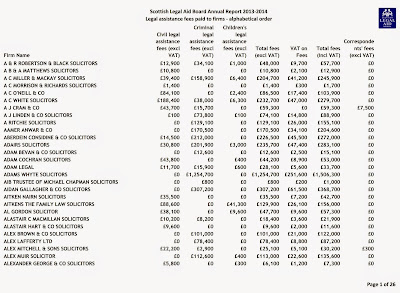
BIG SPENDERS: Spot your solicitors & law firms who take home the legal aid pounds. From total figures of £150.5 million, spend on civil legal assistance was £47.8 while criminal legal assistance was a mere £94 million. Children’s legal assistance stands at £4.9 million. Payments to solicitors increased by 1.7% from £115.1 million to £117.1 million while payments to advocates fell by 21% from £18.3 million to £14.5 million. Payments to solicitor advocates fell by 4.2% from £4.5 million to £4.3 million and expert witnesses along with ‘court reports’ raked in £19.5 million of public money.

And what is legal aid anyway? It goes to lawyers. It does not go to someone who is trying to fight a case in court or secure justice for a case which could have been resolved if some lying toad in a public body up to their eyes in fiddled expenses claims had not covered up for someone else. It goes to lawyers for all sorts of people … even for those of some fraud rap business baron who jaunts off to Dubai on a luxury holiday after his lawyers took nearly £200K in legal aid.

Hands up any of you who flew off to Qatar for a holiday after pocketing nearly a quarter of a million in legal aid from taxpayers. Hello there, Mr Mafia gang boss. Ah, another .. this time, a drug dealer. Another one, a lawyer. And there at the back, is a QC, with a fresh tan after coming back from the Cayman Islands.

No ordinary people then. Not the builder’s labourer next door who has been fighting for legal aid funding after his young child was overdosed with the wrong medication 22 times in hospital and the hospital’s lawyers spent 3 years lying about it.

Strange, that. Isn’t it. Legal Aid for all, Legal Aid for justice. Legal Aid for ordinary Scots. Not really.

Then, there are the judges who sit there hearing criminal cases funded by legal aid, not letting on they have financial, or ‘other’ links to the same firms in front of them, on either side of the court.

Almost laughably, the ‘good lord’ dressed in an 18th Century wig and flashy robe, complete with power bling, sits there in silence wondering if anyone will rumble the fact he received a fat cheque for giving a speech at a function hosted by one of the law firms taking tens of thousands in legal aid.

Never fear m’lud, your secret fat cheque is safe as long as you do not need to declare it. After all, what is a bung between friends, especially when it is at the expense of taxpayers, and justice.

Sure, there are lawyers and law firms who do their clients proud on civil or criminal legal aid … and there are solicitors who defend their clients against reams of somewhat dodgy charges just so the Crown Office can occasionally have a press release to claim a success which crumbles into falsehoods after further analysis. But this is not typical .. it is more the exception to the rule.

During Alex Salmond’s last First Minister’s Questions last Thursday, the thorny, almost un-debatable subject of the legal profession’s massive taxpayer bung was raised for discussion. Witness what happened next:

Graeme Pearson MSP LEGAL AID First Minister's Questions Scottish Parliament 13 Nov 2014

5. Graeme Pearson (South Scotland) (Lab): To ask the First Minister what the Scottish Government’s response is to the Law Society of Scotland’s discussion paper, “Legal Assistance in Scotland”, which says that the current system is not fit for purpose. (S4F-02386)
                   
The First Minister (Alex Salmond): The Scottish Legal Aid Board makes hundreds of thousands of grants of legal assistance each year, whether to help people to deal with welfare benefit problems or to help those who are accused of criminal offences to defend themselves. Expenditure on legal assistance last year was £150.5 million. The Scottish Legal Aid Board’s annual report shows that, since 2011, changes to the legal system have saved the public purse £52 million. However, there is still more to do.

The Law Society’s paper is intended to open up discussion. We have a shared perspective on some points, such as the need for simplification, and we will of course take a detailed look at the Law Society’s proposals over the coming weeks, with a view to assessing their potential impact on public funds and on those who rely on legal aid.

Graeme Pearson: The First Minister may remember that I raised concerns last year about proposed changes to legal aid. The president of the Law Society of Scotland said this week that legal aid cuts are likely to curb rights to justice for people on low and modest incomes who rely on legal aid. Does the First Minister agree that the prospect of citizens of modest means being denied access, as the Law Society suggests, while career criminals repeatedly access legal aid unfettered is indefensible and a foreseeable consequence arising from Mr MacAskill’s changes? Will the First Minister use whatever influence he has to ensure that the situation is addressed by his successor urgently?

The First Minister: As Graeme Pearson knows, expenditure on legal assistance in Scotland has been held at £150 million since 2007. Of course, that is not what has happened south of the border, where there have been substantial cuts. [Interruption.] Labour members should understand that, under the Barnett formula, the consequentials that come to Scotland are directed by expenditure in England. Unless they put forward a position where the great resources of Scotland are available for the Scottish people to direct our own spending, I am afraid that such matters are relevant.

Graeme Pearson should also understand that, although we were extremely interested in some aspects of the Law Society’s paper, such as the need for simplification, the paper has proved deeply controversial. He can see that from the debate that is opening up, in which people are pointing out that many areas of civil law are vital as part of legal aid assistance and criminal lawyers are pointing out that the fundamental right of people to defend themselves against a criminal charge is the essence of a free society.

There are no easy answers to the questions at present, but Graeme Pearson can rest assured that this Government and the Government of the immediate future will protect the right of the people of Scotland to legal assistance so that they can pursue their claims for justice.

Monday, February 03, 2014

Transparency, but not for Scottish Judges: First Minister echoes MacAskill’s claim of no need to review powers, independence of “Window Dressing” Judicial Complaints Reviewer role

First Minister's Questions – No need for review of powers for "window dressing" judicial watchdog. REPLYING to a question from John Wilson MSP (SNP) during First Minister’s Questions last week on matters relating to the investigation of  complaints about misconduct by Scottish judges, Scotland’s First Minister Alex Salmond  claimed in an answer given in the Scottish Parliament’s main chamber that there is currently no need to review the powers of the Judicial Complaints Reviewer (JCR).

The First Minister also refused to increase the power of the JCR to at least match that of equivalent judicial investigators in England & Wales who have wide ranging statutory powers to deal with complaints about judges in the rest of the UK.

The statement from Mr Salmond, who legal observers say effectively sidestepped revelations of multiple breaches of judicial conduct by Scottish judges, comes after Moi Ali, the first person to be appointed to the role by Justice Secretary Kenny MacAskill, officially described the role of JCR as “Window Dressing” during an evidence session before MSPs at the Scottish Parliament’s Public Petitions Committee who are investigating transparency within Scotland’s judiciary and failures of judges to declare their interests or recuse themselves in cases being heard in Scottish courts.

MSP John Wilson further asked the First Minister if the powers of the Judicial Complaints Reviewer could be “enhanced to give the role greater independence, especially given the equivalent powers and budgets in England and Wales and the role of the Northern Ireland Judicial Appointments Ombudsman”. However, in reply, the First Minister simply restated the current position of the Justice Secretary in that no review of the lack of powers held by the Judicial Complaints Reviewer or any move to grant the JCR greater independence is currently being considered.

Questions as put to the First Minister by John Wilson MSP and responses given:

First Ministers Questions, 30 January 2014: John Wilson MSP & Judicial Complaints Reviewer (Review)

Judicial Complaints Reviewer (Review)

John Wilson (Central Scotland) (SNP)
3. To ask the First Minister when the Scottish Government last reviewed the powers of the office of the Judicial Complaints Reviewer. (S4F-01852)

The First Minister (Alex Salmond): Last year, the Cabinet Secretary for Justice said in evidence to, I think, the Public Petitions Committee that the Government does not see a need for a review of the office of the Judicial Complaints Reviewer at this time. The Judicial Complaints Reviewer has been in office since September 2011. She has told Mr MacAskill that she does not wish to be reappointed. We are grateful for her work to date and her commitment to assist with a smooth handover to her successor.

John Wilson: As the First Minister has done, I highlight the valuable contribution that Ms Ali has made in her role, especially in relation to the 20 cases that she has identified as breaches by the Judicial Office for Scotland in relation to the judiciary since 2011. Following Ms Ali’s decision not to seek a second term and her comments, which were reported at the weekend, could the powers of the Judicial Complaints Reviewer be enhanced to give the role greater independence, especially given the equivalent powers and budgets in England and Wales and the role of the Northern Ireland Judicial Appointments Ombudsman?

The First Minister: Let me put it on the record again that, like the member, I am grateful to Ms Ali for her valuable public service over the past two and a half years and for the improvements that she has encouraged in the judicial complaints process. The Judicial Complaints Reviewer carries out her responsibilities independently of Government and the judiciary. In her report for 2012-13, she records having to see 43 review requests and inquiries. By comparison, the Judicial Appointments and Conduct Ombudsman for England and Wales received 810 complaints and written inquiries, of which 482 concerned the personal conduct of judicial office-holders. The powers and the budget reflect that difference in the workload. There is not actually a process of independent review of judicial conduct complaints in Ireland. That is the current position. We are grateful to Ms Ali for her work and, in particular, for the commitment that she has given to smooth the handover to her successor.

JUDICIAL COMPLAINTS: How Scotland’s Judges look after their own in 2014 & beyond?

Contrary to claims made by Justice Secretary Kenny MacAskill and echoed last week by the First Minister during FMQ’s there is no need to review the lack of powers held by Scotland’s Judicial Complaints Reviewer, Moi Ali, the first person to hold the office of Judicial Complaints Reviewer recently told the Justice Secretary that she will not seek a second term in the role because she views her office as having such limited powers to render the JCR’s role as mere “tokenism” compared to how complaints against the judiciary are investigated in England and Wales, where the Office for Judicial Complaints has a complement of 15 staff and regularly publishes details of upheld complaints against judges.

Moi Ali testified before the Public Petitions Committee of the Scottish Parliament, providing revealing answers to questions about the powers of the Judicial Complaints Reviewer and her support for Petition PE1458: Register of Interests for members of Scotland's judiciary a public petition calling for a register of interests of Scotland’s judges. More on Moi Ali’s appearance before the Petitions Committee can be read in an earlier report here: As Scotland’s top judge battles on against transparency, Judicial Complaints Reviewer tells MSPs judges should register their interests like others in public life

Footage of the Committee evidence session, which raises interesting points compared to the claims of Scotland’s Justice Secretary and now First Minister of no need to review the role of JCR , is available below:

JCR Moi Ali gives evidence to Scottish Parliament on a proposed Register of Judicial Interests (Click image to view video)

What's the point of a watchdog without teeth - Sunday Mail 22 September 2013A judicial watchdog without teeth, created after lobbying from angry judges with undeclared interests, secret wealth. The position of Judicial Complaints Reviewer was created by an Act of the Scottish Parliament in 2008, principally highlighted in Section 30, S31 and S32 of the Judiciary and Courts (Scotland) Act 2008. However, protests from vested interests within Scotland’s judiciary and legal profession from Scotland’s judges who were “dead against” proposals to create an independent form of regulation of judges resulted in what legal observers have branded “a cowardly capitulation” by Justice Minister MacAskill.

Ultimately, lobbying from Scotland’s unaccountable judges and other vested interests from justice system led to the creation of the toothless role of Judicial Complaints Reviewer which, unlike its equivalent office in England & Wales, has no statutory powers, only works on a three days a month basis and with an annual budget of £2000 and has no staff. The JCR has been frequently frozen out of document sharing by Scotland’s judiciary as the media have recently reported in detail along with information obtained from annual reports released by Moi Ali, the current Judicial Complaints Reviewer.

Judicial Investigator Moi Ali left in the dark over complaints against Scottish Judges - NO She May Not 10 Feb 2013 Sunday Mail

First Annual Report of JCR for 2011-2012 revealed Scotland’s top judge froze out independent Judicial Investigator. To illustrate what has become a consistent lack of cooperate from the judicial office, the first annual report from Moi Ali last year reiterated concerns over refusals by judges  to share information  with investigators, previously reported in February by the Sunday Mail newspaper and featured on Diary of Injustice here: Annual Report revealed Lord President Lord Gill ‘froze out’ Judicial Complaints Reviewer amid series of revoked findings, secret unshared memos & dismissed complaints.

Ms Ali’s first annual report, which can be read online here : Judicial Complaints Reviewer Annual report 20011- 2012 or available via the JCR’s website HERE reveals a series of incidents where her office has been blocked by the Lord President from accessing communications, internal memos and reports between the office and the judges about complaints.

In one particular case, Ms Ali revealed in her report “When the Judicial Office made an initial assessment of this complaint, it was not reasonable for them to conclude that the behaviour complained about, which left the complainer “insecure and scared”, fell into the category of judicial decision/case management/court programming. According to the Rules, they should have referred that element of the complaint to the disciplinary judge for consideration. This did not happen, and instead the complaint, in its entirety, was dismissed. For that reason I made a referral to the Lord President, who then revoked that part of the original determination and referred it to the disciplinary judge, who then dismissed the complaint.”

Second annual report - JCR lacks much needed powers. The Judicial Complaints Reviewer’s 2012-2013 annual report revealed continuing issues of concern and further instances where the Judicial Office has refused to share files and paperwork in relation to complaints made against judges and how were handled.

The report also makes reference to incidents such as where Scotland’s top judge Lord Brian Gill refused to hand over information to the JCR. Gill claimed Moi Ali’s office was a "Third Party" and that data cannot be shared with her office for reasons of confidentiality. However, the confidentiality concerns of Gill appear to be restricted to Scotland, as the same information in England & Wales is published online.

It also emerged in the JCR’s second annual report that even though a Memorandum of Understanding was signed between the JCR & Judicial Office earlier this year on respective roles, responsibilities and agreed undertakings, the situation regarding the contents of files has not been resolved to Ms Ali’s satisfaction.

The Sunday Mail newspaper reported on issues raised in the JCR’s second annual report, including calls from Moi Ali for the Scottish Government to act over the lack of scrutiny and transparency in Scotland’s judiciary.More can be read here: Calls for Justice Secretary to get tough with anti-transparency judges as Judicial Investigator reveals weak-by-design scrutiny fails to protect public from errant judges