Showing posts with label Wikileaks. Show all posts

Friday, June 05, 2015

A GRAND DAY IN: Judicial attendance & walkout over Wikileaks founder at Commonwealth Law Conference and Lord Gill’s ‘transparency is insidious’ speech ends up costing taxpayers £15K

Judges splurged £15K on Glasgow Law gathering then fled at sight of Wikileaks transparency advocate. THE COST of sending nine Scottish judges including Scotland’s top judge Lord Gill from Edinburgh to a law conference held in the remote, far away city of Glasgow - cost taxpayers fifteen thousand pounds – according to information released this week by the Judicial Office.

However, Lord Gill's grand day out to the Commonwealth Law Conference (CLC2015) – where Scotland’s top judge grimaced & growled, hurling jibes at everyone & everything, from transparency to the political process - was cut short when Gill (73) led a hastily arranged judicial walkout after it was revealed Julian Assange – founder of Wikileaks – was booked to talk live at the event via a digital link.

The information, released by the Judicial Office in response to a Freedom of Information request reveals one booking for 9 judicial office holders to attend the Commonwealth Law Conference 2015 cost £14,823.66.

The following judicial office holders were originally booked to attend the conference: Lord President, Lord Justice Clerk, Lord Armstrong, Lord Woolman, Lord Mathews, Lady Dorrian and 3 Sheriffs were authorised to attend on behalf of the Sheriffs Association (names unknown at time of booking).

Following the bookings being made, the Lord Justice Clerk, Lady Dorrian and Lord Armstrong were unable to attend due to court commitments.

Sir Muir Russell was invited to attend the conference and agreed to chair a session entitled "A model form for judicial appointments in the 21st century Commonwealth". That session was scheduled to take place on the morning of Thursday 16 April.

Book them in – Judicial Office release details of CLC 2015 costs. Sheriff Principal Scott agreed to chair a session entitled "Human trafficking and migration", which was scheduled to take place on the morning of Wednesday 15 April.

In respect of the Sheriffs that were booked to attend the conference on behalf of the Sheriffs Association, it became clear in the lead up to the conference that not all could attend for the full conference due to court commitments. Agreement was therefore reached with the conference organisers that different sheriffs could attend for certain days and sessions.

The following sheriffs represented the Sheriffs Association at the conference: Sheriff Liddle; Sheriff Wood; Sheriff Di Emidio; Sheriff Jamieson; Sheriff Shead; and Sheriff Pettigrew.

1. The total figure quoted is for attendance at the conference only and includes VAT.  One judicial office holder has claimed travel expenses. 

On 19 May the Judicial Office received a T&S claim that related to travel to the conference.  This was in respect of rail costs and travel by private car (mileage costs reimbursed).  The total amount claimed is £17.05.  No accommodation was booked for anyone attending the conference.

2. There was a set fee for attendance at the conference.  The fee was: £1400 plus VAT (£1680) per booking.  This was the “early bird” rate. One other fee was charged at £1144 plus VAT and a service charge of £34.86 (£1,383.66) as the booking was paid by credit card.  There was a discount applied to this booking as SP Scott, who the booking was made for, agreed to chair a session at the event.

Lastly, in respect of the subsequent withdrawal by members of the judiciary relating to the conference booking of Mr Assange, the only information released by the Judicial Office was a copy of a statement that was issued on 16 April 2015 following a press enquiry.

The statement read: "The conference programme was changed to include Mr Assange's participation at short notice and without consultation. Mr Assange is, as a matter of law, currently a fugitive from justice and it would therefore not be appropriate for judges to be addressed by him. Under these circumstances the Lord President, Lord Gill and the other Scottish judicial office holders in attendance have withdrawn from the conference."

However, Scotland’s top judge managed to blast his critics in his opening speech – given prior to Lord Gill ordering judicial colleagues to evacuate the event.

Launching a fierce attack on calls for judicial transparency, the political process and the Scottish Parliament - who are investigating accountability and transparency within the judiciary amid calls for a register of judges interests, Lord Gill told his audience: “The threats to judicial independence do not always come with a knock on the door in the middle of the night.  In a society that prides itself on the  independence  of  its  judiciary,  the  threat  may  come  in  insidious ways, even at the hands of well-meaning governments and legislators, in the name of efficiency and, ironically,  in the name of  transparency.”

Gill, clearly not a fan of Wikileaks, or judicial transparency, or judges declaring their interests – is more used to jet setting off to law conferences held around the world in venues far removed from Scotland.

In 2013, Lord Carloway – who is currently standing in for the now retired Lord Gill - flew off to Cape Town, South Africa to attend the Commonwealth Law Conference at a cost of £5541.37. Lord Gill also took the jet to the same venue, his ticket costing  taxpayers a little less at £3233.31.

More on the jet set lifestyle of Scotland’s judiciary can be read here LORD FLY-BYE: Scotland's courts in the slow lane as judges prefer law conferences, business & 'diplomatic' trips to life on the bench

In 2014, Lord Gill splurged £2855 on a ticket for his five day state visit to the positively honest, reputable middle eastern dictatorship of Qatar – reported here: LORD JET SET: Scotland’s top judge Lord Gill takes 5 day STATE VISIT to Qatar as investigation reveals judiciary's international travel junkets spree

Friday, April 17, 2015

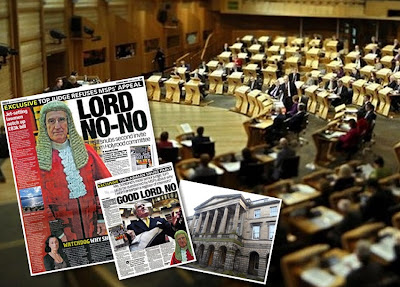
MY COURT NOT YOURS: Scotland’s top judge slams politicians and government as “insidious” in law conference attack on transparency & calls to reform secretive judiciary & vested legal interests

Top judge Brian Gill attacks calls for judicial reforms. IN a speech to the Commonwealth Law Conference held in Glasgow SECC last weekend, Scotland’s top judge Lord President Lord Brian Gill accused government, legislators and transparency as being “insidious” threats to his way of doing things and the judiciary at large.

The lengthy speech from Gill (73), supposedly on independence of the judiciary & legal profession ended up as a bitter tirade aimed at politicians and those calling for reform of the secretive world of the nation’s judiciary and the vested interests of those at the top of the justice system.

Launching a fierce attack on calls for judicial transparency, the political process and Holyrood MSPs who are investigating accountability and transparency within the judiciary amid calls for a register of judges interests, Lord Gill told his audience: “The threats to judicial independence do not always come with a knock on the door in the middle of the night.  In a society that prides itself on the  independence  of  its  judiciary,  the  threat  may  come  in  insidious ways, even at the hands of well-meaning governments and legislators, in the name of efficiency and, ironically,  in the name of  transparency.”

And, Gill – Scotland’s longest serving judge - went on to tell his audience of lawyers, judges & academics that protesters he encountered standing on the Heart of Midlothian in Edinburgh’s Royal Mile were lucky they were not dragged off by Police.

In a swipe at unidentified persons who were apparently calling for the top judge’s resignation, Gill told his audience: “Two years ago, I was crossing the square outside my court when I noticed two individuals standing, perhaps appropriately, at the Heart of Midlothian, the scene of public executions in Edinburgh in former times. They were holding a large banner. It caught my eye. It said "Lord Gill - Resign!" I never discovered what their reasons were; but I thought what a privilege it was to be a judge in a society where the public could make a constructive suggestion of that nature without being taken away by the police.”

The barbed comments from the ageing judge against all and sundry come as Gill continues to fight a bitter two year battle against Holyrood msps who overwhelmingly support proposals to establish a register of interests for members of the judiciary as called for in Petition PE1458: Register of Interests for members of Scotland's judiciary.

Since early 2013 Lord Gill has refused three invitations to appear before the Scottish Parliament’s Public Petitions Committee and be questioned on the issue of judges refusing to declare their interests.

The top judge has instead sent several strongly worded letters to msps warning them they cannot compel a judge to appear at Holyrood. Gill used a loophole in the Scotland Act to dodge questions on his hostility to transparency and also implied in a further letter he may have to reconsider allowing judges to cooperate with the Scottish parliament in the future.

The proposals to create a register of judicial interests envisages the creation of a single independently regulated register of interests containing information on judges backgrounds, their personal wealth, undeclared earnings, business & family connections inside & outside of the legal profession, offshore investments, hospitality, details on recusals and other information routinely lodged in registers of interest across all walks of public life in the UK and around the world.

Faced with investigating the secretive world of judicial vested interests, MSPs who sit on the Scottish Parliament’s Public Petitions Committee instead took evidence from Scotland’s first Judicial Complaints Reviewer (JCR) Moi Ali. During questions at the Scottish Parliament’s Petitions Committee, Moi Ali told msps there was little transparency or accountability in Scotland’s judiciary.

And, despite Scottish Ministers attempt to thwart a debate at Holyrood last October 2014, most msps backed a motion urging the Scottish Government to create a register of judicial interests – reported along with video footage & the official record, here: Debating the Judges
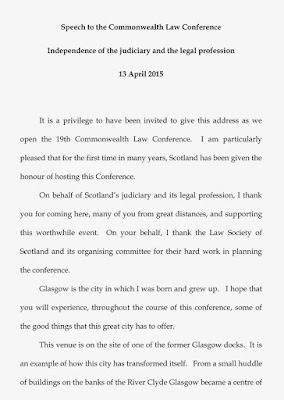
Speech given by Lord Gill to Commonwealth Law Conference Glasgow 2015 Continuing his lengthy seventeen page speech, Gill told his audience of legal professionals that judges lead a lonely life and have no support from anyone else except themselves.

He told his listeners: “The highest priority of judicial education is not to teach judges the law, but to teach them about themselves. The life of a judge is a lonely one where the only support network available is that of one's colleagues.”

However, the sad lonely life of a judge - as Gill would have the public believe - does not appear to preclude the judiciary from becoming involved in tax avoidance schemes, huge movements of wealth around the world, investing in companies who benefit from business in the courts and jet setting around the world at taxpayers expense.

Last year for example, Lord Gill flew off to a five day state visit to Qatar – details of which have been kept mainly hidden from prying eyes.

Gill was later criticised in the Scottish Parliament for attending Qatar and giving a speech on judicial ethics, while refusing to answer questions from msps on judicial ethics, accountability and transparency. MSP Jackson Carlaw even joked the Petition Committee should have gone to Qatar to question the top judge after he refused to show up at Holyrood,

Following Lord Gill’s frequent attacks on “aggressive media” over calls for transparency - and the top judge’s subsequent threat to ban journalists from accessing court documents last year in a highly public fit of pique, Gill launched another broadside against the press for their reporting of cases in the courts.

Gill said: “Criticism of one's judgments in the media is never a pleasant experience; but, as Lord Woolf has commented, we must swallow our pride and be thankful for a free press which stands to safeguard our independence.

Independence relies upon public understanding of our courts and the way in which they should expect our courts to operate. Public awareness breeds public confidence. For most people, newspaper accounts of court cases are the source of their knowledge of our justice system. There is inevitably a tension in the relationship between the judiciary and the media. The court adjudicates on matters involving the media fairly frequently. Therefore, as Lord Woolf rightly observes, we should be circumspect about having a relationship with the media that might cast doubt on judicial independence. It is a fine line to tread.

In modern times, our court systems have a dedicated media team, who liaise with the media to ensure that there is an open and accurate flow of information. For, the media are helpful to our cause only if facts are reported with accuracy. Good communication with the media – at arm's length - is a sign that our court system is in touch with the community and. I would argue, is in itself an important aspect of judicial independence.”

Speaking on his two year consultation to change the rules on judicial discipline and complaints – which ended up with much the same rules as before, Gill said: “A related and more obvious aspect of judicial professionalism is judicial discipline. It is immediately obvious that there is a tension between the concepts of accountability and independence. There must be an effective mechanism in place for investigating and sanctioning misconduct without eroding the independence of the judiciary.”

“Appointment to the bench does not confer immunity from discipline. It is therefore usually suggested that judicial discipline should be left in the hands of the judiciary themselves. That excludes the possibility of interference from the executive, but it does not entirely resolve the independence problem. If the judiciary is essentially self-regulating, the perception of a judiciary driven by self-interest and self-protection, and shrouded in mystery, will do us great damage. It does little to ensure that the public have a satisfactory impression of accountability.”

“In Scotland, this difficulty has been overcome by our adopting two distinct processes, namely, a complaints procedure and a 'fitness for office' procedure. If I were to conclude that a judicial office holder was unfit for office, the matter would be referred to an independent tribunal to investigate and report on whether there was unfitness to hold office by reason of inability, neglect, or misbehaviour. I have never had to take such a step. Disciplinary procedures of this nature are rare. We are fortunate to have a professional and dedicated judiciary. Perhaps, that is a reflection of the fact that we now have a comprehensive Statement of Principles of Judicial Ethics that spells out exactly what conduct we expect of our judiciary.”

Gill ended his speech describing his idea of the “ideal judge”, notably leaving out transparency as a requirement for those on the bench.

Gill told his audience: “So, what kind of judge do we wish to have? First and foremost a judge who is appointed fairly and publicly. Every decision to appoint is made ad hoc. Therefore we should not be excessively prescriptive lest we fail to allow for the unforeseen. But certain general priorities are there for your consideration. It is surely desirable that our ideal judge should be one who has experienced the true meaning of an independent profession and who exemplifies excellence allied to good judgment. A judge who is willing to learn and to be accountable. A judge who has self-knowledge, humility, and an understanding of the nobility of the office to which he has been called.”

Judges, lawyers and academics from many Commonwealth nations attended the conference at the Scottish Exhibition & Conference Centre (SECC). Those organising the conference claimed the gathering of legal eagles generated an economic boost in the region of £1.4m for the city.

The conference - last held in 2013 in Cape Town, South Africa – which Lord Gill jetted to at taxpayers expense has been brought to Glasgow in partnership between the Law Society of Scotland, Glasgow City Marketing Bureau (GCMB) and the SECC. It is officially the conference of the Commonwealth Lawyers Association, which works to promote human rights and the rule of law across the Commonwealth, and to support lawyers in countries where their work may incur sanctions from the authorities.

Just prior to the start of the event, it was revealed Wikileaks founder Julian Assange was booked to speak to the conference via video link.

During his speech, Mr Assange suggested communications were being monitored between legal professionals and the wikileaks team.

However, when judges discovered the Assange booking, several judicial figures including Lord Gill and also Lord Neuberger & Lord Hodge of the UK Supreme Court among others - walked out of the conference.

A spokesperson for the Judicial Office for Scotland said: “The conference programme was changed to include Mr Assange’s participation at short notice and without consultation. Mr Assange is, as a matter of law, currently a fugitive from justice and it would therefore not be appropriate for judges to be addressed by him.Under these circumstances the Lord President, Lord Gill and the other Scottish judicial office holders in attendance have withdrawn from the conference.”

A spokesman for the UK Supreme Court said: “Lord Neuberger and Lord Hodge share the concerns expressed by Lord Gill and his fellow senior Scottish judges regarding the late addition of Mr Assange to the conference programme. As a result of this unfortunate development, they trust that delegates will understand their decision to withdraw from the conference.The justices took this action regretfully, as they value greatly the work of the Commonwealth Lawyers Association and the role of the conference as an important forum for sharing experiences and good practice across the legal profession.”

The Judicial Office have offered no further comment on Lord Gill’s remarks.

Previous articles on the lack of transparency within Scotland’s judiciary, investigations by Diary of Injustice including reports from the media, and video footage of debates at the Scottish Parliament’s Public Petitions Committee can be found here : A Register of Interests for Scotland's Judiciary

Friday, December 10, 2010

Law Society's ‘Killer Insurance’ in the dock as solicitor says only way ‘adversarial’ Master Policy will be revealed is if it ends up on Wikileaks

Master Policy Report Suicides revealedThe Law Society’s secretive Master Policy insurance protection scheme was linked to deaths in SLCC report. AS the Scottish Legal Complaints Commission effectively signalled earlier in July of this year it had abandoned its less than determined two year quest to secure documents & details from infamous insurers Marsh UK & the Law Society of Scotland of of how the Master Policy operates to protect the legal profession, a solicitor who has come forward over the issue said today the only way the SLCC or the public would ever see the inner workings of the notoriously anti-client Professional Indemnity Insurance scheme for the Scottish legal profession would be if it ends up on the whistle blowing website WikiLeaks.

The solicitor, whose identity I have agreed to withhold on the grounds he may face intimidation from the Law Society over his stance on the matter also said this morning he was fed up with the situation where the Master Policy brokers & insurance companies effectively make the whole process of dealing with clients ‘adversarial’ as soon as any doubt or questions over the solicitors work are raised.

He said : “Having read of the flawed, reticent steps the SLCC have so far taken in their attempts to secure documentation relating to how the Master Policy operates, I am now convinced the only way the SLCC or anyone outside the Law Society or Marsh will ever see a copy of the Master Policy and be able to understand its inner workings & policies on claims is if it all ends up on Wikileaks.”

He continued : “While I make no excuses for colleagues who provide clients with shoddy legal services, I would like members of the public to understand we are currently operating under a regime where as soon as a client raises issues with our work which may potentially lead to a complaint, the Law Society require us to inform them of what is going on. The solicitor client relationship possibly built up over a number of years then turns into an adversarial exercise of effectively closing down our end in representing a client’s best interests while the Law Society and Marsh work out the impact of a complaint or a potential claim against the Master Policy. Ultimately the solicitor & client part company and the client then experiences significant problems in obtaining any further legal representation.”

An official from one of Scotland's consumer organisations, commenting on the issue said today : “If we are serious about restoring client confidence in the legal profession, one of the first obvious steps is to open up the Master Policy to full transparency. Whatever way this is achieved, full disclosure must be realised in an effort to break from the way in which claims for negligence have been historically handled, in a manner of full confrontation which has ultimately caused the profession more grief that what its worth.”

A client who has been pursuing a claim against the Master Policy for over 5 years, a claim which involves the loss of the client’s home and business after his solicitor’s negligent actions wiped out his assets & livelihood described the Master Policy as “A killer insurance policy which is out to maim anyone who tries to recover from what the legal profession did to them.”

Earlier last month I reported how the ‘besieged’ Scottish Legal Complaints Commission had effectively wound down its pursuit of information connected to the Master Policy which would allow the SLCC to fulfil its “monitoring role” as mandated to it in Section 39 of the Legal Profession & Legal Aid (Scotland) Act 2007, which states :

(1) The Commission may monitor the effectiveness of—

(a) the Scottish Solicitors Guarantee Fund vested in the Society and controlled and managed by the Council under section 43(1) of the 1980 Act (“the Guarantee Fund”);

(b) arrangements carried into effect by the Society under section 44(2) of that Act (“the professional indemnity arrangements”);

(c) any funds or arrangements maintained by any relevant professional organisation which are for purposes analogous to those of the Guarantee Fund or the professional indemnity arrangements as respects its members.

(2) The Commission may make recommendations to the relevant professional organisation concerned about the effectiveness (including improvement) of the Guarantee Fund, the professional indemnity arrangements or any such funds or arrangements as are referred to in subsection (1)(c).

(3) The Commission may request from the relevant professional organisation such information as the Commission considers relevant to its functions under subsections (1) and (2).

(4) Where a relevant professional organisation fails to provide information requested under subsection (3), it must give reasons to the Commission in respect of that failure.

slcc_logoScottish Legal Complaints Commission have not done enough to secure Master Policy documents. However, despite having the power in law to monitor claims against the Master Policy, the SLCC’s board has singularly failed to achieve any movement on its request to Marsh & the Law Society of Scotland for accurate information on how the Master Policy operates. The SLCC’s board minutes of July 2010 depressingly concluded : “5.1 Master Policy and Guarantee Fund: A verbal update was given which touched upon the issues of the time it was taking to obtain information, and the fact that information may never be forthcoming from Marsh as they are under no legal obligation to provide it and because of commercial sensitivity may not be able to provide it. A discussion took place on the merits of splitting the research and Members agreed to separate research in relation to Master Policy and Guarantee fund and press on with research on the Guarantee Fund.”

You can read more about the University of Manchester’s report on the Master Policy, here : Suicides, illness, broken families and ruined clients reveal true cost of Law Society's Master Policy which 'allows solicitors to sleep at night'.

SLCC report headerOnly a few days after the release of the Scottish Legal Complaints Commission's investigation into the claims process against solicitors, harsh evidence emerged of the human cost to clients, where suicides, illness (some resulting in death), family break ups and huge financial losses are the horrific consequences sustained by members of the public who have tried to make claims against the Law Society of Scotland's 'Master Policy' insurance scheme, touted by the legal profession as protecting lawyers and clients but which the ground breaking report released by Manchester University School of Law on Monday reveals “is simply designed to allow lawyers to sleep at night.”

Page 8 - Consumer Focus Scotland refused cooperation from Law SocietySuicides, illness, family breakdown, loss of homes, loss of livelihood were all identified by interviewees as being directly associated with members of the public’s dealings with the Law Society & Master Policy. During the research team's investigation of claims against the Master Policy, team members were told of suicides which had occurred due to the way in which clients of crooked lawyers had been treated by the Law Society of Scotland and the insurers who operate the Master Policy protection scheme for solicitors against negligence claims. Quoting the report : "Several claimants said that they had been diagnosed with depression; that they had high blood pressure; and several had their marriages fail due to their claim. Some had lost a lot of money, their homes, and we were told that one party litigant had committed suicide."

Further excerpts from the Manchester University report into the Law Society's Master Policy & Guarantee Fund show the intolerable strain clients who attempt to claim against their 'crooked' solicitor have to endure : Claimants "described being intimidated, being forced to settle rather than try to run a hearing without legal support, and all felt that their claims’ outcomes were not fair. Some claimants felt that they should have received more support, and that this lack was further evidence of actors within the legal system being “against” Master Policy claimants. Judges were described as being “former solicitors”, members of the Law Society – and thus, against claimants. Some described judges and other judicial officers as being very hostile to party litigants."

One direct quote from the report, depicts a claimant, who was forced to become a party litigant : "I keep fighting cases, and they keep coming at me, and now I have become ill. But they still keep coming at me. They threw me out onto the street, I couldn’t get my medication, I’ve got nothing, I was homeless, ill, sleeping in the car. Now I am appealing. But I can’t get a solicitor. They are just shutting me down…. My health has been damaged, they kill you off. It's a proven fact. All of us have stress related problems after years and years of stress."

0048Insurers Marsh & Law Society imposed conditions on SLCC’s research team. However, in a startling revelation which gives an insight into the difficulties the research team faced in compiling the report, legal insiders allege that corruption is so rife in the legal services sector, the Law Society refused to hand over actual copies of the Master Policy to the research team, fearing disclosure of the highly secretive & sensitive documents would cause a rush of bad publicity to the Scots legal profession for its consistent cover up of claims & complaints against highly corrupt law firms and individual solicitors. In response to enquiries, Dr Angela Melville, who interviewed many clients for her final report, confirmed the research team did not receive a copy of the Master Policy, despite requesting it. Instead, a letter from Alistair J Sim, Director of the US Insurer Marsh, who had executives convicted of criminal offences in the United States , attached strict conditions to what little information was disclosed : “Please note that the consent of Marsh and Royal & Sun Alliance plc to the production of the enclosed documents is condition on the research team agreeing not to quote from the documents, or any part of them, whether text or figures, in the report to the Scottish Legal Complaints Commission.”

The letter from Marsh banning the SLCC or University of Manchester from publishing information and refusing a copy of the Master Policy went onto say : “The documents which are produced are confidential and are commercially sensitive. They are provided to the research team only and neither the documents nor copies should be provided to any other party nor should the content of the documents be disclosed to anyone outside the research team. At the conclusion of the research project, the documents should be returned with confirmation that foregoing conditions have been complied with and that no copies have been retained. If the research team is unable to agree to the foregoing conditions, the documents should be returned along with confirmation that no copies have been retained.”

The latest annual report of the Scottish Legal Complaints Commission is, apparently, weeks, if not days away from being published, and is expected to show a sharp drop in complaints, although suspiciously there is expected to be little mention of the SLCC’s failure to address the Master Policy issue, being one of the cornerstones of corruption in the Scots legal profession which has led to unrivalled consumer suspicion & distrust of the Law Society and individual solicitors.

So, while some appear not to be encouraging anyone to do or leak anything, in view of the fact people have died to allow lawyers to sleep soundly at night, I think its high time the public were able to inspect the full horrors of the Master Policy, the people involved & implicated in it, and how the Law Society of Scotland cut clients off at the knees from obtaining access to justice … just so some lawyers who would probably end up in jail if their acts were criminalised, rather than being investigated & judged upon by their own peers, can get a good night’s rest …