Independent Law journalists report on legal news for consumers, litigants & Scotland's legal community including features on justice, access to justice, law reform, the judiciary, politics & in-depth investigations, analysis and commentaries on legal related issues.
Lord Carloway – opposes judicial interests register.SCOTLAND’S newly appointed top judge – Lord President Lord Carloway - has attacked proposals before the Scottish Parliament calling for judges to be required to declare their financial interests and links to big business as called for in Petition PE1458: Register of Interests for members of Scotland's judiciary.
The widely backed proposals - debated at the Scottish Parliament on 9 October 2014 - call for the creation of a publicly available register of judicial interests containing information on judges backgrounds, their personal wealth, undeclared earnings, business & family connections inside & outside of the legal profession, offshore investments, hospitality, details on recusals and other information routinely lodged in registers of interest across all walks of public life in the UK and around the world
However, Scotland’s latest top judge – on a salary of £220,655 a year - has declared his opposition to calls for a register of judges’ interests, with Lord Carloway claiming - the judiciary must remain exempt from the same transparency rules which apply to all other branches of Government, public bodies and the Scottish Parliament.
Writing to Michael McMahon MSP, convener of the Scottish Parliament’s Public Petitions Committee, Lord Carloway said: “It is of great constitutional importance that the judiciary remain functionally distinct from both elected representatives, who make the law, and the Government, who promote changes to the law and take executive decisions in areas involving wide discretionary powers covering many areas of economic interest.
And, the top judge – who recently published a speech on making Scotland’s courts 'fit for the 21st Century' – claimed justice could grind to a halt in a constitutional calamity if judges were forced to declare their vast wealth, property owning interests, professional links and other financial affairs – just like politicians, members of public bodies, local councillors are required to reveal.
Lord Carloway (real name: Colin Sutherland) told MSPs: “The proper administration of justice could be inhibited by the disclosure of the judiciary's otherwise confidential financial arrangements. In that connection, there is the possibility that an individual judge may be the subject of misconceived criticism, deriving from the disclosure of personal financial information, where those interests are tangential and de minimis.”
The move by Scotland’s latest Lord President to undermine the Scottish Parliament’s efforts to increase judicial transparency follows a bitter three year campaign against the petition - led by Carloway’s former boss – Lord Brian Gill – which culminated in an ‘aggressive’evidence session with the former top judge at Holyrood in November 2015.
Responding to Lord Carloway’s letter, the petitioner told the Committee: “Lord Carloway presents the same view of his predecessor Lord Gill in that a register of interests for the judiciary is unnecessary or undesirable. Similarly, as Lord Gill has already inferred, Lord Carloway speaks of constitutional problems if the judges are asked to declare their interests.”
“In reality, there are no constitutional issues created by this petition, nor is there an impediment to the creation of a register of judicial interests. Such a register already exists for the Scottish Court Service and Tribunals Board, of which Lord Carloway and others declare their interests.”
“As members of the Petitions Committee have already discussed, it would be no great effort to expand the already existing register to include the entire judiciary. The Committee is also well aware other jurisdictions have implemented registers of judicial interests, without difficulty or an end to justice as we know it.”
“It is not enough to say, as the Lord President suggests, the judiciary should be excluded from the public's expectation of transparency, simply because the judiciary say so upon their own rules.”
“Thankfully, there is a general realisation, and acceptance, that registers of interest in public life are required, promote transparency and assist in the process of good government and detection of vested interests where they should not be.”
Lord Carloway added judges were unable to speak out in public or defend themselves against criticism – despite a series of recent headlines where judges have embarked on highly publicised criticisms of Police Scotland, the Crown Office, the media and other public bodies.
Responding to the Lord President's claims of a judiciary under a vow of silence - the petitioner told the Committee: “Lord Carloway suggests in his letter judges are unable to speak out in public. Not so. The media have covered numerous examples where members of Scotland's judiciary have spoken out in public, on government policy, reforms in the courts, cuts to legal aid, or more recently where senior members of the judiciary have become embroiled in public arguments with the Police and Prosecutors on evidence presentation in court.”
The petitioner provided MSPs with examples of judicial public comments, stating: “On the same day the media reported that the Scottish Government announced a moratorium on Shale Gas Fracking, the previous Lord President Lord Gill spoke out, declaring "Our resources of energy may be increased by the retrieval of shale gas, if that should be allowed. It seems to me therefore that the opportunity that our natural resources present should be served by the court system."
“The current Lord President himself was recently reported in the media to have availed himself of opportunities to speak out against certain interests he appeared to believe contributed to blocking Scottish Government policies such as the removal of corroboration - a move rejected by the Scottish Parliament's Justice Committee.”
“Transparency underpins our modern democracy, and should underpin our courts and judiciary in equal measure. A register of judicial interests enhances transparency, and is both in the public's interest, and that of the judiciary.”
The petitioner concluded his response by asking members of the Public Petitions Committee to call the Lord President to give evidence and to contact Law Professor Alan Paterson of the University of Strathclyde – who has published a book and material on judicial interests.
Lord Carloway: The proposal for a public register of the judiciary's interests, gifts and hospitality is both unnecessary and undesirable.
I have had the benefit of reading the views offered by my predecessor, Lord Gill, both in correspondence and in evidence on 10 November 2015. I agree with his views regarding:
(i) the sufficiency of current safeguards protecting the impartiality of the judiciary;
(ii) the potential for unintended consequences of the register;
(iii) the impracticality of such a register; and
(iv) the petition not, in fact, achieving its stated aims.
The petition raises the issue of the balance to be struck between the principles of openness and transparency in public life, on the one hand, and the proper administration of justice, on the other. I support the need for openness and transparency, where appropriate. There is a potential for tension between these principles and the proper administration of justice. Within the proposals in this petition there lies the potential only to undermine the latter, without advancing respect for the principles in any meaningful way. For example, it was Lord Gill who made the point, with which I agree, that the vast majority of matters that in theory could undermine judicial impartiality, such as familial and social relationships, would not be addressed by such a register.
The proper administration of justice could be inhibited by the disclosure of the judiciary's otherwise confidential financial arrangements. In that connection, there is the possibility that an individual judge may be the subject of misconceived criticism, deriving from the disclosure of personal financial information, where those interests are tangential and de minimis. It is inappropriate for judges to make public comment beyond their judicial opinions in relation to individual cases. Therefore, unlike an elected representative or a member of the Government, a judge enjoys no right of reply. Judges thus have no scope to remedy unjustified reputational and professional damage by explaining their decisions or responding to criticism.
The appropriate safeguard with regard to the judiciary is not a register of interests, but the obligation to decline jurisdiction in a case ("recuse himself/herself") where he or she has any real or perceptible conflict of interest, whatever the nature of that conflict. In that regard, in the interests of openness and transparency, all instances of (and reasons for) recusals are published on the judiciary's website.
It is of great constitutional importance that the judiciary remain functionally distinct from both elected representatives, who make the law, and the Government, who promote changes to the law and take executive decisions in areas involving wide discretionary powers covering many areas of economic interest. The danger that representatives and the Government could be influenced by personal interest is ameliorated by the relevant disclosure requirements incumbent upon them. The judiciary's function is not that of law-making nor is it equivalent to any kind of executive power. The same considerations do not apply.
Lord Gill said that judges, "by their imaginative development of the law, [...] improve and extend the law, explaining it in their judgments". I echo this characterisation, but it is not reasonable to suggest that a judge, through the means Lord Gill explained, would be able to dispense jurisprudence over a period of time that would advantage a particular financial interest which he or she had.
I hope that this assists the Committee.
Amid calls for Lord Carloway to be called to give evidence and take questions on his opposition to judicial transparency, the Scottish Parliament’s Public Petitions Committee will consider the petition again next week, on Tuesday 23 February 2016.
In a previous session of the Public Petitions Committee MSPs took evidence from the current Judicial Complaints Reviewer (JCR) – Gillian Thompson – who said: “I do not see that there is a reasonable argument to be made against people who are in public service—I might go further and say, in particular, people who are paid by the public pound—providing information, within reason, about their other activities.”
MSP Jackson Carlaw (Scottish Conservative, West Scotland) told colleagues during the same hearing: “The clerk has advised me that it is not competent for the committee to initiate a bill of its own. Of course, it is open to any member of the Parliament to do so, in this session or the next.”
“As Ms Thompson has said, there seems to be a clear public interest in the issue, which has found expression. In the absence of a more substantive argument than the impression that it is not something that people want, the committee should be reluctant to allow the petition to run into the sand. We should do all that we can to sustain it and pursue its objectives for as long as we feel able to do so.”
Scotland’s first Judicial Complaints Reviewer, Moi Ali, also backed the petition.
During anevidence session held at Holyrood in September 2013 - Moi Ali provided a first hand, honest and highly detailed account of the workings of Scotland’s judiciary and lack of judicial transparency & accountability.
Ms Ali wrote a further letter to MSPs while she held the post of Judicial Complaints Reviewer – writing of the “incredibly powerful” nature of the judiciary and why a register of judicial interests would help judicial transparency and public confidence in the justice system.
Moi Ali said: “I write not from the viewpoint of the judiciary, who have a vested interest in this issue. I write from the perspective of the Scottish public. I write not on behalf of those who hand down justice, but those who are on the receiving end. It is important that their voice is heard. They have a right to know that justice is being done, an essential component of which is that it is seen to be done. A register of interests is a tangible way of showing that justice is being done.”
“Given the position of power held by the judiciary, it is essential not only that they have absolute integrity but crucially, that they are seen to have absolute integrity. Again, a register of interests is a way of demonstrating that a judicial office holder is impartial and has no vested interest in a case –financially, through family connections, club/society membership or in any other way. Conversely, the refusal to institute a register of interests creates suspicion that in turn undermines judicial credibility. So once more, a register of interests is good for the judiciary and good for the public.”
Previous articles on the lack of transparency within Scotland’s judiciary, investigations by Diary of Injustice including reports from the media, and video footage of debates at the Scottish Parliament’s Public Petitions Committee can be found here :A Register of Interests for Scotland's Judiciary
Lord Gill demanded MSPs close probe on register of judges’ interests.A ‘RETIRED’ top judge who twice snubbed giving evidence to the Scottish Parliament and instead flew to Qatar for a taxpayer funded five day state visit - has demanded MSPs close a three year investigation into proposals calling for judges to declare their interests.
The proposals, widely backed by MSPs after the issue was debated in the Parliament’s main chamber last October 2014 - Debating the Judges - call for the creation of a publicly available register of judicial interests containing information on judges backgrounds, their personal wealth, undeclared earnings, business & family connections inside & outside of the legal profession, offshore investments, hospitality, details on recusals and other information routinely lodged in registers of interest across all walks of public life in the UK and around the world.
During tough exchanges between the ‘retired’ judge and MSPs, Lord Gill got into arguments with members of the Petitions Committee, reflecting his underlying aggressive tone at being hauled before MSPs he twice refused to meet.
In an angry exchange with MSP Jackson Carlaw, Lord Gill demanded to control the kinds of questions he was being asked. Replying to Lord Gill, Mr Carlaw said he would ask his own questions instead of ones suggested to him by the judge.
And,in responses to independent MSP John Wilson, Lord Gill dismissed media reports on scandals within the judiciary and brushed aside evidence from Scotland’s independent Judicial Complaints Reviewers – Moi Ali & Gillian Thompson OBE – both of whom previously gave evidence to MSPs in support of a register of judges’ interests.
A statement issued by Lord Gill at the time of Watson’s suspension said: “The Lord President concluded that in the circumstances a voluntary de-rostering was not appropriate and that suspension was necessary in order to maintain public confidence in the judiciary.”
In angry exchanges, Lord Gill accused American judges of being elected by corporate and vested interests and said he did not want to see that here.
However, the situation is almost identical in Scotland where Scottish judges who refuse to disclose their interests, are elected by legal vested interests with hidden links to corporations.
Speaking after the evidence session, legal insiders said: “Lord Gill appeared to have been made Lord President for a day to go into the Scottish Parliament and order the closure of a petition.”
The move goes back on a decision under the Committee’s previous Convener – John Pentland MSP – to call the new Lord President who is still to be named after a secret six month selection process.
Speaking to the Scottish Sun newspaper, Petitions Committee Convener Michael McMahon MSP said the committee would now write to the new Lord President instead.
And, while saying he was impressed by Gill’s ability to defend his corner, MSP Mr McMahon described Lord Gill as displaying “passive aggression” during his evidence before the committee.
The Public Petitions Committee will debate the evidence and demands from Lord Gill at a future hearing on 1st December 2015.
The Scottish Sun reports:
Holyrood axes plan for grilling top judge
Exclusive: By Russell Findlay, Scottish Sun 15 November 2015
POLITICIANS have axed plans to grill Scotland's next top judge on secret wealth and business links.
The U-turn came as the former Lord President finally agreed to discuss a judicial register of interests with MSPs.
After tetchy exchanges with Lord Gill, 73, the petitions committee have now dropped the move.
It will instead write to his successor then decide whether to invite them.
Committee chair Michael McMahon said: "Despite Lord Gill's passive aggression, I was impressed by his ability to defend his corner.
"The committee has reviewed its decision to automatically invite the incoming Lord President."
The peer twice snubbed committee invites when he held the £220,655 post.
Legal reform campaigner Peter Cherbi said: "The public is entitled to hear the views of the serving Lord President rather than the retired one."
The Convener (Michael McMahon): Good morning, everyone. Welcome to the 18th meeting in 2015 of the Public Petitions Committee. I remind all those who are present, including members of the committee, that mobile phones and BlackBerrys should be completely turned off because they interfere with the sound system even when they are switched to silent.
The first item of business is consideration of PE1458, by Peter Cherbi, on a register of interests for members of Scotland's judiciary. The committee will be taking evidence from the Rt Hon Lord Gill, who is a former Lord President of the Court of Session. I welcome Lord Gill to the meeting. He is accompanied today by Roddy Flinn, who is legal secretary to the Lord President. I invite Lord Gill to make a brief opening statement, after which we will move to questions.
The Rt Hon Lord Gill (Former Lord President of the Court of Session): Thank you, Mr Convener, for your welcome. Your predecessor wrote to me in June this year to invite me to discuss with the committee my views on what the petition seeks. I am happy to do that today. It seems to me that the petition raises some straightforward questions as to the purpose of the proposal and the problems that it seeks to deal with, if they exist.
Behind that, in my view, there are wider constitutional issues regarding the position of the judiciary in Scotland. Also, there is a question to be asked: what is the committee's opinion of the judiciary that we have?
I do not want to take up time—I want to leave as much time as possible for the committee's questions. For the moment, I shall simply say that I am not entirely certain what is to go into the proposed register, I am not clear what current problems there are that the register would solve and I am, therefore, sceptical about what it would achieve.
I hope that there will be time for us to take a wider view of the matter and to consider that perhaps the constitutional questions are such that the petition may not be the appropriate way to deal with them. It seems to me that there is a very serious question about why Scotland should wish to be out of step with every other jurisdiction in the United Kingdom, and with New Zealand, which is the example that the petition mentions.
With that, Mr Convener, I am happy to discuss whatever matters the committee wishes to raise.
The Convener: Thank you for introducing your thoughts for our consideration. I will pass over to members of the committee, because my throat may not last very long this morning; I do not want to use it too much.
John Wilson (Central Scotland) (Ind): I wish a good morning to Lord Gill and Mr Flinn. In what capacity is Mr Flinn here today in the witness chair? He works for the Lord President's office, and Lord Gill is a former Lord President. I just want clarity, given that when Lord Gill was Lord President he refused to come before the committee to give evidence. He met the previous convener and deputy convener privately to discuss the petition.
Lord Gill: I can answer that very simply. When I was Lord President, Mr Flinn was my legal secretary and he was closely involved in this aspect of the work of my office. He is here today simply because he is familiar with the documentation. If I need to refer to any documents, he will help me to do so. I think you said that he is a witness: he is not.
John Wilson: It is a matter of record in the paperwork that has been presented to the committee this morning. The agenda says that we will
"take evidence from—
Rt Hon Lord Gill, former Lord President of the Court of Session" and "Roddy Flinn, Legal Secretary to the Lord President."
I wanted clarification on that. I assumed that Mr Flinn was here because he was your legal secretary, when you were the Lord President.
Lord Gill: The agenda is wrong, Mr Wilson.
John Wilson: Lord Gill, I am reading from what I have in front of me. The agenda stipulates "take evidence from". I am sure that in your line of work—
The Convener: For clarity, if Lord Gill wants to defer to Mr Flinn to answer a question, or if a member of the committee wants to ask Mr Flinn a question directly, that will be perfectly in order, in which case Mr Flinn will be a witness. I do not think that it is any more complicated than that.
John Wilson: I am just trying to get it on the record because we had a problem when the
committee previously tried to get evidence. We will return to the issue later.
To get to the heart of the matter, we are discussing a petition that was lodged by Peter Cherbi. In your view, Lord Gill, is a register appropriate or necessary?
Lord Gill: I do not think that such a register is either of those things.
John Wilson: Right. Peter Cherbi has previously provided the committee with various pieces of evidence to justify his position. Since the petition was introduced, the register of recusals has been introduced. We now know of cases in which a judge or a sheriff has recused themselves because they have an interest. There was a situation in which a judge recused themselves because of a conflict that was represented by their membership of RSPB Scotland, which meant that they felt that they could not hear a case.
Part of the difficulty, as I understand it, is that the register of recusals is a voluntary register; it is up to judges and sheriffs to decide to recuse themselves from hearing a case. Surely if we had the type of register that is suggested by the petition, there would be less need for recusal because the interests of the person sitting on the bench in judgment of a case would be publicly available.
Lord Gill: There are two points to make in answer to that. One is that the register of recusals is not voluntary. To the best of my knowledge, the clerks of court are scrupulously accurate in keeping the register and therefore, wherever there is a recusal, you may depend upon its being recorded in the register.
However, perhaps the more important point is that there are countless cases in which the register does not even come into play. You may find in a sheriff court—particularly in the country areas—that the sheriff will say to the sheriff clerk that they should make sure that the sheriff does not get any cases that come to the court involving such-and-such a body or person, because they have a connection. The result is that such cases never reach the sheriff, so the register never comes into play. That has always been the case. After a while, most sheriff clerks will know exactly the sorts of cases to which the local sheriff may have some sort of connection. I do not really see it as a problem.
The other thing of course—forgive me for adding this point—is that what has become very clear from the register of recusals is that the vast majority are related to circumstances that a register such as that which the petition proposes would not cover in any way. For example, if the sheriff sees the defender's witness list on the night before a case and recognises the name of someone who is a close friend, he would immediately recuse himself. However, a register of assets such as the petition proposes would be of no value in a situation like that.
John Wilson: In your opinion.
We have heard from the current Judicial Complaints Reviewer and the previous one, both of whom indicated that they would welcome a register of interests. The current Judicial Complaints Reviewer added that she would like the register to include information about hospitality that had been given or received. Are the Judicial Complaints Reviewers wrong in their opinion that there should be a register, and is the current reviewer wrong in her opinion that the register should include information about hospitality that has been given or received? A recent press article highlighted a situation with regard to sheriffs who were involved in overseas trips. One sheriff in particular has called for all his peers to be removed from their committee because he has accused them of leaking information about sheriffs' overseas trips. Surely if we had a register in which such matters were publicly declared, there would be less need for accusations to be made against sheriffs or judges in relation to their activities in the UK, Scotland or elsewhere in the world.
Lord Gill: The first Judicial Complaints Reviewer was very strongly of the opinion that there should be a register of assets for judicial office holders. As you will obviously infer, I disagreed entirely with her about that. As for the current reviewer, I think that she probably came here to speak about something rather different but was asked about the suggested register of assets and expressed her views. All I can say is that I do not agree with them.
However, I think that in your question you have perhaps rather changed the agenda of this meeting; my understanding is that what we are here to discuss the proposal in the petition that there be a register of judicial office holders' assets and property. If you are now suggesting that you want a register of gifts and hospitality, that is a separate issue that would have to be dealt with separately.
John Wilson: I was referring to comments by the current Judicial Complaints Reviewer, who came to the committee to discuss the petition that is before us this morning. In response to questions that she was asked, she indicated that she felt that there should be a register of interests and that she would extend it to include hospitality that had been given or received. I agree that that would widen the scope of the register that is proposed by the petition, but the issue was raised by the Judicial Complaints Reviewer in her evidence to the committee.
Lord Gill: I have read her evidence.
David Torrance (Kirkcaldy) (SNP): Good morning, Lord Gill. Can you expand on why you think that the current safeguards are sufficient?
Lord Gill: It is very obvious that, for a long time in Scotland, the judiciary has operated on a basis of integrity deriving from the judicial oath that they take on appointment. The terms of that oath are stark and plain; they are the lamp by which every judge is guided in his judicial path. In the modern era, we have added to that the code of judicial ethics, which is a carefully crafted document that went through a wide consultation process. That code gives every judicial office-holder clear guidance on all the ethical problems that are likely to occur.
The question is: does the Public Petitions Committee trust the judges of Scotland to do what they do with integrity and honour or does it feel that, among the judicial office-holders of Scotland, there are men and women who are liable to act wrongfully? It depends on how you approach the problem. It may be that, if your starting point is a belief that among the judges and sheriffs there are men and women who are capable of hearing cases in which they have a personal interest and therefore are capable of being guilty of misconduct contrary to their oath, I can see that there is an argument for having a register. However, as you can imagine, Mr Torrance, I take the opposite view.
After nearly 50 years in the legal profession, I believe more strongly than ever that the Scottish judiciary are dedicated and committed, honourable and loyal to their judicial oath and that they have integrity. If I had thought that, among the judicial office-holders in Scotland, there were men and women who did not have that standard of honour, I would not have wished to be their leader.
John Wilson: In your term of office as Lord President, how many judges or sheriffs were suspended or removed from the bench for inappropriate behaviour?
Lord Gill: None that I know of.
John Wilson: What about acting sheriff Watson?
Lord Gill: Sheriff Watson was a temporary sheriff—
John Wilson: Acting sheriff.
Lord Gill: Just a moment—may I finish? He was not, as you put it, removed from office. What happened was that a litigation arose in which he was involved and I, in the exercise of my discretion, suspended him from sitting as a temporary sheriff until the matter was resolved.
John Wilson: I go back to my original question, convener. How many sheriffs or judges were suspended or removed from the bench during your term of office as Lord President?
Lord Gill: As I told you, the answer is that I suspended temporary sheriff Watson and I did not suspend any other judicial office-holder. It was not in my power to remove them from office, because judicial office-holders can be removed from office only by a procedure that involves the First Minister and the Scottish Parliament.
The Convener: If there had been a register and that temporary sheriff had registered an interest, would that have helped at all or had any implications for your decision?
Lord Gill: No. You have made my point, convener. That would not have been caught in a register. By the way, we cannot make any judgments of fact about that case because it is still, as I understand it, under litigation. We do not know what the facts are.
Angus MacDonald (Falkirk East) (SNP): Good morning, Lord Gill and Mr Flinn. As we have heard, one of your main arguments is that judges have a different role from that of other public officials. Will you explain in more detail the way in which the role of a judge is different from that of other public officials and why that merits the judiciary being treated differently in respect of a register of financial interests?
Lord Gill: If someone is, let us say, a councillor in a local authority, and they are engaged in the business of the authority, they will be involved in making decisions that involve the spending of council money, the placing of contracts, the purchasing of services and so on. It is perfectly understandable that, when an individual councillor votes on whether a company should be given a contract, it should be publicly known what if any interest that councillor has. Judges fulfil an entirely different function: they administer the law, they resolve disputes between parties and, by their imaginative development of the law, they improve and extend the law, explaining it in their judgments. That is an entirely different constitutional function.
In a devolved Scotland, the ministers, the legislators such as you and the judges, as I once was, carry out their different functions in their own different ways. That is dependent on their doing so in a spirit of mutual confidence in which the three organs of the state carry out the functions in the knowledge that they have the trust of the others. That is why, in Scotland today, our devolved democracy is working so well.
The assumption underlying the petition raises a matter of extreme concern. The petition implies that there are judicial office-holders in this country who are unfit to hold that office. If the committee accedes to the principles behind the petition, that would be regrettable, because it would mean that the committee had evinced its own belief that there are judges and sheriffs who are not to be trusted. I invite you, as a committee, to demonstrate your confidence in Scotland's judiciary. If you were to do that, I am convinced that both you as legislators, and the judiciary, would be all the better for it.
Angus MacDonald: Thank you. It was important to get that fundamental view on the record.
What is your view of the fact that the United States of America has successfully introduced a register of judicial interests? Has the system in the States increased public confidence in the judiciary?
Lord Gill: I do not know that we would want to have a judiciary here that is like the one in the United States. It depends on your personal point of view. I do not give you my view, but I am sure that you can guess what it is.
Angus MacDonald: I will not pick up on that particular point.
Has there been any evidence on the impact that the US system has had on the independence of judges or the way in which the media treats judges in the USA?
Lord Gill: I would be very sorry to see a judiciary in which candidates ran for election and in which candidates' election campaigns were based on fundraising from companies and corporations that might be litigants in their courts. I would also be very sorry if the day ever came where, before appointment, judges had to come before a committee of this honourable legislature for confirmation and for examination of their political, ethical and social views.
Jackson Carlaw (West Scotland) (Con): Lord Gill, I am delighted that you are with us this morning. When the petition first came before us, in 2012, I thought that it was rather vexatious, but we went through our normal process and initiated inquiries, as is our wont. What surprised me, given that you have a record of giving evidence to other committees of the Parliament and given that there is nothing terribly controversial in the evidence that you have given us this morning in response to the petition, was that you felt it inappropriate to comment to the committee at that much earlier stage, before the petition started to gain attention and momentum in the media.
You met the then convener and deputy convener, but only privately—I presume, to say to them what you have said to us today. Unfortunately, that gave wind to those who felt that there was something slightly paternalistic in the suggested approach, which was along the lines of saying, "I am not terribly interested in discussing this. I have told you that I think it is largely a bunch of nonsense. Please accept that to be so and carry on," if I can put it like that. I am interested in knowing what your reluctance was. Also, what did you feel could be said only in private then that you feel able to say today?
Lord Gill: I do not know whether it was you, Mr Carlaw—I think that it may have been you—
Jackson Carlaw: I probably added a bit of colour.
Lord Gill: You said that I looked down upon the hoi polloi.
Jackson Carlaw: I freely admit to adding a bit of colour in order to compensate for the magisterial response that we received, Lord Gill.
Lord Gill: Your remark might have come as a surprise to people who know me. However, that is all water under the bridge and we cannot keep harping on about it forever. The main thing today is to discuss the petition, which is what I am here to do. You have asked the question and I have a jolly good answer for you. Here it comes.
In two detailed letters, I set out my reasons for being against the petition. I hope and I think that I set out those reasons with the greatest clarity. I had no further reasons to add; therefore, I was quite satisfied that I had placed before the committee all the help that I could give it.
I have appeared on numerous occasions before the Justice Committee in this very room, so it is not as though I have an aversion to appearing before committees. I am happy to be here today and I am enjoying this stimulating conversation. However, as I had given you all that I could give you, there was nothing to be gained by my coming here.
I also had to consider the office of the Lord President, which I then held, and my judgment was that it was not a situation in which, under the Scotland Act 1998, it was necessary that I should come here for examination before the committee. That was my view. I am aware that you take a different view and I hope that, in differing on that, we will not fall out.
Jackson Carlaw: I am sure that we will not.
Lord Gill: Thank you for that.
Jackson Carlaw: Obviously, you met the then convener and deputy convener privately to explore the very issues of the advice that you felt you had given us. I only suggest that your doing so created, beyond this committee, an impression that there was a reluctance to bear witness to the advice that had been given or to allow us to explore with you the contrary advice that we had received from the former chair of the JCR, which you have dismissed again this morning.
Lord Gill: No. I think that that is a highly overdramatised view of what I did. It seemed to me that, since there was concern among the committee, it was perfectly reasonable for me to meet the then convener and discuss his concerns. What came out of that was really quite helpful, because I was able to tell him things that he did not know. For example, I told him that, if he wanted to know what all my assets were, he could go to the Scottish courts website and find them. He did not know that. I also told him that I was perfectly happy to institute a recording system for recusals if that would help, and he said that he thought that that would be a good idea. I went back to my office and my staff duly implemented it.
Jackson Carlaw: Okay. I should say that I remain—
Lord Gill: Have you got any questions for me about the merits of the petition, Mr Carlaw?
Jackson Carlaw: I remain broadly sympathetic to the views that you have expressed. I simply say to you that it was unfortunate that we found ourselves in the position that we did. You spoke movingly—
Lord Gill: Mr Carlaw, this is water under the bridge now. I am here to talk about the petition.
Jackson Carlaw: That is why I am moving on.
Lord Gill: Well, please ask me some questions about the petition. That would be the most profitable use of time.
Jackson Carlaw: I will ask questions on the petition and on the remarks that you have made in opening and in your responses to questions. Forgive me, but allow me to frame my own questions rather than have them suggested to me.
Lord Gill: Please do.
Jackson Carlaw: You spoke movingly and with conviction about why you feel that the petition is inappropriate and unnecessary. The leaders or representatives of every profession that has ever been the subject of such a register probably said much the same about the character of the individuals with whom they kept company. That in itself is not an argument against a register.
You said that the register would put us out of step with the rest of the United Kingdom, which is something of a monkey see, monkey do argument. Scotland has led the way on a number of aspects of legislation, and the fact that other parts of the United Kingdom have chosen not to do something is not in itself an argument.
Despite the eloquent way in which you spoke about the character of the individuals who are involved, uncomfortably for us both, perhaps, do we not live in a more cynical age in which transparency and the aims of the petition have become part of commonplace life and something that many members of the public now expect of us irrespective of where we serve?
Lord Gill: You may be right. It may be that the public and perhaps even the legislature are in a more cynical frame of mind than in the past. That might be just an aspect of the modern world. However, I know of no example of a case that such a register would have prevented from occurring. As far as I can see, any problems that are likely to arise in the area are exactly the sort of problems that the petition would not address. I have mentioned the most common one, which is the case in which the judicial office-holder knows one of the parties or one of the witnesses. A register would not pick that up.
The petition also mentions the New Zealand situation. As the committee may know, when the proposal was put to the New Zealand Parliament in February, it was defeated by 104 votes to 16. If the committee does not have the documentation about that, I would be happy to make it available. I read it in preparation for this meeting. That proposal arose from a most unfortunate situation in which a judge in a case owed money to one of the lawyers. Obviously, it was deplorable that such a judge would sit in that case, but you will appreciate that that would not be caught by the proposed register. What it really comes down to is that a register would not meet what appear to be the concerns. On the contrary, there is no evidence base to support the proposal.
Jackson Carlaw: In essence, your argument, beyond all others, is that the objective as established in the petition by the petitioner would not necessarily satisfy the objective that he is potentially trying to seek.
Lord Gill: That is my view.
Jackson Carlaw: Finally, given that you have accepted that we may live in a more cynical age than either of us might wish, is there in your mind something that might arise in the foreseeable future, in the most general terms, that might give further public confidence? You have given us the illustrations of the oath and the process that currently exists. Do you think that those are properly understood by the public in relation to the confidence that they can have in the judiciary?
Lord Gill: Yes, I do. I feel very strongly that the people of Scotland have a judiciary whom they know and trust. That is one of the reasons why one would want to live in a country such as this. It is important that the public should know that the Scottish judiciary enjoys a reputation throughout the judicial world that is out of all proportion to the size of our small nation. The influence that it exerts in judicial thinking is enormous. The Scottish judiciary is admired, is respected and plays its part in the international world of judicial affairs. We should be very proud of that. It is one of Scotland's best assets. It would be a tribute to our judiciary if the committee were to acknowledge that by its decision in the present case.
Hanzala Malik (Glasgow) (Lab): Good morning, Lord Gill. I have to be honest with you: I am very impressed by what you have said to us this morning. I want to ask your opinion on something that no one has raised. If—and I use the word "if" guardedly—there was to be a register, do you think that it could put our judiciary at risk in relation to security and terrorism?
Lord Gill: I do not think so. I do not see that as a serious problem. As you will have gathered from my previous answers, I simply think that it would achieve nothing.
Hanzala Malik: I ask because I think that a register would introduce another layer of information—it perhaps would give more information than is currently available—despite the fact that it might not have a practical role. Would it be wise for us to have that information out there in the open?
Lord Gill: I really do not think so.
The Convener: Short of agreeing with the petition—I know that you are encouraging us not to do that—do you believe that an enhancement of the complaints system could address any concerns that people may have about the interests of a sheriff or a judge when they sit in a case?
Lord Gill: Given the number of cases that go through the Scottish courts in a year, the volume of complaints that come to the Lord President is remarkably small, and very few of those complaints are upheld. There is a very efficient system of investigation. It is carried out thoroughly and effectively, and I do not think that it is in any urgent need of improvement because it is working well. Of course, we have to remember that the role of the complaints reviewer is not to deal with the merits of complaints but to ensure that complaints are handled correctly and that the process is carried out in accordance with the regulations. That is a useful function, and it is very helpful to have a reviewer. However, on the merits of complaints, I think that you may be reassured by me that that aspect is being handled very well.
The Convener: In normal circumstances, who makes complaints? Are they made by defence lawyers or witnesses, for example?
Lord Gill: Very often, the complainer is the losing party in a litigation, which is perfectly understandable. There are very few official complaints, if I can put it that way. Complaints are mostly from members of the public, and we have a very effective system of dealing with them. As soon as they come in, they are immediately assigned to the disciplinary judge, who then reads the papers; if there is a reasonable basis for investigating them further, they are then investigated by an independent investigator. For example, a complaint against a sheriff would probably be carried out by a sheriff principal from another jurisdiction. The matter is gone into very thoroughly, and at the end of the day it comes before the Lord President with a recommendation, which he is free to accept or modify.
The Convener: I suppose the follow-up point is that if someone was to make a complaint, they must already have had a suspicion that something was untoward with regard to the sheriff who presided, in which case it would be irrelevant whether that information was on a register.
Lord Gill: You would be surprised how few of the complaints have any substance to them. When they do, in my experience it tends to be to do with the behaviour on the bench rather than any personal interest on the part of the judicial officeholder. Sometimes judicial office-holders get exacerbated on the bench—you would be surprised.
Angus MacDonald: Clearly, you would like us to take decisive action on the petition. However, is it your view that there would be some merit in the Scottish Law Commission examining the issue in more detail?
Lord Gill: That is not a matter for me. The Scottish Law Commission will draw up its programme of work, and that will then be approved by the Cabinet Secretary for Justice, who may make individual references to the commission on ad hoc topics. It may be that the cabinet secretary would wish to refer the petition to the commission, but that is a matter for him.
Angus MacDonald: You do not have a view on that.
Lord Gill: Not for the moment. Until someone can come up with a specific example of a case where the register would have made any difference, I will continue to take the view that it would achieve no purpose.
John Wilson: You referred earlier to the petition calling only for a register of pecuniary interests. However, the petition actually calls on the judiciary
"to submit their interests & hospitality received to a publicly available Register of Interests."
There are registers in place; registers have been instituted under you as Lord President, such as the public register of recusals and the Scottish Courts and Tribunals Service judicial members' shareholding register, which the petitioner kindly furnished us with for today's meeting. Surely the petition has served some purpose. Action has been taken to address some of the issues.
You said that you referred to the register of recusals when you met the convener and the deputy convener of the committee in private. Surely the debate that we have had about the petition has been useful: it has moved the petitioner's issues forward, it has moved the Parliament forward and it has moved the Lord President's office forward.
Lord Gill: I disagree with you emphatically, Mr Wilson. All that the register of recusals has done is to prove exactly the point that I made to the convener at the time: there has not been a single example of a recusal that would in any way be connected to the petition. From my point of view, the evidence has been useful in demonstrating that what I imagined was the case is the case.
The register of interests for members of Scottish courts was in existence long before the petition was lodged, so the petition was not the cause of it.
John Wilson: Thank you.
The Convener: That appears to conclude our questions. Do you want to add anything else following the discussion, Lord Gill?
Lord Gill: No. Thank you very much for inviting me, convener. I thank members for the cordial atmosphere in which the session has been conducted. I have sincerely tried to help the committee, and I hope that what I have said has been helpful. I strongly urge the committee to refuse the petition.
The Convener: I do not think that we will make a final decision on the petition this morning. Does the committee agree that we should draw up a paper to be discussed at a future meeting so that we can collate all the information, including the comments that Lord Gill and others have made, and make a final decision at a future meeting?
Members indicated agreement.
John Wilson: I am sorry, convener, but we indicated at a previous meeting that we would try to invite the new Lord President to give formal evidence to the committee when they had been appointed. I am not sure whether the committee is still of a mind to wait for the appointment of the new Lord President and invite them. The new Lord President might have a different opinion from that of the former Lord President in giving evidence before the committee.
The Convener: I am open to whether the committee wants to do that. I was not party to the previous conversation, so I do not know what members agreed.
Hanzala Malik: I am happy and feel that I am in a position to make a decision, so I do not need any more meetings on the matter—
Angus MacDonald: Given the situation that we found ourselves in with the previous Lord President, perhaps some written evidence from the new Lord President would suffice rather than our asking him or her to appear at the committee.
Jackson Carlaw: There is a distinction between the petition that we are considering and some of the more general issues that have arisen during our consideration of it. The evidence that we have heard this morning is quite compelling in relation to the decision that we will arrive at on the petition. What we might suggest by way of any future examination of the broader issues is separate. I think that I now have the evidence that I require in order to arrive at a determination on the petition.
The Convener: I see most members of the committee nodding at that. It has been suggested that we bring a paper to a future meeting and make a decision then, having collated all the information that we have gathered. I do not see any desire among members to seek any further information or to wait until we can get a response from the new Lord President. I do not think that there is any demand for that.
Angus MacDonald: My comments were based on John Wilson's suggestion that we ask the new Lord President to appear before us, which I do not think would be helpful. I agree with colleagues that I now have sufficient knowledge to make a balanced judgment.
The Convener: Okay. We will bring a paper to a future meeting and debate the information that we have so far collated. Is that agreed?
Members indicated agreement.
The Convener: I thank Lord Gill and Mr Flinn for attending this morning.
Lord Gill: Thank you, convener. I thank the members of the committee, too.
Meeting suspended.
Previous articles on the lack of transparency within Scotland’s judiciary, investigations on judicial interests including reports from the media, and video footage of debates at the Scottish Parliament’s Public Petitions Committee can be found here :A Register of Interests for Scotland's Judiciary
Scottish Parliament debate on register of judicial interests.ON Thursday 09 October 2014, the Scottish Parliament’s main chamber held a detailed ninety minute debate on calls to require judges to declare their significant financial and other interests, as called for in Petition PE1458: Register of Interests for members of Scotland's judiciary. On conclusion of the debate, MSPs overwhelmingly supported motion S4M-11078 - in the name of Public Petitions Convener David Stewart MSP on petition PE1458 and urged the Scottish Government to give further consideration to a register of interests for judges.
The public petition, submitted to the Scottish Parliament’s Public Petitions Committee in late 2012 envisages the creation of a single independently regulated register of interests containing information on judges backgrounds, their personal wealth, undeclared earnings, business & family connections inside & outside of the legal profession, offshore investments, hospitality, details on recusals and other information routinely lodged in registers of interest across all walks of public life in the UK and around the world.
In a move aimed at widening public awareness of the undisclosed interests of Scotland’s judiciary and details contained in the recent debate by MSPs at Holyrood, each day this week, Diary of Injustice is publishing the official record of the speeches given by individual MSPs who participated in the debate along with video footage.
This article focuses on the closing speech given by Jackson Carlaw MSP (West Scotland) (Scottish Conservative). Jackson Carlaw is a member of the Finance Committee, Health & Support Committee, Standards, Procedures & Public Appointments Committee and the Public Petitions Committee. Mr Carlaw is also a member of a number of Cross Party Group in the Scottish Parliament.
Jackson Carlaw: I will deal with the contributions that have been made to what has been an interesting debate. Angus MacDonald said that Lord Gill had delivered a snub to the Public Petitions Committee. I think that what he did was more of a snub to the Scottish people. The committee is the Public Petitions Committee of the Parliament. The whole point of it is to allow the petitions that are raised by members of the public to receive a proper airing, and for the arguments to be tested. In a sense, we were not able to test the arguments of the Lord President, because he would not engage.
John Wilson is absolutely right. I have here a copy of the 16-page speech that the Lord President gave in Qatar, incorporating the very issues that we addressed. Had the committee known, we could have applied to the parliamentary authorities to go to Qatar to hear the speech in person and tackle the Lord President there. If he did not come to the committee, the committee could have gone to him.
Neil Findlay:
I wonder if Lord Gill has reflected on his non-appearance and on how he feels when someone does not turn up to his court.
Jackson Carlaw:
I shall not stray there, although I am tempted.
Anne McTaggart articulated, as a number of members did, why there is a perfectly balanced argument in favour of a register. David Torrance talked, too, about how they are commonplace. He went on to touch on the subject of the register of recusals, which David Stewart also mentioned. That arose as a result of informal conversations that David Stewart and the committee’s deputy convener had with the Lord President. For that, I suppose that we must be grateful.
David Torrance said, however, that the register does not meet the petitioner’s concerns. I would say to him that the job of the Public Petitions Committee is not necessarily to uphold the petition or the petitioner’s concerns; it is to evaluate the evidence underpinning a petition and then to form a judgment. Again, we have been slightly prevented from our obligations in that respect.
Neil Findlay spoke about the perception of transparency, and he listed various things. Therein lies some of my concern. Were it the case that judges had to register their religion, and if that was thought by people who were appearing before a judge to be a reason to suggest that there might not be impartiality in the proceedings, we would paralyse the court system with endless reasons to object to the appointment of any particular judge.
I hope that she will not find it inexcusable of me, but I found that I agreed almost entirely with the points that Joan McAlpine made in her speech. She talked about the letter that Lord Gill presented, which discussed the practicalities and consequential issues. The consequential issues that he identified were the perfectly legitimate counterargument to the natural assumption that, in the modern age, there should be a register. I again say that, had Lord Gill subjected his reasons to the open test of committee discussion, which would have been perfectly friendly and informed, they would, most likely, have persuaded the committee that, on balance, they represented the correct position.
John Wilson referred to my doing an impression of one of my colleagues. He might suggest that I did that, but I could not possibly recognise it as such.
Stewart Stevenson spoke about the modern argument in all this but then, to my astonishment, I heard this Roman—whoever it was from all those years ago—being quoted for a second day in a row in the Parliament. It was exactly the same quotation. That somewhat brought back the fact that nothing is modern and everything is timeless when we are dealing with such judgments and issues.
I am not, on balance, persuaded that a register is necessary. I refer back to the safeguards that exist. Mind you, I would point out that we, too, swear an oath, but we nonetheless still subscribe to a register. There is a balance, but that balance, that argument and that judgment are much more likely reliably to stand the test of public scrutiny if they are subject to proper public debate, and I feel that we are having this debate today because we have not been able to provide that.
Previous articles on the lack of transparency within Scotland’s judiciary, investigations by Diary of Injustice including reports from the media, and video footage of debates at the Scottish Parliament’s Public Petitions Committee can be found here : A Register of Interests for Scotland's Judiciary
Scottish Parliament debate on register of judicial interests.ON Thursday 09 October 2014, the Scottish Parliament’s main chamber held a detailed ninety minute debate on calls to require judges to declare their significant financial and other interests, as called for in Petition PE1458: Register of Interests for members of Scotland's judiciary. On conclusion of the debate, MSPs overwhelmingly supported motion S4M-11078 - in the name of Public Petitions Convener David Stewart MSP on petition PE1458 and urged the Scottish Government to give further consideration to a register of interests for judges.
The public petition, submitted to the Scottish Parliament’s Public Petitions Committee in late 2012 envisages the creation of a single independently regulated register of interests containing information on judges backgrounds, their personal wealth, undeclared earnings, business & family connections inside & outside of the legal profession, offshore investments, hospitality, details on recusals and other information routinely lodged in registers of interest across all walks of public life in the UK and around the world.
In a move aimed at widening public awareness of the undisclosed interests of Scotland’s judiciary and details contained in the recent debate by MSPs at Holyrood, each day this week, Diary of Injustice is publishing the official record of the speeches given by individual MSPs who participated in the debate along with video footage.
This article focuses on the opening speech given by Jackson Carlaw MSP (West Scotland, Scottish Conservative). Mr Carlaw is also a member of the Public Petitions Committee.
Jackson Carlaw (West Scotland) (Con): I found the debate particularly difficult to prepare for—so much so that I have come with nothing to say.
Roseanna Cunningham:
I do not believe that.
Jackson Carlaw:
I have nothing prepared to say. I thought that I would listen carefully to the arguments that were presented and then comment.
I want to deal with the matter in two ways. I want to deal with the issue at hand in the petition and with the way in which the Lord President responded to it.
I always thought that the petition was rather curious, as it was based on something that might be going to happen in New Zealand. I was never entirely impressed with it, but I thought that, as the issue had been raised, it was perfectly appropriate for the Public Petitions Committee to seek to find out the response of the Scottish Government and the Lord President.
I should say that, among my parliamentary colleagues—I will not name anyone—I have been told quite clearly, “We don’t want any of that.” [Laughter.] However, the minister identified quite ably why we should have confidence in the current process and why I am not persuaded that we need a register of interests. There is the judicial oath, there is the statement of principles of judicial ethics and there is the Judiciary and Courts (Scotland) Act 2008. Either we take the view that we appoint the judges and have confidence in the judges whom we appoint, or we do not. I believe that we should.
I think that Graeme Pearson hit on the point that we do not want the whole process of law in the court system being delayed because issues have been raised about whether the judge has an interest that might be regarded as meaning that they ought to recuse themselves from the trial and the whole thing becomes bogged down.
I am not persuaded by the issue, but I thought that the way in which the consideration of the petition developed was less than satisfactory.
We heard from Moi Ali, who said that she did not know why there was not a register, but that
“it has long been the case in this country that particular groups are harder to challenge. In the past, one such group was the medical profession. I had a look at the website of the General Medical Council—the regulator of doctors. Although I think that it would have resisted this strongly in the past, it now publishes registers of interests, records family relationships of its council members and so on.
At one time, it was difficult for politicians to take on that group. It is perhaps difficult to take on the judiciary, because judicial independence is always mentioned. As I said, that is a cornerstone of democracy, but because there has been no separation of accountability and independence, it is easy for the judiciary to say, ‘We are independent, so don’t interfere in that.’ Unless independence and accountability are separated, legislation will continue to include no requirement for more openness and transparency.”—[Official Report, Public Petitions Committee, 17 September 2013; c 1612.]
I thought that that was quite a powerful argument.
The Lord President’s response was essentially, “Get your tanks off my lawn.” It was all very well for the Lord President to send in a written response, but I thought that the best way for him to allow us to explore the issues raised by the petitioner effectively—and, in fact, to give weight to his argument—would have been to have his argument tested by the committee.
From briefings that I have heard from the Law Society of Scotland, it seems that it does not think that the Public Petitions Committee of this Parliament is a grand enough committee to command the Lord President’s attention. The suggestion seemed to be that if it was a subject committee such as the Justice Committee, that would be fair enough, but all manner of petitions could come forward and the Lord President would have to present himself. That is not the way the Public Petitions Committee conducts itself at all. We thought that the petition made a serious argument that ought to be examined.
In language devoid of any colour—which members know that I usually employ—I said at the committee that the impression given was that the Lord President was part of an
“Edwardian-establishment disdain for the right of the hoi polloi—as ... he sees it—to have any understanding of such matters”
and that
“the swish of judicial ermine and velvet should cow into deference the public and the legislature in relation to our right to understand the issues.”—[Official Report, Public Petitions Committee, 17 September 2013; c 1616-17.]
My colleagues on the committee will speak for themselves, but that is what I think many of them found slightly unsettling and unacceptable.
When petitions are lodged that, as Graeme Pearson said, raise the perception of a problem but there is a very cogent argument, which the minister articulated, why there is no need for further action, the best approach is not to suggest private meetings off the record with members of the committee to explore issues within a limited mandate and framework. The appropriate way to proceed would have been for the Lord President to come to the committee and, in a responsible environment, put his case on the record and allow us to test it. In all likelihood, we would have agreed with the principle that he articulated and would have advocated that that is the right approach. However, we were not able to do that, which is why we are having this debate today. That illustrates that, in the modern age, one cannot simply say, “We are part of something that is independent. We are not accountable to the Parliament on these matters and therefore there is no need for us to make a public defence of our argument.” I do not have a problem with the position taken, but I have a big problem with how we have got to the point that we are at today.
Previous articles on the lack of transparency within Scotland’s judiciary, investigations by Diary of Injustice including reports from the media, and video footage of debates at the Scottish Parliament’s Public Petitions Committee can be found here : A Register of Interests for Scotland's Judiciary
 Lord Carloway – opposes judicial interests register. SCOTLAND’S newly appointed top judge – Lord President Lord Carloway - has attacked proposals before the Scottish Parliament calling for judges to be required to declare their financial interests and links to big business as called for in Petition PE1458: Register of Interests for members of Scotland's judiciary.
 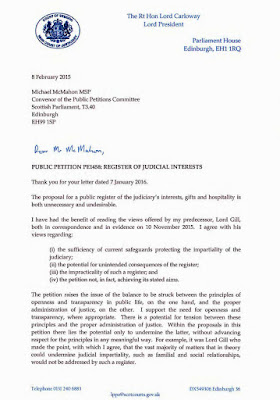 Letter from Lord Carloway to Michael McMahon MSP, Convener, Public Petitions Committee.